

Resistance to checkpoint blockade therapy through inactivation of antigen presentation
Open accessThe DOI matches its Crossref record; 44 of the 44 references it cites were found in a registry or an index.
Abstract
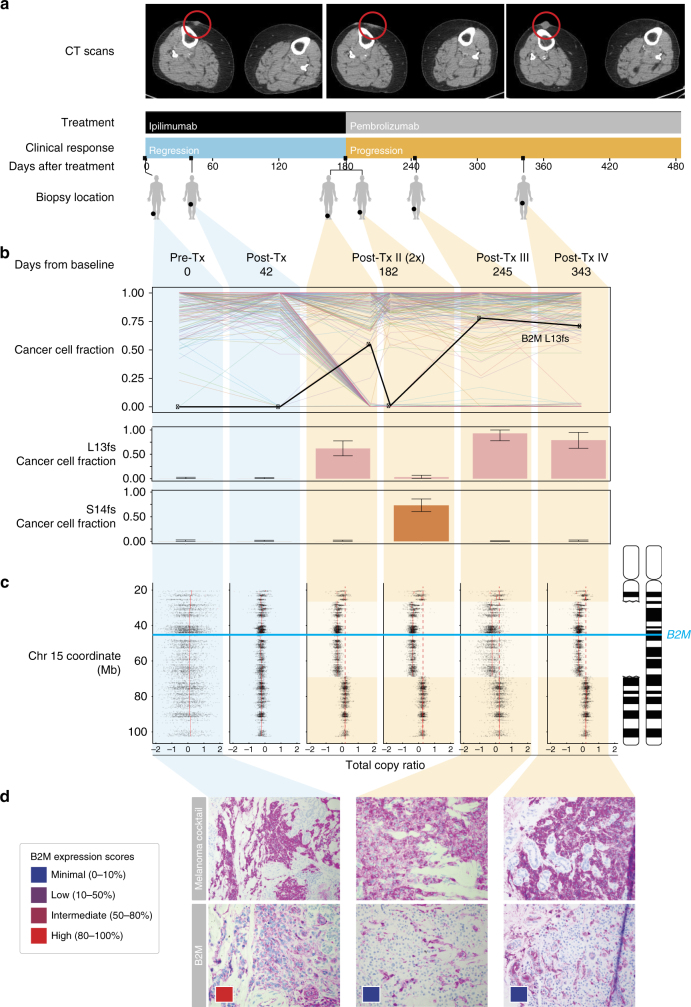
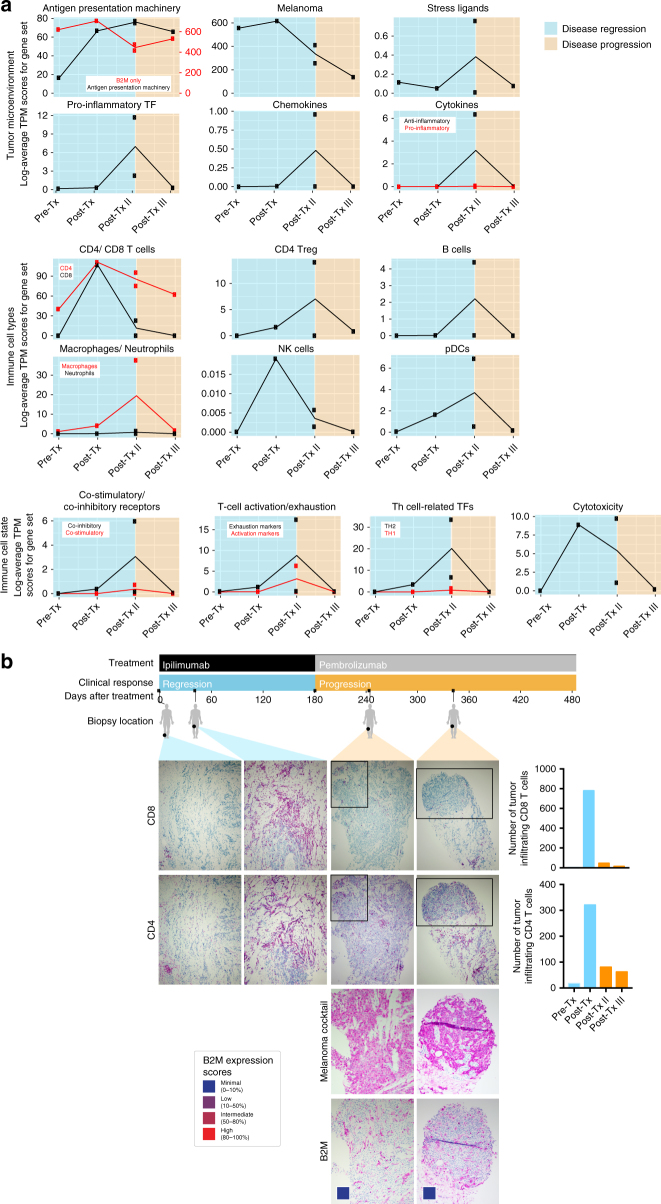
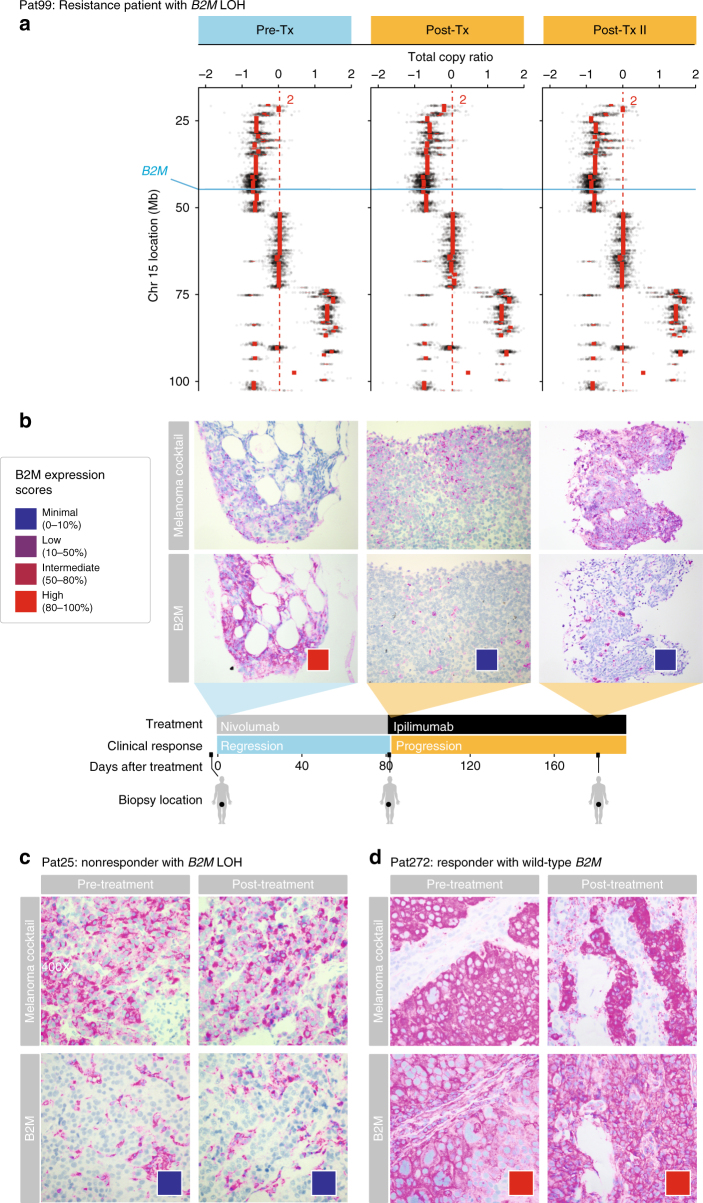
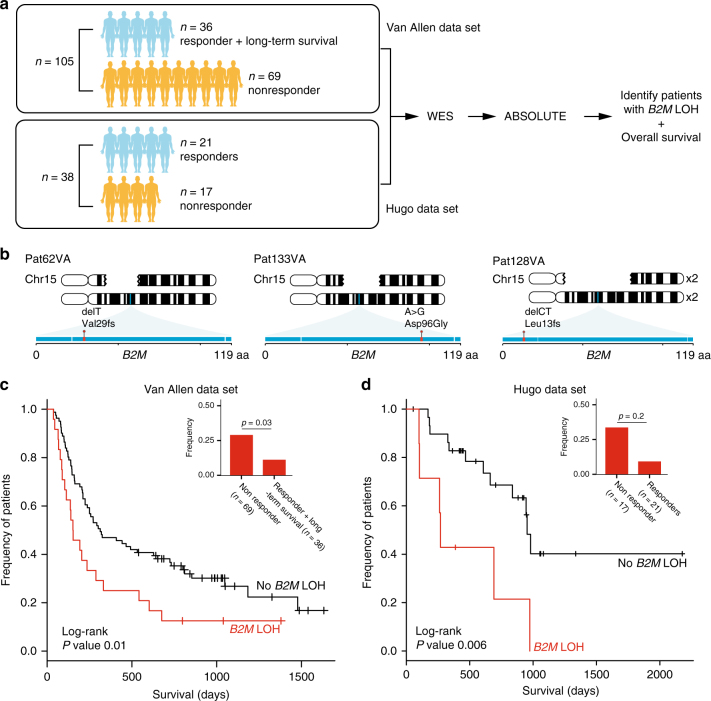
Treatment with immune checkpoint blockade (CPB) therapies often leads to prolonged responses in patients with metastatic melanoma, but the common mechanisms of primary and acquired resistance to these agents remain incompletely characterized and have yet to be validated in large cohorts. By analyzing longitudinal tumor biopsies from 17 metastatic melanoma patients treated with CPB therapies, we observed point mutations, deletions or loss of heterozygosity (LOH) in beta-2-microglobulin ( B2M ), an essential component of MHC class I antigen presentation, in 29.4% of patients with progressing disease. In two independent cohorts of melanoma patients treated with anti-CTLA4 and anti-PD1, respectively, we find that B2M LOH is enriched threefold in non-responders (~30%) compared to responders (~10%) and associated with poorer overall survival. Loss of both copies of B2M is found only in non-responders. B2M loss is likely a common mechanism of resistance to therapies targeting CTLA4 or PD1.
Overview
The claims and statistics of this paper haven’t been checked yet.
Free: it reads the open-access text and checks the first 5 claims that cite a source we can check. Create a free account to check every claim.
Integrity signals
Registry
Cites
Statistics
Figures
Verification
Claims the paper makes
The claims and statistics of this paper haven’t been checked yet.
Free: it reads the open-access text and checks the first 5 claims that cite a source we can check. Create a free account to check every claim.
Claims other papers make about this one
Each is checked against this paper’s own text: does it say what the citing paper says it does?
The source backs part of the claim, not all of it — or backs it for a different population, condition or comparison.
In the citing paper
“perturbations of B2M, HLA-A, JAK1, JAK2, STAT1, IFNGR1 and IFNGR2 (Fig. 2d,e, Extended Data Fig. 3e,f, Supplementary Table 2) conferred immune evasion, consistent with clinical mechanisms of resistance to immunotherapy7–9.”
From Multimodal pooled Perturb-CITE-seq screens in patient models define mechanisms of cancer immune evasion (2021) · cites this paper as [8]
Experimental — accuracy not yet measuredIn the citing paper
“Clinically relevant mechanisms of include mutations in beta-2-microglobulin (B2M) resulting in loss of MHC Class I presentation, downregulation of the antigen presentation machinery, and mutations in the IFNγ-JAK/STAT pathway that impair response to T cell mediated anti-tumor activity7–9.”
From Multimodal pooled Perturb-CITE-seq screens in patient models define mechanisms of cancer immune evasion (2021) · cites this paper as [8]
Self-check
Percentages, sums and reported differences re-computed from the paper’s own numbers.
The self-check needs the paper’s full text.
Citations
Cites
Fiji: an open-source platform for biological-image analysis
Schindelin, J., Arganda-Carreras, I., Frise, E., Kaynig, V., Longair, M., Pietzsch, T., Preibisch, S., Rueden, C., Saalfeld, S., Schmid, B., et al. (2012) · Nature Methods · doi:10.1038/nmeth.2019 · Cited by 66,890
STAR: ultrafast universal RNA-seq aligner
Dobin, A., Davis, C. A., Schlesinger, F., Drenkow, J., Zaleski, C., Jha, S., Batut, P., Chaisson, M., & Gingeras, T. R. (2013) · Bioinformatics · doi:10.1093/bioinformatics/bts635 · Cited by 51,709
PD-1 and PD-L1 Immune Checkpoint Blockade to Treat Breast Cancer
Hartkopf, A. D., Taran, F.-A., Wallwiener, M., Walter, C. B., Krämer, B., Grischke, E.-M., & Brucker, S. Y. (2016) · Breast Care · doi:10.1159/000453569 · Cited by 30,845
RSEM: accurate transcript quantification from RNA-Seq data with or without a reference genome
Li, B., & Dewey, C. N. (2011) · BMC Bioinformatics · doi:10.1186/1471-2105-12-323 · Cited by 22,179
Self-citationCerami, E., Gao, J., Dogrusoz, U., Gross, B. E., Sumer, S. O., Aksoy, B. A., Jacobsen, A., Byrne, C. J., Heuer, M. L., Larsson, E., et al. (2012) · Cancer Discovery · doi:10.1158/2159-8290.cd-12-0095 · Cited by 17,455
Adverse Renal Effects of Immune Checkpoint Inhibitors: A Narrative Review
Wanchoo, R., Karam, S., Uppal, N. N., Barta, V. S., Deray, G., Devoe, C., Launay-Vacher, V., Jhaveri, K. D., & on behalf of Cancer and Kidney International Network Workgroup on Immune Checkpoint Inhibitors (2017) · American Journal of Nephrology · doi:10.1159/000455014 · Cited by 15,256
Integrative Analysis of Complex Cancer Genomics and Clinical Profiles Using the cBioPortal
Gao, J., Aksoy, B. A., Dogrusoz, U., Dresdner, G., Gross, B., Sumer, S. O., Sun, Y., Jacobsen, A., Sinha, R., Larsson, E., et al. (2013) · Science Signaling · doi:10.1126/scisignal.2004088 · Cited by 15,160
The blockade of immune checkpoints in cancer immunotherapy
Pardoll, D. M. (2012) · Nature Reviews Cancer · doi:10.1038/nrc3239 · Cited by 13,838
PD-1 blockade induces responses by inhibiting adaptive immune resistance
Tumeh, P. C., Harview, C. L., Yearley, J. H., Shintaku, I. P., Taylor, E. J. M., Robert, L., Chmielowski, B., Spasic, M., Henry, G., Ciobanu, V., et al. (2014) · Nature · doi:10.1038/nature13954 · Cited by 6,609
Pembrolizumab versus Ipilimumab in Advanced Melanoma
Robert, C., Schachter, J., Long, G. V., Arance, A., Grob, J. J., Mortier, L., Daud, A., Carlino, M. S., McNeil, C., Lotem, M., et al. (2015) · New England Journal of Medicine · doi:10.1056/nejmoa1503093 · Cited by 5,887
Cited by
Items 701–800 of 998
Spatial profiling of the metabolism-immune axis in ovarian cancer
Wang, Z.-B., Long, M., Yu, P., Wang, Y., Yang, Z., & Huang, M.-S. (2026) · Frontiers in Pharmacology · doi:10.3389/fphar.2025.1672020 · Cited by 11
Chariou, P. L., Minnar, C. M., Tandon, M., Guest, M. R., Chari, R., Schlom, J., & Gameiro, S. R. (2024) · PLoS ONE · doi:10.1371/journal.pone.0287733 · Cited by 8
Wu, M. J., Liu, J., Seery, S., Meng, X., & Yue, J. (2021) · Frontiers in Immunology · doi:10.3389/fimmu.2021.646085 · Cited by 4
“However, another study found that resistance to PD-1 blockade is associated with an inactivation of antigen presentation (37).”
BackgroundVaccines as Priming Tools for T Cell Therapy for Epithelial Cancers
Kandalaft, L. E., & Harari, A. (2021) · Cancers · doi:10.3390/cancers13225819 · Cited by 7
Chung, Y. M., Tsai, W.-B., Khan, P. P., Ma, J., Berek, J. S., Larrick, J. W., & Hu, M. C. ‐. (2022) · PubMed Central · Cited by 7
Multi-omics Characterization of Response to PD-1 Inhibitors in Advanced Melanoma
Trilla‐Fuertes, L., Gámez‐Pozo, A., Prado-Vázquez, G., López‐Vacas, R., Soriano, V., Garicano, F., Lecumberri, M. J., de la Borbolla, M. R., Majem, M., Pérez-Ruiz, E., et al. (2023) · Cancers · doi:10.3390/cancers15174407 · Cited by 5
Wang, Y., Zhu, J., Zhou, N., Wang, Y., & Zhang, X. (2023) · Journal of Thoracic Disease · doi:10.21037/jtd-23-1169 · Cited by 5
“Some patients with high expression of PD-1 and PD-L1 do not respond well to ICIs (25).”
BackgroundInfluentialSingh, P., SOUZA, P. D., Scott, K. F., Hall, B. M., Verma, N. D., Becker, T. M., Toh, J. W. T., Sajinovic, M., & Spring, K. J. (2019) · Translational Medicine Communications · doi:10.1186/s41231-019-0032-9 · Cited by 6
“Mutations in beta 2 microglobulin (B2M), one of the components of Class I MHC molecules have been associated with the response to immunotherapies [13].”
BackgroundRen, K., Peng, Q., Ding, G., Yu, Y., Huang, T., Gong, L., Yu, T., & Yang, L. (2021) · Immunotherapy · doi:10.2217/imt-2020-0325 · Cited by 5
Moore, C., Bae, J., Liu, L., Li, H., Fu, Y., & Qiao, J. (2022) · JCI Insight · doi:10.1172/jci.insight.159479 · Cited by 5
Wang, X., Guo, S., Zhou, H., Sun, Y., Gan, J., Zhang, Y., Zheng, W., Zhang, C., Zhao, X., Xiao, J., et al. (2023) · Cancers · doi:10.3390/cancers15020342 · Cited by 5
Targeting tumor-draining lymph node to overcome resistance to cancer immunotherapy: an update
Lu, J., Yu, J., Xu, T., Li, Y., Chen, S., Zhou, Q., & Wang, L. (2025) · Cancer Drug Resistance · doi:10.20517/cdr.2025.126 · Cited by 6
Lee, H.-J., Cho, E., Song, K., & Kim, T. W. (2026) · Immune Network · doi:10.4110/in.2026.26.e11 · Cited by 8
“Some changes arise from fixed genetic lesions, β 2 -microglobulin loss, JAK1/2 inactivation, BAX/CASP8 mutations that permanently abolish Ag presentation and cytotoxic signaling (63-65).”
Benjamin, J. S., Jarret, A. P., Bharill, S., Fontanillas, P., Yadav, S., Sen, D., Ayupova, D. A., Kellar, D., Tilk, S., Hom, C., et al. (2025) · Cancer Research Communications · doi:10.1158/2767-9764.crc-24-0478 · Cited by 4
“However, innate and acquired resistance mechanisms to ICIs, such as the loss of major histocompatibility complex I (MHC I)–mediated antigen presentation on the surface of tumor cells, limit the effectiveness of ICIs in many patients with cancer (1, 2).”
Fragment Autoantigens Stimulated T‐Cell‐Immunotherapy (FAST) as a Fast Autologous Cancer Vaccine
Li, Y., Chen, H., Shen, Q., Liu, Y. J., Li, P., Ma, Y., Wang, Y., Li, S., Yan, X., Liu, L., et al. (2025) · Advanced Science · doi:10.1002/advs.202502937 · Cited by 7
Jie, X., Wei, J.-C., Wang, D., Zhang, X.-W., Lv, M., Lin, Y.-F., Tan, Y., Wang, Z., Alifu, A., Ji, L., et al. (2025) · Cancer Letters · doi:10.1016/j.canlet.2025.217822 · Cited by 8
Bao, L., Zhu, M., Luo, M., Kumar, A., Peng, Y., Xing, C., Wang, Y., & Luo, W. (2025) · Journal of Clinical Investigation · doi:10.1172/jci188801 · Cited by 5
Loss of PTDSS1 in tumor cells improves immunogenicity and response to anti–PD-1 therapy
Liu, J., Herbrich, S. M., Basu, S., Chen, Y., Nagarajan, A., Anandhan, S., Goswami, S., Xiong, L., Guan, B., & Sharma, P. (2025) · Science Advances · doi:10.1126/sciadv.adx8134 · Cited by 8
“…limited to the following: antigen presentation deficiency, caused by inactivating mutations in genes of the antigen presentation machinery ( 10 , 11 ); defective interferon-γ (IFN-γ ) responses, caused by mutations in STAT/JAK pathway ( 12 , 13 ); and oncogenic pathway activation which impair…”
InfluentialImmunologic specificity in glioblastoma: Antigen discovery and translational implications
Hill, C. M., Wang, A. Z., Hsueh, B., Ramirez, R., Sherpa, N. D., Costa, M. A., Williams, O., Mao, L., & Dunn, G. P. (2025) · Neuro-Oncology Advances · doi:10.1093/noajnl/vdaf028 · Cited by 10
“52 76 As loss of antigenicity is one pathway by which tumors evade the immune system, 81 a process that can occur secondary to mutations 82 or epigenetic changes, 83,84 this lack of antigen presentation is not totally surprising and emphasizes the importance of confirming tumor presentation of…”
Metal–Organic Frameworks for Precision Phototherapy of Breast Cancer
Qi, F., Ren, H., Bie, B., Wang, Q., Fan, G., Liu, Z., Fang, H., & Wang, C. (2026) · Molecules · doi:10.3390/molecules31030544 · Cited by 4
Acquired resistance of cancer therapies: Mechanisms and perspectives
Wang, M., Zhai, X., Li, J., Chen, J., Gai, X., Liu, X., Liu, Y., Zhou, Q., & Chen, C. (2026) · Chinese Medical Journal · doi:10.1097/cm9.0000000000004048 · Cited by 8
“For example, Sade-Feldman et al [70] analyzed 17 melanoma patients with ICI resistance and found that 5 patients (approximately 29”
Self-citationKholod, O., Baskett, W. I., Liu, D., Mitchem, J. B., Kaifi, J. T., Dooley, L. M., & Shyu, C. (2022) · Cancers · doi:10.3390/cancers14194759 · Cited by 4
“Our analysis revealed that HNSC EGFR WT subgroups consisted of patients with a low TMB.”
BackgroundInfluentialCrucitta, S., Cucchiara, F., Marconcini, R., Bulleri, A., Manacorda, S., Capuano, A., Cioni, D., Nuzzo, A., de Jonge, E., Mathijssen, R. H. J., et al. (2024) · Frontiers in Molecular Biosciences · doi:10.3389/fmolb.2024.1288677 · Cited by 5
Martinez, R., Finocchiaro, C., Delhaye, L., Gysens, F., Anckaert, J., Trypsteen, W., Versteven, M., Lion, E., Lint, S. V., Vermaelen, K., et al. (2024) · Frontiers in Immunology · doi:10.3389/fimmu.2024.1444886 · Cited by 5
Cytokine-driven cancer immune evasion mechanisms
Arenas, E. J. (2025) · International review of cytology · doi:10.1016/bs.ircmb.2025.01.004 · Cited by 12
A Review of Proteomics Strategies to Study T-Cell Activation and Function in Cancer Disease
Papale, M. (2021) · Methods in molecular biology · doi:10.1007/978-1-0716-1507-2_9 · Cited by 3
Slotta‐Huspenina, J., Schwamborn, K., Steiger, K., Simon, R., Kirchhoff, F. P., Büchler, J., Fiedler, J., Retz, M. M., Nawroth, R., Ritschel, C., et al. (2022) · Bladder Cancer · doi:10.3233/blc-211604 · Cited by 6
“There is increasing preclinical evidence that loss of MHC I expression conveys resistance to checkpoint blockade [23, 30] while few clinical trials have highlighted this issue so far [24, 30, 31].”
BackgroundThe great debate at “Immunotherapy Bridge 2018”, Naples, November 29th, 2018
Ascierto, P. A., Butterfield, L. H., Demaria, S., Ferris, R. L., Freeman, G. J., Lo, R. S., Mantovani, A., Nathan, P., Hamid, O., Politi, K. A., et al. (2019) · Journal for ImmunoTherapy of Cancer · doi:10.1186/s40425-019-0683-0 · Cited by 5
[Role of STAT3 in Resistance of Non-small Cell Lung Cancer].
Sun, S., Jin, S., & Guo, R. (2019) · PubMed Central · doi:10.3779/j.issn.1009-3419.2019.07.08 · Cited by 4
Chen, X., Yuan, H.-H., Guo, J., Zhang, W., Li, Q., Huang, G., Zhang, Y., Jiang, B., & Liu, F. (2020) · Cancer Letters · doi:10.1016/j.canlet.2020.08.016 · Cited by 5
Pinto-Fernández, A., Salio, M., Partridge, T., Chen, J., Vere, G., Greenwood, H., Olie, C. S., Damianou, A., Scott, H. C., Pegg, H. J., et al. (2020) · bioRxiv (Cold Spring Harbor Laboratory) · doi:10.1101/2020.03.31.005629 · Cited by 4
Self-citationGulhan, D., Viswanadham, V., Muyas, F., Jin, H., Foote, M. B., Lee, J. J.-K., Barras, D., Jung, Y. L., Ljungström, V., Rousseau, B., et al. (2024) · medRxiv · doi:10.1101/2024.01.19.24301236 · Cited by 8
Kavran, A. J., Bai, Y., Rabe, B. A., Kreshock, A., Fisher, A., Cheng, Y., Lewin, A. C., Dai, C., Meyer, M. J., Mavrakis, K. J., et al. (2025) · Frontiers in Oncology · doi:10.3389/fonc.2025.1549237 · Cited by 3
Ng, C. S. (2025) · Vaccines · doi:10.3390/vaccines13090911 · Cited by 3
“The hrHPV are 16, 18, 31, 33, 35, 39, 45, 51, 52, 56, 58, 59, 66, and 68.”
Wang, J., Gao, Q., & Chen, J. (2025) · Frontiers in Oncology · doi:10.3389/fonc.2025.1621860 · Cited by 3
Self-citationFujisawa, Y. (2025) · Cancers · doi:10.3390/cancers17193163 · Cited by 7
B cell–reactive neoantigens boost antitumor immunity
Kim, J. Y., An, J., Kim, S.-Y., Jo, H.-Y., Lee, E. J., Kim, M. J., Cha, H., Lee, S., Park, H., Kim, S. C., et al. (2025) · Science Advances · doi:10.1126/sciadv.adx8303 · Cited by 4
Targeting highly attenuated IL-18 to PD-1 for enhanced anti-tumor activity
Zhou, X., Geyer, F. K., Takimoto, J., Kolmar, H., & Rabinovich, B. A. (2025) · Frontiers in Immunology · doi:10.3389/fimmu.2025.1718321 · Cited by 4
“Resistance mechanisms include loss of MHC-I expression (46), altered interferon signaling (47), and an immunosuppressive TME involving the accumulation of MDSCs, M2 macrophages, and Tregs (48).”
He, F., Moawad, M. H. E. D., Alsaied, M. A., Abdul‐Hafez, H. A., Alhadrami, H. A., Azhari, A., & Nawas, B. A. A. (2026) · Clinical & Translational Oncology · doi:10.1007/s12094-026-04316-6 · Cited by 4
“Even when out of the context of immunotherapy, tumors that are under pressure from the immune system will evolve in a way so as to avoid being recognized and destroyed [68].”
Wei, S., Deng, Y., Lee, J., Lan, H., Yang, Z., Labrie, M., Betts, C. B., Duan, H., Tate, B. J., Pucilowska, J., et al. (2026) · Cell Reports Medicine · doi:10.1016/j.xcrm.2026.102716 · Cited by 5
Self-citationBridging clinical gaps in personalized cancer neoantigen vaccines
Khaddour, K., & Ott, P. A. (2026) · Cancer Cell · doi:10.1016/j.ccell.2026.04.002 · Cited by 6
Zefferino, R., & Conese, M. (2023) · Vaccines · doi:10.3390/vaccines11111701 · Cited by 3
Mapping the gene space at single-cell resolution with gene signal pattern analysis
Venkat, A., Leone, S., Youlten, S. E., Fagerberg, E., Attanasio, J., Joshi, N. S., Perlmutter, M., & Krishnaswamy, S. (2024) · Nature Computational Science · doi:10.1038/s43588-024-00734-0 · Cited by 8
“For patient 3, determined to have B2M deficiency associated with resistance and less cytotoxic T cell infiltration 57 , although all samples were determined to be non-responders, they embed near responders on the patient manifold and reflect changes in proportions of memory and activated CD8 + T…”
Intratumoral T reg cell ablation elicits NK cell–mediated control of CD8 T cell–resistant tumors
Zhang, C., Chien, C., Jurgaitytė, E., Sakiyama, K., Bockman, A., Jo, Y., Lee, S., Silveria, S. L., Andrews, E., Mende, A., et al. (2026) · Science Immunology · doi:10.1126/sciimmunol.adx4411 · Cited by 6
Lim, Y., Kang, S., Cho, B. K., Kim, H. J., Mun, J., Roh, M. R., Gulati, N., Yang, H. J., Moon, J. H., Won, C. H., et al. (2022) · Journal of the European Academy of Dermatology and Venereology · doi:10.1111/jdv.18443 · Cited by 3
Nachmanson, D., Pagadala, M. S., Steward, J., Cheung, C., Bruce, L. K., Lee, N. Q., O’Keefe, T. J., Lin, G., Hasteh, F., Morris, G. P., et al. (2022) · Journal of Translational Medicine · doi:10.1186/s12967-022-03810-z · Cited by 4
Wang, Q., Zhang, W., Guo, Y., Shi, F., Li, Y., Kong, Y., Lyu, J., & Wang, S. (2023) · International Immunopharmacology · doi:10.1016/j.intimp.2023.109821 · Cited by 3
CD3ζ as a novel predictive biomarker of PD-1 inhibitor resistance in melanoma
Zhang, Z., Zhang, D., Wang, F., Liu, J., Jiang, X. L., Anuchapreeda, S., Tima, S., Xiao, Z., & Duangmano, S. (2023) · Molecular and Cellular Probes · doi:10.1016/j.mcp.2023.101925 · Cited by 3
Nanotechnology Potent Photothermal and Photodynamic Immunotherapies of Cancer
Jalil, A. T., AL-fatlawi, N. G., Al-Ameer, L. R., Rasol, M. A., Al-Tamimi, J. H. Z., Merza, M. S., Ali, R. T., Zabibah, R. S., & Alhili, F. (2023) · Journal of Medical and Biological Engineering · doi:10.1007/s40846-023-00836-6 · Cited by 3
“The clinical optimization of these techniques has also been challenged by adverse immunological effects, such as the impact on the inflammatory mediator’s cascade, toxicity in the target organ, hematological system malfunction, and inducing drug resistance [12–15].”
Gervais, C., Auclin, É., Saltel-Fulero, A., Clair, G., Oudard, S. M., & Mirghani, H. (2024) · European Annals of Otorhinolaryngology Head and Neck Diseases · doi:10.1016/j.anorl.2024.02.003 · Cited by 3
Lee, S., Pankaj, A., Yilmaz, Ö. H., Deshpande, V., & Yilmaz, O. H. (2025) · Human Pathology · doi:10.1016/j.humpath.2025.105737 · Cited by 3
Unveiling Novel Targets in Lung Tumors for Enhanced Radiotherapy Efficacy: A Comprehensive Review
Muhammad, F. A., Adhab, A. H., Mahdi, M. S., Jain, V. D., Ganesan, S., Bhanot, D., Naidu, K. S., Kaur, S., Mansoor, A. S., Radi, U. K., et al. (2025) · Journal of Biochemical and Molecular Toxicology · doi:10.1002/jbt.70180 · Cited by 3
“Enhancement of antigen presentation and the release of inflammatory cytokines can augment the infiltration of CTLs, thereby improving responses to ICIs [151].”
Biomarkers Predicting for Response and Relapse with Melanoma Systemic Therapy
Welsh, S. J., & Corrie, P. G. (2020) · Acta Dermato Venereologica · doi:10.2340/00015555-3497 · Cited by 3
“β2microglobulin (β2M) is an essential component of MHC class I antigen presentation in which point mutations, deletions or loss of heterozygosity (LOH) have been identified in 30% of melanoma patients with progressing disease (24).”
BackgroundAcquired resistance in NSCLC: the journey from clinical definition to molecular understanding
Wauters, E., & Vansteenkiste, J. (2021) · Annals of Oncology · doi:10.1016/j.annonc.2021.09.018 · Cited by 3
A Novel MHC-Independent Mechanism of Tumor Cell Killing by CD8 + T CellsPreprint
Lerner, E., Woroniecka, K. I., D’Anniballe, V. M., Wilkinson, D. S., Lorrey, S., Polania, J. W., Wachsmuth, L. P., Hoyt-Miggelbrink, A. M., Raj, J., Mohan, A. A., et al. (2023) · bioRxiv (Cold Spring Harbor Laboratory) · doi:10.1101/2023.02.02.526713 · Cited by 3
Clinical and Immunological Significance of ANKRD52 in Pan-Cancer
Yin, H., Zhang, M., & Wu, H. (2024) · Biochemical Genetics · doi:10.1007/s10528-023-10645-w · Cited by 2
“However, many patients receiving PD-1/PD-L1 ICB therapy fail to respond or develop resistance, often due to poor antigen presentation and signaling (Zaretsky et al. 2016; Sade-Feldman et al. 2017; Sharma et al. 2017; Sucker et al. 2017).”
Hegyi, B., Csikó, K. G., Balatoni, T., Fröhlich, G., Bőcs, K., Tóth, E., Mohos, A., Neumark, A. R., Menyhárt, C. D., Ferrone, S., et al. (2024) · Biomolecules · doi:10.3390/biom14121609 · Cited by 2
Genomics guiding personalized first-line immunotherapy response in lung and bladder tumors
Iglesias, J. B., Gallardo‐Gómez, M., Oitabén, A., Lázaro-Quintela, M., León‐Mateos, L., Alves, J. M., Pino-González, M., Juaneda‐Magdalena, L., García-Benito, C., Abdulkader, I., et al. (2025) · Journal of Translational Medicine · doi:10.1186/s12967-025-06323-7 · Cited by 3
Mechanisms of resistance to adoptive cell therapy with tumor-infiltrating lymphocytes
König, D., & Laubli, H. P. (2025) · Expert Review of Clinical Immunology · doi:10.1080/1744666x.2025.2588776 · Cited by 3
“In one work, mutations in the anti-gen-presentation machinery have been observed including in the beta2-microgloblulin [41].”
Mechanisms and therapeutic strategies for immunotherapy resistance in gastric cancer
Zhang, Z., Wu, C., Hu, X., Zhang, L., & Dong, X. (2025) · Cancer Cell International · doi:10.1186/s12935-025-04110-4 · Cited by 4
Khalil, M. I., Wang, J., Vu, L., Yang, C., Yin, C., Chadha, S., Nabors, H., Vocelle, D. B., May, D. G., Chrisopulos, R. J., et al. (2026) · Proceedings of the National Academy of Sciences · doi:10.1073/pnas.2525730123 · Cited by 6
Zhou, Y., Yu, J., Sui, Q., Liao, L., Lv, R.-X., Liu, Y., He, S., Li, Y.-Q., Xu, Z.-H., Jia, Z., et al. (2026) · Cancer Letters · doi:10.1016/j.canlet.2026.218683 · Cited by 3
Heterogeneity in functional genetic screens: friend or foe?
Vredevoogd, D. W., & Peeper, D. S. (2023) · Frontiers in Immunology · doi:10.3389/fimmu.2023.1162706 · Cited by 3
Quantifying the impact of immunotherapy on RNA dynamics in cancer
Usaite, I., Biswas, D., Dijkstra, K. K., Watkins, T. B. K., Pich, O., Puttick, C., Angelova, M., Thakkar, K., Hiley, C. T., Birkbak, N. J., et al. (2023) · Journal for ImmunoTherapy of Cancer · doi:10.1136/jitc-2023-007870 · Cited by 2
“21 In addition, other studies have demonstrated mechanisms of CPI treatment failure, such as defective antigen presentation, 22 23 impaired IFN γ signaling, 22 or neoantigen loss.”
BackgroundSokhangouy, S. K., Jamialahmadi, H., Sani, M. S. M., Khalili‐Tanha, G., Rouzbahani, A. K., Mahmoudvand, G., Goudarzi, Z., Fakouri, A., Farokhi, S., Hassanian, S. M., et al. (2024) · Current Cancer Drug Targets · doi:10.2174/0115680096319027240820055043 · Cited by 2
Immune checkpoints and ncRNAs: pioneering immunotherapy approaches for hematological malignancies
Anvari, S., Nikbakht, M., Vaezi, M., Amini‐Kafiabad, S., & Ahmadvand, M. (2024) · Cancer Cell International · doi:10.1186/s12935-024-03596-8 · Cited by 3
In Situ Detection of Individual Classic MHC-I Gene Products in Cancer
Ericsson, P. I. G., Opalenik, S. R., Sanchez, V. M., Palubinsky, A. M., Hanna, A., Sun, X., Ocampo, A. A., Garcia, G., Maldonado, L., Morante, Z., et al. (2025) · Cancer Immunology Research · doi:10.1158/2326-6066.cir-24-1003 · Cited by 2
Yang, L., Feng, Y., Liu, X., Zhang, Q., Liu, Y., Zhang, X. Y., Li, P., & Chen, D. (2025) · Investigational New Drugs · doi:10.1007/s10637-024-01495-3 · Cited by 2
“Studies involving molecular pathways related to the tumour microenvironment (TME) have expanded our understanding of the mechanism of the ICI response or resistance [15–18].”
Sanchez, A. D. L., Fuentes, J. D. B., Luengo‐Gil, G., García, T., Moreno, E. F., Conesa‐Zamora, P., Yago, J. B., Mohamed, K. M., & Rodríguez, A. B. A. (2025) · Journal of Clinical Medicine · doi:10.3390/jcm14041333 · Cited by 2
“In addition, variants in the TNFA gene (-308 G/A) and IL6 have been identified in various cancers, such as melanoma and other solid tumors, that increase the production of pro-inflammatory cytokines, which may predict the increased severity of CRS [20–25].”
Agostini, M., Traldi, P., & Hamdan, M. H. (2025) · Cancers · doi:10.3390/cancers17061001 · Cited by 3
Emerging new immune checkpoint inhibitors in solid tumor immunotherapy
Poorkhani, A., Tajaldini, M., Ahmadi, F., Tahmasebifar, A., Azadehrah, M., Azadehrah, M., Ghamoushiramandi, A., Amiri, R. S., & Khori, V. (2025) · Naunyn-Schmiedeberg s Archives of Pharmacology · doi:10.1007/s00210-025-04131-w · Cited by 6
“For example, tumors with defects in the interferon-gamma (IFN-γ) signaling pathway (i.e., JAK1/2 mutations) or loss of beta-2-microglobulin (B2M) expression are resistant to PD-1/PD-L1 blockade (Zaretsky et al. 2016a; Shin et al. 2017; Gao et al. 2016; Sade-Feldman et al. 2017).”
Lorenzo, S. D., Farese, S., Balbo, C., Melisi, F., Scrima, M., Pasquale, L. S., Laudato, M., Peluso, T., Solari, D., Ronchi, A., et al. (2025) · International Journal of Molecular Sciences · doi:10.3390/ijms26146868 · Cited by 2
“This effect is likely associated with increased immunological escape, as demonstrated recently in a melanoma patient treated with immunological checkpoint inhibitors [29].”
Cancer Resistance to Immunotherapy
Khoury, R., Shayya, A., Orm, C. B., Deen, O. Z., & Ghanem, H. (2025) · Immuno · doi:10.3390/immuno5030032 · Cited by 3
Tian, T., Ma, L., Mao, L., Wang, X., Cheng, L., Ma, Q., Xu, R., & Zhou, G. (2025) · Frontiers in Immunology · doi:10.3389/fimmu.2025.1617941 · Cited by 2
“Tumor cells can downregulate major histocompatibility complex class I (MHC-I) molecules, tumor-associated antigens (TAAs), and components of the antigen processing and presentation machinery, enabling them to escape T cell-mediated recognition and cytotoxicity (32, 33).”
Ma, L., Wang, X., Zhang, Q., Gao, Z., Ji, X., Li, Z., Li, Y., Zhang, P., Che, X., Sun, Y., et al. (2025) · Cancer Letters · doi:10.1016/j.canlet.2025.218036 · Cited by 3
Osborne-Frazier, M. L., LaBuda, S. E., Parrish, M., Atkins, H., Broaddus, R. R., & Gladden, A. B. (2025) · Modern Pathology · doi:10.1016/j.modpat.2025.100899 · Cited by 2
Biomarkers for immune therapy in melanoma
Johnson, D. B., Chon, J., Johnson, M. R., & Balko, J. M. (2018) · Seminars in Cutaneous Medicine and Surgery · doi:10.12788/j.sder.2018.019 · Cited by 2
Functional Genome Profiling to Understand Cancer Immune Responsiveness
Wang, E., Bedognetti, D., & Marincola, F. M. (2019) · Methods in molecular biology · doi:10.1007/978-1-4939-9773-2_11 · Cited by 2
Melanoma: An immunotherapy journey from bench to bedside
Navani, V., Graves, M. C., Mandaliya, H. A., Hong, M., van der Westhuizen, A., Martin, J. H., & Bowden, N. A. (2022) · Cancer treatment and research · doi:10.1007/978-3-030-96376-7_2 · Cited by 2
Mechanisms of Resistance and Strategies to Combat Resistance in PD-(L)1 Blockade
Moise, J., Murthy, J. J., Dabir, D., Yu, S., Kisto, F., Herron, E., & Aulakh, S. (2022) · Immuno · doi:10.3390/immuno2040041 · Cited by 2
Targeted acidosis mediated delivery of antigenic MHC-binding peptides
Kelly, J. J., Ankrom, E. T., Newkirk, S. E., Thévenin, D., & Pires, M. M. (2024) · Frontiers in Immunology · doi:10.3389/fimmu.2024.1337973 · Cited by 2
“Indeed, non-responders to immune checkpoint inhibition often possess cancer mutations that decrease the presentation of peptides on the cell surface via MHC (58).”
Abrogation of IFN-γ Signaling May not Worsen Sensitivity to PD-1/PD-L1 Blockade
Vackova, J., Piatakova, A., Poláková, I., & Šmahel, M. (2020) · International Journal of Molecular Sciences · doi:10.3390/ijms21051806 · Cited by 2
Immunogenomic profile of colorectal cancer response to immune checkpoint blockadePreprint
Bortolomeazzi, M., Keddar, M., Montorsi, L., Acha-Sagredo, A., Benedetti, L., Temelkovski, D., Choi, S., Petrov, N., Todd, K., Wai, P., et al. (2020) · bioRxiv · doi:10.1101/2020.12.15.422831 · Cited by 1
“resistance to immune checkpoint inhibitors (10).”
Hua, Y.-C., Vella, G., Rambow, F., Allen, E., Martinez, A. A., Duhamel, M., Junius, S., Smeets, A., Nittner, D., Laoui, D., et al. (2021) · bioRxiv · doi:10.1101/2021.12.24.474088 · Cited by 3
Bosisio, F. M., Antoranz, A., Herck, Y. V., Bolognesi, M. M., Lynch, S. M., Rahman, A., Gallagher, W. M., Boecxstaens, V., Marine, J., Cattoretti, G., et al. (2022) · Research Square · doi:10.21203/rs.3.rs-1236531/v1 · Cited by 2
Genetic and immune landscape evolution defines subtypes of MMR deficient colorectal cancerPreprint
Challoner, B. R., Woolston, A., Lau, D. K., Buzzetti, M., Fong, C., Barber, L. J., Anandappa, G., Crux, R., Assiotis, I., Fenwick, K., et al. (2022) · bioRxiv (Cold Spring Harbor Laboratory) · doi:10.1101/2022.02.16.479224 · Cited by 2
Phenotype-guided subpopulation identification from single-cell sequencing dataPreprint
Sun, D., Guan, X., Moran, A. E., Qian, D. Z., Schedin, P. S., Dai, M., Danilov, A., Alumkal, J., Adey, A., Spellman, P. T., et al. (2020) · Research Square · doi:10.1101/2020.06.05.137240 · Cited by 2
Lee, C., DiNatale, R. G., Chowell, D., Krishna, C., Makarov, V., Valero, C., Vuong, L. H., Lee, M., Weiss, K. L., Hoen, D., et al. (2023) · doi:10.1158/1541-7786.c.6545243 · Cited by 2
Khalil, M. I., Wang, J., Yang, C., Vu, L., Yin, C., Chadha, S., Nabors, H., Vocelle, D. B., May, D. G., Chrisopolus, R. J., et al. (2024) · bioRxiv (Cold Spring Harbor Laboratory) · doi:10.1101/2024.11.29.626106 · Cited by 2
Fan, J. L., Zhang, M., O'Brien, W., Myers, J. D., Chatterjee, S., Hoffer-Hawlik, K., Beltran-Velez, N., Preau, A., Arora, I., Melms, J. C., et al. (2026) · Nature Methods · doi:10.1101/2024.12.15.628568 · Cited by 3
Ning, B., Chiu, D. J., Pfefferkorn, R., Kefella, Y., Kane, E., Reyes-Ortíz, V. E., Liu, G., Zhang, S., Liu, H., Sultan, L., et al. (2025) · bioRxiv (Cold Spring Harbor Laboratory) · doi:10.1101/2025.02.03.636307 · Cited by 2
Tumor Microenvironment: Immune Effector and Suppressor Imbalance
Sheehan, K., & Schalper, K. A. (2021) · Current cancer research · doi:10.1007/978-3-030-74028-3_1 · Cited by 1
Resistance to immune checkpoint inhibitors in the treatment of metastatic renal cancer
Измайлов, А. А., Радимович, Р. Р., Sultanbayev, A. V., Меньшиков, К. В., Gilyazova, I. R., Zabelin, V. M., & Izmailov, A. A. (2023) · Siberian Journal of Oncology · doi:10.21294/1814-4861-2023-22-4-109-117 · Cited by 2
Blocking Co-inhibitory Receptors: A Promising Cancer Immunotherapy strategy
Acharya, N. (2024) · Interdisciplinary biotechnological advances · doi:10.1007/978-981-97-5508-0_2 · Cited by 1
Ferraro, D. A., Bisig, B., Rotzinger, D. C., Pareja, F. G., Missiaglia, E., Voutsadakis, I. A., Homicskó, K., & Digklia, A. (2025) · Frontiers in Oncology · doi:10.3389/fonc.2025.1485386 · Cited by 2
“One of the mutations present in our patient ’ s tumor was a loss-of-function mutation in FAT1 , which encodes a tumor suppressor proto cadherin involved in regulating several key pathways in cancer (40 – 42), including in sarcomas (43, 44).”
Zhou, H., Wu, W., Zhang, Q., Zhang, T., Jiang, S., Liu, H., Ma, Y., Chang, L., Xie, Y., Zhu, J., et al. (2025) · Journal of Proteome Research · doi:10.1021/acs.jproteome.5c00143 · Cited by 1
Mondal, A., Jamal, F., Das, A., Sahoo, A. K., Chaudhary, K., Chowdhury, S., Jha, A., & Singha, S. (2025) · European Journal of Immunology · doi:10.1002/eji.202451676 · Cited by 1
Sahoo, A. K., Mondal, A., Jamal, F., Das, A., Chaudhary, K., Jha, A., Bansal, T. S., Mandal, P., Dhara, A. K., Yang, Y., et al. (2025) · Nano Letters · doi:10.1021/acs.nanolett.5c02012 · Cited by 3
Wang, X., Zhang, H., & Wang, J. (2025) · Frontiers in Molecular Biosciences · doi:10.3389/fmolb.2025.1654064 · Cited by 1
Kang, Y., Amoafo, E. B., Entsie, P., Layek, B., Grandgenett, P. M., Hollingsworth, M. A., di Magliano, M. P., & Liverani, E. (2025) · Biomedicine & Pharmacotherapy · doi:10.1016/j.biopha.2025.118695 · Cited by 3
“To evade immune identification, cancer cells also upregulate the expression of immunological checkpoints on immunosuppressive cells or decrease the expression of neoantigens and antigen presentation molecules, such as MHC-I MHC-I [ 4].”
Metadata
- Authors
- Sade-Feldman, M., Jiao, Y. J., Chen, J. H., Rooney, M. S., Barzily-Rokni, M., Eliane, J.-P., Bjorgaard, S. L., Hammond, M. R., Vitzthum, H., Blackmon, S. M., Frederick, D. T., Hazar-Rethinam, M., Nadres, B. A., Van Seventer, E. E., Shukla, S. A., Yizhak, K., Ray, J. P., Rosebrock, D., Livitz, D., Adalsteinsson, V., Getz, G., Duncan, L. M., Li, B., Corcoran, R. B., Lawrence, D. P., Stemmer-Rachamimov, A., Boland, G. M., Landau, D. A., Flaherty, K. T., Sullivan, R. J., & Hacohen, N.
- Affiliations
- Broad Institute (US)
- Massachusetts General Hospital (US)
- Dana-Farber Cancer Institute (US)
- Corresponding author
- Sullivan, Ryan J.
- Hacohen, Nir
- ORCID
- Sade-Feldman, Moshe
- Jiao, Yunxin J.
- Chen, Jonathan H.
- Barzily-Rokni, Michal
- Frederick, Dennie T.
- Hazar-Rethinam, Mehlika
- Nadres, Brandon A.
- Shukla, Sachet A.
- Yizhak, Keren
- Rosebrock, Daniel
- Livitz, Dimitri
- Adalsteinsson, Viktor
- Getz, Gad
- Duncan, Lyn M.
- Li, Bo
- Corcoran, Ryan B.
- Lawrence, Donald P.
- Stemmer-Rachamimov, Anat
- Boland, Genevieve M.
- Landau, Dan A.
- Flaherty, Keith T.
- Sullivan, Ryan J.
- Hacohen, Nir
- Venue
- Nature Communications
- Published
- 2017-10-26
- Volume
- 8
- Issue
- 1
- Pages
- 1136-1136
- ISSN
- 2041-1723 (ISSN-L)
- PMC
- PMC5656607
- OpenAlex
- W2765417948
- Cited by
- 1,005
- References
- 44
- Citations by year
- 2026: 90 · 2025: 116 · 2024: 110 · 2023: 129 · 2022: 145 · 2021: 152 · 2020: 125 · 2019: 78 · 2018: 53 · 2017: 4
- FWCI
- 31.34
- Type
- journal article
- Language
- en
- Open access
- gold
- doi.org
- Licence
- cc-by
- creativecommons.org/licenses/by/4.0 (tdm)
- creativecommons.org/licenses/by/4.0 (vor)
- Locations
- Nature Communications (publishedVersion, cc-by)
- Europe PMC (PubMed Central) (publishedVersion, cc-by)
- PubMed Central (publishedVersion, cc-by)
- PubMed (publishedVersion)
- Digital Access to Scholarship at Harvard (DASH) (Harvard University) (submittedVersion, cc-by)
- RePEc: Research Papers in Economics (submittedVersion)
- DOAJ (DOAJ: Directory of Open Access Journals) (submittedVersion, cc-by-sa)
- DOAJ (DOAJ: Directory of Open Access Journals) (submittedVersion)
- Funders
- National Science Foundation
- Cancer Research Institute
- Melanoma Research Alliance
- Dr. Miriam and Sheldon G. Adelson Medical Research Foundation
- Wellcome Trust
- Broad Institute
- National Institutes of Health
- Stand Up To Cancer
- National Human Genome Research Institute (U54HG003067)
- National Cancer Institute (R01CA208756, T32CA207021, R50CA211482)
- National Institute of Environmental Health Sciences (K01ES025431)
- Topics
- Health Sciences › Medicine › Oncology › Cancer Immunotherapy and Biomarkers
- Life Sciences › Immunology and Microbiology › Immunology › Immunotherapy and Immune Responses
- Health Sciences › Medicine › Oncology › Cutaneous Melanoma Detection and Management
- Keywords
- immune checkpoint blockade, metastatic melanoma, beta2-microglobulin, loss of heterozygosity, MHC class I antigen presentation, anti-CTLA-4, anti-PD-1, treatment resistance, tumor immune evasion, overall survival
- MeSH terms
- Animals, Antibodies, Monoclonal, beta 2-Microglobulin, Female, Humans, Melanoma, Mice, Inbred C57BL, Neoplasm Metastasis, Neoplasms, Experimental, Point Mutation, Antigen Presentation, Mice, Knockout, Drug Resistance, Neoplasm, Loss of Heterozygosity, CTLA-4 Antigen, Programmed Cell Death 1 Receptor
About these checks
Registry, retraction, Cites and statistics results are computed, not judged, with one exception: a printed reference that no index lists is read once by a model before it counts as a citation error. Claims are extracted by a model and kept only when their quote appears verbatim in the text; each cited source is then checked, with a model’s help, for whether it says what the claim relies on. Those verdicts can be wrong — read the claim’s quote and the cited source before relying on one.
Statistics and arithmetic are recomputed, not judged.
Confidence bands are shown only for fields calibrated on our annotated test set. None is calibrated yet, so no band is shown.
What counts as a claim ›How we measure confidence ›How we check this ›
Are you an author, or do you see a problem with this page? Request a review
Data sources
Bibliographic data: Semantic Scholar, OpenAlex, Crossref.
Contains information from the Semantic Scholar Academic Graph Datasets, made available under the ODC Attribution License (ODC-BY 1.0).
Semantic Scholar’s data is described in: Kinney, R., et al. (2023). The Semantic Scholar Open Data Platform. arXiv:2301.10140.
