

Resistance to checkpoint blockade therapy through inactivation of antigen presentation
Open accessThe DOI matches its Crossref record; 44 of the 44 references it cites were found in a registry or an index.
Abstract
Treatment with immune checkpoint blockade (CPB) therapies often leads to prolonged responses in patients with metastatic melanoma, but the common mechanisms of primary and acquired resistance to these agents remain incompletely characterized and have yet to be validated in large cohorts. By analyzing longitudinal tumor biopsies from 17 metastatic melanoma patients treated with CPB therapies, we observed point mutations, deletions or loss of heterozygosity (LOH) in beta-2-microglobulin ( B2M ), an essential component of MHC class I antigen presentation, in 29.4% of patients with progressing disease. In two independent cohorts of melanoma patients treated with anti-CTLA4 and anti-PD1, respectively, we find that B2M LOH is enriched threefold in non-responders (~30%) compared to responders (~10%) and associated with poorer overall survival. Loss of both copies of B2M is found only in non-responders. B2M loss is likely a common mechanism of resistance to therapies targeting CTLA4 or PD1.
Overview
The claims and statistics of this paper haven’t been checked yet.
Free: it reads the open-access text and checks the first 5 claims that cite a source we can check. Create a free account to check every claim.
Integrity signals
Registry
Cites
Statistics
Figures
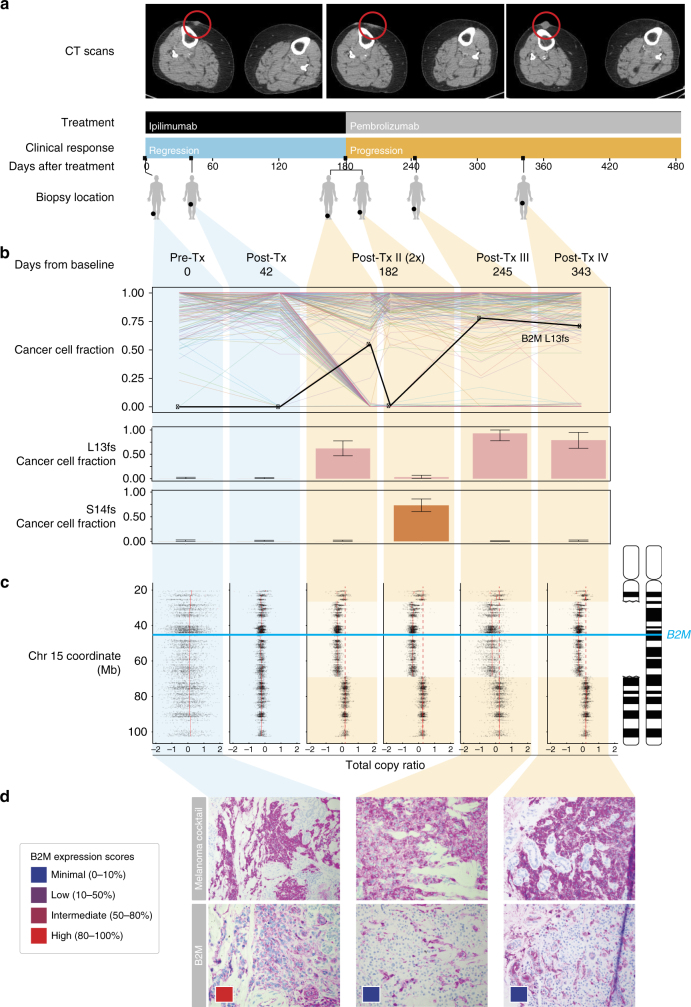
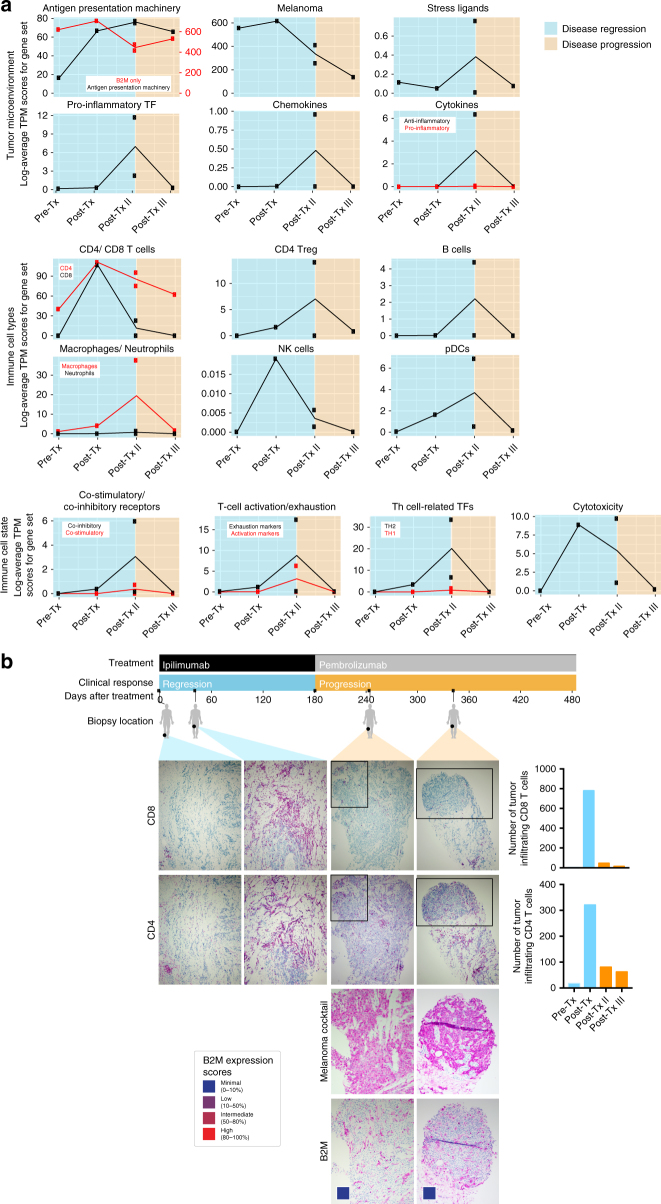
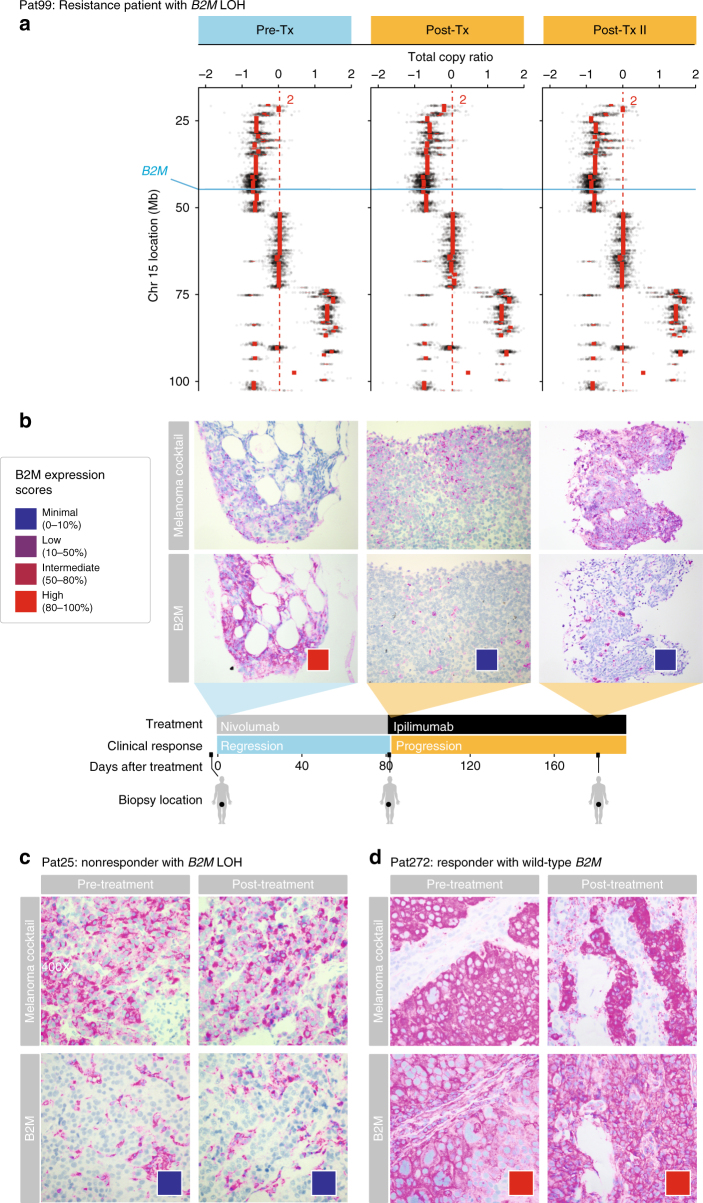
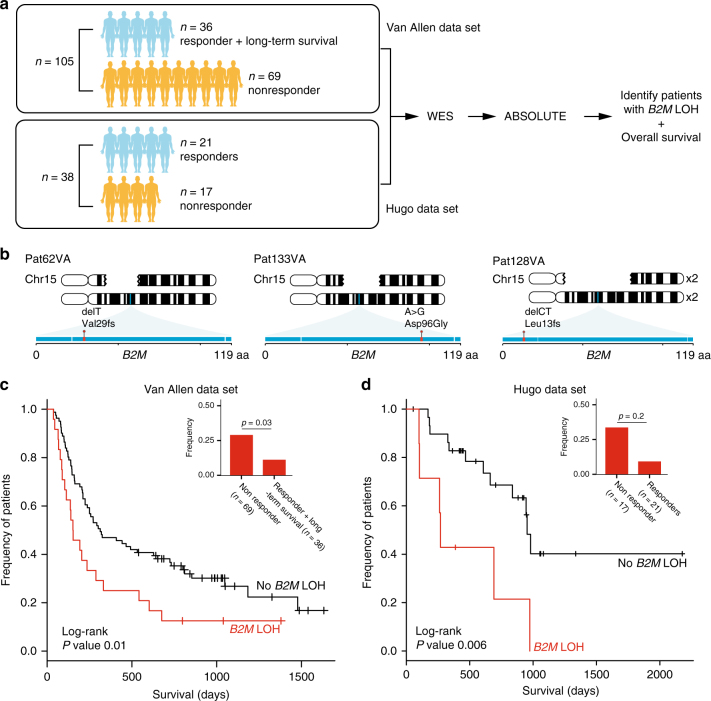
Verification
Claims the paper makes
The claims and statistics of this paper haven’t been checked yet.
Free: it reads the open-access text and checks the first 5 claims that cite a source we can check. Create a free account to check every claim.
Claims other papers make about this one
Each is checked against this paper’s own text: does it say what the citing paper says it does?
The source backs part of the claim, not all of it — or backs it for a different population, condition or comparison.
In the citing paper
“perturbations of B2M, HLA-A, JAK1, JAK2, STAT1, IFNGR1 and IFNGR2 (Fig. 2d,e, Extended Data Fig. 3e,f, Supplementary Table 2) conferred immune evasion, consistent with clinical mechanisms of resistance to immunotherapy7–9.”
From Multimodal pooled Perturb-CITE-seq screens in patient models define mechanisms of cancer immune evasion (2021) · cites this paper as [8]
Experimental — accuracy not yet measuredIn the citing paper
“Clinically relevant mechanisms of include mutations in beta-2-microglobulin (B2M) resulting in loss of MHC Class I presentation, downregulation of the antigen presentation machinery, and mutations in the IFNγ-JAK/STAT pathway that impair response to T cell mediated anti-tumor activity7–9.”
From Multimodal pooled Perturb-CITE-seq screens in patient models define mechanisms of cancer immune evasion (2021) · cites this paper as [8]
Self-check
Percentages, sums and reported differences re-computed from the paper’s own numbers.
The self-check needs the paper’s full text.
Citations
Cites
Fiji: an open-source platform for biological-image analysis
Schindelin, J., Arganda-Carreras, I., Frise, E., Kaynig, V., Longair, M., Pietzsch, T., Preibisch, S., Rueden, C., Saalfeld, S., Schmid, B., et al. (2012) · Nature Methods · doi:10.1038/nmeth.2019 · Cited by 66,890
STAR: ultrafast universal RNA-seq aligner
Dobin, A., Davis, C. A., Schlesinger, F., Drenkow, J., Zaleski, C., Jha, S., Batut, P., Chaisson, M., & Gingeras, T. R. (2013) · Bioinformatics · doi:10.1093/bioinformatics/bts635 · Cited by 51,709
PD-1 and PD-L1 Immune Checkpoint Blockade to Treat Breast Cancer
Hartkopf, A. D., Taran, F.-A., Wallwiener, M., Walter, C. B., Krämer, B., Grischke, E.-M., & Brucker, S. Y. (2016) · Breast Care · doi:10.1159/000453569 · Cited by 30,845
RSEM: accurate transcript quantification from RNA-Seq data with or without a reference genome
Li, B., & Dewey, C. N. (2011) · BMC Bioinformatics · doi:10.1186/1471-2105-12-323 · Cited by 22,179
Self-citationCerami, E., Gao, J., Dogrusoz, U., Gross, B. E., Sumer, S. O., Aksoy, B. A., Jacobsen, A., Byrne, C. J., Heuer, M. L., Larsson, E., et al. (2012) · Cancer Discovery · doi:10.1158/2159-8290.cd-12-0095 · Cited by 17,455
Adverse Renal Effects of Immune Checkpoint Inhibitors: A Narrative Review
Wanchoo, R., Karam, S., Uppal, N. N., Barta, V. S., Deray, G., Devoe, C., Launay-Vacher, V., Jhaveri, K. D., & on behalf of Cancer and Kidney International Network Workgroup on Immune Checkpoint Inhibitors (2017) · American Journal of Nephrology · doi:10.1159/000455014 · Cited by 15,256
Integrative Analysis of Complex Cancer Genomics and Clinical Profiles Using the cBioPortal
Gao, J., Aksoy, B. A., Dogrusoz, U., Dresdner, G., Gross, B., Sumer, S. O., Sun, Y., Jacobsen, A., Sinha, R., Larsson, E., et al. (2013) · Science Signaling · doi:10.1126/scisignal.2004088 · Cited by 15,160
The blockade of immune checkpoints in cancer immunotherapy
Pardoll, D. M. (2012) · Nature Reviews Cancer · doi:10.1038/nrc3239 · Cited by 13,838
PD-1 blockade induces responses by inhibiting adaptive immune resistance
Tumeh, P. C., Harview, C. L., Yearley, J. H., Shintaku, I. P., Taylor, E. J. M., Robert, L., Chmielowski, B., Spasic, M., Henry, G., Ciobanu, V., et al. (2014) · Nature · doi:10.1038/nature13954 · Cited by 6,609
Pembrolizumab versus Ipilimumab in Advanced Melanoma
Robert, C., Schachter, J., Long, G. V., Arance, A., Grob, J. J., Mortier, L., Daud, A., Carlino, M. S., McNeil, C., Lotem, M., et al. (2015) · New England Journal of Medicine · doi:10.1056/nejmoa1503093 · Cited by 5,887
Cited by
Items 301–400 of 998
Siglecs as Therapeutic Targets in Cancer
Lim, J., Sari-Ak, D., & Bagga, T. (2021) · Biology · doi:10.3390/biology10111178 · Cited by 50
Update in TIGIT Immune-Checkpoint Role in Cancer
Annese, T., Tamma, R., & Ribatti, D. (2022) · Frontiers in Oncology · doi:10.3389/fonc.2022.871085 · Cited by 55
Ning, H., HUANG, S. H., Yang, L., Zhi, R., Yan, H., Jin, J., Hu, Z., Guo, K., Liu, J., Yang, J., et al. (2022) · Nature Communications · doi:10.1038/s41467-022-34253-1 · Cited by 58
Das, A., Fernandez, N. R., Levine, A., Bianchi, V., Stengs, L. K., Chung, J., Negm, L., Dimayacyac, J. R., Chang, Y., Nobre, L. F., et al. (2023) · Cancer Discovery · doi:10.1158/2159-8290.cd-23-0559 · Cited by 55
Self-citationKong, S., Zhang, J., Wang, L., Li, W., Guo, H., Weng, Q., He, Q., Lou, H., Ding, L., & Yang, B. (2024) · Cancer Letters · doi:10.1016/j.canlet.2024.217432 · Cited by 71
HLA Class-I Expression and Cancer Immunotherapy
Garrido, F. (2019) · Advances in experimental medicine and biology · doi:10.1007/978-3-030-17864-2_3 · Cited by 58
The Resistance Mechanisms of Checkpoint Inhibitors in Solid Tumors
Koustas, E., Sarantis, P., Papavassiliou, A. G., & Karamouzis, M. V. (2020) · Biomolecules · doi:10.3390/biom10050666 · Cited by 57
“Moreover, a mutation in B2M gene may alter the antigen presentation on MHC I and enrich three-fold in non-responders (30%) compared to responders (10%) along with more reduced OS in independent cohorts of patients with melanoma treated with anti-CTLA4 and anti-PD1 MoAbs respectively [94].”
BackgroundIntratumor Heterogeneity and Antitumor Immunity Shape One Another Bidirectionally
Wolf, Y., & Samuels, Y. (2022) · Clinical Cancer Research · doi:10.1158/1078-0432.ccr-21-1355 · Cited by 53
“…tumors could include dominant clones with strong immune-escape mechanisms, such as genomic and epigenomic neoantigen silencing (30), loss of HLA genes (31), or impaired IFN g -sensing pathways (32), and the abundance of such resistant clones may interfere with immune elimination of the tumor.”
BackgroundHepatoid adenocarcinoma—Clinicopathological features and molecular characteristics
Li, M., Mei, Y., Wen, J., Jiao, Y.-R., Pan, Q.-R., Kong, X.-X., & Li, J. (2023) · Cancer Letters · doi:10.1016/j.canlet.2023.216104 · Cited by 56
Self-citationKeenan, T. E., Guerriero, J. L., Barroso‐Sousa, R., Li, T., O’Meara, T. A., Giobbie‐Hurder, A., Tayob, N., Hu, J., Severgnini, M., Agudo, J., et al. (2021) · Nature Communications · doi:10.1038/s41467-021-25769-z · Cited by 54
Zhang, W., Shi, F., Kong, Y., Li, Y., Sheng, C., Wang, S., & Wang, Q. (2021) · Cancer Medicine · doi:10.1002/cam4.4472 · Cited by 61
RNF31 inhibition sensitizes tumors to bystander killing by innate and adaptive immune cells
Zhang, Z., Kong, X., Ligtenberg, M. A., Veen, S. E. V. H.-V., Visser, N. L., de Bruijn, B., Stecker, K. E., van der Helm, P. W., Kuilman, T., Hoefsmit, E. P., et al. (2022) · Cell Reports Medicine · doi:10.1016/j.xcrm.2022.100655 · Cited by 58
“This activity is highly relevant for the immune elimination of tumors, or tumor fractions, that have lost or downregulated components of their antigen presentationmachinery, thereby allowing them to escape from CD8 T cell attack, whether during the process of tumorigenesis or on immunotherapy.(5,50) Bystander killing…”
BackgroundThe immune-related role of beta-2-microglobulin in melanoma
Wang, C., Wang, Z., Yao, T., Zhou, J., & Wang, Z. (2022) · Frontiers in Oncology · doi:10.3389/fonc.2022.944722 · Cited by 58
“T) at codon 67 in Exon II an early stop codon a short version of b2M LOH in chromosome 15 (30) Ma-Mel48c lymph node metastases one year after diagnosis of stage IV disease a 60-bp deletion starting at codon 96 in Exon II a partial deletion on chromosome 15q (15q13.”
BackgroundInfluentialResistance to immune checkpoint inhibitors and the tumor microenvironment
Kawashima, S., & Togashi, Y. (2022) · Experimental Dermatology · doi:10.1111/exd.14716 · Cited by 55
The role of mitochondria in the resistance of melanoma to PD-1 inhibitors
Du, F., Yang, L.-H., Liu, J., Wang, J., Fan, L., Duangmano, S., Liu, H., Liu, M., Wang, J., Zhong, X., et al. (2023) · Journal of Translational Medicine · doi:10.1186/s12967-023-04200-9 · Cited by 54
“In a study, after anti-PD-1 therapy, the incidence of B2M gene mutation was three times higher in non-responders than in responders [58].”
BackgroundGe, L., Jin, X., Ma, D., Wang, Z.-Y., Liu, C., Zhou, C., Zhao, S., Yu, T., Liu, X., Di, G. H., et al. (2024) · Cell Research · doi:10.1038/s41422-023-00909-w · Cited by 56
“Finally, the TCGA cohort consisted of 134 patients with multi-omics data and H&E images.”
Cohen, R., Colle, R., Pudlarz, T., Heran, M., Duval, A., Svrcek, M., & André, T. (2021) · Cancers · doi:10.3390/cancers13051149 · Cited by 47
Xiao, Q., Li, X., Liu, C., Jiang, Y., He, Y., Zhang, W., Azevedo, H. S., Wu, W., Xia, Y., & He, W. (2022) · Acta Pharmaceutica Sinica B · doi:10.1016/j.apsb.2022.07.012 · Cited by 51
Why is immunotherapy effective (or not) in patients with MSI/MMRD tumors?
Nebot-Bral, L., Coutzac, C., Kannouche, P. L., & Chaput, N. (2018) · Bulletin du Cancer · doi:10.1016/j.bulcan.2018.08.007 · Cited by 52
Wedding of Molecular Alterations and Immune Checkpoint Blockade: Genomics as a Matchmaker
Fountzilas, E., Kurzrock, R., Vo, H. H., & Tsimberidou, A. M. (2021) · JNCI Journal of the National Cancer Institute · doi:10.1093/jnci/djab067 · Cited by 50
Bao, R., Spranger, S., Hernandez, K. M., Zha, Y., Pytel, P., Luke, J. J., Gajewski, T. F., Volchenboum, S. L., Cohn, S. L., & Desai, A. V. (2021) · Journal for ImmunoTherapy of Cancer · doi:10.1136/jitc-2021-002417 · Cited by 49
Haddad, A. F., Young, J. S., Gill, S. A., & Aghi, M. K. (2022) · Seminars in Cancer Biology · doi:10.1016/j.semcancer.2022.02.019 · Cited by 50
Wolf, N. K., Blaj, C., Picton, L. K., Snyder, G., Zhang, L., Nicolai, C. J., Ndubaku, C. O., McWhirter, S. M., García, K. C., & Raulet, D. H. (2022) · Proceedings of the National Academy of Sciences · doi:10.1073/pnas.2200568119 · Cited by 48
Dervovic, D., Malik, A., Chen, E. L. Y., Narimatsu, M., Adler, N., Afiuni‐Zadeh, S., Krenbek, D., Martinez, S., Tsai, R., Boucher, J. G., et al. (2023) · Nature Communications · doi:10.1038/s41467-023-38841-7 · Cited by 56
Immunotherapy resistance in solid tumors: mechanisms and potential solutions
Lefler, D. S., Manobianco, S. A., & Bashir, B. (2024) · Cancer Biology & Therapy · doi:10.1080/15384047.2024.2315655 · Cited by 56
Neoantigens in Hematologic Malignancies
Biernacki, M. A., & Bleakley, M. (2020) · Frontiers in Immunology · doi:10.3389/fimmu.2020.00121 · Cited by 50
Resisting Resistance to Immune Checkpoint Therapy: A Systematic Review
Haibe, Y., Husseini, Z. E., Sayed, R. E., & Shamseddine, A. I. (2020) · International Journal of Molecular Sciences · doi:10.3390/ijms21176176 · Cited by 48
“Mutations in β2m were seen in melanoma cases; some tumors had primary resistance, while others acquired the resistance after initially responding to the immune checkpoint inhibitors [57,58].”
BackgroundCurrent status and future perspectives of immunotherapy in bladder cancer treatment
Wu, Z., Liu, J., Dai, R., & Wu, S. (2020) · Science China Life Sciences · doi:10.1007/s11427-020-1768-y · Cited by 53
“For example, deletions and point mutations in β2microglobulin (β2M), a crucial molecule for MHC I molecular assembly, account for up to nearly 30% of ICB resistance in melanoma (Sade-Feldman et al., 2017).”
BackgroundSong, L., Bretz, A. C., Gravemeyer, J., Spassova, I., Muminova, S., Gambichler, T., Sriram, A., Ferrone, S., & Becker, J. C. (2020) · Journal of Investigative Dermatology · doi:10.1016/j.jid.2020.08.023 · Cited by 46
“, 2005), lack of β2-microglobulin (β2m) expression (Sade-Feldman et al., 2017) or MHC class I molecule instability because of lack of peptide binding to HLA class I groove (Ritter et al.”
BackgroundB2M and JAK1/2–mutated MSI-H Colorectal Carcinomas Can Benefit From Anti-PD-1 Therapy
Zhang, C., Li, D., Xiao, B., Zhou, C., Jiang, W., Tang, J., Li, Y., Zhang, R., Han, K., Hou, Z., et al. (2022) · Journal of Immunotherapy · doi:10.1097/cji.0000000000000417 · Cited by 52
Tumor CEMIP drives immune evasion of colorectal cancer via MHC-I internalization and degradation
Zhang, B., Li, J., Hua, Q., Wang, H., Xu, G., Chen, J., Zhu, Y., Li, R., Liang, Q. D., Wang, L., et al. (2023) · Journal for ImmunoTherapy of Cancer · doi:10.1136/jitc-2022-005592 · Cited by 49
Self-citationT-Cell Receptor–Based Immunotherapy for Hematologic Malignancies
Biernacki, M. A., Brault, M., & Bleakley, M. (2019) · The Cancer Journal · doi:10.1097/ppo.0000000000000378 · Cited by 50
Determinants of Resistance to Checkpoint Inhibitors
Tran, L. L., & Theodorescu, D. (2020) · International Journal of Molecular Sciences · doi:10.3390/ijms21051594 · Cited by 47
“Inactivation of B2M causes defects in antigen presentation, and is enriched in patients that are non-responsive to immune checkpoint blockade [76,77].”
BackgroundIFNγ Signaling in Natural and Therapy-Induced Antitumor Responses
Martínez, A., Arenas, E. J., & Arribas, J. (2021) · Clinical Cancer Research · doi:10.1158/1078-0432.ccr-21-3226 · Cited by 55
Takahashi, H., Yoshimatsu, G., & Faustman, D. L. (2022) · Cells · doi:10.3390/cells11121952 · Cited by 46
“While ICIs may prolong survival, tumors often acquire primary or secondary resistance to them [4].”
Backgroundvan der Woude, L. L., Gorris, M. A. J., Wortel, I. M. N., Creemers, J. H. A., Verrijp, K. N., Monkhorst, K., Grünberg, K., van den Heuvel, M. M., Textor, J. C., Figdor, C. G., et al. (2022) · Journal for ImmunoTherapy of Cancer · doi:10.1136/jitc-2022-005248 · Cited by 49
Waks, A. G., Keenan, T. E., Li, T., Tayob, N., Wulf, G. M., Richardson, E. T., Attaya, V., Anderson, L., Mittendorf, E. A., Overmoyer, B. A., et al. (2022) · Journal for ImmunoTherapy of Cancer · doi:10.1136/jitc-2022-005119 · Cited by 50
Radiological artificial intelligence - predicting personalized immunotherapy outcomes in lung cancer
Roisman, L. C., Kian, W., Anoze, A., Fuchs, V., Spector, M., Steiner, R., Kassel, L., Rechnitzer, G., Fried, I., Peled, N., et al. (2023) · npj Precision Oncology · doi:10.1038/s41698-023-00473-x · Cited by 48
“…mismatch repair; tumor mutational burden; DNA polymerase (POLE) mutations; cytokine expression (e.g., interferon-gamma [ IFN-γ ], tumor necrosis factor-alpha [ TNF-α ], and interleukins); and point mutations, deletions, or homozygous or heterozygous loss of beta-2-microglobulin ( B2M ) 81 – 84 .”
BackgroundBurgers, F. H., van der Mijn, J. C., Seijkens, T. T. P., Jedema, I., Bex, A., & Haanen, J. B. A. G. (2025) · Nature Reviews Nephrology · doi:10.1038/s41581-025-00983-w · Cited by 60
“Consequently, abnormalities in MHC, including alterations or dysregulation of human leukocyte antigen (HLA) class I components, can impair antigen presentation and are associated with ICI resistance in various cancers, including ccRCC 28–31 .”
Tumor MHC Expression Guides First-Line Immunotherapy Selection in Melanoma
Shklovskaya, E., Lee, J., Lim, S. Y., Stewart, A., Pedersen, B., Ferguson, P. M., Saw, R. P. M., Thompson, J. F., Shivalingam, B., Carlino, M. S., et al. (2020) · Cancers · doi:10.3390/cancers12113374 · Cited by 49
“[9], and melanoma loss of MHC-I has been associated with tumor progression [8,9].”
BackgroundRassy, E., Boussios, S., & Pavlidis, N. A. (2021) · European Journal of Clinical Investigation · doi:10.1111/eci.13583 · Cited by 45
Wang, C., Cui, A., Bukenya, M., Aung, A., Pradhan, D., Whittaker, C. A., Agarwal, Y., Thomas, A., Liang, S., Amlashi, P., et al. (2021) · Cell Reports · doi:10.1016/j.celrep.2021.110021 · Cited by 48
Self-citationHistone Deacetylase (HDAC) Inhibitors: A Promising Weapon to Tackle Therapy Resistance in Melanoma
Palamaris, K., Moutafi, M. K., Gakiopoulou, H., & Theocharis, S. E. (2022) · International Journal of Molecular Sciences · doi:10.3390/ijms23073660 · Cited by 43
Tumor-agnostic drug development in dMMR/MSI-H solid tumors
Bhamidipati, D., & Subbiah, V. (2023) · Trends in cancer · doi:10.1016/j.trecan.2023.07.002 · Cited by 50
Zhang, C., Sun, Y.-X., Yi, D., Jiang, B., Yan, L., Liu, Z.-D., Peng, L., Zhang, W., Sun, H., Chen, Z., et al. (2024) · Cell Reports Medicine · doi:10.1016/j.xcrm.2024.101615 · Cited by 64
“48,49 Analysis of the residual malignant tumor cells revealed notably higher CD73 expression in the highly resistant subgroup and extensive TACSTD2 (TROP2) expression, which would also enlighten the study design of an ADC combination strategy as a perioperative setting for EGFR-mutant NSCLC. 50 In…”
Immunologic and immunogenomic aspects of tumor progression
Ladányi, A., & Tímár, J. (2019) · Seminars in Cancer Biology · doi:10.1016/j.semcancer.2019.08.011 · Cited by 46
Schummer, P., Schilling, B., & Gesierich, A. (2020) · American Journal of Clinical Dermatology · doi:10.1007/s40257-020-00509-z · Cited by 47
Biological Factors behind Melanoma Response to Immune Checkpoint Inhibitors
Olbryt, M., Rajczykowski, M., & Widłak, W. (2020) · International Journal of Molecular Sciences · doi:10.3390/ijms21114071 · Cited by 48
“Also, the occurrence of alterations in this gene is approximately three times higher in non-responders than in responders to immune checkpoint blockade (CPB) [35].”
BackgroundEffect of radiotherapy on T cell and PD-1 / PD-L1 blocking therapy in tumor microenvironment
Chen, C., Liu, Y., & Cui, B. (2021) · Human Vaccines & Immunotherapeutics · doi:10.1080/21645515.2020.1840254 · Cited by 45
Lee, M. Y., Robbins, Y. L., Sievers, C. M., Friedman, J., Sater, H. A., Clavijo, P. E., Judd, N. P., Tsong, E., Silvin, C., Soon‐Shiong, P., et al. (2021) · Journal for ImmunoTherapy of Cancer · doi:10.1136/jitc-2020-002128 · Cited by 44
Yan, C., Li, K., Meng, F., Chen, L., Zhao, J., Zhang, Z., Xu, D., Sun, J., & Zhou, M. (2022) · Journal of Advanced Research · doi:10.1016/j.jare.2022.04.006 · Cited by 47
“158 sion has been identified as a mechanism underlying resistance to anti-PD-1 treatment [55].”
BackgroundLiu, X., Zhou, J., Wu, H., Chen, S., Zhang, L., Tang, W., Duan, L., Wang, Y., McCabe, E., Hu, M., et al. (2022) · Molecular Therapy · doi:10.1016/j.ymthe.2022.09.012 · Cited by 48
Antitumor Immune Responses in B2M -Deficient Cancers
Torrejon, D. Y., Galvez, M., Abril-Rodríguez, G., Campbell, K. M., Medina, E., Vega-Crespo, A., Kalbasi, A. K., Comín-Anduix, B., & Ribas, A. (2023) · Cancer Immunology Research · doi:10.1158/2326-6066.cir-23-0139 · Cited by 49
The immunosuppressive landscape in tumor microenvironment
Liu, W., Zhou, H., Lai, W., Hu, C., Xu, R., Gu, P., Luo, M., Zhang, R., & Li, G. (2024) · Immunologic Research · doi:10.1007/s12026-024-09483-8 · Cited by 48
Zhang, Y., Liu, S., Guo, F., Qin, S., Zhou, N., Liu, Z., Fan, X., & Chen, P. R. (2024) · Journal of the American Chemical Society · doi:10.1021/jacs.4c02052 · Cited by 43
RETRACTED ARTICLE: Tumor necrosis factor overcomes immune evasion in p53-mutant medulloblastoma
Garancher, A., Suzuki, H., Haricharan, S., Chau, L. Q., Masihi, M. B., Rusert, J. M., Norris, P. S., Carrette, F., Romero, M. M., Morrissy, A. S., et al. (2020) · Nature Neuroscience · doi:10.1038/s41593-020-0628-4 · Cited by 43
RetractedRelecom, A., Merhi, M., Inchakalody, V. P., Shahab Uddin, M. S., Rinchai, D., Bedognetti, D., & Dermime, S. (2021) · Journal of Experimental & Clinical Cancer Research · doi:10.1186/s13046-021-01872-3 · Cited by 44
“Point mutations, deletions or loss of heterozygosity in beta-2-microglobulin (β-2 M) were documented in 30 % of melanoma patients progressing under ICI [200].”
BackgroundMancini, M., Righetto, M., & Noeßner, E. (2021) · Cancers · doi:10.3390/cancers13236016 · Cited by 52
“Interestingly, loss and lower expression of MHC class II on tumor cells compared to a normal epithelium has been reported uniquely in BC compared to other tumor entities, suggesting that a CD4 T cell immune reaction might be more beneficial than a CD8 response [77,78].”
BackgroundInfluentialTherapy sculpts the complex interplay between cancer and the immune system during tumour evolution
Thol, K., Pawlik, P., & McGranahan, N. (2022) · Genome Medicine · doi:10.1186/s13073-022-01138-3 · Cited by 48
“antigen presentation machinery, was mutated, deleted or subject to LOH in 29% of patients whose tumours did not respond to immune checkpoint blocking therapy [15].”
BackgroundAdvances and clinical applications of immune checkpoint inhibitors in hematological malignancies
Sun, W., Hu, S., & Wang, X. (2024) · 癌症:英文版 · doi:10.1002/cac2.12587 · Cited by 44
Shi, Y., Su, H., Song, Y., Jiang, W., Sun, X., Qian, W., Zhang, W., Gao, Y., Jin, Z., Zhou, J., et al. (2020) · EBioMedicine · doi:10.1016/j.ebiom.2020.102731 · Cited by 42
“Subsequent efforts have confirmed that mutations in B2M and JAK1/2 are associated with primary or acquired resistance to immunotherapy in solid tumors [32].”
BackgroundBerendsen, M. R., Stevens, W. B. C., van den Brand, M., van Krieken, J. H., & Scheijen, B. (2020) · Cancers · doi:10.3390/cancers12123553 · Cited by 44
“For instance, in melanoma, B2M gene alterations have been linked to ICI resistance [122,123], although in microsatellite instability-high colorectal carcinomas, patients with mutant B2M still benefited from immunotherapy [124].”
BackgroundBernardo, M., Tolstykh, T., Zhang, Y., Bangari, D. S., Cao, H., Heyl, K. A., Lee, J. S., Malkova, N. V., Malley, K., Márquez, E. J., et al. (2021) · OncoImmunology · doi:10.1080/2162402x.2021.1881268 · Cited by 46
“Inactivating genomic mutations in the beta-2-microglobulin (β2M) subunit are detected in up to 30% of melanoma tumors from patients that relapse following checkpoint blockade therapy and are associated with poorer response to treatment.(11,12) In tumors with functional MHC I, IFNγ is an important mediator of its expre…”
BackgroundInfluentialBiomarkers for predicting the efficacy of immune checkpoint inhibitors
Wang, C., Wang, H.-N., & Wang, L. (2022) · Journal of Cancer · doi:10.7150/jca.65012 · Cited by 44
“[132] found that 5 of 17 patients with metastatic melanoma and immunotherapy had point mutations, deletions or loss of heterozygosity (LOH) in B2M.”
BackgroundHan, X., Zhang, J., Li, W., Huang, X., Wang, X., Wang, B., Gao, L., & Chen, H. (2025) · Frontiers in Immunology · doi:10.3389/fimmu.2025.1512509 · Cited by 56
“Relevant research demonstrates that B2M LOH is prevalently observed among cancer patients who exhibit poor or no response to ICIs (75).”
InfluentialZhang, S., Bai, X., & Shan, F. (2020) · International Immunopharmacology · doi:10.1016/j.intimp.2020.106247 · Cited by 43
Mechanisms of Pharmaceutical Therapy and Drug Resistance in Esophageal Cancer
Mao, C., Zeng, X., Zhang, C., Yang, Y., Xiao, X., Luan, S., Zhang, Y., & Yuan, Y. (2021) · Frontiers in Cell and Developmental Biology · doi:10.3389/fcell.2021.612451 · Cited by 42
Datar, I. J., Hauc, S. C., Desai, S., Gianino, N., Henick, B. S., Liu, Y., Syrigos, K., Rimm, D. L., Kavathas, P., Ferrone, S., et al. (2021) · Clinical Cancer Research · doi:10.1158/1078-0432.ccr-20-3655 · Cited by 43
Recent advances in light-triggered cancer immunotherapy
Yang, J., Kwon, H., & Kim, S. (2024) · Journal of Materials Chemistry B · doi:10.1039/d3tb02842a · Cited by 41
Exploring optimal sequencing of radiation and immunotherapy combinations
Gunderson, A. J., & Young, K. H. (2018) · Advances in Radiation Oncology · doi:10.1016/j.adro.2018.07.005 · Cited by 40
Leprieur, E. G., Hélias‐Rodzewicz, Z., Kamga, P. T., Costantini, A., Julié, C., Corjon, A., Duménil, C., Dumoulin, J., Giraud, V., Labrune, S., et al. (2020) · Journal for ImmunoTherapy of Cancer · doi:10.1136/jitc-2020-000527 · Cited by 42
Freeman, S. S., Sade-Feldman, M., Kim, J., Stewart, C., Gonye, A. L. K., Ravi, A., Arniella, M. B., Gushterova, I., LaSalle, T. J., Blaum, E. M., et al. (2022) · Cell Reports Medicine · doi:10.1016/j.xcrm.2021.100500 · Cited by 43
Self-citationCheng, Y., Bu, D., Zhang, Q., Sun, R., Lyle, S. R., Zhao, G., Dong, L., Li, H., Zhao, Y. C., Yu, J., et al. (2022) · Journal of Advanced Research · doi:10.1016/j.jare.2022.10.019 · Cited by 39
Challenges and solutions for therapeutic TCR ‐based agents
Malviya, M., Aretz, Z. E. H., Molvi, Z., Lee, J., Pierre, S. A., Wallisch, P., Dao, T., & Scheinberg, D. A. (2023) · Immunological Reviews · doi:10.1111/imr.13233 · Cited by 40
“233,234 249– 251 Changes in antigen presentation that are not the result of genetically encoded lesions may allow for therapeutic intervention with small-molecule drugs.”
BackgroundTumor Microenvironment in Melanoma—Characteristic and Clinical Implications
Sikorski, H., Zmijewski, M. A., & Piotrowska, A. (2025) · International Journal of Molecular Sciences · doi:10.3390/ijms26146778 · Cited by 40
“This possibility was demonstrated in a mouse model, where tumors in mice with reduced NK-cell levels exhibited a higher number of tumor cells with MHC I deficiency [76].”
Interferon Signaling Is Frequently Downregulated in Melanoma
Alavi, S., Stewart, A., Kefford, R. F., Lim, S. Y., Shklovskaya, E., & Rizos, H. (2018) · Frontiers in Immunology · doi:10.3389/fimmu.2018.01414 · Cited by 39
“Loss of MHC class I expression is another established mechanism of immune escape, often involving genetic alterations in the B2M gene (7, 13, 35) and we noted that the SMU15-0217 melanoma cell line showed loss of B2M expression, concurrent with loss of HLA-ABC expression.”
BackgroundImmune Editing: Overcoming Immune Barriers in Stem Cell Transplantation
Meissner, T. B., Schulze, H. S., & Dale, S. M. (2022) · Current Stem Cell Reports · doi:10.1007/s40778-022-00221-0 · Cited by 40
Genomic mediators of acquired resistance to immunotherapy in metastatic melanoma
Schiantarelli, J., Benamar, M., Park, J., Sax, H. E., Oliveira, G., Bosma-Moody, A., Campbell, K. M., Liu, D., Johnson, D. B., Rodig, S. J., et al. (2025) · Cancer Cell · doi:10.1016/j.ccell.2025.01.009 · Cited by 40
Various Uses of PD1/PD-L1 Inhibitor in Oncology: Opportunities and Challenges
Li, Z., Sun, G., Sun, G., Cheng, Y., Wu, L., Wang, Q., Lv, C., Zhou, Y., Xia, Y., & Tang, W. (2021) · Frontiers in Oncology · doi:10.3389/fonc.2021.771335 · Cited by 43
“(87) found that mutations or deletions of beta-2-microglobulin (B2M) resulted in the loss of MHC I expression and impaired antigen recognition, resulting in the inability of cells to recognize tumor cells, which in turn led to drug resistance.”
BackgroundReversal of viral and epigenetic HLA class I repression in Merkel cell carcinoma
Lee, P. C., Klaeger, S., Le, P. M., Korthauer, K. D., Cheng, J., Ananthapadmanabhan, V., Frost, T. C., Stevens, J. D., Wong, A. Y. L., Iorgulescu, J. B., et al. (2022) · Journal of Clinical Investigation · doi:10.1172/jci151666 · Cited by 47
van Elsas, M. J., Labrie, C., Etzerodt, A., Charoentong, P., Thans, J. J. C. V. S., van Hall, T., & van der Burg, S. H. (2023) · Journal for ImmunoTherapy of Cancer · doi:10.1136/jitc-2022-006433 · Cited by 40
A20 regulates the therapeutic effect of anti-PD-1 immunotherapy in melanoma
Guo, W., Ma, J., Guo, S., Wang, H., Wang, S., Shi, Q., Liu, L., Zhao, T., Yang, F., Chen, S., et al. (2020) · Journal for ImmunoTherapy of Cancer · doi:10.1136/jitc-2020-001866 · Cited by 36
Self-citationOvercoming Resistance to Immune Checkpoint Inhibitors in Head and Neck Squamous Cell Carcinomas
dos Santos, L. V., Abrahão, C. M., & William, W. N. (2021) · Frontiers in Oncology · doi:10.3389/fonc.2021.596290 · Cited by 44
Pirozyan, M. R., McGuire, H. M., Emran, A. A., Tseng, H.-Y., Tiffen, J. C., Lee, J. H., Carlino, M. S., Menzies, A. M., Long, G. V., Scolyer, R. A., et al. (2020) · Frontiers in Immunology · doi:10.3389/fimmu.2020.00372 · Cited by 34
“Both primary and acquired resistance can be driven by selection of MHC loss variants of the tumor that result in failure of recognition and loss of sensitivity to killing by T cells (12, 13).”
BackgroundMechanisms underlying response and resistance to immune checkpoint blockade in cancer immunotherapy
Lee, J., & Kim, E. H. (2023) · Frontiers in Oncology · doi:10.3389/fonc.2023.1233376 · Cited by 39
“Another longitudinal study examining five melanoma patients with acquired resistance to ICB reported a patient with two frameshift mutations in B2M and a second patient harboring a single B2M loss with two frameshift mutations during progression, which resulted in a significant reduction in tumor expression of B2M and…”
BackgroundJames, J. L., Taylor, B. C., Axelrod, M. L., Sun, X., Guerin, L. N., Ericsson, P. I. G., Wang, Y., Sanchez, V. M., Fahey, C. C., Sanders, M. E., et al. (2023) · Journal for ImmunoTherapy of Cancer · doi:10.1136/jitc-2023-007736 · Cited by 34
Fahrmann, J. F., Mao, X., Irajizad, E., Katayama, H., Capello, M., Tanaka, I., Kato, T., Wistuba, I. I., Maitra, A., Ostrin, E. J., et al. (2020) · Cancers · doi:10.3390/cancers12051147 · Cited by 41
Chen, Y., Li, Y., Guan, Y., Huang, Y., Lin, J., Chen, L., Li, J., Chen, G., Pan, L. K., Xia, X., et al. (2020) · Molecular Oncology · doi:10.1002/1878-0261.12739 · Cited by 37
Find the Flame: Predictive Biomarkers for Immunotherapy in Melanoma
Garutti, M., Bonin, S., Buriolla, S., Bertoli, E., Pizzichetta, M. A., Zalaudek, I., & Puglisi, F. (2021) · Cancers · doi:10.3390/cancers13081819 · Cited by 39
“Finally, the loss of B2M, a crucial protein belonging to the MHC class I system, has been described as a resistance mechanism to both anti-CTLA-4 and anti-PD-1 drugs [21].”
MHC II immunogenicity shapes the neoepitope landscape in human tumors
Kim, J. Y., Cha, H., Kim, K., Sung, C., An, J., Bang, H., Kim, H., Yang, J. O., Chang, S., Shin, I., et al. (2023) · Nature Genetics · doi:10.1038/s41588-022-01273-y · Cited by 42
Cancer testis antigen PRAME: An anti‐cancer target with immunomodulatory potential
Naik, A., Thomas, R., Al‐Khadairi, G., Bacha, R., Hendrickx, W., & Decock, J. V. (2021) · Journal of Cellular and Molecular Medicine · doi:10.1111/jcmm.16967 · Cited by 35
Gu, S., Qian, L. M., Zhang, Y., Chen, K., Li, Y., Wang, J., & Wang, P. (2021) · Biochimica et Biophysica Acta (BBA) - Reviews on Cancer · doi:10.1016/j.bbcan.2021.188632 · Cited by 41
Lee, N. Y., Riaz, N., Wu, V., Brinkman, T., Tsai, C. J., Zhi, W., Fetten, J. V., Ho, A. L., Wong, R. J., Ghossein, R. A., et al. (2022) · Thyroid · doi:10.1089/thy.2022.0050 · Cited by 36
“Interestingly, this patient had a concurrent B2M mutation, which has previously been suggested to be associated with immune evasion (32).”
Yuan, X., Ma, Y., Gao, R., Cui, S., Wang, Y., Fa, B., Ma, S., Wei, T., Ma, S., & Yu, Z. (2024) · Nature Communications · doi:10.1038/s41467-024-49846-1 · Cited by 39
“Some SVGs of the spatial domain 3, such as B2M 55 – 58 and FTL 57 – 59 are important encoding antigen genes in many cancers, aswell as FTH1 60 – 62 and FTL 59,63,64 ,whicharecloselyrelatedtoironmetabolism in cancer cells.”
DGKA Mediates Resistance to PD-1 Blockade
Fu, L., Li, S., Xiao, W., Yu, K., Li, S., Yuan, S., Shen, J., Dong, X., Fang, Z., Zhang, J., et al. (2021) · Cancer Immunology Research · doi:10.1158/2326-6066.cir-20-0216 · Cited by 36
Balaji, S., Kim, U. R., Muthukkaruppan, V., & Vanniarajan, A. (2021) · Life Sciences · doi:10.1016/j.lfs.2021.119750 · Cited by 36
Paschen, A., Melero, I., & Ribas, A. (2021) · Annual Review of Cancer Biology · doi:10.1146/annurev-cancerbio-070220-111016 · Cited by 37
Disrupting cancer angiogenesis and immune checkpoint networks for improved tumor immunity
Anderson, T. S., McCormick, A. L., Piersall, S. L., Okpalanwaka, I. F., & Lowe, D. B. (2022) · Seminars in Cancer Biology · doi:10.1016/j.semcancer.2022.02.009 · Cited by 37
Nivolumab plus ipilimumab combination therapy in cancer: Current evidence to date
Nikoo, M., Rabiee, F., Mohebbi, H., Eghbalifard, N., Rajabi, H., Yazdani, Y., Sakhaei, D., Khosravifarsani, M., & Akhavan‐Sigari, R. (2023) · International Immunopharmacology · doi:10.1016/j.intimp.2023.109881 · Cited by 35
Metadata
- Authors
- Sade-Feldman, M., Jiao, Y. J., Chen, J. H., Rooney, M. S., Barzily-Rokni, M., Eliane, J.-P., Bjorgaard, S. L., Hammond, M. R., Vitzthum, H., Blackmon, S. M., Frederick, D. T., Hazar-Rethinam, M., Nadres, B. A., Van Seventer, E. E., Shukla, S. A., Yizhak, K., Ray, J. P., Rosebrock, D., Livitz, D., Adalsteinsson, V., Getz, G., Duncan, L. M., Li, B., Corcoran, R. B., Lawrence, D. P., Stemmer-Rachamimov, A., Boland, G. M., Landau, D. A., Flaherty, K. T., Sullivan, R. J., & Hacohen, N.
- Affiliations
- Broad Institute (US)
- Massachusetts General Hospital (US)
- Dana-Farber Cancer Institute (US)
- Corresponding author
- Sullivan, Ryan J.
- Hacohen, Nir
- ORCID
- Sade-Feldman, Moshe
- Jiao, Yunxin J.
- Chen, Jonathan H.
- Barzily-Rokni, Michal
- Frederick, Dennie T.
- Hazar-Rethinam, Mehlika
- Nadres, Brandon A.
- Shukla, Sachet A.
- Yizhak, Keren
- Rosebrock, Daniel
- Livitz, Dimitri
- Adalsteinsson, Viktor
- Getz, Gad
- Duncan, Lyn M.
- Li, Bo
- Corcoran, Ryan B.
- Lawrence, Donald P.
- Stemmer-Rachamimov, Anat
- Boland, Genevieve M.
- Landau, Dan A.
- Flaherty, Keith T.
- Sullivan, Ryan J.
- Hacohen, Nir
- Venue
- Nature Communications
- Published
- 2017-10-26
- Volume
- 8
- Issue
- 1
- Pages
- 1136-1136
- ISSN
- 2041-1723 (ISSN-L)
- PMC
- PMC5656607
- OpenAlex
- W2765417948
- Cited by
- 1,005
- References
- 44
- Citations by year
- 2026: 90 · 2025: 116 · 2024: 110 · 2023: 129 · 2022: 145 · 2021: 152 · 2020: 125 · 2019: 78 · 2018: 53 · 2017: 4
- FWCI
- 31.34
- Type
- journal article
- Language
- en
- Open access
- gold
- doi.org
- Licence
- cc-by
- creativecommons.org/licenses/by/4.0 (tdm)
- creativecommons.org/licenses/by/4.0 (vor)
- Locations
- Nature Communications (publishedVersion, cc-by)
- Europe PMC (PubMed Central) (publishedVersion, cc-by)
- PubMed Central (publishedVersion, cc-by)
- PubMed (publishedVersion)
- Digital Access to Scholarship at Harvard (DASH) (Harvard University) (submittedVersion, cc-by)
- RePEc: Research Papers in Economics (submittedVersion)
- DOAJ (DOAJ: Directory of Open Access Journals) (submittedVersion, cc-by-sa)
- DOAJ (DOAJ: Directory of Open Access Journals) (submittedVersion)
- Funders
- National Science Foundation
- Cancer Research Institute
- Melanoma Research Alliance
- Dr. Miriam and Sheldon G. Adelson Medical Research Foundation
- Wellcome Trust
- Broad Institute
- National Institutes of Health
- Stand Up To Cancer
- National Human Genome Research Institute (U54HG003067)
- National Cancer Institute (R01CA208756, T32CA207021, R50CA211482)
- National Institute of Environmental Health Sciences (K01ES025431)
- Topics
- Health Sciences › Medicine › Oncology › Cancer Immunotherapy and Biomarkers
- Life Sciences › Immunology and Microbiology › Immunology › Immunotherapy and Immune Responses
- Health Sciences › Medicine › Oncology › Cutaneous Melanoma Detection and Management
- Keywords
- immune checkpoint blockade, metastatic melanoma, beta2-microglobulin, loss of heterozygosity, MHC class I antigen presentation, anti-CTLA-4, anti-PD-1, treatment resistance, tumor immune evasion, overall survival
- MeSH terms
- Animals, Antibodies, Monoclonal, beta 2-Microglobulin, Female, Humans, Melanoma, Mice, Inbred C57BL, Neoplasm Metastasis, Neoplasms, Experimental, Point Mutation, Antigen Presentation, Mice, Knockout, Drug Resistance, Neoplasm, Loss of Heterozygosity, CTLA-4 Antigen, Programmed Cell Death 1 Receptor
About these checks
Registry, retraction, Cites and statistics results are computed, not judged, with one exception: a printed reference that no index lists is read once by a model before it counts as a citation error. Claims are extracted by a model and kept only when their quote appears verbatim in the text; each cited source is then checked, with a model’s help, for whether it says what the claim relies on. Those verdicts can be wrong — read the claim’s quote and the cited source before relying on one.
Statistics and arithmetic are recomputed, not judged.
Confidence bands are shown only for fields calibrated on our annotated test set. None is calibrated yet, so no band is shown.
What counts as a claim ›How we measure confidence ›How we check this ›
Are you an author, or do you see a problem with this page? Request a review
Data sources
Bibliographic data: Semantic Scholar, OpenAlex, Crossref.
Contains information from the Semantic Scholar Academic Graph Datasets, made available under the ODC Attribution License (ODC-BY 1.0).
Semantic Scholar’s data is described in: Kinney, R., et al. (2023). The Semantic Scholar Open Data Platform. arXiv:2301.10140.
