

Resistance to checkpoint blockade therapy through inactivation of antigen presentation
Open accessThe DOI matches its Crossref record; 44 of the 44 references it cites were found in a registry or an index.
Abstract
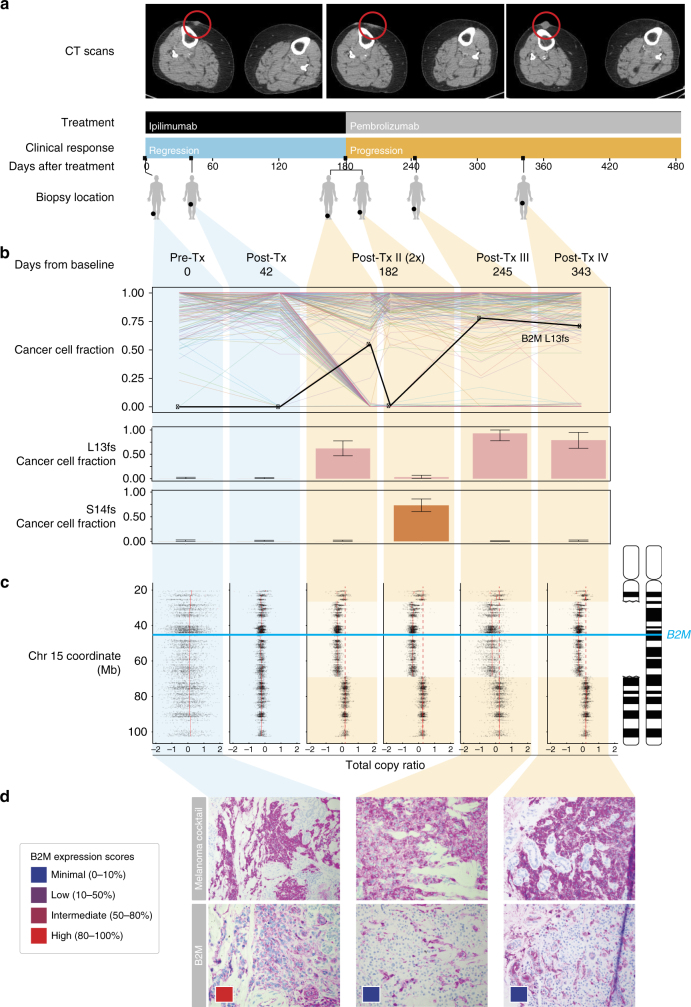
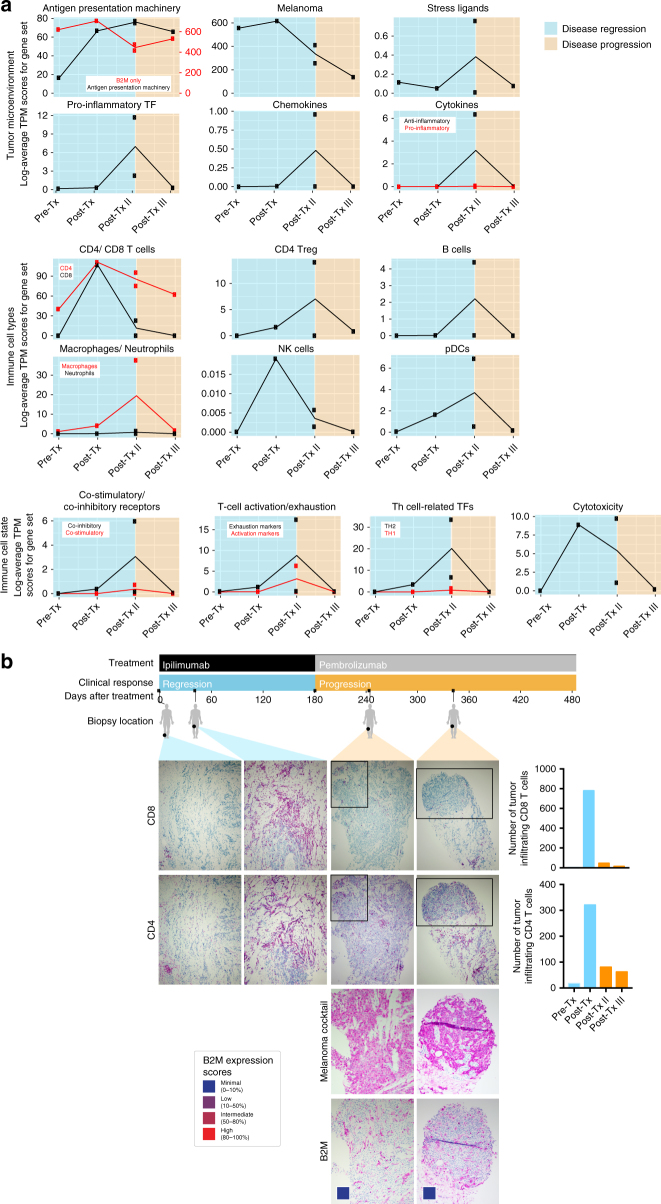
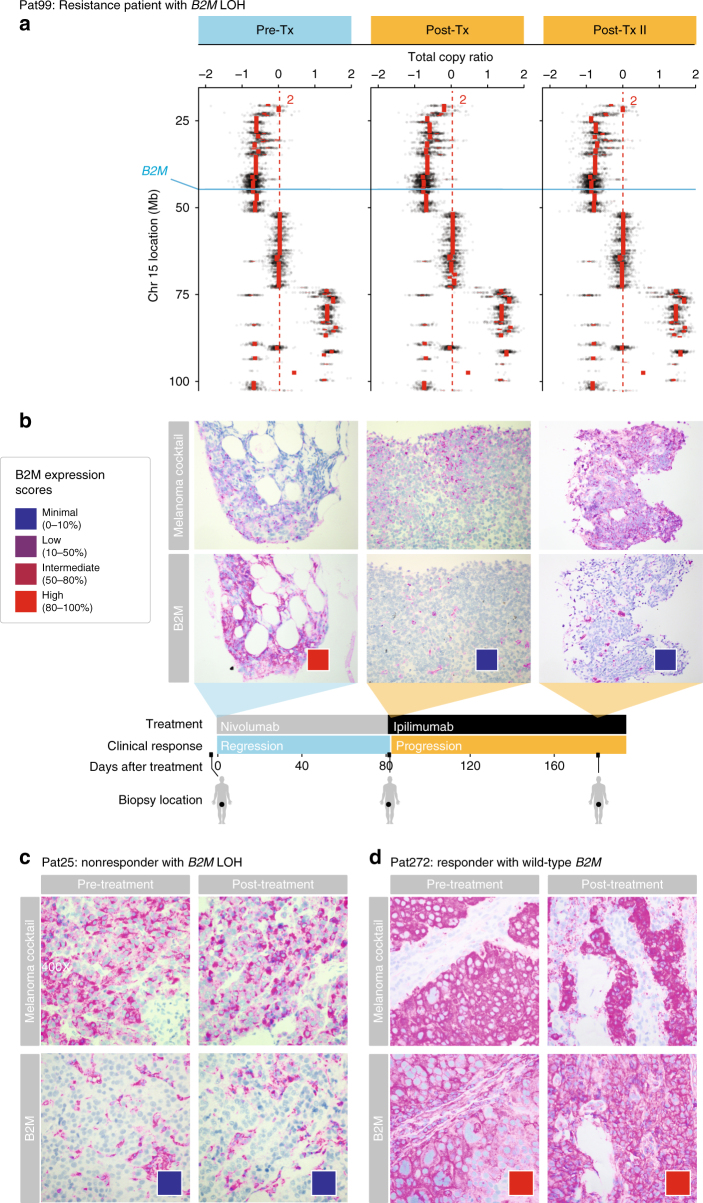
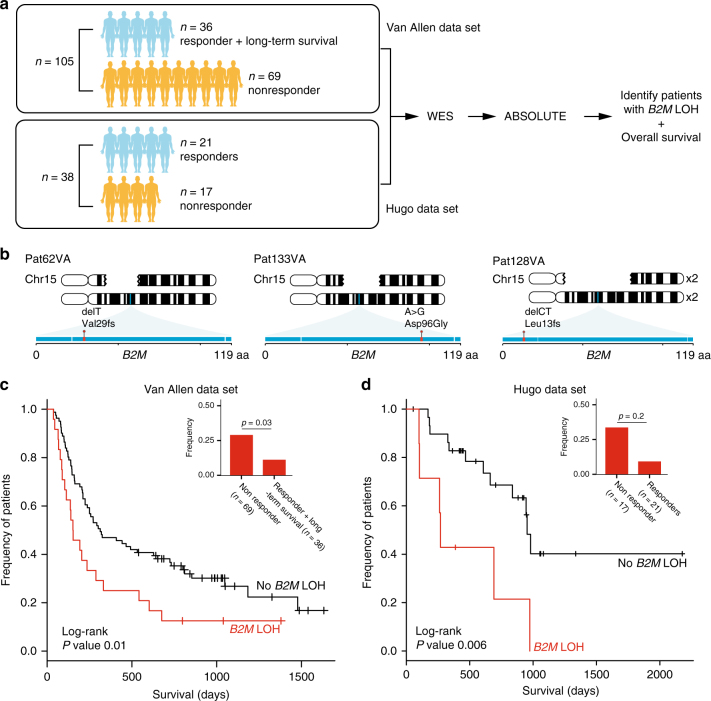
Treatment with immune checkpoint blockade (CPB) therapies often leads to prolonged responses in patients with metastatic melanoma, but the common mechanisms of primary and acquired resistance to these agents remain incompletely characterized and have yet to be validated in large cohorts. By analyzing longitudinal tumor biopsies from 17 metastatic melanoma patients treated with CPB therapies, we observed point mutations, deletions or loss of heterozygosity (LOH) in beta-2-microglobulin ( B2M ), an essential component of MHC class I antigen presentation, in 29.4% of patients with progressing disease. In two independent cohorts of melanoma patients treated with anti-CTLA4 and anti-PD1, respectively, we find that B2M LOH is enriched threefold in non-responders (~30%) compared to responders (~10%) and associated with poorer overall survival. Loss of both copies of B2M is found only in non-responders. B2M loss is likely a common mechanism of resistance to therapies targeting CTLA4 or PD1.
Overview
The claims and statistics of this paper haven’t been checked yet.
Free: it reads the open-access text and checks the first 5 claims that cite a source we can check. Create a free account to check every claim.
Integrity signals
Registry
Cites
Statistics
Figures
Verification
Claims the paper makes
The claims and statistics of this paper haven’t been checked yet.
Free: it reads the open-access text and checks the first 5 claims that cite a source we can check. Create a free account to check every claim.
Claims other papers make about this one
Each is checked against this paper’s own text: does it say what the citing paper says it does?
The source backs part of the claim, not all of it — or backs it for a different population, condition or comparison.
In the citing paper
“perturbations of B2M, HLA-A, JAK1, JAK2, STAT1, IFNGR1 and IFNGR2 (Fig. 2d,e, Extended Data Fig. 3e,f, Supplementary Table 2) conferred immune evasion, consistent with clinical mechanisms of resistance to immunotherapy7–9.”
From Multimodal pooled Perturb-CITE-seq screens in patient models define mechanisms of cancer immune evasion (2021) · cites this paper as [8]
Experimental — accuracy not yet measuredIn the citing paper
“Clinically relevant mechanisms of include mutations in beta-2-microglobulin (B2M) resulting in loss of MHC Class I presentation, downregulation of the antigen presentation machinery, and mutations in the IFNγ-JAK/STAT pathway that impair response to T cell mediated anti-tumor activity7–9.”
From Multimodal pooled Perturb-CITE-seq screens in patient models define mechanisms of cancer immune evasion (2021) · cites this paper as [8]
Self-check
Percentages, sums and reported differences re-computed from the paper’s own numbers.
The self-check needs the paper’s full text.
Citations
Cites
Fiji: an open-source platform for biological-image analysis
Schindelin, J., Arganda-Carreras, I., Frise, E., Kaynig, V., Longair, M., Pietzsch, T., Preibisch, S., Rueden, C., Saalfeld, S., Schmid, B., et al. (2012) · Nature Methods · doi:10.1038/nmeth.2019 · Cited by 66,890
STAR: ultrafast universal RNA-seq aligner
Dobin, A., Davis, C. A., Schlesinger, F., Drenkow, J., Zaleski, C., Jha, S., Batut, P., Chaisson, M., & Gingeras, T. R. (2013) · Bioinformatics · doi:10.1093/bioinformatics/bts635 · Cited by 51,709
PD-1 and PD-L1 Immune Checkpoint Blockade to Treat Breast Cancer
Hartkopf, A. D., Taran, F.-A., Wallwiener, M., Walter, C. B., Krämer, B., Grischke, E.-M., & Brucker, S. Y. (2016) · Breast Care · doi:10.1159/000453569 · Cited by 30,845
RSEM: accurate transcript quantification from RNA-Seq data with or without a reference genome
Li, B., & Dewey, C. N. (2011) · BMC Bioinformatics · doi:10.1186/1471-2105-12-323 · Cited by 22,179
Self-citationCerami, E., Gao, J., Dogrusoz, U., Gross, B. E., Sumer, S. O., Aksoy, B. A., Jacobsen, A., Byrne, C. J., Heuer, M. L., Larsson, E., et al. (2012) · Cancer Discovery · doi:10.1158/2159-8290.cd-12-0095 · Cited by 17,455
Adverse Renal Effects of Immune Checkpoint Inhibitors: A Narrative Review
Wanchoo, R., Karam, S., Uppal, N. N., Barta, V. S., Deray, G., Devoe, C., Launay-Vacher, V., Jhaveri, K. D., & on behalf of Cancer and Kidney International Network Workgroup on Immune Checkpoint Inhibitors (2017) · American Journal of Nephrology · doi:10.1159/000455014 · Cited by 15,256
Integrative Analysis of Complex Cancer Genomics and Clinical Profiles Using the cBioPortal
Gao, J., Aksoy, B. A., Dogrusoz, U., Dresdner, G., Gross, B., Sumer, S. O., Sun, Y., Jacobsen, A., Sinha, R., Larsson, E., et al. (2013) · Science Signaling · doi:10.1126/scisignal.2004088 · Cited by 15,160
The blockade of immune checkpoints in cancer immunotherapy
Pardoll, D. M. (2012) · Nature Reviews Cancer · doi:10.1038/nrc3239 · Cited by 13,838
PD-1 blockade induces responses by inhibiting adaptive immune resistance
Tumeh, P. C., Harview, C. L., Yearley, J. H., Shintaku, I. P., Taylor, E. J. M., Robert, L., Chmielowski, B., Spasic, M., Henry, G., Ciobanu, V., et al. (2014) · Nature · doi:10.1038/nature13954 · Cited by 6,609
Pembrolizumab versus Ipilimumab in Advanced Melanoma
Robert, C., Schachter, J., Long, G. V., Arance, A., Grob, J. J., Mortier, L., Daud, A., Carlino, M. S., McNeil, C., Lotem, M., et al. (2015) · New England Journal of Medicine · doi:10.1056/nejmoa1503093 · Cited by 5,887
Cited by
Cancer immunotherapy using checkpoint blockade
Ribas, A., & Wolchok, J. D. (2018) · Science · doi:10.1126/science.aar4060 · Cited by 6,791
The evolving landscape of biomarkers for checkpoint inhibitor immunotherapy
Havel, J. J., Chowell, D., & Chan, T. A. (2019) · Nature Reviews Cancer · doi:10.1038/s41568-019-0116-x · Cited by 2,286
Regulation and Function of the PD-L1 Checkpoint
Sun, C., Mezzadra, R., & Schumacher, T. N. (2018) · Immunity · doi:10.1016/j.immuni.2018.03.014 · Cited by 2,193
Miller, B. C., Sen, D. R., Al Abosy, R., Bi, K., Virkud, Y. V., LaFleur, M. W., Yates, K. B., Lako, A., Felt, K., Naik, G. S., et al. (2019) · Nature Immunology · doi:10.1038/s41590-019-0312-6 · Cited by 2,087
Defining T Cell States Associated with Response to Checkpoint Immunotherapy in Melanoma
Sade-Feldman, M., Yizhak, K., Bjorgaard, S. L., Ray, J. P., de Boer, C. G., Jenkins, R. W., Lieb, D. J., Chen, J. H., Frederick, D. T., Barzily-Rokni, M., et al. (2018) · Cell · doi:10.1016/j.cell.2018.10.038 · Cited by 2,053
“, 2014); defects in antigen presentation and IFNg pathways (Gao et al., 2016; McGranahan et al., 2017; Sade-Feldman et al., 2017; Zaretsky et al., 2016); and signatures of mesenchymal transition, wound healing, and angiogenesis (Hugo et al.”
Self-citationCancer immunoediting and resistance to T cell-based immunotherapy
O’Donnell, J. S., Teng, M. W. L., & Smyth, M. J. (2019) · Nature Reviews Clinical Oncology · doi:10.1038/s41571-018-0142-8 · Cited by 1,759
Fecal microbiota transplant promotes response in immunotherapy-refractory melanoma patients
Baruch, E. N., Youngster, I., Ben-Betzalel, G., Ortenberg, R., Lahat, A., Katz, L., Adler, K., Dick-Necula, D., Raskin, S., Bloch, N., et al. (2021) · Science · doi:10.1126/science.abb5920 · Cited by 1,757
Saxena, M., van der Burg, S. H., Melief, C. J. M., & Bhardwaj, N. (2021) · Nature reviews. Cancer · doi:10.1038/s41568-021-00346-0 · Cited by 1,581
Antigen presentation in cancer: insights into tumour immunogenicity and immune evasion
Jhunjhunwala, S., Hammer, C., & Delamarre, L. (2021) · Nature Reviews Cancer · doi:10.1038/s41568-021-00339-z · Cited by 1,490
Tumour-intrinsic resistance to immune checkpoint blockade
Kalbasi, A., & Ribas, A. (2020) · Nature Reviews Immunology · doi:10.1038/s41577-019-0218-4 · Cited by 1,486
Immune checkpoint signaling and cancer immunotherapy
He, X., & Xu, C. (2020) · Cell Research · doi:10.1038/s41422-020-0343-4 · Cited by 1,371
Current state of immunotherapy for glioblastoma
Lim, M., Xia, Y., Bettegowda, C., & Weller, M. (2018) · Nature Reviews Clinical Oncology · doi:10.1038/s41571-018-0003-5 · Cited by 1,365
Immunostimulation with chemotherapy in the era of immune checkpoint inhibitors
Galluzzi, L., Humeau, J., Buqué, A., Zitvogel, L., & Kroemer, G. (2020) · Nature Reviews Clinical Oncology · doi:10.1038/s41571-020-0413-z · Cited by 1,349
Melief, C. J. M., van Hall, T., Arens, R., Ossendorp, F., & van der Burg, S. H. (2015) · Journal of Clinical Investigation · doi:10.1172/jci80009 · Cited by 1,164
Detection of immunogenic cell death and its relevance for cancer therapy
Fucikova, J., Kepp, O., Kasikova, L., Petroni, G., Yamazaki, T., Liu, P., Zhao, L., Spisek, R., Kroemer, G., & Galluzzi, L. (2020) · Cell Death & Disease · doi:10.1038/s41419-020-03221-2 · Cited by 1,138
Cancer Immune Evasion Through Loss of MHC Class I Antigen Presentation
Dhatchinamoorthy, K., Colbert, J. D., & Rock, K. L. (2021) · Frontiers in Immunology · doi:10.3389/fimmu.2021.636568 · Cited by 1,077
“LOH and/or mutations in Jaks, and STATs are observed in cancers (143, 171).”
BackgroundLiu, D., Schilling, B., Liu, D., Sucker, A., Livingstone, E., Jerby-Arnon, L., Zimmer, L., Gutzmer, R., Satzger, I., Loquai, C., et al. (2019) · Nature Medicine · doi:10.1038/s41591-019-0654-5 · Cited by 1,039
“To generate non-parametric geneset scores in individual samples, we generated single-sample GSEA (ssGSEA) projections 43 for genesets, using rank normalization, including the MHC-II HLA genes (HLA-DMA, HLA-DMB, HLA-DOA, HLA-DOB, HLA-DPA1, HLA-DPB1, HLA-DQA1, HLA-DQA2, HLA-DQB1, HLA-DQB2, HLA-DRA, HLA-DRB1, HLA-DRB5) a…”
InfluentialSelf-citationImmune-checkpoint inhibitors: long-term implications of toxicity
Johnson, D. B., Nebhan, C. A., Moslehi, J. J., & Balko, J. M. (2022) · Nature Reviews Clinical Oncology · doi:10.1038/s41571-022-00600-w · Cited by 982
Acquired Resistance to Immune Checkpoint Inhibitors
Schoenfeld, A. J., & Hellmann, M. D. (2020) · Cancer Cell · doi:10.1016/j.ccell.2020.03.017 · Cited by 955
“Sade-Feldman et al. profiled the transcriptomes of individual immune cells (48 samples from 32 patients with melanoma) receiving immunotherapy, enabling the detection of individual T cell populations and associated markers associated with ICI responders and non-responders (Sade-Feldman et al., 2018).”
BackgroundResultInfluentialIntratumoral heterogeneity in cancer progression and response to immunotherapy
Vitale, I., Shema, E., Loi, S., & Galluzzi, L. (2021) · Nature Medicine · doi:10.1038/s41591-021-01233-9 · Cited by 826
Ott, P. A., Hu-Lieskovan, S., Chmielowski, B., Govindan, R., Naing, A., Bhardwaj, N., Margolin, K., Awad, M. M., Hellmann, M. D., Lin, J. J., et al. (2020) · Cell · doi:10.1016/j.cell.2020.08.053 · Cited by 738
Self-citationLoss of ADAR1 in tumours overcomes resistance to immune checkpoint blockade
Ishizuka, J. J., Manguso, R. T., Cheruiyot, C. K., Bi, K., Panda, A., Iracheta-Vellve, A., Miller, B. C., Du, P. P., Yates, K. B., Dubrot, J., et al. (2019) · Nature · doi:10.1038/s41586-018-0768-9 · Cited by 697
Cancer biomarkers: Emerging trends and clinical implications for personalized treatment
Passaro, A., Al Bakir, M., Hamilton, E. G., Diehn, M., André, F., Roy-Chowdhuri, S., Mountzios, G., Wistuba, I. I., Swanton, C., & Peters, S. (2024) · Cell · doi:10.1016/j.cell.2024.02.041 · Cited by 672
“…component of the major histocompatibility complex class I (MHC I) molecule which stabilises cell surface expression of MHC I and plays a role in presenting antigenic peptides to the immune system 95 , have been implicated in acquired resistance to immunotherapy in melanoma 96,97 and NSCLC 98 .”
Genomic correlates of response to immune checkpoint blockade in microsatellite-stable solid tumors
Miao, D., Margolis, C. A., Vokes, N. I., Liu, D., Taylor-Weiner, A., Wankowicz, S. M., Adeegbe, D., Keliher, D., Schilling, B., Tracy, A., et al. (2018) · Nature Genetics · doi:10.1038/s41588-018-0200-2 · Cited by 620
Self-citationRole of Immunotherapy in Triple-Negative Breast Cancer
Keenan, T. E., & Tolaney, S. M. (2020) · Journal of the National Comprehensive Cancer Network · doi:10.6004/jnccn.2020.7554 · Cited by 606
The Tumor Microenvironment in the Response to Immune Checkpoint Blockade Therapies
Petitprez, F., Meylan, M., de Reyniès, A., Sautès-Fridman, C., & Fridman, W. H. (2020) · Frontiers in Immunology · doi:10.3389/fimmu.2020.00784 · Cited by 602
Immunosuppressive cells in cancer: mechanisms and potential therapeutic targets
Tie, Y., Tang, F., Wei, Y.-Q., & Wei, X.-W. (2022) · Journal of Hematology & Oncology · doi:10.1186/s13045-022-01282-8 · Cited by 591
“In addition, cancer cells also decrease the expression of neoantigens and antigen presentation molecules, such as MHC-I, or upregulate the expression of immune checkpoints on immunosuppressive cells to escape the immune recognition [8, 9].”
BackgroundSchumacher, T. N., Scheper, W., & Kvistborg, P. (2019) · Annual Review of Immunology · doi:10.1146/annurev-immunol-042617-053402 · Cited by 574
The hallmarks of successful anticancer immunotherapy
Galluzzi, L., Chan, T. A., Kroemer, G., Wolchok, J. D., & López-Soto, A. (2018) · Science Translational Medicine · doi:10.1126/scitranslmed.aat7807 · Cited by 575
The cancer–natural killer cell immunity cycle
Huntington, N. D., Cursons, J., & Rautela, J. (2020) · Nature Reviews Cancer · doi:10.1038/s41568-020-0272-z · Cited by 566
Epigenetic therapy in immune-oncology
Jones, P. A., Ohtani, H., Chakravarthy, A., & De Carvalho, D. D. (2019) · Nature Reviews Cancer · doi:10.1038/s41568-019-0109-9 · Cited by 550
Benci, J. L., Johnson, L. R., Choa, R., Xu, Y., Qiu, J., Zhou, Z., Xu, B., Ye, D., Nathanson, K. L., June, C. H., et al. (2019) · Cell · doi:10.1016/j.cell.2019.07.019 · Cited by 541
“In contrast, some patients have tumors with mutations in the IFN pathway that nonetheless respond to ICB (Hellmann et al., 2018; Sade-Feldman et al., 2017) or have high serum levels of IFNG that associates with ICB progression (Huang et al.”
BackgroundIdentification of neoantigens for individualized therapeutic cancer vaccines
Lang, F., Schrörs, B., Löwer, M., Türeci, Ö., & Sahin, U. (2022) · Nature Reviews Drug Discovery · doi:10.1038/s41573-021-00387-y · Cited by 534
“…be selected that have defects in the antigen-processing or presentation machinery, such as loss of heterozygosity (LOH) of MHC genes, downregulation and mutation of MHC molecules 94 , dysfunction of the transporter for antigen presentation (TAP) 95 or mutations in β 2 -microglobulin (β 2 m) 96 .”
BackgroundGenetic Mechanisms of Immune Evasion in Colorectal Cancer
Grasso, C. S., Giannakis, M., Wells, D. K., Hamada, T., Mu, X. J., Quist, M., Nowak, J. A., Nishihara, R., Qian, Z. R., Inamura, K., et al. (2018) · Cancer Discovery · doi:10.1158/2159-8290.cd-17-1327 · Cited by 535
“Loss of B2M, long known to be an escape mechanism to cancer immunotherapy strategies (77–79), has been recently shown to confer resistance to anti-PD1 antibody therapy (25,42)(43).”
BackgroundSelf-citationIdentifying phenotype-associated subpopulations by integrating bulk and single-cell sequencing data
Sun, D., Guan, X., Moran, A. E., Wu, L.-Y., Qian, D. Z., Schedin, P., Dai, M.-S., Danilov, A. V., Alumkal, J. J., Adey, A. C., et al. (2022) · Nature Biotechnology · doi:10.1038/s41587-021-01091-3 · Cited by 503
“Notably, B2M is a critical component of MHC class I antigen presentation and loss-of-function mutations in B2M have been reported in cancer patients resistant to immunotherapy 24 .”
Biological Consequences of MHC-II Expression by Tumor Cells in Cancer
Axelrod, M. L., Cook, R. S., Johnson, D. B., & Balko, J. M. (2019) · Clinical Cancer Research · doi:10.1158/1078-0432.ccr-18-3200 · Cited by 490
Faje, A. T., Lawrence, D., Flaherty, K., Freedman, C., Fadden, R., Rubin, K., Cohen, J., & Sullivan, R. J. (2018) · Cancer · doi:10.1002/cncr.31629 · Cited by 486
Self-citationSynthetic lethality as an engine for cancer drug target discovery
Huang, A., Garraway, L. A., Ashworth, A., & Weber, B. (2020) · Nature Reviews Drug Discovery · doi:10.1038/s41573-019-0046-z · Cited by 469
Cornel, A. M., Mimpen, I. L., & Nierkens, S. (2020) · Cancers · doi:10.3390/cancers12071760 · Cited by 464
Resistance Mechanisms to Anti-PD Cancer Immunotherapy
Vesely, M. D., Zhang, T., & Chen, L. (2022) · Annual Review of Immunology · doi:10.1146/annurev-immunol-070621-030155 · Cited by 468
Genomic correlates of response to immune checkpoint blockade
Keenan, T. E., Burke, K. P., & Van Allen, E. M. (2019) · Nature Medicine · doi:10.1038/s41591-019-0382-x · Cited by 448
Resistance Mechanisms of Anti-PD1/PDL1 Therapy in Solid Tumors
Lei, Q., Wang, D., Sun, K., Wang, L., & Zhang, Y. (2020) · Frontiers in Cell and Developmental Biology · doi:10.3389/fcell.2020.00672 · Cited by 421
Trujillo, J. A., Sweis, R. F., Bao, R., & Luke, J. J. (2018) · Cancer Immunology Research · doi:10.1158/2326-6066.cir-18-0277 · Cited by 393
“One case of metastatic melanoma with acquired resistance to PD-1 blockade was associated with loss of B2M (24).”
BackgroundInfluentialLymph node colonization induces tumor-immune tolerance to promote distant metastasis
Reticker-Flynn, N. E., Zhang, W., Belk, J. A., Basto, P. A., Escalante, N. K., Pilarowski, G. O. W., Bejnood, A., Martins, M. M., Kenkel, J. A., Linde, I. L., et al. (2022) · Cell · doi:10.1016/j.cell.2022.04.019 · Cited by 385
Signal pathways of melanoma and targeted therapy
Guo, W., Wang, H., & Li, C. (2021) · Signal Transduction and Targeted Therapy · doi:10.1038/s41392-021-00827-6 · Cited by 379
Grasso, C. S., Tsoi, J., Onyshchenko, M., Abril-Rodriguez, G., Ross-Macdonald, P., Wind-Rotolo, M., Champhekar, A., Medina, E., Torrejon, D. Y., Shin, D. S., et al. (2020) · Cancer Cell · doi:10.1016/j.ccell.2020.08.005 · Cited by 390
“, 2018); three cell lines that had developed Janus kinase 1 (JAK1) or JAK2 loss-of-function mutations in patients; as well as variants of parental cell lines that had JAK1 (N = 5), JAK2 (N = 5), or beta-2 microglobulin (B2M) (N = 2) loss of function generated in vitro through CRISPR-Cas9 gene editing, as these are gen…”
BackgroundEmerging Cellular Therapies for Cancer
Guedan, S., Ruella, M., & June, C. H. (2019) · Annual Review of Immunology · doi:10.1146/annurev-immunol-042718-041407 · Cited by 386
“However, the mutation or decreased expression of genes involved in antigen-presentation pathways, including specific deletion of HLA class I alleles or loss of β2 microglobulin (β2m), may also lead to tumor escape (26, 27, 29, 91).”
BackgroundLessons learned from the blockade of immune checkpoints in cancer immunotherapy
Li, X., Shao, C., Shi, Y., & Han, W. (2018) · Journal of Hematology & Oncology · doi:10.1186/s13045-018-0578-4 · Cited by 381
“Loss of antigen display by tumor cells leading to acquired resistance to cancer immunotherapy may be due to mutations in the antigen-processing machinery or proteins involved in antigen presentation can lack of recognition by CD8 T cells following immunotherapy [112, 113].”
BackgroundTowards targeting the breast cancer immune microenvironment
Harris, M. A., Savas, P., Virassamy, B., O’Malley, M. M. R., Kay, J., Mueller, S. N., Mackay, L. K., Salgado, R., & Loi, S. (2024) · Nature Reviews Cancer · doi:10.1038/s41568-024-00714-6 · Cited by 363
“…increase copy number of oncogenes which in turn can drive rapid disease progression 314,315 . β 2 -Microglobulin ( B2M ) and human leukocyte antigen (HLA) are critical for antigen presentation, and loss of B2M and/or HLA is associated with reduced immune infiltration 101 and resistance to ICB 316 .”
CAR T Cells and T-Cell Therapies for Cancer: A Translational Science Review
Brudno, J. N., Maus, M. V., & Hinrichs, C. S. (2024) · JAMA · doi:10.1001/jama.2024.19462 · Cited by 359
IL-18BP is a secreted immune checkpoint and barrier to IL-18 immunotherapy
Zhou, T., Damsky, W., Weizman, O.-E., McGeary, M. K., Hartmann, K. P., Rosen, C. E., Fischer, S., Jackson, R., Flavell, R. A., Wang, J., et al. (2020) · Nature · doi:10.1038/s41586-020-2422-6 · Cited by 363
CAR T cell killing requires the IFNγR pathway in solid but not liquid tumours
Larson, R. C., Kann, M. C., Bailey, S. R., Haradhvala, N. J., Llopis, P. M., Bouffard, A. A., Scarfó, I., Leick, M. B., Grauwet, K., Berger, T. R., et al. (2022) · Nature · doi:10.1038/s41586-022-04585-5 · Cited by 352
Self-citationTaieb, J., Svrcek, M., Cohen, R., Basile, D., Tougeron, D., & Phelip, J.-M. (2022) · European Journal of Cancer · doi:10.1016/j.ejca.2022.07.020 · Cited by 326
Proteomics of Melanoma Response to Immunotherapy Reveals Mitochondrial Dependence
Harel, M., Ortenberg, R., Varanasi, S. K., Mangalhara, K. C., Mardamshina, M., Markovits, E., Baruch, E. N., Tripple, V., Arama-Chayoth, M., Greenberg, E., et al. (2019) · Cell · doi:10.1016/j.cell.2019.08.012 · Cited by 324
“Higher amounts of MHC molecules is directly associated with response to T cell killing (Sade-Feldman et al., 2017; Seliger, 2014); indeed, our immunohistochemistry (IHC) analyses show a correlation between metabolic protein expression and T cell activation, hence the oxidative metabolic state might render the tumor mo…”
BackgroundAntigen presentation in cancer — mechanisms and clinical implications for immunotherapy
Yang, K., Halima, A., & Chan, T. A. (2023) · Nature Reviews Clinical Oncology · doi:10.1038/s41571-023-00789-4 · Cited by 321
Ren, D., Hua, Y., Yu, B., Ye, X., He, Z., Li, C., Wang, J., Mo, Y., Wei, X., Chen, Y., et al. (2020) · Molecular Cancer · doi:10.1186/s12943-020-1144-6 · Cited by 316
γδ T cells are effectors of immunotherapy in cancers with HLA class I defects
de Vries, N. L., van de Haar, J., Veninga, V., Chalabi, M., Ijsselsteijn, M. E., van der Ploeg, M., van den Bulk, J., Ruano, D., van den Berg, J. G., Haanen, J. B., et al. (2023) · Nature · doi:10.1038/s41586-022-05593-1 · Cited by 311
Overcoming resistance to tumor-targeted and immune-targeted therapies
Aldea, M., Andre, F., Marabelle, A., Dogan, S., Barlesi, F., & Soria, J.-C. (2021) · Cancer Discovery · doi:10.1158/2159-8290.cd-20-1638 · Cited by 311
Imaging mass cytometry and multiplatform genomics define the phenogenomic landscape of breast cancer
Ali, H. R., Jackson, H. W., Zanotelli, V. R. T., Danenberg, E., Fischer, J. R., Bardwell, H., Provenzano, E., CRUK IMAXT Grand Challenge Team, Ali, H. R., Al Sa’d, M., et al. (2020) · Nature Cancer · doi:10.1038/s43018-020-0026-6 · Cited by 306
“3 2 Vascular SMA (6) Myofibroblasts (38) Myofibroblasts (42) Myofibroblasts (56) Fibroblasts (1) Myofibroblasts (44) Fibroblasts (21) Myofibroblasts (34) Fibroblasts (4) Myofibroblasts (15) Myofibroblasts (43) Myofibroblasts (17) Fibroblasts (35) HRCK7 (48) Myofibroblasts (39) Fibroblasts (40) Myofibroblasts (11) Fibr…”
BackgroundTherapeutic targeting of tumour myeloid cells
Barry, S. T., Gabrilovich, D. I., Sansom, O. J., Campbell, A. D., & Morton, J. P. (2023) · Nature Reviews Cancer · doi:10.1038/s41568-022-00546-2 · Cited by 305
Defining clinically useful biomarkers of immune checkpoint inhibitors in solid tumours
Holder, A. M., Dedeilia, A., Sierra-Davidson, K., Cohen, S., Liu, D., Parikh, A., & Boland, G. M. (2024) · Nature Reviews Cancer · doi:10.1038/s41568-024-00705-7 · Cited by 298
“A multitude of research groups have investigated histology-specific tumour 20,57,74–82 or immune 83–90 characteristics, such as tumour and immune gene mutational signatures, tumour loss of antigen presentation or multicellular immune hubs or aggregates (such as tertiary lymphoid structures), which…”
InfluentialSelf-citationMechanisms of MHC-I Downregulation and Role in Immunotherapy Response
Taylor, B. C., & Balko, J. M. (2022) · Frontiers in Immunology · doi:10.3389/fimmu.2022.844866 · Cited by 298
“Additionally, truncating mutations of b2M were found in metastatic colon and melanoma cancers found to be resistant to the anti-PD-1 therapy, pembrolizumab (25, 49, 50).”
BackgroundHeterogeneity of the tumor immune microenvironment and its clinical relevance
Jia, Q., Wang, A., Yuan, Y., Zhu, B., & Long, H. (2022) · Experimental Hematology & Oncology · doi:10.1186/s40164-022-00277-y · Cited by 300
Cursons, J., Souza-Fonseca-Guimaraes, F., Foroutan, M., Anderson, A., Hollande, F., Hediyeh-Zadeh, S., Behren, A., Huntington, N. D., & Davis, M. J. (2019) · Cancer Immunology Research · doi:10.1158/2326-6066.cir-18-0500 · Cited by 296
“1F) has one of the most negative hazard coefficients, likely reflecting its role inMHCclass I antigen presentation of neoantigens to CD8þ T cells and consistent with reports of this process for immune control of tumors (54).”
Acquired resistance to cancer immunotherapy: Role of tumor-mediated immunosuppression
Saleh, R., & Elkord, E. (2020) · Seminars in Cancer Biology · doi:10.1016/j.semcancer.2019.07.017 · Cited by 292
PD-1/PD-L1 Blockade: Have We Found the Key to Unleash the Antitumor Immune Response?
Xu-Monette, Z. Y., Zhang, M., Li, J., & Young, K. H. (2017) · Frontiers in Immunology · doi:10.3389/fimmu.2017.01597 · Cited by 288
“Studies have shown that B2M mutations, deletions, or loss of heterozygosity, which leads to loss of MHC class I expression and failure of antigen recognition, is a potential mechanism for immune escape and resistance to PD-1 blockade in patients with melanoma (239, 279).”
BackgroundLee, J. H., Shklovskaya, E., Lim, S. Y., Carlino, M. S., Menzies, A. M., Stewart, A., Pedersen, B., Irvine, M., Alavi, S., Yang, J. Y. H., et al. (2020) · Nature Communications · doi:10.1038/s41467-020-15726-7 · Cited by 288
“…(MHC) class I expression, abnormalities in the interferon-γ (IFN γ ) immune effector signaling pathway ( JAK1 , JAK2 , IFNGR1 , STAT1 mutations) 9 – 13 , oncogenic signaling (elevated ß-catenin/WNT) that leads to immune exclusion 14 , T-cell induced secretion of immunosuppressive…”
Immune mechanisms of toxicity from checkpoint inhibitors
Wang, S. J., Dougan, S. K., & Dougan, M. (2023) · Trends in Cancer · doi:10.1016/j.trecan.2023.04.002 · Cited by 285
Wu, L., Jin, Y., Zhao, X., Tang, K., Zhao, Y., Tong, L., Yu, X., Xiong, K., Luo, C., Zhu, J., et al. (2023) · Cell Metabolism · doi:10.1016/j.cmet.2023.07.001 · Cited by 284
Sun, J.-Y., Zhang, D., Wu, S., Xu, M., Zhou, X., Lu, X.-J., & Ji, J. (2020) · Biomarker Research · doi:10.1186/s40364-020-00212-5 · Cited by 279
Lehmann, B. D., Colaprico, A., Silva, T. C., Chen, J., An, H., Ban, Y., Huang, H., Wang, L., James, J. L., Balko, J. M., et al. (2021) · Nature Communications · doi:10.1038/s41467-021-26502-6 · Cited by 279
Self-citationGreene, S., Robbins, Y., Mydlarz, W. K., Huynh, A. P., Schmitt, N. C., Friedman, J., Horn, L. A., Palena, C., Schlom, J., Maeda, D. Y., et al. (2020) · Clinical Cancer Research · doi:10.1158/1078-0432.ccr-19-2625 · Cited by 280
“Altered genes encoding components of the IFN response pathway (1), antigen processing (1, 2), and antigen presentation (1–3) have been identified in tumors from patients that have failed T-cell–based immunotherapy.”
BackgroundBreast tumor microenvironment structures are associated with genomic features and clinical outcome
Danenberg, E., Bardwell, H., Zanotelli, V. R. T., Provenzano, E., Chin, S.-F., Rueda, O. M., Green, A., Rakha, E., Aparicio, S., Ellis, I. O., et al. (2022) · Nature Genetics · doi:10.1038/s41588-022-01041-y · Cited by 274
“Some somatic mutations, for example, dampen the immune response by causing immune checkpoint overexpression 15–17 , compromised antigen presentation 18,19 , or aberrant interferon signalling 20 .”
A few good peptides: MHC class I-based cancer immunosurveillance and immunoevasion
Dersh, D., Hollý, J., & Yewdell, J. W. (2021) · Nature Reviews Immunology · doi:10.1038/s41577-020-0390-6 · Cited by 278
Radiation therapy and anti-tumor immunity: exposing immunogenic mutations to the immune system
Lhuillier, C., Rudqvist, N.-P., Elemento, O., Formenti, S. C., & Demaria, S. (2019) · Genome Medicine · doi:10.1186/s13073-019-0653-7 · Cited by 276
“Other components of this model include the expression of molecules that are mechanistically linked to the priming of tumorspecific T cells by RT, such as cGAS and STING [55], and the expression of molecules that are linked to cancer-cell recognition by CD8 T cells, such as MHC-I, β2m, and components of the antigen-pre…”
BackgroundFrangieh, C. J., Melms, J. C., Thakore, P. I., Geiger-Schuller, K. R., Ho, P., Luoma, A. M., Cleary, B., Jerby-Arnon, L., Malu, S., Cuoco, M. S., et al. (2021) · Nature Genetics · doi:10.1038/s41588-021-00779-1 · Cited by 276
NK cells mediate clearance of CD8 + T cell–resistant tumors in response to STING agonists
Nicolai, C. J., Wolf, N., Chang, I.-C., Kirn, G., Marcus, A., Ndubaku, C. O., McWhirter, S. M., & Raulet, D. H. (2020) · Science Immunology · doi:10.1126/sciimmunol.aaz2738 · Cited by 268
Pang, K., Shi, Z.-D., Wei, L.-Y., Dong, Y., Ma, Y.-Y., Wang, W., Wang, G.-Y., Cao, M.-Y., Dong, J.-J., Chen, Y.-A., et al. (2023) · Drug Resistance Updates · doi:10.1016/j.drup.2022.100907 · Cited by 260
Sustained Type I interferon signaling as a mechanism of resistance to PD-1 blockade
Jacquelot, N., Yamazaki, T., Roberti, M. P., Duong, C. P. M., Andrews, M. C., Verlingue, L., Ferrere, G., Becharef, S., Vétizou, M., Daillère, R., et al. (2019) · Cell Research · doi:10.1038/s41422-019-0224-x · Cited by 256
Marei, H. E., Hasan, A., Pozzoli, G., & Cenciarelli, C. (2023) · Cancer Cell International · doi:10.1186/s12935-023-02902-0 · Cited by 251
“B2M changes were shown to be more prevalent in nonresponders to anti-CTLA4 therapy [121].”
BackgroundClinical cancer immunotherapy: Current progress and prospects
Liu, C., Yang, M., Zhang, D., Chen, M., & Zhu, D. (2022) · Frontiers in Immunology · doi:10.3389/fimmu.2022.961805 · Cited by 249
Alternative mRNA splicing in cancer immunotherapy
Frankiw, L., Baltimore, D., & Li, G. (2019) · Nature Reviews Immunology · doi:10.1038/s41577-019-0195-7 · Cited by 248
Cichocki, F., Bjordahl, R., Gaidarova, S., Mahmood, S., Abujarour, R., Wang, H., Tuininga, K., Felices, M., Davis, Z. B., Bendzick, L., et al. (2020) · Science Translational Medicine · doi:10.1126/scitranslmed.aaz5618 · Cited by 244
Mechanisms of immune activation and regulation: lessons from melanoma
Kalaora, S., Nagler, A., Wargo, J. A., & Samuels, Y. (2022) · Nature Reviews Cancer · doi:10.1038/s41568-022-00442-9 · Cited by 240
“44 ) .”
BackgroundCancer immunotherapy: broadening the scope of targetable tumours
van den Bulk, J., Verdegaal, E. M., & de Miranda, N. F. (2018) · Open Biology · doi:10.1098/rsob.180037 · Cited by 240
Abelin, J. G., Harjanto, D., Malloy, M., Suri, P., Colson, T., Goulding, S. P., Creech, A. L., Serrano, L. R., Nasir, G., Nasrullah, Y., et al. (2019) · Immunity · doi:10.1016/j.immuni.2019.08.012 · Cited by 240
Self-citationPRMT5 control of cGAS/STING and NLRC5 pathways defines melanoma response to antitumor immunity
Kim, H., Kim, H., Feng, Y., Li, Y., Tamiya, H., Tocci, S., & Ronai, Z. A. (2020) · Science Translational Medicine · doi:10.1126/scitranslmed.aaz5683 · Cited by 232
Treg-mediated acquired resistance to immune checkpoint inhibitors
Saleh, R., & Elkord, E. (2019) · Cancer Letters · doi:10.1016/j.canlet.2019.05.003 · Cited by 236
Targeting MHC-I molecules for cancer: function, mechanism, and therapeutic prospects
Wu, X., Li, T., Jiang, R., Yang, X., Guo, H., & Yang, R. (2023) · Molecular Cancer · doi:10.1186/s12943-023-01899-4 · Cited by 223
“A similar outcome could be demonstrated in B2M, namely that B2M LOH is prevalent in cancer patients who have a poor response to or non-response to ICB therapy [50, 109].”
BackgroundResultInfluentialNanoparticle‐based photothermal and photodynamic immunotherapy for tumor treatment
Hou, X., Tao, Y., Pang, Y., Li, X., Jiang, G., & Liu, Y. (2018) · International Journal of Cancer · doi:10.1002/ijc.31717 · Cited by 221
Significance and implications of FDA approval of pembrolizumab for biomarker-defined disease
Boyiadzis, M. M., Kirkwood, J. M., Marshall, J. L., Pritchard, C. C., Azad, N. S., & Gulley, J. L. (2018) · Journal for ImmunoTherapy of Cancer · doi:10.1186/s40425-018-0342-x · Cited by 219
Memon, D., Schoenfeld, A. J., Ye, D., Fromm, G., Rizvi, H., Zhang, X., Keddar, M. R., Mathew, D., Yoo, K. J., Qiu, J., et al. (2024) · Cancer Cell · doi:10.1016/j.ccell.2023.12.013 · Cited by 207
Szabados, B., Kockx, M., Assaf, Z. J., van Dam, P.-J., Rodriguez-Vida, A., Duran, I., Crabb, S. J., Van Der Heijden, M. S., Pous, A. F., Gravis, G., et al. (2022) · European Urology · doi:10.1016/j.eururo.2022.04.013 · Cited by 209
Immunotherapy efficacy on mismatch repair-deficient colorectal cancer: From bench to bedside
Lizardo, D. Y., Kuang, C., Hao, S., Yu, J., Huang, Y., & Zhang, L. (2020) · Biochimica et Biophysica Acta (BBA) - Reviews on Cancer · doi:10.1016/j.bbcan.2020.188447 · Cited by 205
“B2M inactivation is thought to be a common ICI resistance mechanism in melanoma [59].”
BackgroundA gene expression signature of TREM2hi macrophages and γδ T cells predicts immunotherapy response
Xiong, D., Wang, Y., & You, M. (2020) · Nature Communications · doi:10.1038/s41467-020-18546-x · Cited by 208
Spatial biology of cancer evolution
Seferbekova, Z., Lomakin, A., Yates, L. R., & Gerstung, M. (2023) · Nature Reviews Genetics · doi:10.1038/s41576-022-00553-x · Cited by 203
Deregulation of HLA-I in cancer and its central importance for immunotherapy
Hazini, A., Fisher, K., & Seymour, L. (2021) · Journal for ImmunoTherapy of Cancer · doi:10.1136/jitc-2021-002899 · Cited by 203
Nanomaterial-Based Tumor Photothermal Immunotherapy
Xu, P., & Liang, F. (2020) · International Journal of Nanomedicine · doi:10.2147/ijn.s249252 · Cited by 201
Human Anti-tumor Immunity: Insights from Immunotherapy Clinical Trials
Egen, J. G., Ouyang, W., & Wu, L. C. (2020) · Immunity · doi:10.1016/j.immuni.2019.12.010 · Cited by 197
Landscape of helper and regulatory antitumour CD4+ T cells in melanoma
Oliveira, G., Stromhaug, K., Cieri, N., Iorgulescu, J. B., Klaeger, S., Wolff, J. O., Rachimi, S., Chea, V., Krause, K., Freeman, S. S., et al. (2022) · Nature · doi:10.1038/s41586-022-04682-5 · Cited by 196
Self-citation
Metadata
- Authors
- Sade-Feldman, M., Jiao, Y. J., Chen, J. H., Rooney, M. S., Barzily-Rokni, M., Eliane, J.-P., Bjorgaard, S. L., Hammond, M. R., Vitzthum, H., Blackmon, S. M., Frederick, D. T., Hazar-Rethinam, M., Nadres, B. A., Van Seventer, E. E., Shukla, S. A., Yizhak, K., Ray, J. P., Rosebrock, D., Livitz, D., Adalsteinsson, V., Getz, G., Duncan, L. M., Li, B., Corcoran, R. B., Lawrence, D. P., Stemmer-Rachamimov, A., Boland, G. M., Landau, D. A., Flaherty, K. T., Sullivan, R. J., & Hacohen, N.
- Affiliations
- Broad Institute (US)
- Massachusetts General Hospital (US)
- Dana-Farber Cancer Institute (US)
- Corresponding author
- Sullivan, Ryan J.
- Hacohen, Nir
- ORCID
- Sade-Feldman, Moshe
- Jiao, Yunxin J.
- Chen, Jonathan H.
- Barzily-Rokni, Michal
- Frederick, Dennie T.
- Hazar-Rethinam, Mehlika
- Nadres, Brandon A.
- Shukla, Sachet A.
- Yizhak, Keren
- Rosebrock, Daniel
- Livitz, Dimitri
- Adalsteinsson, Viktor
- Getz, Gad
- Duncan, Lyn M.
- Li, Bo
- Corcoran, Ryan B.
- Lawrence, Donald P.
- Stemmer-Rachamimov, Anat
- Boland, Genevieve M.
- Landau, Dan A.
- Flaherty, Keith T.
- Sullivan, Ryan J.
- Hacohen, Nir
- Venue
- Nature Communications
- Published
- 2017-10-26
- Volume
- 8
- Issue
- 1
- Pages
- 1136-1136
- ISSN
- 2041-1723 (ISSN-L)
- PMC
- PMC5656607
- OpenAlex
- W2765417948
- Cited by
- 1,005
- References
- 44
- Citations by year
- 2026: 90 · 2025: 116 · 2024: 110 · 2023: 129 · 2022: 145 · 2021: 152 · 2020: 125 · 2019: 78 · 2018: 53 · 2017: 4
- FWCI
- 31.34
- Type
- journal article
- Language
- en
- Open access
- gold
- doi.org
- Licence
- cc-by
- creativecommons.org/licenses/by/4.0 (tdm)
- creativecommons.org/licenses/by/4.0 (vor)
- Locations
- Nature Communications (publishedVersion, cc-by)
- Europe PMC (PubMed Central) (publishedVersion, cc-by)
- PubMed Central (publishedVersion, cc-by)
- PubMed (publishedVersion)
- Digital Access to Scholarship at Harvard (DASH) (Harvard University) (submittedVersion, cc-by)
- RePEc: Research Papers in Economics (submittedVersion)
- DOAJ (DOAJ: Directory of Open Access Journals) (submittedVersion, cc-by-sa)
- DOAJ (DOAJ: Directory of Open Access Journals) (submittedVersion)
- Funders
- National Science Foundation
- Cancer Research Institute
- Melanoma Research Alliance
- Dr. Miriam and Sheldon G. Adelson Medical Research Foundation
- Wellcome Trust
- Broad Institute
- National Institutes of Health
- Stand Up To Cancer
- National Human Genome Research Institute (U54HG003067)
- National Cancer Institute (R01CA208756, T32CA207021, R50CA211482)
- National Institute of Environmental Health Sciences (K01ES025431)
- Topics
- Health Sciences › Medicine › Oncology › Cancer Immunotherapy and Biomarkers
- Life Sciences › Immunology and Microbiology › Immunology › Immunotherapy and Immune Responses
- Health Sciences › Medicine › Oncology › Cutaneous Melanoma Detection and Management
- Keywords
- immune checkpoint blockade, metastatic melanoma, beta2-microglobulin, loss of heterozygosity, MHC class I antigen presentation, anti-CTLA-4, anti-PD-1, treatment resistance, tumor immune evasion, overall survival
- MeSH terms
- Animals, Antibodies, Monoclonal, beta 2-Microglobulin, Female, Humans, Melanoma, Mice, Inbred C57BL, Neoplasm Metastasis, Neoplasms, Experimental, Point Mutation, Antigen Presentation, Mice, Knockout, Drug Resistance, Neoplasm, Loss of Heterozygosity, CTLA-4 Antigen, Programmed Cell Death 1 Receptor
About these checks
Registry, retraction, Cites and statistics results are computed, not judged, with one exception: a printed reference that no index lists is read once by a model before it counts as a citation error. Claims are extracted by a model and kept only when their quote appears verbatim in the text; each cited source is then checked, with a model’s help, for whether it says what the claim relies on. Those verdicts can be wrong — read the claim’s quote and the cited source before relying on one.
Statistics and arithmetic are recomputed, not judged.
Confidence bands are shown only for fields calibrated on our annotated test set. None is calibrated yet, so no band is shown.
What counts as a claim ›How we measure confidence ›How we check this ›
Are you an author, or do you see a problem with this page? Request a review
Data sources
Bibliographic data: Semantic Scholar, OpenAlex, Crossref.
Contains information from the Semantic Scholar Academic Graph Datasets, made available under the ODC Attribution License (ODC-BY 1.0).
Semantic Scholar’s data is described in: Kinney, R., et al. (2023). The Semantic Scholar Open Data Platform. arXiv:2301.10140.
