

The DOI matches its Crossref record; 74 of the 74 references it cites were found in a registry or an index; 31 of the 54 sources its claims cite were checked for support.
A genomics approach reveals insights into the importance of gene losses for mammalian adaptations
Open accessAbstract
Identifying the genomic changes that underlie phenotypic adaptations is a key challenge in evolutionary biology and genomics. Loss of protein-coding genes is one type of genomic change with the potential to affect phenotypic evolution. Here, we develop a genomics approach to accurately detect gene losses and investigate their importance for adaptive evolution in mammals. We discover a number of gene losses that likely contributed to morphological, physiological, and metabolic adaptations in aquatic and flying mammals. These gene losses shed light on possible molecular and cellular mechanisms that underlie these adaptive phenotypes. In addition, we show that gene loss events that occur as a consequence of relaxed selection following adaptation provide novel insights into species’ biology. Our results suggest that gene loss is an evolutionary mechanism for adaptation that may be more widespread than previously anticipated. Hence, investigating gene losses has great potential to reveal the genomic basis underlying macroevolutionary changes.
Overview
AI snapshot
Written from the paper’s full text.
TL;DR
The paper develops a comparative-genomics pipeline to detect gene losses across 62 placental mammals and argues that gene loss can both contribute to and result from adaptive phenotypic evolution. It reports novel losses linked to cetacean skin, sperm whale diving/diet, fruit bat renal/metabolic adaptations, and convergent losses in enamel-less, scaly, and fully aquatic lineages.
Key findings
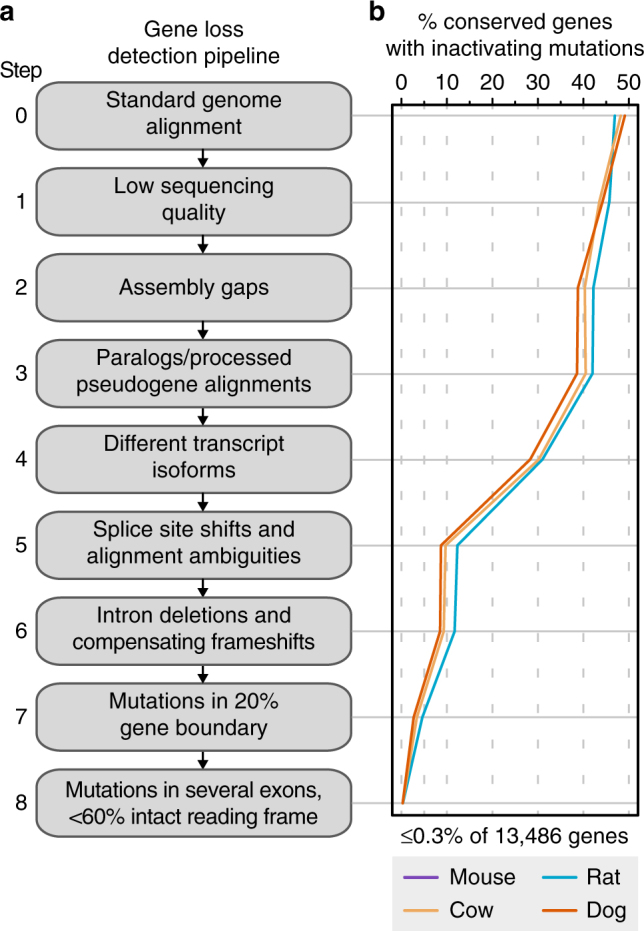
- The pipeline was applied to 62 placental mammals and 19,425 human genes; tested on 13,486 conserved genes, it incorrectly inferred loss for ≤0.33% (32–45) of them.
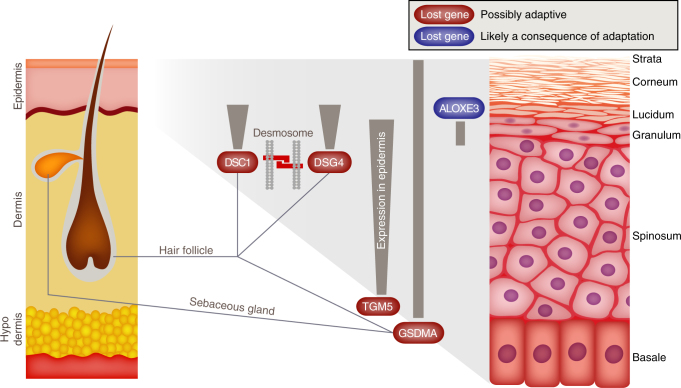
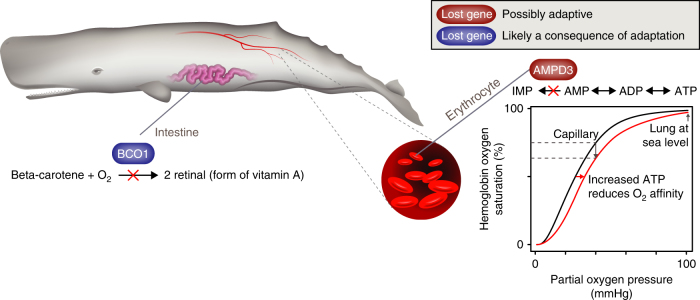
- Cetaceans lost epidermis/hair-related genes GSDMA, DSG4, DSC1, and TGM5, with ALOXE3 lost later; these losses may explain thicker epidermis, hair loss, and high stratum corneum shedding. Sperm whales lost AMPD3, whose mouse knockout increases erythrocyte ATP threefold, potentially improving O2 release for dives of 40–60 min to >400 m; BCO1 loss is likely a consequence of a squid/vitamin A-rich, beta-carotene-poor diet.
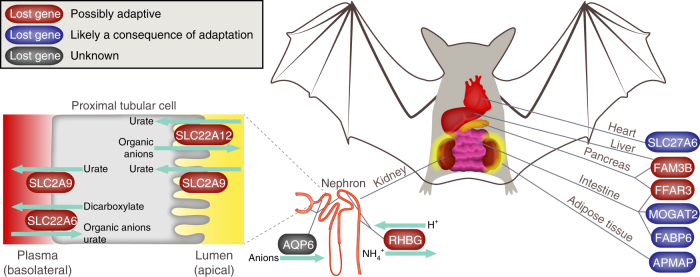
- Fruit bats lost renal transporters SLC22A12, SLC2A9, SLC22A6, RHBG, and AQP6 plus metabolic genes FFAR3, FAM3B, FATP6/SLC27A6, MOGAT2, FABP6, and APMAP (11 genes in Fig. 4), suggesting adaptations for excreting excess water/potassium while preserving sodium and for using sugar as a major energy source.
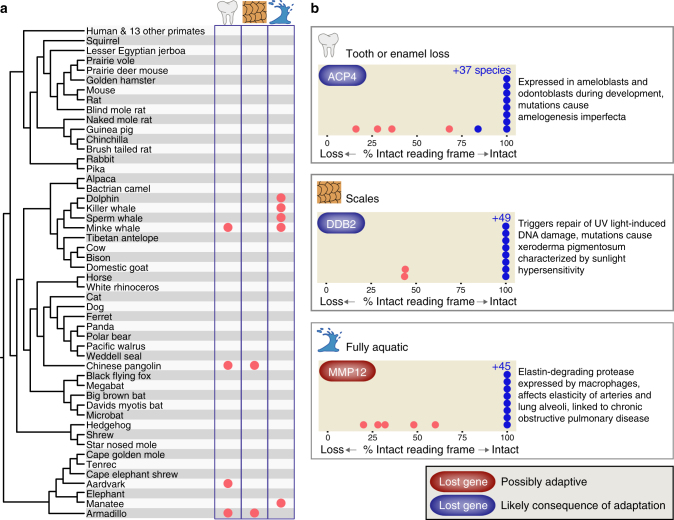
- Convergent losses included MMP20 and C4orf26 plus novel ACP4 in enamel-less mammals, DDB2 in armadillo and pangolin, and KLK8 and MMP12 in cetaceans and manatees; MMP12 loss may contribute to explosive exhalation, which renews ~90% of air in a single breath.
Methods
- Comparative genomics used human hg38/Ensembl 90 annotation and whole-genome alignments to 62 placental mammals, searching for frameshifting indels, premature stop codons, splice-site disruptions, and exon/gene deletions. Filters addressed assembly gaps, conserved synteny, CESAR re-alignment, APPRIS isoforms, and terminal 20% of proteins; loss candidates required %intact <60% and inactivating mutations in ≥20% of exons (or ≥2 mutations for single-exon transcripts).
- Gene losses were validated with unassembled SRA/trace reads requiring ≥10 exact-match raw reads; functional interpretation used GO, MGI mouse knockouts, HPO/OMIM, and InterPro. Loss dates were estimated with Ka/Ks and TimeTree divergence times.
- A new forward-genomics variant used %intact and phylogenetic generalized least squares (pGLS) to find genes preferentially lost in independent lineages sharing derived phenotypes, selecting genes with p < 10⁻⁶.
Limitations
- Stated: more research is necessary to validate whether adaptation by gene loss applies to complex multicellular organisms, not only bacteria; some species had missing data preventing %intact computation; the ACP4 mutation lacked unassembled sequencing reads for validation.
- Stated/evident: causal claims often rely on mouse knockout phenotypes, human disease associations, and dating rather than direct functional experiments in the studied mammals; DDB2 loss timing in armadillo is not well understood.
- Evident: custom scripts and generated datasets are available only on request from the corresponding author, limiting reproducibility.
Model-written summary. Check it against the paper before relying on it.
Integrity signals
Registry
Cites
Statistics
Figures
Verification
Claims the paper makes
40 Own interpretation · 14 No full text of the sources · 11 Supported · 11 Own result · 9 No basis given · 8 Partly supported · 7 Own method · 3 Supported so far · 1 Couldn’t confirm · 1 Sources not found · accuracy not yet measured
The sources with a verdict support this claim; the rest weren’t checked yet, have no full text we could read, or their verdicts aren’t rated yet.
In the paper
“Case studies investigating the fate of selected genes uncovered associations between gene losses and several mammalian phenotypes14–16.”
§ A genomics approach reveals insights into the importance of gene losses for mammalian adaptations > Introduction
What the sources say
- Supportedcites [14] Brawand, D., Wahli, W. & Kaessmann, H. Loss of egg yolk genes in mammals and the origin of lactation and placentation. PLoS Biol. 6, e63 (2008). source
The Abstract reports a case study of vitellogenin gene loss during mammalian evolution and links it to lactation and placentation. The Results/Discussion conclusion likewise associates loss of egg-yolk resources with the shift toward those forms of nourishment, consistent with the citing sentence’s claim of associations rather than causation. (LLM, conf=0.90)
- Not checked — no full text of the sourcecites [15] Meredith, R. W., Zhang, G., Gilbert, M. T., Jarvis, E. D. & Springer, M. S. Evidence for a single loss of mineralized teeth in the common avian ancestor. Science 346, 1254390 (2014). source
- Supportedcites [16] Fang, X. et al. Genome-wide adaptive complexes to underground stresses in blind mole rats Spalax. Nat. Commun. 5, 3966 (2014). source
The adaptation-to-darkness passage (p. 4) identifies 22 visual-system pseudogenes in blind mole rats and reports a contraction of the crystallin gene family potentially linked to degraded vision. It therefore provides a case study associating gene loss with a mammalian phenotype; the sentence’s broader reference to several phenotypes is supported by the citations collectively, not necessarily by this paper alone. (LLM, conf=0.87)
plaincorrelational- Asserted: passes — The authors put it forward as true.
- Checkable: passes — It can be checked against evidence.
- Load-bearing: passes — The paper’s conclusions depend on it.
- Based: passes — The paper gives a reason why it holds.
- Supported
Every source the paper cites for this claim was checked and supports it.
In the paper
“we validated stop codon mutations, splice site mutations, and frameshifting insertions/deletions with unassembled sequencing reads stored in the sequence read archive (SRA)65 or the NCBI trace archive.”
§ A genomics approach reveals insights into the importance of gene losses for mammalian adaptations > Methods > Genomics approach to detect gene loss events
What the sources say
- Supportedcites [65] Kodama, Y., Shumway, M. & Leinonen, R. International Nucleotide Sequence Database Collaboration. The sequence read archive: explosive growth of sequencing data. Nucleic Acids Res. 40, D54–D56 (2012). source
The citation is attached to the Sequence Read Archive (SRA), identifying the repository used by the citing authors, not attributing their mutation-validation results to this source. The paper’s ACCEPTED DATA section (page not supplied) identifies the SRA as a repository of raw sequence data. (LLM, conf=0.93)
plain- Asserted: passes — The authors put it forward as true.
- Checkable: passes — It can be checked against evidence.
- Load-bearing: passes — The paper’s conclusions depend on it.
- Based: passes — The paper gives a reason why it holds.
- Supported
The cited sources support only part of this claim — read each source’s verdict below.
In the paper
“Our results indicate that this ability is likely facilitated by the loss of SLC22A12 (URAT1), SLC2A9 (GLUT9), and SLC22A6 (OAT1), three renal transporter genes whose knockout in mice reduces urine osmolality31,32 (Fig. 4 and Supplementary Note 4).”
§ A genomics approach reveals insights into the importance of gene losses for mammalian adaptations > Results > Physiological and metabolic adaptations in fruit bats
What the sources say
- Not checked — no full text of the sourcecites [31] Eraly, S. A. et al. Multiple organic anion transporters contribute to net renal excretion of uric acid. Physiol. Genom. 33, 180–192 (2008). source
- Partly supportedcites [32] Preitner, F. et al. Glut9 is a major regulator of urate homeostasis and its genetic inactivation induces hyperuricosuria and urate nephropathy. Proc. Natl Acad. Sci. USA 106, 15501–15506 (2009). sourceExperimental — accuracy not yet measured
Split into 2 atoms — 0 confirmed, 2 partially supported, 0 disputed, 0 misattributed, 0 unverifiable. Expand the claim to see per-atom verdicts.
hedgedconditional- Asserted: passes — The authors put it forward as true.
- Checkable: passes — It can be checked against evidence.
- Load-bearing: passes — The paper’s conclusions depend on it.
- Based: passes — The paper gives a reason why it holds.
- Rests on an assumption: A gene loss that predates or coincides with the evolution of an adaptive phenotype and whose knockout phenotype resembles that phenotype likely contributed to the adaptation.
The sources with a verdict support this claim; the rest weren’t checked yet, have no full text we could read, or their verdicts aren’t rated yet.
In the paper
“The loss of FAM3B, encoding a cytokine that is co-secreted with insulin from pancreatic beta-cells39, may contribute to enhanced hepatic insulin sensitivity, as observed in FAM3B knockout mice40.”
§ A genomics approach reveals insights into the importance of gene losses for mammalian adaptations > Results > Physiological and metabolic adaptations in fruit bats
What the sources say
- Not checked — no full text of the sourcecites [39] Yang, J. et al. Mechanisms of glucose-induced secretion of pancreatic-derived factor (PANDER or FAM3B) in pancreatic beta-cells. Diabetes 54, 3217–3228 (2005). source
- Supportedcites [40] Moak, S. L. et al. Enhanced glucose tolerance in pancreatic-derived factor (PANDER) knockout C57BL/6 mice. Dis. Models Mech. 7, 1307–1315 (2014). source
The Discussion section on differences between knockout models reports increased hepatic insulin sensitivity in PANDER (FAM3B) knockout mice and enhanced hepatic Akt and AMPK phosphorylation in the C57BL/6 knockout model. This supports the citing sentence’s qualified claim that loss of FAM3B may contribute to enhanced hepatic insulin sensitivity. Page numbers are not provided in our copy. (LLM, conf=0.92)
hedgedconditional- Asserted: passes — The authors put it forward as true.
- Checkable: passes — It can be checked against evidence.
- Load-bearing: passes — The paper’s conclusions depend on it.
- Based: passes — The paper gives a reason why it holds.
Every source the paper cites for this claim was checked and supports it.
In the paper
“This “less is more” principle56 likely applies to the loss of genes involved in insulin signaling (FAM3B and FFAR3) and renal function (SLC22A12, SLC22A6, SLC2A9, and RHBG) in fruit bats”
§ A genomics approach reveals insights into the importance of gene losses for mammalian adaptations > Discussion
What the sources say
- Supportedcites [56] Olson, M. V. When less is more: gene loss as an engine of evolutionary change. Am. J. Hum. Genet. 64, 18–23 (1999). source
The citation is attached to the “less is more” principle. Olson proposes that adaptive gene loss is a major motif of molecular evolution and describes examples of organisms gaining conditional benefits by losing gene function. The proposed application to specific fruit-bat genes is the citing authors’ inference, not a finding attributed to Olson. (LLM, conf=0.93)
hedgedconditional- Asserted: passes — The authors put it forward as true.
- Checkable: passes — It can be checked against evidence.
- Load-bearing: passes — The paper’s conclusions depend on it.
- Based: passes — The paper gives a reason why it holds.
- Supported
The cited sources support only part of this claim — read each source’s verdict below.
In the paper
“Since placental mammals are separated by an evolutionary distance of ~0.5 or fewer substitutions per neutral site61”
§ A genomics approach reveals insights into the importance of gene losses for mammalian adaptations > Methods > Genomics approach to detect gene loss events
What the sources say
- Partly supportedcites [61] Hiller, M. et al. Computational methods to detect conserved non-genic elements in phylogenetically isolated genomes: application to zebrafish. Nucleic Acids Res. 41, e151 (2013). sourceExperimental — accuracy not yet measured
The Introduction’s Figure 1 caption identifies human and mouse as a comparatively close pair and describes evolutionary distances in neutral substitutions per site. The Discussion likewise uses the human–mouse distance as a benchmark, but the available text gives neither a value of ~0.5 nor an upper bound for placental mammals generally. (LLM, conf=0.78)
plain- Asserted: passes — The authors put it forward as true.
- Checkable: passes — It can be checked against evidence.
- Load-bearing: passes — The paper’s conclusions depend on it.
- Based: passes — The paper gives a reason why it holds.
- Partly supported
Every source the paper cites for this claim was checked and supports it.
In the paper
“The loss of FFAR3, encoding an insulin secretion inhibitor37, may explain why fruit bats secrete substantially more insulin than other mammals38.”
§ A genomics approach reveals insights into the importance of gene losses for mammalian adaptations > Results > Physiological and metabolic adaptations in fruit bats
What the sources say
- Supportedcites [37] Priyadarshini, M. & Layden, B. T. FFAR3 modulates insulin secretion and global gene expression in mouse islets. Islets 7, e1045182 (2015). source
Citation 37 is attached to the description of FFAR3 as an insulin-secretion inhibitor, not to the fruit-bat comparison, which carries citation 38. The Results report that wild-type mouse islets secreted less insulin than FFAR3-knockout islets, and the Discussion reports that FFAR3 activation inhibited glucose-stimulated insulin secretion. (LLM, conf=0.91)
- Supportedcites [38] Protzek, A. O. et al. Insulin and glucose sensitivity, insulin secretion and beta-cell distribution in endocrine pancreas of the fruit bat Artibeus lituratus. Comparative biochemistry and physiology. Comp. Biochem. Physiol. A Mol. Integr. Physiol. 157, 142–148 (2010). source
The Discussion reports that pancreas fragments from Artibeus lituratus released about 16% of their insulin content at basal glucose, compared with roughly 1–2% reported for human, rat, and mouse islets under the same conditions. That supports the comparative insulin-secretion claim attributed to this source. The proposed FFAR3 explanation is the citing authors’ hypothesis, not a finding of this paper. (LLM, conf=0.91)
hedgedconditional- Asserted: passes — The authors put it forward as true.
- Checkable: passes — It can be checked against evidence.
- Load-bearing: passes — The paper’s conclusions depend on it.
- Based: passes — The paper gives a reason why it holds.
- Supported
The cited sources support only part of this claim — read each source’s verdict below.
In the paper
“These studies also revealed that gene loss in humans or human individuals can be adaptive by enhancing protection against pathogenic bacteria or diseases such as plasmodium and HIV infections, and sepsis17–20.”
§ A genomics approach reveals insights into the importance of gene losses for mammalian adaptations > Introduction
What the sources say
- Partly supportedcites [17] Liu, R. et al. Homozygous defect in HIV-1 coreceptor accounts for resistance of some multiply-exposed individuals to HIV-1 infection. Cell 86, 367–377 (1996). sourceExperimental — accuracy not yet measured
The Abstract and Discussion report that a CKR-5 deletion appears to protect two multiply exposed individuals from HIV-1 infection. The Discussion also describes a loss-of-expression DARC allele that provides resistance to Plasmodium vivax, but treats a selective advantage for the CKR-5 deletion as possible rather than established. The paper does not address protection against pathogenic bacteria or sepsis. (LLM, conf=0.88)
- Not checked — no full text of the sourcecites [18] Singh, S. K., Hora, R., Belrhali, H., Chitnis, C. E. & Sharma, A. Structural basis for Duffy recognition by the malaria parasite Duffy-binding-like domain. Nature 439, 741–744 (2006). source
- Supportedcites [19] Wang, X., Grus, W. E. & Zhang, J. Gene losses during human origins. PLoS Biol. 4, e52 (2006). source
The Results/Discussion section reports evidence that loss of CASP12 was adaptive and associates its null allele with reduced incidence and mortality of severe sepsis. The Implications section describes a CCR5 null allele that protects against pathogens such as HIV and a Duffy null allele that probably confers resistance to malaria. These examples support the claim that gene loss can enhance protection, though the paper notes uncertainty about which pathogens drove selection of CCR5. (LLM, conf=0.90)
- Partly supportedcites [20] Wang, X. et al. Specific inactivation of two immunomodulatory SIGLEC genes during human evolution. Proc. Natl Acad. Sci. USA 109, 9935–9940 (2012). sourceExperimental — accuracy not yet measured
The paper reports that SIGLEC13 and SIGLEC17 became nonfunctional and proposes that bacterial pathogens may have selected for their loss (p. 1; Timing of SIGLEC Pseudogenization Events During Hominin Evolution, p. 4). It does not establish that the losses enhanced protection, and the cited passages do not support the claim’s specific examples of Plasmodium, HIV, or sepsis. (LLM, conf=0.86)
plaindirect- Asserted: passes — The authors put it forward as true.
- Checkable: passes — It can be checked against evidence.
- Load-bearing: unclear — It is unclear whether the paper’s conclusions depend on it.
- Based: passes — The paper gives a reason why it holds.
- Partly supported
The cited sources that could be checked couldn’t confirm or dispute this claim.
In the paper
“As a novel result, we detected the convergent loss of ACP4 (Fig. 5b and Supplementary Fig. 33), a gene that is associated with the enamel disorder amelogenesis imperfecta46.”
§ A genomics approach reveals insights into the importance of gene losses for mammalian adaptations > Results > Convergent gene loss and repeated phenotypic adaptations
What the sources say
- Could not verifycites [46] Seymen, F. et al. Recessive mutations in ACPT, encoding testicular acid phosphatase, cause hypoplastic amelogenesis imperfecta. Am. J. Hum. Genet. 99, 1199–1205 (2016). sourceExperimental — accuracy not yet measured
The supplied passage and searches for ACP4 and ACPT returned only a list of URLs, with no substantive passage or section/page information. Our accessible copy therefore does not establish whether ACP4 is associated with amelogenesis imperfecta. The convergent-loss finding is presented as the citing authors’ own result, not as a finding attributed to this source. (LLM, conf=0.70)
plaincorrelational- Asserted: passes — The authors put it forward as true.
- Checkable: passes — It can be checked against evidence.
- Load-bearing: passes — The paper’s conclusions depend on it.
- Based: passes — The paper gives a reason why it holds.
- Could not verify
Every source the paper cites for this claim was checked and supports it.
In the paper
“For example, the loss of FATP6 (SLC27A6) that transports fatty acids into cardiac myocytes41 indicates that sugars replace fatty acids as the major energy source in the heart.”
§ A genomics approach reveals insights into the importance of gene losses for mammalian adaptations > Results > Physiological and metabolic adaptations in fruit bats
What the sources say
- Supportedcites [41] Gimeno, R. E. et al. Characterization of a heart-specific fatty acid transport protein. J. Biol. Chem. 278, 16039–16044 (2003). source
Citation 41 is attached to the statement that FATP6 transports fatty acids into cardiac myocytes. The paper reports that FATP6 is localized to cardiac myocytes, enhances long-chain fatty-acid uptake when expressed in cells, and is involved in uptake in the heart (opening section; Discussion). The fruit-bat energy-source inference is outside the cited clause. (LLM, conf=0.91)
hedgeddirect- Asserted: passes — The authors put it forward as true.
- Checkable: passes — It can be checked against evidence.
- Load-bearing: passes — The paper’s conclusions depend on it.
- Based: passes — The paper gives a reason why it holds.
- Supported
- Probably not a substantial claim. 16
- It may state two separate claims as one. 29
The sources with a verdict support this claim; the rest weren’t checked yet, have no full text we could read, or their verdicts aren’t rated yet.
In the paper
“This approach takes the phylogenetic relatedness of the species as given by the phylogenetic tree into account.”
§ A genomics approach reveals insights into the importance of gene losses for mammalian adaptations > Methods > Forward genomics
What the sources say
- Supportedcites [9] Prudent, X., Parra, G., Schwede, P., Roscito, J. G. & Hiller, M. Controlling for phylogenetic relatedness and evolutionary rates improves the discovery of associations between species’ phenotypic and genomic differences. Mol. Biol. Evol. 33, 2135–2150 (2016). source
The Methods > GLS passage states that the method controls for relatedness between species by computing a covariance matrix from a phylogenetic tree. This directly supports the citing sentence. (LLM, conf=0.95)
- Not checked — no full text of the sourcecites [45] Freckleton, R. P., Harvey, P. H. & Pagel, M. Phylogenetic analysis and comparative data: a test and review of evidence. Am. Nat. 160, 712–726 (2002). source
plain- Asserted: passes — The authors put it forward as true.
- Checkable: passes — It can be checked against evidence.
- Load-bearing: passes — The paper’s conclusions depend on it.
- Based: passes — The paper gives a reason why it holds.
Probably not a substantial claim.
- Supported
Every source the paper cites for this claim was checked and supports it.
In the paper
“In bacteria, laboratory selection experiments demonstrated that gene loss is a frequent cause of adaptations to various environmental conditions21.”
§ A genomics approach reveals insights into the importance of gene losses for mammalian adaptations > Introduction
What the sources say
- Supportedcites [21] Hottes, A. K. et al. Bacterial adaptation through loss of function. PLoS Genet. 9, e1003617 (2013). source
The Introduction (page unavailable) reports that adaptive null mutations were abundant across fitness experiments covering 144 conditions. The Discussion (page unavailable) says the experiments and meta-analysis demonstrate that loss-of-function mutations aid adaptation to novel environments, including through gene deletions. The paper studies loss of gene function, rather than only physical removal of genes. (LLM, conf=0.89)
boosteddirect- Asserted: passes — The authors put it forward as true.
- Checkable: passes — It can be checked against evidence.
- Load-bearing: fails — The paper’s conclusions may not depend on it.
- Based: passes — The paper gives a reason why it holds.
Probably not a substantial claim. The paper’s conclusions may not depend on it.
- Supported
Every source the paper cites for this claim was checked and supports it.
In the paper
“Hyperactivity of MMP12 in the lung can be induced by cigarette smoke in humans and reduces the elasticity of alveoli, which contributes to an incomplete emptying of the lung in chronic obstructive pulmonary disease patients55.”
§ A genomics approach reveals insights into the importance of gene losses for mammalian adaptations > Results > Convergent gene loss and repeated phenotypic adaptations
What the sources say
- Supportedcites [55] Houghton, A. M. Matrix metalloproteinases in destructive lung disease. Matrix Biol. 44-46, 167–174 (2015). source
The MMP-12 section reports that cigarette smoking induces MMP12 expression in human alveolar macrophages and describes MMP12’s role in elastin degradation and emphysema. The Introduction explains that destruction of alveolar walls produces enlarged airspaces that empty more slowly, causing airflow obstruction in COPD. The paper does not directly measure alveolar elasticity in humans, but the claim is a reasonable paraphrase of the mechanism it describes. (LLM, conf=0.86)
plaindirect- Asserted: passes — The authors put it forward as true.
- Checkable: passes — It can be checked against evidence.
- Load-bearing: passes — The paper’s conclusions depend on it.
- Based: passes — The paper gives a reason why it holds.
It may state two separate claims as one.
- Supported
The cited sources support only part of this claim — read each source’s verdict below.
In the paper
“since N or C termini of proteins are generally less constrained in evolution23,24”
§ A genomics approach reveals insights into the importance of gene losses for mammalian adaptations > Methods > Genomics approach to detect gene loss events
What the sources say
- Partly supportedcites [23] MacArthur, D. G. et al. A systematic survey of loss-of-function variants in human protein-coding genes. Science 335, 823–828 (2012). sourceExperimental — accuracy not yet measured
In “Obtaining and filtering candidate LoF variants” (page unavailable), the paper reports greater tolerance of truncations near the 3′ end of coding sequences, which supports a narrower point about the C terminus. It also notes variants near the 5′ end but suggests that alternative-start-codon reinitiation may rescue them. It does not establish that both protein termini are generally less constrained in evolution. (LLM, conf=0.82)
- Partly supportedcites [24] Sharma, V., Elghafari, A. & Hiller, M. Coding exon-structure aware realigner (CESAR) utilizes genome alignments for accurate comparative gene annotation. Nucleic Acids Res. 44, e103 (2016). sourceExperimental — accuracy not yet measured
The Results section reports that frameshifts are enriched near protein N- and C-termini and says this suggests the termini are under less evolutionary constraint. The citing sentence presents that interpretation as a general fact, whereas the paper frames it as a suggestion from its observations. No page number is available in our copy. (LLM, conf=0.85)
plain- Asserted: passes — The authors put it forward as true.
- Checkable: passes — It can be checked against evidence.
- Load-bearing: passes — The paper’s conclusions depend on it.
- Based: passes — The paper gives a reason why it holds.
Probably not a substantial claim.
- Partly supported
Every source the paper cites for this claim was checked and supports it.
In the paper
“AMPD3 encodes an erythrocyte-specific enzyme whose knockout in mice increases the erythrocyte ATP level by threefold28.”
§ A genomics approach reveals insights into the importance of gene losses for mammalian adaptations > Results > Diving and dietary adaptations in sperm whales
What the sources say
- Supportedcites [28] O’Brien, W. G. 3rd, Berka, V., Tsai, A. L., Zhao, Z. & Lee, C. C. CD73 and AMPD3 deficiency enhance metabolic performance via erythrocyte ATP that decreases hemoglobin oxygen affinity. Sci. Rep. 5, 13147 (2015). source
The Discussion identifies AMPD3 as the erythrocyte-associated AMPD isoform, while noting low-level expression in other tissues. The Results report that erythrocyte ATP in Ampd3−/− mice was 2.8-fold higher than in wild-type mice, consistent with the claim’s approximate threefold increase. (LLM, conf=0.93)
plaindirect- Asserted: passes — The authors put it forward as true.
- Checkable: passes — It can be checked against evidence.
- Load-bearing: passes — The paper’s conclusions depend on it.
- Based: passes — The paper gives a reason why it holds.
It may state two separate claims as one.
- Supported
Every source the paper cites for this claim was checked and supports it.
In the paper
“Growing resources of well-characterized gene knockouts in mouse58 and other model organisms will further help to discover novel gene losses that are potential causes or consequences of phenotypic evolution.”
§ A genomics approach reveals insights into the importance of gene losses for mammalian adaptations > Discussion
What the sources say
- Supportedcites [58] Dickinson, M. E. et al. High-throughput discovery of novel developmental phenotypes. Nature 537, 508–514 (2016). source
The Introduction describes the IMPC’s systematic generation and phenotyping of a genome-wide collection of mouse knockouts, and the Abstract reports novel phenotypes from that effort. Because citation 58 follows “mouse,” it identifies the mouse knockout resource; the sentence’s prediction about phenotypic evolution is the citing authors’ own inference. (LLM, conf=0.91)
hedgedconditional- Asserted: passes — The authors put it forward as true.
- Checkable: fails — It may be too vague to check against evidence.
- Load-bearing: fails — The paper’s conclusions may not depend on it.
- Based: passes — The paper gives a reason why it holds.
Probably not a substantial claim. It may be too vague to check against evidence. The paper’s conclusions may not depend on it.
- Supported
Every source the paper cites for this claim was checked and supports it.
In the paper
“While the original forward genomics approach searches for genomic regions that have a higher nucleotide divergence in species that share an independently evolved phenotype6,9”
§ A genomics approach reveals insights into the importance of gene losses for mammalian adaptations > Methods > Forward genomics
What the sources say
- Supportedcites [6] Hiller, M. et al. A “forward genomics” approach links genotype to phenotype using independent phenotypic losses among related species. Cell Rep. 2, 817–823 (2012). source
The Results and Discussion section, “Measuring sequence divergence,” says the approach screens for genes or regions where all independently trait-loss species have diverged more from the ancestral sequence than all trait-preserving species. The Introduction explains why independent trait losses produce that divergence signature. No page numbers are provided in our copy. (LLM, conf=0.94)
- Supportedcites [9] Prudent, X., Parra, G., Schwede, P., Roscito, J. G. & Hiller, M. Controlling for phylogenetic relatedness and evolutionary rates improves the discovery of associations between species’ phenotypic and genomic differences. Mol. Biol. Evol. 33, 2135–2150 (2016). source
The Introduction describes the original Forward Genomics approach as a search for regions with higher sequence divergence in species with independently lost phenotypes. It also specifies that the earlier implementation sought regions where every trait-loss species had higher divergence than trait-preserving species. (LLM, conf=0.94)
plaincorrelational- Asserted: passes — The authors put it forward as true.
- Checkable: passes — It can be checked against evidence.
- Load-bearing: fails — The paper’s conclusions may not depend on it.
- Based: passes — The paper gives a reason why it holds.
Probably not a substantial claim. The paper’s conclusions may not depend on it.
- Supported
The cited sources support only part of this claim — read each source’s verdict below.
In the paper
“Since ATP is an allosteric effector that stabilizes O2-unloaded hemoglobin in vertebrates, the loss of AMPD3 results in a reduced O2 affinity of hemoglobin28.”
§ A genomics approach reveals insights into the importance of gene losses for mammalian adaptations > Results > Diving and dietary adaptations in sperm whales
What the sources say
- Partly supportedcites [28] O’Brien, W. G. 3rd, Berka, V., Tsai, A. L., Zhao, Z. & Lee, C. C. CD73 and AMPD3 deficiency enhance metabolic performance via erythrocyte ATP that decreases hemoglobin oxygen affinity. Sci. Rep. 5, 13147 (2015). sourceExperimental — accuracy not yet measured
The Results section, “Modulation of hemoglobin’s oxygen saturation by ATP” (page unavailable), reports that AMPD3-deficient erythrocytes have higher ATP and a higher hemoglobin p50, consistent with reduced oxygen affinity. The Discussion (page unavailable) also describes ATP binding to hemoglobin, but our copy does not establish the more specific mechanism that ATP stabilizes oxygen-unloaded hemoglobin across vertebrates. (LLM, conf=0.82)
plaindirect- Asserted: passes — The authors put it forward as true.
- Checkable: passes — It can be checked against evidence.
- Load-bearing: passes — The paper’s conclusions depend on it.
- Based: passes — The paper gives a reason why it holds.
It may state two separate claims as one.
- Partly supported
The cited sources support only part of this claim — read each source’s verdict below.
In the paper
“DDB2 detects pyrimidine dimers caused by UV light and triggers nucleotide excision DNA repair47.”
§ A genomics approach reveals insights into the importance of gene losses for mammalian adaptations > Results > Convergent gene loss and repeated phenotypic adaptations
What the sources say
- Partly supportedcites [47] Scrima, A. et al. Structural basis of UV DNA-damage recognition by the DDB1-DDB2 complex. Cell 135, 1213–1223 (2008). sourceExperimental — accuracy not yet measured
The Summary and “The overall structure of the DDB1-DDB2 complex” identify DDB2 as an early detector of UV-induced pyrimidine dimers in global-genome nucleotide excision repair. But the latter section says XPC-RAD23B’s arrival triggers recruitment of the repair machinery; it does not establish that DDB2 itself triggers repair. (LLM, conf=0.84)
plaindirect- Asserted: passes — The authors put it forward as true.
- Checkable: passes — It can be checked against evidence.
- Load-bearing: passes — The paper’s conclusions depend on it.
- Based: passes — The paper gives a reason why it holds.
It may state two separate claims as one.
- Partly supported
The cited sources support only part of this claim — read each source’s verdict below.
In the paper
“Previous studies that comprehensively discovered and characterized genes that are lost in humans and related primates were limited to the human genome19 or involved manual curation13,22, which prevents a large-scale application to many other species.”
§ A genomics approach reveals insights into the importance of gene losses for mammalian adaptations > Results > An approach to accurately detect gene loss events
What the sources say
- Partly supportedcites [19] Wang, X., Grus, W. E. & Zhang, J. Gene losses during human origins. PLoS Biol. 4, e52 (2006). sourceExperimental — accuracy not yet measured
The Results/Discussion section, “Identification of Human-Specific Pseudogenes” (page unavailable), describes a study that identified 67 human-specific pseudogenes through comparisons of human and chimpanzee sequences. The Materials and Methods section describes BLAT searches and gene-tree reconstruction, but our copy does not establish that this study involved manual curation or that manual curation prevented its application to many other species. The separate claim about work limited to the human genome is attached to a different citation. (LLM, conf=0.78)
- Could not verifycites [13] Zhang, Z. D., Frankish, A., Hunt, T., Harrow, J. & Gerstein, M. Identification and analysis of unitary pseudogenes: historic and contemporary gene losses in humans and other primates. Genome Biol. 11, R26 (2010). sourceExperimental — accuracy not yet measured
The sections on S. meliloti phenotypes and phenotype switching (page unavailable) discuss bacterial bet hedging, not gene loss in humans or other primates. Searches for human-genome gene loss and manual curation found no passage addressing the claimed limits on large-scale application. (LLM, conf=0.78)
- Supportedcites [22] Zhu, J. et al. Comparative genomics search for losses of long-established genes on the human lineage. PLoS Comput. Biol. 3, e247 (2007). source
The Introduction says this study identified gene losses in the human lineage, and the Discussion says its analysis identified losses in the human genome. That supports the part attached to this citation: the study focused on human gene losses. The manual-curation claim is attached to other citations. (LLM, conf=0.92)
plaindirect- Asserted: passes — The authors put it forward as true.
- Checkable: passes — It can be checked against evidence.
- Load-bearing: passes — The paper’s conclusions depend on it.
- Based: passes — The paper gives a reason why it holds.
It may state two separate claims as one.
- Partly supported
A result the paper reports from its own data — it cites no other source for it, so there is none to check. The quote shows it is in the paper.
In the paper
“Notably, many of the reported genes have gene-inactivating mutations that are shared between two or more independently assembled species (such as four cetaceans or two fruit bats), which further supports that these gene-inactivating mutations are real.”
§ A genomics approach reveals insights into the importance of gene losses for mammalian adaptations > Methods > Genomics approach to detect gene loss events
plaincorrelational- Asserted: passes — The authors put it forward as true.
- Checkable: passes — It can be checked against evidence.
- Load-bearing: passes — The paper’s conclusions depend on it.
- Based: passes — The paper gives a reason why it holds.
It may state two separate claims as one.
A result the paper reports from its own data — it cites no other source for it, so there is none to check. The quote shows it is in the paper.
In the paper
“We detected the loss of AMPD3, estimated to have happened soon after the sperm whale lineage split from other toothed whales (Supplementary Note 2, Supplementary Fig. 19, and Supplementary Table 5).”
§ A genomics approach reveals insights into the importance of gene losses for mammalian adaptations > Results > Diving and dietary adaptations in sperm whales
hedged- Asserted: passes — The authors put it forward as true.
- Checkable: passes — It can be checked against evidence.
- Load-bearing: passes — The paper’s conclusions depend on it.
- Based: passes — The paper gives a reason why it holds.
It may state two separate claims as one.
A result the paper reports from its own data — it cites no other source for it, so there is none to check. The quote shows it is in the paper.
In the paper
“Supporting this, MMP12 loss predates the split of the fully aquatic toothed and baleen whale lineages and happened early in the fully aquatic sirenia (manatee) lineage (Supplementary Table 5).”
§ A genomics approach reveals insights into the importance of gene losses for mammalian adaptations > Results > Convergent gene loss and repeated phenotypic adaptations
plain- Asserted: passes — The authors put it forward as true.
- Checkable: passes — It can be checked against evidence.
- Load-bearing: passes — The paper’s conclusions depend on it.
- Based: passes — The paper gives a reason why it holds.
It may state two separate claims as one.
The paper states this without a source or data behind it here, so there is nothing to check it against. The quote shows it is in the paper.
In the paper
“In addition, we discovered the loss of MMP12 (Fig. 5, Supplementary Note 8, Supplementary Fig. 35, and Supplementary Table 8), which provides the first insights into the molecular mechanism underlying a unique breathing adaptation.”
§ A genomics approach reveals insights into the importance of gene losses for mammalian adaptations > Results > Convergent gene loss and repeated phenotypic adaptations
plaindirect- Asserted: passes — The authors put it forward as true.
- Checkable: passes — It can be checked against evidence.
- Load-bearing: passes — The paper’s conclusions depend on it.
- Based: passes — The paper gives a reason why it holds.
It may state two separate claims as one.
A result the paper reports from its own data — it cites no other source for it, so there is none to check. The quote shows it is in the paper.
In the paper
“We applied this approach to 62 placental mammals (Supplementary Table 2), which uncovered many known gene losses as well as numerous novel ones (Supplementary Table 3 and Supplementary Fig. 12).”
§ A genomics approach reveals insights into the importance of gene losses for mammalian adaptations > Results > Detecting gene loss events in placental mammals
plain- Asserted: passes — The authors put it forward as true.
- Checkable: passes — It can be checked against evidence.
- Load-bearing: passes — The paper’s conclusions depend on it.
- Based: passes — The paper gives a reason why it holds.
It may state two separate claims as one.
In the paper
“This diet poses the challenge of excreting excess dietary water while preserving scarce electrolytes, which bats address by producing a very dilute urine30.”
§ A genomics approach reveals insights into the importance of gene losses for mammalian adaptations > Results > Physiological and metabolic adaptations in fruit bats
What the sources say
- Not checked — no full text of the sourcecites [30] Arad, Z. & Korine, C. Effect of water restriction on energy and water balance and osmoregulation of the fruit bat Rousettus aegyptiacus. J. Comp. Physiol. B Biochem. Syst. Environ. Physiol. 163, 401–405 (1993). source
plaindirect- Asserted: passes — The authors put it forward as true.
- Checkable: passes — It can be checked against evidence.
- Load-bearing: passes — The paper’s conclusions depend on it.
- Based: passes — The paper gives a reason why it holds.
It may state two separate claims as one.
A conclusion the paper draws from its own results — it cites no other source for it, so there is none to check. The quote shows it is in the paper.
In the paper
“In summary, several fruit bat-specific gene losses reveal new insights into the metabolism of fruit bats and suggest that gene loss could be a genetic mechanism involved in metabolic and physiological adaptations to a frugivorous diet.”
§ A genomics approach reveals insights into the importance of gene losses for mammalian adaptations > Results > Physiological and metabolic adaptations in fruit bats
hedgedconditional- Asserted: passes — The authors put it forward as true.
- Checkable: passes — It can be checked against evidence.
- Load-bearing: passes — The paper’s conclusions depend on it.
- Based: passes — The paper gives a reason why it holds.
It may state two separate claims as one.
What the paper did — it cites no source for this, so there is none to check. The quote shows it is in the paper.
In the paper
“To test the error rate of the approach, we applied it to a set of genes that are conserved between human and mouse/rat/dog/cow.”
§ A genomics approach reveals insights into the importance of gene losses for mammalian adaptations > Methods > Genomics approach to detect gene loss events
plain- Asserted: passes — The authors put it forward as true.
- Checkable: passes — It can be checked against evidence.
- Load-bearing: passes — The paper’s conclusions depend on it.
- Based: passes — The paper gives a reason why it holds.
Probably not a substantial claim.
A conclusion the paper draws from its own results — it cites no other source for it, so there is none to check. The quote shows it is in the paper.
In the paper
“Since the loss of these genes predated or coincided with the split of the cetacean ancestor (Supplementary Note 1, Supplementary Figs. 14–17, and Supplementary Table 5), these gene losses could have contributed to the remodeling of the cetacean epidermis morphology.”
§ A genomics approach reveals insights into the importance of gene losses for mammalian adaptations > Results > Epidermal adaptations in cetaceans
hedgedconditional- Asserted: passes — The authors put it forward as true.
- Checkable: passes — It can be checked against evidence.
- Load-bearing: passes — The paper’s conclusions depend on it.
- Based: passes — The paper gives a reason why it holds.
It may state two separate claims as one.
- Rests on an assumption: A gene loss that predates or coincides with the evolution of an adaptive phenotype and whose knockout phenotype resembles that phenotype likely contributed to the adaptation.
In the paper
“Remarkably, crocodiles that can stay submerged for over an hour also show a reduced O2 affinity of hemoglobin; however, this reduction is mediated by bicarbonate ions (HCO3−) instead of ATP29.”
§ A genomics approach reveals insights into the importance of gene losses for mammalian adaptations > Results > Diving and dietary adaptations in sperm whales
What the sources say
- Not checked — no full text of the sourcecites [29] Komiyama, N. H., Miyazaki, G., Tame, J. & Nagai, K. Transplanting a unique allosteric effect from crocodile into human haemoglobin. Nature 373, 244–246 (1995). source
plaindirect- Asserted: passes — The authors put it forward as true.
- Checkable: passes — It can be checked against evidence.
- Load-bearing: unclear — It is unclear whether the paper’s conclusions depend on it.
- Based: passes — The paper gives a reason why it holds.
It may state two separate claims as one.
A conclusion the paper draws from its own results — it cites no other source for it, so there is none to check. The quote shows it is in the paper.
In the paper
“As the scales of these two species have different developmental origins (made of keratin in pangolins and bone in armadillos), it is unlikely to find gene losses that play a causal role in scale formation; instead, forward genomics may identify genes that are lost as a consequence of scale evolution, which could reveal unknown aspects related to body armor.”
§ A genomics approach reveals insights into the importance of gene losses for mammalian adaptations > Results > Convergent gene loss and repeated phenotypic adaptations
hedgedconditional- Asserted: passes — The authors put it forward as true.
- Checkable: passes — It can be checked against evidence.
- Load-bearing: passes — The paper’s conclusions depend on it.
- Based: passes — The paper gives a reason why it holds.
It may state two separate claims as one.
The paper states this without a source or data behind it here, so there is nothing to check it against. The quote shows it is in the paper.
In the paper
“which is one of the deepest and longest diving mammals that routinely dives for 40–60 min to depths of >400 m.”
§ A genomics approach reveals insights into the importance of gene losses for mammalian adaptations > Results > Diving and dietary adaptations in sperm whales
plain- Asserted: passes — The authors put it forward as true.
- Checkable: passes — It can be checked against evidence.
- Load-bearing: passes — The paper’s conclusions depend on it.
- Based: passes — The paper gives a reason why it holds.
Probably not a substantial claim.
The paper states this without a source or data behind it here, so there is nothing to check it against. The quote shows it is in the paper.
In the paper
“If the loss of an existing (ancestral) gene would increase fitness by making a species better adapted to its environment, then gene loss is an easy solution to an evolutionary problem, because coding genes provide numerous positions for random mutations to inactivate them.”
§ A genomics approach reveals insights into the importance of gene losses for mammalian adaptations > Discussion
hedgeddirect- Asserted: passes — The authors put it forward as true.
- Checkable: passes — It can be checked against evidence.
- Load-bearing: passes — The paper’s conclusions depend on it.
- Based: passes — The paper gives a reason why it holds.
It may state two separate claims as one.
In the paper
“However, it is largely unknown whether gene loss could also play an important role for natural phenotypic adaptations in non-human mammals11.”
§ A genomics approach reveals insights into the importance of gene losses for mammalian adaptations > Introduction
What the sources say
- Not checked — no full text of the sourcecites [11] Albalat, R. & Canestro, C. Evolution by gene loss. Nat. Rev. Genet. 17, 379–391 (2016). source
hedged- Asserted: passes — The authors put it forward as true.
- Checkable: passes — It can be checked against evidence.
- Load-bearing: passes — The paper’s conclusions depend on it.
- Based: passes — The paper gives a reason why it holds.
Probably not a substantial claim.
A conclusion the paper draws from its own results — it cites no other source for it, so there is none to check. The quote shows it is in the paper.
In the paper
“Our study highlights the power of comparative genomics to reveal insights into the genomic basis of complex adaptive phenotypes.”
§ A genomics approach reveals insights into the importance of gene losses for mammalian adaptations > Discussion
plain- Asserted: passes — The authors put it forward as true.
- Checkable: fails — It may be too vague to check against evidence.
- Load-bearing: passes — The paper’s conclusions depend on it.
- Based: passes — The paper gives a reason why it holds.
Probably not a substantial claim. It may be too vague to check against evidence.
The paper states this without a source or data behind it here, so there is nothing to check it against. The quote shows it is in the paper.
In the paper
“since loss of a gene in a query species requires that this gene should have been present in the common ancestor of human and query”
§ A genomics approach reveals insights into the importance of gene losses for mammalian adaptations > Methods > Genomics approach to detect gene loss events
plaindirect- Asserted: passes — The authors put it forward as true.
- Checkable: passes — It can be checked against evidence.
- Load-bearing: passes — The paper’s conclusions depend on it.
- Based: fails — The paper may give no reason why it holds.
Probably not a substantial claim. The paper may give no reason why it holds.
A conclusion the paper draws from its own results — it cites no other source for it, so there is none to check. The quote shows it is in the paper.
In the paper
“fruit bats as dietary specialists might be limited in their ability to return to a generalist state by adapting to a different diet”
§ A genomics approach reveals insights into the importance of gene losses for mammalian adaptations > Discussion
hedgedconditional- Asserted: passes — The authors put it forward as true.
- Checkable: passes — It can be checked against evidence.
- Load-bearing: passes — The paper’s conclusions depend on it.
- Based: passes — The paper gives a reason why it holds.
Probably not a substantial claim.
What the paper did — it cites no source for this, so there is none to check. The quote shows it is in the paper.
In the paper
“we employed additional filters to exclude cases where exon–intron structures of conserved genes have changed in evolution.”
§ A genomics approach reveals insights into the importance of gene losses for mammalian adaptations > Methods > Genomics approach to detect gene loss events
plain- Asserted: passes — The authors put it forward as true.
- Checkable: passes — It can be checked against evidence.
- Load-bearing: passes — The paper’s conclusions depend on it.
- Based: passes — The paper gives a reason why it holds.
Probably not a substantial claim.
A conclusion the paper draws from its own results — it cites no other source for it, so there is none to check. The quote shows it is in the paper.
In the paper
“Hence, the concept of adaptation by gene loss has great potential to uncover the molecular mechanisms underlying the evolution of a wide range of adaptive phenotypes, which will deepen our understanding of how nature’s fascinating phenotypic diversity has evolved.”
§ A genomics approach reveals insights into the importance of gene losses for mammalian adaptations > Discussion
plainconditional- Asserted: passes — The authors put it forward as true.
- Checkable: fails — It may be too vague to check against evidence.
- Load-bearing: passes — The paper’s conclusions depend on it.
- Based: passes — The paper gives a reason why it holds.
Probably not a substantial claim. It may be too vague to check against evidence. It may state two separate claims as one.
In the paper
“Mutations in human and mouse DDB2 compromise DNA repair and cause xeroderma pigmentosum48, a disease characterized by hypersensitivity to sunlight.”
§ A genomics approach reveals insights into the importance of gene losses for mammalian adaptations > Results > Convergent gene loss and repeated phenotypic adaptations
What the sources say
- Not checked — no full text of the sourcecites [48] Rapic-Otrin, V. et al. True XP group E patients have a defective UV-damaged DNA binding protein complex and mutations in DDB2 which reveal the functional domains of its p48 product. Hum. Mol. Genet. 12, 1507–1522 (2003). source
plaindirect- Asserted: passes — The authors put it forward as true.
- Checkable: passes — It can be checked against evidence.
- Load-bearing: passes — The paper’s conclusions depend on it.
- Based: passes — The paper gives a reason why it holds.
It may state two separate claims as one.
What the paper did — it cites no source for this, so there is none to check. The quote shows it is in the paper.
In the paper
“To exclude potential artifacts that can mimic real gene-inactivating mutations, we employed a series of filters.”
§ A genomics approach reveals insights into the importance of gene losses for mammalian adaptations > Methods > Genomics approach to detect gene loss events
plain- Asserted: passes — The authors put it forward as true.
- Checkable: passes — It can be checked against evidence.
- Load-bearing: passes — The paper’s conclusions depend on it.
- Based: passes — The paper gives a reason why it holds.
Probably not a substantial claim.
A conclusion the paper draws from its own results — it cites no other source for it, so there is none to check. The quote shows it is in the paper.
In the paper
“Overall, our analysis shows that several gene losses may have contributed to or are a consequence of different types (morphological, physiological, and metabolic) of adaptations in different mammalian lineages, suggesting that gene losses play an integral role in phenotypic evolution in mammals.”
§ A genomics approach reveals insights into the importance of gene losses for mammalian adaptations > Results > Physiological and metabolic adaptations in fruit bats
hedgedconditional- Asserted: passes — The authors put it forward as true.
- Checkable: passes — It can be checked against evidence.
- Load-bearing: passes — The paper’s conclusions depend on it.
- Based: passes — The paper gives a reason why it holds.
It may state two separate claims as one.
A conclusion the paper draws from its own results — it cites no other source for it, so there is none to check. The quote shows it is in the paper.
In the paper
“Together, the loss of AMPD3 and BCO1 in sperm whales suggest that gene losses can be both causally involved in adaptations and can be a consequence of relaxed selection after adaptations.”
§ A genomics approach reveals insights into the importance of gene losses for mammalian adaptations > Results > Diving and dietary adaptations in sperm whales
hedgedconditionalSingle case- Asserted: passes — The authors put it forward as true.
- Checkable: passes — It can be checked against evidence.
- Load-bearing: passes — The paper’s conclusions depend on it.
- Based: passes — The paper gives a reason why it holds.
It may state two separate claims as one.
A claim is checked only against the cited paper’s full text, never its abstract, and none is available for its sources.
In the paper
“The so-called “explosive exhalation” allows cetaceans and manatees to renew ~90% of the air in a single breath51, and is advantageous for fully aquatic mammals by clearing the blowhole/nostrils before inhaling and by minimizing time at the surface, where wave drag slows swimming52.”
§ A genomics approach reveals insights into the importance of gene losses for mammalian adaptations > Results > Convergent gene loss and repeated phenotypic adaptations
What the sources say
- Not checked — no full text of the sourcecites [51] Berta, A., Sumich, J. L., Kovacs, K. M., Folkens, P. A. & Adam, P. J. in Marine Mammals 2nd edn 237–269 (Academic Press, San Diego, 2006). source
- Not checked — no full text of the sourcecites [52] Kooyman, G. L. & Cornell, L. H. Flow properties of expiration and inspiration in a trained bottle-nosed porpoise. Physiol. Zool. 54, 55–61 (1981). source
plaindirect- Asserted: passes — The authors put it forward as true.
- Checkable: passes — It can be checked against evidence.
- Load-bearing: passes — The paper’s conclusions depend on it.
- Based: passes — The paper gives a reason why it holds.
It may state two separate claims as one.
A conclusion the paper draws from its own results — it cites no other source for it, so there is none to check. The quote shows it is in the paper.
In the paper
“Our approach has broad applicability to generate high-quality gene loss catalogs for the forthcoming “flood of genomes”, of both mammals and other species.”
§ A genomics approach reveals insights into the importance of gene losses for mammalian adaptations > Discussion
plain- Asserted: passes — The authors put it forward as true.
- Checkable: fails — It may be too vague to check against evidence.
- Load-bearing: fails — The paper’s conclusions may not depend on it.
- Based: passes — The paper gives a reason why it holds.
Probably not a substantial claim. It may be too vague to check against evidence. The paper’s conclusions may not depend on it.
A conclusion the paper draws from its own results — it cites no other source for it, so there is none to check. The quote shows it is in the paper.
In the paper
“This reveals a number of previously unknown gene losses that are likely a consequence of adaptations or may contribute to adaptations that evolved in individual or even in multiple mammalian lineages.”
§ A genomics approach reveals insights into the importance of gene losses for mammalian adaptations > Introduction
hedgedconditional- Asserted: passes — The authors put it forward as true.
- Checkable: passes — It can be checked against evidence.
- Load-bearing: passes — The paper’s conclusions depend on it.
- Based: passes — The paper gives a reason why it holds.
It may state two separate claims as one.
The paper states this without a source or data behind it here, so there is nothing to check it against. The quote shows it is in the paper.
In the paper
“Sperm whales feed predominantly on squid that contain no or very little beta-carotene, but are rich in vitamin A.”
§ A genomics approach reveals insights into the importance of gene losses for mammalian adaptations > Results > Diving and dietary adaptations in sperm whales
plain- Asserted: passes — The authors put it forward as true.
- Checkable: passes — It can be checked against evidence.
- Load-bearing: passes — The paper’s conclusions depend on it.
- Based: unclear — It is unclear why the paper says it holds.
It may state two separate claims as one.
A conclusion the paper draws from its own results — it cites no other source for it, so there is none to check. The quote shows it is in the paper.
In the paper
“This “use it or lose it” principle could explain the loss of enzymes whose substrate is scarcely available (sperm whale BCO1), the loss of genes involved in fat digestion in species with a fat-poor diet (fruit bat MOGAT2 and FABP6), and the loss of the amelogenesis-involved ACP4 in enamel-less species.”
§ A genomics approach reveals insights into the importance of gene losses for mammalian adaptations > Discussion
hedgedconditional- Asserted: passes — The authors put it forward as true.
- Checkable: passes — It can be checked against evidence.
- Load-bearing: passes — The paper’s conclusions depend on it.
- Based: passes — The paper gives a reason why it holds.
It may state two separate claims as one.
What the paper did — it cites no source for this, so there is none to check. The quote shows it is in the paper.
In the paper
“Together, these measures avoid assembly and alignment issues, and address evolutionary exon–intron structure changes in genes that are conserved.”
§ A genomics approach reveals insights into the importance of gene losses for mammalian adaptations > Methods > Genomics approach to detect gene loss events
plaindirect- Asserted: passes — The authors put it forward as true.
- Checkable: passes — It can be checked against evidence.
- Load-bearing: passes — The paper’s conclusions depend on it.
- Based: passes — The paper gives a reason why it holds.
It may state two separate claims as one.
A conclusion the paper draws from its own results — it cites no other source for it, so there is none to check. The quote shows it is in the paper.
In the paper
“The presented gene loss-based forward genomics approach can be applied to detect new associations between gene losses and convergent phenotypes.”
§ A genomics approach reveals insights into the importance of gene losses for mammalian adaptations > Discussion
plaincorrelational- Asserted: passes — The authors put it forward as true.
- Checkable: passes — It can be checked against evidence.
- Load-bearing: passes — The paper’s conclusions depend on it.
- Based: passes — The paper gives a reason why it holds.
Probably not a substantial claim.
A conclusion the paper draws from its own results — it cites no other source for it, so there is none to check. The quote shows it is in the paper.
In the paper
“In this study, we showed that evolutionary gene losses are not only a consequence, but may also be causally involved in phenotypic adaptations.”
§ A genomics approach reveals insights into the importance of gene losses for mammalian adaptations > Discussion
hedgedconditional- Asserted: passes — The authors put it forward as true.
- Checkable: passes — It can be checked against evidence.
- Load-bearing: passes — The paper’s conclusions depend on it.
- Based: passes — The paper gives a reason why it holds.
It may state two separate claims as one.
In the paper
“While DDB2 loss in armadillo, a lineage where the timing of scale evolution is not well understood, appears to be relatively old, the gene loss in pangolin most likely happened after the evolution of scales49 (Supplementary Table 5), which suggests that DDB2 loss is a consequence of body armor evolution in that lineage.”
§ A genomics approach reveals insights into the importance of gene losses for mammalian adaptations > Results > Convergent gene loss and repeated phenotypic adaptations
What the sources say
- Not matchedcites [49] von Koenigswald, W., Richter, G. & Storch, G. Nachweis von Hornschuppen bei Eomanis waldi aus der “Grube Messe!” bei Darmstadt (Mammalia, Pholidota). Senckenberg. lethaea 61, 291–298 (1981).
Couldn’t be matched to a paper in Crossref, so it can’t be checked.
hedgedconditionalSingle case- Asserted: passes — The authors put it forward as true.
- Checkable: passes — It can be checked against evidence.
- Load-bearing: passes — The paper’s conclusions depend on it.
- Based: passes — The paper gives a reason why it holds.
It may state two separate claims as one.
- Rests on an assumption: The timing of gene loss relative to the evolution of an adaptive phenotype can distinguish whether the loss contributed to or was a consequence of the adaptation.
- Not matched
A conclusion the paper draws from its own results — it cites no other source for it, so there is none to check. The quote shows it is in the paper.
In the paper
“The cetacean-specific loss of ALOXE3, an atypical lipoxygenase that is important for skin barrier function, happened after the split of the baleen and toothed whale lineage (Supplementary Fig. 18 and Supplementary Table 5) and is thus presumably a consequence of epidermal adaptations in these lineages”
§ A genomics approach reveals insights into the importance of gene losses for mammalian adaptations > Results > Epidermal adaptations in cetaceans
hedgedconditional- Asserted: passes — The authors put it forward as true.
- Checkable: passes — It can be checked against evidence.
- Load-bearing: unclear — It is unclear whether the paper’s conclusions depend on it.
- Based: passes — The paper gives a reason why it holds.
It may state two separate claims as one.
- Rests on an assumption: The timing of gene loss relative to the evolution of an adaptive phenotype can distinguish whether the loss contributed to or was a consequence of the adaptation.
A conclusion the paper draws from its own results — it cites no other source for it, so there is none to check. The quote shows it is in the paper.
In the paper
“By making use of existing gene knockouts in mouse or loss-of-function mutations in human individuals and by dating gene loss events, we discovered a number of previously unknown gene losses (Supplementary Fig. 13 and Supplementary Table 4), some of which may have contributed to morphological, physiological, and metabolic adaptations in mammals, while others are likely a consequence of adaptive ev”
§ A genomics approach reveals insights into the importance of gene losses for mammalian adaptations > Results > Detecting gene loss events in placental mammals
hedgedconditional- Asserted: passes — The authors put it forward as true.
- Checkable: passes — It can be checked against evidence.
- Load-bearing: passes — The paper’s conclusions depend on it.
- Based: passes — The paper gives a reason why it holds.
It may state two separate claims as one.
- Rests on an assumption: A gene loss that predates or coincides with the evolution of an adaptive phenotype and whose knockout phenotype resembles that phenotype likely contributed to the adaptation.
- Rests on an assumption: The timing of gene loss relative to the evolution of an adaptive phenotype can distinguish whether the loss contributed to or was a consequence of the adaptation.
The paper relies on this without support.
A gene loss that predates or coincides with the evolution of an adaptive phenotype and whose knockout phenotype resembles that phenotype likely contributed to the adaptation.
“If a gene loss event contributed to an adaptation, we expect that loss-of-function mutations introduced in a related model organism result in phenotypes that are highly similar to the naturally occurring adaptive phenotype and that the age of the gene loss coincides with a period during which this adaptation evolved.”
The paper relies on this without support.
Mouse knockout phenotypes for a gene reflect the phenotypic consequences of its loss in the natural species.
“Mice in which GSDMA, DSG4, or DSC1 are knocked out exhibit key aspects of the cetacean skin morphology, in particular a thicker epidermis and loss of hair.”
The paper relies on this without support.
The timing of gene loss relative to the evolution of an adaptive phenotype can distinguish whether the loss contributed to or was a consequence of the adaptation.
“Based on the following rationale, we distinguished between gene losses that may have contributed to an adaptation and those that are likely a consequence of the evolution of an adaptive phenotype.”
The paper relies on this without support.
Big insertions or deletions (indels) are rare in conserved genes.
“Since big insertions or deletions (indels) are rare in conserved genes, we also considered frame-preserving indels longer than 50 bp as an inactivating mutation.”
The authors state this as an assumption.
A gene evolved under a selective pressure similar to that in other species until it was inactivated.
“this approach makes the assumption that a gene evolved under a selective pressure similar to that in other species until it was inactivated.”
The authors state this as an assumption.
After the loss, the gene evolves neutrally and accumulates synonymous and non-synonymous mutations at an equal rate.
“After the loss, the gene is assumed to evolve neutrally and should accumulate synonymous and non-synonymous mutations at an equal rate.”
Claims other papers make about this one
Each is checked against this paper’s own text: does it say what the citing paper says it does?
The cited source says what the claim attributes to it.
In the citing paper
“Distinguishing orthologs and paralogs is a fundamental problem in evolutionary and molecular biology (1) and a prerequisite for many genomic analyses, including reconstructing phylogenetic trees, predicting gene function, investigating molecular and genome evolution, and discovering differences in genes that underlie phenotypes of the sequenced species (2–6).”
From Integrating gene annotation with orthology inference at scale (2023) · cites this paper as [5]
The cited source says what the claim attributes to it.
In the citing paper
“The latter requirement is motivated by previous observations that mutations in a single exon of an otherwise-conserved gene are not sufficient to infer gene loss (5).”
From Integrating gene annotation with orthology inference at scale (2023) · cites this paper as [5]
The cited source says what the claim attributes to it.
In the citing paper
“Transcript classification is not a straightforward problem, as assembly gaps result in missing parts of the CDS and individual exons can get lost in otherwise clearly conserved genes, as shown in previous work (5).”
From Integrating gene annotation with orthology inference at scale (2023) · cites this paper as [5]
Citations
Cites
Liu, R., Paxton, W. A., Choe, S., Ceradini, D., Martin, S. R., Horuk, R., MacDonald, M. E., Stuhlmann, H., Koup, R. A., & Landau, N. R. (1996) · Cell · doi:10.1016/s0092-8674(00)80110-5 · Cited by 3,074
Amberger, J. S., Bocchini, C. A., Schiettecatte, F., Scott, A. F., & Hamosh, A. (2015) · Nucleic Acids Research · doi:10.1093/nar/gku1205 · Cited by 2,691
Phylogenetic Analysis and Comparative Data: A Test and Review of Evidence
Freckleton, R. P., Harvey, P. H., & Pagel, M. (2002) · The American Naturalist · doi:10.1086/343873 · Cited by 2,604
Expansion of the Gene Ontology knowledgebase and resources
The Gene Ontology Consortium (2017) · Nucleic Acids Research · doi:10.1093/nar/gkw1108 · Cited by 1,850
The genomic basis of adaptive evolution in threespine sticklebacks
Jones, F. C., Grabherr, M. G., Chan, Y. F., Russell, P. H., Mauceli, E., Johnson, J., Swofford, R., Pirun, M., Zody, M. C., White, S. J., et al. (2012) · Nature · doi:10.1038/nature10944 · Cited by 1,793
Ensembl BioMarts: a hub for data retrieval across taxonomic space
Kinsella, R. J., Kähäri, A., Haider, S., Zamora, J., Proctor, G., Spudich, G. M., Almeida, J. P., Staines, D. M., Derwent, P., Kerhornou, A., et al. (2011) · Database · doi:10.1093/database/bar030 · Cited by 1,471
InterPro in 2017—beyond protein family and domain annotations
Finn, R. D., Attwood, T. K., Babbitt, P. C., Bateman, A. G., Peer Bork, B., Bridge, A. J., Chang, H.-Y., Dosztányi, Z., El-Gebali, S., Fraser, M., et al. (2016) · Nucleic Acids Research · doi:10.1093/nar/gkw1107 · Cited by 1,455
A Systematic Survey of Loss-of-Function Variants in Human Protein-Coding Genes
MacArthur, D. G., Balasubramanian, S., Frankish, A., Huang, N., Morris, J., Walter, K., Jostins, L., Habegger, L., Pickrell, J. K., Montgomery, S. B., et al. (2012) · Science · doi:10.1126/science.1215040 · Cited by 1,272
Yates, A. D., Akanni, W. A., Amode, M. R., Barrell, D. G., Billis, K., Carvalho‐Silva, D., Cummins, C. A., Clapham, P., Fitzgerald, S. F., Gil, L., et al. (2015) · Nucleic Acids Research · doi:10.1093/nar/gkv1157 · Cited by 1,246
TimeTree: A public knowledge-base of divergence times among organisms
Hedges, S. B., Dudley, J., & Kumar, S. (2006) · Bioinformatics · doi:10.1093/bioinformatics/btl505 · Cited by 1,234
Research works printed but not linked: 1
- von Koenigswald, W., Richter, G. & Storch, G. Nachweis von Hornschuppen bei Eomanis waldi aus der “Grube Messe!” bei Darmstadt (Mammalia, Pholidota). Senckenberg. lethaea 61, 291–298 (1981).
Cited by
Sorted by citations
Six reference-quality genomes reveal evolution of bat adaptations
Jebb, D., Huang, Z., Pippel, M., Hughes, G. M., Lavrichenko, K., Devanna, P., Winkler, S., Jermiin, L. S., Skirmuntt, E. C., Katzourakis, A., et al. (2020) · Nature · doi:10.1038/s41586-020-2486-3 · Cited by 361
Self-citationEstablishment, maintenance, and recall of inflammatory memory
Larsen, S. B., Cowley, C. J., Sajjath, S. M., Barrows, D., Yang, Y., Carroll, T. S., & Fuchs, E. V. (2021) · Cell stem cell · doi:10.1016/j.stem.2021.07.001 · Cited by 327
Convergent regulatory evolution and loss of flight in paleognathous birds
Sackton, T. B., Grayson, P., Cloutier, A., Hu, Z., Liu, J. S., Wheeler, N. E., Gardner, P. P., Clarke, J. A., Baker, A. J., Clamp, M., et al. (2019) · Science · doi:10.1126/science.aat7244 · Cited by 291
Integrating gene annotation with orthology inference at scale
Kirilenko, B. M., Munegowda, C., Osipova, E., Jebb, D., Sharma, V., Blumer, M., Morales, A. E., Ahmed, A.-W., Kontopoulos, D.-G., Hilgers, L., et al. (2023) · Science · doi:10.1126/science.abn3107 · Cited by 209
Self-citationHarris, B. J., Clark, J. W., Schrempf, D., Szöllősi, G. J., Donoghue, P. C. J., Hetherington, A. M., & Williams, T. A. (2022) · Nature Ecology & Evolution · doi:10.1038/s41559-022-01885-x · Cited by 187
Huelsmann, M., Hecker, N., Springer, M. S., Gatesy, J., Sharma, V., & Hiller, M. (2019) · Science Advances · doi:10.1126/sciadv.aaw6671 · Cited by 161
Self-citationZhao, T., & Schranz, M. E. (2019) · Proceedings of the National Academy of Sciences · doi:10.1073/pnas.1801757116 · Cited by 120
Convergent gene losses illuminate metabolic and physiological changes in herbivores and carnivores
Hecker, N., Sharma, V., & Hiller, M. (2019) · Proceedings of the National Academy of Sciences · doi:10.1073/pnas.1818504116 · Cited by 123
Self-citationGene Loss Predictably Drives Evolutionary Adaptation
Helsen, J., Voordeckers, K., Vanderwaeren, L., Santermans, T., Tsontaki, M., Verstrepen, K. J., & Jelier, R. (2020) · Molecular Biology and Evolution · doi:10.1093/molbev/msaa172 · Cited by 107
Genomes of leafy and leafless Platanthera orchids illuminate the evolution of mycoheterotrophy
Li, M.-H., Liu, K., Li, Z., Lu, H.-C., Ye, Q., Zhang, D., Wang, J., Li, Y., Zhong, Z., Liu, X., et al. (2022) · Nature Plants · doi:10.1038/s41477-022-01127-9 · Cited by 102
Ancient convergent losses of Paraoxonase 1 yield potential risks for modern marine mammals
Meyer, W. K., Jamison, J. M., Richter, R. J., Woods, S. E., Partha, R., Kowalczyk, A. M., Kronk, C., Chikina, M. D., Bonde, R. K., Crocker, D. E., et al. (2018) · Science · doi:10.1126/science.aap7714 · Cited by 93
Large‐scale genome sampling reveals unique immunity and metabolic adaptations in bats
Moreno-Santillán, D. D., Lama, T. M., Gutiérrez‐Guerrero, Y. T., Brown, A. M., Donat, P., Zhao, H., Rossiter, S. J., Yohe, L. R., Potter, J. H. T., Teeling, E. C., et al. (2021) · Molecular Ecology · doi:10.1111/mec.16027 · Cited by 87
Sharma, V., Lehmann, T., Stuckas, H., Funke, L., & Hiller, M. (2018) · PLoS Biology · doi:10.1371/journal.pbio.2005293 · Cited by 86
Self-citationMolecular mechanisms of adaptive evolution in wild animals and plants
Hu, Y., Wang, X., Xu, Y., Yang, H., Tong, Z., Tian, R., Xu, S., Yu, L., Guo, Y., Shi, P., et al. (2023) · Science China Life Sciences · doi:10.1007/s11427-022-2233-x · Cited by 85
The genetic factors of bilaterian evolution
Heger, P., Zheng, W. L., Rottmann, A., Panfilio, K. A., & Wiehe, T. (2020) · eLife · doi:10.7554/elife.45530 · Cited by 76
Genome evolution in plants and the origins of innovation
Clark, J. (2023) · New Phytologist · doi:10.1111/nph.19242 · Cited by 69
Gonzalo, A., Lucas, M.-O., Charpentier, C., Sandmann, G., Lloyd, A. H., & Jenczewski, E. (2019) · Nature Communications · doi:10.1038/s41467-019-10010-9 · Cited by 70
Gene losses in the common vampire bat illuminate molecular adaptations to blood feeding
Blumer, M., Brown, T., Freitas, M. B., Destro, A. L., Oliveira, J. A., Morales, A. E., Schell, T., Greve, C., Pippel, M., Jebb, D., et al. (2022) · Science Advances · doi:10.1126/sciadv.abm6494 · Cited by 65
Self-citationThe population genomics of adaptive loss of function
Monroe, J. G., McKay, J., Weigel, D., & Flood, P. J. (2021) · Heredity · doi:10.1038/s41437-021-00403-2 · Cited by 63
Evolutionary impacts of purine metabolism genes on mammalian oxidative stress adaptation
Tian, R., 南京师范大学生命科学学院江苏省生物多样性与生物技术重点实验室, 江. 南., Yang, C., Chai, S., Guo, H., Seim, I., Yang, G., 南京师范大学生命科学学院整合生物学实验室, 江. 南., & 昆士兰科技大学生物与环境科学学院, 昆. (2022) · 动物学研究 · doi:10.24272/j.issn.2095-8137.2021.420 · Cited by 64
Hecker, N., & Hiller, M. (2020) · GigaScience · doi:10.1093/gigascience/giz159 · Cited by 59
Self-citationCastagnone‐Sereno, P., Mulet, K., Danchin, É., Koutsovoulos, G., Karaulic, M., Rocha, M. D., Bailly‐Bechet, M., Pratx, L., Perfus‐Barbeoch, L., & Abad, P. (2019) · Molecular Ecology · doi:10.1111/mec.15095 · Cited by 61
Roscito, J. G., Sameith, K., Kirilenko, B. M., Hecker, N., Winkler, S., Dahl, A., Rodrigues, M. T., & Hiller, M. (2022) · Cell Reports · doi:10.1016/j.celrep.2021.110280 · Cited by 44
Self-citationSpringer, M. S., Guerrero‐Juarez, C. F., Huelsmann, M., Collin, M. A., Danil, K., McGowen, M. R., Oh, J. W., Ramos, R., Hiller, M., Plikus, M. V., et al. (2021) · Current Biology · doi:10.1016/j.cub.2021.02.057 · Cited by 52
Self-citationLectin receptor-like kinase LecRK-VIII.2 is a missing link in MAPK signaling-mediated yield control
Xiao, W., Hu, S., Zou, X., Cai, R., Liao, R., Lin, X., Yao, R., & Guo, X. (2021) · PLANT PHYSIOLOGY · doi:10.1093/plphys/kiab241 · Cited by 48
Janiak, M. C., Pinto, S. L., Duytschaever, G., Carrigan, M. A., & Melin, A. D. (2020) · Biology Letters · doi:10.1098/rsbl.2020.0070 · Cited by 45
Tian, R., Geng, Y., Yang, Y., Seim, I., & Yang, G. (2021) · Integrative Zoology · doi:10.1111/1749-4877.12521 · Cited by 46
Complete Inactivation of Sebum-Producing Genes Parallels the Loss of Sebaceous Glands in Cetacea
Lopes‐Marques, M., Machado, A. M., Alves, L. Q., Fonseca, M. M., Barbosa, S., Sinding, M. S., Rasmussen, M. H., Iversen, M. R., Bertelsen, M. F., Campos, P. F., et al. (2019) · Molecular Biology and Evolution · doi:10.1093/molbev/msz068 · Cited by 44
Molecular adaptation and convergent evolution of frugivory in Old World and neotropical fruit bats
Wang, K., Tian, S., Galindo-González, J. R., Dávalos, L. M., Zhang, Y., & Zhao, H. (2020) · Molecular Ecology · doi:10.1111/mec.15542 · Cited by 43
Gloux, A., Duclos, M. J. M. J., Brionne, A., Bourin, M. C., Nys, Y. Y., & Réhault‐Godbert, S. (2019) · BMC Genomics · doi:10.1186/s12864-019-6185-0 · Cited by 45
Collins, G. E., Schneider, C., Boštjančić, L. L., Burkhardt, U., Christian, A., Decker, P., Ebersberger, I., Hohberg, K., Lecompte, O., Merges, D., et al. (2023) · Communications Biology · doi:10.1038/s42003-023-05621-4 · Cited by 45
Potter, J. H. T., Davies, K. T. J., Yohe, L. R., Sánchez, M. K. R., Rengifo, E. M., Struebig, M., Warren, K., Tsagkogeorga, G., Lim, B. K., dos Reis, M., et al. (2021) · Molecular Biology and Evolution · doi:10.1093/molbev/msab028 · Cited by 45
Nagy, L. G., Merényi, Z., Hegedüs, B., & Bálint, B. (2020) · Nucleic Acids Research · doi:10.1093/nar/gkz1241 · Cited by 43
Águeda-Pinto, A., Alves, L. Q., Neves, F., McFadden, G., Jacobs, B. L., Castro, L. F. C., Rahman, M. M., & Esteves, P. J. (2021) · Frontiers in Immunology · doi:10.3389/fimmu.2021.747737 · Cited by 40
Springer, M. S., Emerling, C. A., Gatesy, J., Randall, J. G., Collin, M. A., Hecker, N., Hiller, M., & Delsuc, F. (2019) · BMC Evolutionary Biology · doi:10.1186/s12862-019-1359-6 · Cited by 39
Self-citationChen, X., Fang, D., Xu, Y., Duan, K., Yoshida, S., Yang, S., Sahu, S. K., Fu, H., Guang, X., Liu, M., et al. (2023) · Nature Plants · doi:10.1038/s41477-023-01517-7 · Cited by 34
Jebb, D., & Hiller, M. (2018) · eLife · doi:10.7554/elife.38906 · Cited by 37
Self-citationSharma, V., Hecker, N., Walther, F., Stuckas, H., & Hiller, M. (2020) · Molecular Biology and Evolution · doi:10.1093/molbev/msaa058 · Cited by 38
Self-citationLosing Genes: The Evolutionary Remodeling of Cetacea Skin
Themudo, G. E., Alves, L. Q., Machado, A. M., Lopes‐Marques, M., da Fonseca, R. R., Fonseca, M. M., Ruivo, R., & Castro, L. F. C. (2020) · Frontiers in Marine Science · doi:10.3389/fmars.2020.592375 · Cited by 36
The Singularity of Cetacea Behavior Parallels the Complete Inactivation of Melatonin Gene Modules
Lopes‐Marques, M., Ruivo, R., Alves, L. Q., Sousa, N., Machado, A. M., & Castro, L. F. C. (2019) · Genes · doi:10.3390/genes10020121 · Cited by 34
Contraction of the ROS Scavenging Enzyme Glutathione S -Transferase Gene Family in Cetaceans
Tian, R., Seim, I., Ren, W., Xu, S., & Yang, G. (2019) · G3 Genes Genomes Genetics · doi:10.1534/g3.119.400224 · Cited by 35
Xiang, R., van den Berg, I., MacLeod, I. M., Daetwyler, H. D., & Goddard, M. E. (2020) · Communications Biology · doi:10.1038/s42003-020-0823-6 · Cited by 35
Farkas, Z. J., Kovács, K., Sarkadi, Z., Kalapis, D., Fekete, G., Birtyik, F., Ayaydin, F., Molnár, C., Horváth, P., Pál, C., et al. (2022) · Nature Ecology & Evolution · doi:10.1038/s41559-022-01730-1 · Cited by 34
Unraveling the Molecular Evolution of Blood Coagulation Genes in Fishes and Cetaceans
Mariz, J. P. V., & Nery, M. F. (2020) · Frontiers in Marine Science · doi:10.3389/fmars.2020.592383 · Cited by 31
Gordon, W. E., Baek, S., Nguyen, H. P., Kuo, Y., Bradley, R., Fong, S., Kim, N., Galazyuk, A. V., Lee, I., Ingala, M. R., et al. (2024) · Nature Communications · doi:10.1038/s41467-023-44186-y · Cited by 36
Evolution of Conserved Noncoding Sequences in Arabidopsis thaliana
Yocca, A. E., Lu, Z., Schmitz, R. J., Freeling, M., & Edger, P. P. (2021) · Molecular Biology and Evolution · doi:10.1093/molbev/msab042 · Cited by 31
Foraging shifts and visual preadaptation in ecologically diverse bats
Davies, K. T. J., Yohe, L. R., Almonte, J., Sánchez, M. K. R., Rengifo, E. M., Dumont, E. R., Sears, K. E., Dávalos, L. M., & Rossiter, S. J. (2020) · Molecular Ecology · doi:10.1111/mec.15445 · Cited by 30
Unraveling the heritage of lost traits
Sadier, A., Sears, K. E., & Womack, M. C. (2021) · Journal of Experimental Zoology Part B Molecular and Developmental Evolution · doi:10.1002/jez.b.23030 · Cited by 29
Loss of a gluconeogenic muscle enzyme contributed to adaptive metabolic traits in hummingbirds
Osipova, E., Barsacchi, R., Brown, T., Sadanandan, K. R., Gaede, A. H., Monte, A. A., Jarrells, J., Moebius, C., Pippel, M., Altshuler, D. L., et al. (2023) · Science · doi:10.1126/science.abn7050 · Cited by 29
Self-citationSharma, V., & Hiller, M. (2018) · Genome Biology and Evolution · doi:10.1093/gbe/evy243 · Cited by 29
Self-citationBernardi, O., Estienne, A., Reverchon, M., Bigot, Y., Froment, P., & Dupont, J. (2021) · Molecular and Cellular Endocrinology · doi:10.1016/j.mce.2021.111370 · Cited by 32
Mora‐Carrera, E., Stubbs, R. L., Keller, B., Léveillé‐Bourret, É., de Vos, J. M., Szövényi, P., & Conti, E. (2021) · Molecular Ecology · doi:10.1111/mec.16270 · Cited by 27
Morrissey, K. A., Sampson, J. M., Rivera, M. N., Bu, L., Hansen, V. L., Gemmell, N. J., Gardner, M., Bertozzi, T., & Miller, R. D. (2022) · The Journal of Immunology · doi:10.4049/jimmunol.2101158 · Cited by 29
Gene losses may contribute to subterranean adaptations in naked mole-rat and blind mole-rat
Zheng, Z., Hua, R., Xu, G., Yang, H., & Shi, P. (2022) · BMC Biology · doi:10.1186/s12915-022-01243-0 · Cited by 26
Gatesy, J., Ekdale, E. G., Deméré, T. A., Lanzetti, A., Randall, J. G., Berta, A., Adli, J. J. E., Springer, M. S., & McGowen, M. R. (2022) · Journal of Mammalian Evolution · doi:10.1007/s10914-022-09614-8 · Cited by 27
Boso, G., Buckler-White, A. J., & Kozak, C. A. (2018) · Journal of Virology · doi:10.1128/jvi.00850-18 · Cited by 26
Hecker, N., Lächele, U., Stuckas, H., Giere, P., & Hiller, M. (2019) · Molecular Ecology · doi:10.1111/mec.15180 · Cited by 25
Self-citationExpansin gene loss is a common occurrence during adaptation to an aquatic environment
Hepler, N. K., Bowman, A., Carey, R. E., & Cosgrove, D. J. (2019) · The Plant Journal · doi:10.1111/tpj.14572 · Cited by 25
Randall, J. G., Gatesy, J., & Springer, M. S. (2022) · Molecular Phylogenetics and Evolution · doi:10.1016/j.ympev.2022.107463 · Cited by 25
Cetacean epidermal specialization: A review
Menon, G. K., Elias, P. M., Wakefield, J. S., & Crumrine, D. A. (2022) · Anatomia Histologia Embryologia · doi:10.1111/ahe.12829 · Cited by 25
Origins and evolution of biological novelty
Carscadden, K. A., Batstone, R. T., & Hauser, F. E. (2023) · Biological reviews/Biological reviews of the Cambridge Philosophical Society · doi:10.1111/brv.12963 · Cited by 25
Interspecies transcriptomics identify genes that underlie disproportionate foot growth in jerboas
Saxena, A., Sharma, V., Muthuirulan, P., Neufeld, S. J., Tran, M. P., Gutierrez, H. L., Chen, K. D., Erberich, J. M., Birmingham, A., Capellini, T. D., et al. (2021) · Current Biology · doi:10.1016/j.cub.2021.10.063 · Cited by 27
Self-citationVision-related convergent gene losses reveal SERPINE3’s unknown role in the eye
Indrischek, H., Hammer, J., Machate, A., Hecker, N., Kirilenko, B., Roscito, J., Hans, S., Norden, C., Brand, M., & Hiller, M. (2022) · eLife · doi:10.7554/elife.77999 · Cited by 21
Self-citationChen, Y., Zhao, L., Teng, H., Shi, C., Liu, Q., Zhang, J., & Zhang, Y. (2021) · Frontiers in Zoology · doi:10.1186/s12983-021-00387-z · Cited by 24
Kirilenko, B., Hagey, L. R., Barnes, S., Falany, C. N., & Hiller, M. (2019) · Genome Biology and Evolution · doi:10.1093/gbe/evz238 · Cited by 24
Self-citationCetacea are natural knockouts for IL20
Lopes‐Marques, M., Machado, A. M., Barbosa, S., Fonseca, M. M., Ruivo, R., & Castro, L. F. C. (2018) · Immunogenetics · doi:10.1007/s00251-018-1071-5 · Cited by 21
Expansions and contractions in gene families of independently-evolved blood-feeding insects
Freitas, L. A., & Nery, M. F. (2020) · BMC Evolutionary Biology · doi:10.1186/s12862-020-01650-3 · Cited by 26
Nesi, N., Tsagkogeorga, G., Tsang, S. M., Nicolas, V., Lalis, A., Scanlon, A. T., Riesle‐Sbarbaro, S. A., Wiantoro, S., Hitch, A. T., Javier Juste, B., et al. (2021) · Systematic Biology · doi:10.1093/sysbio/syab013 · Cited by 21
Zheng, Y., Liu, C., Wang, S., Qian, K., Feng, Y., Yu, F., & Wang, J. (2023) · International Journal of Biological Macromolecules · doi:10.1016/j.ijbiomac.2023.124989 · Cited by 21
Chu, X., Li, S., Wang, S., Luo, D., & Luo, H. (2020) · The ISME Journal · doi:10.1038/s41396-020-00790-0 · Cited by 22
Martí‐Solans, J., Godoy-Marín, H., Diaz-Gracia, M., Onuma, T. A., Nishida, H., Albalat, R., & Cañestro, C. (2021) · Frontiers in Cell and Developmental Biology · doi:10.3389/fcell.2021.700827 · Cited by 21
Chattopadhyay, B., Garg, K. M., Ray, R., Mendenhall, I. H., & Rheindt, F. E. (2020) · Genome Biology and Evolution · doi:10.1093/gbe/evaa030 · Cited by 19
Losses of human disease-associated genes in placental mammals
Sharma, V., & Hiller, M. (2019) · NAR Genomics and Bioinformatics · doi:10.1093/nargab/lqz012 · Cited by 21
Self-citationACPT gene is inactivated in mammalian lineages that lack enamel or teeth
Mu, Y., Huang, X., Liu, R., Gai, Y., Liang, N., Yin, D., Shan, L., Xu, S., & Yang, G. (2021) · PeerJ · doi:10.7717/peerj.10219 · Cited by 19
Inactivation of ancV1R as a Predictive Signature for the Loss of Vomeronasal System in Mammals
Zhang, Z., & Nikaido, M. (2020) · Genome Biology and Evolution · doi:10.1093/gbe/evaa082 · Cited by 19
PseudoChecker: an integrated online platform for gene inactivation inference
Alves, L. Q., Ruivo, R., Fonseca, M. M., Lopes‐Marques, M., Ribeiro, P., & Castro, L. F. C. (2020) · Nucleic Acids Research · doi:10.1093/nar/gkaa408 · Cited by 19
Noninsect-Based Diet Leads to Structural and Functional Changes of Acidic Chitinase in Carnivora
Tabata, E., Itoigawa, A., Koinuma, T., Tayama, H., Kashimura, A., Sakaguchi, M., Maťoška, V., Bauer, P. O., & Oyama, F. (2021) · Molecular Biology and Evolution · doi:10.1093/molbev/msab331 · Cited by 17
Holthaus, K. B., Lachner, J., Ebner, B., Tschachler, E., & Eckhart, L. (2021) · Scientific Reports · doi:10.1038/s41598-021-91863-3 · Cited by 17
Lopes‐Marques, M., Serrano, C., Cardoso, A. R., Salazar, R., Seixas, S., Amorim, A., Azevedo, L., & Prata, M. J. (2020) · Scientific Reports · doi:10.1038/s41598-020-68106-y · Cited by 17
Deciphering the RNA universe in sperm in its role as a vertical information carrier
Kretschmer, M., & Gapp, K. (2022) · Current Zoology · doi:10.1093/eep/dvac011 · Cited by 19
Molecular Mechanisms Underlying Vertebrate Adaptive Evolution: A Systematic Review
Sosa, F. M., & Pilot, M. (2023) · Genes · doi:10.3390/genes14020416 · Cited by 17
Modulating vertebrate physiology by genomic fine-tuning of GPCR functions
Schöneberg, T. (2024) · Physiological Reviews · doi:10.1152/physrev.00017.2024 · Cited by 18
Signatures of Relaxed Selection in the CYP8B1 Gene of Birds and Mammals
Shinde, S. S., Teekas, L., Sharma, S., & Vijay, N. (2019) · Journal of Molecular Evolution · doi:10.1007/s00239-019-09903-6 · Cited by 17
Penso-Dolfin, L., Man, A., Mehta, T. K., Haerty, W., & Palma, F. D. (2020) · BMC Evolutionary Biology · doi:10.1186/s12862-020-01629-0 · Cited by 17
Gene Duplication and Loss ofAANATin Mammals Driven by Rhythmic Adaptations
Yin, D., Zhou, R., Yin, M., Chen, Y., Xu, S., & Yang, G. (2021) · Molecular Biology and Evolution · doi:10.1093/molbev/msab125 · Cited by 18
Genomic basis for skin phenotype and cold adaptation in the extinct Steller’s sea cow
Duc, D. L., Velluva, A., Cassatt‐Johnstone, M., Olsen, R., Baleka, S., Lin, C.-C., Lemke, J. R., Southon, J. R., Burdin, A. M., Wang, M., et al. (2022) · Science Advances · doi:10.1126/sciadv.abl6496 · Cited by 19
Distinct Genes with Similar Functions Underlie Convergent Evolution in Myotis Bat Ecomorphs
Morales, A. E., Burbrink, F. T., Segall, M., Meza, M. A., Munegowda, C., Webala, P. W., Patterson, B. D., Thong, V. D., Rüedi, M., Hiller, M., et al. (2024) · Molecular Biology and Evolution · doi:10.1093/molbev/msae165 · Cited by 16
Self-citationEmerging genomic applications in mammalian ecology, evolution, and conservation
Larsen, P. A., & Matocq, M. D. (2019) · Journal of Mammalogy · doi:10.1093/jmammal/gyy184 · Cited by 18
Schneider, K., Adams, C. E., & Elmer, K. R. (2019) · BMC Genomics · doi:10.1186/s12864-019-6361-2 · Cited by 17
Xu, S., Shao, S., Feng, X., Li, S., Zhang, L., Wu, W., Liu, M., Tracy, M. E., Zhong, C., Guo, Z., et al. (2024) · Molecular Biology and Evolution · doi:10.1093/molbev/msae059 · Cited by 15
Wagner, F., Ruf, I., Lehmann, T., Hofmann, R., Ortmann, S., Schiffmann, C. L., Hiller, M., Stefen, C., & Stuckas, H. (2021) · Journal of Evolutionary Biology · doi:10.1111/jeb.13970 · Cited by 18
Self-citationDiverse signatures of convergent evolution in cactus-associated yeasts
Gonçalves, C., Harrison, M., Steenwyk, J. L., Opulente, D. A., LaBella, A. L., Wolters, J. F., Zhou, X., Shen, X., Groenewald, M., Hittinger, C. T., et al. (2024) · PLoS Biology · doi:10.1371/journal.pbio.3002832 · Cited by 15
Schenk, R. P., Bachmaier, S., Bringaud, F., & Boshart, M. (2021) · FEBS Journal · doi:10.1111/febs.15812 · Cited by 14
Gene loss during a transition to multicellularity
Jiménez‐Marín, B., Rakijas, J. B., Tyagi, A., Pandey, A., Hanschen, E. R., Anderson, J., Heffel, M. G., Platt, T. G., & Olson, B. J. S. C. (2023) · Scientific Reports · doi:10.1038/s41598-023-29742-2 · Cited by 16
Convergent inactivation of the skin-specific C-C motif chemokine ligand 27 in mammalian evolution
Lopes‐Marques, M., Alves, L. Q., Fonseca, M. M., Secci‐Petretto, G., Machado, A. M., Ruivo, R., & Castro, L. F. C. (2019) · Immunogenetics · doi:10.1007/s00251-019-01114-z · Cited by 13
Noh, H. J., Turner-Maier, J., Schulberg, S. A., Fitzgerald, M. L., Johnson, J., Allen, K. N., Hückstädt, L. A., Batten, A. J., Alföldi, J., da Costa, D. P., et al. (2022) · Communications Biology · doi:10.1038/s42003-022-03089-2 · Cited by 16
Derežanin, L., Blažytė, A., Dobrynin, P. V., Duchêne, D. A., Grau, J. H., Jeon, S., Kliver, S. F., Koepfli, K., Meneghini, D., Preick, M., et al. (2022) · Molecular Ecology · doi:10.1111/mec.16443 · Cited by 16
Sachslehner, A. P., Surbek, M., Holthaus, K. B., Steinbinder, J., Golabi, B., Hess, C., & Eckhart, L. (2024) · Molecular Biology and Evolution · doi:10.1093/molbev/msae100 · Cited by 13
Genomic signatures associated with the evolutionary loss of egg yolk in parasitoid wasps
Zhao, X., Liu, Y., Yuan, B., Cao, Z., Yang, Y., He, C., Chan, K. C., Xiao, S., Lin, H., Fang, Q., et al. (2025) · Proceedings of the National Academy of Sciences · doi:10.1073/pnas.2422292122 · Cited by 12
Turakhia, Y., Chen, H. I., Marcovitz, A., & Bejerano, G. (2020) · Nucleic Acids Research · doi:10.1093/nar/gkaa550 · Cited by 12
Metadata
- Authors
- Sharma, V., Hecker, N., Roscito, J. G., Foerster, L., Langer, B. E., & Hiller, M.
- Affiliations
- Max Planck Institute for the Physics of Complex Systems (DE)
- Corresponding author
- Hiller, Michael
- Venue
- Nature Communications
- Published
- 2018-03-23
- Volume
- 9
- Issue
- 1
- Pages
- 1215-1215
- ISSN
- 2041-1723 (ISSN-L)
- PMC
- PMC5865188
- OpenAlex
- W2790517927
- Cited by
- 237
- References
- 74
- Citations by year
- 2026: 13 · 2025: 20 · 2024: 32 · 2023: 27 · 2022: 33 · 2021: 43 · 2020: 25 · 2019: 32 · 2018: 10
- FWCI
- 9.78
- Type
- journal article
- Language
- en
- Update notices
- correction (2019-12-10)
- Open access
- gold
- doi.org
- Locations
- Nature Communications (publishedVersion, cc-by)
- PubMed Central (publishedVersion, cc-by)
- PubMed (publishedVersion)
- RePEc: Research Papers in Economics (submittedVersion)
- DOAJ (DOAJ: Directory of Open Access Journals) (submittedVersion)
- DOAJ (DOAJ: Directory of Open Access Journals) (submittedVersion, cc-by-sa)
- Max Planck Digital Library (submittedVersion)
- MPG.PuRe (Max Planck Society) (submittedVersion)
- Funders
- Deutsche Forschungsgemeinschaft (HI 1423/3-1)
- Max-Planck-Gesellschaft (SAW-2016-SGN-2)
- Max-Planck-Institut für Physik Komplexer Systeme
- Leibniz-Gemeinschaft (SAW‐2016‐SGN‐2)
- Topics
- Life Sciences › Biochemistry, Genetics and Molecular Biology › Molecular Biology › Genomics and Phylogenetic Studies
- Physical Sciences › Earth and Planetary Sciences › Paleontology › Evolution and Paleontology Studies
- Life Sciences › Biochemistry, Genetics and Molecular Biology › Genetics › Chromosomal and Genetic Variations
- Keywords
- gene loss, adaptive evolution, mammalian evolution, aquatic mammals, flying mammals, relaxed selection, phenotypic adaptation, morphological adaptation, metabolic adaptation, protein-coding genes, macroevolution
- MeSH terms
- Adaptation, Physiological, Animals, Cattle, Cetacea, Chiroptera, Dogs, Epidermis, Biological Evolution, Mutation, Phenotype, Phylogeny, Species Specificity, Genome, Evolution, Molecular, Genomics, Biodiversity, Sperm Whale, Mice, Rats
About these checks
Registry, retraction, Cites and statistics results are computed, not judged, with one exception: a printed reference that no index lists is read once by a model before it counts as a citation error. Claims are extracted by a model and kept only when their quote appears verbatim in the text; each cited source is then checked, with a model’s help, for whether it says what the claim relies on. Those verdicts can be wrong — read the claim’s quote and the cited source before relying on one.
A language model drew the claims from the paper on 2026-11-02, under version 3 of the claim definition (model deepseek-v4.1-flash, prompt extract-v3).
A second model labelled each claim on 2026-11-02 (model jev-1.13-20260917, definition revision gold-guideline-v0.2).
Cited sources are checked with a language model’s help (gpt-6-sol).
Statistics and arithmetic are recomputed, not judged.
Confidence bands are shown only for fields calibrated on our annotated test set. None is calibrated yet, so no band is shown.
What counts as a claim ›How we measure confidence ›How we check this ›
Are you an author, or do you see a problem with this page? Request a review
