

Quantum theory cannot consistently describe the use of itself
Open accessThe DOI matches its Crossref record; 60 of the 63 references it cites were found in a registry or an index; 10 of the 44 sources its claims cite were checked for support.
Abstract
Quantum theory provides an extremely accurate description of fundamental processes in physics. It thus seems likely that the theory is applicable beyond the, mostly microscopic, domain in which it has been tested experimentally. Here, we propose a Gedankenexperiment to investigate the question whether quantum theory can, in principle, have universal validity. The idea is that, if the answer was yes, it must be possible to employ quantum theory to model complex systems that include agents who are themselves using quantum theory. Analysing the experiment under this presumption, we find that one agent, upon observing a particular measurement outcome, must conclude that another agent has predicted the opposite outcome with certainty. The agents' conclusions, although all derived within quantum theory, are thus inconsistent. This indicates that quantum theory cannot be extrapolated to complex systems, at least not in a straightforward manner.
Overview
CoChat Summary
## TL;DR
The paper proposes a Wigner’s-friend-style Gedankenexperiment showing that if quantum theory is used to reason about agents who are themselves using quantum theory, the agents can derive contradictory conclusions. The authors formalize this as a no-go theorem: assumptions (Q), (C), and (S) cannot all hold at once.
## Key findings
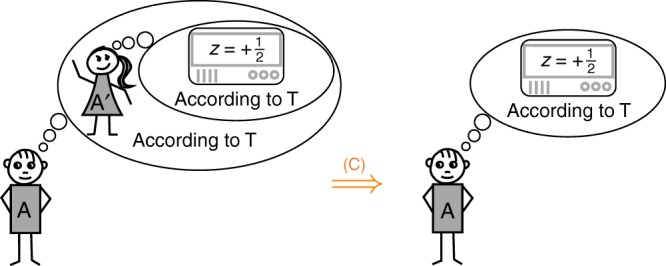
- Theorem 1: any theory satisfying assumptions (Q), (C), and (S) yields contradictory statements when applied to the proposed Gedankenexperiment.
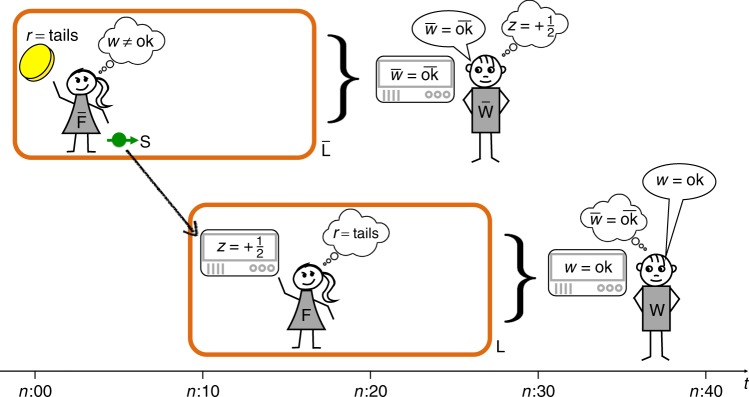
- In the final round of the experiment, agent W is certain he will observe `w = fail` at time `n:31`, yet he nevertheless observes `w = ok`, producing a contradiction.
- The paper states that `p = 1/12 > 0` for the halting event used to derive the statement that the experiment terminates after finitely many rounds.
- The result categorizes interpretations of quantum theory by which assumption they violate: many collapse models violate (Q), most Copenhagen-like / relational / QBist / CH-style readings violate (C), and many-worlds-style interpretations violate (S).
## Methods
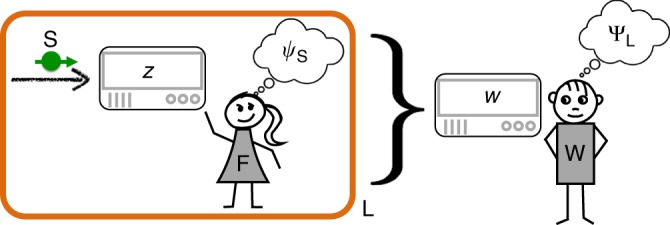
- The paper uses a thought experiment with four agents: two “friends” inside isolated labs and two outside observers, with repeated rounds `n = 0, 1, 2, ...` and a halting condition triggered when specific outcomes occur.
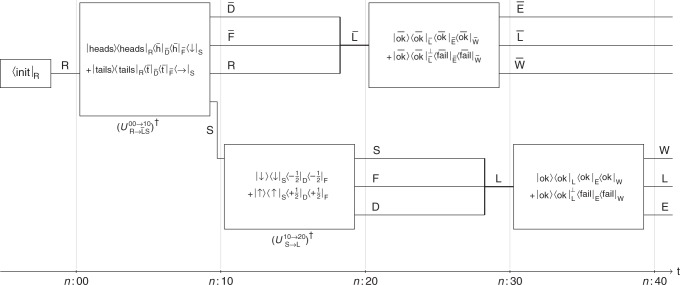
- It analyzes the protocol within standard quantum-mechanical formalism, using Heisenberg operators and a circuit-diagram/information-theoretic description.
- The main analysis derives each agent’s conclusions under assumptions (Q), (C), and (S), then shows these conclusions become inconsistent.
## Limitations
- The authors explicitly state the experiment is a Gedankenexperiment and “not technologically feasible, at least not in the form presented here.”
- The argument depends on the stated assumptions (Q), (C), and (S); the paper itself notes that interpretations may evade the conclusion by rejecting one of them.
- Evident from the text: the conclusion is about a specific self-referential multi-agent scenario, so the contradiction is not shown for all uses of quantum theory, only for this setup.
Model-written summary. Check it against the paper before relying on it.
Integrity signals
Registry
Cites
Statistics
Figures
Verification
Claims the paper makes
5 Valid · 2 Not valid · 13 Not checked · 44 Own results and interpretations
The cited sources support only part of this claim — read each source’s verdict below.
In the paper
“Another class of examples are subjectivistic interpretations, which regard statements about outcomes of measurements as personal to an agent, such as “relational quantum mechanics”38, “QBism”39,40, or the approach proposed in ref. 9”
§ Quantum theory cannot consistently describe the use of itself > Results > Theories that violate Assumption (C)
What the sources say
- Partly supportedcites [38] Rovelli C Relational quantum mechanics Int. J. Theor. Phys. 1996 35 1637 1678 10.1007/BF02302261 sourceExperimental — accuracy not yet measured
The Main discussion (p. 6) says measurement outcomes are relative to a reference system, supporting the citation of relational quantum mechanics as an example of observer-relative outcomes. But the Information section (p. 9) defines an observer as any physical system, not necessarily a personal agent; that part of the citing sentence does not accurately describe Rovelli's account. (LLM, conf=0.86)
- Supportedcites [39] Fuchs CA Schack R Quantum-Bayesian coherence Rev. Mod. Phys. 2013 85 1693 1715 10.1103/RevModPhys.85.1693 source
Our copy of Fuchs & Schack (2013) states squarely that QBism treats measurement outcomes as personal to an agent: §8.1 (p. 50) says the 'Paulian Idea' holds that 'the outcomes to quantum measurements are single-user as well,' i.e. an agent's degrees of belief are 'about her potential personal experiences arising in consequence of her actions,' and §8.1 (p. 52) calls quantum mechanics 'a single-user theory through and through ... quantum measurement outcomes are wholly personal experiences.' §4.2 (p. 26) reinforces the subjectivist side: 'there is no such thing as the quantum state. There are potentially as many states for a given quantum system as there are agents.' The citing sentence's further apparatus—conditions (Q), (S), (C)—is the citing paper's own framing, and the relational-QM and ref. 9 examples attach to other citations, so only the QBism attribution is judged here. (LLM, conf=0.90)
- Supportedcites [40] Fuchs CA Mermin ND Schack R An introduction to QBism with an application to the locality of quantum mechanics Am. J. Phys. 2014 82 749 754 10.1119/1.4874855 source
The cited sentence offers this paper as the characterization of QBism as a subjectivistic interpretation on which statements about measurement outcomes are personal to an agent. Our copy states exactly that: Section I (p. 2) says a measurement 'is an action on the world by an agent that results in the creation of an outcome - a new experience for that agent' and that 'a quantum state assignment is also a personal judgment of the agent assigning that state'; Section II (p. 4) lists as a fundamental QBist precept that 'An outcome is created for the agent who takes the measurement action only when it enters the experience of that agent'; Section III (p. 5) adds that a given outcome 'is valid only for the agent experiencing that outcome'. The (Q)/(S)/(C) conditions and the grouping with relational quantum mechanics and ref. 9 are the citing authors' own framing and are not attributed to this source, so nothing here is unsupported. (LLM, conf=0.90)
- Partly supportedcites [9] Brukner, Č. On the quantum measurement problem. in (eds. Bertlmann, R. & Zeilinger, A.) Quantum [Un]Speakables II: Half a Century of Bell’s Theorem, pp. 95–117 (Springer, 2017). sourceExperimental — accuracy not yet measured
Our copy supports the observer-relative half of the attribution: the Abstract states the quantum state 'is a representation of knowledge of a (real or hypothetical) observer relative to her experimental capabilities' and that '"facts" can only exist relative to the observer', and the Wigner's-friend section ('and thus the communication of the message...', p. ~n/a) says observers' records cannot be comprised as 'facts of the world' and that Copenhagenists/QBism/Rovelli's relational QM ('This is similar to Quantum Bayesianism...') take a like line. What the paper does not support is the 'personal to an agent' characterization of Brukner's own approach: in the probability-interpretation passage he says QBism 'runs into the danger of denying any objective elements in the notion of the quantum state' by restricting the subject matter 'to an individual agent's decisions and experiences', agrees only 'to the extent' that a fundamental limit on belief holds, and concludes 'probabilities are not just personal and subjective'. He also flags 'important differences' from Rovelli, whose 'observer' does not 'make any reference to a conscious, animate, or computing... system'. The (Q)/(S)/(C) conditions are the citing paper's framework and appear nowhere in our copy; the unsupported part is the subsumption of Brukner's approach under a purely agent-personal, subjectivistic class. (LLM, conf=0.72)
plainstates a cause- Asserted: passes — The authors put it forward as true.
- Checkable: passes — It can be checked against evidence.
- Load-bearing: unclear — It is unclear whether the paper’s conclusions depend on it.
- Based: passes — The paper gives a reason why it holds.
- Partly supported
The sources with a verdict support this claim; the rest weren’t checked yet, have no full text we could read, or their verdicts aren’t rated yet.
In the paper
“Assumption (Q) is manifestly violated by theories that postulate a modification of standard quantum mechanics, such as spontaneous16–20 and gravity-induced21–23 collapse models (cf. 24 for a review).”
§ Quantum theory cannot consistently describe the use of itself > Results > Theories that violate Assumption (Q)
What the sources say
- Not checked — no full text of the sourcecites [16] Ghirardi GC Rimini A Weber T Unified dynamics for microscopic and macroscopic systems Phys. Rev. D 1986 34 470 491 10.1103/PhysRevD.34.470 9957165 source
- Not matchedcites [17] Gisin N Stochastic quantum dynamics and relativity Helv. Phys. Acta 1989 62 363 371
Its entry has no title and year that we can search by.
- Not checked — no full text of the sourcecites [18] Pearle P Combining stochastic dynamical state-vector reduction with spontaneous localization Phys. Rev. A 1989 39 2277 2289 10.1103/PhysRevA.39.2277 9901493 source
- Supportedcites [19] Tumulka R On spontaneous wave function collapse and quantum field theory Proc. R. Soc. A 2006 462 1897 1908 10.1098/rspa.2005.1636 source
The Introduction (p. 1) frames the paper as assuming 'that the Schrödinger equation should be modified' so that macroscopic superpositions cannot persist, and names this class 'dynamical reduction', 'spontaneous localization', or 'spontaneous wave function collapse', listing among its advocates [10] Diósi and [27] Penrose, 'Wavefunction collapse as a real gravitational effect' (References, p. 14) — i.e., the gravity-induced models are counted within the same modification-of-standard-QM family. The Abstract (p. 1) repeats it ('modify the Schrödinger evolution by implementing spontaneous collapses ... a nonlinear, stochastic evolution'), and the Introduction (p. 1) notes the GRW model's 'testable predictions ... differ in principle from the quantum formulas'. The gravity-induced models are supported via their inclusion in that list rather than as a separately discussed class in the body; the citing paper's own 'Assumption (Q)' is not something this source addresses. (LLM, conf=0.80)
- Supportedcites [20] Weinberg S Collapse of the state vector Phys. Rev. A. 2012 85 062116 10.1103/PhysRevA.85.062116 source
Weinberg's paper is exactly a theory postulating a modification of standard quantum mechanics: the Abstract (p. 1) states 'Modifications of quantum mechanics are considered, in which the state vector of any system, large or small, undergoes a stochastic evolution,' and the Introduction (p. 2) frames the proposal as 'the possibility that quantum mechanics needs correction' with an 'inherently probabilistic physical collapse... occurring at all scales.' Section VII (pp. 11-12) treats the GRW spontaneous-localization model as a special case, and reference 5 (p. 14) lists the gravity-related proposals of Diosi (1988) and Penrose (2001) among the specific collapse models, so the cited work fits the sentence's characterization as a spontaneous/gravity-induced collapse-type modification of quantum mechanics. The claim's 'Assumption (Q)' is the citing paper's own assumption, not something attributed to this source. (LLM, conf=0.85)
- Not checked — no full text of the sourcecites [21] Karolyhazy F Gravitation and quantum mechanics of macroscopic objects Il Nuovo Cim. A (1971–1996) 1966 42 390 402 10.1007/BF02717926 source
- Not checked — no full text of the sourcecites [22] Diósi L Models for universal reduction of macroscopic quantum fluctuations Phys. Rev. A 1989 40 1165 1174 10.1103/PhysRevA.40.1165 9902248 source
- Not checked — no full text of the sourcecites [23] Penrose R On gravity’s role in quantum state reduction Gen. Relat. Gravit. 1996 28 581 600 10.1007/BF02105068 source
- Supportedcites [24] Bassi A Lochan K Satin S Singh TP Ulbricht H Models of wave–function collapse, underlying theories, and experimental tests Rev. Mod. Phys. 2013 85 471 527 10.1103/RevModPhys.85.471 source
Our copy is precisely the review the citing sentence points to ('cf. 24'): the ABSTRACT (p. 1) frames Continuous Spontaneous Collapse as 'a stochastic nonlinear modification of the Schrödinger equation' and reviews 'two underlying theories for this phenomenology: Trace Dynamics, and gravity induced collapse'. Sec. III.B (p. 73) describes gravity-induced loss of coherence as a modification leaving microphysics untouched, and Sec. IV.J (p. 113) speaks of these models in terms of an observable 'violation of quantum superposition' (also p. 29: without the non-standard noise field 'we would fall back in the realm of standard quantum mechanics, with the superposition principle'). So the attribution — that spontaneous and gravity-induced collapse models postulate a modification of standard quantum mechanics, hence violate a quantum assumption — is stated in the source. (LLM, conf=0.85)
boostedstates a cause- Asserted: passes — The authors put it forward as true.
- Checkable: passes — It can be checked against evidence.
- Load-bearing: unclear — It is unclear whether the paper’s conclusions depend on it.
- Based: passes — The paper gives a reason why it holds.
A result the paper states — it cites no source for it, so there is none to check. The quote shows it is in the paper.
In the paper
“Our main finding is that such a self-referential use of the theory yields contradictory claims.”
- Also stated in: § Abstract · plain
“The agents’ conclusions, although all derived within quantum theory, are thus inconsistent.”
§ Quantum theory cannot consistently describe the use of itself > Introduction
plainstates a cause- Asserted: passes — The authors put it forward as true.
- Checkable: passes — It can be checked against evidence.
- Load-bearing: passes — The paper’s conclusions depend on it.
- Based: passes — The paper gives a reason why it holds.
- Also stated in: § Abstract · plain
A result the paper states — it cites no source for it, so there is none to check. The quote shows it is in the paper.
In the paper
“Theorem 1. Any theory that satisfies assumptions (Q), (C), and (S) yields contradictory statements when applied to the Gedankenexperiment of Box 1.”
- Also stated in: § Introduction · plain
“It asserts that three natural-sounding assumptions, (Q), (C), and (S), cannot all be valid.”
§ Quantum theory cannot consistently describe the use of itself > Results > No-go theorem
plainstates a cause- Asserted: passes — The authors put it forward as true.
- Checkable: passes — It can be checked against evidence.
- Load-bearing: passes — The paper’s conclusions depend on it.
- Based: passes — The paper gives a reason why it holds.
- Rests on 3 assumptions not shown here.
- Also stated in: § Introduction · plain
A result the paper reports from its own data — it cites no other source for it, so there is none to check. The quote shows it is in the paper.
In the paper
“This is indeed confirmed by an explicit calculation in Bohmian mechanics, which reveals that statement of Table 3 does not hold there.”
§ Quantum theory cannot consistently describe the use of itself > Methods > Analysis within Bohmian mechanics
boosted- Asserted: passes — The authors put it forward as true.
- Checkable: passes — It can be checked against evidence.
- Load-bearing: passes — The paper’s conclusions depend on it.
- Based: passes — The paper gives a reason why it holds.
27 more claims
Create a free account to see all 64 claims and to verify the 3 references still open.
- Probably not a substantial claim. 18
- It may state two separate claims as one. 17
Claims other papers make about this one
Each is checked against this paper’s own text: does it say what the citing paper says it does?
The cited source doesn’t support the claim as written.
In the citing paper
“In contrast, for the no-go theorem we tested here (4), it is sufficient that they perform a measurement and record the outcome.”
From Experimental test of local observer independence (2019) · cites this paper as [5]
Checked by a reasoning model — may be wrong.
Experimental — accuracy not yet measuredThe cited source says what the claim attributes to it.
In the citing paper
“While the precise interpretation of (5) within nonlocal theories is under debate (21), it seems that abandoning free choice and locality might not resolve the contradiction (5).”
From Experimental test of local observer independence (2019) · cites this paper as [5]
The cited source says what the claim attributes to it.
In the citing paper
“The related no-go theorem by Frauchiger and Renner (5) rests on different assumptions, which do not explicitly include locality.”
From Experimental test of local observer independence (2019) · cites this paper as [5]
Citations
Cites
On the Einstein Podolsky Rosen paradox
Bell, J. S. (1964) · Physics Physique Fizika · doi:10.1103/physicsphysiquefizika.1.195 · Cited by 12,252
A Suggested Interpretation of the Quantum Theory in Terms of "Hidden" Variables. I
Bohm, D. (1952) · Physical Review · doi:10.1103/physrev.85.166 · Cited by 5,510
"Relative State" Formulation of Quantum Mechanics
Everett, H. (1957) · Reviews of Modern Physics · doi:10.1103/revmodphys.29.454 · Cited by 3,379
On the Problem of Hidden Variables in Quantum Mechanics
BELL, J. S. (1966) · Reviews of Modern Physics · doi:10.1103/revmodphys.38.447 · Cited by 2,845
Unified dynamics for microscopic and macroscopic systems
Ghirardi, G. C., Rimini, A., & Weber, T. (1986) · Physical Review D · doi:10.1103/physrevd.34.470 · Cited by 2,798
The thermodynamics of computation—a review
Bennett, C. H. (1982) · International Journal of Theoretical Physics · doi:10.1007/bf02084158 · Cited by 2,006
On gravity's role in quantum state reduction
Penrose, R. (1996) · General Relativity and Gravitation · doi:10.1007/bf02105068 · Cited by 1,872
Rovelli, C. (1996) · International Journal of Theoretical Physics · doi:10.1007/bf02302261 · Cited by 1,381
The Problem of Hidden Variables in Quantum Mechanics
Kochen, S., & Specker, E. (1967) · Indiana University Mathematics Journal · doi:10.1512/iumj.1968.17.17004 · Cited by 1,250
Models of wave-function collapse, underlying theories, and experimental tests
Bassi, A., Lochan, K., Satin, S., Singh, T. P., & Ulbricht, H. (2013) · Reviews of Modern Physics · doi:10.1103/revmodphys.85.471 · Cited by 1,170
Research works printed but not linked: 9
- Wigner, E. P. Remarks on the mind–body question. in Symmetries and Reflections, pp. 171–184. (Indiana University Press, 1967).
- Hepp K Quantum theory of measurement and macroscopic observables Helv. Phys. Acta 1972 45 237 248
- Bell JS On wave packet reduction in the Coleman–Hepp model Helv. Phys. Acta 1975 48 93 98
- Fagin, R., Halpern, J. Y., Moses, Y. & Vardi, M. Y. Reasoning About Knowledge. (MIT Press, 2004).
- Heisenberg, W. Ist eine deterministische Ergänzung der Quantenmechanik möglich? in (eds. Hermann, A., von Meyenn, K. & Weisskopf, V. F.) Wolfgang Pauli. Wissenschaftlicher Briefwechsel mit Bohr, Einstein, Heisenberg, u.a., volume II, pp. 409–418 (Springer, 1935).
- Bohr, N. Discussions with Einstein on epistemological problems in atomic physics. in (ed. Schilpp, P. A.) Albert Einstein: Philosopher-Scientist, pp. 200–241 (The Library of Living Philosophers, 1949).
- Landau, L. D. & Lifshitz, E. M. Quantum mechanics: non-relativistic theory. Chapter: The Basic Concepts of Quantum Mechanics. (Elsevier, 2013).
- von Neumann, J. Mathematische Grundlagen der Quantenmechanik (Springer-Verlag, 1932).
- Gell-Mann, M. & Hartle, J. B. Quantum mechanics in the light of quantum cosmology. in (ed. Zurek, W.) Complexity, Entropy and the Physics of Information (Addison Wesley, 1990).
Cited by
Items 101–200 of 327
Quantitative relations between different measurement contexts
Ji, M., & Hofmann, H. F. (2024) · Quantum · doi:10.22331/q-2024-02-14-1255 · Cited by 12
“It might be worth noting that the specific case of |〈a|0〉|(2) = 1/2 corresponds to the scenario discussed by Frauchiger and Renner, where the probability of finding the outcome |a, a〉 is |〈a, a|Nf〉|(2) = 1/12 [23, 28].”
BackgroundRepresentation Lost: The Case for a Relational Interpretation of Quantum Mechanics
Krismer, R. (2018) · Entropy · doi:10.3390/e20120975 · Cited by 9
“Due to a recent no-go theorem by Frauchiger & Renner [26], who develop on Hardy’s paradox [46,47], there are good reasons to believe that quantum mechanics is inconsistent with the assumption that, in general, each term in a superposition can be said to represent a world with determinate properties.”
BackgroundMethodInfluentialWalleczek, J. (2018) · Entropy · doi:10.3390/e21010004 · Cited by 7
“from the viewpoint of an agent who carries out a measurement, this measurement has one single outcome”, as was explained by Frauchiger and Renner [33] in the context of their recent argument against the self-consistency of quantum theory due to self-referential relations—in Wigner’s friend paradox—between multiple exp…”
BackgroundInfluentialTowards a quantum-like cognitive architecture for decision-making
Moreira, C., Fell, L., Dehdashti, S., Bruza, P., & Wichert, A. (2020) · Behavioral and Brain Sciences · doi:10.1017/s0140525x19001687 · Cited by 21
Muciño, R., & Okon, E. (2020) · Studies in History and Philosophy of Science Part B Studies in History and Philosophy of Modern Physics · doi:10.1016/j.shpsb.2020.07.001 · Cited by 11
“In [6], Frauchiger and Renner (FR) present a result allegedly proving that “quantum theory cannot consistently describe the use of itself”.”
BackgroundInfluentialWigner's friend paradox: does objective reality not exist?
Belinsky, A. V. (2020) · Uspekhi Fizicheskih Nauk · doi:10.3367/ufnr.2020.05.038767 · Cited by 8
Relational Quantum Mechanics and Contextuality
Robson, C. J. (2024) · Foundations of Physics · doi:10.1007/s10701-024-00788-0 · Cited by 10
“Rovelli [12] has claimed this is a consequence of certain no-go theorems (e.g. [16]), however, the applicability of these theorems to the issue of self-measurement has been challenged [35] [30] and so for this paper I shall take the following statement: 1.”
Relational Quantum Mechanics at the Crossroads
Calosi, C., & Riedel, T. (2024) · Foundations of Physics · doi:10.1007/s10701-024-00810-5 · Cited by 18
“What we end up with, then, is a thoroughly relativist theory on which no specification of ever more references makes it possible to recover absolute statements (as anticipated by [58, 13]), and which hence really does not allow for a God’s eye ‘view from nowhere’ (cf. [59, p. 11]).”
Considerations on the Relativity of Quantum Irrealism
Engelbert, N. G., & Angelo, R. M. (2023) · Entropy · doi:10.3390/e25040603 · Cited by 8
“Frauchiger and Renner showed that quantum mechanics cannot consistently describe the use of itself [15].”
BackgroundMatsushita, T., & Hofmann, H. F. (2023) · Physical Review Research · doi:10.1103/physrevresearch.5.033064 · Cited by 11
Fröhlich, J. M. (2020) · Fundamental theories of physics · doi:10.1007/978-3-030-46777-7_19 · Cited by 159
No-Go Theorems on Machine Consciousness
Kak, S. C. (2023) · Journal of Artificial Intelligence and Consciousness · doi:10.1142/s2705078523500029 · Cited by 9
Reimagining of Schrödinger’s cat breaks quantum mechanics — and stumps physicists
Castelvecchi, D. (2018) · Nature · doi:10.1038/d41586-018-06749-8 · Cited by 7
Epistemic horizons from deterministic laws: lessons from a nomic toy theory
Fankhauser, J., Gonda, T., & Cuevas, G. D. L. (2025) · Synthese · doi:10.1007/s11229-024-04852-0 · Cited by 12
“This may perhaps allow novel insights into the intricacies of many recently studied Wigner’s friend type scenarios as well as no-go claims on ‘observer-independent facts’ [9, 11, 23, 35, 37, 50].”
The measurement postulates of quantum mechanics are not redundant
Kent, A. (2025) · Quantum · doi:10.22331/q-2025-05-20-1749 · Cited by 11
“There are also tensions between some arguably natural-seeming assumptions about conscious perceptions and quantum theory (see e.g. [6, 9, 22, 50, 51]).”
Phenomenology of Holography via Quantum Coherence on Causal Horizons
Kwon, O. (2025) · Foundations of Physics · doi:10.1007/s10701-025-00827-4 · Cited by 11
“…have seen renewed interest in the Wigner’s friend gedankenexperiment in recent years, as analyses of a modified version involving Bell-type states showed that the quantum theory could not consistently describe the use of itself, resulting in a no-go theorem for observer-independent facts [79, 80].”
Derivation from Bloch Equation to von Neumann Equation to Schrödinger–Pauli Equation
Wang, L. V. (2022) · Foundations of Physics · doi:10.1007/s10701-022-00578-6 · Cited by 7
Standard quantum mechanics without observers
Stoica, O. C. (2021) · Physical Review A · doi:10.1103/physreva.103.032219 · Cited by 10
“Probably by removing Schrödinger cats, Wigner’s friend paradox [62] is eliminated, but stronger versions of the paradox suggest that this is not enough [9, 10, 25].”
BackgroundMethodInfluentialUncertainty limits of the information exchange between a quantum system and an external meter
Matsushita, T., & Hofmann, H. F. (2021) · Physical Review A · doi:10.1103/physreva.104.012219 · Cited by 7
“The assumption that Born’s rule can be applied inside a system cannot be applied consistently as shown in [18, 19].”
BackgroundMulti-stage Stern–Gerlach experiment modeled
Wang, L. V. (2023) · Journal of Physics B Atomic Molecular and Optical Physics · doi:10.1088/1361-6455/acc149 · Cited by 8
“Debatable inconsistency has been found in thought experiments, such as “Schrödinger’s cat” [44-46].”
ResultThe Embedded-Observer No-Go TheoremPreprint
Materov (2026) · SSRN Electronic Journal · doi:10.2139/ssrn.7243425 · Cited by 8
Convivial Solipsism as a Maximally Perspectival Interpretation
Hervé Zwirn, C. (2024) · Foundations of Physics · doi:10.1007/s10701-024-00773-7 · Cited by 13
“At the end of his discussions of the arguments of Frauchiger and Renner [29] and of Brukner [30], which show that facts or events are relative to the situation of those who observe them, Bitbol repeatedly insists on reminding us that “lived experience is the only unshakeable certainty, not to say…”
Quantum and Classical Bayesian Agents
DeBrota, J. B., & Love, P. J. (2022) · Quantum · doi:10.22331/q-2022-05-16-713 · Cited by 5
“Reference [2] features a thought exper-iment involving a more elaborate setup than the original Wigner’s friend scenario.”
BackgroundClassical Information and Collapse in Wigner’s Friend Setups
Baumann, V. (2023) · Entropy · doi:10.3390/e25101420 · Cited by 7
“Some of these no-go theorems, for example [16], rely on con-flicting probability assignments of observers and superobservers similar to the simple Wigner’s friend experiment above.”
MethodStatistical Signatures of Quantum Contextuality
Hofmann, H. F. (2024) · Entropy · doi:10.3390/e26090725 · Cited by 8
“Equation (26) indicates that the violation of the non-contextual inequality in Equation (22) can be explained by the negative KD terms of the paths [ 3, f ] and [ 1, P 2 ] .”
BackgroundRefuting Observer-Independence in Quantum Theory
Proietti, M., Pickston, A., Graffitti, F., Barrow, P., Kundys, D. O., Branciard, C., Ringbauer, M., & Fedrizzi, A. (2019) · Conference on Lasers and Electro-Optics Europe & European Quantum Electronics Conference (CLEO/Europe-EQEC) · doi:10.1109/cleoe-eqec.2019.8872242 · Cited by 5
A minimalist's view of quantum mechanics
Sokolovski, D. (2020) · Europhysics Letters (EPL) · doi:10.1209/0295-5075/128/50001 · Cited by 7
“[14] FRAUCHIEGER D.”
ResultCompatibility between agents as a tool for coarse-grained descriptions of quantum systems
Duarte, C. (2020) · Journal of Physics A Mathematical and Theoretical · doi:10.1088/1751-8121/aba574 · Cited by 12
No Relation for Wigner’s Friend
Castellani, L. (2021) · International Journal of Theoretical Physics · doi:10.1007/s10773-021-04826-9 · Cited by 6
“of information, not to quantum mechanical eects, and in our opinion does not motivate any \relational" or subjective interpretation of quantum states. Note: in recent times Gedanken experiments [9, 10, 11] extending Wigner’s friend setup have been proposed to probe the issue of observer independence. A real exper…”
Quantum fluctuations, particles and entanglement: solving the quantum measurement problems
Konishi, K. (2023) · Journal of Physics Conference Series · doi:10.1088/1742-6596/2533/1/012009 · Cited by 8
“6 A possible issue in [17] could be the fact that the information transmission from the first laboratory to the second about the result of the measurement made in the first, might render invalid the assumption that the two laboratories are isolated quantum systems.”
BackgroundInfluentialMulti-agent paradoxes beyond quantum theory
Vilasini, V., Nurgalieva, N., & del Rio, L. (2019) · White Rose Research Online (University of Leeds, The University of Sheffield, University of York) · doi:10.3929/ethz-b-000383643 · Cited by 5
Physics is Organized Around Transformations Connecting Contextures in a Polycontextural World
Falk, J., Eichler, E., Windt, K., & Hütt, M. ‐. (2021) · Foundations of Science · doi:10.1007/s10699-021-09814-0 · Cited by 6
“As a consequence, observations of different observers can generate irresolvable contradictory claims (Frauchiger and Renner, 2018), and it is thus not possible to assign truth values jointly to their contrary propositions (Brukner, 2018, 2015).”
BackgroundQuantum violations of joint reality
Caetano, R. A., & Angelo, R. M. (2024) · Physical Review A · doi:10.1103/physreva.110.032214 · Cited by 5
Wigner's friend's memory and the no-signaling principle
Baumann, V., & Brukner, Č. (2024) · Quantum · doi:10.22331/q-2024-09-25-1481 · Cited by 12
“In recent years new scenarios combining Wigner’s-friend-type experiments with various non-locality setups [5, 6, 7, 8, 4] have been proposed.”
BackgroundExtended Wigner's friend paradoxes do not require nonlocal correlations
Walleghem, L., Wagner, R., Yīng, Y., & Schmid, D. (2025) · Physical Review A · doi:10.1103/n4hv-rlgj · Cited by 13
“To that end, formal no-go results were introduced that require more agents [1, 6, 7, 29, 30], with many observers such as Wigner and his friend, whose actions or thoughts lead to a contradiction.”
BackgroundMethodInfluentialQuasiprobability distributions with weak measurements
Bizzarri, G., Gherardini, S., Manrique, M., Bruni, F., Gianani, I., & Barbieri, M. (2025) · Quantum Science and Technology · doi:10.1088/2058-9565/adf573 · Cited by 5
“Although their ontological status is disputed [2–6], they offer the most complete physical insight quantum mechanics is able to provide in its standard form.”
Preface to Special Issue: Quantum Information Revolution: Impact to Foundations
Fuchs, C. A., & Khrennikov, A. Y. (2020) · Foundations of Physics · doi:10.1007/s10701-020-00401-0 · Cited by 3
Double-trace deformation in open quantum field theory
Meng, X. (2021) · Physical review. D/Physical review. D. · doi:10.1103/physrevd.104.016016 · Cited by 6
Conditional probabilities of measurements, quantum time, and the Wigner's-friend case
Trassinelli, M. (2022) · Physical Review A · doi:10.1103/physreva.105.032213 · Cited by 6
Phenomenological Approaches to Physics
Berghofer, P. (2022) · Synthese Library/Synthese library · doi:10.1007/978-3-030-96113-8_15 · Cited by 4
The Point of Primitive Ontology
Lazarovici, D., & Reichert, P. (2022) · Foundations of Physics · doi:10.1007/s10701-022-00639-w · Cited by 4
“For instance, Wigner’s friend -type thought experiments in which observers become a part of measured quantum systems have caused quite the commotion in recent years since plausible applications of the quantum recipe yield inconsistent predictions for the different observers [27].”
BackgroundA Logico-Epistemic Investigation of Frauchiger and Renner’s Paradox
Corti, A., Fano, V., & Tarozzi, G. (2023) · International Journal of Theoretical Physics · doi:10.1007/s10773-023-05313-z · Cited by 4
“In a groundbreaking paper, Frauchiger and Renner [11] – FR hereafter – originally propose a more sophisticated version of Wigner’s friend paradox [29].”
BackgroundInfluentialQuantum Measurement as Marginalization and Nested Quantum Systems
Loeliger, H., & Vontobel, P. O. (2019) · IEEE Transactions on Information Theory · doi:10.1109/tit.2019.2961377 · Cited by 7
“We will carefully analyze the Frauchiger–Renner model using q functions (hence “nested quantum systems” in the title of this paper), and we find all calculations to be in full agreement with those in [15]—except for the actual contradiction, which involves classical variables that do not coexist.”
BackgroundMethodResultInfluentialIs the Reality Criterion Analytic?
Glick, D., & Boge, F. J. (2019) · Erkenntnis · doi:10.1007/s10670-019-00163-w · Cited by 6
On Explaining Quantum Correlations: Causal vs. Non-Causal
Felline, L. (2021) · Entropy · doi:10.3390/e23050589 · Cited by 4
“In particular, several arguments based on Wigner’s Friend scenarios (see for instance [38], but also [39]) have challenged the claim that black box approaches in information-theoretic interpretations provide a genuine solution to (or ‘explain away’) the measurement problem.”
BackgroundA Conflict Tolerant Logic of Explicit Evidence
Thomas Studer, A. (2021) · Logical Investigations · doi:10.21146/2074-1472-2021-27-1-124-144 · Cited by 4
“The Frauchiger–Renner thought experiment [Frauchiger, Renner, 2018] is used to formulate a no-go theorem in quantum physics.”
BackgroundMethodInfluentialLaw of Total Probability in Quantum Theory and Its Application in Wigner’s Friend Scenario
Yang, J. M. (2022) · Entropy · doi:10.3390/e24070903 · Cited by 6
“6 We do not include the no-go theorem [32] widely discussed in”
BackgroundWigner's friend and the quasi-ideal clock
Rossi, V. P., & Soares-Pinto, D. O. (2021) · Physical Review A · doi:10.1103/physreva.103.052206 · Cited by 5
“In 2018, Daniela Frauchiger and Renato Renner [2] published an article pointing out how Wigner’s friend scenarios (WFS) could do more than highlight this fundamental incompatibility: they can be used as a test environment for the compatibility of assumptions about the world.”
BackgroundWigner’s Friend Scenarios and the Internal Consistency of Standard Quantum Mechanics
Sokolovski, D., & Matzkin, A. (2021) · Entropy · doi:10.3390/e23091186 · Cited by 4
“Some of these works analysed the extended Wigner’s friend setup within frameworks arising in specific interpretations of quantum mechanics, in which the prescriptions for computing the probabilities of the measured outcomes are different from those followed by Frauchiger and Renner, or by Brukner.”
BackgroundInfluentialWhat kind of relationality does quantum mechanics exhibit?
Adlam, E. (2026) · European Journal for Philosophy of Science · doi:10.1007/s13194-025-00709-6 · Cited by 15
“Recently various ‘Extended Wigner’s Friend’ theorems have reinvigorated the discussion of relationalism in quantum mechanics (Bong et al., 2020; Ormrod and Barrett, 2022; Frauchiger and Renner, 2018).”
On the Negative Result Experiments in Quantum Mechanics
Konishi, K. (2024) · Entropy · doi:10.3390/e26110958 · Cited by 6
“This observation is sufficient to explain away a “puzzle” recently discussed in [19].”
Unitary Interactions Do Not Yield Outcomes: Attempting to Model “Wigner’s Friend”
Kastner, R. E. (2021) · Foundations of Physics · doi:10.1007/s10701-021-00492-3 · Cited by 5
Sets of Marginals and Pearson-Correlation-based CHSH Inequalities for a Two-Qubit System
Huang, Y., & Vontobel, P. O. (2021) · IEEE International Symposium on Information Theory (ISIT) · doi:10.1109/isit45174.2021.9518116 · Cited by 3
“I∈K are at the heart of quantum mechanical phenomena like Hardy’s paradox [12] and the Frauchiger–Renner paradox [13].”
BackgroundMacroscopic Wigner's friend paradoxes: Consistency with weak macroscopic realism
Joseph, R. R., Thenabadu, M., Hatharasinghe, C., Fulton, J., Teh, R. Y., Drummond, P. D., & Reid, M. D. (2024) · Physical Review A · doi:10.1103/physreva.110.022219 · Cited by 9
Epistemic Boundaries and Quantum Uncertainty: What Local Observers Can (Not) Predict
Fankhauser, J. (2024) · Quantum · doi:10.22331/q-2024-11-07-1518 · Cited by 4
“[8, 9, 10, 11, 12] None of these (extended) Wigner’s friend type experiments [13], however, addresses the question of predictive advantage.”
Algorithmic Idealism: What Should You Believe to Experience Next?
Müller, M. P. (2026) · Foundations of Physics · doi:10.1007/s10701-026-00913-1 · Cited by 10
“In [3], we construct a more elaborate version of a multiplication thought experiment that demonstrates an instance of Restriction A for N = 2 observers, robust to future changes of our physical theories, which resembles a probabilistic version of the Frauchiger-Renner paradox [32].”
Wigner and Friends, A Map is not the Territory! Contextuality in Multi-agent Paradoxes
Montanhano, S. B. (2025) · Foundations of Science · doi:10.1007/s10699-024-09971-y · Cited by 6
Saving Science from Quantum Mechanics: The Epistemology of the Measurement Problem
Adlam, E. (2025) · doi:10.1093/9780197808887.001.0001 · Cited by 10
Knowledge by direct measurement versus inference from steering
Aw, C. C., Dall’Arno, M., & Scarani, V. (2020) · Quantum Studies Mathematics and Foundations · doi:10.1007/s40509-020-00219-5 · Cited by 4
“The tension between updates from steering and updates from measurements may be detected in the argument put forward by Frauchiger and Renner (FR) [2], which is indeed a discussion of knowledge and certainty regarding measurements via the inference of various agents about each other’s states.”
BackgroundRelating Complexities for the Reflexive Study of Complex Systems
Raimbault, J. (2020) · Lecture notes in morphogenesis · doi:10.1007/978-3-030-36656-8_3 · Cited by 6
“An other approach proposed by [Frauchiger and Renner, 2018] demonstrates that quantum theory is inconsistent with its use to describe itself.”
Belinsky, A. V. (2020) · Quantum Electronics · doi:10.1070/qel17191 · Cited by 3
Wave-Particle Duality and the Objectiveness of “True” and “False”
Bolotin, A. (2021) · Foundations of Physics · doi:10.1007/s10701-021-00478-1 · Cited by 4
“To make this paradox even more dramatic, in Frauchiger and Renner’s thought experiment [46],”
BackgroundFundamental Physics and Computation: The Computer-Theoretic Framework
Miguel-Tomé, S., Lázaro, Á. L. S., & Alonso-Romero, L. (2022) · Universe · doi:10.3390/universe8010040 · Cited by 3
Reply to: Quantum mechanical rules for observed observers and the consistency of quantum theory
del Rio, L., & Renner, R. (2024) · Nature Communications · doi:10.1038/s41467-024-47172-0 · Cited by 8
“This is due to a misunderstanding of the scope of assumption (Q), which was perhaps not clear in early versions of [3]: (Q) demands that an agent can apply the laws of standard quantum theory (notably, the Born rule) to any subsystem around the agent.”
BackgroundSelf-citationThe Extended Wigner’s Friend, Many-and Single-Worlds and Reasoning from Observation
Steane, A. M. (2025) · Foundations of Physics · doi:10.1007/s10701-025-00831-8 · Cited by 3
Connecting extended Wigner's friend arguments and noncontextuality
Walleghem, L., Yīng, Y., Wagner, R., & Schmid, D. (2025) · Quantum · doi:10.22331/q-2025-07-31-1819 · Cited by 12
“E]), the quantum predictions in such an experiment are the same as the predictions in experiments where superobservers measure the entire labs of their respective friends (such as in the Frauchiger–Renner scenario [3]) in appropriate bases instead of reversing and remeasuring.”
The Firewall Paradox Is Wigner’s Friend Paradox
Hausmann, L., & Renner, R. (2025) · Springer Series in Astrophysics and Cosmology · doi:10.1007/978-981-96-6170-1_13 · Cited by 11
Self-citationWigner’s friend scenarios: On what to condition and how to verify the predictions
Santo, F. D., Manzano, G., & Brukner, Č. (2025) · Physical Review Research · doi:10.1103/c3yq-9mc7 · Cited by 9
Wigner’s Diamond and the Quantum Fragmentation of Space-time
Pienaar, J. (2026) · Foundations of Physics · doi:10.1007/s10701-026-00915-z · Cited by 13
Implications of Local Friendliness Violation for Quantum Causality
Cavalcanti, E. G., & Wiseman, H. M. (2021) · Entropy · doi:10.3390/e23080925 · Cited by 47
“However, unlike Bell’s theorem, the Frauchiger-Renner theorem is not theory-independent—that is, it makes assumptions specifically related to quantum theory14.”
BackgroundInfluentialVilasini, V., & Woods, M. P. (2026) · Physical Review X · doi:10.1103/nqbv-6qgr · Cited by 15
Toys can’t play: physical agents in Spekkens’ theory
Hausmann, L., Nurgalieva, N., & del Rio, L. (2023) · New Journal of Physics · doi:10.1088/1367-2630/acb3ef · Cited by 5
“For example, this is the case for the quantum theory and generalized probability theories (in particular, so-called box world), where agents applying standard logic to reason about physical experiments can come to contradictory conclusions [3, 8].”
BackgroundMethodQuantum Computing for Indoor Environmental Quality: A Leapfrogging Technology
Kapoor, N. R., Kumar, A., Kumar, A., Kumar, A., Arora, H. C., & Jahangir, H. (2023) · Advances in systems analysis, software engineering, and high performance computing book series · doi:10.4018/978-1-6684-6697-1.ch011 · Cited by 5
Stochastic bra-ket interpretation of quantum mechanics
Öttinger, H. C. (2024) · Journal of Physics Communications · doi:10.1088/2399-6528/ad829c · Cited by 3
“In the tradition of “Wigner’s friend” [37], Frauchiger and Renner [38] assume the applicability of quantum mechanics to even more complex superposition states that include agents who are themselves using quantum theory, and they then reveal inconsistencies in conventional quantum mechanics.”
BackgroundPlotnitsky, A. (2025) · Journal of Physics Conference Series · doi:10.1088/1742-6596/3017/1/012014 · Cited by 2
“2 Wigner’s original experiment may, however, be seen as paradigmatic of these 2 Especially instructive is the line of thinking initiated by a modified version of the experiment, proposed in [8], in which W is replaced with two agents, leading, the authors argue, to “contradictory claims.””
Quantum Measurement Cannot Be a Local Physical Process
Inamori, H. (2019) · Journal of Quantum Information Science · doi:10.4236/jqis.2019.94009 · Cited by 2
“This is in contradiction with the discontinuous evolution experienced by the inner observer, and this paradox has been captured in particular in the Wigner’s friend paradox [6] and more recently in an extended version of it [7].”
BackgroundA Neo-Copenhagen Quantum Mechanics
Lindblad, G. (2023) · Open Systems & Information Dynamics · doi:10.1142/s1230161223500063 · Cited by 3
From quantum to classical by numbers
Sokolovski, D., Brouard, S., & Alonso, D. (2019) · New Journal of Physics · doi:10.1088/1367-2630/ab59b7 · Cited by 3
“modern literature (see, for example, [28]).”
Quantum Information and Foundations
D’Ariano, G. M., & Perinotti, P. (2019) · Entropy · doi:10.3390/e22010022 · Cited by 2
“This is the subject of the contribution, A No-Go Theorem for Observer-Independent Facts [22], which proposes a perspective on the argument of Frauchiger and Renner [23] proving that “single-world interpretations of quantum theory cannot be self-consistent”.”
BackgroundOn the Objectivity of Measurement Outcomes
Okon, E. (2022) · The British Journal for the Philosophy of Science · doi:10.1086/719046 · Cited by 6
(2022) · Nature Physics · doi:10.1038/s41567-022-01766-x · Cited by 8
A Modal Interpretation of Quantum Spins and Its Application to Freudian Theory
Battilotti, G., Borozan, M., & Grotto, R. L. (2022) · Entropy · doi:10.3390/e24101419 · Cited by 2
“Recent research has addressed issues stemming from “Wigner’s friend” thought experiment, considering different levels of judgements (see [42,43], where the role of time is also considered).”
BackgroundThe Relational Dissolution of the Quantum Measurement Problems
Oldofredi, A. (2022) · Foundations of Physics · doi:10.1007/s10701-022-00652-z · Cited by 5
“14 Cf. Frauchiger and Renner [29], Bong et al.”
Tripartite Wigner’s friend scenario and its test
Ding, D. Y., Wang, C., He, Y. Q., Hou, T., Gao, T., & Yan, F. (2023) · Physica Scripta · doi:10.1088/1402-4896/acdd33 · Cited by 2
Quantum contextuality of complementary photon polarizations explored by adaptive input state control
Matsuyama, K., Ji, M., Hofmann, H. F., & Iinuma, M. (2023) · Physical Review A · doi:10.1103/physreva.108.062213 · Cited by 2
“Motivated by the Gedankenexperiment introduced by Frauchiger and Renner [45], we are considering a situation where two separate physical systems satisfy three statements that can be represented by probabilities of zero for three measurement outcomes obtained in different contexts represented by the local measurements…”
BackgroundMethodInfluentialFulton, J., Teh, R. Y., & Reid, M. D. (2024) · Physical Review A · doi:10.1103/physreva.110.022218 · Cited by 6
AI Copernicus ‘discovers’ that Earth orbits the Sun
Castelvecchi, D. (2019) · Nature · doi:10.1038/d41586-019-03332-7 · Cited by 2
Objective Reality and the Paradox of Wigner Friends
Belinsky, A. V. (2020) · Optics and Spectroscopy · doi:10.1134/s0030400x20090039 · Cited by 2
Emergence of Objective Reality in an Irreversible Friend Thought Experiment
Shuler, R. L. (2021) · Journal of Applied Mathematics and Physics · doi:10.4236/jamp.2021.98128 · Cited by 2
Wigner's friends, tunnelling times and Feynman's “only mystery of quantum mechanics”
Sokolovski, D., & Akhmatskaya, E. V. (2021) · Europhysics Letters (EPL) · doi:10.1209/0295-5075/ac3cd0 · Cited by 2
Testing quantum theory with thought experiments
Nurgalieva, N., & Renner, R. (2021) · Repository for Publications and Research Data (ETH Zurich) · doi:10.3929/ethz-b-000475588 · Cited by 3
Self-citationWhat does it take to solve the measurement problem?
Hance, J. R., & Hossenfelder, S. (2022) · Journal of Physics Communications · doi:10.1088/2399-6528/ac96cf · Cited by 66
“[6] Daniela Frauchiger and Renato Renner.”
BackgroundDemonstration of quantum correlations that are incompatible with absoluteness of measurement
Sarkar, S., & Saha, D. (2023) · Physical Review A · doi:10.1103/physreva.107.022226 · Cited by 2
Are There Observational Differences Between Bohmian Mechanics and Other Interpretations?
Lev Vaidman, A. (2024) · Fundamental theories of physics · doi:10.1007/978-3-031-45434-9_11 · Cited by 1
Delayed choice experiments: an analysis in forward time
Waaijer, M., & van Neerven, J. (2024) · Quantum Studies Mathematics and Foundations · doi:10.1007/s40509-024-00328-5 · Cited by 1
What can we learn from trivial measurements?
Krumm, M. (2019) · doi:10.22331/qv-2019-07-28-17 · Cited by 1
The Metaphysics of Decoherence
Vassallo, A., & Romano, D. (2021) · Erkenntnis · doi:10.1007/s10670-021-00469-8 · Cited by 4
The measurement in classical and quantum theory
Kryukov, A. A. (2023) · Journal of Physics Conference Series · doi:10.1088/1742-6596/2482/1/012025 · Cited by 7
“This, as well as more recent thought experiments based on a similar scenario [23], raise the question of when the collapse of the state actually occur, what does the consciousness of the observers have to do with the collapse, and, ultimately, is there such a thing as an objective reality that all observers can agree…”
BackgroundQuantum Theories with Local Information Flow
Cruz, E. F. D. N., & Möckli, D. (2023) · Brazilian Journal of Physics · doi:10.1007/s13538-023-01386-7 · Cited by 1
“Based on Bell’s result, one then hopes to develop refined no-go theorems and contrast viable categories of interpretations with constraints imposed by both quantum field theory and general relativity to narrow down the menu of interpretations [6–9].”
BackgroundMethodDiffeomorphism invariance and quantum mechanical paradoxes
Dukehart, A., & Mattingly, D. (2024) · International Journal of Modern Physics D · doi:10.1142/s0218271823501092 · Cited by 3
Metadata
- Authors
- Frauchiger, D., & Renner, R.
- Affiliations
- ETH Zurich (CH)
- Corresponding author
- Renner, Renato
- ORCID
- Renner, Renato
- Venue
- Nature Communications
- Published
- 2018-09-18
- Volume
- 9
- Issue
- 1
- Pages
- 3711-3711
- ISSN
- 2041-1723 (ISSN-L)
- PMC
- PMC6143649
- OpenAlex
- W2921169191
- Semantic Scholar
- 612b12de314e91728d6e6ec63b91e099c5702eec
- Cited by
- 333
- References
- 55
- Citations by year
- 2026: 48 · 2025: 43 · 2024: 33 · 2023: 52 · 2022: 35 · 2021: 44 · 2020: 45 · 2019: 26 · 2018: 7
- FWCI
- 14.11
- Type
- journal article
- Language
- en
- Open access
- gold
- doi.org
- Licence
- cc-by
- creativecommons.org/licenses/by/4.0 (tdm)
- creativecommons.org/licenses/by/4.0 (vor)
- Locations
- Nature Communications (publishedVersion, cc-by)
- arXiv (Cornell University) (publishedVersion)
- Europe PMC (PubMed Central) (publishedVersion, other-oa)
- PubMed Central (publishedVersion, cc-by)
- PubMed (publishedVersion)
- arXiv (Cornell University) (submittedVersion)
- DOAJ (DOAJ: Directory of Open Access Journals) (submittedVersion, cc-by-sa)
- DOAJ (DOAJ: Directory of Open Access Journals) (submittedVersion)
- arXiv (Cornell University)
- Funders
- Schweizerischer Nationalfonds zur Förderung der Wissenschaftlichen Forschung (NCCR QSIT)
- EC | Seventh Framework Programme (RAQUEL)
- EC | European Research Council (258932)
- Kavli Institute for Theoretical Physics, University of California, Santa Barbara (PHY17-48958)
- Stellenbosch Institute for Advanced Study
- Topics
- Physical Sciences › Physics and Astronomy › Atomic and Molecular Physics, and Optics › Quantum Mechanics and Applications
- Physical Sciences › Physics and Astronomy › Atomic and Molecular Physics, and Optics › Quantum Information and Cryptography
- Physical Sciences › Physics and Astronomy › Nuclear and High Energy Physics › Noncommutative and Quantum Gravity Theories
- Keywords
- quantum mechanics, self-consistency, thought experiments, measurement outcomes, complex systems, quantum foundations
About these checks
Registry, retraction, Cites and statistics results are computed, not judged, with one exception: a printed reference that no index lists is read once by a model before it counts as a citation error. Claims are extracted by a model and kept only when their quote appears verbatim in the text; each cited source is then checked, with a model’s help, for whether it says what the claim relies on. Those verdicts can be wrong — read the claim’s quote and the cited source before relying on one.
The claim verdicts this report counts are experimental: their accuracy is not yet measured.
A language model drew the claims from the paper on 2026-10-10, under version 3 of the claim definition (model deepseek-v4.1-flash, prompt extract-v3).
A second model labelled each claim on 2026-10-10 (model jev-1.13-20260917, definition revision gold-guideline-v0.2).
Cited sources are checked with a language model’s help (gpt-6-sol and qwen3.8-omni-flash).
Statistics and arithmetic are recomputed, not judged.
Confidence bands are shown only for fields calibrated on our annotated test set. None is calibrated yet, so no band is shown.
What counts as a claim ›How we measure confidence ›How we check this ›
Are you an author, or do you see a problem with this page? Request a review
Data sources
Bibliographic data: Semantic Scholar, OpenAlex, Crossref.
Contains information from the Semantic Scholar Academic Graph Datasets, made available under the ODC Attribution License (ODC-BY 1.0).
Semantic Scholar’s data is described in: Kinney, R., et al. (2023). The Semantic Scholar Open Data Platform. arXiv:2301.10140.
