

Quantum theory cannot consistently describe the use of itself
Open accessThe DOI matches its Crossref record; 60 of the 63 references it cites were found in a registry or an index; 10 of the 44 sources its claims cite were checked for support.
Abstract
Quantum theory provides an extremely accurate description of fundamental processes in physics. It thus seems likely that the theory is applicable beyond the, mostly microscopic, domain in which it has been tested experimentally. Here, we propose a Gedankenexperiment to investigate the question whether quantum theory can, in principle, have universal validity. The idea is that, if the answer was yes, it must be possible to employ quantum theory to model complex systems that include agents who are themselves using quantum theory. Analysing the experiment under this presumption, we find that one agent, upon observing a particular measurement outcome, must conclude that another agent has predicted the opposite outcome with certainty. The agents' conclusions, although all derived within quantum theory, are thus inconsistent. This indicates that quantum theory cannot be extrapolated to complex systems, at least not in a straightforward manner.
Overview
CoChat Summary
## TL;DR
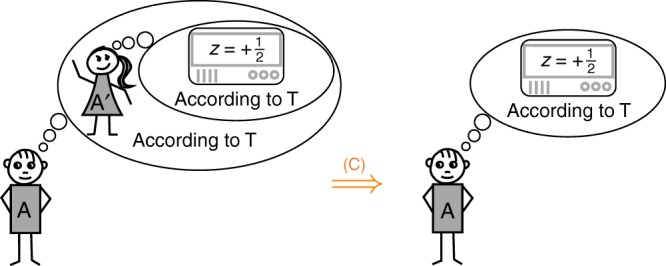
The paper proposes a Wigner’s-friend-style Gedankenexperiment showing that if quantum theory is used to reason about agents who are themselves using quantum theory, the agents can derive contradictory conclusions. The authors formalize this as a no-go theorem: assumptions (Q), (C), and (S) cannot all hold at once.
## Key findings
- Theorem 1: any theory satisfying assumptions (Q), (C), and (S) yields contradictory statements when applied to the proposed Gedankenexperiment.
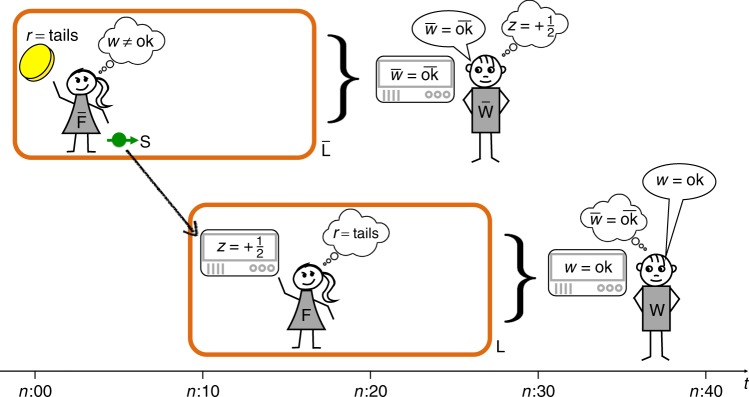
- In the final round of the experiment, agent W is certain he will observe `w = fail` at time `n:31`, yet he nevertheless observes `w = ok`, producing a contradiction.
- The paper states that `p = 1/12 > 0` for the halting event used to derive the statement that the experiment terminates after finitely many rounds.
- The result categorizes interpretations of quantum theory by which assumption they violate: many collapse models violate (Q), most Copenhagen-like / relational / QBist / CH-style readings violate (C), and many-worlds-style interpretations violate (S).
## Methods
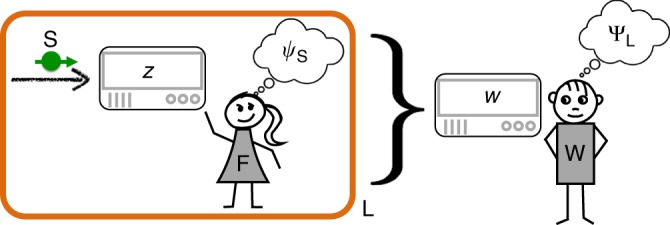
- The paper uses a thought experiment with four agents: two “friends” inside isolated labs and two outside observers, with repeated rounds `n = 0, 1, 2, ...` and a halting condition triggered when specific outcomes occur.
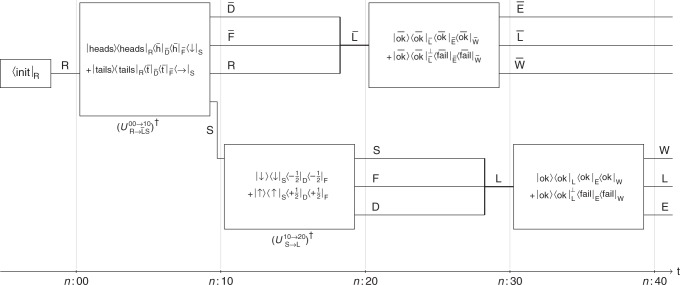
- It analyzes the protocol within standard quantum-mechanical formalism, using Heisenberg operators and a circuit-diagram/information-theoretic description.
- The main analysis derives each agent’s conclusions under assumptions (Q), (C), and (S), then shows these conclusions become inconsistent.
## Limitations
- The authors explicitly state the experiment is a Gedankenexperiment and “not technologically feasible, at least not in the form presented here.”
- The argument depends on the stated assumptions (Q), (C), and (S); the paper itself notes that interpretations may evade the conclusion by rejecting one of them.
- Evident from the text: the conclusion is about a specific self-referential multi-agent scenario, so the contradiction is not shown for all uses of quantum theory, only for this setup.
Model-written summary. Check it against the paper before relying on it.
Integrity signals
Registry
Cites
Statistics
Figures
Verification
Claims the paper makes
5 Valid · 2 Not valid · 13 Not checked · 44 Own results and interpretations
The cited sources support only part of this claim — read each source’s verdict below.
In the paper
“Another class of examples are subjectivistic interpretations, which regard statements about outcomes of measurements as personal to an agent, such as “relational quantum mechanics”38, “QBism”39,40, or the approach proposed in ref. 9”
§ Quantum theory cannot consistently describe the use of itself > Results > Theories that violate Assumption (C)
What the sources say
- Partly supportedcites [38] Rovelli C Relational quantum mechanics Int. J. Theor. Phys. 1996 35 1637 1678 10.1007/BF02302261 sourceExperimental — accuracy not yet measured
The Main discussion (p. 6) says measurement outcomes are relative to a reference system, supporting the citation of relational quantum mechanics as an example of observer-relative outcomes. But the Information section (p. 9) defines an observer as any physical system, not necessarily a personal agent; that part of the citing sentence does not accurately describe Rovelli's account. (LLM, conf=0.86)
- Supportedcites [39] Fuchs CA Schack R Quantum-Bayesian coherence Rev. Mod. Phys. 2013 85 1693 1715 10.1103/RevModPhys.85.1693 source
Our copy of Fuchs & Schack (2013) states squarely that QBism treats measurement outcomes as personal to an agent: §8.1 (p. 50) says the 'Paulian Idea' holds that 'the outcomes to quantum measurements are single-user as well,' i.e. an agent's degrees of belief are 'about her potential personal experiences arising in consequence of her actions,' and §8.1 (p. 52) calls quantum mechanics 'a single-user theory through and through ... quantum measurement outcomes are wholly personal experiences.' §4.2 (p. 26) reinforces the subjectivist side: 'there is no such thing as the quantum state. There are potentially as many states for a given quantum system as there are agents.' The citing sentence's further apparatus—conditions (Q), (S), (C)—is the citing paper's own framing, and the relational-QM and ref. 9 examples attach to other citations, so only the QBism attribution is judged here. (LLM, conf=0.90)
- Supportedcites [40] Fuchs CA Mermin ND Schack R An introduction to QBism with an application to the locality of quantum mechanics Am. J. Phys. 2014 82 749 754 10.1119/1.4874855 source
The cited sentence offers this paper as the characterization of QBism as a subjectivistic interpretation on which statements about measurement outcomes are personal to an agent. Our copy states exactly that: Section I (p. 2) says a measurement 'is an action on the world by an agent that results in the creation of an outcome - a new experience for that agent' and that 'a quantum state assignment is also a personal judgment of the agent assigning that state'; Section II (p. 4) lists as a fundamental QBist precept that 'An outcome is created for the agent who takes the measurement action only when it enters the experience of that agent'; Section III (p. 5) adds that a given outcome 'is valid only for the agent experiencing that outcome'. The (Q)/(S)/(C) conditions and the grouping with relational quantum mechanics and ref. 9 are the citing authors' own framing and are not attributed to this source, so nothing here is unsupported. (LLM, conf=0.90)
- Partly supportedcites [9] Brukner, Č. On the quantum measurement problem. in (eds. Bertlmann, R. & Zeilinger, A.) Quantum [Un]Speakables II: Half a Century of Bell’s Theorem, pp. 95–117 (Springer, 2017). sourceExperimental — accuracy not yet measured
Our copy supports the observer-relative half of the attribution: the Abstract states the quantum state 'is a representation of knowledge of a (real or hypothetical) observer relative to her experimental capabilities' and that '"facts" can only exist relative to the observer', and the Wigner's-friend section ('and thus the communication of the message...', p. ~n/a) says observers' records cannot be comprised as 'facts of the world' and that Copenhagenists/QBism/Rovelli's relational QM ('This is similar to Quantum Bayesianism...') take a like line. What the paper does not support is the 'personal to an agent' characterization of Brukner's own approach: in the probability-interpretation passage he says QBism 'runs into the danger of denying any objective elements in the notion of the quantum state' by restricting the subject matter 'to an individual agent's decisions and experiences', agrees only 'to the extent' that a fundamental limit on belief holds, and concludes 'probabilities are not just personal and subjective'. He also flags 'important differences' from Rovelli, whose 'observer' does not 'make any reference to a conscious, animate, or computing... system'. The (Q)/(S)/(C) conditions are the citing paper's framework and appear nowhere in our copy; the unsupported part is the subsumption of Brukner's approach under a purely agent-personal, subjectivistic class. (LLM, conf=0.72)
plainstates a cause- Asserted: passes — The authors put it forward as true.
- Checkable: passes — It can be checked against evidence.
- Load-bearing: unclear — It is unclear whether the paper’s conclusions depend on it.
- Based: passes — The paper gives a reason why it holds.
- Partly supported
The sources with a verdict support this claim; the rest weren’t checked yet, have no full text we could read, or their verdicts aren’t rated yet.
In the paper
“Assumption (Q) is manifestly violated by theories that postulate a modification of standard quantum mechanics, such as spontaneous16–20 and gravity-induced21–23 collapse models (cf. 24 for a review).”
§ Quantum theory cannot consistently describe the use of itself > Results > Theories that violate Assumption (Q)
What the sources say
- Not checked — no full text of the sourcecites [16] Ghirardi GC Rimini A Weber T Unified dynamics for microscopic and macroscopic systems Phys. Rev. D 1986 34 470 491 10.1103/PhysRevD.34.470 9957165 source
- Not matchedcites [17] Gisin N Stochastic quantum dynamics and relativity Helv. Phys. Acta 1989 62 363 371
Its entry has no title and year that we can search by.
- Not checked — no full text of the sourcecites [18] Pearle P Combining stochastic dynamical state-vector reduction with spontaneous localization Phys. Rev. A 1989 39 2277 2289 10.1103/PhysRevA.39.2277 9901493 source
- Supportedcites [19] Tumulka R On spontaneous wave function collapse and quantum field theory Proc. R. Soc. A 2006 462 1897 1908 10.1098/rspa.2005.1636 source
The Introduction (p. 1) frames the paper as assuming 'that the Schrödinger equation should be modified' so that macroscopic superpositions cannot persist, and names this class 'dynamical reduction', 'spontaneous localization', or 'spontaneous wave function collapse', listing among its advocates [10] Diósi and [27] Penrose, 'Wavefunction collapse as a real gravitational effect' (References, p. 14) — i.e., the gravity-induced models are counted within the same modification-of-standard-QM family. The Abstract (p. 1) repeats it ('modify the Schrödinger evolution by implementing spontaneous collapses ... a nonlinear, stochastic evolution'), and the Introduction (p. 1) notes the GRW model's 'testable predictions ... differ in principle from the quantum formulas'. The gravity-induced models are supported via their inclusion in that list rather than as a separately discussed class in the body; the citing paper's own 'Assumption (Q)' is not something this source addresses. (LLM, conf=0.80)
- Supportedcites [20] Weinberg S Collapse of the state vector Phys. Rev. A. 2012 85 062116 10.1103/PhysRevA.85.062116 source
Weinberg's paper is exactly a theory postulating a modification of standard quantum mechanics: the Abstract (p. 1) states 'Modifications of quantum mechanics are considered, in which the state vector of any system, large or small, undergoes a stochastic evolution,' and the Introduction (p. 2) frames the proposal as 'the possibility that quantum mechanics needs correction' with an 'inherently probabilistic physical collapse... occurring at all scales.' Section VII (pp. 11-12) treats the GRW spontaneous-localization model as a special case, and reference 5 (p. 14) lists the gravity-related proposals of Diosi (1988) and Penrose (2001) among the specific collapse models, so the cited work fits the sentence's characterization as a spontaneous/gravity-induced collapse-type modification of quantum mechanics. The claim's 'Assumption (Q)' is the citing paper's own assumption, not something attributed to this source. (LLM, conf=0.85)
- Not checked — no full text of the sourcecites [21] Karolyhazy F Gravitation and quantum mechanics of macroscopic objects Il Nuovo Cim. A (1971–1996) 1966 42 390 402 10.1007/BF02717926 source
- Not checked — no full text of the sourcecites [22] Diósi L Models for universal reduction of macroscopic quantum fluctuations Phys. Rev. A 1989 40 1165 1174 10.1103/PhysRevA.40.1165 9902248 source
- Not checked — no full text of the sourcecites [23] Penrose R On gravity’s role in quantum state reduction Gen. Relat. Gravit. 1996 28 581 600 10.1007/BF02105068 source
- Supportedcites [24] Bassi A Lochan K Satin S Singh TP Ulbricht H Models of wave–function collapse, underlying theories, and experimental tests Rev. Mod. Phys. 2013 85 471 527 10.1103/RevModPhys.85.471 source
Our copy is precisely the review the citing sentence points to ('cf. 24'): the ABSTRACT (p. 1) frames Continuous Spontaneous Collapse as 'a stochastic nonlinear modification of the Schrödinger equation' and reviews 'two underlying theories for this phenomenology: Trace Dynamics, and gravity induced collapse'. Sec. III.B (p. 73) describes gravity-induced loss of coherence as a modification leaving microphysics untouched, and Sec. IV.J (p. 113) speaks of these models in terms of an observable 'violation of quantum superposition' (also p. 29: without the non-standard noise field 'we would fall back in the realm of standard quantum mechanics, with the superposition principle'). So the attribution — that spontaneous and gravity-induced collapse models postulate a modification of standard quantum mechanics, hence violate a quantum assumption — is stated in the source. (LLM, conf=0.85)
boostedstates a cause- Asserted: passes — The authors put it forward as true.
- Checkable: passes — It can be checked against evidence.
- Load-bearing: unclear — It is unclear whether the paper’s conclusions depend on it.
- Based: passes — The paper gives a reason why it holds.
A result the paper states — it cites no source for it, so there is none to check. The quote shows it is in the paper.
In the paper
“Our main finding is that such a self-referential use of the theory yields contradictory claims.”
- Also stated in: § Abstract · plain
“The agents’ conclusions, although all derived within quantum theory, are thus inconsistent.”
§ Quantum theory cannot consistently describe the use of itself > Introduction
plainstates a cause- Asserted: passes — The authors put it forward as true.
- Checkable: passes — It can be checked against evidence.
- Load-bearing: passes — The paper’s conclusions depend on it.
- Based: passes — The paper gives a reason why it holds.
- Also stated in: § Abstract · plain
A result the paper states — it cites no source for it, so there is none to check. The quote shows it is in the paper.
In the paper
“Theorem 1. Any theory that satisfies assumptions (Q), (C), and (S) yields contradictory statements when applied to the Gedankenexperiment of Box 1.”
- Also stated in: § Introduction · plain
“It asserts that three natural-sounding assumptions, (Q), (C), and (S), cannot all be valid.”
§ Quantum theory cannot consistently describe the use of itself > Results > No-go theorem
plainstates a cause- Asserted: passes — The authors put it forward as true.
- Checkable: passes — It can be checked against evidence.
- Load-bearing: passes — The paper’s conclusions depend on it.
- Based: passes — The paper gives a reason why it holds.
- Rests on 3 assumptions not shown here.
- Also stated in: § Introduction · plain
A result the paper reports from its own data — it cites no other source for it, so there is none to check. The quote shows it is in the paper.
In the paper
“This is indeed confirmed by an explicit calculation in Bohmian mechanics, which reveals that statement of Table 3 does not hold there.”
§ Quantum theory cannot consistently describe the use of itself > Methods > Analysis within Bohmian mechanics
boosted- Asserted: passes — The authors put it forward as true.
- Checkable: passes — It can be checked against evidence.
- Load-bearing: passes — The paper’s conclusions depend on it.
- Based: passes — The paper gives a reason why it holds.
27 more claims
Create a free account to see all 64 claims and to verify the 3 references still open.
- Probably not a substantial claim. 18
- It may state two separate claims as one. 17
Claims other papers make about this one
Each is checked against this paper’s own text: does it say what the citing paper says it does?
The cited source doesn’t support the claim as written.
In the citing paper
“In contrast, for the no-go theorem we tested here (4), it is sufficient that they perform a measurement and record the outcome.”
From Experimental test of local observer independence (2019) · cites this paper as [5]
Checked by a reasoning model — may be wrong.
Experimental — accuracy not yet measuredThe cited source says what the claim attributes to it.
In the citing paper
“While the precise interpretation of (5) within nonlocal theories is under debate (21), it seems that abandoning free choice and locality might not resolve the contradiction (5).”
From Experimental test of local observer independence (2019) · cites this paper as [5]
The cited source says what the claim attributes to it.
In the citing paper
“The related no-go theorem by Frauchiger and Renner (5) rests on different assumptions, which do not explicitly include locality.”
From Experimental test of local observer independence (2019) · cites this paper as [5]
Citations
Cites
On the Einstein Podolsky Rosen paradox
Bell, J. S. (1964) · Physics Physique Fizika · doi:10.1103/physicsphysiquefizika.1.195 · Cited by 12,252
A Suggested Interpretation of the Quantum Theory in Terms of "Hidden" Variables. I
Bohm, D. (1952) · Physical Review · doi:10.1103/physrev.85.166 · Cited by 5,510
"Relative State" Formulation of Quantum Mechanics
Everett, H. (1957) · Reviews of Modern Physics · doi:10.1103/revmodphys.29.454 · Cited by 3,379
On the Problem of Hidden Variables in Quantum Mechanics
BELL, J. S. (1966) · Reviews of Modern Physics · doi:10.1103/revmodphys.38.447 · Cited by 2,845
Unified dynamics for microscopic and macroscopic systems
Ghirardi, G. C., Rimini, A., & Weber, T. (1986) · Physical Review D · doi:10.1103/physrevd.34.470 · Cited by 2,798
The thermodynamics of computation—a review
Bennett, C. H. (1982) · International Journal of Theoretical Physics · doi:10.1007/bf02084158 · Cited by 2,006
On gravity's role in quantum state reduction
Penrose, R. (1996) · General Relativity and Gravitation · doi:10.1007/bf02105068 · Cited by 1,872
Rovelli, C. (1996) · International Journal of Theoretical Physics · doi:10.1007/bf02302261 · Cited by 1,381
The Problem of Hidden Variables in Quantum Mechanics
Kochen, S., & Specker, E. (1967) · Indiana University Mathematics Journal · doi:10.1512/iumj.1968.17.17004 · Cited by 1,250
Models of wave-function collapse, underlying theories, and experimental tests
Bassi, A., Lochan, K., Satin, S., Singh, T. P., & Ulbricht, H. (2013) · Reviews of Modern Physics · doi:10.1103/revmodphys.85.471 · Cited by 1,170
Research works printed but not linked: 9
- Wigner, E. P. Remarks on the mind–body question. in Symmetries and Reflections, pp. 171–184. (Indiana University Press, 1967).
- Hepp K Quantum theory of measurement and macroscopic observables Helv. Phys. Acta 1972 45 237 248
- Bell JS On wave packet reduction in the Coleman–Hepp model Helv. Phys. Acta 1975 48 93 98
- Fagin, R., Halpern, J. Y., Moses, Y. & Vardi, M. Y. Reasoning About Knowledge. (MIT Press, 2004).
- Heisenberg, W. Ist eine deterministische Ergänzung der Quantenmechanik möglich? in (eds. Hermann, A., von Meyenn, K. & Weisskopf, V. F.) Wolfgang Pauli. Wissenschaftlicher Briefwechsel mit Bohr, Einstein, Heisenberg, u.a., volume II, pp. 409–418 (Springer, 1935).
- Bohr, N. Discussions with Einstein on epistemological problems in atomic physics. in (ed. Schilpp, P. A.) Albert Einstein: Philosopher-Scientist, pp. 200–241 (The Library of Living Philosophers, 1949).
- Landau, L. D. & Lifshitz, E. M. Quantum mechanics: non-relativistic theory. Chapter: The Basic Concepts of Quantum Mechanics. (Elsevier, 2013).
- von Neumann, J. Mathematische Grundlagen der Quantenmechanik (Springer-Verlag, 1932).
- Gell-Mann, M. & Hartle, J. B. Quantum mechanics in the light of quantum cosmology. in (ed. Zurek, W.) Complexity, Entropy and the Physics of Information (Addison Wesley, 1990).
Cited by
A strong no-go theorem on the Wigner’s friend paradox
Bong, K.-W., Utreras-Alarcón, A., Ghafari, F., Liang, Y.-C., Tischler, N., Cavalcanti, E. G., Pryde, G. J., & Wiseman, H. M. (2020) · Nature Physics · doi:10.1038/s41567-020-0990-x · Cited by 224
“[16] Frauchiger, D.”
A Postquantum Theory of Classical Gravity?
Oppenheim, J. (2023) · Physical Review X · doi:10.1103/physrevx.13.041040 · Cited by 164
“There is thus no need for the mysterious measurement postulate of quantum theory, a postulate which has meant that the interpretation of quantum theory has been open to dispute, and whose problematic nature has received renewed attention [117].”
A change of perspective: switching quantum reference frames via a perspective-neutral framework
Vanrietvelde, A., Höhn, P. A., Giacomini, F., & Castro-Ruiz, E. (2020) · Quantum · doi:10.22331/q-2020-01-27-225 · Cited by 259
“, see [61,83–86]).”
How Quantum Mechanics can consistently describe the use of itself
Lazarovici, D., & Hubert, M. (2019) · Scientific Reports · doi:10.1038/s41598-018-37535-1 · Cited by 113
Experimental test of local observer independence
Proietti, M., Pickston, A., Graffitti, F., Barrow, P., Kundys, D., Branciard, C., Ringbauer, M., & Fedrizzi, A. (2019) · Science Advances · doi:10.1126/sciadv.aaw9832 · Cited by 130
“We note that the no-go theorem formulated in (5) requires observers to be “agents,”who “use” quantum theory to make predictions based on the measurement outcomes.”
BackgroundInfluentialRespecting One’s Fellow: QBism’s Analysis of Wigner’s Friend
DeBrota, J. B., Fuchs, C. A., & Schack, R. (2020) · Foundations of Physics · doi:10.1007/s10701-020-00369-x · Cited by 129
A Quintet of Quandaries: Five No-Go Theorems for Relational Quantum Mechanics
Pienaar, J. (2021) · Foundations of Physics · doi:10.1007/s10701-021-00500-6 · Cited by 96
Switching Internal Times and a New Perspective on the ‘Wave Function of the Universe’
Höhn, P. (2019) · Universe · doi:10.3390/universe5050116 · Cited by 94
“That is, one has to revisit the measurement problem (and specifically the Wigner friend paradox [73, 79, 87–89]), but now with a complete relational quantum theory at hand, as proposed here, which contains both a perspective-neutral description and all the individual perspectives, a structure that was not available be…”
BackgroundStable Facts, Relative FactsPreprint
Biagio, A. D., & Rovelli, C. (2020) · PhilSci-Archive (University of Pittsburgh) · Cited by 98
Quantum Theory and the Limits of Objectivity
Healey, R. (2018) · Foundations of Physics · doi:10.1007/s10701-018-0216-6 · Cited by 94
On Formalisms and Interpretations
Baumann, V., & Wolf, S. (2018) · Quantum · doi:10.22331/q-2018-10-15-99 · Cited by 88
“Such a subjectivecollapse model, namely that each agent attributes a collapse merely to their own measurement, leads to seemingly contradictory predictions among the agents, see [2, 13].”
BackgroundEntanglement: quantum or classical?
Paneru, D., Cohen, E., Fickler, R., Boyd, R. W., & Karimi, E. (2020) · Reports on Progress in Physics · doi:10.1088/1361-6633/ab85b9 · Cited by 80
Relational Quantum Mechanics Is about Facts, Not States: A Reply to Pienaar and Brukner
Di Biagio, A., & Rovelli, C. (2022) · Foundations of Physics · doi:10.1007/s10701-022-00579-5 · Cited by 35
“This is for instance what happens in the Frauchiger and Renner experiment [9].”
MethodA no-go theorem for the persistent reality of Wigner’s friend’s perception
Guérin, P. A., Baumann, V., Santo, F. D., & Brukner, Č. (2021) · Communications Physics · doi:10.1038/s42005-021-00589-1 · Cited by 104
“In the words of these authors, in a scenario where “multiple agents have access to different pieces of information, and draw conclusions by reasoning about the information held by others”, it can be shown that, “in the general context of quantum theory, the rules for such nested reasoning may be ambiguous” [18]; a con-”
BackgroundInfluentialQuantum reference frames for general symmetry groups
de la Hamette, A.-C., & Galley, T. D. (2020) · Quantum · doi:10.22331/q-2020-11-30-367 · Cited by 156
“In fact, this is assumption C (consistency assumption) of the Frauchiger-Renner no-go theorem [24].”
MethodA detector-based measurement theory for quantum field theory
Polo-Gómez, J., Garay, L. J., & Martín-Martínez, E. (2022) · Physical review. D/Physical review. D. · doi:10.1103/physrevd.105.065003 · Cited by 94
“, the quantum Zeno effect [35, 36], the delayed choice quantum eraser experiment [37–41], or the Wigner’s friend experiment [42, 43], among others) in which the ability to perform measurements and using the information of the outcomes to update the state is essential for their implementation.”
BackgroundIndeterminism in physics and intuitionistic mathematics
Gisin, N. (2021) · Synthese · doi:10.1007/s11229-021-03378-z · Cited by 80
Quantum reference frames for general symmetry groups
de la Hamette, A.-C., & Galley, T. D. (2020) · UCL Discovery (University College London) · doi:10.3929/ethz-b-000458288 · Cited by 60
Quantum relational indeterminacy
Calosi, C., & Mariani, C. (2020) · Studies in History and Philosophy of Science Part B: Studies in History and Philosophy of Modern Physics · doi:10.1016/j.shpsb.2020.06.002 · Cited by 58
Quantum Theory of the Classical: Einselection, Envariance, Quantum Darwinism and Extantons
Zurek, W. H. (2022) · Entropy · doi:10.3390/e24111520 · Cited by 87
Wigner’s Friend as a Rational Agent
Baumann, V., & Brukner, Č. (2020) · Jerusalem Studies in Philosophy and History of Science · doi:10.1007/978-3-030-34316-3_4 · Cited by 51
“[5] two standard Wigner’s-friend setups are combined such that one arrives at a contradiction when combining the supposed knowledge and reasoning of all the agents involved.”
BackgroundBiagio, A. D., & Rovelli, C. (2021) · Foundations of Physics · doi:10.1007/s10701-021-00429-w · Cited by 117
“A number of results have recently appeared in the literature as no-go theorems for absolute (non-relative) facts [5, 6, 12].”
BackgroundQBism and Relational Quantum Mechanics compared
Pienaar, J. (2021) · Foundations of Physics · doi:10.1007/s10701-021-00501-5 · Cited by 72
Generalized probability rules from a timeless formulation of Wigner's friend scenarios
Baumann, V., Santo, F. D., Smith, A. R. H., Giacomini, F., Castro-Ruiz, E., & Brukner, Č. (2021) · Quantum · doi:10.22331/q-2021-08-16-524 · Cited by 50
“[5, 6, 7], the seemingly natural assumptions that quantum theory is universal, that different observers can each apply either of the two dynamical processes of the theory with respect to their description, and that the reasoning of different agents about one another can be freely combined to make statements about an o…”
BackgroundFrauchiger-Renner argument and quantum histories
Losada, M., Laura, R., & Lombardi, O. (2019) · Physical Review A · doi:10.1103/physreva.100.052114 · Cited by 43
The original Wigner’s friend paradox within a realist toy model
Lostaglio, M., & Bowles, J. (2021) · Proceedings of the Royal Society A Mathematical Physical and Engineering Sciences · doi:10.1098/rspa.2021.0273 · Cited by 44
Bell’s Theorem Versus Local Realism in a Quaternionic Model of Physical Space
Christian, J. (2019) · IEEE Access · doi:10.1109/access.2019.2941275 · Cited by 47
Brukner, Č. (2020) · Nature Physics · doi:10.1038/s41567-020-0984-8 · Cited by 49
No-go theorem based on incomplete information of Wigner about his friend
Xu, Z., Steinberg, J., Nguyen, H. C., & Gühne, O. (2023) · Physical Review A · doi:10.1103/physreva.107.022424 · Cited by 37
Physics and Metaphysics of Wigner’s Friends: Even Performed Premeasurements Have No Results
Żukowski, M., & Markiewicz, M. (2021) · Physical Review Letters · doi:10.1103/physrevlett.126.130402 · Cited by 62
Event-Based Quantum Mechanics: A Context for the Emergence of Classical Information
Licata, I. F., & Chiatti, L. (2019) · Symmetry · doi:10.3390/sym11020181 · Cited by 36
Wiseman, H. M., Cavalcanti, E. G., & Rieffel, E. G. (2023) · Quantum · doi:10.22331/q-2023-09-14-1112 · Cited by 60
“[5, 6] — albeit the second technological assumption is often motivated by that belief.”
BackgroundInadequacy of Modal Logic in Quantum Settings
Nurgalieva, N., & del Rio, L. (2019) · Electronic Proceedings in Theoretical Computer Science · doi:10.4204/eptcs.287.16 · Cited by 48
“Assumption 1 (Q [20]) A theory T that satisfies Q allows any agent Alice to reason as follows.”
BackgroundMethodInfluentialClassical analogy of a cat state using vortex light
Liu, S.-L., Zhou, Q., Liu, S.-K., Li, Y., Li, Y., Zhou, Z., Guo, G., & Shi, B.-S. (2019) · Communications Physics · doi:10.1038/s42005-019-0156-2 · Cited by 28
Scientific Objectivity and Its Limits
Healey, R. (2021) · The British Journal for the Philosophy of Science · doi:10.1086/716169 · Cited by 32
Any consistent coupling between classical gravity and quantum matter is fundamentally irreversible
Galley, T. D., Giacomini, F., & Selby, J. H. (2023) · Quantum · doi:10.22331/q-2023-10-16-1142 · Cited by 56
“[53] Daniela Frauchiger and Renato Renner.”
Quantum prescriptions are more ontologically distinct than they are operationally distinguishable
Chaturvedi, A., & Saha, D. (2020) · Quantum · doi:10.22331/q-2020-10-21-345 · Cited by 44
“Then one of the implications of the violation of the ontological principles could be non-existence on an ontology [15, 41, 42].”
BackgroundYīng, Y., Ansanelli, M. M., Biagio, A. D., Wolfe, E., Schmid, D., & Cavalcanti, E. G. (2024) · Quantum · doi:10.22331/q-2024-09-26-1485 · Cited by 40
Switching Quantum Reference Frames for Quantum Measurement
Yang, J. M. (2020) · Quantum · doi:10.22331/q-2020-06-18-283 · Cited by 39
“Applying the second implication, we are able to resolve the Wigner’s friend paradox and the extended version [33, 34].”
MethodFoundations of Quantum Mechanics
Adlam, E. (2021) · Cambridge University Press eBooks · doi:10.1017/9781108885515 · Cited by 28
Life as the Explanation of the Measurement Problem
Łukaszyk, S. (2024) · Journal of Physics Conference Series · doi:10.1088/1742-6596/2701/1/012124 · Cited by 24
“entangled state to Frauchiger and Renner proposition of an extended Wigner’s Friend gedanken experiment [68] it gradually became clear that any observer independent framework of QT is wrong.”
BackgroundA Brief Review of the “ETH-Approach to Quantum Mechanics”
Fröhlich, J. M. (2020) · Springer eBooks · doi:10.1007/978-3-030-56409-4_2 · Cited by 23
Perspectival objectivity: Or: how i learned to stop worrying and love observer-dependent reality
Evans, P. W. (2020) · European Journal for Philosophy of Science · doi:10.1007/s13194-020-00286-w · Cited by 23
The Frauchiger-Renner argument: A new no-go result?
Fortín, S., & Lombardi, O. (2020) · Studies in History and Philosophy of Science Part B Studies in History and Philosophy of Modern Physics · doi:10.1016/j.shpsb.2019.12.002 · Cited by 23
Cuffaro, M. E. (2023) · Entropy · doi:10.3390/e25101410 · Cited by 27
The wave function as a true ensemble
Hance, J. R., & Hossenfelder, S. (2022) · Proceedings of the Royal Society A Mathematical Physical and Engineering Sciences · doi:10.1098/rspa.2021.0705 · Cited by 33
“The Extended Wigner’s Friend experiment [33] is a more recent proposal that beautifully highlights the problems one runs into when rejecting hidden variables theories, but works entirely differently.”
BackgroundA possibilistic no-go theorem on the Wigner’s friend paradox
Haddara, M., & Cavalcanti, E. G. (2023) · New Journal of Physics · doi:10.1088/1367-2630/aceea3 · Cited by 35
“The proof is inspired by observations [11, 18, 19] regarding the similarities of Hardy’s paradox [6, 7] and the no-go theorem of Frauchiger and Renner (FR) [10], where a logical contradiction arises from certain premises in a variant of the Wigner’s friend scenario.”
BackgroundMethodEpistemic–Pragmatist Interpretations of Quantum Mechanics: A Comparative Assessment
Barzegar, A., & Oriti, D. (2024) · Foundations of Physics · doi:10.1007/s10701-024-00804-3 · Cited by 32
“[20, p. 254] In the Frauchiger–Renner scenario [31], as formulated by Bub, there are two pairs of observers Alice-Bob and Wigner-Friend and it makes a factual difference which pair is regarded as the ultimate observer.”
What's left for the neo-Copenhagen theorist
Dascal, M. (2019) · Studies in History and Philosophy of Science Part B Studies in History and Philosophy of Modern Physics · doi:10.1016/j.shpsb.2019.10.005 · Cited by 21
Decoherence framework for Wigner's-friend experiments
Relaño, A. (2020) · Physical Review A · doi:10.1103/physreva.101.032107 · Cited by 30
“[23] D.”
BackgroundKastner, R. E. (2020) · Foundations of Physics · doi:10.1007/s10701-020-00336-6 · Cited by 31
“The Frauchiger–Renner Paradox [13] is a much-discussed thought experiment in the recent literature on the foundations of quantum mechanics.”
BackgroundTesting quantum theory with thought experiments
Nurgalieva, N., & Renner, R. (2020) · Contemporary Physics · doi:10.1080/00107514.2021.1880075 · Cited by 34
“For example, as rightly pointed out by Anthony Sudbery, the argument in [25] uses the assumption that ‘If an agent A prepares a system S in a state |ψ〉, then immediately after the preparation A is certain that S is in the state |ψ〉’ [66].”
BackgroundMethodInfluentialSelf-citationSun, K., Liu, Z., Wang, Y., Hao, Z.-Y., Xu, X.-Y., Xu, J., Li, C., Guo, G., Castellini, A., Lami, L., et al. (2022) · Proceedings of the National Academy of Sciences · doi:10.1073/pnas.2119765119 · Cited by 24
When Greenberger, Horne and Zeilinger Meet Wigner’s Friend
Leegwater, G. (2022) · Foundations of Physics · doi:10.1007/s10701-022-00586-6 · Cited by 54
“Another result to which the current paper is similar is the recent no-go theorem by Frauchiger & Renner, F&R [17].”
ResultWigner’s friend and Relational Quantum Mechanics: A Reply to Laudisa
Weststeijn, N. (2021) · Foundations of Physics · doi:10.1007/s10701-021-00487-0 · Cited by 18
Representations of epistemic uncertainty and awareness in data-driven strategies
Angelelli, M., Gervasi, M., & Ciavolino, E. (2024) · Soft Computing · doi:10.1007/s00500-024-09661-8 · Cited by 22
“…analogies with other scenarios characterized by ambiguity, such as Ellsberg’s urn models (Ellsberg 1961), and explore inequivalent descriptions arising from different data observation levels in measurement settings, such as in Wigner’s Friend experiment (Wigner 1995; Frauchiger and Renner 2018).”
Quantum Information Versus Epistemic Logic: An Analysis of the Frauchiger–Renner Theorem
Boge, F. J. (2019) · Foundations of Physics · doi:10.1007/s10701-019-00298-4 · Cited by 21
Towards a quantum-like cognitive architecture for decision-making
Moreira, C., Fell, L., Dehdashti, S., Bruza, P., & Wichert, A. (2020) · QUT ePrints (Queensland University of Technology) · Cited by 15
Understanding the Frauchiger–Renner Argument
Bub, J. (2021) · Foundations of Physics · doi:10.1007/s10701-021-00420-5 · Cited by 23
Timelessness Strictly inside the Quantum Realm
Thomsen, K. (2021) · Entropy · doi:10.3390/e23060772 · Cited by 17
Relative Facts of Relational Quantum Mechanics are Incompatible with Quantum Mechanics
Lawrence, J., Markiewicz, M., & Żukowski, M. (2023) · Quantum · doi:10.22331/q-2023-05-23-1015 · Cited by 28
“This is the source of a number of inconsistencies in later works, see e.g. Frauchiger and Renner (2018) and Brukner (2018), and the critique in Żukowski and Markiewicz (2021).”
BackgroundResultOperational theories as structural realism
Adlam, E. (2022) · Studies in History and Philosophy of Science Part A · doi:10.1016/j.shpsa.2022.05.007 · Cited by 22
“As a first response to this argument, let us reinforce that ‘interpreting’ quantum mechanics is not merely about our desire to have a subjective feeling of understanding: for without an interpretation we don’t have a precise criterion for when we should ascribe unitary evolution to systems and when we should instead a…”
BackgroundMulti-agent paradoxes beyond quantum theory
Vilasini, V., Nurgalieva, N., & del Rio, L. (2019) · New Journal of Physics · doi:10.1088/1367-2630/ab4fc4 · Cited by 34
“a) In the quantum case, the original experiment is formulated as a prepare-and-measure scenario [1] but is equivalent to the version shown here.”
BackgroundMethodResultInfluentialWaaijer, M., & van Neerven, J. (2021) · Foundations of Physics · doi:10.1007/s10701-021-00413-4 · Cited by 22
Quantum Information in Neural Systems
Georgiev, D. D. (2021) · Symmetry · doi:10.3390/sym13050773 · Cited by 25
Pusey, M. F. (2018) · Nature Physics · doi:10.1038/s41567-018-0293-7 · Cited by 21
Adlam, E. (2022) · Foundations of Physics · doi:10.1007/s10701-022-00620-7 · Cited by 22
“Whereas the correct way to model observers as internal features of a quantum system remains highly controversial [71,72], and therefore the internal IQRF approach lies right at the meeting point of a number of thorny conceptual issues in quantum foundations.”
BackgroundEverett’s Interpretation and Convivial Solipsism
Zwirn, H. (2023) · Quantum Reports · doi:10.3390/quantum5010018 · Cited by 21
“This is the case for the question of non-locality, and this is also the case for the well-known Wigner’s friend [39] problem or its more recent version by Frauchiger and Renner [40] involving four observers, or Bruckner’s version of it [41].”
BackgroundMethodInfluentialGambini, R., & Pullin, J. A. (2020) · PhilSci-Archive (University of Pittsburgh) · Cited by 14
Comment on Healey’s “Quantum Theory and the Limits of Objectivity”
Baumann, V., Del Santo, F., & Brukner, Č. (2019) · Foundations of Physics · doi:10.1007/s10701-019-00276-w · Cited by 13
“Similarly to proposals [2] and [3], the gedankenexperiment introduced in [1] involves two “Wigners” (Alice and Bob) and their respective “friends” (Carol and Dan).”
BackgroundWigner’s friend paradox: does objective reality not exist?
Belinsky, A. V. (2020) · Physics-Uspekhi · doi:10.3367/ufne.2020.05.038767 · Cited by 15
Wigner-friend scenarios with noninvasive weak measurements
Matzkin, A., & Sokolovski, D. (2020) · Physical Review A · doi:10.1103/physreva.102.062204 · Cited by 13
Quantum realism: Axiomatization and quantification
Orthey, A. C., & Angelo, R. M. (2022) · Physical Review A · doi:10.1103/physreva.105.052218 · Cited by 13
Gambini, R., & Pullin, J. A. (2020) · Universe · doi:10.3390/universe6120236 · Cited by 16
“[25] D. Frauchiger, R. Renner, Nat.”
BackgroundThe Time-Evolution of States in Quantum Mechanics according to the ETH-Approach
Fröhlich, J. M., & Pizzo, A. (2021) · Communications in Mathematical Physics · doi:10.1007/s00220-021-04225-5 · Cited by 21
“Among the more famous such paradoxes is the paradox of Wigner’s friend [23] and various more recent variants thereof; see [24, 25].”
BackgroundWhich features of quantum physics are not fundamentally quantum but are due to indeterminism?
Santo, F. D., & Gisin, N. (2025) · Quantum · doi:10.22331/q-2025-04-03-1686 · Cited by 29
“…to retrieve Wigner’s friend scenarios in classical indeterministic physics, the consequences of the measurement problem in quantum mechanics are more profound, due to recent no-go theorems involving the combination of Bell nonlocality with multipartite Wigner’s friend setups [33, 34, 35].”
Bub, J. (2020) · Jerusalem studies in philosophy and history of science · doi:10.1007/978-3-030-34316-3_8 · Cited by 15
Wigner's friend, Feynman's paths and material records
Matzkin, A., & Sokolovski, D. (2020) · Europhysics Letters (EPL) · doi:10.1209/0295-5075/131/40001 · Cited by 11
“[6] LAZAROVICI D.”
Quantum mechanics as a calculus for estimation under epistemic restriction
Budiyono, A. (2019) · Physical Review A · doi:10.1103/physreva.100.062102 · Cited by 11
Introducing the Q-Based Interpretation of Quantum Theory
Friederich, S. (2021) · The British Journal for the Philosophy of Science · doi:10.1086/716196 · Cited by 18
“Epistemic accounts of quantum states (‘ψ-epistemic accounts’) are prima facie attractive because they allow one to conceive of measurement collapse as related to Bayesian updating (Spekkens [2007], Fuchs and Schack [2013], Friederich [2014], Healey [2017]).”
BackgroundQuantum erasing the memory of Wigner's friend
Elouard, C., Lewalle, P., Manikandan, S. K., Rogers, S., Frank, A., & Jordan, A. N. (2021) · Quantum · doi:10.22331/q-2021-07-08-498 · Cited by 21
“[3] as an interferometric setup, involving three different degrees of freedom of a single photon to play the roles of two qubits and the agents measuring them.”
BackgroundMethodInfluentialHow long does it take to implement a projective measurement?
Strasberg, P., Modi, K. K., & Skotiniotis, M. (2022) · European Journal of Physics · doi:10.1088/1361-6404/ac5a7a · Cited by 17
Observers of quantum systems cannot agree to disagree
Contreras-Tejada, P., Scarpa, G., Kubicki, A. M., Brandenburger, A. M., & Mura, P. L. (2021) · Nature Communications · doi:10.1038/s41467-021-27134-6 · Cited by 18
“[13].”
BackgroundJi, M., & Hofmann, H. F. (2023) · Physical Review A · doi:10.1103/physreva.107.022208 · Cited by 12
“The present analysis is based on the demonstration of inconsistencies between different measurements presented by Frauchiger and Renner [19].”
BackgroundMethodInfluentialRelational Quantum Mechanics, quantum relativism, and the iteration of relativity
Riedel, T. (2024) · Studies in History and Philosophy of Science Part A · doi:10.1016/j.shpsa.2024.02.007 · Cited by 21
Quantum mechanical rules for observed observers and the consistency of quantum theory
Polychronakos, A. P. (2024) · Nature Communications · doi:10.1038/s41467-024-47170-2 · Cited by 18
“Recently, Frauchiger and Renner (FR) proposed a thought experiment [2] built on a variant of the “Wigner’s friend” setup paralleling a construction by Hardy [3] that, upon application of the conventional rules of quantum mechanics, leads to a contradiction, thus casting doubt on the logical…”
BackgroundGambini, R., García-Pintos, L. P., & Pullin, J. A. (2019) · Physical Review A · doi:10.1103/physreva.100.012113 · Cited by 12
“More recently, Frauchiger and Renner built on Wigner friend’s paradox, formally proving that in unitary quantum mechanics one cannot consistently define the occurrence of unique events in a self-consistent way [19].”
BackgroundRelational Quantum Mechanics and the PBR Theorem: A Peaceful Coexistence
Oldofredi, A., & Calosi, C. (2021) · Foundations of Physics · doi:10.1007/s10701-021-00485-2 · Cited by 12
Universal structure of objective states in all fundamental causal theories
Scandolo, C. M., Salazar, R., Korbicz, J. K., & Horodecki, P. (2021) · Physical Review Research · doi:10.1103/physrevresearch.3.033148 · Cited by 23
A possible solution to the which-way problem of quantum interference
Hofmann, H. F., Matsushita, T., Kuroki, S., & Iinuma, M. (2023) · Quantum Studies Mathematics and Foundations · doi:10.1007/s40509-023-00304-5 · Cited by 9
Events in quantum mechanics are maximally non-absolute
Moreno, G., Nery, R., Duarte, C., & Chaves, R. (2022) · Quantum · doi:10.22331/q-2022-08-24-785 · Cited by 12
Wigner’s friend and relational objectivity
Brukner, Č. (2022) · Nature Reviews Physics · doi:10.1038/s42254-022-00505-8 · Cited by 15
Quantum Measurements with, and Yet without an Observer
Sokolovski, D. (2020) · Entropy · doi:10.3390/e22101185 · Cited by 14
“A related question is how an Observer, taking part in the experiment, should consider other intelligent participants, and whether his/her reasoning would depend on availability of the information about other Observers’ outcomes [1], or merely on being aware of the other measurements being made.”
BackgroundKastner, R. E. (2019) · PhilSci-Archive (University of Pittsburgh) · Cited by 11
Lohrey, A., & Boreham, B. W. (2020) · Communicative & Integrative Biology · doi:10.1080/19420889.2020.1822583 · Cited by 15
“models and experiments that cannot be extrapolated to accurately describe complex physical systems [3,4].”
BackgroundCellular evolution as the flow of energy
Torday, J. S. (2021) · Progress in Biophysics and Molecular Biology · doi:10.1016/j.pbiomolbio.2021.06.011 · Cited by 8
Local Quantum Theory with Fluids in Space-Time
Waegell, M. (2023) · Quantum Reports · doi:10.3390/quantum5010011 · Cited by 16
Matsuno, K. (2018) · Philosophies · doi:10.3390/philosophies3040045 · Cited by 9
Konishi, K. (2022) · International Journal of Modern Physics A · doi:10.1142/s0217751x22501135 · Cited by 11
“The author’s gratitudes also go to Giampiero Paffuti for the invaluable collaboration work in writing the book [1], to Gabriele Veneziano for explaining some aspects of cosmology, to Hans-Thomas Elze for discussions, suggestions and for carefully reading the manuscript, to Matteo Brini for discussions on [10], to the…”
BackgroundA Physics Lab Inside Your Head: Quantum Thought Experiments as an Educational Tool
Violaris, M. (2023) · IEEE International Conference on Quantum Computing and Engineering (QCE) · doi:10.1109/qce57702.2023.20325 · Cited by 13
Metadata
- Authors
- Frauchiger, D., & Renner, R.
- Affiliations
- ETH Zurich (CH)
- Corresponding author
- Renner, Renato
- ORCID
- Renner, Renato
- Venue
- Nature Communications
- Published
- 2018-09-18
- Volume
- 9
- Issue
- 1
- Pages
- 3711-3711
- ISSN
- 2041-1723 (ISSN-L)
- PMC
- PMC6143649
- OpenAlex
- W2921169191
- Semantic Scholar
- 612b12de314e91728d6e6ec63b91e099c5702eec
- Cited by
- 333
- References
- 55
- Citations by year
- 2026: 48 · 2025: 43 · 2024: 33 · 2023: 52 · 2022: 35 · 2021: 44 · 2020: 45 · 2019: 26 · 2018: 7
- FWCI
- 14.11
- Type
- journal article
- Language
- en
- Open access
- gold
- doi.org
- Licence
- cc-by
- creativecommons.org/licenses/by/4.0 (tdm)
- creativecommons.org/licenses/by/4.0 (vor)
- Locations
- Nature Communications (publishedVersion, cc-by)
- arXiv (Cornell University) (publishedVersion)
- Europe PMC (PubMed Central) (publishedVersion, other-oa)
- PubMed Central (publishedVersion, cc-by)
- PubMed (publishedVersion)
- arXiv (Cornell University) (submittedVersion)
- DOAJ (DOAJ: Directory of Open Access Journals) (submittedVersion, cc-by-sa)
- DOAJ (DOAJ: Directory of Open Access Journals) (submittedVersion)
- arXiv (Cornell University)
- Funders
- Schweizerischer Nationalfonds zur Förderung der Wissenschaftlichen Forschung (NCCR QSIT)
- EC | Seventh Framework Programme (RAQUEL)
- EC | European Research Council (258932)
- Kavli Institute for Theoretical Physics, University of California, Santa Barbara (PHY17-48958)
- Stellenbosch Institute for Advanced Study
- Topics
- Physical Sciences › Physics and Astronomy › Atomic and Molecular Physics, and Optics › Quantum Mechanics and Applications
- Physical Sciences › Physics and Astronomy › Atomic and Molecular Physics, and Optics › Quantum Information and Cryptography
- Physical Sciences › Physics and Astronomy › Nuclear and High Energy Physics › Noncommutative and Quantum Gravity Theories
- Keywords
- quantum mechanics, self-consistency, thought experiments, measurement outcomes, complex systems, quantum foundations
About these checks
Registry, retraction, Cites and statistics results are computed, not judged, with one exception: a printed reference that no index lists is read once by a model before it counts as a citation error. Claims are extracted by a model and kept only when their quote appears verbatim in the text; each cited source is then checked, with a model’s help, for whether it says what the claim relies on. Those verdicts can be wrong — read the claim’s quote and the cited source before relying on one.
The claim verdicts this report counts are experimental: their accuracy is not yet measured.
A language model drew the claims from the paper on 2026-10-10, under version 3 of the claim definition (model deepseek-v4.1-flash, prompt extract-v3).
A second model labelled each claim on 2026-10-10 (model jev-1.13-20260917, definition revision gold-guideline-v0.2).
Cited sources are checked with a language model’s help (gpt-6-sol and qwen3.8-omni-flash).
Statistics and arithmetic are recomputed, not judged.
Confidence bands are shown only for fields calibrated on our annotated test set. None is calibrated yet, so no band is shown.
What counts as a claim ›How we measure confidence ›How we check this ›
Are you an author, or do you see a problem with this page? Request a review
Data sources
Bibliographic data: Semantic Scholar, OpenAlex, Crossref.
Contains information from the Semantic Scholar Academic Graph Datasets, made available under the ODC Attribution License (ODC-BY 1.0).
Semantic Scholar’s data is described in: Kinney, R., et al. (2023). The Semantic Scholar Open Data Platform. arXiv:2301.10140.
