

Quantum theory cannot consistently describe the use of itself
Open accessThe DOI matches its Crossref record; 60 of the 63 references it cites were found in a registry or an index; 10 of the 44 sources its claims cite were checked for support.
Abstract
Quantum theory provides an extremely accurate description of fundamental processes in physics. It thus seems likely that the theory is applicable beyond the, mostly microscopic, domain in which it has been tested experimentally. Here, we propose a Gedankenexperiment to investigate the question whether quantum theory can, in principle, have universal validity. The idea is that, if the answer was yes, it must be possible to employ quantum theory to model complex systems that include agents who are themselves using quantum theory. Analysing the experiment under this presumption, we find that one agent, upon observing a particular measurement outcome, must conclude that another agent has predicted the opposite outcome with certainty. The agents' conclusions, although all derived within quantum theory, are thus inconsistent. This indicates that quantum theory cannot be extrapolated to complex systems, at least not in a straightforward manner.
Overview
CoChat Summary
## TL;DR
The paper proposes a Wigner’s-friend-style Gedankenexperiment showing that if quantum theory is used to reason about agents who are themselves using quantum theory, the agents can derive contradictory conclusions. The authors formalize this as a no-go theorem: assumptions (Q), (C), and (S) cannot all hold at once.
## Key findings
- Theorem 1: any theory satisfying assumptions (Q), (C), and (S) yields contradictory statements when applied to the proposed Gedankenexperiment.
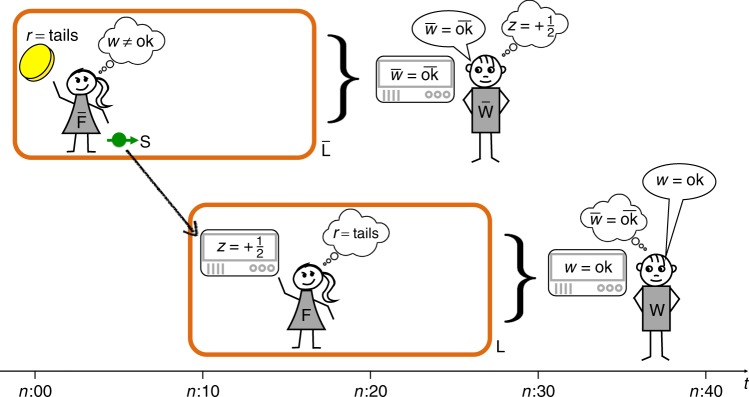
- In the final round of the experiment, agent W is certain he will observe `w = fail` at time `n:31`, yet he nevertheless observes `w = ok`, producing a contradiction.
- The paper states that `p = 1/12 > 0` for the halting event used to derive the statement that the experiment terminates after finitely many rounds.
- The result categorizes interpretations of quantum theory by which assumption they violate: many collapse models violate (Q), most Copenhagen-like / relational / QBist / CH-style readings violate (C), and many-worlds-style interpretations violate (S).
## Methods
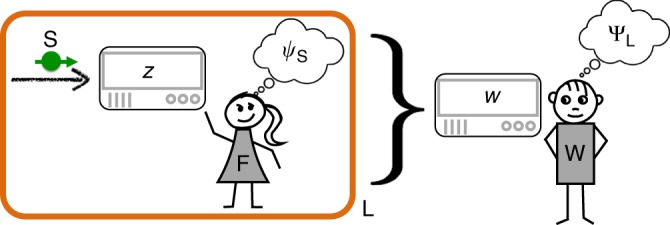
- The paper uses a thought experiment with four agents: two “friends” inside isolated labs and two outside observers, with repeated rounds `n = 0, 1, 2, ...` and a halting condition triggered when specific outcomes occur.
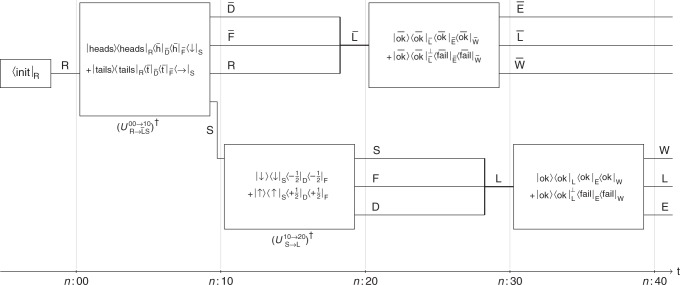
- It analyzes the protocol within standard quantum-mechanical formalism, using Heisenberg operators and a circuit-diagram/information-theoretic description.
- The main analysis derives each agent’s conclusions under assumptions (Q), (C), and (S), then shows these conclusions become inconsistent.
## Limitations
- The authors explicitly state the experiment is a Gedankenexperiment and “not technologically feasible, at least not in the form presented here.”
- The argument depends on the stated assumptions (Q), (C), and (S); the paper itself notes that interpretations may evade the conclusion by rejecting one of them.
- Evident from the text: the conclusion is about a specific self-referential multi-agent scenario, so the contradiction is not shown for all uses of quantum theory, only for this setup.
Model-written summary. Check it against the paper before relying on it.
Integrity signals
Registry
Cites
Statistics
Figures
Verification
Claims the paper makes
5 Valid · 2 Not valid · 13 Not checked · 44 Own results and interpretations
The cited sources support only part of this claim — read each source’s verdict below.
In the paper
“Another class of examples are subjectivistic interpretations, which regard statements about outcomes of measurements as personal to an agent, such as “relational quantum mechanics”38, “QBism”39,40, or the approach proposed in ref. 9”
§ Quantum theory cannot consistently describe the use of itself > Results > Theories that violate Assumption (C)
What the sources say
- Partly supportedcites [38] Rovelli C Relational quantum mechanics Int. J. Theor. Phys. 1996 35 1637 1678 10.1007/BF02302261 sourceExperimental — accuracy not yet measured
The Main discussion (p. 6) says measurement outcomes are relative to a reference system, supporting the citation of relational quantum mechanics as an example of observer-relative outcomes. But the Information section (p. 9) defines an observer as any physical system, not necessarily a personal agent; that part of the citing sentence does not accurately describe Rovelli's account. (LLM, conf=0.86)
- Supportedcites [39] Fuchs CA Schack R Quantum-Bayesian coherence Rev. Mod. Phys. 2013 85 1693 1715 10.1103/RevModPhys.85.1693 source
Our copy of Fuchs & Schack (2013) states squarely that QBism treats measurement outcomes as personal to an agent: §8.1 (p. 50) says the 'Paulian Idea' holds that 'the outcomes to quantum measurements are single-user as well,' i.e. an agent's degrees of belief are 'about her potential personal experiences arising in consequence of her actions,' and §8.1 (p. 52) calls quantum mechanics 'a single-user theory through and through ... quantum measurement outcomes are wholly personal experiences.' §4.2 (p. 26) reinforces the subjectivist side: 'there is no such thing as the quantum state. There are potentially as many states for a given quantum system as there are agents.' The citing sentence's further apparatus—conditions (Q), (S), (C)—is the citing paper's own framing, and the relational-QM and ref. 9 examples attach to other citations, so only the QBism attribution is judged here. (LLM, conf=0.90)
- Supportedcites [40] Fuchs CA Mermin ND Schack R An introduction to QBism with an application to the locality of quantum mechanics Am. J. Phys. 2014 82 749 754 10.1119/1.4874855 source
The cited sentence offers this paper as the characterization of QBism as a subjectivistic interpretation on which statements about measurement outcomes are personal to an agent. Our copy states exactly that: Section I (p. 2) says a measurement 'is an action on the world by an agent that results in the creation of an outcome - a new experience for that agent' and that 'a quantum state assignment is also a personal judgment of the agent assigning that state'; Section II (p. 4) lists as a fundamental QBist precept that 'An outcome is created for the agent who takes the measurement action only when it enters the experience of that agent'; Section III (p. 5) adds that a given outcome 'is valid only for the agent experiencing that outcome'. The (Q)/(S)/(C) conditions and the grouping with relational quantum mechanics and ref. 9 are the citing authors' own framing and are not attributed to this source, so nothing here is unsupported. (LLM, conf=0.90)
- Partly supportedcites [9] Brukner, Č. On the quantum measurement problem. in (eds. Bertlmann, R. & Zeilinger, A.) Quantum [Un]Speakables II: Half a Century of Bell’s Theorem, pp. 95–117 (Springer, 2017). sourceExperimental — accuracy not yet measured
Our copy supports the observer-relative half of the attribution: the Abstract states the quantum state 'is a representation of knowledge of a (real or hypothetical) observer relative to her experimental capabilities' and that '"facts" can only exist relative to the observer', and the Wigner's-friend section ('and thus the communication of the message...', p. ~n/a) says observers' records cannot be comprised as 'facts of the world' and that Copenhagenists/QBism/Rovelli's relational QM ('This is similar to Quantum Bayesianism...') take a like line. What the paper does not support is the 'personal to an agent' characterization of Brukner's own approach: in the probability-interpretation passage he says QBism 'runs into the danger of denying any objective elements in the notion of the quantum state' by restricting the subject matter 'to an individual agent's decisions and experiences', agrees only 'to the extent' that a fundamental limit on belief holds, and concludes 'probabilities are not just personal and subjective'. He also flags 'important differences' from Rovelli, whose 'observer' does not 'make any reference to a conscious, animate, or computing... system'. The (Q)/(S)/(C) conditions are the citing paper's framework and appear nowhere in our copy; the unsupported part is the subsumption of Brukner's approach under a purely agent-personal, subjectivistic class. (LLM, conf=0.72)
plainstates a cause- Asserted: passes — The authors put it forward as true.
- Checkable: passes — It can be checked against evidence.
- Load-bearing: unclear — It is unclear whether the paper’s conclusions depend on it.
- Based: passes — The paper gives a reason why it holds.
- Partly supported
The sources with a verdict support this claim; the rest weren’t checked yet, have no full text we could read, or their verdicts aren’t rated yet.
In the paper
“Assumption (Q) is manifestly violated by theories that postulate a modification of standard quantum mechanics, such as spontaneous16–20 and gravity-induced21–23 collapse models (cf. 24 for a review).”
§ Quantum theory cannot consistently describe the use of itself > Results > Theories that violate Assumption (Q)
What the sources say
- Not checked — no full text of the sourcecites [16] Ghirardi GC Rimini A Weber T Unified dynamics for microscopic and macroscopic systems Phys. Rev. D 1986 34 470 491 10.1103/PhysRevD.34.470 9957165 source
- Not matchedcites [17] Gisin N Stochastic quantum dynamics and relativity Helv. Phys. Acta 1989 62 363 371
Its entry has no title and year that we can search by.
- Not checked — no full text of the sourcecites [18] Pearle P Combining stochastic dynamical state-vector reduction with spontaneous localization Phys. Rev. A 1989 39 2277 2289 10.1103/PhysRevA.39.2277 9901493 source
- Supportedcites [19] Tumulka R On spontaneous wave function collapse and quantum field theory Proc. R. Soc. A 2006 462 1897 1908 10.1098/rspa.2005.1636 source
The Introduction (p. 1) frames the paper as assuming 'that the Schrödinger equation should be modified' so that macroscopic superpositions cannot persist, and names this class 'dynamical reduction', 'spontaneous localization', or 'spontaneous wave function collapse', listing among its advocates [10] Diósi and [27] Penrose, 'Wavefunction collapse as a real gravitational effect' (References, p. 14) — i.e., the gravity-induced models are counted within the same modification-of-standard-QM family. The Abstract (p. 1) repeats it ('modify the Schrödinger evolution by implementing spontaneous collapses ... a nonlinear, stochastic evolution'), and the Introduction (p. 1) notes the GRW model's 'testable predictions ... differ in principle from the quantum formulas'. The gravity-induced models are supported via their inclusion in that list rather than as a separately discussed class in the body; the citing paper's own 'Assumption (Q)' is not something this source addresses. (LLM, conf=0.80)
- Supportedcites [20] Weinberg S Collapse of the state vector Phys. Rev. A. 2012 85 062116 10.1103/PhysRevA.85.062116 source
Weinberg's paper is exactly a theory postulating a modification of standard quantum mechanics: the Abstract (p. 1) states 'Modifications of quantum mechanics are considered, in which the state vector of any system, large or small, undergoes a stochastic evolution,' and the Introduction (p. 2) frames the proposal as 'the possibility that quantum mechanics needs correction' with an 'inherently probabilistic physical collapse... occurring at all scales.' Section VII (pp. 11-12) treats the GRW spontaneous-localization model as a special case, and reference 5 (p. 14) lists the gravity-related proposals of Diosi (1988) and Penrose (2001) among the specific collapse models, so the cited work fits the sentence's characterization as a spontaneous/gravity-induced collapse-type modification of quantum mechanics. The claim's 'Assumption (Q)' is the citing paper's own assumption, not something attributed to this source. (LLM, conf=0.85)
- Not checked — no full text of the sourcecites [21] Karolyhazy F Gravitation and quantum mechanics of macroscopic objects Il Nuovo Cim. A (1971–1996) 1966 42 390 402 10.1007/BF02717926 source
- Not checked — no full text of the sourcecites [22] Diósi L Models for universal reduction of macroscopic quantum fluctuations Phys. Rev. A 1989 40 1165 1174 10.1103/PhysRevA.40.1165 9902248 source
- Not checked — no full text of the sourcecites [23] Penrose R On gravity’s role in quantum state reduction Gen. Relat. Gravit. 1996 28 581 600 10.1007/BF02105068 source
- Supportedcites [24] Bassi A Lochan K Satin S Singh TP Ulbricht H Models of wave–function collapse, underlying theories, and experimental tests Rev. Mod. Phys. 2013 85 471 527 10.1103/RevModPhys.85.471 source
Our copy is precisely the review the citing sentence points to ('cf. 24'): the ABSTRACT (p. 1) frames Continuous Spontaneous Collapse as 'a stochastic nonlinear modification of the Schrödinger equation' and reviews 'two underlying theories for this phenomenology: Trace Dynamics, and gravity induced collapse'. Sec. III.B (p. 73) describes gravity-induced loss of coherence as a modification leaving microphysics untouched, and Sec. IV.J (p. 113) speaks of these models in terms of an observable 'violation of quantum superposition' (also p. 29: without the non-standard noise field 'we would fall back in the realm of standard quantum mechanics, with the superposition principle'). So the attribution — that spontaneous and gravity-induced collapse models postulate a modification of standard quantum mechanics, hence violate a quantum assumption — is stated in the source. (LLM, conf=0.85)
boostedstates a cause- Asserted: passes — The authors put it forward as true.
- Checkable: passes — It can be checked against evidence.
- Load-bearing: unclear — It is unclear whether the paper’s conclusions depend on it.
- Based: passes — The paper gives a reason why it holds.
A result the paper states — it cites no source for it, so there is none to check. The quote shows it is in the paper.
In the paper
“Our main finding is that such a self-referential use of the theory yields contradictory claims.”
- Also stated in: § Abstract · plain
“The agents’ conclusions, although all derived within quantum theory, are thus inconsistent.”
§ Quantum theory cannot consistently describe the use of itself > Introduction
plainstates a cause- Asserted: passes — The authors put it forward as true.
- Checkable: passes — It can be checked against evidence.
- Load-bearing: passes — The paper’s conclusions depend on it.
- Based: passes — The paper gives a reason why it holds.
- Also stated in: § Abstract · plain
A result the paper states — it cites no source for it, so there is none to check. The quote shows it is in the paper.
In the paper
“Theorem 1. Any theory that satisfies assumptions (Q), (C), and (S) yields contradictory statements when applied to the Gedankenexperiment of Box 1.”
- Also stated in: § Introduction · plain
“It asserts that three natural-sounding assumptions, (Q), (C), and (S), cannot all be valid.”
§ Quantum theory cannot consistently describe the use of itself > Results > No-go theorem
plainstates a cause- Asserted: passes — The authors put it forward as true.
- Checkable: passes — It can be checked against evidence.
- Load-bearing: passes — The paper’s conclusions depend on it.
- Based: passes — The paper gives a reason why it holds.
- Rests on 3 assumptions not shown here.
- Also stated in: § Introduction · plain
A result the paper reports from its own data — it cites no other source for it, so there is none to check. The quote shows it is in the paper.
In the paper
“This is indeed confirmed by an explicit calculation in Bohmian mechanics, which reveals that statement of Table 3 does not hold there.”
§ Quantum theory cannot consistently describe the use of itself > Methods > Analysis within Bohmian mechanics
boosted- Asserted: passes — The authors put it forward as true.
- Checkable: passes — It can be checked against evidence.
- Load-bearing: passes — The paper’s conclusions depend on it.
- Based: passes — The paper gives a reason why it holds.
27 more claims
Create a free account to see all 64 claims and to verify the 3 references still open.
- Probably not a substantial claim. 18
- It may state two separate claims as one. 17
Claims other papers make about this one
Each is checked against this paper’s own text: does it say what the citing paper says it does?
The cited source doesn’t support the claim as written.
In the citing paper
“In contrast, for the no-go theorem we tested here (4), it is sufficient that they perform a measurement and record the outcome.”
From Experimental test of local observer independence (2019) · cites this paper as [5]
Checked by a reasoning model — may be wrong.
Experimental — accuracy not yet measuredThe cited source says what the claim attributes to it.
In the citing paper
“While the precise interpretation of (5) within nonlocal theories is under debate (21), it seems that abandoning free choice and locality might not resolve the contradiction (5).”
From Experimental test of local observer independence (2019) · cites this paper as [5]
The cited source says what the claim attributes to it.
In the citing paper
“The related no-go theorem by Frauchiger and Renner (5) rests on different assumptions, which do not explicitly include locality.”
From Experimental test of local observer independence (2019) · cites this paper as [5]
Citations
Cites
On the Einstein Podolsky Rosen paradox
Bell, J. S. (1964) · Physics Physique Fizika · doi:10.1103/physicsphysiquefizika.1.195 · Cited by 12,252
A Suggested Interpretation of the Quantum Theory in Terms of "Hidden" Variables. I
Bohm, D. (1952) · Physical Review · doi:10.1103/physrev.85.166 · Cited by 5,510
"Relative State" Formulation of Quantum Mechanics
Everett, H. (1957) · Reviews of Modern Physics · doi:10.1103/revmodphys.29.454 · Cited by 3,379
On the Problem of Hidden Variables in Quantum Mechanics
BELL, J. S. (1966) · Reviews of Modern Physics · doi:10.1103/revmodphys.38.447 · Cited by 2,845
Unified dynamics for microscopic and macroscopic systems
Ghirardi, G. C., Rimini, A., & Weber, T. (1986) · Physical Review D · doi:10.1103/physrevd.34.470 · Cited by 2,798
The thermodynamics of computation—a review
Bennett, C. H. (1982) · International Journal of Theoretical Physics · doi:10.1007/bf02084158 · Cited by 2,006
On gravity's role in quantum state reduction
Penrose, R. (1996) · General Relativity and Gravitation · doi:10.1007/bf02105068 · Cited by 1,872
Rovelli, C. (1996) · International Journal of Theoretical Physics · doi:10.1007/bf02302261 · Cited by 1,381
The Problem of Hidden Variables in Quantum Mechanics
Kochen, S., & Specker, E. (1967) · Indiana University Mathematics Journal · doi:10.1512/iumj.1968.17.17004 · Cited by 1,250
Models of wave-function collapse, underlying theories, and experimental tests
Bassi, A., Lochan, K., Satin, S., Singh, T. P., & Ulbricht, H. (2013) · Reviews of Modern Physics · doi:10.1103/revmodphys.85.471 · Cited by 1,170
Research works printed but not linked: 9
- Wigner, E. P. Remarks on the mind–body question. in Symmetries and Reflections, pp. 171–184. (Indiana University Press, 1967).
- Hepp K Quantum theory of measurement and macroscopic observables Helv. Phys. Acta 1972 45 237 248
- Bell JS On wave packet reduction in the Coleman–Hepp model Helv. Phys. Acta 1975 48 93 98
- Fagin, R., Halpern, J. Y., Moses, Y. & Vardi, M. Y. Reasoning About Knowledge. (MIT Press, 2004).
- Heisenberg, W. Ist eine deterministische Ergänzung der Quantenmechanik möglich? in (eds. Hermann, A., von Meyenn, K. & Weisskopf, V. F.) Wolfgang Pauli. Wissenschaftlicher Briefwechsel mit Bohr, Einstein, Heisenberg, u.a., volume II, pp. 409–418 (Springer, 1935).
- Bohr, N. Discussions with Einstein on epistemological problems in atomic physics. in (ed. Schilpp, P. A.) Albert Einstein: Philosopher-Scientist, pp. 200–241 (The Library of Living Philosophers, 1949).
- Landau, L. D. & Lifshitz, E. M. Quantum mechanics: non-relativistic theory. Chapter: The Basic Concepts of Quantum Mechanics. (Elsevier, 2013).
- von Neumann, J. Mathematische Grundlagen der Quantenmechanik (Springer-Verlag, 1932).
- Gell-Mann, M. & Hartle, J. B. Quantum mechanics in the light of quantum cosmology. in (ed. Zurek, W.) Complexity, Entropy and the Physics of Information (Addison Wesley, 1990).
Cited by
Items 201–300 of 327
The Ultimate Reality in the Universe: A Study on the Views of Quantum Physics and Vedanta Philosophy
Gain, J. (2023) · Studies in Philosophy of Science and Education · doi:10.46627/sipose.v4i3.262 · Cited by 1
Hidden Variables in Quantum Mechanics from the Perspective of Boltzmannian Statistical Mechanics
Lazarovici, D. (2024) · Quantum Reports · doi:10.3390/quantum6030031 · Cited by 1
“Interesting, albeit hypothetical, cases in which macroscopic records can be changed by subsequent measurements are Wigner’s friend-type experiments [20,21]).”
Relativity and quantum theory: Under the spell of today’s paradigms
Weigert, S. (2024) · Journal of Physics Conference Series · doi:10.1088/1742-6596/2877/1/012071 · Cited by 1
“The measurement problem has been made quite explicit by refining a paradoxical thought experiment dating back to the 1960s [17, 18].”
Reassessing the Strength of a Class of Wigner’s Friend No-Go Theorems
Okon, E. (2025) · Entropy · doi:10.3390/e27060563 · Cited by 5
“The idea that conditions ii and iii in AOE are necessary to prove Bell’s theorem might be thought to be related with the so-called “collapse locality loophole” described in Kent (2005).”
Briegel, H. J., & Müller, T. (2025) · Synthese Library/Synthese library · doi:10.1007/978-3-031-98119-7_3 · Cited by 1
Experimental evidence for the physical delocalization of individual photons in an interferometer
Fukuda, R., Iinuma, M., Matsumoto, Y., & Hofmann, H. F. (2026) · New Journal of Physics · doi:10.1088/1367-2630/ae51b7 · Cited by 1
Phenomenological quantum mechanics: I. Phenomenology of quantum observables
Szańkowski, P., Lonigro, D., Sakuldee, F., Cywiński, Ł., & Chruściński, D. (2026) · Journal of Physics A Mathematical and Theoretical · doi:10.1088/1751-8121/ae97a0 · Cited by 2
“The observations 5, 6 and 8 concerning various aspects of quantum interference described in section 5 compelled us to consider a formal parameterization of phenomenological probability distributions based on a family of complex-valued distributions on the space of sequence pairs, These…”
How the Natural Interpretation of QM Avoids the Recent No-Go Theorem
Rizzi, A. (2020) · Foundations of Physics · doi:10.1007/s10701-020-00323-x · Cited by 2
“In these last two sections, equations are given for step of the experiment, even those ignored in DF&RR’s formal analysis; this is done especially in order manifest the nature of the ensemble approach in which measurement entangles the measuring device and the thing measured.”
InfluentialDorato, M. (2020) · Jerusalem studies in philosophy and history of science · doi:10.1007/978-3-030-34316-3_10 · Cited by 1
Copenhagen Interpretation Can Survive the Upgraded Schrödinger’s cat Gedankenexperiment
He, G. P. (2020) · Foundations of Physics · doi:10.1007/s10701-020-00343-7 · Cited by 2
Nelson-Isaacs, S. (2020) · Quantum Reports · doi:10.3390/quantum3010002 · Cited by 4
“A related paper by Frauchiger and Renner [5] proposes an experiment which shows that QM generates inconsistent experimental predictions if, again, three assumptions are all held to be true:”
BackgroundResultInfluentialSudbery, A. (2022) · International Journal of Theoretical Physics · doi:10.1007/s10773-022-05046-5 · Cited by 2
“The Frauchiger-Renner argument assumes communication between F1, W1 and W2 and therefore requires that they should be treated as a single observer whose experience covers the measurement results of all three.”
MethodInfluentialUnitary Evolution and Elements of Reality in Consecutive Quantum Measurements
Sokolovski, D. (2022) · Entropy · doi:10.3390/e24070877 · Cited by 1
“Firstly, is it consistent? There have been recent suggestions [2] that quantum mechanics may be self-contradictory, and that its flaws can be detected from within the theory, i.”
BackgroundThe Morbid Equation of Quantum NumbersPreprint
Dongfang, X. (2020) · doi:10.14293/s2199-1006.1.sor-.pp61cui.v1 · Cited by 1
“Article title: The Morbid Equation of Quantum Numbers Authors: XD Dongfang[1] Affiliations: Wutong Mountain National Forest Park[1] Orcid ids: 0000-0002-3644-5170[1] Contact e-mail: xddongfang@gmail.com License information: This work has been published open access under Creative Commons Attribution License http://crea…”
InfluentialThe metaphysics of decoherencePreprint
Vassallo, A., & Romano, D. (2021) · PhilSci-Archive (University of Pittsburgh) · Cited by 1
Szyperski, T. (2022) · The Journal of Physical Chemistry A · doi:10.1021/acs.jpca.2c07388 · Cited by 1
A single hidden variable interpretation of the quantum wave functionPreprint
Gentile, D. (2023) · Qeios · doi:10.32388/j3pvm1.3 · Cited by 1
A single hidden variable interpretation of the quantum wave functionPreprint
Gentile, D. (2023) · Qeios · doi:10.32388/j3pvm1.6
A single hidden variable interpretation of the quantum wave functionPreprint
Gentile, D. (2023) · Qeios · doi:10.32388/j3pvm1.9 · Cited by 1
A Heuristic Sketch How It Could Fit All Together With TimePreprint
Thomsen, K. (2024) · Preprints.org · doi:10.20944/preprints202403.1778.v1 · Cited by 3
Встроенный наблюдатель и границы самопознания: квантовая теорема и трансцендентальная эпистемологияPreprint
Materov (2026) · doi:10.24108/preprints-3116125 · Cited by 1
Towards violations of Local Friendliness with quantum computers
Zeng, W. J., Labib, F., & Russo, V. (2025) · Quantum · doi:10.22331/q-2025-09-05-1851
“Building on the original Wigner’s Friend thought experiment, work by Brukner [18, 19] and by Frauchiger and Renner [20] led to an extension of the thought experiment called the Extended Wigner’s Friend Scenario (EWFS), illustrated in Figure 2.”
Mind Before Matter: Reversing the Arrow of Fundamentality
Müller, M. P. (2019) · The frontiers collection · doi:10.1007/978-3-030-11301-8_7 · Cited by 1
“This insight can be cast into many different precise mathematical statements, from Bell’s theorem [10, 11] to no-go theorems about “facts of the world” [12, 13].”
BackgroundQuantum Cheshire cats and their elements of reality
Hsu, L. (2020) · Physics Letters A · doi:10.1016/j.physleta.2020.126537
Relationship between covariance of Wigner functions and transformation noncontextualityPreprint
Catani, L. (2020) · arXiv (Cornell University) · doi:10.21203/rs.3.rs-2396391/v1
Souček, J. (2019) · Journal of Physics Conference Series · doi:10.1088/1742-6596/1416/1/012036
Szangolies, J. (2021) · The frontiers collection · doi:10.1007/978-3-030-70354-7_8 · Cited by 1
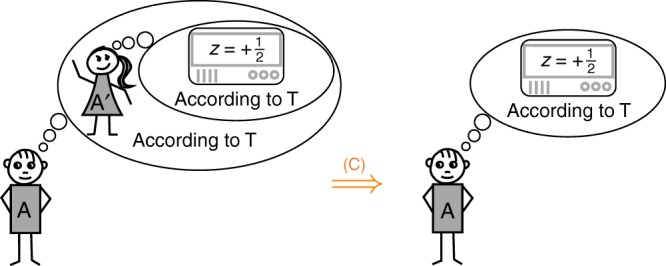
“] allow any agent A to promote the conclusions drawn by another agent A′ to his own conclusions” [22].”
A Gödelian Hunch from Quantum Theory
Dourdent, H. (2021) · The frontiers collection · doi:10.1007/978-3-030-70354-7_7 · Cited by 4
Analogy as prerequisite for understanding: A hypothesis and its implicationsPreprint
Gurevich, G. (2021) · SSRN Electronic Journal · doi:10.2139/ssrn.3838563
Making Mistakes Saves the Single Observer’s World of the Extended Wigner’s Friend Experiment
Łukaszyk, S. (2022) · Journal of Quantum Information Science · doi:10.4236/jqis.2022.121001 · Cited by 1
“[2] on the grounds of the following predictions made by Alice, Bob and Charlie in different times t0, t1, t2 during a happy round of this experiment.”
BackgroundInfluentialThe Paradox of Classical Reasoning
Bolotin, A. (2022) · Foundations of Physics · doi:10.1007/s10701-022-00604-7 · Cited by 1
“The second category includes Hardy’s paradox [6] and the Frauchiger-Renner thought experiment [7] confronting the semantic principle of bivalence [8] and the axioms of classical modal logic [9, 10], respectively, in quantum settings.”
BackgroundThe Quantum World as a Resource. A Case for the Cohabitation of Two Paradigms
Felline, L. (2022) · Synthese Library/Synthese library · doi:10.1007/978-3-030-99642-0_4
Multi-stage Stern-Gerlach experiment modeled (with additional appendices)Preprint
Wang, L. V. (2022) · arXiv (Cornell University) · doi:10.48550/arxiv.2208.06471
“Debatable inconsistency has been found in thought experiments, such as “Schrödinger’s cat” [44-46].”
ResultTumulka, R. (2022) · Lecture notes in physics · doi:10.1007/978-3-031-09548-1_4
Any consistent coupling between classical gravity and quantum matter is fundamentally irreversiblePreprint
Galley, T. D., Giacomini, F., & Selby, J. H. (2023) · arXiv (Cornell University) · doi:10.3929/ethz-b-000649559
The Physical Foundation of Quantum Theory
Shaghaghi, M. (2023) · Foundations of Physics · doi:10.1007/s10701-023-00673-2 · Cited by 1
“(16)), there are no problems parallel to the “measurement problem” discussed in quantum literature (insisting on describing measurements by QM physics), as well as Schrödinger’s cat [36, 37], Wigner’s friend [38], the Frauchiger-Renner paradox [39], the observer and the observed, and many other situations that essenti…”
BackgroundBloß ungenau oder falsch? – Laborsprache und verborgene Variablen
Werner, R. F. (2023) · Springer eBooks · doi:10.1007/978-3-662-65644-0_5
Quale mechanics as a metaphysical weltanschauung of quantum mechanics
Brânzanic, A. M. V., & Silaghi-Dumitrescu, R. L. (2023) · History of science and technology · doi:10.32703/2415-7422-2023-13-1-10-33
Optimal Encoding of Contextuality in Polarization Entangled Photon States
Ji, M., Matsuyama, K., Iinuma, M., & Hofmann, H. F. (2022) · Conference on Lasers and Electro-Optics Pacific Rim (CLEO-PR) · doi:10.1364/cleopr.2022.cfa7h_04
Quantum Bayes' rule affirming consistency in measurement inferences in quantum mechanics
Bera, M. L., & Bera, M. N. (2023) · Physical Review A · doi:10.1103/physreva.108.012224 · Cited by 1
Quantum Epistemology and Constructivism
Fraser, P. T., Nurgalieva, N., & del Rio, L. (2023) · Journal of Philosophical Logic · doi:10.1007/s10992-023-09717-4 · Cited by 12
“Readers familiar with recent developments in the foundations of quantum theory will recognize that this assumption is the conclusion of the famous Frauchiger-Renner theorem [26].”
BackgroundA single hidden variable interpretation of the quantum wave functionPreprint
Gentile, D. (2023) · Qeios · doi:10.32388/j3pvm1.4
Wigner's friend scenario, Born's rule and a new interpretation of quantum mechanicsPreprint
Li, Q. (2023) · Research Square · doi:10.21203/rs.3.rs-3270399/v1
Classical information and collapse in Wigner's friend setups
Baumann, V. (2023) · PubMed · doi:10.48550/arxiv.2308.08260
“Some of these no-go theorems, for example [16], rely on con-flicting probability assignments of observers and superobservers similar to the simple Wigner’s friend experiment above.”
MethodA single hidden variable interpretation of the quantum wave functionPreprint
Gentile, D. (2023) · Qeios · doi:10.32388/j3pvm1.5
Wigner’s friend scenario and a new interpretation of quantum mechanics v2Preprint
Li, Q. (2023) · Research Square · doi:10.21203/rs.3.rs-3270399/v2
Matsuyama, K., Ji, M., Hofmann, H. F., & Iinuma, M. (2023) · Quantum 2.0 Conference and Exhibition · doi:10.1364/quantum.2023.qth2a.17
A single hidden variable interpretation of the quantum wave functionPreprint
Gentile, D. (2023) · Qeios · doi:10.32388/j3pvm1.7
A single hidden variable interpretation of the quantum wave functionPreprint
Gentile, D. (2023) · Qeios · doi:10.32388/j3pvm1.8
Quantum Superpositions of Conscious States in a Minimal Integrated Information Model
McQueen, K. J., Durham, I. T., & Müller, M. P. (2026) · Entropy · doi:10.3390/e28040394 · Cited by 2
“Extensions of the Wigner’s Friend experiment have sharpened the epis-temological and consistency issues involved [2–6], and many-worlds and many-minds interpretations have offered accounts of how superpositions of experiences might be understood [7–15].”
Wigner’s friend scenario and a new interpretation of quantum mechanics v2Preprint
Li, Q. (2023) · Research Square · doi:10.21203/rs.3.rs-3270399/v3
Truths, observations and illusions: a quantum mechanics perspectivePreprint
Review, B. (2023) · OSF Preprints (OSF Preprints) · doi:10.31219/osf.io/6jm7y
A single hidden variable interpretation of the quantum wave functionPreprint
Gentile, D. (2023) · Qeios · doi:10.32388/j3pvm1.10
Oral, Ş. B. (2023) · Springer eBooks · doi:10.1007/978-3-031-41538-8_1
Wigner's friend scenario, Born's rule and an alternative formulation of pilot wave theoryPreprint
Li, Q. (2023) · Research Square · doi:10.21203/rs.3.rs-3270399/v4
On the significance of Wigner's Friend in contexts beyond quantum foundations
Jones, C. L., & Müller, M. P. (2026) · Quantum · doi:10.22331/q-2026-06-30-2147 · Cited by 15
“In 2016, Frauchiger and Renner [5] introduced a version involving four agents, showing that it is in general inconsistent for such agents to reason indirectly by pooling each others’ predictions, even if those predictions involve only statements of probability zero or one.”
InfluentialOptimal Encoding of Contextuality in Polarization Entangled Photon States
Ji, M., Matsuyama, K., Iinuma, M., & Hofmann, H. F. (2022) · Conference on Lasers and Electro-Optics Pacific Rim (CLEO-PR) · doi:10.1109/cleo-pr62338.2022.10431989
Evidenssistä lähtevä keskustelu
Himanka, J. T. (2024) · Tiedepolitiikka · doi:10.58957/tp.143266
On the Absolute and Relative Pessimistic Inductions: A Reply to S. Park
Hess, E. (2024) · Problemos · doi:10.15388/problemos.2024.105.16
Logic Meets Wigner’s Friend (and their Friends)
Baltag, A., & Smets, S. (2024) · International Journal of Theoretical Physics · doi:10.1007/s10773-024-05611-0 · Cited by 3
“In this paper we focus on Wigner’s Friend thought-experiment [30], and the proposed variations [14] and extensions such as the Frauchiger-Renner (FR) Paradox [17], that have recently shaken-up the debate in the foundations of quantum theory.”
InfluentialRelational quantum mechanics, causal composition, and molecular structure
Esser, S. (2024) · Foundations of Chemistry · doi:10.1007/s10698-024-09513-1 · Cited by 1
“…struc-16 Recently, several thought-experiments have been proposed that extend Wigner’s friend-style scenarios (involving multiple observers and experiments) in order to derive results that appear to lead to genuine disagreement between observers about outcomes (e.g. Frauchiger and Renner 2018 ).”
Classicality concept test on neutral pseudoscalar meson qubits with Wigner inequalities
Efimova, A. Y., & Nikitin, N. (2024) · Physical review. D/Physical review. D. · doi:10.1134/s1063778824700236
Schrodinger’s Cat and Wigner’s Friend
Stuckey, W. M., Silberstein, M., & McDevitt, T. J. (2024) · Oxford University Press eBooks · doi:10.1093/9780198919698.003.0014
On testimony in scenarios with Wigner and Friend
Placek, T. (2024) · Synthese · doi:10.1007/s11229-024-04754-1
“Recent arguments, starting with Brukner (2018) and Frauchiger and Renner (2018), prompt novel revisions of this kind.”
InfluentialWhat is it like to be unitarily reversed?
Evans, P. W. (2024) · European Journal for Philosophy of Science · doi:10.1007/s13194-024-00613-5
“First introduced by Frauchiger and Renner (2018) to form the core of a no-go theorem, the scenario has become integral to a series of no-go theorems: in particular, those of Brukner (2018) and Bong et al. (2020).”
Efimova, A. Y., & Nikitin, N. (2024) · Ядерная физика · doi:10.31857/s0044002724030122
Relative descriptors for quantum agents
Möckli, D., & Perraro, L. S. (2025) · Journal of Physics A Mathematical and Theoretical · doi:10.1088/1751-8121/ada74a
“We assume the reader is familiar with the thought experiment, as it has been extensively discussed in the literature, not only by the original authors [10, 13, 14], but also by others [15, 24, 25].”
InfluentialVariable-strength nonlocal measurements reveal quantum violations of classical counting principles
Lupu-Gladstein, N., Pang, O. T. A., Ferretti, H., Tham, W.-K., Steinberg, A. M., Bonsma-Fisher, K., & Brodutch, A. (2025) · Proceedings of the National Academy of Sciences · doi:10.1073/pnas.2416331122
Does Quantum Information Require Additional Structure?
Horodecki, R. (2025) · Foundations of Physics · doi:10.1007/s10701-025-00828-3 · Cited by 2
“This issue covers many aspects: it has a long history and a vast literature, including the famous Wigner paradox [25, 26].”
A Heuristic Sketch of How It Could All Fit Together with TimePreprint
Thomsen, K. (2025) · Qeios · doi:10.32388/vnfm11
A Consistent Approach to Modeling Quantum Observers
Ring, D. (2025) · Entropy · doi:10.3390/e27030302
“Interest in the topic was renewed recently when an extended version of WF was developed by Frauchiger and Renner (FR) [3].”
Adlam, E. (2025) · Oxford University Press eBooks · doi:10.1093/9780197808887.003.0003
The Epistemology of Measurement
Adlam, E. (2025) · Oxford University Press eBooks · doi:10.1093/9780197808887.003.0004
First and Third Person Views of Science
Adlam, E. (2025) · Oxford University Press eBooks · doi:10.1093/9780197808887.003.0010
Adlam, E. (2025) · Oxford University Press eBooks · doi:10.1093/9780197808887.003.0013
Primitive Ontology, Fundamentality, and Scale
Adlam, E. (2025) · Oxford University Press eBooks · doi:10.1093/9780197808887.003.0011
Superdeterminism and Naturalness
Adlam, E. (2025) · Oxford University Press eBooks · doi:10.1093/9780197808887.003.0012
Observer-Relative Interpretations
Adlam, E. (2025) · Oxford University Press eBooks · doi:10.1093/9780197808887.003.0009
Adlam, E. (2025) · Oxford University Press eBooks · doi:10.1093/9780197808887.003.0008
What is the Measurement Problem?
Adlam, E. (2025) · Oxford University Press eBooks · doi:10.1093/9780197808887.003.0002
Adlam, E. (2025) · Oxford University Press eBooks · doi:10.1093/9780197808887.003.0006
Adlam, E. (2025) · Oxford University Press eBooks · doi:10.1093/9780197808887.003.0007
Adlam, E. (2025) · Oxford University Press eBooks · doi:10.1093/9780197808887.003.0005
Adlam, E. (2025) · Oxford University Press eBooks · doi:10.1093/9780197808887.003.0014
Adlam, E. (2025) · Oxford University Press eBooks · doi:10.1093/9780197808887.003.0001
Riek, R. (2025) · Journal of Physics Conference Series · doi:10.1088/1742-6596/3017/1/012019
Beyond Space and Time: Quantum Superposition as a Real-Mental State About Choices
Suárez, A. (2025) · Condensed Matter · doi:10.3390/condmat10030043 · Cited by 1
“…Renner of the Zurich Polytechnic (ETHZ) construct a more complicated thought experiment in which Wigner’s friend observes “1 and the cat dead”, and at the same moment, outside the laboratory, Wigner applies quantum superposition and concludes that his friend observes “0 and the cat alive” [23].”
QBism: Integrating Agency and Quantum Mechanics
Briegel, H. J., & Müller, T. (2025) · Synthese Library/Synthese library · doi:10.1007/978-3-031-98119-7_4 · Cited by 1
Schmid, G. B. (2025) · Springer eBooks · doi:10.1007/978-3-662-70831-6_2
Fields, C., & Glazebrook, J. F. (2025) · Synthesis lectures on engineering, science, and technology · doi:10.1007/978-3-031-97263-8_2
The Arrow of Time Is Alive and Well but Forbidden under the Received View in Physics
Kastner, R. E. (2025) · Cambridge University Press eBooks · doi:10.1017/9781009581608.008
The Modeling Relation at the Quantum Level: How QBism Vindicates Rosen's Anticipatory SystemsPreprint
Lissack, M. R. (2025) · SSRN Electronic Journal · doi:10.2139/ssrn.5956852
Quantum Theory and the Limits of Objectivity
Healey, R. (2026) · Oxford University Press eBooks · doi:10.1093/9780198911586.003.0013
The Structure of the Modal-Hamiltonian Ontology
Lombardi, O. (2026) · Oxford University Press eBooks · doi:10.1093/9780198951407.003.0010
Facing the Ontological Challenges of Quantum Mechanics
Lombardi, O. (2026) · Oxford University Press eBooks · doi:10.1093/9780198951407.003.0011
Lombardi, O. (2026) · Oxford University Press eBooks · doi:10.1093/9780198951407.003.0009
Lombardi, O. (2026) · Oxford University Press eBooks · doi:10.1093/9780198951407.003.0001
Metadata
- Authors
- Frauchiger, D., & Renner, R.
- Affiliations
- ETH Zurich (CH)
- Corresponding author
- Renner, Renato
- ORCID
- Renner, Renato
- Venue
- Nature Communications
- Published
- 2018-09-18
- Volume
- 9
- Issue
- 1
- Pages
- 3711-3711
- ISSN
- 2041-1723 (ISSN-L)
- PMC
- PMC6143649
- OpenAlex
- W2921169191
- Semantic Scholar
- 612b12de314e91728d6e6ec63b91e099c5702eec
- Cited by
- 333
- References
- 55
- Citations by year
- 2026: 48 · 2025: 43 · 2024: 33 · 2023: 52 · 2022: 35 · 2021: 44 · 2020: 45 · 2019: 26 · 2018: 7
- FWCI
- 14.11
- Type
- journal article
- Language
- en
- Open access
- gold
- doi.org
- Licence
- cc-by
- creativecommons.org/licenses/by/4.0 (tdm)
- creativecommons.org/licenses/by/4.0 (vor)
- Locations
- Nature Communications (publishedVersion, cc-by)
- arXiv (Cornell University) (publishedVersion)
- Europe PMC (PubMed Central) (publishedVersion, other-oa)
- PubMed Central (publishedVersion, cc-by)
- PubMed (publishedVersion)
- arXiv (Cornell University) (submittedVersion)
- DOAJ (DOAJ: Directory of Open Access Journals) (submittedVersion, cc-by-sa)
- DOAJ (DOAJ: Directory of Open Access Journals) (submittedVersion)
- arXiv (Cornell University)
- Funders
- Schweizerischer Nationalfonds zur Förderung der Wissenschaftlichen Forschung (NCCR QSIT)
- EC | Seventh Framework Programme (RAQUEL)
- EC | European Research Council (258932)
- Kavli Institute for Theoretical Physics, University of California, Santa Barbara (PHY17-48958)
- Stellenbosch Institute for Advanced Study
- Topics
- Physical Sciences › Physics and Astronomy › Atomic and Molecular Physics, and Optics › Quantum Mechanics and Applications
- Physical Sciences › Physics and Astronomy › Atomic and Molecular Physics, and Optics › Quantum Information and Cryptography
- Physical Sciences › Physics and Astronomy › Nuclear and High Energy Physics › Noncommutative and Quantum Gravity Theories
- Keywords
- quantum mechanics, self-consistency, thought experiments, measurement outcomes, complex systems, quantum foundations
About these checks
Registry, retraction, Cites and statistics results are computed, not judged, with one exception: a printed reference that no index lists is read once by a model before it counts as a citation error. Claims are extracted by a model and kept only when their quote appears verbatim in the text; each cited source is then checked, with a model’s help, for whether it says what the claim relies on. Those verdicts can be wrong — read the claim’s quote and the cited source before relying on one.
The claim verdicts this report counts are experimental: their accuracy is not yet measured.
A language model drew the claims from the paper on 2026-10-10, under version 3 of the claim definition (model deepseek-v4.1-flash, prompt extract-v3).
A second model labelled each claim on 2026-10-10 (model jev-1.13-20260917, definition revision gold-guideline-v0.2).
Cited sources are checked with a language model’s help (gpt-6-sol and qwen3.8-omni-flash).
Statistics and arithmetic are recomputed, not judged.
Confidence bands are shown only for fields calibrated on our annotated test set. None is calibrated yet, so no band is shown.
What counts as a claim ›How we measure confidence ›How we check this ›
Are you an author, or do you see a problem with this page? Request a review
Data sources
Bibliographic data: Semantic Scholar, OpenAlex, Crossref.
Contains information from the Semantic Scholar Academic Graph Datasets, made available under the ODC Attribution License (ODC-BY 1.0).
Semantic Scholar’s data is described in: Kinney, R., et al. (2023). The Semantic Scholar Open Data Platform. arXiv:2301.10140.
