

Artificial optic-neural synapse for colored and color-mixed pattern recognition
Open accessThe DOI matches its Crossref record; 38 of the 40 references it cites were found in a registry or an index.
Abstract
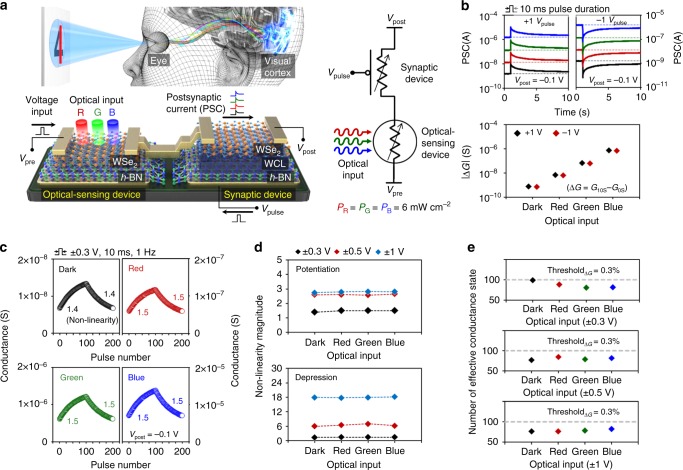
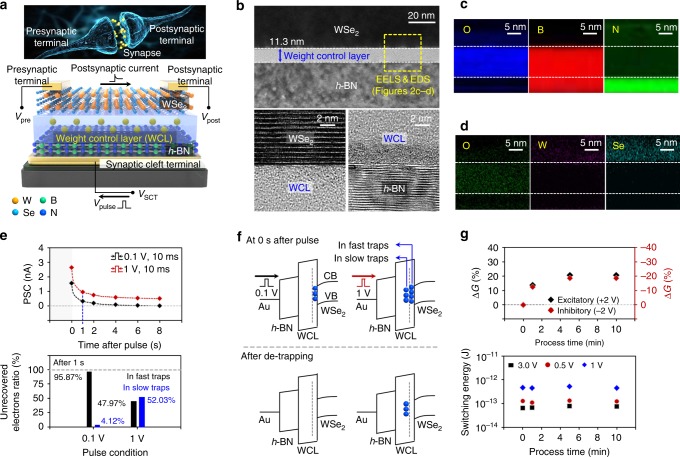
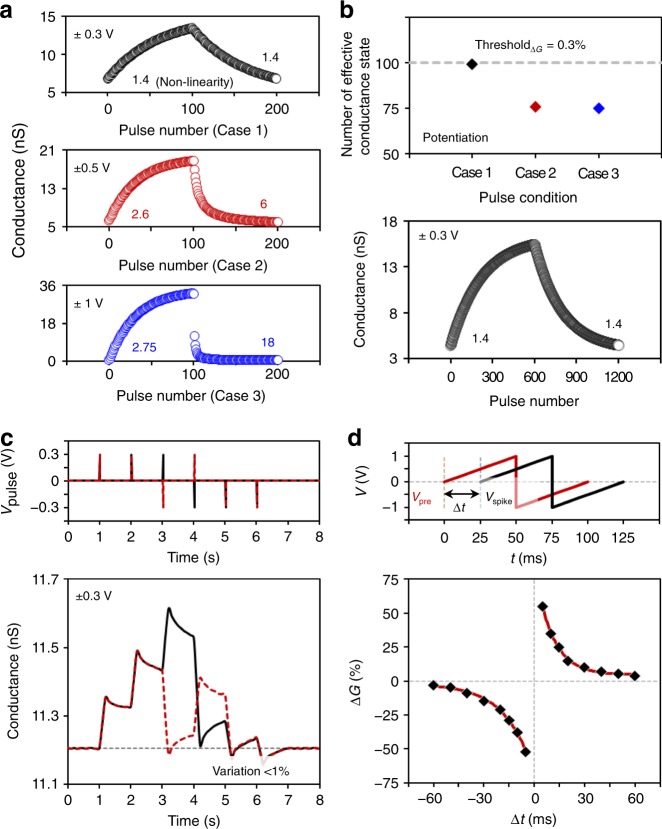
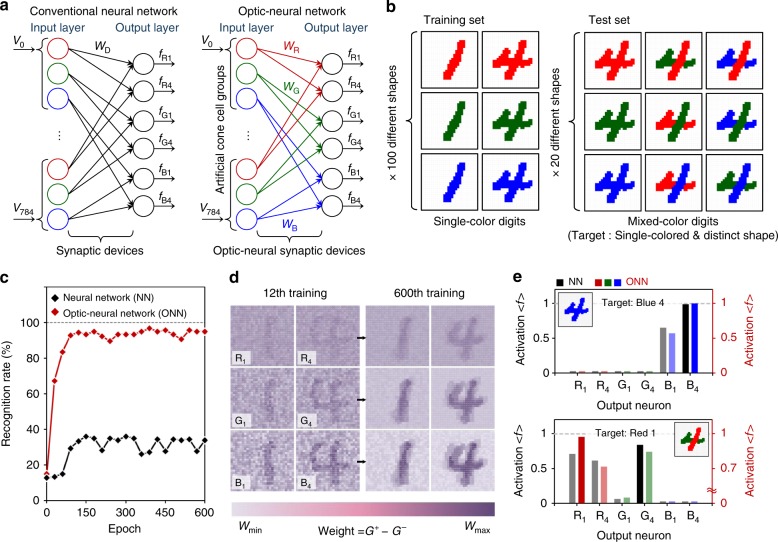
The priority of synaptic device researches has been given to prove the device potential for the emulation of synaptic dynamics and not to functionalize further synaptic devices for more complex learning. Here, we demonstrate an optic-neural synaptic device by implementing synaptic and optical-sensing functions together on h-BN/WSe 2 heterostructure. This device mimics the colored and color-mixed pattern recognition capabilities of the human vision system when arranged in an optic-neural network. Our synaptic device demonstrates a close to linear weight update trajectory while providing a large number of stable conduction states with less than 1% variation per state. The device operates with low voltage spikes of 0.3 V and consumes only 66 fJ per spike. This consequently facilitates the demonstration of accurate and energy efficient colored and color-mixed pattern recognition. The work will be an important step toward neural networks that comprise neural sensing and training functions for more complex pattern recognition.
Overview
The claims and statistics of this paper haven’t been checked yet.
Free: it reads the open-access text and checks the first 5 claims that cite a source we can check. Create a free account to check every claim.
Integrity signals
Registry
Cites
Statistics
Figures
Verification
Claims the paper makes
The claims and statistics of this paper haven’t been checked yet.
Free: it reads the open-access text and checks the first 5 claims that cite a source we can check. Create a free account to check every claim.
Claims other papers make about this one
Each is checked against this paper’s own text: does it say what the citing paper says it does?
The source backs part of the claim, not all of it — or backs it for a different population, condition or comparison.
In the citing paper
“some articles focused on the fabrication and device-level characterization of one/few memristors62–70,186,187, also present some of the figures-of-merit generated by a software-based training ANN process (similar to the ones in Fig. 14) in order to claim that their devices exhibit potential for neuromorphic applications.”
From Hardware implementation of memristor-based artificial neural networks (2024) · cites this paper as [67]
Experimental — accuracy not yet measuredThe cited source says what the claim attributes to it.
In the citing paper
“However, most of those studies in fact only measured the figures-of-merit of one/few devices and simulated the accuracy of an ANN via software62–67 in such type of studies the connection between the memristors fabricated and the ANN is relatively weak.”
From Hardware implementation of memristor-based artificial neural networks (2024) · cites this paper as [67]
Self-check
Percentages, sums and reported differences re-computed from the paper’s own numbers.
The self-check needs the paper’s full text.
Citations
Cites
Gradient-based learning applied to document recognition
Lecun, Y., Bottou, L., Bengio, Y., & Haffner, P. (1998) · Proceedings of the IEEE · doi:10.1109/5.726791 · Cited by 58,805
Parallel Distributed Processing: Explorations in the Microstructure of Cognition: Foundations
Rumelhart, D. E., McClelland, J. L., & AU (1986) · doi:10.7551/mitpress/5236.001.0001 · Cited by 15,686
Mastering the game of Go with deep neural networks and tree search
Silver, D., Huang, A., Maddison, C. J., Guez, A., Sifre, L., van den Driessche, G., Schrittwieser, J., Antonoglou, I., Panneershelvam, V., Lanctot, M., et al. (2016) · Nature · doi:10.1038/nature16961 · Cited by 15,612
Van der Waals heterostructures
Geim, A. K., & Grigorieva, I. V. (2013) · Nature · doi:10.1038/nature12385 · Cited by 10,875
Introduction to the theory of neural computation
(1994) · Neural Networks · doi:10.1016/0893-6080(94)90014-0 · Cited by 6,401
International Conference on Learning Representations (ICLR 2013)
松尾, 豊. (2013) · 人工知能学会誌 = Journal of Japanese Society for Artificial Intelligence · Cited by 6,286
Bi, G.-Q., & Poo, M.-M. (1998) · The Journal of Neuroscience · doi:10.1523/jneurosci.18-24-10464.1998 · Cited by 4,744
Han, S., Mao, H., & Dally, W. J. (2015) · arXiv · doi:10.48550/arxiv.1510.00149 · Cited by 4,662 · cited 1×
“Additionally, to con fi rm if this synaptic device can achieve the number of conductance states that were typically demanded for inference of DNNs (6 − 8 bits = 64 − 256 states) 32,33 , we applied excitatory and inhibitory pulses 600 times each (see Fig.”
MethodMemristive devices for computing
Yang, J. J., Strukov, D. B., & Stewart, D. R. (2013) · Nature Nanotechnology · doi:10.1038/nnano.2012.240 · Cited by 3,885
Training and operation of an integrated neuromorphic network based on metal-oxide memristors
Prezioso, M., Merrikh-Bayat, F., Hoskins, B. D., Adam, G. C., Likharev, K. K., & Strukov, D. B. (2015) · Nature · doi:10.1038/nature14441 · Cited by 3,001
Cited by
Items 401–500 of 766
Ahn, H., Kim, Y., Seo, S., Lee, J., Lee, S., Oh, S., Kim, B., Park, J., Kang, S.-M., Kim, Y., et al. (2025) · Advanced Materials · doi:10.1002/adma.202418582 · Cited by 22
Self-citationRajbhar, M. K., Kumar, D., Li, H., Kumbhar, D. D., Singh, A., Syed, A. M., Ansari, M. H. R., Tytov, S., Alqahtani, B., Lee, H., et al. (2025) · Materials Science and Engineering R Reports · doi:10.1016/j.mser.2025.101088 · Cited by 22
Li, C., Wang, J., Li, D., Ilyas, N., Yang, Z., Chen, K., Gu, P., Jiang, X., Gu, D., Liu, F., et al. (2022) · Journal of Material Science and Technology · doi:10.1016/j.jmst.2021.11.082 · Cited by 22
Jin, D., Kim, S., Jeon, H., Park, E.-J., Kim, S. H., Kim, J.-Y., & Yu, H. (2023) · Materials Today Nano · doi:10.1016/j.mtnano.2023.100320 · Cited by 26
Self-citationHigh-Performance Floating Gate Heterostructure With WSe2-MoS2 Diode Channel for Neural Synapse
Su, Z.-J., Cheng, H., Sun, X., Sun, H., & Zuo, C. (2023) · IEEE Electron Device Letters · doi:10.1109/led.2023.3278454 · Cited by 22
Emerging Opportunities for 2D Materials in Neuromorphic Computing
Feng, C., Wu, W., Liu, H., Wang, J., Wan, H., Ma, G., & Wang, H. (2023) · Nanomaterials · doi:10.3390/nano13192720 · Cited by 23
“This strategy employs a charge-trapping layer, termed the weight control layer (WCL), to facilitate electron trapping or release [51].”
MethodZhang, D., Li, Y., Sui, N., Li, M., Shao, S., Li, J., Li, B., Yang, W., Wang, X., Zhang, T., et al. (2024) · Applied Materials Today · doi:10.1016/j.apmt.2024.102234 · Cited by 22
Huang, Z., Tong, C., Zhao, Y., Jiang, L., Deng, L., Gao, X., He, J., & Jiang, J. (2024) · Nanoscale · doi:10.1039/d4nr02350a · Cited by 22
Pei, Y., Kang, Y., Zhou, X., Ma, M., Yang, M., He, D., Li, W., & Xiao, X. (2024) · Small · doi:10.1002/smll.202410773 · Cited by 22
Jeong, Y., Tordi, P., Tamayo, A., Han, B., Bonini, M., & Samorí, P. (2025) · Advanced Functional Materials · doi:10.1002/adfm.202509607 · Cited by 24
Perspective on oxide-based three-terminal artificial synapses in physical neural networks
Chen, K., & Chen, J. (2022) · Applied Physics Letters · doi:10.1063/5.0115449 · Cited by 23
An Image Detection–Memory–Recognition Artificial Visual Unit Based on Dual‐Gate Phototransistors
Wang, B., Zhang, Y., You, J., Yang, M., Zhao, H., Lin, D., Liu, M., Zhang, N., Jiang, Z., Guo, H. Y., et al. (2023) · Advanced Intelligent Systems · doi:10.1002/aisy.202200328 · Cited by 23
Jo, E. S., & Rim, Y. S. (2023) · Materials Today Physics · doi:10.1016/j.mtphys.2023.101194 · Cited by 21
Dual Synapses and Security Devices from Ternary C 60 ‐Pentacene‐TiO 2‐x Nanorods Heterostructures
Jeon, Y., Lee, G., Kim, Y. J., Jang, B. C., & Yoo, H. (2024) · Advanced Functional Materials · doi:10.1002/adfm.202409578 · Cited by 21
Endowing TENGs with sequential logic
Xiong, Y., Wang, Y., Zhang, J., Zheng, L., Liu, Y., Jiao, H., Yang, J., Wang, Z. L., & Sun, Q. (2024) · Device · doi:10.1016/j.device.2024.100472 · Cited by 21
Kim, J. T., Song, J., & Ah, C. S. (2020) · ACS Applied Electronic Materials · doi:10.1021/acsaelm.0c00314 · Cited by 21
Self-citationMemristive neuromorphic interfaces: integrating sensory modalities with artificial neural networks
Kim, J. E., Soh, K., Hwang, S. I., Yang, D. Y., & Yoon, J. H. (2025) · Materials Horizons · doi:10.1039/d5mh00038f · Cited by 21
Self-citationMultisensory Neuromorphic Devices: From Physics to Integration
Gui, A., Mu, H., Yang, R., Zhang, G., & Lin, S. (2026) · Nano-Micro Letters · doi:10.1007/s40820-025-01940-9 · Cited by 20
Two-Dimensional Nanostructures for Advanced Applications
Mohanty, R., Mishra, A., & Khatei, J. (2020) · ACS symposium series · doi:10.1021/bk-2020-1353.ch001 · Cited by 25
Neotype kuramite optoelectronic memristor for bio-synaptic plasticity simulations
Dong, X., Wei, W., Sun, H., Li, S., Chen, J., Chen, J., Zhang, X., Zhao, Y., & Li, Y. (2023) · The Journal of Chemical Physics · doi:10.1063/5.0151205 · Cited by 20
Chen, X., Sun, Y., Wu, X., Shi, S., Wang, Z., Zhang, J., Fang, W., & Huang, W. (2023) · Advanced Materials · doi:10.1002/adma.202306260 · Cited by 20
Liu, Y., Wang, B., Wu, L., Huang, L., Lin, L., Li, X., Liu, D., Zhang, S., Zhu, C., Tao, Y., et al. (2023) · ACS Applied Materials & Interfaces · doi:10.1021/acsami.3c11495 · Cited by 20
Das, S., Pal, V., Mukherjee, S., Das, S., Tiwary, C. S., & Ray, S. K. (2024) · Advanced Optical Materials · doi:10.1002/adom.202400037 · Cited by 20
Artificial Biphasic Synapses Based on Nonvolatile Phase‐Change Photonic Memory Cells
Zhou, W. Y., Farmakidis, N., Li, X., Tan, J., Aggarwal, S., Feldmann, J., Brückerhoff‐Plückelmann, F., Wright, C. D., Pernice, W. H. P., & Bhaskaran, H. (2022) · physica status solidi (RRL) - Rapid Research Letters · doi:10.1002/pssr.202100487 · Cited by 21
Wang, B., Zhang, N., You, J., Wu, X., Zhang, Y., Miao, T., Liu, Y., Jiang, Z., Zhong, Z., Sun, H., et al. (2025) · InfoMat · doi:10.1002/inf2.12661 · Cited by 19
Lee, S. J., An, G., Kim, D., Lee, H., Kim, S., & Kim, T. (2025) · Small · doi:10.1002/smll.202501276 · Cited by 22
Self-citationPhoto-Responsible Synapse Using Ge Synaptic Transistors and GaAs Photodetectors
Kim, S. K., Geum, D., Lim, H., Han, J., Kim, H.-J., Jeong, Y., & Kim, S. (2020) · IEEE Electron Device Letters · doi:10.1109/led.2020.2971321 · Cited by 19
“These results suggested that the proposed photo-responsible synapse could distinguish not only various colors such as red, green, blue and near-IR, but also intensities for human-eyes like future artificial vision sensors [10].”
BackgroundSelf-citationOptoelectronic neuromorphic devices and their applications
Shen, L., Hu, L., Kang, F.-W., Ye, Y.-M., & Zhuge, F. (2022) · Acta Physica Sinica · doi:10.7498/aps.71.20220111 · Cited by 19
Flexible neuromorphic electronics based on low-dimensional materials
Jin, T., Gao, J. L., Wang, Y., & Chen, W. (2022) · Science China Materials · doi:10.1007/s40843-021-1979-3 · Cited by 19
Recent progresses of organic photonic synaptic transistors
Deng, Z., Zhou, B., Xu, Y., Jin, C., Liu, W., Liu, B., Sun, J., & Yang, J. (2022) · Flexible and Printed Electronics · doi:10.1088/2058-8585/ac66ac · Cited by 19
Sensitive MoS2 photodetector cell with high air-stability for multifunctional in-sensor computing
Zhao, D., Gu, Z., Wang, T., Guo, X., Jiang, X., Zhang, M., Zhu, H., Chen, L., Sun, Q., & Zhang, D. W. (2022) · Chip · doi:10.1016/j.chip.2022.100023 · Cited by 19
Highly Bionic Neurotransmitter-Communicated Neurons Following Integrate-and-Fire Dynamics
Luo, S. J., Shao, L., Ji, D., Chen, Y., Wang, X., Wu, Y., Kong, D., Guo, M., Wei, D., Zhao, Y. J., et al. (2023) · Nano Letters · doi:10.1021/acs.nanolett.3c00799 · Cited by 19
Emerging Memtransistors for Neuromorphic System Applications: A Review
You, T., Zhao, M., Fan, Z., & Ju, C. (2023) · Sensors · doi:10.3390/s23125413 · Cited by 19
Advances in integrated quantum photonics for quantum sensing and communication
Dutta, T., Safinezhad, A., Zhuldybina, M., Llamas‐Garro, I., Velázquez-González, J. S., Sharma, A. K., Ung, B., & Mishra, S. K. (2025) · Journal of Materials Chemistry C · doi:10.1039/d4tc05290k · Cited by 20
Fu, W., Li, J., Jiang, D., Yang, Y., Chen, Q., Zhu, W., & Zhang, J. (2020) · Organic Electronics · doi:10.1016/j.orgel.2020.105870 · Cited by 19
Soft sensory-neuromorphic system for closed-loop neuroprostheses
Kim, J., Lee, S., Yoon, J., & Son, D. (2025) · International Journal of Extreme Manufacturing · doi:10.1088/2631-7990/adb9aa · Cited by 18
“Leveraging the high performance of visual synaptic devices, these devices have recently advanced their applications in image recognition, including tasks such as color differentiation [187,195,196] and complex image pattern recognition [177,179,182,186,190,192] .”
Self-citationA neuromorphic imager based on a cascaded optoelectronic synapse
Lu, Y., Rao, Z., Shim, H., Song, Y. M., Fan, Z., Guo, C., & Yu, C. (2026) · Nature Electronics · doi:10.1038/s41928-025-01540-w · Cited by 19
“In neuromorphic computing, the linearity of the weight update trajectory and the number of effective conductance states are important parameters for achieving high recognition accuracy and efficiency 32,33 .”
Wang, J., Liu, K., Tiw, P. J., He, D., Yu, L., Wang, B., Bai, J., Zhang, T., Shan, X., Yang, Y., et al. (2026) · Nature Communications · doi:10.1038/s41467-026-68905-3 · Cited by 22
Self-Powered Optoelectronic Device with Depression-Related Synaptic Functions
Cui, M., Zhao, P., Jiang, C., Tian, B., Luo, C., Lin, H., Peng, H., & Duan, C. (2023) · ACS Applied Electronic Materials · doi:10.1021/acsaelm.3c00407 · Cited by 18
Bio-inspired visual systems based on curved image sensors and synaptic devices
Long, Z., Ding, Y., Poddar, S., Gu, L., Zhang, Q., & Fan, Z. (2023) · Materials Today Electronics · doi:10.1016/j.mtelec.2023.100071 · Cited by 20
Mechanisms and applications of neuromorphic sensors for intelligent visual perception
Du, W., Li, C., Xiao, Y., Huang, Y., Shen, K., & Wu, J. (2023) · Science China Materials · doi:10.1007/s40843-023-2655-0 · Cited by 18
“…combination of carrier recombination and de-trapping in shallow trap states; the slow rise of the current is because the continuous illumination makes the trap gradually saturated; the slow recovery of current can be attributed mainly to the release of carrier bound by deep trap states [27,44,104].”
BackgroundHuang, Y., Tan, Y., Kang, Y., Chen, Y., Tang, Y., & Jiang, T. (2024) · Science China Information Sciences · doi:10.1007/s11432-023-3888-0 · Cited by 18
Hassanzadeh, P. (2021) · Life Sciences · doi:10.1016/j.lfs.2021.119272 · Cited by 18
Sun, Y., Ding, Y., Xie, D., Xu, J., Sun, M., Yang, P., & Zhang, Y. (2021) · Optics Letters · doi:10.1364/ol.414820 · Cited by 18
Guo, F., Io, W. F., Dang, Z., Ding, R., Pang, S., Zhao, Y., & Hao, J. (2023) · Materials Horizons · doi:10.1039/d3mh00714f · Cited by 18
Su, F., Wan, J., & Wang, D. (2025) · Advanced Functional Materials · doi:10.1002/adfm.202425627 · Cited by 19
Guo, Y., Liu, Y., Chen, Q., & Liu, G. (2022) · RSC Advances · doi:10.1039/d2ra02749f · Cited by 17
Tunable synaptic behaviors of solution-processed InGaO films for artificial visual systems
Li, P., Song, H., Sa, Z., Liu, F., Wang, M., Wang, G., Wan, J., Zang, Z., Jiang, J., & Yang, Z. (2024) · Materials Horizons · doi:10.1039/d4mh00396a · Cited by 17
Gao, C., Yu, R., Li, E., Zhang, C., Zou, Y., Chen, H., Lin, Z., & Guo, T. (2022) · Cell Reports Physical Science · doi:10.1016/j.xcrp.2022.100930 · Cited by 17
Spectrally Tunable 2D Material‐Based Infrared Photodetectors for Intelligent Optoelectronics
Ha, J., Ma, Y., An, Y. N., An, S., Jung, H. H., Varjamo, S., Yoo, J., Min, J., Kim, H., Ahmed, F., et al. (2025) · Advanced Functional Materials · doi:10.1002/adfm.202519542 · Cited by 18
Yang, M., Gong, K., Cui, Y., Liu, S., Li, G., & Lin, S. (2026) · Nano-Micro Letters · doi:10.1007/s40820-026-02129-4 · Cited by 20
Retina‐Inspired Organic Photonic Synapses for Selective Detection of SWIR Light
Wang, S., Chen, H., Liu, T., Wei, Y., Guo, Y., Lin, Q., Han, X., Zhang, C., & Huang, H. (2022) · Angewandte Chemie · doi:10.1002/ange.202213733 · Cited by 16
Integrated Graphene Heterostructures in Optical Sensing
Pham, P. V., Mai, T.-H., Do, H., Ponnusamy, V. K., & Chuang, F. (2023) · Micromachines · doi:10.3390/mi14051060 · Cited by 16
“Concepts on high-performance advanced future optoelectronics, such as artificial intelligence [114], machine learning [71,78,115,116], or photovoltaic and energy harvesting [117], are being developed as a first-step toward the bright future of 2D heterostructures [71,78,114,117].”
BackgroundMemristor-Based CNNs for Detecting Stress Using Brain Imaging Signals
Bak, S., Park, J., Lee, J., & Jeong, J. (2023) · IEEE Transactions on Emerging Topics in Computational Intelligence · doi:10.1109/tetci.2023.3297841 · Cited by 18
“5(b) should be close to zero [48].”
Self-citationHigh-Detectivity UV-Sensitive 2D MoS 2 Phototransistors Enhanced by Silicon Quantum Dots
Lian, Z., Wei, J., Liu, Z., Guo, C., Kuo, H., Dan, Y., Tu, C., & Yang, R. (2024) · ACS Photonics · doi:10.1021/acsphotonics.4c01122 · Cited by 16
Qian, C., Sun, J., & Gao, Y. (2021) · Physical Chemistry Chemical Physics · doi:10.1039/d1cp00889g · Cited by 16
Wei, L., Jiang, J., & Wan, Q. C. (2022) · Advanced Electronic Materials · doi:10.1002/aelm.202101174 · Cited by 16
Artificial Vision Adaptation Based on Optoelectronic Neuromorphic Transistors
Li, Q., Wang, T., Yang, Y., Meng, J., Wu, X., Zhu, H., Sun, Q., Zhang, D. W., & Chen, L. (2022) · IEEE Electron Device Letters · doi:10.1109/led.2022.3205315 · Cited by 16
“and computing functions in the same device [2], [10].”
BackgroundCho, S. S., Kim, J., Jeong, S., Kwon, S. M., Jo, C., Kwak, J. Y., Kim, D. H., Cho, S. W., Kim, Y., & Park, S. K. (2022) · Nano Energy · doi:10.1016/j.nanoen.2022.107991 · Cited by 16
Self-citationWang, J., Shao, Y., Li, C., Liu, B., & Yan, X. (2022) · Applied Physics Letters · doi:10.1063/5.0124217 · Cited by 16
Emerging Ferroelectric Materials for High-Performance Next-Generation Memory Devices
Faizan, M., Qian, Z., Zhu, H., Fan, S., Abas, N., Rauf, S., Khan, G. A., & Huzaibi, H. U. (2025) · ACS Applied Electronic Materials · doi:10.1021/acsaelm.5c01058 · Cited by 17
Two-dimensional materials-based integrated hardware
Peng, Z., Lin, R., Li, Z., Xu, L., Yu, X., Huang, X., Shi, W., He, X., Meng, X., Tong, L., et al. (2023) · Science China Information Sciences · doi:10.1007/s11432-023-3744-2 · Cited by 15
Jin, D., & Yu, H. (2023) · Small · doi:10.1002/smll.202309467 · Cited by 15
Li, Y., Cai, W. H., Tao, R., Shuai, W., Rao, J., Chang, C., Cheng, S., Fan, Z. H., Zhou, G., Lu, X., et al. (2024) · ACS Applied Materials & Interfaces · doi:10.1021/acsami.4c02880 · Cited by 15
Kumar, N., Patel, M., Nguyen, T. T., Lee, J., Choi, C., Bhatnagar, P. K., & Kim, J. (2024) · Advanced Materials · doi:10.1002/adma.202411420 · Cited by 17
Self-citationPan, B., Zhang, L., Lan, S., Hong, Y., Liang, J., Deng, L., Taniguchi, T., Watanabe, K., Gao, X., Xu, J., et al. (2025) · Advanced Functional Materials · doi:10.1002/adfm.202421337 · Cited by 15
Advancements in neuromorphic computing for bio-inspired artificial vision: A review
Gabayre, S. A., Illeperuma, M., Silva, D., Shi, X., & Savel'ev, S. E. (2025) · Neurocomputing · doi:10.1016/j.neucom.2025.131221 · Cited by 18
Long, T. Y., Zhu, L. Q., Ren, Z. Y., & Guo, Y. B. (2020) · Journal of Physics D Applied Physics · doi:10.1088/1361-6463/ab9ad7 · Cited by 16
Non-Volatile In-Ga-Zn-O Transistors for Neuromorphic Computing
Huang, Y., Qiu, W., Liu, W., Jin, C., Sun, J., & Yang, J. (2021) · Applied Physics A · doi:10.1007/s00339-021-04512-x · Cited by 15
Wang, J., Wang, Q., Chen, Q., Lei, T., Lv, W., Tu, H., Hu, R., Wang, Y., Zeng, Z., & Ma, T. (2022) · physica status solidi (a) · doi:10.1002/pssa.202200156 · Cited by 15
Recent progress in optoelectronic memristive devices for in-sensor computing
Shan, X., Wang, Z., Xie, J., Zheng, J., Xu, H., & Liu, Y. (2022) · Acta Physica Sinica · doi:10.7498/aps.71.20220350 · Cited by 15
Low-fluctuation nonlinear model using incremental step pulse programming with memristive devices
Lee, G. H., Kim, T., Youn, S., Park, J., Kim, S., & Kim, H. (2023) · Chaos Solitons & Fractals · doi:10.1016/j.chaos.2023.113359 · Cited by 15
Self-citationKim, T., Lee, W., Kim, S., Lim, D. C., & Kim, Y. (2024) · Advanced Intelligent Systems · doi:10.1002/aisy.202300651 · Cited by 15
Self-citationHuang, Y. J., Di, J. K., Wang, W. S., Huang, X. C., Zhou, S. Y., Gong, B. C., Zhao, Z. Q., & Zhu, L. Q. (2024) · Applied Materials Today · doi:10.1016/j.apmt.2024.102521 · Cited by 17
Lee, H.-H., Ro, J.-S., Kim, K., Park, H., & Lee, T. (2025) · Current Opinion in Solid State and Materials Science · doi:10.1016/j.cossms.2025.101215 · Cited by 14
Yin, Z., Shan, L., Ci, R., Hao, D., Miao, G., Tian, L., Liu, G., & Shan, F. (2025) · Applied Physics Letters · doi:10.1063/5.0256082 · Cited by 15
Shen, R., Jiang, Y., Li, Z., Tian, J., Li, S., Li, T., & Chen, Q. (2022) · Materials · doi:10.3390/ma15228247 · Cited by 14
“potential in response to various external stimuli [32,58].”
BackgroundReinforcing Synaptic Plasticity of Defect-Tolerant States in Alloyed 2D Artificial Transistors
Bak, J., Kim, S., Park, K., Yoon, J., Yang, M., Kim, U. J., Hosono, H., Park, J., You, B., Kwon, O., et al. (2023) · ACS Applied Materials & Interfaces · doi:10.1021/acsami.3c07578 · Cited by 14
Self-citationChauhan, M. S., Singh, R., & Sharma, S. K. (2024) · ACS Applied Electronic Materials · doi:10.1021/acsaelm.4c00257 · Cited by 14
Kang, H., Kim, H. W., Hong, E. R., & Woo, J. (2022) · Applied Physics Letters · doi:10.1063/5.0086164 · Cited by 14
A droplet memristor with ionic liquid-electrolyte meniscus
Liu, W. K., Shang, J., Zheng, F., Fan, Q., Yuan, X., Chen, Y., & Sha, J. (2024) · Chemical Engineering Journal · doi:10.1016/j.cej.2024.158948 · Cited by 13
Pei, B., Han, X., Wang, Y., & Liu, J. (2025) · Small · doi:10.1002/smll.202500184 · Cited by 13
Shao, L., Li, M., Wu, P., Wang, F., Chen, S., Hu, W., Wang, H., Cui, Z., & Zhao, J. (2020) · Journal of Materials Chemistry C · doi:10.1039/d0tc01156h · Cited by 13
A photosensor employing data-driven binning for ultrafast image recognition
Mennel, L., Molina‐Mendoza, A. J., Paur, M., Polyushkin, D. K., Kwak, D., Giparakis, M., Beiser, M., Andrews, A. M., & Mueller, T. (2022) · Scientific Reports · doi:10.1038/s41598-022-18821-5 · Cited by 13
Park, J. B., Kim, J., Jang, Y. W., Park, H., Yang, S. H., Kim, D., Kim, M., Facchetti, A. F., & Park, S. K. (2022) · Advanced Optical Materials · doi:10.1002/adom.202201559 · Cited by 14
Self-citationAn Artificial Olfactory Chemical‐Resistant Synapse for Training‐Free Gas Recognition
Hu, F., Cao, C., Han, S., Wang, D., & Chen, X. (2024) · Advanced Materials Technologies · doi:10.1002/admt.202301814 · Cited by 13
Jeon, Y., Kim, D., Ku, B., Chung, C., & Choi, C. (2023) · ACS Applied Materials & Interfaces · doi:10.1021/acsami.3c13159 · Cited by 12
Self-citation杨, Y. 玉. Y., 赵, J. 吉. Z., 刘, Y. 胤. L., Hua, X., 王, T. 天. W., 郑, J. 纪. Z., 郝, Z. 智. H., Bing, 熊. X., 孙, C. 长. S., Han, Y., et al. (2024) · Chinese Physics B · doi:10.1088/1674-1056/ad1c58 · Cited by 14
A synapse with low power consumption based on MoTe2/SnS2 heterostructure
He, W., Xing, Y., Fang, P., Han, Z., Yu, Z., Zhan, R., Han, J., Guan, B., Zhang, B., Lv, W., et al. (2024) · Nanotechnology · doi:10.1088/1361-6528/ad4cf4 · Cited by 12
In-sensor neuromorphic computing using perovskites and transition metal dichalcogenides
Li, S.-Y., Li, J.-T., Zhou, K., Yan, Y., Ding, G., Han, S., & Zhou, Y. (2024) · Journal of Physics Materials · doi:10.1088/2515-7639/ad5251 · Cited by 15
“By tuning the stimulation conditions, the nonlinear factors (potentiation/depression), and asymmetry can be optimized to 2.92/5.49 and 2.57 respectively, facilitating their neural network applications to train photoelectric synapses [248].”
BackgroundInfluentialLuo, S., Fu, C., Zhang, C.-Y., Li, Z., Zhu, Z., Wang, J., Wang, Y., He, G., Luo, L., & Liang, F. (2024) · IEEE Transactions on Electron Devices · doi:10.1109/ted.2024.3408782 · Cited by 12
“Despite numerous reports on IGZO-based optoelectronic RC systems [12], [13], research on such synapse devices [14], [15], [16] is mainly limited to software-based simulations [17].”
BackgroundSong, X., Lv, X., He, M., Mao, F., Bai, J., Qin, X., Hu, Y., Ma, Z., Liu, Z., Li, X., et al. (2024) · Nanophotonics · doi:10.1515/nanoph-2024-0368 · Cited by 12
“For the simulations of large images with 28 × 28 pixels also obtain a high accuracy of 91.9 %, which is comparable or higher than that of most reported optoelectronic synaptic devices [43]–[45] (Table 1).”
ResultInfluential2D materials-based crossbar array for neuromorphic computing hardware
Lee, H. J., Park, S., Kim, J., Park, M. H., Kim, J., Lim, J. A., & Jang, H. W. (2024) · Neuromorphic Computing and Engineering · doi:10.1088/2634-4386/ad7755 · Cited by 13
“The LRS and HRS are induced by the charge trap sites between the 2D materials and the electrodes, which allows for the control of synaptic weight [60–62].”
Self-citationOrganic transistors-driven wearable electronics for smart life
Liu, Z., Zhang, C., Xiang, L., Zhang, F., & Di, C. (2024) · Wearable electronics. · doi:10.1016/j.wees.2024.09.004 · Cited by 12
Recent progress of neuromorphic sensory and optoelectronic systems
Nam, S., Kang, D., Jo, J., Kang, D., Park, S. K., & Kim, Y. (2025) · International Journal of Extreme Manufacturing · doi:10.1088/2631-7990/adbb33 · Cited by 13
“When the flakes on the substrate contact a layer that has a stronger adhesion energy with the flakes, the flakes are picked up from the substrate and attached to the counter layer [78] .”
Artificial Synapse with High Weight-Updating Performance Based on Charge-Trapping Mechanism
Han, Z., Xing, Y., Lin, Y., Yu, Z., Han, Q., Zhou, D., Bian, L., Zeng, Y., Zhan, R., Zhang, B., et al. (2025) · ACS Applied Materials & Interfaces · doi:10.1021/acsami.5c00738 · Cited by 12
Neuromorphic Light‐Responsive Organic Matter for in Materia Reservoir Computing
Lupi, F. F., Rosero‐Realpe, M., Ocarino, A., Frascella, F., Milano, G., & Angelini, A. (2025) · Advanced Materials · doi:10.1002/adma.202501813 · Cited by 15
Wang, H., Lin, R., Zhao, K., Yang, J., Liu, H., Yang, Z., & Yan, X. (2025) · Advanced Functional Materials · doi:10.1002/adfm.202510543 · Cited by 12
Two-dimensional materials for adaptive functionalities in soft robotics
Li, Y., Ong, A. J., & Lee, P. S. (2025) · Materials Horizons · doi:10.1039/d5mh00565e · Cited by 15
Toward Advancement of Fabrication Techniques of Neuromorphic Computing Devices Based on 2D Materials
Gupta, S. U., Patel, M., Kumar, N., Pohl, L., Park, M., Youn, S., Jeong, C., & Kim, J. (2025) · Advanced Materials Technologies · doi:10.1002/admt.202500786 · Cited by 13
Self-citation
Metadata
- Authors
- Seo, S., Jo, S.-H., Kim, S., Shim, J., Oh, S., Kim, J.-H., Heo, K., Choi, J.-W., Choi, C., Oh, S., Kuzum, D., Wong, H.-S. P., & Park, J.-H.
- Affiliations
- Sungkyunkwan University (KR)
- Hanyang University (KR)
- University of California San Diego (US)
- Stanford University (US)
- Corresponding author
- Park, Jin-Hong
- ORCID
- Venue
- Nature Communications
- Published
- 2018-11-30
- Volume
- 9
- Issue
- 1
- Pages
- 5106-5106
- ISSN
- 2041-1723 (ISSN-L)
- PMC
- PMC6269540
- OpenAlex
- W2902437043
- Cited by
- 731
- References
- 40
- Citations by year
- 2026: 56 · 2025: 115 · 2024: 127 · 2023: 121 · 2022: 132 · 2021: 83 · 2020: 70 · 2019: 26
- FWCI
- 17.12
- Type
- journal article
- Language
- en
- Open access
- gold
- doi.org
- Licence
- cc-by
- creativecommons.org/licenses/by/4.0 (tdm)
- creativecommons.org/licenses/by/4.0 (vor)
- Locations
- Nature Communications (publishedVersion, cc-by)
- Europe PMC (PubMed Central) (publishedVersion, other-oa)
- PubMed Central (publishedVersion, cc-by)
- PubMed (publishedVersion)
- RePEc: Research Papers in Economics (submittedVersion)
- DOAJ (DOAJ: Directory of Open Access Journals) (submittedVersion)
- DOAJ (DOAJ: Directory of Open Access Journals) (submittedVersion, cc-by-sa)
- Funders
- National Research Foundation (2017R1A4A1015400, 2016M3A7B4910426)
- National Research Foundation of Korea (2017R1A4A1015400, 2016M3A7B4910426, 2018R1A2A2A05020475)
- Topics
- Physical Sciences › Engineering › Electrical and Electronic Engineering › Advanced Memory and Neural Computing
- Physical Sciences › Materials Science › Materials Chemistry › 2D Materials and Applications
- Physical Sciences › Computer Science › Artificial Intelligence › Neural Networks and Reservoir Computing
- Keywords
- artificial synapses, color pattern recognition, neuromorphic computing, synaptic weight update, optical sensing, energy-efficient neural networks, low-voltage operation
- MeSH terms
- Algorithms, Humans, Models, Neurological, Neurons, Pattern Recognition, Automated, Synapses
About these checks
Registry, retraction, Cites and statistics results are computed, not judged, with one exception: a printed reference that no index lists is read once by a model before it counts as a citation error. Claims are extracted by a model and kept only when their quote appears verbatim in the text; each cited source is then checked, with a model’s help, for whether it says what the claim relies on. Those verdicts can be wrong — read the claim’s quote and the cited source before relying on one.
Statistics and arithmetic are recomputed, not judged.
Confidence bands are shown only for fields calibrated on our annotated test set. None is calibrated yet, so no band is shown.
What counts as a claim ›How we measure confidence ›How we check this ›
Are you an author, or do you see a problem with this page? Request a review
Data sources
Bibliographic data: Semantic Scholar, OpenAlex, Crossref.
Contains information from the Semantic Scholar Academic Graph Datasets, made available under the ODC Attribution License (ODC-BY 1.0).
Semantic Scholar’s data is described in: Kinney, R., et al. (2023). The Semantic Scholar Open Data Platform. arXiv:2301.10140.
