

Artificial optic-neural synapse for colored and color-mixed pattern recognition
Open accessThe DOI matches its Crossref record; 38 of the 40 references it cites were found in a registry or an index.
Abstract
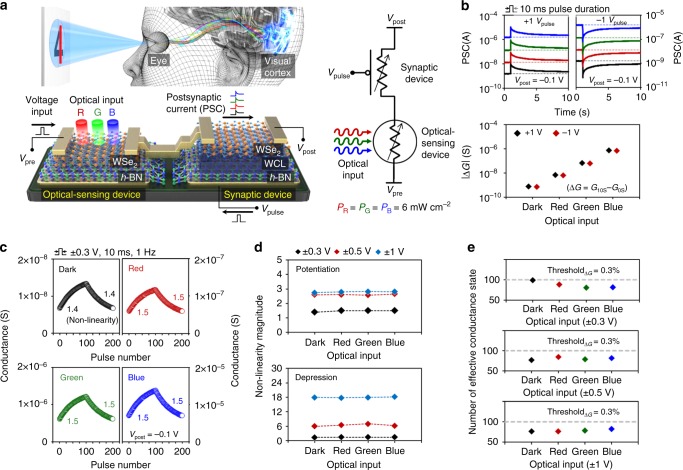
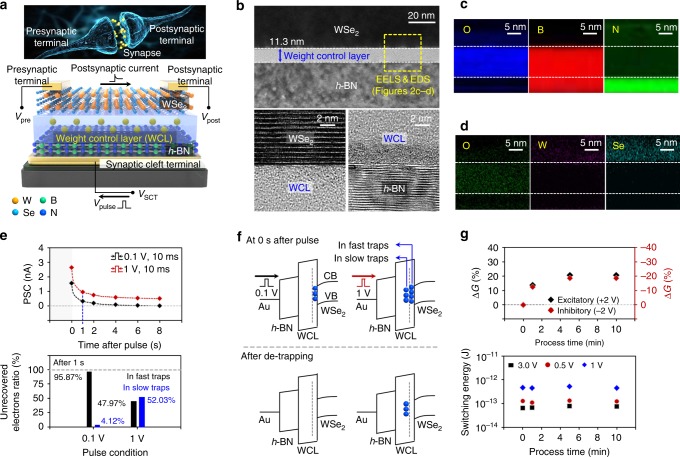
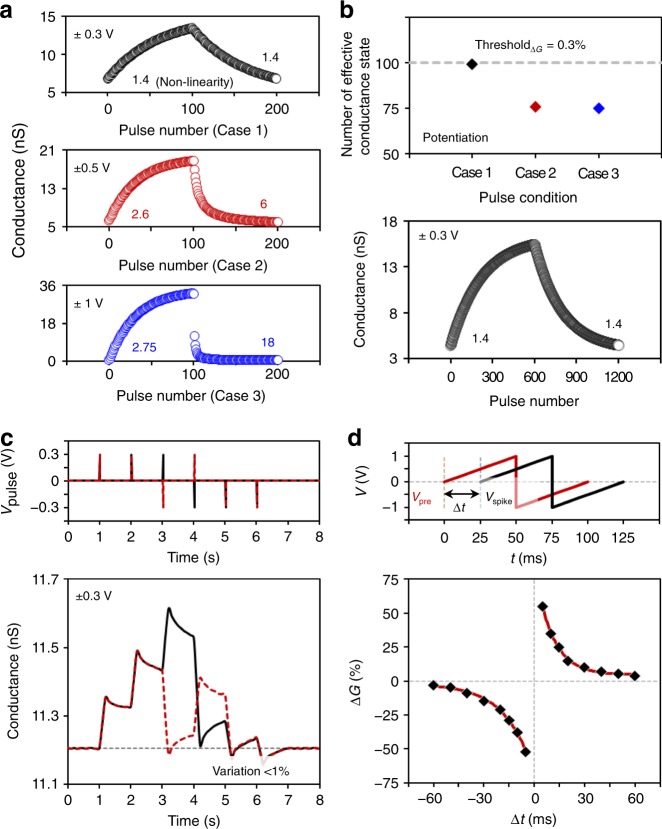
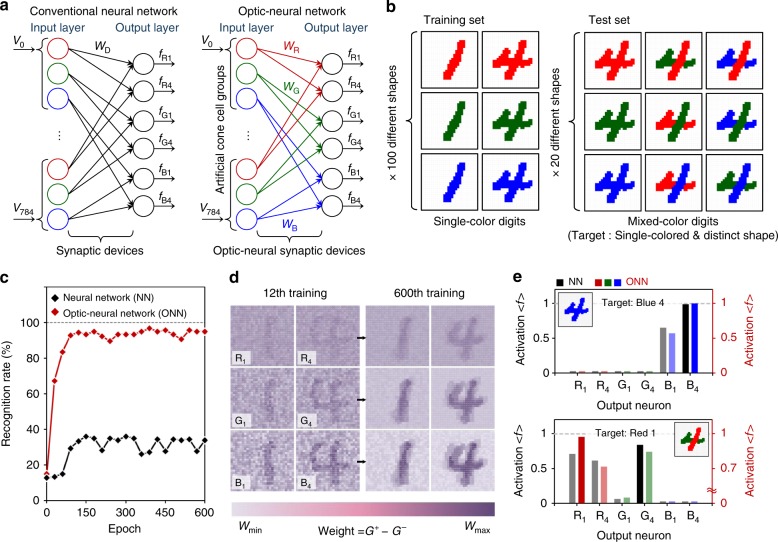
The priority of synaptic device researches has been given to prove the device potential for the emulation of synaptic dynamics and not to functionalize further synaptic devices for more complex learning. Here, we demonstrate an optic-neural synaptic device by implementing synaptic and optical-sensing functions together on h-BN/WSe 2 heterostructure. This device mimics the colored and color-mixed pattern recognition capabilities of the human vision system when arranged in an optic-neural network. Our synaptic device demonstrates a close to linear weight update trajectory while providing a large number of stable conduction states with less than 1% variation per state. The device operates with low voltage spikes of 0.3 V and consumes only 66 fJ per spike. This consequently facilitates the demonstration of accurate and energy efficient colored and color-mixed pattern recognition. The work will be an important step toward neural networks that comprise neural sensing and training functions for more complex pattern recognition.
Overview
The claims and statistics of this paper haven’t been checked yet.
Free: it reads the open-access text and checks the first 5 claims that cite a source we can check. Create a free account to check every claim.
Integrity signals
Registry
Cites
Statistics
Figures
Verification
Claims the paper makes
The claims and statistics of this paper haven’t been checked yet.
Free: it reads the open-access text and checks the first 5 claims that cite a source we can check. Create a free account to check every claim.
Claims other papers make about this one
Each is checked against this paper’s own text: does it say what the citing paper says it does?
The source backs part of the claim, not all of it — or backs it for a different population, condition or comparison.
In the citing paper
“some articles focused on the fabrication and device-level characterization of one/few memristors62–70,186,187, also present some of the figures-of-merit generated by a software-based training ANN process (similar to the ones in Fig. 14) in order to claim that their devices exhibit potential for neuromorphic applications.”
From Hardware implementation of memristor-based artificial neural networks (2024) · cites this paper as [67]
Experimental — accuracy not yet measuredThe cited source says what the claim attributes to it.
In the citing paper
“However, most of those studies in fact only measured the figures-of-merit of one/few devices and simulated the accuracy of an ANN via software62–67 in such type of studies the connection between the memristors fabricated and the ANN is relatively weak.”
From Hardware implementation of memristor-based artificial neural networks (2024) · cites this paper as [67]
Self-check
Percentages, sums and reported differences re-computed from the paper’s own numbers.
The self-check needs the paper’s full text.
Citations
Cites
Gradient-based learning applied to document recognition
Lecun, Y., Bottou, L., Bengio, Y., & Haffner, P. (1998) · Proceedings of the IEEE · doi:10.1109/5.726791 · Cited by 58,805
Parallel Distributed Processing: Explorations in the Microstructure of Cognition: Foundations
Rumelhart, D. E., McClelland, J. L., & AU (1986) · doi:10.7551/mitpress/5236.001.0001 · Cited by 15,686
Mastering the game of Go with deep neural networks and tree search
Silver, D., Huang, A., Maddison, C. J., Guez, A., Sifre, L., van den Driessche, G., Schrittwieser, J., Antonoglou, I., Panneershelvam, V., Lanctot, M., et al. (2016) · Nature · doi:10.1038/nature16961 · Cited by 15,612
Van der Waals heterostructures
Geim, A. K., & Grigorieva, I. V. (2013) · Nature · doi:10.1038/nature12385 · Cited by 10,875
Introduction to the theory of neural computation
(1994) · Neural Networks · doi:10.1016/0893-6080(94)90014-0 · Cited by 6,401
International Conference on Learning Representations (ICLR 2013)
松尾, 豊. (2013) · 人工知能学会誌 = Journal of Japanese Society for Artificial Intelligence · Cited by 6,286
Bi, G.-Q., & Poo, M.-M. (1998) · The Journal of Neuroscience · doi:10.1523/jneurosci.18-24-10464.1998 · Cited by 4,744
Han, S., Mao, H., & Dally, W. J. (2015) · arXiv · doi:10.48550/arxiv.1510.00149 · Cited by 4,662 · cited 1×
“Additionally, to con fi rm if this synaptic device can achieve the number of conductance states that were typically demanded for inference of DNNs (6 − 8 bits = 64 − 256 states) 32,33 , we applied excitatory and inhibitory pulses 600 times each (see Fig.”
MethodMemristive devices for computing
Yang, J. J., Strukov, D. B., & Stewart, D. R. (2013) · Nature Nanotechnology · doi:10.1038/nnano.2012.240 · Cited by 3,885
Training and operation of an integrated neuromorphic network based on metal-oxide memristors
Prezioso, M., Merrikh-Bayat, F., Hoskins, B. D., Adam, G. C., Likharev, K. K., & Strukov, D. B. (2015) · Nature · doi:10.1038/nature14441 · Cited by 3,001
Cited by
Items 601–700 of 766
Wu, X., Ren, Y., Zhang, Y., Sun, L., Wang, Z., Hu, S., Xie, Y., Du, Y., Li, R., Zhang, X., et al. (2025) · Science China Materials · doi:10.1007/s40843-025-3593-5 · Cited by 5
“Conventional approaches, however, rely on discrete photo-detectors coupled with synaptic devices, leading to fabrication complexity that impedes scalable integration [8].”
Advancing Flexible Optoelectronic Synapses and Neurons with MXene-Integrated Polymeric Platforms
Xu, H., Zeng, X., & Qadir, A. (2025) · Nanomaterials · doi:10.3390/nano15191481 · Cited by 5
“For example, optoelectronic synapses have been demonstrated with energy consumption as low as 66 fJ per spike [32], and neuromorphic visual systems using photodiode arrays have achieved real-time optical encoding at speeds of 20 million bins per second [33].”
He, Y., Xiong, F., Jiang, J., Zheng, B., Xu, W., Zhu, M., & Zhu, Z. (2025) · Carbon · doi:10.1016/j.carbon.2025.120875 · Cited by 5
Dahiya, A., Pal, P., Rani, S., Gautam, M. K., Babu, R. S., Zeimpekis, I., Georgiadou, D. G., & Kumar, S. (2025) · Materials Science and Engineering R Reports · doi:10.1016/j.mser.2025.101146 · Cited by 6
Oxygen‐Vacancy‐Mediated Amorphous Ga 2 O 3 for Neuromorphic Multicolor Image Sensor
Yuan, H., Liang, H., Zhu, R., Mu, H., Wang, Y., Lin, S., Zheng, W., Song, P., Zhang, G., & Mei, Z. (2026) · Advanced Optical Materials · doi:10.1002/adom.202503046 · Cited by 5
A Fourier neuromorphic visual system based on InGaZnO synaptic transistor
Peng, B., Sun, Q., Long, H., Xu, K., Qiao, L., Hu, Z., Wan, C., & Wan, Q. (2024) · Applied Physics Letters · doi:10.1063/5.0188601 · Cited by 5
Advancing device-based computing by simplifying circuit complexity
Park, T., Kim, M., Seo, J., Kim, Y., Trivedi, A. R., Han, J., & Yoo, H. (2025) · Device · doi:10.1016/j.device.2025.100720 · Cited by 5
Application of neuromorphic resistive random access memory in image processing
Jiang, B., Zhou, F., & Chai, Y. (2022) · Acta Physica Sinica · doi:10.7498/aps.71.20220463 · Cited by 5
Organic Photonic Synaptic Devices with UV‐Stimulated Inhibition and Adaptive Short‐Term Plasticity
Zhu, C., Gao, X., Huang, H., Li, L., Xu, J., Zhong, Y., Tang, W., Guo, X., & Wang, S. (2023) · Advanced Materials Technologies · doi:10.1002/admt.202300187 · Cited by 5
Zhou, Y., Zhang, P., Li, J., & Mao, X. (2023) · Nanotechnology · doi:10.1088/1361-6528/acf82d · Cited by 5
Photoelectric biomemristors for artificial visual perception systems
Wang, L., Li, J., Su, W., & Wen, D. (2023) · Applied Materials Today · doi:10.1016/j.apmt.2023.101964 · Cited by 5
Core processing neuron‐enabled circuit motifs for neuromorphic computing
Li, H., Hu, J., Chen, A., Zhang, Y., Wang, C., Wang, B., Tong, Y., Zhou, J., Loh, K. P., Xu, Y., et al. (2023) · InfoMat · doi:10.1002/inf2.12465 · Cited by 6
Lee, N., Pujar, P., & Hong, S. (2024) · Biomimetics · doi:10.3390/biomimetics9090547 · Cited by 4
“Neuromorphic semiconductors function similarly as synapses, converting spike-shaped signals into electrical signals through synaptic devices [10].”
BackgroundLee, C. W., Kim, S. J., Shin, H.-K., Han, S. S., Yoo, C., Lee, H., Kim, J. H., & Jung, Y. (2025) · Small · doi:10.1002/smll.202503131 · Cited by 5
Self-citationLee, J., Choi, H., Lee, J., Moon, J., Jang, T., Yu, B., Kim, S. Y., Cho, J., Han, S., Kim, H., et al. (2025) · Advanced Materials · doi:10.1002/adma.202515140 · Cited by 4
Self-citationBag, A., Lee, J. W., Lee, Y. R., & 이내응 (2025) · Advanced Functional Materials · doi:10.1002/adfm.202518534 · Cited by 4
Beyond Sight: Neuromorphic Synapses Triggered by Invisible Light
Park, J., Kim, K., Lee, E. K., Kim, Y., & Yoo, H. (2026) · Small · doi:10.1002/smll.202510540 · Cited by 4
Self-citationNanolaminate Ferroelectric Transistor Enabling Wide‐Reservoir In Sensor Neuromorphic Vision
An, G., Lee, S., Lee, H., Kim, G., Kim, T., Kim, H. S., Chai, Y., & Kim, S. (2026) · Advanced Materials · doi:10.1002/adma.202522251 · Cited by 4
“Linearity factors were extracted by fitting the PD traces in MATLAB to the phenomenological forms G LTP ( P ) and G LTD ( P ), which describe the conductance trajectory as a function of the pulse index P [42, 43].”
Self-citationEmulating Ebbinghaus forgetting behavior in a neuromorphic device based on low dimensional h-BN
Sunny, A., & Thamankar, R. (2024) · AIP Advances · doi:10.1063/5.0203002 · Cited by 4
Atomic‐Level Strain Sensing and Piezoresistance Effect in a 1D Single‐Atom Chain
Qu, Z., Zhang, W., Wang, S., Chen, D., Yao, Y., Cheng, M., & Dong, L. (2025) · Advanced Science · doi:10.1002/advs.202500553 · Cited by 4
Meng, J., Shi, N., Yan, T., Wan, Y., & Li, L. (2025) · Materials Today Physics · doi:10.1016/j.mtphys.2025.102000 · Cited by 5
Papakonstantinopoulos, C., Bousoulas, P., Aslanidis, E., Skotadis, E., Tsigkourakos, M., & Tsoukalas, D. (2022) · Flexible and Printed Electronics · doi:10.1088/2058-8585/ac88e1 · Cited by 4
In-sensor nonlinear convolutional processing based on hybrid MTJ/CMOS arrays
Ji, M., Yang, L., Pan, M., Zhang, X., Wang, J., Hu, Y., Du, Q., Hu, J., Qiu, W., Peng, J., et al. (2024) · Digital Signal Processing · doi:10.1016/j.dsp.2024.104412 · Cited by 4
Multistage opto-neuromorphic process system based on commercial optoelectric devices
Choi, M., Lee, M., Lee, B., & Lee, Y. T. (2020) · Current Applied Physics · doi:10.1016/j.cap.2020.07.006 · Cited by 5
Zou, S., Wang, H., Guo, J., Jiang, S., Hao, Z., Pei, M., Xu, X., Li, Y., Chen, J., Wang, J., et al. (2021) · Flexible and Printed Electronics · doi:10.1088/2058-8585/ac442f · Cited by 4
Xu, J., Leng, K., Huang, X., Ye, Y., & Gong, J. (2021) · Applied Physics Letters · doi:10.1063/5.0076672 · Cited by 4
In situ edge extraction enabled by reconfigurable van der Waals infrared photodetectors
Wang, J., Fang, Y., Jiang, Y., Long, S., Ma, X., Fu, X. D., She, Y., Zhao, Q., Chen, Y., Xu, H., et al. (2024) · Applied Physics Letters · doi:10.1063/5.0199370 · Cited by 5
Gazder, U., Hasan, A. S., & Yousif, Y. (2024) · Digital Technologies Research and Applications · doi:10.54963/dtra.v3i2.245 · Cited by 3
Perspectives on 2D materials for hybrid and beyond-Si image sensor applications
Wan, H., Xu, Z., Zhang, Y., Zhao, J., & Wang, C. (2024) · 2D Materials · doi:10.1088/2053-1583/ad6912 · Cited by 3
“On the other hand, charge trapping centers, such as floating gate or interfacial trapping states, can also enable light-induced memory by storing photogenerated electrons/holes even after the removal of light stimulus [59, 60].”
Transistor-Structured Artificial Dendrites for Spatiotemporally Correlated Reservoir Computing
Ni, Y., Zhang, Y., Lin, J., Liu, X., Yu, Y., Liu, L., Zhong, W., Chen, Y., Chen, R., Kwok, H. S., et al. (2025) · IEEE Electron Device Letters · doi:10.1109/led.2025.3598823 · Cited by 3
“Neuromorphic RC systems are enhanced systems that mimic biological neural networks, enabling efficient parallel processing and lower power consumption [6], [7], [8].”
Liu, Y., Guo, J., Wang, J., Zhao, Y., Zhang, Y., Gu, G., Ruan, H., Li, P., Sun, Y., Zhang, L., et al. (2025) · Chemical Engineering Journal · doi:10.1016/j.cej.2025.170213 · Cited by 3
Brain-inspired neural networks: neuromorphic devices and their practical applications
Wang, Y., Yan, T., Li, Y., Cai, Y.-B., Zhang, P., Cao, M., Wang, F., Zhan, X., & Wang, Z. (2025) · Nanotechnology · doi:10.1088/1361-6528/ae1840 · Cited by 4
Supramolecular Control of Ionic Retention in Electrolyte-Gated Synaptic Transistors
Zhou, H., Chivukula, K., Fang, Q., Wang, K., Ren, X., Garudapalli, A., Liang, C., Tian, J., Butler, S., Liang, A., et al. (2025) · ACS Materials Letters · doi:10.1021/acsmaterialslett.5c01336 · Cited by 3
AI-native robotic vision systems enabled by in-sensor computing
Kim, D., Kwon, J. I., Kim, Y., Kim, D., & Choi, C. (2026) · npj Unconventional Computing · doi:10.1038/s44335-025-00047-z · Cited by 5
Self-citationSerghiou, T., Morais, R. M., Vieira, D. H., Alves, N., Parvizi, R., & Kettle, J. (2026) · Advanced Intelligent Systems · doi:10.1002/aisy.202501338 · Cited by 3
“However, most publications record this exponential decrease in the PPF index at much shorter Δ t pre (milliseconds regime) [48, 56, 57], unlike our findings which show that PPF is maintained for over a minute ( PPF index = 113% with Δ t pre = 80 s).”
From optoelectronic synapses to physical reservoir computing: materials, progress and application
Saputra, R. M., Kim, H., Yao, Y.-C., Oh, H., & Lee, Y. (2026) · Current Opinion in Solid State and Materials Science · doi:10.1016/j.cossms.2026.101266 · Cited by 3
Angstrom-fluidic chemical synapses for accurate cancer diagnosis
Zhao, J., Ma, Q., Luo, X., Liu, H., Xu, S., Lian, G., Liu, Y., Liang, H., Zhou, L., Lin, M., et al. (2026) · Nature Communications · doi:10.1038/s41467-026-76214-y · Cited by 3
Yang, J. S., Jung, S. H., Kim, D. S., Choi, J. H., Suh, H. W., Lee, H. H., Lee, K. W., & Cho, H. K. (2022) · Micromachines · doi:10.3390/mi13040526 · Cited by 3
“At this time, for visual perception, such as the dispersion of color and complex patterns, the delicate processing of the optical signal transmitted to the brain is a very important step [29,30].”
BackgroundSelf-citationZuo, Z., Zhou, C., Ma, Z., Huang, Y., Chen, L., Li, W., Xu, J., & Chen, K. (2024) · Nanomaterials · doi:10.3390/nano14181474 · Cited by 3
Liu, J., Wang, Q., Feng, H., Wu, Y., Li, Y., Hou, F., Min, T., & Li, T. (2025) · Nanoscale · doi:10.1039/d5nr01908g · Cited by 3
Hybrid 3D printing of bio-inspired artificial slowly adapting type II afferents
Lee, M., Sotzing, M., Wang, J., & Chortos, A. (2025) · Nature Communications · doi:10.1038/s41467-025-63470-7 · Cited by 4
Review on data-centric brain-inspired computing paradigms exploiting emerging memory devices
Wang, W. J., Kvatinsky, S., Schmidt, H., & Du, N. (2022) · Frontiers in Electronic Materials · doi:10.3389/femat.2022.1020076 · Cited by 3
Geng, Y., Zhao, Y., Zhao, Y., Ma, J., Wei, X. F., Cao, S., Zhang, Z., Gao, H., Jiang, L., & Wu, Y. (2022) · Advanced Electronic Materials · doi:10.1002/aelm.202200802 · Cited by 3
2D materials for optoelectronics
Thakar, K., & Lodha, S. (2023) · Elsevier eBooks · doi:10.1016/b978-0-12-821505-0.00002-2 · Cited by 4
Shih, L., Chen, K., Mao, S., Huang, Y., Chu, F., Liu, T.-H., Cheng, W.-H. S., & Chen, J. (2023) · Journal of Materials Chemistry C · doi:10.1039/d3tc02255b · Cited by 3
Su, D., Liang, X., Geng, D., Wu, Q., Liu, B., & Liu, C. (2024) · Micromachines · doi:10.3390/mi15040433 · Cited by 3
Graphene/F16CuPc synaptic transistor for the emulation of multiplexed neurotransmission
Xu, Z., Ni, Y., Sun, M., Yuan, Y., Wu, N., & Xu, W. (2025) · Journal of Semiconductors · doi:10.1088/1674-4926/24080035 · Cited by 3
ReS2 based high-k dielectric stack charge-trapping and synaptic memory
Fan, Z., Zhang, M., Chen, L., Sun, Q., & Zhang, D. W. (2020) · Japanese Journal of Applied Physics · doi:10.35848/1347-4065/ab7279 · Cited by 3
Zhao, J., Zhang, Y., Guo, D., & Zhai, J. (2025) · Sensors · doi:10.3390/s25092750 · Cited by 2
“Optoelectronic artificial synapses enabling integrated optoelectrical signal integration in monolithic architectures demonstrate superior potential for direct real-time ocular data processing with energy-efficient operation [32].”
Beyond Traditional Computing Architecture: the Evolution of All-in-One Devices
Liu, Y., Zhao, C., Li, H., Yi, W., Wang, Z., & Tian, H. (2025) · IEEE electron devices reviews. · doi:10.1109/edr.2025.3602372 · Cited by 2
“Thus, all-in-one sensors deliver equal-or-better precision, sub-millisecond response, and multi-month stability in compact form factors, enabling applications from medical implants to industrial automation where traditional systems fail [41], [42], [43].”
Memristor-driven neuromorphic computing with crossbar arrays: A hardware perspective
Polian, I., & Du, N. (2025) · Elsevier eBooks · doi:10.1016/b978-0-443-29981-0.00016-1 · Cited by 2
Tetrachromatic photonic synaptic arrays using WS 2 monolayers for bioinspired neuromorphic retinas
Li, J., Li, Y., Wang, Q., Yan, C., Gao, Y., Xin, W., Liu, W., Xu, H., & Liu, Y. (2025) · Nano Research · doi:10.26599/nr.2026.94908375 · Cited by 2
Fang, Z., Wang, K., Zhao, S., Fan, S., Liu, W., Li, X., Li, G., & Han, C. (2026) · Nano Research · doi:10.26599/nr.2026.94908456 · Cited by 3
Sun, Y., Tong, P., Shen, J., Xu, H., Cao, R., Liu, C., Chen, C., Song, B., Wang, Y., Wang, W., et al. (2026) · Nature Communications · doi:10.1038/s41467-026-70860-y · Cited by 2
A Scalable Perovskite Platform With Multi‐State Photoresponsivity for In‐Sensor Saliency Detection
Xing, X., Tripathi, A. K., Ng, S. E., Yantara, N., Gong, Y., Wu, Q., Tay, Y. B., Lew, W. S., Chai, Y., Basu, A., et al. (2026) · Advanced Materials · doi:10.1002/adma.73243 · Cited by 2
“In addition to suffering from device-to-device variability, these devices often exhibit limited photoresponsivity modulation due to the carrier transport dynamics in atomic-scale thin layers, resulting in a few discrete states (7-82 photoresponsivity states) [1, 7, 9, 12–19].”
Pang, S., Xie, Y., & Zhang, J. (2026) · Applied Physics Letters · doi:10.1063/5.0325348 · Cited by 2
Photonic‐Enabled Energy‐Efficient Transparent Neuromorphic Computing Devices: A Review
Ghosh, S., Lee, K., Lee, J., Cho, S., Patel, M., Li, H., Wen, Y., Zhou, Y., & Kim, J. (2026) · Advanced Science · doi:10.1002/advs.75861 · Cited by 2
“In addition, combining photonic and electronic stimuli in synaptic devices allows for the integration of synaptic functions with biometric sensing elements, including vision, auditory, and olfactory sensors [ 15–17 ].”
Self-citation2D Materials Powering Neuromorphic Intelligence
Kazmi, J., Ahmad, W., Naqi, M., Abbas, Y., Abbas, A., Wang, P., Mohamed, M. A., Rosei, F., Wang, Z., & Song, H. (2026) · Nano-Micro Letters · doi:10.1007/s40820-026-02253-1 · Cited by 2
Lee, S.-U., Kim, E. H., Chang, S. J., Choi, Y.-W., Zhang, Y., Lee, D., & Park, N. (2026) · ACS Applied Electronic Materials · doi:10.1021/acsaelm.6c00843 · Cited by 2
Enabling Reconfigurable Resistive Switching via Tailored Multimodal Phase Transition
Huang, T., Tao, J., Xu, P., Yang, W., Niu, L., Chen, Z., Chen, X., & Dai, N. (2024) · ACS Applied Electronic Materials · doi:10.1021/acsaelm.3c01796 · Cited by 2
An optical-control lateral synaptic device based on WO3-x:Ti for visual memory
Chen, Z., Luo, M., Zhu, Z., & Zhou, H. (2025) · Sensors and Actuators A Physical · doi:10.1016/j.sna.2025.116530 · Cited by 2
High-efficiency thermo-optic switch based on waveguide superlattices with artificial gauge field
Zhang, X., Du, J., Li, J., Li, Y., Zhang, W., Xu, K., & He, Z. (2025) · Optics Express · doi:10.1364/oe.564059 · Cited by 2
A self-adapting synapse that shines: Bridging in-sensor computing and interactive displays
Dong, L., Zhu, C., Chen, Z., Pan, A., & Chu, S. (2025) · Matter · doi:10.1016/j.matt.2025.102353 · Cited by 2
Emerging Artificial Two-Dimensional van der Waals Heterostructures for Optoelectronics
Ruan, H., Huang, Y., Chen, Y., & Zhuge, F. (2019) · IntechOpen eBooks · doi:10.5772/intechopen.88433 · Cited by 2
Two-dimensional Layered Materials for Artificial Synapse
Chen, Y., Hsu, C.-P., Liu, P.-S., & Hou, T. (2020) · International Symposium on VLSI Technology, Systems and Applications (VLSI-TSA) · doi:10.1109/vlsi-tsa48913.2020.9203753 · Cited by 2
“For example, previous studies have attempted to replace the electrode and switching layers in RS synapses [3-6] and the channel, oxide, and floating-gate layers in FG synapses [7-10] with 2D materials.”
ResultBioinspired In-Sensor Computing Devices for Visual Adaptation
Liao, F., & Chai, Y. (2022) · Springer eBooks · doi:10.1007/978-3-031-11506-6_3 · Cited by 2
Neuromorphic Computing: Implementation and Open Issues
Hunagund, S. (2023) · Advances in systems analysis, software engineering, and high performance computing book series · doi:10.4018/978-1-6684-6596-7.ch002 · Cited by 6
Ferroelectric Domain Wall Delayer and Low-Dropout Regulator
Li, Y., Hu, D., Sun, J., Zhang, W., & Jiang, A. (2024) · ACS Applied Materials & Interfaces · doi:10.1021/acsami.3c18979 · Cited by 1
Alolaiyan, O., Albawardi, S., Alsaggaf, S., Tabbakh, T., DelRio, F. W., & Amer, M. R. (2024) · ACS Applied Materials & Interfaces · doi:10.1021/acsami.4c07231 · Cited by 1
Fully CMOS Compatible Charge Trap Memory‐Based Reservoir Computing System
Park, S., Ryu, D., Kim, S., Choi, W. Y., & Kim, S. (2025) · Advanced Materials Technologies · doi:10.1002/admt.202500858 · Cited by 1
Self-citation2D Material‐Based Bioinspired Devices for Neuromorphic Computing
Zhu, C., Wu, G., Sun, X., Yi, J., Xie, T., Liu, H., Li, D., & Pan, A. (2025) · Small · doi:10.1002/smll.202504118 · Cited by 2
Go, S., Wang, Q., Jiang, Y., Zhang, Y., & Loke, D. K. (2025) · Materials Science and Engineering R Reports · doi:10.1016/j.mser.2025.101095 · Cited by 1
Dual‐Mode Optoelectronic Neuromorphic Architecture for Imaging‐Recognition of Chinese Characters
Zhu, Z., Wang, J., Wang, X., Wang, S., Fu, C., & Luo, L. (2025) · Advanced Optical Materials · doi:10.1002/adom.202502311 · Cited by 2
Two-Terminal Ferroelectric Artificial Synaptic Devices with Asymmetric Structure
Wu, Y., Jiang, N., Qiao, X., Geng, W., & Chou, X. (2025) · ACS Applied Materials & Interfaces · doi:10.1021/acsami.5c18166 · Cited by 1
Kim, H., Eom, D., Kim, J., Kang, D., Kim, H., & Kim, H. (2025) · Laser & Photonics Review · doi:10.1002/lpor.202502533 · Cited by 2
Self-citationLi, H., Wang, D., Zhou, Z., & Hou, P. (2025) · Applied Physics Letters · doi:10.1063/5.0285421 · Cited by 1
Li, T., Wang, Y., Zhang, W., Xu, J., & Yan, X. (2026) · Advanced Electronic Materials · doi:10.1002/aelm.202500819 · Cited by 1
Advance design for brain-inspired flexible computing: Materials, structures, models to applications
Cao, Y., Chung, K. Y., Guan, X., Chen, Y., Tian, X., Fan, X., Fu, H., & Xu, B. (2026) · Materials Today · doi:10.1016/j.mattod.2026.103262 · Cited by 1
Wang, J., Liu, K., Zhuang, J., Zhang, Y., Tiw, P. J., Zhang, C., Wu, W., Shan, X., He, D., Wang, Y., et al. (2026) · Nano Research · doi:10.26599/nr.2026.94908610 · Cited by 1
Anisotropic 2D materials for integrated polarimetric neuromorphic vision
Liu, Q., Zhou, L., Wei, Q., Ren, H., Zhu, X., & Li, M. (2026) · Light Advanced Manufacturing · doi:10.37188/lam.2026.011 · Cited by 1
Retina‐Inspired Bi‐Based Terahertz Photonic Neuromorphic Devices
Zhang, P., Xie, D., Shi, L., Wang, M., Shi, H., Wu, Y., Li, M. H., She, G., Wang, P., Shi, W., et al. (2026) · Advanced Science · doi:10.1002/advs.75145 · Cited by 2
Li, Y., Gou, K., Wang, Y., Huang, H., He, J., Chu, L., Jiang, L., & Jiang, J. (2026) · Nano Energy · doi:10.1016/j.nanoen.2026.111949 · Cited by 1
Tactile and Visual Artificial Synaptic Devices: Progress and Challenges
Chen, Z., Chen, C. P., & Huang, Y. (2026) · Electronic Materials · doi:10.3390/electronicmat7020008 · Cited by 2
“Based on h-BN/WSe 2 heterostructure, Seo et al. implemented an artificial photonic synapse with linear weight updates [26].”
Kumar, A., & Tseng, T.-Y. (2026) · Nanomaterials · doi:10.3390/nano16110657 · Cited by 2
“The overall system integrates an optical neural network with a conventional neural network [174].”
Ding, B., Zhang, T., Shao, L., Zhelev, N., Hector, A. L., & Huang, R. (2026) · Advanced Science · doi:10.1002/advs.76163 · Cited by 1
“The evolution of conductance during potentiation and depression follows an exponential weight-update rule, described by [ 63 ]: where G n + 1 and G n represent the conductance values after the ( n + 1) th and n th pulses, respectively, and α and β denote the magnitude and nonlinearity of…”
Chang, C., Tan, F., Zhao, X., Qi, L., An, J., Liu, Z., Shi, Y., Liu, M., Che, M., Li, Y., et al. (2026) · Advanced Materials · doi:10.1002/adma.74191 · Cited by 1
“This systematic optoelectronic response mimics biological chromatic adaptation mechanisms, achieving human-eye-like color discrimination functionality through photonic synaptic weight control [43].”
Meng, L., Wang, J., Han, J., Shan, X., Tao, Y., Dang, B., Zeng, T., Zhao, X., Lin, Y., & Wang, Z. (2026) · Nanoscale · doi:10.1039/d6nr02312f · Cited by 1
P‐80: Light‐Adjustable Optoelectronic Neuromorphic Device for Artificial Visual Display System
Kwon, S. M., Cho, S. W., Shin, J.-C., Shin, S. B., & Park, S. K. (2020) · SID Symposium Digest of Technical Papers · doi:10.1002/sdtp.14213 · Cited by 1
2D materials for neuromorphic devices
Jiang, J., & Su, J. (2023) · Elsevier eBooks · doi:10.1016/b978-0-12-821505-0.00007-1 · Cited by 1
Metal oxides in quantum-dot-based LEDs and their applications
Ayoub, I., Mushtaq, U., Swart, H. C., & Kumar, V. (2024) · Elsevier eBooks · doi:10.1016/b978-0-323-99143-8.00010-9 · Cited by 2
Organic N-type Electrets for Field-effect Transistors, Photo Memories and Artificial SynapsesPreprint
Li, D., Qin, Z., Lu, W., Ren, Y., Zhu, Y., Wang, H., Li, S., Bu, L., & Lu, G. (2021) · Research Square · doi:10.21203/rs.3.rs-379270/v1 · Cited by 1
Metal oxide memristors for neuromorphic electronics
Ng, T. S. E. (2021) · DR-NTU (Nanyang Technological University) · doi:10.32657/10356/155068 · Cited by 2
逐次モンテカルロ法を用いたBayes的顔画像認識(テーマセッション(4),CVのためのパターン認識・学習理論の新展開)
松井, 淳., Clippingdale, S., 藤井, 真., & 八木, 伸. (2006) · 電子情報通信学会技術研究報告. PRMU, パターン認識・メディア理解
Neuromorphic Perceptual Systems with Emerging Devices
Zhu, Y., Wan, C., & Wan, Q. C. (2021) · Wiley eBooks · doi:10.1002/9783527835317.ch7
Neuromorphic Vision Based on van der Waals Heterostructure Materials
Wang, S., Liang, S., & Miao, F. (2022) · Springer eBooks · doi:10.1007/978-3-031-11506-6_4
Structurally tunable perovskite nanocones for artificial synaptic retina
Kim, H., Lee, K., & Park, C. (2023) · doi:10.1117/12.2676591
Working Dynamics in Low-dimensional Material-based Neuromorphic Devices
Ahmed, T., Krishnamurthi, V., & Walia, S. (2023) · Royal Society of Chemistry eBooks · doi:10.1039/bk9781839169946-00458
Dai, H., Fu, Y., Li, J., Wang, C., Zhao, D., Zhang, X., Liu, C., Lv, Q., Wang, Y., Xiao, Y., et al. (2023) · Research Square · doi:10.21203/rs.3.rs-3479435/v1
Dai, H., Fu, Y., Li, J., Wang, C., Zhao, D., Zhang, X., Liu, C., Lv, Q., Wang, Y., Xiao, Y., et al. (2023) · Research Square · doi:10.21203/rs.3.rs-3479435/v2
Optoelectronic synapses for two-dimensional neuromorphic photonics
Chen, X., & Li, R. (2024) · Elsevier eBooks · doi:10.1016/b978-0-323-98829-2.00004-9
Metadata
- Authors
- Seo, S., Jo, S.-H., Kim, S., Shim, J., Oh, S., Kim, J.-H., Heo, K., Choi, J.-W., Choi, C., Oh, S., Kuzum, D., Wong, H.-S. P., & Park, J.-H.
- Affiliations
- Sungkyunkwan University (KR)
- Hanyang University (KR)
- University of California San Diego (US)
- Stanford University (US)
- Corresponding author
- Park, Jin-Hong
- ORCID
- Venue
- Nature Communications
- Published
- 2018-11-30
- Volume
- 9
- Issue
- 1
- Pages
- 5106-5106
- ISSN
- 2041-1723 (ISSN-L)
- PMC
- PMC6269540
- OpenAlex
- W2902437043
- Cited by
- 731
- References
- 40
- Citations by year
- 2026: 56 · 2025: 115 · 2024: 127 · 2023: 121 · 2022: 132 · 2021: 83 · 2020: 70 · 2019: 26
- FWCI
- 17.12
- Type
- journal article
- Language
- en
- Open access
- gold
- doi.org
- Licence
- cc-by
- creativecommons.org/licenses/by/4.0 (tdm)
- creativecommons.org/licenses/by/4.0 (vor)
- Locations
- Nature Communications (publishedVersion, cc-by)
- Europe PMC (PubMed Central) (publishedVersion, other-oa)
- PubMed Central (publishedVersion, cc-by)
- PubMed (publishedVersion)
- RePEc: Research Papers in Economics (submittedVersion)
- DOAJ (DOAJ: Directory of Open Access Journals) (submittedVersion)
- DOAJ (DOAJ: Directory of Open Access Journals) (submittedVersion, cc-by-sa)
- Funders
- National Research Foundation (2017R1A4A1015400, 2016M3A7B4910426)
- National Research Foundation of Korea (2017R1A4A1015400, 2016M3A7B4910426, 2018R1A2A2A05020475)
- Topics
- Physical Sciences › Engineering › Electrical and Electronic Engineering › Advanced Memory and Neural Computing
- Physical Sciences › Materials Science › Materials Chemistry › 2D Materials and Applications
- Physical Sciences › Computer Science › Artificial Intelligence › Neural Networks and Reservoir Computing
- Keywords
- artificial synapses, color pattern recognition, neuromorphic computing, synaptic weight update, optical sensing, energy-efficient neural networks, low-voltage operation
- MeSH terms
- Algorithms, Humans, Models, Neurological, Neurons, Pattern Recognition, Automated, Synapses
About these checks
Registry, retraction, Cites and statistics results are computed, not judged, with one exception: a printed reference that no index lists is read once by a model before it counts as a citation error. Claims are extracted by a model and kept only when their quote appears verbatim in the text; each cited source is then checked, with a model’s help, for whether it says what the claim relies on. Those verdicts can be wrong — read the claim’s quote and the cited source before relying on one.
Statistics and arithmetic are recomputed, not judged.
Confidence bands are shown only for fields calibrated on our annotated test set. None is calibrated yet, so no band is shown.
What counts as a claim ›How we measure confidence ›How we check this ›
Are you an author, or do you see a problem with this page? Request a review
Data sources
Bibliographic data: Semantic Scholar, OpenAlex, Crossref.
Contains information from the Semantic Scholar Academic Graph Datasets, made available under the ODC Attribution License (ODC-BY 1.0).
Semantic Scholar’s data is described in: Kinney, R., et al. (2023). The Semantic Scholar Open Data Platform. arXiv:2301.10140.
