

Artificial optic-neural synapse for colored and color-mixed pattern recognition
Open accessThe DOI matches its Crossref record; 38 of the 40 references it cites were found in a registry or an index.
Abstract
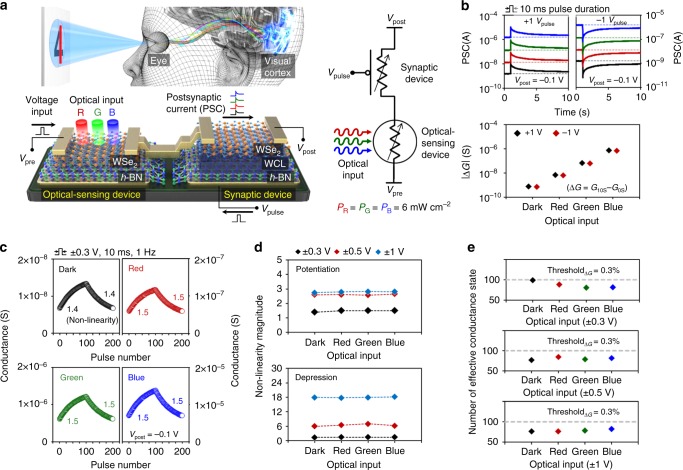
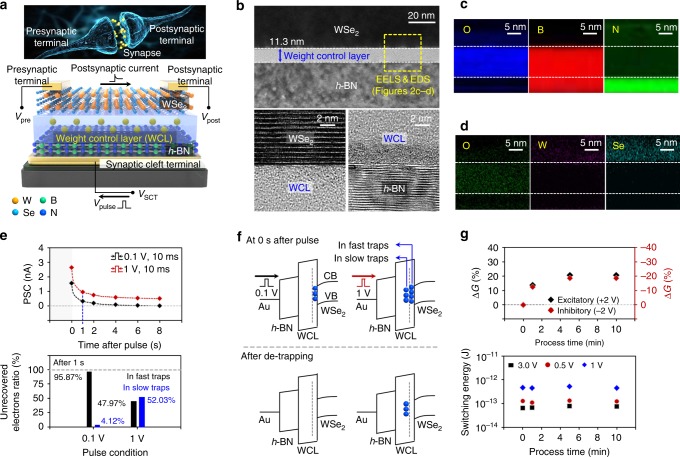
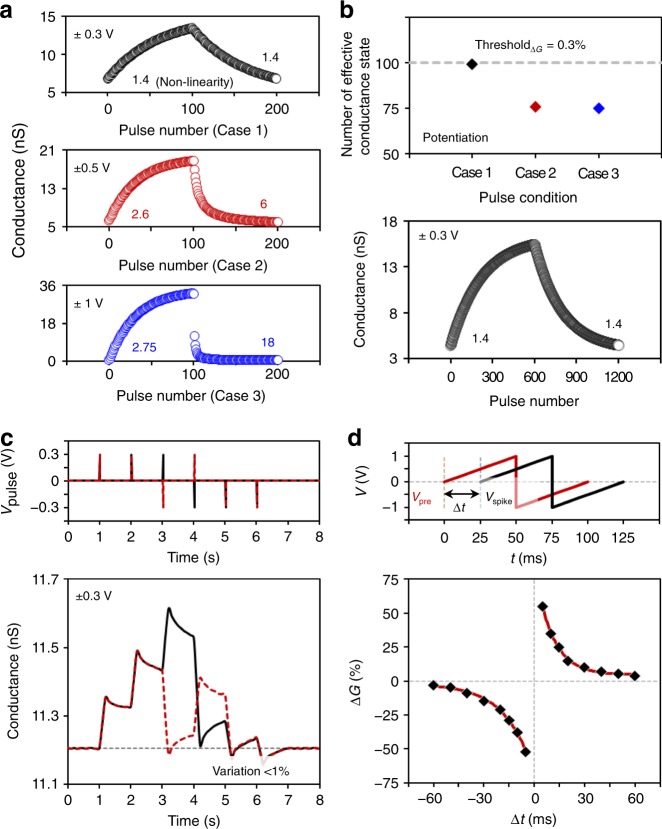
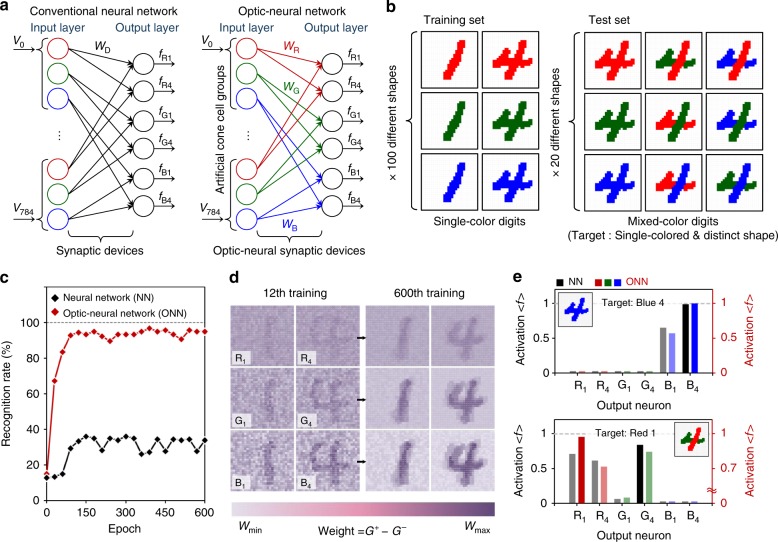
The priority of synaptic device researches has been given to prove the device potential for the emulation of synaptic dynamics and not to functionalize further synaptic devices for more complex learning. Here, we demonstrate an optic-neural synaptic device by implementing synaptic and optical-sensing functions together on h-BN/WSe 2 heterostructure. This device mimics the colored and color-mixed pattern recognition capabilities of the human vision system when arranged in an optic-neural network. Our synaptic device demonstrates a close to linear weight update trajectory while providing a large number of stable conduction states with less than 1% variation per state. The device operates with low voltage spikes of 0.3 V and consumes only 66 fJ per spike. This consequently facilitates the demonstration of accurate and energy efficient colored and color-mixed pattern recognition. The work will be an important step toward neural networks that comprise neural sensing and training functions for more complex pattern recognition.
Overview
The claims and statistics of this paper haven’t been checked yet.
Free: it reads the open-access text and checks the first 5 claims that cite a source we can check. Create a free account to check every claim.
Integrity signals
Registry
Cites
Statistics
Figures
Verification
Claims the paper makes
The claims and statistics of this paper haven’t been checked yet.
Free: it reads the open-access text and checks the first 5 claims that cite a source we can check. Create a free account to check every claim.
Claims other papers make about this one
Each is checked against this paper’s own text: does it say what the citing paper says it does?
The source backs part of the claim, not all of it — or backs it for a different population, condition or comparison.
In the citing paper
“some articles focused on the fabrication and device-level characterization of one/few memristors62–70,186,187, also present some of the figures-of-merit generated by a software-based training ANN process (similar to the ones in Fig. 14) in order to claim that their devices exhibit potential for neuromorphic applications.”
From Hardware implementation of memristor-based artificial neural networks (2024) · cites this paper as [67]
Experimental — accuracy not yet measuredThe cited source says what the claim attributes to it.
In the citing paper
“However, most of those studies in fact only measured the figures-of-merit of one/few devices and simulated the accuracy of an ANN via software62–67 in such type of studies the connection between the memristors fabricated and the ANN is relatively weak.”
From Hardware implementation of memristor-based artificial neural networks (2024) · cites this paper as [67]
Self-check
Percentages, sums and reported differences re-computed from the paper’s own numbers.
The self-check needs the paper’s full text.
Citations
Cites
Gradient-based learning applied to document recognition
Lecun, Y., Bottou, L., Bengio, Y., & Haffner, P. (1998) · Proceedings of the IEEE · doi:10.1109/5.726791 · Cited by 58,805
Parallel Distributed Processing: Explorations in the Microstructure of Cognition: Foundations
Rumelhart, D. E., McClelland, J. L., & AU (1986) · doi:10.7551/mitpress/5236.001.0001 · Cited by 15,686
Mastering the game of Go with deep neural networks and tree search
Silver, D., Huang, A., Maddison, C. J., Guez, A., Sifre, L., van den Driessche, G., Schrittwieser, J., Antonoglou, I., Panneershelvam, V., Lanctot, M., et al. (2016) · Nature · doi:10.1038/nature16961 · Cited by 15,612
Van der Waals heterostructures
Geim, A. K., & Grigorieva, I. V. (2013) · Nature · doi:10.1038/nature12385 · Cited by 10,875
Introduction to the theory of neural computation
(1994) · Neural Networks · doi:10.1016/0893-6080(94)90014-0 · Cited by 6,401
International Conference on Learning Representations (ICLR 2013)
松尾, 豊. (2013) · 人工知能学会誌 = Journal of Japanese Society for Artificial Intelligence · Cited by 6,286
Bi, G.-Q., & Poo, M.-M. (1998) · The Journal of Neuroscience · doi:10.1523/jneurosci.18-24-10464.1998 · Cited by 4,744
Han, S., Mao, H., & Dally, W. J. (2015) · arXiv · doi:10.48550/arxiv.1510.00149 · Cited by 4,662 · cited 1×
“Additionally, to con fi rm if this synaptic device can achieve the number of conductance states that were typically demanded for inference of DNNs (6 − 8 bits = 64 − 256 states) 32,33 , we applied excitatory and inhibitory pulses 600 times each (see Fig.”
MethodMemristive devices for computing
Yang, J. J., Strukov, D. B., & Stewart, D. R. (2013) · Nature Nanotechnology · doi:10.1038/nnano.2012.240 · Cited by 3,885
Training and operation of an integrated neuromorphic network based on metal-oxide memristors
Prezioso, M., Merrikh-Bayat, F., Hoskins, B. D., Adam, G. C., Likharev, K. K., & Strukov, D. B. (2015) · Nature · doi:10.1038/nature14441 · Cited by 3,001
Cited by
Items 701–766 of 766
Silicon Optoelectronic Device With Pulse Encoding Capability for Biomimetic Vision
Cao, Z., Yang, J. M., Yang, Y., Liu, Y., Wang, Z., & Jin, X. (2024) · IEEE Sensors Journal · doi:10.1109/jsen.2024.3453065
“Seo et al. [19] integrated synaptic devices with visual biosensing elements.”
Lihua, 徐. X., Yibo, 赵. Z., & Chengdong, 杨. Y. (2024) · Acta Optica Sinica · doi:10.3788/aos241074
A Two-Terminal, Broadband, Low-Energy Optical Synaptic Device for Optical Encoding
Guo, Z., Xu, J., Cai, S., Wang, Z., Li, Y., & Zhou, F. (2024) · IEEE International Conference on Manipulation, Manufacturing and Measurement on the Nanoscale (3M-NANO) · doi:10.1109/3m-nano61605.2024.10769655
“When consecutive light pulses are applied, the photocurrent first increases dramatically but then slows down gradually as the electron trapping reaches saturation and the trap becomes filled [10-12].”
Study of optoelectronic synaptic devices and image memory based on BaSrTiO3 (BST) thin film
Sun, H., Zhu, L. Q., Wang, J., & Jiang, X. (2024) · Applied Optics and Photonics China (AOPC) · doi:10.1117/12.3045677
The Evolutionary Impact of Pattern Recognition in Research Applications: A Wide Spectrum Survey
Pal, S., Bhattacharya, S., Mondal, B., Bandyopadhyay, A., Sinha, D., & Bandyopadhyay, C. (2025) · Springer proceedings in mathematics & statistics · doi:10.1007/978-3-031-51338-1_31
Meang, K., & Yun, K. (2025) · Journal of Electrical Engineering and Technology · doi:10.1007/s42835-025-02359-3
Retinomorphic devices beyond silicon for dynamic machine vision
Xia, Y., Babu, R. S., Vishwanath, S. K., & Georgiadou, D. G. (2025) · Neuromorphic Computing and Engineering · doi:10.1088/2634-4386/ae2156 · Cited by 1
“This integration has the potential to optimise system performance and reduce latency and energy consumption [43, 54–56].”
Biomimetic High‐Order Encoder for Trichromatic Recognition Based on Flexible MoS 2 Ring Oscillators
Wang, Y., Zhang, S., Li, Y., Yu, H., Zhou, Y., Zhang, Y. Q., Li, X., Zhang, X., Cui, C., Liu, S., et al. (2025) · Advanced Electronic Materials · doi:10.1002/aelm.202500486
“Modern neuromorphic implementations leverage this principle through engineered materials systems, demonstrating color differentiation via quantum dot heterojunctions, perovskite spectral-tuning, and mem-ristive ion-migration dynamics [5–8].”
A self-powered WO 3 -based photoelectrochemical synapse for object distance judgment
Yang, J., Chen, X., Huang, S., Han, X., Huang, Z., Chen, Y., & Qi, X. (2025) · Journal of Materials Chemistry C · doi:10.1039/d5tc03463a
In-sensor computing: A comprehensive review
Syed, I., Khanday, M. A., Rashid, S., & Khanday, F. A. (2025) · Elsevier eBooks · doi:10.1016/b978-0-443-29981-0.00010-0
All-optically controlled terahertz memristor for multidimensional neuromorphic computing
Lai, W., Lan, S., Liang, X., Gan, Y., Huang, R., Liao, C., Li, H., Amini, A., & Cheng, C. (2026) · Optics & Laser Technology · doi:10.1016/j.optlastec.2026.114807
Wei, B., Kang, Y., Xia, Y., Sun, Y., Han, X., Liang, B. L., Peng, Y., Fang, L., Chen, Y., Li, C., et al. (2026) · The Journal of Physical Chemistry Letters · doi:10.1021/acs.jpclett.5c04067
Panin, G. N. (2026) · Nanoenergy Advances · doi:10.3390/nanoenergyadv6010006
“The device operates with low 0.3 V pulse voltages and consumes only 66 fJ per pulse [54].”
InfluentialZhang, S., Cai, M., Chen, Y., Zheng, Z., Lei, S., Zhang, X., cai, W., Zhuang, S., Zhao, B., Balakin, A. V., et al. (2026) · Photonics Research · doi:10.1364/prj.589551
Microfabrication of high-refractive-index titanium 2D and 3D photonic integrated components
Singhal, A., Saxena, S., & Shukla, S. (2026) · Journal of Physics Photonics · doi:10.1088/2515-7647/ae485f · Cited by 1
Digital discovery of distorted-P1 molybdenum ditelluride and its significance in resistive switching
Guha, S., Padmapriya, K., & Mahapatra, S. (2026) · Journal of Applied Physics · doi:10.1063/5.0315066
Optoelectronic synapse based on a BiI3/Bi2Se3 van der Waals heterostructure for neuromorphic visions
Wen, F., Meng, Y., Zhou, H., & Chen, X. (2026) · Applied Physics Letters · doi:10.1063/5.0316774
Fang, Y., Wu, Y., Hou, Q., & Chen, X. (2026) · Photonics · doi:10.3390/photonics13040328
Zhang, M., Xu, C., Xu, Z., Li, J., Shi, K., Xueying, C. H. U., Liu, F., & Pan, X. (2026) · Langmuir · doi:10.1021/acs.langmuir.5c06429
An optically controlled synaptic device based on a PdSe 2 /α-In 2 Se 3 vdW heterostructure FET
Ghosh, A., Dahan, I., Santra, B., Vijayan, G., Uzhansky, M., & Koren, E. (2026) · Materials Horizons · doi:10.1039/d5mh02349a
From planar to curved to synaptic: Advances in imaging devices for next-generation vision systems
Kong, P., Li, M., Dai, G., Huang, Y., Wei, B., Zhang, D., Li, H., & Chu, F. (2026) · Chemical Engineering Journal · doi:10.1016/j.cej.2026.176272
Lee, S. Y., Cho, J. H., & Lee, S. (2026) · Applied Materials Today · doi:10.1016/j.apmt.2026.103212
Liu, J., Li, X., Gu, J., Chen, J., Yu, F., Song, Y., Yang, J., Li, G., Chen, X. H., & Lu, W. (2026) · Coatings · doi:10.3390/coatings16040492
Triple‐Mode Ferroelectric Thin‐Film Transistor for Hybrid Electrical–Optical Reservoir Computing
Lee, H., Lee, S., Kim, T., Jeong, Y., An, G., Ko, M., Yu, J., Kim, H. S., Chai, Y., & Kim, S. D. (2026) · Advanced Science · doi:10.1002/advs.75471
“Therefore, to strictly examine the linearity by obtaining a linearity factor, the following equation was applied [ 45–47 ]. α ( P ) and β ( P ) represent the conductance during LTP and LTD, respectively, with the number of pulses P as the independent variable. w is an internal variable that moves…”
Self-citationZhang, M., Liu, Y. Z., Wang, H., Du, C., Zhang, Y., Wang, J., & Hao, L. (2026) · ACS Applied Electronic Materials · doi:10.1021/acsaelm.6c00390
Optosynapse Habituation in WO x -C 60 Heterojunction for Efficient Human Faces Recognition
Xiang, K., Li, J., Yue, X. I. N., Guo, J., Luo, S., Ouyang, G., Hu, X., Li, P., Wu, B., Sun, B., et al. (2026) · ACS Photonics · doi:10.1021/acsphotonics.5c03119
Multi‐Mode Artificial Vision Neurons for High Precision Image Recognition
Wu, X., Liang, Y., Liu, D., Lian, M., Chen, S., & Chen, H. (2026) · Advanced Functional Materials · doi:10.1002/adfm.76532
Energy-level regulated organic memristive synapses for high-accuracy visual recognition
Qian, R., Zhang, M., Wan, S., Ren, S., Cai, W., Wu, J., Chen, X., Zhang, Y., & Zhang, G. (2026) · Journal of Materials Chemistry C · doi:10.1039/d6tc01126h
High‐Performance Neuromorphic Visual System With Image Pre‐Processing via Normally‐Off GaN MOS‐HEMT
Yang, G., Du, H., Qu, H., Liu, C., Li, Y., Zhou, X., Wang, H., Li, K., & Zou, X. (2026) · Advanced Materials Technologies · doi:10.1002/admt.71128
“A and B can be extracted through the fitting of experimental data, where A is a parameter representing the nonlinearity factor, and B is a fitting constant to normalize the conductance range [ 50, 51 ].”
Nanoporous optoelectronic synapse with bidirectional photoresponse for neuromorphic vision
Chen, H., Qian, H., Li, W., Zhu, H., Zhou, J., Lv, X., Zha, T., Li, X., Niu, Q., Shi, W. Y., et al. (2026) · Journal of Materials Chemistry C · doi:10.1039/d6tc01350c
Wavelength‐Modulated Multi‐Functional Photoresponse for Image Processing and Encryption
Ding, F. W. X., Xue, D., Liu, H. R., Gong, W., Wang, Z., Huang, L., & Chi, L. (2026) · Laser & Photonics Review · doi:10.1002/lpor.71602
Enhanced IGZO Neuromorphic Vision via Interface and Film Quality Optimization
Guo, L., Li, W., Sun, F., Hu, Y., & Meng, Y. (2026) · Journal of Electronic Materials · doi:10.1007/s11664-026-13050-2
“…support over 500 distinct conductance states, and achieve high energy efficiency with a switching energy of less than 10 pJ. 13,14 Photonic stimulation has been proven to substantially reduce power consumption and increase processing speed compared to electrical stimulation.”
Chen, X., Li, Z., Guo, T., Liu, H., Chen, X., Tao, H., Niu, S., Zhu, G., Song, X., Wang, L., et al. (2026) · Nanoscale · doi:10.1039/d6nr02357f
Na, M., Park, J., Kim, Y., Sim, K., Shin, D., Kim, S., Park, H., & Sim, K. (2026) · Device · doi:10.1016/j.device.2026.101249
Self-citationDong, Y., Duan, Y., Meng, X., Wang, L., Zheng, J., Yu, H., Chen, X., Luan, H. F., & Gu, M. (2026) · Advanced Functional Materials · doi:10.1002/adfm.77556
Neuromorphic optoelectronic computing system based on semiconducting metal oxide nanocrystallites
Krasnikov, V. V., Chezhegov, A. А., Chizhov, A. S., Grunin, A. A., & Fedyanin, A. A. (2026) · Scientific Reports · doi:10.1038/s41598-026-65987-3
All-fiber sensing and nonvolatile optical weighting for gesture recognition
Li, Y., Wang, X., Xia, Y., Zhao, M., Zhang, Y., & Liu, Z. (2026) · Optics Express · doi:10.1364/oe.608179
Qu, H., Jiang, H., Liu, C., Li, K., Wang, H., You, T., Ou, X., Xu, W., & Zou, X. (2026) · Advanced Optical Materials · doi:10.1002/adom.71653
Tang, J., & Dai, L. (2026) · Advanced Electronic Materials · doi:10.1002/aelm.70543
“In the h-BN/WSe 2 device shown in Figure 4d–i , the pulse-dependent current relaxation and conductance modulation support the presence of trap populations with different relaxation times [ 161 ].”
Saha, S., Das, S., Roy, B., Ghosh, S. K., Satpathy, R., Bullock, J., Unnithan, R. R., & Ray, S. K. (2026) · Small · doi:10.1002/smll.75437
Yoon, J., Jang, J., Jung, H., Seong, D., Kim, D., Jeon, Y., Koo, J. H., Won, S. M., & Son, D. (2026) · Advanced Science · doi:10.1002/advs.77505
Advances in GaN Nanowire-Based Optoelectronic Devices
Zhao, Y., Xu, Q., Zhang, D., Chen, Y., Song, C., Wang, Y., & Zhang, J. (2026) · ACS Nano · doi:10.1021/acsnano.6c08302
Zhang, F., Wang, M., Chen, Z., Tan, H., Li, C., Li, Z., Xiao, S., Lv, C., & Zhao, J. (2026) · ACS Applied Materials & Interfaces · doi:10.1021/acsami.6c04661
Lin, Y., Hu, C., Wang, L., Zhong, L., Liu, Z., Liu, Y., Yao, R., Li, Y., & 耿魁伟 (2026) · Chemical Engineering Journal · doi:10.1016/j.cej.2026.181448
Zhao, J., Zhang, H., Wang, H., Shen, X., Niu, X., Li, Q., & He, G. (2026) · IEEE Transactions on Electron Devices · doi:10.1109/ted.2026.3727407
“It is evident that optoelectronic synergy serves as an e ff ective strategy for integrating sensing, memory, and processing functions [18], [19], [20].”
Kong, M., Kim, S. E., Kim, K., Yu, S., Park, N., & Lee, S. (2026) · ACS Photonics · doi:10.1021/acsphotonics.6c01155
Self-citationA New Way to Benchmark Low-Dimensional Optoelectronic Synapses
Pelella, A., Sessa, A., Mazzotti, A., Chiara, F. D., & Bartolomeo, A. D. (2026) · IEEE International Conference on Nanotechnology (IEEE-NANO) · doi:10.1109/nano67986.2026.11667528
“This approach mimics the human visual system, where optical stimuli are simultaneously detected, processed, and memorized, drastically reducing the energy overhead of data conversion[6], [7], [8], [9], [10].”
Wang, Y., Gu, Z., Wang, S., Wang, A., Zhu, Y., Yu, J., Humayun, M., & Bououdina, M. (2026) · Journal of Alloys and Compounds · doi:10.1016/j.jallcom.2026.190836
Zhao, C., Chen, B., Liu, Y., Wang, Z., Zhang, X., Cheng, N., Sun, L., & Tao, L. (2026) · IEEE International Conference on Nanotechnology (IEEE-NANO) · doi:10.1109/nano67986.2026.11667520
“Second, single-mode sensing is susceptible to signal crosstalk, making it difficult to distinguish between photon and molecular signals in complex environments[6], [7].”
Intrinsically Nonvolatile n‐Type Polymer Synapses for Neuromorphic Vision
Zhang, T., Li, Y., Yu, Z., Kong, H., Zhang, X.-Y., Long, Y., Wang, J., Yao, Z., & Pei, J. (2026) · Advanced Materials · doi:10.1002/adma.74890
“This formulation highlights that a small step size α P and low nonlinearity β P favor multi ‑state discrimination [ 53 ].”
Ion‐Exchange‐Driven Ternary Organic Neuromorphic Devices with High Efficiency and Stability
Lee, S., Singh, V. P., Lee, H., Kim, Y. Y., Jo, Y., Lee, C., Shim, J. H., Lim, N., Wang, G. Y., Sung, J., et al. (2026) · Advanced Science · doi:10.1002/advs.77486
“In addition, pulse sequences of 256 pulses ( = 2 8 pulses) were used to assess the 8-bit operation capability (Figure S23 ) [ 14, 20, 57 ].”
Self-citationZeng, H., Sui, N., Shao, S., Xu, C., Wang, S., Luo, M., Gu, W., Li, T., Jiao, L., & Zhao, J. (2026) · Small · doi:10.1002/smll.75944
Liu, Z., Wang, Y., 路泽西, Sun, S., Zeng, Y. J., Hu, L., Pan, X., Qian, H., Lu, B., & Ye, Z. (2026) · Small · doi:10.1002/smll.76006
All-optically controlled photoelectrochemical synapse for aqueous neuromorphic applications
Zhao, S., Liu, J., Yang, X., Zhou, J., Li, W., Li, X., Sun, B., Gao, X., He, Y., & Feng, W. (2026) · Journal of Colloid and Interface Science · doi:10.1016/j.jcis.2026.141728
Zhang, X., Wang, X., Wang, X., Song, X., Yu, H., Zhang, H., Xue, R., Liu, Z., Qin, Y., & Wang, F. (2026) · The Journal of Physical Chemistry Letters · doi:10.1021/acs.jpclett.6c02945
Poirier, T. P. J. (2026) · K-State Research Exchange (Kansas State University)
Jeon, D., Song, S., Tak, S., & Lee, S. (2026) · Applied Surface Science · doi:10.1016/j.apsusc.2026.168637
Chatterjee, R., Karybayeva, K., Amangeldinova, Y., Kim, W., Kundale, S. S., Son, H., Saha, D., Byun, C. W., Kim, T. G., Kim, H., et al. (2026) · Small · doi:10.1002/smll.76261
Self-citationSynaptic Characteristics of c-GaN-Based Optoelectronic Neuromorphic Sensors
Singh, D. K., Prajapat, P., Nanda, K. K., Krupanidhi, S. B., & Gupta, G. (2026) · Journal of Electronic Materials · doi:10.1007/s11664-026-13242-w
Song, X., Fan, S., Zhang, S., Gao, X., Liu, H., Sun, N., & Li, Y. (2026) · Journal of Materiomics · doi:10.1016/j.jmat.2026.101345
Memristors based brain-like chip towards human-computer interaction
Tuo, S., Dong, X., Wang, S. L., Lu, Z., & Sun, B. T. (2026) · Materials Today Nano · doi:10.1016/j.mtnano.2026.100987
Xie, D., Liu, Z., Wang, J., Cao, D., Chen, X., & Shu, H. (2026) · Journal of Materials Informatics · doi:10.20517/jmi.2026.70
Two‐Dimensional Heterostructures: From Controlled Synthesis to Post‐Moore Device Applications
Xie, J., Niu, Z., Zhang, B., & Zhang, Z. (2026) · Information & Functional Materials · doi:10.1002/ifm2.70031
Photoactive Nanocomposite Dielectric‐Driven Low‐Power All‐Optical Organic Synaptic Transistors
Chen, Q., Li, R., Liu, H., Chueh, C., & Lee, W. (2026) · Small · doi:10.1002/smll.76650
Ferroionic‐Assisted, Charge‐Driven Polymorphic Phase Engineering for Multilevel Memristive Devices
Kim, N., Wei, C., Hwang, E., Cho, W., Hong, H., Lee, Y., Noh, D., Jang, M. S., Wang, Z., & Yang, H. (2026) · Advanced Materials · doi:10.1002/adma.75648
A Flexible Complementary Memristive Synapse for Convolutional Neural Network Applications
Lee, K., Cho, J., Baek, D.-H., Choi, J.-H., Moon, J., Park, S. H., & Choi, B. (2026) · ACS Nano · doi:10.1021/acsnano.6c14396
Self-citation
Metadata
- Authors
- Seo, S., Jo, S.-H., Kim, S., Shim, J., Oh, S., Kim, J.-H., Heo, K., Choi, J.-W., Choi, C., Oh, S., Kuzum, D., Wong, H.-S. P., & Park, J.-H.
- Affiliations
- Sungkyunkwan University (KR)
- Hanyang University (KR)
- University of California San Diego (US)
- Stanford University (US)
- Corresponding author
- Park, Jin-Hong
- ORCID
- Venue
- Nature Communications
- Published
- 2018-11-30
- Volume
- 9
- Issue
- 1
- Pages
- 5106-5106
- ISSN
- 2041-1723 (ISSN-L)
- PMC
- PMC6269540
- OpenAlex
- W2902437043
- Cited by
- 731
- References
- 40
- Citations by year
- 2026: 56 · 2025: 115 · 2024: 127 · 2023: 121 · 2022: 132 · 2021: 83 · 2020: 70 · 2019: 26
- FWCI
- 17.12
- Type
- journal article
- Language
- en
- Open access
- gold
- doi.org
- Licence
- cc-by
- creativecommons.org/licenses/by/4.0 (tdm)
- creativecommons.org/licenses/by/4.0 (vor)
- Locations
- Nature Communications (publishedVersion, cc-by)
- Europe PMC (PubMed Central) (publishedVersion, other-oa)
- PubMed Central (publishedVersion, cc-by)
- PubMed (publishedVersion)
- RePEc: Research Papers in Economics (submittedVersion)
- DOAJ (DOAJ: Directory of Open Access Journals) (submittedVersion)
- DOAJ (DOAJ: Directory of Open Access Journals) (submittedVersion, cc-by-sa)
- Funders
- National Research Foundation (2017R1A4A1015400, 2016M3A7B4910426)
- National Research Foundation of Korea (2017R1A4A1015400, 2016M3A7B4910426, 2018R1A2A2A05020475)
- Topics
- Physical Sciences › Engineering › Electrical and Electronic Engineering › Advanced Memory and Neural Computing
- Physical Sciences › Materials Science › Materials Chemistry › 2D Materials and Applications
- Physical Sciences › Computer Science › Artificial Intelligence › Neural Networks and Reservoir Computing
- Keywords
- artificial synapses, color pattern recognition, neuromorphic computing, synaptic weight update, optical sensing, energy-efficient neural networks, low-voltage operation
- MeSH terms
- Algorithms, Humans, Models, Neurological, Neurons, Pattern Recognition, Automated, Synapses
About these checks
Registry, retraction, Cites and statistics results are computed, not judged, with one exception: a printed reference that no index lists is read once by a model before it counts as a citation error. Claims are extracted by a model and kept only when their quote appears verbatim in the text; each cited source is then checked, with a model’s help, for whether it says what the claim relies on. Those verdicts can be wrong — read the claim’s quote and the cited source before relying on one.
Statistics and arithmetic are recomputed, not judged.
Confidence bands are shown only for fields calibrated on our annotated test set. None is calibrated yet, so no band is shown.
What counts as a claim ›How we measure confidence ›How we check this ›
Are you an author, or do you see a problem with this page? Request a review
Data sources
Bibliographic data: Semantic Scholar, OpenAlex, Crossref.
Contains information from the Semantic Scholar Academic Graph Datasets, made available under the ODC Attribution License (ODC-BY 1.0).
Semantic Scholar’s data is described in: Kinney, R., et al. (2023). The Semantic Scholar Open Data Platform. arXiv:2301.10140.
