

Artificial optic-neural synapse for colored and color-mixed pattern recognition
Open accessThe DOI matches its Crossref record; 38 of the 40 references it cites were found in a registry or an index.
Abstract
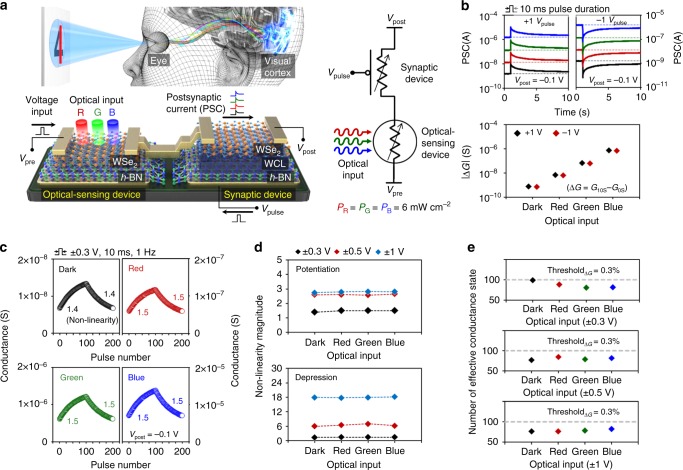
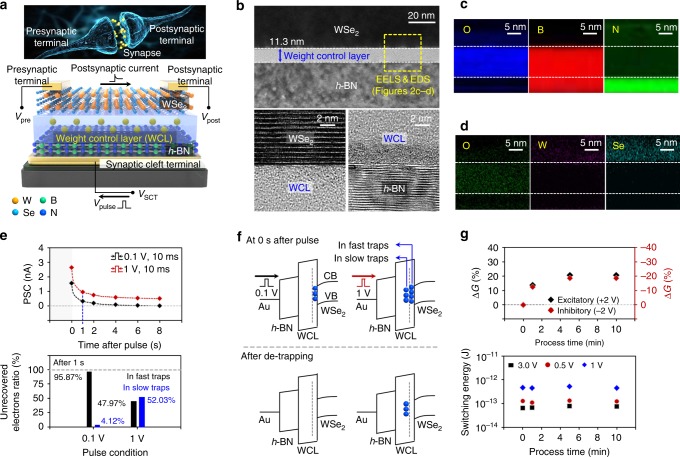
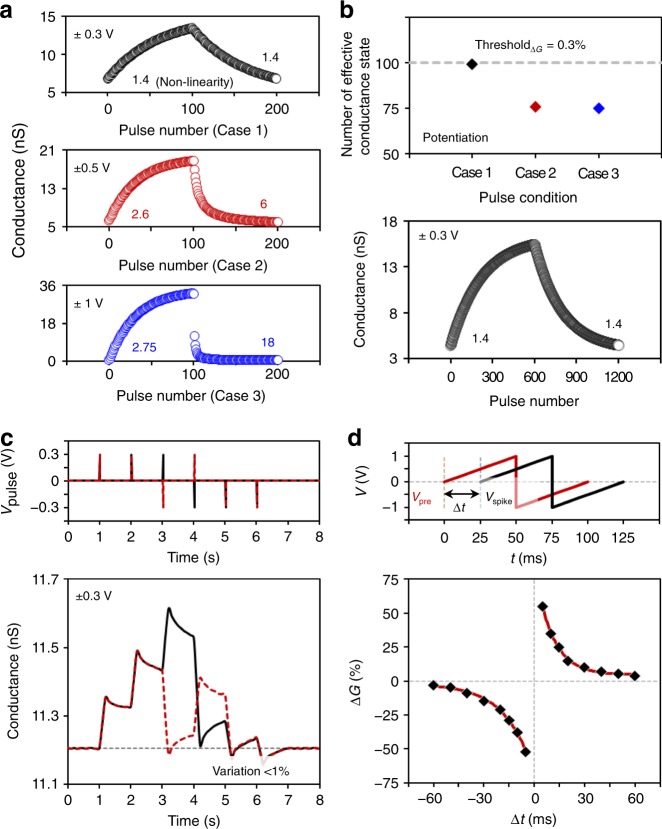
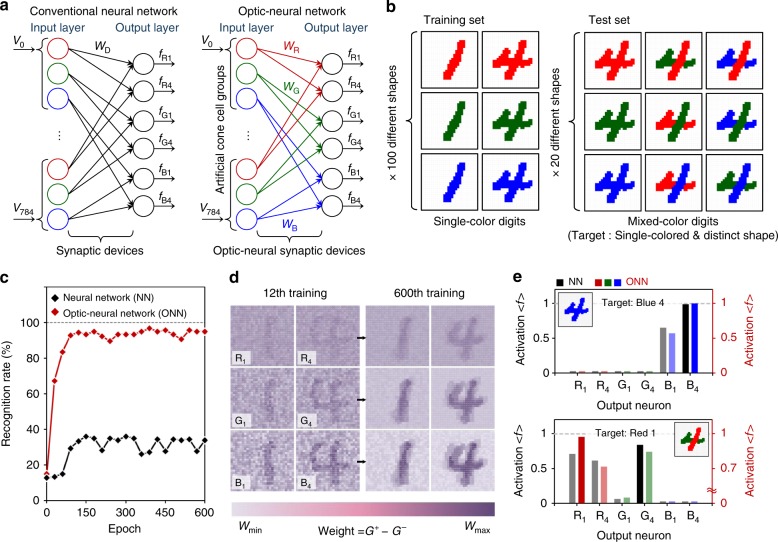
The priority of synaptic device researches has been given to prove the device potential for the emulation of synaptic dynamics and not to functionalize further synaptic devices for more complex learning. Here, we demonstrate an optic-neural synaptic device by implementing synaptic and optical-sensing functions together on h-BN/WSe 2 heterostructure. This device mimics the colored and color-mixed pattern recognition capabilities of the human vision system when arranged in an optic-neural network. Our synaptic device demonstrates a close to linear weight update trajectory while providing a large number of stable conduction states with less than 1% variation per state. The device operates with low voltage spikes of 0.3 V and consumes only 66 fJ per spike. This consequently facilitates the demonstration of accurate and energy efficient colored and color-mixed pattern recognition. The work will be an important step toward neural networks that comprise neural sensing and training functions for more complex pattern recognition.
Overview
The claims and statistics of this paper haven’t been checked yet.
Free: it reads the open-access text and checks the first 5 claims that cite a source we can check. Create a free account to check every claim.
Integrity signals
Registry
Cites
Statistics
Figures
Verification
Claims the paper makes
The claims and statistics of this paper haven’t been checked yet.
Free: it reads the open-access text and checks the first 5 claims that cite a source we can check. Create a free account to check every claim.
Claims other papers make about this one
Each is checked against this paper’s own text: does it say what the citing paper says it does?
The source backs part of the claim, not all of it — or backs it for a different population, condition or comparison.
In the citing paper
“some articles focused on the fabrication and device-level characterization of one/few memristors62–70,186,187, also present some of the figures-of-merit generated by a software-based training ANN process (similar to the ones in Fig. 14) in order to claim that their devices exhibit potential for neuromorphic applications.”
From Hardware implementation of memristor-based artificial neural networks (2024) · cites this paper as [67]
Experimental — accuracy not yet measuredThe cited source says what the claim attributes to it.
In the citing paper
“However, most of those studies in fact only measured the figures-of-merit of one/few devices and simulated the accuracy of an ANN via software62–67 in such type of studies the connection between the memristors fabricated and the ANN is relatively weak.”
From Hardware implementation of memristor-based artificial neural networks (2024) · cites this paper as [67]
Self-check
Percentages, sums and reported differences re-computed from the paper’s own numbers.
The self-check needs the paper’s full text.
Citations
Cites
Gradient-based learning applied to document recognition
Lecun, Y., Bottou, L., Bengio, Y., & Haffner, P. (1998) · Proceedings of the IEEE · doi:10.1109/5.726791 · Cited by 58,805
Parallel Distributed Processing: Explorations in the Microstructure of Cognition: Foundations
Rumelhart, D. E., McClelland, J. L., & AU (1986) · doi:10.7551/mitpress/5236.001.0001 · Cited by 15,686
Mastering the game of Go with deep neural networks and tree search
Silver, D., Huang, A., Maddison, C. J., Guez, A., Sifre, L., van den Driessche, G., Schrittwieser, J., Antonoglou, I., Panneershelvam, V., Lanctot, M., et al. (2016) · Nature · doi:10.1038/nature16961 · Cited by 15,612
Van der Waals heterostructures
Geim, A. K., & Grigorieva, I. V. (2013) · Nature · doi:10.1038/nature12385 · Cited by 10,875
Introduction to the theory of neural computation
(1994) · Neural Networks · doi:10.1016/0893-6080(94)90014-0 · Cited by 6,401
International Conference on Learning Representations (ICLR 2013)
松尾, 豊. (2013) · 人工知能学会誌 = Journal of Japanese Society for Artificial Intelligence · Cited by 6,286
Bi, G.-Q., & Poo, M.-M. (1998) · The Journal of Neuroscience · doi:10.1523/jneurosci.18-24-10464.1998 · Cited by 4,744
Han, S., Mao, H., & Dally, W. J. (2015) · arXiv · doi:10.48550/arxiv.1510.00149 · Cited by 4,662 · cited 1×
“Additionally, to con fi rm if this synaptic device can achieve the number of conductance states that were typically demanded for inference of DNNs (6 − 8 bits = 64 − 256 states) 32,33 , we applied excitatory and inhibitory pulses 600 times each (see Fig.”
MethodMemristive devices for computing
Yang, J. J., Strukov, D. B., & Stewart, D. R. (2013) · Nature Nanotechnology · doi:10.1038/nnano.2012.240 · Cited by 3,885
Training and operation of an integrated neuromorphic network based on metal-oxide memristors
Prezioso, M., Merrikh-Bayat, F., Hoskins, B. D., Adam, G. C., Likharev, K. K., & Strukov, D. B. (2015) · Nature · doi:10.1038/nature14441 · Cited by 3,001
Cited by
Items 501–600 of 766
Toward Energy‐Efficient Machine Vision: Advances in Optoelectronic Memristors
Pan, S., Wu, S., Ming, J., & Ling, H. (2025) · Advanced Optical Materials · doi:10.1002/adom.202501992 · Cited by 16
Yoon, H., Park, S., Kim, Y. K., Baek, J., Kim, K. H., Yun, S., Son, H., Choi, J.-H., Jang, B. C., & Kang, D. (2025) · Advanced Functional Materials · doi:10.1002/adfm.202519498 · Cited by 13
Self-citationLeng, K., Zhu, X., Ma, Z., Yu, X., Xu, J., Xu, L., Li, W., & Chen, K. (2022) · Nanomaterials · doi:10.3390/nano12030311 · Cited by 12
Multifunctional neurosynaptic devices for human perception systems
Wen, W., Guo, Y., & Liu, Y. (2022) · Journal of Semiconductors · doi:10.1088/1674-4926/43/5/051201 · Cited by 12
Bidirectionally Modulated Synaptic Plasticity with Optically Tunable Ionic Electrolyte Transistors
Kwon, S. M., Kang, S., Cho, S. S., Jang, Y.-W., Nam, S., Kim, J., Moon, U.-C., Shin, J., Kim, Y., & Park, S. K. (2022) · ACS Applied Electronic Materials · doi:10.1021/acsaelm.2c00289 · Cited by 12
Self-citationFu, Y., Dai, H., Li, J., Wang, C., Zhao, D., Zhang, X., Liu, C., Lü, Q., Wang, Y., Xiao, Y., et al. (2024) · ACS Photonics · doi:10.1021/acsphotonics.3c01725 · Cited by 12
Two-dimensional materials for artificial synapses: toward a practical application
Wang, I., Chang, C.-C., Chen, Y., Su, Y.-S., & Hou, T. (2022) · Neuromorphic Computing and Engineering · doi:10.1088/2634-4386/ac5086 · Cited by 12
Artificial synapse‐based intelligent light‐controlled liquid crystal network actuators
Song, Y., Zhang, J., Sun, Z., Liang, H., Sun, T., Lu, Z., Li, S., Yao, Y., Wang, X., Xu, Y., et al. (2025) · InfoMat · doi:10.1002/inf2.70008 · Cited by 11
Tariq, R., Raza, W., Albalawi, K. M., Hussain, A., Ahmad, M., Mushtaq, M. A., Helal, M. H., Shaaban, I. A., Khan, S., & Javed, M. S. (2025) · Chemical Engineering Journal · doi:10.1016/j.cej.2025.162688 · Cited by 13
Park, J., Mok, J., Ha, J., Choi, C., & Kim, D. (2025) · FlexTech · doi:10.1002/fle2.70003 · Cited by 11
“Color detection is a fundamental capability in robotic vision, enabling efficient pattern recognition and feature classification. directly processing spectral information at the sensor level [100].”
Self-citationRecent advances in optoelectronic synapses: from advanced materials to neuromorphic applications
Su, F., Wang, Z., Wan, J., & Wang, D. (2025) · Rare Metals · doi:10.1007/s12598-025-03433-5 · Cited by 11
“Park’s team [95] utilized plasma technology to create trap states, or charge trapping layers, on top of h-BN, thereby adjusting the conductivity of the WSe 2 channel.”
Recent Advances in Neuromorphic Devices Based on 2D Materials
Guo, P., Yang, H., Jia, M., Pan, J., Li, S., Kang, Q., Li, Y., Yang, Y., & Ren, T. (2025) · Advanced Materials Technologies · doi:10.1002/admt.202501408 · Cited by 12
Ra, H., Kim, T. W., Taylor, D. A., Lee, J., Song, S., Ahn, J., Jang, J., Taniguchi, T., Watanabe, K., Shim, J. W., et al. (2023) · Advanced Materials · doi:10.1002/adma.202303664 · Cited by 11
Self-citationSingle Wavelength Operating Neuromorphic Device Based on a Graphene–Ferroelectric Transistor
Maity, K. P., Dayen, J., Doudin, B., Gumeniuk, R. V., & Kundys, B. (2023) · ACS Applied Materials & Interfaces · doi:10.1021/acsami.3c10010 · Cited by 11
Kim, T. W., Ra, H., Ahn, J., Jang, J., Taniguchi, T., Watanabe, K., Shim, J. W., Lee, Y. T., & Hwang, D. K. (2021) · ACS Applied Materials & Interfaces · doi:10.1021/acsami.0c21222 · Cited by 11
Self-citationLi, L., Wang, Q., Pei, M., Wang, H., Guo, J., Hao, Z., Li, Y., Dai, Q., Lu, K., & Li, Y. (2023) · Advanced Intelligent Systems · doi:10.1002/aisy.202200434 · Cited by 11
Flexible Neuromorphic Devices Based on Two-Dimensional Transition Metal Dichalcogenides
Ma, X., Ding, G., Niu, W., Jia, Z., Han, S., Kuo, C., & Zhou, Y. (2023) · IEEE Journal on Flexible Electronics · doi:10.1109/jflex.2023.3298593 · Cited by 11
“Seo et al. [113] demonstrated an h-BN/WSe 2 heterostructure synaptic device for simulating the ability of colored and color-mixed pattern recognition in the human vision system [113].”
BackgroundJacob, B., Silva, J., Figueiredo, J. M. L., Nieder, J. B., & Romeira, B. (2025) · Scientific Reports · doi:10.1038/s41598-025-90265-z · Cited by 12
Heterostructure carbon-packed MoSSe nanospheres for flexible ReRAM and synapse devices
Rani, A., Khot, A. C., Jang, I. G., & Kim, T. G. (2021) · Carbon · doi:10.1016/j.carbon.2021.12.057 · Cited by 10
Bioinspired activation of silent synapses in layered materials for extensible neuromorphic computing
Kang, Y., Chen, Y., Tan, Y., Hao, H., Li, C., Xie, X., Hua, W., & Jiang, T. (2023) · Journal of Materiomics · doi:10.1016/j.jmat.2023.02.007 · Cited by 12
Synaptic properties of plasma-treated SnS2/h-BN van der Waals heterostructure
Fang, P., Wang, Q., Lei, T., Wang, Y., Wang, B., Luo, Y., Wu, H., Lv, W., & Zeng, Z. (2023) · Applied Physics Letters · doi:10.1063/5.0145392 · Cited by 10
Flexible oxide neuromorphic transistors with synaptic learning functions
Long, T. Y., Zhu, L. Q., Guo, Y. B., Ren, Z. Y., Xiao, H., Ge, Z. Y., & Wang, L. (2019) · Journal of Physics D Applied Physics · doi:10.1088/1361-6463/ab2d19 · Cited by 10
Developing an Algorithm for Real-Time 3D Identification of Images
Alexandrov, I. A., Kuklin, V. Z., Muranov, A. N., & Polezhaev, D. V. (2024) · Engineering Journal · doi:10.4186/ej.2024.28.5.83 · Cited by 9
Temperature-dependent behavior of VO2-based artificial neurons
Zhao, T., Xu, Y. F., Liu, J., Bao, X., Liu, Y., & Gu, D. (2024) · Applied Physics Letters · doi:10.1063/5.0231840 · Cited by 9
Hu, Y., Lin, Y., Zhang, X., Zhao, Y., Li, L., Zhang, Y., Lei, H., & Pan, Y. M. (2025) · Nanoscale Horizons · doi:10.1039/d5nh00062a · Cited by 9
Taha, M., Khalid, A., Nageh, H., & Abdalla, S. (2025) · Materials Science and Engineering B · doi:10.1016/j.mseb.2025.119166 · Cited by 9
Kumar, D., Li, H., Divyanshu, D., Kumbhar, D. D., Rajbhar, M. K., Singh, A., Syed, A. M., Amara, S., Setti, G., & El‐Atab, N. (2026) · Advanced Science · doi:10.1002/advs.75318 · Cited by 10
Bioinspired Vertical Transistors from Artificial Synapse to Neuromorphic System
Li, Y., Huang, Z., Zhang, Y., & Jiang, J. (2023) · physica status solidi (RRL) - Rapid Research Letters · doi:10.1002/pssr.202300181 · Cited by 9
Jeon, Y., Kim, J. H., Akinwande, D., & Choi, C. (2024) · Advanced Intelligent Systems · doi:10.1002/aisy.202300754 · Cited by 9
Self-citationHuman somatosensory systems based on sensor-memory-integrated technology
Meng, Y., & Cheng, G. (2024) · Nanoscale · doi:10.1039/d3nr06521a · Cited by 9
Huang, Y., Mu, P., Zhou, P., & Li, N. (2024) · Photonics Research · doi:10.1364/prj.535334 · Cited by 10
Optical Bio-Inspired Synaptic Devices
Li, P., Wang, K., Jiang, S., He, G., Zhang, H., Cheng, S., Li, Q., Zhu, Y., Fu, C., Wei, H., et al. (2024) · Nanomaterials · doi:10.3390/nano14191573 · Cited by 9
Optical convolution operations with optical neural networks for incoherent color image recognition
Kim, B., Kim, Y., Kim, M., Yang, S. I., Jeong, D. S., & Park, W. I. (2024) · Optics and Lasers in Engineering · doi:10.1016/j.optlaseng.2024.108740 · Cited by 9
Chen, J.-Y., Zhong, W., Ren, Q.-Z., He, A., Guo, X., Jiang, Y., Liu, Q., & Tang, X. (2025) · ACS Photonics · doi:10.1021/acsphotonics.4c01535 · Cited by 9
Multidimensional Light Perception through Time-Dependent Plasticity of an Optoelectronic Synapse
Wang, Y., Yang, H. Y., & Chen, X. (2025) · ACS Applied Electronic Materials · doi:10.1021/acsaelm.5c00090 · Cited by 9
Field-driven modulating of In-Sn-O synaptic transistors with a precisely controlled weight update
Liu, W., Huang, Y., Jin, C., Zhou, B., Yu, J., Liang, Y., Sun, Q., Sun, J., & Yang, J. (2021) · Applied Materials Today · doi:10.1016/j.apmt.2021.101024 · Cited by 9
An Image Memory Logic Unit Inspired by Human Retina
Du, W., Li, C., Long, Z., Huang, Y., Luo, L., Zou, J., & Wu, J. (2021) · IEEE Electron Device Letters · doi:10.1109/led.2021.3118053 · Cited by 9
Light‐operated On‐chip Autonomous Vision Using Low‐dimensional Material Systems
Walia, S. (2022) · Advanced Materials Technologies · doi:10.1002/admt.202101494 · Cited by 9
Mnemonic-opto-synaptic transistor for in-sensor vision system
Han, J., Chung, Y., Sim, J., Yu, J., Lee, G., Kim, S., & Choi, Y. (2022) · Scientific Reports · doi:10.1038/s41598-022-05944-y · Cited by 9
“The demonstrated wavelength dependency as well as the intensity dependency of the tunable photoresponsivity can help in recognizing a color mixed pattern 33,34 .”
BackgroundSelf-citationLi, S., Wang, B., Li, L., Li, J., Wang, M., Luo, G., Ren, X. F., Yan, Y., & Li, J. (2022) · Advanced Electronic Materials · doi:10.1002/aelm.202200665 · Cited by 9
Multiplexed Complementary Signal Transmission for a Self‐Regulating Artificial Nervous System
Choi, Y. J., Roe, D. G., Choi, Y. Y., Kim, S., Jo, S. B., Lee, H. S., Kim, D. H., & Cho, J. H. (2022) · Advanced Science · doi:10.1002/advs.202205155 · Cited by 9
Self-citationLee, S., Jang, H., An, G., Ju, S., & Kim, S. (2025) · Nano Energy · doi:10.1016/j.nanoen.2025.111395 · Cited by 9
Self-citationMonolithically‐Integrated van der Waals Synaptic Memory via Bulk Nano‐Crystallization
Lee, J., Kim, G., Seok, H., Han, S., Shim, H., Cha, Y., Son, S., Choi, H., Grzeszczyk, M., Bogucki, A., et al. (2025) · Advanced Science · doi:10.1002/advs.202510961 · Cited by 8
Self-citationAbbas, Z., Riaz, M., Jaffery, S. H. A., Abidi, S. K. A., Hussain, S., & Jung, J. (2025) · Small · doi:10.1002/smll.202504294 · Cited by 8
Low-dimensional optoelectronic memristors: From quantum confinement to neuromorphic vision
Pei, Y., Zhang, J., Guo, M., Zhao, J., Wang, L., Chen, J., & Yan, X. (2025) · Materials Science and Engineering R Reports · doi:10.1016/j.mser.2025.101115 · Cited by 9
Wang, Y., Zhang, C., Li, S., Xiao, G., & Zou, B. (2025) · Advanced Materials · doi:10.1002/adma.202516053 · Cited by 8
Memristor Synapse—A Device-Level Critical Review
Chandrasekaran, S., Chang, Y., & Simanjuntak, F. M. (2026) · Nanomaterials · doi:10.3390/nano16030179 · Cited by 9
“Seo et al. proposed an artificial optic-neural synapse [136] that contributes to a significant enhancement in synthetic vision by directly interfacing an optical sensing device with a synaptic device connected to the visual cortex of the human brain.”
Nirmal, K. A., Patil, A. R., Patil, P. P., Khot, A. C., Dongale, T. D., & Kim, T. G. (2026) · International Journal of Extreme Manufacturing · doi:10.1088/2631-7990/ae542d · Cited by 8
Research progress of neuromorphic devices based on two-dimensional layered materials
Li, C., Yang, D., & Sun, L. (2022) · Acta Physica Sinica · doi:10.7498/aps.71.20221424 · Cited by 8
Liu, L., Chen, Q., Zeng, H., Shan, L., An, C., Zhuang, B., Chen, H., Guo, T., & Hu, W. (2023) · Advanced Materials Technologies · doi:10.1002/admt.202300225 · Cited by 8
Liu, L., Zhang, X., Tian, R., Zhang, Q., Zhang, M., Zhang, Y., & Gan, X. (2025) · Applied Physics Reviews · doi:10.1063/5.0235614 · Cited by 8
Oh, I., & Pak, J. J. (2025) · Journal of Alloys and Compounds · doi:10.1016/j.jallcom.2025.179383 · Cited by 10
Interface engineering for enhanced memristive devices and neuromorphic computing applications
Xiao, M., Shen, D., & Huang, J. (2025) · International Materials Reviews · doi:10.1177/09506608251318108 · Cited by 9
“267 Optoelectronic synapses with light-sensing and information-processing capabilities acquire color, intensity, and frequency, which behave as effective fundamental units for neuromorphic computing networks.”
InfluentialTong, Y. Q., Li, J., Fan, X., Zhu, H., Tang, W., Ma, H., & Li, L. (2025) · ACS Applied Materials & Interfaces · doi:10.1021/acsami.4c21775 · Cited by 8
Recent Progress in Organic Optoelectronic Synaptic Devices
He, M., & Tang, X. (2025) · Photonics · doi:10.3390/photonics12050435 · Cited by 8
Two-Dimensional InSe Artificial Synapses with fJ Energy Consumption
Xu, N., Duan, M., Zhang, K., Zhang, W., & Jia, C. (2025) · ACS Applied Energy Materials · doi:10.1021/acsaem.4c03324 · Cited by 8
Kim, J., Lim, J. W., & Lee, J. (2021) · Advanced Electronic Materials · doi:10.1002/aelm.202101061 · Cited by 8
Self-citationAdvanced Bioinspired Organic Sensors for Future‐Oriented Intelligent Applications
Lu, K., Li, L., Jiang, S., Xu, C., Chang, Q., Shi, Y., & Li, Y. (2023) · Advanced Sensor Research · doi:10.1002/adsr.202200066 · Cited by 9
Navaneeth Krishnan, K., Sagar, S., Mukherjee, A., & Das, B. C. (2023) · ACS Applied Optical Materials · doi:10.1021/acsaom.2c00192 · Cited by 8
Visible-Active Artificial Synapses Based on Ultrathin Indium Oxide
Mazumder, A., Nguyen, C. K., Abidi, I. H., Ranjan, A., Daeneke, T., Ahmed, T., Balendhran, S., & Walia, S. (2024) · ACS Applied Nano Materials · doi:10.1021/acsanm.3c05012 · Cited by 8
Chen, C., Gao, C., Lin, K., Zhang, J., Zhang, Z., Jing, Y., Xiao, Y., Shan, G., & Xie, C. (2024) · Chemical Engineering Journal · doi:10.1016/j.cej.2024.152326 · Cited by 8
Indium-Gallium-Zinc-Oxide-Based Photoelectric Neuromorphic Transistors for Spiking Morse Coding
Lin, X., Long, H., Ke, S., Wang, Y., Zhu, Y., Chen, C., Wan, C., & Wan, Q. C. (2022) · Chinese Physics Letters · doi:10.1088/0256-307x/39/6/068501 · Cited by 8
Chang, C., Li, Y., Zhang, Y., Shuai, W., Liu, H., Huang, T. H., Fan, Z. H., Minari, T., Zhou, G., Tao, R., et al. (2022) · IEEE Electron Device Letters · doi:10.1109/led.2022.3189758 · Cited by 8
“Highly linear conductance modulation is critical in synaptic efficiency [8].”
BackgroundThe necessity of nanotechnology in Mycoplasma pneumoniae detection: A comprehensive examination
Matini, A., & Naghib, S. M. (2024) · Sensing and Bio-Sensing Research · doi:10.1016/j.sbsr.2024.100631 · Cited by 7
Ambipolar two-dimensional materials-based reconfigurable devices
He, P., Zhan, P., Liu, Y., Luo, L., Cui, X., & Zheng, J. Y. (2025) · Science China Materials · doi:10.1007/s40843-025-3322-5 · Cited by 7
“[189] demonstrated an optic-neural synaptic (ONS) device by implementing synaptic and light sensing functions on a h-BN/WSe 2 heterostructure (Fig.”
Xu, B., Cai, Y., Wang, Z., Xu, Q., Ren, Y., Chen, X., Hu, C., Li, X., Shi, J., Sun, C., et al. (2025) · Small Methods · doi:10.1002/smtd.202500842 · Cited by 7
Neuromorphic devices for intelligent visual perception
Zhu, Y., Wang, X., Hu, Y., Chen, X., Le, X., Wan, C., & Wan, Q. C. (2025) · International Journal of Extreme Manufacturing · doi:10.1088/2631-7990/ae0a91 · Cited by 9
“Reproduced from [35] .”
Ryu, D., Park, S., Kim, S., Lee, H. H., Kim, S., & Choi, W. Y. (2025) · Nano Energy · doi:10.1016/j.nanoen.2025.111525 · Cited by 8
Self-citationWang, M., Lv, Y., Li, S., Zhao, J., Cao, D., Luo, G., Jiang, Y., Song, X., Yan, Y., & Xia, C. (2023) · ACS Applied Nano Materials · doi:10.1021/acsanm.3c02435 · Cited by 7
Hardware‐Implemented DropConnect Function for Energy‐Efficient Neuromorphic Computing
Zhou, J., Zhang, X., Zhang, Y., Huang, S., Chen, A., Gong, Z., Li, Z., Wang, L., Xue, F., Wang, H., et al. (2025) · Advanced Functional Materials · doi:10.1002/adfm.202503452 · Cited by 7
Kim, J., Kim, H., Cheon, G. J., Lee, D., Kim, I. S., Won, U., Lee, J., Won, S. M., & Kang, J. (2025) · Advanced Functional Materials · doi:10.1002/adfm.202514177 · Cited by 7
Self-citationExcitatory postsynaptic current model for synaptic thin-film transistors
Im, C., Kim, J., Lee, J., Jin, M., Lee, H., Lee, J., Shin, J. C., Lee, C. Y., Kim, Y. S., & Lee, E. (2022) · Journal of Applied Physics · doi:10.1063/5.0101168 · Cited by 7
Self-citationJeon, Y., Lee, D., Cho, H. B., Ku, B., Im, W. B., & Choi, C. (2022) · Ceramics International · doi:10.1016/j.ceramint.2022.11.310 · Cited by 7
Self-citationAhmed, T., Krishnamurthi, V., Mitchell, A., & Walia, S. (2023) · Advanced Intelligent Systems · doi:10.1002/aisy.202200316 · Cited by 7
Optoelectronic artificial synapse based on Si1-xSnx alloyed film
Zhu, L. Q., Gao, H.-Z., Xu, W., Wang, J., Li, W., & Jiang, X. (2023) · Vacuum · doi:10.1016/j.vacuum.2023.112002 · Cited by 7
Kim, H. W., Jeon, S., Jeon, S., Hong, E., Kim, N., & Woo, J. (2023) · IEEE Access · doi:10.1109/access.2023.3301562 · Cited by 7
“The development of artificial intelligence algorithms has enabled machines to perform natural language translation and pattern recognition [1], [2], [3], [4].”
Song, O., Rhee, D., Kim, J., Jung, M., Kim, S., Kim, I. S., & Kang, J. (2023) · IEEE Journal of Selected Topics in Quantum Electronics · doi:10.1109/jstqe.2023.3307515 · Cited by 7
“2D-TMDC-based 2D-TMDC-based photosynaptic devices have been successfully demonstrated, but most work has focused on rigid substrates such as silicon and germanium [9], [12], [15], [16], [17], [18], [19].”
BackgroundSelf-citation赵, Y. 月. Z., 孙, H. 浩. S., 盛, Z. 喆. S., 张, D. W. 卫. Z., 周, P. 鹏. Z., & 张, Z. 增. Z. (2023) · Chinese Physics B · doi:10.1088/1674-1056/ad08a5 · Cited by 7
Artificial optoelectronic synapses based on flexible and transparent oxide transistors
Sadiq, M. I., Zahid, M., Jin, C., Shi, X., Liu, W., Xu, Y., Tahir, M., Aslam, F., Yang, J., & Sun, J. (2024) · Journal of Physics D Applied Physics · doi:10.1088/1361-6463/ad6454 · Cited by 7
Pérez‐Tomás, A., Chikoidze, E., & Rogers, D. J. (2021) · Oxide-based Materials and Devices · doi:10.1117/12.2590747 · Cited by 7
“When the HJ active layers are made of 2D materials, they are commonly referred as vdW HJs, as for example h-BN/MoS2 [182], graphene/MoS2 [183] or h-BN/WSe2 [184].”
BackgroundA Multiple‐State Ion Synaptic Transistor Applicable to Abnormal Car Detection with Transfer Learning
Yu, J., Ham, G., Lee, C., Lee, J.-H., Han, J., Kim, J., Jang, D., Kim, N., Kim, M., Im, S. G., et al. (2022) · Advanced Intelligent Systems · doi:10.1002/aisy.202100231 · Cited by 7
Self-citationTao, J., Vazquez, J. S., Chae, H. U., Ahsan, R., & Kapadia, R. (2022) · IEEE Journal of Quantum Electronics · doi:10.1109/jqe.2022.3169565 · Cited by 7
Sun, X., Hu, Y., Jiang, C., & Yang, S. (2025) · InfoScience. · doi:10.1002/inc2.70005 · Cited by 11
“32 Nevertheless, current research on 2D‐TMD‐based optoelectronic synaptic devices remains mainly focused on two‐terminal and three‐ terminal architectures.”
Liu, P., Heo, J., Bong, H., Choe, J., Lee, H., Lee, W., Kim, M., Son, D., Kang, J., Eom, T., et al. (2025) · International Journal of Extreme Manufacturing · doi:10.1088/2631-7990/ae1db9 · Cited by 8
“Reproduced from [96] .”
Organic Transistor‐Based Neuromorphic Electronics and Their Recent Applications
Wang, Z., & Yan, F. (2026) · Small Methods · doi:10.1002/smtd.202501966 · Cited by 7
Gong, C., Wang, C., Fan, B., Meng, X., Shi, S., Hu, T., Hu, X., & Chen, Y. (2024) · Advanced Optical Materials · doi:10.1002/adom.202402521 · Cited by 6
2D Reconfigurable Memory for Integrated Optical Sensing and Multifunctional Image Processing
Cheng, J., Ouyang, X., Tang, X., Qin, B., Liu, S., Chen, H., Song, B., & Zheng, Y. (2025) · ACS Applied Materials & Interfaces · doi:10.1021/acsami.5c01496 · Cited by 6
Liu, F., Zhang, X., Valencia, A., Li, W., Bo, X., & Daoud, W. A. (2025) · Nano Energy · doi:10.1016/j.nanoen.2025.111145 · Cited by 7
Chen, J., Huang, Y., Wen, H., Wang, Y., Li, H., Zheng, X., Wang, X., Ma, Z., Wang, T., Yan, S., et al. (2025) · Advanced Optical Materials · doi:10.1002/adom.202501078 · Cited by 7
An Ultrasensitive Biomimetic Optic Afferent Nervous System with Circadian Learnability
Wang, K., Ren, S., Jia, Y., & Yan, X. (2024) · Advanced Science · doi:10.1002/advs.202309489 · Cited by 6
Zhang, Q., Hou, B., Zhang, J., Gu, X., Huang, Y., Pei, R., & Zhao, Y. (2024) · Nanotechnology · doi:10.1088/1361-6528/ad2ee3 · Cited by 6
“The structure of this neural network consists of an input layer with 784 neurons, a hidden layer with 100 neurons, and an output layer with 10 neurons ( fi gure 7 ( a )) [ 27 ] .”
Weight‐Reconfigurable Neuromorphic Computing Systems for Analog Signal Integration
Choi, Y. J., Roe, D. G., Li, Z., Choi, Y. Y., Lim, B., Kong, H., Kim, S. H., & Cho, J. H. (2024) · Advanced Functional Materials · doi:10.1002/adfm.202316664 · Cited by 6
Self-citationZhang, G., Tang, J., Lai, B., Wang, H., Zeng, Z., Su, C., Yi, X., Yan, Y., & Chen, H. (2025) · IEEE Electron Device Letters · doi:10.1109/led.2024.3525088 · Cited by 6
“However, research on optoelectronic neural devices is relatively sparse compared to other optoelectronic synapses [16], [17], [18], [19].”
Recent Advances in Transistor-Based Bionic Perceptual Devices for Artificial Sensory Systems
Yu, H., Zhu, Y., Zhu, L. Q., Lin, X., & Wan, Q. C. (2022) · Frontiers in Nanotechnology · doi:10.3389/fnano.2022.954165 · Cited by 6
Excitation/Inhibition Balancing in 2D Synaptic Transistors With Minority-Carrier Charge Dynamics
Wu, R., Liu, X., Wang, Z., Jing, Y., Yuan, Y., Tang, K., Dai, X., Qiu, A., Jaiswal, H. N., Sun, J., et al. (2022) · IEEE Electron Device Letters · doi:10.1109/led.2022.3224471 · Cited by 6
“Distinct physical mechanisms causing resistance switching have been reported, including charge dynamics [2], [3], floating gate [4], ferroelectric polarization [5], [6], [7], [8], and ion migration [9].”
BackgroundA real-time pattern recognition module via Matlab-Arduino interface
Díaz, N. H., García, A. P., & Suárez, O. J. (2020) · LACCEI International Multi-Conference for Engineering, Education and Technology (LACCEI) · doi:10.18687/laccei2020.1.1.646 · Cited by 6
“Pattern recognition plays key roles in the processes of engineering, computing, mathematics, and economy, among others [1][2][3].”
BackgroundSurface Potential-Controlled Oscillation in FET-Based Biosensors
Kim, J. H., Park, S. J., Han, J., & Ahn, J. (2021) · Sensors · doi:10.3390/s21061939 · Cited by 6
Self-citationMennel, L., Polyushkin, D. K., Kwak, D., & Mueller, T. (2022) · Scientific Reports · doi:10.1038/s41598-022-09594-y · Cited by 6
“Many of those devices emulate certain neurobiological functions of the retina, either using complementary metal-oxide-semiconductor (CMOS) technology (silicon retina) 10,11,12 or emerging device concepts 13,14,15,16,17,18 .”
BackgroundPerla, V. K., Ghosh, S. K., & Mallick, K. (2022) · ACS Applied Electronic Materials · doi:10.1021/acsaelm.2c01246 · Cited by 6
Two-dimensional materials-based artificial neuron devices and their working mechanism
Wu, Y., Wu, Y., Li, H., & Liu, S. (2025) · Chip · doi:10.1016/j.chip.2025.100161 · Cited by 5
Metadata
- Authors
- Seo, S., Jo, S.-H., Kim, S., Shim, J., Oh, S., Kim, J.-H., Heo, K., Choi, J.-W., Choi, C., Oh, S., Kuzum, D., Wong, H.-S. P., & Park, J.-H.
- Affiliations
- Sungkyunkwan University (KR)
- Hanyang University (KR)
- University of California San Diego (US)
- Stanford University (US)
- Corresponding author
- Park, Jin-Hong
- ORCID
- Venue
- Nature Communications
- Published
- 2018-11-30
- Volume
- 9
- Issue
- 1
- Pages
- 5106-5106
- ISSN
- 2041-1723 (ISSN-L)
- PMC
- PMC6269540
- OpenAlex
- W2902437043
- Cited by
- 731
- References
- 40
- Citations by year
- 2026: 56 · 2025: 115 · 2024: 127 · 2023: 121 · 2022: 132 · 2021: 83 · 2020: 70 · 2019: 26
- FWCI
- 17.12
- Type
- journal article
- Language
- en
- Open access
- gold
- doi.org
- Licence
- cc-by
- creativecommons.org/licenses/by/4.0 (tdm)
- creativecommons.org/licenses/by/4.0 (vor)
- Locations
- Nature Communications (publishedVersion, cc-by)
- Europe PMC (PubMed Central) (publishedVersion, other-oa)
- PubMed Central (publishedVersion, cc-by)
- PubMed (publishedVersion)
- RePEc: Research Papers in Economics (submittedVersion)
- DOAJ (DOAJ: Directory of Open Access Journals) (submittedVersion)
- DOAJ (DOAJ: Directory of Open Access Journals) (submittedVersion, cc-by-sa)
- Funders
- National Research Foundation (2017R1A4A1015400, 2016M3A7B4910426)
- National Research Foundation of Korea (2017R1A4A1015400, 2016M3A7B4910426, 2018R1A2A2A05020475)
- Topics
- Physical Sciences › Engineering › Electrical and Electronic Engineering › Advanced Memory and Neural Computing
- Physical Sciences › Materials Science › Materials Chemistry › 2D Materials and Applications
- Physical Sciences › Computer Science › Artificial Intelligence › Neural Networks and Reservoir Computing
- Keywords
- artificial synapses, color pattern recognition, neuromorphic computing, synaptic weight update, optical sensing, energy-efficient neural networks, low-voltage operation
- MeSH terms
- Algorithms, Humans, Models, Neurological, Neurons, Pattern Recognition, Automated, Synapses
About these checks
Registry, retraction, Cites and statistics results are computed, not judged, with one exception: a printed reference that no index lists is read once by a model before it counts as a citation error. Claims are extracted by a model and kept only when their quote appears verbatim in the text; each cited source is then checked, with a model’s help, for whether it says what the claim relies on. Those verdicts can be wrong — read the claim’s quote and the cited source before relying on one.
Statistics and arithmetic are recomputed, not judged.
Confidence bands are shown only for fields calibrated on our annotated test set. None is calibrated yet, so no band is shown.
What counts as a claim ›How we measure confidence ›How we check this ›
Are you an author, or do you see a problem with this page? Request a review
Data sources
Bibliographic data: Semantic Scholar, OpenAlex, Crossref.
Contains information from the Semantic Scholar Academic Graph Datasets, made available under the ODC Attribution License (ODC-BY 1.0).
Semantic Scholar’s data is described in: Kinney, R., et al. (2023). The Semantic Scholar Open Data Platform. arXiv:2301.10140.
