

Artificial optic-neural synapse for colored and color-mixed pattern recognition
Open accessThe DOI matches its Crossref record; 38 of the 40 references it cites were found in a registry or an index.
Abstract
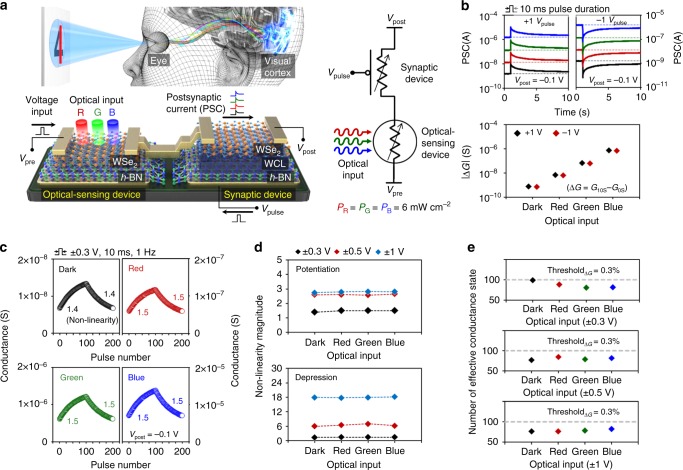
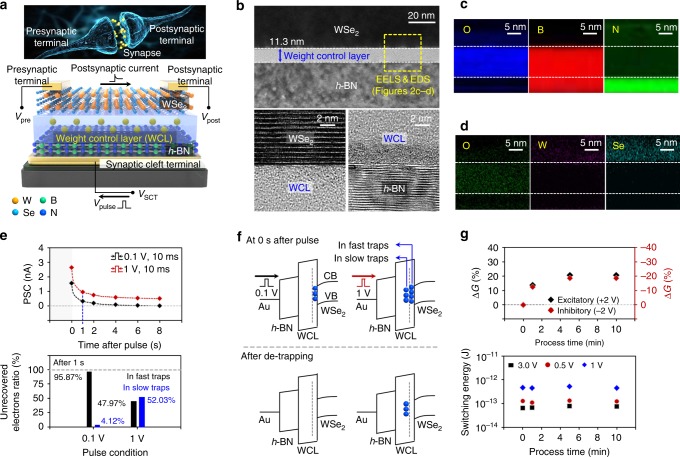
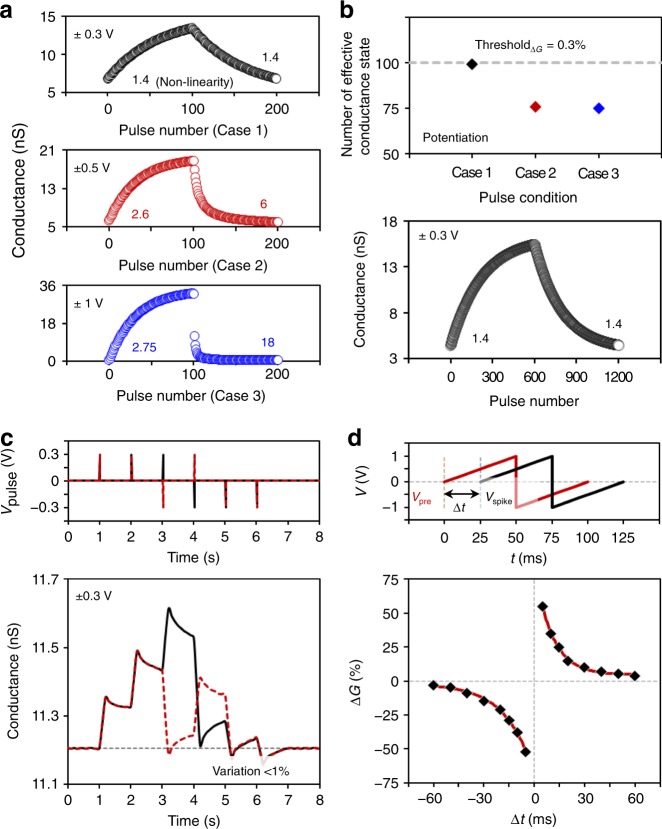
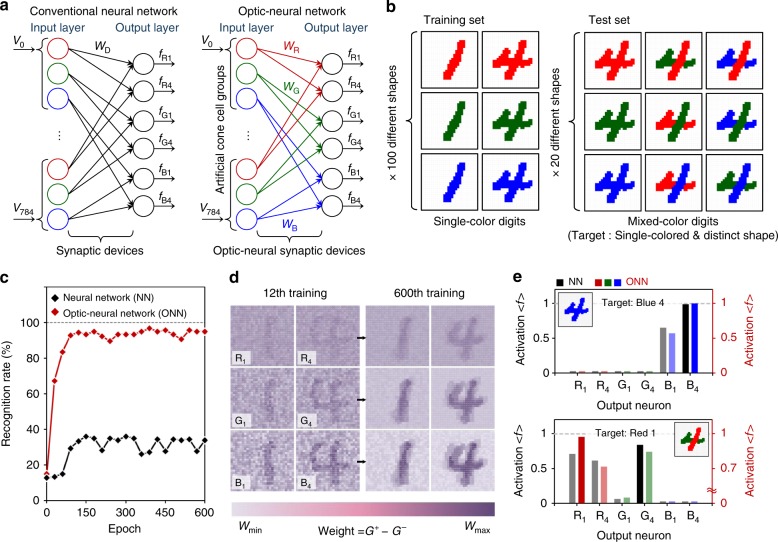
The priority of synaptic device researches has been given to prove the device potential for the emulation of synaptic dynamics and not to functionalize further synaptic devices for more complex learning. Here, we demonstrate an optic-neural synaptic device by implementing synaptic and optical-sensing functions together on h-BN/WSe 2 heterostructure. This device mimics the colored and color-mixed pattern recognition capabilities of the human vision system when arranged in an optic-neural network. Our synaptic device demonstrates a close to linear weight update trajectory while providing a large number of stable conduction states with less than 1% variation per state. The device operates with low voltage spikes of 0.3 V and consumes only 66 fJ per spike. This consequently facilitates the demonstration of accurate and energy efficient colored and color-mixed pattern recognition. The work will be an important step toward neural networks that comprise neural sensing and training functions for more complex pattern recognition.
Overview
The claims and statistics of this paper haven’t been checked yet.
Free: it reads the open-access text and checks the first 5 claims that cite a source we can check. Create a free account to check every claim.
Integrity signals
Registry
Cites
Statistics
Figures
Verification
Claims the paper makes
The claims and statistics of this paper haven’t been checked yet.
Free: it reads the open-access text and checks the first 5 claims that cite a source we can check. Create a free account to check every claim.
Claims other papers make about this one
Each is checked against this paper’s own text: does it say what the citing paper says it does?
The source backs part of the claim, not all of it — or backs it for a different population, condition or comparison.
In the citing paper
“some articles focused on the fabrication and device-level characterization of one/few memristors62–70,186,187, also present some of the figures-of-merit generated by a software-based training ANN process (similar to the ones in Fig. 14) in order to claim that their devices exhibit potential for neuromorphic applications.”
From Hardware implementation of memristor-based artificial neural networks (2024) · cites this paper as [67]
Experimental — accuracy not yet measuredThe cited source says what the claim attributes to it.
In the citing paper
“However, most of those studies in fact only measured the figures-of-merit of one/few devices and simulated the accuracy of an ANN via software62–67 in such type of studies the connection between the memristors fabricated and the ANN is relatively weak.”
From Hardware implementation of memristor-based artificial neural networks (2024) · cites this paper as [67]
Self-check
Percentages, sums and reported differences re-computed from the paper’s own numbers.
The self-check needs the paper’s full text.
Citations
Cites
Gradient-based learning applied to document recognition
Lecun, Y., Bottou, L., Bengio, Y., & Haffner, P. (1998) · Proceedings of the IEEE · doi:10.1109/5.726791 · Cited by 58,805
Parallel Distributed Processing: Explorations in the Microstructure of Cognition: Foundations
Rumelhart, D. E., McClelland, J. L., & AU (1986) · doi:10.7551/mitpress/5236.001.0001 · Cited by 15,686
Mastering the game of Go with deep neural networks and tree search
Silver, D., Huang, A., Maddison, C. J., Guez, A., Sifre, L., van den Driessche, G., Schrittwieser, J., Antonoglou, I., Panneershelvam, V., Lanctot, M., et al. (2016) · Nature · doi:10.1038/nature16961 · Cited by 15,612
Van der Waals heterostructures
Geim, A. K., & Grigorieva, I. V. (2013) · Nature · doi:10.1038/nature12385 · Cited by 10,875
Introduction to the theory of neural computation
(1994) · Neural Networks · doi:10.1016/0893-6080(94)90014-0 · Cited by 6,401
International Conference on Learning Representations (ICLR 2013)
松尾, 豊. (2013) · 人工知能学会誌 = Journal of Japanese Society for Artificial Intelligence · Cited by 6,286
Bi, G.-Q., & Poo, M.-M. (1998) · The Journal of Neuroscience · doi:10.1523/jneurosci.18-24-10464.1998 · Cited by 4,744
Han, S., Mao, H., & Dally, W. J. (2015) · arXiv · doi:10.48550/arxiv.1510.00149 · Cited by 4,662 · cited 1×
“Additionally, to con fi rm if this synaptic device can achieve the number of conductance states that were typically demanded for inference of DNNs (6 − 8 bits = 64 − 256 states) 32,33 , we applied excitatory and inhibitory pulses 600 times each (see Fig.”
MethodMemristive devices for computing
Yang, J. J., Strukov, D. B., & Stewart, D. R. (2013) · Nature Nanotechnology · doi:10.1038/nnano.2012.240 · Cited by 3,885
Training and operation of an integrated neuromorphic network based on metal-oxide memristors
Prezioso, M., Merrikh-Bayat, F., Hoskins, B. D., Adam, G. C., Likharev, K. K., & Strukov, D. B. (2015) · Nature · doi:10.1038/nature14441 · Cited by 3,001
Cited by
Items 301–400 of 766
Organic Optoelectronic Synaptic Devices for Energy-Efficient Neuromorphic Computing
Li, Q., Wang, T., Hu, X., Wu, X., Zhu, H., Li, J., Sun, Q., Zhang, D. W., & Chen, L. (2022) · IEEE Electron Device Letters · doi:10.1109/led.2022.3180346 · Cited by 44
Zhong, W., Tang, X., Liu, Q., & Jiang, Y. (2022) · Materials & Design · doi:10.1016/j.matdes.2022.111046 · Cited by 44
Neuromorphic devices assisted by machine learning algorithms
Huo, Z., Sun, Q., Yu, J., Wei, Y., Wang, Y., Cho, J. H., & Wang, Z. L. (2025) · International Journal of Extreme Manufacturing · doi:10.1088/2631-7990/adba1e · Cited by 43
“Seo et al. have presented an artificial optical nerve by conjugating synaptic and optical sensing functions based on h-BN/WSe 2 heterogeneous structure [171] .”
Defect Engineering in Ambipolar Layered Materials for Mode‐Regulable Nociceptor
Li, M., Yang, F., Hsu, H.-C., Chen, W., Kuo, C.-N., Chen, J., Yang, S., Yang, T., Lin, C., Chou, Y., et al. (2020) · Advanced Functional Materials · doi:10.1002/adfm.202007587 · Cited by 42
A minireview on 2D materials-enabled optoelectronic artificial synaptic devices
Yoo, C., Ko, T., Kaium, M. G., Martínez, R., Islam, M. M., Li, H., Kim, J. H., Cao, J., Acharya, M., Roy, T., et al. (2022) · APL Materials · doi:10.1063/5.0096053 · Cited by 42
Self-citationNeuromorphic Skin Based on Emerging Artificial Synapses
Lee, Y., Oh, J. Y., & Lee, T. (2022) · Advanced Materials Technologies · doi:10.1002/admt.202200193 · Cited by 42
Recent advances in imaging devices: image sensors and neuromorphic vision sensors
Wu, W., Wang, C., Han, S., & Pan, C. (2024) · Rare Metals · doi:10.1007/s12598-024-02811-9 · Cited by 44
Two-dimensional material-based devices for in-sensor computing
Chen, J., Wang, W., & Yan, X. (2025) · npj Unconventional Computing · doi:10.1038/s44335-025-00034-4 · Cited by 43
“The 2D h-BN/WSe 2 heterostructure offers enhanced properties for optical synapses 41 .”
Wang, S., Chen, X., Huang, X., Zhang, D. W., & Zhou, P. (2020) · Advanced Intelligent Systems · doi:10.1002/aisy.202000124 · Cited by 44
CMOS back-end compatible memristors for in situ digital and neuromorphic computing applications
He, Z., Wang, T., Meng, J.-L., Zhu, H., Li, J., Sun, Q., Chen, L., & Zhang, D. W. (2021) · Materials Horizons · doi:10.1039/d1mh01257f · Cited by 42
Carbon Nanotube-Based Flexible Ferroelectric Synaptic Transistors for Neuromorphic Computing
Xia, F., Xia, T., Li, X., Ding, S., Li, S., Yin, Y., Xi, M., Jin, C., Liang, X., & Hu, Y. (2022) · ACS Applied Materials & Interfaces · doi:10.1021/acsami.2c07825 · Cited by 40
Zhou, X., Hu, F., Hou, Q., Hu, J., Wang, Y., & Chen, X. (2024) · Communications Materials · doi:10.1038/s43246-024-00553-w · Cited by 43
“Conventional arti fi cial visual systems rely on von Neumann architecture, which is struggling with generating huge computational transfer burdens due to the separation of data storage and processing 2,3 .”
Wang, X., Zhang, Z., Wang, J.-J., Chen, X., Yao, B., Hou, Y., Yu, M., Li, Y., & Lu, T. (2020) · ACS Applied Materials & Interfaces · doi:10.1021/acsami.0c05327 · Cited by 40
Yang, J., Jung, Y., Lee, J.-H., Kim, Y. C., Kim, S., Seo, S., Park, D.-A., Kim, J., Jeong, S.-Y., Han, I., et al. (2021) · Nanoscale Horizons · doi:10.1039/d1nh00452b · Cited by 41
Self-citationQian, C., Choi, Y., Kim, S., Kim, S., Choi, Y. J., Roe, D. G., Lee, J. H., Kang, M. S., Lee, W. H., & Cho, J. H. (2022) · Advanced Functional Materials · doi:10.1002/adfm.202112490 · Cited by 41
Self-citationLi, X., Li, S., Tang, B. H., Liao, J., & Chen, Q. (2022) · Advanced Electronic Materials · doi:10.1002/aelm.202200343 · Cited by 42
Overview of Memristor-Based Neural Network Design and Applications
Ye, L., Gao, Z., Fu, J., Ren, W., Yang, C., Wen, J., Wan, X., Ren, Q., Gu, S., Liu, X., et al. (2022) · Frontiers in Physics · doi:10.3389/fphy.2022.839243 · Cited by 44
“(B) Synaptic values change versus the increase of the training number [138].”
BackgroundMethodA biomimetic ocular prosthesis system: emulating autonomic pupil and corneal reflections
Kim, S., Choi, Y. Y., Kim, T., Kim, Y. M., Ho, D. H., Choi, Y. J., Roe, D. G., Lee, J.-H., Park, J., Choi, J., et al. (2022) · Nature Communications · doi:10.1038/s41467-022-34448-6 · Cited by 38
Self-citationRoles of Low‐Dimensional Nanomaterials in Pursuing Human–Machine–Thing Natural Interaction
Zhao, X., Xuan, J., Li, Q., Gao, F., Xun, X., Liao, Q., & Zhang, Y. (2023) · Advanced Materials · doi:10.1002/adma.202207437 · Cited by 40
Ghafoor, F., Ismail, M., Kim, H., Ali, M., Rehman, S., Ghafoor, B., Khan, M. A., Patil, H., Kim, S., Khan, M. F., et al. (2024) · Nano Energy · doi:10.1016/j.nanoen.2024.109272 · Cited by 38
Self-citationYao, Y.-C., Lee, C., Chen, Y., Feng, J., Oh, H., Lue, C. S., Sheu, J., & Lee, Y. (2024) · Advanced Science · doi:10.1002/advs.202409933 · Cited by 37
Metal oxide-based resistive switching memristors for neuromorphic computing
Tian, Q., Shan, X., Bian, J., Cheng, Y., Zheng, J., Wang, Z., Zhao, X., Xu, H., & Liu, Y. (2025) · Journal of Materials Chemistry C · doi:10.1039/d5tc01467k · Cited by 40
A Photoelectric-Stimulated MoS 2 Transistor for Neuromorphic Engineering
Wang, S., Hou, X., Liu, L., Li, J., Shan, Y., Wu, S., Zhang, D. W., & Zhou, P. (2019) · Research · doi:10.34133/2019/1618798 · Cited by 39
Xu, L., Wang, W., Li, Y., Lin, Y.-H., Yue, W., Qian, K., Guo, Q., Kim, J., & Shen, G. (2023) · Nano Research · doi:10.1007/s12274-023-6004-4 · Cited by 37
Self-citationWang, J., Ren, Y., Yang, Z., Lv, Q., Zhang, Y., Zhang, M., Zhao, T., Gu, D., Liu, F., Tang, B., et al. (2024) · Advanced Science · doi:10.1002/advs.202309538 · Cited by 39
Kim, S., Kwon, O., Kim, S., Jang, S., Yu, S., Lee, C. H., Choi, Y. Y., Cho, S., Kim, K. C., Yu, C., et al. (2025) · Nature Communications · doi:10.1038/s41467-024-55173-2 · Cited by 37
Self-citationLarge-scale high uniform optoelectronic synapses array for artificial visual neural network
Zhang, F., Li, C., Chen, Z., Tan, H., Li, Z., Lv, C., Xiao, S., Wu, L., & Zhao, J. (2025) · Microsystems & Nanoengineering · doi:10.1038/s41378-024-00859-2 · Cited by 41
Xu, X., & Yan, B. (2022) · Journal of Materials Chemistry A · doi:10.1039/d2ta03154j · Cited by 36
Design of Motor Skill Recognition and Hierarchical Evaluation System for Table Tennis Players
Shi, Z., Jia, Y., Shi, G., Zhang, K., Ji, L., Wang, D., & Wu, Y. (2024) · IEEE Sensors Journal · doi:10.1109/jsen.2023.3346880 · Cited by 38
Humidity/Oxygen‐Insensitive Organic Synaptic Transistors Based on Optical Radical Effect
Liu, D., Zhang, J., Shi, Q., Sun, T., Xu, Y., Li, L., Li, T., Xiong, L., Zhang, J., & Huang, J. D. (2023) · Advanced Materials · doi:10.1002/adma.202305370 · Cited by 35
Yoon, J., You, B., Kim, Y., Bak, J., Yang, M., Park, J., Hahm, M. G., & Lee, M. (2023) · ACS Applied Materials & Interfaces · doi:10.1021/acsami.3c00254 · Cited by 34
Self-citationGong, Y., Xing, X., Wang, X., Duan, R., Han, S., & Tay, B. K. (2024) · Advanced Functional Materials · doi:10.1002/adfm.202406547 · Cited by 34
Improvement in conductance modulation linearity of artificial synapses based on NaNbO3 memristor
Woo, J., Hwang, H.-G., Park, S.-M., Lee, T., & Nahm, S. (2020) · Applied Materials Today · doi:10.1016/j.apmt.2020.100582 · Cited by 35
Lee, M., Nam, S.-H., Cho, B., Kwon, O., Lee, H. U., Hahm, M. G., Kim, U. J., & Son, H. (2021) · Nano Letters · doi:10.1021/acs.nanolett.1c01885 · Cited by 34
Yan, Y., Yu, N., Yu, Z., Su, Y., Chen, J., Xiang, T., Han, Y., & Wang, J. (2023) · Small Methods · doi:10.1002/smtd.202201679 · Cited by 33
Zhang, S., Zhu, J., Qiu, R., Liu, D., Ren, Q., & Zhang, M. (2025) · Advanced Materials · doi:10.1002/adma.202418418 · Cited by 35
Advances in materials and devices for mimicking sensory adaptation
He, Z., Ye, D., Liu, L., Di, C., & Zhu, D. (2022) · Materials Horizons · doi:10.1039/d1mh01111a · Cited by 36
Yang, J., Lee, J., Jung, Y., Kim, S., Kim, J. H., Kim, S., Kim, J., Seo, S., Park, D.-A., Lee, J., et al. (2022) · Advanced Science · doi:10.1002/advs.202200168 · Cited by 33
Self-citationInorganic electrochromic transistors as environmentally adaptable photodetectors
Ng, S. E., Tay, Y. B., Ho, T. Y. K., Ankit, A., & Mathews, N. (2022) · Nano Energy · doi:10.1016/j.nanoen.2022.107142 · Cited by 34
Han, J., Shan, X., Lin, Y., Tao, Y., Zhao, X., Wang, Z., Xu, H., & Liu, Y. (2023) · Small · doi:10.1002/smll.202207928 · Cited by 33
Sui, N., Ji, Y., Li, M., Zheng, F., Shao, S., Li, J., Liu, Z., Wu, J., Zhao, J., & Li, L. (2024) · Advanced Science · doi:10.1002/advs.202401794 · Cited by 32
Lee, C. W., Yoo, C., Han, S. S., Song, Y., Kim, S. J., Kim, J. H., & Jung, Y. (2024) · ACS Nano · doi:10.1021/acsnano.4c04851 · Cited by 34
Self-citationDong, X., Chen, C., Li, Y., Sun, H., Liu, B., Li, Z., Wang, K.-L., He, Z., Yu, M., Huang, W. H., et al. (2025) · ACS Nano · doi:10.1021/acsnano.4c16251 · Cited by 32
All‐Optically Modulated In‐Sensor Computing Device Based on Ionic‐Conducting CuInP 2 Se 6
Yang, Q., Zhuang, Y., Zhong, Z., Cheng, X., Li, X., Meng, X., Shi, W., Huang, H., Wang, J., & Chu, J. (2025) · Advanced Materials · doi:10.1002/adma.202502254 · Cited by 36
All-in-one neuromorphic hardware with 2D material technology: current status and future perspective
Zhang, G., Luo, Q., Yao, J., Zhong, S., Wang, H., Xue, F., Yu, B., Loh, K. P., & Zhang, Y. (2025) · Chemical Society Reviews · doi:10.1039/d5cs00251f · Cited by 35
Graphene–oxide interface for optoelectronic synapse application
Martinez-Martinez, R., Islam, M. M., Krishnaprasad, A., & Roy, T. (2022) · Scientific Reports · doi:10.1038/s41598-022-09873-8 · Cited by 32
A light-emitting electrochemical artificial synapse with dual output of photoelectric signals
Zeng, H., Chen, Q., Shan, L., Yan, Y., Gao, C., Lu, W., Chen, H., & Guo, T. (2022) · Science China Materials · doi:10.1007/s40843-021-2029-y · Cited by 33
Neurorobotic approaches to emulate human motor control with the integration of artificial synapse
Kim, S., Kim, S., Ho, D. H., Roe, D. G., Choi, Y. J., Kim, M. J., Kim, U. J., Le, M. L., Kim, J., Kim, S. H., et al. (2022) · Science Advances · doi:10.1126/sciadv.abo3326 · Cited by 34
Self-citationLiu, M., Cao, Z., Wang, X., Mao, S., Qin, J., Yang, Y., Rao, Z., Zhao, Y. X., & Sun, B. T. (2023) · Journal of Materials Chemistry C · doi:10.1039/d3tc02309e · Cited by 32
2D MoS2-based reconfigurable analog hardware
Huang, X., Tong, L., Xu, L., Shi, W., Peng, Z., Li, Z., Yu, X., Li, W., Wang, Y., Zhang, X., et al. (2025) · Nature Communications · doi:10.1038/s41467-024-55395-4 · Cited by 31
Modern 2D Heterostructures: From Fabrication Challenges to Emerging Applications
Nawaz, M. Z., Ahmad, W., Hasan, I. M. U., Gulzar, H., Hasan, W. U., Younis, U., FAROOQ, M. A., Saleem, M. S., Li, M., & Chu, P. K.-H. (2026) · Small Methods · doi:10.1002/smtd.202502365 · Cited by 33
Nonvolatile reconfigurable broadband photodiodes based on BP/α-In2Se3 ferroelectric p–n junctions
Zhu, C., Wang, Y., Wang, F., Yang, J., Zhan, X., Fang, L., Wang, Z., & He, J. (2022) · Applied Physics Letters · doi:10.1063/5.0079535 · Cited by 31
Yang, N., Zhang, J., Huang, J., Liu, Y., Shi, J., Si, Q., Yang, J., & Li, S. (2022) · ACS Applied Electronic Materials · doi:10.1021/acsaelm.2c00663 · Cited by 31
Atomically Thin Synaptic Devices for Optoelectronic Neuromorphic Vision
Ahmed, T., Jannat, A., Krishnamurthi, V., Aung, T., Mazumder, A., Zavabeti, A., Syed, N., Daeneke, T., Ou, J. Z., Al‐Hourani, A., et al. (2023) · Advanced Materials Technologies · doi:10.1002/admt.202201772 · Cited by 32
The rise of metal halide perovskite memristors for edge computing
Duan, T., Zha, J., Lin, N., Wang, Z., Tan, C., & Zhou, Y. (2023) · Device · doi:10.1016/j.device.2023.100221 · Cited by 31
Low-dimensional optoelectronic synaptic devices for neuromorphic vision sensors
Lv, C., Zhang, F., Li, C., Li, Z., & Zhao, J. (2023) · Materials Futures · doi:10.1088/2752-5724/acda4d · Cited by 31
“Seo et al demonstrated an optoelectronic synaptic device with h-BN/WSe 2 van der Waals heterostructure that had both synaptic and optical sensing functions [44].”
MethodBioinspired and biointegrated vision for artificial sight convergence
Yang, Y., Wang, Y., Zhu, C., Xie, Z., Qin, Z., Wang, Z., & Chai, Y. (2025) · Nature Reviews Bioengineering · doi:10.1038/s44222-025-00324-3 · Cited by 30
Organic electrochemical transistors toward synaptic electronics
Zhou, B., Liu, W., Xu, Y., Jin, C., Yang, J., & Sun, J. (2022) · Journal of Physics D Applied Physics · doi:10.1088/1361-6463/ac67b9 · Cited by 34
“As OECT is extremely similar to the biological synapse in terms of performance and working principle [26], it has broad application prospects in many fields as shown in figure 1, such as intelligent sensors [27–30], biomedical field [31], and flexible and wearable electronic devices [32].”
Intelligent Optoelectronic Devices for Next‐Generation Artificial Machine Vision
Chen, W., & Liu, G. (2022) · Advanced Electronic Materials · doi:10.1002/aelm.202200668 · Cited by 31
Parallelizing analog in-sensor visual processing with arrays of gate-tunable silicon photodetectors
Xiong, Z., Liang, W., Zhang, M., Mao, D., Xia, Q., & Xu, G. (2025) · Nature Communications · doi:10.1038/s41467-025-60006-x · Cited by 29
“Therefore, from Fig.2 and Fig.3 of this work, as a reader I expected very much that the authors was going to show large-scale array of in-sensor event-detecting.”
Trung, T. Q., Bag, A., Huyen, L. T. N., Meeseepong, M., & Lee, N. (2023) · Advanced Functional Materials · doi:10.1002/adfm.202309378 · Cited by 31
Chang, K., Liu, H., Duan, X., Peng, Z., Lin, X., & Li, L. (2024) · Nano Energy · doi:10.1016/j.nanoen.2024.109564 · Cited by 28
Xie, J., Shan, X., Zou, N., Lin, Y., Wang, Z., Tao, Y., Zhao, X., Xu, H., & Liu, Y. (2024) · Research · doi:10.34133/research.0580 · Cited by 28
Deng, W., Lv, Y., Ruan, X., Zhang, X., Jia, R., Yu, Y., Liu, Z., Wu, D., Zhang, X., & Jie, J. (2022) · Laser & Photonics Review · doi:10.1002/lpor.202200283 · Cited by 28
Synapse-Mimetic Hardware-Implemented Resistive Random-Access Memory for Artificial Neural Network
Seok, H., Son, S., Jathar, S. B., Lee, J., & Kim, T. (2023) · Sensors · doi:10.3390/s23063118 · Cited by 31
“(WSe2/weight control layer (WCL)/h-BN) and optical (WSe2/h-BN) sensing functions capable of both colored and color-mixed pattern recognition [129].”
BackgroundKhan, R., Rahman, N. U., Hayat, M. F., Ghernaout, D., Salih, A. A. M., Ashraf, G. A., Samad, A., Mahmood, M. A., Rahman, N., Sohail, M., et al. (2024) · Nanoscale · doi:10.1039/d4nr00904e · Cited by 29
Liu, L., Gao, P., Zhang, M., Dou, J., Liu, C., Shi, T., Huang, H., Wang, C., He, H., Chen, Z., et al. (2024) · Advanced Science · doi:10.1002/advs.202408210 · Cited by 29
Melrose, J. (2019) · Neural Regeneration Research · doi:10.4103/1673-5374.251298 · Cited by 28
“GAG emulsions are receiving increasing levels of attention in the development of artificial neural networks and in biomedical applications (Abiodun et al., 2018; Aregueta-Robles et al., 2018; Guha Roy et al., 2018; Seo et al., 2018).”
BackgroundShim, J., Jang, S. W., Lim, J.-H., Kim, H., Kang, D., Kim, K.-H., Seo, S., Heo, K., Shin, C., Yu, H., et al. (2019) · Nanoscale · doi:10.1039/c9nr03441b · Cited by 27
Self-citationZhang, S., Guo, K., Han, H., Yu, H., Wei, H., Gong, J., & Xu, W. (2021) · Advanced Functional Materials · doi:10.1002/adfm.202101917 · Cited by 27
Bio-Inspired Electronic Eyes and Synaptic Photodetectors for Mobile Artificial Vision
Choi, C., Seung, H., & Kim, D. (2022) · IEEE Journal on Flexible Electronics · doi:10.1109/jflex.2022.3162169 · Cited by 28
Self-citationRogdakis, K., Loizos, M., Viskadouros, G., & Kymakis, E. (2022) · Materials Advances · doi:10.1039/d2ma00402j · Cited by 27
Intrinsically flexible organic phototransistors for bioinspired neuromorphic sensory system
Wang, C., Liu, Y., & Guo, Y. (2024) · Wearable electronics. · doi:10.1016/j.wees.2024.05.001 · Cited by 27
Design and applications of graphene-based flexible and wearable physical sensing devices
Li, X., & Chai, Y. (2020) · 2D Materials · doi:10.1088/2053-1583/abcbe6 · Cited by 29
“4 035022 [43] Seo S et al 2018 Artificial optic-neural synapse for colored and color-mixed pattern recognition Nat.”
BackgroundZhao, H., Zhang, Y., Mi, Q. S., You, J., Zhang, N., Zhong, Z., Jiang, Z., Guo, H. Y., Hu, H., Wang, L., et al. (2024) · ACS Nano · doi:10.1021/acsnano.4c10619 · Cited by 26
Zhou, J., Chen, A., Zhang, Y., Zhang, X., Chai, J., Hu, J., Li, H., Xu, Y., Liu, X., Tan, N., et al. (2024) · Nano Letters · doi:10.1021/acs.nanolett.4c05071 · Cited by 26
Oh, S., Jung, S., Ali, M. H., Kim, J.-H., Kim, H., & Park, J. (2020) · ACS Applied Materials & Interfaces · doi:10.1021/acsami.0c07394 · Cited by 26
Self-citationDeng, W., Yan, X., Wang, L., Yu, N., Luo, W., & Mai, L. (2024) · Nano Energy · doi:10.1016/j.nanoen.2024.109861 · Cited by 27
Constructing van der Waals heterostructures by dry-transfer assembly for novel optoelectronic device
Li, H., Xiong, X., Hui, F., Yang, D., Jiang, J., Feng, W., Han, J., Duan, J., Wang, Z., & Sun, L. (2022) · Nanotechnology · doi:10.1088/1361-6528/ac5f96 · Cited by 25
“Therefore, the key to simulate the learning and memory functions of the brain is to develop electronic synapses [ 141 – 145 ] .”
Min, J., Kim, J. H., & Kang, J. (2024) · ACS Applied Nano Materials · doi:10.1021/acsanm.3c06263 · Cited by 25
Self-citationShen, W., Wang, P., Wei, G., Yuan, S., Chen, M., Su, Y., Xu, B., & Li, G. (2024) · Small · doi:10.1002/smll.202400458 · Cited by 26
An Active‐Matrix Synaptic Phototransistor Array for In‐Sensor Spectral Processing
Li, D., Chen, Y., Ren, H., Tang, Y., Zhang, S., Wang, Y., Xing, L., Huang, Q., Meng, L., & Zhu, B. (2024) · Advanced Science · doi:10.1002/advs.202406401 · Cited by 30
Kim, S., Jin, D., Kim, J., Baek, D., Kim, H.-J., & Yu, H. (2025) · ACS Nano · doi:10.1021/acsnano.4c10732 · Cited by 24
Self-citationMulti-Stimuli-Responsive Synapse Based on Vertical van der Waals Heterostructures
Zhou, J., Li, H., Tian, M., Chen, A., Chen, L., Pu, D., Hu, J., Cao, J., Li, L., Xu, X., et al. (2022) · ACS Applied Materials & Interfaces · doi:10.1021/acsami.2c08335 · Cited by 24
Brain-inspired nanophotonic spike computing: challenges and prospects
Romeira, B., Adão, R. M. R., Nieder, J. B., Al-Taai, Q. R. A., Zhang, W., Hadfield, R. H., Wasige, E., Hejda, M., Hurtado, A., Malysheva, E., et al. (2023) · Neuromorphic Computing and Engineering · doi:10.1088/2634-4386/acdf17 · Cited by 28
“, (m) 2D material-based optical sensing device (Reproduced from [22].”
Zhang, H., Ju, X., Chi, D., Feng, L., Liu, Z., Yew, K. S., Zhu, M., Li, T., Wei, R., Wang, S. H., et al. (2023) · Applied Materials Today · doi:10.1016/j.apmt.2023.101885 · Cited by 24
Multifunctional Two-Terminal Optoelectronic Synapse Based on an Organic Semiconductor Film
Zhao, P., Peng, X., Cui, M., Li, Y., Jiang, C., Luo, C., Tian, B., Lin, H., Peng, H., & Duan, C. (2023) · ACS Applied Polymer Materials · doi:10.1021/acsapm.3c02012 · Cited by 24
Silicon-based optoelectronic synaptic devices*
Yin, L., Pi, X., & Yang, D. (2020) · Chinese Physics B · doi:10.1088/1674-1056/ab973f · Cited by 24
Sun, Y., Hu, R., An, C., Ma, X., Zhang, J., & Liu, J. (2021) · Nanotechnology · doi:10.1088/1361-6528/ac1c26 · Cited by 24
Emerging 2D materials hardware for in-sensor computing
Shi, Y., Duong, N. T., & Ang, K. (2025) · Nanoscale Horizons · doi:10.1039/d4nh00405a · Cited by 26
Serghiou, T., Fernandes, J. D., Karthikeyan, V., Assi, D. S., Vieira, D. H., Alves, N., & Kettle, J. (2025) · Advanced Functional Materials · doi:10.1002/adfm.202417355 · Cited by 25
Lee, C. W., Kim, S. J., Shin, H.-K., Cho, Y.-J., Yoo, C., Han, S. S., Lee, H., Kim, J. H., & Jung, Y. (2025) · Nano Today · doi:10.1016/j.nantod.2025.102633 · Cited by 26
Self-citationOrganic Phototransistor Photonic Synapses for Artificial Vision
Ding, F., Xue, D., Chi, L., & Huang, L. (2026) · Nano-Micro Letters · doi:10.1007/s40820-025-02036-0 · Cited by 24
“For example, light-adaptive devices and neuromorphic phototransistors either employ complex multilayered designs or integrate detectors and processors, increasing manufacturing costs and complexity [134, 212, 213].”
Xu, L., Xiong, H., Fu, Z., Deng, M., Wang, S., Zhang, J., Shang, L., Jiang, K., Li, Y., Zhu, L., et al. (2021) · Physical Review Applied · doi:10.1103/physrevapplied.16.044049 · Cited by 23
Ga 2 O 3 Bipolar Heterojunction-Based Optoelectronic Synapse Array with Visual Attention
Xu, K., Peng, B., Mao, H., Wang, Z., Gong, H., Fu, C., Ren, F., Yang, Y. T., Wan, C., Wan, Q., et al. (2024) · The Journal of Physical Chemistry Letters · doi:10.1021/acs.jpclett.3c02898 · Cited by 23
Lateral heterostructures of WS2 and MoS2 monolayers for photo-synaptic transistor
Park, J., Kim, J. O., & Kang, S. (2024) · Scientific Reports · doi:10.1038/s41598-024-57642-6 · Cited by 24
Self-citationZhang, J., Li, X., Xiao, P., Wei, Z., & Hong, Q. (2024) · IEEE Transactions on Circuits and Systems I Regular Papers · doi:10.1109/tcsi.2024.3391281 · Cited by 23
“Seo et al. [51] connected the h − BN / WSe 2 optical sensor in series with a three-terminal memristor and constructed 28 × 28 optic neural network.”
MethodResearch progress and applications of optoelectronic synaptic devices based on 2D materials
Zhao, Y., Lu, C., Xu, R., Yu, Z., & Zhang, J. (2024) · Brain‐X · doi:10.1002/brx2.70004 · Cited by 23
Physically Transient Optic-Neural Synapse for Secure In-Sensor Computing
Dang, B., Ma, L., Yan, L., Wang, S., Liu, K., Xu, L., Cheng, C., Zhao, M., Yang, Y., Wang, H., et al. (2020) · IEEE Electron Device Letters · doi:10.1109/led.2020.3025791 · Cited by 23
“The abovementioned optical synaptic device can mimic the colored and color-mixed pattern recognition capabilities of the human vision system when arranged in an optic-neural network [1].”
BackgroundEmerging multimodal memristors for biorealistic neuromorphic applications
Shan, X., Lin, Y., Wang, Z., Zhao, X., Tao, Y., Xu, H., & Liu, Y. (2023) · Materials Futures · doi:10.1088/2752-5724/ad119e · Cited by 22
“For instance, Seo et al developed an optic-neural synaptic (ONS) device based on h-BN/WSe 2 heterojunction, as demonstrated in figure 2(a) [42].”
BackgroundMethodResult
Metadata
- Authors
- Seo, S., Jo, S.-H., Kim, S., Shim, J., Oh, S., Kim, J.-H., Heo, K., Choi, J.-W., Choi, C., Oh, S., Kuzum, D., Wong, H.-S. P., & Park, J.-H.
- Affiliations
- Sungkyunkwan University (KR)
- Hanyang University (KR)
- University of California San Diego (US)
- Stanford University (US)
- Corresponding author
- Park, Jin-Hong
- ORCID
- Venue
- Nature Communications
- Published
- 2018-11-30
- Volume
- 9
- Issue
- 1
- Pages
- 5106-5106
- ISSN
- 2041-1723 (ISSN-L)
- PMC
- PMC6269540
- OpenAlex
- W2902437043
- Cited by
- 731
- References
- 40
- Citations by year
- 2026: 56 · 2025: 115 · 2024: 127 · 2023: 121 · 2022: 132 · 2021: 83 · 2020: 70 · 2019: 26
- FWCI
- 17.12
- Type
- journal article
- Language
- en
- Open access
- gold
- doi.org
- Licence
- cc-by
- creativecommons.org/licenses/by/4.0 (tdm)
- creativecommons.org/licenses/by/4.0 (vor)
- Locations
- Nature Communications (publishedVersion, cc-by)
- Europe PMC (PubMed Central) (publishedVersion, other-oa)
- PubMed Central (publishedVersion, cc-by)
- PubMed (publishedVersion)
- RePEc: Research Papers in Economics (submittedVersion)
- DOAJ (DOAJ: Directory of Open Access Journals) (submittedVersion)
- DOAJ (DOAJ: Directory of Open Access Journals) (submittedVersion, cc-by-sa)
- Funders
- National Research Foundation (2017R1A4A1015400, 2016M3A7B4910426)
- National Research Foundation of Korea (2017R1A4A1015400, 2016M3A7B4910426, 2018R1A2A2A05020475)
- Topics
- Physical Sciences › Engineering › Electrical and Electronic Engineering › Advanced Memory and Neural Computing
- Physical Sciences › Materials Science › Materials Chemistry › 2D Materials and Applications
- Physical Sciences › Computer Science › Artificial Intelligence › Neural Networks and Reservoir Computing
- Keywords
- artificial synapses, color pattern recognition, neuromorphic computing, synaptic weight update, optical sensing, energy-efficient neural networks, low-voltage operation
- MeSH terms
- Algorithms, Humans, Models, Neurological, Neurons, Pattern Recognition, Automated, Synapses
About these checks
Registry, retraction, Cites and statistics results are computed, not judged, with one exception: a printed reference that no index lists is read once by a model before it counts as a citation error. Claims are extracted by a model and kept only when their quote appears verbatim in the text; each cited source is then checked, with a model’s help, for whether it says what the claim relies on. Those verdicts can be wrong — read the claim’s quote and the cited source before relying on one.
Statistics and arithmetic are recomputed, not judged.
Confidence bands are shown only for fields calibrated on our annotated test set. None is calibrated yet, so no band is shown.
What counts as a claim ›How we measure confidence ›How we check this ›
Are you an author, or do you see a problem with this page? Request a review
Data sources
Bibliographic data: Semantic Scholar, OpenAlex, Crossref.
Contains information from the Semantic Scholar Academic Graph Datasets, made available under the ODC Attribution License (ODC-BY 1.0).
Semantic Scholar’s data is described in: Kinney, R., et al. (2023). The Semantic Scholar Open Data Platform. arXiv:2301.10140.
