

Machine learning applied to enzyme turnover numbers reveals protein structural correlates and improves metabolic models
Open accessThe DOI matches its Crossref record; 75 of the 75 references it cites were found in a registry or an index.
Abstract
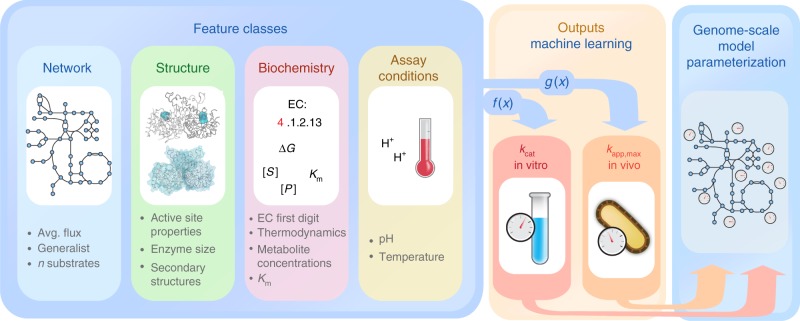
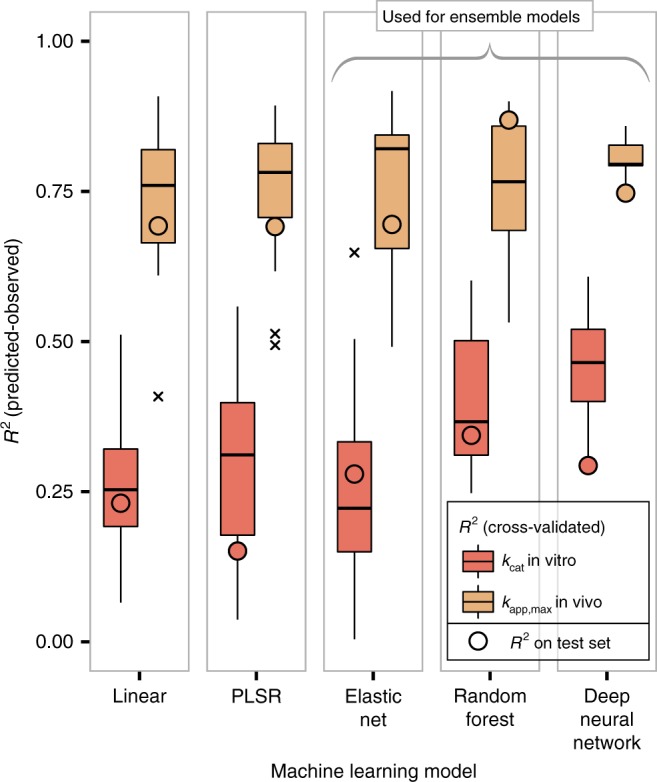
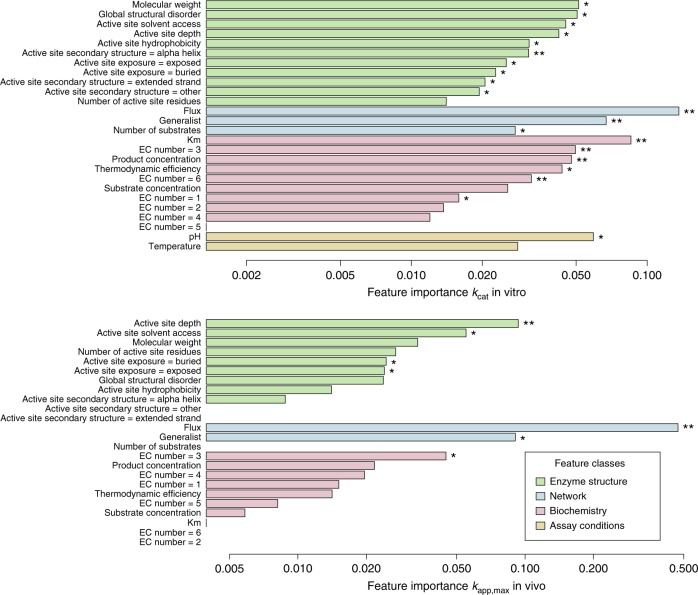
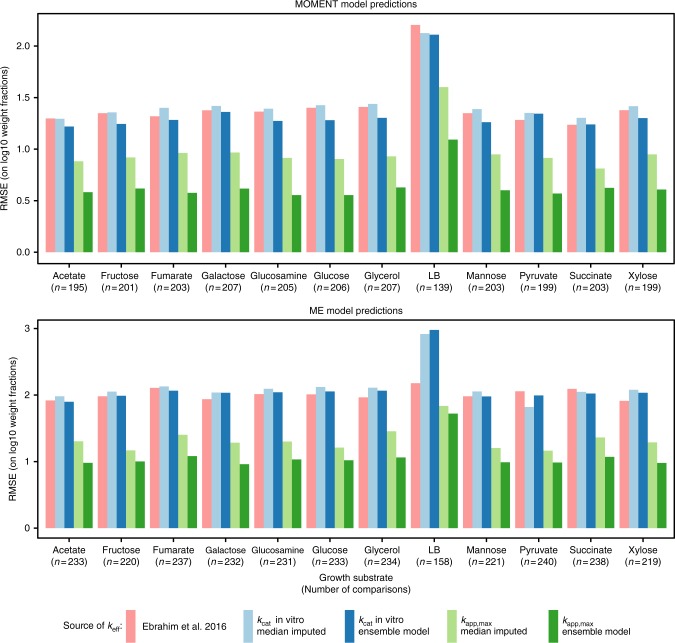
Knowing the catalytic turnover numbers of enzymes is essential for understanding the growth rate, proteome composition, and physiology of organisms, but experimental data on enzyme turnover numbers is sparse and noisy. Here, we demonstrate that machine learning can successfully predict catalytic turnover numbers in Escherichia coli based on integrated data on enzyme biochemistry, protein structure, and network context. We identify a diverse set of features that are consistently predictive for both in vivo and in vitro enzyme turnover rates, revealing novel protein structural correlates of catalytic turnover. We use our predictions to parameterize two mechanistic genome-scale modelling frameworks for proteome-limited metabolism, leading to significantly higher accuracy in the prediction of quantitative proteome data than previous approaches. The presented machine learning models thus provide a valuable tool for understanding metabolism and the proteome at the genome scale, and elucidate structural, biochemical, and network properties that underlie enzyme kinetics.
Overview
The claims and statistics of this paper haven’t been checked yet.
Free: it reads the open-access text and checks the first 5 claims that cite a source we can check. Create a free account to check every claim.
Integrity signals
Registry
Cites
Statistics
Figures
Verification
Claims the paper makes
The claims and statistics of this paper haven’t been checked yet.
Free: it reads the open-access text and checks the first 5 claims that cite a source we can check. Create a free account to check every claim.
Claims other papers make about this one
Each is checked against this paper’s own text: does it say what the citing paper says it does?
The source backs part of the claim, not all of it — or backs it for a different population, condition or comparison.
In the citing paper
“The model achieved a coefficient of determination R 2 ≈ 0.34 on a test set.”
From Turnover number predictions for kinetically uncharacterized enzymes using machine and deep learning (2023) · cites this paper as [14]
Experimental — accuracy not yet measuredThe source backs part of the claim, not all of it — or backs it for a different population, condition or comparison.
In the citing paper
“Its coefficient of determination ( R 2 = 0.44) is higher than that of Heckmann et al. ( R 2 ≈ 0.34) 14”
From Turnover number predictions for kinetically uncharacterized enzymes using machine and deep learning (2023) · cites this paper as [14]
Experimental — accuracy not yet measuredThe cited source says what the claim attributes to it.
In the citing paper
“Moreover, even for those well-studied organisms, the k cat coverage is far from complete 13,15,16 .”
From Deep learning-based kcat prediction enables improved enzyme-constrained model reconstruction (2022) · cites this paper as [16]
The cited source says what the claim attributes to it.
In the citing paper
“Previously, Heckmann and colleagues employed machine learning approaches to predict E. coli k cat values based on features such as average metabolic fluxes and catalytic sites obtained from protein structures 16 .”
From Deep learning-based kcat prediction enables improved enzyme-constrained model reconstruction (2022) · cites this paper as [16]
The cited source says what the claim attributes to it.
In the citing paper
“Our resulting Turnover Number Prediction model— TurNuP—outperforms a simple similarity-based approach and both previous methods for predicting k cat 14 , 16 .”
From Turnover number predictions for kinetically uncharacterized enzymes using machine and deep learning (2023) · cites this paper as [14]
5 more claims about this paper
Create a free account to see every claim other papers make about this one.
Self-check
Percentages, sums and reported differences re-computed from the paper’s own numbers.
The self-check needs the paper’s full text.
Citations
Cites
Berman, H. M. (2000) · Nucleic Acids Research · doi:10.1093/nar/28.1.235 · Cited by 40,196
KEGG: Kyoto Encyclopedia of Genes and Genomes
Kanehisa, M. (2000) · Nucleic Acids Research · doi:10.1093/nar/28.1.27 · Cited by 37,077
KEGG: Kyoto Encyclopedia of Genes and Genomes
Ogata, H., Goto, S., Sato, K., Fujibuchi, W., Bono, H., & Kanehisa, M. (1999) · Nucleic Acids Research · doi:10.1093/nar/27.1.29 · Cited by 31,232
A simple method for displaying the hydropathic character of a protein
Kyte, J., & Doolittle, R. F. (1982) · Journal of Molecular Biology · doi:10.1016/0022-2836(82)90515-0 · Cited by 22,843
Kabsch, W., & Sander, C. (1983) · Biopolymers · doi:10.1002/bip.360221211 · Cited by 15,320
mice: Multivariate Imputation by Chained Equations in R
Buuren, S. V., & Groothuis-Oudshoorn, K. (2011) · Journal of Statistical Software · doi:10.18637/jss.v045.i03 · Cited by 13,870
EMBOSS: the European molecular biology open software suite.
Rice, P., Longden, I., & Bleasby, A. (2000) · Trends in Genetics · doi:10.1016/s0168-9525(00)02024-2 · Cited by 9,466 · cited 1×
“From the protein sequence, global properties were calculated using the EMBOSS pepstats package 54 and the Biopython ProtParam module 55 .”
MethodBuilding Predictive Models in R Using the caret Package
Kuhn, M. (2008) · Journal of Statistical Software · doi:10.18637/jss.v028.i05 · Cited by 8,863
UniProt: the Universal Protein knowledgebase
Apweiler, R. (2004) · Nucleic Acids Research · doi:10.1093/nar/gkh131 · Cited by 7,498
Biopython: freely available python tools for computational molecular biology and bioinformatics
Cock, P. J. A., Antao, T., Chang, J. T., Chapman, B. A., Cox, C. J., Dalke, A., Friedberg, I., Hamelryck, T., Kauff, F., Wilczynski, B., et al. (2009) · Bioinformatics · doi:10.1093/bioinformatics/btp163 · Cited by 6,080
Cited by
Items 201–247 of 247
[Progress and application of metabolic network model based on enzyme constraints].
Zhao, X., Yang, X. N., Mao, Z., & Ma, H. (2019) · PubMed · doi:10.13345/j.cjb.190220 · Cited by 1
Application of machine learning in systems biology
Li, G. (2020) · Chalmers Research (Chalmers University of Technology) · Cited by 1
Evaluating the Potential of Applying Machine Learning Tools to Metabolic Pathway Optimization
Ng, W. (2021) · Biotechnology and Bioprocessing · doi:10.31579/2766-2314/060 · Cited by 1
Immunoglobulin Go: Synergy of Combinatorics for Catalysis
Smirnov, I. V., Belogurov, A. A., Golovin, A. V., Stepanov, A. V., Zhang, H., Blackburn, G. M., & Gabibov, A. G. (2023) · Israel Journal of Chemistry · doi:10.1002/ijch.202300078 · Cited by 1
Liebermeister, W. (2019) · HAL · doi:10.1101/2019.12.23.887166 · Cited by 1
Towards a Scalable, Future-Proof Platform for Dynamical Modeling in Biology
Medley, K. (2019) · ResearchWorks at the University of Washington (University of Washington) · Cited by 1
Genome Engineering for Materials Synthesis: Workshop Report
USDOE Office of Science (SC) (United States), Ajo-Franklin, C. M., Fox, B., Jewett, M. C., Zhao, H., Anderson, T., Rabinowicz, P., & Singh, S. (2018) · OSTI OAI (U.S. Department of Energy Office of Scientific and Technical Information) · doi:10.2172/1616529 · Cited by 1
Sezer, D., Schubert, P., & Lercher, M. J. (2020) · bioRxiv (Cold Spring Harbor Laboratory) · doi:10.1101/2020.09.19.304998 · Cited by 1
Self-citationIn silico protein science: from sequence to network
Marrero, M. C. (2021) · doi:10.18174/547092 · Cited by 1
Arend, M. (2024) · publish.UP (University of Potsdam) · doi:10.25932/publishup-65147 · Cited by 1
Rate-enhancing Single Amino Acid Mutation for Hydrolases: A Statistical ProfilingPreprint
Yan, B., Ran, X., Jiang, Y., Torrence, S. K., Li, Y., Shao, Q., & Yang, Z. J. (2021) · ChemRxiv · doi:10.26434/chemrxiv.14551332
Back, G., & Walther, D. (2021) · Research Square · doi:10.21203/rs.3.rs-234201/v1
Modélisation de voies métaboliques pour la production de molécules
Lo-Thong-Viramoutou, O. (2021) · theses.fr (ABES) · doi:10.70675/975c6aa5zc443z4ffaz85e6ze7f985550552
Modelling of Metabolic Pathways for Biomolecule Production in Cell-Free Systems
Nagaraja, A. A. (2020) · theses.fr (ABES) · doi:10.70675/a7134138zc795z4e8ez8f60z0d2cea5dcc2c
Model-driven evaluation of microbial physiology: insights from protein allocation
Ferreira, M. A. D. M. (2024) · doi:10.47328/ufvbbt.2024.425
Computational genomics: finding out mystery of whole genome
Upasani, S. M. (2025) · Elsevier eBooks · doi:10.1016/b978-0-443-31550-3.00006-8
Prediction of Enzyme Michaelis Constant (Km) Based on Deep Learning
Xie, J., & Yan, M. (2025) · Theoretical and Natural Science · doi:10.54254/2753-8818/2025.25699
Schooneveld, A., Dewan, S., Arad, N., Genway, S., Kalsi, S. K., Bloznelyte, K., Addison, W., & Berman, D. (2025) · bioRxiv (Cold Spring Harbor Laboratory) · doi:10.1101/2025.10.29.684458
Particle-based simulation of non-elementary bimolecular kinetics
Kearney, T., & Flegg, M. B. (2025) · Mathematical Biosciences · doi:10.1016/j.mbs.2025.109582
Nguyen, L. K., Hoang, D. T., & Jouannic, S. (2025) · International review of cytology · doi:10.1016/bs.ircmb.2025.11.007
Pettersen, J. P., Castillo, S., Jouhten, P., & Almaas, E. (2024) · Figshare · doi:10.6084/m9.figshare.26643343
Maeda, K., Hatae, A., Sakai, Y., Boogerd, F. C., & Kurata, H. (2022) · Figshare · doi:10.6084/m9.figshare.21456140
Becker, K. D. (2022) · Lirias (KU Leuven)
Explainable AI for metabolic engineering
van Graft, T. (. (2023) · Research Repository (Delft University of Technology)
A Novel SciML Framework using Mechanistic Constraints
Hughes, G. (2024) · eScholarship (California Digital Library)
Systems metabolic engineering of cyanobacteria for the production of bio-alkenes
Kugler, A. (2024) · Uppsala University Publications (Uppsala University)
Constraint-based modeling of yeast metabolism and protein secretion
Li, F. (2021) · Chalmers Research (Chalmers University of Technology)
From Genome to Actionable Insights in Biotechnology
Morrissey, J., Strain, B., & Kontoravdi, C. (2026) · Wiley eBooks · doi:10.1002/9783527850532.ch1
UniKineG: Unified-Coordinate Geometric Graphs Enable Robust Enzyme Kinetic Prediction
Wang, X., Shi, P., Mao, J., Liu, K., & Shuangping, L. I. U. (2026) · International Journal of Molecular Sciences · doi:10.3390/ijms27041731
Functional Locality–Aligned Learning Reveals Structure–Function Causality in Enzyme KineticsPreprint
Zhang, H., Zhang, H., Kang, M., Zhang, K., Yang, T., & Zheng, N. (2026) · bioRxiv (Cold Spring Harbor Laboratory) · doi:10.64898/2026.03.04.709726
Simensen, V., & Almaas, E. (2026) · PLoS Computational Biology · doi:10.1371/journal.pcbi.1014636
Development of hybrid models for genome-scale metabolic networks
Faure, L. (2023) · theses.fr (ABES) · doi:10.70675/5989d46fz2d26z4a0cza61dza1cb667827d9
Liu, X., Zhou, R., Qi, S., Qiao, N., & Deng, Z. (2026) · Journal of Chemical Information and Modeling · doi:10.1021/acs.jcim.6c00032
Toward a networked central dogma: protein specificity reshapes molecular encounters across evolutionPreprint
Tong, Z., & Chen, F. (2026) · bioRxiv (Cold Spring Harbor Laboratory) · doi:10.64898/2026.04.21.720012
Priyanka, Chandra, R., Fahad, M. S., Oraon, R., & Ranjan, A. (2026) · Enzyme and Microbial Technology · doi:10.1016/j.enzmictec.2026.110915
Zhao, W., & Tamura, T. (2026) · arXiv (Cornell University) · doi:10.24433/co.5279530.v1
Dynamic Constrained Allocation Flux Balance Analysis (dCAFBA)
Yuan, H., Bai, Y., & Fu, X. (2026) · Methods in molecular biology · doi:10.1007/978-1-0716-5304-3_20
Potential benefit of loss-of-function on bacterial fitnessPreprint
Hidalgo, D., Soto-Avila, L., Aguilar-Vera, A., Ledezma-Tejeida, D., Farías‐Rico, J. A., & Utrilla, J. (2026) · bioRxiv (Cold Spring Harbor Laboratory) · doi:10.64898/2026.08.13.744710
Martínez, M. J. R., Lottermoser, J., Bouillon, A. T. C., Vranken, W., Zehetner, L., & Zanghellini, J. (2026) · bioRxiv (Cold Spring Harbor Laboratory) · doi:10.64898/2026.08.28.747816
Accessing Enzyme Kinetic Data and Prediction Methods at ScalePreprint
Alwer, S., Escoffier, H., Taha, K., Boorla, V. S., Yu, H., Santra, S., Wang, Z., Egwu, C., Osinuga, A., Dey, S., et al. (2026) · bioRxiv (Cold Spring Harbor Laboratory) · doi:10.64898/2026.09.25.751968
Improving constraint-based metabolic models with deep learning
Brasch, B. (2023) · Illinois Digital Environment for Access to Learning and Scholarship (University of Illinois at Urbana-Champaign)
Enzyme-Constrained Metabolic Modeling Reveals CO 2 -Dependent Growth Control in Picochlorum celeriPreprint
Chowdhury, N. B., Torres-Tiji, Y., Cintolesi, A., & Posewitz, M. (2026) · bioRxiv (Cold Spring Harbor Laboratory) · doi:10.64898/2026.10.30.763171
Voss, H., Sandberg, E., & Åkesson, K. (2026) · Journal Of Biochemical Technology · doi:10.51847/kxemfmavig
Supporting information 3 of A framework towards digital twins for type 2 diabetes
Zhang, Y., Qin, G., Aguilar, B., Rappaport, N., Yurkovich, J. T., Pflieger, L., Huang, S., Hood, L., & Shmulevich, I. (2024) · doi:10.3389/fdgth.2024.1336050.s003
Kroll, A., Engqvist, M. K. M., Heckmann, D., & Lercher, M. J. (2021) · doi:10.1371/journal.pbio.3001402.r004
Self-citationShichkova, P., Coggan, J. S., & Markram, H. (2021) · doi:10.3389/fnmol.2021.604559.s004
Metadata
- Authors
- Heckmann, D., Lloyd, C. J., Mih, N., Ha, Y., Zielinski, D. C., Haiman, Z. B., Desouki, A. A., Lercher, M. J., & Palsson, B. O.
- Affiliations
- University of California San Diego (US)
- Heinrich Heine University Düsseldorf (DE)
- Corresponding author
- Heckmann, David
- ORCID
- Venue
- Nature Communications
- Published
- 2018-12-07
- Volume
- 9
- Issue
- 1
- Pages
- 5252-5252
- ISSN
- 2041-1723 (ISSN-L)
- PMC
- PMC6286351
- OpenAlex
- W2903357856
- Cited by
- 218
- References
- 75
- Citations by year
- 2026: 21 · 2025: 34 · 2024: 31 · 2023: 31 · 2022: 32 · 2021: 30 · 2020: 24 · 2019: 15
- FWCI
- 6.13
- Type
- journal article
- Language
- en
- Open access
- gold
- doi.org
- Licence
- cc-by
- creativecommons.org/licenses/by/4.0 (tdm)
- creativecommons.org/licenses/by/4.0 (vor)
- Locations
- Nature Communications (publishedVersion, cc-by)
- Europe PMC (PubMed Central) (publishedVersion, other-oa)
- PubMed Central (publishedVersion, cc-by)
- PubMed (publishedVersion)
- RePEc: Research Papers in Economics (submittedVersion)
- DOAJ (DOAJ: Directory of Open Access Journals) (submittedVersion, cc-by-sa)
- DOAJ (DOAJ: Directory of Open Access Journals) (submittedVersion)
- eScholarship (California Digital Library) (submittedVersion)
- eScholarship (California Digital Library) (submittedVersion, cc-by)
- Technical University of Denmark, DTU Orbit (Technical University of Denmark, DTU) (submittedVersion, other-oa)
- Funders
- Deutsche Forschungsgemeinschaft (CRC1310)
- Novo Nordisk (NNF10CC1016517)
- Novo Nordisk Fonden (NNF10CC1016517)
- Topics
- Life Sciences › Biochemistry, Genetics and Molecular Biology › Molecular Biology › Microbial Metabolic Engineering and Bioproduction
- Life Sciences › Biochemistry, Genetics and Molecular Biology › Molecular Biology › Bioinformatics and Genomic Networks
- Life Sciences › Biochemistry, Genetics and Molecular Biology › Molecular Biology › Gene Regulatory Network Analysis
- Keywords
- enzyme turnover number, Escherichia coli, protein structure, enzyme kinetics, genome-scale metabolic models, machine learning prediction
- MeSH terms
- Machine Learning, Algorithms, Escherichia coli, Kinetics, Models, Biological, Proteome, Escherichia coli Proteins, Metabolic Networks and Pathways, Biocatalysis
About these checks
Registry, retraction, Cites and statistics results are computed, not judged, with one exception: a printed reference that no index lists is read once by a model before it counts as a citation error. Claims are extracted by a model and kept only when their quote appears verbatim in the text; each cited source is then checked, with a model’s help, for whether it says what the claim relies on. Those verdicts can be wrong — read the claim’s quote and the cited source before relying on one.
Statistics and arithmetic are recomputed, not judged.
Confidence bands are shown only for fields calibrated on our annotated test set. None is calibrated yet, so no band is shown.
What counts as a claim ›How we measure confidence ›How we check this ›
Are you an author, or do you see a problem with this page? Request a review
Data sources
Bibliographic data: Semantic Scholar, OpenAlex, Crossref.
Contains information from the Semantic Scholar Academic Graph Datasets, made available under the ODC Attribution License (ODC-BY 1.0).
Semantic Scholar’s data is described in: Kinney, R., et al. (2023). The Semantic Scholar Open Data Platform. arXiv:2301.10140.
