

Machine learning applied to enzyme turnover numbers reveals protein structural correlates and improves metabolic models
Open accessThe DOI matches its Crossref record; 75 of the 75 references it cites were found in a registry or an index.
Abstract
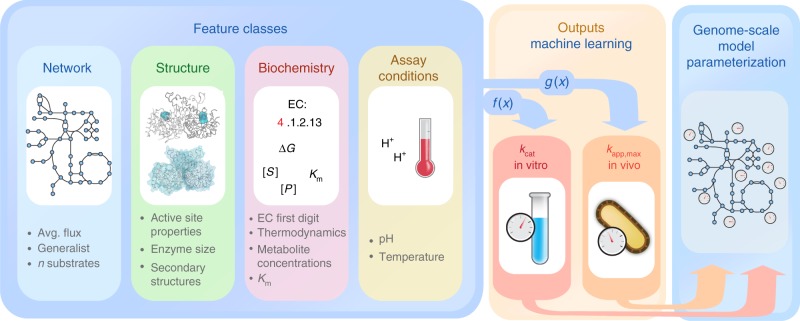
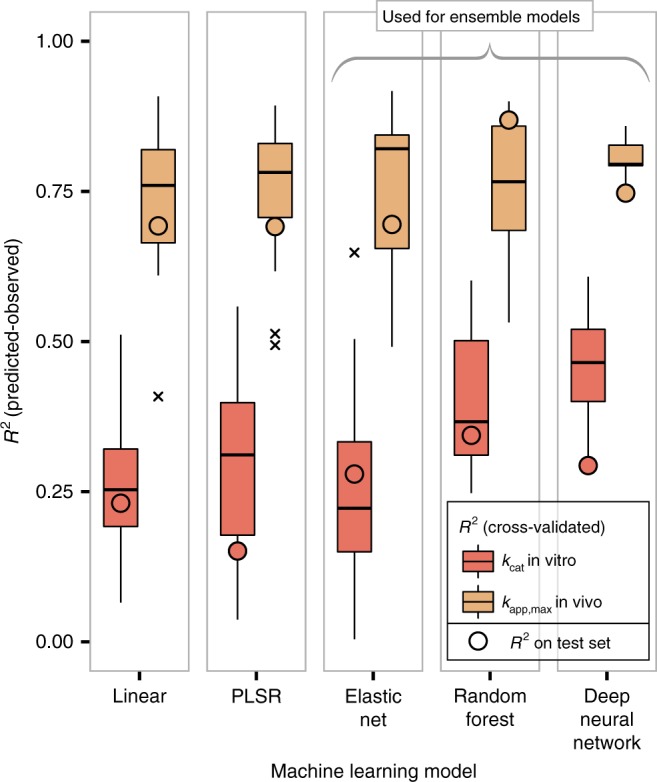
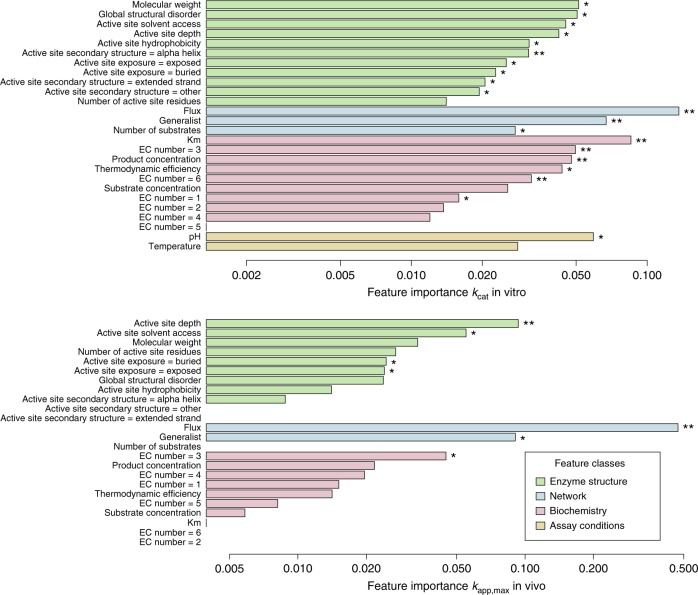
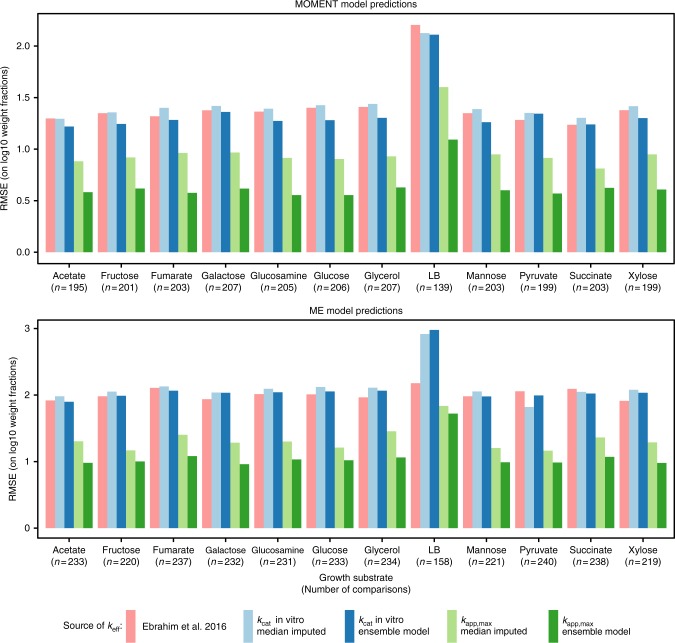
Knowing the catalytic turnover numbers of enzymes is essential for understanding the growth rate, proteome composition, and physiology of organisms, but experimental data on enzyme turnover numbers is sparse and noisy. Here, we demonstrate that machine learning can successfully predict catalytic turnover numbers in Escherichia coli based on integrated data on enzyme biochemistry, protein structure, and network context. We identify a diverse set of features that are consistently predictive for both in vivo and in vitro enzyme turnover rates, revealing novel protein structural correlates of catalytic turnover. We use our predictions to parameterize two mechanistic genome-scale modelling frameworks for proteome-limited metabolism, leading to significantly higher accuracy in the prediction of quantitative proteome data than previous approaches. The presented machine learning models thus provide a valuable tool for understanding metabolism and the proteome at the genome scale, and elucidate structural, biochemical, and network properties that underlie enzyme kinetics.
Overview
The claims and statistics of this paper haven’t been checked yet.
Free: it reads the open-access text and checks the first 5 claims that cite a source we can check. Create a free account to check every claim.
Integrity signals
Registry
Cites
Statistics
Figures
Verification
Claims the paper makes
The claims and statistics of this paper haven’t been checked yet.
Free: it reads the open-access text and checks the first 5 claims that cite a source we can check. Create a free account to check every claim.
Claims other papers make about this one
Each is checked against this paper’s own text: does it say what the citing paper says it does?
The source backs part of the claim, not all of it — or backs it for a different population, condition or comparison.
In the citing paper
“The model achieved a coefficient of determination R 2 ≈ 0.34 on a test set.”
From Turnover number predictions for kinetically uncharacterized enzymes using machine and deep learning (2023) · cites this paper as [14]
Experimental — accuracy not yet measuredThe source backs part of the claim, not all of it — or backs it for a different population, condition or comparison.
In the citing paper
“Its coefficient of determination ( R 2 = 0.44) is higher than that of Heckmann et al. ( R 2 ≈ 0.34) 14”
From Turnover number predictions for kinetically uncharacterized enzymes using machine and deep learning (2023) · cites this paper as [14]
Experimental — accuracy not yet measuredThe cited source says what the claim attributes to it.
In the citing paper
“Moreover, even for those well-studied organisms, the k cat coverage is far from complete 13,15,16 .”
From Deep learning-based kcat prediction enables improved enzyme-constrained model reconstruction (2022) · cites this paper as [16]
The cited source says what the claim attributes to it.
In the citing paper
“Previously, Heckmann and colleagues employed machine learning approaches to predict E. coli k cat values based on features such as average metabolic fluxes and catalytic sites obtained from protein structures 16 .”
From Deep learning-based kcat prediction enables improved enzyme-constrained model reconstruction (2022) · cites this paper as [16]
The cited source says what the claim attributes to it.
In the citing paper
“Our resulting Turnover Number Prediction model— TurNuP—outperforms a simple similarity-based approach and both previous methods for predicting k cat 14 , 16 .”
From Turnover number predictions for kinetically uncharacterized enzymes using machine and deep learning (2023) · cites this paper as [14]
5 more claims about this paper
Create a free account to see every claim other papers make about this one.
Self-check
Percentages, sums and reported differences re-computed from the paper’s own numbers.
The self-check needs the paper’s full text.
Citations
Cites
Berman, H. M. (2000) · Nucleic Acids Research · doi:10.1093/nar/28.1.235 · Cited by 40,196
KEGG: Kyoto Encyclopedia of Genes and Genomes
Kanehisa, M. (2000) · Nucleic Acids Research · doi:10.1093/nar/28.1.27 · Cited by 37,077
KEGG: Kyoto Encyclopedia of Genes and Genomes
Ogata, H., Goto, S., Sato, K., Fujibuchi, W., Bono, H., & Kanehisa, M. (1999) · Nucleic Acids Research · doi:10.1093/nar/27.1.29 · Cited by 31,232
A simple method for displaying the hydropathic character of a protein
Kyte, J., & Doolittle, R. F. (1982) · Journal of Molecular Biology · doi:10.1016/0022-2836(82)90515-0 · Cited by 22,843
Kabsch, W., & Sander, C. (1983) · Biopolymers · doi:10.1002/bip.360221211 · Cited by 15,320
mice: Multivariate Imputation by Chained Equations in R
Buuren, S. V., & Groothuis-Oudshoorn, K. (2011) · Journal of Statistical Software · doi:10.18637/jss.v045.i03 · Cited by 13,870
EMBOSS: the European molecular biology open software suite.
Rice, P., Longden, I., & Bleasby, A. (2000) · Trends in Genetics · doi:10.1016/s0168-9525(00)02024-2 · Cited by 9,466 · cited 1×
“From the protein sequence, global properties were calculated using the EMBOSS pepstats package 54 and the Biopython ProtParam module 55 .”
MethodBuilding Predictive Models in R Using the caret Package
Kuhn, M. (2008) · Journal of Statistical Software · doi:10.18637/jss.v028.i05 · Cited by 8,863
UniProt: the Universal Protein knowledgebase
Apweiler, R. (2004) · Nucleic Acids Research · doi:10.1093/nar/gkh131 · Cited by 7,498
Biopython: freely available python tools for computational molecular biology and bioinformatics
Cock, P. J. A., Antao, T., Chang, J. T., Chapman, B. A., Cox, C. J., Dalke, A., Friedberg, I., Hamelryck, T., Kauff, F., Wilczynski, B., et al. (2009) · Bioinformatics · doi:10.1093/bioinformatics/btp163 · Cited by 6,080
UniProt: the universal protein knowledgebase
The UniProt Consortium (2017) · Nucleic Acids Research · doi:10.1093/nar/gkw1099 · Cited by 4,436
What is flux balance analysis?
Orth, J. D., Thiele, I., & Palsson, B. Ø. (2010) · Nature Biotechnology · doi:10.1038/nbt.1614 · Cited by 3,903
Self-citationCaspi, R., Billington, R., Ferrer, L., Foerster, H., Fulcher, C. A., Keseler, I. M., Kothari, A., Krummenacker, M., Latendresse, M., Mueller, L. A., et al. (2016) · Nucleic Acids Research · doi:10.1093/nar/gkv1164 · Cited by 3,395
Reduced surface: An efficient way to compute molecular surfaces
Sanner, M. F., Olson, A. J., & Spehner, J.-C. (1996) · Biopolymers · doi:10.1002/(sici)1097-0282(199603)38:3<305::aid-bip4>3.3.co;2-8 · Cited by 1,058
The Moderately Efficient Enzyme: Evolutionary and Physicochemical Trends Shaping Enzyme Parameters
Bar-Even, A., Noor, E., Savir, Y., Liebermeister, W., Davidi, D., Tawfik, D. S., & Milo, R. (2011) · Biochemistry · doi:10.1021/bi2002289 · Cited by 1,050
SCRATCH: a protein structure and structural feature prediction server
Cheng, J., Randall, A. Z., Sweredoski, M. J., & Baldi, P. (2005) · Nucleic Acids Research · doi:10.1093/nar/gki396 · Cited by 1,044
BiGG Models: A platform for integrating, standardizing and sharing genome-scale models
King, Z. A., Lu, J., Dräger, A., Miller, P., Federowicz, S., Lerman, J. A., Ebrahim, A., Palsson, B. O., & Lewis, N. E. (2016) · Nucleic Acids Research · doi:10.1093/nar/gkv1049 · Cited by 938 · cited 1×
“Reaction EC numbers were obtained from the Bigg data-base 60 , and extended with additional EC number data from KEGG 61 and Meta-netX 62 where available.”
MethodSelf-citationOverflow metabolism in Escherichia coli results from efficient proteome allocation
Basan, M., Hui, S., Okano, H., Zhang, Z., Shen, Y., Williamson, J. R., & Hwa, T. (2015) · Nature · doi:10.1038/nature15765 · Cited by 785
The quantitative and condition-dependent Escherichia coli proteome
Schmidt, A., Kochanowski, K., Vedelaar, S., Ahrné, E., Volkmer, B., Callipo, L., Knoops, K., Bauer, M., Aebersold, R., & Heinemann, M. (2016) · Nature Biotechnology · doi:10.1038/nbt.3418 · Cited by 771
Omic data from evolved E. coli are consistent with computed optimal growth from genome‐scale models
Lewis, N. E., Hixson, K. K., Conrad, T. M., Lerman, J. A., Charusanti, P., Polpitiya, A. D., Adkins, J. N., Schramm, G., Purvine, S. O., Lopez‐Ferrer, D., et al. (2010) · Molecular Systems Biology · doi:10.1038/msb.2010.47 · Cited by 753
Self-citationSystematic evaluation of objective functions for predicting intracellular fluxes in Escherichia coli
Schuetz, R., Kuepfer, L., & Sauer, U. (2007) · Molecular Systems Biology · doi:10.1038/msb4100162 · Cited by 677
Thermodynamics-Based Metabolic Flux Analysis
Henry, C. S., Broadbelt, L. J., & Hatzimanikatis, V. (2007) · Biophysical Journal · doi:10.1529/biophysj.106.093138 · Cited by 607
Porter, C. T. (2004) · Nucleic Acids Research · doi:10.1093/nar/gkh028 · Cited by 604
Reduced surface: an efficient way to compute molecular surfaces.
Sanner, M. F., Olson, A. J., & Spehner, J.-C. (1996) · PubMed · doi:10.1002/(sici)1097-0282(199603)38:3<305::aid-bip4>3.0.co;2-y · Cited by 585
iML1515, a knowledgebase that computes Escherichia coli traits
Monk, J. M., Lloyd, C. J., Brunk, E., Mih, N., Sastry, A., King, Z., Takeuchi, R., Nomura, W., Zhang, Z., Mori, H., et al. (2017) · Nature Biotechnology · doi:10.1038/nbt.3956 · Cited by 560
Self-citationAlgorithm AS 89: The Upper Tail Probabilities of Spearman's Rho
Best, D. J., & Roberts, D. E. (1975) · Applied Statistics · doi:10.2307/2347111 · Cited by 502
Hastie, T., Friedman, J., & Tibshirani, R. (2001) · Springer Series in Statistics · doi:10.1007/978-0-387-21606-5_1 · Cited by 483
Genome‐scale models of metabolism and gene expression extend and refine growth phenotype prediction
O'Brien, E. J., Lerman, J. A., Chang, R. L., Hyduke, D. R., & Palsson, B. Ø. (2013) · Molecular Systems Biology · doi:10.1038/msb.2013.52 · Cited by 471
Self-citationSánchez, B. J., Zhang, C., Nilsson, A., Lahtvee, P., Kerkhoven, E. J., & Nielsen, J. (2017) · Molecular Systems Biology · doi:10.15252/msb.20167411 · Cited by 466
Using deep learning to model the hierarchical structure and function of a cell
Ma, J., Yu, M. K., Fong, S., Ono, K., Sage, E., Demchak, B., Sharan, R., & Ideker, T. (2018) · Nature Methods · doi:10.1038/nmeth.4627 · Cited by 435 · cited 1×
“Machine learning (ML) methods for the development of complex statistical models have been successfully applied to modelling bacterial physiology 18 – 20 , enzyme speci fi city 21,22 , and enzyme af fi nity 21,23 , with applications in metabolic engineering and synthetic biology 24,25 .”
MethodBeg, Q. K., Vazquez, A., Ernst, J., de Menezes, M. A., Bar-Joseph, Z., Barabási, A.-L., & Oltvai, Z. N. (2007) · Proceedings of the National Academy of Sciences · doi:10.1073/pnas.0609845104 · Cited by 368
Holzhütter, H. (2004) · European Journal of Biochemistry · doi:10.1111/j.1432-1033.2004.04213.x · Cited by 296
Molecular crowding limits translation and cell growth
Klumpp, S., Scott, M., Pedersen, S., & Hwa, T. (2013) · Proceedings of the National Academy of Sciences · doi:10.1073/pnas.1310377110 · Cited by 293 · cited 1×
“…living cells have to allocate a fi nite amount of protein into diverse cellular functions. central Understanding optimal global proteome allocation is a problem in systems biology and underlies important cellular properties like growth rate 1 , thermosensitivity 2 , and over-fl ow metabolism 3 .”
BackgroundGora, A., Brezovsky, J., & Damborsky, J. (2013) · Chemical Reviews · doi:10.1021/cr300384w · Cited by 280
Network Context and Selection in the Evolution to Enzyme Specificity
Nam, H., Lewis, N. E., Lerman, J. A., Lee, D.-H., Chang, R. L., Kim, D., & Palsson, B. O. (2012) · Science · doi:10.1126/science.1216861 · Cited by 277
Self-citationBRENDA in 2017: new perspectives and new tools in BRENDA
Placzek, S., Schomburg, I., Chang, A., Jeske, L., Ulbrich, M., Tillack, J., & Schomburg, D. (2017) · Nucleic Acids Research · doi:10.1093/nar/gkw952 · Cited by 274
Davidi, D., Noor, E., Liebermeister, W., Bar-Even, A., Flamholz, A., Tummler, K., Barenholz, U., Goldenfeld, M., Shlomi, T., & Milo, R. (2016) · Proceedings of the National Academy of Sciences · doi:10.1073/pnas.1514240113 · Cited by 266
In silico method for modelling metabolism and gene product expression at genome scale
Lerman, J. A., Hyduke, D. R., Latif, H., Portnoy, V. A., Lewis, N. E., Orth, J. D., Schrimpe-Rutledge, A. C., Smith, R. D., Adkins, J. N., Zengler, K., et al. (2012) · Nature Communications · doi:10.1038/ncomms1928 · Cited by 266
Self-citationSABIO-RK--database for biochemical reaction kinetics
Wittig, U., Kania, R., Golebiewski, M., Rey, M., Shi, L., Jong, L., Algaa, E., Weidemann, A., Sauer-Danzwith, H., Mir, S., et al. (2012) · Nucleic Acids Research · doi:10.1093/nar/gkr1046 · Cited by 259
Diminishing returns and tradeoffs constrain the laboratory optimization of an enzyme
Tokuriki, N., Jackson, C. J., Afriat-Jurnou, L., Wyganowski, K. T., Tang, R., & Tawfik, D. S. (2012) · Nature Communications · doi:10.1038/ncomms2246 · Cited by 253
Khodayari, A., & Maranas, C. D. (2016) · Nature Communications · doi:10.1038/ncomms13806 · Cited by 230
A Quick Introduction to Version Control with Git and GitHub
Blischak, J. D., Davenport, E. R., & Wilson, G. (2016) · PLOS Computational Biology · doi:10.1371/journal.pcbi.1004668 · Cited by 192
The Protein Cost of Metabolic Fluxes: Prediction from Enzymatic Rate Laws and Cost Minimization
Noor, E., Flamholz, A., Bar-Even, A., Davidi, D., Milo, R., & Liebermeister, W. (2016) · PLOS Computational Biology · doi:10.1371/journal.pcbi.1005167 · Cited by 189
Adadi, R., Volkmer, B., Milo, R., Heinemann, M., & Shlomi, T. (2012) · PLoS Computational Biology · doi:10.1371/journal.pcbi.1002575 · Cited by 179 · cited 22×
“3), and the total weight of the metabolic proteome was set to 0.32 g protein /g DW in accordance with the E. coli metabolic protein fraction across diverse growth conditions 5,44 .”
BackgroundMethodInfluentialGerosa, L., van Rijsewijk, B. R. B. H., Christodoulou, D., Kochanowski, K., Schmidt, T., Noor, Ε., & Sauer, U. (2015) · Cell Systems · doi:10.1016/j.cels.2015.09.008 · Cited by 178
Arike, L., Valgepea, K., Peil, L., Nahku, R., Adamberg, K., & Vilu, R. (2012) · Journal of Proteomics · doi:10.1016/j.jprot.2012.06.020 · Cited by 170
COBRAme: A computational framework for genome-scale models of metabolism and gene expression
Lloyd, C. J., Ebrahim, A., Yang, L., King, Z. A., Catoiu, E., O’Brien, E. J., Liu, J. K., & Palsson, B. O. (2018) · PLOS Computational Biology · doi:10.1371/journal.pcbi.1006302 · Cited by 167 · cited 1×
“For these simulations the i JL1678b ME-model of E. coli K-12 MG1655 was used 70 .”
MethodSelf-citationMulti-omic data integration enables discovery of hidden biological regularities
Ebrahim, A., Brunk, E., Tan, J., O'Brien, E. J., Kim, D., Szubin, R., Lerman, J. A., Lechner, A., Sastry, A., Bordbar, A., et al. (2016) · Nature Communications · doi:10.1038/ncomms13091 · Cited by 155 · cited 4×
“This behaviour could be explained by the fact that Ebrahim et al. aimed to study biological regularities, and thus only used fi tted k eff parameters that are invariable across conditions, and focused on highly expressed proteins in their optimization procedure.”
BackgroundInfluentialSelf-citationMetRxn: a knowledgebase of metabolites and reactions spanning metabolic models and databases
Kumar, A., Suthers, P. F., & Maranas, C. D. (2012) · BMC Bioinformatics · doi:10.1186/1471-2105-13-6 · Cited by 140
Kim, M., Rai, N., Zorraquino, V., & Tagkopoulos, I. (2016) · Nature Communications · doi:10.1038/ncomms13090 · Cited by 138
sybil – Efficient constraint-based modelling in R
Gelius-Dietrich, G., Desouki, A. A., Fritzemeier, C. J., & Lercher, M. J. (2013) · BMC Systems Biology · doi:10.1186/1752-0509-7-125 · Cited by 130
Self-citationWalsh, K., & Koshland, D. E. (1985) · Journal of Biological Chemistry · doi:10.1016/s0021-9258(17)39492-9 · Cited by 126
A Bird’s-Eye View of Enzyme Evolution: Chemical, Physicochemical, and Physiological Considerations
Davidi, D., Longo, L. M., Jabłońska, J., Milo, R., & Tawfik, D. S. (2018) · Chemical Reviews · doi:10.1021/acs.chemrev.8b00039 · Cited by 120
MetaNetX.org: a website and repository for accessing, analysing and manipulating metabolic networks
Ganter, M., Bernard, T., Moretti, S., Stelling, J., & Pagni, M. (2013) · Bioinformatics · doi:10.1093/bioinformatics/btt036 · Cited by 113
Thiele, I., Fleming, R. M. T., Que, R., Bordbar, A., Diep, D., & Palsson, B. O. (2012) · PLoS ONE · doi:10.1371/journal.pone.0045635 · Cited by 109
Self-citationThermosensitivity of growth is determined by chaperone-mediated proteome reallocation
Chen, K., Gao, Y., Mih, N., O’Brien, E. J., Yang, L., & Palsson, B. O. (2017) · Proceedings of the National Academy of Sciences · doi:10.1073/pnas.1705524114 · Cited by 95
Self-citationDiffusion-controlled reaction rate to a buried active site
Samson, R., & Deutch, J. M. (1978) · The Journal of Chemical Physics · doi:10.1063/1.435494 · Cited by 91
Metabolic Models of Protein Allocation Call for the Kinetome
Nilsson, A., Nielsen, J., & Palsson, B. O. (2017) · Cell Systems · doi:10.1016/j.cels.2017.11.013 · Cited by 87 · cited 1×
“It would thus be desirable to understand the underlying genome-scale patterns of catalytic enzyme turnover rates — a major part of the kinetome 16 — and thus protein ef fi ciency.”
BackgroundSelf-citationMolecular signatures-based prediction of enzyme promiscuity
Carbonell, P., & Faulon, J.-L. (2010) · Bioinformatics · doi:10.1093/bioinformatics/btq317 · Cited by 79
Wu, S. G., Wang, Y., Jiang, W., Oyetunde, T., Yao, R., Zhang, X., Shimizu, K., Tang, Y. J., & Bao, F. S. (2016) · PLOS Computational Biology · doi:10.1371/journal.pcbi.1004838 · Cited by 73
Semisupervised Gaussian Process for Automated Enzyme Search
Mellor, J., Grigoras, I., Carbonell, P., & Faulon, J.-L. (2016) · ACS Synthetic Biology · doi:10.1021/acssynbio.5b00294 · Cited by 72
Evidence of histidine phosphorylation in isocitrate lyase from Escherichia coli.
Robertson, E. F., Hoyt, J. C., & Reeves, H. C. (1988) · Journal of Biological Chemistry · doi:10.1016/s0021-9258(18)69231-2 · Cited by 62
Systems biology of the structural proteome
Brunk, E., Mih, N., Monk, J., Zhang, Z., O’Brien, E. J., Bliven, S. E., Chen, K., Chang, R. L., Bourne, P. E., & Palsson, B. O. (2016) · BMC Systems Biology · doi:10.1186/s12918-016-0271-6 · Cited by 56
Self-citationModeling the multi-scale mechanisms of macromolecular resource allocation
Yang, L., Yurkovich, J. T., King, Z. A., & Palsson, B. O. (2018) · Current Opinion in Microbiology · doi:10.1016/j.mib.2018.01.002 · Cited by 55
Self-citationsolveME: fast and reliable solution of nonlinear ME models
Yang, L., Ma, D., Ebrahim, A., Lloyd, C. J., Saunders, M. A., & Palsson, B. O. (2016) · BMC Bioinformatics · doi:10.1186/s12859-016-1240-1 · Cited by 51
Self-citationXu, D., & Zhang, Y. (2013) · Scientific Reports · doi:10.1038/srep01895 · Cited by 47
ssbio: a Python framework for structural systems biology
Mih, N., Brunk, E., Chen, K., Catoiu, E., Sastry, A., Kavvas, E., Monk, J. M., Zhang, Z., & Palsson, B. O. (2018) · Bioinformatics · doi:10.1093/bioinformatics/bty077 · Cited by 41
Self-citationTemperature-Dependent Estimation of Gibbs Energies Using an Updated Group-Contribution Method
Du, B., Zhang, Z., Grubner, S., Yurkovich, J. T., Palsson, B. Ø., & Zielinski, D. C. (2018) · Biophysical Journal · doi:10.1016/j.bpj.2018.04.030 · Cited by 41
Self-citationReliable and efficient solution of genome-scale models of Metabolism and macromolecular Expression
Ma, D., Yang, L., Fleming, R. M. T., Thiele, I., Palsson, B. O., & Saunders, M. A. (2017) · Scientific Reports · doi:10.1038/srep40863 · Cited by 39
Self-citationColletti, P. F., Goyal, Y., Varman, A. M., Feng, X., Wu, B., & Tang, Y. (2010) · Biotechnology and Bioengineering · doi:10.1002/bit.22996 · Cited by 35
Prediction of enzyme kinetic parameters based on statistical learning.
Borger, S., Liebermeister, W., & Klipp, E. (2006) · PubMed · Cited by 32
Modeling genome-wide enzyme evolution predicts strong epistasis underlying catalytic turnover rates
Heckmann, D., Zielinski, D. C., & Palsson, B. Ø. (2018) · Nature Communications · doi:10.1038/s41467-018-07649-1 · Cited by 23
Self-citationFacilitate Collaborations among Synthetic Biology, Metabolic Engineering and Machine Learning
Wu, S. G., Shimizu, K., Tang, J. K., & Tang, Y. (2016) · ChemBioEng Reviews · doi:10.1002/cben.201500024 · Cited by 22
Cost Constrained FLux Balance Analysis: MetabOlic Modeling withENzyme kineTics (MOMENT)
Desouki, A. A. (2015) · Cited by 2
Self-citationHeckmann, D., Zielinski, D. C., & Palsson, B. O. (2018) · doi:10.1101/318972
Self-citation
Cited by
Common principles and best practices for engineering microbiomes
Lawson, C. E., Harcombe, W. R., Hatzenpichler, R., Lindemann, S. R., Löffler, F. E., O’Malley, M. A., García Martín, H., Pfleger, B. F., Raskin, L., Venturelli, O. S., et al. (2019) · Nature Reviews Microbiology · doi:10.1038/s41579-019-0255-9 · Cited by 633
Deep learning-based kcat prediction enables improved enzyme-constrained model reconstruction
Li, F., Yuan, L., Lu, H., Li, G., Chen, Y., Engqvist, M. K. M., Kerkhoven, E. J., & Nielsen, J. (2022) · Nature Catalysis · doi:10.1038/s41929-022-00798-z · Cited by 466
Machine Learning Applications for Mass Spectrometry-Based Metabolomics
Liebal, U. W., Phan, A. N. T., Sudhakar, M., Raman, K., & Blank, L. M. (2020) · Metabolites · doi:10.3390/metabo10060243 · Cited by 357
Machine and deep learning meet genome-scale metabolic modeling
Zampieri, G., Vijayakumar, S., Yaneske, E., & Angione, C. (2019) · PLOS Computational Biology · doi:10.1371/journal.pcbi.1007084 · Cited by 313
Machine learning for metabolic engineering: A review
Lawson, C. E., Martí, J. M., Radivojevic, T., Jonnalagadda, S. V. R., Gentz, R., Hillson, N. J., Peisert, S., Kim, J., Simmons, B. A., Petzold, C. J., et al. (2021) · Metabolic Engineering · doi:10.1016/j.ymben.2020.10.005 · Cited by 313
Metadata
- Authors
- Heckmann, D., Lloyd, C. J., Mih, N., Ha, Y., Zielinski, D. C., Haiman, Z. B., Desouki, A. A., Lercher, M. J., & Palsson, B. O.
- Affiliations
- University of California San Diego (US)
- Heinrich Heine University Düsseldorf (DE)
- Corresponding author
- Heckmann, David
- ORCID
- Venue
- Nature Communications
- Published
- 2018-12-07
- Volume
- 9
- Issue
- 1
- Pages
- 5252-5252
- ISSN
- 2041-1723 (ISSN-L)
- PMC
- PMC6286351
- OpenAlex
- W2903357856
- Cited by
- 218
- References
- 75
- Citations by year
- 2026: 21 · 2025: 34 · 2024: 31 · 2023: 31 · 2022: 32 · 2021: 30 · 2020: 24 · 2019: 15
- FWCI
- 6.13
- Type
- journal article
- Language
- en
- Open access
- gold
- doi.org
- Licence
- cc-by
- creativecommons.org/licenses/by/4.0 (tdm)
- creativecommons.org/licenses/by/4.0 (vor)
- Locations
- Nature Communications (publishedVersion, cc-by)
- Europe PMC (PubMed Central) (publishedVersion, other-oa)
- PubMed Central (publishedVersion, cc-by)
- PubMed (publishedVersion)
- RePEc: Research Papers in Economics (submittedVersion)
- DOAJ (DOAJ: Directory of Open Access Journals) (submittedVersion, cc-by-sa)
- DOAJ (DOAJ: Directory of Open Access Journals) (submittedVersion)
- eScholarship (California Digital Library) (submittedVersion)
- eScholarship (California Digital Library) (submittedVersion, cc-by)
- Technical University of Denmark, DTU Orbit (Technical University of Denmark, DTU) (submittedVersion, other-oa)
- Funders
- Deutsche Forschungsgemeinschaft (CRC1310)
- Novo Nordisk (NNF10CC1016517)
- Novo Nordisk Fonden (NNF10CC1016517)
- Topics
- Life Sciences › Biochemistry, Genetics and Molecular Biology › Molecular Biology › Microbial Metabolic Engineering and Bioproduction
- Life Sciences › Biochemistry, Genetics and Molecular Biology › Molecular Biology › Bioinformatics and Genomic Networks
- Life Sciences › Biochemistry, Genetics and Molecular Biology › Molecular Biology › Gene Regulatory Network Analysis
- Keywords
- enzyme turnover number, Escherichia coli, protein structure, enzyme kinetics, genome-scale metabolic models, machine learning prediction
- MeSH terms
- Machine Learning, Algorithms, Escherichia coli, Kinetics, Models, Biological, Proteome, Escherichia coli Proteins, Metabolic Networks and Pathways, Biocatalysis
About these checks
Registry, retraction, Cites and statistics results are computed, not judged, with one exception: a printed reference that no index lists is read once by a model before it counts as a citation error. Claims are extracted by a model and kept only when their quote appears verbatim in the text; each cited source is then checked, with a model’s help, for whether it says what the claim relies on. Those verdicts can be wrong — read the claim’s quote and the cited source before relying on one.
Statistics and arithmetic are recomputed, not judged.
Confidence bands are shown only for fields calibrated on our annotated test set. None is calibrated yet, so no band is shown.
What counts as a claim ›How we measure confidence ›How we check this ›
Are you an author, or do you see a problem with this page? Request a review
Data sources
Bibliographic data: Semantic Scholar, OpenAlex, Crossref.
Contains information from the Semantic Scholar Academic Graph Datasets, made available under the ODC Attribution License (ODC-BY 1.0).
Semantic Scholar’s data is described in: Kinney, R., et al. (2023). The Semantic Scholar Open Data Platform. arXiv:2301.10140.
