

Machine learning applied to enzyme turnover numbers reveals protein structural correlates and improves metabolic models
Open accessThe DOI matches its Crossref record; 75 of the 75 references it cites were found in a registry or an index.
Abstract
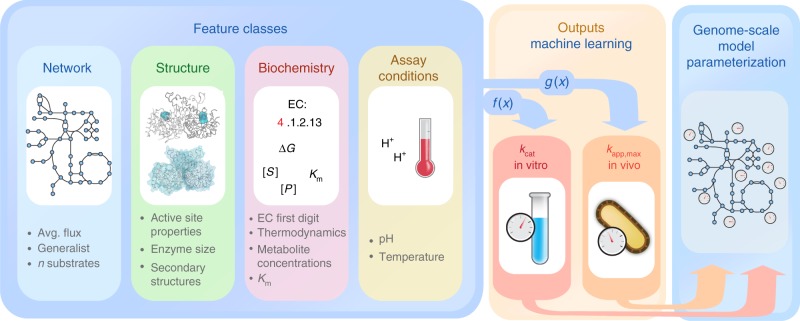
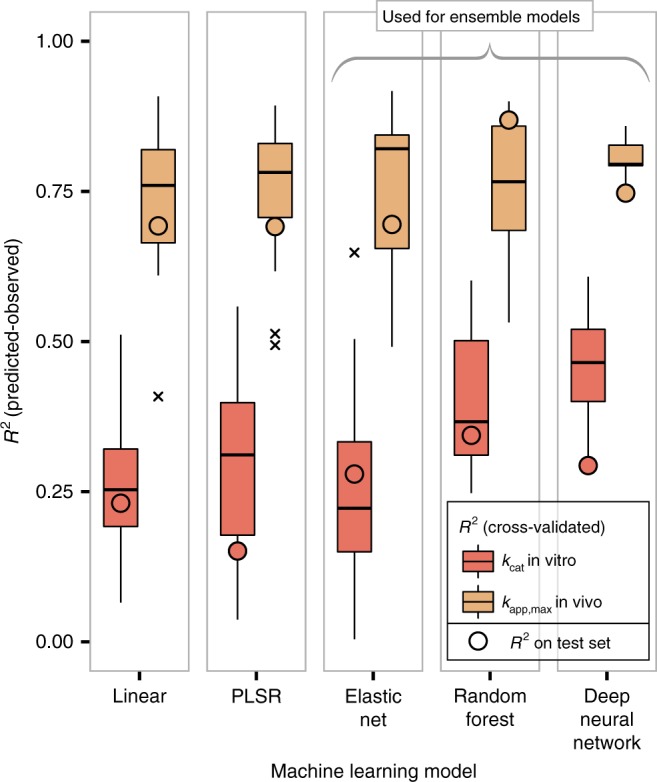
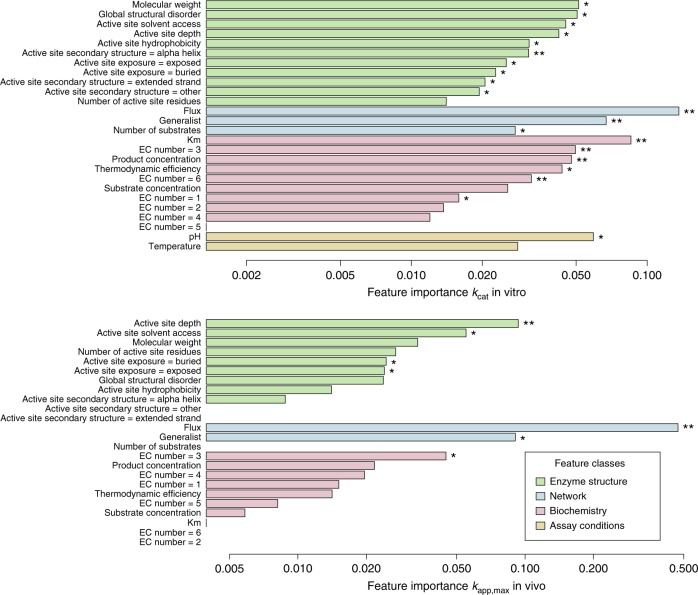
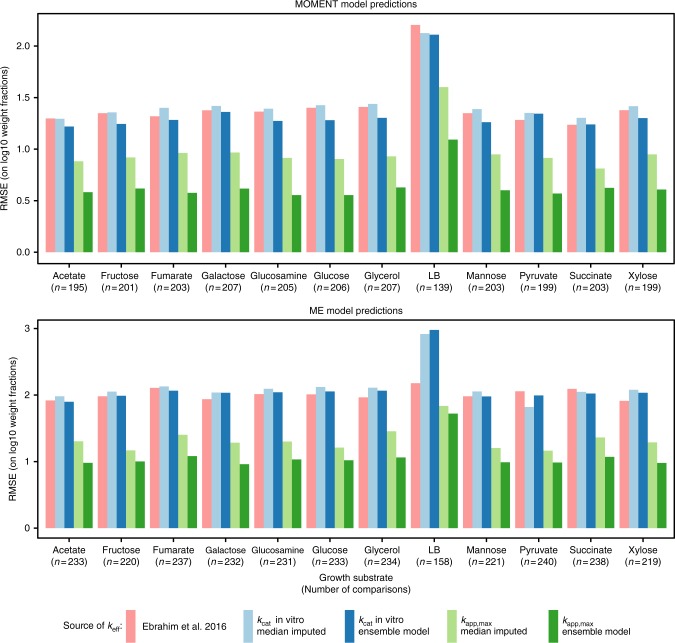
Knowing the catalytic turnover numbers of enzymes is essential for understanding the growth rate, proteome composition, and physiology of organisms, but experimental data on enzyme turnover numbers is sparse and noisy. Here, we demonstrate that machine learning can successfully predict catalytic turnover numbers in Escherichia coli based on integrated data on enzyme biochemistry, protein structure, and network context. We identify a diverse set of features that are consistently predictive for both in vivo and in vitro enzyme turnover rates, revealing novel protein structural correlates of catalytic turnover. We use our predictions to parameterize two mechanistic genome-scale modelling frameworks for proteome-limited metabolism, leading to significantly higher accuracy in the prediction of quantitative proteome data than previous approaches. The presented machine learning models thus provide a valuable tool for understanding metabolism and the proteome at the genome scale, and elucidate structural, biochemical, and network properties that underlie enzyme kinetics.
Overview
The claims and statistics of this paper haven’t been checked yet.
Free: it reads the open-access text and checks the first 5 claims that cite a source we can check. Create a free account to check every claim.
Integrity signals
Registry
Cites
Statistics
Figures
Verification
Claims the paper makes
The claims and statistics of this paper haven’t been checked yet.
Free: it reads the open-access text and checks the first 5 claims that cite a source we can check. Create a free account to check every claim.
Claims other papers make about this one
Each is checked against this paper’s own text: does it say what the citing paper says it does?
The source backs part of the claim, not all of it — or backs it for a different population, condition or comparison.
In the citing paper
“The model achieved a coefficient of determination R 2 ≈ 0.34 on a test set.”
From Turnover number predictions for kinetically uncharacterized enzymes using machine and deep learning (2023) · cites this paper as [14]
Experimental — accuracy not yet measuredThe source backs part of the claim, not all of it — or backs it for a different population, condition or comparison.
In the citing paper
“Its coefficient of determination ( R 2 = 0.44) is higher than that of Heckmann et al. ( R 2 ≈ 0.34) 14”
From Turnover number predictions for kinetically uncharacterized enzymes using machine and deep learning (2023) · cites this paper as [14]
Experimental — accuracy not yet measuredThe cited source says what the claim attributes to it.
In the citing paper
“Moreover, even for those well-studied organisms, the k cat coverage is far from complete 13,15,16 .”
From Deep learning-based kcat prediction enables improved enzyme-constrained model reconstruction (2022) · cites this paper as [16]
The cited source says what the claim attributes to it.
In the citing paper
“Previously, Heckmann and colleagues employed machine learning approaches to predict E. coli k cat values based on features such as average metabolic fluxes and catalytic sites obtained from protein structures 16 .”
From Deep learning-based kcat prediction enables improved enzyme-constrained model reconstruction (2022) · cites this paper as [16]
The cited source says what the claim attributes to it.
In the citing paper
“Our resulting Turnover Number Prediction model— TurNuP—outperforms a simple similarity-based approach and both previous methods for predicting k cat 14 , 16 .”
From Turnover number predictions for kinetically uncharacterized enzymes using machine and deep learning (2023) · cites this paper as [14]
5 more claims about this paper
Create a free account to see every claim other papers make about this one.
Self-check
Percentages, sums and reported differences re-computed from the paper’s own numbers.
The self-check needs the paper’s full text.
Citations
Cites
Berman, H. M. (2000) · Nucleic Acids Research · doi:10.1093/nar/28.1.235 · Cited by 40,196
KEGG: Kyoto Encyclopedia of Genes and Genomes
Kanehisa, M. (2000) · Nucleic Acids Research · doi:10.1093/nar/28.1.27 · Cited by 37,077
KEGG: Kyoto Encyclopedia of Genes and Genomes
Ogata, H., Goto, S., Sato, K., Fujibuchi, W., Bono, H., & Kanehisa, M. (1999) · Nucleic Acids Research · doi:10.1093/nar/27.1.29 · Cited by 31,232
A simple method for displaying the hydropathic character of a protein
Kyte, J., & Doolittle, R. F. (1982) · Journal of Molecular Biology · doi:10.1016/0022-2836(82)90515-0 · Cited by 22,843
Kabsch, W., & Sander, C. (1983) · Biopolymers · doi:10.1002/bip.360221211 · Cited by 15,320
mice: Multivariate Imputation by Chained Equations in R
Buuren, S. V., & Groothuis-Oudshoorn, K. (2011) · Journal of Statistical Software · doi:10.18637/jss.v045.i03 · Cited by 13,870
EMBOSS: the European molecular biology open software suite.
Rice, P., Longden, I., & Bleasby, A. (2000) · Trends in Genetics · doi:10.1016/s0168-9525(00)02024-2 · Cited by 9,466 · cited 1×
“From the protein sequence, global properties were calculated using the EMBOSS pepstats package 54 and the Biopython ProtParam module 55 .”
MethodBuilding Predictive Models in R Using the caret Package
Kuhn, M. (2008) · Journal of Statistical Software · doi:10.18637/jss.v028.i05 · Cited by 8,863
UniProt: the Universal Protein knowledgebase
Apweiler, R. (2004) · Nucleic Acids Research · doi:10.1093/nar/gkh131 · Cited by 7,498
Biopython: freely available python tools for computational molecular biology and bioinformatics
Cock, P. J. A., Antao, T., Chang, J. T., Chapman, B. A., Cox, C. J., Dalke, A., Friedberg, I., Hamelryck, T., Kauff, F., Wilczynski, B., et al. (2009) · Bioinformatics · doi:10.1093/bioinformatics/btp163 · Cited by 6,080
Cited by
Items 101–200 of 247
Data integration across conditions improves turnover number estimates and metabolic predictions
Wendering, P., Arend, M., Razaghi-Moghadam, Z., & Nikoloski, Z. (2023) · Nature Communications · doi:10.1038/s41467-023-37151-2 · Cited by 23
IntEnzyDB: an Integrated Structure–Kinetics Enzymology Database
Yan, B., Ran, X., Gollu, A., Cheng, Z., Zhou, X., Chen, Y., & Yang, Z. J. (2022) · Journal of Chemical Information and Modeling · doi:10.1021/acs.jcim.2c01139 · Cited by 23
Mey, F., Clauwaert, J., Huffel, K. V., Waegeman, W., & Mey, M. D. (2021) · Biotechnology Advances · doi:10.1016/j.biotechadv.2021.107858 · Cited by 23
Data-driven enzyme engineering to identify function-enhancing enzymes
Jiang, Y., Ran, X., & Yang, Z. J. (2023) · Protein Engineering, Design and Selection · doi:10.1093/protein/gzac009 · Cited by 22
Protein Abundance Prediction Through Machine Learning Methods
Ferreira, M. A. D. M., Ventorim, R. Z., de Almeida, E. L. M., Silveira, S. D. A., & da Silveira, W. B. (2021) · Journal of Molecular Biology · doi:10.1016/j.jmb.2021.167267 · Cited by 22
Poorinmohammad, N., & Kerkhoven, E. J. (2021) · Biotechnology and Bioengineering · doi:10.1002/bit.27859 · Cited by 21
DeepMolecules: a web server for predicting enzyme and transporter–small molecule interactions
Kroll, A., Rousset, Y., Spitzlei, T., & Lercher, M. J. (2025) · Nucleic Acids Research · doi:10.1093/nar/gkaf343 · Cited by 20
Self-citationBai, L., You, Q., Zhang, C., Sun, J., Liu, L., Lu, H., & Chen, Q. (2022) · Systems Microbiology and Biomanufacturing · doi:10.1007/s43393-022-00115-6 · Cited by 20
Westphal, H., Schmidt, S., Lama, S., Polack, M., Weise, C., Oestereich, T., Warias, R., Gulder, T., & Belder, D. (2024) · Reaction Chemistry & Engineering · doi:10.1039/d4re00004h · Cited by 20
Metabolic signatures of regulation by phosphorylation and acetylation
Smith, K., Shen, F., Lee, H. J., & Chandrasekaran, S. (2019) · doi:10.1101/838243 · Cited by 20
Recycling of Thermoplastics with Machine Learning: A Review
Albuquerque, R. Q., Stephan, F., Pongratz, A., Brütting, C., Krause, K., & Ruckdäschel, H. (2025) · Advanced Functional Materials · doi:10.1002/adfm.202509447 · Cited by 19
The Expanding Computational Toolbox for Engineering Microbial Phenotypes at the Genome Scale
Zielinski, D., Patel, A., & Palsson, B. (2020) · Microorganisms · doi:10.3390/microorganisms8122050 · Cited by 10
Self-citationMachine learning for predicting protein properties: A comprehensive review
Wang, Y., Zhang, Y., Zhan, X., He, Y., Yang, Y., Cheng, L., & Alghazzawi, D. (2024) · Neurocomputing · doi:10.1016/j.neucom.2024.128103 · Cited by 18
NEXT-FBA: A hybrid stoichiometric/data-driven approach to improve intracellular flux predictions
Morrissey, J., Barberi, G., Strain, B., Facco, P., & Kontoravdi, C. (2025) · Metabolic Engineering · doi:10.1016/j.ymben.2025.03.010 · Cited by 18
Using resource constraints derived from genomic and proteomic data in metabolic network models
Becker, K. D., Totis, N., Bernaerts, K., & Waldherr, S. (2021) · Current Opinion in Systems Biology · doi:10.1016/j.coisb.2021.100400 · Cited by 18
Resource allocation in mammalian systems
Baghdassarian, H. M., & Lewis, N. E. (2024) · Biotechnology Advances · doi:10.1016/j.biotechadv.2023.108305 · Cited by 17
RBC-GEM: A genome-scale metabolic model for systems biology of the human red blood cell
Haiman, Z. B., Key, A., D’Alessandro, A., & Palsson, B. Ø. (2025) · PLoS Computational Biology · doi:10.1371/journal.pcbi.1012109 · Cited by 19
Self-citationCatRange enables robust prediction of enzyme variant kinetic regimes
Sajeevan, K. A., Osinuga, A., Arunraj, B., Ferdous, S., Shahreen, N., Noor, M. S., Koneru, S., Santos-Correa, L. M., Salehi, R., Chowdhury, N. B., et al. (2026) · PNAS Nexus · doi:10.1093/pnasnexus/pgag309 · Cited by 17
Alzoubi, D., Desouki, A. A., & Lercher, M. J. (2019) · Scientific Reports · doi:10.1038/s41598-019-47935-6 · Cited by 17
Self-citationOptimal density of bacterial cells
Pang, T. Y., & Lercher, M. J. (2023) · PLoS Computational Biology · doi:10.1371/journal.pcbi.1011177 · Cited by 17
Self-citationA compact model of Escherichia coli core and biosynthetic metabolism
Corrao, M., He, H., Liebermeister, W., Noor, Ε., & Bar‐Even, A. (2025) · PLoS Computational Biology · doi:10.1371/journal.pcbi.1013564 · Cited by 16
Synthetic Biology Meets Machine Learning
Sieow, B. F., Sotto, R. D., Seet, Z. R. D., Hwang, I. Y., & Chang, M. W. (2022) · Methods in molecular biology · doi:10.1007/978-1-0716-2617-7_2 · Cited by 16
Machine learning for enzyme catalytic activity: current progress and future horizons
Qiu, S., Saeed, H., Leonard, W., Li, F., & Yang, A. (2026) · Briefings in Bioinformatics · doi:10.1093/bib/bbag002 · Cited by 15
Proteome efficiency of metabolic pathways in Escherichia coli increases along the nutrient flow
Hu, X.-P., Schroeder, S., & Lercher, M. J. (2023) · mSystems · doi:10.1128/msystems.00760-23 · Cited by 15
Self-citationCai, Y., Zhang, W., Dou, Z., Wang, C., Yu, W., & Wang, L. (2025) · Computational Biology and Chemistry · doi:10.1016/j.compbiolchem.2024.108327 · Cited by 15
Zhai, J., Qi, X., Cai, L., Liu, Y., Tang, H., Xie, L., & Wang, J. (2025) · Briefings in Bioinformatics · doi:10.1093/bib/bbaf212 · Cited by 15
Chen, K., Anand, A., Olson, C. A., Sandberg, T. E., Gao, Y., Mih, N., & Palsson, B. Ø. (2021) · PLoS Computational Biology · doi:10.1371/journal.pcbi.1008596 · Cited by 16
Self-citationRate-Perturbing Single Amino Acid Mutation for Hydrolases: A Statistical Profiling
Yan, B., Ran, X., Jiang, Y., Torrence, S. K., Yuan, L., Shao, Q., & Yang, Z. J. (2021) · The Journal of Physical Chemistry B · doi:10.1021/acs.jpcb.1c05901 · Cited by 15
Experimental methods for dissecting the terraincognita of protein-metabolite interactomes
Wagner, M. M., Zhang, B., Tauffenberger, A., Schroeder, F. C., & Skirycz, A. (2021) · Current Opinion in Systems Biology · doi:10.1016/j.coisb.2021.100403 · Cited by 15
Advanced strategy for metabolite exploration in filamentous fungi
Deng, H., Bai, Y., Fan, T., Zheng, X., & Cai, Y. (2020) · Critical Reviews in Biotechnology · doi:10.1080/07388551.2019.1709798 · Cited by 15
Mathematical properties of optimal fluxes in cellular reaction networks at balanced growth
Dourado, H., Liebermeister, W., Ebenhöh, O., & Lercher, M. J. (2023) · PLOS Computational Biology · doi:10.1371/journal.pcbi.1011156 · Cited by 14
Self-citationIntegration of proteomic data with genome‐scale metabolic models: A methodological overview
Zare, F., & Fleming, R. (2024) · Protein Science · doi:10.1002/pro.5150 · Cited by 13
Expanding the uses of genome‐scale models with protein structures
Mih, N., & Palsson, B. Ø. (2019) · Molecular Systems Biology · doi:10.15252/msb.20188601 · Cited by 14
Self-citationOn Catalytic Kinetics of Enzymes
Dong, J. (2021) · Processes · doi:10.3390/pr9020271 · Cited by 14
Genome-scale metabolic modeling in antimicrobial pharmacology
Zhu, Y., Zhao, J., & Li, J. (2022) · Engineering Microbiology · doi:10.1016/j.engmic.2022.100021 · Cited by 14
Protein allocation and enzymatic constraints explain Escherichia coli wildtype and mutant phenotypesPreprint
Alter, T. B., Blank, L. M., & Ebert, B. E. (2020) · bioRxiv (Cold Spring Harbor Laboratory) · doi:10.1101/2020.02.10.941294 · Cited by 14
(2022) · doi:10.1016/j.ymben.2022.09.002 · Cited by 13
Role of Machine Learning in Bioprocess Engineering: Current Perspectives and Future Directions
Singh, A., & Singhal, B. (2022) · Women in engineering and science · doi:10.1007/978-3-031-17929-7_3 · Cited by 13
Extrapolated Cross-Validation for Randomized Ensembles
Du, J., Patil, P., Roeder, K., & Kuchibhotla, A. K. (2023) · Journal of Computational and Graphical Statistics · doi:10.1080/10618600.2023.2288194 · Cited by 13
Non-linearity of Metabolic Pathways Critically Influences the Choice of Machine Learning Model
Lo-Thong-Viramoutou, O., Charton, P., Cadet, X. F., Grondin-Pérez, B., Saavedra, E., Damour, C., & Cadet, F. (2022) · Frontiers in Artificial Intelligence · doi:10.3389/frai.2022.744755 · Cited by 12
Overcoming bottlenecks towards complete biocatalytic conversions and complete product recovery
Wohlgemuth, R. (2025) · Reaction Chemistry & Engineering · doi:10.1039/d4re00349g · Cited by 12
Lloyd, C. J., Monk, J. M., Yang, L., Ebrahim, A., & Palsson, B. Ø. (2021) · PLoS Computational Biology · doi:10.1371/journal.pcbi.1007817 · Cited by 12
Self-citationMetabolic modeling of host-microbe interactions
Srinak, N., Krüger, F., Kaleta, C., & Taubenheim, J. (2025) · Computational and Structural Biotechnology Journal · doi:10.1016/j.csbj.2025.10.006 · Cited by 11
A geometric deep learning framework for genome-wide prediction of enzyme turnover number
Pan, T., Cui, X., Koh, H. Y., Bi, Y., Wang, X., Zhang, Y., Hu, S., Webb, G. I., Kurgan, L., Zhang, G., et al. (2026) · Genome biology · doi:10.1186/s13059-026-03986-3 · Cited by 11
Model Balancing: A Search for In-Vivo Kinetic Constants and Consistent Metabolic States
Liebermeister, W., & Noor, Ε. (2021) · Metabolites · doi:10.3390/metabo11110749 · Cited by 11
Turanlı, B., Gülfidan, G., Aydogan, O. O., Kula, C., Selvaraj, G., & Arğa, K. Y. (2024) · Molecular Omics · doi:10.1039/d3mo00152k · Cited by 11
Pettersen, J. P., Castillo, S., Jouhten, P., & Almaas, E. (2023) · BMC Bioinformatics · doi:10.1186/s12859-023-05506-7 · Cited by 10
GELKcat: An Integration Learning of Substrate Graph with Enzyme Embedding for Kcat prediction
Du, B.-X., Yu, H., Zhu, B., Long, Y., Wu, M., & Shi, J. (2023) · IEEE International Conference on Bioinformatics and Biomedicine (BIBM) · doi:10.1109/bibm58861.2023.10385630 · Cited by 10
Precise metabolic modeling in post-omics era: accomplishments and perspectives
Kong, Y., Chen, H., Huang, X., Chang, L., Yang, B. K., & Chen, W. (2024) · Critical Reviews in Biotechnology · doi:10.1080/07388551.2024.2390089 · Cited by 10
Genome-scale Modeling of Metabolism and Macromolecular Expression and Their Applications
Dahal, S., Zhao, J., & Yang, L. (2020) · Biotechnology and Bioprocess Engineering · doi:10.1007/s12257-020-0061-2 · Cited by 10
KinForm: kinetics-informed feature optimised representation models for enzyme kcat and KM prediction
Alwer, S., & Fleming, R. M. T. (2026) · npj Systems Biology and Applications · doi:10.1038/s41540-026-00692-5 · Cited by 9
Optimizing VLP production in gene therapy: Opportunities and challenges for in silico modeling
Zehetner, L., Széliová, D., Kraus, B., Graninger, M., Zanghellini, J., & Bort, J. A. H. (2023) · Biotechnology Journal · doi:10.1002/biot.202200636 · Cited by 9
Specifics of Metabolite-Protein Interactions and Their Computational Analysis and Prediction
Walther, D. (2022) · Methods in molecular biology · doi:10.1007/978-1-0716-2624-5_12 · Cited by 9
A structure-oriented kinetics dataset of enzyme-substrate interactions
Krishnan, S. R., Pandey, N., Srinivasan, R., & Roy, A. (2025) · Scientific Data · doi:10.1038/s41597-025-05829-5 · Cited by 9
Wang, J., Zhao, Y., Yang, Z., Ge, Y., Han, P., Liu, J., Chen, C., Zan, P., Wan, X., Bo, X., et al. (2025) · Briefings in Bioinformatics · doi:10.1093/bib/bbaf283 · Cited by 8
Valerozo, J. A., Rice, D. T. F., Bucao, D. S., Ramil, R. J. D., Agrupis, S. C., & Anal, A. K. (2025) · Food Bioscience · doi:10.1016/j.fbio.2025.106941 · Cited by 8
PARROT: Prediction of enzyme abundances using protein-constrained metabolic models
Ferreira, M. A. D. M., da Silveira, W. B., & Nikoloski, Z. (2023) · PLoS Computational Biology · doi:10.1371/journal.pcbi.1011549 · Cited by 8
Resource Allocation Principles and Minimal Cell Design
Hidalgo, D., & Utrilla, J. (2019) · Springer eBooks · doi:10.1007/978-3-030-31897-0_8 · Cited by 8
Personalized Metabolic Analysis of Diseases
Cakmak, A., & Celik, M. H. (2020) · IEEE Transactions on Computational Biology and Bioinformatics · doi:10.1109/tcbb.2020.3008196 · Cited by 7
A multimodal deep learning framework for enzyme turnover prediction with missing modality
Sun, X., Wang, Y. G., & Shen, Y. (2025) · Computers in Biology and Medicine · doi:10.1016/j.compbiomed.2025.110348 · Cited by 7
A Standardized Brain Molecular Atlas: A Resource for Systems Modeling and Simulation
Shichkova, P., Coggan, J. S., Markram, H., & Keller, D. X. (2021) · Frontiers in Molecular Neuroscience · doi:10.3389/fnmol.2021.604559 · Cited by 8
Li, Z.-H., Zhang, C., Wang, Z., Li, C., Yang, Z.-H., Li, Z.-L., Zhang, L.-X., & Wang, W.-S. (2022) · Synthetic and Systems Biotechnology · doi:10.1016/j.synbio.2021.12.006 · Cited by 5
Ferreira, M. A. D. M., Wendering, P., Arend, M., da Silveira, W. B., & Nikoloski, Z. (2023) · Metabolic Engineering · doi:10.1016/j.ymben.2023.09.014 · Cited by 7
Bottom-up parameterization of enzyme rate constants: Reconciling inconsistent data
Zielinski, D. C., Matos, M. R. A., de Bree, J. E., Glass, K., Sonnenschein, N., & Palsson, B. O. (2024) · Metabolic Engineering Communications · doi:10.1016/j.mec.2024.e00234 · Cited by 6
Self-citationWang, X., Wang, Y., Zhuang, Y., Wang, G., & Lu, H. (2026) · Nature Communications · doi:10.1038/s41467-026-73744-3 · Cited by 8
Metabolic flux simulation of microbial systems based on optimal planning algorithms
Yang, C., Xue, B., Zhang, Y., Wang, S., & Su, H. (2022) · Green Chemical Engineering · doi:10.1016/j.gce.2022.04.003 · Cited by 6
Understanding Plant Secondary Metabolism Using Bioinformatics Tools
Mukherjee, D., & Mukherjee, A. (2024) · Wiley eBooks · doi:10.1002/9781394209965.ch19 · Cited by 6
Yang, X. N., Mao, Z., Huang, J., Wang, R., Dong, H., Zhang, Y., & Ma, H. (2023) · Synthetic and Systems Biotechnology · doi:10.1016/j.synbio.2023.09.002 · Cited by 7
Erkanli, M. E., Jang, Y., Malli, A., El‐Halabi, K., Ryu, C., & Kim, J. R. (2025) · ACS Synthetic Biology · doi:10.1021/acssynbio.5c00257 · Cited by 5
Li, L., Chen, M., Fenghua, Z. H. A. I., & Li, Q. (2026) · Journal of Agricultural and Food Chemistry · doi:10.1021/acs.jafc.5c14175 · Cited by 5
Du, B.-X., Yu, H., Zhu, B., Long, Y., Wu, M., & Shi, J. (2025) · Methods · doi:10.1016/j.ymeth.2025.02.010 · Cited by 5
Ai, L., Muggleton, S., Liang, S.-S., & Baldwin, G. S. (2025) · Machine Learning · doi:10.1007/s10994-025-06868-0 · Cited by 5
Wu, C., Law, J. N., Onyenemezu, O., Roy, J. K., John, P. C. S., Jernigan, R., Bomble, Y., & Jarboe, L. (2025) · Metabolic Engineering · doi:10.1016/j.ymben.2025.12.003 · Cited by 4
KmPred: prediction of Michaelis constants (Km) using an integrative machine learning framework
Alazmi, M. (2026) · Frontiers in Artificial Intelligence · doi:10.3389/frai.2026.1711471 · Cited by 4
Fan, X., Cao, L., & Yan, X. (2023) · Biotechnology and Bioengineering · doi:10.1002/bit.28493 · Cited by 4
Oulia, F., Charton, P., Lo-Thong-Viramoutou, O., Acevedo‐Rocha, C. G., Liu, W., Huynh, D. Q., Damour, C., Wang, J. B., & Cadet, F. (2024) · International Journal of Molecular Sciences · doi:10.3390/ijms252413390 · Cited by 4
Recent advances in genome-scale modeling of proteome allocation
Dahal, S., Zhao, J., & Yang, L. (2021) · Current Opinion in Systems Biology · doi:10.1016/j.coisb.2021.04.002 · Cited by 4
ML helps predict enzyme turnover rates
Boorla, V. S., Upadhyay, V., & Maranas, C. D. (2022) · Nature Catalysis · doi:10.1038/s41929-022-00827-x · Cited by 4
Deep Learning Meets Synthetic Biology: Applications Across Molecular, Cellular, and Metabolic Scales
Zhao, Y., Yang, C., Xue, B., Liu, H., Wang, S., & Su, H. (2026) · Green Carbon · doi:10.1016/j.greenca.2025.11.003 · Cited by 3
Mosoh, D. A. (2026) · Frontiers in Plant Science · doi:10.3389/fpls.2026.1771802 · Cited by 3
Enzyme Kinetic Parameter Prediction via Catalytic Pocket-Augmented Machine Learning
Luo, D., Ji, H., Cheng, S., Wen, K., Qu, X., Cao, M., Hong, L., & Wang, B. (2026) · ACS Catalysis · doi:10.1021/acscatal.6c03874 · Cited by 3
Discretised Flux Balance Analysis for Reaction–Diffusion Simulation of Single-Cell Metabolism
Chew, Y. H., & Spill, F. (2024) · Bulletin of Mathematical Biology · doi:10.1007/s11538-024-01264-6 · Cited by 3
Karakoltzidis, A., Karakitsios, S., & Sarigiannis, D. A. (2025) · NAM journal. · doi:10.1016/j.namjnl.2025.100012 · Cited by 3
A Regressor-Guided Graph Diffusion Model for Predicting Enzyme Mutations to Enhance Turnover Number
Yu, X., Yi, K., Wang, Y. G., & Shen, Y. (2024) · IEEE International Conference on Bioinformatics and Biomedicine (BIBM) · doi:10.1109/bibm62325.2024.10822301 · Cited by 3
Enhancing kcat prediction through residue-aware attention mechanism and pre-trained representations
Cai, Y., Ge, F., Zhang, C., Chen, H., Qi, X., Liao, X., & Wang, L. (2026) · Communications Biology · doi:10.1038/s42003-026-09551-9 · Cited by 2
The protein interactome of Escherichia coli carbohydrate metabolism
Chowdhury, S., Fong, S. S., & Uetz, P. (2025) · PLoS ONE · doi:10.1371/journal.pone.0315240 · Cited by 2
Wu, Y., Du, F., Li, N., Zheng, W., Duan, M., Cao, M., Zheng, S., Dong, L., Ma, M., & Luo, Z. (2025) · Catalysis Letters · doi:10.1007/s10562-025-05130-5 · Cited by 2
Machine Learning for Sequence‐to‐Function Approaches
Barghout, R. A., Kirby, M., Zheng, A., Chinas, L., Mohammadi, M., Xu, Z., Sánchez-Lengeling, B., & Mahadevan, R. (2026) · Wiley eBooks · doi:10.1002/9783527850532.ch4 · Cited by 2
Zhang, S., He, J., Duan, X., Liu, Z., Lan, Z., Wang, Q., Wang, J., Liu, W., Zhai, Q., Cruz‐Morales, P., et al. (2026) · Journal of Agricultural and Food Chemistry · doi:10.1021/acs.jafc.5c06841 · Cited by 2
AUKAT: Conditional VAE-Driven Augmentation and Neural Modeling of Enzyme Turnover Numbers
Liu, M., Ni, X., & Bryliński, M. (2026) · Biomolecules · doi:10.3390/biom16071049 · Cited by 2
SAEKP: A Site Attention Enzyme Kinetics Prediction Method to Facilitate Enzyme Engineering
Qiu, J.-H., Lin, Z., Chen, K.-W., Wang, Q., Sun, T., Yuan, L., Zhang, X., Tian, Y., & Wu, Y. (2026) · Journal of Chemical Information and Modeling · doi:10.1021/acs.jcim.6c01516 · Cited by 2
An analytical theory of balanced cellular growthPreprint
Dourado, H., & Lercher, M. J. (2019) · bioRxiv (Cold Spring Harbor Laboratory) · doi:10.1101/607374 · Cited by 2
Self-citation(2023) · doi:10.1101/2023.05.09.539830 · Cited by 1
Absolute proteome quantification in the gas-fermenting acetogen Clostridium autoethanogenum
Valgepea, K., Talbo, G., Takemori, N., Takemori, A., Ludwig, C., Mueller, A. P., Tappel, R., Köpke, M., Simpson, S. D., Nielsen, L. K., et al. (2021) · doi:10.1101/2021.05.11.443690 · Cited by 1
Costa, R. S., & Henriques, R. (2026) · Wiley eBooks · doi:10.1002/9783527850532.ch11 · Cited by 1
Kell, D. B., & Roberts, I. (2026) · Chemical Society Reviews · doi:10.1039/d5cs01387a · Cited by 1
Ahsan, W. (2026) · Catalysts · doi:10.3390/catal16070598 · Cited by 1
Geng, Z., Wu, D., Zhao, X., Hu, C., Qiu, P., Fu, C., & Liu, J. (2026) · Academia Catalysis · doi:10.20935/acadcatal8457 · Cited by 1
EINN: An enzyme-informed neural network guided by an enzyme-constrained genome-scale metabolic model
Steven, R., Kimata, K., Chegodaev, D., Handayani, L., & Satou, K. (2026) · Synthetic and Systems Biotechnology · doi:10.1016/j.synbio.2026.07.009
Ukaegbu, D. C., Curean, V., Bender, A., & Maertens, A. (2026) · ALTEX · doi:10.14573/altex.2606062 · Cited by 1
Metadata
- Authors
- Heckmann, D., Lloyd, C. J., Mih, N., Ha, Y., Zielinski, D. C., Haiman, Z. B., Desouki, A. A., Lercher, M. J., & Palsson, B. O.
- Affiliations
- University of California San Diego (US)
- Heinrich Heine University Düsseldorf (DE)
- Corresponding author
- Heckmann, David
- ORCID
- Venue
- Nature Communications
- Published
- 2018-12-07
- Volume
- 9
- Issue
- 1
- Pages
- 5252-5252
- ISSN
- 2041-1723 (ISSN-L)
- PMC
- PMC6286351
- OpenAlex
- W2903357856
- Cited by
- 218
- References
- 75
- Citations by year
- 2026: 21 · 2025: 34 · 2024: 31 · 2023: 31 · 2022: 32 · 2021: 30 · 2020: 24 · 2019: 15
- FWCI
- 6.13
- Type
- journal article
- Language
- en
- Open access
- gold
- doi.org
- Licence
- cc-by
- creativecommons.org/licenses/by/4.0 (tdm)
- creativecommons.org/licenses/by/4.0 (vor)
- Locations
- Nature Communications (publishedVersion, cc-by)
- Europe PMC (PubMed Central) (publishedVersion, other-oa)
- PubMed Central (publishedVersion, cc-by)
- PubMed (publishedVersion)
- RePEc: Research Papers in Economics (submittedVersion)
- DOAJ (DOAJ: Directory of Open Access Journals) (submittedVersion, cc-by-sa)
- DOAJ (DOAJ: Directory of Open Access Journals) (submittedVersion)
- eScholarship (California Digital Library) (submittedVersion)
- eScholarship (California Digital Library) (submittedVersion, cc-by)
- Technical University of Denmark, DTU Orbit (Technical University of Denmark, DTU) (submittedVersion, other-oa)
- Funders
- Deutsche Forschungsgemeinschaft (CRC1310)
- Novo Nordisk (NNF10CC1016517)
- Novo Nordisk Fonden (NNF10CC1016517)
- Topics
- Life Sciences › Biochemistry, Genetics and Molecular Biology › Molecular Biology › Microbial Metabolic Engineering and Bioproduction
- Life Sciences › Biochemistry, Genetics and Molecular Biology › Molecular Biology › Bioinformatics and Genomic Networks
- Life Sciences › Biochemistry, Genetics and Molecular Biology › Molecular Biology › Gene Regulatory Network Analysis
- Keywords
- enzyme turnover number, Escherichia coli, protein structure, enzyme kinetics, genome-scale metabolic models, machine learning prediction
- MeSH terms
- Machine Learning, Algorithms, Escherichia coli, Kinetics, Models, Biological, Proteome, Escherichia coli Proteins, Metabolic Networks and Pathways, Biocatalysis
About these checks
Registry, retraction, Cites and statistics results are computed, not judged, with one exception: a printed reference that no index lists is read once by a model before it counts as a citation error. Claims are extracted by a model and kept only when their quote appears verbatim in the text; each cited source is then checked, with a model’s help, for whether it says what the claim relies on. Those verdicts can be wrong — read the claim’s quote and the cited source before relying on one.
Statistics and arithmetic are recomputed, not judged.
Confidence bands are shown only for fields calibrated on our annotated test set. None is calibrated yet, so no band is shown.
What counts as a claim ›How we measure confidence ›How we check this ›
Are you an author, or do you see a problem with this page? Request a review
Data sources
Bibliographic data: Semantic Scholar, OpenAlex, Crossref.
Contains information from the Semantic Scholar Academic Graph Datasets, made available under the ODC Attribution License (ODC-BY 1.0).
Semantic Scholar’s data is described in: Kinney, R., et al. (2023). The Semantic Scholar Open Data Platform. arXiv:2301.10140.
