

Prostaglandin E2 mediates sensory nerve regulation of bone homeostasis
Open accessThe DOI matches its Crossref record; 55 of the 55 references it cites were found in a registry or an index.
Abstract
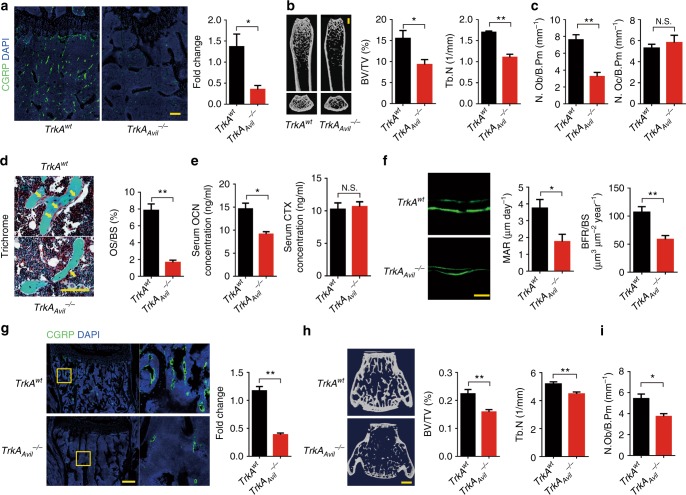
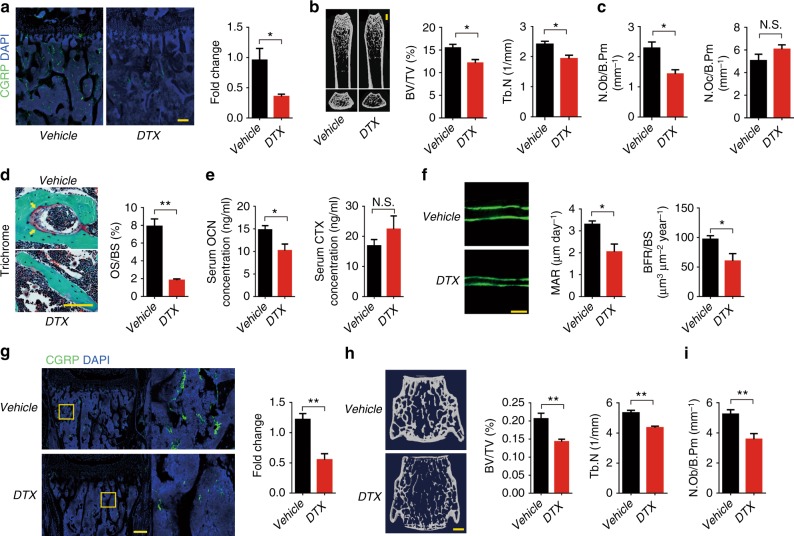
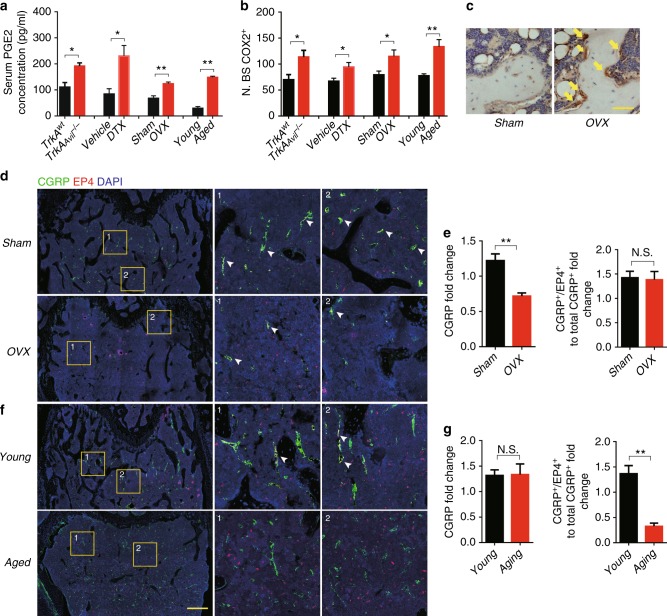
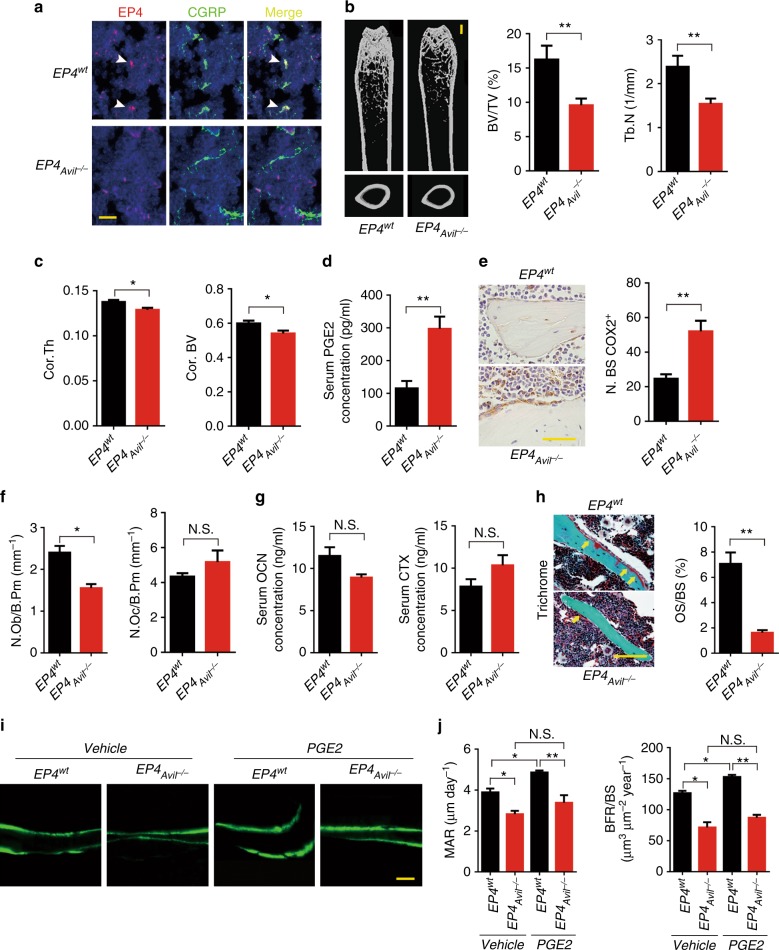
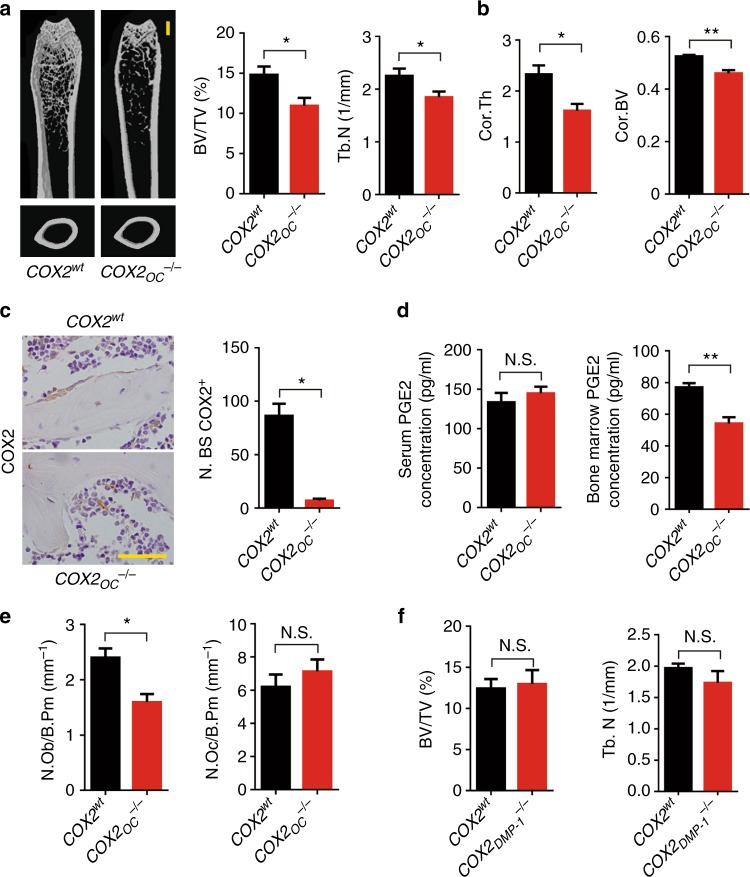
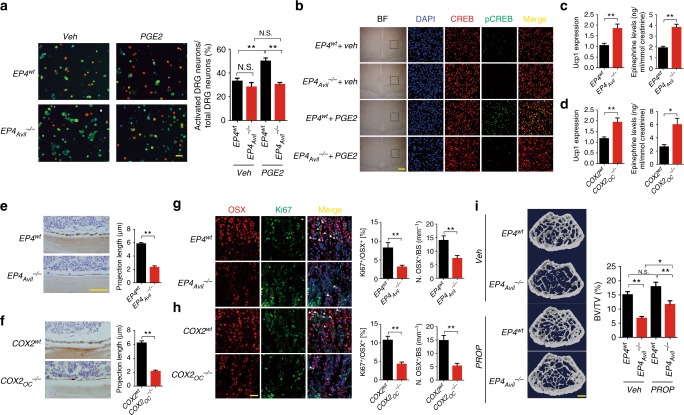
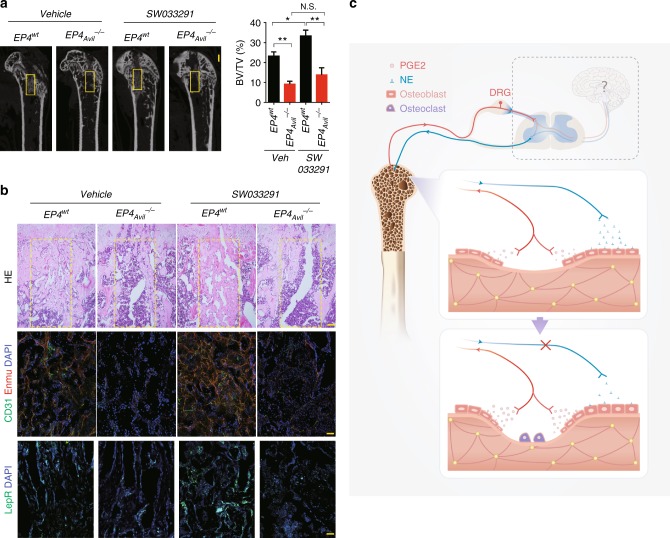
Whether sensory nerve can sense bone density or metabolic activity to control bone homeostasis is unknown. Here we found prostaglandin E2 (PGE2) secreted by osteoblastic cells activates PGE2 receptor 4 (EP4) in sensory nerves to regulate bone formation by inhibiting sympathetic activity through the central nervous system. PGE2 secreted by osteoblasts increases when bone density decreases as demonstrated in osteoporotic animal models. Ablation of sensory nerves erodes the skeletal integrity. Specifically, knockout of the EP4 gene in the sensory nerves or cyclooxygenase-2 (COX2) in the osteoblastic cells significantly reduces bone volume in adult mice. Sympathetic tone is increased in sensory denervation models, and propranolol, a β2-adrenergic antagonist, rescues bone loss. Furthermore, injection of SW033291, a small molecule to increase PGE2 level locally, significantly boostes bone formation, whereas the effect is obstructed in EP4 knockout mice. Thus, we show that PGE2 mediates sensory nerve to control bone homeostasis and promote regeneration.
Overview
The claims and statistics of this paper haven’t been checked yet.
Free: it reads the open-access text and checks the first 5 claims that cite a source we can check. Create a free account to check every claim.
Integrity signals
Registry
Cites
Statistics
Figures
Verification
Claims the paper makes
The claims and statistics of this paper haven’t been checked yet.
Free: it reads the open-access text and checks the first 5 claims that cite a source we can check. Create a free account to check every claim.
Claims other papers make about this one
Each is checked against this paper’s own text: does it say what the citing paper says it does?
The source backs part of the claim, not all of it — or backs it for a different population, condition or comparison.
In the citing paper
“osteoblast-derived prostaglandin E2 (PGE2) activates EP4 receptors on sensory nerves to relay bone mechanical status to the hypothalamus, where it suppresses sympathetic output and promotes bone formation [44]”
From Interorgan Communications in Skeletal Pathophysiology: From Molecular Pathways to Multidisciplinary Therapies (2026) · cites this paper as [44]
Experimental — accuracy not yet measured
Self-check
Percentages, sums and reported differences re-computed from the paper’s own numbers.
The self-check needs the paper’s full text.
Citations
Cites
Coupling of angiogenesis and osteogenesis by a specific vessel subtype in bone
Kusumbe, A. P., Ramasamy, S. K., & Adams, R. H. (2014) · Nature · doi:10.1038/nature13145 · Cited by 2,155
Leptin Inhibits Bone Formation through a Hypothalamic Relay
Ducy, P., Amling, M., Takeda, S., Priemel, M., Schilling, A. F., Beil, F. T., Shen, J., Vinson, C., Rueger, J. M., & Karsenty, G. (2000) · Cell · doi:10.1016/s0092-8674(00)81558-5 · Cited by 2,077
Nociceptor Sensory Neuron–Immune Interactions in Pain and Inflammation
Pinho-Ribeiro, F. A., Verri, W. A., & Chiu, I. M. (2017) · Trends in Immunology · doi:10.1016/j.it.2016.10.001 · Cited by 1,027
PDGF-BB secreted by preosteoclasts induces angiogenesis during coupling with osteogenesis
Xie, H., Cui, Z., Wang, L., Xia, Z., Hu, Y., Xian, L., Li, C., Xie, L., Crane, J., Wan, M., et al. (2014) · Nature Medicine · doi:10.1038/nm.3668 · Cited by 951
Self-citationCentral mechanisms of pathological pain
Kuner, R. (2010) · Nature Medicine · doi:10.1038/nm.2231 · Cited by 790
Origins of skeletal pain: sensory and sympathetic innervation of the mouse femur
Mach, D. B., Rogers, S. D., Sabino, M. C., Luger, N. M., Schwei, M. J., Pomonis, J. D., Keyser, C. P., Clohisy, D. R., Adams, D. J., O’Leary, P., et al. (2002) · Neuroscience · doi:10.1016/s0306-4522(02)00165-3 · Cited by 677
Yadav, V. K., Oury, F., Suda, N., Liu, Z.-W., Gao, X.-B., Confavreux, C., Klemenhagen, K. C., Tanaka, K. F., Gingrich, J. A., Guo, X. E., et al. (2009) · Cell · doi:10.1016/j.cell.2009.06.051 · Cited by 661
A reproducible and well-tolerated method for 2/3 partial hepatectomy in mice
Mitchell, C., & Willenbring, H. (2008) · Nature Protocols · doi:10.1038/nprot.2008.80 · Cited by 577
Sema3A regulates bone-mass accrual through sensory innervations
Fukuda, T., Takeda, S., Xu, R., Ochi, H., Sunamura, S., Sato, T., Shibata, S., Yoshida, Y., Gu, Z., Kimura, A., et al. (2013) · Nature · doi:10.1038/nature12115 · Cited by 415
Osteoblasts remotely supply lung tumors with cancer-promoting SiglecF high neutrophils
Engblom, C., Pfirschke, C., Zilionis, R., Da Silva Martins, J., Bos, S. A., Courties, G., Rickelt, S., Severe, N., Baryawno, N., Faget, J., et al. (2017) · Science · doi:10.1126/science.aal5081 · Cited by 389
Cited by
Items 201–300 of 331
Jin, Z., Chen, J., Shan, Z., Liu, W., Wen, Z., Shao, H., Liang, T., Chen, Z., Ren, X., Tan, D., et al. (2025) · Journal of Orthopaedic Translation · doi:10.1016/j.jot.2025.05.011 · Cited by 7
“Recent preclinical studies have identified the crosstalk between the central nervous system and peripheral skeletal system, where specific brain areas can regulate bone homeostasis and bone mass, which can also possibly regulate the fracture healing process [33,34].”
Comparative analysis of fat composition in marrow, serum, and muscle from aging C57BL6 mice
Saedi, A. A., Wang, Z., Shah, A. D., Brotto, M. A. P., & Duque, G. (2022) · Mechanisms of Ageing and Development · doi:10.1016/j.mad.2022.111690 · Cited by 9
Brown fat-specific mitoribosomal function is crucial for preventing cold exposure-induced bone loss
Tian, J., Moon, J. S., Nga, H. T., Lee, H. Y., Nguyen, T. L., Jang, H. J., Setoyama, D., Shong, M., Lee, J. H., & Yi, H. (2024) · Cellular and Molecular Life Sciences · doi:10.1007/s00018-024-05347-4 · Cited by 6
Lin, R., Lin, H., Zhu, C., Zeng, J., Hou, J., Xu, T., Tan, Y., Zhou, X., Ma, Y., Yang, M., et al. (2024) · Journal of Orthopaedic Translation · doi:10.1016/j.jot.2024.09.005 · Cited by 10
Self-citationDenervation delays initial bone healing of rat tooth extraction socket
Sheng, Z., Zheng, F., Li, J., Wang, Y., Du, Y., Liu, X., & Yu, X. (2022) · Odontology · doi:10.1007/s10266-022-00773-x · Cited by 6
“Sensory denervation increases potential of bisphosphonates to induce osteonecrosis [18] and erodes the skeletal integrity [15].”
BackgroundThe Potential Role of Exercise Training and Mechanical Loading on Bone-Associated Skeletal Nerves
Negri, S., Samuel, T. J., & Lee, S. (2021) · Journal of Bone Metabolism · doi:10.11005/jbm.2021.28.4.267 · Cited by 6
“Sensory nerves that transmit pain sensation have been found to innervate the bone tissue and promote bone regeneration.[29-34] NGF stimulates the proliferation of sensory nerve fibers and increases sensory axonal growth, NGF treatment has been performed as an osteoanabolic mediator.”
BackgroundInfluentialCai, G., Xiao, Y., Yang, M., Guo, Q., Su, T., Liu, Y., Jiang, T., & Li, C. (2022) · PeerJ · doi:10.7717/peerj.13475 · Cited by 6
Self-citationBeeve, A. T., Hassan, M. G., Li, A., Migotsky, N., Silva, M. J., & Scheller, E. L. (2025) · JBMR Plus · doi:10.1093/jbmrpl/ziaf006 · Cited by 5
Mao, W., Zhang, X., Li, K., Lin, W., Liu, X., Shi, Y. L., Liu, T., Pan, C., Liu, J., Wang, H. H., et al. (2025) · Cell Biomaterials · doi:10.1016/j.celbio.2025.100015 · Cited by 6
Self-citationChen, Y., Zhang, Z., Ti, H., Wu, J., Yuan, F., & Li, X. (2025) · Journal of Orthopaedic Surgery and Research · doi:10.1186/s13018-025-05944-4 · Cited by 5
“Recent studies have focused on the interplay between peripheral nerves and bone, offering new possibilities for osteoporosis treat-ment [39–41].”
The liver-bone axis: an emerging player in disease pathogenesis and therapeutic intervention
Han, S., Wei, Y., Yu, G., Jia, W., Liao, W., He, Y., Cheng, K., Zhao, J., Xiang, S., Zhang, W., et al. (2026) · Science China Life Sciences · doi:10.1007/s11427-025-3207-5 · Cited by 5
“In fact, recent studies have demonstrated that the sympathetic nervous system (SNS) plays a role in regulating the generation and differentiation of osteoblasts (Chen et al., 2019; Guo et al., 2023).”
Feng, C., Qiao, C., Ji, W., Pang, H., Li, W., Feng, Q., Ge, Y., & Rui, M. (2024) · International Journal of Biological Macromolecules · doi:10.1016/j.ijbiomac.2024.133263 · Cited by 6
Zhou, Y., Xu, W., Ruan, B., Zhu, L., Jiang, Y., Cai, H., & Huang, J. (2024) · Angewandte Chemie International Edition · doi:10.1002/anie.202416002 · Cited by 5
Liu, Z., Lin, Z., Chen, Y., Lu, M., Hong, W., Yu, B., & Liu, G. (2024) · Journal of Cellular and Molecular Medicine · doi:10.1111/jcmm.70247 · Cited by 5
Regenerative Potential of Neural Stem/Progenitor Cells for Bone Repair
Muangsanit, P., Yuddnaraveesak, P., & Singhatanadgit, W. (2025) · Tissue Engineering Part B Reviews · doi:10.1089/ten.teb.2024.0188 · Cited by 6
“24 To sum up, NSPCs could serve as valuable agents in modulating the in fl ammatory environment to promote bone repair and regeneration.”
Wei, X., Li, M., You, J., Luo, J., Zhai, J., Zhang, J., Feng, J., Wang, H., & Zhou, Y. (2025) · International Journal of Nanomedicine · doi:10.2147/ijn.s505677 · Cited by 5
“22,23,145 Following neuronal depolarization at their endings, CGRP is released and exerts its biological functions in bone regeneration, including angiogenesis and osteogenesis.”
NSAID-mediated cyclooxygenase inhibition disrupts ectodermal derivative formation in axolotl embryos
Marshall, E. J., Ramarapu, R., Leathers, T. A., Morrison‐Welch, N., Sandberg, K., Kawashima, M., & Rogers, C. D. (2025) · Differentiation · doi:10.1016/j.diff.2025.100856 · Cited by 5
“Despite being well-studied in normal tissue homeostasis (Chen et al., 2019; Goldyne, 2000; Lopez and Ballaz, 2020; Sellers et al., 2010; Vegiopoulos et al., 2010), pathophysiologic inflammation (Coon et al., 2007; Hoozemans et al., 2008; Jackson et al., 2000; Park and Christman, 2006; Sales and…”
Liver Neurobiology: Regulation of Liver Functions by the Nervous System
Mravec, B., & Szántová, M. (2025) · Seminars in Liver Disease · doi:10.1055/a-2562-2000 · Cited by 6
“130 In support of this, Chen et al 131 demonstrated that genetic depletion of sensory nerves impaired liver regeneration in mice with partial hepatectomy.”
The Role of PGE2 in Age-related Diseases
Guan, J., Chen, C., Wu, S., & Zhu, H. (2025) · Current Drug Targets · doi:10.2174/0113894501383329250616070727 · Cited by 5
Regulation of tissue regeneration and repair by the peripheral nervous system
Wakelin, G., & Johnston, A. P. W. (2025) · Development · doi:10.1242/dev.205116 · Cited by 6
PGE2 Ameliorates Aging-Aggravated Rotator Cuff Muscle Atrophy
Shu, L., Wang, X., Wang, H., Tang, Y., Wang, C., & Zhang, Y. (2025) · Journal of Bone and Joint Surgery · doi:10.2106/jbjs.24.00866 · Cited by 5
Self-citationSympathosensory interactions – Possible relevance in osteoarthritis
Jenei‐Lanzl, Z., Grässel, S., Schaible, H., & Straub, R. H. (2025) · Osteoarthritis and Cartilage · doi:10.1016/j.joca.2025.12.001 · Cited by 5
Prostaglandin E₂ (PGE₂) in tissue regeneration: Its role and therapeutic strategies
Wang, W., Pan, K., Yang, J., & Li, Z. (2025) · EXCLI journal · doi:10.17179/excli2025-9025 · Cited by 8
Research progress on mitochondria in bone defect repair: mechanisms and therapeutic implications
Hu, Z., Chen, G., & Long, Z. (2026) · Frontiers in Bioengineering and Biotechnology · doi:10.3389/fbioe.2026.1763027 · Cited by 4
Wen, R., Wang, H., & Wang, S. (2026) · Journal of Orthopaedic Translation · doi:10.1016/j.jot.2026.101119 · Cited by 5
“Conversely, prostaglandin E2 receptor EP4 agonists activate the sensory nerve-OB pathway in an EP4 receptor-dependent manner, promoting OB proliferation, differentiation, and bone microarchitecture improvement [98].”
Li, Q., Long, X., Wang, L., Yang, X., Yang, X., Hu, B., Zhu, C., Zhang, Z., Deng, Z., Li, J., et al. (2024) · Chemical Engineering Journal · doi:10.1016/j.cej.2024.158258 · Cited by 7
Self-citationChen, P., & Lin, J. (2025) · Tissue and Cell · doi:10.1016/j.tice.2025.103025 · Cited by 4
Li, Q., Zang, Y., An, D., Yin, S., Wu, H., Wang, M., Li, C., Zhou, Y. M., Liu, L., & Zhang, X. (2025) · Journal of Medicinal Chemistry · doi:10.1021/acs.jmedchem.5c01361 · Cited by 4
Boraschi-Diaz, I., Chen, G., Polak-Nachumow, J., Young, R. N., & Rauch, F. (2021) · Bone · doi:10.1016/j.bone.2021.115867 · Cited by 4
Basolateral Amygdala Mediates Central Mechanosensory Feedback of Musculoskeletal System
Liu, N., Li, B., Zhang, L., Yang, D., & Yang, F. (2022) · Frontiers in Molecular Neuroscience · doi:10.3389/fnmol.2022.834980 · Cited by 5
“, 2013) and the sympathetic nervous system is known to inhibit bone mass accrual (Chen et al., 2019).”
BackgroundShiwaku, Y., Okawa, H., Suzuki, I., Sakai, S., Egusa, H., & Suzuki, O. (2024) · Acta Biomaterialia · doi:10.1016/j.actbio.2024.08.054 · Cited by 4
SW033291 promotes liver regeneration after acetaminophen-induced liver injury in mice
Li, J., Liu, H., Jia, Y., Tuniyazi, X., Liao, X., Zhao, J., Du, Y., Fang, Z., & Lü, G. (2025) · Biochemical and Biophysical Research Communications · doi:10.1016/j.bbrc.2025.151365 · Cited by 5
Aitongxiao improves pain symptoms of rats with cancer pain by reducing IL-1, TNF-α, and PGE2.
Mao, M., Li, Y., Wang, L., Chen, J., Ming, X. L., Sun, Y., Lu, Y. E., & Ning, J. (2021) · PubMed · Cited by 4
Self-citationWu, Z., Li, N., Luo, Z., Chen, Z., He, X., Han, J., Lin, X., Shi, F., Huang, H., Shi, B., et al. (2025) · Journal of Clinical Investigation · doi:10.1172/jci193014 · Cited by 6
“Whereas sensory nerves significantly regulate cortical bone mass (70, 71), alteration in sympathetic innervation results only in a modest cortical bone phenotype in Slit2 th mice, indicating that sensory nerves, rather than sympathetic nerves, may primarily support osteogenesis driven by PSCs,…”
Self-citationWu, Z.-G., Zhao, Q.-Q., Lin, S., Lei, J.-Y., Yang, C.-J., Sun, S., Yang, Z.-Q., Ni, S.-H., Chen, X.-L., & Lu, L. (2026) · npj Aging · doi:10.1038/s41514-026-00433-2 · Cited by 4
“Muscle-resident macrophages normally support regeneration through secretion of PGE2, which activates EP4 signaling on muscle stem cells (MuSCs) 233 .”
Self-citationThe sensory nerve regulates stem cell homeostasis through Wnt5a signaling
Zhang, T., Liu, J., Jin, W., Nie, H., Chen, S., Tang, X., Liu, R., Wang, M., Chen, R., Lu, J., et al. (2024) · iScience · doi:10.1016/j.isci.2024.111035 · Cited by 3
“32,33 36 To study the ideal objects for the stem cell niche, the incisors of rodents were considered.”
Developments of Thermosensitive Hydrogel for Maxillofacial Bone Regeneration
Zhang, Q., Wu, Y., Dai, J., Jia, Z., Zhu, M., Li, X., Xiao, L., Li, J., Dai, Z., Bai, Y., et al. (2025) · Small Science · doi:10.1002/smsc.202500225 · Cited by 4
Lu, Z., Liu, C., Tang, C. Y., Tan, J., Chang, H., Chen, Y.-J., Li, G., Lu, W., Wang, Y., & Zhang, J. (2025) · Journal of Hazardous Materials · doi:10.1016/j.jhazmat.2025.140025 · Cited by 4
Herz, C., Frei, L., Tran, H. T. T., Claßen, S., Spöttel, J., Krell, M., Hanschen, F. S., Arvandi, M., Binder, N., Schreiner, M., et al. (2023) · Frontiers in Nutrition · doi:10.3389/fnut.2023.1223158 · Cited by 3
“It is involved in temperature regulation (11), crucial for muscle regeneration, or osteoblast bone formation (26, 27).”
BackgroundBasic knowledge and research methods
Zheng, K., Deng, M., Yang, Y., Zhou, J., Hou, Y., Chen, L., Ma, Y., Chen, Y., Chen, H., Guo, X., et al. (2023) · Elsevier eBooks · doi:10.1016/b978-0-323-96123-3.00001-4 · Cited by 3
Self-citationZhu, M., Zeiss, C. J., Hamrick, M. W., Weinstein, R. S., Sun, B., Brotto, M., Liu, X., Siu, E., Huttner, A. J., Tommasini, S. M., et al. (2024) · Bone · doi:10.1016/j.bone.2024.117086 · Cited by 3
The role of sympathetic control in bone vasculature: insights from spinal cord injury
Sukhoplyasova, M., Hamner, J. W., & Draghici, A. E. (2024) · Journal of Bone and Mineral Research · doi:10.1093/jbmr/zjae204 · Cited by 3
Kao, Y.-F., Tu, M.-C., Chai, H., Lin, Y., & Chen, Y. (2020) · Journal of the Chinese Medical Association · doi:10.1097/jcma.0000000000000447 · Cited by 3
Mohn, C. E., Troncoso, G. R., Ossola, C. A., Bozzini, C., Elverdin, J. C., & Fernández‐Solari, J. (2023) · Odontology · doi:10.1007/s10266-023-00872-3 · Cited by 2
Severe traumatic brain injury and risk for osteoporosis: a Mendelian randomization study
Wang, G., Wang, J., Yang, D., Liu, L., & Xu, P. (2025) · BMC Medical Genomics · doi:10.1186/s12920-025-02127-2 · Cited by 2
“For example, the cAMP-response element binding protein (CREB) signaling pathway in the ventromedial hypothalamic nucleus (VMH) is an important factor affecting bone metabolism via sympathetic nerves [10].”
Yin, M., Shi, H., Lv, C., Shi, L., Xie, L., Yu, G., & Xu, K. (2025) · Medicine Plus · doi:10.1016/j.medp.2025.100104 · Cited by 2
Kim, M., Kim, H. J., Lee, Y., Lee, S., Lim, D., Park, H. D., & Shin, D. W. (2025) · Molecules · doi:10.3390/molecules31010123 · Cited by 2
An ROS-scavenging dual-network hydrogel for diabetic bone regeneration
Cai, Z., Xu, W., Zhang, Q., Zhou, X., Zeng, J., Wang, Z., Deng, P., Sun, P., Tang, F., Jiang, X., et al. (2026) · Chemical Engineering Journal · doi:10.1016/j.cej.2026.175305 · Cited by 2
Neuro-osteo crosstalk: The sympathetic nervous system as a key driver of SCI-induced osteoporosis
Bryan, J. A., Jackson, W., Lemmens, N., & Hook, M. A. (2026) · Experimental Neurology · doi:10.1016/j.expneurol.2026.115824 · Cited by 2
Directing Neutrophil Fate via Sensory–Immune Interactions Accelerates Diabetic Bone Healing
Qi, X., Huang, Y., Li, Y., Chen, J., Zhou, M., Mei, L., Xu, Z., Lin, S., & Jiang, X. (2026) · Research · doi:10.34133/research.1320 · Cited by 2
Hu, Q., Qi, B., Dong, Y., Pan, Y., Liu, Y., Chen, Z., Fang, J., Liang, Y., & Zhang, P. (2026) · Bone Research · doi:10.1038/s41413-026-00561-1 · Cited by 2
“20 Therefore, elevated PGE2 levels in the subchondral bone simultaneously promote enhanced local sensory innervation and increased H-type angiogenesis.”
[Research progress on mechanism of traumatic brain injury promoting fracture healing].
Li, H., Han, F., Meng, J., Chang, W., & Feng, L. (2024) · PubMed Central · doi:10.7507/1002-1892.202310045 · Cited by 3
The Interplay of Lipid Signaling in Musculoskeletal Cross Talk: Implications for Health and Disease
Saedi, A. A., Yacoub, A. S., Awad, K. R., Karasik, D., Brotto, M., & Duque, G. (2024) · Methods in molecular biology · doi:10.1007/978-1-0716-3902-3_1 · Cited by 3
Senso-immunology: the hidden relationship between sensory system and immune system
Miyamoto, S., Takayama, Y., Kondo, T., & Maruyama, K. (2024) · Journal of Bone and Mineral Metabolism · doi:10.1007/s00774-024-01538-y · Cited by 2
“…there are reports that magnesium-stimulated primary sensory neurons promote bone formation via CGRP production [43], and that prostaglandin E2 (PGE2) secreted by osteoblasts promotes bone formation by inhibiting sympathetic nerve activity through activation of primary sensory neurons [44].”
Innervation of bones. Sensory innervation. Part I: a literature review
Khodorovskaya, A. М., Agranovich, O. Е., Savina, M. V., Garkavenko, Y. E., Melchenko, E. V., Filin, Y. A., & Gorelik, K. E. (2024) · Pediatric Traumatology Orthopaedics and Reconstructive Surgery · doi:10.17816/ptors642092 · Cited by 2
Xu, C., Luo, Y., Cai, Z., Ji, J., Guo, Z., Cai, Z., You, C., Zhou, Y., Chen, Z., Zhang, W., et al. (2025) · Bioactive Materials · doi:10.1016/j.bioactmat.2025.06.019 · Cited by 8
“Osteoblasts and macrophages have been reported as the main cell courses to secret PGE2 [20,38].”
Primary Hypertrophic Osteoarthropathy: A Case Series
Singh, R., Kishore, K., Sankar, J., Gupta, A. K., Kumar, A., Sharma, D. P., & Padwal, P. (2025) · Journal of Marine Medical Society · doi:10.4103/jmms.jmms_108_25 · Cited by 2
Gan, D., Qin, L., & Xiao, G. (2026) · Research · doi:10.34133/research.1319 · Cited by 1
“Specifically, osteoblast-derived prostaglandin E2 (PGE2) activates EP4 receptors on sensory nerves to relay bone mechanical status to the hypothalamus, where it suppresses sympathetic output and promotes bone formation [ 44 ].”
Essential roles of sensory nerve in maintenance of cornea-phenotype in mice
Okada, Y., Sumioka, T., Iwanishi, H., Yasuda, S., Zhang, J., Yuan, Y., Liu, C., Kao, W. W.-Y., & Saika, S. (2025) · The Ocular Surface · doi:10.1016/j.jtos.2025.02.012 · Cited by 1
Li, J., Jia, S., Guo, J., Xie, W., Ma, Y., Gao, X., & Gao, M. (2025) · BMC Pediatrics · doi:10.1186/s12887-025-05590-z · Cited by 1
“It also mediates skeletal homeostasis through sensory nerves and promotes bone regeneration and deposition [25].”
Shao, Z., Wang, W., Wang, Y., Chen, S., Ling, Z., Zhou, X., Zhao, W., & Zhao, C. (2026) · Advanced Healthcare Materials · doi:10.1002/adhm.202504760 · Cited by 1
“Prostaglandin E2 (PGE 2 ) is a multifunctional molecule in which evidence shows that PGE 2 can elicit primary pain and prolong nociceptor sensitization [62, 63].”
Stem Cells and their Key Derivatives in Degenerative Musculoskeletal Diseases
Khan, N., Ahmadova, Z., Zeng, B., Ahmed, W., Shafiq, T., Zhang, Z., Su, A., Muhammad, N., Khan, S., Liang, Y., et al. (2026) · Stem Cell Reviews and Reports · doi:10.1007/s12015-026-11080-1 · Cited by 1
Denervation induces rapid bone degeneration concurrent to neurovascular and mechanical changes
Pan, K., Cheng, X., Wu, Y., Orozco, E., Shin, S. H., Du, J., Ma, Y., Jerban, S., Hughes‐Austin, J. M., Bukata, S. V., et al. (2026) · Bone · doi:10.1016/j.bone.2026.117863 · Cited by 2
Chen, Y., Shen, H., Wang, Z., Zhu, W., Lu, W., Shen, J., Li, W., Zhang, Y., Yang, G., Wu, Y., et al. (2026) · Ecotoxicology and Environmental Safety · doi:10.1016/j.ecoenv.2026.120088 · Cited by 1
Talin1 loss activates DRG neurons to accelerate bone remodeling and fracture healing in mice
Yan, Q., Gan, D., Xu, K., Chen, Z., Lin, S., Zhou, B., Xu, Z., Zhong, Q., Tao, C., Zhong, Y., et al. (2026) · Journal of Orthopaedic Translation · doi:10.1016/j.jot.2026.101113 · Cited by 2
“Besides receiving skeletal pain signals, sensory nerve fibers have been shown to play functional roles in bone development and homeostasis [1,8 – 10], as well as in fracture healing and cranial defect repair [11,12].”
Zhao, Y., Wei, X., Wu, H., Yao, C., Zheng, Z., Chen, W., Feng, Z., Bao, H., Cai, Z., Xue, Q., et al. (2026) · The FASEB Journal · doi:10.1096/fj.202600672r · Cited by 1
“Since prostaglandin E2 (PGE2) is known to mediate sensory nerve regulation of bone homeostasis [27, 28], we then examined enzymes associated with PGE2 synthesis and found no significant changes after A939572 treatment, ruling out the role of PGE2 in this process (Figure S2E).”
Unraveling stress fractures: from cellular and molecular mechanisms to therapeutic approaches
Pu, P., Zhang, X., Zhang, S., Chen, H., Lei, Q., Song, T., Wang, C., Xie, Y., & Chen, L. (2026) · Journal of Orthopaedic Translation · doi:10.1016/j.jot.2026.101185 · Cited by 2
“…may impair angiogenesis [177,178], inhibit osteoblast differentiation in periosteal woven bone [179,180], and delay sensory nerve regeneration [181], thereby potentially disrupting the coordinated interplay among inflammation, neurovascular remodeling, and osteogenesis essential for…”
Self-citationImmunological Basis of Inflammatory Arthritides
Kalliolias, G. D., & Skokos, D. (2019) · Springer eBooks · doi:10.1007/978-3-030-23022-7_1 · Cited by 2
Age and sex changes in the mass, length and width of the scapula of Romanov sheep during ontogenesis
Алексеевич, И. Е., Сергеевич, Д. М., Kicheeva, T. G., Фисенко, С. П., Panuev, M. S., Shishkina, D. A., Glukhova, E. R., & Пронин, В. В. (2019) · IOP Conference Series Earth and Environmental Science · doi:10.1088/1755-1315/341/1/012044 · Cited by 1
“Introduction The skeleton of domestic animals has been studied by many researchers [1-6], because people have to deal with its various disorders (underdevelopment, loss of strength, lacking or excessive mineralization) that cause bone and general diseases.”
BackgroundCharacteristics of bone metabolism in the male patients with diabetic neuropathy
Huang, D., Zeng, Y., Ding, H.-R., Zhang, Z.-K., Wang, Y., Han, D., Zhang, X., & Song, L. (2024) · Journal of the Chinese Medical Association · doi:10.1097/jcma.0000000000001062 · Cited by 2
“15 PGE2 can bind to EP4 in the sensory nerve and regulate sympathetic nervous activity through the central nervous system to form osteoblastic bone.”
BackgroundInfluentialBone mechanical loading reduces heart rate and increases heart rate variability in mice
Vallejo, J. A., Gray, M., Klump, J., Wacker, A., Dallas, M., Johnson, M. L., & Wacker, M. (2025) · Bone Reports · doi:10.1016/j.bonr.2025.101844 · Cited by 1
“In addition to its elegant self-regulatory ability, bone has emerged as a multifaceted organ, exhibiting endocrine functions (Robling and Bone-wald, 2020) as well as being linked to the central/peripheral nervous system (Tomlinson et al., 2017; Chen et al., 2019).”
InfluentialDeng, J., Wang, S., Yuan, S., Lü, Q., Gu, X., Huang, C., Guo, S., Yu, D., & Yin, X. (2025) · Scientific Reports · doi:10.1038/s41598-025-17561-6 · Cited by 1
“as evidenced by prostaglandin E2 receptor 4 knockout models demonstrating impaired osteogenesis 16 .”
Bone Remodeling and Homeostasis
Zhen, G., & Cao, X. (2020) · Elsevier eBooks · doi:10.1016/b978-0-12-801238-3.11180-8 · Cited by 1
Self-citationSugiatno, E., Herminajeng, E., & Sosroseno, W. (2019) · World Journal of Dentistry · doi:10.5005/jp-journals-10015-1678
Liu, B., Ji, C., Shao, Y., Liang, T., He, J.-H., Jiang, H., Chen, G., & Luo, Z. (2020) · doi:10.21203/rs.2.20150/v1
Aberrant Subchondral Metabolism Activates Piezo2 to Induce OsteoarthritisPreprint
Han, F., Zhu, Y., Wu, W., Luo, H., Guo, B., Hu, Y., & Zhu, J. (2021) · SSRN Electronic Journal · doi:10.2139/ssrn.3864023
Proteomics of Human Bone Tissue Reveals Potential Key Molecules in OsteoporosisPreprint
Wang, A., Chen, B., Zhang, H., Li, G., Jia, P., Wang, X., Liu, B., Cao, Z., Li, J., Liu, G., et al. (2022) · SSRN Electronic Journal · doi:10.2139/ssrn.4008929
Self-citationTanaka, S. (2020) · Faculty Opinions – Post-Publication Peer Review of the Biomedical Literature · doi:10.3410/f.737590438.793575232
Liu, B., Ji, C., Shao, Y., Liang, T., He, J., Jiang, H., Chen, G., & Luo, Z. (2020) · doi:10.21203/rs.2.23391/v1
Frolova, T. M., Golounina, O. O., Mamedova, E., Litvinova, E. E., & Belaya, Z. E. (2023) · Osteoporosis and Bone Diseases · doi:10.14341/osteo13136
Pain syndrome in multiple myeloma (results of a single-center study)
Soloveva, M. V., Solovev, M. V., Irugova, E. Z., Startsev, A. A., Арутюнян, Н. К., Крайзман, А. А., Abakumova, A. V., & Менделеева, Л. П. (2024) · Oncohematology · doi:10.17650/1818-8346-2024-19-3-224-232
Zhou, Y., Xu, W., Ruan, B., Zhu, L., Jiang, Y., Cai, H., & Huang, J. (2024) · Angewandte Chemie · doi:10.1002/ange.202416002
Liu, W., Dai, Y., Liu, J., Lin, J., & Wang, S. (2025) · Medicine · doi:10.1097/md.0000000000043164 · Cited by 1
“[3] In Europe and the United States, OP fractures represent a significant public health challenge, with incidence rates approaching 33% in the general population and escalating to approximately 50% among postmenopausal women, thereby imposing substantial healthcare economic pressures.”
Osteoporosis and Sympathetic Nerve Activity: A Review
Ahmed, F., Ahmad, S. S., Najmi, A. K., & Khan, M. A. (2025) · Research Journal of Pharmacy and Technology · doi:10.52711/0974-360x.2025.00415
Chen, L., Zhang, C., Li, X., Zhang, J., Zou, J., Zhang, S., Zhang, J., Liu, X., Liu, Y., Ma, Z., et al. (2025) · Phytomedicine · doi:10.1016/j.phymed.2025.157382
Cui, Y., Xiang, Q., Zhao, K., Li, J. J., Che, B., Zheng, K., Gao, Y., Guo, S., & Fu, D. (2025) · doi:10.22541/au.176150016.60795129/v1
PTGS2 Is Involved in Osteonecrosis of the Femoral Head and Bone Marrow Edema
Lin, C. K., Li, R., Lu, H., Wang, H., Li, H., Fang, H., Tang, H., & Liu, H. (2025) · International Journal of Genomics · doi:10.1155/ijog/8835132
“In our study, XLGBC can e ff ectively inhibit the secretion of PTGS2 and promote osteogenic di ff erentiation of BMSCs, which may constitute a potential mechanism by which it ameliorates local osteogenic insu ffi ciency in the femoral head, thereby exerting a therapeutic e ff ect on ONFH [33].”
Wang, F., Cheng, Q., Wang, W., Sun, Y., & Bing, Y. (2025) · Research Square · doi:10.21203/rs.3.rs-7412540/v1
Neto, E., Leitão, L., Mateus, J. C., Sousa, D. M., Alves, C. J., Aroso, M., Monteiro, A. C., Conceição, F., Oreffo, R. O. C., West, J. J., et al. (2022) · Figshare · doi:10.6084/m9.figshare.20488814
Wang, Y., Zheng, G., Xie, X., Yu, W., Wang, J., Zang, F., Yang, C., Xiao, Q., Zhang, R., Wei, L., et al. (2023) · Figshare · doi:10.6084/m9.figshare.22622833
Self-citationCosta, P. A. C., Silva, W. N., Prazeres, P. H. D. M., Picoli, C. C., Guardia, G. D. A., Costa, A. C., Oliveira, M. A., Guimarães, P. P. G., Gonçalves, R., Pinto, M. C. X., et al. (2021) · Figshare · doi:10.6084/m9.figshare.17030956
Costa, P. A. C., Silva, W. N., Prazeres, P. H. D. M., Picoli, C. C., Guardia, G. D. A., Costa, A. C., Oliveira, M. A., Guimarães, P. P. G., Gonçalves, R., Pinto, M. C. X., et al. (2021) · Figshare · doi:10.6084/m9.figshare.17030947
Costa, P. A. C., Silva, W. N., Prazeres, P. H. D. M., Picoli, C. C., Guardia, G. D. A., Costa, A. C., Oliveira, M. A., Guimarães, P. P. G., Gonçalves, R., Pinto, M. C. X., et al. (2021) · Figshare · doi:10.6084/m9.figshare.17030950
Deficiency of Sensory Afferents Impairs Dental Pulp Stem Cells (DPSCs) in a Mouse Model of Pulpitis
Chiang, H. (2025) · Digital Access to Scholarship at Harvard (DASH) (Harvard University)
Biomimetic Nanoparticles for Bone Regeneration: Construction Strategies and Therapeutic Mechanisms
Wang, Z., Shen, N., Yang, T., Dong, S., Kaige, X., Zhao, K., Zhang, Y., Jiang, Y., & Li, T. (2026) · International Journal of Nanomedicine · doi:10.2147/ijn.s589003 · Cited by 2
“86 Sensory nerve endings release neuropeptides such as calcitonin gene-related peptide (CGRP) and substance P (SP), directly influencing the activity of osteoblasts and osteoclasts to promote bone formation or inhibit bone resorption.”
Bidirectional interaction between the skeletal and nervous systems: a review
Khodorovskaya, A. М., Agranovich, O. Е., Savina, M. V., Garkavenko, Y. E., Melchenko, E. V., Trofimova, S. I., Petrova, E. V., Dreval, A. D., & Вчерашний, Д. Б. (2026) · Pediatric Traumatology Orthopaedics and Reconstructive Surgery · doi:10.17816/ptors701608
Bouhadoun, A. (2022) · theses.fr (ABES) · doi:10.70675/774cb3d0z938ez4b96z85ffze9119702485e
Metadata
- Authors
- Chen, H., Hu, B., Lv, X., Zhu, S., Zhen, G., Wan, M., Jain, A., Gao, B., Chai, Y., Yang, M., Wang, X., Deng, R., Wang, L., Cao, Y., Ni, S., Liu, S., Yuan, W., Chen, H., Dong, X., Guan, Y., Yang, H., & Cao, X.
- Affiliations
- Johns Hopkins University (US)
- Second Military Medical University (CN)
- Howard Hughes Medical Institute (US)
- First Affiliated Hospital of Soochow University (CN)
- Corresponding author
- Yang, Huilin
- Cao, Xu
- ORCID
- Venue
- Nature Communications
- Published
- 2019-01-14
- Volume
- 10
- Issue
- 1
- Pages
- 181-181
- ISSN
- 2041-1723 (ISSN-L)
- PMC
- PMC6331599
- OpenAlex
- W2909717083
- Cited by
- 321
- References
- 55
- Citations by year
- 2026: 41 · 2025: 68 · 2024: 57 · 2023: 45 · 2022: 40 · 2021: 29 · 2020: 28 · 2019: 12
- FWCI
- 9.01
- Type
- journal article
- Language
- en
- Open access
- gold
- doi.org
- Licence
- cc-by
- creativecommons.org/licenses/by/4.0 (tdm)
- creativecommons.org/licenses/by/4.0 (vor)
- Locations
- Nature Communications (publishedVersion, cc-by)
- Europe PMC (PubMed Central) (publishedVersion, other-oa)
- PubMed Central (publishedVersion, cc-by)
- PubMed (publishedVersion)
- RePEc: Research Papers in Economics (submittedVersion)
- DOAJ (DOAJ: Directory of Open Access Journals) (submittedVersion)
- DOAJ (DOAJ: Directory of Open Access Journals) (submittedVersion, cc-by-sa)
- Funders
- Johns Hopkins University
- University of California, Los Angeles
- Topics
- Life Sciences › Biochemistry, Genetics and Molecular Biology › Molecular Biology › Bone Metabolism and Diseases
- Health Sciences › Medicine › Orthopedics and Sports Medicine › Bone health and osteoporosis research
- Health Sciences › Medicine › Pharmacology (medical) › Inflammatory mediators and NSAID effects
- Keywords
- prostaglandin E2, EP4 receptor, sensory nerves, bone homeostasis, osteoblasts, sympathetic nervous system, osteoporosis, bone formation, cyclooxygenase-2, sensory denervation, bone regeneration
- MeSH terms
- Adrenergic beta-Antagonists, Adrenergic Fibers, Animals, Bone and Bones, Bone Regeneration, Cells, Cultured, Disease Models, Animal, Female, Humans, Hydroxyprostaglandin Dehydrogenases, Male, Mice, Inbred C57BL, Osteoblasts, Osteoporosis, Propranolol, Pyridines, Sensory Receptor Cells, Thiophenes, Dinoprostone, Bone Density, Mice, Knockout, Feedback, Physiological, Mice, Cyclooxygenase 2, Receptors, Prostaglandin E, EP4 Subtype
About these checks
Registry, retraction, Cites and statistics results are computed, not judged, with one exception: a printed reference that no index lists is read once by a model before it counts as a citation error. Claims are extracted by a model and kept only when their quote appears verbatim in the text; each cited source is then checked, with a model’s help, for whether it says what the claim relies on. Those verdicts can be wrong — read the claim’s quote and the cited source before relying on one.
Statistics and arithmetic are recomputed, not judged.
Confidence bands are shown only for fields calibrated on our annotated test set. None is calibrated yet, so no band is shown.
What counts as a claim ›How we measure confidence ›How we check this ›
Are you an author, or do you see a problem with this page? Request a review
Data sources
Bibliographic data: Semantic Scholar, OpenAlex, Crossref.
Contains information from the Semantic Scholar Academic Graph Datasets, made available under the ODC Attribution License (ODC-BY 1.0).
Semantic Scholar’s data is described in: Kinney, R., et al. (2023). The Semantic Scholar Open Data Platform. arXiv:2301.10140.
