

Prostaglandin E2 mediates sensory nerve regulation of bone homeostasis
Open accessThe DOI matches its Crossref record; 55 of the 55 references it cites were found in a registry or an index.
Abstract
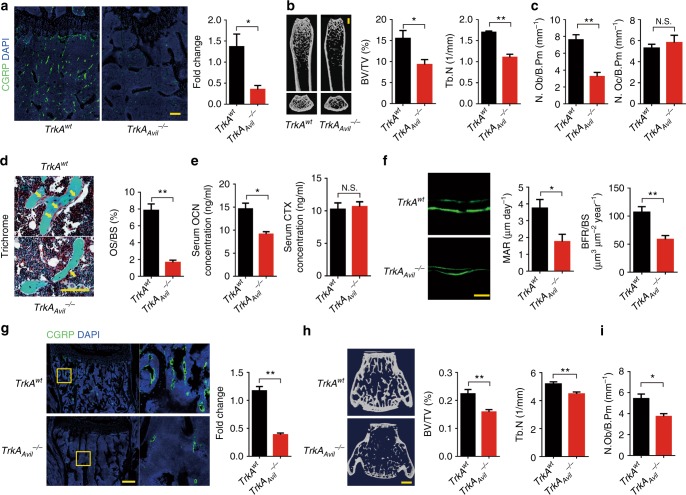
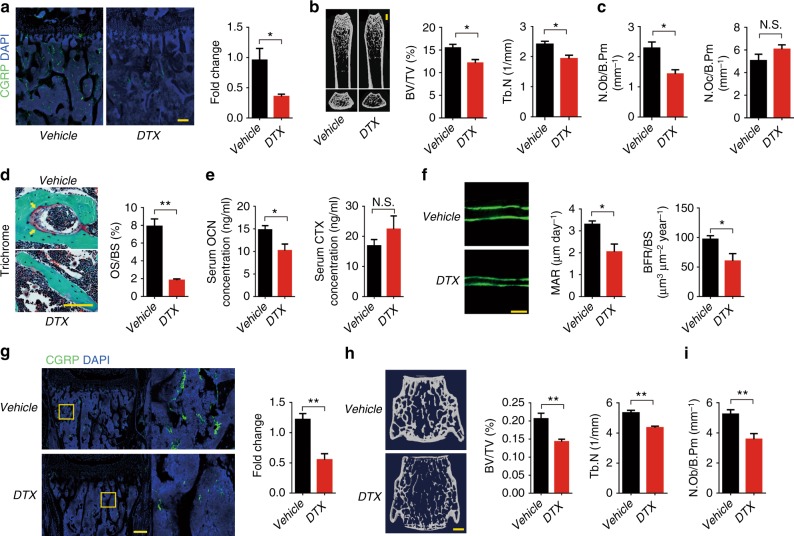
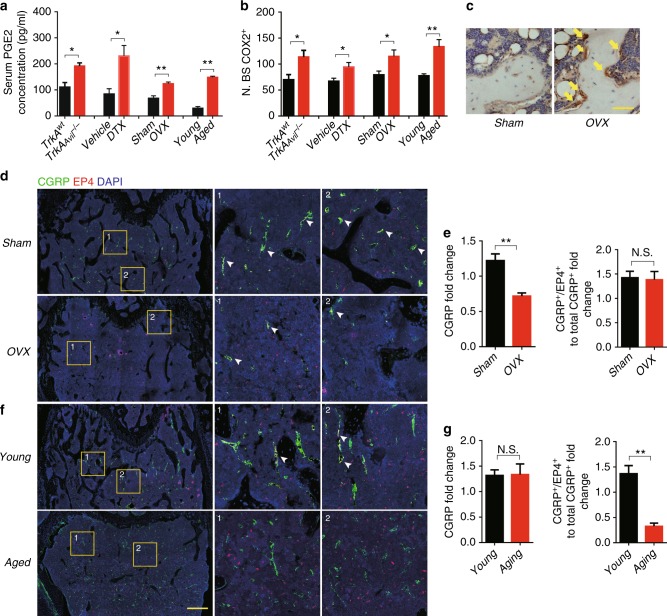
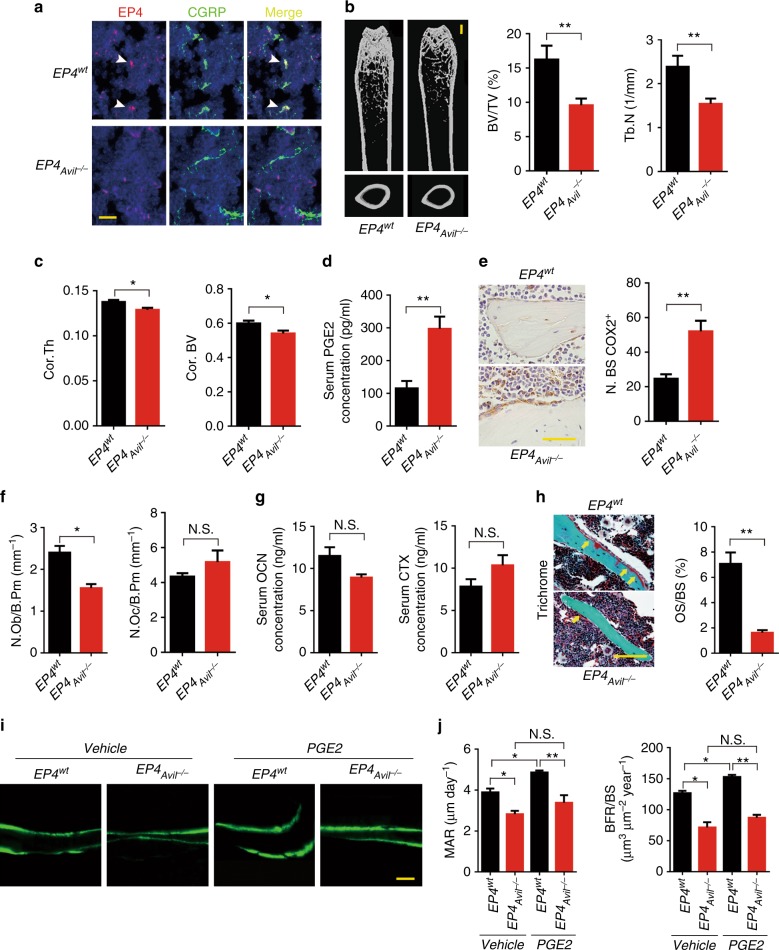
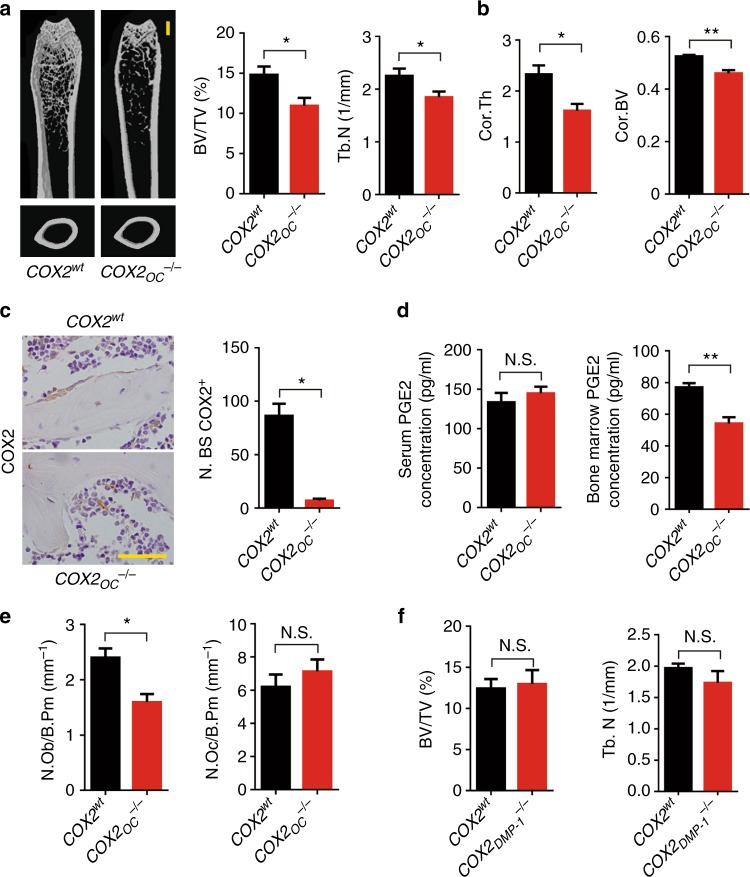
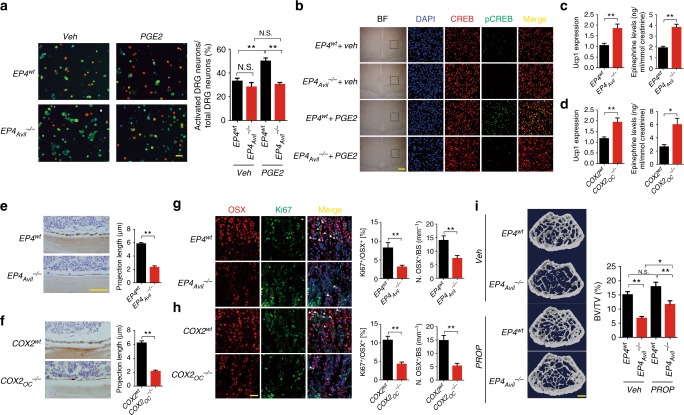
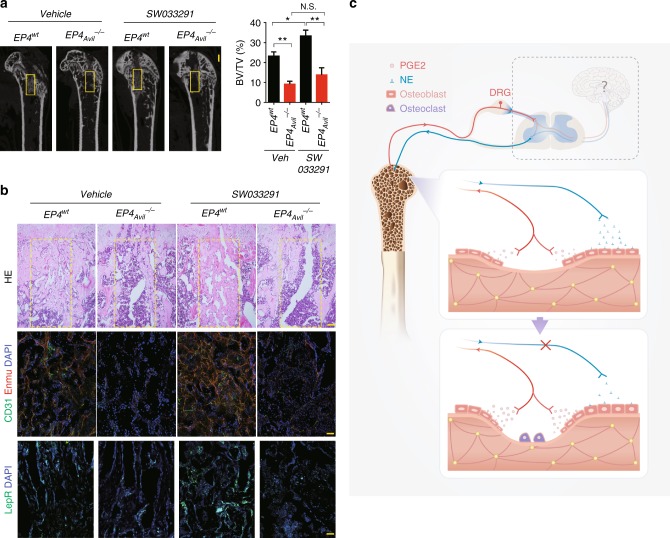
Whether sensory nerve can sense bone density or metabolic activity to control bone homeostasis is unknown. Here we found prostaglandin E2 (PGE2) secreted by osteoblastic cells activates PGE2 receptor 4 (EP4) in sensory nerves to regulate bone formation by inhibiting sympathetic activity through the central nervous system. PGE2 secreted by osteoblasts increases when bone density decreases as demonstrated in osteoporotic animal models. Ablation of sensory nerves erodes the skeletal integrity. Specifically, knockout of the EP4 gene in the sensory nerves or cyclooxygenase-2 (COX2) in the osteoblastic cells significantly reduces bone volume in adult mice. Sympathetic tone is increased in sensory denervation models, and propranolol, a β2-adrenergic antagonist, rescues bone loss. Furthermore, injection of SW033291, a small molecule to increase PGE2 level locally, significantly boostes bone formation, whereas the effect is obstructed in EP4 knockout mice. Thus, we show that PGE2 mediates sensory nerve to control bone homeostasis and promote regeneration.
Overview
The claims and statistics of this paper haven’t been checked yet.
Free: it reads the open-access text and checks the first 5 claims that cite a source we can check. Create a free account to check every claim.
Integrity signals
Registry
Cites
Statistics
Figures
Verification
Claims the paper makes
The claims and statistics of this paper haven’t been checked yet.
Free: it reads the open-access text and checks the first 5 claims that cite a source we can check. Create a free account to check every claim.
Claims other papers make about this one
Each is checked against this paper’s own text: does it say what the citing paper says it does?
The source backs part of the claim, not all of it — or backs it for a different population, condition or comparison.
In the citing paper
“osteoblast-derived prostaglandin E2 (PGE2) activates EP4 receptors on sensory nerves to relay bone mechanical status to the hypothalamus, where it suppresses sympathetic output and promotes bone formation [44]”
From Interorgan Communications in Skeletal Pathophysiology: From Molecular Pathways to Multidisciplinary Therapies (2026) · cites this paper as [44]
Experimental — accuracy not yet measured
Self-check
Percentages, sums and reported differences re-computed from the paper’s own numbers.
The self-check needs the paper’s full text.
Citations
Cites
Coupling of angiogenesis and osteogenesis by a specific vessel subtype in bone
Kusumbe, A. P., Ramasamy, S. K., & Adams, R. H. (2014) · Nature · doi:10.1038/nature13145 · Cited by 2,155
Leptin Inhibits Bone Formation through a Hypothalamic Relay
Ducy, P., Amling, M., Takeda, S., Priemel, M., Schilling, A. F., Beil, F. T., Shen, J., Vinson, C., Rueger, J. M., & Karsenty, G. (2000) · Cell · doi:10.1016/s0092-8674(00)81558-5 · Cited by 2,077
Nociceptor Sensory Neuron–Immune Interactions in Pain and Inflammation
Pinho-Ribeiro, F. A., Verri, W. A., & Chiu, I. M. (2017) · Trends in Immunology · doi:10.1016/j.it.2016.10.001 · Cited by 1,027
PDGF-BB secreted by preosteoclasts induces angiogenesis during coupling with osteogenesis
Xie, H., Cui, Z., Wang, L., Xia, Z., Hu, Y., Xian, L., Li, C., Xie, L., Crane, J., Wan, M., et al. (2014) · Nature Medicine · doi:10.1038/nm.3668 · Cited by 951
Self-citationCentral mechanisms of pathological pain
Kuner, R. (2010) · Nature Medicine · doi:10.1038/nm.2231 · Cited by 790
Origins of skeletal pain: sensory and sympathetic innervation of the mouse femur
Mach, D. B., Rogers, S. D., Sabino, M. C., Luger, N. M., Schwei, M. J., Pomonis, J. D., Keyser, C. P., Clohisy, D. R., Adams, D. J., O’Leary, P., et al. (2002) · Neuroscience · doi:10.1016/s0306-4522(02)00165-3 · Cited by 677
Yadav, V. K., Oury, F., Suda, N., Liu, Z.-W., Gao, X.-B., Confavreux, C., Klemenhagen, K. C., Tanaka, K. F., Gingrich, J. A., Guo, X. E., et al. (2009) · Cell · doi:10.1016/j.cell.2009.06.051 · Cited by 661
A reproducible and well-tolerated method for 2/3 partial hepatectomy in mice
Mitchell, C., & Willenbring, H. (2008) · Nature Protocols · doi:10.1038/nprot.2008.80 · Cited by 577
Sema3A regulates bone-mass accrual through sensory innervations
Fukuda, T., Takeda, S., Xu, R., Ochi, H., Sunamura, S., Sato, T., Shibata, S., Yoshida, Y., Gu, Z., Kimura, A., et al. (2013) · Nature · doi:10.1038/nature12115 · Cited by 415
Osteoblasts remotely supply lung tumors with cancer-promoting SiglecF high neutrophils
Engblom, C., Pfirschke, C., Zilionis, R., Da Silva Martins, J., Bos, S. A., Courties, G., Rickelt, S., Severe, N., Baryawno, N., Faget, J., et al. (2017) · Science · doi:10.1126/science.aal5081 · Cited by 389
Stimulation of bone formation and prevention of bone loss by prostaglandin E EP4 receptor activation
Yoshida, K., Oida, H., Kobayashi, T., Maruyama, T., Tanaka, M., Katayama, T., Yamaguchi, K., Segi, E., Tsuboyama, T., Matsushita, M., et al. (2002) · Proceedings of the National Academy of Sciences · doi:10.1073/pnas.062053399 · Cited by 345
Prostaglandin E2 and Pain-An Update
Kawabata, A. (2011) · Biological and Pharmaceutical Bulletin · doi:10.1248/bpb.34.1170 · Cited by 332
Mutations in 15-hydroxyprostaglandin dehydrogenase cause primary hypertrophic osteoarthropathy
Uppal, S., Diggle, C. P., Carr, I. M., Fishwick, C. W. G., Ahmed, M., Ibrahim, G. H., Helliwell, P. S., Latos-Bieleńska, A., Phillips, S. E. V., Markham, A. F., et al. (2008) · Nature Genetics · doi:10.1038/ng.153 · Cited by 331
Cliffer, K., Burstein, R., & Giesler, G. (1991) · The Journal of Neuroscience · doi:10.1523/jneurosci.11-03-00852.1991 · Cited by 311
Prostaglandins in bone: bad cop, good cop?
Blackwell, K. A., Raisz, L. G., & Pilbeam, C. C. (2010) · Trends in Endocrinology & Metabolism · doi:10.1016/j.tem.2009.12.004 · Cited by 311
Inhibition of the prostaglandin-degrading enzyme 15-PGDH potentiates tissue regeneration
Zhang, Y., Desai, A., Yang, S. Y., Bae, K. B., Antczak, M. I., Fink, S. P., Tiwari, S., Willis, J. E., Williams, N. S., Dawson, D. M., et al. (2015) · Science · doi:10.1126/science.aaa2340 · Cited by 297
Neurogenic heterotopic ossification in spinal cord injury
van Kuijk, A., Geurts, A., & van Kuppevelt, H. (2002) · Spinal Cord · doi:10.1038/sj.sc.3101309 · Cited by 268
15-Hydroxyprostaglandin dehydrogenase is an in vivo suppressor of colon tumorigenesis
Myung, S.-J., Rerko, R. M., Yan, M., Platzer, P., Guda, K., Dotson, A., Lawrence, E., Dannenberg, A. J., Lovgren, A. K., Luo, G., et al. (2006) · Proceedings of the National Academy of Sciences · doi:10.1073/pnas.0603235103 · Cited by 264
Serre, C. M., Farlay, D., Delmas, P. D., & Chenu, C. (1999) · Bone · doi:10.1016/s8756-3282(99)00215-x · Cited by 261
Kondo, H., Nifuji, A., Takeda, S., Ezura, Y., Rittling, S. R., Denhardt, D. T., Nakashima, K., Karsenty, G., & Noda, M. (2005) · Journal of Biological Chemistry · doi:10.1074/jbc.m504179200 · Cited by 209
The role of IP prostanoid receptors in inflammatory pain
Bley, K. R., Hunter, J. C., Eglen, R. M., & Smith, J. A. M. (1998) · Trends in Pharmacological Sciences · doi:10.1016/s0165-6147(98)01185-7 · Cited by 200
Anatomy and function of sensory hepatic nerves
Berthoud, H. (2004) · The Anatomical Record Part A: Discoveries in Molecular, Cellular, and Evolutionary Biology · doi:10.1002/ar.a.20088 · Cited by 197
Karner, C. M., & Long, F. (2018) · Bone · doi:10.1016/j.bone.2017.08.008 · Cited by 163
Menétrey, D., & de Pommery, J. (1991) · European Journal of Neuroscience · doi:10.1111/j.1460-9568.1991.tb00087.x · Cited by 162
Green, T., & Dockray, G. J. (1987) · Neuroscience Letters · doi:10.1016/0304-3940(87)90707-5 · Cited by 160
Metabolism of PGE2 by prostaglandin dehydrogenase is essential for remodeling the ductus arteriosus
Coggins, K. G., Latour, A. M., Nguyen, M., Audoly, L., Coffman, T. M., & Koller, B. H. (2002) · Nature Medicine · doi:10.1038/nm0202-91 · Cited by 129
Hara‐Irie, F., Amizuka, N., & Ozawa, H. (1996) · Bone · doi:10.1016/8756-3282(95)00425-4 · Cited by 123
Oury, F., Yadav, V. K., Wang, Y., Zhou, B., Liu, X. S., Guo, X. E., Tecott, L. H., Schutz, G., Means, A. R., & Karsenty, G. (2010) · Genes & Development · doi:10.1101/gad.1977210 · Cited by 123
Congenital insensitivity to pain
Bar‐On, E., Weigl, D., Parvari, R., Katz, K., Weitz, R., & Steinberg, T. (2002) · Journal of Bone and Joint Surgery - British Volume · doi:10.1302/0301-620x.84b2.11939 · Cited by 123
Vance, J. L., Galley, S. A., Liu, D. F., & Donahue, S. W. (2005) · Tissue Engineering · doi:10.1089/ten.2005.11.1832 · Cited by 109
Ortuño, M. J., Robinson, S. T., Subramanyam, P., Paone, R., Huang, Y.-Y., Guo, X. E., Colecraft, H. M., Mann, J. J., & Ducy, P. (2016) · Nature Medicine · doi:10.1038/nm.4166 · Cited by 109
Hypothalamic regulation of bone
Drießler, F., & Baldock, P. A. J. (2010) · Journal of Molecular Endocrinology · doi:10.1677/jme-10-0015 · Cited by 102
Thorsen, K., Kristoffersson, A. O., Lerner, U. H., & Lorentzon, R. P. (1996) · Journal of Clinical Investigation · doi:10.1172/jci119061 · Cited by 95
Role of innervation in the control of bone remodeling.
Chenu, C. (2004) · PubMed · Cited by 87
Fatty acid metabolism by the osteoblast
Kushwaha, P., Wolfgang, M. J., & Riddle, R. C. (2017) · Bone · doi:10.1016/j.bone.2017.08.024 · Cited by 86
Dramatic Decrease of Innervation Density in Bone after Ovariectomy
Burt‐Pichat, B., Lafage‐Proust, M., Duboeuf, F., Laroche, N., Itzstein, C., Vico, L., Delmas, P. D., & Chenu, C. (2004) · Endocrinology · doi:10.1210/en.2004-0884 · Cited by 83
Celecoxib, NSAIDs and the skeleton
O' Connor, J. P., & Lysz, T. W. (2008) · Drugs of today · doi:10.1358/dot.2008.44.9.1251573 · Cited by 78
Oral sensory nerve damage: Causes and consequences
Snyder, D. J., & Bartoshuk, L. M. (2016) · Reviews in Endocrine and Metabolic Disorders · doi:10.1007/s11154-016-9377-9 · Cited by 72
Bakker, A. D., Joldersma, M., Klein‐Nulend, J., & Burger, E. H. (2003) · American Journal of Physiology-Endocrinology and Metabolism · doi:10.1152/ajpendo.00501.2002 · Cited by 71
Minamizaki, T., Yoshiko, Y., Kozai, K., Aubin, J. E., & Maeda, N. (2009) · Bone · doi:10.1016/j.bone.2009.02.010 · Cited by 69
Controversial Effects of Non-Steroidal Anti-Inflammatory Drugs on Bone: A Review
Salari, P., & Abdollahi, M. R. (2009) · Inflammation & Allergy - Drug Targets · doi:10.2174/187152809788681065 · Cited by 67
Prostaglandins and the Release of the Adrenergic Transmitter
Malik, K. U., & SEHIC, E. (1990) · Annals of the New York Academy of Sciences · doi:10.1111/j.1749-6632.1990.tb31996.x · Cited by 65
Update Review and Clinical Presentation in Congenital Insensitivity to Pain and Anhidrosis
Pérez-López, L. M., Cabrera-González, M., la Iglesia, D. G.-D., Ricart, S., & Knörr-Giménez, G. (2015) · Case Reports in Pediatrics · doi:10.1155/2015/589852 · Cited by 62
The role of the dorsal column pathway in visceral nociception
Willis, W. D., & Westlund, K. N. (2001) · Current Pain and Headache Reports · doi:10.1007/s11916-001-0006-1 · Cited by 57
Strotmeyer, E. S., Cauley, J. A., Schwartz, A. V., de Rekeneire, N., Resnick, H. E., Zmuda, J. M., Shorr, R. I., Tylavsky, F. A., Vinik, A. I., Harris, T. B., et al. (2006) · Journal of Bone and Mineral Research · doi:10.1359/jbmr.060725 · Cited by 56
Yüksel‐Konuk, B., Sırmacı, A., Ayten, G. E., Özdemir, M., Aslan, İ., Yılmaz-Turay, Ü., Erdoğan, Y., & Tekin, M. (2009) · Rheumatology International · doi:10.1007/s00296-009-0895-6 · Cited by 47
Sumitani, K., Kawata, T., Yoshimoto, T., Yamamoto, S., & Kumegawa, M. (1989) · Archives of Biochemistry and Biophysics · doi:10.1016/0003-9861(89)90541-9 · Cited by 44
Raisz, L. G., & Woodiel, F. N. (2003) · Prostaglandins & Other Lipid Mediators · doi:10.1016/s1098-8823(03)00049-2 · Cited by 44
Costa, M. S. M. O., Santee, U. R., Cavalcante, J. S., Moraes, P. R. A., Santos, N. P., & Britto, L. R. G. (1999) · The Journal of Comparative Neurology · doi:10.1002/(sici)1096-9861(19991220)415:3<393::aid-cne5>3.0.co;2-r · Cited by 43
入江史子, & 原, 史. (1995) · Medical Entomology and Zoology · doi:10.11501/3104815 · Cited by 41
Gao, Q., Zhan, P., Alander, C. B., Kream, B. E., Hao, C., Breyer, M. D., Pilbeam, C. C., & Raisz, L. G. (2009) · Bone · doi:10.1016/j.bone.2009.03.667 · Cited by 30
Coetzee, M., Haag, M., Claassen, N., & Kruger, M. C. (2005) · Prostaglandins Leukotrienes and Essential Fatty Acids · doi:10.1016/j.plefa.2005.08.005 · Cited by 22
Unloading‐induced bone loss was suppressed in gold‐thioglucose treated mice
Hino, K., Nifuji, A., Morinobu, M., Tsuji, K., Ezura, Y., Nakashima, K., Yamamoto, H., & Noda, M. (2006) · Journal of Cellular Biochemistry · doi:10.1002/jcb.20935 · Cited by 15
Kandilis, A. N., Koskinas, J. S., Vlachos, I. S., Skaltsas, S. D., Karandrea, D., Karakitsos, P., Pantopoulou, A., Palaiologou, M., Nikiteas, N. I., TINIAKOS, D. G., et al. (2014) · BMC Gastroenterology · doi:10.1186/s12876-014-0202-1 · Cited by 13
“TrkA”cking why “no pain, no gain” is the rule for bone formation
Lévi, B. (2017) · Science Translational Medicine · doi:10.1126/scitranslmed.aan3780 · Cited by 9
Cited by
Subchondral bone microenvironment in osteoarthritis and pain
Hu, Y., Chen, X., Wang, S., Jing, Y., & Su, J. (2021) · Bone Research · doi:10.1038/s41413-021-00147-z · Cited by 577
“The peripheral sensory nerve detects the bone density by sensing the PGE2 concentration and stimulates the phosphorylation of CREB1 in the hypothalamus, thus maintaining the bone mass by regulating sympathetic nerve activity.(182) This evidence reveals the elaborate feedback loop involving subchondral bone remodeling,…”
Background3D printing of Haversian bone–mimicking scaffolds for multicellular delivery in bone regeneration
Zhang, M., Lin, R., Wang, X., Xue, J., Deng, C., Feng, C., Zhuang, H., Ma, J., Qin, C., Wan, L., et al. (2020) · Science Advances · doi:10.1126/sciadv.aaz6725 · Cited by 387
“Besides blood vessels, bone also contains a wealth of sensory nerves, which are important for bone formation and remodeling (34).”
Self-citationOsteoporosis pathogenesis and treatment: existing and emerging avenues
Liang, B., Burley, G., Lin, S., & Shi, Y.-C. (2022) · Cellular & Molecular Biology Letters · doi:10.1186/s11658-022-00371-3 · Cited by 238
Inhibition of prostaglandin-degrading enzyme 15-PGDH rejuvenates aged muscle mass and strength
Palla, A. R., Ravichandran, M., Wang, Y. X., Alexandrova, L., Yang, A. V., Kraft, P., Holbrook, C. A., Schürch, C. M., Ho, A. T. V., & Blau, H. M. (2021) · Science · doi:10.1126/science.abc8059 · Cited by 232
Crosstalk between Bone and Nerves within Bone
Wan, Q., Qin, W., Ma, Y., Shen, M., Li, J., Zhang, Z., Chen, J., Tay, F. R., Niu, L., & Jiao, K. (2021) · Advanced Science · doi:10.1002/advs.202003390 · Cited by 212
Metadata
- Authors
- Chen, H., Hu, B., Lv, X., Zhu, S., Zhen, G., Wan, M., Jain, A., Gao, B., Chai, Y., Yang, M., Wang, X., Deng, R., Wang, L., Cao, Y., Ni, S., Liu, S., Yuan, W., Chen, H., Dong, X., Guan, Y., Yang, H., & Cao, X.
- Affiliations
- Johns Hopkins University (US)
- Second Military Medical University (CN)
- Howard Hughes Medical Institute (US)
- First Affiliated Hospital of Soochow University (CN)
- Corresponding author
- Yang, Huilin
- Cao, Xu
- ORCID
- Venue
- Nature Communications
- Published
- 2019-01-14
- Volume
- 10
- Issue
- 1
- Pages
- 181-181
- ISSN
- 2041-1723 (ISSN-L)
- PMC
- PMC6331599
- OpenAlex
- W2909717083
- Cited by
- 321
- References
- 55
- Citations by year
- 2026: 41 · 2025: 68 · 2024: 57 · 2023: 45 · 2022: 40 · 2021: 29 · 2020: 28 · 2019: 12
- FWCI
- 9.01
- Type
- journal article
- Language
- en
- Open access
- gold
- doi.org
- Licence
- cc-by
- creativecommons.org/licenses/by/4.0 (tdm)
- creativecommons.org/licenses/by/4.0 (vor)
- Locations
- Nature Communications (publishedVersion, cc-by)
- Europe PMC (PubMed Central) (publishedVersion, other-oa)
- PubMed Central (publishedVersion, cc-by)
- PubMed (publishedVersion)
- RePEc: Research Papers in Economics (submittedVersion)
- DOAJ (DOAJ: Directory of Open Access Journals) (submittedVersion)
- DOAJ (DOAJ: Directory of Open Access Journals) (submittedVersion, cc-by-sa)
- Funders
- Johns Hopkins University
- University of California, Los Angeles
- Topics
- Life Sciences › Biochemistry, Genetics and Molecular Biology › Molecular Biology › Bone Metabolism and Diseases
- Health Sciences › Medicine › Orthopedics and Sports Medicine › Bone health and osteoporosis research
- Health Sciences › Medicine › Pharmacology (medical) › Inflammatory mediators and NSAID effects
- Keywords
- prostaglandin E2, EP4 receptor, sensory nerves, bone homeostasis, osteoblasts, sympathetic nervous system, osteoporosis, bone formation, cyclooxygenase-2, sensory denervation, bone regeneration
- MeSH terms
- Adrenergic beta-Antagonists, Adrenergic Fibers, Animals, Bone and Bones, Bone Regeneration, Cells, Cultured, Disease Models, Animal, Female, Humans, Hydroxyprostaglandin Dehydrogenases, Male, Mice, Inbred C57BL, Osteoblasts, Osteoporosis, Propranolol, Pyridines, Sensory Receptor Cells, Thiophenes, Dinoprostone, Bone Density, Mice, Knockout, Feedback, Physiological, Mice, Cyclooxygenase 2, Receptors, Prostaglandin E, EP4 Subtype
About these checks
Registry, retraction, Cites and statistics results are computed, not judged, with one exception: a printed reference that no index lists is read once by a model before it counts as a citation error. Claims are extracted by a model and kept only when their quote appears verbatim in the text; each cited source is then checked, with a model’s help, for whether it says what the claim relies on. Those verdicts can be wrong — read the claim’s quote and the cited source before relying on one.
Statistics and arithmetic are recomputed, not judged.
Confidence bands are shown only for fields calibrated on our annotated test set. None is calibrated yet, so no band is shown.
What counts as a claim ›How we measure confidence ›How we check this ›
Are you an author, or do you see a problem with this page? Request a review
Data sources
Bibliographic data: Semantic Scholar, OpenAlex, Crossref.
Contains information from the Semantic Scholar Academic Graph Datasets, made available under the ODC Attribution License (ODC-BY 1.0).
Semantic Scholar’s data is described in: Kinney, R., et al. (2023). The Semantic Scholar Open Data Platform. arXiv:2301.10140.
