

Exceptionally low likelihood of Alzheimer’s dementia in APOE2 homozygotes from a 5,000-person neuropathological study
Open accessPublished version of a preprint
The DOI matches its Crossref record; 35 of the 36 references it cites were found in a registry or an index; 16 of the 40 sources its claims cite were checked for support.
Abstract
Each additional copy of the apolipoprotein E4 (APOE4) allele is associated with a higher risk of Alzheimer’s dementia, while the APOE2 allele is associated with a lower risk of Alzheimer’s dementia, it is not yet known whether APOE2 homozygotes have a particularly low risk. We generated Alzheimer’s dementia odds ratios and other findings in more than 5,000 clinically characterized and neuropathologically characterized Alzheimer’s dementia cases and controls. APOE2/2 was associated with a low Alzheimer’s dementia odds ratios compared to APOE2/3 and 3/3, and an exceptionally low odds ratio compared to APOE4/4, and the impact of APOE2 and APOE4 gene dose was significantly greater in the neuropathologically confirmed group than in more than 24,000 neuropathologically unconfirmed cases and controls. Finding and targeting the factors by which APOE and its variants influence Alzheimer’s disease could have a major impact on the understanding, treatment and prevention of the disease.
Overview
CoChat Summary
TL;DR
In a large clinically and neuropathologically characterized Alzheimer’s dementia case–control study, APOE2 homozygotes had an exceptionally low likelihood of Alzheimer’s dementia, especially compared with APOE4/4. The impact of APOE2 and APOE4 gene dose was greater in neuropathologically confirmed cases and controls than in neuropathologically unconfirmed groups.
Key findings
- In the neuropathologically confirmed group, APOE2/2 had a significantly lower Alzheimer’s dementia OR than APOE2/3 (0.34, 95% CI 0.12–0.95), an extremely low OR versus APOE3/3 (0.13, 95% CI 0.05–0.36), and an exceptionally low OR versus APOE4/4 (0.004, 95% CI 0.001–0.014).
- APOE4/4 versus APOE3/3 was associated with a much higher OR in the neuropathologically confirmed group (31.22, 95% CI 16.59–58.75) than in the neuropathologically unconfirmed group (10.70, 95% CI 9.12–12.56).
- APOE2 allelic dose OR was lower in the neuropathologically confirmed group (0.38, 95% CI 0.30–0.48) than in the unconfirmed group (0.64, 95% CI 0.58–0.72), while APOE4 allelic dose OR was higher in the confirmed group (6.00, 95% CI 5.06–7.12) than in the unconfirmed group (3.43, 95% CI 3.26–3.60).
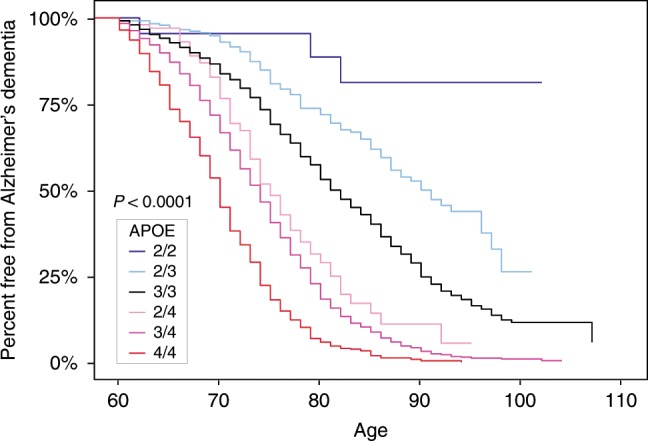
- In neuropathologically confirmed cases with available onset ages, mean age at Alzheimer’s dementia onset ranged from 69.9 ± 6.1 years in APOE4/4 to 79.3 ± 9.0 years in the combined APOE2/3 and 2/2 group.
Methods
- Primary analysis used the ADGC neuropathologically confirmed autopsy group: 5,007 brain donors, including 4,018 Alzheimer’s dementia cases and 989 cognitively unimpaired controls; post hoc comparisons used 23,857 neuropathologically unconfirmed clinical participants (10,430 cases, 13,426 controls) and a combined group of 28,864 participants (14,448 cases, 14,416 controls).
- Alzheimer’s dementia ORs were computed for each APOE genotype and for APOE2/APOE4 allelic dose using logistic regression under a generalized linear model, with generalized estimating equations for clinical/combined groups to account for family structure; analyses were performed with and without adjustment for age and sex.
- Additional analyses included ROC curves/AUCs for case–control classification, Kaplan–Meier curves for freedom from Alzheimer’s dementia, and linear regression for CERAD neuritic plaque scores and Braak tau tangle stage, including residual Braak effects after adjustment for CERAD score.
Limitations
- The paper states that although the overall study was unusually large, there were relatively few APOE2 homozygotes, limiting statistical power; it also states that it cannot clarify whether the greater APOE effects in confirmed cases/controls are solely due to excluding neuropathologically misclassified cases/controls or also to brain-donation ascertainment bias.
- The paper states that it cannot exclude an impact of differential disease onset, duration, or survival on Alzheimer’s dementia ORs and AD pathology measures, and that findings from non-Hispanic White groups cannot yet be extended to other ethnic and racial groups.
- Evident from the text: this is a case–control/autopsy-based design, not a prospective cohort, so it does not provide absolute lifetime risk by APOE genotype; the paper also notes it does not provide information about preclinical AD, MCI, or primary diagnoses of other neurodegenerative disorders, and that onset-age estimates may be affected by lack of standardized prospective assessments.
Model-written summary. Check it against the paper before relying on it.
Integrity signals
Registry
Cites
Statistics
Figures
Verification
Claims the paper makes
8 Valid · 3 Not valid · 9 Not checked · 56 Own results and interpretations
Some cited sources support this claim and some don’t — read each source’s verdict below.
In the paper
“This possibility has remained unaddressed, because case–control studies without neuropathological or biomarker assessments of AD may have underestimated the impact of APOE genotypes on Alzheimer’s dementia ORs due to the confounding effects of APOE genotypes on the percentages of neuropathologically misclassified cases and controls8–10.”
§ Exceptionally low likelihood of Alzheimer’s dementia in APOE2 homozygotes from a 5,000-person neuropathological study > Introduction
What the sources say
- Partly supportedcites [8] Monsell SE Characterizing apolipoprotein E epsilon4 carriers and noncarriers with the clinical diagnosis of mild to moderate Alzheimer dementia and minimal beta-amyloid peptide plaques JAMA Neurol. 2015 72 1124 1131 10.1001/jamaneurol.2015.1721 26302353 PMC4833059 sourceExperimental — accuracy not yet measured
The Results and Discussion (page unavailable) report minimal AD plaques in 37% of clinically diagnosed APOE4 noncarriers versus 13% of carriers, supporting genotype-related differences in potentially misclassified cases. The paper does not assess misclassified controls or estimate how such misclassification affects case–control odds ratios, so the proposed underestimation is not established by this source. (LLM, conf=0.86)
- Could not verifycites [9] Reiman EM Fibrillar amyloid-beta burden in cognitively normal people at 3 levels of genetic risk for Alzheimer’s disease Proc. Natl Acad. Sci. USA 2009 106 6820 6825 10.1073/pnas.0900345106 19346482 PMC2665196 sourceExperimental — accuracy not yet measured
The Abstract reports an association between APOE ε4 gene dose and Alzheimer’s disease risk, and the Discussion reports an association with fibrillar amyloid-β burden. Neither addresses whether case–control studies lacking neuropathological or biomarker assessments underestimated dementia odds ratios because of genotype-related misclassification. Searches for misclassified cases and controls and for underestimated case–control odds ratios found no passage addressing that claim. (LLM, conf=0.73)
- Disputedcites [10] Jansen WJ Prevalence of cerebral amyloid pathology in persons without dementia: a meta-analysis JAMA 2015 313 1924 1938 10.1001/jama.2015.4668 25988462 PMC4486209 sourceExperimental — accuracy not yet measured
Split into 2 atoms — 0 confirmed, 1 partially supported, 1 disputed, 0 misattributed, 0 unverifiable. Expand the claim to see per-atom verdicts.
Checked by a reasoning model — may be wrong.
hedgedstates a possible cause- Asserted: passes — The authors put it forward as true.
- Checkable: passes — It can be checked against evidence.
- Load-bearing: passes — The paper’s conclusions depend on it.
- Based: passes — The paper gives a reason why it holds.
- Partly supported
Every source the paper cites for this claim was checked and supports it.
In the paper
“The study supports known effects of APOE genotypes on standard measures of neuritic Aβ plaque and tau tangle severity13”
§ Exceptionally low likelihood of Alzheimer’s dementia in APOE2 homozygotes from a 5,000-person neuropathological study > Discussion
What the sources say
- Supportedcites [13] Serrano-Pozo A Qian J Monsell SE Betensky RA Hyman BT APOEepsilon2 is associated with milder clinical and pathological Alzheimer disease Ann. Neurol. 2015 77 917 929 10.1002/ana.24369 25623662 PMC4447539 source
The Results report APOE genotype associations with CERAD neuritic-plaque scores and Braak neurofibrillary-tangle stages. The Abstract Results specify that ε2 is associated with lower Braak stages and possibly fewer plaques, while ε4 is associated with more plaques but has no independent effect on Braak stage. Section labels are available in our copy, but page numbers are not. (LLM, conf=0.92)
plainstates an association- Asserted: passes — The authors put it forward as true.
- Checkable: passes — It can be checked against evidence.
- Load-bearing: unclear — It is unclear whether the paper’s conclusions depend on it.
- Based: passes — The paper gives a reason why it holds.
- Supported
Every source the paper cites for this claim was checked and supports it.
In the paper
“Evidence from a person without APOE function due to homozygosity for an ablative APOE frameshift mutation24 and the availability of dyslipidemia treatments support the potential tolerability of this approach.”
§ Exceptionally low likelihood of Alzheimer’s dementia in APOE2 homozygotes from a 5,000-person neuropathological study > Discussion
What the sources say
- Supportedcites [24] Mak AC Effects of the absence of apolipoprotein E on lipoproteins, neurocognitive function, and retinal function JAMA Neurol. 2014 71 1228 1236 10.1001/jamaneurol.2014.2011 25111166 PMC4714860 source
The Results (Exome Sequencing Results) identify a homozygous APOE frameshift deletion, and the Conclusions report that the resulting absence of apoE did not affect the patient’s neurocognitive or retinal function. The Discussion describes available approaches to treating dyslipidemia, while noting that conventional treatments had been relatively ineffective for this patient. The claim presents potential tolerability as the citing authors’ inference from that evidence. (LLM, conf=0.90)
hedgedstates a possible causeSingle case- Asserted: passes — The authors put it forward as true.
- Checkable: passes — It can be checked against evidence.
- Load-bearing: passes — The paper’s conclusions depend on it.
- Based: passes — The paper gives a reason why it holds.
- Supported
A result the paper reports from its own data — it cites no other source for it, so there is none to check. The quote shows it is in the paper.
In the paper
“APOE2 homozygotes were distinguished from the APOE2/3 group by a significantly lower Braak stage (2.26 ± 1.63 versus 3.16 ± 1.69, P < 0.05), before and after adjustment for age and sex.”
§ Exceptionally low likelihood of Alzheimer’s dementia in APOE2 homozygotes from a 5,000-person neuropathological study > Results > Neuritic plaque and neurofibrillary tangle severity
plainstates an association- Asserted: passes — The authors put it forward as true.
- Checkable: passes — It can be checked against evidence.
- Load-bearing: passes — The paper’s conclusions depend on it.
- Based: passes — The paper gives a reason why it holds.
A result the paper reports from its own data — it cites no other source for it, so there is none to check. The quote shows it is in the paper.
In the paper
“such that the protective effect was more than three times greater in the APOE2/2 group than in the APOE2/3 group.”
§ Exceptionally low likelihood of Alzheimer’s dementia in APOE2 homozygotes from a 5,000-person neuropathological study > Results > Neuritic plaque and neurofibrillary tangle severity
plainstates an association- Asserted: passes — The authors put it forward as true.
- Checkable: passes — It can be checked against evidence.
- Load-bearing: passes — The paper’s conclusions depend on it.
- Based: passes — The paper gives a reason why it holds.
41 more claims
Create a free account to see all 76 claims and every source verdict.
- It may state two separate claims as one. 19
- Probably not a substantial claim. 18
Claims other papers make about this one
Each is checked against this paper’s own text: does it say what the citing paper says it does?
The source backs part of the claim, not all of it — or backs it for a different population, condition or comparison.
In the citing paper
“Previous human and animal studies have already established the baseline consequences of APOE3 and APOE4 in the absence of amyloid pathology. 60 , 61 , 62 , 63”
From Apolipoprotein ε4 exacerbates white matter impairment in a mouse model of Aβ amyloidosis by decreasing actively myelinating oligodendrocytes (2025) · cites this paper as [60]
Experimental — accuracy not yet measuredThe source backs part of the claim, not all of it — or backs it for a different population, condition or comparison.
In the citing paper
“In contrast, APOE3 is defined as risk-neutral while APOE2 represents the strongest genetic protective factor (Corder et al., 1994; Farrer et al., 1997; Reiman et al., 2020).”
From APOE genotype-dependent differences in human astrocytic energy metabolism (2025) · cites this paper as Reiman et al., 2020
Experimental — accuracy not yet measuredThe source backs part of the claim, not all of it — or backs it for a different population, condition or comparison.
In the citing paper
“In contrast to the most common isoform ApoE3, present in 78% of the population, ApoE4 increases the risk of developing AD by three to twelve times depending on whether the ε4 allele is present in heterozygosis or homozygosis [3].”
From ApoE3 vs. ApoE4 Astrocytes: A Detailed Analysis Provides New Insights into Differences in Cholesterol Homeostasis (2022) · cites this paper as [3]
Experimental — accuracy not yet measuredThe cited source says what the claim attributes to it.
In the citing paper
“Common variants of the apolipoprotein E gene (APOE) influence the risk of Alzheimer’s disease: APOE4 is linked to high risk, APOE3 is considered to confer a neutral risk, and APOE2 is associated with relative protection.2–5”
From APOE3 Christchurch Heterozygosity and Autosomal Dominant Alzheimer’s Disease (2024) · cites this paper as [4]
Experimental — accuracy not yet measuredThe cited source says what the claim attributes to it.
In the citing paper
“However, the effect size of the APOE genotype on AD risk is now known to depend on a number of variables, including demographics such as race and ethnicity, age and sex, and whether the AD diagnosis is made on clinical or neuropathological8 grounds, or confirmed with biomarkers9.”
From Multifaceted roles of APOE in Alzheimer disease (2024) · cites this paper as [8]
11 more claims about this paper
Create a free account to see every claim other papers make about this one.
Self-check
Percentages, sums and reported differences re-computed from the paper’s own numbers.
Each contradiction between two passages listed here was confirmed by an independent check.
Rated minor: it would not touch a result — a value no result rests on, a p-value that stays on the same side of the significance level, or a conflict that is clerical, resolved elsewhere in the paper, or outside its own findings.
In the paper
§ Exceptionally low likelihood of Alzheimer’s dementia in APOE2 homozygotes from a 5,000-person neuropathological study > Discussion
“we did not include persons with the APOE3/4 genotype in our assessment of APOE2 and APOE4 allelic doses.”
§ Exceptionally low likelihood of Alzheimer’s dementia in APOE2 homozygotes from a 5,000-person neuropathological study > Methods > Statistical analysis
“for the assessment of APOE4 allelic dose, we coded APOE3/3, APOE3/4, and APOE4/4 as 0, 1, 2, respectively, in the APOE2 non-carriers.”
Rated minor: it would not touch a result — a value no result rests on, a p-value that stays on the same side of the significance level, or a conflict that is clerical, resolved elsewhere in the paper, or outside its own findings.
In the paper
§ Exceptionally low likelihood of Alzheimer’s dementia in APOE2 homozygotes from a 5,000-person neuropathological study > Abstract
“more than 24,000 neuropathologically unconfirmed cases and controls”
§ Exceptionally low likelihood of Alzheimer’s dementia in APOE2 homozygotes from a 5,000-person neuropathological study > Results > Neuropathologically confirmed and unconfirmed groups
“The 23,857 participants in the clinically classified but neuropathologically unconfirmed cohort”
Citations
Cites
Neuropathological stageing of Alzheimer-related changes.
Braak, H., & Braak, E. (1991) · Acta Neuropathologica · doi:10.1007/bf00308809 · Cited by 16,123
Corder, E. H., Saunders, A. M., Strittmatter, W. J., Schmechel, D. E., Gaskell, P. C., Small, G. W., Roses, A. D., Haines, J. L., & Pericak-Vance, M. A. (1993) · Science · doi:10.1126/science.8346443 · Cited by 9,429
Self-citationAlzheimer Disease Genetics Consortium (ADGC), Kunkle, B. W., The European Alzheimer’s Disease Initiative (EADI), Cohorts for Heart and Aging Research in Genomic Epidemiology Consortium (CHARGE), Genetic and Environmental Risk in AD/Defining Genetic, P. A. E. R. F. A. D. C. (., Grenier-Boley, B., Sims, R., Bis, J. C., Damotte, V., Naj, A. C., et al. (2019) · Nature Genetics · doi:10.1038/s41588-019-0358-2 · Cited by 2,946
Self-citationProtective effect of apolipoprotein E type 2 allele for late onset Alzheimer disease
Corder, E. H., Saunders, A. M., Risch, N. J., Strittmatter, W. J., Schmechel, D. E., Gaskell, P. C., Rimmler, J. B., Locke, P. A., Conneally, P. M., Schmader, K. E., et al. (1994) · Nature Genetics · doi:10.1038/ng0694-180 · Cited by 1,920
Self-citationNaj, A. C., Jun, G., Beecham, G. W., Wang, L.-S., Vardarajan, B. N., Buros, J., Gallins, P. J., Buxbaum, J. D., Jarvik, G. P., Crane, P. K., et al. (2011) · Nature Genetics · doi:10.1038/ng.801 · Cited by 1,901
Self-citationPrevalence of Cerebral Amyloid Pathology in Persons Without Dementia: A Meta-analysis
Jansen, W. J., Ossenkoppele, R., Knol, D. L., Tijms, B. M., Scheltens, P., Verhey, F. R. J., Visser, P. J., Aalten, P., Aarsland, D., Alcolea, D., et al. (2015) · JAMA · doi:10.1001/jama.2015.4668 · Cited by 1,610
Self-citationHYMAN, B. T., & TROJANOWSKI, J. Q. (1997) · Journal of Neuropathology and Experimental Neurology · doi:10.1097/00005072-199710000-00002 · Cited by 1,542
Self-citationApoE4 markedly exacerbates tau-mediated neurodegeneration in a mouse model of tauopathy
Initiative, A. D. N., Shi, Y., Yamada, K., Liddelow, S. A., Smith, S. T., Zhao, L., Luo, W., Tsai, R. M., Spina, S., Grinberg, L. T., et al. (2017) · Nature · doi:10.1038/nature24016 · Cited by 1,220
Self-citationApolipoprotein E: from cardiovascular disease to neurodegenerative disorders
Mahley, R. W. (2016) · Journal of Molecular Medicine · doi:10.1007/s00109-016-1427-y · Cited by 837
Reiman, E. M., Chen, K., Liu, X., Bandy, D., Yu, M., Lee, W., Ayutyanont, N., Keppler, J., Reeder, S. A., Langbaum, J. B. S., et al. (2009) · Proceedings of the National Academy of Sciences · doi:10.1073/pnas.0900345106 · Cited by 785
Self-citation
Cited by
Scheltens, P., De Strooper, B., Kivipelto, M., Holstege, H., Chételat, G., Teunissen, C. E., Cummings, J., & van der Flier, W. M. (2021) · The Lancet · doi:10.1016/s0140-6736(20)32205-4 · Cited by 5,465
APOE and Alzheimer’s disease: Advances in genetics, pathophysiology, and therapeutic approaches
Serrano-Pozo, A., Das, S., & Hyman, B. T. (2021) · The Lancet Neurology · doi:10.1016/s1474-4422(20)30412-9 · Cited by 1,037
Self-citationThe probabilistic model of Alzheimer disease: the amyloid hypothesis revised
Frisoni, G. B., Altomare, D., Thal, D. R., Ribaldi, F., van der Kant, R., Ossenkoppele, R., Blennow, K., Cummings, J., van Duijn, C., Nilsson, P. M., et al. (2022) · Nature Reviews Neuroscience · doi:10.1038/s41583-021-00533-w · Cited by 513
Yin, F. (2023) · The FEBS Journal · doi:10.1111/febs.16344 · Cited by 441
Sadick, J. S., O’Dea, M. R., Hasel, P., Dykstra, T., Faustin, A., & Liddelow, S. A. (2022) · Neuron · doi:10.1016/j.neuron.2022.03.008 · Cited by 415
Economic burden of Alzheimer disease and managed care considerations
(2020) · The American Journal of Managed Care · doi:10.37765/ajmc.2020.88482 · Cited by 398
The complex genetic architecture of Alzheimer's disease: novel insights and future directions
Andrews, S. J., Renton, A. E., Fulton-Howard, B., Podlesny-Drabiniok, A., Marcora, E., & Goate, A. M. (2023) · eBioMedicine · doi:10.1016/j.ebiom.2023.104511 · Cited by 377
Self-citationAPOE4 homozygosity represents a distinct genetic form of Alzheimer’s disease
Fortea, J., Pegueroles, J., Alcolea, D., Belbin, O., Dols-Icardo, O., Vaqué-Alcázar, L., Videla, L., Gispert, J. D., Suárez-Calvet, M., Johnson, S. C., et al. (2024) · Nature Medicine · doi:10.1038/s41591-024-02931-w · Cited by 369
APOE and Alzheimer’s Disease: From Lipid Transport to Physiopathology and Therapeutics
Husain, M. A., Laurent, B., & Plourde, M. (2021) · Frontiers in Neuroscience · doi:10.3389/fnins.2021.630502 · Cited by 353
Solving neurodegeneration: common mechanisms and strategies for new treatments
Wareham, L. K., Liddelow, S. A., Temple, S., Benowitz, L. I., Di Polo, A., Wellington, C., Goldberg, J. L., He, Z., Duan, X., Bu, G., et al. (2022) · Molecular Neurodegeneration · doi:10.1186/s13024-022-00524-0 · Cited by 324
“Potential protective targets include variants in APP that lead to a reduction in pathologic Aβ [297, 298], APOE gene variants including APOE2 [251], APOE3-Christchurch [299], and APOE3-Jacksonville [300] with lower risk of developing AD [301], and variants in cholesterol efflux pathways such as ABCA1 [302], amongst ot…”
BackgroundAPOE2: protective mechanism and therapeutic implications for Alzheimer’s disease
Li, Z., Shue, F., Zhao, N., Shinohara, M., & Bu, G. (2020) · Molecular Neurodegeneration · doi:10.1186/s13024-020-00413-4 · Cited by 306
“APOE*ε2 protects against AD: the pathological evidence APOE*ε2 reduces Aβ pathology in humans The protective effect of APOE*ε2 is more pronounced in pathologically confirmed AD than clinically diagnosed AD [10] (Fig.”
BackgroundRegulation of beta-amyloid production in neurons by astrocyte-derived cholesterol
Wang, H., Kulas, J. A., Wang, C., Holtzman, D. M., Ferris, H. A., & Hansen, S. B. (2021) · Proceedings of the National Academy of Sciences · doi:10.1073/pnas.2102191118 · Cited by 301
“In a large study of Alzheimer’s pathology, APOE variants were shown to have strong effects on tau tangle burden, with APOE4/E4 carriers most adversely affected (66).”
BackgroundTolar, M., Hey, J., Power, A., & Abushakra, S. (2021) · International Journal of Molecular Sciences · doi:10.3390/ijms22126355 · Cited by 243
“Individuals with two APOE4 alleles (APOE4/4 homozygotes) have a 10–30× greater risk for developing AD compared with the APOE3/3 genotype and develop symptoms of AD on average more than a decade earlier [50,51].”
BackgroundCholesterol and Alzheimer’s Disease; From Risk Genes to Pathological Effects
Feringa, F. M., & van der Kant, R. (2021) · Frontiers in Aging Neuroscience · doi:10.3389/fnagi.2021.690372 · Cited by 226
“In contrast to ApoE4, expression of the ApoE2 allele confers a decreased risk for LOAD and hence is considered protective (Corder et al., 1994; Reiman et al., 2020).”
BackgroundEmrani, S., Arain, H. A., DeMarshall, C., & Nuriel, T. (2020) · Alzheimer's Research & Therapy · doi:10.1186/s13195-020-00712-4 · Cited by 194
“more, while possession of the APOE2 allele is protective against AD [2, 10, 11], with Caucasian individuals who”
BackgroundCell type‐specific roles of APOE4 in Alzheimer disease
Blumenfeld, J., Yip, O., Kim, M. J., & Huang, Y. (2024) · Nature Reviews Neuroscience · doi:10.1038/s41583-023-00776-9 · Cited by 202
“204–206), adeno-associated viruses have been used to deliver this isoform into the brains of APP/PS1/APOE4 mice, which reduced amyloid plaque burdens 207 .”
Multifaceted roles of APOE in Alzheimer disease
Jackson, R. J., Hyman, B. T., & Serrano-Pozo, A. (2024) · Nature Reviews Neurology · doi:10.1038/s41582-024-00988-2 · Cited by 193
Self-citationMicroglia and lipids: how metabolism controls brain innate immunity
Chausse, B., Kakimoto, P. A., & Kann, O. (2021) · Seminars in Cell & Developmental Biology · doi:10.1016/j.semcdb.2020.08.001 · Cited by 181
Cerebrospinal fluid proteomics define the natural history of autosomal dominant Alzheimer’s disease
Johnson, E. C. B., Bian, S., Haque, R. U., Carter, E. K., Watson, C. M., Gordon, B. A., Ping, L., Duong, D. M., Epstein, M. P., McDade, E., et al. (2023) · Nature Medicine · doi:10.1038/s41591-023-02476-4 · Cited by 170
“The APOE ε2 allele, protective against LOAD, also has reduced heparin-binding activity 49,50 .”
BackgroundSelf-citationThe synapse as a treatment avenue for Alzheimer’s Disease
Peng, L., Bestard‐Lorigados, I., & Song, W. (2022) · Molecular Psychiatry · doi:10.1038/s41380-022-01565-z · Cited by 180
“ApoE2 can play a protective role and reduce the risk of AD [44, 45].”
Buchholz, S., & Zempel, H. (2024) · Alzheimer's & Dementia · doi:10.1002/alz.13784 · Cited by 137
“261,262 In addition, the rare Icelandic APP mutation (A647T) has been shown to protect against cognitive decline by reducing the production of A β 42 by up to 40%.”
BackgroundProtective genes and pathways in Alzheimer’s disease: moving towards precision interventions
Seto, M., Weiner, R. L., Dumitrescu, L., & Hohman, T. J. (2021) · Molecular Neurodegeneration · doi:10.1186/s13024-021-00452-5 · Cited by 135
“Carrying two APOE-ε4 alleles can increase risk by up to 15-fold [71, 72].”
BackgroundGenetic architecture of Alzheimer's disease
Neuner, S. M., TCW, J., & Goate, A. M. (2020) · Neurobiology of Disease · doi:10.1016/j.nbd.2020.104976 · Cited by 126
Self-citationGenome-wide association studies for Alzheimer’s disease: bigger is not always better
Escott-Price, V., & Hardy, J. (2022) · Brain Communications · doi:10.1093/braincomms/fcac125 · Cited by 119
“…itself is a complex concept since it is possible that everyone would develop Alzheimer ’ s disease if they lived long enough (but see Morris 29 ); and genetic risk appears to determine when this occurs, not if it will occur 30,31 : thus heritability estimates are exquisitely age dependent.”
BackgroundSelf-citationPetit, D., Fernández, S. G., Zoltowska, K. M., Enzlein, T., Ryan, N. S., O’Connor, A., Szaruga, M., Hill, E., Vandenberghe, R., Fox, N. C., et al. (2022) · Molecular Psychiatry · doi:10.1038/s41380-022-01518-6 · Cited by 120
“The APOE ε 2 allele has been found to lower AD risk and/or delay its onset [52–54].”
Nelson, M. R., Liu, P., Agrawal, A., Yip, O., Blumenfeld, J., Traglia, M., Kim, M. J., Koutsodendris, N., Rao, A., Grone, B., et al. (2023) · Nature Neuroscience · doi:10.1038/s41593-023-01480-8 · Cited by 120
“Variants of APOE with point mutations near or within these regions, such as APOE2(Cys112, Cys158) 18,38 , APOE3-V236E 39,40 and APOE4-R251G 40 , are associated with protection against AD.”
BackgroundSelf-citationMicroglial efferocytosis: Diving into the Alzheimer’s disease gene pool
Romero-Molina, C., Garretti, F., Andrews, S. J., Marcora, E., & Goate, A. M. (2022) · Neuron · doi:10.1016/j.neuron.2022.10.015 · Cited by 111
Self-citationRanson, J. M., Rittman, T., Hayat, S. A., Brayne, C., Jessen, F., Blennow, K., van Duijn, C. M., Barkhof, F., Tang, E. Y. H., Mummery, C. J., et al. (2021) · Alzheimer s Research & Therapy · doi:10.1186/s13195-021-00895-4 · Cited by 132
“, 51–95% in APOE ɛ4/ɛ4 and 22–90% in APOE ɛ4/- [26, 27] and a mean age at dementia onset of 73–74 years in APOE ɛ4/ɛ4 and 75–82 in APOE ɛ4/- [28, 29].”
Mullane, K., & Williams, M. (2020) · Biochemical Pharmacology · doi:10.1016/j.bcp.2020.113945 · Cited by 105
Duong, M. T., Nasrallah, I. M., Wolk, D. A., Chang, C. C. Y., & Chang, T.-Y. (2021) · Frontiers in Aging Neuroscience · doi:10.3389/fnagi.2021.647990 · Cited by 105
“While APOE2 is associated with elevated very-low-density lipoprotein (VLDL) and lower dementia risk (Reiman et al., 2020), APOE4 is linked to higher LDL cholesterol (Beilby et al.”
BackgroundVitek, M. P., Araujo, J. A., Fossel, M., Greenberg, B. D., Howell, G. R., Rizzo, S. J. S., Seyfried, N. T., Tenner, A. J., Territo, P. R., Windisch, M., et al. (2020) · Alzheimer's & Dementia: Translational Research & Clinical Interventions · doi:10.1002/trc2.12114 · Cited by 103
The cell biology of APOE in the brain
Windham, I. A., & Cohen, S. (2024) · Trends in Cell Biology · doi:10.1016/j.tcb.2023.09.004 · Cited by 103
From Menopause to Neurodegeneration—Molecular Basis and Potential Therapy
Cheng, Y., Lin, C., & Lane, H. (2021) · International Journal of Molecular Sciences · doi:10.3390/ijms22168654 · Cited by 114
“APOE4 is associated with a higher risk of AD, and people with APOE2 homozygotes present an exceptionally low likelihood of AD [155].”
BackgroundTsai, A. P., Dong, C., Lin, P. B.-C., Messenger, E. J., Casali, B. T., Moutinho, M., Liu, Y., Oblak, A. L., Lamb, B. T., Landreth, G. E., et al. (2022) · Genome Medicine · doi:10.1186/s13073-022-01022-0 · Cited by 99
Alzheimer’s disease – the journey of a healthy brain into organ failure
Golde, T. E. (2022) · Molecular Neurodegeneration · doi:10.1186/s13024-022-00523-1 · Cited by 88
Apolipoprotein E in Alzheimer’s disease: molecular insights and therapeutic opportunities
Belaidi, A. A., Bush, A. I., & Ayton, S. (2025) · Molecular Neurodegeneration · doi:10.1186/s13024-025-00843-y · Cited by 91
“ApoE pre-dominantly drives risk for late-onset AD since the ε4 carriers are highly represented in late-onset AD cases [15].”
InfluentialThe informed road map to prevention of Alzheimer Disease: a call to arms
McDade, E., Llibre-Guerra, J. J., Holtzman, D. M., Morris, J. C., & Bateman, R. J. (2021) · Molecular Neurodegeneration · doi:10.1186/s13024-021-00467-y · Cited by 89
“Despite our increased understanding of the detrimental effect of APOE-ε4, there is also sufficient evidence of a protective effect of APOE-ε2 against AD [127, 138]; therefore, it is reasonable to consider that APOE-ε2 based therapies may yield significant therapeutic effects in APOE-ε4 and APOE-ε3 individuals.”
BackgroundCarling, G. K., Fan, L., Foxe, N. R., Norman, K., Wong, M. Y., Zhu, D., Corona, C., Razzoli, A., Yu, F., Yarahmady, A., et al. (2024) · Neuron · doi:10.1016/j.neuron.2024.09.006 · Cited by 89
Jackson, R. J., Keiser, M. S., Meltzer, J. C., Fykstra, D. P., Dierksmeier, S. E., Hajizadeh, S., Kreuzer, J., Morris, R., Melloni, A., Nakajima, T., et al. (2024) · Molecular Therapy · doi:10.1016/j.ymthe.2024.03.024 · Cited by 86
Self-citationShifting paradigms: The central role of microglia in Alzheimer’s disease
Schwabe, T., Srinivasan, K., & Rhinn, H. (2020) · Neurobiology of Disease · doi:10.1016/j.nbd.2020.104962 · Cited by 84
Isoform- and cell-state-specific lipidation of ApoE in astrocytes
Lindner, K., Beckenbauer, K., van Ek, L. C., Titeca, K., de Leeuw, S. M., Awwad, K., Hanke, F., Korepanova, A. V., Rybin, V., van der Kam, E. L., et al. (2022) · Cell Reports · doi:10.1016/j.celrep.2022.110435 · Cited by 84
Gamache, J., Yun, Y., & Chiba-Falek, O. (2020) · Disease Models & Mechanisms · doi:10.1242/dmm.045211 · Cited by 84
“, 2019) and of APOE ε2 homozygosity (Reiman et al., 2020).”
BackgroundResultAssociation of APOE e2 genotype with Alzheimer’s and non-Alzheimer’s neurodegenerative pathologies
Goldberg, T. E., Huey, E. D., & Devanand, D. P. (2020) · Nature Communications · doi:10.1038/s41467-020-18198-x · Cited by 82
APOE effects on regional tau in preclinical Alzheimer’s disease
Young, C. B., Johns, E., Kennedy, G., Belloy, M. E., Insel, P. S., Greicius, M. D., Sperling, R. A., Johnson, K. A., Poston, K. L., Mormino, E. C., et al. (2023) · Molecular Neurodegeneration · doi:10.1186/s13024-022-00590-4 · Cited by 80
“Post-mortem work examining the full disease spectrum from CU to AD dementia has shown mixed results, with one study of 411 e2 carriers showing no effect on Braak staging after controlling for neuritic amyloid plaque severity [33], and another study of 163 e2 carriers showing fewer tau tangles in the Aβ+ e2 group compa…”
BackgroundResultThe Links between Cardiovascular Diseases and Alzheimer's Disease
Leszek, J., Вячеславовна, М. Е., Belousov, D. M., Koutsouraki, E., Szczechowiak, K., Kobusiak−Prokopowicz, M., Mysiak, A., Diniz, B. S., Somasundaram, S. G., Kirkland, C. E., et al. (2020) · Current Neuropharmacology · doi:10.2174/1570159x18666200729093724 · Cited by 115
“Many studies describe APOEε4 as a crucial risk factor exacerbating VaD and SAD progression as well as aggravating the severity of tau-pathology [84, 86-89].”
Backgroundde Vries, L. E., Huitinga, I., Kessels, H. W., Swaab, D. F., & Verhaagen, J. (2024) · Molecular Neurodegeneration · doi:10.1186/s13024-024-00719-7 · Cited by 72
“ApoE4 has been shown to reduce the clearance and increase the deposition of Aβ in plaques and to decrease metabolic activity compared to ApoE3 [264], while ApoE2 has been associated with a reduced risk of AD [265].”
BackgroundAlzheimer’s disease clinical trial update 2019–2021
Pleen, J., & Townley, R. A. (2021) · Journal of Neurology · doi:10.1007/s00415-021-10790-5 · Cited by 75
APOE4 confers transcriptomic and functional alterations to primary mouse microglia
Machlovi, S. I., Neuner, S. M., Hemmer, B. M., Khan, R., Liu, Y., Huang, M., Zhu, J. D., Castellano, J. M., Cai, D., Marcora, E., et al. (2022) · Neurobiology of Disease · doi:10.1016/j.nbd.2022.105615 · Cited by 73
Self-citationLodder, C., Scheyltjens, I., Stancu, I. C., Botella Lucena, P., Gutiérrez de Ravé, M., Vanherle, S., Vanmierlo, T., Cremers, N., Vanrusselt, H., Brône, B., et al. (2021) · Acta Neuropathologica Communications · doi:10.1186/s40478-021-01204-8 · Cited by 71
“In the same vein, the APOE2 allele is associated with a lower risk of AD dementia [46].”
BackgroundShade, L. M. P., Katsumata, Y., Abner, E. L., Aung, K. Z., Claas, S. A., Qiao, Q., Heberle, B. A., Brandon, J. A., Page, M. L., Hohman, T. J., et al. (2024) · Nature Genetics · doi:10.1038/s41588-024-01939-9 · Cited by 72
Self-citationFrom degenerative disease to malignant tumors: Insight to the function of ApoE
Miao, G., Zhuo, D., Han, X. N., Yao, W., Liu, C., Liu, H., Cao, H., Sun, Y., Chen, Z., & Feng, T. (2022) · Biomedicine & Pharmacotherapy · doi:10.1016/j.biopha.2022.114127 · Cited by 81
Association of APOE Genotype With Heterogeneity of Cognitive Decline Rate in Alzheimer Disease
Qian, J., Betensky, R. A., Hyman, B. T., & Serrano-Pozo, A. (2021) · Neurology · doi:10.1212/wnl.0000000000011883 · Cited by 71
“The underrepresentation of APOE e2 carriers with substantial ADNC (n = 44) is expected given the protective effect of this allele against AD; APOE e4 carriers would also be underrepresented in a sample of cognitively intact individuals with low ADNC.(5,45) In addition, the effects of APOE genotype on the visuospatial/…”
InfluentialSelf-citationCurrent and evolving treatment strategies for the Alzheimer disease continuum
(2020) · The American Journal of Managed Care · doi:10.37765/ajmc.2020.88481 · Cited by 66
Insel, P. S., Hansson, O., & Mattsson-Carlgren, N. (2021) · JAMA Neurology · doi:10.1001/jamaneurol.2020.3780 · Cited by 68
The Importance of Complement-Mediated Immune Signaling in Alzheimer’s Disease Pathogenesis
Batista, A. F., Khan, K. A., Papavergi, M.-T., & Lemere, C. A. (2024) · International Journal of Molecular Sciences · doi:10.3390/ijms25020817 · Cited by 65
“On the other hand, the APOE2 allele has been associated with a decreased risk of AD [141,142].”
BackgroundRole of estrogen in women's Alzheimer's disease risk as modified by APOE
Valencia‐Olvera, A. C., Weng, J. M., Christensen, A., LaDu, M. J., & Pike, C. J. (2022) · Journal of Neuroendocrinology · doi:10.1111/jne.13209 · Cited by 80
Rajabli, F., Beecham, G. W., Hendrie, H. C., Baiyewu, O., Ogunniyi, A., Gao, S., Kushch, N. A., Lipkin-Vasquez, M., Hamilton-Nelson, K. L., Young, J. I., et al. (2022) · PLOS Genetics · doi:10.1371/journal.pgen.1009977 · Cited by 65
Self-citationThe Role of Astrocytes in Synapse Loss in Alzheimer's Disease: A Systematic Review
Hulshof, L. A., van Nuijs, D., Hol, E. M., & Middeldorp, J. (2022) · Frontiers in Cellular Neuroscience · doi:10.3389/fncel.2022.899251 · Cited by 64
Apolipoprotein E in Alzheimer’s disease trajectories and the next-generation clinical care pathway
Narasimhan, S., Holtzman, D. M., Apostolova, L. G., Cruchaga, C., Masters, C. L., Hardy, J., Villemagne, V. L., Bell, J., Cho, M., & Hampel, H. (2024) · Nature Neuroscience · doi:10.1038/s41593-024-01669-5 · Cited by 66
“By contrast, APOE ε2 remains the strongest genetic protective factor against sporadic AD 7,8 , with very few APOE ε2 / ε2 individuals developing AD up to the age of 90 years 14,18 .”
InfluentialSelf-citationPanitch, R., Hu, J., Chung, J., Zhu, C., Meng, G., Xia, W., Bennett, D. A., Lunetta, K. L., Ikezu, T., Au, R., et al. (2021) · Molecular Psychiatry · doi:10.1038/s41380-021-01266-z · Cited by 63
Self-citationCognitive Impairment in Older Adults and Therapeutic Strategies
Montine, T. J., Bukhari, S. A., & White, L. R. (2020) · Pharmacological Reviews · doi:10.1124/pharmrev.120.000031 · Cited by 72
“Homozygosity for APOE «2 is associated with reduced pathologic lesions of AD, and the signs and symptoms of AD are very rare in people with this resistant genotype (Reiman et al., 2020).”
BackgroundSelf-citationCao, Y., Zhao, L.-W., Chen, Z.-X., & Li, S.-H. (2024) · Frontiers in Neuroscience · doi:10.3389/fnins.2024.1430465 · Cited by 65
Genetics of Alzheimer’s disease: An East Asian perspective
Miyashita, A., Kikuchi, M., Hara, N., & Ikeuchi, T. (2023) · Journal of Human Genetics · doi:10.1038/s10038-022-01050-z · Cited by 64
“8) [10] Caucasians: population-based 0.”
BackgroundThe small HDL particle hypothesis of Alzheimer's disease
Martinez, A. E., Weissberger, G. H., Kuklenyik, Z., He, X., Meuret, C. J., Parekh, T., Rees, J. C., Parks, B. A., Gardner, M. S., King, S. M., et al. (2022) · Alzheimer s & Dementia · doi:10.1002/alz.12649 · Cited by 66
Self-citationAPOE3 Christchurch Heterozygosity and Autosomal Dominant Alzheimer’s Disease
Quiroz, Y. T., Aguillon, D., Aguirre-Acevedo, D. C., Vasquez, D., Zuluaga, Y., Baena, A. Y., Madrigal, L., Hincapié, L., Sanchez, J. S., Langella, S., et al. (2024) · New England Journal of Medicine · doi:10.1056/nejmoa2308583 · Cited by 63
Self-citationWalters, S., Contreras, A. G., Eissman, J. M., Mukherjee, S., Lee, M. L., Choi, S.-E., Scollard, P., Trittschuh, E. H., Mez, J. B., Bush, W. S., et al. (2023) · JAMA Neurology · doi:10.1001/jamaneurol.2023.2169 · Cited by 60
Self-citationGut inflammation associated with age and Alzheimer’s disease pathology: a human cohort study
Heston, M. B., Hanslik, K. L., Zarbock, K. R., Harding, S. J., Davenport‐Sis, N. J., Kerby, R. L., Chin, N. A., Sun, Y., Hoeft, A., Deming, Y. K., et al. (2023) · Scientific Reports · doi:10.1038/s41598-023-45929-z · Cited by 73
“…genotyping was performed at baseline using allele-specific polymerase chain reaction-based assays, and for the present study a pseudo-continuous APOE risk score was calculated using estimates derived from neuropathologically confirmed cases in the Alzheimer’s Disease Neuroimaging Initiative 33,38 .”
MethodSelf-citationMitochondria in Alzheimer’s Disease Pathogenesis
Reiss, A. B., Gulkarov, S., Jacob, B., Srivastava, A., Pinkhasov, A., Gomolin, I. H., Stecker, M. M., Wısnıewskı, T., & Leon, J. D. (2024) · Life · doi:10.3390/life14020196 · Cited by 88
“These confer varying degrees of AD risk, with the ApoE ε 4 allele being the strongest genetic risk factor for sporadic AD, while the ApoE ε 2 allele is associated with the lowest AD risk [162–164].”
BackgroundFernandez, H. R., Varma, A., Flowers, S. A., & Rebeck, G. W. (2020) · Cancers · doi:10.3390/cancers12123842 · Cited by 58
“Compared to the most common APOE3 allele, APOE2 reduces risk of AD by up to 50% and APOE4 increases AD risk three-fold in heterozygotes and 14-fold in homozygotes [34].”
BackgroundGenetic testing in dementia — utility and clinical strategies
Koriath, C., Kenny, J., Ryan, N. S., Rohrer, J. D., Schott, J. M., Houlden, H., Fox, N. C., Tabrizi, S. J., & Mead, S. (2020) · Nature Reviews Neurology · doi:10.1038/s41582-020-00416-1 · Cited by 62
Chen, J., Doyle, M. F., Fang, Y., Mez, J., Crane, P. K., Scollard, P., ADSP Data Harmonization Consortium Cognitive Harmonization Core, Satizabal, C. L., Alosco, M. L., Qiu, W. Q., et al. (2023) · Aging Cell · doi:10.1111/acel.13955 · Cited by 56
Self-citationThe Neurolipid Atlas: a lipidomics resource for neurodegenerative diseases
Feringa, F. M., Koppes-den Hertog, S. J., Wang, L. Y., Derks, R. J. E., Kruijff, I., Erlebach, L., Heijneman, J., Miramontes, R., Pömpner, N., Blomberg, N., et al. (2025) · Nature Metabolism · doi:10.1038/s42255-025-01365-z · Cited by 56
“https://doi.org/10.1038/s42255-025-01365-z the risk for AD from 3–4-fold (heterozygosity) to 14-fold (homozygo-sity) depending on ethnicity 56,57 , with even higher reported odds ratios in neuropathologically confirmed cases 58 .”
InfluentialSelf-citationApoE e2 and aging-related outcomes in 379,000 UK Biobank participants
Kuo, C.-L., Pilling, L. C., Atkins, J. L., Kuchel, G. A., & Melzer, D. (2020) · Aging · doi:10.18632/aging.103405 · Cited by 55
Neuroimaging in Dementia: More than Typical Alzheimer Disease
Haller, S., Jäger, H. R., Vernooij, M. W., & Barkhof, F. (2023) · Radiology · doi:10.1148/radiol.230173 · Cited by 63
Brain Lipids and Lipid Droplet Dysregulation in Alzheimer’s Disease and Neuropsychiatric Disorders
Zhao, X., Zhang, S., Sanders, A. R., & Duan, J. (2023) · Complex Psychiatry · doi:10.1159/000535131 · Cited by 54
Genetic Phenotypes of Alzheimer’s Disease: Mechanisms and Potential Therapy
Quan, M., Cao, S., Wang, Q., Wang, S., & Jia, J. (2023) · Phenomics · doi:10.1007/s43657-023-00098-x · Cited by 67
Chung, J., Das, A., Sun, X., Sobreira, D. R., Leung, Y. Y., Igartua, C., Mozaffari, S. V., Chou, Y., Thiagalingam, S., Mez, J., et al. (2022) · Alzheimer s & Dementia · doi:10.1002/alz.12719 · Cited by 53
Self-citationSalvadó, G., Grothe, M. J., Groot, C., Moscoso, A., Schöll, M., Gispert, J. D., Ossenkoppele, R., & Initiative, F. T. A. D. N. (2021) · European Journal of Nuclear Medicine and Molecular Imaging · doi:10.1007/s00259-021-05192-8 · Cited by 52
Vance, J. M., Farrer, L. A., Huang, Y., Cruchaga, C., Hyman, B. T., Pericak‐Vance, M. A., Goate, A. M., Greicius, M. D., Griswold, A. J., Haines, J. L., et al. (2024) · Annals of Neurology · doi:10.1002/ana.26864 · Cited by 52
Self-citationFirdaus, Z., & Li, X. (2024) · International Journal of Molecular Sciences · doi:10.3390/ijms25042320 · Cited by 51
“Employing CRISPR– Cas9 technology, a recent investigation selectively deactivated mutant familial APP Swedish alleles in both cellular and in vivo settings, without impacting the corresponding wild-type alleles [381].”
BackgroundModifiable cardiovascular risk factors and genetics for targeted prevention of dementia
Rasmussen, I. J., & Frikke‐Schmidt, R. (2023) · European Heart Journal · doi:10.1093/eurheartj/ehad293 · Cited by 62
“Heparin-binding affinities of apoE isoforms are apoE4 > apoE3 > apoE2 > apoE3christchurch, and lower binding affinity is suggested to decrease neuronal tau pathology, hence decreasing AD pathology.(191,192) Together with a recent report of low AD risk and sparse tau pathology in APOE ɛ22 carriers,(192) this observatio…”
BackgroundEffect of APOE alleles on the glial transcriptome in normal aging and Alzheimer’s disease
Serrano-Pozo, A., Li, Z., Noori, A., Nguyen, H. N., Mezlini, A., Li, L., Hudry, E., Jackson, R. J., Hyman, B. T., & Das, S. (2021) · Nature Aging · doi:10.1038/s43587-021-00123-6 · Cited by 49
Self-citationWang, Y.-Y., Ge, Y.-J., Tan, C.-C., Cao, X.-P., Tan, L., & Xu, W. (2021) · Journal of Alzheimer's Disease · doi:10.3233/jad-201606 · Cited by 49
Yang, A., Kantor, B., & Chiba-Falek, O. (2021) · International Journal of Molecular Sciences · doi:10.3390/ijms22031244 · Cited by 48
NHE6 depletion corrects ApoE4-mediated synaptic impairments and reduces amyloid plaque load
Pohlkamp, T., Xian, X., Wong, C. H., Durakoglugil, M. S., Werthmann, G. C., Saido, T. C., Evers, B. M., White, C. L., Connor, J., Hammer, R. E., et al. (2021) · eLife · doi:10.7554/elife.72034 · Cited by 46
“Each ApoE4 allele reduces the age of Alzheimer’s disease (AD) onset by approximately 3–5 years compared to ApoE3 homozygotes, which comprise ~80 % of the human population (Roses, 1994; Sando et al., 2008).”
BackgroundFronza, M. G., Alves, D. A. C., Praticò, D., & Savegnago, L. (2023) · Ageing Research Reviews · doi:10.1016/j.arr.2023.102033 · Cited by 49
Marino, C., Perez‐Corredor, P., O'Hare, M., Heuer, A., Chmielewska, N., Gordon, H., Chandrahas, A. S., Gonzalez‐Buendia, L., Delgado‐Tirado, S., Doan, T. H., et al. (2024) · Alzheimer's & Dementia · doi:10.1002/alz.13436 · Cited by 45
Self-citationShort leukocyte telomeres predict 25-year Alzheimer's disease incidence in non-APOE ε4-carriers
Hackenhaar, F. S., Josefsson, M., Adolfsson, A. N., Landfors, M., Kauppi, K., Hultdin, M., Adolfsson, R., Degerman, S., & Pudas, S. (2021) · Alzheimer s Research & Therapy · doi:10.1186/s13195-021-00871-y · Cited by 43
Sandau, U. S., McFarland, T. J., Smith, S. J., Galasko, D. R., Quinn, J. F., & Saugstad, J. A. (2022) · Frontiers in Cell and Developmental Biology · doi:10.3389/fcell.2022.864022 · Cited by 42
“Importantly, while the APOE-e2 allele is relatively rare and may provide some protection against AD (Reiman et al., 2020), people who inherit one copy of the APOE-e4 allele have an increased chance of developing the disease; those who inherit two copies of the allele are at even greater risk (Sando…”
BackgroundSelf-citationOberlin, L. E., Wan, L., Kang, C., Romano, A., Aghjayan, S. L., Lesnovskaya, A., Ripperger, H. S., Drake, J. A., Harrison, R., Collins, A. M., et al. (2024) · British Journal of Sports Medicine · doi:10.1136/bjsports-2024-108257 · Cited by 61
Self-citationBoche, D., & Nicoll, J. A. R. (2020) · Neuropathology and Applied Neurobiology · doi:10.1111/nan.12642 · Cited by 42
Apolipoprotein E Genotype e2: Neuroprotection and Its Limits
Kim, H., Devanand, D. P., Carlson, S., & Goldberg, T. E. (2022) · Frontiers in Aging Neuroscience · doi:10.3389/fnagi.2022.919712 · Cited by 46
Genome-wide association study and functional validation implicates JADE1 in tauopathy
Farrell, K. W., Kim, S., Han, N., Iida, M. A., Gonzalez, E. M., Otero‐García, M., Walker, J. M., Richardson, T. E., Renton, A. E., Andrews, S. J., et al. (2021) · Acta Neuropathologica · doi:10.1007/s00401-021-02379-z · Cited by 39
Self-citationHenningfield, C. M., Arreola, M. A., Soni, N., Spangenberg, E. E., & Green, K. N. (2022) · Glia · doi:10.1002/glia.24105 · Cited by 40
Abushakra, S. R., Porsteinsson, A. P., Sabbagh, M. N., Bracoud, L., Schaerer, J., Power, A., Hey, J. A., Scott, D., Suhy, J., Tolar, M., et al. (2020) · Alzheimer s & Dementia Translational Research & Clinical Interventions · doi:10.1002/trc2.12117 · Cited by 49
Panitch, R., Hu, J., Xia, W., Bennett, D. A., Stein, T. D., Farrer, L. A., & Jun, G. R. (2022) · Alzheimer's Research & Therapy · doi:10.1186/s13195-022-00975-z · Cited by 39
“By contrast, among clinically and neuropathologically confirmed AD cases and controls of European ancestry, a single copy of the APOE ε2 allele is associated with 61% decreased risk and ε2 homozygotes have an 87% reduced risk for AD compared to individuals with the ε3/ε3 genotype [10].”
Self-citationXu, L., Wang, Z., Li, M., & Li, Q. (2025) · Journal of Global Health · doi:10.7189/jogh.15.04156 · Cited by 62
“For instance, APOE ε4 gene variant carriers face a significantly increased risk [ 9 , 10 ].”
Ali, J., Choe, K., Park, J. S., Park, H. Y., Kang, H., Park, T. J., & Kim, M.-O. (2024) · Antioxidants · doi:10.3390/antiox13070862 · Cited by 44
Jun, G. R., You, Y., Zhu, C., Meng, G., Chung, J., Panitch, R., Hu, J., Xia, W., The Alzheimer's Disease Genetics Consortium, Bennett, D. A., et al. (2022) · Alzheimer's & Dementia · doi:10.1002/alz.12607 · Cited by 38
Self-citationFrom Lab Bench to Hope: Emerging Gene Therapies in Clinical Trials for Alzheimer’s Disease
Ortega, A., Chernicki, B. P., Ou, G., & Parmar, M. S. (2024) · Molecular Neurobiology · doi:10.1007/s12035-024-04285-3 · Cited by 42
“APOE ε4 is the strongest genetic risk factor for late-onset AD (LOAD [19–21], while the APOE ε2 allele is associated with the lowest risk of AD dementia [15, 17, 21].”
Metadata
- Authors
- Reiman, E. M., Arboleda-Velasquez, J. F., Quiroz, Y. T., Huentelman, M. J., Beach, T. G., Caselli, R. J., Chen, Y., Su, Y., Myers, A. J., Hardy, J., Paul Vonsattel, J., Younkin, S. G., Bennett, D. A., De Jager, P. L., Larson, E. B., Crane, P. K., Keene, C. D., Kamboh, M. I., Kofler, J. K., Duque, L., Gilbert, J. R., Gwirtsman, H. E., Buxbaum, J. D., Dickson, D. W., Frosch, M. P., Ghetti, B. F., Lunetta, K. L., Wang, L.-S., Hyman, B. T., Kukull, W. A., Foroud, T., Haines, J. L., Mayeux, R. P., Pericak-Vance, M. A., Schneider, J. A., Trojanowski, J. Q., Farrer, L. A., Schellenberg, G. D., Beecham, G. W., Montine, T. J., Jun, G. R., The Alzheimer’s Disease Genetics Consortium, Abner, E., Adams, P. M., Albert, M. S., Albin, R. L., Apostolova, L. G., Arnold, S. E., Asthana, S., Atwood, C. S., Baldwin, C. T., Barber, R. C., Barnes, L. L., Barral, S., Becker, J. T., Beekly, D., Bigio, E. H., Bird, T. D., Blacker, D., Boeve, B. F., Bowen, J. D., Boxer, A., Burke, J. R., Burns, J. M., Cairns, N. J., Cantwell, L. B., Cao, C., Carlson, C. S., Carlsson, C. M., Carney, R. M., Carrasquillo, M. M., Chui, H. C., Cribbs, D. H., Crocco, E. A., Cruchaga, C., DeCarli, C., Dick, M., Doody, R. S., Duara, R., Ertekin-Taner, N., Evans, D. A., Faber, K. M., Fairchild, T. J., Fallon, K. B., Fardo, D. W., Farlow, M. R., Ferris, S., Galasko, D. R., Gearing, M., Geschwind, D. H., Ghisays, V., Goate, A. M., Graff-Radford, N. R., Green, R. C., Growdon, J. H., Hakonarson, H., Hamilton, R. L., Hamilton-Nelson, K. L., Harrell, L. E., Honig, L. S., Huebinger, R. M., Hulette, C. M., Jarvik, G. P., Jin, L.-W., Karydas, A., Katz, M. J., Kauwe, J. S. K., Kaye, J. A., Kim, R., Kowall, N. W., Kramer, J. H., Kunkle, B. W., Kuzma, A. P., LaFerla, F. M., Lah, J. J., Leung, Y. Y., Leverenz, J. B., Levey, A. I., Li, G., Lieberman, A. P., Lipton, R. B., Lopez, O. L., Lyketsos, C. G., Malamon, J., Marson, D. C., Martin, E. R., Martiniuk, F., Mash, D. C., Masliah, E., McCormick, W. C., McCurry, S. M., McDavid, A. N., McDonough, S., McKee, A. C., Mesulam, M., Miller, B. L., Miller, C. A., Miller, J. W., Morris, J. C., Mukherjee, S., Naj, A. C., O’Bryant, S., Olichney, J. M., Parisi, J. E., Paulson, H. L., Peskind, E., Petersen, R. C., Pierce, A., Poon, W. W., Potter, H., Qu, L., Quinn, J. F., Raj, A., Raskind, M., Reisberg, B., Reisch, J. S., Reitz, C., Ringman, J. M., Roberson, E. D., Rogaeva, E., Rosen, H. J., Rosenberg, R. N., Royall, D. R., Sager, M. A., Sano, M., Saykin, A. J., Schneider, L. S., Seeley, W. W., Smith, A. G., Sonnen, J. A., Spina, S., George-Hyslop, P. S., Stern, R. A., Swerdlow, R. H., Tanzi, R. E., Troncoso, J. C., Tsuang, D. W., Valladares, O., Van Deerlin, V. M., Van Eldik, L. J., Vardarajan, B. N., Vinters, H. V., Weintraub, S., Welsh-Bohmer, K. A., Wilhelmsen, K. C., Williamson, J., Wingo, T. S., Woltjer, R. L., Wright, C. B., Wu, C.-K., Yu, C.-E., Yu, L., & Zhao, Y.
- Affiliations
- Translational Genomics Research Institute (US)
- Harvard University (US)
- Banner Alzheimer’s Institute (US)
- Mayo Clinic in Arizona (US)
- University of Miami (US)
- UCL Queen Square Institute of Neurology (GB)
- Mayo Clinic in Florida (US)
- Rush University Medical Center (US)
- Kaiser Permanente Washington Health Research Institute (US)
- University of Washington (US)
- University of Pittsburgh (US)
- Vanderbilt University (US)
- Icahn School of Medicine at Mount Sinai (US)
- Mayo Clinic (US)
- Massachusetts General Hospital (US)
- Indiana University Indianapolis (US)
- Boston University (US)
- University of Pennsylvania (US)
- Case Western Reserve University (US)
- Columbia University Irving Medical Center (US)
- Stanford Medicine (US)
- University of Kentucky (US)
- The University of Texas Southwestern Medical Center (US)
- Johns Hopkins University (US)
- University of Michigan (US)
- Duke University (US)
- University of Wisconsin–Madison (US)
- University of North Texas Health Science Center (US)
- Northwestern University (US)
- Massachusetts Eye and Ear Infirmary (US)
- Swedish Medical Center (US)
- University of California, San Francisco (US)
- University of Kansas (US)
- Washington University in St. Louis (US)
- University of South Florida (US)
- Fred Hutch Cancer Center (US)
- University of Southern California (US)
- University of California, Irvine (US)
- University of California, Davis (US)
- Baylor College of Medicine (US)
- Mount Sinai Medical Center (US)
- University of Alabama at Birmingham (US)
- New York University (US)
- University of California San Diego (US)
- Emory University (US)
- University of California, Los Angeles (US)
- Brigham and Women's Hospital (US)
- Children's Hospital of Philadelphia (US)
- University of California Davis Medical Center (US)
- Albert Einstein College of Medicine (US)
- Brigham Young University (US)
- Oregon Health & Science University (US)
- Cleveland Clinic (US)
- Pfizer (United States) (US)
- University of Colorado Anschutz (US)
- University of Toronto (CA)
- The University of Texas at San Antonio Health Science Center (US)
- Indiana University Hospital (US)
- University of North Carolina at Chapel Hill (US)
- Texas Tech University (US)
- Corresponding author
- Reiman, Eric M.
- ORCID
- Reiman, Eric M.
- Arboleda-Velasquez, Joseph F.
- Quiroz, Yakeel T.
- Huentelman, Matthew J.
- Beach, Thomas G.
- Caselli, Richard J.
- Chen, Yinghua
- Su, Yi
- Myers, Amanda J.
- Hardy, John
- Bennett, David A.
- Larson, Eric B.
- Crane, Paul K.
- Keene, C. Dirk
- Kamboh, M. Ilyas
- Kofler, Julia K.
- Gilbert, John R.
- Buxbaum, Joseph D.
- Dickson, Dennis W.
- Frosch, Matthew P.
- Ghetti, Bernardino F.
- Lunetta, Kathryn L.
- Hyman, Bradley T.
- Kukull, Walter A.
- Foroud, Tatiana
- Haines, Jonathan L.
- Mayeux, Richard P.
- Pericak-Vance, Margaret A.
- Schneider, Julie A.
- Trojanowski, John Q.
- Farrer, Lindsay A.
- Schellenberg, Gerard D.
- Beecham, Gary W.
- Montine, Thomas J.
- Jun, Gyungah R.
- Abner, Erin
- Adams, Perrie M.
- Albert, Marilyn S.
- Albin, Roger L.
- Apostolova, Liana G.
- Arnold, Steven E.
- Asthana, Sanjay
- Atwood, Craig S.
- Barber, Robert C.
- Barnes, Lisa L.
- Becker, James T.
- Bigio, Eileen H.
- Bird, Thomas D.
- Blacker, Deborah
- Boeve, Bradley F.
- Bowen, James D.
- Boxer, Adam
- Burke, James R.
- Burns, Jeffrey M.
- Cairns, Nigel J.
- Cao, Chuanhai
- Carlsson, Cynthia M.
- Carrasquillo, Minerva M.
- Chui, Helena C.
- Cribbs, David H.
- Crocco, Elizabeth A.
- Cruchaga, Carlos
- DeCarli, Charles
- Duara, Ranjan
- Evans, Denis A.
- Faber, Kelley M.
- Fardo, David W.
- Farlow, Martin R.
- Ferris, Steven
- Galasko, Douglas R.
- Gearing, Marla
- Geschwind, Daniel H.
- Ghisays, Valentina
- Goate, Alison M.
- Green, Robert C.
- Hakonarson, Hakon
- Hamilton, Ronald L.
- Honig, Lawrence S.
- Huebinger, Ryan M.
- Jarvik, Gail P.
- Katz, Mindy J.
- Kaye, Jeffrey A.
- Kowall, Neil W.
- Kramer, Joel H.
- Kunkle, Brian W.
- LaFerla, Frank M.
- Lah, James J.
- Leverenz, James B.
- Levey, Allan I.
- Li, Ge
- Lieberman, Andrew P.
- Lipton, Richard B.
- Lyketsos, Constantine G.
- Malamon, John
- Marson, Daniel C.
- Martin, Eden R.
- Martiniuk, Frank
- Mash, Deborah C.
- Masliah, Eliezer
- McCurry, Susan M.
- McDavid, Andrew N.
- McKee, Ann C.
- Mesulam, Marsel
- Miller, Bruce L.
- Morris, John C.
- Mukherjee, Shubhabrata
- Naj, Adam C.
- O’Bryant, Sid
- Olichney, John M.
- Paulson, Henry L.
- Peskind, Elaine
- Petersen, Ronald C.
- Poon, Wayne W.
- Potter, Huntington
- Qu, Liming
- Quinn, Joseph F.
- Raskind, Murray
- Reisberg, Barry
- Ringman, John M.
- Roberson, Erik D.
- Rogaeva, Ekaterina
- Sano, Mary
- Saykin, Andrew J.
- Schneider, Lon S.
- Seeley, William W.
- Smith, Amanda G.
- Sonnen, Joshua A.
- Spina, Salvatore
- Stern, Robert A.
- Swerdlow, Russell H.
- Tanzi, Rudolph E.
- Troncoso, Juan C.
- Tsuang, Debby W.
- Valladares, Otto
- Vardarajan, Badri N.
- Vinters, Harry V.
- Welsh-Bohmer, Kathleen A.
- Wilhelmsen, Kirk C.
- Wingo, Thomas S.
- Woltjer, Randall L.
- Yu, Chang-En
- Yu, Lei
- Zhao, Yi
- Venue
- Nature Communications
- Published
- 2020-02-03
- Volume
- 11
- Issue
- 1
- Pages
- 667-667
- ISSN
- 2041-1723 (ISSN-L)
- PMC
- PMC6997393
- OpenAlex
- W3003860558
- Semantic Scholar
- 7c0db1d8af0ccd861ccc1e6ade8b49e094b48947
- Cited by
- 473
- References
- 36
- Citations by year
- 2026: 57 · 2025: 73 · 2024: 92 · 2023: 69 · 2022: 74 · 2021: 64 · 2020: 44
- FWCI
- 37.68
- Type
- journal article
- Language
- en
- Open access
- gold
- doi.org
- Licence
- cc-by
- creativecommons.org/licenses/by/4.0 (tdm)
- creativecommons.org/licenses/by/4.0 (vor)
- Locations
- Nature Communications (publishedVersion, cc-by)
- medRxiv (acceptedVersion, cc-by-nc-nd)
- PubMed Central (publishedVersion, cc-by)
- PubMed (publishedVersion)
- UA Campus Repository (The University of Arizona) (acceptedVersion, cc-by)
- eScholarship (California Digital Library) (submittedVersion, cc-by)
- RePEc: Research Papers in Economics (submittedVersion)
- DOAJ (DOAJ: Directory of Open Access Journals) (submittedVersion)
- DOAJ (DOAJ: Directory of Open Access Journals) (submittedVersion, cc-by-sa)
- UCL Discovery (University College London) (submittedVersion)
- eScholarship (California Digital Library) (submittedVersion)
- IUScholarWorks (Indiana University) (submittedVersion, cc-by)
- Apollo (University of Cambridge) (submittedVersion, cc-by)
- Apollo (cc-by)
- Funders
- U.S. Department of Health & Human Services | NIH | National Institute on Aging (RF1AG057519, P30-AG10161, R01AG15819, R01AG17917)
- Topics
- Life Sciences › Neuroscience › Cellular and Molecular Neuroscience › Alzheimer's disease research and treatments
- Health Sciences › Medicine › Psychiatry and Mental health › Dementia and Cognitive Impairment Research
- Health Sciences › Medicine › Complementary and alternative medicine › Medicinal Plants and Neuroprotection
- Keywords
- Alzheimer's disease, APOE ε4, apolipoprotein E, gene dosage, dementia risk, neuropathology
- MeSH terms
- Neuropathology, Aged, Aged, 80 and over, Alleles, Alzheimer Disease, Brain, Female, Genotype, Homozygote, Humans, Male, Middle Aged, Probability, Genetic Predisposition to Disease, Apolipoprotein E3, Apolipoprotein E4, Apolipoprotein E2, Genetic Association Studies
About these checks
Registry, retraction, Cites and statistics results are computed, not judged, with one exception: a printed reference that no index lists is read once by a model before it counts as a citation error. Claims are extracted by a model and kept only when their quote appears verbatim in the text; each cited source is then checked, with a model’s help, for whether it says what the claim relies on. Those verdicts can be wrong — read the claim’s quote and the cited source before relying on one.
The claim verdicts this report counts are experimental: their accuracy is not yet measured.
A language model drew the claims from the paper on 2026-10-01, under version 3 of the claim definition (model deepseek-v4.1-flash, prompt extract-v3).
A second model labelled each claim on 2026-10-01 (model jev-1.13-20260917, definition revision gold-guideline-v0.2).
Cited sources are checked with a language model’s help (gpt-6-sol).
Statistics and arithmetic are recomputed, not judged.
Confidence bands are shown only for fields calibrated on our annotated test set. None is calibrated yet, so no band is shown.
What counts as a claim ›How we measure confidence ›How we check this ›
Are you an author, or do you see a problem with this page? Request a review
Data sources
Bibliographic data: Semantic Scholar, OpenAlex, Crossref.
Contains information from the Semantic Scholar Academic Graph Datasets, made available under the ODC Attribution License (ODC-BY 1.0).
Semantic Scholar’s data is described in: Kinney, R., et al. (2023). The Semantic Scholar Open Data Platform. arXiv:2301.10140.
