

Wireless battery-free body sensor networks using near-field-enabled clothing
Open accessThe DOI matches its Crossref record; 55 of the 58 references it cites were found in a registry or an index.
Abstract
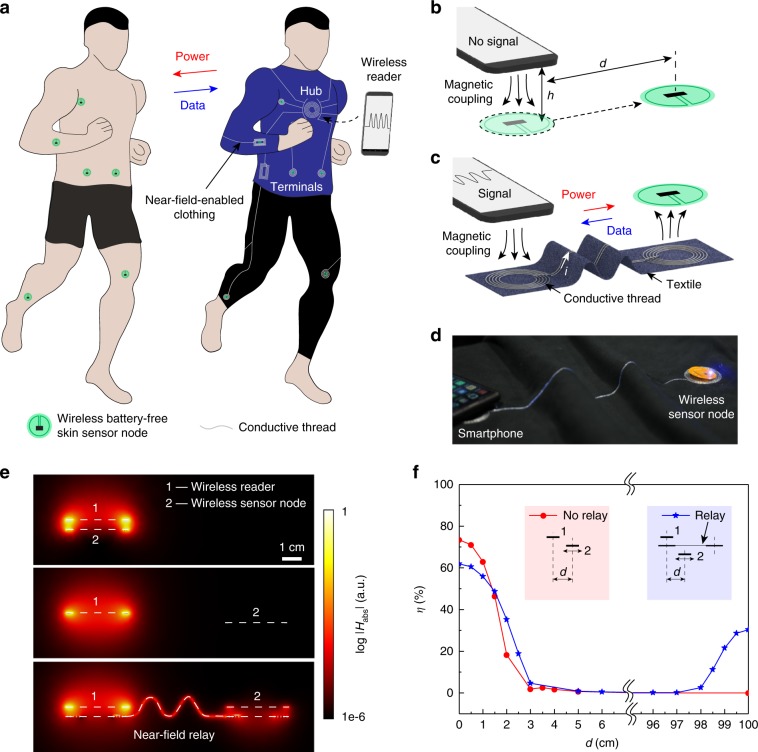
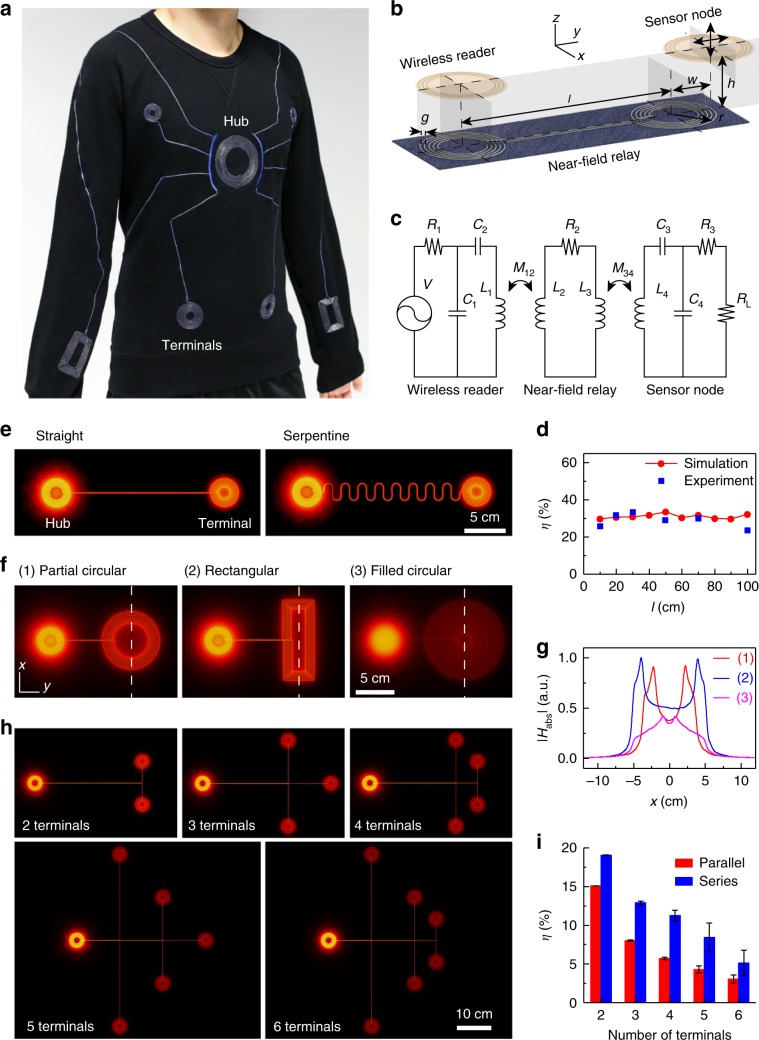
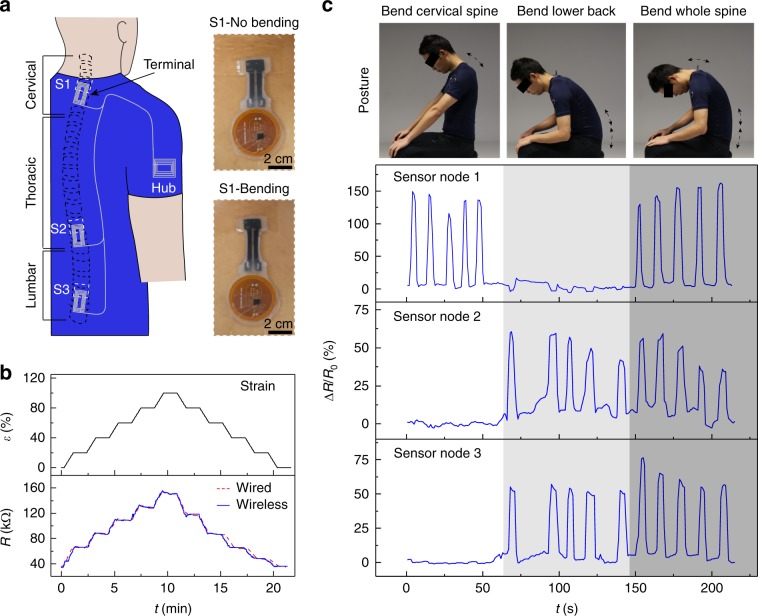
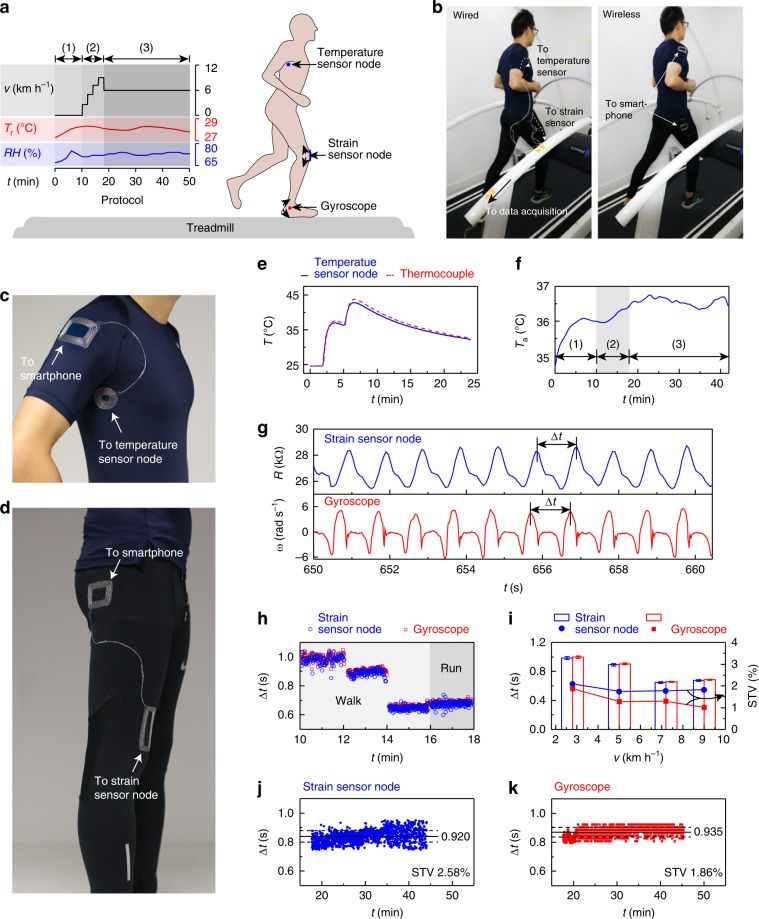
Networks of sensors placed on the skin can provide continuous measurement of human physiological signals for applications in clinical diagnostics, athletics and human-machine interfaces. Wireless and battery-free sensors are particularly desirable for reliable long-term monitoring, but current approaches for achieving this mode of operation rely on near-field technologies that require close proximity (at most a few centimetres) between each sensor and a wireless readout device. Here, we report near-field-enabled clothing capable of establishing wireless power and data connectivity between multiple distant points around the body to create a network of battery-free sensors interconnected by proximity to functional textile patterns. Using computer-controlled embroidery of conductive threads, we integrate clothing with near-field-responsive patterns that are completely fabric-based and free of fragile silicon components. We demonstrate the utility of the networked system for real-time, multi-node measurement of spinal posture as well as continuous sensing of temperature and gait during exercise.
Overview
The claims and statistics of this paper haven’t been checked yet.
Free: it reads the open-access text and checks the first 5 claims that cite a source we can check. Create a free account to check every claim.
Integrity signals
Registry
Cites
Statistics
Figures
Verification
Claims the paper makes
The claims and statistics of this paper haven’t been checked yet.
Free: it reads the open-access text and checks the first 5 claims that cite a source we can check. Create a free account to check every claim.
Claims other papers make about this one
Each is checked against this paper’s own text: does it say what the citing paper says it does?
The source backs part of the claim, not all of it — or backs it for a different population, condition or comparison.
In the citing paper
“In medical rehabilitation, temperature sensing is commonly used to monitor the body, which can be a reference for health.[225,226]”
From Flexible Electronics and Devices as Human–Machine Interfaces for Medical Robotics (2022) · cites this paper as [225]
Experimental — accuracy not yet measured
Self-check
Percentages, sums and reported differences re-computed from the paper’s own numbers.
The self-check needs the paper’s full text.
Citations
Cites
Kim, D.-H., Lu, N., Ma, R., Kim, Y.-S., Kim, R.-H., Wang, S., Wu, J., Won, S. M., Tao, H., Islam, A., et al. (2011) · Science · doi:10.1126/science.1206157 · Cited by 4,836
Wearable biosensors for healthcare monitoring
Kim, J., Campbell, A. S., de Ávila, B. E.-F., & Wang, J. (2019) · Nature Biotechnology · doi:10.1038/s41587-019-0045-y · Cited by 3,373
An ultra-lightweight design for imperceptible plastic electronics
Kaltenbrunner, M., Sekitani, T., Reeder, J., Yokota, T., Kuribara, K., Tokuhara, T., Drack, M., Schwödiauer, R., Graz, I., Bauer-Gogonea, S., et al. (2013) · Nature · doi:10.1038/nature12314 · Cited by 2,485
The rise of plastic bioelectronics
Someya, T., Bao, Z., & Malliaras, G. G. (2016) · Nature · doi:10.1038/nature21004 · Cited by 1,884
Lee, H., Choi, T. K., Lee, Y. B., Cho, H. R., Ghaffari, R., Wang, L., Choi, H. J., Chung, T. D., Lu, N., Hyeon, T., et al. (2016) · Nature Nanotechnology · doi:10.1038/nnano.2016.38 · Cited by 1,802
Ultrasensitive mechanical crack-based sensor inspired by the spider sensory system
Kang, D., Pikhitsa, P. V., Choi, Y. W., Lee, C., Shin, S. S., Piao, L., Park, B., Suh, K.-Y., Kim, T.-I., & Choi, M. (2014) · Nature · doi:10.1038/nature14002 · Cited by 1,626
Multifunctional wearable devices for diagnosis and therapy of movement disorders
Son, D., Lee, J., Qiao, S., Ghaffari, R., Kim, J., Lee, J. E., Song, C., Kim, S. J., Lee, D. J., Jun, S. W., et al. (2014) · Nature Nanotechnology · doi:10.1038/nnano.2014.38 · Cited by 1,462
Self-citationSkin-inspired highly stretchable and conformable matrix networks for multifunctional sensing
Hua, Q., Sun, J., Liu, H., Bao, R., Yu, R., Zhai, J., Pan, C., & Wang, Z. L. (2018) · Nature Communications · doi:10.1038/s41467-017-02685-9 · Cited by 1,413
Ultrathin conformal devices for precise and continuous thermal characterization of human skin
Webb, R. C., Bonifas, A. P., Behnaz, A., Zhang, Y., Yu, K. J., Cheng, H., Shi, M., Bian, Z., Liu, Z., Kim, Y.-S., et al. (2013) · Nature Materials · doi:10.1038/nmat3755 · Cited by 1,229
Soft Microfluidic Assemblies of Sensors, Circuits, and Radios for the Skin
Xu, S., Zhang, Y., Jia, L., Mathewson, K. E., Jang, K.-I., Kim, J., Fu, H., Huang, X., Chava, P., Wang, R., et al. (2014) · Science · doi:10.1126/science.1250169 · Cited by 1,199
Cited by
Items 301–355 of 355
Yamamoto, H., Li, Y., Yukita, W., Yokota, T., Someya, T., Takahashi, R., & Kawahara, Y. (2026) · CHI Conference Extended Abstracts on Human Factors in Computing Systems (CHI EA) · doi:10.1145/3772363.3799126 · Cited by 1
“While previous research, such as e-textiles composed of multiple sparse small coils [13, 14], is effectively available for specific applications, these systems are rigid in their design.”
Orchestrating the post‑silicon revolution of electronics through material-enabled intelligence
Wang, B., Li, X., Yu, L., & Lu, Y. (2026) · Chemical Engineering Journal · doi:10.1016/j.cej.2026.175242 · Cited by 1
Structure‐Driven Smart Textiles for Self‐Powered Wearable Systems
Ryu, H., Lee, S., & Kim, S. (2026) · Small Structures · doi:10.1002/sstr.202500910 · Cited by 1
“Such storage-layer properties directly affect the reliability of downstream electronics [187, 191, 317, 318].”
Near-Field Power and Data Networking via Meandered E-Textiles for Continuous, Large-Scale BodyNet
Takahashi, R., & Kawahara, Y. (2026) · IEEE Pervasive Computing · doi:10.1109/mprv.2026.3712563 · Cited by 1
“Moreover, multilayered wiring pattern of the standard coils constrains the fabrication process to the postprocess techniques like digital sewing 8,9 and screen printing, 10 restricting the fabrication of textile coil on a small scale.”
InfluentialInvestigation of self-oscillation piezoelectric energy harvesting mechanics for lower-limb motion
Gao, S., He, T., Ao, H., & Lee, C. (2021) · International Conference on Micro and Nanotechnology for Power Generation and Energy Conversion Applications (PowerMEMS) · doi:10.1109/powermems54003.2021.9658386 · Cited by 1
Analyzing the 6G Technology: A New Evolution of Wireless Communication
Devi, P. M., Perumal, S., & Gunasekaran, K. (2022) · Advances in wireless technologies and telecommunication book series · doi:10.4018/978-1-7998-9636-4.ch003 · Cited by 1
Yacoob, I. M., Basheer, R. A., Karyakos, R. S., & Kheder, M. H. (2023) · Baghdad Science Journal · doi:10.21123/bsj.2023.6889 · Cited by 1
Machine learning in talkative power technology
Mousavi, S. A., Izadi, Z. G., & Khooban, M. H. (2024) · Elsevier eBooks · doi:10.1016/b978-0-443-21432-5.00009-7 · Cited by 1
A comparison of technologies for smart queueing system to cater social distancing issue
Sharip, A. A., Rahid, N. N. A., Zain, S. M. M., Halim, S. A., Buja, A. G., & Halim, F. H. (2021) · AIP conference proceedings · doi:10.1063/5.0052869
Effect Analysis of Language Education Based on Computer and Network Sensors
Dan-dan, W., Wu, Y., & Zhu, Y. (2021) · Journal of Sensors · doi:10.1155/2021/4903433
“Some scholars have proposed the transmission scheduling problem to minimize the cost of data collection and used the connected dominating set to solve the above problem [18].”
BackgroundBio-environmental Monitoring System using Soft Conductive Textile
Odagaki, M. (2020) · Journal of Japan Society of Kansei Engineering · doi:10.5057/kansei.18.1_8
Liu, Z., Li, J., & Li, G. (2022) · International Conference on Microwave and Millimeter Wave Technology (ICMMT) · doi:10.1109/icmmt55580.2022.10022567
Target focus capture system based on enhancement learning and impedance variable structure controlPreprint
Zhang, Z., Hu, C., & Zhang, S. (2023) · Research Square · doi:10.21203/rs.3.rs-2603904/v1
Recent Progress on Non-invasive Wearable Epidermal Biosensors
Li, B. (2023) · Theoretical and Natural Science · doi:10.54254/2753-8818/4/20220536
العنزي, ر. س. ج., & منصور, أ. ش. (2024) · Al-Mağallah Al-ՙilmiyyaẗ Li ʿulūm Al-Tarbiyyaẗ Al-Nawʿiyyaẗ · doi:10.21608/sjsep.2024.353995
Understanding and supporting wearable technologies for freedivers
Bube, B. (2023) · Repositorio Institucional de la Universidad de Burgos (University of Burgos) · doi:10.36443/10259/9230
Capacitance Modelling of Conductive Cotton Knit Fabric for Sensor Node Communication
Akbari, S., Voigt, T., & Hjort, K. (2024) · Mediterranean Conference on Embedded Computing (MECO) · doi:10.1109/meco62516.2024.10577879
Human Movement Prediction with Wearable Sensors on Loose Clothing
Shen, T., Giulio, I. D., & Howard, M. (2024) · IEEE-RAS International Conference on Humanoid Robots (Humanoids) · doi:10.1109/humanoids58906.2024.10769938
“For example, (i) sensors have been tightly attached to the body using tape [7], [8], (ii) attached to tight-fitting clothing [9]–[12] or (iii) statistical machine learning/signal processing methods have been employed to reduce artefacts [13]–[15].”
Kušņins, R., Tjukovs, S., Eidaks, J., Gailis, K., & Pikuļins, D. (2024) · Applied Sciences · doi:10.3390/app142411733
An Authentication Protocol for Integrating Body Sensor Networks and Internet of Vehicles
Meng, X., Shu, T., Liang, W., Wang, X., Ke, M., & Wang, J. (2025) · Lecture notes in electrical engineering · doi:10.1007/978-981-96-5693-6_1
Data Transmission and Wireless Communication in Smart Fabrics
Singh, M., Saxena, P., Sharma, M., Malik, A., & Singh, S. (2025) · IGI Global eBooks · doi:10.4018/979-8-3373-4287-0.ch007
High-Efficiency Wearable Wireless Power Transfer using Magnetoinductive Waveguides
Jenkins, C., & Kiourti, A. (2025) · Digest - IEEE Antennas and Propagation Society. International Symposium · doi:10.1109/ap-s/cnc-usnc-ursi55537.2025.11265996
“MI relies on F araday’s Law to couple a transmit and receive coil and transfer power between them [3].”
González Fernández, E. (2021) · Rovira & Virgili repository
Remote Epitaxy by In-Situ Grown BN and InGaN Strain Relaxation
Liu, Y. (2024) · DSpace@MIT (Massachusetts Institute of Technology) · Cited by 1
Fahad, I., Scott, D., Zahid, A., Bringle, M., Patil, S., Bevins, E., Palileo, C., & Swaminathan, S. G. (2025) · ACM International Joint Conference on Pervasive and Ubiquitous Computing (UbiComp) · doi:10.1145/3714394.3754358
“Technologiessuch asanalogbackscat-ter [2], RFID [6], NFC [9], Bluetooth [1], BLE, and WiFi backscatter [5] offer various trade-offs, typically achieving ranges below 10 m and requiring higher power (up to several mW).”
Tunable magnetoelectric antennas enabled by multi-physics synergistic regulation
Min, S., Liu, K., Li, N., Jiao, Z., Zhang, Y., & Zheng, B. (2026) · Journal of Magnetism and Magnetic Materials · doi:10.1016/j.jmmm.2026.173831
A Fully Soft Sensing Suit With Optimal Sensor Placement for Real‐Time Motion Tracking
Oh, J., & Bae, J. (2026) · Advanced Intelligent Systems · doi:10.1002/aisy.202500995
Development of an NFC Antenna Multiplexing System for the Application in Smart Textiles
Oberle, R. R., Thun, J., & Gries, T. (2026) · Springer Proceedings in Materials · doi:10.1007/978-981-95-2953-7_1
Ju, L., Yu, B., Wang, R., Chen, H., Hou, K., Zhang, C., Geng, M., Dai, Y., Zhang, Y., Guan, Y., et al. (2026) · Advanced Science · doi:10.1002/advs.202522350
Somoreau, F. (2022) · theses.fr (ABES) · doi:10.70675/24126254z0610z47e0zbfc0z709f18e45e2b
Recent advances in magnetic metamaterials for enhancing the efficiency of wireless power transfer
Pham, T. S., Hiep, L. T. H., Bui, H. N., Khuyen, B. X., Tùng, B. S., Chen, A. L. Y., Lãm, V. Đ., & Lee, Y. (2026) · Journal of Electromagnetic Waves and Applications · doi:10.1080/09205071.2026.2656810
“Table 1 presents a classification of the WPT system designs incorporating magnetic metamaterials [12,37,41–43].”
Advances in wireless flexible electronic devices for rehabilitation medicine
Liu, M., Wang, W. F., Zeng, S.-C., Guo, H.-Y., Tian, L.-R., Zhang, Y., Zeng, N., & Zhao, Q. (2026) · Science China Technological Sciences · doi:10.1007/s11431-025-3202-5
Sarma, B., & Rani, K. V. (2026) · Journal of Medical Engineering & Technology · doi:10.1080/03091902.2026.2657309
“…for device-to-device communication can benefit the transmitting and processing of clinical data such as treatment progress and therapeutic feedback [40], thus contributing to precise medical services in a patient-participatory manner. eventually, textile-based diagnostic, therapeutic, protective,…”
Li, Y. F., Ding, Y., Lei, K., Zhang, Y., Lin, Z., Sun, J., Guo, K., Zheng, Y., Tan, S., Zhang, X., et al. (2026) · FlexMat. · doi:10.1002/flm2.70090 · Cited by 1
Self-citationXu, Y., Xie, L., Jiang, X., Chen, S. G., & Huang, W. (2026) · Science China Materials · doi:10.1007/s40843-025-4145-0
Yang, J., Choi, M., Ha, J., Ahn, J., Hwang, S. H., Jeon, S., Kim, D., Jeong, J., Kim, M., Lim, H., et al. (2026) · Nano Letters · doi:10.1021/acs.nanolett.6c01958
Self-citationSoft Mechanical Inductive Sensors: Principles, Design, and Applications
Awais, M., Indukumar, G., Cafiso, D., & Beccai, L. (2026) · Micromachines · doi:10.3390/mi17091051
Toward self-sustained wearables: Energy harvesting, storage, and smart power management
Wang, Z., 王锡淦, Yi, Z., Wang, L., Xu, M., & Liao, C. (2026) · Wearable electronics. · doi:10.1016/j.wees.2026.06.002
Li, H., Liu, X., Fan, Y., Ma, X., Zhang, Z., & Tentzeris, M. M. (2026) · IEEE Internet of Things Journal · doi:10.1109/jiot.2026.3718888
“W EARABLE electronic devices (WEDs), such as medical healthcare equipment [1], body-centric sensors [2], and epidermal electronics [3], have brought great convenience to users.”
Prakhinkit, S., & Titawattanaku, A. (2026) · International Journal of Public Health Science (IJPHS) · doi:10.11591/ijphs.v15i3.27129
Yan, J., Xu, Y., Jiang, W., & Yin, J. (2026) · ACS Applied Polymer Materials · doi:10.1021/acsapm.6c02585
A self-powered LC wireless sensing platform based on flexible PVDF film
Li, H., Yuan, Y., Wu, D., Zhang, J., Hu, R., Lu, X., Gao, E., Peng, T., & Nie, B. (2026) · Sensors and Actuators A Physical · doi:10.1016/j.sna.2026.118418
Zhang, Y., Fengman, H., He, T., Luo, Q., Lin, J., Xu, Q., Guo, C., Chai, X., Wang, Y., Wu, T., et al. (2026) · Nature Communications · doi:10.1038/s41467-026-77600-2
“To harvest energy from the 13.56MHz NFC signal emitted by a smartphone, this battery-free sensor node employs a six-turn coil.”
InfluentialZhang, F., 孙富昌, & Yan, Z. (2026) · npj Soft Matter · doi:10.1038/s44431-026-00041-w
“WearablepatchesgenerallyfavourNFCorBluetooth;shallowsubcutaneous implantsoftenbene fi t from inductive links; and deep miniaturized implants may require ultrasound, magnetoelectric transducers or hybrid power-management architectures 42 – 46 .”
Near-Exceptional-Point Operation via PWM Load Switching in a PT-Symmetry-Based Wearable WPT
Fukui, T., & Noda, A. (2026) · IEEE Wireless Power Technology Conference and Expo (WPTCE) · doi:10.1109/wptce66920.2026.11691186
“In recent years, conductive-fabric-based electronic textiles (e-textiles) have attracted increasing attention as platforms for wearable sensor networks [3], [4].”
Protocol-Flexible Custom NFC for Wire-Free Wearable Sensor Networks
Maeda, R., & Noda, A. (2026) · IEEE Sensors Letters · doi:10.1109/lsens.2026.3736589
Gupta, P., Mallick, S., Garg, R., Patra, N. R., Garg, A., Zhang, Z., Zhang, C., & Parida, K. (2026) · Advanced Materials Technologies · doi:10.1002/admt.71312
Fiber‐Based Wearable Electronics as Adaptive Biointerfaces for Healthcare Applications
Hong, S., Kim, J., Jeong, Y., Kang, S., Lee, D., & Ko, S. H. (2026) · Advanced Functional Materials · doi:10.1002/adfm.78534
Smart Alarm Indicators for the Internet of Things
Węglarski, M., & Skrobacz, K. (2026) · Advances in IT and Electrical Engineering · doi:10.7862/ra.2026.1
“…05-14 p-ISSN 3071-9003, e-ISSN 3071-9011 In this logistics domain, there is significant potential for the use of RFID transponders equipped with enhanced capabilities [12-14], such as storing data acquired from embedded sensors [15-17] or logging selected operational parameters of the tag [18, 19].”
From stretchable materials and functional fibers to intelligent textile sensing systems
Papaefstathiou, M., Elgendi, M., & Menon, C. (2026) · Communications Materials · doi:10.1038/s43246-026-01333-4
Li, C., Xu, S., Li, W., Jin, D., Zhao, Y., Zhang, C., Li, W., Sun, Z., & Zhou, S. (2026) · Micromachines · doi:10.3390/mi17101210
“Rongzhou Lin et al. developed near-field enabled clothing and a wireless body sensor network [32], which seamlessly integrate near-field response patterns into fabrics through computer-controlled conductive fiber embroidery technology (Figure 3d), achieving wireless power supply and data connection…”
Textile-Based Nanogenerators for Home-Based Monitoring of Cardiovascular Diseases
Yuan, X., Luo, J., Zhao, Y., Yan, Z., Zhi, J., Shi, Y., Wang, D., & Qin, Y. (2026) · Nanoenergy Advances · doi:10.3390/nanoenergyadv6040034
Choi, H., Suvindran, N., Neyestanak, M. L., Wang, Y.-C., Hu, M.-L. M., Yang, G., & Servati, P. (2026) · Sensors · doi:10.3390/s26216877
Robotic Electronic Skin for Contact Sensing and Robot Interaction
Wang, Z., Wu, K., & Dou, X. (2026) · Semiconductors and Heterogeneous Integration · doi:10.3390/shi1030011
Metadata
- Authors
- Lin, R., Kim, H.-J., Achavananthadith, S., Kurt, S. A., Tan, S. C. C., Yao, H., Tee, B. C. K., Lee, J. K. W., & Ho, J. S.
- Affiliations
- National University of Singapore (SG)
- Corresponding author
- Lin, Rongzhou
- Ho, John S.
- ORCID
- Venue
- Nature Communications
- Published
- 2020-01-23
- Volume
- 11
- Issue
- 1
- Pages
- 444-444
- ISSN
- 2041-1723 (ISSN-L)
- PMC
- PMC6978350
- OpenAlex
- W3002340625
- Semantic Scholar
- 9fb7c4cd82602c0ef48db5c466e5cb9fe2b65f1a
- Cited by
- 331
- References
- 58
- Citations by year
- 2026: 37 · 2025: 62 · 2024: 54 · 2023: 52 · 2022: 59 · 2021: 51 · 2020: 16
- FWCI
- 13.98
- Type
- journal article
- Language
- en
- Open access
- gold
- doi.org
- Licence
- cc-by
- creativecommons.org/licenses/by/4.0 (tdm)
- creativecommons.org/licenses/by/4.0 (vor)
- Locations
- Nature Communications (publishedVersion, cc-by)
- Europe PMC (PubMed Central) (publishedVersion, cc-by)
- PubMed Central (publishedVersion, cc-by)
- PubMed (publishedVersion)
- National University of Singapore (submittedVersion)
- RePEc: Research Papers in Economics (submittedVersion)
- DOAJ (DOAJ: Directory of Open Access Journals) (submittedVersion)
- DOAJ (DOAJ: Directory of Open Access Journals) (submittedVersion, cc-by-sa)
- Funders
- National Research Foundation (AISG-GC-2019-002)
- National Research Foundation Singapore (AISG-GC-2019-002, NRFF2017-07)
- Ministry of Education, India
- Topics
- Physical Sciences › Engineering › Biomedical Engineering › Advanced Sensor and Energy Harvesting Materials
- Physical Sciences › Engineering › Biomedical Engineering › Wireless Body Area Networks
- Physical Sciences › Engineering › Biomedical Engineering › Non-Invasive Vital Sign Monitoring
- Keywords
- battery-free sensors, wireless body sensor networks, near field communication, smart textiles, functional clothing, wireless power transfer, physiological monitoring, temperature sensing, human-machine interaction
- MeSH terms
- Clothing, Equipment Design, Humans, Knee, Posture, Electric Power Supplies, Spine, Temperature, Exercise, Walking, Monitoring, Ambulatory, Electromagnetic Phenomena, Wireless Technology
About these checks
Registry, retraction, Cites and statistics results are computed, not judged, with one exception: a printed reference that no index lists is read once by a model before it counts as a citation error. Claims are extracted by a model and kept only when their quote appears verbatim in the text; each cited source is then checked, with a model’s help, for whether it says what the claim relies on. Those verdicts can be wrong — read the claim’s quote and the cited source before relying on one.
Statistics and arithmetic are recomputed, not judged.
Confidence bands are shown only for fields calibrated on our annotated test set. None is calibrated yet, so no band is shown.
What counts as a claim ›How we measure confidence ›How we check this ›
Are you an author, or do you see a problem with this page? Request a review
Data sources
Bibliographic data: Semantic Scholar, OpenAlex, Crossref.
Contains information from the Semantic Scholar Academic Graph Datasets, made available under the ODC Attribution License (ODC-BY 1.0).
Semantic Scholar’s data is described in: Kinney, R., et al. (2023). The Semantic Scholar Open Data Platform. arXiv:2301.10140.
