

Wireless battery-free body sensor networks using near-field-enabled clothing
Open accessThe DOI matches its Crossref record; 55 of the 58 references it cites were found in a registry or an index.
Abstract
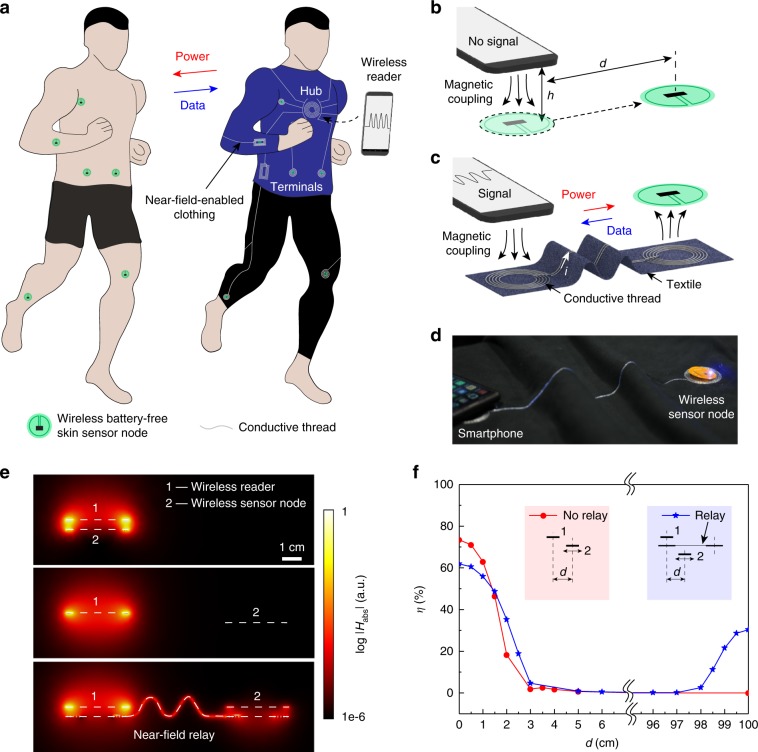
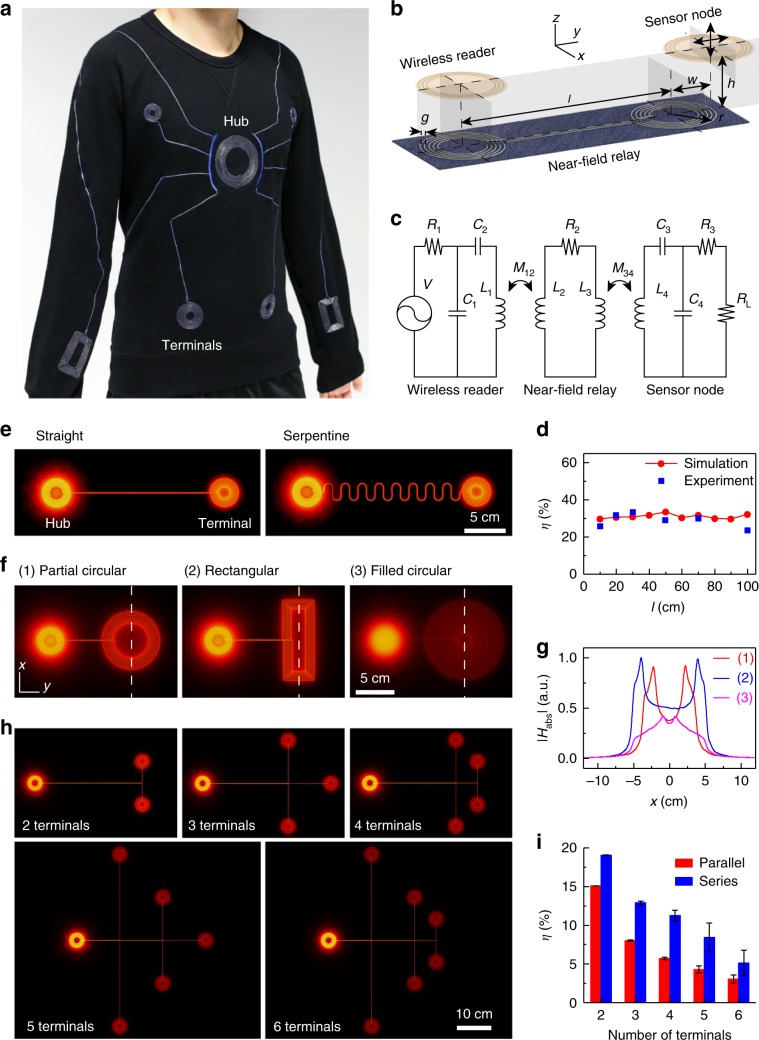
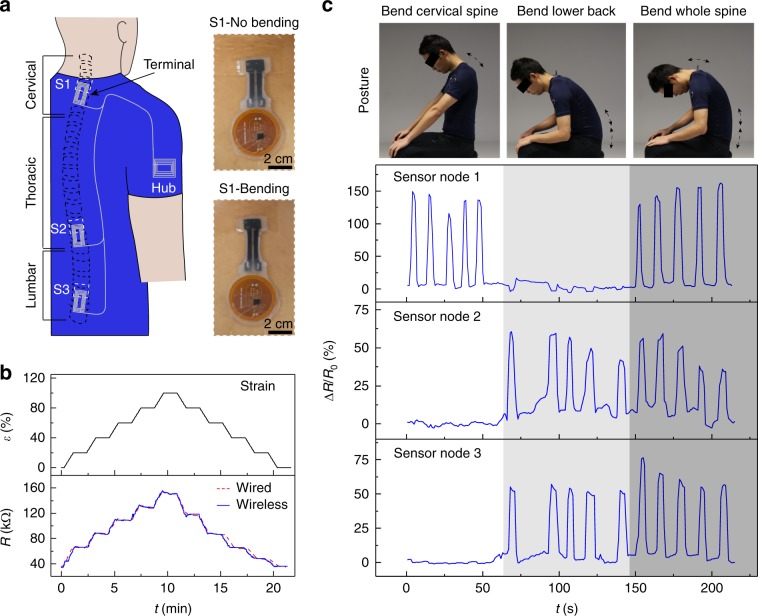
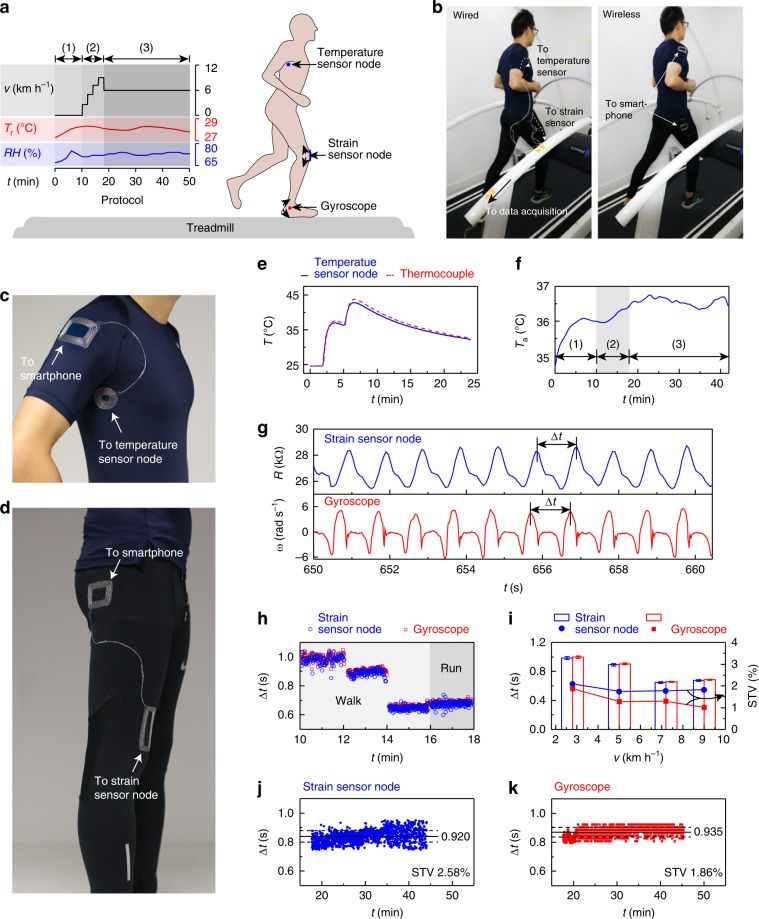
Networks of sensors placed on the skin can provide continuous measurement of human physiological signals for applications in clinical diagnostics, athletics and human-machine interfaces. Wireless and battery-free sensors are particularly desirable for reliable long-term monitoring, but current approaches for achieving this mode of operation rely on near-field technologies that require close proximity (at most a few centimetres) between each sensor and a wireless readout device. Here, we report near-field-enabled clothing capable of establishing wireless power and data connectivity between multiple distant points around the body to create a network of battery-free sensors interconnected by proximity to functional textile patterns. Using computer-controlled embroidery of conductive threads, we integrate clothing with near-field-responsive patterns that are completely fabric-based and free of fragile silicon components. We demonstrate the utility of the networked system for real-time, multi-node measurement of spinal posture as well as continuous sensing of temperature and gait during exercise.
Overview
The claims and statistics of this paper haven’t been checked yet.
Free: it reads the open-access text and checks the first 5 claims that cite a source we can check. Create a free account to check every claim.
Integrity signals
Registry
Cites
Statistics
Figures
Verification
Claims the paper makes
The claims and statistics of this paper haven’t been checked yet.
Free: it reads the open-access text and checks the first 5 claims that cite a source we can check. Create a free account to check every claim.
Claims other papers make about this one
Each is checked against this paper’s own text: does it say what the citing paper says it does?
The source backs part of the claim, not all of it — or backs it for a different population, condition or comparison.
In the citing paper
“In medical rehabilitation, temperature sensing is commonly used to monitor the body, which can be a reference for health.[225,226]”
From Flexible Electronics and Devices as Human–Machine Interfaces for Medical Robotics (2022) · cites this paper as [225]
Experimental — accuracy not yet measured
Self-check
Percentages, sums and reported differences re-computed from the paper’s own numbers.
The self-check needs the paper’s full text.
Citations
Cites
Kim, D.-H., Lu, N., Ma, R., Kim, Y.-S., Kim, R.-H., Wang, S., Wu, J., Won, S. M., Tao, H., Islam, A., et al. (2011) · Science · doi:10.1126/science.1206157 · Cited by 4,836
Wearable biosensors for healthcare monitoring
Kim, J., Campbell, A. S., de Ávila, B. E.-F., & Wang, J. (2019) · Nature Biotechnology · doi:10.1038/s41587-019-0045-y · Cited by 3,373
An ultra-lightweight design for imperceptible plastic electronics
Kaltenbrunner, M., Sekitani, T., Reeder, J., Yokota, T., Kuribara, K., Tokuhara, T., Drack, M., Schwödiauer, R., Graz, I., Bauer-Gogonea, S., et al. (2013) · Nature · doi:10.1038/nature12314 · Cited by 2,485
The rise of plastic bioelectronics
Someya, T., Bao, Z., & Malliaras, G. G. (2016) · Nature · doi:10.1038/nature21004 · Cited by 1,884
Lee, H., Choi, T. K., Lee, Y. B., Cho, H. R., Ghaffari, R., Wang, L., Choi, H. J., Chung, T. D., Lu, N., Hyeon, T., et al. (2016) · Nature Nanotechnology · doi:10.1038/nnano.2016.38 · Cited by 1,802
Ultrasensitive mechanical crack-based sensor inspired by the spider sensory system
Kang, D., Pikhitsa, P. V., Choi, Y. W., Lee, C., Shin, S. S., Piao, L., Park, B., Suh, K.-Y., Kim, T.-I., & Choi, M. (2014) · Nature · doi:10.1038/nature14002 · Cited by 1,626
Multifunctional wearable devices for diagnosis and therapy of movement disorders
Son, D., Lee, J., Qiao, S., Ghaffari, R., Kim, J., Lee, J. E., Song, C., Kim, S. J., Lee, D. J., Jun, S. W., et al. (2014) · Nature Nanotechnology · doi:10.1038/nnano.2014.38 · Cited by 1,462
Self-citationSkin-inspired highly stretchable and conformable matrix networks for multifunctional sensing
Hua, Q., Sun, J., Liu, H., Bao, R., Yu, R., Zhai, J., Pan, C., & Wang, Z. L. (2018) · Nature Communications · doi:10.1038/s41467-017-02685-9 · Cited by 1,413
Ultrathin conformal devices for precise and continuous thermal characterization of human skin
Webb, R. C., Bonifas, A. P., Behnaz, A., Zhang, Y., Yu, K. J., Cheng, H., Shi, M., Bian, Z., Liu, Z., Kim, Y.-S., et al. (2013) · Nature Materials · doi:10.1038/nmat3755 · Cited by 1,229
Soft Microfluidic Assemblies of Sensors, Circuits, and Radios for the Skin
Xu, S., Zhang, Y., Jia, L., Mathewson, K. E., Jang, K.-I., Kim, J., Fu, H., Huang, X., Chava, P., Wang, R., et al. (2014) · Science · doi:10.1126/science.1250169 · Cited by 1,199
Cited by
Chowdhury, M. Z., Shahjalal, M., Ahmed, S., & Jang, Y. M. (2020) · IEEE Open Journal of the Communications Society · doi:10.1109/ojcoms.2020.3010270 · Cited by 1,857
Technology Roadmap for Flexible Sensors
Luo, Y., Abidian, M. R., Ahn, J.-H., Akinwande, D., Andrews, A. M., Antonietti, M., Bao, Z., Berggren, M., Berkey, C. A., Bettinger, C. J., et al. (2023) · ACS Nano · doi:10.1021/acsnano.2c12606 · Cited by 1,383
Self-citationElectronic Textiles for Wearable Point-of-Care Systems
Chen, G., Xiao, X., Zhao, X., Tat, T., Bick, M., & Chen, J. (2022) · Chemical Reviews · doi:10.1021/acs.chemrev.1c00502 · Cited by 688
Functional Fibers and Fabrics for Soft Robotics, Wearables, and Human–Robot Interface
Xiong, J., Chen, J., & Lee, P. S. (2021) · Advanced Materials · doi:10.1002/adma.202002640 · Cited by 627
Flexible Electronics and Devices as Human–Machine Interfaces for Medical Robotics
Heng, W., Solomon, S., & Gao, W. (2022) · Advanced Materials · doi:10.1002/adma.202107902 · Cited by 609
Materials-Driven Soft Wearable Bioelectronics for Connected Healthcare
Gong, S., Lu, Y., Yin, J., Levin, A., & Cheng, W. (2024) · Chemical Reviews · doi:10.1021/acs.chemrev.3c00502 · Cited by 411
2D Materials in Flexible Electronics: Recent Advances and Future Prospectives
Katiyar, A. K., Hoang, A. T., Xu, D., Hong, J., Kim, B. J., Ji, S., & Ahn, J.-H. (2024) · Chemical Reviews · doi:10.1021/acs.chemrev.3c00302 · Cited by 363
Triboelectric nanogenerator based self-powered sensor for artificial intelligence
Zhou, Y., Shen, M., Cui, X., Shao, Y., Li, L., & Zhang, Y. (2021) · Nano Energy · doi:10.1016/j.nanoen.2021.105887 · Cited by 344
Power generation for wearable systems
Gao, M., Wang, P., Jiang, L., Wang, B., Yao, Y., Liu, S., Chu, D., Cheng, W., & Lu, Y. (2021) · Energy & Environmental Science · doi:10.1039/d0ee03911j · Cited by 343
Hierarchically Microstructure-Bioinspired Flexible Piezoresistive Bioelectronics
Yang, T., Deng, W., Chu, X., Wang, X., Hu, Y., Fan, X., Song, J., Gao, Y., Zhang, B., Tian, G., et al. (2021) · ACS Nano · doi:10.1021/acsnano.1c01606 · Cited by 342
An ultrathin rechargeable solid-state zinc ion fiber battery for electronic textiles
Xiao, X., Xiao, X., Zhou, Y., Zhao, X., Chen, G., Liu, Z., Wang, Z., Lu, C., Hu, M., Nashalian, A., et al. (2021) · Science Advances · doi:10.1126/sciadv.abl3742 · Cited by 297
“The TBAN could continuously acquire physiological information and enable a change from the current reactive and disease-centric health care system to a personalized model that focuses on disease prevention and health promotion ( 3 , 4 ).”
Wang, C., He, T., Zhou, H., Zhang, Z., & Lee, C. (2023) · Bioelectronic Medicine · doi:10.1186/s42234-023-00118-1 · Cited by 295
“Near-field communication (NFC) offers an alternative approach where sensors can be wirelessly powered by a reader, enabling battery-free and secure operation for various physiological measurements on the skin or inside the body (Lin et al. 2020; Lin et al. 2022; Niu et al. 2019; Shi et al. 2022).”
BackgroundChip-less wireless electronic skins by remote epitaxial freestanding compound semiconductors
Kim, Y., Suh, J. M., Shin, J., Liu, Y., Yeon, H., Qiao, K., Kum, H. S., Kim, C., Lee, H. E., Choi, C., et al. (2022) · Science · doi:10.1126/science.abn7325 · Cited by 285
Self-citationSingle body-coupled fiber enables chipless textile electronics
Yang, W., Lin, S., Gong, W., Lin, R., Jiang, C., Yang, X., Hu, Y., Wang, J., Xiao, X., Li, K., et al. (2024) · Science · doi:10.1126/science.adk3755 · Cited by 274
Self-citationPorous Conductive Textiles for Wearable Electronics
Ding, Y., Jiang, J., Wu, Y., Zhang, Y., Zhou, J., Zhang, Y., Huang, Q., & Zheng, Z. (2024) · Chemical Reviews · doi:10.1021/acs.chemrev.3c00507 · Cited by 269
Digitally-embroidered liquid metal electronic textiles for wearable wireless systems
Lin, R., Kim, H.-J., Achavananthadith, S., Xiong, Z., Lee, J. K. W., Kong, Y. L., & Ho, J. S. (2022) · Nature Communications · doi:10.1038/s41467-022-29859-4 · Cited by 267
Self-citationFunctionalized Fiber-Based Strain Sensors: Pathway to Next-Generation Wearable Electronics
Liu, Z., Zhu, T., Wang, J., Zheng, Z., Li, Y., Li, J., & Lai, Y. (2022) · Nano-Micro Letters · doi:10.1007/s40820-022-00806-8 · Cited by 243
Advances in Ionic Thermoelectrics: From Materials to Devices
Sun, S., Li, M., Shi, X., & Chen, Z. (2023) · Advanced Energy Materials · doi:10.1002/aenm.202203692 · Cited by 237
Rational Design of Flexible Zn-Based Batteries for Wearable Electronic Devices
Xiao, X., Zheng, Z., Zhong, X., Gao, R., Piao, Z., Jiao, M., & Zhou, G. (2023) · ACS Nano · doi:10.1021/acsnano.2c09509 · Cited by 236
Electronic textiles: New age of wearable technology for healthcare and fitness solutions
Meena, J. S., Choi, S. B., Jung, S.-B., & Kim, J.-W. (2023) · Materials Today Bio · doi:10.1016/j.mtbio.2023.100565 · Cited by 232
Advances in Nanostructures for High‐Performance Triboelectric Nanogenerators
Zou, Y., Xu, J., Chen, K., & Chen, J. (2021) · Advanced Materials Technologies · doi:10.1002/admt.202000916 · Cited by 220
Song, H., Luo, G., Ji, Z., Bo, R., Xue, Z., Yan, D., Zhang, F., Bai, K., Liu, J., Cheng, X., et al. (2022) · Science Advances · doi:10.1126/sciadv.abm3785 · Cited by 211
“In comparison to previously reported inorganic electronic systems with similar levels of biaxial elastic stretchability and functional complexity ( 51 , 53 , 70 ), the present system offers a much smaller lateral size (by more than twice) and a much higher areal coverage ratio (110% versus 76%).”
A Wearable Body Condition Sensor System with Wireless Feedback Alarm Functions
Xu, K., Fujita, Y., Lu, Y., Honda, S., Shiomi, M., Arie, T., Akita, S., & Takei, K. (2021) · Advanced Materials · doi:10.1002/adma.202008701 · Cited by 207
Skin Electronics: Next‐Generation Device Platform for Virtual and Augmented Reality
Kim, J. J., Wang, Y., Wang, H., Lee, S., Yokota, T., & Someya, T. (2021) · Advanced Functional Materials · doi:10.1002/adfm.202009602 · Cited by 193
A wireless and battery-free wound infection sensor based on DNA hydrogel
Xiong, Z., Achavananthadith, S., Lian, S., Madden, L. E., Ong, Z. X., Chua, W., Kalidasan, V., Li, Z., Liu, Z., Singh, P., et al. (2021) · Science Advances · doi:10.1126/sciadv.abj1617 · Cited by 186
Self-citationHuang, J., Li, J., Xu, X., Hua, L., & Lu, Z. (2022) · ACS Nano · doi:10.1021/acsnano.2c01540 · Cited by 182
Yang, H., Li, J., Xiao, X., Wang, J., Li, Y., Li, K., Li, Z., Yang, H., Wang, Q., Yang, J., et al. (2022) · Nature Communications · doi:10.1038/s41467-022-33021-5 · Cited by 176
Self-citationHighly anisotropic and flexible piezoceramic kirigami for preventing joint disorders
Hong, Y., Wang, B., Lin, W., Jin, L., Liu, S., Luo, X., Pan, J., Wang, W., & Yang, Z. (2021) · Science Advances · doi:10.1126/sciadv.abf0795 · Cited by 165
Sun, J., Xiu, K., Wang, Z., Hu, N., Zhao, L., Zhu, H., Kong, F., Xiao, J., Cheng, L., & Bi, X. (2023) · Nano Energy · doi:10.1016/j.nanoen.2023.108215 · Cited by 164
Soft Wearable Healthcare Materials and Devices
Lyu, Q., Gong, S., Yin, J., Dyson, J. M., & Cheng, W. (2021) · Advanced Healthcare Materials · doi:10.1002/adhm.202100577 · Cited by 160
Gao, S., He, T., Zhang, Z., Ao, H., Jiang, H., & Lee, C. (2021) · Advanced Science · doi:10.1002/advs.202101834 · Cited by 168
Wearable Self‐Powered Electrochemical Devices for Continuous Health Management
Parrilla, M., & Wael, K. D. (2021) · Advanced Functional Materials · doi:10.1002/adfm.202107042 · Cited by 163
Wen, F., He, T., Liu, H., Chen, H.-Y., Zhang, T., & Lee, C. (2020) · Nano Energy · doi:10.1016/j.nanoen.2020.105155 · Cited by 158
Min, S., An, J., Lee, J. H., Kim, J. H., Joe, D. J., Eom, S. H., Yoo, C. D., Ahn, H., Hwang, J.-Y., Xu, S. H., et al. (2025) · Nature Reviews Cardiology · doi:10.1038/s41569-025-01127-0 · Cited by 178
“Low-power wireless communication is also crucial for the reliable transmission of data in wearable devices, and includes near-field communication 251,252 , Bluetooth technology 253,254 and WiFi 255,256 .”
Self-citationHassani, F. A., Shi, Q., Wen, F., He, T., Haroun, A., Yang, Y., Feng, Y., & Lee, C. (2020) · Smart Materials in Medicine · doi:10.1016/j.smaim.2020.07.005 · Cited by 159
Fibres—threads of intelligence—enable a new generation of wearable systems
Dang, C., Wang, Z., Hughes‐Riley, T., Dias, T., Qian, S., Wang, Z., Wang, X., Liu, M., Yu, S., Liu, R., et al. (2024) · Chemical Society Reviews · doi:10.1039/d4cs00286e · Cited by 144
Tactile Near‐Sensor Analogue Computing for Ultrafast Responsive Artificial Skin
Wang, M., Tu, J., Huang, Z., Wang, T., Liu, Z., Zhang, F., Li, W., He, K., Pan, L., Zhang, X., et al. (2022) · Advanced Materials · doi:10.1002/adma.202201962 · Cited by 144
Advanced Flexible Skin-Like Pressure and Strain Sensors for Human Health Monitoring
Liu, X., Yuan, W., & Qiu, Y. (2021) · Micromachines · doi:10.3390/mi12060695 · Cited by 136
Hybrid Integration of Wearable Devices for Physiological Monitoring
Zhang, Y., Zheng, X. T., Zhang, X., Pan, J., & Thean, A. (2024) · Chemical Reviews · doi:10.1021/acs.chemrev.3c00471 · Cited by 138
Zhang, S., Zahed, M. A., Sharifuzzaman, M., Yoon, S., Hui, X., Barman, S. C., Sharma, S., Yoon, H. S., Park, C., & Park, J. Y. (2020) · Biosensors and Bioelectronics · doi:10.1016/j.bios.2020.112844 · Cited by 129
Smart Textiles for Personalized Sports and Healthcare
Xu, Z., Zhang, C., Wang, F., Yu, J., Yang, G., Анатольевич, С. Р., Li, Z., & Ding, B. (2025) · Nano-Micro Letters · doi:10.1007/s40820-025-01749-6 · Cited by 136
“The fabric can provide enough space and protection, especially the communication technology in the form of embroi-dery [91, 204] and attachments [205], which can freely choose the position of action and avoid damage to the transmission module due to fabric deformation.”
Wagih, M., Balocchi, L., Benassi, F., Carvalho, N. B., Chiao, J. ‐., Correia, R., Costanzo, A., Cui, Y., Georgiadou, D. G., Gouveia, C., et al. (2022) · IEEE Journal of Microwaves · doi:10.1109/jmw.2022.3223254 · Cited by 136
“Emerging materials for e-textiles, e.g. liquid metals, have shown potential for achieving an RF performance close to conventional copper-based devices while retaining flexibility and reliability [147].”
BackgroundInfluentialSelf-citationTextile-integrated metamaterials for near-field multibody area networks
Hajiaghajani, A., Zargari, A. H. A., Dautta, M., Jimenez, A., Kurdahi, F. J., & Tseng, P. (2021) · Nature Electronics · doi:10.1038/s41928-021-00663-0 · Cited by 130
Wearable devices for continuous monitoring of biosignals: Challenges and opportunities
Stuart, T., Hanna, J., & Gutruf, P. (2022) · APL Bioengineering · doi:10.1063/5.0086935 · Cited by 134
“Lin et al. 80 demonstrated a multimodal system based on skin-mounted wireless sensors powered by near-field-enabled clothing.”
Zhang, X., Ke, L., Zhang, X., Xu, F., Hu, Y., Lin, H., & Zhu, J. (2022) · ACS Applied Materials & Interfaces · doi:10.1021/acsami.2c04790 · Cited by 122
Peng, J., Cheng, H., Liu, J., Han, W., Wu, T., Yin, Y., & Wang, C. (2023) · Advanced Fiber Materials · doi:10.1007/s42765-023-00328-x · Cited by 121
Flexible Strain and Temperature Sensing NFC Tag for Smart Food Packaging Applications
Escobedo, P., Bhattacharjee, M., Nikbakhtnasrabadi, F., & Dahiya, R. (2021) · IEEE Sensors Journal · doi:10.1109/jsen.2021.3100876 · Cited by 114
Designing wearable microgrids: towards autonomous sustainable on-body energy management
Yin, L., Kim, K. N., Trifonov, A., Podhajny, T., & Wang, J. (2022) · Energy & Environmental Science · doi:10.1039/d1ee03113a · Cited by 111
Recent progress in the fabrication of flexible materials for wearable sensors
Liu, H., Wang, L., Lin, G., & Feng, Y. (2022) · Biomaterials Science · doi:10.1039/d1bm01136g · Cited by 114
Flexible thermoelectric generator and energy management electronics powered by body heat
Yang, S., Li, Y., Deng, L., Tian, S. F., Yao, Y., Yang, F., Feng, C., Dai, J., Wang, P., & Gao, M. (2023) · Microsystems & Nanoengineering · doi:10.1038/s41378-023-00583-3 · Cited by 114
Gas Sensors Based on Single-Wall Carbon Nanotubes
Guo, S., Hou, P., Zhang, F., Liu, C., & Cheng, H. (2022) · Molecules · doi:10.3390/molecules27175381 · Cited by 113
Electronic textiles for energy, sensing, and communication
Du, K., Lin, R., Yin, L., Ho, J. S., Wang, J., & Lim, C. T. (2022) · iScience · doi:10.1016/j.isci.2022.104174 · Cited by 109
Self-citationActive tissue adhesive activates mechanosensors and prevents muscle atrophy
Nam, S., Seo, B. R., Najibi, A. J., McNamara, S. L., & Mooney, D. J. (2022) · Nature Materials · doi:10.1038/s41563-022-01396-x · Cited by 105
Highly Stretchable PU Ionogels with Self-Healing Capability for a Flexible Thermoelectric Generator
Xu, J., Wang, H., Du, X., Cheng, X., Du, Z., & Wang, H. (2021) · ACS Applied Materials & Interfaces · doi:10.1021/acsami.1c03328 · Cited by 99
Fiber-shaped artificial optoelectronic synapses for wearable visual-memory systems
Chen, L., Li, R., Yuan, S., Chen, A., Li, Y., Zhang, T., Wei, L., Zhang, Q., & Li, Q. (2022) · Matter · doi:10.1016/j.matt.2022.12.001 · Cited by 99
Lam, C. K. C., Hang, J., Zhang, D., Wang, Q., Ren, M., & Huang, C. (2021) · Building and Environment · doi:10.1016/j.buildenv.2021.107877 · Cited by 94
Electrogenic Bacteria Promise New Opportunities for Powering, Sensing, and Synthesizing
Choi, S. (2022) · Small · doi:10.1002/smll.202107902 · Cited by 92
Engineering the Comfort‐of‐Wear for Next Generation Wearables
Shimura, T., Sato, S., Zalar, P., & Matsuhisa, N. (2023) · Advanced Electronic Materials · doi:10.1002/aelm.202200512 · Cited by 86
Wei, J., Zhang, X., Mugo, S. M., & Zhang, Q. M. (2022) · Analytical Chemistry · doi:10.1021/acs.analchem.2c02587 · Cited by 86
Osseosurface electronics—thin, wireless, battery-free and multimodal musculoskeletal biointerfaces
Cai, L., Burton, A., Gonzales, D. A., Kasper, K. A., Azami, A., Peralta, R., Johnson, M., Bakall, J. A., Villalobos, E. B., Ross, E. C., et al. (2021) · Nature Communications · doi:10.1038/s41467-021-27003-2 · Cited by 85
Peng, J., Wang, B., Cheng, H., Yang, R., Yin, Y., Xu, S., & Wang, C. (2022) · Composites Science and Technology · doi:10.1016/j.compscitech.2022.109561 · Cited by 84
Overview of Talkative Power Conversion Technologies
Liserre, M., Beiranvand, H., Leng, Y., Zhu, R., & Hoeher, P. A. (2023) · IEEE Open Journal of Power Electronics · doi:10.1109/ojpel.2023.3237709 · Cited by 93
“sors have been enabled by this technology where data and power can be exchanged between sensors easily in near-field [84].”
BackgroundEnergy autonomous paper modules and functional circuits
Han, J., Xu, N., Yu, J., Wang, Y., Xiong, Y., Wei, Y., Wang, Z. L., & Sun, Q. (2022) · Energy & Environmental Science · doi:10.1039/d2ee02557d · Cited by 86
A self-assembled implantable microtubular pacemaker for wireless cardiac electrotherapy
Wang, S., Cui, Q., Abiri, P., Roustaei, M., Zhu, E., Li, Y.-R., Wang, K., Duarte, S., Yang, L., Ebrahimi, R., et al. (2023) · Science Advances · doi:10.1126/sciadv.adj0540 · Cited by 84
Wireless and battery-free platforms for collection of biosignals
Stuart, T., Cai, L., Burton, A., & Gutruf, P. (2021) · Biosensors and Bioelectronics · doi:10.1016/j.bios.2021.113007 · Cited by 82
“Recently, wearable near-field enabled clothing has been demonstrated by embroidering conductive thread on conventional textiles (Jiang et al., 2020; Lin et al., 2020) to form connected planar inductor patterns that function as relays between physically separated locations and enable wireless powering and data connecti…”
Zhang, L., Wang, L., Li, J., Cui, C., Zhou, Z., & Wen, L. (2022) · Nano Letters · doi:10.1021/acs.nanolett.2c01500 · Cited by 78
Flexible Magnetic Field Nanosensors for Wearable Electronics: A Review
Mostufa, S., Yari, P., Rezaei, B., Xu, K., & Wu, K. (2023) · ACS Applied Nano Materials · doi:10.1021/acsanm.3c01936 · Cited by 80
Chen, S., Fan, S., Chan, H., Qiao, Z., Qi, J., Wu, Z., Yeo, J. C., & Lim, C. T. (2023) · Advanced Functional Materials · doi:10.1002/adfm.202309989 · Cited by 84
All‐day wearable health monitoring system
Han, S. A., Naqi, M., Kim, S., & Kim, J. H. (2022) · EcoMat · doi:10.1002/eom2.12198 · Cited by 77
Passive and Wireless All‐Textile Wearable Sensor System
Galli, V., Sailapu, S. K., Cuthbert, T. J., Ahmadizadeh, C., Hannigan, B. C., & Menon, C. (2023) · Advanced Science · doi:10.1002/advs.202206665 · Cited by 84
Phatak, A. A., Wieland, F.-G., Vempala, K., Volkmar, F., & Memmert, D. (2021) · Sports Medicine - Open · doi:10.1186/s40798-021-00372-0 · Cited by 74
“Continuous exercise monitor‐ ing through body motion analysis Biomechanical data Body position, postural control and team interaction Accelerometers, pressure sen‐ sors, inertial measurement unit gyroscope [36, 37]”
MethodPolyelectrolyte-based wireless and drift-free iontronic sensors for orthodontic sensing
Song, J., Yang, R., Shi, J., Chen, X., Xie, S., Liao, Z., Zou, R., Feng, Y., Ye, T. T., & Guo, C. F. (2025) · Science Advances · doi:10.1126/sciadv.adu6086 · Cited by 72
Zhang, Q., Wang, Y., Li, D., Xie, J., Tao, K., Hu, P., Zhou, J. W., Chang, H., & Fu, Y. (2022) · Advanced Functional Materials · doi:10.1002/adfm.202209667 · Cited by 71
Yue, W., Guo, Y., Lee, J., Ganbold, E., Wu, J., Li, Y., Wang, C., Kim, H. S., Shin, Y. K., Liang, J., et al. (2025) · Nano-Micro Letters · doi:10.1007/s40820-024-01599-8 · Cited by 74
Self-citationHong, Y., Jin, L., Wang, B., Liao, J., He, B., Yang, T., Long, Z., Li, P., Zhang, Z., Liu, S., et al. (2021) · Energy & Environmental Science · doi:10.1039/d1ee02353e · Cited by 71
Bioinspired Stretchable Fiber-Based Sensor toward Intelligent Human–Machine Interactions
Li, T., Su, Y., Chen, F., Zheng, H., Meng, W., Liu, Z., Ai, Q., Liu, Q., Tan, Y., & Zhou, Z. (2022) · ACS Applied Materials & Interfaces · doi:10.1021/acsami.2c05823 · Cited by 70
Wearable sweat biosensors on textiles for health monitoring
Shi, Y., Zhang, Z., Huang, Q., Lin, Y., & Zheng, Z. (2023) · Journal of Semiconductors · doi:10.1088/1674-4926/44/2/021601 · Cited by 68
Near‐Sensor Reservoir Computing for Gait Recognition via a Multi‐Gate Electrolyte‐Gated Transistor
Liu, X., Sun, C., Guo, Z., Xia, X., Jiang, Q., Ye, X., Shang, J., Zhang, Y., Zhu, X., & Li, R. (2023) · Advanced Science · doi:10.1002/advs.202300471 · Cited by 65
Internet of wearable things: Advancements and benefits from 6G technologies
Dao, N. (2022) · Future Generation Computer Systems · doi:10.1016/j.future.2022.07.006 · Cited by 71
Li, X., Sun, R., Pan, J., Shi, Z., An, Z., Dai, C., Lv, J., Liu, G., Liang, H., Liu, J., et al. (2024) · Nature Communications · doi:10.1038/s41467-024-48294-1 · Cited by 64
Wireless Technologies for Wearable Electronics: A Review
Kim, C. Y., Lee, J., Jeong, E. Y., Jang, Y., Kim, H., Choi, B., Han, D., Oh, Y., & Jeong, J. (2025) · Advanced Electronic Materials · doi:10.1002/aelm.202400884 · Cited by 69
Self-citationLoRa Sensor Network Development for Air Quality Monitoring or Detecting Gas Leakage Events
González, E., Casanova‐Cháfer, J., Romero, A., Vilanova, X., Mitrovics, J., & Llobet, E. (2020) · Sensors · doi:10.3390/s20216225 · Cited by 64
Near-Field Communication in Biomedical Applications
Kang, S.-G., Song, M.-S., Kim, J., Lee, J. W., & Kim, J. (2021) · Sensors · doi:10.3390/s21030703 · Cited by 66
“…a node based on an NFC tag with an integrated negative temperature coefficient of resistance (NTC) thermistor (ERTJ1VS104A, Panasonic Corp., Kadoma, Osaka), the power consumption of the front-end circuit for the temperature sensor was 1.15 µ W and the total power consumption was less than 4 mW [48].”
InfluentialSelf-citationWang, Z., Li, X., Yang, Z., Guo, H., Tan, Y. J., Susanto, G. J., Cheng, W. M., Yang, W., & Tee, B. C. K. (2021) · EcoMat · doi:10.1002/eom2.12073 · Cited by 61
Self-citationQu, C., Xu, Y. F., Xiao, Y., Zhang, S., Liu, H., & Song, G. (2021) · ACS Applied Electronic Materials · doi:10.1021/acsaelm.1c00833 · Cited by 60
Khan, A. N., Cha, Y., Giddens, H., & Hao, Y. (2022) · Engineering · doi:10.1016/j.eng.2021.10.019 · Cited by 61
Wang, H., Xiang, J., Xiao, W., Du, X., Wang, Y., Du, Z., Cheng, X., & Wang, S. (2022) · Composites Part A Applied Science and Manufacturing · doi:10.1016/j.compositesa.2022.106835 · Cited by 57
Biomaterials-enabled electrical stimulation for tissue healing and regeneration
Kim, H., Baby, T., Lee, J., Shin, U. S., & Kim, H. (2024) · Med-X · doi:10.1007/s44258-024-00020-8 · Cited by 60
“Also, practical limitations, including power sources and wiring constraints, can reduce the feasibility of direct electrical connections [130, 131], which warrants further developments.”
Self-citationMin, J., Lu, Y., Zhu, Z., & Jia, W. (2021) · Micromachines · doi:10.3390/mi12060698 · Cited by 57
“If traditional sensors are used to construct the IoT, 120 million kilowatts will be required, equivalent to burning about 15 tons of standard coal per hour [94].”
BackgroundRoss, G. M. S., Zhao, Y., Bosman, A. J., Geballa-Koukoula, A., Zhou, H., Elliott, C. T., Nielen, M. W. F., Rafferty, K., & Salentijn, G. I. (2022) · TrAC Trends in Analytical Chemistry · doi:10.1016/j.trac.2022.116863 · Cited by 65
object, E. L. P. C. D. D. T. C. O. T. C. R. B. T. T. S. A. T. T., Specifically, W. C. H. B. M. B. V. A. A. S., unit, I. T. O. I. E. H. O. I. S. I. L. T. A. S., properties., T. L. P. C. B. S. E. T. G., texture, I. T. C. U. E. A. A. R. S. T. D. E. P. I. S., stiffness, conductivity, T., & substance., A. T. A. C. (2023) · Soft Science · doi:10.20517/ss.2022.34 · Cited by 82
Liu, F., Feng, Y., Qi, Y., Liu, G., Zhou, H., Lin, Y., Fan, B., Zhang, Z., Dong, S., & Zhang, C. (2023) · InfoMat · doi:10.1002/inf2.12428 · Cited by 58
Ying, X., Fu, W., Zhu, L., Sun, T., Qi, M., Zhou, L., Wang, Y.-F., Wang, J., Su, B., & Zhang, J. (2024) · Analytical Chemistry · doi:10.1021/acs.analchem.4c01224 · Cited by 55
Recent Advances in Bioinspired Hydrogels: Materials, Devices, and Biosignal Computing
Zhu, Y., Haghniaz, R., Hartel, M. C., Mou, L., Tian, X., Garrido, P. R., Wu, Z., Hao, T., Guan, S., Ahadian, S., et al. (2021) · ACS Biomaterials Science & Engineering · doi:10.1021/acsbiomaterials.1c00741 · Cited by 57
Self-citationWeavable thermoelectrics: advances, controversies, and future developments
Shi, X., Sun, S., Wu, T., Tu, J., Zhou, Z., Liu, Q., & Chen, Z. (2024) · Materials Futures · doi:10.1088/2752-5724/ad0ca9 · Cited by 54
“…[205], moisture generators [206], ferroelectric generators [204, 207], to more complex objectives such as creating a human sensing network [208], luminous fabrics [209], smart eye masks [210], intelligent gloves [211], sleep monitoring/smart beddings [212, 213], electronic clothing [214],…”
BackgroundWireless Battery-free and Fully Implantable Organ Interfaces
Bhatia, A., Hanna, J., Stuart, T., Kasper, K. A., Clausen, D. M., & Gutruf, P. (2024) · Chemical Reviews · doi:10.1021/acs.chemrev.3c00425 · Cited by 54
Atanasova, G., & Atanasov, N. (2020) · Sensors · doi:10.3390/s20185157 · Cited by 45
“These wireless technologies require each wearable sensor node to be equipped with a sensing element, processor, memory, power module, transceiver and an antenna [2,4,6].”
BackgroundScalable and Reconfigurable Green Electronic Textiles with Personalized Comfort Management
Gong, W., Guo, Y., Yang, W., Wu, Z., Xing, R., Liu, J., Wei, W., Zhou, J., Guo, Y., Li, K., et al. (2022) · ACS Nano · doi:10.1021/acsnano.2c04252 · Cited by 47
3D designed battery-free wireless origami pressure sensor
Kim, T., Kalhori, A. H., Kim, T., Bao, C., & Kim, W. S. (2022) · Microsystems & Nanoengineering · doi:10.1038/s41378-022-00465-0 · Cited by 47
Li, R., Wei, D., & Wang, Z. L. (2024) · Nanomaterials · doi:10.3390/nano14020165 · Cited by 53
“The treatment and recycling of waste batteries increase the difficulty of environmental management [3].”
Background
Metadata
- Authors
- Lin, R., Kim, H.-J., Achavananthadith, S., Kurt, S. A., Tan, S. C. C., Yao, H., Tee, B. C. K., Lee, J. K. W., & Ho, J. S.
- Affiliations
- National University of Singapore (SG)
- Corresponding author
- Lin, Rongzhou
- Ho, John S.
- ORCID
- Venue
- Nature Communications
- Published
- 2020-01-23
- Volume
- 11
- Issue
- 1
- Pages
- 444-444
- ISSN
- 2041-1723 (ISSN-L)
- PMC
- PMC6978350
- OpenAlex
- W3002340625
- Semantic Scholar
- 9fb7c4cd82602c0ef48db5c466e5cb9fe2b65f1a
- Cited by
- 331
- References
- 58
- Citations by year
- 2026: 37 · 2025: 62 · 2024: 54 · 2023: 52 · 2022: 59 · 2021: 51 · 2020: 16
- FWCI
- 13.98
- Type
- journal article
- Language
- en
- Open access
- gold
- doi.org
- Licence
- cc-by
- creativecommons.org/licenses/by/4.0 (tdm)
- creativecommons.org/licenses/by/4.0 (vor)
- Locations
- Nature Communications (publishedVersion, cc-by)
- Europe PMC (PubMed Central) (publishedVersion, cc-by)
- PubMed Central (publishedVersion, cc-by)
- PubMed (publishedVersion)
- National University of Singapore (submittedVersion)
- RePEc: Research Papers in Economics (submittedVersion)
- DOAJ (DOAJ: Directory of Open Access Journals) (submittedVersion)
- DOAJ (DOAJ: Directory of Open Access Journals) (submittedVersion, cc-by-sa)
- Funders
- National Research Foundation (AISG-GC-2019-002)
- National Research Foundation Singapore (AISG-GC-2019-002, NRFF2017-07)
- Ministry of Education, India
- Topics
- Physical Sciences › Engineering › Biomedical Engineering › Advanced Sensor and Energy Harvesting Materials
- Physical Sciences › Engineering › Biomedical Engineering › Wireless Body Area Networks
- Physical Sciences › Engineering › Biomedical Engineering › Non-Invasive Vital Sign Monitoring
- Keywords
- battery-free sensors, wireless body sensor networks, near field communication, smart textiles, functional clothing, wireless power transfer, physiological monitoring, temperature sensing, human-machine interaction
- MeSH terms
- Clothing, Equipment Design, Humans, Knee, Posture, Electric Power Supplies, Spine, Temperature, Exercise, Walking, Monitoring, Ambulatory, Electromagnetic Phenomena, Wireless Technology
About these checks
Registry, retraction, Cites and statistics results are computed, not judged, with one exception: a printed reference that no index lists is read once by a model before it counts as a citation error. Claims are extracted by a model and kept only when their quote appears verbatim in the text; each cited source is then checked, with a model’s help, for whether it says what the claim relies on. Those verdicts can be wrong — read the claim’s quote and the cited source before relying on one.
Statistics and arithmetic are recomputed, not judged.
Confidence bands are shown only for fields calibrated on our annotated test set. None is calibrated yet, so no band is shown.
What counts as a claim ›How we measure confidence ›How we check this ›
Are you an author, or do you see a problem with this page? Request a review
Data sources
Bibliographic data: Semantic Scholar, OpenAlex, Crossref.
Contains information from the Semantic Scholar Academic Graph Datasets, made available under the ODC Attribution License (ODC-BY 1.0).
Semantic Scholar’s data is described in: Kinney, R., et al. (2023). The Semantic Scholar Open Data Platform. arXiv:2301.10140.
