

Training deep quantum neural networks
Open accessThe DOI matches its Crossref record; 56 of the 57 references it cites were found in a registry or an index; 1 of the 5 sources its claims cite were checked for support.
Abstract
Neural networks enjoy widespread success in both research and industry and, with the advent of quantum technology, it is a crucial challenge to design quantum neural networks for fully quantum learning tasks. Here we propose a truly quantum analogue of classical neurons, which form quantum feedforward neural networks capable of universal quantum computation. We describe the efficient training of these networks using the fidelity as a cost function, providing both classical and efficient quantum implementations. Our method allows for fast optimisation with reduced memory requirements: the number of qudits required scales with only the width, allowing deep-network optimisation. We benchmark our proposal for the quantum task of learning an unknown unitary and find remarkable generalisation behaviour and a striking robustness to noisy training data.
Overview
CoChat Summary
TL;DR
The paper proposes a quantum perceptron defined as an arbitrary unitary on input and output qubits, forming feedforward quantum neural networks capable of universal quantum computation. It gives a fidelity-based training algorithm whose memory scales with network width, and numerical simulations for learning an unknown unitary show generalization and robustness to noisy training data.
Key findings
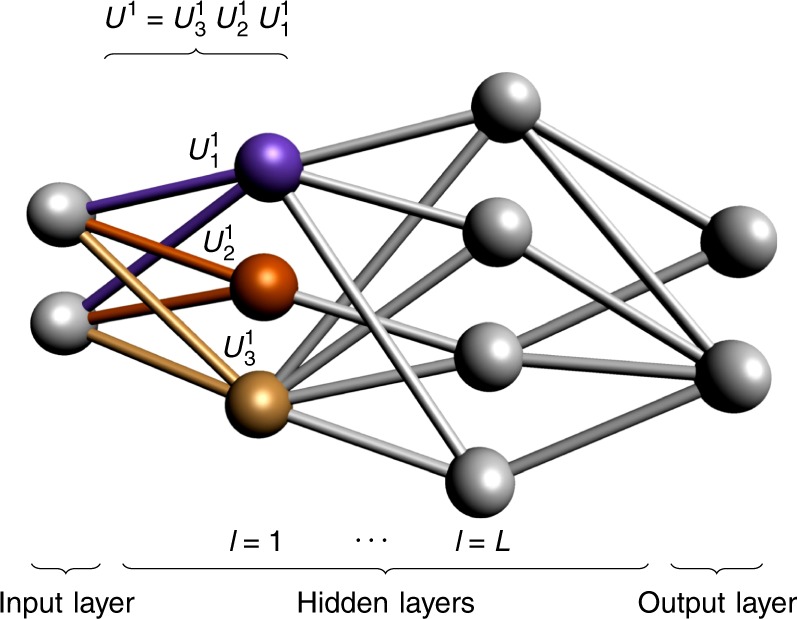
- A quantum perceptron is an arbitrary unitary with \(m\) input and \(n\) output qubits; QNNs built from them can carry out universal quantum computation even for two-input one-output qubit perceptrons, and commuting 4-level qudit perceptrons within each layer also suffice.
- Training uses the fidelity between QNN output and desired output as cost; parameter matrices are computed layer-by-layer, accessing only two layers at a time, so memory scales with width rather than depth, enabling deep-network optimization.
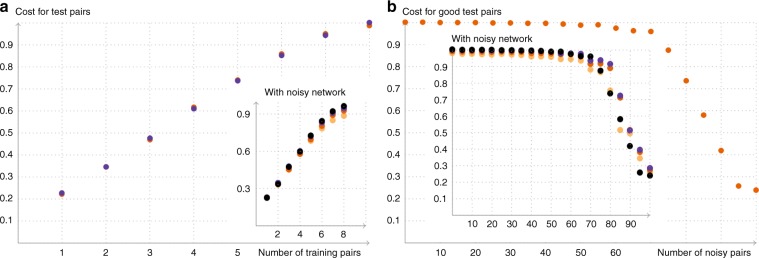
- In simulations, a 3-3-3 network trained with \(\epsilon=0.1\), \(\eta=2/3\) for 1000 rounds with \(n=1,\dots,8\) training pairs and evaluated on 10 test pairs matched a theoretical optimal cost estimate, averaged over 20 rounds.
- A 2-3-2 network trained with \(\epsilon=0.1\), \(\eta=1\) for 300 rounds with 100 training pairs remained robust when some pairs were replaced by random noisy data; insets show approximate depolarizing noise strengths \(t=0, 0.0033, 0.0066, 0.01\).
Methods
- Architecture: perceptrons are arbitrary unitaries on \(m\) input and \(n\) output qubits; a QNN is a quantum circuit of perceptrons organized into \(L\) hidden layers, with output expressed as a composition of completely positive layer-to-layer transition maps.
- Training: the cost is average fidelity between QNN output and desired output; perceptron unitaries are updated by gradient ascent, with parameter matrices computed from the previous layer’s output state and adjoint channels applied to the desired output state up to the current layer.
- Simulations: classical pilot simulations for input/output spaces of \(m=2\) and \(3\) qubits learning a random unitary \(V\), covering generalization from limited random training pairs and robustness to corrupted training data under an approximate depolarizing noise model.
Limitations
- Stated: classical simulation is impossible for more than a handful of qubits due to exponential Hilbert-space growth, so the authors were restricted to small-width QNNs; near-term large networks may require sparse connectivity because copies per training round scale linearly with the number of network parameters, and multiple network evaluations are needed to estimate the derivative.
- Stated: the introduction notes that one would still have to study how noise in the network itself influences performance; future work includes generalizing the perceptron to general CP maps, studying overfitting, and optimized NISQ implementation.
- Evident: empirical validation is limited to classical simulations of small-width QNNs (\(m=2,3\) qubits), with no experimental demonstration; no overfitting analysis is reported despite being listed as future work.
Model-written summary. Check it against the paper before relying on it.
Integrity signals
Registry
Cites
Statistics
Figures
Verification
Claims the paper makes
1 Valid · 2 Not valid · 3 Not checked · 31 Own results and interpretations
The cited sources support only part of this claim — read each source’s verdict below.
In the paper
“However, in the near term, this tradeoff is a happy one as many NISQ architectures—most notably superconducting qubit devices—can easily and rapidly repeat executions of a quantum circuit.”
§ Training deep quantum neural networks > Discussion
What the sources say
- Partly supportedcites [46] Arute F Quantum supremacy using a programmable superconducting processor Nature 2019 574 505 510 10.1038/s41586-019-1666-5 31645734 sourceExperimental — accuracy not yet measured
Our copy supports the superconducting part concretely: in 'The classical computational cost' (p. 509) it states 'it took 600 seconds to sample the circuit on the quantum processor three million times, where sampling time is limited by control hardware communications; in fact, the net quantum processor time is only about 30 seconds,' and in 'The future' it notes that 'for m = 20, obtaining a million samples on the quantum processor takes 200 seconds.' The paper also frames its result as heralding 'the era of noisy intermediate-scale quantum (NISQ) technologies' (intro, crediting Preskill 2018). What it does not support is the generalization to 'many NISQ architectures': the device-level statements are about its own 53-qubit superconducting processor only, and no other NISQ platform is shown to repeat circuit executions easily and rapidly. (LLM, conf=0.70)
plain- Asserted: passes — The authors put it forward as true.
- Checkable: passes — It can be checked against evidence.
- Load-bearing: passes — The paper’s conclusions depend on it.
- Based: passes — The paper gives a reason why it holds.
- Partly supported
In the paper
“It is also an important observation that there is no barren plateau in the cost function landscape.”
- Also stated in: § Simulation of learning tasks · boosted
“A crucial consequence of our numerical investigations was the absence of a “barren plateau” in the cost function landscape for our QNNs45.”
- Also stated in: § Discussion · boosted
“The resulting QML algorithm, when applied to our QNNs, demostrates remarkable capabilities, including, the ability to generalise, tolerance to noisy training data, and an absence of a barren plateau in the cost function landscape.”
§ Training deep quantum neural networks > Introduction
What the sources say
- Not checked yetcites McClean et al.45 McClean JR Boixo S Smelyanskiy VN Babbush R Neven H Barren plateaus in quantum neural network training landscape Nat. Commun. 2018 9 4812 10.1038/s41467-018-07090-4 30446662 PMC6240101 source
boosted- Asserted: passes — The authors put it forward as true.
- Checkable: passes — It can be checked against evidence.
- Load-bearing: passes — The paper’s conclusions depend on it.
- Based: passes — The paper gives a reason why it holds.
- Also stated in: § Simulation of learning tasks · boosted
A result the paper reports from its own data — it cites no other source for it, so there is none to check. The quote shows it is in the paper.
In the paper
“Interestingly, we have obtained numerical evidence that, for approximate depolarising noise, QNNs are robust (see inset of Fig. 2).”
§ Training deep quantum neural networks > Discussion
hedged- Asserted: passes — The authors put it forward as true.
- Checkable: passes — It can be checked against evidence.
- Load-bearing: unclear — It is unclear whether the paper’s conclusions depend on it.
- Based: passes — The paper gives a reason why it holds.
- Rests on an assumption not shown here.
A result the paper reports from its own data — it cites no other source for it, so there is none to check. The quote shows it is in the paper.
In the paper
“Here we see that the QNN matches the theoretical estimate and demonstrates the remarkable ability of our QNNs to generalise.”
§ Training deep quantum neural networks > Results > Simulation of learning tasks
boosted- Asserted: passes — The authors put it forward as true.
- Checkable: passes — It can be checked against evidence.
- Load-bearing: passes — The paper’s conclusions depend on it.
- Based: passes — The paper gives a reason why it holds.
A result the paper reports from its own data — it cites no other source for it, so there is none to check. The quote shows it is in the paper.
In the paper
“In addition, we always initialised our QNNs with random unitaries and we did not observe any exponential reduction in the value of the parameter matrices K (which arise from the derivative of our QNN with respect to the parameters).”
§ Training deep quantum neural networks > Results > Simulation of learning tasks
plain- Asserted: passes — The authors put it forward as true.
- Checkable: passes — It can be checked against evidence.
- Load-bearing: passes — The paper’s conclusions depend on it.
- Based: passes — The paper gives a reason why it holds.
17 more claims
Create a free account to see all 37 claims and to verify the 4 references still open.
- The quote only partly states this claim. 1
- It may state two separate claims as one. 9
- Probably not a substantial claim. 5
Claims other papers make about this one
Each is checked against this paper’s own text: does it say what the citing paper says it does?
The cited source doesn’t support the claim as written.
In the citing paper
“Ref. [174] proposed a VQA for learning continuous distributions which is meant to be a quantum version of GANs.”
From Variational quantum algorithms (2021) · cites this paper as [174]
Checked by a reasoning model — may be wrong.
Experimental — accuracy not yet measuredThe cited source says what the claim attributes to it.
In the citing paper
“there has been significant efforts put forward to use quantum algorithms for machine learning applications [154, 157, 174, 287].”
From Variational quantum algorithms (2021) · cites this paper as [174]
The check wasn’t confident either way, so it gives no verdict — never disputed.
In the citing paper
“We remark that the cost function in (1) contains as special cases many relevant applications.For instance, in a binary classification problem the cost function is given by the mean squarederror C(θ) = x (y x -y(θ, ρ x )) 2 [16,17,39,40].”
From Effect of barren plateaus on gradient-free optimization (2021) · cites this paper as [16]
Experimental — accuracy not yet measured
Self-check
Percentages, sums and reported differences re-computed from the paper’s own numbers.
Each contradiction between two passages listed here was confirmed by an independent check.
Rated minor: it would not touch a result — a value no result rests on, a p-value that stays on the same side of the significance level, or a conflict that is clerical, resolved elsewhere in the paper, or outside its own findings.
In the paper
§ Training deep quantum neural networks > Results > Simulation of learning tasks
“where N was smaller than the Hilbert space dimension.”
§ Training deep quantum neural networks > Results > Simulation of learning tasks
“We trained a 3-3-3 network with ϵ = 0.1, η = 2∕3 for 1000 rounds with n = 1, 2, …, 8 training pairs”
Citations
Cites
Book Review: Pattern Recognition and Machine Learning
Nasrabadi, N. M. (2007) · Journal of Electronic Imaging · doi:10.1117/1.2819119 · Cited by 22,066 · cited 1×
“(4), we obtain a formula for the parameter matrices (this is described in detail in Supplementary Note 2).”
MethodQuantum Computation and Quantum Information
Nielsen, M. A., Chuang, I., & Grover, L. K. (2002) · American Journal of Physics · doi:10.1119/1.1463744 · Cited by 21,895
Machine learning: Trends, perspectives, and prospects
Jordan, M. I., & Mitchell, T. M. (2015) · Science · doi:10.1126/science.aaa8415 · Cited by 9,955
Pattern Recognition and Machine Learning
(2006) · doi:10.1007/978-0-387-45528-0 · Cited by 9,824
Quantum Computation and Quantum Information: 10th Anniversary Edition
Nielsen, M. A., & Chuang, I. L. (2012) · doi:10.1017/cbo9780511976667 · Cited by 8,436
Quantum supremacy using a programmable superconducting processor
Arute, F., Arya, K., Babbush, R., Bacon, D., Bardin, J. C., Barends, R., Biswas, R., Boixo, S., Brandao, F. G. S. L., Buell, D. A., et al. (2019) · Nature · doi:10.1038/s41586-019-1666-5 · Cited by 7,720
Biamonte, J., Wittek, P., Pancotti, N., Rebentrost, P., Wiebe, N., & Lloyd, S. (2017) · Nature · doi:10.1038/nature23474 · Cited by 4,779
Pattern recognition and machine learning
(2007) · Choice Reviews Online · doi:10.5860/choice.44-5091 · Cited by 2,650
Barren plateaus in quantum neural network training landscapes
McClean, J. R., Boixo, S., Smelyanskiy, V. N., Babbush, R., & Neven, H. (2018) · Nature Communications · doi:10.1038/s41467-018-07090-4 · Cited by 2,329
Solving the quantum many-body problem with artificial neural networks
Carleo, G., & Troyer, M. (2017) · Science · doi:10.1126/science.aag2302 · Cited by 2,215
Research works printed but not linked: 1
- Goodfellow, I., Bengio, Y. & Courville, A. Deep Learning (MIT Press, 2016).
Cited by
Items 101–200 of 737
Resource-efficient high-dimensional subspace teleportation with a quantum autoencoder
Zhang, H., Wan, L., Haug, T., Mok, W., Paesani, S., Shi, Y., Cai, H. N., Chin, L. K., Karim, M. F., Xiao, L., et al. (2022) · Science Advances · doi:10.1126/sciadv.abn9783 · Cited by 52
“An immediate application of GA is to optimize hybrid quantum-classical systems, e.g., variational quantum eigensolvers ( 59 ), where optimization is carried out by a classical optimizer and the cost function is evaluated on a parametrized quantum circuit and hybrid quantum computers ( 60 , 61 ).”
MethodDensity Matrix Quantum Circuit Simulation via the BSP Machine on Modern GPU Clusters
Li, A., Subasi, O., Yang, X., & Krishnamoorthy, S. (2020) · International Conference for High Performance Computing, Networking, Storage and Analysis (SC) · doi:10.1109/sc41405.2020.00017 · Cited by 62
“Sometimes it is unknown on purpose [9].”
BackgroundQuClassi: A Hybrid Deep Neural Network Architecture based on Quantum State Fidelity
Stein, S. A., Baheri, B., Chen, D., Mao, Y., Guan, Q., Li, A., Xu, S., & Ding, C. (2021) · arXiv · doi:10.48550/arxiv.2103.11307 · Cited by 41
“Based on a general unitary operator that acts on the corresponding input and output qubits, authors in (Beer et al., 2020) propose a training algorithm for this quantum neural network architecture that is efficient in the sense that it only depends on the width of the individual layers and not on…”
ResQNets: a residual approach for mitigating barren plateaus in quantum neural networks
Kashif, M., & Al-Kuwari, S. M. (2024) · EPJ Quantum Technology · doi:10.1140/epjqt/s40507-023-00216-8 · Cited by 67
“Unlike classical neural networks, QNNs use quantum-inspired representations and operations to encode and process data [36–38].”
Chaudhary, S., Budhiraja, I., Chaudhary, R., Kumar, N., Garg, D., & Almuhaideb, A. M. (2024) · IEEE Internet of Things Journal · doi:10.1109/jiot.2024.3464853 · Cited by 46
“1) Cost Function: Similar to [47], we quantify the difference between label data states and output states using fidelity as our cost function.”
MethodQuantum interval neural network for uncertain structural static analysis
Zhu, J., Wang, X., Cao, G., Xu, L., & Cao, Y. H. (2025) · International Journal of Mechanical Sciences · doi:10.1016/j.ijmecsci.2025.110646 · Cited by 52
Quantum self-supervised learning
Jaderberg, B., Anderson, L. W., Xie, W., Albanie, S., Kiffner, M., & Jaksch, D. (2022) · Quantum Science and Technology · doi:10.1088/2058-9565/ac6825 · Cited by 59
“Importantly, early evidence suggests that quantum models can achieve an advantage over their classical counter-parts, yet these works focus only on the supervised learning of either artificial data [36, 39] or simple historical datasets [38].”
BackgroundA Novel Efficient Quantum Random Access Memory
Zidan, M., Abdel‐Aty, A., Khalil, A., Abdel‐Aty, M., & Eleuch, H. (2021) · IEEE Access · doi:10.1109/access.2021.3119588 · Cited by 43
Wu, D., Hu, Z., Li, J., & Sun, X. (2021) · The Journal of Chemical Physics · doi:10.1063/5.0073689 · Cited by 46
Selvan, G. S. R. E., Ganeshan, R., Jingle, I. D. J., & Ananth, J. P. (2022) · Knowledge-Based Systems · doi:10.1016/j.knosys.2022.110132 · Cited by 39
Provably Trainable Rotationally Equivariant Quantum Machine Learning
West, M. T., Heredge, J., Sevior, M. E., & Usman, M. (2024) · PRX Quantum · doi:10.1103/prxquantum.5.030320 · Cited by 66
Quantum intrusion detection system using outlier analysis
Kim, T. H., & Madhavi, S. (2024) · Scientific Reports · doi:10.1038/s41598-024-78389-0 · Cited by 63
“The articles give great detail on the development of several ML techniques for traffic monitoring and identifying unusual node activity inside the network 18–28 .”
BackgroundQuantum computing methods for supervised learning
Kulkarni, V., Kulkarni, M., & Pant, A. (2021) · Quantum Machine Intelligence · doi:10.1007/s42484-021-00050-0 · Cited by 46
Grammar-aware sentence classification on quantum computers
Meichanetzidis, K., Toumi, A., de Felice, G., & Coecke, B. (2023) · Quantum Machine Intelligence · doi:10.1007/s42484-023-00097-1 · Cited by 115
“2009), or quantising classical machine learning algorithms based on neural networks (Beer et al. 2020), support vector machines, clustering (Kerenidis et al.”
BackgroundToward Trainability of Quantum Neural Networks
Zhang, K., Hsieh, M.-H., Liu, L., & Tao, D. (2020) · arXiv · doi:10.48550/arxiv.2011.06258 · Cited by 36
“Besides, QNNs with dissipative layers have shown the ability to avoid the barren plateaus [17].”
QFNN-FFD: Quantum Federated Neural Network for Financial Fraud Detection
Innan, N., Marchisio, A., Bennai, M., & Shafique, M. (2025) · IEEE International Conference on Quantum Software (QSW) · doi:10.1109/qsw67625.2025.00015 · Cited by 74
Quantum Error Correction with Quantum Autoencoders
Locher, D. F., Cardarelli, L., & Müller, M. (2023) · Quantum · doi:10.22331/q-2023-03-09-942 · Cited by 68
“ming language, based on code available on Github at [49, 60].”
BackgroundMethodInfluentialMedical image classification via quantum neural networksPreprint
Mathur, N., Landman, J., Li, Y. Y., Strahm, M., Kazdaghli, S., Prakash, A., & Kerenidis, I. (2021) · arXiv (Cornell University) · doi:10.48550/arxiv.2109.01831 · Cited by 104
“8: The optimized qiskit circuits for (a) a [4,2] quantum-assisted NN layer and (b) a [4,2] quantum orthogonal NN layer”
InfluentialScrambling ability of quantum neural network architectures
Wu, Y., Zhang, P., & Zhai, H. (2021) · Physical Review Research · doi:10.1103/physrevresearch.3.l032057 · Cited by 40
“[17] Kerstin Beer, Dmytro Bondarenko, Terry Farrelly, Tobias J Osborne, Robert Salzmann, and Ramona Wolf, “Efficient Learning for Deep Quantum Neural Networks,” arXiv:1902.”
BackgroundPirhooshyaran, M., & Terlaky, T. (2021) · Quantum Machine Intelligence · doi:10.1007/s42484-021-00051-z · Cited by 58
Quantum Graph Neural Network Models for Materials Search
Ryu, J.-Y., Elala, E., & Rhee, J. K. (2023) · Materials · doi:10.3390/ma16124300 · Cited by 48
“Some examples include the quantum convolutional Some examples include the quantum convolutional neural 170 network [51], the quantum graph neural network [15,52–54], and the dissipative quantum 171 neural network [55].”
BackgroundGandhudi, M., Alphonse, P. J. A., Fiore, U., & Gangadharan, G. R. (2024) · Computers & Electrical Engineering · doi:10.1016/j.compeleceng.2024.109302 · Cited by 50
Quantum superposition inspired spiking neural network
Sun, Y., Zeng, Y., & Zhang, T. (2021) · iScience · doi:10.1016/j.isci.2021.102880 · Cited by 38
“Deep quantum neural networks (Beer et al., 2020) raise the prospect of deploying deep learning algorithms on quantum computers.”
BackgroundA Hybrid System for Learning Classical Data in Quantum States
Stein, S. A., L'Abbate, R., Mu, W., Liu, Y., Baheri, B., Mao, Y., Guan, Q., Li, A., & Fang, B. (2021) · IEEE International Performance, Computing, and Communications Conference · doi:10.1109/ipccc51483.2021.9679430 · Cited by 56
“The use of quantum systems to train deep learning models is rather developed with a multitude of approaches for creating and mimicking aspects of classical deep learning systems [12, 4, 13, 8].”
BackgroundMethodInfluentialNon-trivial symmetries in quantum landscapes and their resilience to quantum noise
Fontana, E., Cerezo, M., Arrasmith, A., Rungger, I., & Coles, P. J. (2022) · Quantum · doi:10.22331/q-2022-09-15-804 · Cited by 67
“Arguably, the leading role has been played by Parametrized Quantum Circuits (PQCs), which are exploited for both Variational Quantum Algorithms [2, 3, 4, 5, 6, 7, 8, 9, 10, 11, 12, 13, 14] and Quantum Neural Networks [15, 16, 17, 18, 19].”
MethodPirhooshyaran, M., & Terlaky, T. (2020) · arXiv · doi:10.48550/arxiv.2012.04046 · Cited by 34
Hybrid quantum neural network structures for image multi-classification
Shi, M., Situ, H., & Zhang, C. (2024) · Physica Scripta · doi:10.1088/1402-4896/ad3e3d · Cited by 42
“Consequently, combining Parametric Quantum Circuits with neural networks has led to the development of Quantum Neural Network (QNN) algorithms[19–21].”
MethodA New Quantum Circuits of Quantum Convolutional Neural Network for X-Ray Images Classification
Yousif, M., Al‐Khateeb, B., & García-Zapirain, B. (2024) · IEEE Access · doi:10.1109/access.2024.3396411 · Cited by 43
“Many classic ML methods, including supervised learning, principal component analysis, and other dimension reduction algorithms, have found new inspiration from quantum approaches, which have become a hot area in study in recent years [7], [13].”
BackgroundSimulating Noisy Variational Quantum Algorithms: A Polynomial Approach
Shao, Y., Wei, F., Cheng, S., & Liu, Z. (2024) · Physical Review Letters · doi:10.1103/physrevlett.133.120603 · Cited by 102
Detecting Entanglement With Deep Quantum Neural Networks
Qiu, P., Chen, X., & Shi, Y.-W. (2019) · IEEE Access · doi:10.1109/access.2019.2929084 · Cited by 41
Variational quantum attacks threaten advanced encryption standard based symmetric cryptography
Wang, Z., Wei, S., Long, G., & Hanzo, L. (2022) · Science China Information Sciences · doi:10.1007/s11432-022-3511-5 · Cited by 43
Non-trivial symmetries in quantum landscapes and their resilience to quantum noise
Fontana, E., Cerezo, M., Arrasmith, A., Rungger, I., & Coles, P. J. (2020) · arXiv · doi:10.48550/arxiv.2011.08763 · Cited by 32
“[16] Kerstin Beer, Dmytro Bondarenko, Terry Farrelly, Tobias J Osborne, Robert Salzmann, Daniel Scheiermann, and Ramona Wolf, “Training deep quantum neural networks,” Nature Communications 11, 1–6 (2020).”
BackgroundMartis, J. E., Sannidhan, M. S., Balasubramani, R., Mutawa, A. M., & Murugappan, M. (2024) · Bioengineering · doi:10.3390/bioengineering11080799 · Cited by 35
“With ongoing advancements, quantum layers are poised to play a crucial role in the evolution of quantum machine learning and artificial intelligence [10].”
BackgroundNeural network-based prediction of the secret-key rate of quantum key distribution
Zhou, M.-G., Liu, Z., Liu, W., Li, C., Bai, J.-L., Xue, Y.-R., Fu, Y., Yin, H., & Chen, Z. (2022) · Scientific Reports · doi:10.1038/s41598-022-12647-x · Cited by 38
“(3) is the penalty term and is used to make the key rates predicted by the neural network as information-theoretically secure as possible.”
BackgroundMethodInfluentialChoudhury, A., Shankar, V., Singh, S. P., Kumar, M., & Kumar, S. N. P. (2023) · Biomedical Signal Processing and Control · doi:10.1016/j.bspc.2023.104816 · Cited by 31
Quantum machine learning with adaptive linear optics
Chabaud, U., Markham, D., & Sohbi, A. (2021) · Quantum · doi:10.22331/q-2021-07-05-496 · Cited by 61
A GNN-based predictor for quantum architecture search
He, Z., Zhang, X., Chen, C., Huang, Z., Zhou, Y., & Situ, H. (2023) · Quantum Information Processing · doi:10.1007/s11128-023-03881-x · Cited by 46
“VQA has also been applied to machine learning tasks, such as classification problems [13, 14] and generative models [15, 16], achieving quadratic or even exponential speedup of traditional machine learning algorithms.”
MethodAn invitation to distributed quantum neural networks
Pira, L., & Ferrie, C. (2023) · Quantum Machine Intelligence · doi:10.1007/s42484-023-00114-3 · Cited by 46
Krittanawong, C., Omar, A. M. S., Narula, S., Sengupta, P. P., Glicksberg, B. S., Narula, J., & Argulian, E. (2023) · Life · doi:10.3390/life13041029 · Cited by 45
“, quantum computation) to classify image details and moving images [82,83].”
BackgroundEngineered dissipation to mitigate barren plateaus
Sannia, A., Tacchino, F., Tavernelli, I., Giorgi, G. L., & Zambrini, R. (2024) · npj Quantum Information · doi:10.1038/s41534-024-00875-0 · Cited by 59
“Published in partnership with The University of New South Wales https://doi.org/10.1038/s41534-024-00875-0”
InfluentialCurrent status and future developments in predicting outcomes in radiation oncology
Niraula, D., Cui, S., Pakela, J. M., Wei, L., Luo, Y., Haken, R. K. T., & Naqa, I. E. (2022) · British Journal of Radiology · doi:10.1259/bjr.20220239 · Cited by 35
Design of a quantum convolutional neural network on quantum circuits
Zheng, J. Y., Gao, Q. Z., Lü, J., OGORZAŁEK, M. J., Pan, Y., & Lü, Y. (2022) · Journal of the Franklin Institute · doi:10.1016/j.jfranklin.2022.07.033 · Cited by 35
Narottama, B., & Shin, S. Y. (2023) · IEEE Transactions on Vehicular Technology · doi:10.1109/tvt.2023.3280459 · Cited by 52
Entangled Datasets for Quantum Machine LearningPreprint
Schatzki, L., Arrasmith, A., Coles, P. J., & Cerezo, M. (2021) · arXiv (Cornell University) · doi:10.48550/arxiv.2109.03400 · Cited by 96
“[20] Kerstin Beer, Dmytro Bondarenko, Terry Farrelly, Tobias J.”
BackgroundLiu, Z., Shen, P.-X., Li, W., Duan, L.-M., & Deng, D.-L. (2022) · Quantum Science and Technology · doi:10.1088/2058-9565/aca55d · Cited by 34
“…quantum machine learning models have been proposed, including the quantum decision tree classifiers [29, 30], quantum support vector machines [31], quantum Boltzmann machines [32], quantum generative models [33–36], quantum CNNs [37–41], and perception-based quantum neural networks [42], etc.”
West, M. T., Nakhl, A. C., Heredge, J., Creevey, F. M., Hollenberg, L. C. L., Sevior, M. E., & Usman, M. (2024) · Intelligent Computing · doi:10.34133/icomputing.0100 · Cited by 46
Design Space Exploration of Hybrid Quantum–Classical Neural Networks
Kashif, M., & Al-Kuwari, S. M. (2021) · Electronics · doi:10.3390/electronics10232980 · Cited by 39
A Survey on Quantum Computational Finance for Derivatives Pricing and VaR
Gómez, A., Leitao, Á., Manzano, A., Musso, D., Nogueiras, M. R., Ordóñez, G., & Vázquez, C. (2022) · Archives of Computational Methods in Engineering · doi:10.1007/s11831-022-09732-9 · Cited by 49
“In the last few years, many works on QNN advanced training have been proposed, among which we highlight [10, 23].”
BackgroundMethodQuantum multi-programming for Grover’s search
Park, G., Zhang, K., Yu, K., & Korepin, V. E. (2023) · Quantum Information Processing · doi:10.1007/s11128-022-03793-2 · Cited by 34
“In this vein, Variational Quantum Algorithms (VQAs), such as Quantum Approximate Optimization Algorithm (QAOA) [9], Variation Quantum Eigensolver (VQE) [10], and Quantum Neural Networks [11–14], have drawn attention as a promising candidate to achieve quantum advantage on NISQ devices.”
MethodQCLR: Quantum-LSTM contrastive learning framework for continuous mental health monitoring
Padha, A., & Sahoo, A. (2023) · Expert Systems with Applications · doi:10.1016/j.eswa.2023.121921 · Cited by 39
Solving quantum master equations with deep quantum neural networks
Liu, Z., Duan, L., & Deng, D.-L. (2022) · Physical Review Research · doi:10.1103/physrevresearch.4.013097 · Cited by 34
“As a result of the special structure of the quantum networks, our approach escape barren plateaus [22] and allows for convenient implementation of translational symmetry and resource-saving reuse of hidden qubits.”
BackgroundMethodInfluentialA Distributed Learning Scheme for Variational Quantum Algorithms
Du, Y., Qian, Y., Wu, X., & Tao, D. (2022) · IEEE Transactions on Quantum Engineering · doi:10.1109/tqe.2022.3175267 · Cited by 37
Quantum neural networks for power flow analysis
Kaseb, Z., Möller, M., Balducci, G. T., Pálenský, P., & Vergara, P. P. (2024) · Electric Power Systems Research · doi:10.1016/j.epsr.2024.110677 · Cited by 41
“In addition, the inherent randomness of quantum phenomena allows for the capture of complex relationships between inputs and output with reduced reliance on large datasets [15].”
Unified framework for quantum classification
Nghiem, N. A., Chen, S. Y.-C., & Wei, T.-C. (2021) · Physical Review Research · doi:10.1103/physrevresearch.3.033056 · Cited by 47
“There have been numerous works that explore the relation between quantum computation and neural networks [26, 27, 40–43].”
BackgroundQuantum Artificial Intelligence for the Science of Climate Change
Singh, M., Dhara, C., Kumar, A., Gill, S. S., & Uhlig, S. (2022) · CRC Press eBooks · doi:10.1201/9781003250357-13 · Cited by 35
Nonlinear transformations in quantum computation
Holmes, Z., Coble, N. J., Sornborger, A. T., & Subaşı, Y. (2023) · Physical Review Research · doi:10.1103/physrevresearch.5.013105 · Cited by 65
Quantum Face Recognition With Multigate Quantum Convolutional Neural Network
Zhu, Y., Bouridane, A., Celebi, M. E., Konar, D., Angelov, P. P., Ni, Q., & Jiang, R. (2024) · IEEE Transactions on Artificial Intelligence · doi:10.1109/tai.2024.3419077 · Cited by 36
“At present, a variety of quantum machine learning methods have been proposed, such as the quantum Boltzmann machine [14] and quantum neural network [15], [16].”
HQNet: A hybrid quantum network for multi-class MRI brain classification via quantum computing
Wang, A., Dun, M., Li, X., Li, T., & Li, L. (2024) · Expert Systems with Applications · doi:10.1016/j.eswa.2024.125537 · Cited by 39
Scalable quantum convolutional neural network for image classification
Sun, Y., Li, D., Xiang, Q., Yuan, Y., Hu, Z., Hua, X., Jiang, Y., Zhu, Y., & Fu, Y. (2024) · Physica A Statistical Mechanics and its Applications · doi:10.1016/j.physa.2024.130226 · Cited by 41
Verma, V. R., Nishad, D. K., Sharma, V. L., Singh, V. K., Verma, A., & Shah, D. R. (2025) · Scientific Reports · doi:10.1038/s41598-024-84441-w · Cited by 31
“However, computation offloading comes accompanied by new issues, such as joint communication and computation resource management under dynamic network conditions 8 .”
Storage capacity and learning capability of quantum neural networks
Lewenstein, M., Gratsea, A., Riera-Campeny, A., Aloy, A., Kasper, V., & Sanpera, A. (2021) · Quantum Science and Technology · doi:10.1088/2058-9565/ac070f · Cited by 30
Quantum neural networks force fields generation
Kiss, O., Tacchino, F., Vallecorsa, S., & Tavernelli, I. (2022) · Machine Learning Science and Technology · doi:10.1088/2632-2153/ac7d3c · Cited by 39
Quantum Neural Networks and Topological Quantum Field Theories
Marcianò, A., Chen, D., Fabrocini, F., Fields, C., Greco, E., Gresnigt, N. G., Jinklub, K., Lulli, M., Terzidis, K., & Zappala, E. (2022) · Neural Networks · doi:10.1016/j.neunet.2022.05.028 · Cited by 31
The free energy principle induces neuromorphic development
Fields, C., Friston, K. J., Glazebrook, J. F., Levin, M. G., & Marcianò, A. (2022) · Neuromorphic Computing and Engineering · doi:10.1088/2634-4386/aca7de · Cited by 31
“These generalize conventional quantum ANNs [193, 194] by allowing the number and organization of “layers” to be indeterminate.”
InfluentialwpScalable Quantum Neural Networks for Classification
Wu, J., Tao, Z., & Li, Q. (2022) · IEEE International Conference on Quantum Computing and Engineering (QCE) · doi:10.1109/qce53715.2022.00022 · Cited by 31
“Numerous applications of classical neural networks (NNs) have achieved huge success, which motivates many research into quantum neural networks (QNNs) [8]–[13].”
BackgroundPest Localization Using YOLOv5 and Classification Based on Quantum Convolutional Network
Amin, J., Anjum, M. A., Zahra, R., Sharif, M. I., Kadry, S., & Sevcik, L. (2023) · Agriculture · doi:10.3390/agriculture13030662 · Cited by 26
Neural-network-encoded variational quantum algorithms
Miao, J., Hsieh, C., & Zhang, S. (2024) · Physical Review Applied · doi:10.1103/physrevapplied.21.014053 · Cited by 34
Learning Shallow Quantum Circuits
Huang, H.-Y., Liu, Y., Broughton, M., Kim, I. H., Anshu, A., Landau, Z. A., & McClean, J. R. (2024) · ACM Symposium on Theory of Computing (STOC) · doi:10.1145/3618260.3649722 · Cited by 101
“…power provides the basis for quantum computational advantage with NISQ (noisy intermediate-scale quantum) devices and supports the quest for developing quantum algorithms based on learning parameterized shallow quantum circuits [4, 5, 10, 11, 13, 19, 21, 22, 31, 34, 54, 74, 75, 79, 82].”
Reduction of finite sampling noise in quantum neural networks
Kreplin, D. A., & Roth, M. (2024) · Quantum · doi:10.22331/q-2024-06-25-1385 · Cited by 57
Defending Against Byzantine Attacks in Quantum Federated Learning
Xia, Q., Tao, Z., & Li, Q. (2021) · International Conference on Mobility, Sensing and Networking (MSN) · doi:10.1109/msn53354.2021.00035 · Cited by 38
“The method to derive the unitaries is very similar to backpropagation, which is discussed in [3].”
BackgroundMethodInfluentialThe impact of cost function globality and locality in hybrid quantum neural networks on NISQ devices
Kashif, M., & Al-Kuwari, S. M. (2023) · Machine Learning Science and Technology · doi:10.1088/2632-2153/acb12f · Cited by 44
“Analogous to classical NNs, where classical parameters are optimized during training, in HQNNs, the quantum parameters need to be optimized too [18, 30, 35, 46, 52], which is not a straightforward task.”
BackgroundEffects of quantum resources and noise on the statistical complexity of quantum circuits
Bu, K., Koh, D. E., Li, L., Luo, Q., & Zhang, Y. (2023) · Quantum Science and Technology · doi:10.1088/2058-9565/acb56a · Cited by 40
“[26] Kerstin Beer, Dmytro Bondarenko, Terry Farrelly, Tobias J.”
Advancements in Quantum Computing—Viewpoint: Building Adoption and Competency in Industry
Pfaendler, S. M.-L., Konson, K., & Greinert, F. (2024) · Datenbank-Spektrum · doi:10.1007/s13222-024-00467-4 · Cited by 43
Karthick, G. S., & Pankajavalli, P. B. (2022) · Theoretical Computer Science · doi:10.1016/j.tcs.2022.08.021 · Cited by 26
Differentiable Quantum Architecture Search for Quantum Reinforcement Learning
Sun, Y., Ma, Y., & Volker Tresp, C. (2023) · IEEE International Conference on Quantum Computing and Engineering (QCE) · doi:10.1109/qce57702.2023.10177 · Cited by 26
“Diverse quantum algorithms were proposed in different fields [2]–[7].”
BackgroundEffects of noise on the overparametrization of quantum neural networks
García-Martín, D., Larocca, M., & Cerezo, M. (2024) · Physical Review Research · doi:10.1103/physrevresearch.6.013295 · Cited by 42
Grammar-Aware Question-Answering on Quantum Computers.Preprint
Meichanetzidis, K., Toumi, A., de Felice, G., & Coecke, B. (2020) · arXiv (Cornell University) · Cited by 24
Chaos and Complexity from Quantum Neural Network: A study with Diffusion Metric in Machine Learning
Choudhury, S., Dutta, A., & Ray, D. (n.d.) · MPG.PuRe (Max Planck Society) · Cited by 22
Khatun, A., & Usman, M. (2024) · Advanced Quantum Technologies · doi:10.1002/qute.202400268 · Cited by 38
“…of quantum computing and machine learning in a single framework, researchers developed hybrid quantum convolutional neural networks (QCNNs) [8, 9] which have already demonstrated superior performance in object classification [10–12], particularly in low-parameter scenarios while the…”
BackgroundHong, Y., Lopez, D. J. D., & Wang, Y.-Y. (2024) · IEEE Access · doi:10.1109/access.2024.3472053 · Cited by 32
“This limitation can result in insufficient data for mitigating errors in reading out information from qubits [20], [21], and it may not be suitable for handling high-dimensional data or the weights within a neural network [22], [23].”
BackgroundQuantum Computing in Intelligent Transportation Systems: A Survey
Zhuang, Y., Azfar, T., Wang, Y., Sun, W., Wang, X., Guo, Q., & Ke, R. (2024) · CHAIN · doi:10.23919/chain.2024.000007 · Cited by 46
Quantum computing in renewable energy exploration: status, opportunities, and challenges
Olatunji, O. O., Adedeji, P. A., & Madushele, N. (2021) · Elsevier eBooks · doi:10.1016/b978-0-12-824555-2.00019-8 · Cited by 32
QMLSC: A quantum multimodal learning model for sentiment classification
Li, Y., Qu, Y., Zhou, R.-G., & Zhang, J. (2025) · Information Fusion · doi:10.1016/j.inffus.2025.103049 · Cited by 39
Sample complexity of learning parametric quantum circuits
Cai, H., Ye, Q., & Deng, D.-L. (2022) · Quantum Science and Technology · doi:10.1088/2058-9565/ac4f30 · Cited by 39
Certified Robustness of Quantum Classifiers Against Adversarial Examples Through Quantum Noise
Huang, J.-C., Tsai, Y.-L., Yang, C.-H. H., Su, C.-F., Yu, C.-M., Chen, P., & Kuo, S. (2023) · IEEE International Conference on Acoustics Speech and Signal Processing · doi:10.1109/icassp49357.2023.10095030 · Cited by 40
“Based on the training data, QNNs utilize optimizers similar to the classical ones to optimize parameters with specific techniques [12, 13, 14] to calculate the gradient.”
MethodDong, C., Zhou, J., An, A., Jiang, F., Chen, S., Pan, L., & Liu, X. (2023) · Drones · doi:10.3390/drones7070413 · Cited by 23
Quantum-Inspired Neural Network Model of Optical Illusions
Maksymov, I. S. (2024) · Algorithms · doi:10.3390/a17010030 · Cited by 28
QuGAN: A Generative Adversarial Network Through Quantum StatesPreprint
Stein, S. A., Baheri, B., Chen, D., Mao, Y., Guan, Q., Li, A., Fang, B., & Xu, S. (2020) · arXiv (Cornell University) · Cited by 26
A hybrid quantum regression model for the prediction of molecular atomization energies
Reddy, P., & Bhattacherjee, A. B. (2020) · Machine Learning Science and Technology · doi:10.1088/2632-2153/abd486 · Cited by 28
“…quantum machine learning algorithms [15–20] and quantization of classical machine learning and deep learning models such as a quantum support vector machine [21–23], quantum neural networks [24–26], quantum convolutional neural networks (CNNs) [27], and quantum generative adversarial networks [28].”
BackgroundClustering and enhanced classification using a hybrid quantum autoencoder
Srikumar, M., Hill, C. D., & Hollenberg, L. C. L. (2021) · Quantum Science and Technology · doi:10.1088/2058-9565/ac3c53 · Cited by 38
“In [30], QNNs are of the form in [31] to construct a QAE that successfully denoises Greenberger–Horne–Zeilinger states which are subject to spin-flip and random unitary noise errors.”
MethodQuantum face recognition protocol with ghost imaging
Salari, V., Paneru, D., Sağlamyürek, E., Ghadimi, M., Abdar, M., Rezaee, M., Aslani, M., Barzanjeh, S., & Karimi, E. (2023) · Scientific Reports · doi:10.1038/s41598-022-25280-5 · Cited by 30
Hybrid Classic-Quantum Neural Networks for Image Classification
Trochun, Y., Stirenko, S., Rokovyi, O., Alienin, O., Pavlov, E., & Gordienko, Y. G. (2021) · IEEE International Conference on Intelligent Data Acquisition and Advanced Computing Systems: Technology and Applications (IDAACS) · doi:10.1109/idaacs53288.2021.9661011 · Cited by 26
Synergy between AI and Optical Metasurfaces: A Critical Overview of Recent Advances
Jakšić, Z. (2024) · Photonics · doi:10.3390/photonics11050442 · Cited by 24
Quantum Adversarial Machine Learning: Status, Challenges and Perspectives
Edwards, D., & Rawat, D. B. (2020) · IEEE International Conference on Trust, Privacy and Security in Intelligent Systems and Applications (TPS-ISA) · doi:10.1109/tps-isa50397.2020.00026 · Cited by 26
“Encoding classical data has been shown through amplitude embedding, basis embedding, Qsample encoding, and Hamiltonian encoding [17] [11] [18] [19] where these approaches encode a dataset of M inputs and N features.”
BackgroundMethodInfluentialQuantum algorithms for scientific computing
Au-Yeung, R., Camino, B., Rathore, O., & Kendon, V. M. (2024) · Reports on Progress in Physics · doi:10.1088/1361-6633/ad85f0 · Cited by 44
Ajibosin, S. S., & Çetinkaya, D. (2024) · Software · doi:10.3390/software3040024 · Cited by 31
An Analytical Review of Quantum Neural Network Models and Relevant Research
Chakraborty, S., Das, T., Sutradhar, S., Das, M., & Deb, S. (2020) · International Conference on Communication and Electronics Systems (ICCES) · doi:10.1109/icces48766.2020.9137960 · Cited by 23
“Training deep quantum neural networks [21].”
BackgroundQuantum Fan-out: Circuit Optimizations and Technology Modeling
Gokhale, P., Koretsky, S., Huang, S., Majumder, S., Drucker, A., Brown, K. R., & Chong, F. T. (2021) · IEEE International Conference on Quantum Computing and Engineering (QCE) · doi:10.1109/qce52317.2021.00045 · Cited by 40
Generic detection-based error mitigation using quantum autoencoders
Zhang, X., Kong, W., Farooq, M. U., Yung, M., Guo, G., & Wang, X. (2021) · Physical Review A · doi:10.1103/physreva.103.l040403 · Cited by 33
A duplication-free quantum neural network for universal approximation
Hou, X., Zhou, G., Li, Q., Jin, S., & Wang, X. (2023) · Science China Physics Mechanics and Astronomy · doi:10.1007/s11433-023-2098-8 · Cited by 30
Metadata
- Authors
- Beer, K., Bondarenko, D., Farrelly, T., Osborne, T. J., Salzmann, R., Scheiermann, D., & Wolf, R.
- Affiliations
- Leibniz University Hannover (DE)
- Corresponding author
- Beer, Kerstin
- ORCID
- Venue
- Nature Communications
- Published
- 2020-02-10
- Volume
- 11
- Issue
- 1
- Pages
- 808-808
- ISSN
- 2041-1723 (ISSN-L)
- PMC
- PMC7010779
- OpenAlex
- W3004965358
- Semantic Scholar
- 9c8e8416bf64e592444e25e484f3f729480fd146
- Cited by
- 726
- References
- 52
- Citations by year
- 2026: 96 · 2025: 138 · 2024: 134 · 2023: 118 · 2022: 95 · 2021: 113 · 2020: 28
- FWCI
- 34.79
- Type
- journal article
- Language
- en
- Open access
- gold
- doi.org
- Licence
- cc-by
- creativecommons.org/licenses/by/4.0 (tdm)
- creativecommons.org/licenses/by/4.0 (vor)
- Locations
- Nature Communications (publishedVersion, cc-by)
- PubMed Central (publishedVersion, cc-by)
- PubMed (publishedVersion)
- arXiv (Cornell University) (submittedVersion)
- Institutional Repository of Leibniz Universität Hannover (Leibniz Universität Hannover) (submittedVersion, cc-by-nc-nd)
- LA Referencia (Red Federada de Repositorios Institucionales de Publicaciones Científicas) (submittedVersion, cc-by)
- RePEc: Research Papers in Economics (submittedVersion)
- DOAJ (DOAJ: Directory of Open Access Journals) (submittedVersion, cc-by-sa)
- Institutional Repository of Leibniz Universität Hannover (Leibniz Universität Hannover) (submittedVersion, cc-by)
- Apollo (University of Cambridge) (submittedVersion, cc-by)
- arXiv (Cornell University)
- Leibniz Universität Hannover (cc-by)
- Apollo (cc-by)
- Funders
- Deutsche Forschungsgemeinschaft (SFB 1227, RTG 1991, EXC 2123)
- Topics
- Physical Sciences › Computer Science › Artificial Intelligence › Quantum Computing Algorithms and Architecture
- Physical Sciences › Physics and Astronomy › Atomic and Molecular Physics, and Optics › Quantum Information and Cryptography
- Physical Sciences › Physics and Astronomy › Atomic and Molecular Physics, and Optics › Quantum many-body systems
- Keywords
- quantum neural networks, quantum neurons, quantum machine learning, qudits, deep neural network training, noisy data robustness, generalization
About these checks
Registry, retraction, Cites and statistics results are computed, not judged, with one exception: a printed reference that no index lists is read once by a model before it counts as a citation error. Claims are extracted by a model and kept only when their quote appears verbatim in the text; each cited source is then checked, with a model’s help, for whether it says what the claim relies on. Those verdicts can be wrong — read the claim’s quote and the cited source before relying on one.
The claim verdicts this report counts are experimental: their accuracy is not yet measured.
A language model drew the claims from the paper on 2026-10-08, under version 3 of the claim definition (model deepseek-v4.1-flash, prompt extract-v3).
A second model labelled each claim on 2026-10-08 (model jev-1.13-20260917, definition revision gold-guideline-v0.2).
Cited sources are checked with a language model’s help (qwen3.8-omni-flash).
Statistics and arithmetic are recomputed, not judged.
Confidence bands are shown only for fields calibrated on our annotated test set. None is calibrated yet, so no band is shown.
What counts as a claim ›How we measure confidence ›How we check this ›
Are you an author, or do you see a problem with this page? Request a review
Data sources
Bibliographic data: Semantic Scholar, OpenAlex, Crossref.
Contains information from the Semantic Scholar Academic Graph Datasets, made available under the ODC Attribution License (ODC-BY 1.0).
Semantic Scholar’s data is described in: Kinney, R., et al. (2023). The Semantic Scholar Open Data Platform. arXiv:2301.10140.
