

Training deep quantum neural networks
Open accessThe DOI matches its Crossref record; 56 of the 57 references it cites were found in a registry or an index; 1 of the 5 sources its claims cite were checked for support.
Abstract
Neural networks enjoy widespread success in both research and industry and, with the advent of quantum technology, it is a crucial challenge to design quantum neural networks for fully quantum learning tasks. Here we propose a truly quantum analogue of classical neurons, which form quantum feedforward neural networks capable of universal quantum computation. We describe the efficient training of these networks using the fidelity as a cost function, providing both classical and efficient quantum implementations. Our method allows for fast optimisation with reduced memory requirements: the number of qudits required scales with only the width, allowing deep-network optimisation. We benchmark our proposal for the quantum task of learning an unknown unitary and find remarkable generalisation behaviour and a striking robustness to noisy training data.
Overview
CoChat Summary
TL;DR
The paper proposes a quantum perceptron defined as an arbitrary unitary on input and output qubits, forming feedforward quantum neural networks capable of universal quantum computation. It gives a fidelity-based training algorithm whose memory scales with network width, and numerical simulations for learning an unknown unitary show generalization and robustness to noisy training data.
Key findings
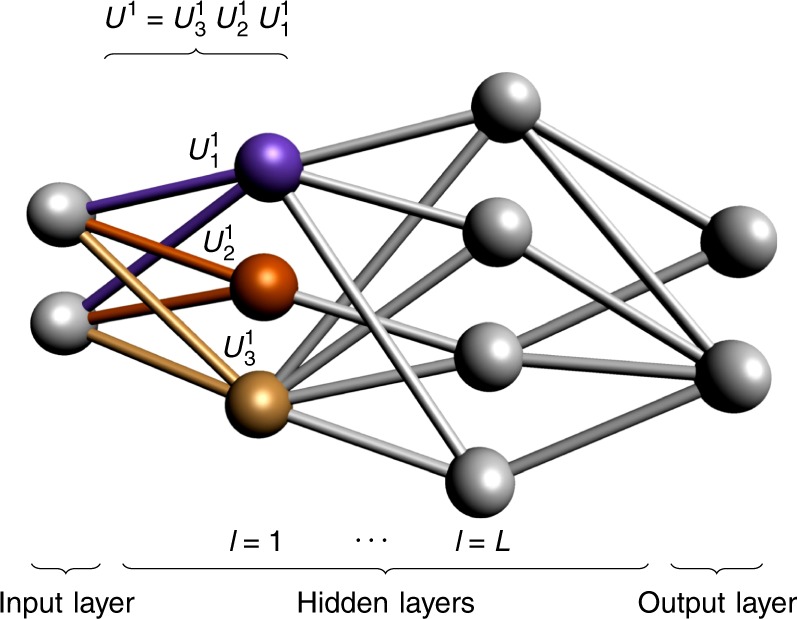
- A quantum perceptron is an arbitrary unitary with \(m\) input and \(n\) output qubits; QNNs built from them can carry out universal quantum computation even for two-input one-output qubit perceptrons, and commuting 4-level qudit perceptrons within each layer also suffice.
- Training uses the fidelity between QNN output and desired output as cost; parameter matrices are computed layer-by-layer, accessing only two layers at a time, so memory scales with width rather than depth, enabling deep-network optimization.
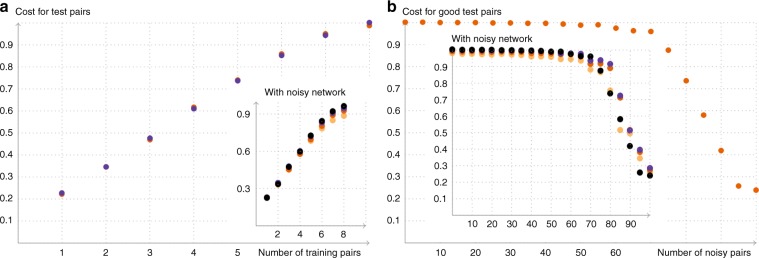
- In simulations, a 3-3-3 network trained with \(\epsilon=0.1\), \(\eta=2/3\) for 1000 rounds with \(n=1,\dots,8\) training pairs and evaluated on 10 test pairs matched a theoretical optimal cost estimate, averaged over 20 rounds.
- A 2-3-2 network trained with \(\epsilon=0.1\), \(\eta=1\) for 300 rounds with 100 training pairs remained robust when some pairs were replaced by random noisy data; insets show approximate depolarizing noise strengths \(t=0, 0.0033, 0.0066, 0.01\).
Methods
- Architecture: perceptrons are arbitrary unitaries on \(m\) input and \(n\) output qubits; a QNN is a quantum circuit of perceptrons organized into \(L\) hidden layers, with output expressed as a composition of completely positive layer-to-layer transition maps.
- Training: the cost is average fidelity between QNN output and desired output; perceptron unitaries are updated by gradient ascent, with parameter matrices computed from the previous layer’s output state and adjoint channels applied to the desired output state up to the current layer.
- Simulations: classical pilot simulations for input/output spaces of \(m=2\) and \(3\) qubits learning a random unitary \(V\), covering generalization from limited random training pairs and robustness to corrupted training data under an approximate depolarizing noise model.
Limitations
- Stated: classical simulation is impossible for more than a handful of qubits due to exponential Hilbert-space growth, so the authors were restricted to small-width QNNs; near-term large networks may require sparse connectivity because copies per training round scale linearly with the number of network parameters, and multiple network evaluations are needed to estimate the derivative.
- Stated: the introduction notes that one would still have to study how noise in the network itself influences performance; future work includes generalizing the perceptron to general CP maps, studying overfitting, and optimized NISQ implementation.
- Evident: empirical validation is limited to classical simulations of small-width QNNs (\(m=2,3\) qubits), with no experimental demonstration; no overfitting analysis is reported despite being listed as future work.
Model-written summary. Check it against the paper before relying on it.
Integrity signals
Registry
Cites
Statistics
Figures
Verification
Claims the paper makes
1 Valid · 2 Not valid · 3 Not checked · 31 Own results and interpretations
The cited sources support only part of this claim — read each source’s verdict below.
In the paper
“However, in the near term, this tradeoff is a happy one as many NISQ architectures—most notably superconducting qubit devices—can easily and rapidly repeat executions of a quantum circuit.”
§ Training deep quantum neural networks > Discussion
What the sources say
- Partly supportedcites [46] Arute F Quantum supremacy using a programmable superconducting processor Nature 2019 574 505 510 10.1038/s41586-019-1666-5 31645734 sourceExperimental — accuracy not yet measured
Our copy supports the superconducting part concretely: in 'The classical computational cost' (p. 509) it states 'it took 600 seconds to sample the circuit on the quantum processor three million times, where sampling time is limited by control hardware communications; in fact, the net quantum processor time is only about 30 seconds,' and in 'The future' it notes that 'for m = 20, obtaining a million samples on the quantum processor takes 200 seconds.' The paper also frames its result as heralding 'the era of noisy intermediate-scale quantum (NISQ) technologies' (intro, crediting Preskill 2018). What it does not support is the generalization to 'many NISQ architectures': the device-level statements are about its own 53-qubit superconducting processor only, and no other NISQ platform is shown to repeat circuit executions easily and rapidly. (LLM, conf=0.70)
plain- Asserted: passes — The authors put it forward as true.
- Checkable: passes — It can be checked against evidence.
- Load-bearing: passes — The paper’s conclusions depend on it.
- Based: passes — The paper gives a reason why it holds.
- Partly supported
In the paper
“It is also an important observation that there is no barren plateau in the cost function landscape.”
- Also stated in: § Simulation of learning tasks · boosted
“A crucial consequence of our numerical investigations was the absence of a “barren plateau” in the cost function landscape for our QNNs45.”
- Also stated in: § Discussion · boosted
“The resulting QML algorithm, when applied to our QNNs, demostrates remarkable capabilities, including, the ability to generalise, tolerance to noisy training data, and an absence of a barren plateau in the cost function landscape.”
§ Training deep quantum neural networks > Introduction
What the sources say
- Not checked yetcites McClean et al.45 McClean JR Boixo S Smelyanskiy VN Babbush R Neven H Barren plateaus in quantum neural network training landscape Nat. Commun. 2018 9 4812 10.1038/s41467-018-07090-4 30446662 PMC6240101 source
boosted- Asserted: passes — The authors put it forward as true.
- Checkable: passes — It can be checked against evidence.
- Load-bearing: passes — The paper’s conclusions depend on it.
- Based: passes — The paper gives a reason why it holds.
- Also stated in: § Simulation of learning tasks · boosted
A result the paper reports from its own data — it cites no other source for it, so there is none to check. The quote shows it is in the paper.
In the paper
“Interestingly, we have obtained numerical evidence that, for approximate depolarising noise, QNNs are robust (see inset of Fig. 2).”
§ Training deep quantum neural networks > Discussion
hedged- Asserted: passes — The authors put it forward as true.
- Checkable: passes — It can be checked against evidence.
- Load-bearing: unclear — It is unclear whether the paper’s conclusions depend on it.
- Based: passes — The paper gives a reason why it holds.
- Rests on an assumption not shown here.
A result the paper reports from its own data — it cites no other source for it, so there is none to check. The quote shows it is in the paper.
In the paper
“Here we see that the QNN matches the theoretical estimate and demonstrates the remarkable ability of our QNNs to generalise.”
§ Training deep quantum neural networks > Results > Simulation of learning tasks
boosted- Asserted: passes — The authors put it forward as true.
- Checkable: passes — It can be checked against evidence.
- Load-bearing: passes — The paper’s conclusions depend on it.
- Based: passes — The paper gives a reason why it holds.
A result the paper reports from its own data — it cites no other source for it, so there is none to check. The quote shows it is in the paper.
In the paper
“In addition, we always initialised our QNNs with random unitaries and we did not observe any exponential reduction in the value of the parameter matrices K (which arise from the derivative of our QNN with respect to the parameters).”
§ Training deep quantum neural networks > Results > Simulation of learning tasks
plain- Asserted: passes — The authors put it forward as true.
- Checkable: passes — It can be checked against evidence.
- Load-bearing: passes — The paper’s conclusions depend on it.
- Based: passes — The paper gives a reason why it holds.
17 more claims
Create a free account to see all 37 claims and to verify the 4 references still open.
- The quote only partly states this claim. 1
- It may state two separate claims as one. 9
- Probably not a substantial claim. 5
Claims other papers make about this one
Each is checked against this paper’s own text: does it say what the citing paper says it does?
The cited source doesn’t support the claim as written.
In the citing paper
“Ref. [174] proposed a VQA for learning continuous distributions which is meant to be a quantum version of GANs.”
From Variational quantum algorithms (2021) · cites this paper as [174]
Checked by a reasoning model — may be wrong.
Experimental — accuracy not yet measuredThe cited source says what the claim attributes to it.
In the citing paper
“there has been significant efforts put forward to use quantum algorithms for machine learning applications [154, 157, 174, 287].”
From Variational quantum algorithms (2021) · cites this paper as [174]
The check wasn’t confident either way, so it gives no verdict — never disputed.
In the citing paper
“We remark that the cost function in (1) contains as special cases many relevant applications.For instance, in a binary classification problem the cost function is given by the mean squarederror C(θ) = x (y x -y(θ, ρ x )) 2 [16,17,39,40].”
From Effect of barren plateaus on gradient-free optimization (2021) · cites this paper as [16]
Experimental — accuracy not yet measured
Self-check
Percentages, sums and reported differences re-computed from the paper’s own numbers.
Each contradiction between two passages listed here was confirmed by an independent check.
Rated minor: it would not touch a result — a value no result rests on, a p-value that stays on the same side of the significance level, or a conflict that is clerical, resolved elsewhere in the paper, or outside its own findings.
In the paper
§ Training deep quantum neural networks > Results > Simulation of learning tasks
“where N was smaller than the Hilbert space dimension.”
§ Training deep quantum neural networks > Results > Simulation of learning tasks
“We trained a 3-3-3 network with ϵ = 0.1, η = 2∕3 for 1000 rounds with n = 1, 2, …, 8 training pairs”
Citations
Cites
Book Review: Pattern Recognition and Machine Learning
Nasrabadi, N. M. (2007) · Journal of Electronic Imaging · doi:10.1117/1.2819119 · Cited by 22,066 · cited 1×
“(4), we obtain a formula for the parameter matrices (this is described in detail in Supplementary Note 2).”
MethodQuantum Computation and Quantum Information
Nielsen, M. A., Chuang, I., & Grover, L. K. (2002) · American Journal of Physics · doi:10.1119/1.1463744 · Cited by 21,895
Machine learning: Trends, perspectives, and prospects
Jordan, M. I., & Mitchell, T. M. (2015) · Science · doi:10.1126/science.aaa8415 · Cited by 9,955
Pattern Recognition and Machine Learning
(2006) · doi:10.1007/978-0-387-45528-0 · Cited by 9,824
Quantum Computation and Quantum Information: 10th Anniversary Edition
Nielsen, M. A., & Chuang, I. L. (2012) · doi:10.1017/cbo9780511976667 · Cited by 8,436
Quantum supremacy using a programmable superconducting processor
Arute, F., Arya, K., Babbush, R., Bacon, D., Bardin, J. C., Barends, R., Biswas, R., Boixo, S., Brandao, F. G. S. L., Buell, D. A., et al. (2019) · Nature · doi:10.1038/s41586-019-1666-5 · Cited by 7,720
Biamonte, J., Wittek, P., Pancotti, N., Rebentrost, P., Wiebe, N., & Lloyd, S. (2017) · Nature · doi:10.1038/nature23474 · Cited by 4,779
Pattern recognition and machine learning
(2007) · Choice Reviews Online · doi:10.5860/choice.44-5091 · Cited by 2,650
Barren plateaus in quantum neural network training landscapes
McClean, J. R., Boixo, S., Smelyanskiy, V. N., Babbush, R., & Neven, H. (2018) · Nature Communications · doi:10.1038/s41467-018-07090-4 · Cited by 2,329
Solving the quantum many-body problem with artificial neural networks
Carleo, G., & Troyer, M. (2017) · Science · doi:10.1126/science.aag2302 · Cited by 2,215
Research works printed but not linked: 1
- Goodfellow, I., Bengio, Y. & Courville, A. Deep Learning (MIT Press, 2016).
Cited by
Items 401–500 of 737
Daka, C., & Bhattacharyya, S. (2025) · Physica Scripta · doi:10.1088/1402-4896/ada58d · Cited by 5
Investigation of Quantum Machine Learning for Smart Eco System Focusing on Energy Optimization
Hussain, S. M., Malviya, N., & Pareek, P. (2025) · Lecture notes of the Institute for Computer Sciences, Social Informatics and Telecommunications Engineering · doi:10.1007/978-3-031-77075-3_12 · Cited by 4
Experimental benchmarking of quantum state overlap estimation strategies with photonic systems
Zhan, H., Wang, B., Mi, M., Xie, J., Xu, L., Zhang, A., & Zhang, L. (2025) · Light Science & Applications · doi:10.1038/s41377-025-01755-8 · Cited by 8
“Given the prevalence of overlap estimation in quantum machine learning algorithms 17 – 31 , the optimized estimation strategies can fi nd immediate applications in quantum algorithms involving readout of state overlaps as the cost function or quantum kernel function 18 – 23 .”
Quantum-Inspired Spatio-Temporal Inference Network for Sustainable Car-Sharing Demand Prediction
Brahimi, N., Zhang, H., & Razzaq, Z. (2025) · Sustainability · doi:10.3390/su17114987 · Cited by 5
Hybrid quantum convolutional neural network for multi-channel image classification
Zhang, C., Zheng, L., & Situ, H. (2025) · Physica A Statistical Mechanics and its Applications · doi:10.1016/j.physa.2025.131152 · Cited by 4
Cutting is All You Need: Execution of Large-Scale Quantum Neural Networks on Limited-Qubit Devices
Marchisio, A., Sychiuco, E., Kashif, M., & Shafique, M. (2025) · IEEE International Conference on Quantum Artificial Intelligence (QAI) · doi:10.1109/qai63978.2025.00058 · Cited by 22
“The outputs of the HQNNs are plugged into a loss function to train the parameters through classical backpropagation [55].”
Li, W., & Ran, S.-J. (2022) · Mathematics · doi:10.3390/math10060940 · Cited by 8
Iswardani, P. R., Sudarma, M., & Jasa, L. (2021) · Majalah Ilmiah Teknologi Elektro · doi:10.24843/mite.2021.v20i01.p18 · Cited by 5
Using a Deep Quantum Neural Network to Enhance the Fidelity of Quantum Convolutional Codes
Xiao, H., Chen, X., & Xu, J. S. Y. (2022) · Applied Sciences · doi:10.3390/app12115662 · Cited by 4
Shirley, C. P., Kumar, J., Rane, K. P., Kumar, N., Rani, D. R., Harshitha, K., & Tiwari, M. (2023) · Journal of High Speed Networks · doi:10.3233/jhs-230028 · Cited by 4
“IoT device type detection phase, Training deep quantum neural networks (TDQNN) [4] optimized with Chimp optimization algorithm (COA [7].”
Grigoryan, A. M., & Agaian, S. С. (2024) · Journal of quantum computing · doi:10.32604/jqc.2023.026981 · Cited by 4
AlMasri, M. W. (2024) · International Journal of Theoretical Physics · doi:10.1007/s10773-024-05569-z · Cited by 7
A quantum information theoretic view on a deep quantum neural network
Hiesmayr, B. C. (2024) · AIP conference proceedings · doi:10.1063/5.0203600 · Cited by 4
Retracted: Binary Image Classification Using Machine Learning and Deep Quantum Neural Networks
Mehta, V., Kumar, A., Nahar, K., Poonam, Sharma, D., & Tiwari, R. (2024) · International Conference on Cloud Computing, Data Science & Engineering (Confluence) · doi:10.1109/confluence60223.2024.10463226 · Cited by 4
“To identify the provided pictures, deep neural networks extract semantic characteristics from the image collection and network-fuse those features [14][20].”
RetractedRecurrent quantum embedding neural network and its application in vulnerability detection
Song, Z., Zhou, X., Xu, J., Ding, X., & Shan, Z. (2024) · Scientific Reports · doi:10.1038/s41598-024-63021-y · Cited by 12
Bouchmal, O., Cimoli, B., Stabile, R., Olmos, J. J. V., Hernández-Chulde, C., Martínez, R., Casellas, R., & Monroy, I. T. (2024) · Photonics · doi:10.3390/photonics11111023 · Cited by 5
Equilibrium propagation: the quantum and the thermal cases
Massar, S., & Mognetti, B. M. (2024) · Quantum Studies Mathematics and Foundations · doi:10.1007/s40509-024-00351-6 · Cited by 12
Coherent feed-forward quantum neural network
Singh, U., Goldberg, A. Z., & Heshami, K. (2024) · Quantum Machine Intelligence · doi:10.1007/s42484-024-00222-8 · Cited by 14
“…researchers have focused on developing algorithms suitable for the current generation of noisy intermediate-scalequantum(NISQ)devices(Wanetal.2017; Beer et al. 2020; Bondarenko and Feldmann 2020; Cong et al. 2019; Li et al. 2020; Sharma et al. 2022; Zhou et al. 2023; Bharti et al. 2022),…”
Channel-noise tracking for sub-shot-noise-limited receivers with neural networks
DiMario, M. T., & Becerra, F. E. (2021) · Physical Review Research · doi:10.1103/physrevresearch.3.013200 · Cited by 5
Quantum Computing for Machine Learning
Niraula, D., Jamaluddin, J., Pakela, J. M., & Naqa, I. E. (2022) · Springer eBooks · doi:10.1007/978-3-030-83047-2_5 · Cited by 4
State Classification via a Random-Walk-Based Quantum Neural Network
Wang, L.-J., Lin, J.-Y., & Wu, S. (2022) · Chinese Physics Letters · doi:10.1088/0256-307x/39/5/050301 · Cited by 4
Gabor, T., Zorn, M., & Linnhoff–Popien, C. (2022) · Genetic and Evolutionary Computation Conference Companion (GECCO Companion) · doi:10.1145/3520304.3534039 · Cited by 13
“While there are works exploring quantum ML [4], quantum neural networks [3], and quantum reinforcement learning [9, 10] running entirely on the quantum computer, the gate cost for setup and logic on current QC hardware is still the constraining factor for realizing their full potential.”
BackgroundMeerasha, M. A., Madhupriya, G., & Pandiyan, K. (2022) · Optical and Quantum Electronics · doi:10.1007/s11082-022-04168-8 · Cited by 4
“By extending the convolutional neural network to the quantum context, a quantum feed-forward neural network Beer (2020) is developed for the character recognition.”
MethodNoisy Quantum Channel Characterization Using Quantum Neural Networks
Song, J.-Y., Lü, B., Liu, L., & Wang, C. (2023) · Electronics · doi:10.3390/electronics12112430 · Cited by 6
Quantum multi-programming for maximum likelihood amplitude estimation
Rao, P., Choi, S., & Yu, K. (2024) · Quantum Computing, Communication, and Simulation · doi:10.1117/12.3002854 · Cited by 6
Variational denoising for variational quantum eigensolver
Tran, Q. H., Kikuchi, S., & Oshima, H. (2024) · Physical Review Research · doi:10.1103/physrevresearch.6.023181 · Cited by 16
Bisection Grover’s Search Algorithm and Its Application in Analyzing CITE-seq Data
Ma, P., Chen, Y., Lu, H., & Zhong, W. (2024) · Journal of the American Statistical Association · doi:10.1080/01621459.2024.2404259 · Cited by 7
“It has the potential to be seamlessly integrated into other machine learning methods, such as deep neural networks, which are known for their remarkable fitting or expressive power and predictive capabilities (Beer et al. 2020; Abbas et al. 2021).”
A QFT Approach to Data Streaming in Natural and Artificial Neural Networks
Basti, G., & Vitiello, G. (2021) · International Society for the Study of Information Summit (IS4SI Summit) · doi:10.3390/proceedings2022081106 · Cited by 4
Gsqas: Graph Self-Supervised Quantum Architecture SearchPreprint
He, Z., Deng, M., Zheng, S., Li, L., & Situ, H. (2023) · SSRN Electronic Journal · doi:10.2139/ssrn.4501980 · Cited by 6
Gunisetti, L., Koduri, S. B., Jagannathan, V., & Ramesh, C. (2024) · International Journal of Adaptive Control and Signal Processing · doi:10.1002/acs.3836 · Cited by 3
Storage Capacity Evaluation of Quantum Perceptron by Replica Method
Urushibata, M., & Ohzeki, M. (2025) · Journal of the Physical Society of Japan · doi:10.7566/jpsj.94.054002 · Cited by 4
Ewald, D. (2025) · Electronics · doi:10.3390/electronics14112189 · Cited by 3
Nonlinear classification capability of quantum neural networks due to emergent quantum metastability
Boneberg, M., Carollo, F., & Lesanovsky, I. (2025) · Physical Review A · doi:10.1103/physreva.111.062405 · Cited by 8
“[31].”
InfluentialAnomaly Detection Using Quantum Neural Networks
Varra, L. B., Puttanapura, J., Reddy, C. K. K., Khullar, S., Lazrek, G., & Paranthaman, J. (2025) · IGI Global eBooks · doi:10.4018/979-8-3373-3551-3.ch008 · Cited by 3
Intrusion detection with improved quantum neural network: A bigdata perspective
Nithya, B. N., & Uppala, H. (2025) · Future Generation Computer Systems · doi:10.1016/j.future.2025.108102 · Cited by 37
On the Differential Topology of Expressivity of Parameterized Quantum Circuits
Barzen, J., & Leymann, F. (2025) · AppliedMath · doi:10.3390/appliedmath5030121 · Cited by 5
“Also, some problems are inherently solved by variational quantum algorithms like quantum neural networks [5].”
InfluentialQuantum convolutional neural network for phase recognition in two dimensions
Sander, L. C., McMahon, N. A., Zapletal, P., & Hartmann, M. J. (2025) · Physical Review Research · doi:10.1103/vpyw-nszk · Cited by 10
Almost fault-tolerant quantum machine learning with drastic overhead reduction
Kang, H., Kim, Y., Adermann, E., Sevior, M. E., & Usman, M. (2025) · Quantum Science and Technology · doi:10.1088/2058-9565/ae2157 · Cited by 8
Method for Noise‐Induced Regularization in Quantum Neural Networks
Kuzmin, V., Somogyi, W., Pankovets, E., & Melnikov, A. A. (2025) · Advanced Quantum Technologies · doi:10.1002/qute.202400603 · Cited by 21
“However, they can be broadly categorized into three ‘species’: dissipative QNNs [23], in which information is transferred to a new register of qubits at each layer (analogous to a classical feed-forward neural network); convolutional QNNs [24, 25], where some number of qubits are measured at each…”
Halab, K., Marzoug, N., Meslouhi, O. E., Elassad, Z. E. A., & Akhloufi, M. A. (2025) · Big Data and Cognitive Computing · doi:10.3390/bdcc10010012 · Cited by 3
Tanveer, L., Kaleem, Z., El-Maleh, A. H., Afaq, M., Barnawi, A. Y., & Arslan, H. (2026) · IEEE Open Journal of the Communications Society · doi:10.1109/ojcoms.2026.3653312 · Cited by 5
“The authors in [25] introduced a QNN framework that leverages quantum information processing principles using optical components like beam splitters and phase shifters to represent weights.”
Miki, T., Tsukayama, D., Okita, R., Shimada, M., & Shirakashi, J. (2022) · IEEE International Conference on Manipulation, Manufacturing and Measurement on the Nanoscale (3M-NANO) · doi:10.1109/3m-nano56083.2022.9941666 · Cited by 5
“The variational quantum algorithms (VQAs) [12], including quantum neural networks [13-15] and variational quantum eigensolvers (VQEs) [16-19], are a method of promising candidates to harness noisy intermediate-scale quantum devices to solve practical problems that are beyond the range of classical…”
MethodWisdom of Crowds in Quantum Machine Learning
Krisnanda, T., Dini, K., Xu, H., Verstraelen, W., & Liew, T. C. H. (2023) · Physical Review Applied · doi:10.1103/physrevapplied.19.034010 · Cited by 4
QNet: A Quantum-Native Sequence Encoder Architecture
Day, W., Chen, H., & Sun, M.-T. (2023) · IEEE International Conference on Quantum Computing and Engineering (QCE) · doi:10.1109/qce57702.2023.00035 · Cited by 4
“Based on VQC, multiple quantum Feedforward neural networks capable of universal quantum computation have been proposed [31, 38, 11, 22, 4] to exploit the potential of quantum computers in machine learning and attempt to train networks more effectively.”
BackgroundTraining quantum neural networks using the quantum information bottleneck method
Çatlı, A. B., & Wiebe, N. (2024) · Journal of Physics A Mathematical and Theoretical · doi:10.1088/1751-8121/ad6daf · Cited by 5
“ML is perhaps the most natural application of QIB since it allows us to understand how the relevant information flows through a quantum network [10, 11, 13, 30] such as a quantum autoencoder [31] while also generalizing previous generative objective functions for QML [11, 32].”
Tensor ring optimized quantum-enhanced tensor neural networks
Konar, D., Peddireddy, D., Panigrahi, B. K., & Aggarwal, V. (2025) · Quantum Machine Intelligence · doi:10.1007/s42484-025-00281-5 · Cited by 4
“Recently Quantum Neural Networks (QNN) have emerged as a potential contender to circumvent the problems and to facilitate the training of DNN [33, 34, 35, 36, 37, 38, 39, 40, 41, 42, 43, 44].”
Theoretical framework for quantum associative memories
Labay-Mora, A., Fiorelli, E., Zambrini, R., & Giorgi, G. L. (2025) · Quantum Science and Technology · doi:10.1088/2058-9565/ade184 · Cited by 10
“This aspect is common to quantum machine learning algorithms such as quantum reservoir computing [89, 90], quantum neural networks [48, 91] or variational quantum algorithms [92, 93], but also in algorithms such as state preparation [94, 95], and quantum error correction [96, 97].”
Pal, M. N., & De, D. (2025) · IET Quantum Communication · doi:10.1049/qtc2.70010 · Cited by 3
Quantum Attention for Vision Transformers in High Energy Physics
Tesi, A., Gleyzer, S., Matchev, K. T., Matcheva, K., Kong, K., Dahale, G. R., & Magorsch, T. (2026) · Communications in computer and information science · doi:10.1007/978-3-032-15931-1_2 · Cited by 13
Recent advances of quantum neural networks on the near term quantum processor
Lü, Y., Gao, Q. Z., Lü, J., Pan, Y., & Dong, D. (2021) · Scientia Sinica Technologica · doi:10.1360/sst-2020-0459 · Cited by 7
Arrighi, P. J., Durbec, A., & Wilson, M. (2024) · Quantum · doi:10.22331/q-2024-10-23-1508 · Cited by 21
“In classical computer science composite systems such as computer processes [40], neurons [11], biochemical agents [38], particle systems [32], market agents [34], social networks users, are often modelled as dynamical networks.”
BackgroundPurification in entanglement distribution with deep quantum neural network
Xu, J. S. Y., Chen, X., Zhang, R., & Xiao, H. (2022) · Chinese Physics B · doi:10.1088/1674-1056/ac6330 · Cited by 3
Multiqubit state learning with entangling quantum generative adversarial networks
Rasmussen, S. E., & Zinner, N. T. (2022) · Physical Review A · doi:10.1103/physreva.106.032429 · Cited by 6
Quantum Alphatron: quantum advantage for learning with kernels and noise
Yang, S., Guo, N., Sántha, M., & Rebentrost, P. (2023) · Quantum · doi:10.22331/q-2023-11-08-1174 · Cited by 19
“Many algorithms are envisioned for near-term quantum computers [27, 25, 5].”
BackgroundWrobel, N., Baul, A., Tam, K.-M., & Moreno, J. (2022) · Quantum Reports · doi:10.3390/quantum4040042 · Cited by 10
Learning of error statistics for the detection of quantum phases
Jamadagni, A., Kazemi, J., & Weimer, H. (2023) · Physical review. B./Physical review. B · doi:10.1103/physrevb.107.075146 · Cited by 3
Protecting security of quantum neural network with sampling checks
Zhang, Y., & Lu, H. C. (2023) · Frontiers in Physics · doi:10.3389/fphy.2023.1236828 · Cited by 5
“Beer et al proposed a real quantum simulation of classical neurons, which can form a quantum feed forward neural network capable of general quantum computation [20].”
BackgroundA Quantum Classifier Based on Tree Structure
Zhu, H., Gong, C., Gani, A., & Qi, H. (2023) · International Conference on Machine Learning and Computing (ICMLC) · doi:10.1145/3587716.3587797 · Cited by 3
“Literature [16] shows that the quantum neural network based on perceptron can also produce barren plateau phenomenon.”
BackgroundSimulation of exceptional-point systems on quantum computers for quantum sensing
Waghela, C., & Dasgupta, S. (2024) · AVS Quantum Science · doi:10.1116/5.0172968 · Cited by 4
Denoising quantum mixed states using quantum autoencoders
Wang, M. (2024) · Quantum Information Processing · doi:10.1007/s11128-023-04239-z · Cited by 4
Quantum neural network with privacy protection of input data and training parameters
Fang, C., & Chang, Y. (2024) · Physica Scripta · doi:10.1088/1402-4896/ad2146 · Cited by 4
Classical-Quantum Computing Model with MobileNet for Precise Pest Classification
Saranya, T., Deisy, C., & Sridevi, S. (2023) · International Conference on Energy, Materials and Communication Engineering (ICEMCE) · doi:10.1109/icemce57940.2023.10434179 · Cited by 3
Minimal qubit representations of Hamiltonians via conserved charges
Gunderman, L. G., Jena, A., & Dellantonio, L. (2024) · Physical Review A · doi:10.1103/physreva.109.022618 · Cited by 9
Linear Structure of Training Samples in Quantum Neural Network Applications
Mandl, A., Barzen, J., Bechtold, M., Keckeisen, M., Leymann, F., & Vaudrevange, P. K. S. (2024) · Lecture notes in computer science · doi:10.1007/978-981-97-0989-2_12 · Cited by 4
Measurement-based quantum machine learning
Calderón, L. M., Raussendorf, R., Feldmann, P., & Bondarenko, D. (2026) · Physical Review A · doi:10.1103/2snk-m8c6 · Cited by 9
Self-citationChen, Y. X., Tian, J., Guo, X.-L., & Na, B. (2025) · European Journal of Wood and Wood Products · doi:10.1007/s00107-024-02198-5 · Cited by 6
Baul, A., Fotso, H. F., Terletska, H., Tam, K.-M., & Moreno, J. (2025) · Quantum Reports · doi:10.3390/quantum7020018 · Cited by 9
“The quantum neural network [95,96] is a direct conceptual generalization of the classical neural network; the main difference is that the activation functions [95,97,98] are replaced by quantum gates and the input and output are replaced by quantum states instead of an array of classical variables.”
Quantum Machine Learning in Climate Science and Climate Change Solutions
Behera, B. P., & Jena, M. (2025) · Intelligent systems reference library · doi:10.1007/978-3-031-89905-8_5 · Cited by 3
Application of HPC and big data in post-pandemic times
Tufo, H. M., Yuen, D. A., Morra, G., Knepley, M. G., Zhang, B., & Chen, S. (2021) · Earthquake research advances · doi:10.1016/j.eqrea.2021.100006 · Cited by 3
Abdelgaber, N., & Nikolopoulos, C. (2021) · International Conference on Artificial Intelligence for Industries (AI4I) · doi:10.1109/ai4i51902.2021.00023 · Cited by 4
Toğaçar, M. (2021) · Düzce Üniversitesi Bilim ve Teknoloji Dergisi · doi:10.29130/dubited.903358 · Cited by 2
Quantum classifiers for domain adaptation
He, X., Du, F., Xue, M., Du, X., Lei, T., & Nandi, A. K. (2023) · Quantum Information Processing · doi:10.1007/s11128-023-03846-0 · Cited by 4
“In the field of deep learning, quantumBoltzmannmachine [23, 24], quantum generative adversarial learning [25–30], quantum auto-encoder [31–33], and quantum neural networks [34, 35] have been proposed to deal efficiently with deep learning tasks on quantum devices.”
BackgroundLeveraging Pre-Trained Neural Networks to Enhance Machine Learning with Variational Quantum CircuitsPreprint
Qi, J., Yang, C.-H. H., Samuel, Y.-C., Chen, P., Zenil, H., & Tegner, J. N. (2024) · Research Square · doi:10.21203/rs.3.rs-5442273/v1 · Cited by 4
Resource-efficient Quantum Neuron for Quantum Neural Networks
Maheshwari, S., Li, S., Bassoli, R., & Fitzek, F. H. P. (2023) · IEEE Globecom Workshops (GC Wkshps) · doi:10.1109/gcwkshps58843.2023.10464884 · Cited by 2
“Another work [6] performed training on a deep quantum neural network and evaluated its robustness against noise.”
BackgroundQuantum Transfer Learning Algorithm Based on Parameterized Quantum Circuit
Zhang, S., & Wang, A. (2024) · International Seminar on Artificial Intelligence, Networking and Information Technology (AINIT) · doi:10.1109/ainit61980.2024.10581781 · Cited by 3
“Beer et al. [6] define a generic quantum network that can be trained efficiently.”
BackgroundMahalungkar, S. P., Shrivastava, R., & Angadi, S. (2024) · Intelligent Decision Technologies · doi:10.1177/18724981241292473 · Cited by 2
“Lastly, the outcome a 2 is fed to the DQNN technique to acquire detected brain activity outcome a 3 .”
InfluentialReinforcement Learning to Learn Quantum States for Heisenberg Scaling Accuracy
Jae, J., Hong, J.-J., Choo, J., & Kwon, Y. (2025) · Advanced Quantum Technologies · doi:10.1002/qute.202500206 · Cited by 9
“The quantum models can be implemented with parameterized quantum gates [30, 31], making them well suited for learning states of quantum computers.”
Raval, A. S., & Oza, R. (2025) · Information systems engineering and management · doi:10.1007/978-3-031-99786-0_14 · Cited by 3
Bagarello, F., Gargano, F., & Khrennikova, P. (2025) · Quantum Economics and Finance · doi:10.1177/29767032251385514 · Cited by 4
“The study by Beer et al. (2020) advanced the architecture of quantum neural networks by utilizing quantum neurons as part of a feed-forward neural network structure.”
Post-Variational Quantum Neural Networks on a Hybrid HPC-QC System
Vandromme, M., & Tsuji, M. (2025) · International Conference for High Performance Computing, Networking, Storage and Analysis (SC) · doi:10.1145/3731599.3767540 · Cited by 3
“Quantum variants of several types of NN have been proposed, including convolutional NN [12] and deep learning models [5].”
Superior resilience to poisoning and amenability to unlearning in quantum machine learning
Chen, Y., & Zhang, S. (2026) · Nature Communications · doi:10.1038/s41467-026-70420-4 · Cited by 11
Cai, N., Zhao, M., Ke, Y., & Liu, X. (2025) · Scientific Reports · doi:10.1038/s41598-025-32780-7 · Cited by 4
“Dynamic adjustment capabilities enable real-time adaptation of tactical strategies based on evolving game conditions through continuous policy refinement using online quantum learning algorithms 46 .”
Quantum-driven neural network with masked self-attention for multi-modal driving fatigue detection
Xu, X., & Fu, C. (2026) · Engineering Applications of Artificial Intelligence · doi:10.1016/j.engappai.2026.114192 · Cited by 2
A Review of Quantum Computing Systems and Software
Yin, J.-W., Chen, Z.-R., Peng, S., Luo, H.-C., Tao, C.-N., Tan, S.-W., & Lu, L.-Q. (2026) · Journal of Computer Science and Technology · doi:10.1007/s11390-025-5953-3 · Cited by 4
Hong, Y.-Y., & Medina, D. J. (2026) · Measurement · doi:10.1016/j.measurement.2026.121470 · Cited by 2
Quantum deep learning in remote sensing: achievements and challenges
Khoshboresh-Masouleh, M., & Shah–Hosseini, R. (2021) · Photonics for Quantum (PfQ) · doi:10.1117/12.2600472 · Cited by 3
“Deep neural networks often consist of the input layer, hidden layer, and output layer, whereas the hidden layer can include a multilayer of low-level properties to high-level properties 11,12 (cf. Fig.”
BackgroundLi, Z., Meng, F., Zeng, H., Gong, Z., Zhang, Z., & Yu, X. (2023) · Advanced Quantum Technologies · doi:10.1002/qute.202200130 · Cited by 3
“Gradient descent is literately a gradient-based optimizer that has been generally used in training VQE [7, 8, 11, 12].”
MethodClifford Algebras, Quantum Neural Networks and Generalized Quantum Fourier Transform
Trindade, M. A. S., Lula-Rocha, V. N. A., & Floquet, S. (2023) · Advances in Applied Clifford Algebras · doi:10.1007/s00006-023-01279-7 · Cited by 8
“In reference [8], Beer et al introduced quantum deep neural networks with an efficient quantum training algorithm, using the fi-delity as a cost function.”
MethodDesign of Nanoscale Quantum Interconnects Aided by Conditional Generative Adversarial Networks
Preda, A. T., Pantis-Simut, C.-A., Marciu, M., Anghel, D.-V., Allosh, A., Ion, L., Manolescu, A. R., & Nemneş, G. A. (2024) · Applied Sciences · doi:10.3390/app14031111 · Cited by 2
Design of a novel hybrid quantum deep neural network in INEQR images classification
Wang, S., Wang, K.-H., 程, T. 涛. C., Zhao, R.-S., Ma, H., & Guo, S. (2024) · Chinese Physics B · doi:10.1088/1674-1056/ad342e · Cited by 6
Quantum Hopfield model with dilute memories
Xie, R., & Kamenev, A. (2024) · Physical Review A · doi:10.1103/physreva.110.032418 · Cited by 8
Audio Compression Using Qubits and Quantum Neural Network
Aher, R. N., & Aher, N. D. (2024) · Procedia Computer Science · doi:10.1016/j.procs.2024.10.307 · Cited by 2
Scaling Up the Quantum Divide and Conquer Algorithm for Combinatorial Optimization
Ibrahim, C., Tomesh, T., Saleem, Z. H., & Safro, I. (2024) · IEEE International Conference on Quantum Computing and Engineering (QCE) · doi:10.1109/qce60285.2024.00070 · Cited by 6
“Quantum advantage describes the potential speedup achievable using quantum computers on tasks traditionally performed on classical hardware, such as cryptography [1], machine learning [2], and optimization [3].”
BackgroundError mitigation in brainbox quantum autoencoders
Pazem, J., & Ansari, M. H. (2025) · Scientific Reports · doi:10.1038/s41598-024-84171-z · Cited by 15
“First initialized at random, the interlayer unitaries { U lj } are updated layerwise and iteratively with the parameter matrix multiplication method [27, 28]: where K lj ( n ) is the parameter matrix derived from F [38].”
A Taxonomy of Real Faults for Hybrid Quantum-Classical Software Architectures
Bensoussan, A., Jahangirova, G., & Mousavi, M. R. (2026) · ACM Transactions on Software Engineering and Methodology · doi:10.1145/3788677 · Cited by 9
Paths towards time evolution with larger neural-network quantum states
Zhang, W., Xing, B., Xu, X., & Poletti, D. (2025) · Computer Physics Communications · doi:10.1016/j.cpc.2025.109577 · Cited by 9
Quantum Machine Learning: Hybrid System of Quantum and Classical Computing
Peng, L., Meikang Qiu, A., Li, C., & Lu, Z. (2025) · Lecture notes in computer science · doi:10.1007/978-981-96-8725-1_35 · Cited by 3
Quantum natural stochastic pairwise coordinate descent
Sohail, M. A., Heidari, M., & Pradhan, S. S. (2025) · npj Quantum Information · doi:10.1038/s41534-025-01047-4 · Cited by 7
Quantum natural gradient with thermal-state initialization
Minervini, M., Patel, D., & Wilde, M. M. (2025) · Physical Review A · doi:10.1103/49b1-fbc3 · Cited by 7
“Mixed states also arise naturally in quantum machine learning, where they improve robustness to noisy data and act as effective regularizers in supervised tasks [50, 51].”
Anonymous, Jäger, J., & Krems, R. V. (2026) · Physical Review A · doi:10.1103/6hbr-kj64 · Cited by 12
“QNNs are a family of parameterized circuits that have been used for regression and classification tasks in quantum machine learning [38, 39].”
Metadata
- Authors
- Beer, K., Bondarenko, D., Farrelly, T., Osborne, T. J., Salzmann, R., Scheiermann, D., & Wolf, R.
- Affiliations
- Leibniz University Hannover (DE)
- Corresponding author
- Beer, Kerstin
- ORCID
- Venue
- Nature Communications
- Published
- 2020-02-10
- Volume
- 11
- Issue
- 1
- Pages
- 808-808
- ISSN
- 2041-1723 (ISSN-L)
- PMC
- PMC7010779
- OpenAlex
- W3004965358
- Semantic Scholar
- 9c8e8416bf64e592444e25e484f3f729480fd146
- Cited by
- 726
- References
- 52
- Citations by year
- 2026: 96 · 2025: 138 · 2024: 134 · 2023: 118 · 2022: 95 · 2021: 113 · 2020: 28
- FWCI
- 34.79
- Type
- journal article
- Language
- en
- Open access
- gold
- doi.org
- Licence
- cc-by
- creativecommons.org/licenses/by/4.0 (tdm)
- creativecommons.org/licenses/by/4.0 (vor)
- Locations
- Nature Communications (publishedVersion, cc-by)
- PubMed Central (publishedVersion, cc-by)
- PubMed (publishedVersion)
- arXiv (Cornell University) (submittedVersion)
- Institutional Repository of Leibniz Universität Hannover (Leibniz Universität Hannover) (submittedVersion, cc-by-nc-nd)
- LA Referencia (Red Federada de Repositorios Institucionales de Publicaciones Científicas) (submittedVersion, cc-by)
- RePEc: Research Papers in Economics (submittedVersion)
- DOAJ (DOAJ: Directory of Open Access Journals) (submittedVersion, cc-by-sa)
- Institutional Repository of Leibniz Universität Hannover (Leibniz Universität Hannover) (submittedVersion, cc-by)
- Apollo (University of Cambridge) (submittedVersion, cc-by)
- arXiv (Cornell University)
- Leibniz Universität Hannover (cc-by)
- Apollo (cc-by)
- Funders
- Deutsche Forschungsgemeinschaft (SFB 1227, RTG 1991, EXC 2123)
- Topics
- Physical Sciences › Computer Science › Artificial Intelligence › Quantum Computing Algorithms and Architecture
- Physical Sciences › Physics and Astronomy › Atomic and Molecular Physics, and Optics › Quantum Information and Cryptography
- Physical Sciences › Physics and Astronomy › Atomic and Molecular Physics, and Optics › Quantum many-body systems
- Keywords
- quantum neural networks, quantum neurons, quantum machine learning, qudits, deep neural network training, noisy data robustness, generalization
About these checks
Registry, retraction, Cites and statistics results are computed, not judged, with one exception: a printed reference that no index lists is read once by a model before it counts as a citation error. Claims are extracted by a model and kept only when their quote appears verbatim in the text; each cited source is then checked, with a model’s help, for whether it says what the claim relies on. Those verdicts can be wrong — read the claim’s quote and the cited source before relying on one.
The claim verdicts this report counts are experimental: their accuracy is not yet measured.
A language model drew the claims from the paper on 2026-10-08, under version 3 of the claim definition (model deepseek-v4.1-flash, prompt extract-v3).
A second model labelled each claim on 2026-10-08 (model jev-1.13-20260917, definition revision gold-guideline-v0.2).
Cited sources are checked with a language model’s help (qwen3.8-omni-flash).
Statistics and arithmetic are recomputed, not judged.
Confidence bands are shown only for fields calibrated on our annotated test set. None is calibrated yet, so no band is shown.
What counts as a claim ›How we measure confidence ›How we check this ›
Are you an author, or do you see a problem with this page? Request a review
Data sources
Bibliographic data: Semantic Scholar, OpenAlex, Crossref.
Contains information from the Semantic Scholar Academic Graph Datasets, made available under the ODC Attribution License (ODC-BY 1.0).
Semantic Scholar’s data is described in: Kinney, R., et al. (2023). The Semantic Scholar Open Data Platform. arXiv:2301.10140.
