

Training deep quantum neural networks
Open accessThe DOI matches its Crossref record; 56 of the 57 references it cites were found in a registry or an index; 1 of the 5 sources its claims cite were checked for support.
Abstract
Neural networks enjoy widespread success in both research and industry and, with the advent of quantum technology, it is a crucial challenge to design quantum neural networks for fully quantum learning tasks. Here we propose a truly quantum analogue of classical neurons, which form quantum feedforward neural networks capable of universal quantum computation. We describe the efficient training of these networks using the fidelity as a cost function, providing both classical and efficient quantum implementations. Our method allows for fast optimisation with reduced memory requirements: the number of qudits required scales with only the width, allowing deep-network optimisation. We benchmark our proposal for the quantum task of learning an unknown unitary and find remarkable generalisation behaviour and a striking robustness to noisy training data.
Overview
CoChat Summary
TL;DR
The paper proposes a quantum perceptron defined as an arbitrary unitary on input and output qubits, forming feedforward quantum neural networks capable of universal quantum computation. It gives a fidelity-based training algorithm whose memory scales with network width, and numerical simulations for learning an unknown unitary show generalization and robustness to noisy training data.
Key findings
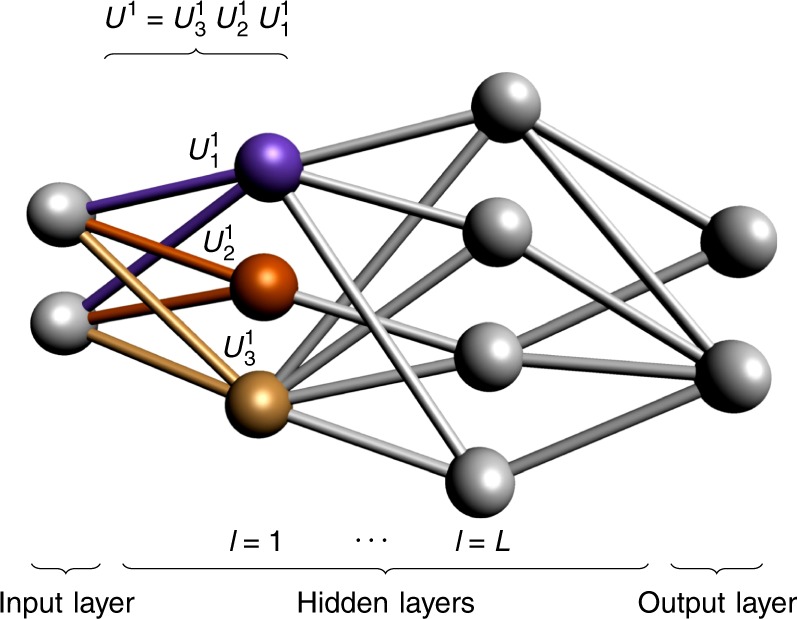
- A quantum perceptron is an arbitrary unitary with \(m\) input and \(n\) output qubits; QNNs built from them can carry out universal quantum computation even for two-input one-output qubit perceptrons, and commuting 4-level qudit perceptrons within each layer also suffice.
- Training uses the fidelity between QNN output and desired output as cost; parameter matrices are computed layer-by-layer, accessing only two layers at a time, so memory scales with width rather than depth, enabling deep-network optimization.
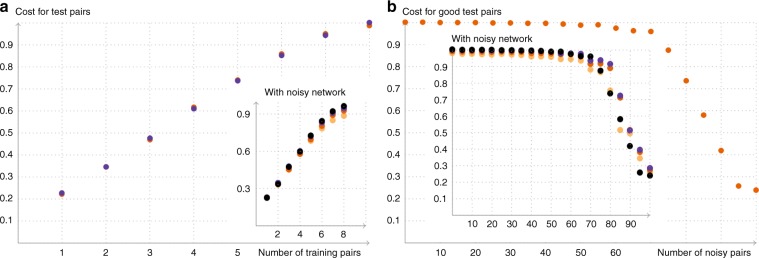
- In simulations, a 3-3-3 network trained with \(\epsilon=0.1\), \(\eta=2/3\) for 1000 rounds with \(n=1,\dots,8\) training pairs and evaluated on 10 test pairs matched a theoretical optimal cost estimate, averaged over 20 rounds.
- A 2-3-2 network trained with \(\epsilon=0.1\), \(\eta=1\) for 300 rounds with 100 training pairs remained robust when some pairs were replaced by random noisy data; insets show approximate depolarizing noise strengths \(t=0, 0.0033, 0.0066, 0.01\).
Methods
- Architecture: perceptrons are arbitrary unitaries on \(m\) input and \(n\) output qubits; a QNN is a quantum circuit of perceptrons organized into \(L\) hidden layers, with output expressed as a composition of completely positive layer-to-layer transition maps.
- Training: the cost is average fidelity between QNN output and desired output; perceptron unitaries are updated by gradient ascent, with parameter matrices computed from the previous layer’s output state and adjoint channels applied to the desired output state up to the current layer.
- Simulations: classical pilot simulations for input/output spaces of \(m=2\) and \(3\) qubits learning a random unitary \(V\), covering generalization from limited random training pairs and robustness to corrupted training data under an approximate depolarizing noise model.
Limitations
- Stated: classical simulation is impossible for more than a handful of qubits due to exponential Hilbert-space growth, so the authors were restricted to small-width QNNs; near-term large networks may require sparse connectivity because copies per training round scale linearly with the number of network parameters, and multiple network evaluations are needed to estimate the derivative.
- Stated: the introduction notes that one would still have to study how noise in the network itself influences performance; future work includes generalizing the perceptron to general CP maps, studying overfitting, and optimized NISQ implementation.
- Evident: empirical validation is limited to classical simulations of small-width QNNs (\(m=2,3\) qubits), with no experimental demonstration; no overfitting analysis is reported despite being listed as future work.
Model-written summary. Check it against the paper before relying on it.
Integrity signals
Registry
Cites
Statistics
Figures
Verification
Claims the paper makes
1 Valid · 2 Not valid · 3 Not checked · 31 Own results and interpretations
The cited sources support only part of this claim — read each source’s verdict below.
In the paper
“However, in the near term, this tradeoff is a happy one as many NISQ architectures—most notably superconducting qubit devices—can easily and rapidly repeat executions of a quantum circuit.”
§ Training deep quantum neural networks > Discussion
What the sources say
- Partly supportedcites [46] Arute F Quantum supremacy using a programmable superconducting processor Nature 2019 574 505 510 10.1038/s41586-019-1666-5 31645734 sourceExperimental — accuracy not yet measured
Our copy supports the superconducting part concretely: in 'The classical computational cost' (p. 509) it states 'it took 600 seconds to sample the circuit on the quantum processor three million times, where sampling time is limited by control hardware communications; in fact, the net quantum processor time is only about 30 seconds,' and in 'The future' it notes that 'for m = 20, obtaining a million samples on the quantum processor takes 200 seconds.' The paper also frames its result as heralding 'the era of noisy intermediate-scale quantum (NISQ) technologies' (intro, crediting Preskill 2018). What it does not support is the generalization to 'many NISQ architectures': the device-level statements are about its own 53-qubit superconducting processor only, and no other NISQ platform is shown to repeat circuit executions easily and rapidly. (LLM, conf=0.70)
plain- Asserted: passes — The authors put it forward as true.
- Checkable: passes — It can be checked against evidence.
- Load-bearing: passes — The paper’s conclusions depend on it.
- Based: passes — The paper gives a reason why it holds.
- Partly supported
In the paper
“It is also an important observation that there is no barren plateau in the cost function landscape.”
- Also stated in: § Simulation of learning tasks · boosted
“A crucial consequence of our numerical investigations was the absence of a “barren plateau” in the cost function landscape for our QNNs45.”
- Also stated in: § Discussion · boosted
“The resulting QML algorithm, when applied to our QNNs, demostrates remarkable capabilities, including, the ability to generalise, tolerance to noisy training data, and an absence of a barren plateau in the cost function landscape.”
§ Training deep quantum neural networks > Introduction
What the sources say
- Not checked yetcites McClean et al.45 McClean JR Boixo S Smelyanskiy VN Babbush R Neven H Barren plateaus in quantum neural network training landscape Nat. Commun. 2018 9 4812 10.1038/s41467-018-07090-4 30446662 PMC6240101 source
boosted- Asserted: passes — The authors put it forward as true.
- Checkable: passes — It can be checked against evidence.
- Load-bearing: passes — The paper’s conclusions depend on it.
- Based: passes — The paper gives a reason why it holds.
- Also stated in: § Simulation of learning tasks · boosted
A result the paper reports from its own data — it cites no other source for it, so there is none to check. The quote shows it is in the paper.
In the paper
“Interestingly, we have obtained numerical evidence that, for approximate depolarising noise, QNNs are robust (see inset of Fig. 2).”
§ Training deep quantum neural networks > Discussion
hedged- Asserted: passes — The authors put it forward as true.
- Checkable: passes — It can be checked against evidence.
- Load-bearing: unclear — It is unclear whether the paper’s conclusions depend on it.
- Based: passes — The paper gives a reason why it holds.
- Rests on an assumption not shown here.
A result the paper reports from its own data — it cites no other source for it, so there is none to check. The quote shows it is in the paper.
In the paper
“Here we see that the QNN matches the theoretical estimate and demonstrates the remarkable ability of our QNNs to generalise.”
§ Training deep quantum neural networks > Results > Simulation of learning tasks
boosted- Asserted: passes — The authors put it forward as true.
- Checkable: passes — It can be checked against evidence.
- Load-bearing: passes — The paper’s conclusions depend on it.
- Based: passes — The paper gives a reason why it holds.
A result the paper reports from its own data — it cites no other source for it, so there is none to check. The quote shows it is in the paper.
In the paper
“In addition, we always initialised our QNNs with random unitaries and we did not observe any exponential reduction in the value of the parameter matrices K (which arise from the derivative of our QNN with respect to the parameters).”
§ Training deep quantum neural networks > Results > Simulation of learning tasks
plain- Asserted: passes — The authors put it forward as true.
- Checkable: passes — It can be checked against evidence.
- Load-bearing: passes — The paper’s conclusions depend on it.
- Based: passes — The paper gives a reason why it holds.
17 more claims
Create a free account to see all 37 claims and to verify the 4 references still open.
- The quote only partly states this claim. 1
- It may state two separate claims as one. 9
- Probably not a substantial claim. 5
Claims other papers make about this one
Each is checked against this paper’s own text: does it say what the citing paper says it does?
The cited source doesn’t support the claim as written.
In the citing paper
“Ref. [174] proposed a VQA for learning continuous distributions which is meant to be a quantum version of GANs.”
From Variational quantum algorithms (2021) · cites this paper as [174]
Checked by a reasoning model — may be wrong.
Experimental — accuracy not yet measuredThe cited source says what the claim attributes to it.
In the citing paper
“there has been significant efforts put forward to use quantum algorithms for machine learning applications [154, 157, 174, 287].”
From Variational quantum algorithms (2021) · cites this paper as [174]
The check wasn’t confident either way, so it gives no verdict — never disputed.
In the citing paper
“We remark that the cost function in (1) contains as special cases many relevant applications.For instance, in a binary classification problem the cost function is given by the mean squarederror C(θ) = x (y x -y(θ, ρ x )) 2 [16,17,39,40].”
From Effect of barren plateaus on gradient-free optimization (2021) · cites this paper as [16]
Experimental — accuracy not yet measured
Self-check
Percentages, sums and reported differences re-computed from the paper’s own numbers.
Each contradiction between two passages listed here was confirmed by an independent check.
Rated minor: it would not touch a result — a value no result rests on, a p-value that stays on the same side of the significance level, or a conflict that is clerical, resolved elsewhere in the paper, or outside its own findings.
In the paper
§ Training deep quantum neural networks > Results > Simulation of learning tasks
“where N was smaller than the Hilbert space dimension.”
§ Training deep quantum neural networks > Results > Simulation of learning tasks
“We trained a 3-3-3 network with ϵ = 0.1, η = 2∕3 for 1000 rounds with n = 1, 2, …, 8 training pairs”
Citations
Cites
Book Review: Pattern Recognition and Machine Learning
Nasrabadi, N. M. (2007) · Journal of Electronic Imaging · doi:10.1117/1.2819119 · Cited by 22,066 · cited 1×
“(4), we obtain a formula for the parameter matrices (this is described in detail in Supplementary Note 2).”
MethodQuantum Computation and Quantum Information
Nielsen, M. A., Chuang, I., & Grover, L. K. (2002) · American Journal of Physics · doi:10.1119/1.1463744 · Cited by 21,895
Machine learning: Trends, perspectives, and prospects
Jordan, M. I., & Mitchell, T. M. (2015) · Science · doi:10.1126/science.aaa8415 · Cited by 9,955
Pattern Recognition and Machine Learning
(2006) · doi:10.1007/978-0-387-45528-0 · Cited by 9,824
Quantum Computation and Quantum Information: 10th Anniversary Edition
Nielsen, M. A., & Chuang, I. L. (2012) · doi:10.1017/cbo9780511976667 · Cited by 8,436
Quantum supremacy using a programmable superconducting processor
Arute, F., Arya, K., Babbush, R., Bacon, D., Bardin, J. C., Barends, R., Biswas, R., Boixo, S., Brandao, F. G. S. L., Buell, D. A., et al. (2019) · Nature · doi:10.1038/s41586-019-1666-5 · Cited by 7,720
Biamonte, J., Wittek, P., Pancotti, N., Rebentrost, P., Wiebe, N., & Lloyd, S. (2017) · Nature · doi:10.1038/nature23474 · Cited by 4,779
Pattern recognition and machine learning
(2007) · Choice Reviews Online · doi:10.5860/choice.44-5091 · Cited by 2,650
Barren plateaus in quantum neural network training landscapes
McClean, J. R., Boixo, S., Smelyanskiy, V. N., Babbush, R., & Neven, H. (2018) · Nature Communications · doi:10.1038/s41467-018-07090-4 · Cited by 2,329
Solving the quantum many-body problem with artificial neural networks
Carleo, G., & Troyer, M. (2017) · Science · doi:10.1126/science.aag2302 · Cited by 2,215
Research works printed but not linked: 1
- Goodfellow, I., Bengio, Y. & Courville, A. Deep Learning (MIT Press, 2016).
Cited by
Items 601–700 of 737
Introducing Reduced-Width QNNs, an AI-Inspired Ansatz Design Pattern
Stein, J., Rohe, T., Nappi, F., Hager, J., Bucher, D., Zorn, M., Kölle, M., & Linnhoff–Popien, C. (2024) · International Conference on Agents and Artificial Intelligence (ICAART) · doi:10.5220/0012449800003636 · Cited by 4
“Although the terminology suggests a close similarity be-tween QNNs and ANNs, there exist significant differences.”
BackgroundLin, C., Xu, R., & Li, Y. (2024) · SSRN Electronic Journal · doi:10.2139/ssrn.4793562
Ying, M. (2024) · Elsevier eBooks · doi:10.1016/b978-0-44-315942-8.00027-7
(2024) · Elsevier eBooks · doi:10.1016/b978-0-44-315942-8.00030-7
Chawla, K. (2023) · International Journal of Science and Research (IJSR) · doi:10.21275/sr23516220618
Quantum-Tunnelling Deep Neural Networks for Sociophysical Neuromorphic AIPreprint
Maksymov, I. S. (2024) · Preprints.org · doi:10.20944/preprints202406.1912.v1
Balasubramanian, S., Gampala, V., Misra, A., & Rao, T. V. M. (2024) · International Journal of Pattern Recognition and Artificial Intelligence · doi:10.1142/s0218001424570131
Quantum error mitigations for quantum approximate optimization algorithms on IBM quantum processors
Liu, S., Lim, H., Choi, J., Castillo, P., Park, G., & Yu, K. (2024) · Quantum Communications and Quantum Imaging · doi:10.1117/12.3030458
Minimial-Risk Training Samples for QNN Training from Measurements
Mandl, A., Barzen, J., Bechtold, M., & Leymann, F. (2024) · Communications in computer and information science · doi:10.1007/978-3-031-72578-4_6
Variational quantum algorithm for designing quantum information maskers*
Li, J., Wang, M., & Zhou, B. (2024) · Communications in Theoretical Physics · doi:10.1088/1572-9494/ad89ac
“In the fi eld of quantum machine learning, PQCs are an important way to realize quantum neural networks [ 43 – 45 ] .”
Research on Key Technologies for Analyzing Quantum Computing with Deep Learning
Chen, K., Shi, L., He, C., Yu, Y., & Deng, K. (2025) · SPIN · doi:10.1142/s2010324724400083
Learning complexity gradually in quantum machine learning models
Recio-Armengol, E., Schreiber, F. J., Eisert, J., & Bravo-Prieto, C. (2026) · Physical Review Research · doi:10.1103/wnlr-q9xd · Cited by 4
Circumventing traps in analog quantum machine learning algorithms through co-design
Bravo, R. A., Ponce, J. G., Hu, H.-Y., & Yelin, S. F. (2024) · APL Quantum · doi:10.1063/5.0235279 · Cited by 1
Multichannel Quantum Data Preprocessing for Image Classification
Trochun, Y., Stirenko, S., & Gordienko, Y. G. (2024) · Algorithms for intelligent systems · doi:10.1007/978-981-97-5791-6_58
Xu, K. Y., Wei, M., Tang, B., Li, J., Li, L., & Lin, H. (2024) · Applied Optics and Photonics China (AOPC) · doi:10.1117/12.3045725
“Researches have shifted to novel computing paradigms such as quantum computing [1, 2], mechanics-based computing [3] and optical computing [4, 5].”
Li, S., Salek, M. S., Chowdhury, M., & Wang, Y. (2026) · Physical Review Research · doi:10.1103/wb1b-ntpc
Cohesive Quantum Circuit Layer Construction with Reinforcement Learning
Zorn, M., Stein, J., Altmann, P. J., Kölle, M., Linnhoff–Popien, C., & Gabor, T. (2024) · IEEE International Conference on Quantum Computing and Engineering (QCE) · doi:10.1109/qce60285.2024.00201 · Cited by 2
“While there are works exploring quantum ML [4], quantum neural networks [21], and quantum reinforcement learning [12], [22] running entirely on the quantum computer, the gate cost for setup and logic on current QC hardware is still the constraining factor for realizing their full potential.”
Hybrid Quantum Physics-Informed Neural Networks for Power Flow Analysis
Kaseb, Z., Pálenský, P., & Vergara, P. P. (2024) · IEEE PES Innovative Smart Grid Technologies Europe · doi:10.1109/isgteurope62998.2024.10863453 · Cited by 3
“In addition, the inherent randomness of quantum phenomena allows for the capture of complex relationships between inputs and outputs with reduced reliance on large datasets [19].”
Quantum Machine Learning: Bridging Quantum Computing and AI for Exponential Gains
Chaudhary, S. (2025) · International Journal of Scientific Research in Computer Science Engineering and Information Technology · doi:10.32628/cseit251112393
DQFCNN: A New Deep Learning Architecture for Bird Species Classification Based on Images
Gavali, P. R., & Banu, J. S. (2025) · Journal of Circuits Systems and Computers · doi:10.1142/s0218126625502895 · Cited by 4
Optimal depth and a novel approach to variational quantum process tomography
Galetsky, V., Farré, P. J., Ghosh, S., Deppe, C., & Ferrara, R. (2024) · Globecom · doi:10.1109/globecom52923.2024.10901365
“For QDNN [1], the cost function is defined by the fidelity between the QDNN output ρ outx and the correct output ϕ out x averaged over the training data set To meet the criterion of achieving a fidelity of 0.9 across 5 consecutive seeds, we utilize 3 n initial states for the QDNN scheme.”
InfluentialHamiltonian-based Quantum Paths Guided by Engineered Perceptron
Nieto–Chaupis, H. (2024) · International Conference on Engineering and Emerging Technologies (ICEET) · doi:10.1109/iceet65156.2024.10913682
Tsironis, G. P. (2025) · Understanding complex systems · doi:10.1007/978-3-031-81946-9_15
Unraveling the rodeo algorithm through the Zeeman model
Gomes, R. F. I., Rocha, J. C. S., Nogueira, W. A. T., & Dias, R. A. (2025) · Physica Scripta · doi:10.1088/1402-4896/add58c · Cited by 4
“Consequently, the tuning processes allow us not only to create strategies to efficiently sample the entire rank of energy, but also pave the way to enhance the results through artificial intelligence techniques [39–42].”
A Quantum-Classical Hybrid Model for Long-term Network Traffic Prediction
Huang, Y., Li, Y., Hou, S., Zhao, X. M., Pan, C., Lu, X. P., & Wang, D. (2025) · Journal of Visualized Experiments · doi:10.3791/68229
A Quantum of Learning: Using Quaternion Algebra to Model Learning on Quantum Devices
Talebi, S. P., Took, C. C., & Mandic, D. P. (2025) · IEEE International Conference on Digital Signal Processing (DSP) · doi:10.1109/dsp65409.2025.11075094
“A comprehensive review of these approaches can be found in [12,15].”
A multi-axis diagnostic framework for Hybrid Quantum-Classical Neural Networks in Empirical settingPreprint
Gore, P. (2025) · Research Square · doi:10.21203/rs.3.rs-7093575/v1
High-Frequency Trading, Short Squeeze and ARMA-GARCH-Fractal Neural Networks
Alaminos, D., Salas, M. B., & Alaminos, E. (2025) · Computational Economics · doi:10.1007/s10614-025-11026-8
Modeling Intelligence as Trajectories in Complex Space: A Quantum-Inspired Approach to AGI
Pospieszynski, P. F. (2025) · Lecture notes in computer science · doi:10.1007/978-3-032-00800-8_10
Quantum Machine Learning (QML)
Natarajan, V. (2025) · Springer eBooks · doi:10.1007/978-981-96-5051-4_5
Claude, & Dranias, N. (2025) · SSRN Electronic Journal · doi:10.2139/ssrn.5384610
Architecture of Quantum Neural Networks: Design and Implementation
Latheef, F. N., & Rubell Marion Lincy, G. (2025) · Springer eBooks · doi:10.1007/978-3-031-87931-9_3 · Cited by 2
Application of Quantum Multi-classification Network in Image Processing
Qiu, J., & Cong, S. (2025) · Lecture notes in computer science · doi:10.1007/978-981-95-1233-1_12
Machine Reasoning Framework for Large Language Models
Georgiev, K., GEGOV, A. E., Khaleghzadeh, H., Adda, M., & Ichtev, A. (2025) · 2025 International Conference Automatics, Robotics and Artificial Intelligence (ICARAI) · doi:10.1109/icarai67046.2025.11137913
“Research into quantum neural networks (QNNs) [42] hints at new ways to simulate abstract thought processes starting by enabling efficient search and retrieval from already obtain.”
Approximate Quantum Amplitude Encoding with Parameterized Quantum Circuits
Zheng, J. Y., Gao, Q. Z., & OGORZAŁEK, M. J. (2025) · IEEE International Conference on Quantum Control, Computing and Learning (qCCL) · doi:10.1109/qccl65142.2025.11159050
“As a key tool in QML, quantum neural networks (QNNs) aim to leverage the unique properties of quantum computing, such as superposition, entanglement, and parallelism, to enhance classical neural networks [4], [5].”
Li, Y., Wang, Z., Xing, R., Wang, X., & Gu, Y. (2026) · Expert Systems with Applications · doi:10.1016/j.eswa.2026.132848
Research on Quantum Phase Perceptron for Solving XOR and XNOR Problems
Cong, S., Yang, J. M., & Harraz, S. (2025) · Signals and communication technology · doi:10.1007/978-3-031-94973-9_28
Quantum algorithm for polynomial multiplication and its applications
Gao, S. B., Huang, R., Liu, B., Cheng, Z., Xie, H., Zhang, Z.-X., Zhang, Z. P., Xu, G., & Yang, Y. (2025) · EPJ Quantum Technology · doi:10.1140/epjqt/s40507-025-00423-5 · Cited by 1
Leveraging Quantum Machine Learning Generalization to Significantly Speed up Quantum Compilation
Kukliansky, A., Cincio, Ł., Younis, E., & Iancu, C. (2025) · IEEE Transactions on Quantum Engineering · doi:10.1109/tqe.2025.3622495 · Cited by 6
“Solving for parameters is commonly referred to as instantiation , and it is an operation that appears in hybrid algorithms [1], [2], circuit synthesis [3], [4], [5], [6], [7], [8], [9], or within quantum machine learning (QML) [10], [11], [12], [13] algorithms.”
Multi-agent Communication, Games, and Computational Complexity
Fields, C., & Glazebrook, J. F. (2025) · Synthesis lectures on engineering, science, and technology · doi:10.1007/978-3-031-97263-8_7
GroverAttention: Quantum-Enhanced Attention Mechanism for Effcient TransformersPreprint
Chikhaoui, B. (2025) · Research Square · doi:10.21203/rs.3.rs-7301044/v1
Boateng, B., Alabintei, D. D., & Attoh-Okine, N. (2025) · SSRN Electronic Journal · doi:10.2139/ssrn.5688904
Mandl, A., Barzen, J., Leymann, F., & Vietz, D. (2025) · Quantum Machine Intelligence · doi:10.1007/s42484-025-00328-7 · Cited by 4
“…unitary can make use of a set of training samples S comprised of quantum inputs | ψ j ⟩ and the expected quantum outputs | ϕ j ⟩ = U | ψ j ⟩ [9,26] Regardless of how the hypothesis unitary is described, a training algorithm continuously adjusts the quantum circuit V S until it matches U…”
Filardo, G.-E., & Heckmann, T. (2025) · Neurocomputing · doi:10.1016/j.neucom.2025.132031 · Cited by 1
Sujitha, M., & Manikandan, N. (2025) · Biomedical Engineering Applications Basis and Communications · doi:10.4015/s1016237225500607
Learnability of a hybrid quantum-classical neural network for graph-structured quantum data
Liang, Y., Tang, S.-L., Zhu, Y., Situ, H., & Zheng, Z. (2025) · Quantum Information Processing · doi:10.1007/s11128-025-04997-y · Cited by 2
No-Free-Lunch Theorems for Tensor Network Machine Learning Models
Wu, J.-C., Ye, Q., Deng, D.-L., & Yu, L.-W. (2025) · Physical Review Letters · doi:10.1103/by9g-5bkm · Cited by 4
QSEA: Quantum Self‐Supervised Learning with Entanglement Augmentation
Li, L., Ni, X., Li, J., Qin, S., & Gao, F. (2025) · Advanced Quantum Technologies · doi:10.1002/qute.202500530 · Cited by 3
Murota, K., & Kobori, T. (2025) · IEEE International Conference on Quantum Computing and Engineering (QCE) · doi:10.1109/qce65121.2025.00171
“In this classical-quantum hybrid approach, classically trained TNs provide high-quality initializations for the quantum neural networks (QNNs) [35]–[37].”
Reinforcement Learning for Quantum Phase Estimation Using Deep Q-Network
Sundharess, B., Vikash Krishna, R., Gopika, S. S., Sinha, S., Donald, A. C., & Paul, A. (2025) · IEEE Madhya Pradesh Section Conference (MPCON) · doi:10.1109/mpcon66082.2025.11256566
“With this combination, DQN can take advantage of deep neural networks for high-dimensional quantum data processing, allowing it to make strategic decisions for better accuracy in phase estimation [14].”
Measuring incompatible observables with quantum neural networks
Yang, M., Huang, Y., & Zhou, D. L. (2025) · Physical review. B./Physical review. B · doi:10.1103/qz9c-m3z4
“We believe this protocol can be generalized to other kinds of QML architectures, such as deep quantum neural networks [39], quantum recurrent neural networks [40], quantum convolutional neural networks [20] and quantum autoencoders [41, 42].”
Budiutama, G., Daimon, S., Nishi, H., Kaneko, R., Ohtsuki, T., & Matsushita, Y. (2025) · Physical Review A · doi:10.1103/vyr3-h9hq · Cited by 1
False Memory via Quantum Tunnelling: A Photosynthetic Simulation of Social Cyber Engineering Risks
Merat, S., & Almuhtadi, W. (2025) · IEEE International Conference on Consumer Electronics - Berlin (ICCE-Berlin) · doi:10.1109/icce-berlin67488.2025.11277867
Kumar, G. V., Bellary, M. I., & Reddy, T. B. (2025) · International Conference on Innovative Data Communication Technologies and Application (ICIDCA) · doi:10.1109/icidca66325.2025.11280343
Nehzati, M. (2025) · Frontiers in Artificial Intelligence · doi:10.3389/frai.2025.1689727
NeuroBloom: A Quantum-Inspired, Self-Developing Neural Architecture with Curiosity-Guided GrowthPreprint
Gauba, A. (2025) · SSRN Electronic Journal · doi:10.2139/ssrn.5375790
Golnari, A., Yousefi, J., Moheimani, R., & Sanei, S. (2026) · Neural Networks · doi:10.1016/j.neunet.2026.109627
Relative Entropy-Based Training of Quantum Neural Networks
Mondal, S., & Dutta, A. K. (2025) · IEEE Transactions on Quantum Engineering · doi:10.1109/tqe.2025.3638878 · Cited by 2
“This situation is not merely a theoretical possibility but arises naturally in practical QML tasks, particularly when the objective is to learn an entire quantum channel rather than just a unitary transformation, as also discussed in [22].”
InfluentialMitigating barren plateaus in quantum denoising diffusion probabilistic models
Cao, H., Zhang, K., Tao, D., & Su, Z. (2026) · Physical Review A · doi:10.1103/gg2j-xtk6 · Cited by 1
Quantum deep neural networks modeling for inventory management
Maitra, S. (2025) · Journal of Modelling in Management · doi:10.1108/jm2-11-2024-0371
Assessing the Efficiency of Hybrid Quantum Models Relative to Classical Deep Learning Models
Juyal, R., Jayabharti, M., Anjum, R., Singh, V. P., Pasupuleti, H., & Sudarsan, S. D. (2025) · IEEE International Conference on Electronics, Computing and Communication Technologies (CONECCT) · doi:10.1109/conecct65861.2025.11306825
“The limited number of qubits can result in insufficient data for mitigating errors in reading out information from the qubits, and it may not be suitable for handling high-dimensional data or the weights within a neural network [2] [3] [4].”
Tensor Networks in Quantum Neural Network Architectures
Meenakshi, K., Chauhan, R., & Bhargava, D. (2026) · Signals and communication technology · doi:10.1007/978-981-95-1683-4_2
Quantum Convolutional Neural Networks with Residual Learning: Advancing Quantum Model Architectures
Verma, M., Arora, K., Kumar, P., Trivedi, K., Yadav, J., & Pandey, S. K. (2026) · Communications in computer and information science · doi:10.1007/978-3-032-08511-5_33 · Cited by 2
The Quantum Shift in Machine Learning
Rai, P., John, T. J., & Dkhar, J. M. (2026) · Lecture notes in networks and systems · doi:10.1007/978-981-96-9184-5_45
Structured Quantum Neural Networks Inspired by Multi-Head Attention Mechanisms
Lyu, C. (2025) · International Conference on Electronic Information Engineering and Computer Technology (EIECT) · doi:10.1109/eiect68017.2025.11331713
“Nevertheless, most QML models remain structurally limited, often using parameterized quantum circuits as static feature extractors without mechanisms to dynamically emphasize relationships among features—capabilities central to modern deep learning [7]– [11].”
Characterizing Scaling Trends of Post-Compilation Circuit Resources for NISQ-Era QML Models
Bhattacharjee, R., Escofet, P., Rodrigo, S., Abadal, S., Almudéver, C. G., & Alarcón, E. (2025) · IEEE International Conference on Quantum Artificial Intelligence (QAI) · doi:10.1109/qai63978.2025.00059
“Among the most studied paradigms are Quantum Kernel Methods (QKMs) [3] and Quantum Neural Networks (QNNs) [4], [5], where quantum circuits are used to implicitly map classical data into high-dimensional Hilbert spaces to learn complex patterns while also being suitable for NISQ devices.”
Hernandez-Martinez, J. I., Juárez-Osorio, S. L., Méndez-Vázquez, A., Rodriguez‐Hernandez, G., & Rodríguez-Tello, E. (2025) · IEEE International Conference on Quantum Artificial Intelligence (QAI) · doi:10.1109/qai63978.2025.00020
“Quantum recurrent networks have been shown to outperform classical RNNs in learning tasks involving highly entangled physical systems [22], and QLSTMs in particular have achieved faster convergence and better accuracy in the modeling of physical sequences compared to classical LSTMs [23].”
Machine Learning by Adiabatic Evolutionary Quantum Systems
Yamakami, T. (2026) · Lecture notes in computer science · doi:10.1007/978-3-032-15641-9_16
Quantum Enhancements for AI Models
Singh, M. S. I., & Rawal, B. S. (2026) · Springer eBooks · doi:10.1007/978-981-95-2498-3_10
Hamiltonian-based qutrit quantum neural network with multi-subspace feature mapPreprint
Rodríguez, P. A. (2026) · Research Square · doi:10.21203/rs.3.rs-8332601/v1
Classification of X-ray Images Using Quantum-Hybrid Neural Network
Muhamediyeva, D. T., Mamatov, N. S., Samijonov, B. N., Isoqov, A. F., & Jumayev, B. J. (2026) · Communications in computer and information science · doi:10.1007/978-3-032-16105-5_13
Bhalerao, V. T., Mani, P., Rajawat, A. S., & Goyal, S. B. (2025) · International Conference on Advancement in Electronics & Communication Engineering (AECE) · doi:10.1109/aece67531.2025.11386726 · Cited by 1
“According to Beer et al. [19] quantum neural networks demonstrate the capability to resolve particular pattern recognition tasks using less computational resources than standard neural networks.”
Long, C., Ye, X., & Sakurai, T. (2025) · doi:10.1109/icrai68431.2025.11396700
“The demand for data-efficient solutions has motivated research into small-sample learning techniques and alternative network architectures that can preserve generalization under data scarcity [10]–[13].”
Yang, J., Cai, Q., Guo, J., & Deng, G. (2026) · Acta Physica Sinica · doi:10.7498/aps.75.20251792
Non-Equilibrium Dynamics of Quantum Many-Body Systems for Image Processing
Zhou, R., & Bayat, A. (2025) · Intelligent Autonomous Systems · doi:10.1109/icoias69065.2025.00008
“The results demonstrate the e ff ectiveness of the hybrid classical-quantum neural network architecture in accurately classifying images across a diverse range of datasets [17], [46]–[52].”
Quantum transport in two-dimensional systems : artificial intelligence applied to material science
Percebois, G. (2023) · theses.fr (ABES) · doi:10.70675/c32ea9edze333z4de6z900az5571678f3344 · Cited by 4
Quantum Error Correction and Detection for Quantum Machine Learning
Adermann, E., Kang, H., Sevior, M., & Usman, M. (2026) · Quantum science and technology · doi:10.1007/978-3-032-11153-1_17 · Cited by 4
Moye, J. N. (2026) · Emerald Group Publishing Limited eBooks · doi:10.1108/978-1-80686-539-020261013
Lee, M.-H., Hurd, A. J., van Wijk, J. W., & Kop, M. (2026) · SSRN Electronic Journal · doi:10.2139/ssrn.6648661
HDQE: Hybrid Deep Quantum Embeddings with Pauli Readouts and Learnable FusionPreprint
Suleiman, D., Assaf, A. J., Sanjalawe, Y. K., Obiedat, R., Al-Sayyed, R., & Mirjalili, S. (2026) · SSRN Electronic Journal · doi:10.2139/ssrn.6661507
Bach, N. H., & Nguyen, V. D. (2026) · Ocean Engineering · doi:10.1016/j.oceaneng.2026.125667 · Cited by 2
Quantum complex language processing: a framework for semantic encoding in hilbert space
Routh, A., Dey, T. K., & Singh, O. (2026) · Engineering Research Express · doi:10.1088/2631-8695/ae660c
“However, most QML works focus on real-valued data [3, 25] or amplitude-encoded classical features [6].”
A Fourier Lens on Parameterised Quantum Circuits: A Review
Kim, D., Oh, S., & Kim, J. (2026) · International Conference on Information Networking · doi:10.1109/icoin68469.2026.11480524
Jha, M., Chen, S. Y.-C., Kulkarni, C. M., & Kim, J. (2026) · Engineering Applications of Artificial Intelligence · doi:10.1016/j.engappai.2026.114991 · Cited by 2
Ganesan, S., Karunarathne, L., Karunarathne, K., Weerakoddi, M., & Somasiri, N. (2026) · Cureus Journal of Computer Science. · doi:10.7759/s44389-025-00063-x
Noor, K., & Fatima, U. (2026) · Global Conference on Wireless and Optical Technologies (GCWOT) · doi:10.1109/gcwot69191.2026.11499728
“Quantum neural models were expanded by the works of Mitarai et al. (2018) on quantum circuit learning [7], Schuld and Killoran (2019) on quantum feature Hilbert spaces [8], and Beer et al. (2020), who addressed some optimization obstacles in quantum neural networks [9].”
A Hybrid Quantum-Classical Framework for Saliency-Aware Medical Image Encoding
Nikam, V., Atre, T. S., Santhosh, L., N, A. K., & Praveena, M. V. (2026) · Quantum Reports · doi:10.3390/quantum8020046
A2G-QFL: Adaptive Aggregation with Two Gains in Quantum Federated Learning
Nanayakkara, S. I., & Pokhrel, S. R. (2026) · International Conference on Quantum Communications, Networking, and Computing (QCNC) · doi:10.1109/qcnc69040.2026.00132
“…of hardware noise, decoherence, shot-induced gradient variance, and in distributed implementations teleportation fidelity fluctuations, all of which distort the effective optimization landscape and make naive euclidean aggregation misaligned with the underlying parameter geometry [17], [18].”
Consensus Protocols for Entanglement-Aware Scheduling in Distributed Quantum Neural Networks
Chen, K.-C., Chen, S. Y.-C., Chehimi, M. M., Burt, F., & Leung, K. K. (2026) · International Conference on Quantum Communications, Networking, and Computing (QCNC) · doi:10.1109/qcnc69040.2026.00092
Murugasamy, P., Malick, R., & R, A. J. M. (2026) · IEEE International Conference on Communication Systems and Network Technologies (CSNT) · doi:10.1109/csnt69054.2026.11502350
“Variational Quantum Classifiers (VQC) have demonstrated potential for small-scale datasets [10], yet most studies remain limited to centralized simulations without addressing multi-institutional privacy.”
Quantum Machine Learning in Climate Change Using IoT Devices
Darwish, D. A. M. (2026) · Studies in computational intelligence · doi:10.1007/978-981-95-6276-3_6
Govindarajan, E., Mathiyalagan, G., Thirumalai, J., & Ramalingam, P. (2026) · International Journal of Computational Intelligence Systems · doi:10.1007/s44196-026-01311-1
“The DQNN [59] has the input, t hidden, and output layers.”
Farakte, A. B., Sridhar, K. P., & Rasale, M. B. (2026) · Microsystem Technologies · doi:10.1007/s00542-026-06023-2
“After that, the system load is predicted by using Deep QNN (Beer et al. 2020 ).”
Mahanta, A., Kaur, J., Kumar, K. S., & Jain, M. (2026) · International Conference on Smart Electronic Devices and Intelligent Systems (ICSEDIS) · doi:10.1109/icsedis68157.2026.11518232
“Quantum Graph Learning (QGL) has been suggested in order to take advantage of the exponential representational ability of Hilbert spaces (Lloyd et al., 2013), (Beer et al., 2020).”
The dawn of quantum AI in nuclear medicine: an EANM perspective
Papp, L., Visvikis, D., Sollini, M., Shi, K., & Kirienko, M. (2026) · The EANM Journal · doi:10.1016/j.eanmj.2026.100227
An Intelligent Hybrid Quantum Machine Learning Approach for Early Anomaly Detection
Singh, B., Kumar, D., Kumar, P., & Tyagi, V. (2026) · International Conference on Intelligent Processing, Hardware, Electronics, and Radio Systems (CIPHER) · doi:10.1109/cipher70417.2026.11523963
“Yin et al. (2019; 2021) introduced DiabDeep, a diabetes management framework using wearable IoT sensors and lightweight neural networks designed for edge devices [22].”
Intrinsic Preservation of Plasticity in Continual Quantum Learning
Chen, Y., & Zhang, S. (2026) · PRX Quantum · doi:10.1103/ry52-85ll · Cited by 6
Training the classification capability of large-scale quantum cellular automata
Boneberg, M., Kochsiek, S., Perfetto, G., & Lesanovsky, I. (2026) · Physical Review A · doi:10.1103/gds1-9vhy · Cited by 2
Quantum Machine Learning for IoT: Trends, Challenges, and Technology Readiness
Sharma, C., Sood, K., & Sood, S. K. (2026) · IEEE Internet of Things Journal · doi:10.1109/jiot.2026.3701410
“It builds on early work developing training strategies for deep QNNs [64].”
Metadata
- Authors
- Beer, K., Bondarenko, D., Farrelly, T., Osborne, T. J., Salzmann, R., Scheiermann, D., & Wolf, R.
- Affiliations
- Leibniz University Hannover (DE)
- Corresponding author
- Beer, Kerstin
- ORCID
- Venue
- Nature Communications
- Published
- 2020-02-10
- Volume
- 11
- Issue
- 1
- Pages
- 808-808
- ISSN
- 2041-1723 (ISSN-L)
- PMC
- PMC7010779
- OpenAlex
- W3004965358
- Semantic Scholar
- 9c8e8416bf64e592444e25e484f3f729480fd146
- Cited by
- 726
- References
- 52
- Citations by year
- 2026: 96 · 2025: 138 · 2024: 134 · 2023: 118 · 2022: 95 · 2021: 113 · 2020: 28
- FWCI
- 34.79
- Type
- journal article
- Language
- en
- Open access
- gold
- doi.org
- Licence
- cc-by
- creativecommons.org/licenses/by/4.0 (tdm)
- creativecommons.org/licenses/by/4.0 (vor)
- Locations
- Nature Communications (publishedVersion, cc-by)
- PubMed Central (publishedVersion, cc-by)
- PubMed (publishedVersion)
- arXiv (Cornell University) (submittedVersion)
- Institutional Repository of Leibniz Universität Hannover (Leibniz Universität Hannover) (submittedVersion, cc-by-nc-nd)
- LA Referencia (Red Federada de Repositorios Institucionales de Publicaciones Científicas) (submittedVersion, cc-by)
- RePEc: Research Papers in Economics (submittedVersion)
- DOAJ (DOAJ: Directory of Open Access Journals) (submittedVersion, cc-by-sa)
- Institutional Repository of Leibniz Universität Hannover (Leibniz Universität Hannover) (submittedVersion, cc-by)
- Apollo (University of Cambridge) (submittedVersion, cc-by)
- arXiv (Cornell University)
- Leibniz Universität Hannover (cc-by)
- Apollo (cc-by)
- Funders
- Deutsche Forschungsgemeinschaft (SFB 1227, RTG 1991, EXC 2123)
- Topics
- Physical Sciences › Computer Science › Artificial Intelligence › Quantum Computing Algorithms and Architecture
- Physical Sciences › Physics and Astronomy › Atomic and Molecular Physics, and Optics › Quantum Information and Cryptography
- Physical Sciences › Physics and Astronomy › Atomic and Molecular Physics, and Optics › Quantum many-body systems
- Keywords
- quantum neural networks, quantum neurons, quantum machine learning, qudits, deep neural network training, noisy data robustness, generalization
About these checks
Registry, retraction, Cites and statistics results are computed, not judged, with one exception: a printed reference that no index lists is read once by a model before it counts as a citation error. Claims are extracted by a model and kept only when their quote appears verbatim in the text; each cited source is then checked, with a model’s help, for whether it says what the claim relies on. Those verdicts can be wrong — read the claim’s quote and the cited source before relying on one.
The claim verdicts this report counts are experimental: their accuracy is not yet measured.
A language model drew the claims from the paper on 2026-10-08, under version 3 of the claim definition (model deepseek-v4.1-flash, prompt extract-v3).
A second model labelled each claim on 2026-10-08 (model jev-1.13-20260917, definition revision gold-guideline-v0.2).
Cited sources are checked with a language model’s help (qwen3.8-omni-flash).
Statistics and arithmetic are recomputed, not judged.
Confidence bands are shown only for fields calibrated on our annotated test set. None is calibrated yet, so no band is shown.
What counts as a claim ›How we measure confidence ›How we check this ›
Are you an author, or do you see a problem with this page? Request a review
Data sources
Bibliographic data: Semantic Scholar, OpenAlex, Crossref.
Contains information from the Semantic Scholar Academic Graph Datasets, made available under the ODC Attribution License (ODC-BY 1.0).
Semantic Scholar’s data is described in: Kinney, R., et al. (2023). The Semantic Scholar Open Data Platform. arXiv:2301.10140.
