

Training deep quantum neural networks
Open accessThe DOI matches its Crossref record; 56 of the 57 references it cites were found in a registry or an index; 1 of the 5 sources its claims cite were checked for support.
Abstract
Neural networks enjoy widespread success in both research and industry and, with the advent of quantum technology, it is a crucial challenge to design quantum neural networks for fully quantum learning tasks. Here we propose a truly quantum analogue of classical neurons, which form quantum feedforward neural networks capable of universal quantum computation. We describe the efficient training of these networks using the fidelity as a cost function, providing both classical and efficient quantum implementations. Our method allows for fast optimisation with reduced memory requirements: the number of qudits required scales with only the width, allowing deep-network optimisation. We benchmark our proposal for the quantum task of learning an unknown unitary and find remarkable generalisation behaviour and a striking robustness to noisy training data.
Overview
CoChat Summary
TL;DR
The paper proposes a quantum perceptron defined as an arbitrary unitary on input and output qubits, forming feedforward quantum neural networks capable of universal quantum computation. It gives a fidelity-based training algorithm whose memory scales with network width, and numerical simulations for learning an unknown unitary show generalization and robustness to noisy training data.
Key findings
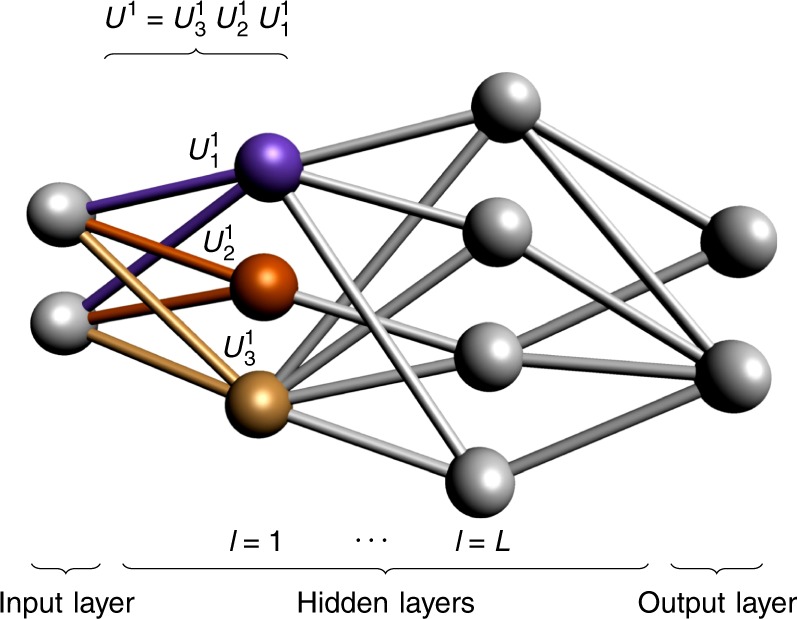
- A quantum perceptron is an arbitrary unitary with \(m\) input and \(n\) output qubits; QNNs built from them can carry out universal quantum computation even for two-input one-output qubit perceptrons, and commuting 4-level qudit perceptrons within each layer also suffice.
- Training uses the fidelity between QNN output and desired output as cost; parameter matrices are computed layer-by-layer, accessing only two layers at a time, so memory scales with width rather than depth, enabling deep-network optimization.
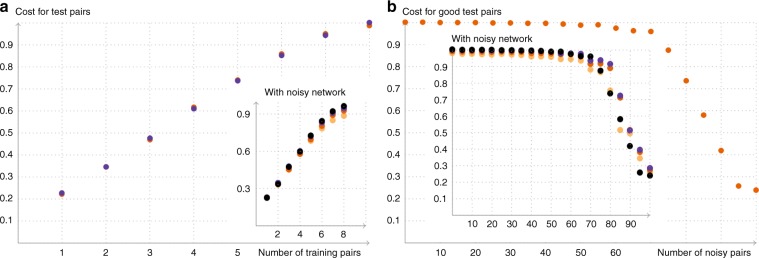
- In simulations, a 3-3-3 network trained with \(\epsilon=0.1\), \(\eta=2/3\) for 1000 rounds with \(n=1,\dots,8\) training pairs and evaluated on 10 test pairs matched a theoretical optimal cost estimate, averaged over 20 rounds.
- A 2-3-2 network trained with \(\epsilon=0.1\), \(\eta=1\) for 300 rounds with 100 training pairs remained robust when some pairs were replaced by random noisy data; insets show approximate depolarizing noise strengths \(t=0, 0.0033, 0.0066, 0.01\).
Methods
- Architecture: perceptrons are arbitrary unitaries on \(m\) input and \(n\) output qubits; a QNN is a quantum circuit of perceptrons organized into \(L\) hidden layers, with output expressed as a composition of completely positive layer-to-layer transition maps.
- Training: the cost is average fidelity between QNN output and desired output; perceptron unitaries are updated by gradient ascent, with parameter matrices computed from the previous layer’s output state and adjoint channels applied to the desired output state up to the current layer.
- Simulations: classical pilot simulations for input/output spaces of \(m=2\) and \(3\) qubits learning a random unitary \(V\), covering generalization from limited random training pairs and robustness to corrupted training data under an approximate depolarizing noise model.
Limitations
- Stated: classical simulation is impossible for more than a handful of qubits due to exponential Hilbert-space growth, so the authors were restricted to small-width QNNs; near-term large networks may require sparse connectivity because copies per training round scale linearly with the number of network parameters, and multiple network evaluations are needed to estimate the derivative.
- Stated: the introduction notes that one would still have to study how noise in the network itself influences performance; future work includes generalizing the perceptron to general CP maps, studying overfitting, and optimized NISQ implementation.
- Evident: empirical validation is limited to classical simulations of small-width QNNs (\(m=2,3\) qubits), with no experimental demonstration; no overfitting analysis is reported despite being listed as future work.
Model-written summary. Check it against the paper before relying on it.
Integrity signals
Registry
Cites
Statistics
Figures
Verification
Claims the paper makes
1 Valid · 2 Not valid · 3 Not checked · 31 Own results and interpretations
The cited sources support only part of this claim — read each source’s verdict below.
In the paper
“However, in the near term, this tradeoff is a happy one as many NISQ architectures—most notably superconducting qubit devices—can easily and rapidly repeat executions of a quantum circuit.”
§ Training deep quantum neural networks > Discussion
What the sources say
- Partly supportedcites [46] Arute F Quantum supremacy using a programmable superconducting processor Nature 2019 574 505 510 10.1038/s41586-019-1666-5 31645734 sourceExperimental — accuracy not yet measured
Our copy supports the superconducting part concretely: in 'The classical computational cost' (p. 509) it states 'it took 600 seconds to sample the circuit on the quantum processor three million times, where sampling time is limited by control hardware communications; in fact, the net quantum processor time is only about 30 seconds,' and in 'The future' it notes that 'for m = 20, obtaining a million samples on the quantum processor takes 200 seconds.' The paper also frames its result as heralding 'the era of noisy intermediate-scale quantum (NISQ) technologies' (intro, crediting Preskill 2018). What it does not support is the generalization to 'many NISQ architectures': the device-level statements are about its own 53-qubit superconducting processor only, and no other NISQ platform is shown to repeat circuit executions easily and rapidly. (LLM, conf=0.70)
plain- Asserted: passes — The authors put it forward as true.
- Checkable: passes — It can be checked against evidence.
- Load-bearing: passes — The paper’s conclusions depend on it.
- Based: passes — The paper gives a reason why it holds.
- Partly supported
In the paper
“It is also an important observation that there is no barren plateau in the cost function landscape.”
- Also stated in: § Simulation of learning tasks · boosted
“A crucial consequence of our numerical investigations was the absence of a “barren plateau” in the cost function landscape for our QNNs45.”
- Also stated in: § Discussion · boosted
“The resulting QML algorithm, when applied to our QNNs, demostrates remarkable capabilities, including, the ability to generalise, tolerance to noisy training data, and an absence of a barren plateau in the cost function landscape.”
§ Training deep quantum neural networks > Introduction
What the sources say
- Not checked yetcites McClean et al.45 McClean JR Boixo S Smelyanskiy VN Babbush R Neven H Barren plateaus in quantum neural network training landscape Nat. Commun. 2018 9 4812 10.1038/s41467-018-07090-4 30446662 PMC6240101 source
boosted- Asserted: passes — The authors put it forward as true.
- Checkable: passes — It can be checked against evidence.
- Load-bearing: passes — The paper’s conclusions depend on it.
- Based: passes — The paper gives a reason why it holds.
- Also stated in: § Simulation of learning tasks · boosted
A result the paper reports from its own data — it cites no other source for it, so there is none to check. The quote shows it is in the paper.
In the paper
“Interestingly, we have obtained numerical evidence that, for approximate depolarising noise, QNNs are robust (see inset of Fig. 2).”
§ Training deep quantum neural networks > Discussion
hedged- Asserted: passes — The authors put it forward as true.
- Checkable: passes — It can be checked against evidence.
- Load-bearing: unclear — It is unclear whether the paper’s conclusions depend on it.
- Based: passes — The paper gives a reason why it holds.
- Rests on an assumption not shown here.
A result the paper reports from its own data — it cites no other source for it, so there is none to check. The quote shows it is in the paper.
In the paper
“Here we see that the QNN matches the theoretical estimate and demonstrates the remarkable ability of our QNNs to generalise.”
§ Training deep quantum neural networks > Results > Simulation of learning tasks
boosted- Asserted: passes — The authors put it forward as true.
- Checkable: passes — It can be checked against evidence.
- Load-bearing: passes — The paper’s conclusions depend on it.
- Based: passes — The paper gives a reason why it holds.
A result the paper reports from its own data — it cites no other source for it, so there is none to check. The quote shows it is in the paper.
In the paper
“In addition, we always initialised our QNNs with random unitaries and we did not observe any exponential reduction in the value of the parameter matrices K (which arise from the derivative of our QNN with respect to the parameters).”
§ Training deep quantum neural networks > Results > Simulation of learning tasks
plain- Asserted: passes — The authors put it forward as true.
- Checkable: passes — It can be checked against evidence.
- Load-bearing: passes — The paper’s conclusions depend on it.
- Based: passes — The paper gives a reason why it holds.
17 more claims
Create a free account to see all 37 claims and to verify the 4 references still open.
- The quote only partly states this claim. 1
- It may state two separate claims as one. 9
- Probably not a substantial claim. 5
Claims other papers make about this one
Each is checked against this paper’s own text: does it say what the citing paper says it does?
The cited source doesn’t support the claim as written.
In the citing paper
“Ref. [174] proposed a VQA for learning continuous distributions which is meant to be a quantum version of GANs.”
From Variational quantum algorithms (2021) · cites this paper as [174]
Checked by a reasoning model — may be wrong.
Experimental — accuracy not yet measuredThe cited source says what the claim attributes to it.
In the citing paper
“there has been significant efforts put forward to use quantum algorithms for machine learning applications [154, 157, 174, 287].”
From Variational quantum algorithms (2021) · cites this paper as [174]
The check wasn’t confident either way, so it gives no verdict — never disputed.
In the citing paper
“We remark that the cost function in (1) contains as special cases many relevant applications.For instance, in a binary classification problem the cost function is given by the mean squarederror C(θ) = x (y x -y(θ, ρ x )) 2 [16,17,39,40].”
From Effect of barren plateaus on gradient-free optimization (2021) · cites this paper as [16]
Experimental — accuracy not yet measured
Self-check
Percentages, sums and reported differences re-computed from the paper’s own numbers.
Each contradiction between two passages listed here was confirmed by an independent check.
Rated minor: it would not touch a result — a value no result rests on, a p-value that stays on the same side of the significance level, or a conflict that is clerical, resolved elsewhere in the paper, or outside its own findings.
In the paper
§ Training deep quantum neural networks > Results > Simulation of learning tasks
“where N was smaller than the Hilbert space dimension.”
§ Training deep quantum neural networks > Results > Simulation of learning tasks
“We trained a 3-3-3 network with ϵ = 0.1, η = 2∕3 for 1000 rounds with n = 1, 2, …, 8 training pairs”
Citations
Cites
Book Review: Pattern Recognition and Machine Learning
Nasrabadi, N. M. (2007) · Journal of Electronic Imaging · doi:10.1117/1.2819119 · Cited by 22,066 · cited 1×
“(4), we obtain a formula for the parameter matrices (this is described in detail in Supplementary Note 2).”
MethodQuantum Computation and Quantum Information
Nielsen, M. A., Chuang, I., & Grover, L. K. (2002) · American Journal of Physics · doi:10.1119/1.1463744 · Cited by 21,895
Machine learning: Trends, perspectives, and prospects
Jordan, M. I., & Mitchell, T. M. (2015) · Science · doi:10.1126/science.aaa8415 · Cited by 9,955
Pattern Recognition and Machine Learning
(2006) · doi:10.1007/978-0-387-45528-0 · Cited by 9,824
Quantum Computation and Quantum Information: 10th Anniversary Edition
Nielsen, M. A., & Chuang, I. L. (2012) · doi:10.1017/cbo9780511976667 · Cited by 8,436
Quantum supremacy using a programmable superconducting processor
Arute, F., Arya, K., Babbush, R., Bacon, D., Bardin, J. C., Barends, R., Biswas, R., Boixo, S., Brandao, F. G. S. L., Buell, D. A., et al. (2019) · Nature · doi:10.1038/s41586-019-1666-5 · Cited by 7,720
Biamonte, J., Wittek, P., Pancotti, N., Rebentrost, P., Wiebe, N., & Lloyd, S. (2017) · Nature · doi:10.1038/nature23474 · Cited by 4,779
Pattern recognition and machine learning
(2007) · Choice Reviews Online · doi:10.5860/choice.44-5091 · Cited by 2,650
Barren plateaus in quantum neural network training landscapes
McClean, J. R., Boixo, S., Smelyanskiy, V. N., Babbush, R., & Neven, H. (2018) · Nature Communications · doi:10.1038/s41467-018-07090-4 · Cited by 2,329
Solving the quantum many-body problem with artificial neural networks
Carleo, G., & Troyer, M. (2017) · Science · doi:10.1126/science.aag2302 · Cited by 2,215
Research works printed but not linked: 1
- Goodfellow, I., Bengio, Y. & Courville, A. Deep Learning (MIT Press, 2016).
Cited by
Items 201–300 of 737
Entanglement detection with classical deep neural networks
Ureña, J., Sojo, A., Bermejo-Vega, J., & Manzano, D. (2024) · Scientific Reports · doi:10.1038/s41598-024-68213-0 · Cited by 37
“One specific line of research in these directions are quantum neural networks (QNN), meaning learning models inspired by biological systems [21–23].”
BackgroundChaos and complexity from quantum neural network. A study with diffusion metric in machine learning
Choudhury, S., Dutta, A., & Ray, D. (2021) · Journal of High Energy Physics · doi:10.1007/jhep04(2021)138 · Cited by 23
Benchmarking quantum tomography completeness and fidelity with machine learning
Yong-Siah, T., Shin, S., Jeong, H., Kim, Y., Kim, Y.-H., Struchalin, G. I., Kovlakov, E. V., Straupe, S. S., Kulik, S. P., Leuchs, G., et al. (2021) · Library Open Repository (Universidad Complutense Madrid) · Cited by 20
Variational quantum extreme learning machine
Wang, Y., Lin, K.-Y., Cheng, S., & Li, L. (2022) · Neurocomputing · doi:10.1016/j.neucom.2022.09.068 · Cited by 20
VENUS: A Geometrical Representation for Quantum State Visualization
Ruan, S., Yuan, R., Guan, Q., Lin, Y., Mao, Y., Jiang, W., Wang, Z., Xu, W. F., & Wang, Y. (2023) · Computer Graphics Forum · doi:10.1111/cgf.14827 · Cited by 38
“…plays a critical role in many popular applications ( e.g. , Grover’s Algorithm [Hay08], Deutsch Algorithm [GRL ∗ 03], and Quantum Machine Learning [SLM ∗ 21,BBF ∗ 20]), especially in the near-term Noisy Intermediate-Scale Quantum [BCLK ∗ 21] (NISQ) era where the qubit number is severely limited.”
BackgroundQuantum-Enhanced Federated Learning for Metaverse-Empowered Vehicular Networks
Hazarika, B., Singh, K. K., Dobre, O. A., Li, C., & Duong, T. Q. (2024) · IEEE Transactions on Communications · doi:10.1109/tcomm.2024.3502667 · Cited by 25
“Utilizing quantum neural networks (QNN) [18], QFL offers an advanced data processing capability, enhanced model precision, and improved security, aligning well with the dynamic requirements of the vehicular metaverse.”
Quantum machine learning of graph-structured data
Beer, K., Khosla, M., Köhler, J., Osborne, T. J., & Zhao, T. (2023) · Physical Review A · doi:10.1103/physreva.108.012410 · Cited by 35
“The update matrix for a QNN trained with pure states | φ sv u as supervised vertices (and without using any known graph structure) is where This is shown in [26].”
BackgroundMethodInfluentialSelf-citationVerifying Fairness in Quantum Machine Learning
Guan, J., Fang, W. S., & Ying, M. (2022) · Lecture notes in computer science · doi:10.1007/978-3-031-13188-2_20 · Cited by 28
Kashif, M., & Al-Kuwari, S. M. (2023) · International Journal of Parallel Emergent and Distributed Systems · doi:10.1080/17445760.2023.2231163 · Cited by 29
GSQAS: Graph Self-supervised Quantum Architecture Search
He, Z., Deng, M., Zheng, S., Li, L., & Situ, H. (2023) · Physica A Statistical Mechanics and its Applications · doi:10.1016/j.physa.2023.129286 · Cited by 27
“The applications of VQAs have great potential in the demonstration of quantum advantage in NISQ era [13–17].”
BackgroundA Quantum-Classical Collaborative Training Architecture Based on Quantum State Fidelity
L'Abbate, R., D’Onofrio, A., Stein, S., Chen, S. Y.-C., Li, A., Chen, P., Chen, J., & Mao, Y. (2024) · IEEE Transactions on Quantum Engineering · doi:10.1109/tqe.2024.3367234 · Cited by 30
“Specific areas within classical learning, such as deep learning and support vector machines, could potentially benefit from quantum computing [7], [8].”
BackgroundGyöngyösi, L., & Imre, S. (2025) · Quantum Information and Computation · doi:10.2478/qic-2025-0006 · Cited by 40
On the learnability of quantum neural networksPreprint
Du, Y., Hsieh, M.-H., Liu, T., You, S., & Tao, D. (2020) · Research Square · doi:10.21203/rs.3.rs-80242/v1 · Cited by 18
“Specifically, several studies have investigated how to implemented QNN on noiseless quantum machines [64, 65, 66], quantum reservoir [67], and quantum annealers [68].”
BackgroundQuantum Topological Data Analysis with Linear Depth and Exponential SpeedupPreprint
Ubaru, S., Akhalwaya, I. Y., Squillante, M. S., Clarkson, K. L., & Horesh, L. (2021) · arXiv (Cornell University) · doi:10.48550/arxiv.2108.02811 · Cited by 55
“Learning models based on parameterized quantum circuits have also been proposed [4, 5, 6, 7].”
BackgroundA Hybrid Quantum-Classical Generative Adversarial Network for Near-Term Quantum Processors
Boyle, A. O., & Nikandish, G. (2024) · IEEE Access · doi:10.1109/access.2024.3433383 · Cited by 27
“…editor coordinating the review of this manuscript and approving it for publication was Tony Thomas. machine learning [1], [2], [3], [4], [5], [6], autonomous driving [7], drug discovery and healthcare [8], cryptography and secure communications [9], [10], teleportation [11], and the Internet…”
BackgroundHassan, S. S., Khan, L. U., Park, Y. M., Guizani, M., Han, Z., Ratnarajah, T., & Hong, C. S. (2025) · IEEE Communications Surveys & Tutorials · doi:10.1109/comst.2025.3610357 · Cited by 31
“The training process typically involves a hybrid optimization scheme where quantum circuits process input data through parameterized quantum gates, while classical optimizers adjust the circuit parameters based on measurement outcomes [181], [182], [183].”
Safe reinforcement learning under temporal logic with reward design and quantum action selection
Cai, M., Xiao, S., Li, J., & Kan, Z. (2023) · Scientific Reports · doi:10.1038/s41598-023-28582-4 · Cited by 32
Castillo-Rojas, W., Medina-Quispe, F., & Hernández, G. (2023) · Energies · doi:10.3390/en16135093 · Cited by 21
Estimating quantum mutual information through a quantum neural network
Shin, M., Lee, J., & Jeong, K. (2024) · Quantum Information Processing · doi:10.1007/s11128-023-04253-1 · Cited by 30
“Quantum neural networks (QNNs) [20, 21], which are among the most powerful quantum machine learning methods, serve as quantum counterparts to conventional neural networks, and offer several advantages.”
Towards Building a Facial Identification System Using Quantum Machine Learning Techniques
Easom, P., Bouridane, A., Belatreche, A., & Jiang, R. (2022) · Journal of Advances in Information Technology · doi:10.12720/jait.13.2.198-202 · Cited by 26
Phase diagram of quantum generalized Potts-Hopfield neural networks
Fiorelli, E., Lesanovsky, I., & Müller, M. (2022) · New Journal of Physics · doi:10.1088/1367-2630/ac5490 · Cited by 19
A Review on Quantum Machine Learning in Applied Systems and Engineering
Hong, Y.-Y., & Lopez, D. J. D. (2025) · IEEE Access · doi:10.1109/access.2025.3599147 · Cited by 32
“These approaches have laid the groundwork for quantum neural networks (QNNs) and deeper architectures, collectively forming the backbone of quantum deep learning [7].”
Edge to quantum: hybrid quantum-spiking neural network image classifier
Ajayan, A., & James, A. P. (2021) · Neuromorphic Computing and Engineering · doi:10.1088/2634-4386/ac1cec · Cited by 18
“On the other hand, they are not easy to train, with most common approach being spiking type backpropagation and STDP. Quantum neural networks [7, 8] is an emerging area of study, that aim to make use of the parallel computing abilities of quantum computers in speeding up neural computations.”
BackgroundVariational convolutional neural networks classifiers
Huang, F., Tan, X., Huang, R., & Xu, Q. (2022) · Physica A Statistical Mechanics and its Applications · doi:10.1016/j.physa.2022.128067 · Cited by 21
Optimal Quantum Dataset for Learning a Unitary Transformation
Yu, Z., Zhao, X., Zhao, B., & Wang, X. (2023) · Physical Review Applied · doi:10.1103/physrevapplied.19.034017 · Cited by 23
Deep Q-learning with hybrid quantum neural network on solving maze problems
Chen, H.-Y., Chang, Y.-J., Liao, S.-W., & Chang, C. (2024) · Quantum Machine Intelligence · doi:10.1007/s42484-023-00137-w · Cited by 36
Complexity of life sciences in quantum and AI era
Pyrkov, A. N., Aliper, A., Bezrukov, D. S., Podolskiy, D. I., Ren, F., & Zhavoronkov, A. A. (2024) · Wiley Interdisciplinary Reviews Computational Molecular Science · doi:10.1002/wcms.1701 · Cited by 30
Mitigated barren plateaus in the time-nonlocal optimization of analog quantum-algorithm protocols
Broers, L., & Mathey, L. (2024) · Physical Review Research · doi:10.1103/physrevresearch.6.013076 · Cited by 25
Enhancing the expressivity of quantum neural networks with residual connections
Wen, J., Huang, Z., Cai, D., & Qian, L. (2024) · Communications Physics · doi:10.1038/s42005-024-01719-1 · Cited by 31
“Similar to the classical neural networks that consist of input layers, hidden layers and output layers, the fundamental structures of the variational quantum neural networks include data-encoding circuits, variational ansatz, and output layers realized by quantum measurement 23,24 .”
Analysis of efficiency factors of companies in Serbia based on artificial neural networks
Lukić, R. (2022) · Anali Ekonomskog fakulteta u Subotici · doi:10.5937/aneksub2247097l · Cited by 15
Hurricane Damage Detection by Classic and Hybrid Classic-Quantum Neural Networks
Trochun, Y., Wang, Z., Rokovyi, O., Peng, G., Alienin, O., Lai, G., Gordienko, Y. G., & Stirenko, S. (2021) · International Conference on Space-Air-Ground Computing (SAGC) · doi:10.1109/sagc52752.2021.00033 · Cited by 17
Ising granularity image analysis on VAE–GAN
Chen, G., Long, S., Yuan, Z., Zhu, W., Chen, Q., & Wu, Y. (2022) · Machine Vision and Applications · doi:10.1007/s00138-022-01338-2 · Cited by 16
“Beer [9] proposed a quantum analogue of classical neurons, by utilizing quantum feed forward neural networks and making fidelity as cost function.”
MethodVariational quantum state discriminator for supervised machine learning
Lee, D., Baek, K., Huh, J., & Park, D. K. (2023) · Quantum Science and Technology · doi:10.1088/2058-9565/ad0a05 · Cited by 22
“7 in Appendix A).”
Quantum image compression with autoencoders based on parameterized quantum circuits
Wang, H., Tan, J., Huang, Y., & Zheng, W. (2024) · Quantum Information Processing · doi:10.1007/s11128-023-04243-3 · Cited by 25
Secure Delegated Variational Quantum Algorithms
Li, Q., Quan, J., Shi, J., Zhang, S., & Li, X. (2024) · IEEE Transactions on Computer-Aided Design of Integrated Circuits and Systems · doi:10.1109/tcad.2024.3391690 · Cited by 23
“Presently, VQAs are used in a wide range of areas, such as quantum neural networks [5], [6], [7], [8], variational quantum classifier [9], and variational quantum eigensolver (VQE) [10], [11].”
MethodQuantum Artificial Intelligence Scalability in the NISQ Era: Pathways to Quantum Utility
Moreau, G. S., Pisani, L., Profir, M., Podda, C., Leoni, L., & Cao, G. (2025) · Advanced Quantum Technologies · doi:10.1002/qute.202400716 · Cited by 27
A Cationic Oligomer as an Organic Template for Direct Synthesis of Aluminosilicate ITH Zeolite
López, A. R., Carocci, S., Martin, T., Molinari, A., Alexander, J., Martínez, P., Bianchi, G., Feller, L., Bernardi, P., Conte, E., et al. (2014) · DIGITAL.CSIC (Spanish National Research Council (CSIC)) · doi:10.13039/501100000781 · Cited by 15
Quantifying scrambling in quantum neural networks
Garcia, R. J., Bu, K., & Jaffe, A. (2022) · Journal of High Energy Physics · doi:10.1007/jhep03(2022)027 · Cited by 19
“A quantum neural network (QNN) [1–6] is a quantum generalization of a classical neural network [7–9] used to learn or optimize functions.”
Quantum Annealing Formulation for Binary Neural Networks
Sasdelli, M., & Chin, T.-J. (2021) · International Conference on Digital Image Computing: Techniques and Applications (DICTA) · doi:10.1109/dicta52665.2021.9647321 · Cited by 25
Optimizing parametrized quantum circuits via noise-induced breaking of symmetriesPreprint
Fontana, E., Cerezo, M., Arrasmith, A., Rungger, I., & Coles, P. J. (2020) · arXiv (Cornell University) · Cited by 15
ChSO-DNFNet: Spam detection in Twitter using feature fusion and optimized Deep Neuro Fuzzy Network
Thomas, M., & Meshram, B. B. (2022) · Advances in Engineering Software · doi:10.1016/j.advengsoft.2022.103333 · Cited by 14
West, M. T., Sevior, M. E., & Usman, M. (2023) · Advanced Quantum Technologies · doi:10.1002/qute.202300130 · Cited by 16
A variational quantum perceptron with Grover’s algorithm for efficient classification
Innan, N., & Bennai, M. (2024) · Physica Scripta · doi:10.1088/1402-4896/ad3e38 · Cited by 27
Quantum Fourier networks for solving parametric PDEs
Jain, N., Landman, J., Mathur, N., & Kerenidis, I. (2024) · Quantum Science and Technology · doi:10.1088/2058-9565/ad42ce · Cited by 21
“Following this, many works [14, 15] proposed small-scale implementations of fully connected quantum neural networks on near-term hardware.”
BackgroundEfficient Trainability of Linear Optical Modules in Quantum Optical Neural Networks
Volkoff, T. J. (2021) · Journal of Russian Laser Research · doi:10.1007/s10946-021-09958-1 · Cited by 16
A continuous rosenblatt quantum perceptron
Maronese, M., & Prati, E. (2021) · International Journal of Quantum Information · doi:10.1142/s0219749921400025 · Cited by 14
Quantum and Classical Temporal Correlations in (1+1)D Quantum Cellular Automata
Gillman, E., Carollo, F., & Lesanovsky, I. (2021) · Physical Review Letters · doi:10.1103/physrevlett.127.230502 · Cited by 14
High-dimensional encryption in optical fibers using spatial modes of light and machine learning
Lollie, M. L., Mostafavi, F., Bhusal, N., Hong, M., You, C., León‐Montiel, R. D. J., Magaña‐Loaiza, O. S., & Quiroz-Juarez, M. A. (2022) · Machine Learning Science and Technology · doi:10.1088/2632-2153/ac7f1b · Cited by 19
On Exploring the Potential of Quantum Auto-Encoder for Learning Quantum Systems
Du, Y., & Tao, D. (2024) · IEEE Transactions on Neural Networks and Learning Systems · doi:10.1109/tnnls.2024.3474793 · Cited by 34
“A leading candidate of QML models in NISQ era is variational quantum algorithms (VQAs), also known as quantum neural networks (QNNs) [36], [37], [38], [39], [40], [41], [42], [43].”
Abedi, E., Beigi, S., & Taghavi, L. (2023) · Quantum · doi:10.22331/q-2023-04-27-989 · Cited by 29
“, fresh qubits are introduced and qubits are measured/discarded in the middle of the circuit [2].”
BackgroundDeep Spiking Quantum Neural Network for Noisy Image Classification
Konar, D., Aggarwal, V., Sarma, A. D., Bhandary, S., Bhattacharyya, S., & Cangi, A. (2023) · International Joint Conference on Neural Networks (IJCNN) · doi:10.1109/ijcnn54540.2023.10191509 · Cited by 13
Zeng, X., Fan, Y., Liu, J., Li, Z., & Yang, J. (2023) · Journal of Chemical Theory and Computation · doi:10.1021/acs.jctc.3c00527 · Cited by 18
“Using QNN as an example, information propagates from the ( l -1)th layer to the l ’th layer via projecting out the ( l - 1)th layer states after a unitary operation on these two layers (Figure 1a).”
MethodA Quantum LSTM-based approach to cyber threat detection in virtual environment
Tripathi, S. M., Upadhyay, H., & Soni, J. (2024) · The Journal of Supercomputing · doi:10.1007/s11227-024-06615-7 · Cited by 19
“RNN algorithms have been very successful in tasks involving sequential data problems in natural language processing (NLP) such as machine translation, speech recognition, and language modeling and text generation [4].”
Quantum Gated Recurrent Neural Networks
Li, Y., Wang, Z., Xing, R., Shao, C., Shi, S., Li, J., Zhong, G., & Gu, Y. (2024) · IEEE Transactions on Pattern Analysis and Machine Intelligence · doi:10.1109/tpami.2024.3519605 · Cited by 26
“In another work, Paquet et al. [44] developed a hybrid quantum deep neural network called Quan-tumLeap, which integrates a deep QNN [45] with a classical dense neural network.”
Quantum data parallelism in quantum neural networks
Wu, S., Zhang, Y., & Li, J. (2025) · Physical Review Research · doi:10.1103/physrevresearch.7.013177 · Cited by 20
Studying the Impact of Quantum-Specific Hyperparameters on Hybrid Quantum-Classical Neural Networks
Zaman, K., Ahmed, T., Kashif, M., Hanif, M. A., Marchisio, A., & Shafique, M. (2025) · Communications in computer and information science · doi:10.1007/978-3-031-85884-0_11 · Cited by 20
Nonunitary quantum machine learning
Heredge, J., West, M. T., Hollenberg, L. C. L., & Sevior, M. E. (2025) · Physical Review Applied · doi:10.1103/physrevapplied.23.044046 · Cited by 29
“Various quantum machine learning algorithms have been proposed, with some of the most common examples at-tempting to recreate a quantum analogue of the classical neural network [7, 8].”
Simulation of implementable quantum-assisted genetic algorithm
Supasil, J., Pathumsoot, P., & Suwanna, S. (2021) · Journal of Physics Conference Series · doi:10.1088/1742-6596/1719/1/012102 · Cited by 13
Hybrid quantum-classical algorithms: Foundation, design and applications
Chen, R.-Y.-L., Zhao, B., Song, Z., Zhao, X., Wang, K., & Wang, X. (2021) · Acta Physica Sinica · doi:10.7498/aps.70.20210985 · Cited by 16
Evolution strategies: application in hybrid quantum-classical neural networks
Friedrich, L., & Maziero, J. (2023) · Quantum Information Processing · doi:10.1007/s11128-023-03876-8 · Cited by 16
Ground state search by local and sequential updates of neural network quantum states
Zhang, W.-X., Xu, X., Wu, Z., Balachandran, V., & Poletti, D. (2023) · Physical review. B./Physical review. B · doi:10.1103/physrevb.107.165149 · Cited by 19
Optimization enabled Deep Quantum Neural Network for weed classification and density estimation
Veeragandham, S., & Santhi, H. (2023) · Expert Systems with Applications · doi:10.1016/j.eswa.2023.122679 · Cited by 17
Encoding optimization for quantum machine learning demonstrated on a superconducting transmon qutrit
Cao, S., Zhang, W., Tilly, J., Agarwal, A., Bakr, M. S., Campanaro, G., Fasciati, S. D., Wills, J., Shteynas, B., Chidambaram, V., et al. (2024) · Quantum Science and Technology · doi:10.1088/2058-9565/ad7315 · Cited by 18
Simulation of memristive synapses and neuromorphic computing on a quantum computer
Li, Y. (2021) · Physical Review Research · doi:10.1103/physrevresearch.3.023146 · Cited by 19
“Compared with the general quantum neural network [17], the number of variational parameters is significantly reduced with respect to the number of neurons and synapses.”
BackgroundGillman, E., Carollo, F., & Lesanovsky, I. (2023) · Physical review. E · doi:10.1103/physreve.107.l022102 · Cited by 16
Nagapavithra, S., & Umamaheswari, S. (2023) · Artificial Intelligence Review · doi:10.1007/s10462-023-10574-5 · Cited by 12
“Finally, classification of sugarcane billet damage is done using DQNN (Beer et al. 2020).”
BackgroundMethodQuantum-classical hybrid neural networks in the neural tangent kernel regime
Nakaji, K., Tezuka, H., & Yamamoto, N. (2023) · Quantum Science and Technology · doi:10.1088/2058-9565/ad133e · Cited by 25
“[10] K Beer, D Bondarenko, T Farrelly, T.”
VIOLET: Visual Analytics for Explainable Quantum Neural Networks
Ruan, S., Liang, Z., Guan, Q., Griffin, P., Wen, X., Lin, Y., & Wang, Y. (2024) · IEEE Transactions on Visualization and Computer Graphics · doi:10.1109/tvcg.2024.3388557 · Cited by 24
“Data encoding , as the first step of a quantum neural network, is used to convert the input data to quantum states, so that it can be processed by a quantum neural network as the quantum states serve as the carriers of information [2,7].”
MethodQuantum computing and neuroscience for 6G/7G networks: Survey
Glisic, S., & Lorenzo, B. (2024) · Intelligent Systems with Applications · doi:10.1016/j.iswa.2024.200346 · Cited by 19
Quantum Computational Intelligence Techniques: A Scientometric Mapping
Arora, M., & Gupta, K. (2024) · Archives of Computational Methods in Engineering · doi:10.1007/s11831-024-10183-7 · Cited by 19
“Beer [64] proposed a quantum feed-forward neural network capable of universal QC, describing efficient QNN training using fidelity as a cost function and providing conventional and quantum implementations for quick optimization of deep networks with reduced memory usage.”
Radar HRRP Target Recognition Based on Hybrid Quantum Neural Networks
Liu, X., Zhou, D., & Huang, Q. (2025) · IEEE Transactions on Aerospace and Electronic Systems · doi:10.1109/taes.2025.3526112 · Cited by 14
“Quantum algorithms, including quantum-inspired reinforcement learning [32], quantum machine learning [33], deep quantum neural networks [34], and quantum CNNs [36], have demonstrated faster learning rates, stronger resistance to noise, and better generalization compared to classical methods.”
Quantum Reinforcement Learning for QoS-Aware Real-Time Job Scheduling in Cloud Systems
Dai, S., Saurabh, N., Wang, Q., Nian, J., Kan, S., Mao, Y., & Cheng, L. (2025) · IEEE Systems Journal · doi:10.1109/jsyst.2025.3568752 · Cited by 16
Approach for Training Quantum Neural Network to Predict Severity of COVID-19 in Patients
El-Shafeiy, E., Hassanien, A. E., Sallam, K. M., & Abohany, A. A. (2020) · Computers, materials & continua/Computers, materials & continua (Print) · doi:10.32604/cmc.2020.013066 · Cited by 15
“[9] suggested a complete quantum analog of classical neurons which constructed quantum feedforward NNs capable of universal quantum computing.”
BackgroundMethodChen, Y., Wang, C., Guo, H., Gao, X., & Wu, J. (2022) · Neurocomputing · doi:10.1016/j.neucom.2022.02.004 · Cited by 15
“For the reason that quantum has the natures of superposition and entanglement, in recent years, multi-type ANNs have been implemented on quantum computers (i.e., the details are illustrated in Section 2) to reduce the computational complexity and further expand the scale of neural networks [6-17] .”
BackgroundMethodQuantum data learning for quantum simulations in high-energy physics
Nagano, L., Miessen, A., Onodera, T., Tavernelli, I., Tacchino, F., & Terashi, K. (2023) · Physical Review Research · doi:10.1103/physrevresearch.5.043250 · Cited by 25
Quantum-Driven Energy-Efficiency Optimization for Next-Generation Communications Systems
Chien, S. F., Lim, H. S., Kourtis, M., Ni, Q., Zappone, A., & Zarakovitis, C. C. (2021) · Energies · doi:10.3390/en14144090 · Cited by 12
“Such a feature is known as universal quantum computation [26] and enables fast optimization with minimum memory demands because the number of the required qubits depends only on the width of the network at hand.”
BackgroundA quantum Hopfield associative memory implemented on an actual quantum processor
Miller, N. E., & Mukhopadhyay, S. (2021) · Scientific Reports · doi:10.1038/s41598-021-02866-z · Cited by 14
Kaseb, Z., Möller, M., Vergara, P. P., & Pálenský, P. (2024) · Scientific Reports · doi:10.1038/s41598-024-73512-7 · Cited by 29
Denoising diffusion models with optimized quantum implicit neural networks for image generation
Zhang, J., Che, X., Fan, Y., Peng, S., Chen, G., Ma, Q., & Hu, J. (2025) · Future Generation Computer Systems · doi:10.1016/j.future.2025.107875 · Cited by 20
Das, S., Meghanath, A., Behera, B. K., Mumtaz, S., Al-Kuwari, S. M., & Farouk, A. (2025) · IEEE Transactions on Computational Social Systems · doi:10.1109/tcss.2025.3568618 · Cited by 15
“Quantum-enhanced models, such as quantum deep neural networks (QDNNs), can deliver faster optimization [26], and more accurate predictions, especially when dealing with multifeature financial datasets.”
Application of Deep Quantum Neural Networks to Finance
Sakuma, T. (2024) · Wilmott · doi:10.54946/wilm.12042 · Cited by 23
“Although Beer et al. (2020) proposed one appropriate approach, in order to implement it, we would need a quantum computer with high capacity in the sense of it needing to be able to implement SWAP gates and partial trace operations efficiently.”
BackgroundMethodInfluentialPerkowski, M. A. (2022) · Science of Computer Programming · doi:10.1016/j.scico.2022.102775 · Cited by 16
Tomographic completeness and robustness of quantum reservoir networks
Krisnanda, T., Xu, H., Ghosh, S., & Liew, T. C. H. (2023) · Physical Review A · doi:10.1103/physreva.107.042402 · Cited by 16
Deep learning of deformation-dependent conductance in thin films: Nanobubbles in graphene
Nedell, J. G., Spector, J., Abbout, A., Vogl, M. R., & Fiete, G. A. (2022) · Physical review. B./Physical review. B · doi:10.1103/physrevb.105.075425 · Cited by 13
“[7] Kerstin Beer, Dmytro Bondarenko, Terry Farrelly, To-”
A new method of software vulnerability detection based on a quantum neural network
Zhou, X., Pang, J., Yue, F., Liu, F., Guo, J., Liu, W., Song, Z., Shu, G., Xia, B., & Shan, Z. (2022) · Scientific Reports · doi:10.1038/s41598-022-11227-3 · Cited by 18
“In this encoding method, there is no entanglement, and classical nodes are merely replaced with a parameter quantum node 41 .”
MethodQuantum variational learning for entanglement witnessing
Scala, F., Mangini, S., Macchiavello, C., Bajoni, D., & Gerace, D. (2022) · International Joint Conference on Neural Networks (IJCNN) · doi:10.1109/ijcnn55064.2022.9892080 · Cited by 17
Physical Realization of Measurement Based Quantum Computation
Kashif, M., & Al-Kuwari, S. M. (2023) · IEEE Access · doi:10.1109/access.2023.3289005 · Cited by 13
MORE: Measurement and Correlation Based Variational Quantum Circuit for Multi-Classification
Wu, J., Hu, T., & Li, Q. (2023) · IEEE International Conference on Quantum Computing and Engineering (QCE) · doi:10.1109/qce57702.2023.00031 · Cited by 12
Sirra, K. K., Mogalla, S., & Madhuri, K. B. (2024) · International Journal of Information Technology · doi:10.1007/s41870-024-01943-6 · Cited by 14
Quantum-convolution-based hybrid neural network model for arrhythmia detection
Zhang, S., Wang, A., & Li, L. (2024) · Quantum Machine Intelligence · doi:10.1007/s42484-024-00207-7 · Cited by 14
“With the advent of noisy intermediate-scale quantum (NISQ) computers (Grze-siak et al. 2020), quantum machine learning (QML) and quantum neural network (QNN) techniques attract extensive attention of researchers (Schuld et al. 2015; Killoran et al. 2019; Beer et al. 2020).”
A Quantum Multimodal Neural Network Model for Sentiment Analysis on Quantum Circuits
Zheng, J., Gao, Q. Z., Dong, D., Lü, J., & Deng, Y. C. (2024) · IEEE Transactions on Artificial Intelligence · doi:10.1109/tai.2024.3511514 · Cited by 21
“As the essential model of QML, the quantum neural network (QNN) has been extensively investigated and has found successful applications across diverse domains [12], [13], [14].”
She, T., Shao, H., Deng, X., & Jiang, Y. (2025) · Applied Acoustics · doi:10.1016/j.apacoust.2024.110527 · Cited by 10
Maksimovic, M., & Maksymov, I. S. (2025) · Big Data and Cognitive Computing · doi:10.3390/bdcc9010012 · Cited by 21
“[30] discussed the quantum generalisation of feedforward neural network models, while [31,33,35] introduced different approaches to quantum-inspired deep learning [32,36].”
Review of quantum algorithms for medicine, finance and logistics
Ciacco, A., Guerriero, F., & Macrina, G. (2025) · Soft Computing · doi:10.1007/s00500-025-10540-z · Cited by 24
Backdoor attacks against Hybrid Classical-Quantum Neural Networks
Guo, J. H., Jiang, W., Zhang, R., Fan, W., Li, J., Lu, G., & Li, H. (2025) · Neural Networks · doi:10.1016/j.neunet.2025.107776 · Cited by 27
Jahin, M. A., Masud, M. A., Mridha, M. F., Aung, Z., & Dey, N. (2025) · Computers in Biology and Medicine · doi:10.1016/j.compbiomed.2025.110976 · Cited by 30
Qsun: an open-source platform towards practical quantum machine learning applications
Nguyen, Q. C., Ho, L. B., Tran, L. N., & Nguyen, H. Q. (2022) · Machine Learning Science and Technology · doi:10.1088/2632-2153/ac5997 · Cited by 16
“[40] Kerstin Beer, Dmytro Bondarenko, Terry Farrelly, Tobias J.”
BackgroundOptimization Landscape of Quantum Control Systems
Ge, X., Wu, R.-B., & RABITZ, H. A. (2021) · Complex System Modeling and Simulation · doi:10.23919/csms.2021.0014 · Cited by 13
Wang, L.-J., Lin, J.-Y., & Wu, S. (2022) · Physical Review Research · doi:10.1103/physrevresearch.4.023058 · Cited by 15
Optimal storage capacity of quantum Hopfield neural networks
Bödeker, L., Fiorelli, E., & Müller, M. (2023) · Physical Review Research · doi:10.1103/physrevresearch.5.023074 · Cited by 13
“Research efforts to harness the potential power of quantum NNs are focusing on quantum algorithms and quantum circuit settings [7–16], e.g. through so-called feed-forward quantum NNs, as well as on many-body physics and condensed matter scenarios.”
Metadata
- Authors
- Beer, K., Bondarenko, D., Farrelly, T., Osborne, T. J., Salzmann, R., Scheiermann, D., & Wolf, R.
- Affiliations
- Leibniz University Hannover (DE)
- Corresponding author
- Beer, Kerstin
- ORCID
- Venue
- Nature Communications
- Published
- 2020-02-10
- Volume
- 11
- Issue
- 1
- Pages
- 808-808
- ISSN
- 2041-1723 (ISSN-L)
- PMC
- PMC7010779
- OpenAlex
- W3004965358
- Semantic Scholar
- 9c8e8416bf64e592444e25e484f3f729480fd146
- Cited by
- 726
- References
- 52
- Citations by year
- 2026: 96 · 2025: 138 · 2024: 134 · 2023: 118 · 2022: 95 · 2021: 113 · 2020: 28
- FWCI
- 34.79
- Type
- journal article
- Language
- en
- Open access
- gold
- doi.org
- Licence
- cc-by
- creativecommons.org/licenses/by/4.0 (tdm)
- creativecommons.org/licenses/by/4.0 (vor)
- Locations
- Nature Communications (publishedVersion, cc-by)
- PubMed Central (publishedVersion, cc-by)
- PubMed (publishedVersion)
- arXiv (Cornell University) (submittedVersion)
- Institutional Repository of Leibniz Universität Hannover (Leibniz Universität Hannover) (submittedVersion, cc-by-nc-nd)
- LA Referencia (Red Federada de Repositorios Institucionales de Publicaciones Científicas) (submittedVersion, cc-by)
- RePEc: Research Papers in Economics (submittedVersion)
- DOAJ (DOAJ: Directory of Open Access Journals) (submittedVersion, cc-by-sa)
- Institutional Repository of Leibniz Universität Hannover (Leibniz Universität Hannover) (submittedVersion, cc-by)
- Apollo (University of Cambridge) (submittedVersion, cc-by)
- arXiv (Cornell University)
- Leibniz Universität Hannover (cc-by)
- Apollo (cc-by)
- Funders
- Deutsche Forschungsgemeinschaft (SFB 1227, RTG 1991, EXC 2123)
- Topics
- Physical Sciences › Computer Science › Artificial Intelligence › Quantum Computing Algorithms and Architecture
- Physical Sciences › Physics and Astronomy › Atomic and Molecular Physics, and Optics › Quantum Information and Cryptography
- Physical Sciences › Physics and Astronomy › Atomic and Molecular Physics, and Optics › Quantum many-body systems
- Keywords
- quantum neural networks, quantum neurons, quantum machine learning, qudits, deep neural network training, noisy data robustness, generalization
About these checks
Registry, retraction, Cites and statistics results are computed, not judged, with one exception: a printed reference that no index lists is read once by a model before it counts as a citation error. Claims are extracted by a model and kept only when their quote appears verbatim in the text; each cited source is then checked, with a model’s help, for whether it says what the claim relies on. Those verdicts can be wrong — read the claim’s quote and the cited source before relying on one.
The claim verdicts this report counts are experimental: their accuracy is not yet measured.
A language model drew the claims from the paper on 2026-10-08, under version 3 of the claim definition (model deepseek-v4.1-flash, prompt extract-v3).
A second model labelled each claim on 2026-10-08 (model jev-1.13-20260917, definition revision gold-guideline-v0.2).
Cited sources are checked with a language model’s help (qwen3.8-omni-flash).
Statistics and arithmetic are recomputed, not judged.
Confidence bands are shown only for fields calibrated on our annotated test set. None is calibrated yet, so no band is shown.
What counts as a claim ›How we measure confidence ›How we check this ›
Are you an author, or do you see a problem with this page? Request a review
Data sources
Bibliographic data: Semantic Scholar, OpenAlex, Crossref.
Contains information from the Semantic Scholar Academic Graph Datasets, made available under the ODC Attribution License (ODC-BY 1.0).
Semantic Scholar’s data is described in: Kinney, R., et al. (2023). The Semantic Scholar Open Data Platform. arXiv:2301.10140.
