

Training deep quantum neural networks
Open accessThe DOI matches its Crossref record; 56 of the 57 references it cites were found in a registry or an index; 1 of the 5 sources its claims cite were checked for support.
Abstract
Neural networks enjoy widespread success in both research and industry and, with the advent of quantum technology, it is a crucial challenge to design quantum neural networks for fully quantum learning tasks. Here we propose a truly quantum analogue of classical neurons, which form quantum feedforward neural networks capable of universal quantum computation. We describe the efficient training of these networks using the fidelity as a cost function, providing both classical and efficient quantum implementations. Our method allows for fast optimisation with reduced memory requirements: the number of qudits required scales with only the width, allowing deep-network optimisation. We benchmark our proposal for the quantum task of learning an unknown unitary and find remarkable generalisation behaviour and a striking robustness to noisy training data.
Overview
CoChat Summary
TL;DR
The paper proposes a quantum perceptron defined as an arbitrary unitary on input and output qubits, forming feedforward quantum neural networks capable of universal quantum computation. It gives a fidelity-based training algorithm whose memory scales with network width, and numerical simulations for learning an unknown unitary show generalization and robustness to noisy training data.
Key findings
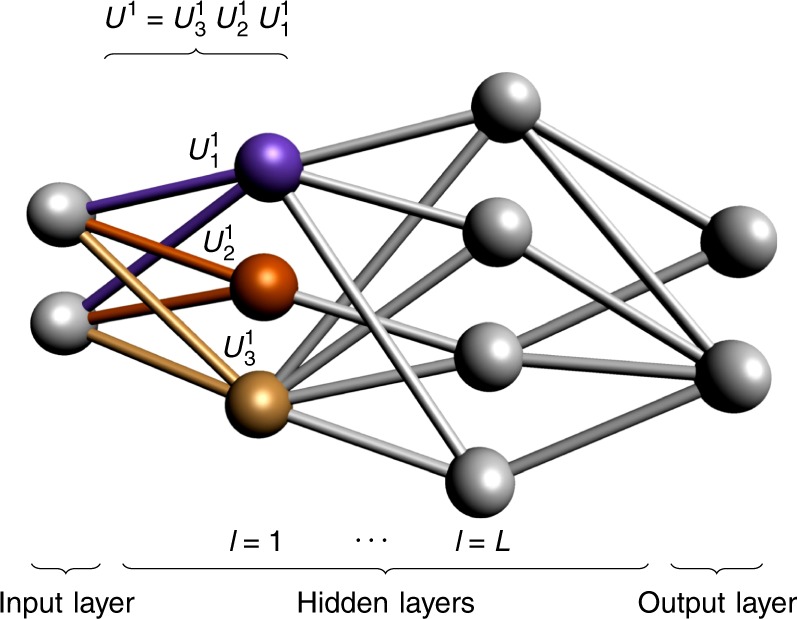
- A quantum perceptron is an arbitrary unitary with \(m\) input and \(n\) output qubits; QNNs built from them can carry out universal quantum computation even for two-input one-output qubit perceptrons, and commuting 4-level qudit perceptrons within each layer also suffice.
- Training uses the fidelity between QNN output and desired output as cost; parameter matrices are computed layer-by-layer, accessing only two layers at a time, so memory scales with width rather than depth, enabling deep-network optimization.
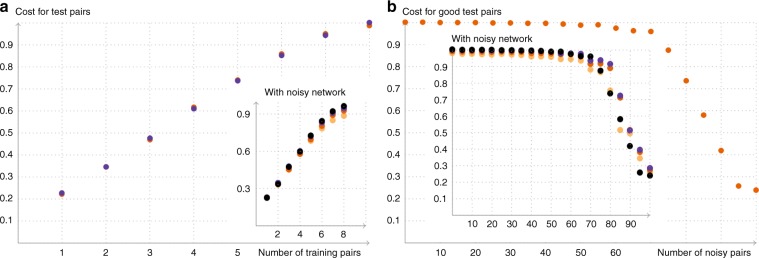
- In simulations, a 3-3-3 network trained with \(\epsilon=0.1\), \(\eta=2/3\) for 1000 rounds with \(n=1,\dots,8\) training pairs and evaluated on 10 test pairs matched a theoretical optimal cost estimate, averaged over 20 rounds.
- A 2-3-2 network trained with \(\epsilon=0.1\), \(\eta=1\) for 300 rounds with 100 training pairs remained robust when some pairs were replaced by random noisy data; insets show approximate depolarizing noise strengths \(t=0, 0.0033, 0.0066, 0.01\).
Methods
- Architecture: perceptrons are arbitrary unitaries on \(m\) input and \(n\) output qubits; a QNN is a quantum circuit of perceptrons organized into \(L\) hidden layers, with output expressed as a composition of completely positive layer-to-layer transition maps.
- Training: the cost is average fidelity between QNN output and desired output; perceptron unitaries are updated by gradient ascent, with parameter matrices computed from the previous layer’s output state and adjoint channels applied to the desired output state up to the current layer.
- Simulations: classical pilot simulations for input/output spaces of \(m=2\) and \(3\) qubits learning a random unitary \(V\), covering generalization from limited random training pairs and robustness to corrupted training data under an approximate depolarizing noise model.
Limitations
- Stated: classical simulation is impossible for more than a handful of qubits due to exponential Hilbert-space growth, so the authors were restricted to small-width QNNs; near-term large networks may require sparse connectivity because copies per training round scale linearly with the number of network parameters, and multiple network evaluations are needed to estimate the derivative.
- Stated: the introduction notes that one would still have to study how noise in the network itself influences performance; future work includes generalizing the perceptron to general CP maps, studying overfitting, and optimized NISQ implementation.
- Evident: empirical validation is limited to classical simulations of small-width QNNs (\(m=2,3\) qubits), with no experimental demonstration; no overfitting analysis is reported despite being listed as future work.
Model-written summary. Check it against the paper before relying on it.
Integrity signals
Registry
Cites
Statistics
Figures
Verification
Claims the paper makes
1 Valid · 2 Not valid · 3 Not checked · 31 Own results and interpretations
The cited sources support only part of this claim — read each source’s verdict below.
In the paper
“However, in the near term, this tradeoff is a happy one as many NISQ architectures—most notably superconducting qubit devices—can easily and rapidly repeat executions of a quantum circuit.”
§ Training deep quantum neural networks > Discussion
What the sources say
- Partly supportedcites [46] Arute F Quantum supremacy using a programmable superconducting processor Nature 2019 574 505 510 10.1038/s41586-019-1666-5 31645734 sourceExperimental — accuracy not yet measured
Our copy supports the superconducting part concretely: in 'The classical computational cost' (p. 509) it states 'it took 600 seconds to sample the circuit on the quantum processor three million times, where sampling time is limited by control hardware communications; in fact, the net quantum processor time is only about 30 seconds,' and in 'The future' it notes that 'for m = 20, obtaining a million samples on the quantum processor takes 200 seconds.' The paper also frames its result as heralding 'the era of noisy intermediate-scale quantum (NISQ) technologies' (intro, crediting Preskill 2018). What it does not support is the generalization to 'many NISQ architectures': the device-level statements are about its own 53-qubit superconducting processor only, and no other NISQ platform is shown to repeat circuit executions easily and rapidly. (LLM, conf=0.70)
plain- Asserted: passes — The authors put it forward as true.
- Checkable: passes — It can be checked against evidence.
- Load-bearing: passes — The paper’s conclusions depend on it.
- Based: passes — The paper gives a reason why it holds.
- Partly supported
In the paper
“It is also an important observation that there is no barren plateau in the cost function landscape.”
- Also stated in: § Simulation of learning tasks · boosted
“A crucial consequence of our numerical investigations was the absence of a “barren plateau” in the cost function landscape for our QNNs45.”
- Also stated in: § Discussion · boosted
“The resulting QML algorithm, when applied to our QNNs, demostrates remarkable capabilities, including, the ability to generalise, tolerance to noisy training data, and an absence of a barren plateau in the cost function landscape.”
§ Training deep quantum neural networks > Introduction
What the sources say
- Not checked yetcites McClean et al.45 McClean JR Boixo S Smelyanskiy VN Babbush R Neven H Barren plateaus in quantum neural network training landscape Nat. Commun. 2018 9 4812 10.1038/s41467-018-07090-4 30446662 PMC6240101 source
boosted- Asserted: passes — The authors put it forward as true.
- Checkable: passes — It can be checked against evidence.
- Load-bearing: passes — The paper’s conclusions depend on it.
- Based: passes — The paper gives a reason why it holds.
- Also stated in: § Simulation of learning tasks · boosted
A result the paper reports from its own data — it cites no other source for it, so there is none to check. The quote shows it is in the paper.
In the paper
“Interestingly, we have obtained numerical evidence that, for approximate depolarising noise, QNNs are robust (see inset of Fig. 2).”
§ Training deep quantum neural networks > Discussion
hedged- Asserted: passes — The authors put it forward as true.
- Checkable: passes — It can be checked against evidence.
- Load-bearing: unclear — It is unclear whether the paper’s conclusions depend on it.
- Based: passes — The paper gives a reason why it holds.
- Rests on an assumption not shown here.
A result the paper reports from its own data — it cites no other source for it, so there is none to check. The quote shows it is in the paper.
In the paper
“Here we see that the QNN matches the theoretical estimate and demonstrates the remarkable ability of our QNNs to generalise.”
§ Training deep quantum neural networks > Results > Simulation of learning tasks
boosted- Asserted: passes — The authors put it forward as true.
- Checkable: passes — It can be checked against evidence.
- Load-bearing: passes — The paper’s conclusions depend on it.
- Based: passes — The paper gives a reason why it holds.
A result the paper reports from its own data — it cites no other source for it, so there is none to check. The quote shows it is in the paper.
In the paper
“In addition, we always initialised our QNNs with random unitaries and we did not observe any exponential reduction in the value of the parameter matrices K (which arise from the derivative of our QNN with respect to the parameters).”
§ Training deep quantum neural networks > Results > Simulation of learning tasks
plain- Asserted: passes — The authors put it forward as true.
- Checkable: passes — It can be checked against evidence.
- Load-bearing: passes — The paper’s conclusions depend on it.
- Based: passes — The paper gives a reason why it holds.
17 more claims
Create a free account to see all 37 claims and to verify the 4 references still open.
- The quote only partly states this claim. 1
- It may state two separate claims as one. 9
- Probably not a substantial claim. 5
Claims other papers make about this one
Each is checked against this paper’s own text: does it say what the citing paper says it does?
The cited source doesn’t support the claim as written.
In the citing paper
“Ref. [174] proposed a VQA for learning continuous distributions which is meant to be a quantum version of GANs.”
From Variational quantum algorithms (2021) · cites this paper as [174]
Checked by a reasoning model — may be wrong.
Experimental — accuracy not yet measuredThe cited source says what the claim attributes to it.
In the citing paper
“there has been significant efforts put forward to use quantum algorithms for machine learning applications [154, 157, 174, 287].”
From Variational quantum algorithms (2021) · cites this paper as [174]
The check wasn’t confident either way, so it gives no verdict — never disputed.
In the citing paper
“We remark that the cost function in (1) contains as special cases many relevant applications.For instance, in a binary classification problem the cost function is given by the mean squarederror C(θ) = x (y x -y(θ, ρ x )) 2 [16,17,39,40].”
From Effect of barren plateaus on gradient-free optimization (2021) · cites this paper as [16]
Experimental — accuracy not yet measured
Self-check
Percentages, sums and reported differences re-computed from the paper’s own numbers.
Each contradiction between two passages listed here was confirmed by an independent check.
Rated minor: it would not touch a result — a value no result rests on, a p-value that stays on the same side of the significance level, or a conflict that is clerical, resolved elsewhere in the paper, or outside its own findings.
In the paper
§ Training deep quantum neural networks > Results > Simulation of learning tasks
“where N was smaller than the Hilbert space dimension.”
§ Training deep quantum neural networks > Results > Simulation of learning tasks
“We trained a 3-3-3 network with ϵ = 0.1, η = 2∕3 for 1000 rounds with n = 1, 2, …, 8 training pairs”
Citations
Cites
Book Review: Pattern Recognition and Machine Learning
Nasrabadi, N. M. (2007) · Journal of Electronic Imaging · doi:10.1117/1.2819119 · Cited by 22,066 · cited 1×
“(4), we obtain a formula for the parameter matrices (this is described in detail in Supplementary Note 2).”
MethodQuantum Computation and Quantum Information
Nielsen, M. A., Chuang, I., & Grover, L. K. (2002) · American Journal of Physics · doi:10.1119/1.1463744 · Cited by 21,895
Machine learning: Trends, perspectives, and prospects
Jordan, M. I., & Mitchell, T. M. (2015) · Science · doi:10.1126/science.aaa8415 · Cited by 9,955
Pattern Recognition and Machine Learning
(2006) · doi:10.1007/978-0-387-45528-0 · Cited by 9,824
Quantum Computation and Quantum Information: 10th Anniversary Edition
Nielsen, M. A., & Chuang, I. L. (2012) · doi:10.1017/cbo9780511976667 · Cited by 8,436
Quantum supremacy using a programmable superconducting processor
Arute, F., Arya, K., Babbush, R., Bacon, D., Bardin, J. C., Barends, R., Biswas, R., Boixo, S., Brandao, F. G. S. L., Buell, D. A., et al. (2019) · Nature · doi:10.1038/s41586-019-1666-5 · Cited by 7,720
Biamonte, J., Wittek, P., Pancotti, N., Rebentrost, P., Wiebe, N., & Lloyd, S. (2017) · Nature · doi:10.1038/nature23474 · Cited by 4,779
Pattern recognition and machine learning
(2007) · Choice Reviews Online · doi:10.5860/choice.44-5091 · Cited by 2,650
Barren plateaus in quantum neural network training landscapes
McClean, J. R., Boixo, S., Smelyanskiy, V. N., Babbush, R., & Neven, H. (2018) · Nature Communications · doi:10.1038/s41467-018-07090-4 · Cited by 2,329
Solving the quantum many-body problem with artificial neural networks
Carleo, G., & Troyer, M. (2017) · Science · doi:10.1126/science.aag2302 · Cited by 2,215
Research works printed but not linked: 1
- Goodfellow, I., Bengio, Y. & Courville, A. Deep Learning (MIT Press, 2016).
Cited by
Items 301–400 of 737
Quantum Neural Network Based Distinguisher on SPECK-32/64
Kim, H., Jang, K., Lim, S., Kang, Y., Kim, W., & Seo, H. (2023) · Sensors · doi:10.3390/s23125683 · Cited by 10
“However, with current quantum computers, it is difficult to use many qubits [20].”
BackgroundFingerprinting-Based Indoor Localization With Hybrid Quantum-Deep Neural Network
Numan, P. E., Jeong, M., Park, H., Choi, S. W., & Kim, S. (2023) · IEEE Access · doi:10.1109/access.2023.3341972 · Cited by 11
“Recently, there has been an interest in the introduction of quantum ML (QML) algorithms aimed at accelerating specific ML tasks and dealing with more complex structures with fewer real-time datasets [20], [21].”
BackgroundPawłowski, J., & Krawczyk, M. (2024) · Physical Review Applied · doi:10.1103/physrevapplied.22.014068 · Cited by 20
“An interesting idea in this area is to implement NNs on a quantum computer 16,17 and thus create a bridge between DL and quantum computing 18 , leading to exponential speedup in training deep NNs 17 .”
BackgroundParallel structure of hybrid quantum–classical neural networks for image classification
Xu, Z., Hu, Y., Yang, T., Cai, P., Shen, K., Lv, B., Chen, S., Wang, J., Zhu, Y., Wu, Z., et al. (2025) · Quantum Information Processing · doi:10.1007/s11128-025-04813-7 · Cited by 13
Entanglement assisted training algorithm for supervised quantum classifiers
Adhikary, S. (2021) · Quantum Information Processing · doi:10.1007/s11128-021-03179-w · Cited by 12
Quantum collisional classifier driven by information reservoirs
Korkmaz, U., & Türkpençe, D. (2023) · Physical Review A · doi:10.1103/physreva.107.012432 · Cited by 14
The Hintons in your Neural Network: a Quantum Field Theory View of Deep LearningPreprint
Bondesan, R., & Welling, M. (2021) · arXiv (Cornell University) · doi:10.48550/arxiv.2103.04913 · Cited by 18
Quantum Data Compression and Quantum Cross EntropyPreprint
Shangnan, Z. (2021) · arXiv (Cornell University) · doi:10.48550/arxiv.2106.13823 · Cited by 15
“Despite many attempts in designing quantum machine learning architectures [2, 3, 4, 5], there are many unanswered questions and unresolved issues, partly due to a lack of theoretical foundation.”
BackgroundImage Compression and Classification Using Qubits and Quantum Deep LearningPreprint
Mohsen, A., & Tiwari, M. (2021) · arXiv (Cornell University) · doi:10.48550/arxiv.2110.05476 · Cited by 25
“Other work, such as Beer et al. (2020), assumes the wavefunctions as given proposes a generalization of the perceptron to the quantum setting, which provides a more generalized framework than in E. Farhi (2018) These authors use inherently quantum data, in contrast with our work.”
BackgroundResultArtificial Intelligence and Quantum Computing Techniques for Stock Market Predictions
Iyer, R., & Bakshi, A. (2024) · doi:10.1002/9781394214334.ch5 · Cited by 10
Quantum Neural Network With Parallel Training for Wireless Resource Optimization
Narottama, B., Jamaluddin, T., & Shin, S. Y. (2023) · IEEE Transactions on Mobile Computing · doi:10.1109/tmc.2023.3321467 · Cited by 14
An RNN–policy gradient approach for quantum architecture search
Wang, G., Wang, B.-H., & Fei, S.-M. (2024) · Quantum Information Processing · doi:10.1007/s11128-024-04393-y · Cited by 13
“This kind of hybrid quantum models includes quantum neural networks [15] and quantum eigen-solvers [16] etc..”
BackgroundContinuous evolution for efficient quantum architecture search
Ma, Q., Hao, C., Yang, X., Qian, L., Zhang, H., Si, N., Xu, M., & Qu, D. (2024) · EPJ Quantum Technology · doi:10.1140/epjqt/s40507-024-00265-7 · Cited by 16
“The variational quantum algorithms [2, 3] including quantum neural networks [4, 5] and variational quantum eigensolvers (VQEs) [6–8], are a class of promising candidates to use noisy intermediate-scale quantum (NISQ) devices to solve practical tasks that are beyond the reach of classical computers…”
Agliardi, G., O’Meara, C., Yogaraj, K., Ghosh, K., Sabino, P., Fernández-Campoamor, M., Cortiana, G., Moreno, J. H., Tacchino, F., Mezzacapo, A., et al. (2025) · Quantum Science and Technology · doi:10.1088/2058-9565/ada08c · Cited by 13
“Methodsfor treating nonlinearities either exploit black-box approaches for usage in trainable circuits [20, 21], or represent specific types of nonlinear functions [22, 23].”
Architectural patterns for designing quantum artificial intelligence systems
Klymenko, M. V., Hoang, T., Xu, X., Xing, Z., Usman, M., Lu, Q., & Zhu, L. (2025) · Journal of Systems and Software · doi:10.1016/j.jss.2025.112456 · Cited by 27
Song, B., Liu, T., Meng, F., Yang, W., & Lu, W. (2025) · IEEE Transactions on Antennas and Propagation · doi:10.1109/tap.2025.3577781 · Cited by 10
“Among the diverse approaches in QML, the methods based on variational quantum algorithms (VQAs) have garnered significant attention due to their potential for implementation on near-term quantum devices [27], [28].”
Resource frugal optimizer for quantum machine learning
Moussa, C., Gordon, M. H., Bączyk, M., Cerezo, M., Cincio, Ł., & Coles, P. J. (2023) · Quantum Science and Technology · doi:10.1088/2058-9565/acef55 · Cited by 18
Avoiding barren plateaus in the variational determination of geometric entanglement
Zambrano, L., Muñoz-Moller, A. D., Muñoz, M., Pereira, L., & Delgado, A. (2024) · Quantum Science and Technology · doi:10.1088/2058-9565/ad2a16 · Cited by 14
Error-tolerant quantum convolutional neural networks for symmetry-protected topological phases
Zapletal, P., McMahon, N. A., & Hartmann, M. J. (2024) · Physical Review Research · doi:10.1103/physrevresearch.6.033111 · Cited by 17
Exploring quantum neural networks for binary classification on MNIST dataset: A swap test approach
Chen, K., Liu, J., & Yan, F. (2025) · Neural Networks · doi:10.1016/j.neunet.2025.107442 · Cited by 12
Learning Fourier series with parametrized quantum circuits
Heimann, D., Hohenfeld, H., Schönhoff, G., Mounzer, E., & Kirchner, F. (2025) · Physical Review Research · doi:10.1103/physrevresearch.7.023151 · Cited by 25
“…chitectures or ans¨atze for PQCs have been proposed and used, ranging from hardware-efficient circuits [27] and the quantum alternating operator ansatz (QAOA) [28] to dissipative quantum neural networks (dQNNs) [29], which were successfully implemented on a six-qubit superconducting processor [30].”
InfluentialQuantum subspace alignment for domain adaptation
He, X. (2020) · Physical Review A · doi:10.1103/physreva.102.062403 · Cited by 13
Quantum measurement classification with qudits
Useche, D. H., Carvajal, A. G., Zuluaga-Bucheli, H. M., Jaramillo-Villegas, J. A., & Gonzalez, F. A. (2021) · Quantum Information Processing · doi:10.1007/s11128-021-03363-y · Cited by 11
Cyber Forensic Investigation in IoT Using Deep Learning Based Feature Fusion in Big Data
Thapaliya, S., & Sharma, P. K. (2022) · International Journal of Wireless Information Networks · doi:10.1007/s10776-022-00586-3 · Cited by 9
“In mapper, the partitioned data v is adapted for performing feature fusion that includes two steps, such as features sorting and fusion of features with DQNN. (13) T r = ; 1 ≤ 𝜈 ≤ 4.3.1.1 Feature Fusion Once data partitioning is done, features are acquired through data and sorted using mutual information (MI) in accor…”
MethodInfluentialGenQu: A Hybrid System for Learning Classical Data in Quantum StatesPreprint
Stein, S. A., Tischio, R. M., Baheri, B., Chen, Y.-W., Mao, Y., Guan, Q., Li, A., & Fang, B. (2021) · arXiv (Cornell University) · Cited by 10
Strong generalization in quantum neural networks
Jiang, J., Zhao, Y., Li, R., Li, C., Guo, Z., Fan, B., Li, X., Li, R., & Zhang, X. (2023) · Quantum Information Processing · doi:10.1007/s11128-023-04095-x · Cited by 10
Expressive quantum perceptrons for quantum neuromorphic computing
Bravo, R. A., Patti, T. L., Najafi, K., Gao, X., & Yelin, S. F. (2025) · Quantum Science and Technology · doi:10.1088/2058-9565/ad9fa4 · Cited by 11
Maksimovic, M., & Maksymov, I. S. (2025) · Technologies · doi:10.3390/technologies13050183 · Cited by 16
Xu, Q., Li, R., Qi, Y., Su, Z., & Fang, D. (2025) · IEEE Journal on Selected Areas in Communications · doi:10.1109/jsac.2025.3568054 · Cited by 9
“According to [42] and [43], the unitary operation can be expressed as the composition of a sequence of completely positive layer-to-layer transition maps.”
Distributed machine learning based on quantum cloud with quantum homomorphic encryption
Lin, Z., Chang, Y., Zhang, X., Xue, W., Zhang, S., Yan, L., & Gou, Z. (2025) · Future Generation Computer Systems · doi:10.1016/j.future.2025.108053 · Cited by 10
NeuroQ: Quantum-Inspired Brain Emulation
Vallverdú, J., & Rius, G. (2025) · Biomimetics · doi:10.3390/biomimetics10080516 · Cited by 9
SLIQ: Quantum Image Similarity Networks on Noisy Quantum Computers
Silver, D., Patel, T., Ranjan, A., Gandhi, H., Cutler, W., & Tiwari, D. (2023) · Proceedings of the AAAI Conference on Artificial Intelligence · doi:10.1609/aaai.v37i8.26175 · Cited by 14
“This includes porting workloads such as generalized neural networks (Beer et al. 2020), convolutional neural networks (Hur, Kim, and Park 2022), and even applicationspecific networks such as models used to learn the metalinsulator transition of VO2 (Li and Kais 2021).”
MethodUnveiling Advanced Computational Applications in Quantum Computing: A Comprehensive Review
Markna, J. H., Palatia, T. P., Gohel, S., & Kataria, B. R. (2023) · International Journal of Advanced Nano Computing and Analytics · doi:10.61797/ijanca.v2i2.284 · Cited by 9
Hybrid deep learning enabled breast cancer detection using mammogram images
J, S. K. P., Shibu, S., Mohan, M., & Kalaichelvi, T. (2024) · Biomedical Signal Processing and Control · doi:10.1016/j.bspc.2024.106310 · Cited by 8
Hussain, S., Xu, S., Aslam, M. U., Hussain, F., & Ali, I. (2024) · New Generation Computing · doi:10.1007/s00354-024-00261-6 · Cited by 9
“…depending on the parameters of the quantum circuit by the variable x, while � 0 ⟩⟨ 0 � U ( x ) represents the projection of the transformed state U ( x ) � 0 ⟩ onto the computational basis state � 0 ⟩ followed by the conjugate transpose ⟨ 0 � [57]. of The architecture QNN, as depicted in Fig.”
Classification Analysis of Transition Metal Compounds Using Quantum Machine Learning
Vedavyasa, K. V., & Kumar, A. (2024) · Advanced Quantum Technologies · doi:10.1002/qute.202400081 · Cited by 13
Uso de computación cuántica en la mejora de algoritmos de aprendizaje automático
Galarza-Sánchez, P. C., Erazo-Luzuriaga, A. F., & Boné-Andrade, M. F. (2023) · Revista Científica Ciencia y Método · doi:10.55813/gaea/rcym/v1/n4/25 · Cited by 10
Quantum Machine Learning with HQC Architectures using non-Classically Simulable Feature Maps
Farhan, S., Rawat, R., & Moharir, M. (2021) · International Conference on Computational Intelligence and Knowledge Economy (ICCIKE) · doi:10.1109/iccike51210.2021.9410753 · Cited by 11
“Today’s generation of Quantum Computers fall under the NISQ (Noisy Intermediate-State Quantum) era, which makes them prone to errors, less reliable and not very usable[17].”
BackgroundImpact of Hybrid Neural Network Structure on Performance of Multiclass Classification
Trochun, Y., Pavlov, E., Stirenko, S., & Gordienko, Y. G. (2021) · IEEE EUROCON - International Conference on Computer as a Tool (EUROCON) · doi:10.1109/eurocon52738.2021.9535586 · Cited by 8
Asynchronism and nonequilibrium phase transitions in (1+1) -dimensional quantum cellular automata
Gillman, E., Carollo, F., & Lesanovsky, I. (2022) · Physical review. E · doi:10.1103/physreve.106.l032103 · Cited by 9
Choi, I., & Kim, W. C. (2024) · Entropy · doi:10.3390/e26010070 · Cited by 9
Nadim, M., Hassan, M. M., Mandal, A. K., Roy, C. K., Roy, B., & Schneider, K. A. (2025) · Quantum Machine Intelligence · doi:10.1007/s42484-025-00236-w · Cited by 18
“…on smaller data segments and combining the results, this method can extend beyond QSVC, potentially enhancing the applicability of QML models like quantum neural networks (Beer et al. 2020) and quantum k-nearest neighbors (Zardini et al. 2024; Li et al. 2022) in similar large-data contexts.”
Quantum architecture search for optimizing quantum generators in quantum GAN
Ma, Q., Hao, C., Si, N., & Qu, D. (2025) · Machine Learning Science and Technology · doi:10.1088/2632-2153/ae056d · Cited by 10
Quantum-enhanced LSTM for predictive maintenance in industrial IoT systems
Sudharson, K., Varsha, S., Santhiya, R., & Rajalakshmi, D. (2025) · MethodsX · doi:10.1016/j.mex.2025.103653 · Cited by 10
Retrieval of exudate‐affected retinal image patches using Siamese quantum classical neural network
Pal, M. N., Banerjee, M., & Sarkar, A. (2021) · IET Quantum Communication · doi:10.1049/qtc2.12026 · Cited by 9
Shanthi, A., & Koppu, S. (2023) · Sensors · doi:10.3390/s23115316 · Cited by 7
HQ-Sim: High-performance State Vector Simulation of Quantum Circuits on Heterogeneous HPC Systems
Zhang, B., Fang, B., Guan, Q., Li, A., & Tao, D. (2023) · doi:10.1145/3588983.3596679 · Cited by 7
“…computers are still significant to verify the correctness of the quantum algorithms in the broader quantum computing community [14], such as quantum neural networks (QNN) [4, 10], quantum approximate optimization algorithms (QAOA) [9, 12], and variational quantum eigensolvers (VQE) [15, 21].”
BackgroundQuantum-aided secure deep neural network inference on real quantum computers
Yu, H., Ren, X., Zhao, C., Yang, S., & McCann, J. A. (2023) · Scientific Reports · doi:10.1038/s41598-023-45791-z · Cited by 8
Cuéllar, M. P., Pegalajar, M. C., & Cano, C. (2024) · Quantum Information Processing · doi:10.1007/s11128-024-04391-0 · Cited by 10
Hacking Cryptographic Protocols with Advanced Variational Quantum Attacks
Aizpurua, B., Bermejo, P., Martínez, J. E., & Orús, R. (2025) · ACM Transactions on Quantum Computing · doi:10.1145/3718349 · Cited by 16
“As a significant example, a classical simulation of a small 8-qubit quantum computer allows us to find the secret key of a 32-bit Blowfish instance 24 times faster than a brute-force attack.”
Quantum Neural Network model for Token allocation for Course Bidding
Laokondee, S., & Chongstitvatana, P. (2021) · International Computer Science and Engineering Conference · doi:10.1109/icsec53205.2021.9684650 · Cited by 9
“Many research papers include [2, 3, 4, 5, 6] show the potential advantages such as speed up in training a model and in [7] has shown the power of using quantum neural networks to train machine learning model.”
BackgroundLiu, J., Zhong, C., Otten, M., Chandra, A., Cortes, C. L., Ti, C., Gray, S. K., & Han, X. (2023) · Machine Learning Science and Technology · doi:10.1088/2632-2153/acc726 · Cited by 12
Toward Physically Realizable Quantum Neural Networks
Heidari, M., Grama, A. Y., & Szpankowski, W. (2022) · Proceedings of the AAAI Conference on Artificial Intelligence · doi:10.1609/aaai.v36i6.20647 · Cited by 15
Quantum classification algorithm with multi-class parallel training
Zhang, A., He, X., & Zhao, S. (2022) · Quantum Information Processing · doi:10.1007/s11128-022-03700-9 · Cited by 16
“We adopt the fidelity [35] between the final output state of quantum circuit and the optimal output averaged over the training data as the cost function.”
MethodAdaptive Spotted Hyena Optimizer-enabled Deep QNN for Laryngeal Cancer Classification
Sachane, M. N., & Patil, S. A. (2022) · International Conference on Edge Computing and Applications (ICECAA) · doi:10.1109/icecaa55415.2022.9936500 · Cited by 7
Differentiable Quantum Programming with Unbounded Loops
Fang, W. S., Ying, M., & Wu, X. (2023) · ACM Transactions on Software Engineering and Methodology · doi:10.1145/3617178 · Cited by 14
“2014], quantum neural networks [Beer et al. 2020; Cong et al. 2019; Farhi and Neven 2018], to the quantum approximate optimization algorithm (QAOA) [Farhi et al.”
BackgroundMethodInfluentialQuantum Earth Mover's Distance: A New Approach to Learning Quantum DataPreprint
Kiani, B. T., Palma, G. D., Marvian, M., Liu, Z.-W., & Lloyd, S. (2021) · arXiv (Cornell University) · Cited by 7
Explainable Quantum Neural Networks: Example-Based and Feature-Based Methods
Tian, J., & Yang, W. (2024) · Electronics · doi:10.3390/electronics13204136 · Cited by 10
Quantum graph learning and algorithms applied in quantum computer sciences and image classification
Shayeganfar, F., Ramazani, A., Sundararaghavan, V., & Duan, Y. (2025) · Applied Physics Reviews · doi:10.1063/5.0237599 · Cited by 11
Bowen, 白. B., Liangcai, 曹. C., Hongwei, 陈. C., Jianji, 董. D., Shiyin, 杜. D., Fang, L., Feng, F., Tingzhao, 符. F., Yunhui, 高. G., Xingxing, 郭. G., et al. (2025) · Laser & Optoelectronics Progress · doi:10.3788/lop251552 · Cited by 6
A hybrid quantum-classical approach for liver disease detection using quantum machine learning
Donaire, L. M., Ortega, G., Orts, F. J., Garzón, E. M., & Filatovas, E. (2025) · Engineering Applications of Artificial Intelligence · doi:10.1016/j.engappai.2025.113240 · Cited by 9
Asghar, S. A., Naz, S., & Raja, M. A. Z. (2023) · International Journal of Modern Physics B · doi:10.1142/s021797922350217x · Cited by 5
An efficient combination strategy for hybrid quantum ensemble classifier
Zhang, X.-Y., & Wang, M. (2023) · International Journal of Quantum Information · doi:10.1142/s0219749923500272 · Cited by 10
Boneberg, M., Carollo, F., & Lesanovsky, I. (2023) · New Journal of Physics · doi:10.1088/1367-2630/aceff4 · Cited by 9
A progressive predictor-based quantum architecture search with active learning
Deng, M., He, Z., Zheng, S., Zhou, Y., Zhang, F., & Situ, H. (2023) · The European Physical Journal Plus · doi:10.1140/epjp/s13360-023-04537-6 · Cited by 8
Maximizing quantum-computing expressive power through randomized circuits
Yang, Y., Zhang, Z., Wang, A., Xu, X., Wang, X., & Li, Y. (2024) · Physical Review Research · doi:10.1103/physrevresearch.6.023098 · Cited by 11
Quantum Machine Learning for Power System Stability Assessment.
Zhou, Y., & Zhang, P. (2021) · Cited by 6
Alsubai, S., Alqahtani, A., Binbusayyis, A., Sha, M., Gumaei, A., & Wang, S. (2023) · Mathematics · doi:10.3390/math11112513 · Cited by 7
“Therefore, deep learning approaches have attained more interest, performing better in near-term quantum computers [3,4].”
BackgroundQuantum Hopfield Neural Networks: A New Approach and Its Storage Capacity
Meinhardt, N., Neumann, N. M. P., & Phillipson, F. (2020) · Lecture notes in computer science · doi:10.1007/978-3-030-50433-5_44 · Cited by 12
Quantum case-based reasoning (qCBR)
Atchade-Adelomou, P., Casado-Faulí, D., Golobardes-Ribé, E., & Vilasis-Cardona, X. (2022) · Artificial Intelligence Review · doi:10.1007/s10462-022-10238-w · Cited by 16
“Other promising developments are the Quantum Neural Network (QNN) [23–25], the Quantum Support Vector Machine (QSVM)[26–28] and the data loading system [29, 30].”
Quantum Machine Learning Algorithms
Wong, R., Garg, T., Thombre, R., Maldonado-Romo, A., Niranjan, P., Sen, P., Saggi, M. K., & Bhatia, A. S. (2022) · Wiley eBooks · doi:10.1002/9781119813439.ch5 · Cited by 6
From Quantum Computing to Quantum-inspired Computation for Neuromorphic Advancement -- A SurveyPreprint
Jha, R. K. (2023) · doi:10.36227/techrxiv.24053250.v1 · Cited by 5
Hybrid Quantum Algorithms and Quantum Software Development FrameworksPreprint
Ramouthar, R., & Şeker, H. (2023) · doi:10.14293/pr2199.000298.v1 · Cited by 7
An energy-aware traffic offloading approach based on deep learning and optimization in massive MIMO
Farakte, A. B., Sridhar, K. P., & Rasale, M. B. (2024) · Telecommunication Systems · doi:10.1007/s11235-024-01177-8 · Cited by 5
“It is a quantum circuit of quantum perceptron arranged into Hn , which act as a primary state λ in of input qubits, and generate an, generally, mixed state λ out for output qubits following [29]: wherein v V out V Hn V Hn − 1 ....”
InfluentialExploring Chemical Space with Chemistry-Inspired Dynamic Quantum Circuits in the NISQ Era
Chen, L.-Y., Li, T.-Y., Li, Y., Chen, N.-Y., & You, F. (2025) · Journal of Chemical Theory and Computation · doi:10.1021/acs.jctc.5c00305 · Cited by 7
Cho, H., Kim, J.-H., No, K. T., & Lim, H. (2025) · EPJ Quantum Technology · doi:10.1140/epjqt/s40507-025-00385-8 · Cited by 8
“As a subset of QML, quantum neural networks (QNNs) resemble architectures of neural networks with the capability of carrying out universal quantum computation [18].”
Practicality of training a quantum-classical machine in the noisy intermediate-scale quantum era
Dutta, T., Jin, A., Huihong, C. L., Latorre, J. I., & Mukherjee, M. (2025) · iScience · doi:10.1016/j.isci.2025.113058 · Cited by 15
“18 Empirical comparisons between QNN and classical neural networks (CNNs) are essential due to the absence of analytical models for heuristic-based algorithms.”
Zhang, M., Cheng, Y., & Lei, Z. (2026) · Engineering Applications of Artificial Intelligence · doi:10.1016/j.engappai.2025.113605 · Cited by 6
“The development of quantum neural networks (QNNs) (Beer et al., 2020) and quantum convolutional neural networks (QCNNs) (Wei et al., 2022) represents a deep convergence of classical deep learning and quantum computing.”
Detection of brain cancer using quantum-classical CNN based method
Bada, S., Warrier, S. R., & Dontabhaktuni, J. (2023) · Quantum Computing, Communication, and Simulation · doi:10.1117/12.2650132 · Cited by 5
Vignesh, R. S., & Subashini, M. M. (2024) · Kybernetes · doi:10.1108/k-07-2023-1210 · Cited by 7
Analysis of Quantum-Classical Hybrid Deep Learning for 6G Image Processing with Copyright Detection
Seol, J., Kim, H.-Y., Kancharla, A., & Kim, J. (2024) · Information · doi:10.3390/info15110727 · Cited by 9
Quantum resonant dimensionality reduction
Yang, F., Wang, F., Xu, X., Gao, P., Xin, T., Wei, S., & Long, G. (2025) · Physical Review Research · doi:10.1103/physrevresearch.7.013007 · Cited by 9
“…of quantum computing, numerous quantum machine learning (QML) algorithms have been proposed [6], such as quantum recommendation systems (QRS) [7], quantum support vector machines (QSVM) [8], quantum principal component analysis (QPCA) [9], and quantum neural networks [10, 11], among others.”
BackgroundQuantum Differential Machine Learning
Sakuma, T. (2025) · Quantum Economics and Finance · doi:10.1177/29767032251334589 · Cited by 6
“As a trial of using quantum computers in the fi eld of quantitative fi nance, Sakuma (2024) used a simulator of a deep quantum neural network (DQNN) provided by Beer et al. (2020) to learn implied volatilities and Black-Scholes European option prices.”
Design of an efficient fault-tolerant quantum-computing circuit with quantum neural network learning
Lin, C., Xu, R., & Li, Y. (2025) · Engineering Applications of Artificial Intelligence · doi:10.1016/j.engappai.2025.110808 · Cited by 9
Gugulothu, P., & Bhukya, R. (2023) · Computer Methods in Biomechanics & Biomedical Engineering · doi:10.1080/10255842.2023.2244109 · Cited by 7
“:3) h : In DQNN (Beer et al. 2020), the quantum perceptron and quantum model of the perceptron represent a small building block of QNN and are employed in classical ML techniques.”
Quantum neural networks for the discovery and implementation of quantum error-correcting codes
Chalkiadakis, A., Theocharakis, M., Barmparis, G. D., & Tsironis, G. P. (2023) · Chaos An Interdisciplinary Journal of Nonlinear Science · doi:10.1063/5.0157940 · Cited by 7
Paquet, E., Soleymani, F., St-Pierre-Lemieux, G., Viktor, H. L., & Michalowski, W. (2023) · Artificial Intelligence Chemistry · doi:10.1016/j.aichem.2023.100030 · Cited by 6
QuantumSEA: In-Time Sparse Exploration for Noise Adaptive Quantum Circuits
Chen, T., Zhang, Z., Wang, H., Gu, J., Li, Z., Pan, D. Z., Chong, F. T., Han, S., & Wang, Z. (2023) · IEEE International Conference on Quantum Computing and Engineering (QCE) · doi:10.1109/qce57702.2023.00015 · Cited by 9
“Among these, parameterized Quantum Circuits (PQCs) [1] on the noisy intermediate-scale quantum (NISQ) devices [3] is one of the most promising near-term applications showing impressive benefits from QC.”
BackgroundOptimal depth and a novel approach to variational unitary quantum process tomography
Galetsky, V., Farré, P. J., Ghosh, S., Deppe, C., & Ferrara, R. (2024) · New Journal of Physics · doi:10.1088/1367-2630/ad5df1 · Cited by 6
Pomarico, D., Monaco, A., Amoroso, N., Bellantuono, L., Lacalamita, A., Rocca, M. L., Maggipinto, T., Pantaleo, E., Tangaro, S., Stramaglia, S., et al. (2025) · Discover Applied Sciences · doi:10.1007/s42452-025-06638-6 · Cited by 9
An improved quantum algorithm for support matrix machines
Zhang, Y., Song, T., & Wu, Z. (2021) · Quantum Information Processing · doi:10.1007/s11128-021-03160-7 · Cited by 5
Denoising quantum states with Quantum Autoencoders -- Theory and ApplicationsPreprint
Achache, T., Lior Horesh, C., & Smolin, J. A. (2020) · arXiv (Cornell University) · doi:10.48550/arxiv.2012.14714 · Cited by 5
Quantum Computing Aided Machine Learning Through Quantum State FidelityPreprint
Stein, S. A. (2021) · Preprints.org · doi:10.20944/preprints202103.0583.v1 · Cited by 5
“Based on a general unitary operator that acts on the corresponding input and output qubits, authors in [6] propose a training algorithm for this quantum neural network architecture that is efficient in the sense that it only depends on the width of the individual layers and not on the depth of the network.”
BackgroundMethodA Leap among Entanglement and Neural Networks: A Quantum Survey.Preprint
Massoli, F. V., Vadicamo, L., Amato, G. M., & Falchi, F. (2021) · arXiv (Cornell University) · Cited by 5
Hussain, S., Xu, S., Aslam, M., Waqas, M., & Hussain, S. (2024) · Research Square · doi:10.21203/rs.3.rs-4743771/v1 · Cited by 8
Emerging Paradigm of Quantum Machine Learning: Knowledge Insights and Future Prospects
Rawat, K. S., & Sharma, T. K. (2026) · IEEE Transactions on Artificial Intelligence · doi:10.1109/tai.2026.3669545 · Cited by 7
“These models enable classical-quantum execution, allowing for faster optimization, lower memory use, and scalable network widths [86].”
Quantum Memory and Scrambling From the Perspective of a Classical Neural Network
Maroulakos, D., Wal, A., Kowalik, M., Jasiukiewicz, C., Shukla, R. K., Mishra, S. K., & Chotorlishvili, L. (2026) · Annalen der Physik · doi:10.1002/andp.202500560 · Cited by 4
Ye, X., Chen, Z., Zhu, T., Wei, W., & Peng, H. (2024) · Electronics · doi:10.3390/electronics13040732 · Cited by 4
Navaneethakrishnan, M., Joel, M. R., Palani, S. K., & Gnanaprakasam, G. J. (2024) · Network Computation in Neural Systems · doi:10.1080/0954898x.2024.2361093 · Cited by 4
“DQNN (Beer et al. 2020) structure permits for quantum analogues of traditional back-propagation approach by utilizing entirely positive layer transition map.”
Ivashkov, P., Huang, P., Koor, K., Pira, L., & Rebentrost, P. (2026) · npj Quantum Information · doi:10.1038/s41534-026-01202-5 · Cited by 33
“Published in partnership with The University of New South Wales https://doi.org/10.1038/s41534-026-01202-5 QKAN: quantum Kolmogorov-Arnold networks with applications in machine learning and multivariate state preparation”
Influential
Metadata
- Authors
- Beer, K., Bondarenko, D., Farrelly, T., Osborne, T. J., Salzmann, R., Scheiermann, D., & Wolf, R.
- Affiliations
- Leibniz University Hannover (DE)
- Corresponding author
- Beer, Kerstin
- ORCID
- Venue
- Nature Communications
- Published
- 2020-02-10
- Volume
- 11
- Issue
- 1
- Pages
- 808-808
- ISSN
- 2041-1723 (ISSN-L)
- PMC
- PMC7010779
- OpenAlex
- W3004965358
- Semantic Scholar
- 9c8e8416bf64e592444e25e484f3f729480fd146
- Cited by
- 726
- References
- 52
- Citations by year
- 2026: 96 · 2025: 138 · 2024: 134 · 2023: 118 · 2022: 95 · 2021: 113 · 2020: 28
- FWCI
- 34.79
- Type
- journal article
- Language
- en
- Open access
- gold
- doi.org
- Licence
- cc-by
- creativecommons.org/licenses/by/4.0 (tdm)
- creativecommons.org/licenses/by/4.0 (vor)
- Locations
- Nature Communications (publishedVersion, cc-by)
- PubMed Central (publishedVersion, cc-by)
- PubMed (publishedVersion)
- arXiv (Cornell University) (submittedVersion)
- Institutional Repository of Leibniz Universität Hannover (Leibniz Universität Hannover) (submittedVersion, cc-by-nc-nd)
- LA Referencia (Red Federada de Repositorios Institucionales de Publicaciones Científicas) (submittedVersion, cc-by)
- RePEc: Research Papers in Economics (submittedVersion)
- DOAJ (DOAJ: Directory of Open Access Journals) (submittedVersion, cc-by-sa)
- Institutional Repository of Leibniz Universität Hannover (Leibniz Universität Hannover) (submittedVersion, cc-by)
- Apollo (University of Cambridge) (submittedVersion, cc-by)
- arXiv (Cornell University)
- Leibniz Universität Hannover (cc-by)
- Apollo (cc-by)
- Funders
- Deutsche Forschungsgemeinschaft (SFB 1227, RTG 1991, EXC 2123)
- Topics
- Physical Sciences › Computer Science › Artificial Intelligence › Quantum Computing Algorithms and Architecture
- Physical Sciences › Physics and Astronomy › Atomic and Molecular Physics, and Optics › Quantum Information and Cryptography
- Physical Sciences › Physics and Astronomy › Atomic and Molecular Physics, and Optics › Quantum many-body systems
- Keywords
- quantum neural networks, quantum neurons, quantum machine learning, qudits, deep neural network training, noisy data robustness, generalization
About these checks
Registry, retraction, Cites and statistics results are computed, not judged, with one exception: a printed reference that no index lists is read once by a model before it counts as a citation error. Claims are extracted by a model and kept only when their quote appears verbatim in the text; each cited source is then checked, with a model’s help, for whether it says what the claim relies on. Those verdicts can be wrong — read the claim’s quote and the cited source before relying on one.
The claim verdicts this report counts are experimental: their accuracy is not yet measured.
A language model drew the claims from the paper on 2026-10-08, under version 3 of the claim definition (model deepseek-v4.1-flash, prompt extract-v3).
A second model labelled each claim on 2026-10-08 (model jev-1.13-20260917, definition revision gold-guideline-v0.2).
Cited sources are checked with a language model’s help (qwen3.8-omni-flash).
Statistics and arithmetic are recomputed, not judged.
Confidence bands are shown only for fields calibrated on our annotated test set. None is calibrated yet, so no band is shown.
What counts as a claim ›How we measure confidence ›How we check this ›
Are you an author, or do you see a problem with this page? Request a review
Data sources
Bibliographic data: Semantic Scholar, OpenAlex, Crossref.
Contains information from the Semantic Scholar Academic Graph Datasets, made available under the ODC Attribution License (ODC-BY 1.0).
Semantic Scholar’s data is described in: Kinney, R., et al. (2023). The Semantic Scholar Open Data Platform. arXiv:2301.10140.
