

Training deep quantum neural networks
Open accessThe DOI matches its Crossref record; 56 of the 57 references it cites were found in a registry or an index; 1 of the 5 sources its claims cite were checked for support.
Abstract
Neural networks enjoy widespread success in both research and industry and, with the advent of quantum technology, it is a crucial challenge to design quantum neural networks for fully quantum learning tasks. Here we propose a truly quantum analogue of classical neurons, which form quantum feedforward neural networks capable of universal quantum computation. We describe the efficient training of these networks using the fidelity as a cost function, providing both classical and efficient quantum implementations. Our method allows for fast optimisation with reduced memory requirements: the number of qudits required scales with only the width, allowing deep-network optimisation. We benchmark our proposal for the quantum task of learning an unknown unitary and find remarkable generalisation behaviour and a striking robustness to noisy training data.
Overview
CoChat Summary
TL;DR
The paper proposes a quantum perceptron defined as an arbitrary unitary on input and output qubits, forming feedforward quantum neural networks capable of universal quantum computation. It gives a fidelity-based training algorithm whose memory scales with network width, and numerical simulations for learning an unknown unitary show generalization and robustness to noisy training data.
Key findings
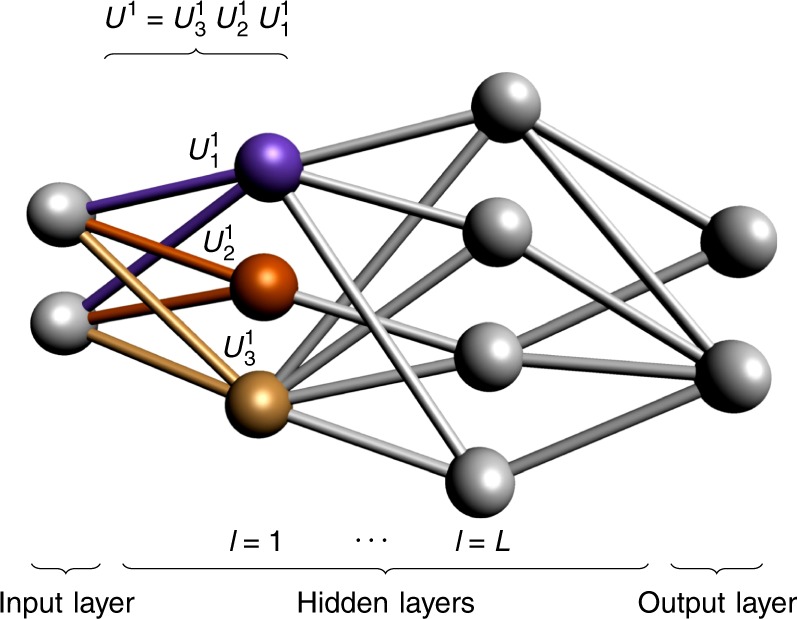
- A quantum perceptron is an arbitrary unitary with \(m\) input and \(n\) output qubits; QNNs built from them can carry out universal quantum computation even for two-input one-output qubit perceptrons, and commuting 4-level qudit perceptrons within each layer also suffice.
- Training uses the fidelity between QNN output and desired output as cost; parameter matrices are computed layer-by-layer, accessing only two layers at a time, so memory scales with width rather than depth, enabling deep-network optimization.
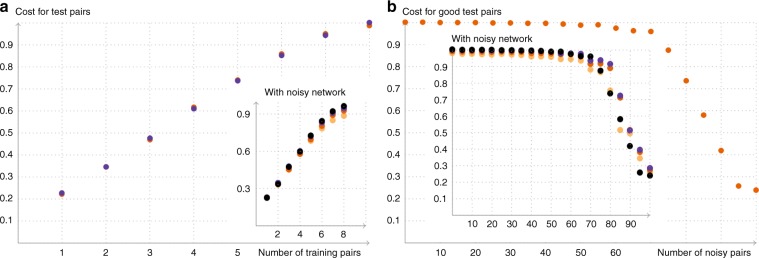
- In simulations, a 3-3-3 network trained with \(\epsilon=0.1\), \(\eta=2/3\) for 1000 rounds with \(n=1,\dots,8\) training pairs and evaluated on 10 test pairs matched a theoretical optimal cost estimate, averaged over 20 rounds.
- A 2-3-2 network trained with \(\epsilon=0.1\), \(\eta=1\) for 300 rounds with 100 training pairs remained robust when some pairs were replaced by random noisy data; insets show approximate depolarizing noise strengths \(t=0, 0.0033, 0.0066, 0.01\).
Methods
- Architecture: perceptrons are arbitrary unitaries on \(m\) input and \(n\) output qubits; a QNN is a quantum circuit of perceptrons organized into \(L\) hidden layers, with output expressed as a composition of completely positive layer-to-layer transition maps.
- Training: the cost is average fidelity between QNN output and desired output; perceptron unitaries are updated by gradient ascent, with parameter matrices computed from the previous layer’s output state and adjoint channels applied to the desired output state up to the current layer.
- Simulations: classical pilot simulations for input/output spaces of \(m=2\) and \(3\) qubits learning a random unitary \(V\), covering generalization from limited random training pairs and robustness to corrupted training data under an approximate depolarizing noise model.
Limitations
- Stated: classical simulation is impossible for more than a handful of qubits due to exponential Hilbert-space growth, so the authors were restricted to small-width QNNs; near-term large networks may require sparse connectivity because copies per training round scale linearly with the number of network parameters, and multiple network evaluations are needed to estimate the derivative.
- Stated: the introduction notes that one would still have to study how noise in the network itself influences performance; future work includes generalizing the perceptron to general CP maps, studying overfitting, and optimized NISQ implementation.
- Evident: empirical validation is limited to classical simulations of small-width QNNs (\(m=2,3\) qubits), with no experimental demonstration; no overfitting analysis is reported despite being listed as future work.
Model-written summary. Check it against the paper before relying on it.
Integrity signals
Registry
Cites
Statistics
Figures
Verification
Claims the paper makes
1 Valid · 2 Not valid · 3 Not checked · 31 Own results and interpretations
The cited sources support only part of this claim — read each source’s verdict below.
In the paper
“However, in the near term, this tradeoff is a happy one as many NISQ architectures—most notably superconducting qubit devices—can easily and rapidly repeat executions of a quantum circuit.”
§ Training deep quantum neural networks > Discussion
What the sources say
- Partly supportedcites [46] Arute F Quantum supremacy using a programmable superconducting processor Nature 2019 574 505 510 10.1038/s41586-019-1666-5 31645734 sourceExperimental — accuracy not yet measured
Our copy supports the superconducting part concretely: in 'The classical computational cost' (p. 509) it states 'it took 600 seconds to sample the circuit on the quantum processor three million times, where sampling time is limited by control hardware communications; in fact, the net quantum processor time is only about 30 seconds,' and in 'The future' it notes that 'for m = 20, obtaining a million samples on the quantum processor takes 200 seconds.' The paper also frames its result as heralding 'the era of noisy intermediate-scale quantum (NISQ) technologies' (intro, crediting Preskill 2018). What it does not support is the generalization to 'many NISQ architectures': the device-level statements are about its own 53-qubit superconducting processor only, and no other NISQ platform is shown to repeat circuit executions easily and rapidly. (LLM, conf=0.70)
plain- Asserted: passes — The authors put it forward as true.
- Checkable: passes — It can be checked against evidence.
- Load-bearing: passes — The paper’s conclusions depend on it.
- Based: passes — The paper gives a reason why it holds.
- Partly supported
In the paper
“It is also an important observation that there is no barren plateau in the cost function landscape.”
- Also stated in: § Simulation of learning tasks · boosted
“A crucial consequence of our numerical investigations was the absence of a “barren plateau” in the cost function landscape for our QNNs45.”
- Also stated in: § Discussion · boosted
“The resulting QML algorithm, when applied to our QNNs, demostrates remarkable capabilities, including, the ability to generalise, tolerance to noisy training data, and an absence of a barren plateau in the cost function landscape.”
§ Training deep quantum neural networks > Introduction
What the sources say
- Not checked yetcites McClean et al.45 McClean JR Boixo S Smelyanskiy VN Babbush R Neven H Barren plateaus in quantum neural network training landscape Nat. Commun. 2018 9 4812 10.1038/s41467-018-07090-4 30446662 PMC6240101 source
boosted- Asserted: passes — The authors put it forward as true.
- Checkable: passes — It can be checked against evidence.
- Load-bearing: passes — The paper’s conclusions depend on it.
- Based: passes — The paper gives a reason why it holds.
- Also stated in: § Simulation of learning tasks · boosted
A result the paper reports from its own data — it cites no other source for it, so there is none to check. The quote shows it is in the paper.
In the paper
“Interestingly, we have obtained numerical evidence that, for approximate depolarising noise, QNNs are robust (see inset of Fig. 2).”
§ Training deep quantum neural networks > Discussion
hedged- Asserted: passes — The authors put it forward as true.
- Checkable: passes — It can be checked against evidence.
- Load-bearing: unclear — It is unclear whether the paper’s conclusions depend on it.
- Based: passes — The paper gives a reason why it holds.
- Rests on an assumption not shown here.
A result the paper reports from its own data — it cites no other source for it, so there is none to check. The quote shows it is in the paper.
In the paper
“Here we see that the QNN matches the theoretical estimate and demonstrates the remarkable ability of our QNNs to generalise.”
§ Training deep quantum neural networks > Results > Simulation of learning tasks
boosted- Asserted: passes — The authors put it forward as true.
- Checkable: passes — It can be checked against evidence.
- Load-bearing: passes — The paper’s conclusions depend on it.
- Based: passes — The paper gives a reason why it holds.
A result the paper reports from its own data — it cites no other source for it, so there is none to check. The quote shows it is in the paper.
In the paper
“In addition, we always initialised our QNNs with random unitaries and we did not observe any exponential reduction in the value of the parameter matrices K (which arise from the derivative of our QNN with respect to the parameters).”
§ Training deep quantum neural networks > Results > Simulation of learning tasks
plain- Asserted: passes — The authors put it forward as true.
- Checkable: passes — It can be checked against evidence.
- Load-bearing: passes — The paper’s conclusions depend on it.
- Based: passes — The paper gives a reason why it holds.
17 more claims
Create a free account to see all 37 claims and to verify the 4 references still open.
- The quote only partly states this claim. 1
- It may state two separate claims as one. 9
- Probably not a substantial claim. 5
Claims other papers make about this one
Each is checked against this paper’s own text: does it say what the citing paper says it does?
The cited source doesn’t support the claim as written.
In the citing paper
“Ref. [174] proposed a VQA for learning continuous distributions which is meant to be a quantum version of GANs.”
From Variational quantum algorithms (2021) · cites this paper as [174]
Checked by a reasoning model — may be wrong.
Experimental — accuracy not yet measuredThe cited source says what the claim attributes to it.
In the citing paper
“there has been significant efforts put forward to use quantum algorithms for machine learning applications [154, 157, 174, 287].”
From Variational quantum algorithms (2021) · cites this paper as [174]
The check wasn’t confident either way, so it gives no verdict — never disputed.
In the citing paper
“We remark that the cost function in (1) contains as special cases many relevant applications.For instance, in a binary classification problem the cost function is given by the mean squarederror C(θ) = x (y x -y(θ, ρ x )) 2 [16,17,39,40].”
From Effect of barren plateaus on gradient-free optimization (2021) · cites this paper as [16]
Experimental — accuracy not yet measured
Self-check
Percentages, sums and reported differences re-computed from the paper’s own numbers.
Each contradiction between two passages listed here was confirmed by an independent check.
Rated minor: it would not touch a result — a value no result rests on, a p-value that stays on the same side of the significance level, or a conflict that is clerical, resolved elsewhere in the paper, or outside its own findings.
In the paper
§ Training deep quantum neural networks > Results > Simulation of learning tasks
“where N was smaller than the Hilbert space dimension.”
§ Training deep quantum neural networks > Results > Simulation of learning tasks
“We trained a 3-3-3 network with ϵ = 0.1, η = 2∕3 for 1000 rounds with n = 1, 2, …, 8 training pairs”
Citations
Cites
Book Review: Pattern Recognition and Machine Learning
Nasrabadi, N. M. (2007) · Journal of Electronic Imaging · doi:10.1117/1.2819119 · Cited by 22,066 · cited 1×
“(4), we obtain a formula for the parameter matrices (this is described in detail in Supplementary Note 2).”
MethodQuantum Computation and Quantum Information
Nielsen, M. A., Chuang, I., & Grover, L. K. (2002) · American Journal of Physics · doi:10.1119/1.1463744 · Cited by 21,895
Machine learning: Trends, perspectives, and prospects
Jordan, M. I., & Mitchell, T. M. (2015) · Science · doi:10.1126/science.aaa8415 · Cited by 9,955
Pattern Recognition and Machine Learning
(2006) · doi:10.1007/978-0-387-45528-0 · Cited by 9,824
Quantum Computation and Quantum Information: 10th Anniversary Edition
Nielsen, M. A., & Chuang, I. L. (2012) · doi:10.1017/cbo9780511976667 · Cited by 8,436
Quantum supremacy using a programmable superconducting processor
Arute, F., Arya, K., Babbush, R., Bacon, D., Bardin, J. C., Barends, R., Biswas, R., Boixo, S., Brandao, F. G. S. L., Buell, D. A., et al. (2019) · Nature · doi:10.1038/s41586-019-1666-5 · Cited by 7,720
Biamonte, J., Wittek, P., Pancotti, N., Rebentrost, P., Wiebe, N., & Lloyd, S. (2017) · Nature · doi:10.1038/nature23474 · Cited by 4,779
Pattern recognition and machine learning
(2007) · Choice Reviews Online · doi:10.5860/choice.44-5091 · Cited by 2,650
Barren plateaus in quantum neural network training landscapes
McClean, J. R., Boixo, S., Smelyanskiy, V. N., Babbush, R., & Neven, H. (2018) · Nature Communications · doi:10.1038/s41467-018-07090-4 · Cited by 2,329
Solving the quantum many-body problem with artificial neural networks
Carleo, G., & Troyer, M. (2017) · Science · doi:10.1126/science.aag2302 · Cited by 2,215
Research works printed but not linked: 1
- Goodfellow, I., Bengio, Y. & Courville, A. Deep Learning (MIT Press, 2016).
Cited by
Items 501–600 of 737
Benchmarking quantum tomography completeness and fidelity with machine learning
Teo, Y. S., Shin, S., Jeong, H., Kim, Y., Kim, Y.-H., Struchalin, G. I., Kovlakov, E. V., Straupe, S. S., Kulik, S. P., Leuchs, G., et al. (2021) · New Journal of Physics · doi:10.1088/1367-2630/ac1fcb · Cited by 28
A Case for Noisy Shallow Gate-based Circuits in Quantum Machine Learning
Selig, P., Murphy, N., Ashwin Sundareswaran, R., Redmond, D., & Caton, S. J. (2021) · IEEE International Conference on Rebooting Computing (ICRC) · doi:10.1109/icrc53822.2021.00015 · Cited by 5
Quantum approximation of normalized Schatten norms and applications to learning
Chen, Y., Miyahara, H., Bouchard, L., & Roychowdhury, V. (2022) · Physical Review A · doi:10.1103/physreva.106.052409 · Cited by 4
Prasad, R. S., Prasad, J. R., Chaudhari, B. S., Ranjan, N. M., & Srivastava, R. (2023) · International Journal of Image and Graphics · doi:10.1142/s0219467824500414 · Cited by 2
Jackulin, C., Murugavalli, S., & Valarmathi, K. (2023) · Concurrency and Computation Practice and Experience · doi:10.1002/cpe.7946 · Cited by 3
Quantum restricted Boltzmann machine is universal for quantum computationPreprint
Wu, Y., Wei, C., Qin, S.-J., Wen, Q., & Gao, F. (2020) · Research Square · doi:10.21203/rs.3.rs-69480/v1 · Cited by 5
“[22] indicated that the Deep QRBM can implement the universal quantum computation tasks.”
MethodQuantum Deformed Neural Networks
Bondesan, R., & Welling, M. (2020) · arXiv · doi:10.48550/arxiv.2010.11189 · Cited by 2
“Their performance could be studied only on small input tasks such as classifying 4 × 4 images, due to the exponential time of classical simulations of those circuits. on Other works variational quantum circuits for neural networks are Verdon et al. (2018); Beer et al. (2019).”
BackgroundAccelerating variational quantum algorithms with multiple quantum processorsPreprint
Du, Y., Qian, Y., & Tao, D. (2021) · arXiv (Cornell University) · doi:10.48550/arxiv.2106.12819 · Cited by 14
“For concreteness, let us recall the machinery of quantum neural networks (QNNs), as a crucial subclass of VQAs, when dealing with classification tasks [27–29 , 50– 52].”
Observation of a symmetry-protected topological time crystal with superconducting qubitsPreprint
Zhang, X., Jiang, W., Deng, J., Wang, K., Chen, J., Zhang, P., Ren, W., Dong, H., Xu, S., Gao, Y. Q., et al. (2021) · arXiv (Cornell University) · doi:10.48550/arxiv.2109.05577 · Cited by 6
Optimization of Quantum Algorithm Protocols without Barren PlateausPreprint
Broers, L., & Mathey, L. (2021) · arXiv (Cornell University) · Cited by 2
A Quantum LSTM Based Approach to Cyber Threat Detection in Virtual EnvironmentPreprint
Tripathi, S. M., Upadhyay, H., & Soni, J. (2024) · Research Square · doi:10.21203/rs.3.rs-4118482/v1 · Cited by 2
On the capacity of a quantum perceptron for storing biased patterns
Benatti, F., Gramegna, G., Mancini, S., & Nwemadji, G. (2023) · Journal of Physics A Mathematical and Theoretical · doi:10.1088/1751-8121/ad125b · Cited by 1
Şahin, S., & Harman, G. (2024) · Karaelmas Science and Engineering Journal · doi:10.7212/karaelmasfen.1416331 · Cited by 1
Gate-based quantum neurons in hybrid neural networks
Lu, C., Hu, M., Miao, F., & Hou, J. (2024) · New Journal of Physics · doi:10.1088/1367-2630/ad6f3d · Cited by 1
Ultrafast artificial intelligence: machine learning with atomic-scale quantum systems
Pfeifer, T., Wollenhaupt, M., & Lein, M. (2024) · New Journal of Physics · doi:10.1088/1367-2630/ad7492 · Cited by 2
“Our approach is to be distinguished from recent developments referred to as quantum machine learning [23, 24], where the ultimate goal is to train quantum computing devices to perform quantum tasks, and also from the earlier proposals to mimic specific quantum gates in laser-driven molecules…”
BackgroundQuantum sparse coding and decoding based on quantum network
Ji, X., Liu, Q., Huang, S., Chen, A., & Wu, S. (2024) · Applied Physics Letters · doi:10.1063/5.0226021 · Cited by 4
Sarsengeldin, M. M., Ahmad, Z., & Bağcı, U. (2024) · IEEE Holm Conference on Electrical Contacts (HOLM) · doi:10.1109/holm56222.2024.10768556 · Cited by 1
Towards a quantum synapse for quantum sensing
Pau, L.-F. (2025) · Scientific Reports · doi:10.1038/s41598-025-93113-2 · Cited by 1
Dabass, V., & Sangwan, S. (2025) · International Journal of Adaptive Control and Signal Processing · doi:10.1002/acs.4015 · Cited by 2
Advances in Random and Quantum Walks: Bridging Classical and Quantum Computational Paradigms
Soni, A., Rasool, A., & Singh, D. P. (2025) · Procedia Computer Science · doi:10.1016/j.procs.2025.04.528 · Cited by 1
A Quantum-Driven Efficient Learning Model for Enhancing Robustness of IoT Topology
Zhang, S., Qiu, T., Zhou, X., & Ji, Y. (2025) · IEEE Transactions on Mobile Computing · doi:10.1109/tmc.2025.3586749 · Cited by 4
QcNet: A Hybrid Quantum-Classical Neural Network for Multi-Class Image Classification
Gunasekar, S. P., & Subarna, C. (2025) · International Conference on Inventive Research in Computing Applications (ICIRCA) · doi:10.1109/icirca65293.2025.11089744 · Cited by 2
“Rooted in the laws of Quantum Mechanics, advancements in Quantum hardware appear promising in preventing this slowdown and propelling AI to new heights of advancement [2].”
Integrating Neural Networks with Quantum Chips: Converging Two Cutting-Edge Frontiers
Fatima, S., Hilal, S. A., & Hanafiah, M. M. (2025) · Springer eBooks · doi:10.1007/978-3-031-87931-9_17 · Cited by 1
Tripathi, S. M., Upadhyay, H., & Soni, J. (2025) · IEEE Access · doi:10.1109/access.2025.3604721 · Cited by 3
“In the quantum setting, this classification process is reformulated as a linear algebraic operation using a quantum perceptron [19], [20], which effectively ends up implementing the classifier described in Equation (12).”
Kim, M., Heo, J., Roh, E. J., & Park, S. (2025) · IEEE International Workshop on Signal Processing Advances in Wireless Communications (SPAWC) · doi:10.1109/spawc66079.2025.11143329 · Cited by 1
“This inherent parallelism in QNN can lead to improvements in computational efficiency and representational power compared to classical neural networks [9].”
Photonic processor benchmarking for variational quantum process tomography
Galetsky, V., Kohl, P. R., & Nötzel, J. (2025) · New Journal of Physics · doi:10.1088/1367-2630/ae0ea9 · Cited by 2
“VQCs form the backbone of quantum machine learning frameworks, including quantum deep neural networks and kernel-based methods [10, 11].”
Liu, S., & Xie, G. (2025) · Journal of Forecasting · doi:10.1002/for.70047 · Cited by 1
Li, Z.-L., & Zhang, S. (2026) · Physical Review Research · doi:10.1103/4kyq-n8jb · Cited by 14
Devale, S., Seshadri, K., & Nagesh Bhattu, S. (2025) · Quantum Machine Intelligence · doi:10.1007/s42484-025-00325-w · Cited by 2
“The construction of the QEC for learning the graph representation is inspired by Quantum Graph Neural Networks (QGNN) (Verdon et al. 2019; Beer et al. 2020; Schuld et al. 2014), which is concisely described in the methodology section.”
Quantum Machine Learning for Drug Discovery: Taxonomy, Research Challenges, and the Road Ahead
Duong, Y. H. P., Rizvi, S. M. A., McNiven, B. D. E., Nguyen, T. T., Shin, H., Dobre, O. A., & Duong, T. Q. (2026) · ACM Computing Surveys · doi:10.1145/3785660 · Cited by 7
“Similar to classical neural networks, QNNs are composed of layers of interconnected nodes, where each node is represented by a qubit and the layers are realized through parameterized quantum circuits [1, 15].”
Dixit, A., & Chawla, I. (2026) · International Journal of Image and Data Fusion · doi:10.1080/19479832.2026.2613394 · Cited by 1
Systematic Review on the Influence of Classical and Quantum Machine Learning in the Financial Sector
Murugaraj, G., Krishnan, R., Harikrishnan, L., & Kandasamy, M. S. (2026) · Data Science and Management · doi:10.1016/j.dsm.2026.01.001 · Cited by 6
Malick, R., Murugasamy, P., & R, A. (2025) · 2025 4th International Conference on Automation, Computing and Renewable Systems (ICACRS) · doi:10.1109/icacrs67045.2025.11324437 · Cited by 1
“Unlike Beer et al. [7], The contrasting dataset-dependent performance validates recent complexity analyses [2], [5] suggesting quantum advantage is problem-contingent.”
InfluentialZhang, H., Bai, D., & Ren, Z. (2026) · Physics Letters B · doi:10.1016/j.physletb.2026.140174 · Cited by 3
Learning parameterized quantum circuits with quantum gradient
Li, K., Wang, Y., Gao, P., & Zheng, S. (2026) · npj Quantum Information · doi:10.1038/s41534-025-01179-7 · Cited by 6
“For example, PQCs are fundamental in quantum machine learning, enabling a streamlined representation of quantum neural networks architectures [5, 6].”
Quantum multiview kernel learning with local information
Li, J., Song, Y., Qin, S., & Gao, F. (2026) · Physical Review Applied · doi:10.1103/rp2m-n8xd · Cited by 1
Romero, A. M., Kirsopp, J. J. M., Buonaiuto, G., & Krompiec, M. (2026) · Physical Chemistry Chemical Physics · doi:10.1039/d5cp04124d · Cited by 3
“…foster the possibility of reducing the size of data needed for training quantum or quantum-inspired machine learning algorithm, especially those that require the evaluation of a large amount of expectation value to function properly, such as Quantum Kernels and Quantum Neural Networks [43, 44].”
Spectral invariance and maximality properties of the frequency spectrum of quantum neural networks
Holzer, P., & Turkalj, I. (2026) · Quantum Machine Intelligence · doi:10.1007/s42484-026-00372-x · Cited by 11
“There are also variations and extension to the QNN ansatz like Dissipative Quantum Neural Networks (dQNNs) [17–19] or Hybrid Classical-Quantum Neural Networks (HQNNs) [13, 20, 21].”
Saxena, N., Nigam, A., Behera, B. K., & Seo, F. J. (2026) · AIP Advances · doi:10.1063/5.0281142 · Cited by 2
Liang, Y., Ding, W., Xu, H., Wang, H., Shentu, G., Qiu, T., & Ma, H. (2026) · Physica Scripta · doi:10.1088/1402-4896/ae67b8 · Cited by 1
Advancing hybrid quantum neural network for alternating current optimal power flow
Hu, Z., Zhu, Z., Zhu, L., Xiang, W., Bu, S., & Chan, K. W. (2026) · Applied Energy · doi:10.1016/j.apenergy.2026.127945 · Cited by 4
The Potential of Hybrid and Fully Quantum Machine Learning Models: A State-of-the-Art Review
Schlichte, S., Sowinski, C., Feng, Y., Thielen, N., Franke, J. E., & Risch, F. (2025) · doi:10.1109/midcongress66428.2025.11547386 · Cited by 1
“While this work serves as a proof of concept, it provides a valuable foundation for the future integration of QNNs into FQML-models, even under current hardware constraints [20].”
Niu, Z., Zhao, W., Jackson, L., Cai, Q., Pinfield, V. J., Lin, W.-F., Wu, B., Luo, K., & Wang, Y. (2026) · 中国科学通报:英文版 · doi:10.1016/j.scib.2026.07.036 · Cited by 1
Design of quantum filter for hybrid quantum-classical convolutional neural networks
Wang, Y., Chen, C., & Huang, W. (2021) · International Conference on Information Technology and Biomedical Engineering (ICITBE) · doi:10.1109/icitbe54178.2021.00024 · Cited by 2
Thiruselvan, D., & Ananth, J. P. (2023) · Cybernetics & Systems · doi:10.1080/01969722.2023.2175142 · Cited by 1
“Deep QNN (Beer et al. 2020) is a quantum circuit of number of percep-torns consists of l count of hidden layers of qubits considering in an initial state M ini of the input qubits and creating a mixed state result Q outj , which is represented as, 0 :::: 0 i hid , out h 0 ::: Here, R ¼ E out E l E l (cid:4) 1 ::::: E…”
InfluentialA Preventive Approach to Weapons Detection for Children Using Quantum Deep Learning
Shah, S. A. A. (2023) · Studies in computational intelligence · doi:10.1007/978-3-031-21199-7_10 · Cited by 1
Estimating the degree of non-Markovianity using variational quantum circuits
Dinani, H. T., Tancara, D., Fanchini, F. F., Norambuena, A., & Coto, R. (2023) · Quantum Machine Intelligence · doi:10.1007/s42484-023-00120-5 · Cited by 3
“The development of quantum artificial neural networks [9] and quantum kernel methods [10] are examples of this.”
Machine Learning-Based Sustainable Dew Computing: Classical to Quantum
Pal, M. N., Sengupta, D., Tran, T. A., & De, D. (2023) · Internet of things · doi:10.1007/978-981-99-4590-0_8 · Cited by 1
Noise Robustness of Data Re-Uploading Quantum Classifiers
Molina, D. E., & Hamilton, K. E. (2023) · IEEE International Conference on Quantum Computing and Engineering (QCE) · doi:10.1109/qce57702.2023.10299 · Cited by 2
“Recent noise robustness studies in the literature include: training with noisy data sets [5], [6] and training quantum kernel methods on noisy quantum processors [7].”
BackgroundWang, W., Chen, G., Zhou, H., & Goi, E. (2024) · Elsevier eBooks · doi:10.1016/b978-0-323-98829-2.00003-7 · Cited by 1
Perspective on photonic neuromorphic computing
Goi, E., & Gu, M. (2024) · Elsevier eBooks · doi:10.1016/b978-0-323-98829-2.00009-8 · Cited by 1
Ahmadkhaniha, A., & Bathaee, M. (2024) · Physical Review A · doi:10.1103/physreva.109.032620 · Cited by 1
Practical quantum approximate optimization algorithms on IBM quantum processors
Medwig, G., Choi, S., Castillo, P., & Yu, K. (2024) · Quantum Computing, Communication, and Simulation · doi:10.1117/12.3002940 · Cited by 1
Quantum Wasserstein distance between unitary operations
Qiu, X., Chen, L., & Zhao, L.-J. (2024) · Physical Review A · doi:10.1103/physreva.110.012412 · Cited by 5
“Recent progress in quantum information processing derives prominent applications, such as simulation [1, 2], control into computation [3, 4] and machine learning [5–7].”
Quantum-enhanced neural exchange-correlation functionals
Sokolov, I. O., Both, G., Bochevarov, A. D., Dub, P. A., Levine, D. S., Brown, C. T., Acheche, S., Barkoutsos, P. K., & Elfving, V. E. (2025) · Physical Review A · doi:10.1103/m51l-fys2 · Cited by 5
Quantum Machine Learning with SQUID
Roggero, A., Filipek, J., Hsu, S.-C., & Wiebe, N. (2022) · Quantum · doi:10.22331/q-2022-05-30-727 · Cited by 3
An improved algorithm for computing hitting probabilities of quantum walks
Zhang, Y., Song, T., & Wu, Z. (2022) · Physica A Statistical Mechanics and its Applications · doi:10.1016/j.physa.2022.127009 · Cited by 2
Saoji, A. R., & Rao, G. S. (2022) · Parallel Processing Letters · doi:10.1142/s0129626422500049 · Cited by 1
Method for Quantum Denoisers Using Convolutional Neural Network
Kim, B.-H., & Madhavi, S. (2022) · Computational Intelligence and Neuroscience · doi:10.1155/2022/4885897 · Cited by 1
RetractedNumerical Simulation of Quantum Dissipative Dynamics of a Superconducting Neuron
Pikunov, P. V., Pashin, D. S., & Bastrakova, M. V. (2022) · Communications in computer and information science · doi:10.1007/978-3-031-24145-1_24 · Cited by 1
Circuit of Quantum Fractional Fourier Transform
Zhao, T., & Chi, Y. (2023) · Fractal and Fractional · doi:10.3390/fractalfract7100743 · Cited by 2
ExpDNN: Explainable Deep Neural NetworkPreprint
Chen, C. (2021) · Research Square · doi:10.21203/rs.3.rs-299913/v1 · Cited by 1
Enhanced Quantum Key Distribution using Hybrid Channels and Natural Random NumbersPreprint
Rana, H., & Verma, N. (2020) · arXiv (Cornell University) · doi:10.48550/arxiv.2007.14298 · Cited by 1
“Some of the recent works include Big data clustering [3], Representing images in a quantum system using Quantum States and Normalized Amplitudes [4], Training Quantum Neural Networks [5], Quantum algorithm for training gaussian processes [6] and Practical implementation of Cancer detection using Quantum Neural Network…”
MethodA hybrid quantum-classical neural network with deep residual learningPreprint
Liang, Y., Peng, W., Zheng, Z., Sílven, O., & Zhao, G. (2020) · arXiv (Cornell University) · doi:10.48550/arxiv.2012.07772 · Cited by 1
IGO-QNN: Quantum Neural Network Architecture for Inductive Grover OracularizationPreprint
Hasan, A. (2021) · arXiv (Cornell University) · doi:10.48550/arxiv.2105.11603 · Cited by 2
“[7][6][4][2][8] One algorithm that utilizes these paradigmatic advantages to achieve quadratic speedup in unstructured search is Grover’s search.”
MethodQuantum Alphatron.Preprint
Rebentrost, P., Sántha, M., & Yang, S. (2021) · arXiv (Cornell University) · Cited by 1
Realization of Multi-Valued Logic Using Optical Quantum Computing
Choe, S. (2023) · PDXScholar (Portland State University) · doi:10.15760/etd.8192 · Cited by 1
Hybrid Quantum Algorithms and Quantum Software Development FrameworksPreprint
Ramouthar, R., & Şeker, H. (2023) · AfricArXiv (OSF Preprints) · doi:10.31730/osf.io/fsw24 · Cited by 1
From Quantum Computing to Quantum-inspired Computation for Neuromorphic Advancement – A SurveyPreprint
Jha, R. K. (2023) · doi:10.36227/techrxiv.24053250 · Cited by 7
A Comprehensive Study of Quantum Computing Technologies in Smart City: Review and Future DirectionsPreprint
Chen, H., Azzoui, A. E., Park, H., Camacho, D., & Park, J. H. (2023) · SSRN Electronic Journal · doi:10.2139/ssrn.4661705 · Cited by 4
Variational Quantum Algorithms: From Theory to NISQ-Era Applications Challenges and OpportunitiesPreprint
Benamer, H. (2025) · Preprints.org · doi:10.20944/preprints202508.1482.v1 · Cited by 3
Czuba, M., Holzer, P., & Oo, H. Z. Y. (2026) · Research Square · doi:10.21203/rs.3.rs-9115478/v1 · Cited by 1
Quantum Spike Neural NetworkPreprint
Chen, Y., Guo, H., Wang, C., Gao, X., & Wu, J. (2020) · arXiv (Cornell University) · doi:10.48550/arxiv.2011.05062
“For the reason that quantum has the natures of superposition and entanglement, in recent years, multi-type ANNs have been implemented on quantum computers (i.e., the details are illustrated in Section 2) to reduce the computational complexity and further expand the scale of neural networks [6-17] .”
BackgroundMethodQuantum neural networks with deep residual learning.Preprint
Liang, Y., Peng, W., Zheng, Z., Sílven, O., & Zhao, G. (2020) · arXiv (Cornell University)
Improving stability of stochastic algorithms being applied to spin Hamiltonians
Майбах, Е. А., & Kashin, I. V. (2020) · AIP conference proceedings · doi:10.1063/5.0032351
Toward Programmable Moiré Computation
Gao, Y., Ye, S., Lin, H., & Zhu, X. (2021) · Advanced Theory and Simulations · doi:10.1002/adts.202100063
A Quantum Approach to Neural Networks
Ansari, P. A., Shaikh, A., Shaikh, F., & Sayed, F. (2021) · International Journal of Advanced Research in Science Communication and Technology · doi:10.48175/ijarsct-1129
Machine learning for secure key rate in continuous-variable quantum key distribution.Preprint
Zhou, M.-G., Liu, Z., Liu, W., Li, C.-L., Bai, J.-L., Xue, Y.-R., Fu, Y., Yin, H., & Chen, Z. (2021) · arXiv (Cornell University)
Meerasha, M. A., Madhupriya, G., & Pandiyan, K. (2021) · Research Square · doi:10.21203/rs.3.rs-650201/v1
“By extending the convolutional neural network to the quantum context, a quantum feed-forward neural network [12] is developed for the character recognition.”
Quantum Based Deep Learning Models for Pattern Recognition
Shrivastava, P., Soni, K. K., & Rasool, A. (2021) · Communications in computer and information science · doi:10.1007/978-3-030-88378-2_14
Quantum Algorithms for Unsupervised Machine Learning and Neural NetworksPreprint
Landman, J. (2021) · arXiv (Cornell University) · doi:10.48550/arxiv.2111.03598
Working capacity of deep networks with topology attacksPreprint
Zhang, L., Chen, Y., & Ali, I. (2021) · Research Square · doi:10.21203/rs.3.rs-1042846/v1
Penyuluhan Machine Learning dan Quantum Artificial Intelligence di Era Industri 4.0
Bunyamin, H., Zakaria, T. M., Widjaja, A., Halim, N., & Sarwoko, V. (2021) · Servirisma · doi:10.21460/servirisma.2021.11.4
(2021) · Emerald Group Publishing Limited eBooks · doi:10.1108/978-1-80117-113-720211012
Neural network-based prediction of the secret-key rate of quantum key distributionPreprint
Yin, H., Zhou, M.-G., Liu, Z., Liu, W., Li, C., Bai, J.-L., Xue, Y.-R., Fu, Y., & Chen, Z. (2022) · Research Square · doi:10.21203/rs.3.rs-1462416/v1
Advanced Communication and Sensing Protocols Using Twisted Light and Engineered Quantum Statistics
Lollie, M. L. (2022) · Louisiana State University · doi:10.31390/gradschool_dissertations.5799
Raju, A. R., Pabboju, S., & Rao, R. R. (2022) · Biomedical Engineering Applications Basis and Communications · doi:10.4015/s1016237222500442
Variational Quantum Search with Exponential SpeedupPreprint
Zhan, J. (2022) · Research Square · doi:10.21203/rs.3.rs-2388911/v1 · Cited by 1
A Review on Quantum Deep Machine Learning Model for Predicting Rice Husk Ash Compressive Strength
Agboola, B. D., Arowolo, M. O., & Tyagi, A. K. (2023) · Advances in systems analysis, software engineering, and high performance computing book series · doi:10.4018/978-1-6684-6697-1.ch006
Cao, Z. (2023) · Advanced Quantum Technologies · doi:10.1002/qute.202300033
Compilation Optimizations to Enhance Resilience of Big Data Programs and Quantum Processors
LeCompte, T. (2022) · Louisiana State University · doi:10.31390/gradschool_dissertations.5996
Quantum Intelligent Systems and Deep Learning
Swain, B., & Gountia, D. (2023) · Wiley eBooks · doi:10.1002/9781119905172.ch18
Audio Compression Using Quantum Neural Network
Aher, R. N., & Aher, N. D. (2023) · Lecture notes in networks and systems · doi:10.1007/978-981-99-0838-7_20
Arquitectura de Computadoras con RISC-V
Villegas, J. A. J., Zuluaga-Bucheli, H. M., & Caviedes, C. S. (2022) · Universidad Tecnológica de Pereira eBooks · doi:10.22517/9789587227956
Enhanced Generalization of Variational Quantum Learning Under Reduced-Domain Initialization
Wang, Y., & Qi, B. (2023) · Chinese Control Conference (CCC) · doi:10.23919/ccc58697.2023.10240281 · Cited by 2
MVITA, M. J., Zulu, N. G., Thethwayo, B., & Makhamisa, S. (2023) · International Conference on Industrial Engineering and Operations Management (IEOM) · doi:10.46254/eu6.20230207
Disturbance rejection in pattern recognition: a realization of quantum neural network
Hu, X. S., Su, J., & Zhang, J. (2023) · Quantum Information Processing · doi:10.1007/s11128-023-04143-6
The deterministic pattern matching based on the parameterized quantum circuit
Liu, L., Wu, X.-Y., Xu, C.-Y., Zhang, L., & Wang, C. (2024) · EPJ Quantum Technology · doi:10.1140/epjqt/s40507-023-00215-9
Quantum Neural Network model for Token allocation for Course Bidding
Laokondee, S., & Chongstitvatana, P. (2024) · ECTI Transactions on Computer and Information Technology (ECTI-CIT) · doi:10.37936/ecti-cit.2024181.247613
Intelligent Hardware-Software Processing of High-Frequency Scanning Data
Mukanova, Z., Atanov, S. K., & Jamshidi, M. (2023) · Journal of Robotics and Control (JRC) · doi:10.18196/jrc.v4i5.18915
“Together, they form a training pair [70], [71].”
Background
Metadata
- Authors
- Beer, K., Bondarenko, D., Farrelly, T., Osborne, T. J., Salzmann, R., Scheiermann, D., & Wolf, R.
- Affiliations
- Leibniz University Hannover (DE)
- Corresponding author
- Beer, Kerstin
- ORCID
- Venue
- Nature Communications
- Published
- 2020-02-10
- Volume
- 11
- Issue
- 1
- Pages
- 808-808
- ISSN
- 2041-1723 (ISSN-L)
- PMC
- PMC7010779
- OpenAlex
- W3004965358
- Semantic Scholar
- 9c8e8416bf64e592444e25e484f3f729480fd146
- Cited by
- 726
- References
- 52
- Citations by year
- 2026: 96 · 2025: 138 · 2024: 134 · 2023: 118 · 2022: 95 · 2021: 113 · 2020: 28
- FWCI
- 34.79
- Type
- journal article
- Language
- en
- Open access
- gold
- doi.org
- Licence
- cc-by
- creativecommons.org/licenses/by/4.0 (tdm)
- creativecommons.org/licenses/by/4.0 (vor)
- Locations
- Nature Communications (publishedVersion, cc-by)
- PubMed Central (publishedVersion, cc-by)
- PubMed (publishedVersion)
- arXiv (Cornell University) (submittedVersion)
- Institutional Repository of Leibniz Universität Hannover (Leibniz Universität Hannover) (submittedVersion, cc-by-nc-nd)
- LA Referencia (Red Federada de Repositorios Institucionales de Publicaciones Científicas) (submittedVersion, cc-by)
- RePEc: Research Papers in Economics (submittedVersion)
- DOAJ (DOAJ: Directory of Open Access Journals) (submittedVersion, cc-by-sa)
- Institutional Repository of Leibniz Universität Hannover (Leibniz Universität Hannover) (submittedVersion, cc-by)
- Apollo (University of Cambridge) (submittedVersion, cc-by)
- arXiv (Cornell University)
- Leibniz Universität Hannover (cc-by)
- Apollo (cc-by)
- Funders
- Deutsche Forschungsgemeinschaft (SFB 1227, RTG 1991, EXC 2123)
- Topics
- Physical Sciences › Computer Science › Artificial Intelligence › Quantum Computing Algorithms and Architecture
- Physical Sciences › Physics and Astronomy › Atomic and Molecular Physics, and Optics › Quantum Information and Cryptography
- Physical Sciences › Physics and Astronomy › Atomic and Molecular Physics, and Optics › Quantum many-body systems
- Keywords
- quantum neural networks, quantum neurons, quantum machine learning, qudits, deep neural network training, noisy data robustness, generalization
About these checks
Registry, retraction, Cites and statistics results are computed, not judged, with one exception: a printed reference that no index lists is read once by a model before it counts as a citation error. Claims are extracted by a model and kept only when their quote appears verbatim in the text; each cited source is then checked, with a model’s help, for whether it says what the claim relies on. Those verdicts can be wrong — read the claim’s quote and the cited source before relying on one.
The claim verdicts this report counts are experimental: their accuracy is not yet measured.
A language model drew the claims from the paper on 2026-10-08, under version 3 of the claim definition (model deepseek-v4.1-flash, prompt extract-v3).
A second model labelled each claim on 2026-10-08 (model jev-1.13-20260917, definition revision gold-guideline-v0.2).
Cited sources are checked with a language model’s help (qwen3.8-omni-flash).
Statistics and arithmetic are recomputed, not judged.
Confidence bands are shown only for fields calibrated on our annotated test set. None is calibrated yet, so no band is shown.
What counts as a claim ›How we measure confidence ›How we check this ›
Are you an author, or do you see a problem with this page? Request a review
Data sources
Bibliographic data: Semantic Scholar, OpenAlex, Crossref.
Contains information from the Semantic Scholar Academic Graph Datasets, made available under the ODC Attribution License (ODC-BY 1.0).
Semantic Scholar’s data is described in: Kinney, R., et al. (2023). The Semantic Scholar Open Data Platform. arXiv:2301.10140.
