

Single-cell RNA-sequencing of differentiating iPS cells reveals dynamic genetic effects on gene expression
Open accessPublished version of a preprint
The DOI matches its Crossref record; 64 of the 64 references it cites were found in a registry or an index.
Abstract
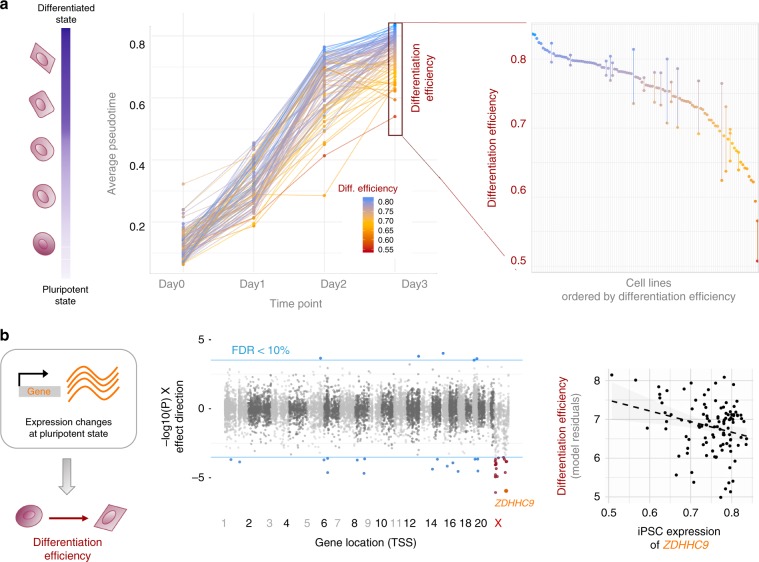
Recent developments in stem cell biology have enabled the study of cell fate decisions in early human development that are impossible to study in vivo. However, understanding how development varies across individuals and, in particular, the influence of common genetic variants during this process has not been characterised. Here, we exploit human iPS cell lines from 125 donors, a pooled experimental design, and single-cell RNA-sequencing to study population variation of endoderm differentiation. We identify molecular markers that are predictive of differentiation efficiency of individual lines, and utilise heterogeneity in the genetic background across individuals to map hundreds of expression quantitative trait loci that influence expression dynamically during differentiation and across cellular contexts.
Overview
The claims and statistics of this paper haven’t been checked yet.
Free: it reads the open-access text and checks the first 5 claims that cite a source we can check. Create a free account to check every claim.
Integrity signals
Registry
Cites
Statistics
Figures
Verification
Claims the paper makes
The claims and statistics of this paper haven’t been checked yet.
Free: it reads the open-access text and checks the first 5 claims that cite a source we can check. Create a free account to check every claim.
Claims other papers make about this one
Each is checked against this paper’s own text: does it say what the citing paper says it does?
The source backs part of the claim, not all of it — or backs it for a different population, condition or comparison.
In the citing paper
“Alternatively cells were mapped to known reference cell (sub)types or states4,5,11,12, making effective use only of cell-state or cell-type specific marker genes.”
From Targeted Perturb-seq enables genome-scale genetic screens in single cells (2020) · cites this paper as [12]
Experimental — accuracy not yet measuredIn the citing paper
“A number of single-cell RNA-seq eQTL datasets have been published from differentiating iPSCs and peripheral blood cells10,48–50 and many others are likely to follow in the near future.”
From A compendium of uniformly processed human gene expression and splicing quantitative trait loci (2021) · cites this paper as [48]
Self-check
Percentages, sums and reported differences re-computed from the paper’s own numbers.
The self-check needs the paper’s full text.
Citations
Cites
Fitting Linear Mixed-Effects Models Using lme4
Bates, D., Mächler, M., Bolker, B., & Walker, S. (2015) · Journal of Statistical Software · doi:10.18637/jss.v067.i01 · Cited by 86,835
Fast and accurate short read alignment with Burrows-Wheeler transform
Li, H., & Durbin, R. (2009) · Bioinformatics · doi:10.1093/bioinformatics/btp324 · Cited by 58,607
Self-citationSTAR: ultrafast universal RNA-seq aligner
Dobin, A., Davis, C. A., Schlesinger, F., Drenkow, J., Zaleski, C., Jha, S., Batut, P., Chaisson, M., & Gingeras, T. R. (2013) · Bioinformatics · doi:10.1093/bioinformatics/bts635 · Cited by 51,709 · cited 1×
“Trimmed reads were mapped to the human reference genome build 37 using STAR [40] (version: 020201) in two-pass alignment mode, using the default settings proposed by the ENCODE consortium (STAR manual).”
PLINK: a tool set for whole-genome association and population-based linkage analyses.
Purcell, S., Neale, B., Todd-Brown, K., Thomas, L., Ferreira, M. A. R., Bender, D., Maller, J., Sklar, P., de Bakker, P. I. W., Daly, M. J., et al. (2007) · The American Journal of Human Genetics · doi:10.1086/519795 · Cited by 34,089 · cited 2×
“Association tests were performed using a linear mixed model (LMM), accounting for population structure and sample repeat structure (see below) as random effects (using a kinship matrix estimated using PLINK [50]).”
Cutadapt removes adapter sequences from high-throughput sequencing reads
Martin, M. (2011) · EMBnet.journal · doi:10.14806/ej.17.1.200 · Cited by 33,889
BEDTools: a flexible suite of utilities for comparing genomic features
Quinlan, A. R., & Hall, I. M. (2010) · Bioinformatics · doi:10.1093/bioinformatics/btq033 · Cited by 27,437
An integrated encyclopedia of DNA elements in the human genome
The ENCODE Project Consortium (2012) · Nature · doi:10.1038/nature11247 · Cited by 18,072
Salmon provides fast and bias-aware quantification of transcript expression
Patro, R., Duggal, G., Love, M. I., Irizarry, R. A., & Kingsford, C. (2017) · Nature Methods · doi:10.1038/nmeth.4197 · Cited by 12,700
Statistical significance for genomewide studies
Storey, J. D., & Tibshirani, R. (2003) · Proceedings of the National Academy of Sciences · doi:10.1073/pnas.1530509100 · Cited by 9,692 · cited 1×
“We then adjusted for multiple testing using this empirical null distribution.”
SCANPY: large-scale single-cell gene expression data analysis
Wolf, F. A., Angerer, P., & Theis, F. J. (2018) · Genome Biology · doi:10.1186/s13059-017-1382-0 · Cited by 8,881
Cited by
Items 301–336 of 336
Aydin, S. C., Skelly, D. A., Dewey, H. B., Mahoney, J. M., Choi, T., Reinholdt, L. G., Baker, C. L., & Munger, S. C. (2025) · bioRxiv (Cold Spring Harbor Laboratory) · doi:10.1101/2025.01.24.634514
“…has been characterized at multiple molecular levels (Kilpinen et al. 2017; Panopoulos et al. 2017; Banovich et al. 2018; Mirauta et al. 2020) and throughout differentiation into various cell types (Cuomo et al. 2020; Jerber et al. 2021; Elorbany et al. 2022; Wells et al. 2023; Popp et al. 2024).”
Diwakar, P., Udayakumar, H. M., & Shwetha, S. V. (2025) · Journal of Mines Metals and Fuels · doi:10.18311/jmmf/2023/47311
Xu, Z., Massarat, A. R., Rumker, L., Gymrek, M., Raychaudhuri, S., Zhou, W., & Amariuta, T. (2025) · bioRxiv (Cold Spring Harbor Laboratory) · doi:10.1101/2025.02.24.639892 · Cited by 1
“In attempts to mimic the architecture of bulk RNA-81 seq studies, previous studies performed eQTL mapping or heritability estimation with “pseudobulk” counts generated by summing or averaging the measurements across cells of the same donor 22 ,24 ,27,28,41,42,43,44,45,46,47 .”
Cheetham, N. J., Beattie, A., Comery, A., Bowyer, V., Carpentieri, J., & Steves, C. J. (2026) · Health Expectations · doi:10.1111/hex.70692
Signatures of digital Polycomb regulation in functional iPSC heterogeneity between individualsPreprint
Miangolarra, A. M., Kurlovich, J., Torabi, F., Dovgusha, O., Cao, Y., Lin, L., Günesdogan, U., Schoenfelder, S., & Howard, M. (2025) · bioRxiv (Cold Spring Harbor Laboratory) · doi:10.1101/2025.07.25.666753 · Cited by 1
Scalise, S., Benedetto, G. L., Covello, R., Gabriele, C., Puccio, B., Valente, D., Zannino, C., Guzzi, P. H., Veltri, P., Quattrone, A., et al. (2025) · Research Square · doi:10.21203/rs.3.rs-7289863/v1
YOU, Y., Caranica, C., Dai, G., & Lu, M. (2025) · bioRxiv (Cold Spring Harbor Laboratory) · doi:10.64898/2025.12.08.693064 · Cited by 1
Additional file 1 of splatPop: simulating population scale single-cell RNA sequencing data
Azodi, C. B. D., Zappia, L., Oshlack, A., & McCarthy, D. J. (2021) · Figshare · doi:10.6084/m9.figshare.17210481
Self-citationKelly, D. E., Ramdas, S., Ma, R., Rawlings-Goss, R., Grant, G. R., Ranciaro, A., Hirbo, J. B., Beggs, W. R., Yeager, M., Chanock, S. J., et al. (2023) · Figshare · doi:10.6084/m9.figshare.22607726
Strober, B. J., Tayeb, K., Popp, J. M., Qi, G., Gordon, M. G., Perez, R. K., Ye, C. J., & Battle, A. J. (2024) · Figshare · doi:10.6084/m9.figshare.26670819
Aygün, N., Liang, D., Crouse, W. L., Keele, G. R., Love, M. I., & Stein, J. L. (2024) · Figshare · doi:10.6084/m9.figshare.26592971
Aygün, N., Liang, D., Crouse, W. L., Keele, G. R., Love, M. I., & Stein, J. L. (2024) · Figshare · doi:10.6084/m9.figshare.26592974
Additional file 2 of splatPop: simulating population scale single-cell RNA sequencing data
Azodi, C. B. D., Zappia, L., Oshlack, A., & McCarthy, D. J. (2021) · Figshare · doi:10.6084/m9.figshare.17210484
Self-citationKelly, D. E., Ramdas, S., Ma, R., Rawlings-Goss, R., Grant, G. R., Ranciaro, A., Hirbo, J. B., Beggs, W. R., Yeager, M., Chanock, S. J., et al. (2023) · Figshare · doi:10.6084/m9.figshare.22607720
Aygün, N., Liang, D., Crouse, W. L., Keele, G. R., Love, M. I., & Stein, J. L. (2024) · Figshare · doi:10.6084/m9.figshare.26592962
Aygün, N., Liang, D., Crouse, W. L., Keele, G. R., Love, M. I., & Stein, J. L. (2024) · Figshare · doi:10.6084/m9.figshare.26592968
Strober, B. J., Tayeb, K., Popp, J. M., Qi, G., Gordon, M. G., Perez, R. K., Ye, C. J., & Battle, A. J. (2024) · Figshare · doi:10.6084/m9.figshare.26670822
Aygün, N., Liang, D., Crouse, W. L., Keele, G. R., Love, M. I., & Stein, J. L. (2024) · Figshare · doi:10.6084/m9.figshare.26592965
Mapping trans -eQTLs at single-cell resolution using Latent Interaction Variational InferencePreprint
Vagiaki, D., Heinen, T., Saraswat, M., Clarke, B., & Stegle, O. (2026) · bioRxiv (Cold Spring Harbor Laboratory) · doi:10.64898/2026.02.04.703363 · Cited by 1
“We considered LIVI’s donor-aware latent space D as a set of quantitative traits in a classical eQTL analysis workflow [27, 28].”
Self-citationfastdemux: Robust SNP-based demultiplexing of single-cell population genomics dataPreprint
Ranjbaran, A., Luca, F., & Piqué-Regi, R. (2026) · bioRxiv (Cold Spring Harbor Laboratory) · doi:10.64898/2026.02.10.705082
Pseudotimecascade Visualizes Gene Expression Cascade in Pseudotime Analysis
Wan, C., Ji, B., & Ji, Z. (2026) · Computational and Structural Biotechnology Journal · doi:10.34133/csbj.0007
DAESC + : high-performance, integrated software for single-cell allele-specific expression data
Cui, T., & Qi, G. (2026) · BMC Bioinformatics · doi:10.1186/s12859-026-06426-y
“Traditionally, Smart-seq [33, 34] protocols was commonly used for single-cell ASE quantification due to its full-length coverage [6, 7, 9].”
InfluentialGenetic effects put into context
Zeng, B., & Roussos, P. (2026) · Science · doi:10.1126/science.aei6085
Zhang, Q., Bao, Q., Zeng, L., He, Z., Wang, Z., Li, C., & Yi, G. (2026) · Journal of Animal Science and Biotechnology/Journal of animal science and biotechnology · doi:10.1186/s40104-026-01452-5
AI-Driven Signal Processing for Single-Cell Data Analysis: A Case Study in Cancer Research
Gangwar, S., Banday, M., Anjum, Z., Khanna, K., Khan, N. A., & Raza, K. (2026) · Studies in computational intelligence · doi:10.1007/978-3-032-19543-2_8 · Cited by 4
Caudal, A., Hu, E., Chen, Y. M., & Wu, J. C. (2026) · Physiology in health and disease · doi:10.1007/978-3-032-26472-5_25
sc-pcQTL: hurdle-based co-expression modeling for multi-gene QTL mapping in single-cell RNA-seq dataPreprint
Zhang, J., Huang, Y., Claussnitzer, M., Kanai, M., & Zhou, W. (2026) · bioRxiv (Cold Spring Harbor Laboratory) · doi:10.64898/2026.08.18.745314
Induced pluripotent stem cells from discovery to translation
Lee, J., Herron, T. J., Studer, L., Mummery, C. L., & Wu, J. C. (2026) · Nature Medicine · doi:10.1038/s41591-026-04584-3 · Cited by 3
“Functional assays combined with single-cell 55 and spatial multi-omics 56 enable high-resolution characterization of dynamic cellular states across heterogeneous populations.”
Reed, X., Weller, C. A., Sáez-Atiénzar, S., Beilina, A. G., Solaiman, S., Portley, M., Kaileh, M., Roy, R., Ding, J., Moore, A. Z., et al. (2026) · PLoS ONE · doi:10.1371/journal.pone.0356501 · Cited by 3
“For example, iPSC models have been used to replicate tissue-based methQTL and eQTL in an endogenous genomic context, suggesting that these models retain genetically encoded influences on epigenetics and gene expression [9,10].”
Early considerations for village-in-a-dish platform: a multidisciplinary perspective
Qureshi, T., Bertocci, A., Redekop, K., Vandekerckhove, P., IJzerman, M. J., van Meurs, J. B. J., Groot, C. U., & Narcisi, R. (2026) · Frontiers in Bioengineering and Biotechnology · doi:10.3389/fbioe.2026.1923405
Using Brain Organoids to Explore Human Neurobiology
Marei, H. E. S., & Hasan, A. (2026) · Cellular and Molecular Neurobiology · doi:10.1007/s10571-026-01808-5
“While bulk RNA-seq has enabled global characterization of transcriptional changes during organoid differentiation, scRNA-seq has substan - tially advanced the field by resolving many differences at the cellular level (Cuomo et al. 2020 ; Lu et al. 2021).”
Mo, X., Qiu, M., Song, R., Wu, Z., Liu, C., Su, L., Wang, H., Xue, R., Yu, L., Wang, M., et al. (2026) · Frontiers in Pharmacology · doi:10.3389/fphar.2026.1855808
“Single-cell studies also indicate that different iPSC lines can show distinct cell-state transition trajectories during differentiation (Cuomo et al., 2020).”
Disease-associated loci share properties with response eQTLs under common environmental exposures
Lin, W., Li, M., Allen, O., Burnett, J. E., Popp, J. M., Stephens, M., Battle, A. J., & Gilad, Y. (2026) · Cell Genomics · doi:10.1016/j.xgen.2026.101383 · Cited by 5
Toward Mechanistically Informed Genomic Selection through Single-Cell Transcriptomics
Verma, N. K., Kumari, S., & Sharma, R. K. (2026) · ACS Agricultural Science & Technology · doi:10.1021/acsagscitech.6c00232
Melo-Carrillo, A., Pellegrino, E., Balachandran, P., Kostich, M., Werren, L., Lorig, C., Kendra, A., Diniz, J. A., Merisotis, K., Garofalo, J., et al. (2026) · bioRxiv (Cold Spring Harbor Laboratory) · doi:10.64898/2026.10.14.759173
Metadata
- Authors
- Cuomo, A. S. E., Seaton, D. D., McCarthy, D. J., Martinez, I., Bonder, M. J., Garcia-Bernardo, J., Amatya, S., Madrigal, P., Isaacson, A., Buettner, F., Knights, A., Natarajan, K. N., HipSci Consortium, Agu, C. A., Alderton, A., Danecek, P., Denton, R., Durbin, R., Gaffney, D. J., Goncalves, A., Halai, R., Harper, S., Kirton, C. M., Kolb-Kokocinski, A., Leha, A., McCarthy, S. A., Memari, Y., Patel, M., Birney, E., Casale, F. P., Clarke, L., Harrison, P. W., Kilpinen, H., Streeter, I., Denovi, D., Meleckyte, R., Moens, N., Watt, F. M., Ouwehand, W. H., Lamond, A. I., Bensaddek, D., Beales, P., Vallier, L., Marioni, J. C., Chhatriwala, M., & Stegle, O.
- Affiliations
- European Bioinformatics Institute (GB)
- Wellcome Sanger Institute (GB)
- Ames Research Center (US)
- University of Southern Denmark (DK)
- King's College London (GB)
- National Health Service (GB)
- University of Dundee (GB)
- University College London (GB)
- Wellcome/MRC Cambridge Stem Cell Institute (GB)
- Corresponding author
- Vallier, Ludovic
- Marioni, John C.
- Chhatriwala, Mariya
- Stegle, Oliver
- ORCID
- Cuomo, Anna S. E.
- Seaton, Daniel D.
- McCarthy, Davis J.
- Bonder, Marc Jan
- Madrigal, Pedro
- Isaacson, Abigail
- Buettner, Florian
- Knights, Andrew
- Natarajan, Kedar Nath
- Agu, Chukwuma A.
- Danecek, Petr
- Durbin, Richard
- Gaffney, Daniel J.
- Leha, Andreas
- McCarthy, Shane A.
- Memari, Yasin
- Birney, Ewan
- Casale, Francesco Paolo
- Clarke, Laura
- Harrison, Peter W.
- Kilpinen, Helena
- Streeter, Ian
- Meleckyte, Ruta
- Watt, Fiona M.
- Ouwehand, Willem H.
- Lamond, Angus I.
- Bensaddek, Dalila
- Beales, Philip
- Vallier, Ludovic
- Marioni, John C.
- Chhatriwala, Mariya
- Stegle, Oliver
- Venue
- Nature Communications
- Published
- 2020-02-10
- Volume
- 11
- Issue
- 1
- Pages
- 810-810
- ISSN
- 2041-1723 (ISSN-L)
- PMC
- PMC7010688
- OpenAlex
- W3004479572
- Semantic Scholar
- a688fc6ea43c847dfdd53e5442b3edd4aaa1b3d8
- Cited by
- 331
- References
- 63
- Citations by year
- 2026: 27 · 2025: 43 · 2024: 48 · 2023: 80 · 2022: 57 · 2021: 54 · 2020: 21
- FWCI
- 17.28
- Type
- journal article
- Language
- en
- Update notices
- correction (2020-03-23)
- Open access
- gold
- doi.org
- Licence
- cc-by
- creativecommons.org/licenses/by/4.0 (tdm)
- creativecommons.org/licenses/by/4.0 (vor)
- Locations
- Nature Communications (publishedVersion, cc-by)
- PubMed Central (publishedVersion, cc-by)
- PubMed (publishedVersion)
- University of Groningen research database (University of Groningen / Centre for Information Technology) (publishedVersion, other-oa)
- Minerva Access (University of Melbourne) (submittedVersion, cc-by)
- University of Southern Denmark Research Portal (University of Southern Denmark) (submittedVersion, cc-by)
- DOAJ (DOAJ: Directory of Open Access Journals) (submittedVersion, cc-by-sa)
- Funders
- Villum Fonden (00025397)
- Wellcome Trust (WT098503)
- Cancer Research UK (22231, DRCPGM\100015)
- Medical Research Council (MR/M008975/1, MC_PC_12009, WT098503, MC_PC_17230)
- Engineering and Physical Sciences Research Council (TS/H001220/1)
- H2020 Marie Skłodowska-Curie Actions (EI3POD, 664726)
- Topics
- Life Sciences › Biochemistry, Genetics and Molecular Biology › Molecular Biology › Pluripotent Stem Cells Research
- Life Sciences › Biochemistry, Genetics and Molecular Biology › Molecular Biology › Single-cell and spatial transcriptomics
- Life Sciences › Biochemistry, Genetics and Molecular Biology › Molecular Biology › Developmental Biology and Gene Regulation
- Keywords
- induced pluripotent stem cells, endoderm differentiation, expression quantitative trait loci, single-cell RNA sequencing, population genetic variation, differentiation efficiency, molecular markers, cellular heterogeneity, human development, donor heterogeneity
- MeSH terms
- Cell Differentiation, Cell Line, Endoderm, Female, Humans, Male, Gene Expression, Genetic Heterogeneity, Gene Expression Profiling, Quantitative Trait Loci, Genetic Association Studies, Induced Pluripotent Stem Cells, Single-Cell Analysis, Gene-Environment Interaction
About these checks
Registry, retraction, Cites and statistics results are computed, not judged, with one exception: a printed reference that no index lists is read once by a model before it counts as a citation error. Claims are extracted by a model and kept only when their quote appears verbatim in the text; each cited source is then checked, with a model’s help, for whether it says what the claim relies on. Those verdicts can be wrong — read the claim’s quote and the cited source before relying on one.
Statistics and arithmetic are recomputed, not judged.
Confidence bands are shown only for fields calibrated on our annotated test set. None is calibrated yet, so no band is shown.
What counts as a claim ›How we measure confidence ›How we check this ›
Are you an author, or do you see a problem with this page? Request a review
Data sources
Bibliographic data: Semantic Scholar, OpenAlex, Crossref.
Contains information from the Semantic Scholar Academic Graph Datasets, made available under the ODC Attribution License (ODC-BY 1.0).
Semantic Scholar’s data is described in: Kinney, R., et al. (2023). The Semantic Scholar Open Data Platform. arXiv:2301.10140.
