

Meta-analysis of neural systems underlying placebo analgesia from individual participant fMRI data
Open accessThe DOI matches its Crossref record; 79 of the 82 references it cites were found in a registry or an index.
Abstract
The brain systems underlying placebo analgesia are insufficiently understood. Here we performed a systematic, participant-level meta-analysis of experimental functional neuroimaging studies of evoked pain under stimulus-intensity-matched placebo and control conditions, encompassing 603 healthy participants from 20 (out of 28 eligible) studies. We find that placebo vs. control treatments induce small, widespread reductions in pain-related activity, particularly in regions belonging to ventral attention (including mid-insula) and somatomotor networks (including posterior insula). Behavioral placebo analgesia correlates with reduced pain-related activity in these networks and the thalamus, habenula, mid-cingulate, and supplementary motor area. Placebo-associated activity increases occur mainly in frontoparietal regions, with high between-study heterogeneity. We conclude that placebo treatments affect pain-related activity in multiple brain areas, which may reflect changes in nociception and/or other affective and decision-making processes surrounding pain. Between-study heterogeneity suggests that placebo analgesia is a multi-faceted phenomenon involving multiple cerebral mechanisms that differ across studies.
Overview
The claims and statistics of this paper haven’t been checked yet.
Free: it reads the open-access text and checks the first 5 claims that cite a source we can check. Create a free account to check every claim.
Integrity signals
Registry
Cites
Statistics
Figures
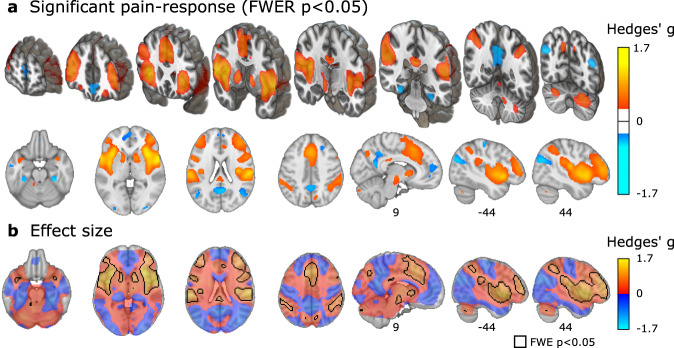
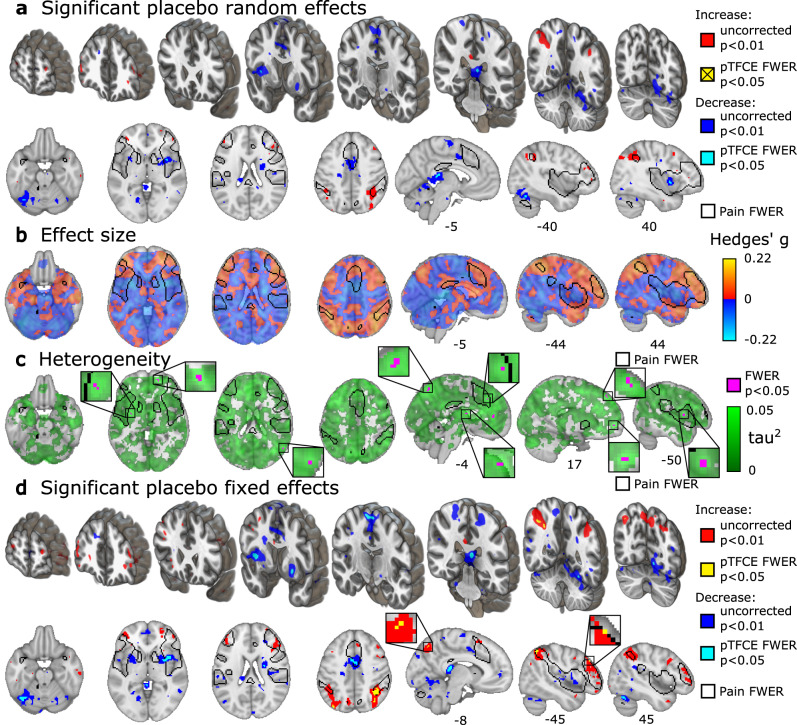
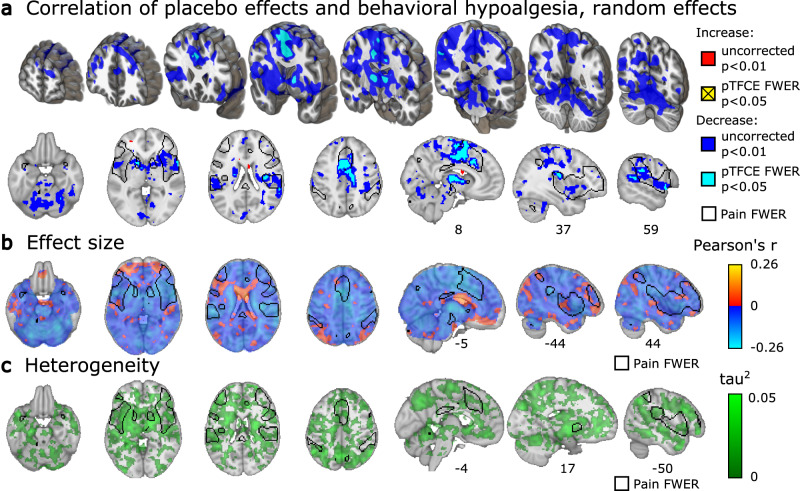
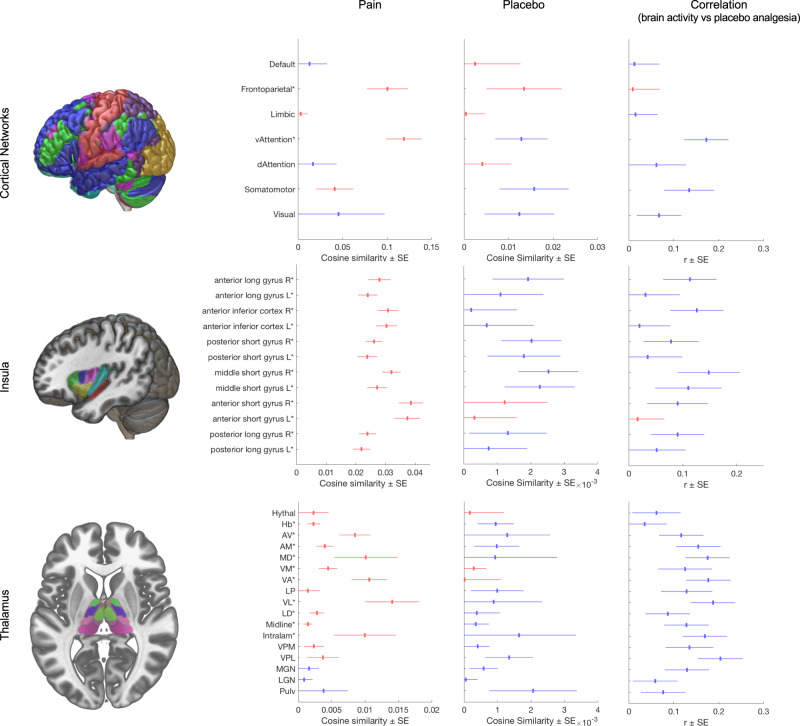
Verification
Claims the paper makes
The claims and statistics of this paper haven’t been checked yet.
Free: it reads the open-access text and checks the first 5 claims that cite a source we can check. Create a free account to check every claim.
Claims other papers make about this one
Each is checked against this paper’s own text: does it say what the citing paper says it does?
The source backs part of the claim, not all of it — or backs it for a different population, condition or comparison.
In the citing paper
“In particular, dlPFC regions appear especially important for exerting top-downregulation of treatment and placebo expectancies, whereas mPFC regions play a key role in encoding value of expected outcomes [218,219].”
From Prefrontal cortex and depression (2022) · cites this paper as [219]
Experimental — accuracy not yet measured
Self-check
Percentages, sums and reported differences re-computed from the paper’s own numbers.
The self-check needs the paper’s full text.
Citations
Cites
Hao (2015) · doi:10.1002/14651858 · Cited by 11,321
Lakens, D. (2013) · Frontiers in Psychology · doi:10.3389/fpsyg.2013.00863 · Cited by 10,303
The organization of the human cerebral cortex estimated by intrinsic functional connectivity
Thomas Yeo, B. T., Krienen, F. M., Sepulcre, J., Sabuncu, M. R., Lashkari, D., Hollinshead, M., Roffman, J. L., Smoller, J. W., Zöllei, L., Polimeni, J. R., et al. (2011) · Journal of Neurophysiology · doi:10.1152/jn.00338.2011 · Cited by 9,182
Cohen, J. (1992) · Psychological Bulletin · doi:10.1037//0033-2909.112.1.155 · Cited by 8,771
The organization of the human cerebellum estimated by intrinsic functional connectivity
Buckner, R. L., Krienen, F. M., Castellanos, A., Diaz, J. C., & Yeo, B. T. T. (2011) · Journal of Neurophysiology · doi:10.1152/jn.00339.2011 · Cited by 7,304
Nonparametric permutation tests for functional neuroimaging: A primer with examples
Nichols, T. E., & Holmes, A. P. (2002) · Human Brain Mapping · doi:10.1002/hbm.1058 · Cited by 6,256
A multi-modal parcellation of human cerebral cortex
Glasser, M. F., Coalson, T. S., Robinson, E. C., Hacker, C. D., Harwell, J., Yacoub, E., Ugurbil, K., Andersson, J., Beckmann, C. F., Jenkinson, M., et al. (2016) · Nature · doi:10.1038/nature18933 · Cited by 5,111
Psychosomatic medicine in Germany: more timely than ever
Zipfel, S., Herzog, W., Kruse, J., & Henningsen, P. (2016) · Psychotherapy and Psychosomatics · doi:10.1159/000447701 · Cited by 2,323
Functional topography in the human cerebellum: A meta-analysis of neuroimaging studies
STOODLEY, C., & SCHMAHMANN, J. (2009) · NeuroImage · doi:10.1016/j.neuroimage.2008.08.039 · Cited by 2,183
Placebo-Induced Changes in fMRI in the Anticipation and Experience of Pain
Wager, T. D., Rilling, J. K., Smith, E. E., Sokolik, A., Casey, K. L., Davidson, R. J., Kosslyn, S. M., Rose, R. M., & Cohen, J. D. (2004) · Science · doi:10.1126/science.1093065 · Cited by 1,992
Self-citationCognitive Reappraisal of Emotion: A Meta-Analysis of Human Neuroimaging Studies
Buhle, J. T., Silvers, J. A., Wager, T. D., Lopez, R., Onyemekwu, C., Kober, H., Weber, J., & Ochsner, K. N. (2014) · Cerebral Cortex · doi:10.1093/cercor/bht154 · Cited by 1,896
Self-citationUnconscious determinants of free decisions in the human brain
Soon, C. S., Brass, M., Heinze, H.-J., & Haynes, J.-D. (2008) · Nature Neuroscience · doi:10.1038/nn.2112 · Cited by 1,741
An fMRI-Based Neurologic Signature of Physical Pain
Wager, T. D., Atlas, L. Y., Lindquist, M. A., Roy, M., Woo, C.-W., & Kross, E. (2013) · New England Journal of Medicine · doi:10.1056/nejmoa1204471 · Cited by 1,597
Self-citationA probabilistic MR atlas of the human cerebellum
Diedrichsen, J., Balsters, J. H., Flavell, J., Cussans, E., & Ramnani, N. (2009) · NeuroImage · doi:10.1016/j.neuroimage.2009.01.045 · Cited by 1,359
The cerebellum and cognitive function: 25 years of insight from anatomy and neuroimaging
Buckner, R. L. (2013) · Neuron · doi:10.1016/j.neuron.2013.10.044 · Cited by 1,173
The problem of functional localization in the human brain
Brett, M., Johnsrude, I. S., & Owen, A. M. (2002) · Nature Reviews Neuroscience · doi:10.1038/nrn756 · Cited by 1,119
The problem of functional localization in the human brain
Morgan, T. (2002) · Cited by 965
The neuroscience of placebo effects: connecting context, learning and health
Wager, T. D., & Atlas, L. Y. (2015) · Nature Reviews Neuroscience · doi:10.1038/nrn3976 · Cited by 844
Self-citationActivation of the Opioidergic Descending Pain Control System Underlies Placebo Analgesia
Eippert, F., Bingel, U., Schoell, E. D., Yacubian, J., Klinger, R., Lorenz, J., & Büchel, C. (2009) · Neuron · doi:10.1016/j.neuron.2009.07.014 · Cited by 839
Self-citationBingel, U., Wanigasekera, V., Wiech, K., Ni Mhuircheartaigh, R., Lee, M. C., Ploner, M., & Tracey, I. (2011) · Science Translational Medicine · doi:10.1126/scitranslmed.3001244 · Cited by 810
Self-citationThe organization of the human striatum estimated by intrinsic functional connectivity
Choi, E. Y., Yeo, B. T. T., & Buckner, R. L. (2012) · Journal of Neurophysiology · doi:10.1152/jn.00270.2012 · Cited by 746
The placebo response in medicine: minimize, maximize or personalize?
Enck, P., Bingel, U., Schedlowski, M., & Rief, W. (2013) · Nature Reviews Drug Discovery · doi:10.1038/nrd3923 · Cited by 671
Self-citationFunctional anatomy of thalamus and basal ganglia
Herrero, M.-T., Barcia, C., & Navarro, J. (2002) · Child's Nervous System · doi:10.1007/s00381-002-0604-1 · Cited by 664
Hierarchically organized behavior and its neural foundations: A reinforcement learning perspective
Botvinick, M. M., Niv, Y., & Barto, A. G. (2009) · Cognition · doi:10.1016/j.cognition.2008.08.011 · Cited by 646
Mechanisms of placebo analgesia: rACC recruitment of a subcortical antinociceptive network
Bingel, U., Lorenz, J., Schoell, E., Weiller, C., & Büchel, C. (2006) · Pain · doi:10.1016/j.pain.2005.08.027 · Cited by 567
Self-citationPlacebo effects on human μ-opioid activity during pain
Wager, T. D., Scott, D. J., & Zubieta, J.-K. (2007) · Proceedings of the National Academy of Sciences · doi:10.1073/pnas.0702413104 · Cited by 562
Self-citationIs there a dysexecutive syndrome?
Stuss, D. T., & Alexander, M. P. (2007) · Philosophical Transactions of the Royal Society B: Biological Sciences · doi:10.1098/rstb.2007.2096 · Cited by 557
Similarity-Dissimilarity Competition in Disjunctive Classification Tasks
Mathy, F., Haladjian, H. H., Laurent, É., & Goldstone, R. L. (2013) · Frontiers in Psychology · doi:10.3389/fpsyg.2013.00026 · Cited by 493
Placebo and the New Physiology of the Doctor-Patient Relationship
Benedetti, F. (2013) · Physiological Reviews · doi:10.1152/physrev.00043.2012 · Cited by 492
Self-citationConsensus Paper: The Role of the Cerebellum in Perceptual Processes
Baumann, O., Borra, R. J., Bower, J. M., Cullen, K. E., Habas, C., Ivry, R. B., Leggio, M., Mattingley, J. B., Molinari, M., Moulton, E. A., et al. (2015) · The Cerebellum · doi:10.1007/s12311-014-0627-7 · Cited by 462
Kong, J., Gollub, R. L., Rosman, I. S., Webb, J. M., Vangel, M. G., Kirsch, I., & Kaptchuk, T. J. (2006) · The Journal of Neuroscience · doi:10.1523/jneurosci.3556-05.2006 · Cited by 395
Self-citationThe dorsal posterior insula subserves a fundamental role in human pain
Segerdahl, A. R., Mezue, M., Okell, T. W., Farrar, J. T., & Tracey, I. (2015) · Nature Neuroscience · doi:10.1038/nn.3969 · Cited by 393
Self-citationCorticolimbic anatomical characteristics predetermine risk for chronic pain
Vachon-Presseau, E., Tétreault, P., Petre, B., Huang, L., Berger, S. E., Torbey, S., Baria, A. T., Mansour, A. R., Hashmi, J. A., Griffith, J. W., et al. (2016) · Brain · doi:10.1093/brain/aww100 · Cited by 390
Salimi-Khorshidi, G., Smith, S. M., Keltner, J. R., Wager, T. D., & Nichols, T. E. (2009) · NeuroImage · doi:10.1016/j.neuroimage.2008.12.039 · Cited by 388
Self-citationA mean three-dimensional atlas of the human thalamus: Generation from multiple histological data
Krauth, A., Blanc, R., Poveda, A., Jeanmonod, D., Morel, A., & Székely, G. (2010) · NeuroImage · doi:10.1016/j.neuroimage.2009.10.042 · Cited by 382
Brooks, J., & Tracey, I. (2005) · Journal of Anatomy · doi:10.1111/j.1469-7580.2005.00428.x · Cited by 378
Self-citationZeidan, F., Emerson, N. M., Farris, S. R., Ray, J. N., Jung, Y., McHaffie, J. G., & Coghill, R. C. (2015) · The Journal of Neuroscience · doi:10.1523/jneurosci.2542-15.2015 · Cited by 369
Self-citationUnconscious Activation of the Cognitive Control System in the Human Prefrontal Cortex
Lau, H. C., & Passingham, R. E. (2007) · The Journal of Neuroscience · doi:10.1523/jneurosci.4335-06.2007 · Cited by 358
The relation between statistical power and inference in fMRI
Cremers, H. R., Wager, T. D., & Yarkoni, T. (2017) · PLOS ONE · doi:10.1371/journal.pone.0184923 · Cited by 349
Self-citationLocalization of pain-related brain activation: A meta-analysis of neuroimaging data
Duerden, E. G., & Albanese, M. (2013) · Human Brain Mapping · doi:10.1002/hbm.21416 · Cited by 342
Prefrontal cortex modulates placebo analgesia
Krummenacher, P., Candia, V., Folkers, G., Schedlowski, M., & Schönbächler, G. (2010) · Pain · doi:10.1016/j.pain.2009.09.033 · Cited by 337
Wager, T. D., Atlas, L. Y., Leotti, L. A., & Rilling, J. K. (2011) · The Journal of Neuroscience · doi:10.1523/jneurosci.3420-10.2011 · Cited by 328
Self-citationDistinct Brain Systems Mediate the Effects of Nociceptive Input and Self-Regulation on Pain
Woo, C.-W., Roy, M., Buhle, J. T., & Wager, T. D. (2015) · PLoS Biology · doi:10.1371/journal.pbio.1002036 · Cited by 263
Self-citationBeaudrot, L., Ahumada, J. A., O'Brien, T., Alvarez-Loayza, P., Boekee, K., Campos-Arceiz, A., Eichberg, D., Espinosa, S., Fegraus, E., Fletcher, C., et al. (2016) · PLOS Biology · doi:10.1371/journal.pbio.1002357 · Cited by 226
Supplementary motor area as key structure for domain-general sequence processing: A unified account
Cona, G., & Semenza, C. (2017) · Neuroscience & Biobehavioral Reviews · doi:10.1016/j.neubiorev.2016.10.033 · Cited by 222
Fewer permutations, more accurate P-values
Knijnenburg, T. A., Wessels, L. F. A., Reinders, M. J. T., & Shmulevich, I. (2009) · Bioinformatics · doi:10.1093/bioinformatics/btp211 · Cited by 221
Rütgen, M., Seidel, E.-M., Silani, G., Riečanský, I., Hummer, A., Windischberger, C., Petrovic, P., & Lamm, C. (2015) · Proceedings of the National Academy of Sciences · doi:10.1073/pnas.1511269112 · Cited by 208
Self-citationAmanzio, M., Benedetti, F., Porro, C. A., Palermo, S., & Cauda, F. (2013) · Human Brain Mapping · doi:10.1002/hbm.21471 · Cited by 202
Self-citationBrain Mechanisms of the Placebo Effect: An Affective Appraisal Account
Ashar, Y. K., Chang, L. J., & Wager, T. D. (2017) · Annual Review of Clinical Psychology · doi:10.1146/annurev-clinpsy-021815-093015 · Cited by 191
Self-citationBrain Connectivity Predicts Placebo Response across Chronic Pain Clinical Trials
Tétreault, P., Mansour, A., Vachon-Presseau, E., Schnitzer, T. J., Apkarian, A. V., & Baliki, M. N. (2016) · PLOS Biology · doi:10.1371/journal.pbio.1002570 · Cited by 190
Vase, L., Petersen, G. L., Riley, J. L., & Price, D. D. (2009) · Pain · doi:10.1016/j.pain.2009.04.008 · Cited by 189
Topographic organization of the cerebral cortex and brain cartography
Eickhoff, S. B., Constable, R. T., & Yeo, B. T. T. (2018) · NeuroImage · doi:10.1016/j.neuroimage.2017.02.018 · Cited by 178
Dissociable Influences of Opiates and Expectations on Pain
Atlas, L. Y., Whittington, R. A., Lindquist, M. A., Wielgosz, J., Sonty, N., & Wager, T. D. (2012) · Journal of Neuroscience · doi:10.1523/jneurosci.0383-12.2012 · Cited by 176
Self-citationZunhammer, M., Bingel, U., Wager, T. D., & for the Placebo Imaging Consortium (2018) · JAMA Neurology · doi:10.1001/jamaneurol.2018.2017 · Cited by 168
Self-citationAtlas, L. Y., & Wager, T. D. (2014) · Handbook of Experimental Pharmacology · doi:10.1007/978-3-662-44519-8_3 · Cited by 162
Self-citationMacroanatomy and 3D probabilistic atlas of the human insula
Faillenot, I., Heckemann, R. A., Frot, M., & Hammers, A. (2017) · NeuroImage · doi:10.1016/j.neuroimage.2017.01.073 · Cited by 161
Kong, J., Kaptchuk, T. J., Polich, G., Kirsch, I., Vangel, M., Zyloney, C., Rosen, B., & Gollub, R. (2009) · NeuroImage · doi:10.1016/j.neuroimage.2008.12.025 · Cited by 159
Self-citationNeural bases of conditioned placebo analgesia
Lui, F., Colloca, L., Duzzi, D., Anchisi, D., Benedetti, F., & Porro, C. A. (2010) · Pain · doi:10.1016/j.pain.2010.09.021 · Cited by 149 · cited 2×
“…Sigrid Elsenbruch16, Stephan Geuter17, Ted J. Kaptchuk18, Simon S. Kessner19, Irving Kirsch18, Jian Kong20, Claus Lamm21, Siri Leknes22,23, Fausta Lui12, 10 NATURE COMMUNICATIONS | (2021) 12:1391 | https://doi.org/10.1038/s41467-021-21179-3 | www.nature.com/naturecommunications Alexa…”
InfluentialSelf-citationExploring the impact of analysis software on task fMRI results
Bowring, A., Maumet, C., & Nichols, T. E. (2019) · Human Brain Mapping · doi:10.1002/hbm.24603 · Cited by 146
Altered experimental pain perception after cerebellar infarction
Ruscheweyh, R., Kühnel, M., Filippopulos, F. M., Blum, B., Eggert, T., & Straube, A. M. (2014) · Pain · doi:10.1016/j.pain.2014.04.006 · Cited by 135
Spisák, T., Spisák, Z., Zunhammer, M., Bingel, U., Smith, S. M., Nichols, T. E., & Kincses, Z. T. (2018) · NeuroImage · doi:10.1016/j.neuroimage.2018.09.078 · Cited by 135
Self-citationCortical and subcortical responses to high and low effective placebo treatments
Geuter, S., Eippert, F., Hindi Attar, C., & Büchel, C. (2013) · NeuroImage · doi:10.1016/j.neuroimage.2012.11.029 · Cited by 132
Self-citationBrain and psychological determinants of placebo pill response in chronic pain patients
Vachon‐Presseau, É., Berger, S., Abdullah, T. B., Huang, L., Cecchi, G., Griffith, J. W., Schnitzer, T. J., & Apkarian, A. V. (2018) · Nature Communications · doi:10.1038/s41467-018-05859-1 · Cited by 129
Distinct neural representations of placebo and nocebo effects
Freeman, S., Yu, R., Egorova, N., Chen, X., Kirsch, I., Claggett, B., Kaptchuk, T. J., Gollub, R. L., & Kong, J. (2015) · NeuroImage · doi:10.1016/j.neuroimage.2015.03.015 · Cited by 116
Self-citationPlacebo improves pleasure and pain through opposite modulation of sensory processing
Ellingsen, D.-M., Wessberg, J., Eikemo, M., Liljencrantz, J., Endestad, T., Olausson, H., & Leknes, S. (2013) · Proceedings of the National Academy of Sciences · doi:10.1073/pnas.1305050110 · Cited by 111
Self-citationThe Effect of Treatment History on Therapeutic Outcome: An Experimental Approach
Kessner, S., Wiech, K., Forkmann, K., Ploner, M., & Bingel, U. (2013) · JAMA Internal Medicine · doi:10.1001/jamainternmed.2013.6705 · Cited by 102
Self-citationElsenbruch, S., Kotsis, V., Benson, S., Rosenberger, C., Reidick, D., Schedlowski, M., Bingel, U., Theysohn, N., Forsting, M., & Gizewski, E. R. (2012) · Pain · doi:10.1016/j.pain.2011.10.036 · Cited by 99
Self-citationHashmi, J. A., Kong, J., Spaeth, R., Khan, S., Kaptchuk, T. J., & Gollub, R. L. (2014) · The Journal of Neuroscience · doi:10.1523/jneurosci.3155-13.2014 · Cited by 78
Self-citationExpectation requires treatment to boost pain relief: An fMRI study
Schenk, L. A., Sprenger, C., Geuter, S., & Büchel, C. (2014) · Pain · doi:10.1016/j.pain.2013.09.024 · Cited by 76
Self-citationMeta-analysis of neuroimaging data
Kober, H., & Wager, T. D. (2010) · WIREs Cognitive Science · doi:10.1002/wcs.41 · Cited by 74
Self-citationNeurobiology of placebo effects: expectations or learning?
Peciña, M., Stohler, C. S., & Zubieta, J.-K. (2014) · Social Cognitive and Affective Neuroscience · doi:10.1093/scan/nst079 · Cited by 62
Suppression of Striatal Prediction Errors by the Prefrontal Cortex in Placebo Hypoalgesia
Schenk, L. A., Sprenger, C., Onat, S., Colloca, L., & Büchel, C. (2017) · The Journal of Neuroscience · doi:10.1523/jneurosci.1101-17.2017 · Cited by 58
Self-citationHaloperidol blocks dorsal striatum activity but not analgesia in a placebo paradigm
Wrobel, N., Wiech, K., Forkmann, K., Ritter, C., & Bingel, U. (2014) · Cortex · doi:10.1016/j.cortex.2014.02.023 · Cited by 45
Self-citationEffect Sizes Based on Correlations
(2009) · Introduction to Meta‐Analysis · doi:10.1002/9780470743386.ch6 · Cited by 44
Theysohn, N., Schmid, J., Icenhour, A., Mewes, C., Forsting, M., Gizewski, E. R., Schedlowski, M., Elsenbruch, S., & Benson, S. (2014) · Neurogastroenterology & Motility · doi:10.1111/nmo.12454 · Cited by 42
Self-citationLink-N: The missing link towards intervertebral disc repair is species-specific
Bach, F. C., Laagland, L. T., Grant, M. P., Creemers, L. B., Ito, K., Meij, B. P., Mwale, F., & Tryfonidou, M. A. (2017) · PLoS ONE · doi:10.1371/journal.pone.0187831 · Cited by 31
D’Souza, D., & D’Souza, H. (2016) · Journal of Neuroscience · doi:10.1523/jneurosci.0798-16.2016 · Cited by 30
Placebo effects on analgesia related to testosterone and premotor activation
Choi, J. C., Yi, D.-J., Han, B. S., Lee, P. H., Kim, J. H., & Kim, B.-H. (2011) · Neuroreport · doi:10.1097/wnr.0b013e32834601c9 · Cited by 24
Self-citationMolecular Mechanisms of Placebo Responses in Humans
Peciña, M., & Zubieta, J.-K. (2013) · Elsevier eBooks · doi:10.1016/b978-0-12-397928-5.00004-0 · Cited by 9
Research works printed but not linked: 1
- Deeks, J. J. & Higgins, J. P. Statistical algorithms in Review Manager 5 on behalf of the Statistical Methods Group of The Cochrane Collaboration. Documentation 2010, (2010).
Cited by
Prefrontal cortex and depression
Pizzagalli, D. A., & Roberts, A. C. (2022) · Neuropsychopharmacology · doi:10.1038/s41386-021-01101-7 · Cited by 667
Brain circuits for pain and its treatment
Mercer Lindsay, N., Chen, C., Gilam, G., Mackey, S., & Scherrer, G. (2021) · Science Translational Medicine · doi:10.1126/scitranslmed.abj7360 · Cited by 229
Pain and the Triple Network Model
De Ridder, D., Vanneste, S., Smith, M., & Adhia, D. (2022) · Frontiers in Neurology · doi:10.3389/fneur.2022.757241 · Cited by 163
Functional Connectivity Mapping for rTMS Target Selection in Depression
Elbau, I. G., Lynch, C. J., Downar, J., Vila-Rodriguez, F., Power, J. D., Solomonov, N., Daskalakis, Z. J., Blumberger, D. M., & Liston, C. (2023) · American Journal of Psychiatry · doi:10.1176/appi.ajp.20220306 · Cited by 120
Neural circuit basis of placebo pain relief
Chen, C., Niehaus, J. K., Dinç, F., Huang, K. L., Barnette, A. L., Tassou, A., Shuster, S. A., Wang, L., Lemire, A. L., Menon, V., et al. (2024) · Nature · doi:10.1038/s41586-024-07816-z · Cited by 98
Metadata
- Authors
- Zunhammer, M., Spisák, T., Wager, T. D., Bingel, U., The Placebo Imaging Consortium, Atlas, L., Benedetti, F., Büchel, C., Choi, J. C., Colloca, L., Duzzi, D., Eippert, F., Ellingsen, D.-M., Elsenbruch, S., Geuter, S., Kaptchuk, T. J., Kessner, S. S., Kirsch, I., Kong, J., Lamm, C., Leknes, S., Lui, F., Müllner-Huber, A., Porro, C. A., Rütgen, M., Schenk, L. A., Schmid, J., Theysohn, N., Tracey, I., Wrobel, N., & Zeidan, F.
- Affiliations
- Essen University Hospital (DE)
- Dartmouth College (US)
- National Institutes of Health (US)
- University of Turin (IT)
- University Medical Center Hamburg-Eppendorf (DE)
- Yonsei University (KR)
- University of Maryland, Baltimore (US)
- University of Modena and Reggio Emilia (IT)
- Max Planck Institute for Human Cognitive and Brain Sciences (DE)
- Oslo University Hospital (NO)
- Ruhr University Bochum (DE)
- Johns Hopkins University (US)
- Beth Israel Deaconess Medical Center (US)
- Harvard University (US)
- University of Vienna (AT)
- University of Oxford (GB)
- Karolinska Institutet (SE)
- Wake Forest University Health Sciences (US)
- Corresponding author
- Wager, Tor D.
- Bingel, Ulrike
- ORCID
- Zunhammer, Matthias
- Spisák, Tamás
- Wager, Tor D.
- Bingel, Ulrike
- Atlas, Lauren
- Büchel, Christian
- Choi, Jae Chan
- Colloca, Luana
- Eippert, Falk
- Ellingsen, Dan-Mikael
- Elsenbruch, Sigrid
- Geuter, Stephan
- Kaptchuk, Ted J.
- Kessner, Simon S.
- Kirsch, Irving
- Kong, Jian
- Lamm, Claus
- Leknes, Siri
- Lui, Fausta
- Porro, Carlo A.
- Rütgen, Markus
- Schenk, Lieven A.
- Tracey, Irene
- Wrobel, Nathalie
- Zeidan, Fadel
- Venue
- Nature Communications
- Published
- 2021-03-02
- Volume
- 12
- Issue
- 1
- Pages
- 1391-1391
- ISSN
- 2041-1723 (ISSN-L)
- PMC
- PMC7925520
- OpenAlex
- W3134682531
- Cited by
- 171
- References
- 82
- Citations by year
- 2026: 16 · 2025: 33 · 2024: 46 · 2023: 32 · 2022: 32 · 2021: 12
- FWCI
- 4.46
- Type
- journal article
- Language
- en
- Open access
- gold
- doi.org
- Licence
- cc-by
- creativecommons.org/licenses/by/4.0 (tdm)
- creativecommons.org/licenses/by/4.0 (vor)
- Locations
- Nature Communications (publishedVersion, cc-by)
- PubMed Central (publishedVersion, cc-by)
- PubMed (publishedVersion)
- RePEc: Research Papers in Economics (submittedVersion, cc-by)
- IRIS UNIMORE (University of Modena and Reggio Emilia) (submittedVersion, cc-by)
- Universitätsbibliographie, Universität Duisburg-Essen (submittedVersion)
- DOAJ (DOAJ: Directory of Open Access Journals) (submittedVersion, cc-by-sa)
- DuEPublico (University of Duisburg-Essen) (submittedVersion, cc-by)
- Institutional Research Information System University of Turin (University of Turin) (submittedVersion)
- Funders
- Mercator Research Center Ruhr
- U.S. Department of Health & Human Services | National Institutes of Health (MH076136)
- Deutsche Forschungsgemeinschaft (TRR 289)
- Topics
- Life Sciences › Neuroscience › Cognitive Neuroscience › Pain Management and Placebo Effect
- Health Sciences › Medicine › Physiology (medical) › Pain Mechanisms and Treatments
- Health Sciences › Medicine › Anesthesiology and Pain Medicine › Pain Management and Treatment
- Keywords
- placebo analgesia, placebo effect, pain processing, ventral attention network, posterior insula, sensorimotor network, thalamus, habenula, midcingulate cortex, supplementary motor area, frontoparietal cortex, nociception, study heterogeneity
- MeSH terms
- Adult, Analgesia, Behavior, Brain, Female, Humans, Image Enhancement, Magnetic Resonance Imaging, Male, Nervous System, Pain, Placebos
About these checks
Registry, retraction, Cites and statistics results are computed, not judged, with one exception: a printed reference that no index lists is read once by a model before it counts as a citation error. Claims are extracted by a model and kept only when their quote appears verbatim in the text; each cited source is then checked, with a model’s help, for whether it says what the claim relies on. Those verdicts can be wrong — read the claim’s quote and the cited source before relying on one.
Statistics and arithmetic are recomputed, not judged.
Confidence bands are shown only for fields calibrated on our annotated test set. None is calibrated yet, so no band is shown.
What counts as a claim ›How we measure confidence ›How we check this ›
Are you an author, or do you see a problem with this page? Request a review
Data sources
Bibliographic data: Semantic Scholar, OpenAlex, Crossref.
Contains information from the Semantic Scholar Academic Graph Datasets, made available under the ODC Attribution License (ODC-BY 1.0).
Semantic Scholar’s data is described in: Kinney, R., et al. (2023). The Semantic Scholar Open Data Platform. arXiv:2301.10140.
