

The DOI matches its Crossref record; 66 of the 67 references it cites were found in a registry or an index.
Blood n-3 fatty acid levels and total and cause-specific mortality from 17 prospective studies
Open accessAbstract
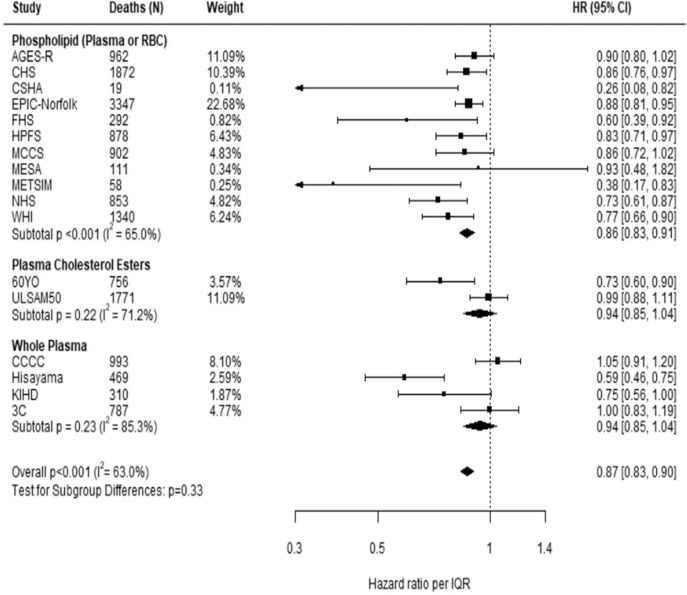
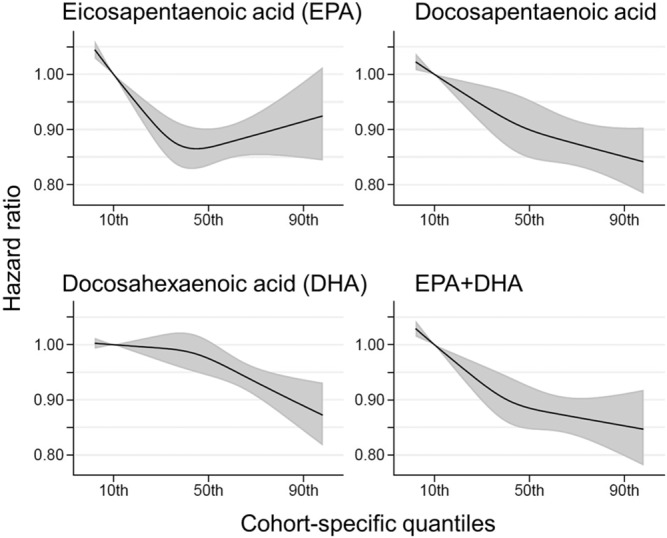
The health effects of omega-3 fatty acids have been controversial. Here we report the results of a de novo pooled analysis conducted with data from 17 prospective cohort studies examining the associations between blood omega-3 fatty acid levels and risk for all-cause mortality. Over a median of 16 years of follow-up, 15,720 deaths occurred among 42,466 individuals. We found that, after multivariable adjustment for relevant risk factors, risk for death from all causes was significantly lower (by 15–18%, at least p < 0.003) in the highest vs the lowest quintile for circulating long chain (20–22 carbon) omega-3 fatty acids (eicosapentaenoic, docosapentaenoic, and docosahexaenoic acids). Similar relationships were seen for death from cardiovascular disease, cancer and other causes. No associations were seen with the 18-carbon omega-3, alpha-linolenic acid. These findings suggest that higher circulating levels of marine n-3 PUFA are associated with a lower risk of premature death.
Overview
The claims and statistics of this paper haven’t been checked yet.
Run the check — free, no account needed. It reads the open-access text and checks the sources it cites.
Integrity signals
Registry
Cites
Statistics
Figures
Verification
Claims the paper makes
The claims and statistics of this paper haven’t been checked yet.
Run the check — free, no account needed. It reads the open-access text and checks the sources it cites.
Claims other papers make about this one
Each is checked against this paper’s own text: does it say what the citing paper says it does?
The source backs part of the claim, not all of it — or backs it for a different population, condition or comparison.
In the citing paper
“Observational studies consistently show that an O3I of ≥8% is ideal for reducing risk of major adverse cardiovascular events116 (MACE), stroke20 and all-cause mortality117.”
From Effects of Omega-3 Fatty Acid Treatment on Risk for Atrial Fibrillation: An Updated Meta-Analysis of 35 Trials including 114 592 Individuals (2026) · cites this paper as [117]
Experimental — accuracy not yet measured
Self-check
Percentages, sums and reported differences re-computed from the paper’s own numbers.
The self-check needs the paper’s full text.
Citations
Cites
R: A Language and Environment for Statistical Computing
R Core Team (2000) · doi:10.32614/r.manuals · Cited by 355,893
Conducting Meta-Analyses in R with the metafor Package
Viechtbauer, W. (2010) · Journal of Statistical Software · doi:10.18637/jss.v036.i03 · Cited by 20,464
Cardiovascular Risk Reduction with Icosapent Ethyl for Hypertriglyceridemia
Bhatt, D. L., Steg, P. G., Miller, M., Brinton, E. A., Jacobson, T. A., Ketchum, S. B., Doyle, R. T., Juliano, R. A., Jiao, L., Granowitz, C., et al. (2019) · New England Journal of Medicine · doi:10.1056/nejmoa1812792 · Cited by 3,317
EICOSAPENTAENOIC ACID AND PREVENTION OF THROMBOSIS AND ATHEROSCLEROSIS?
Dyerberg, J. (1978) · The Lancet · doi:10.1016/s0140-6736(78)91505-2 · Cited by 1,692
Hodson, L., Skeaff, C. M., & Fielding, B. A. (2008) · Progress in Lipid Research · doi:10.1016/j.plipres.2008.03.003 · Cited by 1,344
Orsini, N., Li, R., Wolk, A., Khudyakov, P., & Spiegelman, D. L. (2011) · American Journal of Epidemiology · doi:10.1093/aje/kwr265 · Cited by 1,284
Blood Levels of Long-Chain n–3 Fatty Acids and the Risk of Sudden Death
Albert, C. M., Campos, H., Stampfer, M. J., Ridker, P. M., Manson, J. E., Willett, W. C., & Ma, J. (2002) · New England Journal of Medicine · doi:10.1056/nejmoa012918 · Cited by 1,146
Nicholls, S. J., Lincoff, A. M., Garcia, M., Bash, D., Ballantyne, C. M., Barter, P. J., Davidson, M. H., Kastelein, J. J. P., Koenig, W., McGuire, D. K., et al. (2020) · JAMA · doi:10.1001/jama.2020.22258 · Cited by 1,028
Self-citationMarine n−3 Fatty Acids and Prevention of Cardiovascular Disease and Cancer
Manson, J. E., Cook, N. R., Lee, I.-M., Christen, W., Bassuk, S. S., Mora, S., Gibson, H., Albert, C. M., Gordon, D., Copeland, T., et al. (2019) · New England Journal of Medicine · doi:10.1056/nejmoa1811403 · Cited by 979
Siscovick, D. S. (1995) · JAMA: The Journal of the American Medical Association · doi:10.1001/jama.1995.03530170043030 · Cited by 920
Self-citation
Cited by
Sorted by citations
Global Impacts of Western Diet and Its Effects on Metabolism and Health: A Narrative Review
Clemente‐Suárez, V. J., Beltrán-Velasco, A. I., Redondo-Flórez, L., Martín-Rodríguez, A., & Tornero-Aguilera, J. F. (2023) · Nutrients · doi:10.3390/nu15122749 · Cited by 933
Inflammation and Cardiovascular Disease: 2025 ACC Scientific Statement
Mensah, G. A., Arnold, N., Prabhu, S. D., Ridker, P. M., & Welty, F. K. (2025) · Journal of the American College of Cardiology · doi:10.1016/j.jacc.2025.08.047 · Cited by 231
Naghshi, S., Aune, D., Beyene, J., Mobarak, S., Asadi, M., & Sadeghi, O. (2021) · BMJ · doi:10.1136/bmj.n2213 · Cited by 177
Impact of α-Linolenic Acid, the Vegetable ω-3 Fatty Acid, on Cardiovascular Disease and Cognition
Sala‐Vila, A., Fleming, J. A., Kris‐Etherton, P. M., & Ros, E. (2022) · Advances in Nutrition · doi:10.1093/advances/nmac016 · Cited by 166
Self-citationYu, Y., Wang, G., Yin, X., Ge, C., & Liao, G. (2021) · Food Research International · doi:10.1016/j.foodres.2021.110696 · Cited by 97
Metadata
- Authors
- Harris, W. S., Tintle, N. L., Imamura, F., Qian, F., Korat, A. V. A., Marklund, M., Djoussé, L., Bassett, J. K., Carmichael, P.-H., Chen, Y.-Y., Hirakawa, Y., Küpers, L. K., Laguzzi, F., Lankinen, M., Murphy, R. A., Samieri, C., Senn, M. K., Shi, P., Virtanen, J. K., Brouwer, I. A., Chien, K.-L., Eiriksdottir, G., Forouhi, N. G., Geleijnse, J. M., Giles, G. G., Gudnason, V., Helmer, C., Hodge, A., Jackson, R., Khaw, K.-T., Laakso, M., Lai, H., Laurin, D., Leander, K., Lindsay, J., Micha, R., Mursu, J., Ninomiya, T., Post, W., Psaty, B. M., Risérus, U., Robinson, J. G., Shadyab, A. H., Snetselaar, L., Sala-Vila, A., Sun, Y., Steffen, L. M., Tsai, M. Y., Wareham, N. J., Wood, A. C., Wu, J. H. Y., Hu, F., Sun, Q., Siscovick, D. S., Lemaitre, R. N., Mozaffarian, D., & The Fatty Acids and Outcomes Research Consortium (FORCE)
- Affiliations
- University of South Dakota (US)
- Dordt University (US)
- University of Cambridge (GB)
- Brigham and Women's Hospital (US)
- Johns Hopkins University (US)
- Cancer Council Victoria (AU)
- National Taiwan University (TW)
- Kyushu University (JP)
- Wageningen University & Research (NL)
- Karolinska Institutet (SE)
- University of Eastern Finland (FI)
- BC Cancer Agency (CA)
- Université de Bordeaux (FR)
- Baylor College of Medicine (US)
- Tufts University (US)
- Amsterdam Public Health (NL)
- The University of Melbourne (AU)
- University of Iceland (IS)
- The Ohio State University (US)
- Université Laval (CA)
- University of Ottawa (CA)
- University of Washington (US)
- Uppsala University (SE)
- University of Iowa (US)
- University of California San Diego (US)
- University of Minnesota (US)
- UNSW Sydney (AU)
- New York Academy of Medicine (US)
- Corresponding author
- Harris, William S.
- ORCID
- Harris, William S.
- Tintle, Nathan L.
- Imamura, Fumiaki
- Qian, Frank
- Korat, Andres V. Ardisson
- Marklund, Matti
- Djoussé, Luc
- Bassett, Julie K.
- Carmichael, Pierre-Hugues
- Chen, Yun-Yu
- Hirakawa, Yoichiro
- Küpers, Leanne K.
- Laguzzi, Federica
- Lankinen, Maria
- Murphy, Rachel A.
- Samieri, Cécilia
- Senn, Mackenzie K.
- Virtanen, Jyrki K.
- Brouwer, Ingeborg A.
- Chien, Kuo-Liong
- Forouhi, Nita G.
- Geleijnse, Johanna M.
- Giles, Graham G.
- Gudnason, Vilmundur
- Helmer, Catherine
- Hodge, Allison
- Khaw, Kay-Tee
- Laakso, Markku
- Lai, Heidi
- Laurin, Danielle
- Leander, Karin
- Micha, Renata
- Ninomiya, Toshiharu
- Post, Wendy
- Psaty, Bruce M.
- Risérus, Ulf
- Robinson, Jennifer G.
- Shadyab, Aladdin H.
- Snetselaar, Linda
- Sun, Yangbo
- Steffen, Lyn M.
- Tsai, Michael Y.
- Wareham, Nicholas J.
- Wood, Alexis C.
- Wu, Jason H. Y.
- Hu, Frank
- Sun, Qi
- Siscovick, David S.
- Lemaitre, Rozenn N.
- Mozaffarian, Dariush
- Venue
- Nature Communications
- Published
- 2021-04-22
- Volume
- 12
- Issue
- 1
- Pages
- 2329-2329
- ISSN
- 2041-1723 (ISSN-L)
- PMC
- PMC8062567
- OpenAlex
- W3155934512
- Cited by
- 244
- References
- 67
- Citations by year
- 2026: 33 · 2025: 45 · 2024: 45 · 2023: 46 · 2022: 53 · 2021: 21
- FWCI
- 26.29
- Type
- journal article
- Language
- en
- Open access
- gold
- doi.org
- Locations
- Nature Communications (publishedVersion, cc-by)
- PubMed Central (publishedVersion, cc-by)
- PubMed (publishedVersion)
- VU Research Portal (publishedVersion, other-oa)
- HAL (submittedVersion, cc-by)
- Socio-Environmental Systems Modeling (submittedVersion, cc-by)
- Opin vísindi (Opin vísindi) (submittedVersion, cc-by-nc-sa)
- Apollo (University of Cambridge) (submittedVersion, cc-by)
- Digital Commons-TMC (Texas Medical Center) (submittedVersion)
- Uppsala University Publications (Uppsala University) (submittedVersion, other-oa)
- RePEc: Research Papers in Economics (submittedVersion)
- DOAJ (DOAJ: Directory of Open Access Journals) (submittedVersion, cc-by-sa)
- Minerva Access (University of Melbourne) (submittedVersion, cc-by)
- Opin vísindi (Opin vísindi) (submittedVersion, other-oa)
- Oskar-Bordeaux (Universite de Bordeaux) (submittedVersion, cc-by)
- Repositori digital de la UPF (Universitat Pompeu Fabra) (submittedVersion, cc-by)
- Data Archiving and Networked Services (DANS) (submittedVersion, other-oa)
- Data Archiving and Networked Services (DANS) (submittedVersion, cc-by)
- Apollo
- Apollo (cc-by)
- Funders
- Bill and Melinda Gates Foundation
- Rockefeller Foundation
- Amgen
- Eli Lilly and Company
- Sanofi
- Yale University
- Pharmavite
- Cleveland Clinic
- Cleveland Clinic Foundation
- Danone
- Regeneron Pharmaceuticals
- Amarin Corporation
- California Walnut Commission
- National Institute for Health and Care Research (NIHR202397)
- Cambridge University Hospitals (146281)
- Esperion Therapeutics
- National Institutes of Health
- Medical Research Council (MC_UU_12015/5, MC_UU_12015/1)
- National Cancer Institute (T32CA009001)
- Topics
- Health Sciences › Nursing › Nutrition and Dietetics › Fatty Acid Research and Health
- Health Sciences › Medicine › Public Health, Environmental and Occupational Health › Nutritional Studies and Diet
- Life Sciences › Agricultural and Biological Sciences › Aquatic Science › Aquaculture Nutrition and Growth
- Keywords
- omega-3 fatty acids, blood fatty acid levels, all-cause mortality, cardiovascular mortality, cancer mortality, eicosapentaenoic acid, docosahexaenoic acid, docosapentaenoic acid, alpha-linolenic acid, marine omega-3 fatty acids, cause-specific mortality
- MeSH terms
- Aged, Aged, 80 and over, Cause of Death, Female, Follow-Up Studies, Humans, Male, Middle Aged, Prospective Studies, Risk Factors, Fatty Acids, Omega-3, Mortality, Premature, Protective Factors
About these checks
Registry, retraction, Cites and statistics results are computed, not judged, with one exception: a printed reference that no index lists is read once by a model before it counts as a citation error. Claims are extracted by a model and kept only when their quote appears verbatim in the text; each cited source is then checked, with a model’s help, for whether it says what the claim relies on. Those verdicts can be wrong — read the claim’s quote and the cited source before relying on one.
Statistics and arithmetic are recomputed, not judged.
Confidence bands are shown only for fields calibrated on our annotated test set. None is calibrated yet, so no band is shown.
What counts as a claim ›How we measure confidence ›How we check this ›
Are you an author, or do you see a problem with this page? Request a review
