

The DOI matches its Crossref record; 76 of the 77 references it cites were found in a registry or an index, and 1 are not checked yet.
Mapping mutations to the SARS-CoV-2 RBD that escape binding by different classes of antibodies
Open accessPublished version of a preprint
Abstract
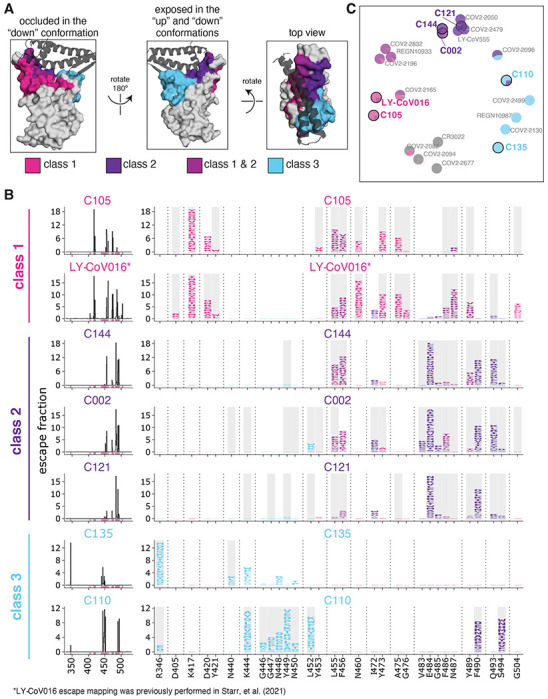
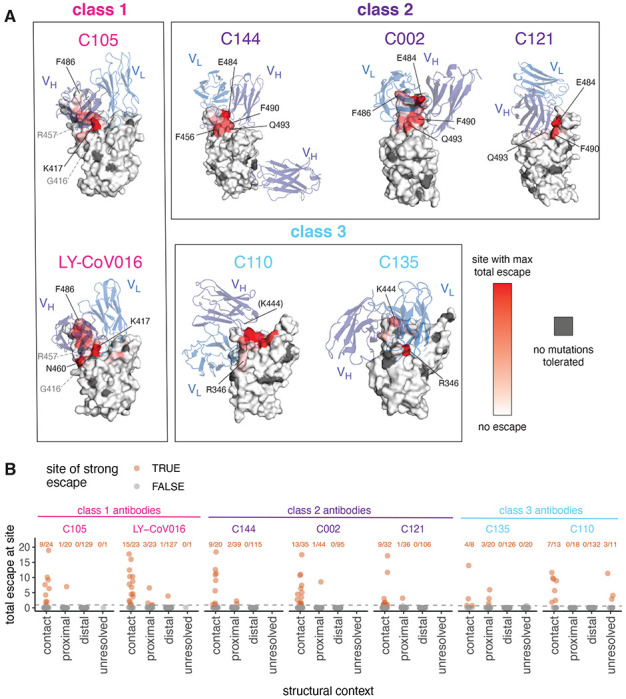
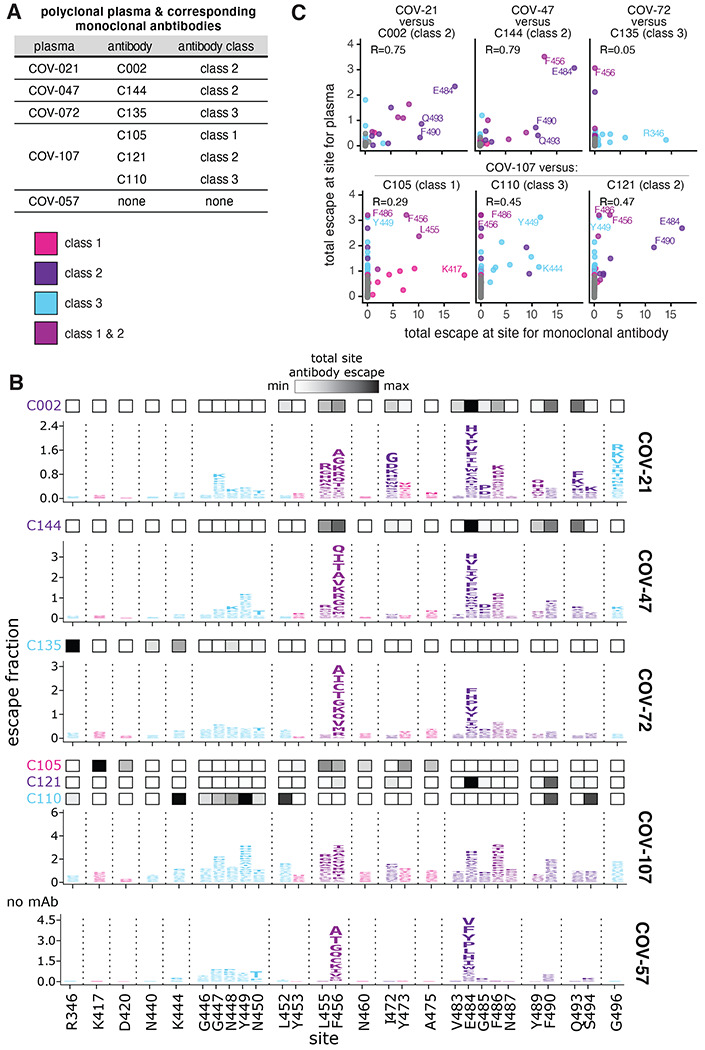
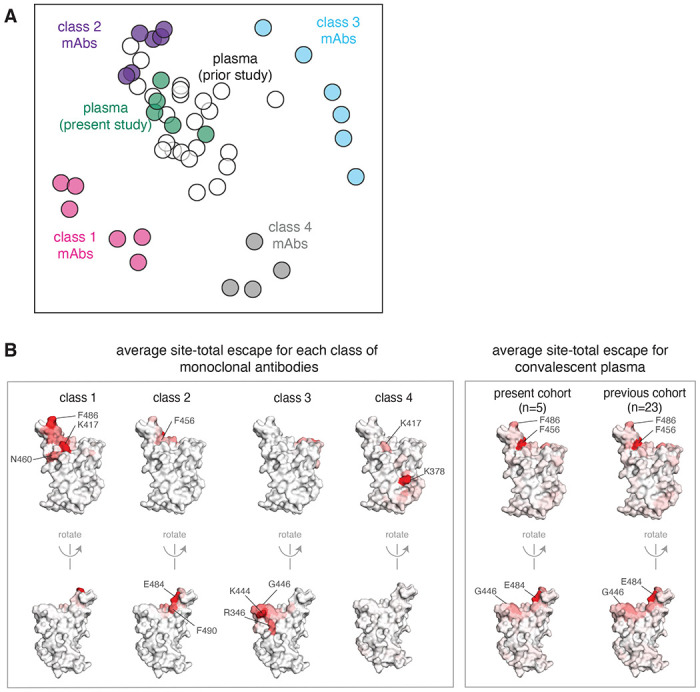
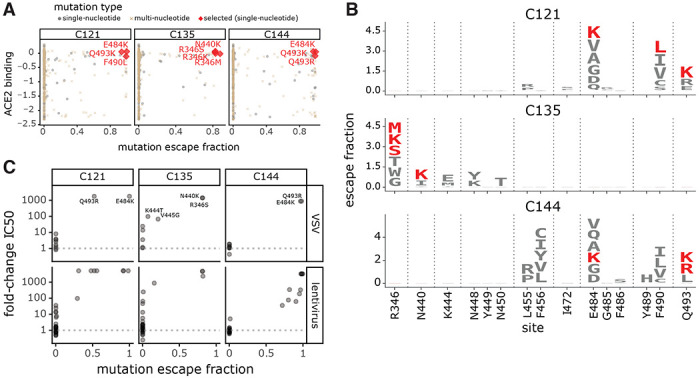
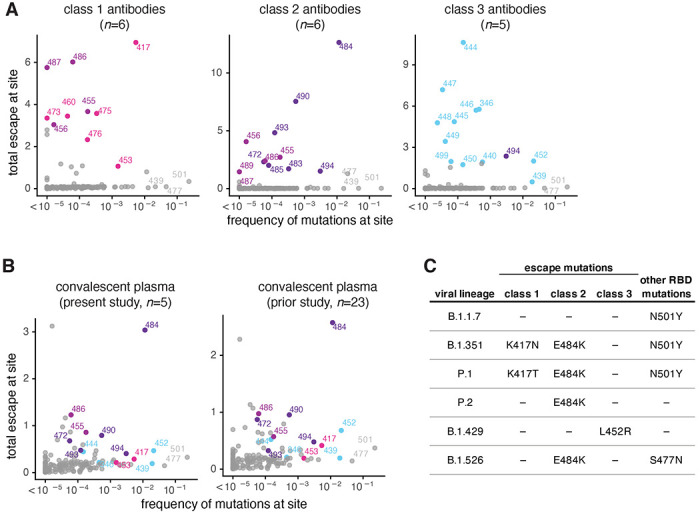
Monoclonal antibodies targeting a variety of epitopes have been isolated from individuals previously infected with SARS-CoV-2, but the relative contributions of these different antibody classes to the polyclonal response remains unclear. Here we use a yeast-display system to map all mutations to the viral spike receptor-binding domain (RBD) that escape binding by representatives of three potently neutralizing classes of anti-RBD antibodies with high-resolution structures. We compare the antibody-escape maps to similar maps for convalescent polyclonal plasmas, including plasmas from individuals from whom some of the antibodies were isolated. While the binding of polyclonal plasma antibodies are affected by mutations across multiple RBD epitopes, the plasma-escape maps most resemble those of a single class of antibodies that target an epitope on the RBD that includes site E484. Therefore, although the human immune system can produce antibodies that target diverse RBD epitopes, in practice the polyclonal response to infection is skewed towards a single class of antibodies targeting an epitope that is already undergoing rapid evolution.
Overview
The claims and statistics of this paper haven’t been checked yet.
Run the check — free, no account needed. It reads the open-access text and checks the sources it cites.
Integrity signals
Registry
Cites
Statistics
Figures
Verification
Claims the paper makes
The claims and statistics of this paper haven’t been checked yet.
Run the check — free, no account needed. It reads the open-access text and checks the sources it cites.
Claims other papers make about this one
Each is checked against this paper’s own text: does it say what the citing paper says it does?
The source backs part of the claim, not all of it — or backs it for a different population, condition or comparison.
In the citing paper
“Mutations at F486 are associated with a reduction in neutralizing activity by class 1 (and some class 2) neutralizing antibodies and by polyclonal sera9–11.”
From Emergence of SARS-CoV-2 Omicron lineages BA.4 and BA.5 in South Africa (2022) · cites this paper as [9]
Experimental — accuracy not yet measuredIn the citing paper
“mutations at this position have been associated with a reduction in neutralization by monoclonal antibodies (particularly class 2 antibodies) and polyclonal sera9–11.”
From Emergence of SARS-CoV-2 Omicron lineages BA.4 and BA.5 in South Africa (2022) · cites this paper as [9]
Self-check
Percentages, sums and reported differences re-computed from the paper’s own numbers.
The self-check needs the paper’s full text.
Citations
Cites
MAFFT Multiple Sequence Alignment Software Version 7: Improvements in Performance and Usability
Katoh, K., & Standley, D. M. (2013) · Molecular Biology and Evolution · doi:10.1093/molbev/mst010 · Cited by 46,209
Structure of the SARS-CoV-2 spike receptor-binding domain bound to the ACE2 receptor
Lan, J., Ge, J., Yu, J., Shan, S., Zhou, H., Fan, S., Zhang, Q., Shi, X., Wang, Q., Zhang, L., et al. (2020) · Nature · doi:10.1038/s41586-020-2180-5 · Cited by 5,983
Letko, M., Marzi, A., & Munster, V. (2020) · Nature Microbiology · doi:10.1038/s41564-020-0688-y · Cited by 3,109
Detection of a SARS-CoV-2 variant of concern in South Africa
Tegally, H., Wilkinson, E., Giovanetti, M., Iranzadeh, A., Fonseca, V., Giandhari, J., Doolabh, D., Pillay, S., San, E. J., Msomi, N., et al. (2021) · Nature · doi:10.1038/s41586-021-03402-9 · Cited by 2,510
Antibody Resistance of SARS-CoV-2 Variants B.1.351 and B.1.1.7
Wang, P., Nair, M. S., Liu, L., Iketani, S., Luo, Y., Guo, Y., Wang, M., Yu, J., Zhang, B., Kwong, P. D., et al. (2021) · doi:10.1101/2021.01.25.428137 · Cited by 2,328
Antibody resistance of SARS-CoV-2 variants B.1.351 and B.1.1.7
Wang, P., Nair, M. S., Liu, L., Iketani, S., Luo, Y., Guo, Y., Wang, M., Yu, J., Zhang, B., Kwong, P. D., et al. (2021) · Nature · doi:10.1038/s41586-021-03398-2 · Cited by 2,312
Bio3d: an R package for the comparative analysis of protein structures
Grant, B. J., Rodrigues, A. P. C., ElSawy, K. M., McCammon, J. A., & Caves, L. S. D. (2006) · Bioinformatics · doi:10.1093/bioinformatics/btl461 · Cited by 2,005
Starr, T. N., Greaney, A. J., Hilton, S. K., Ellis, D., Crawford, K. H. D., Dingens, A. S., Navarro, M. J., Bowen, J. E., Tortorici, M. A., Walls, A. C., et al. (2020) · Cell · doi:10.1016/j.cell.2020.08.012 · Cited by 1,956
Self-citationData, disease and diplomacy: GISAID's innovative contribution to global health
Elbe, S., & Buckland‐Merrett, G. (2017) · Global Challenges · doi:10.1002/gch2.1018 · Cited by 1,928
Mapping the Antigenic and Genetic Evolution of Influenza Virus
Smith, D. J., Lapedes, A. S., de Jong, J. C., Bestebroer, T. M., Rimmelzwaan, G. F., Osterhaus, A. D. M. E., & Fouchier, R. A. M. (2004) · Science · doi:10.1126/science.1097211 · Cited by 1,868
Research works printed but not linked: 1
- Chen, R. E. et al. Resistance of SARS-CoV-2 variants to neutralization by monoclonal and serum-derived polyclonal antibodies. Nat. Med. https://doi.org/10.1038/s41591-021-01294-w (2021). · DOI · Paper page
Cited by
Sorted by citations
Items 401–444 of 444
Screening-Identified Oxazole-4-Carboxamide KB-2777 Exhibits In Vitro Anti-Coronavirus Activity
Jung, B., Na, W., Yeom, M., Lim, J.-W., Do, H.-Q., Jang, G., Ban, M. K., Yang, J., Byun, Y., & Song, D. (2025) · Pharmaceutics · doi:10.3390/pharmaceutics17111477
Fan, C., Cohen, A. A., Dam, K.-M. A., Rorick, A. V., Fils, A.-C. I. P., Yang, Z., Gnanapragasam, P. N. P., Segovia, L. N., Huey‐Tubman, K. E., Moon, W. J., et al. (2025) · eLife · doi:10.7554/elife.108959.1
Innocenti, G., Obara, M., Costa, B., Jacobsen, H., Katzmarzyk, M., Čičin‐Šain, L., Kalinke, U., & Galardini, M. (2024) · Figshare · doi:10.6084/m9.figshare.26942604
Innocenti, G., Obara, M., Costa, B., Jacobsen, H., Katzmarzyk, M., Čičin‐Šain, L., Kalinke, U., & Galardini, M. (2024) · Figshare · doi:10.6084/m9.figshare.26942580
Sun, Y., Zhang, Y., Yu, H., Saint Fleur, A., Yu, D., Yang, Z., & Feng, H. (2023) · Figshare · doi:10.6084/m9.figshare.24196825
Innocenti, G., Obara, M., Costa, B., Jacobsen, H., Katzmarzyk, M., Čičin‐Šain, L., Kalinke, U., & Galardini, M. (2024) · Figshare · doi:10.6084/m9.figshare.26942583
Innocenti, G., Obara, M., Costa, B., Jacobsen, H., Katzmarzyk, M., Čičin‐Šain, L., Kalinke, U., & Galardini, M. (2024) · Figshare · doi:10.6084/m9.figshare.26942601
Innocenti, G., Obara, M., Costa, B., Jacobsen, H., Katzmarzyk, M., Čičin‐Šain, L., Kalinke, U., & Galardini, M. (2024) · Figshare · doi:10.6084/m9.figshare.26942598
Additional file 3 of Chronic shedding of a SARS-CoV-2 Alpha variant in wastewater
Conway, M. J., Yang, H., Revord, L. A., Novay, M. P., Lee, R. J., Ward, A. S., Abel, J. D., Williams, M. R., Uzarski, R. L., & Alm, E. W. (2024) · Figshare · doi:10.6084/m9.figshare.26667334
Innocenti, G., Obara, M., Costa, B., Jacobsen, H., Katzmarzyk, M., Čičin‐Šain, L., Kalinke, U., & Galardini, M. (2024) · Figshare · doi:10.6084/m9.figshare.26942607
Schröder, S., Richter, A., Veith, T., Emanuel, J., Gudermann, L., Friedmann, K., Jeworowski, L. M., Mühlemann, B., Jones, T. C., Müller, M. A., et al. (2024) · Figshare · doi:10.6084/m9.figshare.26637489
Innocenti, G., Obara, M., Costa, B., Jacobsen, H., Katzmarzyk, M., Čičin‐Šain, L., Kalinke, U., & Galardini, M. (2024) · Figshare · doi:10.6084/m9.figshare.26942595
Additional file 2 of Chronic shedding of a SARS-CoV-2 Alpha variant in wastewater
Conway, M. J., Yang, H., Revord, L. A., Novay, M. P., Lee, R. J., Ward, A. S., Abel, J. D., Williams, M. R., Uzarski, R. L., & Alm, E. W. (2024) · Figshare · doi:10.6084/m9.figshare.24995573
Innocenti, G., Obara, M., Costa, B., Jacobsen, H., Katzmarzyk, M., Čičin‐Šain, L., Kalinke, U., & Galardini, M. (2024) · Figshare · doi:10.6084/m9.figshare.26942610
Innocenti, G., Obara, M., Costa, B., Jacobsen, H., Katzmarzyk, M., Čičin‐Šain, L., Kalinke, U., & Galardini, M. (2024) · Figshare · doi:10.6084/m9.figshare.26942592
Innocenti, G., Obara, M., Costa, B., Jacobsen, H., Katzmarzyk, M., Čičin‐Šain, L., Kalinke, U., & Galardini, M. (2024) · Figshare · doi:10.6084/m9.figshare.26942577
Innocenti, G., Obara, M., Costa, B., Jacobsen, H., Katzmarzyk, M., Čičin‐Šain, L., Kalinke, U., & Galardini, M. (2024) · Figshare · doi:10.6084/m9.figshare.26942586
Additional file 1 of Chronic shedding of a SARS-CoV-2 Alpha variant in wastewater
Conway, M. J., Yang, H., Revord, L. A., Novay, M. P., Lee, R. J., Ward, A. S., Abel, J. D., Williams, M. R., Uzarski, R. L., & Alm, E. W. (2024) · Figshare · doi:10.6084/m9.figshare.24995498
Sun, Y., Zhang, Y., Yu, H., Saint Fleur, A., Yu, D., Yang, Z., & Feng, H. (2023) · Figshare · doi:10.6084/m9.figshare.24196822
Innocenti, G., Obara, M., Costa, B., Jacobsen, H., Katzmarzyk, M., Čičin‐Šain, L., Kalinke, U., & Galardini, M. (2024) · Figshare · doi:10.6084/m9.figshare.26942574
Innocenti, G., Obara, M., Costa, B., Jacobsen, H., Katzmarzyk, M., Čičin‐Šain, L., Kalinke, U., & Galardini, M. (2024) · Figshare · doi:10.6084/m9.figshare.26942589
Ayres, F., Lambson, B. E., Mkhize, N. N., Makhado, Z., Mhlanga, D., Serage, R., Moore, P. L., Wibmer, C. K., & Moyo-Gwete, T. (2026) · Structure · doi:10.1016/j.str.2026.01.006
Tsuji, I., Okada, K., Kroppen, B., Katta, T., Yamamura, K., Nishihama, T., Miura, A., Götzke, H., Crampon, E., & Bertolotti‐Ciarlet, A. (2026) · Antibodies · doi:10.3390/antib15020018
Kotzen, B., Gurev, S. F., Youssef, N., Jaimes, J. A., Luban, J., Marks, D. S., Seaman, M. S., & Lemieux, J. E. (2026) · bioRxiv (Cold Spring Harbor Laboratory) · doi:10.64898/2026.02.26.706090
“Of the ten mutations with the greatest effect, seven are in the RBD. Notably, three are at residue F486, a key residue for ACE-2 binding (11,15,34), one of the most exposed residues of the entire protein and a target of many antibodies (Figure 1E, Supplemental Figure S2) (12,14,15,18,19,21,22,34).”
Adversarial use of protein language models for modeling escape
Littlefield, S. B., & Campbell, R. H. (2025) · Annual Computer Security Applications Conference Workshops (ACSAC Workshops) · doi:10.1109/acsacw69556.2025.00024
“Finally, in Figure 4, we show the relationship between fitness scores and escape using biological data from Starr et al. [28] and Greaney et al. [29].”
Song, W., Wang, C., Xie, W., Li, Y., 陈开云, Song, W., & Jiang, T. (2026) · Viruses · doi:10.3390/v18030349
“It also poses a more formidable challenge to single-epitope broad-spectrum antibody strategies [23–25].”
Adaptive Ratchets and the Evolution of Molecular Complexity
Röschinger, T., Morán-Tovar, R., Pompei, S., & Lässig, M. (2026) · PRX Life · doi:10.1103/bhf2-3v22
Nguyen, H. L., Nguyen, T., Tran, L., & Li, M.-S. (2026) · RSC Advances · doi:10.1039/d5ra08084c
Fan, C., Cohen, A. A., Dam, K.-M. A., Rorick, A. V., Fils, A.-C. I. P., Yang, Z., Gnanapragasam, P. N. P., Segovia, L. N., Huey‐Tubman, K. E., Moon, W. J., et al. (2026) · eLife · doi:10.7554/elife.108959.2
Chittem, M. B., Cherukuri, V. N. S. K., Cheerapareddy, A. R., Pamulapati, S. M., Borra, P., Pappula, S., & Nagamani, S. (2026) · International Conference on Computing, Communication, Control and Cyber-Physical Systems (I5CPS) · doi:10.1109/i5cps67958.2026.11452600
“Subsequent studies applied DMS concepts to viral proteins, including analyses of antibody escape mutations in SARS-CoV-2, demonstrating how specific mutations can significantly alter immune recognition [2].”
Alshahrani, M., Gatlin, W., Ludwick, M., Turano, L., Foley, B., & Verkhivker, G. M. (2026) · bioRxiv (Cold Spring Harbor Laboratory) · doi:10.64898/2026.04.02.716254
Engineering nasally delivered IgM antibodies for respiratory viral infections
Ramesh, A. K., & An, Z. (2026) · hLife · doi:10.1016/j.hlife.2026.03.004
“Several key mutation sites have been identified in the RBD, which were directly responsible for immune escape [136,137].”
Deciphering the temporal and spatial mutation dynamics of the SARS-CoV-2 spike glycoprotein
Hasan, M., Chen, S., Jia, M., Leung, C. F. A., Xu, W., Chang, K. P., Kan, C. M., Yap, S., Yuan, B., Zhu, K., et al. (2026) · Physical Chemistry Chemical Physics · doi:10.1039/d5cp04811g
Scanning the horizon: deep mutational scanning approaches in virology
Dorman, J., Bakhache, W., & Dolan, P. (2026) · Journal of Virology · doi:10.1128/jvi.01784-25
“…most notable use of DMS to understand immune dynamics was during the COVID-19 pandemic, where DMS studies focused on the RBD and fusion peptide of SARS-CoV-2 spike protein to understand and anticipate mutations that alter viral protein function (36, 37) and evade antibody immunity (64, 122, 123).”
Liu, Z., Zuo, J., Li, Y., & Zu, J. (2026) · Lecture notes in computer science · doi:10.1007/978-981-92-3716-6_24
Design of Epitope-Focused Vaccines via Epitope Cleavage
Pham, D. M., Costello, R. M., Bruun, T. U. J., & Kim, P. S. (2026) · ACS Central Science · doi:10.1021/acscentsci.6c00476
Pollo, B. A. L., Perias, G. A. S., Aguimatang, R. H., Espiritu, A. P., Ching, D. S., Idolor, M. I., King, R. A., Climacosa, F. M. M., & Caoili, S. E. C. (2026) · Frontiers in Tropical Diseases · doi:10.3389/fitd.2026.1885784
Suryadevara, N., Zost, S. J., Powers, J. M., Dadonaite, B., Gilchuk, P., Binshtein, E., Scheaffer, S. M., Leist, S. R., Myers, L., Ravera, S., et al. (2026) · bioRxiv (Cold Spring Harbor Laboratory) · doi:10.64898/2026.08.15.745004
Self-citationShao, C., Fu, J., Deng, F., Yu, H., Fan, H., Chen, Y., Xu, K., Wei, M., 贾斯月, Jia, X., et al. (2026) · Microorganisms · doi:10.3390/microorganisms14091872
Alshahrani, M., Gatlin, W., Ludwick, M., Turano, L., Foley, B., & Verkhivker, G. M. (2026) · Physical Chemistry Chemical Physics · doi:10.1039/d6cp02673g
Upper respiratory tract CD8+ tissue-resident memory T cells protect against viral transmission
Michalets, S. E., Soto-Vázquez, Y., Moore, K. M., Williams, M. E. K., Saha, A., Jimenez, A. R., Huang, Y.-S., Lowen, A. C., Scharer, C. D., Swaims-Kohlmeier, A., et al. (2026) · The Journal of Experimental Medicine · doi:10.1084/jem.20252329
“…sterilizing immunity, respiratory virus infections such as SARS-CoV-2 and influenza have demonstrated the inadequacy of antibody-mediated immunity to provide broad protection against emerging and drifted viral variants (Cox et al., 2023; Doud et al., 2017; Greaney et al., 2021; Smith et al., 2004).”
Garba, A., Usman, S., & Hussaini, A. (2026) · Veterinary Immunology and Immunopathology · doi:10.1016/j.vetimm.2026.111213
Characterization of the SARS-CoV-2 Mu variant
Gordon, A., & Kawaoka, Y. (2024) · ImmPort · doi:10.21430/m3ak8n7kte
Metadata
- Authors
- Greaney, A. J., Starr, T. N., Barnes, C. O., Weisblum, Y., Schmidt, F., Caskey, M., Gaebler, C., Cho, A., Agudelo, M., Finkin, S., Wang, Z., Poston, D., Muecksch, F., Hatziioannou, T., Bieniasz, P. D., Robbiani, D. F., Nussenzweig, M. C., Bjorkman, P. J., & Bloom, J. D.
- Affiliations
- University of Washington (US)
- Howard Hughes Medical Institute (US)
- California Institute of Technology (US)
- Rockefeller University (US)
- Institute for Research in Biomedicine (CH)
- Corresponding author
- Bloom, Jesse D.
- ORCID
- Greaney, Allison J.
- Starr, Tyler N.
- Barnes, Christopher O.
- Weisblum, Yiska
- Schmidt, Fabian
- Caskey, Marina
- Gaebler, Christian
- Cho, Alice
- Agudelo, Marianna
- Finkin, Shlomo
- Wang, Zijun
- Poston, Daniel
- Muecksch, Frauke
- Hatziioannou, Theodora
- Bieniasz, Paul D.
- Robbiani, Davide F.
- Nussenzweig, Michel C.
- Bjorkman, Pamela J.
- Bloom, Jesse D.
- Venue
- Nature Communications
- Published
- 2021-07-07
- Volume
- 12
- Issue
- 1
- Pages
- 4196-4196
- ISSN
- 2041-1723 (ISSN-L)
- PMC
- PMC7987015
- OpenAlex
- W3179259355
- Cited by
- 433
- References
- 64
- Citations by year
- 2026: 34 · 2025: 39 · 2024: 56 · 2023: 83 · 2022: 157 · 2021: 64
- FWCI
- 29.43
- Type
- journal article
- Language
- en
- Open access
- gold
- doi.org
- Locations
- Nature Communications (publishedVersion, cc-by)
- bioRxiv (Cold Spring Harbor Laboratory) (acceptedVersion, cc-by)
- PubMed Central (publishedVersion, cc-by)
- PubMed (publishedVersion)
- PubMed Central (submittedVersion, cc-by)
- CaltechAUTHORS (California Institute of Technology) (submittedVersion, cc-by)
- RePEc: Research Papers in Economics (submittedVersion)
- DOAJ (DOAJ: Directory of Open Access Journals) (submittedVersion, cc-by-sa)
- Funders
- Howard Hughes Medical Institute
- Burroughs Wellcome Fund
- Bill and Melinda Gates Foundation (INV-004949)
- Damon Runyon Cancer Research Foundation (DRG-2381-19)
- Washington Research Foundation
- Fred Hutchinson Cancer Research Center
- George Mason University
- California Institute of Technology
- University of Washington
- National Institutes of Health (1s10od028685-01, P01-AI138398-S1, AI111825)
- Beckman Institute, California Institute of Technology
- National Institute of Allergy and Infectious Diseases (U01AI151698, P01 AI138398-S1, R01AI127893, T32AI083203, U19AI111825, R01AI141707, AI151698, F30AI157898)
- Office of Research Infrastructure Programs, National Institutes of Health (S10OD028685)
- Topics
- Health Sciences › Medicine › Infectious Diseases › SARS-CoV-2 and COVID-19 Research
- Life Sciences › Biochemistry, Genetics and Molecular Biology › Molecular Biology › vaccines and immunoinformatics approaches
- Life Sciences › Immunology and Microbiology › Immunology › Monoclonal and Polyclonal Antibodies Research
- Keywords
- SARS-CoV-2, spike protein receptor-binding domain, antibody escape mutations, neutralizing antibodies, monoclonal antibodies, convalescent plasma, antibody-antigen binding, epitope evolution
About these checks
Registry, retraction, Cites and statistics results are computed, not judged, with one exception: a printed reference that no index lists is read once by a model before it counts as a citation error. Claims are extracted by a model and kept only when their quote appears verbatim in the text; each cited source is then checked, with a model’s help, for whether it says what the claim relies on. Those verdicts can be wrong — read the claim’s quote and the cited source before relying on one.
Statistics and arithmetic are recomputed, not judged.
Confidence bands are shown only for fields calibrated on our annotated test set. None is calibrated yet, so no band is shown.
What counts as a claim ›How we measure confidence ›How we check this ›
Are you an author, or do you see a problem with this page? Request a review
