

The DOI matches its Crossref record; 76 of the 77 references it cites were found in a registry or an index, and 1 are not checked yet.
Mapping mutations to the SARS-CoV-2 RBD that escape binding by different classes of antibodies
Open accessPublished version of a preprint
Abstract
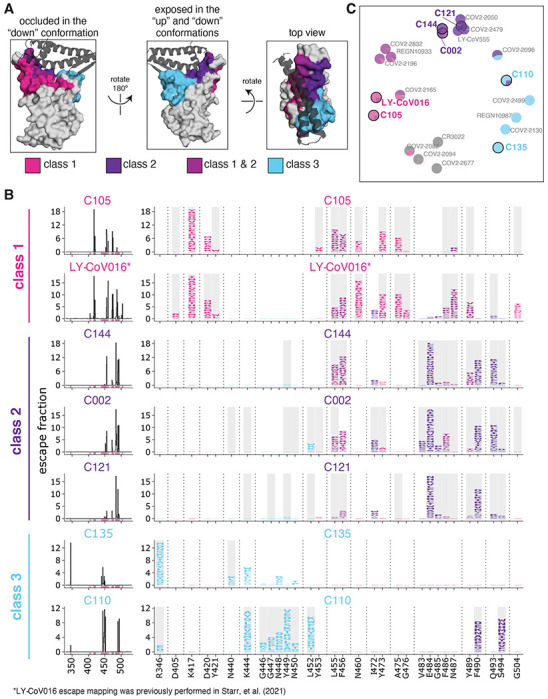
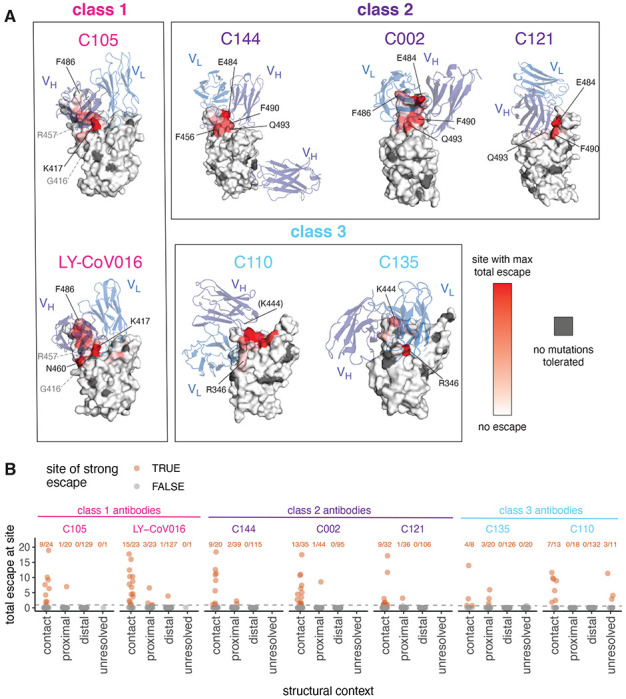
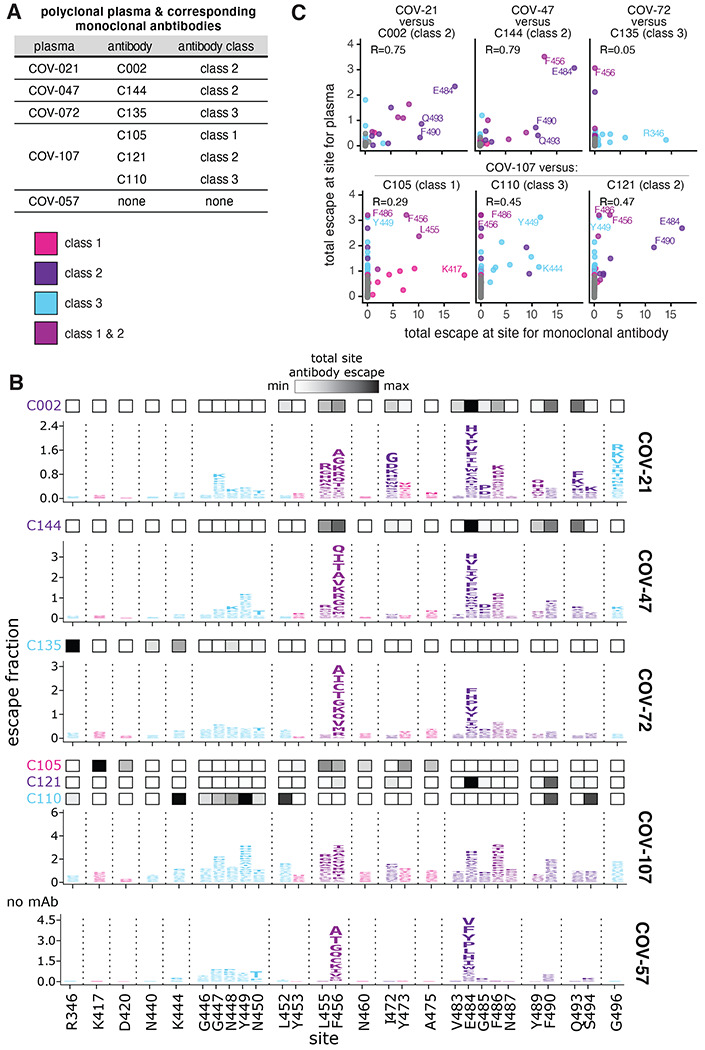
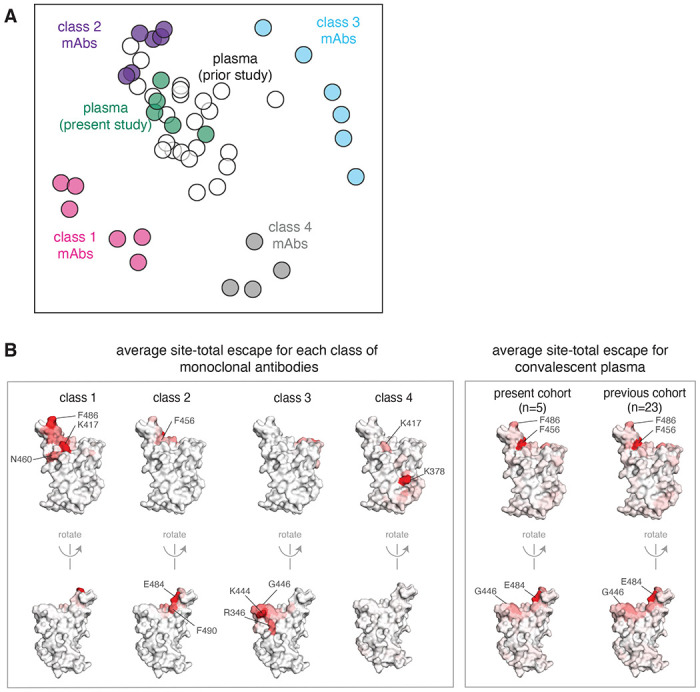
Monoclonal antibodies targeting a variety of epitopes have been isolated from individuals previously infected with SARS-CoV-2, but the relative contributions of these different antibody classes to the polyclonal response remains unclear. Here we use a yeast-display system to map all mutations to the viral spike receptor-binding domain (RBD) that escape binding by representatives of three potently neutralizing classes of anti-RBD antibodies with high-resolution structures. We compare the antibody-escape maps to similar maps for convalescent polyclonal plasmas, including plasmas from individuals from whom some of the antibodies were isolated. While the binding of polyclonal plasma antibodies are affected by mutations across multiple RBD epitopes, the plasma-escape maps most resemble those of a single class of antibodies that target an epitope on the RBD that includes site E484. Therefore, although the human immune system can produce antibodies that target diverse RBD epitopes, in practice the polyclonal response to infection is skewed towards a single class of antibodies targeting an epitope that is already undergoing rapid evolution.
Overview
The claims and statistics of this paper haven’t been checked yet.
Run the check — free, no account needed. It reads the open-access text and checks the sources it cites.
Integrity signals
Registry
Cites
Statistics
Figures
Verification
Claims the paper makes
The claims and statistics of this paper haven’t been checked yet.
Run the check — free, no account needed. It reads the open-access text and checks the sources it cites.
Claims other papers make about this one
Each is checked against this paper’s own text: does it say what the citing paper says it does?
In the citing paper
“mutations at this position have been associated with a reduction in neutralization by monoclonal antibodies (particularly class 2 antibodies) and polyclonal sera9–11.”
From Emergence of SARS-CoV-2 Omicron lineages BA.4 and BA.5 in South Africa (2022) · cites this paper as [9]
In the citing paper
“Mutations at F486 are associated with a reduction in neutralizing activity by class 1 (and some class 2) neutralizing antibodies and by polyclonal sera9–11.”
From Emergence of SARS-CoV-2 Omicron lineages BA.4 and BA.5 in South Africa (2022) · cites this paper as [9]
Self-check
Percentages, sums and reported differences re-computed from the paper’s own numbers.
The self-check needs the paper’s full text.
Citations
Cites
MAFFT Multiple Sequence Alignment Software Version 7: Improvements in Performance and Usability
Katoh, K., & Standley, D. M. (2013) · Molecular Biology and Evolution · doi:10.1093/molbev/mst010 · Cited by 46,209
Structure of the SARS-CoV-2 spike receptor-binding domain bound to the ACE2 receptor
Lan, J., Ge, J., Yu, J., Shan, S., Zhou, H., Fan, S., Zhang, Q., Shi, X., Wang, Q., Zhang, L., et al. (2020) · Nature · doi:10.1038/s41586-020-2180-5 · Cited by 5,983
Letko, M., Marzi, A., & Munster, V. (2020) · Nature Microbiology · doi:10.1038/s41564-020-0688-y · Cited by 3,109
Detection of a SARS-CoV-2 variant of concern in South Africa
Tegally, H., Wilkinson, E., Giovanetti, M., Iranzadeh, A., Fonseca, V., Giandhari, J., Doolabh, D., Pillay, S., San, E. J., Msomi, N., et al. (2021) · Nature · doi:10.1038/s41586-021-03402-9 · Cited by 2,510
Antibody Resistance of SARS-CoV-2 Variants B.1.351 and B.1.1.7
Wang, P., Nair, M. S., Liu, L., Iketani, S., Luo, Y., Guo, Y., Wang, M., Yu, J., Zhang, B., Kwong, P. D., et al. (2021) · doi:10.1101/2021.01.25.428137 · Cited by 2,328
Antibody resistance of SARS-CoV-2 variants B.1.351 and B.1.1.7
Wang, P., Nair, M. S., Liu, L., Iketani, S., Luo, Y., Guo, Y., Wang, M., Yu, J., Zhang, B., Kwong, P. D., et al. (2021) · Nature · doi:10.1038/s41586-021-03398-2 · Cited by 2,312
Bio3d: an R package for the comparative analysis of protein structures
Grant, B. J., Rodrigues, A. P. C., ElSawy, K. M., McCammon, J. A., & Caves, L. S. D. (2006) · Bioinformatics · doi:10.1093/bioinformatics/btl461 · Cited by 2,005
Starr, T. N., Greaney, A. J., Hilton, S. K., Ellis, D., Crawford, K. H. D., Dingens, A. S., Navarro, M. J., Bowen, J. E., Tortorici, M. A., Walls, A. C., et al. (2020) · Cell · doi:10.1016/j.cell.2020.08.012 · Cited by 1,956
Self-citationData, disease and diplomacy: GISAID's innovative contribution to global health
Elbe, S., & Buckland‐Merrett, G. (2017) · Global Challenges · doi:10.1002/gch2.1018 · Cited by 1,928
Mapping the Antigenic and Genetic Evolution of Influenza Virus
Smith, D. J., Lapedes, A. S., de Jong, J. C., Bestebroer, T. M., Rimmelzwaan, G. F., Osterhaus, A. D. M. E., & Fouchier, R. A. M. (2004) · Science · doi:10.1126/science.1097211 · Cited by 1,868
Research works printed but not linked: 1
- Chen, R. E. et al. Resistance of SARS-CoV-2 variants to neutralization by monoclonal and serum-derived polyclonal antibodies. Nat. Med. https://doi.org/10.1038/s41591-021-01294-w (2021). · DOI · Paper page
Cited by
Sorted by citations
Items 101–200 of 444
Lusvarghi, S., Wang, W., Herrup, R., Neerukonda, S. N., Vassell, R. A., Bentley, L., Eakin, A. E., Erlandson, K. J., & Weiss, C. D. (2021) · Journal of Virology · doi:10.1128/jvi.01110-21 · Cited by 33
Characterization of the SARS-CoV-2 B.1.621 (Mu) variant
Halfmann, P., Kuroda, M., Armbrust, T., Theiler, J. P., Balaram, A., Moreno, G. K., Accola, M. A., Iwatsuki‐Horimoto, K., Valdez, R., Stoneman, E. K., et al. (2022) · Science Translational Medicine · doi:10.1126/scitranslmed.abm4908 · Cited by 35
“The R346K mutation, categorized as a Barnes class III-type antibody site, and the E484K mutation, categorized as a Barnes class II-type antibody site, may lead to reduced antibody recognition of the receptor-binding domain of the B.1.621 spike protein ( 8 ).”
InfluentialReversal of the unique Q493R mutation increases the affinity of Omicron S1-RBD for ACE2
Philip, A. M., Ahmed, W. S., & Biswas, K. H. (2023) · Computational and Structural Biotechnology Journal · doi:10.1016/j.csbj.2023.02.019 · Cited by 35
“…that the loss of two charged residues due to the K417N and E484A mutations in Omicron variant S1-RBD, which might have a role to play in immune escape [68–70], could minimally impact its interaction with ACE2 as these residues do not appear to be involved in salt-bridge formation in the WT complex.”
Insights on the mutational landscape of the SARS-CoV-2 Omicron variantPreprint
Miller, N. L., Clark, T., Raman, R., & Sasisekharan, R. (2021) · bioRxiv (Cold Spring Harbor Laboratory) · doi:10.1101/2021.12.06.471499 · Cited by 35
Omicron: a drug developer’s perspective
Fang, F., & Shi, P. (2021) · Emerging Microbes & Infections · doi:10.1080/22221751.2021.2023330 · Cited by 34
“? E484A In the class 2 neutralizing epitope [7].”
BackgroundInfluentialCassaniti, I., Bergami, F., Percivalle, E., Gabanti, E., Sammartino, J. C., Ferrari, A., Adzasehoun, K. M. G., Zavaglio, F., Zelini, P., Comolli, G., et al. (2021) · Clinical Microbiology and Infection · doi:10.1016/j.cmi.2021.09.016 · Cited by 36
Maltseva, M., Keeshan, A., Cooper, C., & Langlois, M. (2024) · Human Vaccines & Immunotherapeutics · doi:10.1080/21645515.2024.2384192 · Cited by 34
The SARS-CoV-2 Delta variant is poised to acquire complete resistance to wild-type spike vaccinesPreprint
Liu, Y., Arase, N., Kishikawa, J.-I., Hirose, M., Li, S., Tada, A., Matsuoka, S., Arakawa, A., Akamatsu, K., Ono, C., et al. (2021) · bioRxiv (Cold Spring Harbor Laboratory) · doi:10.1101/2021.08.22.457114 · Cited by 31
“The Delta variant has already acquired large numbers of additional mutations in the RBD, some of which occur in epitopes for anti-RBD neutralizing antibodies (Greaney et al., 2021a; Greaney et al., 2021b; Greaney et al., 2021c; Wang et al., 2021b; Weisblum et al., 2020).”
BackgroundInferring effects of mutations on SARS-CoV-2 transmission from genomic surveillance data
Lee, B., Quadeer, A. A., Sohail, M. S., Finney, E., Ahmed, S. F., McKay, M. R., & Barton, J. P. (2025) · Nature Communications · doi:10.1038/s41467-024-55593-0 · Cited by 32
Iron dysregulation in COVID‐19 and reciprocal evolution of SARS‐CoV‐2: Natura nihil frustra facit
Gupta, Y., Maciorowski, D., Medernach, B., Becker, D. P., Durvasula, R., Libertin, C. R., & Kempaiah, P. (2022) · Journal of Cellular Biochemistry · doi:10.1002/jcb.30207 · Cited by 33
Cotten, M. L., & Phan, M. V. T. (2023) · iScience · doi:10.1016/j.isci.2023.106230 · Cited by 31
Mutation informatics: SARS-CoV-2 receptor-binding domain of the spike protein
Verma, S. K., Patil, V. M., & Gupta, M. (2022) · Drug Discovery Today · doi:10.1016/j.drudis.2022.06.012 · Cited by 31
Rak, A. Y., Donina, S., Zabrodskaya, Y. A., Георгиевна, Р. Л., & Николаевна, И.-С. И. (2022) · Viruses · doi:10.3390/v14092041 · Cited by 30
Structural basis of broad SARS-CoV-2 cross-neutralization by affinity-matured public antibodies
Sheward, D. J., Pushparaj, P., Das, H., Greaney, A. J., Kim, C., Kim, S., Hanke, L., Hyllner, E., Dyrdak, R., Lee, J., et al. (2024) · Cell Reports Medicine · doi:10.1016/j.xcrm.2024.101577 · Cited by 31
Self-citationAnatomy of Omicron BA.1 and BA.2 neutralizing antibodies in COVID-19 mRNA vaccinees
Andreano, E., Paciello, I., Marchese, S., Donnici, L., Pierleoni, G., Piccini, G., Manganaro, N., Pantano, E., Abbiento, V., Pileri, P., et al. (2022) · Nature Communications · doi:10.1038/s41467-022-31115-8 · Cited by 30
A structure-function analysis shows SARS-CoV-2 BA.2.86 balances antibody escape and ACE2 affinity
Liu, C., Zhou, D., Dijokaite-Guraliuc, A., Supasa, P., Duyvesteyn, H. M. E., Ginn, H. M., Selvaraj, M., Mentzer, A. J., Das, R., de Silva, T. I., et al. (2024) · Cell Reports Medicine · doi:10.1016/j.xcrm.2024.101553 · Cited by 28
Structural basis of Omicron neutralization by affinity-matured public antibodiesPreprint
Sheward, D. J., Pushparaj, P., Das, H., Kim, C., Kim, S., Hanke, L., Dyrdak, R., McInerney, G. M., Albert, J., Murrell, B., et al. (2022) · bioRxiv (Cold Spring Harbor Laboratory) · doi:10.1101/2022.01.03.474825 · Cited by 27
Tsai, K., Lee, Y.-C., & Tseng, T.-S. (2021) · Frontiers in Microbiology · doi:10.3389/fmicb.2021.698365 · Cited by 32
Tuccori, M., Convertino, I., Ferraro, S., Valdiserra, G., Cappello, E., Fini, E., & Focosi, D. (2021) · Expert Opinion on Drug Discovery · doi:10.1080/17460441.2021.1960819 · Cited by 27
López-Morales, J., Vanella, R., Appelt, E. A., Whillock, S., Paulk, A. M., Shusta, E. V., Hackel, B. J., Liu, C. C., & Nash, M. A. (2023) · Small Science · doi:10.1002/smsc.202300095 · Cited by 28
Mapping the neutralizing specificity of human anti-HIV serum by deep mutational scanning
Radford, C. E., Schommers, P., Gieselmann, L., Crawford, K. H. D., Dadonaite, B., Yu, T. C., Dingens, A. S., Overbaugh, J. M., Klein, F., & Bloom, J. D. (2023) · Cell Host & Microbe · doi:10.1016/j.chom.2023.05.025 · Cited by 28
Self-citationShooting at a Moving Target—Effectiveness and Emerging Challenges for SARS-CoV-2 Vaccine Development
Günl, F., Mecate-Zambrano, A., Rehländer, S., Hinse, S., Ludwig, S., & Brunotte, L. (2021) · Vaccines · doi:10.3390/vaccines9101052 · Cited by 27
“2 variants has also been reported to reduce ACE2 receptor binding but confers immune escape to certain class 1 and class 3 antibodies [56,64,65,67].”
BackgroundDesigned mosaic nanoparticles enhance cross-reactive immune responses in mice
Wang, E. J. D., Cohen, A. A., Caldera, L. F., Keeffe, J. R., Rorick, A. V., Adia, Y. M., Gnanapragasam, P. N. P., Björkman, P. J., & Chakraborty, A. K. (2025) · Cell · doi:10.1016/j.cell.2024.12.015 · Cited by 29
Ouyang, W. O., Tan, T. J. C., Lei, R., Song, G., Kieffer, C., Andrabi, R., Matreyek, K. A., & Wu, N. C. (2022) · Science Advances · doi:10.1126/sciadv.add7221 · Cited by 27
Lubin, J. H., Markosian, C., Balamurugan, D., Ma, M. T., Chen, C.-H., Liu, D., Pasqualini, R., Arap, W., Burley, S. K., & Khare, S. D. (2023) · JCI Insight · doi:10.1172/jci.insight.168296 · Cited by 26
Carr, C. R., Crawford, K. H. D., Murphy, M., Galloway, J., Haddox, H. K., Matsen, F. A., IV, Andersen, K. G., King, N. P., & Bloom, J. D. (2024) · Immunity · doi:10.1016/j.immuni.2024.06.013 · Cited by 29
Self-citationStructural Biology of Nanobodies against the Spike Protein of SARS-CoV-2
Tang, Q., Owens, R. J., & Naismith, J. H. (2021) · Viruses · doi:10.3390/v13112214 · Cited by 24
“The beta variant [6] of SARS-CoV-2 carries amongst other changes a mutation at E484.”
BackgroundInfluentialMcLeod, D. V., & Gandon, S. (2022) · Nature Ecology & Evolution · doi:10.1038/s41559-022-01709-y · Cited by 26
Greaney, A. J., Eguia, R. T., Starr, T. N., Khan, K., Franko, N., Logue, J. K., Lord, S. M., Speake, C., Chu, H. Y., Sigal, A., et al. (2022) · PLoS Pathogens · doi:10.1371/journal.ppat.1010592 · Cited by 29
Self-citationLenart, K., Cerveira, R. A., Hellgren, F., Ols, S., Sheward, D. J., Kim, C., Cagigi, A., Gagné, M., Davis, B. J., Germosen, D., et al. (2024) · npj Vaccines · doi:10.1038/s41541-024-00806-2 · Cited by 26
“While the third immunization further increased SHM and antibody avidity, major af fi nity maturation can be attributed to the fi rst booster dose as evident by the progressive increase in S antibody avidity between weeks 6 and 35.”
Computationally designed proteins mimic antibody immune evasion in viral evolution
Youssef, N., Gurev, S. F., Ghantous, F., Brock, K. P., Jaimes, J. A., Thadani, N. N., Dauphin, A., Sherman, A. C., Yurkovetskiy, L., Soto, D., et al. (2025) · Immunity · doi:10.1016/j.immuni.2025.04.015 · Cited by 34
Kramer, K. J., Johnson, N. V., Shiakolas, A. R., Suryadevara, N., Periasamy, S., Raju, N., Williams, J. K., Wrapp, D., Zost, S. J., Walker, L. M., et al. (2021) · Cell Reports · doi:10.1016/j.celrep.2021.109784 · Cited by 25
Can the SARS-CoV-2 Spike Protein Bind Integrins Independent of the RGD Sequence?
Beaudoin, C. A., Hamaia, S. W., Huang, C. L.-H., Blundell, T. L., & Jackson, A. P. (2021) · Frontiers in Cellular and Infection Microbiology · doi:10.3389/fcimb.2021.765300 · Cited by 25
“Mutations have been suggested to increase affinity for ACE2 or to prevent recognition by neutralizing antibodies (Armijos-Jaramillo et al., 2020; Greaney et al., 2021).”
BackgroundLi, R., Mor, M., Ma, B., Clark, A. E., Alter, J., Werbner, M., Lee, J. C., Leibel, S. L., Carlin, A. F., Dessau, M., et al. (2022) · Communications Biology · doi:10.1038/s42003-022-03739-5 · Cited by 25
Antibody-mediated immunity to SARS-CoV-2 spike
Errico, J. M., Adams, L. J., & Fremont, D. H. (2022) · Advances in immunology · doi:10.1016/bs.ai.2022.07.001 · Cited by 22
“Besides ACE2 blockade, these mAbs are distinguished from their non-ACE2 blocking counterparts by recognition of residues closer to the RBM (G404-K417, encoding the α4-helix and subsequent loop) ( Jette et al., 2021; Yuan et al., 2021) (Fig.”
InfluentialJu, B., Fan, Q., Liu, C., Shen, S., Wang, M., Guo, H., Zhou, B., Ge, X., & Zhang, Z. (2023) · Cell Reports · doi:10.1016/j.celrep.2023.112532 · Cited by 23
“Greaney and colleagues have been mapped that class 1 nAbs might be escaped by mutations to N460 and F486 sites using a yeast-display system.(48) Here, we performed further functional verification of N460K and F486V/S mutations causing the enhanced neutralization resistances of SARSCoV-2 Omicron subvariants to VacBB-55…”
Challenges and Progress in Designing Broad-Spectrum Vaccines Against Rapidly Mutating Viruses
Bedi, R., Bayless, N. L., & Glanville, J. (2023) · Annual Review of Biomedical Data Science · doi:10.1146/annurev-biodatasci-020722-041304 · Cited by 26
Mosaic RBD nanoparticle elicits immunodominant antibody responses across sarbecoviruses
Liu, C., Xu, S., Zheng, Y., Xie, Y., Xu, K., Chai, Y., Luo, T., Dai, L., & Gao, G. F. (2024) · Cell Reports · doi:10.1016/j.celrep.2024.114235 · Cited by 24
Reading the repertoire: Progress in adaptive immune receptor analysis using machine learning
O’Donnell, T. J., Kanduri, C., Isacchini, G., Limenitakis, J. P., Brachman, R. A., Alvarez, R. A., Haff, I. H., Sandve, G. K., & Greiff, V. (2024) · Cell Systems · doi:10.1016/j.cels.2024.11.006 · Cited by 24
Rapid identification of neutralizing antibodies against SARS-CoV-2 variants by mRNA display
Tanaka, S., Olson, C. A., Barnes, C. O., Higashide, W., Gonzalez, M. R., Taft, J. D., Richardson, A., Martín-Fernández, M., Bogunovic, D., Gnanapragasam, P. N. P., et al. (2022) · Cell Reports · doi:10.1016/j.celrep.2022.110348 · Cited by 20
“Structural characterization of S1-specific antibodies N-612-014 and N-612-004 The primary target of SARS-CoV-2 nAbs is the viral S glycoprotein, with the majority of nAbs targeting the RBD C (Greaney et al., 2021a; Piccoli et al., 2020).”
Self-citationSARS-CoV-2 antibodies recognize 23 distinct epitopic sites on the receptor binding domain
Jiang, J., Boughter, C. T., Ahmad, J., Natarajan, K., Boyd, L. F., Meier-Schellersheim, M., & Margulies, D. H. (2023) · Communications Biology · doi:10.1038/s42003-023-05332-w · Cited by 24
de Campos‐Mata, L., Trinité, B., Modrego, A., Vaquero, S. T., Pradenas, E., Pons-Grífols, A., Melero, N. R., Carlero, D., Marfil, S., Santiago, C. A., et al. (2024) · Nature Communications · doi:10.1038/s41467-024-45171-9 · Cited by 24
“Inter-estingly, D420 has been recently identi fi ed by mutagenesis as a potentialsiteforescapingneutralizationbysomeclass1antibodies 35,36 .”
Karim, F., Riou, C., Bernstein, M. P., Jule, Z., Lustig, G., van Graan, S., Keeton, R., Upton, J., Ganga, Y., Khan, K., et al. (2024) · Nature Communications · doi:10.1038/s41467-024-46673-2 · Cited by 26
Zhang, L., Poorbaugh, J., Dougan, M. L., Chen, P., Gottlieb, R., Huhn, G. D., Beasley, S., Daniels, M., Trinh, T. N. V., Crisp, M., et al. (2021) · Frontiers in Immunology · doi:10.3389/fimmu.2021.790469 · Cited by 25
“Other groups have found that the polyclonal immune response for some individuals has at least a proportion that is directed at the E484 position (32).”
BackgroundBeeraka, N. M., Sukocheva, O. A., Lukina, E., Liu, J., & Fan, R. (2022) · Reviews in Medical Virology · doi:10.1002/rmv.2346 · Cited by 23
“immune system were shown to bind to the several RBD sites that are undergoing intense evolutionary changes.(149) Therefore, current RBD‐targeting antibodies alone may not provide an efficient protection from the virus.”
BackgroundMatsui, Y., Li, L., Prahl, M. K., Cassidy, A. G., Özarslan, N., Golan, Y., Gonzalez, V. J., Lin, C. Y., Jigmeddagva, U., Chidboy, M. A., et al. (2022) · JCI Insight · doi:10.1172/jci.insight.157354 · Cited by 23
“The E484K mutation can most strongly disrupt the binding of the class 2 Abs, whereas L452R is located in the class 3 site (40).”
Expanding and improving nanobody repertoires using a yeast display method: Targeting SARS-CoV-2
Cross, F. R., Fridy, P. C., Ketaren, N. E., Mast, F. D., Li, S., Olivier, J. P., Pecani, K., Chait, B. T., Aitchison, J. D., & Rout, M. P. (2023) · Journal of Biological Chemistry · doi:10.1016/j.jbc.2023.102954 · Cited by 21
“We wanted to evaluate the utility of yeast display for analyzing the sensitivity of our nanobody repertoire to these variants, focusing on the RBD domain as it is the region of largest mutational variation (50, 51) and the 7704 animal as it has the largest representation.”
Breakthrough Infections of E484K-Harboring SARS-CoV-2 Delta Variant, Lombardy, Italy
Baj, A., Novazzi, F., Pasciuta, R., Genoni, A. P., Ferrante, F. D., Valli, M., Partenope, M., Tripiciano, R., Ciserchia, A., Catanoso, G., et al. (2021) · Emerging infectious diseases · doi:10.3201/eid2712.211792 · Cited by 21
Tang, J., Grubbs, G., Lee, Y., Huang, C., Ravichandran, S., Forgacs, D., Golding, H., Ross, T. M., & Khurana, S. (2021) · EBioMedicine · doi:10.1016/j.ebiom.2021.103748 · Cited by 20
Bozdaganyan, M. E., Sokolova, O. S., Шайтан, К. В., Kirpichnikov, M. P., & Orekhov, P. S. (2022) · Viruses · doi:10.3390/v14020295 · Cited by 20
“The observed increase in variability of three epitopes overlapping with the ACE2 interface may result from the epistatic effects [57] of some RBD variants [58], which became widespread in the population du ing la e 2020 and allowed for the fixation of ot rwis compromised mutations.”
BackgroundMakowski, E. K., Schardt, J. S., Smith, M. D., & Tessier, P. M. (2022) · PLoS Computational Biology · doi:10.1371/journal.pcbi.1010160 · Cited by 20
“Furthermore, recent impressive studies have employed RBD libraries displayed on yeast to map RBD mutations that escape binding to i) clinical monoclonal antibodies (LY-CoV555) and antibody cocktails (Ly-CoV555 and LyCoV016) [31], and ii) monoclonal antibodies specific for distinct RBD epitopes [32].”
Epitope mapping via in vitro deep mutational scanning methods and its applications
Keen, M. M., Keith, A. D., & Ortlund, E. A. (2024) · Journal of Biological Chemistry · doi:10.1016/j.jbc.2024.108072 · Cited by 20
Rapid genome sequencing in hospitals to identify potential vaccine-escape SARS-CoV-2 variants
Snell, L. B., Cliff, P. R., Charalampous, T., Alcolea-Medina, A., Ebie, S. A. R. T., Sehmi, J. K., Flaviani, F., Batra, R., Douthwaite, S. T., Edgeworth, J. D., et al. (2021) · The Lancet Infectious Diseases · doi:10.1016/s1473-3099(21)00482-5 · Cited by 20
Verkhivker, G. M., Agajanian, S., Kassab, R., & Krishnan, K. (2022) · International Journal of Molecular Sciences · doi:10.3390/ijms231911542 · Cited by 18
Structural basis of nanobodies neutralizing SARS-CoV-2 variants
Shi, Z., Li, X., Wang, L., Sun, Z., Zhang, H., Chen, X., Cui, Q., Qiao, H., Lan, Z., Zhang, X., et al. (2022) · Structure · doi:10.1016/j.str.2022.02.011 · Cited by 19
“They found that the most prominent emerging viral lineages include K417T/N, E484K/Q, L452R, N501Y, S477N, and T478K mutations (Figure 3A) (Greaney et al., 2021).”
BackgroundHuffman, A., Ong, E., Hur, J., D’Mello, A., Tettelin, H., & He, Y. O. (2022) · Briefings in Bioinformatics · doi:10.1093/bib/bbac190 · Cited by 20
Chang, M., Ke, H., Coherd, C. D., Wang, Y., Mashima, K., Kastrunes, G. M., Huang, C., & Marasco, W. A. (2022) · EBioMedicine · doi:10.1016/j.ebiom.2022.104025 · Cited by 20
“39,40 The importance of escaped RBD immunity compared to full-length spike immunity is exemplified in work published by Garcia-Beltran et al. who utilized pseudovi-rus neutralization assays to demonstrate that the neutralization resistance of Beta is mainly due to mutations in the RBD and not…”
Maponga, T. G., Jeffries, M., Tegally, H., Sutherland, A. D., Wilkinson, E., Lessells, R. J., Msomi, N., van Zyl, G. U., de Oliveira, T., & Preiser, W. (2022) · SSRN Electronic Journal · doi:10.2139/ssrn.4014499 · Cited by 19
SARS-CoV-2: The Interplay Between Evolution and Host Immunity
Case, J. B., Jain, S., Suthar, M. S., & Diamond, M. (2024) · Annual Review of Immunology · doi:10.1146/annurev-immunol-083122-043054 · Cited by 26
“While K417T/N mutations escape some Class 1 antibodies, the effects on polyclonal serum antibody binding and neutralization were modest (185, 186, 192–194).”
Upadhyay, V., Patrick, C., Lucas, A., & Mallela, K. M. G. (2022) · Biochemistry · doi:10.1021/acs.biochem.2c00132 · Cited by 17
Chakraborty, C., Bhattacharya, M., Sharma, A. R., Dhama, K., & Agoramoorthy, G. (2022) · GeroScience · doi:10.1007/s11357-022-00631-2 · Cited by 20
“Notably, some mutations in the spike-glycoprotein are responsible for antibody escape, especially mutations in the RBD region [33, 34].”
BackgroundDefining and Studying B Cell Receptor and TCR Interactions
Rappazzo, C. G., Fernández‐Quintero, M. L., Mayer, A., Wu, N. C., Greiff, V., & Guthmiller, J. J. (2023) · The Journal of Immunology · doi:10.4049/jimmunol.2300136 · Cited by 18
Advancing Antibody Engineering through Synthetic Evolution and Machine Learning
Irvine, E. B., & Reddy, S. T. (2024) · The Journal of Immunology · doi:10.4049/jimmunol.2300492 · Cited by 18
Vanhove, B., Marot, S., So, R. T. Y., Gaborit, B. J., Evanno, G., Malet, I., Lafrogne, G., Mevel, E., Ciron, C., Royer, P., et al. (2021) · Frontiers in Immunology · doi:10.3389/fimmu.2021.761250 · Cited by 20
Comparative structural analyses of selected spike protein-RBD mutations in SARS-CoV-2 lineages
Roy, U. (2021) · Immunologic Research · doi:10.1007/s12026-021-09250-z · Cited by 18
Shrestha, L., Lin, M. J., Xie, H. J., Mills, M. G., Bakhash, S. A. M., Gaur, V. P., Livingston, R. J., Castor, J., Bruce, E. A., Botten, J., et al. (2022) · Journal of Molecular Diagnostics · doi:10.1016/j.jmoldx.2022.05.007 · Cited by 17
Conserved Neutralizing Epitopes on the N-Terminal Domain of Variant SARS-CoV-2 Spike ProteinsPreprint
Wang, Z.-J., Muecksch, F., Cho, A., Gaebler, C., Hoffmann, H., Ramos, V. A., Zong, S., Cipolla, M., Johnson, B., Schmidt, F., et al. (2022) · bioRxiv · doi:10.1101/2022.02.01.478695 · Cited by 20
Self-citationVerkhivker, G. M. (2022) · International Journal of Molecular Sciences · doi:10.3390/ijms23062928 · Cited by 17
Laroche, A., Delgado, M. L. O., Chalopin, B., Cuniasse, P., DuBois, S. G., Sierocki, R., Gallais, F., Debroas, S., Bellanger, L., Simon, S., et al. (2022) · mAbs · doi:10.1080/19420862.2022.2076775 · Cited by 21
“standing of the interaction modalities, as recently shown for the RBD/ACE2 and RBD/antibodies interactions.(12,13,39,40) In this work, we used these systematic mutagenesis data to engineer new nanobodies with improved affinity and tailored selectivity.”
MethodAdaptive variations in SARS-CoV-2 spike proteins: effects on distinct virus-cell entry stages
Qing, E., & Gallagher, T. (2023) · mBio · doi:10.1128/mbio.00171-23 · Cited by 17
Emerging variants develop total escape from potent monoclonal antibodies induced by BA.4/5 infection
Liu, C., Das, R., Dijokaite-Guraliuc, A., Zhou, D., Mentzer, A. J., Supasa, P., Selvaraj, M., Duyvesteyn, H. M. E., Ritter, T. G., Temperton, N. J., et al. (2024) · Nature Communications · doi:10.1038/s41467-024-47393-3 · Cited by 17
“All commercially developed mAbs to date target the RBD 12 – 14 , whilst anti-NTD mAbs tend to be variant-speci fi c due to extensive mutation of the supersite between variants.”
InfluentialVerkhivker, G. M., Agajanian, S., Kassab, R., & Krishnan, K. (2022) · International Journal of Molecular Sciences · doi:10.3390/ijms23084376 · Cited by 18
Predicting pathogen evolution and immune evasion in the age of artificial intelligence
Hamelin, D. J., Scicluna, M., Saadie, I., Mostefai, F., Grenier, J., Baron, C., Caron, É., & Hussin, J. (2025) · Computational and Structural Biotechnology Journal · doi:10.1016/j.csbj.2025.03.044 · Cited by 21
Gayvert, K. M., McKay, S., Lim, W. K., Baum, A., Kyratsous, C. A., Copin, R., & Atwal, G. S. (2023) · npj Viruses · doi:10.1038/s44298-023-00007-z · Cited by 17
Molecular epidemiological features of SARS-CoV-2 in Japan, 2020–1
Ode, H., Nakata, Y., Nagashima, M., Hayashi, M., Yamazaki, T., Asakura, H., Suzuki, J., Kubota, M., Matsuoka, K., Matsuda, M., et al. (2022) · Virus Evolution · doi:10.1093/ve/veac034 · Cited by 18
Jugler, C., Sun, H., Nguyen, K., Palt, R., Felder, M., Steinkellner, H., & Chen, Q. (2022) · Plant Biotechnology Journal · doi:10.1111/pbi.13970 · Cited by 16
“This will potentially reduce neutralizing potency of host antibody response against the new variants (Greaney et al., 2021; Hoffmann et al., 2021) and, in some cases, abolish the utility of previously potent therapeutic mAbs (Chen et al., 2021; Starr et al., 2021).”
BackgroundInfluentialAntigenicity and infectivity characterization of SARS-CoV-2 BA.2.86Preprint
Yang, S., Yu, Y., Jian, F., Song, W., Yisimayi, A., Chen, X., Xu, Y., Wang, P., Wang, J., Yu, L., et al. (2023) · bioRxiv (Cold Spring Harbor Laboratory) · doi:10.1101/2023.09.01.555815 · Cited by 16
Ataya, F. S., Alamro, A. A., Alghamdi, A. A., & Fouad, D. (2025) · Scientific Reports · doi:10.1038/s41598-025-15979-6 · Cited by 15
“A novel K484-D38 (ACE2) salt bridge emerged, preserving hydrogen bond counts 7,12,13,23 despite the electrostatic perturbation (Fig.”
InfluentialAdvances in antibody discovery from human BCR repertoires
Xu, Z., Ismanto, H. S., Zhou, H., Saputri, D. S., Sugihara, F., & Standley, D. M. (2022) · Frontiers in Bioinformatics · doi:10.3389/fbinf.2022.1044975 · Cited by 18
SARS-CoV-2 epitopes inform future vaccination strategies
Shafqat, A., Omer, M. H., Ahmad, O., Niaz, M., Abdulkader, H. S., Shafqat, S., Mushtaq, A. H., Shaik, A., Elshaer, A. N., Kashir, J., et al. (2022) · Frontiers in Immunology · doi:10.3389/fimmu.2022.1041185 · Cited by 15
“VOCs feature RBS mutations, such as E484K, n501Y, and K417N, that significantly reduce neutralizing activity of monoclonal antibodies isolated from infected donors (97, 98).”
BackgroundJugler, C., Sun, H., Grill, F. J., Kibler, K. V., Esqueda, A., Lai, H., Li, Y., Lake, D. F., & Chen, Q. (2022) · Vaccines · doi:10.3390/vaccines10050772 · Cited by 16
“The ongoing need for developing new nAb cocktails is highlighted by the emergence of variants of concern that have mutations in previously identified neutralizing epitopes, thereby reducing the efficacy of previously potent nAbs [20,22,23].”
BackgroundKöchl, K., Schopper, T., Durmaz, V., Parigger, L., Singh, A., Krassnigg, A., Cespugli, M., Wu, W. T., Yang, X., Zhang, Y., et al. (2023) · Scientific Reports · doi:10.1038/s41598-023-27636-x · Cited by 13
“We performed virus-neutralization assays to evaluate the potential of four hACE2 variants linked to an Fc segment of human IgG1 (hACE2-Fc) to inhibit the spread of wild-type SARS-CoV-2 as well as SARS-CoV-2 Beta, which has acquired mutations that reduced the binding to class 1 antibodies 5 .”
MethodCastelán-Sánchez, H. G., Delaye, L., Inward, R. P. D., Dellicour, S., Gutiérrez, B., de la Viña, N. M., Boukadida, C., Pybus, O. G., de Anda‐Jáuregui, G., Guzmán, P., et al. (2023) · eLife · doi:10.7554/elife.82069 · Cited by 15
Tegally, H., Ramuth, M., Amoaka, D., Scheepers, C., Wilkinson, E., Giovanetti, M., Lessells, R. J., Giandhari, J., Ismail, A., Martin, D. P., et al. (2021) · medRxiv · doi:10.1101/2021.06.16.21259017 · Cited by 13
Verkhivker, G. M., Agajanian, S., Kassab, R., & Krishnan, K. (2022) · Journal of Chemical Information and Modeling · doi:10.1021/acs.jcim.2c00124 · Cited by 16
Roshdy, W. H., Khalifa, M. K., San, J. E., Tegally, H., Wilkinson, E., Showky, S., Martin, D. P., Moir, M., Naguib, A. M., Elguindy, N., et al. (2022) · Viruses · doi:10.3390/v14091878 · Cited by 12
Neutralizing and enhancing antibodies against SARS-CoV-2
Liu, Y., & Arase, H. (2022) · Inflammation and Regeneration · doi:10.1186/s41232-022-00233-7 · Cited by 13
“Similarly, mutations in K417 reduce the binding of class 1 neutralizing antibodies and were selected in the presence of vaccine-induced monoclonal antibodies [35, 37].”
BackgroundChangrob, S., Halfmann, P., Liu, H., Torres, J. L., McGrath, J. J. C., Ozorowski, G., Li, L., Wilbanks, G. D., Kuroda, M., Maemura, T., et al. (2023) · Journal of Clinical Investigation · doi:10.1172/jci166844 · Cited by 13
“…a multivariant RBD mutant containing K417N/E484K/L452R/ N501Y substitutions, an artificially designed RBD to include key mutations for virus escape (17, 18), nor did they demonstrate any cross-reactivity to the RBD of SARS-CoV-1 and Middle Eastern respiratory syndrome (MERS)-CoV (Figure 1F).”
Verkhivker, G. M., Alshahrani, M., Gupta, G., Xiao, S., & Tao, P. (2023) · International Journal of Molecular Sciences · doi:10.3390/ijms24097747 · Cited by 16
What makes SARS‐CoV‐2 unique? Focusing on the spike protein
Qian, J., Zhang, S.-C., Wang, F., Li, J., & Zhang, J. (2024) · Cell Biology International · doi:10.1002/cbin.12130 · Cited by 16
“The nonconserved regions of the S protein mainly contribute to a reduction in the titer of neutralizing antibodies in patients with SARS ‐ CoV ‐ 2 variants (Greaney et al., 2021b).”
BackgroundFrei, L., Gao, B., Han, J., Taft, J. M., Irvine, E. B., Weber, C. R., Kumar, R. K., Eisinger, B., Ignatov, A., Yang, Z., et al. (2025) · Nature Biomedical Engineering · doi:10.1038/s41551-025-01353-4 · Cited by 16
Barre, A., Klonjkowski, B., Benoist, H., & Rougé, P. (2022) · Viruses · doi:10.3390/v14040783 · Cited by 14
“In particular, the mutated R493 residue exhibited a strong inhibition effect on the fixation of monoclonal antibodies on RBD [42].”
BackgroundA structural dynamic explanation for observed escape of SARS-CoV-2 BA.2 variant mutation S371L/FPreprint
Miller, N. L., Clark, T., Raman, R., & Sasisekharan, R. (2022) · bioRxiv (Cold Spring Harbor Laboratory) · doi:10.1101/2022.02.25.481957 · Cited by 13
Bloom, N. I., Ramirez, S. I., Cohn, H., Parikh, U. M., Heaps, A., Sieg, S. F., Greninger, A. L., Ritz, J., Moser, C., Eron, J. J., et al. (2024) · The Journal of Infectious Diseases · doi:10.1093/infdis/jiae371 · Cited by 18
Dreyer, F. A., Schneider, C., Kovaltsuk, A., Cutting, D., Byrne, M. J., Nissley, D. A., Kenlay, H., Marks, C., Errington, D., Gildea, R. J., et al. (2025) · mAbs · doi:10.1080/19420862.2025.2511220 · Cited by 20
The Relative Positioning of B and T Cell Epitopes Drives Immunodominance
Biavasco, R., & Giovanni, M. D. (2022) · Vaccines · doi:10.3390/vaccines10081227 · Cited by 13
“Of interest, other neutralizing and dominant B epitopes were described to locate within the RBD spike domain, distant from dominant CD4 determinants [76,77].”
BackgroundRole of the Pangolin in Origin of SARS-CoV-2: An Evolutionary Perspective
Gupta, S. K., Minocha, R., Thapa, P. J., Srivastava, M., & Dandekar, T. (2022) · International Journal of Molecular Sciences · doi:10.3390/ijms23169115 · Cited by 13
“These events also indicate that some fragments in the SARS-CoV-2, Bat-CoV-RaTG13 and Pangolin-CoVs were possibly integrated from bat-CoV ZC45-ZXC21 through recombination [26].”
BackgroundLim, S. M., Cheng, H. L., Jia, H., Kongsuphol, P., Shunmuganathan, B. D. O., Chen, M. W., Ng, S. Y., Gao, X., Turaga, S. P., Heussler, S. P., et al. (2022) · Bioengineering & Translational Medicine · doi:10.1002/btm2.10293 · Cited by 12
Delineating antibody escape from Omicron sublineagesPreprint
Gruell, H., Vanshylla, K., Korenkov, M., Tober‐Lau, P., Zehner, M., Münn, F., Janicki, H., Augustin, M., Schommers, P., Sander, L. E., et al. (2022) · bioRxiv (Cold Spring Harbor Laboratory) · doi:10.1101/2022.04.06.487257 · Cited by 13
Gonzalez-Reiche, A. S., Alshammary, H., Schaefer, S. H., Patel, G., Polanco, J., Carreño, J. M., Amoako, A. A., Rooker, A., Cognigni, C., Floda, D. L., et al. (2022) · medRxiv · doi:10.1101/2022.05.25.22275533 · Cited by 13
Metadata
- Authors
- Greaney, A. J., Starr, T. N., Barnes, C. O., Weisblum, Y., Schmidt, F., Caskey, M., Gaebler, C., Cho, A., Agudelo, M., Finkin, S., Wang, Z., Poston, D., Muecksch, F., Hatziioannou, T., Bieniasz, P. D., Robbiani, D. F., Nussenzweig, M. C., Bjorkman, P. J., & Bloom, J. D.
- Affiliations
- University of Washington (US)
- Howard Hughes Medical Institute (US)
- California Institute of Technology (US)
- Rockefeller University (US)
- Institute for Research in Biomedicine (CH)
- Corresponding author
- Bloom, Jesse D.
- ORCID
- Greaney, Allison J.
- Starr, Tyler N.
- Barnes, Christopher O.
- Weisblum, Yiska
- Schmidt, Fabian
- Caskey, Marina
- Gaebler, Christian
- Cho, Alice
- Agudelo, Marianna
- Finkin, Shlomo
- Wang, Zijun
- Poston, Daniel
- Muecksch, Frauke
- Hatziioannou, Theodora
- Bieniasz, Paul D.
- Robbiani, Davide F.
- Nussenzweig, Michel C.
- Bjorkman, Pamela J.
- Bloom, Jesse D.
- Venue
- Nature Communications
- Published
- 2021-07-07
- Volume
- 12
- Issue
- 1
- Pages
- 4196-4196
- ISSN
- 2041-1723 (ISSN-L)
- PMC
- PMC7987015
- OpenAlex
- W3179259355
- Cited by
- 433
- References
- 64
- Citations by year
- 2026: 34 · 2025: 39 · 2024: 56 · 2023: 83 · 2022: 157 · 2021: 64
- FWCI
- 29.43
- Type
- journal article
- Language
- en
- Open access
- gold
- doi.org
- Locations
- Nature Communications (publishedVersion, cc-by)
- bioRxiv (Cold Spring Harbor Laboratory) (acceptedVersion, cc-by)
- PubMed Central (publishedVersion, cc-by)
- PubMed (publishedVersion)
- PubMed Central (submittedVersion, cc-by)
- CaltechAUTHORS (California Institute of Technology) (submittedVersion, cc-by)
- RePEc: Research Papers in Economics (submittedVersion)
- DOAJ (DOAJ: Directory of Open Access Journals) (submittedVersion, cc-by-sa)
- Funders
- Howard Hughes Medical Institute
- Burroughs Wellcome Fund
- Bill and Melinda Gates Foundation (INV-004949)
- Damon Runyon Cancer Research Foundation (DRG-2381-19)
- Washington Research Foundation
- Fred Hutchinson Cancer Research Center
- George Mason University
- California Institute of Technology
- University of Washington
- National Institutes of Health (1s10od028685-01, P01-AI138398-S1, AI111825)
- Beckman Institute, California Institute of Technology
- National Institute of Allergy and Infectious Diseases (U01AI151698, P01 AI138398-S1, R01AI127893, T32AI083203, U19AI111825, R01AI141707, AI151698, F30AI157898)
- Office of Research Infrastructure Programs, National Institutes of Health (S10OD028685)
- Topics
- Health Sciences › Medicine › Infectious Diseases › SARS-CoV-2 and COVID-19 Research
- Life Sciences › Biochemistry, Genetics and Molecular Biology › Molecular Biology › vaccines and immunoinformatics approaches
- Life Sciences › Immunology and Microbiology › Immunology › Monoclonal and Polyclonal Antibodies Research
- Keywords
- SARS-CoV-2, spike protein receptor-binding domain, antibody escape mutations, neutralizing antibodies, monoclonal antibodies, convalescent plasma, antibody-antigen binding, epitope evolution
About these checks
Registry, retraction, Cites and statistics results are computed, not judged, with one exception: a printed reference that no index lists is read once by a model before it counts as a citation error. Claims are extracted by a model and kept only when their quote appears verbatim in the text; each cited source is then checked, with a model’s help, for whether it says what the claim relies on. Those verdicts can be wrong — read the claim’s quote and the cited source before relying on one.
Statistics and arithmetic are recomputed, not judged.
Confidence bands are shown only for fields calibrated on our annotated test set. None is calibrated yet, so no band is shown.
What counts as a claim ›How we measure confidence ›How we check this ›
Are you an author, or do you see a problem with this page? Request a review
