

The DOI matches its Crossref record; 62 of the 62 references it cites were found in a registry or an index; 10 of the 56 sources its claims cite were checked for support.
Hypoxia induces HIF1α-dependent epigenetic vulnerability in triple negative breast cancer to confer immune effector dysfunction and resistance to anti-PD-1 immunotherapy
Open accessAbstract
The hypoxic tumor microenvironment has been implicated in immune escape, but the underlying mechanism remains elusive. Using an in vitro culture system modeling human T cell dysfunction and exhaustion in triple-negative breast cancer (TNBC), we find that hypoxia suppresses immune effector gene expression, including in T and NK cells, resulting in immune effector cell dysfunction and resistance to immunotherapy. We demonstrate that hypoxia-induced factor 1α (HIF1α) interaction with HDAC1 and concurrent PRC2 dependency causes chromatin remolding resulting in epigenetic suppression of effector genes and subsequent immune dysfunction. Targeting HIF1α and the associated epigenetic machinery can reverse the immune effector dysfunction and overcome resistance to PD-1 blockade, as demonstrated both in vitro and in vivo using syngeneic and humanized mice models. These findings identify a HIF1α-mediated epigenetic mechanism in immune dysfunction and provide a potential strategy to overcome immune resistance in TNBC.
Overview
AI snapshot
Written from the paper’s full text.
TL;DR
Hypoxia in triple-negative breast cancer suppresses T and NK effector gene expression via HIF1α-dependent recruitment of HDAC1 and pre-existing PRC2, producing chromatin remodeling and resistance to anti-PD-1 therapy. Targeting HIF1α or the associated epigenetic machinery restores immune effector function and sensitizes TNBC to PD-1 blockade in vitro and in mouse models.
Key findings
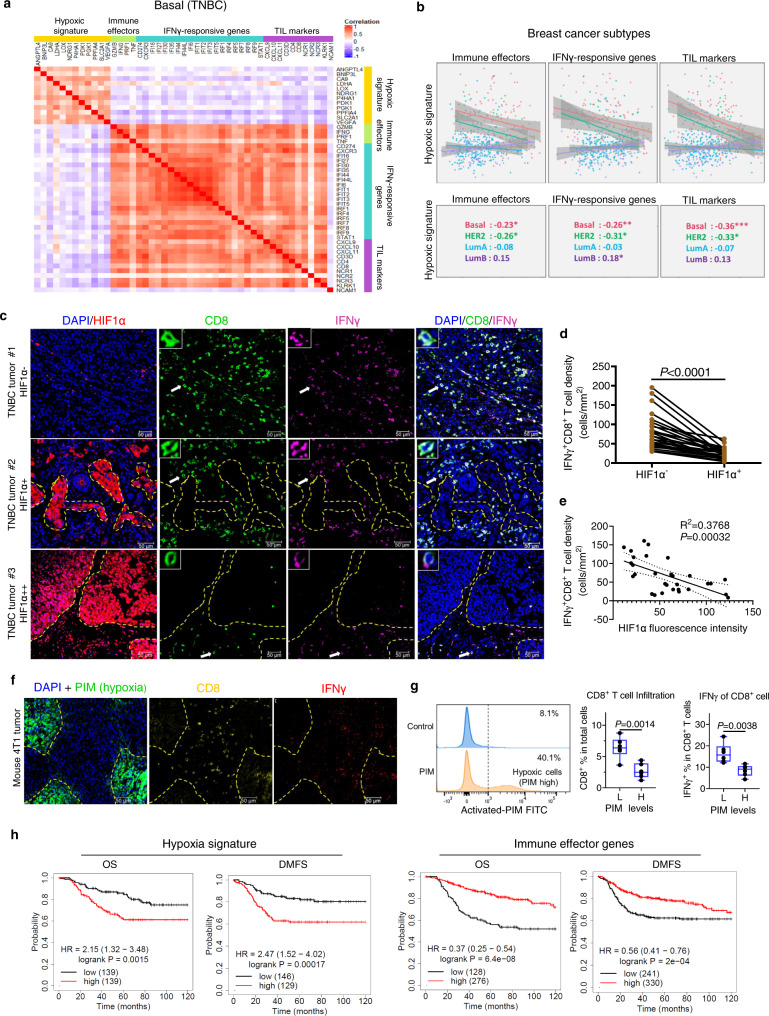
- In TCGA basal TNBC samples (n = 98 in Fig. 1a), hypoxia gene signature expression was inversely correlated with immune effector genes (IFNG, TNF, GZMB, PRF1), IFNγ-responsive genes, and TIL-associated genes; in human TNBC samples (n = 30), HIF1α-high tumor areas had reduced CD8+ T cell infiltration and IFNγ expression.
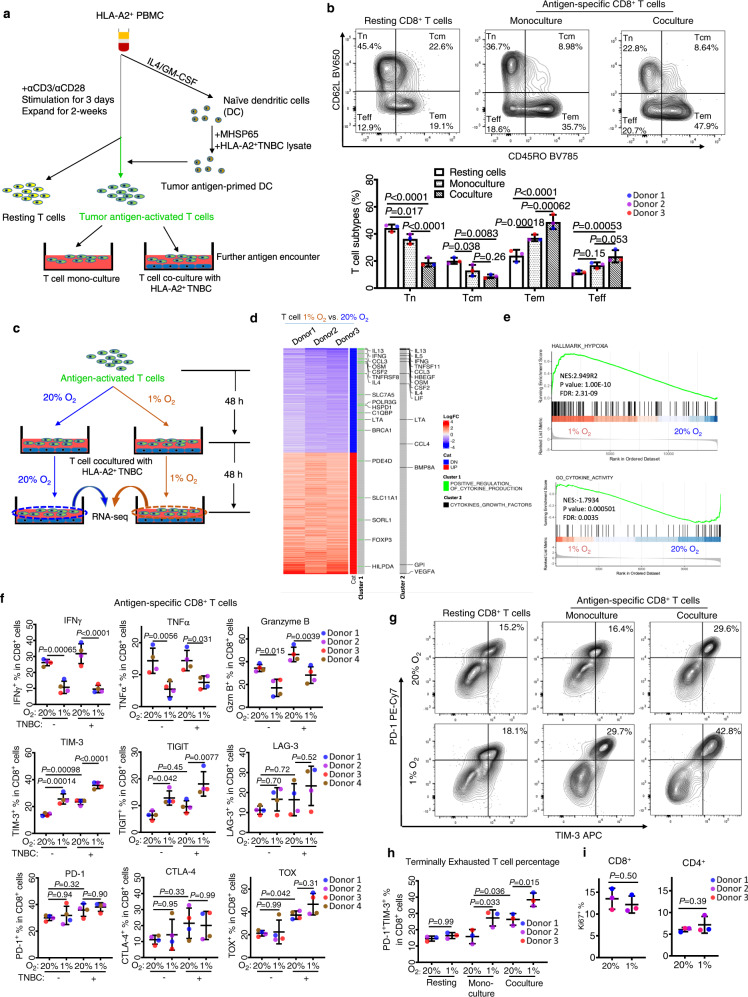
- Hypoxia (1% O2) suppressed IFNγ, TNFα, and granzyme B in CD8+ T cells and NK cells, and induced TIM-3/TIGIT; hypoxia plus TNBC coculture increased PD-1+TIM-3+ double-positive CD8+ T cells to 30–40% versus 10–20% in resting T cells.
- Hypoxia increased HIF1α and HDAC1 occupancy at IFNG and TNF promoters, reduced H3K27ac, and increased H3K27me3; HIF1α co-immunoprecipitated with HDAC1, and HDAC1 also interacted with SUZ12. HDAC inhibitor entinostat, EZH2 inhibitor EPZ6438, HIF1α inhibitors PX478/digoxin, or CRISPR depletion of HDAC1/EZH2 restored effector expression.
- In 4T1 syngeneic and humanized NIKO/LM2 mouse models, anti-PD-1 alone had minimal effect, but anti-PD-1 combined with PX478 or entinostat induced tumor regression, suppressed lung metastasis, and improved survival; depletion of T or NK cells largely abolished combination efficacy.
Methods
- Human T and NK cells were isolated from healthy donor PBMC, expanded, and cultured under normoxia (20% O2) or hypoxia (1% O2), alone or cocultured with TNBC lines BT549, MDA-MB-231, or MDA-MB-231-LM2; assays included RNA-seq, flow cytometry, RT-qPCR, ChIP-qPCR, co-immunoprecipitation, CRISPR knockdown, and luciferase-based cytotoxicity.
- TCGA breast cancer data were analyzed by PAM50 subtype (basal/TNBC n = 98; HER2+ n = 58; Luminal A n = 231; Luminal B n = 129); immunofluorescence used human TNBC samples (n = 30) and mouse 4T1 tumors.
- In vivo work used BALB/c mice bearing orthotopic 4T1-Luc tumors and humanized NOD/SCID/IL2Rg−/− (NIKO) mice reconstituted with human CD34+ cells and engrafted with MDA-MB-231-LM2; treatments included anti-PD-1/Keytruda with PX478, entinostat, or EPZ6438. Statistics used ANOVA, t-tests, and log-rank tests; RNA-seq DEG thresholds were |logFC| > 1 and adjusted P < 0.01.
Limitations
- The paper states that PX478 and epigenetic drugs have additional effects on other tumor microenvironment elements such as myeloid cells and macrophages, and that EPZ6438 could not achieve satisfactory solubility in different formulations, likely explaining its weaker in vivo effects.
- The paper notes that HIF1α-independent induction of TIM-3 and TIGIT remains to be explored as a possible additional strategy to prevent T cell exhaustion.
- Evident from the text: the mechanistic evidence relies heavily on in vitro healthy-donor human immune cells and mouse/humanized models, with no clinical trial validation; TCGA findings are correlative, and the 1% O2 system may not fully capture heterogeneous tumor hypoxia.
Model-written summary. Check it against the paper before relying on it.
Integrity signals
Registry
Cites
Statistics
Figures
Verification
Claims the paper makes
87 Own result · 45 Own interpretation · 24 Not checked yet · 9 Own method · 3 Partly supported · 1 Mixed support · 1 No basis given · accuracy not yet measured
The cited sources support only part of this claim — read each source’s verdict below.
In the paper
“In breast cancer, hypoxia is more evident in TNBC than in other breast cancer subtypes11,12.”
§ Hypoxia induces HIF1α-dependent epigenetic vulnerability in triple negative breast cancer to confer immune effector dysfunction and resistance to anti-PD-1 immunotherapy > Introduction
What the sources say
- Partly supportedcites [11] Cancer Genome Atlas Network. Comprehensive molecular portraits of human breast tumours. Nature 490, 61–70 (2012). sourceExperimental — accuracy not yet measured
The Basal-like summary analysis reports hyperactivation of the HIF1α/ARNT pathway in Basal-like cancers compared with Luminal cancers and notes that most Basal-like cancers are TNBC. It does not directly establish that hypoxia is more evident in TNBC than in every other breast cancer subtype; Basal-like and TNBC are not identical groups. (LLM, conf=0.85)
- Supportedcites [12] Tutzauer, J. et al. Breast cancer hypoxia in relation to prognosis and benefit from radiotherapy after breast-conserving surgery in a large, randomised trial with long-term follow-up. Br. J. Cancer 126, 1145–1156 (2022). source
The Discussion reports that HIF-1α positivity, used here as a marker of tumour hypoxia, increases across breast cancer subtypes from luminal A through luminal B and HER2-positive to triple-negative tumours. This supports the claim that hypoxia is more evident in TNBC than in the other subtypes examined. (LLM, conf=0.93)
plainstates an association- Asserted: passes — The authors put it forward as true.
- Checkable: passes — It can be checked against evidence.
- Load-bearing: passes — The paper’s conclusions depend on it.
- Based: passes — The paper gives a reason why it holds.
- Partly supported
None of the sources cited for this claim have been checked yet.
In the paper
“data analysis of The Cancer Genome Atlas (TCGA) dataset11 identified that hypoxic gene signature, which includes commonly documented hypoxia-responsive genes26, was inversely correlated with immune effector genes (IFNG, TNF, GZMB, PRF1), IFNγ-responsive genes, as well as genes associated with tumor-infiltrating lymphocytes (TILs) in TNBC (n = 99) (also referred as a basal subtype of breast cancer)”
§ Hypoxia induces HIF1α-dependent epigenetic vulnerability in triple negative breast cancer to confer immune effector dysfunction and resistance to anti-PD-1 immunotherapy > Results > Hypoxia is associated with immune escape in breast cancer
What the sources say
- Not checked yetcites [11] Cancer Genome Atlas Network. Comprehensive molecular portraits of human breast tumours. Nature 490, 61–70 (2012). source
- Not checked yetcites [26] Mahara, S. et al. HIFI-alpha activation underlies a functional switch in the paradoxical role of Ezh2/PRC2 in breast cancer. Proc. Natl Acad. Sci. USA 113, E3735–E3744 (2016). source
plainstates an associationn = 99- Asserted: passes — The authors put it forward as true.
- Checkable: passes — It can be checked against evidence.
- Load-bearing: passes — The paper’s conclusions depend on it.
- Based: passes — The paper gives a reason why it holds.
A result the paper reports from its own data — it cites no other source for it, so there is none to check. The quote shows it is in the paper.
In the paper
“Therefore, we showed that this protocol could efficiently differentiate the peripheral naive T cells into antigen-specific cytotoxic effector and memory T cells.”
§ Hypoxia induces HIF1α-dependent epigenetic vulnerability in triple negative breast cancer to confer immune effector dysfunction and resistance to anti-PD-1 immunotherapy > Results > Hypoxia induces T cell dysfunction, which upon further antigen stimulation, drives towards an exhaustion-like state
hedgedstates a cause- Asserted: passes — The authors put it forward as true.
- Checkable: passes — It can be checked against evidence.
- Load-bearing: unclear — It is unclear whether the paper’s conclusions depend on it.
- Based: passes — The paper gives a reason why it holds.
A result the paper reports from its own data — it cites no other source for it, so there is none to check. The quote shows it is in the paper.
In the paper
“The results showed that hypoxia caused marked downregulations of IFNγ, TNFα, and granzyme B in CD8+ T cells in both monoculture and coculture conditions (Fig. 2f).”
§ Hypoxia induces HIF1α-dependent epigenetic vulnerability in triple negative breast cancer to confer immune effector dysfunction and resistance to anti-PD-1 immunotherapy > Results > Hypoxia induces T cell dysfunction, which upon further antigen stimulation, drives towards an exhaustion-like state
plainstates a cause- Asserted: passes — The authors put it forward as true.
- Checkable: passes — It can be checked against evidence.
- Load-bearing: passes — The paper’s conclusions depend on it.
- Based: passes — The paper gives a reason why it holds.
A result the paper reports from its own data — it cites no other source for it, so there is none to check. The quote shows it is in the paper.
In the paper
“Conversely, TNBC patients with higher immune effector gene signatures are associated with prolonged survivals (Fig. 1h).”
§ Hypoxia induces HIF1α-dependent epigenetic vulnerability in triple negative breast cancer to confer immune effector dysfunction and resistance to anti-PD-1 immunotherapy > Results > Hypoxia is associated with immune escape in breast cancer
plainstates an association- Asserted: passes — The authors put it forward as true.
- Checkable: passes — It can be checked against evidence.
- Load-bearing: passes — The paper’s conclusions depend on it.
- Based: passes — The paper gives a reason why it holds.
A result the paper reports from its own data — it cites no other source for it, so there is none to check. The quote shows it is in the paper.
In the paper
“Intratumoral analysis showed that tumor areas with high levels of hypoxia, as indicated by staining of HIF1α, displayed markedly reduced CD8+ T cell infiltration as well as IFNγ expression compared to low hypoxic areas (Fig. 1c, d).”
§ Hypoxia induces HIF1α-dependent epigenetic vulnerability in triple negative breast cancer to confer immune effector dysfunction and resistance to anti-PD-1 immunotherapy > Results > Hypoxia is associated with immune escape in breast cancer
plainstates an association- Asserted: passes — The authors put it forward as true.
- Checkable: passes — It can be checked against evidence.
- Load-bearing: passes — The paper’s conclusions depend on it.
- Based: passes — The paper gives a reason why it holds.
A result the paper reports from its own data — it cites no other source for it, so there is none to check. The quote shows it is in the paper.
In the paper
“TNF (TNFα) and GZMB (granzyme B) were also downregulated by hypoxia in two of the three donors (1.7–2.4 fold), though they did not meet the cutoff criteria.”
§ Hypoxia induces HIF1α-dependent epigenetic vulnerability in triple negative breast cancer to confer immune effector dysfunction and resistance to anti-PD-1 immunotherapy > Results > Hypoxia induces T cell dysfunction, which upon further antigen stimulation, drives towards an exhaustion-like state
plainstates a causen = 2- Asserted: passes — The authors put it forward as true.
- Checkable: passes — It can be checked against evidence.
- Load-bearing: unclear — It is unclear whether the paper’s conclusions depend on it.
- Based: passes — The paper gives a reason why it holds.
A result the paper reports from its own data — it cites no other source for it, so there is none to check. The quote shows it is in the paper.
In the paper
“Consistent with the gene signature analysis in TCGA, an inverse correlation between HIF1α and IFNγ+/ CD8+ T cells in TNBC was confirmed (Fig. 1e).”
§ Hypoxia induces HIF1α-dependent epigenetic vulnerability in triple negative breast cancer to confer immune effector dysfunction and resistance to anti-PD-1 immunotherapy > Results > Hypoxia is associated with immune escape in breast cancer
boostedstates an association- Asserted: passes — The authors put it forward as true.
- Checkable: passes — It can be checked against evidence.
- Load-bearing: passes — The paper’s conclusions depend on it.
- Based: passes — The paper gives a reason why it holds.
A result the paper reports from its own data — it cites no other source for it, so there is none to check. The quote shows it is in the paper.
In the paper
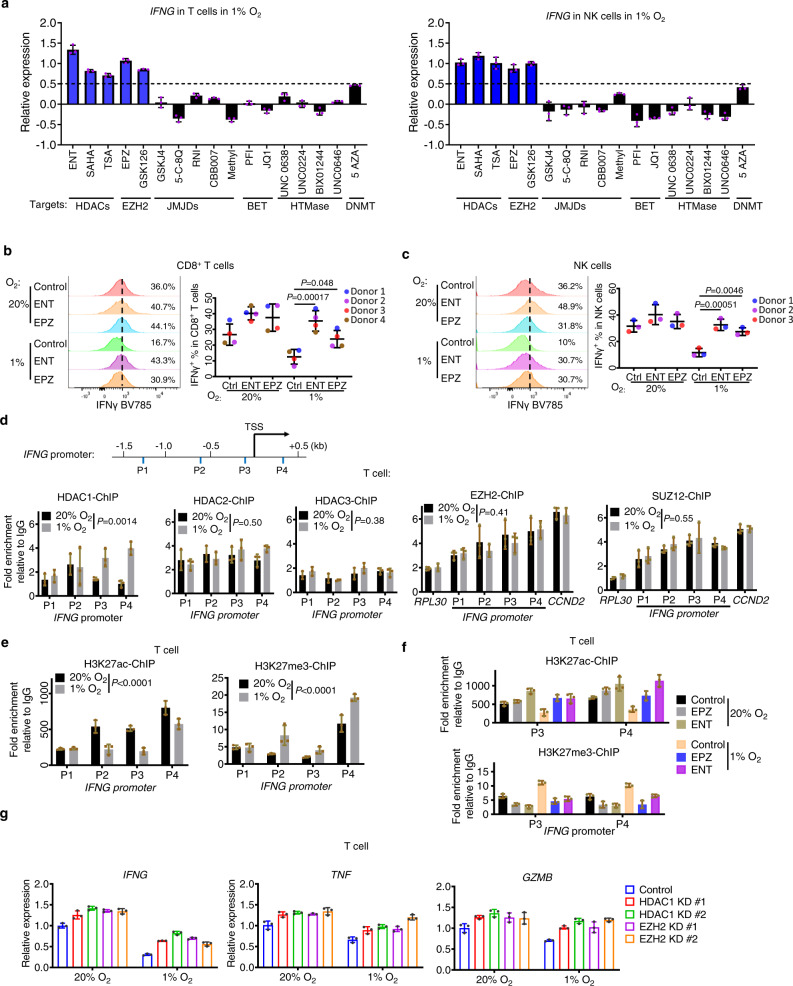
“Among the drugs tested that target different epigenetic modifications, inhibitors of histone deacetylase (HDAC) and Enhancer of zeste homolog 2 (EZH2)/PRC2, and to a lesser extent, DNMT inhibitor 5-azacytidine (AZA), were found to consistently induce the expression of IFNG in both T and NK cells (Fig. 3a).”
§ Hypoxia induces HIF1α-dependent epigenetic vulnerability in triple negative breast cancer to confer immune effector dysfunction and resistance to anti-PD-1 immunotherapy > Results > Hypoxia induces chromatin remodeling to suppress immune effector gene expression in T and NK cells
plainstates a cause- Asserted: passes — The authors put it forward as true.
- Checkable: passes — It can be checked against evidence.
- Load-bearing: passes — The paper’s conclusions depend on it.
- Based: passes — The paper gives a reason why it holds.
A result the paper reports from its own data — it cites no other source for it, so there is none to check. The quote shows it is in the paper.
In the paper
“Further verification by flow cytometry has demonstrated that HDAC inhibitor Entinostat (ENT) and EZH2 inhibitor EPZ6438 (EPZ), both of which are clinically approved drugs, were able to rescue the IFNγ, TNFα and granzyme B expression in hypoxic CD8+, CD4+ T cells and NK cells (Fig. 3b, c and Fig. S3a, b).”
§ Hypoxia induces HIF1α-dependent epigenetic vulnerability in triple negative breast cancer to confer immune effector dysfunction and resistance to anti-PD-1 immunotherapy > Results > Hypoxia induces chromatin remodeling to suppress immune effector gene expression in T and NK cells
boostedstates a cause- Asserted: passes — The authors put it forward as true.
- Checkable: passes — It can be checked against evidence.
- Load-bearing: passes — The paper’s conclusions depend on it.
- Based: passes — The paper gives a reason why it holds.
A result the paper reports from its own data — it cites no other source for it, so there is none to check. The quote shows it is in the paper.
In the paper
“However, the hypoxia did not alter the expression of Ki67 (Fig. 2i), indicating that the above hypoxic effect is not due to a change in cell proliferation.”
§ Hypoxia induces HIF1α-dependent epigenetic vulnerability in triple negative breast cancer to confer immune effector dysfunction and resistance to anti-PD-1 immunotherapy > Results > Hypoxia induces T cell dysfunction, which upon further antigen stimulation, drives towards an exhaustion-like state
plain- Asserted: passes — The authors put it forward as true.
- Checkable: passes — It can be checked against evidence.
- Load-bearing: passes — The paper’s conclusions depend on it.
- Based: passes — The paper gives a reason why it holds.
A result the paper reports from its own data — it cites no other source for it, so there is none to check. The quote shows it is in the paper.
In the paper
“Indeed, hypoxia plus coculture resulted in significant upregulation of TIM-3+/PD-1+ double-positive population (30–40%) in CD8+ T cells compared to T cells in the resting stage (10–20%) (Fig. 2g, h).”
§ Hypoxia induces HIF1α-dependent epigenetic vulnerability in triple negative breast cancer to confer immune effector dysfunction and resistance to anti-PD-1 immunotherapy > Results > Hypoxia induces T cell dysfunction, which upon further antigen stimulation, drives towards an exhaustion-like state
plainstates a cause- Asserted: passes — The authors put it forward as true.
- Checkable: passes — It can be checked against evidence.
- Load-bearing: passes — The paper’s conclusions depend on it.
- Based: passes — The paper gives a reason why it holds.
A result the paper reports from its own data — it cites no other source for it, so there is none to check. The quote shows it is in the paper.
In the paper
“Similar results were also seen in NK cells (Fig. S3e, f).”
§ Hypoxia induces HIF1α-dependent epigenetic vulnerability in triple negative breast cancer to confer immune effector dysfunction and resistance to anti-PD-1 immunotherapy > Results > Hypoxia induces chromatin remodeling to suppress immune effector gene expression in T and NK cells
plain- Asserted: passes — The authors put it forward as true.
- Checkable: passes — It can be checked against evidence.
- Load-bearing: unclear — It is unclear whether the paper’s conclusions depend on it.
- Based: passes — The paper gives a reason why it holds.
A result the paper reports from its own data — it cites no other source for it, so there is none to check. The quote shows it is in the paper.
In the paper
“Furthermore, in T cells stimulated with CD3/CD28 antibodies in the absence of tumor antigen, hypoxia remains capable of suppressing the effector expression of CD8+ and CD4+ T cells (Fig. S2f).”
§ Hypoxia induces HIF1α-dependent epigenetic vulnerability in triple negative breast cancer to confer immune effector dysfunction and resistance to anti-PD-1 immunotherapy > Results > Hypoxia induces T cell dysfunction, which upon further antigen stimulation, drives towards an exhaustion-like state
plainstates a cause- Asserted: passes — The authors put it forward as true.
- Checkable: passes — It can be checked against evidence.
- Load-bearing: passes — The paper’s conclusions depend on it.
- Based: passes — The paper gives a reason why it holds.
A result the paper reports from its own data — it cites no other source for it, so there is none to check. The quote shows it is in the paper.
In the paper
“Compared to hypoxia treatment of T cell alone, hypoxia together with coculture with TNBC cells resulted in further upregulation of TIM-3 and TIGIT expression in CD8+ and CD4+cells (Fig. 2f and Fig. S2c).”
§ Hypoxia induces HIF1α-dependent epigenetic vulnerability in triple negative breast cancer to confer immune effector dysfunction and resistance to anti-PD-1 immunotherapy > Results > Hypoxia induces T cell dysfunction, which upon further antigen stimulation, drives towards an exhaustion-like state
plainstates a cause- Asserted: passes — The authors put it forward as true.
- Checkable: passes — It can be checked against evidence.
- Load-bearing: passes — The paper’s conclusions depend on it.
- Based: passes — The paper gives a reason why it holds.
A result the paper reports from its own data — it cites no other source for it, so there is none to check. The quote shows it is in the paper.
In the paper
“Like hypoxia treatment, HIF1A overexpression was sufficient to decrease effector expression in T cells under normoxia; it also abolished effector induction in T cells with HIF1A KD under hypoxia (Fig. S6b).”
§ Hypoxia induces HIF1α-dependent epigenetic vulnerability in triple negative breast cancer to confer immune effector dysfunction and resistance to anti-PD-1 immunotherapy > Results > Hypoxia-induced epigenetic inactivation of effector genes is HIF1α-dependent
plainstates a cause- Asserted: passes — The authors put it forward as true.
- Checkable: passes — It can be checked against evidence.
- Load-bearing: passes — The paper’s conclusions depend on it.
- Based: passes — The paper gives a reason why it holds.
A result the paper reports from its own data — it cites no other source for it, so there is none to check. The quote shows it is in the paper.
In the paper
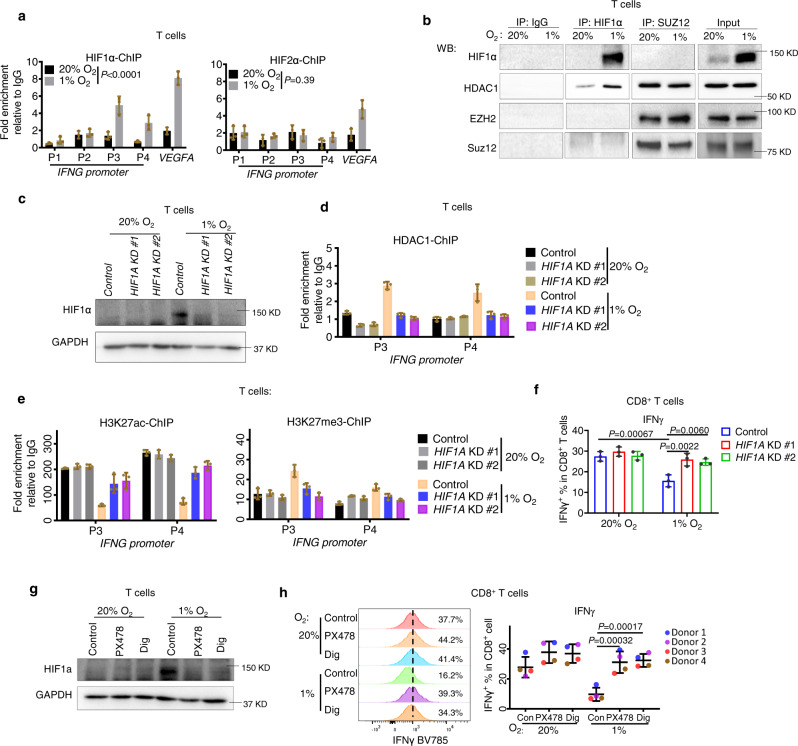
“The results show that hypoxia treatment of both T and NK cells induced a marked increase in HIF1α, but not HIF2α, enrichments at IFNG and TNF in regions identical to HDAC1 binding (Fig. 4a and Fig. S5a, b).”
§ Hypoxia induces HIF1α-dependent epigenetic vulnerability in triple negative breast cancer to confer immune effector dysfunction and resistance to anti-PD-1 immunotherapy > Results > Hypoxia-induced epigenetic inactivation of effector genes is HIF1α-dependent
plainstates a cause- Asserted: passes — The authors put it forward as true.
- Checkable: passes — It can be checked against evidence.
- Load-bearing: passes — The paper’s conclusions depend on it.
- Based: passes — The paper gives a reason why it holds.
A result the paper reports from its own data — it cites no other source for it, so there is none to check. The quote shows it is in the paper.
In the paper
“HIF1α knockdown in T cells abolished hypoxia-induced HDAC1 enrichment at effector genes (Fig. 4c, d and Fig. S5d), reversed the corresponding changes in H3K27ac and H3K27me3 (Fig. 4e and Fig. S5e), and restored IFNG expression in hypoxia (Fig. 4f).”
§ Hypoxia induces HIF1α-dependent epigenetic vulnerability in triple negative breast cancer to confer immune effector dysfunction and resistance to anti-PD-1 immunotherapy > Results > Hypoxia-induced epigenetic inactivation of effector genes is HIF1α-dependent
plainstates a cause- Asserted: passes — The authors put it forward as true.
- Checkable: passes — It can be checked against evidence.
- Load-bearing: passes — The paper’s conclusions depend on it.
- Based: passes — The paper gives a reason why it holds.
A result the paper reports from its own data — it cites no other source for it, so there is none to check. The quote shows it is in the paper.
In the paper
“Interestingly, HIF1α knockdown or inhibitors of HIF1α, HDAC, or EZH2 did not affect hypoxia-induced TIM-3 and TIGIT expressions (Fig. S6d, e), nor did they affect the percentage of PD-1+TIM-3+ double-positive populations in CD8 T cells under hypoxia (Fig. S6f), but increased IFNγ levels in PD-1−TIM-3−, PD-1+TIM-3− and PD-1+TIM-3+ populations of CD8 T cells under hypoxia (Fig. S6g).”
§ Hypoxia induces HIF1α-dependent epigenetic vulnerability in triple negative breast cancer to confer immune effector dysfunction and resistance to anti-PD-1 immunotherapy > Results > Hypoxia-induced epigenetic inactivation of effector genes is HIF1α-dependent
plain- Asserted: passes — The authors put it forward as true.
- Checkable: passes — It can be checked against evidence.
- Load-bearing: passes — The paper’s conclusions depend on it.
- Based: passes — The paper gives a reason why it holds.
A result the paper reports from its own data — it cites no other source for it, so there is none to check. The quote shows it is in the paper.
In the paper
“HIF1α knockdown in T cells abolished hypoxia-induced HDAC1 enrichment at effector genes (Fig. 4c, d and Fig. S5d), reversed the corresponding changes in H3K27ac and H3K27me3 (Fig. 4e and Fig. S5e), and restored IFNG expression in hypoxia (Fig. 4f).”
§ Hypoxia induces HIF1α-dependent epigenetic vulnerability in triple negative breast cancer to confer immune effector dysfunction and resistance to anti-PD-1 immunotherapy > Results > Hypoxia-induced epigenetic inactivation of effector genes is HIF1α-dependent
plainstates a cause- Asserted: passes — The authors put it forward as true.
- Checkable: passes — It can be checked against evidence.
- Load-bearing: passes — The paper’s conclusions depend on it.
- Based: passes — The paper gives a reason why it holds.
A result the paper reports from its own data — it cites no other source for it, so there is none to check. The quote shows it is in the paper.
In the paper
“HIF1α knockdown in T cells abolished hypoxia-induced HDAC1 enrichment at effector genes (Fig. 4c, d and Fig. S5d), reversed the corresponding changes in H3K27ac and H3K27me3 (Fig. 4e and Fig. S5e), and restored IFNG expression in hypoxia (Fig. 4f).”
§ Hypoxia induces HIF1α-dependent epigenetic vulnerability in triple negative breast cancer to confer immune effector dysfunction and resistance to anti-PD-1 immunotherapy > Results > Hypoxia-induced epigenetic inactivation of effector genes is HIF1α-dependent
plainstates a cause- Asserted: passes — The authors put it forward as true.
- Checkable: passes — It can be checked against evidence.
- Load-bearing: passes — The paper’s conclusions depend on it.
- Based: passes — The paper gives a reason why it holds.
None of the sources cited for this claim have been checked yet.
In the paper
“Likewise, pharmacologic depletion of HIF1α by small molecules PX478 and Digoxin41,42 also produced similar results in T and NK cells (Fig. 4g, h and Fig. S5f, g, h).”
§ Hypoxia induces HIF1α-dependent epigenetic vulnerability in triple negative breast cancer to confer immune effector dysfunction and resistance to anti-PD-1 immunotherapy > Results > Hypoxia-induced epigenetic inactivation of effector genes is HIF1α-dependent
What the sources say
- Not checked yetcites [41] Zhang, H. et al. Digoxin and other cardiac glycosides inhibit HIF-1α synthesis and block tumor growth. Proc. Natl Acad. Sci. USA 105, 19579–19586 (2008). source
- Not checked yetcites [42] Koh, M. Y. et al. Molecular mechanisms for the activity of PX-478, an antitumor inhibitor of the hypoxia-inducible factor-1alpha. Mol. Cancer Ther. 7, 90–100 (2008). source
plain- Asserted: passes — The authors put it forward as true.
- Checkable: passes — It can be checked against evidence.
- Load-bearing: passes — The paper’s conclusions depend on it.
- Based: passes — The paper gives a reason why it holds.
A result the paper reports from its own data — it cites no other source for it, so there is none to check. The quote shows it is in the paper.
In the paper
“We found that HIF1α co-immunoprecipitated with HDAC1, suggesting that HDAC1 might form a complex with HIF1α under hypoxia.”
§ Hypoxia induces HIF1α-dependent epigenetic vulnerability in triple negative breast cancer to confer immune effector dysfunction and resistance to anti-PD-1 immunotherapy > Results > Hypoxia-induced epigenetic inactivation of effector genes is HIF1α-dependent
plainstates an association- Asserted: passes — The authors put it forward as true.
- Checkable: passes — It can be checked against evidence.
- Load-bearing: passes — The paper’s conclusions depend on it.
- Based: passes — The paper gives a reason why it holds.
A result the paper reports from its own data — it cites no other source for it, so there is none to check. The quote shows it is in the paper.
In the paper
“Like hypoxia treatment, HIF1A overexpression was sufficient to decrease effector expression in T cells under normoxia; it also abolished effector induction in T cells with HIF1A KD under hypoxia (Fig. S6b).”
§ Hypoxia induces HIF1α-dependent epigenetic vulnerability in triple negative breast cancer to confer immune effector dysfunction and resistance to anti-PD-1 immunotherapy > Results > Hypoxia-induced epigenetic inactivation of effector genes is HIF1α-dependent
plainstates a cause- Asserted: passes — The authors put it forward as true.
- Checkable: passes — It can be checked against evidence.
- Load-bearing: passes — The paper’s conclusions depend on it.
- Based: passes — The paper gives a reason why it holds.
A result the paper reports from its own data — it cites no other source for it, so there is none to check. The quote shows it is in the paper.
In the paper
“it failed to do so in hypoxia”
§ Hypoxia induces HIF1α-dependent epigenetic vulnerability in triple negative breast cancer to confer immune effector dysfunction and resistance to anti-PD-1 immunotherapy > Results > Hypoxia impairs the immune cell cytotoxicity, reduces interferon signaling response, and confers resistance to anti-PD-1 blockade
plain- Asserted: passes — The authors put it forward as true.
- Checkable: passes — It can be checked against evidence.
- Load-bearing: passes — The paper’s conclusions depend on it.
- Based: passes — The paper gives a reason why it holds.
A result the paper reports from its own data — it cites no other source for it, so there is none to check. The quote shows it is in the paper.
In the paper
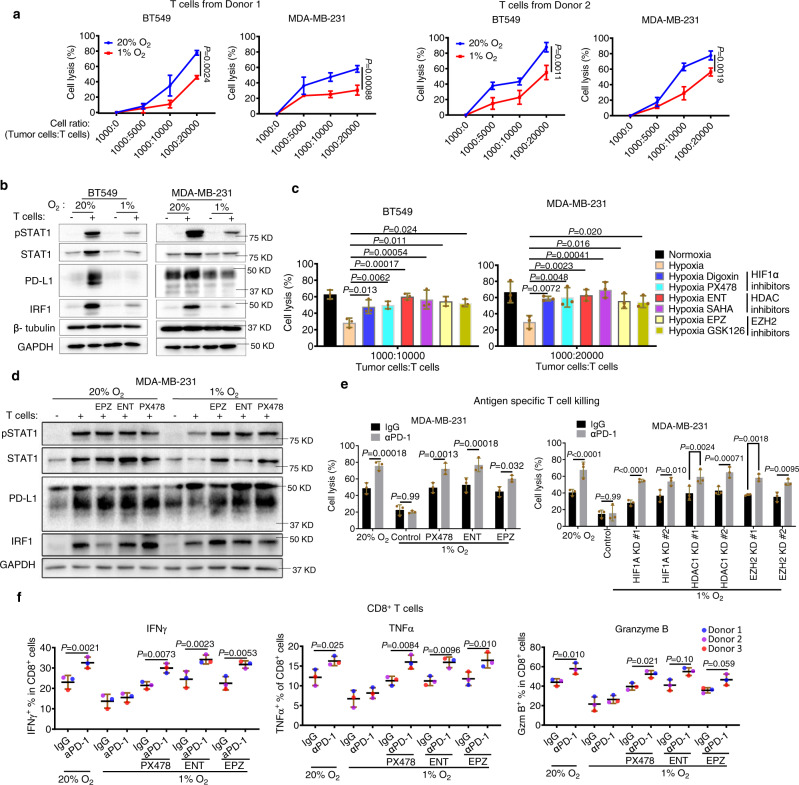
“In both TNBC cell lines, hypoxia attenuated immune cells-elicited interferon signaling, as evidenced by both Western blotting (Fig. 5b) and RT-qPCR (Fig. S7c, d).”
§ Hypoxia induces HIF1α-dependent epigenetic vulnerability in triple negative breast cancer to confer immune effector dysfunction and resistance to anti-PD-1 immunotherapy > Results > Hypoxia impairs the immune cell cytotoxicity, reduces interferon signaling response, and confers resistance to anti-PD-1 blockade
plainstates a causen = 2- Asserted: passes — The authors put it forward as true.
- Checkable: passes — It can be checked against evidence.
- Load-bearing: passes — The paper’s conclusions depend on it.
- Based: passes — The paper gives a reason why it holds.
A result the paper reports from its own data — it cites no other source for it, so there is none to check. The quote shows it is in the paper.
In the paper
“As anticipated, we observed that hypoxia treatment of T or NK cells resulted in a reduced capacity in killing TNBC cells, as determined by measuring the luciferase activity of the coculture (Fig. 5a and Fig. S7a).”
§ Hypoxia induces HIF1α-dependent epigenetic vulnerability in triple negative breast cancer to confer immune effector dysfunction and resistance to anti-PD-1 immunotherapy > Results > Hypoxia impairs the immune cell cytotoxicity, reduces interferon signaling response, and confers resistance to anti-PD-1 blockade
plainstates a cause- Asserted: passes — The authors put it forward as true.
- Checkable: passes — It can be checked against evidence.
- Load-bearing: passes — The paper’s conclusions depend on it.
- Based: passes — The paper gives a reason why it holds.
A result the paper reports from its own data — it cites no other source for it, so there is none to check. The quote shows it is in the paper.
In the paper
“pretreatment of T cell or NK cells with inhibitors of HIF1α (Digoxin and PX478), EZH2 inhibitors (EPZ and GSK126), and HDAC inhibitors (ENT and SAHA) were able to rescue the impaired killing of TNBC cells by immune cells in hypoxia (Fig. 5c)”
- Also stated in: § Hypoxia impairs the immune cell cytotoxicity, reduces interferon signaling response, and confers resistance to anti-PD-1 blockade · plain
“although inhibition of HIF1α, HDAC1, or EZH2 in immune cells can restore immune cytotoxicity”
§ Hypoxia induces HIF1α-dependent epigenetic vulnerability in triple negative breast cancer to confer immune effector dysfunction and resistance to anti-PD-1 immunotherapy > Results > Hypoxia impairs the immune cell cytotoxicity, reduces interferon signaling response, and confers resistance to anti-PD-1 blockade
plainstates a cause- Asserted: passes — The authors put it forward as true.
- Checkable: passes — It can be checked against evidence.
- Load-bearing: passes — The paper’s conclusions depend on it.
- Based: passes — The paper gives a reason why it holds.
- Also stated in: § Hypoxia impairs the immune cell cytotoxicity, reduces interferon signaling response, and confers resistance to anti-PD-1 blockade · plain
A result the paper reports from its own data — it cites no other source for it, so there is none to check. The quote shows it is in the paper.
In the paper
“Interestingly, HIF1α knockdown or inhibitors of HIF1α, HDAC, or EZH2 did not affect hypoxia-induced TIM-3 and TIGIT expressions (Fig. S6d, e), nor did they affect the percentage of PD-1+TIM-3+ double-positive populations in CD8 T cells under hypoxia (Fig. S6f), but increased IFNγ levels in PD-1−TIM-3−, PD-1+TIM-3− and PD-1+TIM-3+ populations of CD8 T cells under hypoxia (Fig. S6g).”
§ Hypoxia induces HIF1α-dependent epigenetic vulnerability in triple negative breast cancer to confer immune effector dysfunction and resistance to anti-PD-1 immunotherapy > Results > Hypoxia-induced epigenetic inactivation of effector genes is HIF1α-dependent
plainstates a cause- Asserted: passes — The authors put it forward as true.
- Checkable: passes — It can be checked against evidence.
- Load-bearing: passes — The paper’s conclusions depend on it.
- Based: passes — The paper gives a reason why it holds.
A result the paper reports from its own data — it cites no other source for it, so there is none to check. The quote shows it is in the paper.
In the paper
“Interestingly, HIF1α knockdown or inhibitors of HIF1α, HDAC, or EZH2 did not affect hypoxia-induced TIM-3 and TIGIT expressions (Fig. S6d, e), nor did they affect the percentage of PD-1+TIM-3+ double-positive populations in CD8 T cells under hypoxia (Fig. S6f), but increased IFNγ levels in PD-1−TIM-3−, PD-1+TIM-3− and PD-1+TIM-3+ populations of CD8 T cells under hypoxia (Fig. S6g).”
§ Hypoxia induces HIF1α-dependent epigenetic vulnerability in triple negative breast cancer to confer immune effector dysfunction and resistance to anti-PD-1 immunotherapy > Results > Hypoxia-induced epigenetic inactivation of effector genes is HIF1α-dependent
plain- Asserted: passes — The authors put it forward as true.
- Checkable: passes — It can be checked against evidence.
- Load-bearing: passes — The paper’s conclusions depend on it.
- Based: passes — The paper gives a reason why it holds.
A result the paper reports from its own data — it cites no other source for it, so there is none to check. The quote shows it is in the paper.
In the paper
“although anti-PD-1 antibody can induce T cell killing of BT549 and MDA-MB-231 cells in normoxia”
§ Hypoxia induces HIF1α-dependent epigenetic vulnerability in triple negative breast cancer to confer immune effector dysfunction and resistance to anti-PD-1 immunotherapy > Results > Hypoxia impairs the immune cell cytotoxicity, reduces interferon signaling response, and confers resistance to anti-PD-1 blockade
plainstates a cause- Asserted: passes — The authors put it forward as true.
- Checkable: passes — It can be checked against evidence.
- Load-bearing: passes — The paper’s conclusions depend on it.
- Based: passes — The paper gives a reason why it holds.
A result the paper reports from its own data — it cites no other source for it, so there is none to check. The quote shows it is in the paper.
In the paper
“with the corresponding restoration of interferon signaling response (Fig. 5d and Fig. S7e, f).”
§ Hypoxia induces HIF1α-dependent epigenetic vulnerability in triple negative breast cancer to confer immune effector dysfunction and resistance to anti-PD-1 immunotherapy > Results > Hypoxia impairs the immune cell cytotoxicity, reduces interferon signaling response, and confers resistance to anti-PD-1 blockade
plainstates a cause- Asserted: passes — The authors put it forward as true.
- Checkable: passes — It can be checked against evidence.
- Load-bearing: passes — The paper’s conclusions depend on it.
- Based: passes — The paper gives a reason why it holds.
The paper states this without a source or data behind it here, so there is nothing to check it against. The quote shows it is in the paper.
In the paper
“IFNγ is the most downregulated effector by hypoxia in T and NK cells”
§ Hypoxia induces HIF1α-dependent epigenetic vulnerability in triple negative breast cancer to confer immune effector dysfunction and resistance to anti-PD-1 immunotherapy > Results > Hypoxia impairs the immune cell cytotoxicity, reduces interferon signaling response, and confers resistance to anti-PD-1 blockade
plainstates a cause- Asserted: passes — The authors put it forward as true.
- Checkable: passes — It can be checked against evidence.
- Load-bearing: passes — The paper’s conclusions depend on it.
- Based: passes — The paper gives a reason why it holds.
A result the paper reports from its own data — it cites no other source for it, so there is none to check. The quote shows it is in the paper.
In the paper
“inhibitors of HIF1α, HDAC1, and EZH2 restored the anti-PD-1 antibody treatment response (Fig. S8e).”
§ Hypoxia induces HIF1α-dependent epigenetic vulnerability in triple negative breast cancer to confer immune effector dysfunction and resistance to anti-PD-1 immunotherapy > Results > Targeting HIF1α and associated epigenetic dependency overcomes resistance to PD-1 blockade in both syngeneic and humanized mouse models
plainstates a cause- Asserted: passes — The authors put it forward as true.
- Checkable: passes — It can be checked against evidence.
- Load-bearing: passes — The paper’s conclusions depend on it.
- Based: passes — The paper gives a reason why it holds.
A result the paper reports from its own data — it cites no other source for it, so there is none to check. The quote shows it is in the paper.
In the paper
“anti-PD-1 treatment alone had minimum effect on tumor growth”
§ Hypoxia induces HIF1α-dependent epigenetic vulnerability in triple negative breast cancer to confer immune effector dysfunction and resistance to anti-PD-1 immunotherapy > Results > Targeting HIF1α and associated epigenetic dependency overcomes resistance to PD-1 blockade in both syngeneic and humanized mouse models
plain- Asserted: passes — The authors put it forward as true.
- Checkable: passes — It can be checked against evidence.
- Load-bearing: passes — The paper’s conclusions depend on it.
- Based: passes — The paper gives a reason why it holds.
A result the paper reports from its own data — it cites no other source for it, so there is none to check. The quote shows it is in the paper.
In the paper
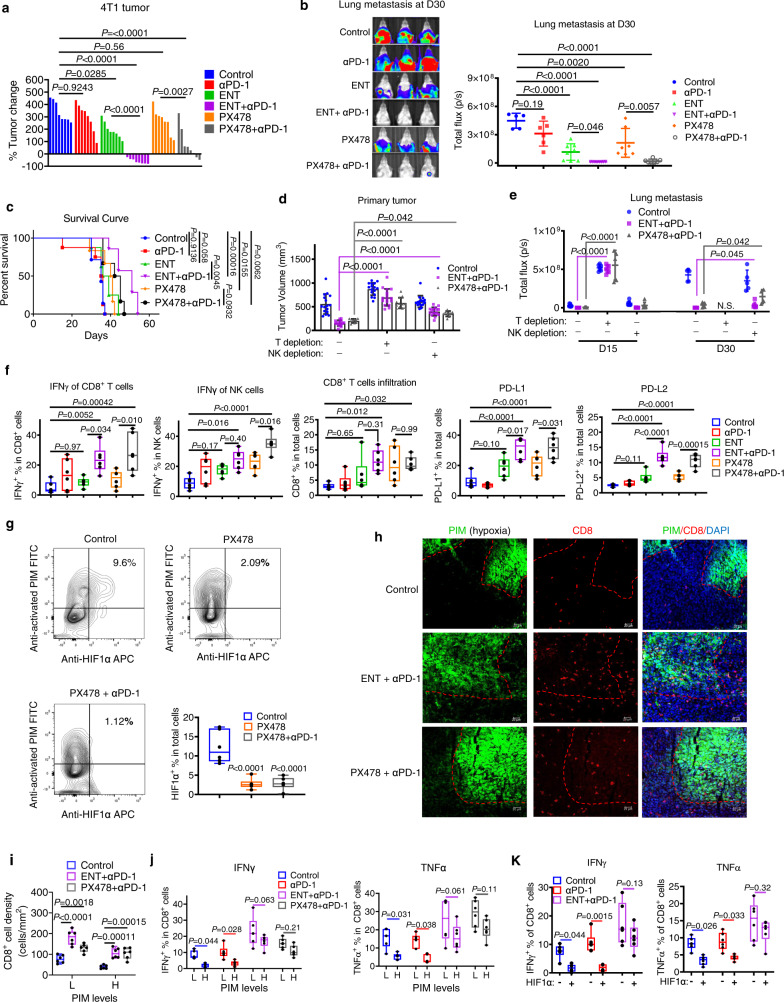
“The combination treatments also resulted in robust suppression of lung metastasis compared to single treatments (Fig. 6b and Fig. S9d)”
§ Hypoxia induces HIF1α-dependent epigenetic vulnerability in triple negative breast cancer to confer immune effector dysfunction and resistance to anti-PD-1 immunotherapy > Results > Targeting HIF1α and associated epigenetic dependency overcomes resistance to PD-1 blockade in both syngeneic and humanized mouse models
plainstates a cause- Asserted: passes — The authors put it forward as true.
- Checkable: passes — It can be checked against evidence.
- Load-bearing: passes — The paper’s conclusions depend on it.
- Based: passes — The paper gives a reason why it holds.
A result the paper reports from its own data — it cites no other source for it, so there is none to check. The quote shows it is in the paper.
In the paper
“but a combination of anti-PD-1 with PX478 or ENT could induce substantial tumor regression (Fig. 6a and Fig. S9a).”
§ Hypoxia induces HIF1α-dependent epigenetic vulnerability in triple negative breast cancer to confer immune effector dysfunction and resistance to anti-PD-1 immunotherapy > Results > Targeting HIF1α and associated epigenetic dependency overcomes resistance to PD-1 blockade in both syngeneic and humanized mouse models
hedgedstates a cause- Asserted: passes — The authors put it forward as true.
- Checkable: passes — It can be checked against evidence.
- Load-bearing: passes — The paper’s conclusions depend on it.
- Based: passes — The paper gives a reason why it holds.
A result the paper reports from its own data — it cites no other source for it, so there is none to check. The quote shows it is in the paper.
In the paper
“and as in human T cells, they did not affect TIM-3 expression (Fig. S8d).”
§ Hypoxia induces HIF1α-dependent epigenetic vulnerability in triple negative breast cancer to confer immune effector dysfunction and resistance to anti-PD-1 immunotherapy > Results > Targeting HIF1α and associated epigenetic dependency overcomes resistance to PD-1 blockade in both syngeneic and humanized mouse models
plain- Asserted: passes — The authors put it forward as true.
- Checkable: passes — It can be checked against evidence.
- Load-bearing: unclear — It is unclear whether the paper’s conclusions depend on it.
- Based: passes — The paper gives a reason why it holds.
A result the paper reports from its own data — it cites no other source for it, so there is none to check. The quote shows it is in the paper.
In the paper
“which were translated to significant survival benefits (Fig. 6c).”
§ Hypoxia induces HIF1α-dependent epigenetic vulnerability in triple negative breast cancer to confer immune effector dysfunction and resistance to anti-PD-1 immunotherapy > Results > Targeting HIF1α and associated epigenetic dependency overcomes resistance to PD-1 blockade in both syngeneic and humanized mouse models
plainstates a cause- Asserted: passes — The authors put it forward as true.
- Checkable: passes — It can be checked against evidence.
- Load-bearing: passes — The paper’s conclusions depend on it.
- Based: passes — The paper gives a reason why it holds.
A result the paper reports from its own data — it cites no other source for it, so there is none to check. The quote shows it is in the paper.
In the paper
“but upregulations of TIM-3 and TIGIT (Fig. S8a, b, and c).”
§ Hypoxia induces HIF1α-dependent epigenetic vulnerability in triple negative breast cancer to confer immune effector dysfunction and resistance to anti-PD-1 immunotherapy > Results > Targeting HIF1α and associated epigenetic dependency overcomes resistance to PD-1 blockade in both syngeneic and humanized mouse models
plainstates a cause- Asserted: passes — The authors put it forward as true.
- Checkable: passes — It can be checked against evidence.
- Load-bearing: passes — The paper’s conclusions depend on it.
- Based: passes — The paper gives a reason why it holds.
A result the paper reports from its own data — it cites no other source for it, so there is none to check. The quote shows it is in the paper.
In the paper
“PX478, ENT, and EPZ treatment restored the effector expression in hypoxia”
§ Hypoxia induces HIF1α-dependent epigenetic vulnerability in triple negative breast cancer to confer immune effector dysfunction and resistance to anti-PD-1 immunotherapy > Results > Targeting HIF1α and associated epigenetic dependency overcomes resistance to PD-1 blockade in both syngeneic and humanized mouse models
plainstates a cause- Asserted: passes — The authors put it forward as true.
- Checkable: passes — It can be checked against evidence.
- Load-bearing: passes — The paper’s conclusions depend on it.
- Based: passes — The paper gives a reason why it holds.
A result the paper reports from its own data — it cites no other source for it, so there is none to check. The quote shows it is in the paper.
In the paper
“flow cytometry analysis also showed that hypoxia blunted the induction of effector expression by anti-PD-1 in CD8+ T cells”
§ Hypoxia induces HIF1α-dependent epigenetic vulnerability in triple negative breast cancer to confer immune effector dysfunction and resistance to anti-PD-1 immunotherapy > Results > Hypoxia impairs the immune cell cytotoxicity, reduces interferon signaling response, and confers resistance to anti-PD-1 blockade
plainstates a cause- Asserted: passes — The authors put it forward as true.
- Checkable: passes — It can be checked against evidence.
- Load-bearing: passes — The paper’s conclusions depend on it.
- Based: passes — The paper gives a reason why it holds.
A result the paper reports from its own data — it cites no other source for it, so there is none to check. The quote shows it is in the paper.
In the paper
“which can be rescued by treatment with PX478, ENT, or EPZ (Fig. 5f).”
§ Hypoxia induces HIF1α-dependent epigenetic vulnerability in triple negative breast cancer to confer immune effector dysfunction and resistance to anti-PD-1 immunotherapy > Results > Hypoxia impairs the immune cell cytotoxicity, reduces interferon signaling response, and confers resistance to anti-PD-1 blockade
plainstates a cause- Asserted: passes — The authors put it forward as true.
- Checkable: passes — It can be checked against evidence.
- Load-bearing: passes — The paper’s conclusions depend on it.
- Based: passes — The paper gives a reason why it holds.
A result the paper reports from its own data — it cites no other source for it, so there is none to check. The quote shows it is in the paper.
In the paper
“hypoxia treatment of the ex vivo-expanded mouse T cells isolated from the spleen of a 4T1-bearing mouse resulted in downregulations of IFNγ, TNFα, and granzyme B”
§ Hypoxia induces HIF1α-dependent epigenetic vulnerability in triple negative breast cancer to confer immune effector dysfunction and resistance to anti-PD-1 immunotherapy > Results > Targeting HIF1α and associated epigenetic dependency overcomes resistance to PD-1 blockade in both syngeneic and humanized mouse models
plainstates a cause- Asserted: passes — The authors put it forward as true.
- Checkable: passes — It can be checked against evidence.
- Load-bearing: passes — The paper’s conclusions depend on it.
- Based: passes — The paper gives a reason why it holds.
A result the paper reports from its own data — it cites no other source for it, so there is none to check. The quote shows it is in the paper.
In the paper
“as well as an overall increase in tumor-infiltrating CD8+ T cells (Fig. 6f).”
§ Hypoxia induces HIF1α-dependent epigenetic vulnerability in triple negative breast cancer to confer immune effector dysfunction and resistance to anti-PD-1 immunotherapy > Results > Targeting HIF1α and associated epigenetic dependency overcomes resistance to PD-1 blockade in both syngeneic and humanized mouse models
plainstates a cause- Asserted: passes — The authors put it forward as true.
- Checkable: passes — It can be checked against evidence.
- Load-bearing: passes — The paper’s conclusions depend on it.
- Based: passes — The paper gives a reason why it holds.
A result the paper reports from its own data — it cites no other source for it, so there is none to check. The quote shows it is in the paper.
In the paper
“treatment with PX478 or PX478/anti-PD-1 markedly depleted HIF1α expression (Fig. 6g).”
§ Hypoxia induces HIF1α-dependent epigenetic vulnerability in triple negative breast cancer to confer immune effector dysfunction and resistance to anti-PD-1 immunotherapy > Results > Targeting HIF1α and associated epigenetic dependency overcomes resistance to PD-1 blockade in both syngeneic and humanized mouse models
plainstates a cause- Asserted: passes — The authors put it forward as true.
- Checkable: passes — It can be checked against evidence.
- Load-bearing: passes — The paper’s conclusions depend on it.
- Based: passes — The paper gives a reason why it holds.
A result the paper reports from its own data — it cites no other source for it, so there is none to check. The quote shows it is in the paper.
In the paper
“as well as CXCL9, CXCL10, CXCL11, and IRF1 in tumors treated with combination treatments (Fig. S9g).”
§ Hypoxia induces HIF1α-dependent epigenetic vulnerability in triple negative breast cancer to confer immune effector dysfunction and resistance to anti-PD-1 immunotherapy > Results > Targeting HIF1α and associated epigenetic dependency overcomes resistance to PD-1 blockade in both syngeneic and humanized mouse models
plainstates a cause- Asserted: passes — The authors put it forward as true.
- Checkable: passes — It can be checked against evidence.
- Load-bearing: passes — The paper’s conclusions depend on it.
- Based: passes — The paper gives a reason why it holds.
A result the paper reports from its own data — it cites no other source for it, so there is none to check. The quote shows it is in the paper.
In the paper
“CD8+ TIL with higher PIM staining displayed lower expressions of IFNγ and TNFα (Fig. 6j).”
§ Hypoxia induces HIF1α-dependent epigenetic vulnerability in triple negative breast cancer to confer immune effector dysfunction and resistance to anti-PD-1 immunotherapy > Results > Targeting HIF1α and associated epigenetic dependency overcomes resistance to PD-1 blockade in both syngeneic and humanized mouse models
plainstates an association- Asserted: passes — The authors put it forward as true.
- Checkable: passes — It can be checked against evidence.
- Load-bearing: passes — The paper’s conclusions depend on it.
- Based: passes — The paper gives a reason why it holds.
A result the paper reports from its own data — it cites no other source for it, so there is none to check. The quote shows it is in the paper.
In the paper
“we also observed significantly increased expression of IFNγ responsive PD-L1 and PD-L2 (Fig. 6f)”
§ Hypoxia induces HIF1α-dependent epigenetic vulnerability in triple negative breast cancer to confer immune effector dysfunction and resistance to anti-PD-1 immunotherapy > Results > Targeting HIF1α and associated epigenetic dependency overcomes resistance to PD-1 blockade in both syngeneic and humanized mouse models
plainstates a cause- Asserted: passes — The authors put it forward as true.
- Checkable: passes — It can be checked against evidence.
- Load-bearing: passes — The paper’s conclusions depend on it.
- Based: passes — The paper gives a reason why it holds.
A result the paper reports from its own data — it cites no other source for it, so there is none to check. The quote shows it is in the paper.
In the paper
“In vitro coculture experiment using LM2 cells showed similar results as MDA-231 cells (Fig. S7b).”
§ Hypoxia induces HIF1α-dependent epigenetic vulnerability in triple negative breast cancer to confer immune effector dysfunction and resistance to anti-PD-1 immunotherapy > Results > Targeting HIF1α and associated epigenetic dependency overcomes resistance to PD-1 blockade in both syngeneic and humanized mouse models
plain- Asserted: passes — The authors put it forward as true.
- Checkable: passes — It can be checked against evidence.
- Load-bearing: unclear — It is unclear whether the paper’s conclusions depend on it.
- Based: passes — The paper gives a reason why it holds.
A result the paper reports from its own data — it cites no other source for it, so there is none to check. The quote shows it is in the paper.
In the paper
“tumor areas with high hypoxia reduced infiltration of CD8+ T cells”
§ Hypoxia induces HIF1α-dependent epigenetic vulnerability in triple negative breast cancer to confer immune effector dysfunction and resistance to anti-PD-1 immunotherapy > Results > Targeting HIF1α and associated epigenetic dependency overcomes resistance to PD-1 blockade in both syngeneic and humanized mouse models
plainstates a cause- Asserted: passes — The authors put it forward as true.
- Checkable: passes — It can be checked against evidence.
- Load-bearing: passes — The paper’s conclusions depend on it.
- Based: passes — The paper gives a reason why it holds.
A result the paper reports from its own data — it cites no other source for it, so there is none to check. The quote shows it is in the paper.
In the paper
“though NK depletion only exhibited a modest impact on metastasis (Fig. 6e).”
§ Hypoxia induces HIF1α-dependent epigenetic vulnerability in triple negative breast cancer to confer immune effector dysfunction and resistance to anti-PD-1 immunotherapy > Results > Targeting HIF1α and associated epigenetic dependency overcomes resistance to PD-1 blockade in both syngeneic and humanized mouse models
plain- Asserted: passes — The authors put it forward as true.
- Checkable: passes — It can be checked against evidence.
- Load-bearing: unclear — It is unclear whether the paper’s conclusions depend on it.
- Based: passes — The paper gives a reason why it holds.
A result the paper reports from its own data — it cites no other source for it, so there is none to check. The quote shows it is in the paper.
In the paper
“Anti-PD-1 treatment alone failed to restore the IFNγ and TNFα expression on CD8+ cells”
§ Hypoxia induces HIF1α-dependent epigenetic vulnerability in triple negative breast cancer to confer immune effector dysfunction and resistance to anti-PD-1 immunotherapy > Results > Targeting HIF1α and associated epigenetic dependency overcomes resistance to PD-1 blockade in both syngeneic and humanized mouse models
plain- Asserted: passes — The authors put it forward as true.
- Checkable: passes — It can be checked against evidence.
- Load-bearing: passes — The paper’s conclusions depend on it.
- Based: passes — The paper gives a reason why it holds.
A result the paper reports from its own data — it cites no other source for it, so there is none to check. The quote shows it is in the paper.
In the paper
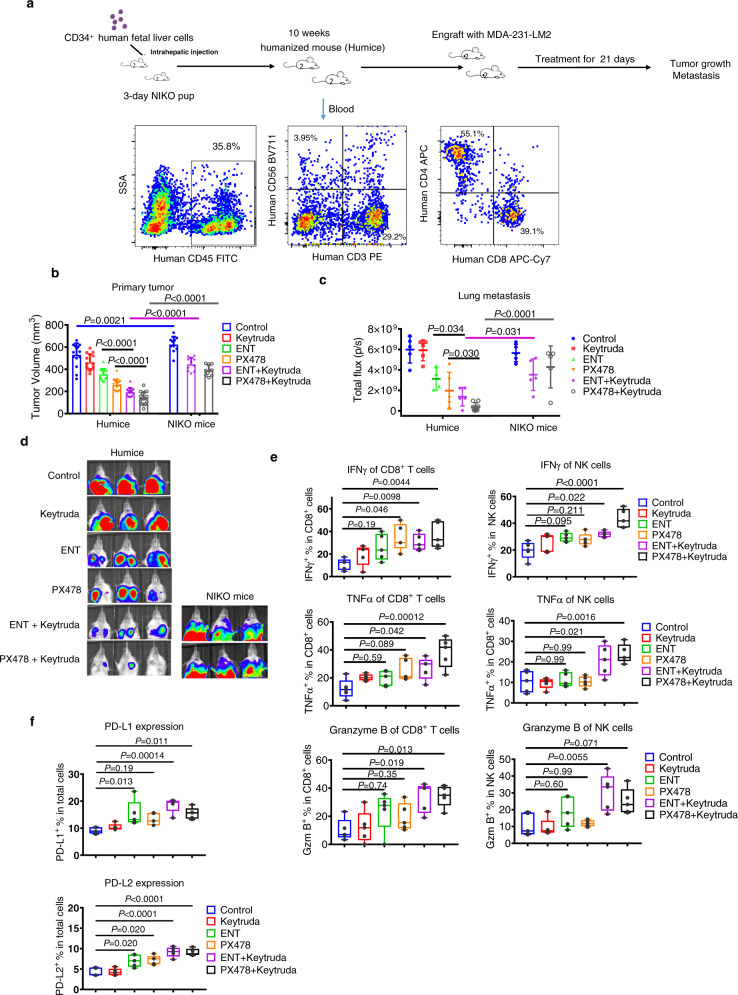
“LM2-bearing NIKO mice without human immune cells showed a much-weakened response to the combination treatments (Fig. 7b–d)”
§ Hypoxia induces HIF1α-dependent epigenetic vulnerability in triple negative breast cancer to confer immune effector dysfunction and resistance to anti-PD-1 immunotherapy > Results > Targeting HIF1α and associated epigenetic dependency overcomes resistance to PD-1 blockade in both syngeneic and humanized mouse models
plainstates a cause- Asserted: passes — The authors put it forward as true.
- Checkable: passes — It can be checked against evidence.
- Load-bearing: passes — The paper’s conclusions depend on it.
- Based: passes — The paper gives a reason why it holds.
A result the paper reports from its own data — it cites no other source for it, so there is none to check. The quote shows it is in the paper.
In the paper
“the combination treatments did not induce the IFNγ expression in T and NK cells isolated from the mouse spleen or peripheral blood of the same mice (Fig. S9h).”
§ Hypoxia induces HIF1α-dependent epigenetic vulnerability in triple negative breast cancer to confer immune effector dysfunction and resistance to anti-PD-1 immunotherapy > Results > Targeting HIF1α and associated epigenetic dependency overcomes resistance to PD-1 blockade in both syngeneic and humanized mouse models
plain- Asserted: passes — The authors put it forward as true.
- Checkable: passes — It can be checked against evidence.
- Load-bearing: passes — The paper’s conclusions depend on it.
- Based: passes — The paper gives a reason why it holds.
A result the paper reports from its own data — it cites no other source for it, so there is none to check. The quote shows it is in the paper.
In the paper
“but its combination with PX478 or ENT resulted in marked suppression of tumor growth and lung metastasis (Fig. 7b–d).”
§ Hypoxia induces HIF1α-dependent epigenetic vulnerability in triple negative breast cancer to confer immune effector dysfunction and resistance to anti-PD-1 immunotherapy > Results > Targeting HIF1α and associated epigenetic dependency overcomes resistance to PD-1 blockade in both syngeneic and humanized mouse models
plainstates a cause- Asserted: passes — The authors put it forward as true.
- Checkable: passes — It can be checked against evidence.
- Load-bearing: passes — The paper’s conclusions depend on it.
- Based: passes — The paper gives a reason why it holds.
A result the paper reports from its own data — it cites no other source for it, so there is none to check. The quote shows it is in the paper.
In the paper
“Flow cytometry analysis of PIM and HIF1α demonstrated a positive correlation between HIF1α expression and PIM”
§ Hypoxia induces HIF1α-dependent epigenetic vulnerability in triple negative breast cancer to confer immune effector dysfunction and resistance to anti-PD-1 immunotherapy > Results > Targeting HIF1α and associated epigenetic dependency overcomes resistance to PD-1 blockade in both syngeneic and humanized mouse models
boostedstates an association- Asserted: passes — The authors put it forward as true.
- Checkable: passes — It can be checked against evidence.
- Load-bearing: unclear — It is unclear whether the paper’s conclusions depend on it.
- Based: passes — The paper gives a reason why it holds.
A result the paper reports from its own data — it cites no other source for it, so there is none to check. The quote shows it is in the paper.
In the paper
“the anti-PD-1 agent Keytruda alone did not have a pronounced effect”
§ Hypoxia induces HIF1α-dependent epigenetic vulnerability in triple negative breast cancer to confer immune effector dysfunction and resistance to anti-PD-1 immunotherapy > Results > Targeting HIF1α and associated epigenetic dependency overcomes resistance to PD-1 blockade in both syngeneic and humanized mouse models
plain- Asserted: passes — The authors put it forward as true.
- Checkable: passes — It can be checked against evidence.
- Load-bearing: passes — The paper’s conclusions depend on it.
- Based: passes — The paper gives a reason why it holds.
A result the paper reports from its own data — it cites no other source for it, so there is none to check. The quote shows it is in the paper.
In the paper
“the combination treatment resulted in increased expression of IFNγ, TNFα, and granzyme B in intratumoral CD8+ T and NK cells (Fig. 6f and Fig. S9f)”
§ Hypoxia induces HIF1α-dependent epigenetic vulnerability in triple negative breast cancer to confer immune effector dysfunction and resistance to anti-PD-1 immunotherapy > Results > Targeting HIF1α and associated epigenetic dependency overcomes resistance to PD-1 blockade in both syngeneic and humanized mouse models
plainstates a cause- Asserted: passes — The authors put it forward as true.
- Checkable: passes — It can be checked against evidence.
- Load-bearing: passes — The paper’s conclusions depend on it.
- Based: passes — The paper gives a reason why it holds.
A result the paper reports from its own data — it cites no other source for it, so there is none to check. The quote shows it is in the paper.
In the paper
“in mice with depletion of T or NK cells, the efficacy of combination treatment was largely abolished (Fig. 6d and Fig. S9e).”
§ Hypoxia induces HIF1α-dependent epigenetic vulnerability in triple negative breast cancer to confer immune effector dysfunction and resistance to anti-PD-1 immunotherapy > Results > Targeting HIF1α and associated epigenetic dependency overcomes resistance to PD-1 blockade in both syngeneic and humanized mouse models
plainstates a cause- Asserted: passes — The authors put it forward as true.
- Checkable: passes — It can be checked against evidence.
- Load-bearing: passes — The paper’s conclusions depend on it.
- Based: passes — The paper gives a reason why it holds.
A result the paper reports from its own data — it cites no other source for it, so there is none to check. The quote shows it is in the paper.
In the paper
“the combination therapies increased human IFNγ, TNFα, and granzyme B production in intratumoral human CD8+ and NK cells compared to Keytruda treatment alone (Fig. 7e).”
§ Hypoxia induces HIF1α-dependent epigenetic vulnerability in triple negative breast cancer to confer immune effector dysfunction and resistance to anti-PD-1 immunotherapy > Results > Targeting HIF1α and associated epigenetic dependency overcomes resistance to PD-1 blockade in both syngeneic and humanized mouse models
plainstates a cause- Asserted: passes — The authors put it forward as true.
- Checkable: passes — It can be checked against evidence.
- Load-bearing: passes — The paper’s conclusions depend on it.
- Based: passes — The paper gives a reason why it holds.
A result the paper reports from its own data — it cites no other source for it, so there is none to check. The quote shows it is in the paper.
In the paper
“They also increased expressions of PD-L1 and PD-L2 in tumors”
§ Hypoxia induces HIF1α-dependent epigenetic vulnerability in triple negative breast cancer to confer immune effector dysfunction and resistance to anti-PD-1 immunotherapy > Results > Targeting HIF1α and associated epigenetic dependency overcomes resistance to PD-1 blockade in both syngeneic and humanized mouse models
plainstates a cause- Asserted: passes — The authors put it forward as true.
- Checkable: passes — It can be checked against evidence.
- Load-bearing: unclear — It is unclear whether the paper’s conclusions depend on it.
- Based: passes — The paper gives a reason why it holds.
A result the paper reports from its own data — it cites no other source for it, so there is none to check. The quote shows it is in the paper.
In the paper
“We showed this hypoxia effect on immune cells also leads to inadequate interferon signaling response, including PD-L1 and PD-L2 in TNBC.”
§ Hypoxia induces HIF1α-dependent epigenetic vulnerability in triple negative breast cancer to confer immune effector dysfunction and resistance to anti-PD-1 immunotherapy > Discussion
boostedstates a cause- Asserted: passes — The authors put it forward as true.
- Checkable: passes — It can be checked against evidence.
- Load-bearing: passes — The paper’s conclusions depend on it.
- Based: passes — The paper gives a reason why it holds.
A result the paper reports from its own data — it cites no other source for it, so there is none to check. The quote shows it is in the paper.
In the paper
“Using both syngeneic and humanized mouse models, we demonstrated the efficacy of PD-1 blockade combined with PX478 and ENT to suppress tumor growth and metastasis in anti-PD-1-resistant TNBC”
§ Hypoxia induces HIF1α-dependent epigenetic vulnerability in triple negative breast cancer to confer immune effector dysfunction and resistance to anti-PD-1 immunotherapy > Discussion
boostedstates a cause- Asserted: passes — The authors put it forward as true.
- Checkable: passes — It can be checked against evidence.
- Load-bearing: passes — The paper’s conclusions depend on it.
- Based: passes — The paper gives a reason why it holds.
None of the sources cited for this claim have been checked yet.
In the paper
“In addition to affecting immune effector function, hypoxia, plus continuous tumor antigen stimulation, can also induce expressions of exhaustion markers TIM-3 and TIGIT, which is HIF1α-independent.”
§ Hypoxia induces HIF1α-dependent epigenetic vulnerability in triple negative breast cancer to confer immune effector dysfunction and resistance to anti-PD-1 immunotherapy > Discussion
plainstates a cause- Asserted: passes — The authors put it forward as true.
- Checkable: passes — It can be checked against evidence.
- Load-bearing: unclear — It is unclear whether the paper’s conclusions depend on it.
- Based: passes — The paper gives a reason why it holds.
None of the sources cited for this claim have been checked yet.
In the paper
“Considerable evidence in mouse models has shown that hypoxia promotes tumor escape from immune surveillance and immunotherapy13–19.”
§ Hypoxia induces HIF1α-dependent epigenetic vulnerability in triple negative breast cancer to confer immune effector dysfunction and resistance to anti-PD-1 immunotherapy > Introduction
What the sources say
- Not checked yetcites [13] Lukashev, D. et al. Cutting edge: hypoxia-inducible factor 1alpha and its activation-inducible short isoform I.1 negatively regulate functions of CD4+ and CD8+ T lymphocytes. J. Immunol. 177, 4962–4965 (2006). source
- Not checked yetcites [14] Townsend, K. N. et al. Markers of T cell infiltration and function associate with favorable outcome in vascularized high-grade serous ovarian carcinoma. PLoS ONE 8, e82406 (2013). source
- Not checked yetcites [15] Zheng, X. et al. Mitochondrial fragmentation limits NK cell-based tumor immunosurveillance. Nat. Immunol. 20, 1656–1667 (2019). source
- Not checked yetcites [16] Jayaprakash, P. et al. Targeted hypoxia reduction restores T cell infiltration and sensitizes prostate cancer to immunotherapy. J. Clin. Invest. 128, 5137–5149 (2018). source
- Not checked yetcites [17] Ni, J. et al. Single-cell RNA sequencing of tumor-infiltrating NK cells reveals that inhibition of transcription factor HIF-1alpha unleashes NK cell activity. Immunity 52, 1075–1087 e1078 (2020). source
- Not checked yetcites [18] Barsoum, I. B., Smallwood, C. A., Siemens, D. R. & Graham, C. H. A mechanism of hypoxia-mediated escape from adaptive immunity in cancer cells. Cancer Res. 74, 665–674 (2014). source
- Not checked yetcites [19] Scharping, N. E. et al. Mitochondrial stress induced by continuous stimulation under hypoxia rapidly drives T cell exhaustion. Nat. Immunol. 22, 205–215 (2021). source
boostedstates a cause- Asserted: passes — The authors put it forward as true.
- Checkable: passes — It can be checked against evidence.
- Load-bearing: passes — The paper’s conclusions depend on it.
- Based: passes — The paper gives a reason why it holds.
None of the sources cited for this claim have been checked yet.
In the paper
“In addition, there is also increasing clinical evidence suggesting a role of tumor hypoxia in the exclusion of immune cell tumor infiltration and resistance to ICB therapy20,21, yet the mechanisms remain to be determined.”
§ Hypoxia induces HIF1α-dependent epigenetic vulnerability in triple negative breast cancer to confer immune effector dysfunction and resistance to anti-PD-1 immunotherapy > Introduction
What the sources say
- Not checked yetcites [20] Gide, T. N. et al. Distinct immune cell populations define response to anti-PD-1 monotherapy and anti-PD-1/Anti-CTLA-4 combined therapy. Cancer cell 35, 238–255.e236 (2019). source
- Not checked yetcites [21] Hugo, W. et al. Genomic and transcriptomic features of response to anti-PD-1 therapy in metastatic melanoma. Cell 165, 35–44 (2016). source
hedgedstates an association- Asserted: passes — The authors put it forward as true.
- Checkable: passes — It can be checked against evidence.
- Load-bearing: passes — The paper’s conclusions depend on it.
- Based: passes — The paper gives a reason why it holds.
A conclusion the paper draws from its own results — it cites no other source for it, so there is none to check. The quote shows it is in the paper.
In the paper
“Of notice, hypoxia-induced suppression of immune effectors occurred across all the subsets of CD8+ cells, despite more obvious in effector subsets (both Tem and Teff) (Fig. S2e), indicating that hypoxia can induce effector suppression regardless of T cell differentiation.”
§ Hypoxia induces HIF1α-dependent epigenetic vulnerability in triple negative breast cancer to confer immune effector dysfunction and resistance to anti-PD-1 immunotherapy > Results > Hypoxia induces T cell dysfunction, which upon further antigen stimulation, drives towards an exhaustion-like state
hedgedstates a cause- Asserted: passes — The authors put it forward as true.
- Checkable: passes — It can be checked against evidence.
- Load-bearing: passes — The paper’s conclusions depend on it.
- Based: passes — The paper gives a reason why it holds.
A conclusion the paper draws from its own results — it cites no other source for it, so there is none to check. The quote shows it is in the paper.
In the paper
“However, the hypoxia did not alter the expression of Ki67 (Fig. 2i), indicating that the above hypoxic effect is not due to a change in cell proliferation.”
§ Hypoxia induces HIF1α-dependent epigenetic vulnerability in triple negative breast cancer to confer immune effector dysfunction and resistance to anti-PD-1 immunotherapy > Results > Hypoxia induces T cell dysfunction, which upon further antigen stimulation, drives towards an exhaustion-like state
hedged- Asserted: passes — The authors put it forward as true.
- Checkable: passes — It can be checked against evidence.
- Load-bearing: passes — The paper’s conclusions depend on it.
- Based: passes — The paper gives a reason why it holds.
A conclusion the paper draws from its own results — it cites no other source for it, so there is none to check. The quote shows it is in the paper.
In the paper
“This effect is most likely a direct effect rather than a secondary effect of immune cell exhaustion, which raised our interest in investigating the corresponding mechanism.”
§ Hypoxia induces HIF1α-dependent epigenetic vulnerability in triple negative breast cancer to confer immune effector dysfunction and resistance to anti-PD-1 immunotherapy > Results > Hypoxia induces T cell dysfunction, which upon further antigen stimulation, drives towards an exhaustion-like state
hedgedstates a possible cause- Asserted: passes — The authors put it forward as true.
- Checkable: passes — It can be checked against evidence.
- Load-bearing: passes — The paper’s conclusions depend on it.
- Based: passes — The paper gives a reason why it holds.
A conclusion the paper draws from its own results — it cites no other source for it, so there is none to check. The quote shows it is in the paper.
In the paper
“Thus, we have demonstrated that hypoxia is sufficient to suppress the immune effector gene expression in T and NK cells.”
§ Hypoxia induces HIF1α-dependent epigenetic vulnerability in triple negative breast cancer to confer immune effector dysfunction and resistance to anti-PD-1 immunotherapy > Results > Hypoxia induces T cell dysfunction, which upon further antigen stimulation, drives towards an exhaustion-like state
boostedstates a cause- Asserted: passes — The authors put it forward as true.
- Checkable: passes — It can be checked against evidence.
- Load-bearing: passes — The paper’s conclusions depend on it.
- Based: passes — The paper gives a reason why it holds.
- Rests on an assumption: The in vitro culture system models human T cell dysfunction and exhaustion in TNBC.
A conclusion the paper draws from its own results — it cites no other source for it, so there is none to check. The quote shows it is in the paper.
In the paper
“We found that HIF1α co-immunoprecipitated with HDAC1, suggesting that HDAC1 might form a complex with HIF1α under hypoxia.”
§ Hypoxia induces HIF1α-dependent epigenetic vulnerability in triple negative breast cancer to confer immune effector dysfunction and resistance to anti-PD-1 immunotherapy > Results > Hypoxia-induced epigenetic inactivation of effector genes is HIF1α-dependent
hedgedstates an association- Asserted: passes — The authors put it forward as true.
- Checkable: passes — It can be checked against evidence.
- Load-bearing: passes — The paper’s conclusions depend on it.
- Based: passes — The paper gives a reason why it holds.
A conclusion the paper draws from its own results — it cites no other source for it, so there is none to check. The quote shows it is in the paper.
In the paper
“These data support that HIF1a induction by hypoxia increased the HDAC1 recruitment to the effector gene promoter to enable their downregulation.”
§ Hypoxia induces HIF1α-dependent epigenetic vulnerability in triple negative breast cancer to confer immune effector dysfunction and resistance to anti-PD-1 immunotherapy > Results > Hypoxia-induced epigenetic inactivation of effector genes is HIF1α-dependent
plainstates a cause- Asserted: passes — The authors put it forward as true.
- Checkable: passes — It can be checked against evidence.
- Load-bearing: passes — The paper’s conclusions depend on it.
- Based: passes — The paper gives a reason why it holds.
A conclusion the paper draws from its own results — it cites no other source for it, so there is none to check. The quote shows it is in the paper.
In the paper
“Taken together, we conclude that hypoxia resulted in HIF1α-dependent epigenetic reprogramming through HDAC1 and PRC2-mediated histone modifications, enforcing the transcriptional suppression of effector genes in human T and NK cells.”
§ Hypoxia induces HIF1α-dependent epigenetic vulnerability in triple negative breast cancer to confer immune effector dysfunction and resistance to anti-PD-1 immunotherapy > Results > Hypoxia-induced epigenetic inactivation of effector genes is HIF1α-dependent
boostedstates a cause- Asserted: passes — The authors put it forward as true.
- Checkable: passes — It can be checked against evidence.
- Load-bearing: passes — The paper’s conclusions depend on it.
- Based: passes — The paper gives a reason why it holds.
A conclusion the paper draws from its own results — it cites no other source for it, so there is none to check. The quote shows it is in the paper.
In the paper
“This finding suggests that hypoxia promotes co-enrichments of HIF1α and HDAC1 at IFNG and TNF.”
§ Hypoxia induces HIF1α-dependent epigenetic vulnerability in triple negative breast cancer to confer immune effector dysfunction and resistance to anti-PD-1 immunotherapy > Results > Hypoxia-induced epigenetic inactivation of effector genes is HIF1α-dependent
hedgedstates a cause- Asserted: passes — The authors put it forward as true.
- Checkable: passes — It can be checked against evidence.
- Load-bearing: passes — The paper’s conclusions depend on it.
- Based: passes — The paper gives a reason why it holds.
A conclusion the paper draws from its own results — it cites no other source for it, so there is none to check. The quote shows it is in the paper.
In the paper
“These findings showed that the hypoxia-induced epigenetic inactivation of effector genes is not due to overall changes in epigenetic enzymes or histone modifications.”
§ Hypoxia induces HIF1α-dependent epigenetic vulnerability in triple negative breast cancer to confer immune effector dysfunction and resistance to anti-PD-1 immunotherapy > Results > Hypoxia induces chromatin remodeling to suppress immune effector gene expression in T and NK cells
plain- Asserted: passes — The authors put it forward as true.
- Checkable: passes — It can be checked against evidence.
- Load-bearing: passes — The paper’s conclusions depend on it.
- Based: passes — The paper gives a reason why it holds.
A conclusion the paper draws from its own results — it cites no other source for it, so there is none to check. The quote shows it is in the paper.
In the paper
“These findings consolidated that hypoxia acts on the immune cells to weaken the interferon signaling in TNBC cells rather than directly influence TNBC cells.”
§ Hypoxia induces HIF1α-dependent epigenetic vulnerability in triple negative breast cancer to confer immune effector dysfunction and resistance to anti-PD-1 immunotherapy > Results > Hypoxia impairs the immune cell cytotoxicity, reduces interferon signaling response, and confers resistance to anti-PD-1 blockade
boostedstates a causen = 2- Asserted: passes — The authors put it forward as true.
- Checkable: passes — It can be checked against evidence.
- Load-bearing: passes — The paper’s conclusions depend on it.
- Based: passes — The paper gives a reason why it holds.
A conclusion the paper draws from its own results — it cites no other source for it, so there is none to check. The quote shows it is in the paper.
In the paper
“The data indicate that HIF1α and its associated epigenetic machinery act directly on the expression of effector cytokines, regardless of T cells’ differentiation and inhibitory receptor expression patterns.”
§ Hypoxia induces HIF1α-dependent epigenetic vulnerability in triple negative breast cancer to confer immune effector dysfunction and resistance to anti-PD-1 immunotherapy > Results > Hypoxia-induced epigenetic inactivation of effector genes is HIF1α-dependent
hedgedstates a cause- Asserted: passes — The authors put it forward as true.
- Checkable: passes — It can be checked against evidence.
- Load-bearing: passes — The paper’s conclusions depend on it.
- Based: passes — The paper gives a reason why it holds.
A conclusion the paper draws from its own results — it cites no other source for it, so there is none to check. The quote shows it is in the paper.
In the paper
“Nevertheless, we show that the HIF1α-dependent epigenetic mechanism is an important driver event inducing effector dysfunction and therapeutic targeting of this mechanism appeared to be sufficient to rescue the impaired immune effector expression.”
§ Hypoxia induces HIF1α-dependent epigenetic vulnerability in triple negative breast cancer to confer immune effector dysfunction and resistance to anti-PD-1 immunotherapy > Results > Hypoxia-induced epigenetic inactivation of effector genes is HIF1α-dependent
hedgedstates a possible cause- Asserted: passes — The authors put it forward as true.
- Checkable: passes — It can be checked against evidence.
- Load-bearing: passes — The paper’s conclusions depend on it.
- Based: passes — The paper gives a reason why it holds.
A conclusion the paper draws from its own results — it cites no other source for it, so there is none to check. The quote shows it is in the paper.
In the paper
“Nevertheless, we show that the HIF1α-dependent epigenetic mechanism is an important driver event inducing effector dysfunction and therapeutic targeting of this mechanism appeared to be sufficient to rescue the impaired immune effector expression.”
§ Hypoxia induces HIF1α-dependent epigenetic vulnerability in triple negative breast cancer to confer immune effector dysfunction and resistance to anti-PD-1 immunotherapy > Results > Hypoxia-induced epigenetic inactivation of effector genes is HIF1α-dependent
boostedstates a cause- Asserted: passes — The authors put it forward as true.
- Checkable: passes — It can be checked against evidence.
- Load-bearing: passes — The paper’s conclusions depend on it.
- Based: passes — The paper gives a reason why it holds.
A conclusion the paper draws from its own results — it cites no other source for it, so there is none to check. The quote shows it is in the paper.
In the paper
“These findings identify a HIF1α-mediated epigenetic mechanism in immune dysfunction and provide a potential strategy to overcome immune resistance in TNBC.”
§ Hypoxia induces HIF1α-dependent epigenetic vulnerability in triple negative breast cancer to confer immune effector dysfunction and resistance to anti-PD-1 immunotherapy > Abstract
plainstates a cause- Asserted: passes — The authors put it forward as true.
- Checkable: passes — It can be checked against evidence.
- Load-bearing: passes — The paper’s conclusions depend on it.
- Based: passes — The paper gives a reason why it holds.
- Rests on an assumption: The in vitro culture system models human T cell dysfunction and exhaustion in TNBC.
In the paper
“we used the immune-competent syngeneic 4T1 murine breast tumor model that closely mimics human TNBC breast cancer tumorigenesis28.”
§ Hypoxia induces HIF1α-dependent epigenetic vulnerability in triple negative breast cancer to confer immune effector dysfunction and resistance to anti-PD-1 immunotherapy > Results > Targeting HIF1α and associated epigenetic dependency overcomes resistance to PD-1 blockade in both syngeneic and humanized mouse models
What the sources say
- Not checked yetcites [28] Pulaski, B.A. & Ostrand-Rosenberg, S. Mouse 4T1 breast tumor model. Cur. Prot. Immunol. Chapter 20, Unit 20.22 (2001). source
plainstates an association- Asserted: passes — The authors put it forward as true.
- Checkable: passes — It can be checked against evidence.
- Load-bearing: passes — The paper’s conclusions depend on it.
- Based: passes — The paper gives a reason why it holds.
A conclusion the paper draws from its own results — it cites no other source for it, so there is none to check. The quote shows it is in the paper.
In the paper
“verifying that hypoxia conferred resistance to PD-1 blockade.”
§ Hypoxia induces HIF1α-dependent epigenetic vulnerability in triple negative breast cancer to confer immune effector dysfunction and resistance to anti-PD-1 immunotherapy > Results > Hypoxia impairs the immune cell cytotoxicity, reduces interferon signaling response, and confers resistance to anti-PD-1 blockade
boostedstates a cause- Asserted: passes — The authors put it forward as true.
- Checkable: passes — It can be checked against evidence.
- Load-bearing: passes — The paper’s conclusions depend on it.
- Based: passes — The paper gives a reason why it holds.
A conclusion the paper draws from its own results — it cites no other source for it, so there is none to check. The quote shows it is in the paper.
In the paper
“Collectively, these in vitro findings validated the role of hypoxia and HIF1α-associated epigenetic events in impairing immune cytotoxicity, interferon signaling, and therapeutic response to immunotherapy.”
§ Hypoxia induces HIF1α-dependent epigenetic vulnerability in triple negative breast cancer to confer immune effector dysfunction and resistance to anti-PD-1 immunotherapy > Results > Hypoxia impairs the immune cell cytotoxicity, reduces interferon signaling response, and confers resistance to anti-PD-1 blockade
boostedstates a cause- Asserted: passes — The authors put it forward as true.
- Checkable: passes — It can be checked against evidence.
- Load-bearing: passes — The paper’s conclusions depend on it.
- Based: passes — The paper gives a reason why it holds.
A conclusion the paper draws from its own results — it cites no other source for it, so there is none to check. The quote shows it is in the paper.
In the paper
“Thus, these in vitro studies in mouse T cells recapitulated the results seen in human T cells.”
§ Hypoxia induces HIF1α-dependent epigenetic vulnerability in triple negative breast cancer to confer immune effector dysfunction and resistance to anti-PD-1 immunotherapy > Results > Targeting HIF1α and associated epigenetic dependency overcomes resistance to PD-1 blockade in both syngeneic and humanized mouse models
plainstates an association- Asserted: passes — The authors put it forward as true.
- Checkable: passes — It can be checked against evidence.
- Load-bearing: passes — The paper’s conclusions depend on it.
- Based: passes — The paper gives a reason why it holds.
A conclusion the paper draws from its own results — it cites no other source for it, so there is none to check. The quote shows it is in the paper.
In the paper
“though T cells seemed to be more crucial in controlling the metastasis progression.”
§ Hypoxia induces HIF1α-dependent epigenetic vulnerability in triple negative breast cancer to confer immune effector dysfunction and resistance to anti-PD-1 immunotherapy > Results > Targeting HIF1α and associated epigenetic dependency overcomes resistance to PD-1 blockade in both syngeneic and humanized mouse models
hedgedstates a possible cause- Asserted: passes — The authors put it forward as true.
- Checkable: passes — It can be checked against evidence.
- Load-bearing: unclear — It is unclear whether the paper’s conclusions depend on it.
- Based: passes — The paper gives a reason why it holds.
A conclusion the paper draws from its own results — it cites no other source for it, so there is none to check. The quote shows it is in the paper.
In the paper
“These analyses demonstrated the specificity of the combinational therapies towards intratumoral immune cells, which converted a cold tumor TME towards a hot one that is permissive to immune checkpoint blockade.”
§ Hypoxia induces HIF1α-dependent epigenetic vulnerability in triple negative breast cancer to confer immune effector dysfunction and resistance to anti-PD-1 immunotherapy > Results > Targeting HIF1α and associated epigenetic dependency overcomes resistance to PD-1 blockade in both syngeneic and humanized mouse models
boostedstates a cause- Asserted: passes — The authors put it forward as true.
- Checkable: passes — It can be checked against evidence.
- Load-bearing: passes — The paper’s conclusions depend on it.
- Based: passes — The paper gives a reason why it holds.
A conclusion the paper draws from its own results — it cites no other source for it, so there is none to check. The quote shows it is in the paper.
In the paper
“Taken together, we have demonstrated that inhibition of HIF1α and its binding partner HDAC1 can reinvigorate impaired immune cell effector activity in a hypoxic TME, leading to an enhanced response to PD-1 blockade.”
§ Hypoxia induces HIF1α-dependent epigenetic vulnerability in triple negative breast cancer to confer immune effector dysfunction and resistance to anti-PD-1 immunotherapy > Results > Targeting HIF1α and associated epigenetic dependency overcomes resistance to PD-1 blockade in both syngeneic and humanized mouse models
boostedstates a cause- Asserted: passes — The authors put it forward as true.
- Checkable: passes — It can be checked against evidence.
- Load-bearing: passes — The paper’s conclusions depend on it.
- Based: passes — The paper gives a reason why it holds.
A conclusion the paper draws from its own results — it cites no other source for it, so there is none to check. The quote shows it is in the paper.
In the paper
“Thus, both T and NK cells were required for efficient tumor control induced by the combination treatments”
§ Hypoxia induces HIF1α-dependent epigenetic vulnerability in triple negative breast cancer to confer immune effector dysfunction and resistance to anti-PD-1 immunotherapy > Results > Targeting HIF1α and associated epigenetic dependency overcomes resistance to PD-1 blockade in both syngeneic and humanized mouse models
plainstates a cause- Asserted: passes — The authors put it forward as true.
- Checkable: passes — It can be checked against evidence.
- Load-bearing: passes — The paper’s conclusions depend on it.
- Based: passes — The paper gives a reason why it holds.
A conclusion the paper draws from its own results — it cites no other source for it, so there is none to check. The quote shows it is in the paper.
In the paper
“These findings from both syngeneic and humanized mouse models indicated the potential clinical utility of the proposed combination treatments to reinvigorate the immune dysfunction and sensitize PD-1 blockade in hypoxic TNBC.”
§ Hypoxia induces HIF1α-dependent epigenetic vulnerability in triple negative breast cancer to confer immune effector dysfunction and resistance to anti-PD-1 immunotherapy > Results > Targeting HIF1α and associated epigenetic dependency overcomes resistance to PD-1 blockade in both syngeneic and humanized mouse models
hedgedstates a possible cause- Asserted: passes — The authors put it forward as true.
- Checkable: passes — It can be checked against evidence.
- Load-bearing: passes — The paper’s conclusions depend on it.
- Based: passes — The paper gives a reason why it holds.
A conclusion the paper draws from its own results — it cites no other source for it, so there is none to check. The quote shows it is in the paper.
In the paper
“that indicate a more active immune environment (Fig. 7f).”
§ Hypoxia induces HIF1α-dependent epigenetic vulnerability in triple negative breast cancer to confer immune effector dysfunction and resistance to anti-PD-1 immunotherapy > Results > Targeting HIF1α and associated epigenetic dependency overcomes resistance to PD-1 blockade in both syngeneic and humanized mouse models
hedgedstates an association- Asserted: passes — The authors put it forward as true.
- Checkable: passes — It can be checked against evidence.
- Load-bearing: unclear — It is unclear whether the paper’s conclusions depend on it.
- Based: passes — The paper gives a reason why it holds.
A conclusion the paper draws from its own results — it cites no other source for it, so there is none to check. The quote shows it is in the paper.
In the paper
“their data supports our findings that targeting HIF1α in T cells enhanced anticancer immunity.”
§ Hypoxia induces HIF1α-dependent epigenetic vulnerability in triple negative breast cancer to confer immune effector dysfunction and resistance to anti-PD-1 immunotherapy > Discussion
plainstates a cause- Asserted: passes — The authors put it forward as true.
- Checkable: passes — It can be checked against evidence.
- Load-bearing: unclear — It is unclear whether the paper’s conclusions depend on it.
- Based: passes — The paper gives a reason why it holds.
None of the sources cited for this claim have been checked yet.
In the paper
“clinical studies have consistently demonstrated that hypoxia is associated with immune exclusion and resistance to immune checkpoint blockade therapy10,20,21,51.”
§ Hypoxia induces HIF1α-dependent epigenetic vulnerability in triple negative breast cancer to confer immune effector dysfunction and resistance to anti-PD-1 immunotherapy > Discussion
What the sources say
- Not checked yetcites [10] Pietrobon, V. & Marincola, F. M. Hypoxia and the phenomenon of immune exclusion. J. Transl. Med. 19, 9 (2021). source
- Not checked yetcites [20] Gide, T. N. et al. Distinct immune cell populations define response to anti-PD-1 monotherapy and anti-PD-1/Anti-CTLA-4 combined therapy. Cancer cell 35, 238–255.e236 (2019). source
- Not checked yetcites [21] Hugo, W. et al. Genomic and transcriptomic features of response to anti-PD-1 therapy in metastatic melanoma. Cell 165, 35–44 (2016). source
boostedstates an association- Asserted: passes — The authors put it forward as true.
- Checkable: passes — It can be checked against evidence.
- Load-bearing: passes — The paper’s conclusions depend on it.
- Based: passes — The paper gives a reason why it holds.
A conclusion the paper draws from its own results — it cites no other source for it, so there is none to check. The quote shows it is in the paper.
In the paper
“These findings were supported by in vivo studies using both syngeneic and humanized models in which targeting hypoxia-activated epigenetic machinery was found to sensitize TNBC to anti-PD-1 therapy”
§ Hypoxia induces HIF1α-dependent epigenetic vulnerability in triple negative breast cancer to confer immune effector dysfunction and resistance to anti-PD-1 immunotherapy > Discussion
plainstates a cause- Asserted: passes — The authors put it forward as true.
- Checkable: passes — It can be checked against evidence.
- Load-bearing: passes — The paper’s conclusions depend on it.
- Based: passes — The paper gives a reason why it holds.
A conclusion the paper draws from its own results — it cites no other source for it, so there is none to check. The quote shows it is in the paper.
In the paper
“thus providing new therapeutic avenues to overcome the resistance to immunotherapy in TNBC.”
§ Hypoxia induces HIF1α-dependent epigenetic vulnerability in triple negative breast cancer to confer immune effector dysfunction and resistance to anti-PD-1 immunotherapy > Discussion
plainstates a cause- Asserted: passes — The authors put it forward as true.
- Checkable: passes — It can be checked against evidence.
- Load-bearing: passes — The paper’s conclusions depend on it.
- Based: passes — The paper gives a reason why it holds.
A conclusion the paper draws from its own results — it cites no other source for it, so there is none to check. The quote shows it is in the paper.
In the paper
“validating the utility of the humanized mouse in the evaluation of immunotherapy and related combination treatments.”
§ Hypoxia induces HIF1α-dependent epigenetic vulnerability in triple negative breast cancer to confer immune effector dysfunction and resistance to anti-PD-1 immunotherapy > Results > Targeting HIF1α and associated epigenetic dependency overcomes resistance to PD-1 blockade in both syngeneic and humanized mouse models
plain- Asserted: passes — The authors put it forward as true.
- Checkable: passes — It can be checked against evidence.
- Load-bearing: passes — The paper’s conclusions depend on it.
- Based: passes — The paper gives a reason why it holds.
A conclusion the paper draws from its own results — it cites no other source for it, so there is none to check. The quote shows it is in the paper.
In the paper
“Our study uncovered the role of epigenetics in hypoxia-induced immune resistance.”
§ Hypoxia induces HIF1α-dependent epigenetic vulnerability in triple negative breast cancer to confer immune effector dysfunction and resistance to anti-PD-1 immunotherapy > Discussion
plainstates a cause- Asserted: passes — The authors put it forward as true.
- Checkable: passes — It can be checked against evidence.
- Load-bearing: passes — The paper’s conclusions depend on it.
- Based: passes — The paper gives a reason why it holds.
In the paper
“large-scale clinical studies in melanoma have shown that tumor hypoxia signature is associated with impaired T cell function and resistance to anti-PD-1 therapy21.”
§ Hypoxia induces HIF1α-dependent epigenetic vulnerability in triple negative breast cancer to confer immune effector dysfunction and resistance to anti-PD-1 immunotherapy > Discussion
What the sources say
- Not checked yetcites [21] Hugo, W. et al. Genomic and transcriptomic features of response to anti-PD-1 therapy in metastatic melanoma. Cell 165, 35–44 (2016). source
plainstates an association- Asserted: passes — The authors put it forward as true.
- Checkable: passes — It can be checked against evidence.
- Load-bearing: unclear — It is unclear whether the paper’s conclusions depend on it.
- Based: passes — The paper gives a reason why it holds.
A conclusion the paper draws from its own results — it cites no other source for it, so there is none to check. The quote shows it is in the paper.
In the paper
“Thus, HIF1α-mediated HDAC1/PRC2 provides an epigenetic checkpoint to attenuate effector immune cell function”
§ Hypoxia induces HIF1α-dependent epigenetic vulnerability in triple negative breast cancer to confer immune effector dysfunction and resistance to anti-PD-1 immunotherapy > Discussion
plainstates a cause- Asserted: passes — The authors put it forward as true.
- Checkable: passes — It can be checked against evidence.
- Load-bearing: passes — The paper’s conclusions depend on it.
- Based: passes — The paper gives a reason why it holds.
In the paper
“hypoxia signature gene markers are enriched with non-responders to anti-PD-1 treatment compared to responders20.”
§ Hypoxia induces HIF1α-dependent epigenetic vulnerability in triple negative breast cancer to confer immune effector dysfunction and resistance to anti-PD-1 immunotherapy > Discussion
What the sources say
- Not checked yetcites [20] Gide, T. N. et al. Distinct immune cell populations define response to anti-PD-1 monotherapy and anti-PD-1/Anti-CTLA-4 combined therapy. Cancer cell 35, 238–255.e236 (2019). source
plainstates an association- Asserted: passes — The authors put it forward as true.
- Checkable: passes — It can be checked against evidence.
- Load-bearing: unclear — It is unclear whether the paper’s conclusions depend on it.
- Based: passes — The paper gives a reason why it holds.
- Probably not a substantial claim. 27
- It may state two separate claims as one. 51
- The quote only partly states this claim. 1
Some cited sources support this claim and some don’t — read each source’s verdict below.
In the paper
“Triple-negative breast cancer (TNBC) is an aggressive subtype of breast cancer that lacks effective treatment1,2.”
§ Hypoxia induces HIF1α-dependent epigenetic vulnerability in triple negative breast cancer to confer immune effector dysfunction and resistance to anti-PD-1 immunotherapy > Introduction
What the sources say
- Disputedcites [1] Bianchini, G., Balko, J. M., Mayer, I. A., Sanders, M. E. & Gianni, L. Triple-negative breast cancer: challenges and opportunities of a heterogeneous disease. Nat. Rev. Clin. Oncol. 13, 674–690 (2016). sourceExperimental — accuracy not yet measured
The Abstract describes TNBC as having aggressive clinical behaviour, supporting that part of the claim. But “Chemotherapy for TNBC” says chemotherapy provides significant benefit and identifies taxanes and anthracyclines as effective treatments. The paper reports a lack of recognized molecular targets, not a lack of effective treatment. (LLM, conf=0.88)
Checked by a reasoning model — may be wrong.
- Partly supportedcites [2] Podo, F. et al. Triple-negative breast cancer: present challenges and new perspectives. Mol. Oncol. 4, 209–229 (2010). sourceExperimental — accuracy not yet measured
The Introduction describes TNBC as aggressive and notes a lack of targeted therapies. Section 2.2 reports that chemotherapy can produce responses, though relapse remains a problem. The claim’s broad statement that TNBC lacks effective treatment overstates the narrower treatment limitation described in the paper. (LLM, conf=0.88)
plain- Asserted: passes — The authors put it forward as true.
- Checkable: passes — It can be checked against evidence.
- Load-bearing: fails — The paper’s conclusions may not depend on it.
- Based: passes — The paper gives a reason why it holds.
Probably not a substantial claim. The paper’s conclusions may not depend on it. It may state two separate claims as one.
- Disputed
The cited sources support only part of this claim — read each source’s verdict below.
In the paper
“Immune checkpoint blockade (ICB) directed against programmed death-1 (PD-1) or programmed death-ligand 1 (PD-L1) has shown promising results in TNBC4–6, but the overall response rate of ICB is less than 20%7.”
§ Hypoxia induces HIF1α-dependent epigenetic vulnerability in triple negative breast cancer to confer immune effector dysfunction and resistance to anti-PD-1 immunotherapy > Introduction
What the sources say
- Supportedcites [4] Nanda, R. et al. Effect of pembrolizumab plus neoadjuvant chemotherapy on pathologic complete response in women with early-stage breast cancer: an analysis of the ongoing phase 2 adaptively randomized I-SPY2 trial. JAMA Oncol. 6, 676–684 (2020). source
The cited paper supports the promising-results clause attached to references 4–6. Its Results report an estimated pathologic complete response rate of 60% with pembrolizumab plus chemotherapy versus 22% with chemotherapy alone in the TNBC cohort. The separate claim that the overall response rate is below 20% is attached to reference 7, not attributed to this source. (LLM, conf=0.91)
- Supportedcites [5] Schmid, P. et al. Pembrolizumab plus chemotherapy as neoadjuvant treatment of high-risk, early-stage triple-negative breast cancer: results from the phase 1b open-label, multicohort KEYNOTE-173 study. Ann. Oncol. 31, 569–581 (2020). source
This source is cited for the promising-results clause, not the less-than-20% response-rate clause, which has a separate citation. The Abstract reports promising antitumor activity for PD-1-directed pembrolizumab plus chemotherapy in early-stage TNBC, with a 60% pathological complete response rate. (LLM, conf=0.90)
- Not checked yetcites [6] Schmid, P. et al. Pembrolizumab for early triple-negative breast cancer. N. Engl. J. Med. 382, 810–821 (2020). source
- Partly supportedcites [7] Nanda, R. et al. Pembrolizumab in patients with advanced triple-negative breast cancer: phase Ib KEYNOTE-012 study. J. Clin. Oncol. 34, 2460–2467 (2016). sourceExperimental — accuracy not yet measured
The Results report an 18.5% overall response rate among 27 evaluable patients with advanced, PD-L1-positive TNBC treated with pembrolizumab. That supports the less-than-20% figure for this study, but not a general response rate for all PD-1 or PD-L1 immune checkpoint blockade in TNBC. (LLM, conf=0.86)
plain- Asserted: passes — The authors put it forward as true.
- Checkable: passes — It can be checked against evidence.
- Load-bearing: passes — The paper’s conclusions depend on it.
- Based: passes — The paper gives a reason why it holds.
Probably not a substantial claim. It may state two separate claims as one.
- Supported
The cited sources support only part of this claim — read each source’s verdict below.
In the paper
“Hypoxia is a hallmark of most solid tumors and a common trait of TME that is associated with cancer progression and metastasis8–10.”
§ Hypoxia induces HIF1α-dependent epigenetic vulnerability in triple negative breast cancer to confer immune effector dysfunction and resistance to anti-PD-1 immunotherapy > Introduction
What the sources say
- Partly supportedcites [8] Chaturvedi, P., Gilkes, D. M., Takano, N. & Semenza, G. L. Hypoxia-inducible factor-dependent signaling between triple-negative breast cancer cells and mesenchymal stem cells promotes macrophage recruitment. Proc. Natl Acad. Sci. USA 111, E2120–E2129 (2014). sourceExperimental — accuracy not yet measured
The introductory HIF-1 section (page unavailable) calls intratumoral hypoxia a major microenvironmental factor associated with invasion and metastasis. The Significance section also links hypoxia in breast cancer to metastatic risk. Our copy does not establish that hypoxia is a hallmark of most solid tumors, so the claim’s prevalence statement is unsupported. (LLM, conf=0.84)
- Supportedcites [9] Rankin, E. B. & Giaccia, A. J. Hypoxic control of metastasis. Science 352, 175–180 (2016). source
The Hypoxic signaling section calls hypoxia a hallmark of the tumor microenvironment, estimates that 50–60% of solid tumors contain hypoxic or anoxic regions, and associates hypoxia with metastasis and tumor progression. This supports the citing sentence’s description of hypoxia as common in solid tumors and associated with progression and metastasis. (LLM, conf=0.93)
- Supportedcites [10] Pietrobon, V. & Marincola, F. M. Hypoxia and the phenomenon of immune exclusion. J. Transl. Med. 19, 9 (2021). source
The section “Techniques to map hypoxic areas and immune infiltration” calls hypoxia a hallmark of most solid tumors and describes its effects on the tumor microenvironment. “Molecular mechanisms involved in cell response to hypoxia” says hypoxic conditions favor aggressive tumor clones and that hypoxic tumors have increased metastatic potential. Page numbers are not provided in our copy. (LLM, conf=0.94)
plainstates an association- Asserted: passes — The authors put it forward as true.
- Checkable: passes — It can be checked against evidence.
- Load-bearing: passes — The paper’s conclusions depend on it.
- Based: passes — The paper gives a reason why it holds.
Probably not a substantial claim. It may state two separate claims as one.
- Partly supported
None of the sources cited for this claim have been checked yet.
In the paper
“Kaplan–Meier analysis using public breast cancer meta-analysis database11,30 reveals that TNBC patients with higher hypoxia gene signature are associated with worse disease outcomes, including both overall survival (OS) and distant metastasis-free survival (DMFS), compared to those with lower expression of hypoxia gene signature (Fig. 1h).”
§ Hypoxia induces HIF1α-dependent epigenetic vulnerability in triple negative breast cancer to confer immune effector dysfunction and resistance to anti-PD-1 immunotherapy > Results > Hypoxia is associated with immune escape in breast cancer
What the sources say
plainstates an association- Asserted: passes — The authors put it forward as true.
- Checkable: passes — It can be checked against evidence.
- Load-bearing: passes — The paper’s conclusions depend on it.
- Based: passes — The paper gives a reason why it holds.
It may state two separate claims as one.
A result the paper reports from its own data — it cites no other source for it, so there is none to check. The quote shows it is in the paper.
In the paper
“Hypoxia did not seem to affect the CD4+ and CD8+ T cell compositions (Fig. S2b), nor did it affect the overall T cell differentiation status, though it slightly decreased the Tem population and increased Teff population (Fig. S2d).”
§ Hypoxia induces HIF1α-dependent epigenetic vulnerability in triple negative breast cancer to confer immune effector dysfunction and resistance to anti-PD-1 immunotherapy > Results > Hypoxia induces T cell dysfunction, which upon further antigen stimulation, drives towards an exhaustion-like state
hedged- Asserted: passes — The authors put it forward as true.
- Checkable: passes — It can be checked against evidence.
- Load-bearing: unclear — It is unclear whether the paper’s conclusions depend on it.
- Based: passes — The paper gives a reason why it holds.
It may state two separate claims as one.
A result the paper reports from its own data — it cites no other source for it, so there is none to check. The quote shows it is in the paper.
In the paper
“Further analysis of other breast cancer subtypes revealed that the inverse correlation between hypoxia gene signature and immune gene activity was also observed in HER2+ breast cancer but not in luminal breast cancers, which were less aggressive and less hypoxic (Fig. 1b).”
§ Hypoxia induces HIF1α-dependent epigenetic vulnerability in triple negative breast cancer to confer immune effector dysfunction and resistance to anti-PD-1 immunotherapy > Results > Hypoxia is associated with immune escape in breast cancer
plainstates an association- Asserted: passes — The authors put it forward as true.
- Checkable: passes — It can be checked against evidence.
- Load-bearing: unclear — It is unclear whether the paper’s conclusions depend on it.
- Based: passes — The paper gives a reason why it holds.
It may state two separate claims as one.
A result the paper reports from its own data — it cites no other source for it, so there is none to check. The quote shows it is in the paper.
In the paper
“Flow cytometry analysis also confirmed that intratumor T cells with higher levels of PIM exhibited lower numbers of CD8+ T cells and reduced IFNγ expression in CD8+ T cells (Fig. 1g).”
§ Hypoxia induces HIF1α-dependent epigenetic vulnerability in triple negative breast cancer to confer immune effector dysfunction and resistance to anti-PD-1 immunotherapy > Results > Hypoxia is associated with immune escape in breast cancer
plainstates an association- Asserted: passes — The authors put it forward as true.
- Checkable: passes — It can be checked against evidence.
- Load-bearing: passes — The paper’s conclusions depend on it.
- Based: passes — The paper gives a reason why it holds.
It may state two separate claims as one.
A result the paper reports from its own data — it cites no other source for it, so there is none to check. The quote shows it is in the paper.
In the paper
“A similar result was also found in HER2+ breast cancer but not in luminal breast cancers (Fig. S1).”
§ Hypoxia induces HIF1α-dependent epigenetic vulnerability in triple negative breast cancer to confer immune effector dysfunction and resistance to anti-PD-1 immunotherapy > Results > Hypoxia is associated with immune escape in breast cancer
plainstates an association- Asserted: passes — The authors put it forward as true.
- Checkable: passes — It can be checked against evidence.
- Load-bearing: unclear — It is unclear whether the paper’s conclusions depend on it.
- Based: passes — The paper gives a reason why it holds.
It may state two separate claims as one.
A result the paper reports from its own data — it cites no other source for it, so there is none to check. The quote shows it is in the paper.
In the paper
“Tumor areas showing higher levels of PIM exhibited minimum staining of IFNγ and CD8 signals, while the tumor areas showing lower levels of PIM were enriched with IFNγ and CD8 signals (Fig. 1f).”
§ Hypoxia induces HIF1α-dependent epigenetic vulnerability in triple negative breast cancer to confer immune effector dysfunction and resistance to anti-PD-1 immunotherapy > Results > Hypoxia is associated with immune escape in breast cancer
plainstates an association- Asserted: passes — The authors put it forward as true.
- Checkable: passes — It can be checked against evidence.
- Load-bearing: passes — The paper’s conclusions depend on it.
- Based: passes — The paper gives a reason why it holds.
It may state two separate claims as one.
A result the paper reports from its own data — it cites no other source for it, so there is none to check. The quote shows it is in the paper.
In the paper
“Among them, IFNG (IFNγ) was one of the top genes downregulated in hypoxia and was consistently downregulated in all three donors.”
§ Hypoxia induces HIF1α-dependent epigenetic vulnerability in triple negative breast cancer to confer immune effector dysfunction and resistance to anti-PD-1 immunotherapy > Results > Hypoxia induces T cell dysfunction, which upon further antigen stimulation, drives towards an exhaustion-like state
plainstates a causen = 3- Asserted: passes — The authors put it forward as true.
- Checkable: passes — It can be checked against evidence.
- Load-bearing: unclear — It is unclear whether the paper’s conclusions depend on it.
- Based: passes — The paper gives a reason why it holds.
It may state two separate claims as one.
In the paper
“The data analysis showed that hypoxia treatment resulted in substantial transcriptional changes in T cells. These included marked downregulation of a cohort of cytokines expression, one of the critical hallmark features of T cell exhaustion25, accompanied by upregulation of genes enriched in the hypoxia pathway (Fig. 2d, e; twofold change, p < 0.01 as cutoffs).”
§ Hypoxia induces HIF1α-dependent epigenetic vulnerability in triple negative breast cancer to confer immune effector dysfunction and resistance to anti-PD-1 immunotherapy > Results > Hypoxia induces T cell dysfunction, which upon further antigen stimulation, drives towards an exhaustion-like state
What the sources say
- Not checked yetcites [25] Collier, J. L., Weiss, S. A., Pauken, K. E., Sen, D. R. & Sharpe, A. H. Not-so-opposite ends of the spectrum: CD8(+) T cell dysfunction across chronic infection, cancer and autoimmunity. Nat. Immunol. 22, 809–819 (2021). source
plainstates a causen = 3 ·- Asserted: passes — The authors put it forward as true.
- Checkable: passes — It can be checked against evidence.
- Load-bearing: passes — The paper’s conclusions depend on it.
- Based: passes — The paper gives a reason why it holds.
It may state two separate claims as one.
A result the paper reports from its own data — it cites no other source for it, so there is none to check. The quote shows it is in the paper.
In the paper
“Interestingly, hypoxia significantly induced TIM-3 and TIGIT protein expression, though it did not affect the classic checkpoint molecules PD-1 and CTLA-4 (Fig. 2f).”
§ Hypoxia induces HIF1α-dependent epigenetic vulnerability in triple negative breast cancer to confer immune effector dysfunction and resistance to anti-PD-1 immunotherapy > Results > Hypoxia induces T cell dysfunction, which upon further antigen stimulation, drives towards an exhaustion-like state
plainstates a cause- Asserted: passes — The authors put it forward as true.
- Checkable: passes — It can be checked against evidence.
- Load-bearing: passes — The paper’s conclusions depend on it.
- Based: passes — The paper gives a reason why it holds.
It may state two separate claims as one.
A result the paper reports from its own data — it cites no other source for it, so there is none to check. The quote shows it is in the paper.
In the paper
“Of notice, hypoxia-induced suppression of immune effectors occurred across all the subsets of CD8+ cells, despite more obvious in effector subsets (both Tem and Teff) (Fig. S2e), indicating that hypoxia can induce effector suppression regardless of T cell differentiation.”
§ Hypoxia induces HIF1α-dependent epigenetic vulnerability in triple negative breast cancer to confer immune effector dysfunction and resistance to anti-PD-1 immunotherapy > Results > Hypoxia induces T cell dysfunction, which upon further antigen stimulation, drives towards an exhaustion-like state
plainstates a cause- Asserted: passes — The authors put it forward as true.
- Checkable: passes — It can be checked against evidence.
- Load-bearing: unclear — It is unclear whether the paper’s conclusions depend on it.
- Based: passes — The paper gives a reason why it holds.
It may state two separate claims as one.
A result the paper reports from its own data — it cites no other source for it, so there is none to check. The quote shows it is in the paper.
In the paper
“Consistent with this hypothesis, we see that HDAC inhibition by HDAC inhibitor ENT or EZH2 inhibition by EPZ reversed the hypoxia-induced changes in H3K27ac and H3K27me3 at IFNG (Fig. 3f).”
§ Hypoxia induces HIF1α-dependent epigenetic vulnerability in triple negative breast cancer to confer immune effector dysfunction and resistance to anti-PD-1 immunotherapy > Results > Hypoxia induces chromatin remodeling to suppress immune effector gene expression in T and NK cells
plainstates a cause- Asserted: passes — The authors put it forward as true.
- Checkable: passes — It can be checked against evidence.
- Load-bearing: passes — The paper’s conclusions depend on it.
- Based: passes — The paper gives a reason why it holds.
It may state two separate claims as one.
A result the paper reports from its own data — it cites no other source for it, so there is none to check. The quote shows it is in the paper.
In the paper
“Corresponding to the increased HDAC1 enrichment in hypoxia, H3K27ac at IFNG and TNF showed decreased enrichment in hypoxia while H3K27me3 enrichment was increased (Fig. 3e and Fig. S3d).”
§ Hypoxia induces HIF1α-dependent epigenetic vulnerability in triple negative breast cancer to confer immune effector dysfunction and resistance to anti-PD-1 immunotherapy > Results > Hypoxia induces chromatin remodeling to suppress immune effector gene expression in T and NK cells
plainstates a cause- Asserted: passes — The authors put it forward as true.
- Checkable: passes — It can be checked against evidence.
- Load-bearing: passes — The paper’s conclusions depend on it.
- Based: passes — The paper gives a reason why it holds.
It may state two separate claims as one.
A result the paper reports from its own data — it cites no other source for it, so there is none to check. The quote shows it is in the paper.
In the paper
“Hypoxia-induced suppression of effector expression and upregulation of TIM-3 was also observed in NK cells isolated from PBMC (Fig. S2g, h), though the effect on TIGIT was not so obvious upon coculture with TNBC (Fig. S2h).”
§ Hypoxia induces HIF1α-dependent epigenetic vulnerability in triple negative breast cancer to confer immune effector dysfunction and resistance to anti-PD-1 immunotherapy > Results > Hypoxia induces T cell dysfunction, which upon further antigen stimulation, drives towards an exhaustion-like state
plainstates a cause- Asserted: passes — The authors put it forward as true.
- Checkable: passes — It can be checked against evidence.
- Load-bearing: unclear — It is unclear whether the paper’s conclusions depend on it.
- Based: passes — The paper gives a reason why it holds.
It may state two separate claims as one.
A result the paper reports from its own data — it cites no other source for it, so there is none to check. The quote shows it is in the paper.
In the paper
“Interestingly, EZH2 and its PRC2 partner SUZ12 already showed a significant enrichment at IFNG in normoxia, indicating a pre-existing PRC2 complex at IFNG, and hypoxia did not further increase their enrichments (Fig. 3d).”
§ Hypoxia induces HIF1α-dependent epigenetic vulnerability in triple negative breast cancer to confer immune effector dysfunction and resistance to anti-PD-1 immunotherapy > Results > Hypoxia induces chromatin remodeling to suppress immune effector gene expression in T and NK cells
hedged- Asserted: passes — The authors put it forward as true.
- Checkable: passes — It can be checked against evidence.
- Load-bearing: passes — The paper’s conclusions depend on it.
- Based: passes — The paper gives a reason why it holds.
It may state two separate claims as one.
A result the paper reports from its own data — it cites no other source for it, so there is none to check. The quote shows it is in the paper.
In the paper
“Of note, hypoxia did not change the bulk expression levels of HDACs, EZH2, SUZ12, and EED (Fig. S4d), nor the global levels of H3K27me3 and H3K27ac in T and NK cells (Fig. S4d).”
§ Hypoxia induces HIF1α-dependent epigenetic vulnerability in triple negative breast cancer to confer immune effector dysfunction and resistance to anti-PD-1 immunotherapy > Results > Hypoxia induces chromatin remodeling to suppress immune effector gene expression in T and NK cells
plain- Asserted: passes — The authors put it forward as true.
- Checkable: passes — It can be checked against evidence.
- Load-bearing: passes — The paper’s conclusions depend on it.
- Based: passes — The paper gives a reason why it holds.
It may state two separate claims as one.
A result the paper reports from its own data — it cites no other source for it, so there is none to check. The quote shows it is in the paper.
In the paper
“Further validation using CRISPR-mediated depletion of HDAC1 or EZH2 recapitulated the effect of ENT or EPZ and restored effector gene expression in T and NK cells (Fig. S4a, b, Fig. 3g, and Fig. S4c).”
§ Hypoxia induces HIF1α-dependent epigenetic vulnerability in triple negative breast cancer to confer immune effector dysfunction and resistance to anti-PD-1 immunotherapy > Results > Hypoxia induces chromatin remodeling to suppress immune effector gene expression in T and NK cells
plainstates a cause- Asserted: passes — The authors put it forward as true.
- Checkable: passes — It can be checked against evidence.
- Load-bearing: passes — The paper’s conclusions depend on it.
- Based: passes — The paper gives a reason why it holds.
It may state two separate claims as one.
A result the paper reports from its own data — it cites no other source for it, so there is none to check. The quote shows it is in the paper.
In the paper
“Scanning the promoter regions across −1.5 to 1 Kb of TSS of IFNG and TNF showed that although with minimum enrichments of HDACs in normoxia, hypoxia treatment resulted in higher HDAC1 enrichment at both IFNG and TNF, though without affecting HDAC2 and HDAC3 (Fig. 3d and Fig. S3c).”
§ Hypoxia induces HIF1α-dependent epigenetic vulnerability in triple negative breast cancer to confer immune effector dysfunction and resistance to anti-PD-1 immunotherapy > Results > Hypoxia induces chromatin remodeling to suppress immune effector gene expression in T and NK cells
plainstates a cause- Asserted: passes — The authors put it forward as true.
- Checkable: passes — It can be checked against evidence.
- Load-bearing: passes — The paper’s conclusions depend on it.
- Based: passes — The paper gives a reason why it holds.
It may state two separate claims as one.
A result the paper reports from its own data — it cites no other source for it, so there is none to check. The quote shows it is in the paper.
In the paper
“We also found that neither hypoxic culture nor the drug treatment significantly affects the viability of T cells within a time course of 6 days (Fig. S6c).”
§ Hypoxia induces HIF1α-dependent epigenetic vulnerability in triple negative breast cancer to confer immune effector dysfunction and resistance to anti-PD-1 immunotherapy > Results > Hypoxia-induced epigenetic inactivation of effector genes is HIF1α-dependent
plain- Asserted: passes — The authors put it forward as true.
- Checkable: passes — It can be checked against evidence.
- Load-bearing: unclear — It is unclear whether the paper’s conclusions depend on it.
- Based: passes — The paper gives a reason why it holds.
It may state two separate claims as one.
A result the paper reports from its own data — it cites no other source for it, so there is none to check. The quote shows it is in the paper.
In the paper
“HDAC1, but not HIF1α, was also found in SUZ12 pulldown (Fig. 4b).”
§ Hypoxia induces HIF1α-dependent epigenetic vulnerability in triple negative breast cancer to confer immune effector dysfunction and resistance to anti-PD-1 immunotherapy > Results > Hypoxia-induced epigenetic inactivation of effector genes is HIF1α-dependent
plain- Asserted: passes — The authors put it forward as true.
- Checkable: passes — It can be checked against evidence.
- Load-bearing: unclear — It is unclear whether the paper’s conclusions depend on it.
- Based: passes — The paper gives a reason why it holds.
It may state two separate claims as one.
A result the paper reports from its own data — it cites no other source for it, so there is none to check. The quote shows it is in the paper.
In the paper
“By contrast, in the absence of immune cells, neither hypoxia nor the above drugs altered the IRF1 and PD-L1 expression and the viability of the two TNBC cell lines (Fig. S7g, h).”
§ Hypoxia induces HIF1α-dependent epigenetic vulnerability in triple negative breast cancer to confer immune effector dysfunction and resistance to anti-PD-1 immunotherapy > Results > Hypoxia impairs the immune cell cytotoxicity, reduces interferon signaling response, and confers resistance to anti-PD-1 blockade
plainn = 2- Asserted: passes — The authors put it forward as true.
- Checkable: passes — It can be checked against evidence.
- Load-bearing: passes — The paper’s conclusions depend on it.
- Based: passes — The paper gives a reason why it holds.
It may state two separate claims as one.
A result the paper reports from its own data — it cites no other source for it, so there is none to check. The quote shows it is in the paper.
In the paper
“Hypoxia also weakened the mouse T cell cytotoxicity and anti-PD-1 response towards 4T1”
§ Hypoxia induces HIF1α-dependent epigenetic vulnerability in triple negative breast cancer to confer immune effector dysfunction and resistance to anti-PD-1 immunotherapy > Results > Targeting HIF1α and associated epigenetic dependency overcomes resistance to PD-1 blockade in both syngeneic and humanized mouse models
plainstates a cause- Asserted: passes — The authors put it forward as true.
- Checkable: passes — It can be checked against evidence.
- Load-bearing: passes — The paper’s conclusions depend on it.
- Based: passes — The paper gives a reason why it holds.
It may state two separate claims as one.
A result the paper reports from its own data — it cites no other source for it, so there is none to check. The quote shows it is in the paper.
In the paper
“Indeed, hypoxia-induced resistance to anti-PD-1 was reversed by PX478, ENT, and EPZ, as well as the knockdown of HIF1α, HDAC1, or EZH2 (Fig. 5e).”
§ Hypoxia induces HIF1α-dependent epigenetic vulnerability in triple negative breast cancer to confer immune effector dysfunction and resistance to anti-PD-1 immunotherapy > Results > Hypoxia impairs the immune cell cytotoxicity, reduces interferon signaling response, and confers resistance to anti-PD-1 blockade
plainstates a cause- Asserted: passes — The authors put it forward as true.
- Checkable: passes — It can be checked against evidence.
- Load-bearing: passes — The paper’s conclusions depend on it.
- Based: passes — The paper gives a reason why it holds.
It may state two separate claims as one.
A result the paper reports from its own data — it cites no other source for it, so there is none to check. The quote shows it is in the paper.
In the paper
“the combination treatments reversed the hypoxic effect and promoted the effector T cell infiltration into the hypoxic region (Fig. 6h, i).”
§ Hypoxia induces HIF1α-dependent epigenetic vulnerability in triple negative breast cancer to confer immune effector dysfunction and resistance to anti-PD-1 immunotherapy > Results > Targeting HIF1α and associated epigenetic dependency overcomes resistance to PD-1 blockade in both syngeneic and humanized mouse models
plainstates a cause- Asserted: passes — The authors put it forward as true.
- Checkable: passes — It can be checked against evidence.
- Load-bearing: passes — The paper’s conclusions depend on it.
- Based: passes — The paper gives a reason why it holds.
It may state two separate claims as one.
A result the paper reports from its own data — it cites no other source for it, so there is none to check. The quote shows it is in the paper.
In the paper
“but combinations with ENT or PX478 restored the expression of IFNγ and TNFα in CD8+ TILs and blunted the hypoxic effect (Fig. 6j).”
§ Hypoxia induces HIF1α-dependent epigenetic vulnerability in triple negative breast cancer to confer immune effector dysfunction and resistance to anti-PD-1 immunotherapy > Results > Targeting HIF1α and associated epigenetic dependency overcomes resistance to PD-1 blockade in both syngeneic and humanized mouse models
plainstates a cause- Asserted: passes — The authors put it forward as true.
- Checkable: passes — It can be checked against evidence.
- Load-bearing: passes — The paper’s conclusions depend on it.
- Based: passes — The paper gives a reason why it holds.
It may state two separate claims as one.
A result the paper reports from its own data — it cites no other source for it, so there is none to check. The quote shows it is in the paper.
In the paper
“T cell depletion also markedly promoted lung metastasis and abolished the drug combination effects on metastasis”
§ Hypoxia induces HIF1α-dependent epigenetic vulnerability in triple negative breast cancer to confer immune effector dysfunction and resistance to anti-PD-1 immunotherapy > Results > Targeting HIF1α and associated epigenetic dependency overcomes resistance to PD-1 blockade in both syngeneic and humanized mouse models
plainstates a cause- Asserted: passes — The authors put it forward as true.
- Checkable: passes — It can be checked against evidence.
- Load-bearing: passes — The paper’s conclusions depend on it.
- Based: passes — The paper gives a reason why it holds.
It may state two separate claims as one.
A result the paper reports from its own data — it cites no other source for it, so there is none to check. The quote shows it is in the paper.
In the paper
“EPZ combined with anti-PD-1 also improved the effect on tumor growth and metastasis, though the effects were less potent than PX478 and ENT (Fig. S9b, c)”
§ Hypoxia induces HIF1α-dependent epigenetic vulnerability in triple negative breast cancer to confer immune effector dysfunction and resistance to anti-PD-1 immunotherapy > Results > Targeting HIF1α and associated epigenetic dependency overcomes resistance to PD-1 blockade in both syngeneic and humanized mouse models
plainstates a cause- Asserted: passes — The authors put it forward as true.
- Checkable: passes — It can be checked against evidence.
- Load-bearing: unclear — It is unclear whether the paper’s conclusions depend on it.
- Based: passes — The paper gives a reason why it holds.
It may state two separate claims as one.
A result the paper reports from its own data — it cites no other source for it, so there is none to check. The quote shows it is in the paper.
In the paper
“We found that hypoxia induces HIF1α and HDAC1 co-occupancy at the effector genes, leading to reductions of H3K27ac and increases of H3K27me3 through a pre-existing PRC2 presence effector gene loci, and suppressed effector gene expression in both T and NK cells.”
§ Hypoxia induces HIF1α-dependent epigenetic vulnerability in triple negative breast cancer to confer immune effector dysfunction and resistance to anti-PD-1 immunotherapy > Discussion
plainstates a cause- Asserted: passes — The authors put it forward as true.
- Checkable: passes — It can be checked against evidence.
- Load-bearing: passes — The paper’s conclusions depend on it.
- Based: passes — The paper gives a reason why it holds.
It may state two separate claims as one.
A result the paper reports from its own data — it cites no other source for it, so there is none to check. The quote shows it is in the paper.
In the paper
“In both syngeneic and humanized mouse models, PD-1 blockade plus inhibition of HIF1α or HDAC1 is sufficient to increase intratumoral expression of effector genes on CD8+ T cells and NK cells and IFNγ production in tumors that showed a regressive response.”
§ Hypoxia induces HIF1α-dependent epigenetic vulnerability in triple negative breast cancer to confer immune effector dysfunction and resistance to anti-PD-1 immunotherapy > Discussion
plainstates a cause- Asserted: passes — The authors put it forward as true.
- Checkable: passes — It can be checked against evidence.
- Load-bearing: passes — The paper’s conclusions depend on it.
- Based: passes — The paper gives a reason why it holds.
It may state two separate claims as one.
A result the paper reports from its own data — it cites no other source for it, so there is none to check. The quote shows it is in the paper.
In the paper
“we have validated that the combination treatments significantly promoted CD8+ T cell infiltration in hypoxic tumor areas and increased IFNγ expression in the intratumoral CD8+ T and NK cells.”
§ Hypoxia induces HIF1α-dependent epigenetic vulnerability in triple negative breast cancer to confer immune effector dysfunction and resistance to anti-PD-1 immunotherapy > Discussion
boostedstates a cause- Asserted: passes — The authors put it forward as true.
- Checkable: passes — It can be checked against evidence.
- Load-bearing: passes — The paper’s conclusions depend on it.
- Based: passes — The paper gives a reason why it holds.
It may state two separate claims as one.
None of the sources cited for this claim have been checked yet.
In the paper
“Paradoxically, despite strong immunogenicity and a higher prevalence of tumor-infiltrating lymphocytes (TILs) in TNBC3, patients often progress to metastasis with poor clinical outcomes1.”
§ Hypoxia induces HIF1α-dependent epigenetic vulnerability in triple negative breast cancer to confer immune effector dysfunction and resistance to anti-PD-1 immunotherapy > Introduction
What the sources say
- Not checked yetcites [3] Liu, Z., Li, M., Jiang, Z. & Wang, X. A comprehensive immunologic portrait of triple-negative breast cancer. Transl. oncol. 11, 311–329 (2018). source
- Not checked yetcites [1] Bianchini, G., Balko, J. M., Mayer, I. A., Sanders, M. E. & Gianni, L. Triple-negative breast cancer: challenges and opportunities of a heterogeneous disease. Nat. Rev. Clin. Oncol. 13, 674–690 (2016). source
plainstates an association- Asserted: passes — The authors put it forward as true.
- Checkable: passes — It can be checked against evidence.
- Load-bearing: passes — The paper’s conclusions depend on it.
- Based: passes — The paper gives a reason why it holds.
It may state two separate claims as one.
None of the sources cited for this claim have been checked yet.
In the paper
“Nevertheless, there are also contradictory reports showing the role of hypoxia in potentiating the activity of cytotoxic T cells, though these studies were mainly conducted in mouse models22–24.”
§ Hypoxia induces HIF1α-dependent epigenetic vulnerability in triple negative breast cancer to confer immune effector dysfunction and resistance to anti-PD-1 immunotherapy > Introduction
What the sources say
- Not checked yetcites [22] Doedens, A. L. et al. Hypoxia-inducible factors enhance the effector responses of CD8(+) T cells to persistent antigen. Nat. Immunol. 14, 1173–1182 (2013). source
- Not checked yetcites [23] Palazon, A. et al. An HIF-1alpha/VEGF-A axis in cytotoxic T cells regulates tumor progression. Cancer Cell 32, 669–683 e665 (2017). source
- Not checked yetcites [24] Labiano, S. et al. CD69 is a direct HIF-1alpha target gene in hypoxia as a mechanism enhancing expression on tumor-infiltrating T lymphocytes. Oncoimmunology 6, e1283468 (2017). source
plainstates a cause- Asserted: passes — The authors put it forward as true.
- Checkable: passes — It can be checked against evidence.
- Load-bearing: fails — The paper’s conclusions may not depend on it.
- Based: passes — The paper gives a reason why it holds.
Probably not a substantial claim. The paper’s conclusions may not depend on it. It may state two separate claims as one.
In the paper
“Tumor-infiltrating T cell terminal exhaustion resulting from chronic and continuous tumor antigen stimulation is the primary factor contributing to immune evasion and resistance to cancer immunotherapy25.”
§ Hypoxia induces HIF1α-dependent epigenetic vulnerability in triple negative breast cancer to confer immune effector dysfunction and resistance to anti-PD-1 immunotherapy > Introduction
What the sources say
- Not checked yetcites [25] Collier, J. L., Weiss, S. A., Pauken, K. E., Sen, D. R. & Sharpe, A. H. Not-so-opposite ends of the spectrum: CD8(+) T cell dysfunction across chronic infection, cancer and autoimmunity. Nat. Immunol. 22, 809–819 (2021). source
plainstates a cause- Asserted: passes — The authors put it forward as true.
- Checkable: passes — It can be checked against evidence.
- Load-bearing: fails — The paper’s conclusions may not depend on it.
- Based: passes — The paper gives a reason why it holds.
Probably not a substantial claim. The paper’s conclusions may not depend on it.
A conclusion the paper draws from its own results — it cites no other source for it, so there is none to check. The quote shows it is in the paper.
In the paper
“Together, these findings support that hypoxia has a role in immune exclusion in TNBC and is associated with poor disease outcomes.”
§ Hypoxia induces HIF1α-dependent epigenetic vulnerability in triple negative breast cancer to confer immune effector dysfunction and resistance to anti-PD-1 immunotherapy > Results > Hypoxia is associated with immune escape in breast cancer
plainstates an association- Asserted: passes — The authors put it forward as true.
- Checkable: passes — It can be checked against evidence.
- Load-bearing: passes — The paper’s conclusions depend on it.
- Based: passes — The paper gives a reason why it holds.
It may state two separate claims as one.
A conclusion the paper draws from its own results — it cites no other source for it, so there is none to check. The quote shows it is in the paper.
In the paper
“Therefore, hypoxia triggered an epigenetic remodeling and HDAC1/PRC2 concurrent dependency, resulting in effector gene suppression.”
§ Hypoxia induces HIF1α-dependent epigenetic vulnerability in triple negative breast cancer to confer immune effector dysfunction and resistance to anti-PD-1 immunotherapy > Results > Hypoxia induces chromatin remodeling to suppress immune effector gene expression in T and NK cells
plainstates a cause- Asserted: passes — The authors put it forward as true.
- Checkable: passes — It can be checked against evidence.
- Load-bearing: passes — The paper’s conclusions depend on it.
- Based: passes — The paper gives a reason why it holds.
It may state two separate claims as one.
A conclusion the paper draws from its own results — it cites no other source for it, so there is none to check. The quote shows it is in the paper.
In the paper
“These findings suggest that HDAC1 interacts with HIF1α and PRC2 after hypoxia to form two distinct repressor complexes that co-occupy the effector gene promoters.”
§ Hypoxia induces HIF1α-dependent epigenetic vulnerability in triple negative breast cancer to confer immune effector dysfunction and resistance to anti-PD-1 immunotherapy > Results > Hypoxia-induced epigenetic inactivation of effector genes is HIF1α-dependent
hedgedstates a cause- Asserted: passes — The authors put it forward as true.
- Checkable: passes — It can be checked against evidence.
- Load-bearing: passes — The paper’s conclusions depend on it.
- Based: passes — The paper gives a reason why it holds.
It may state two separate claims as one.
A conclusion the paper draws from its own results — it cites no other source for it, so there is none to check. The quote shows it is in the paper.
In the paper
“Targeting HIF1α and the associated epigenetic machinery can reverse the immune effector dysfunction and overcome resistance to PD-1 blockade, as demonstrated both in vitro and in vivo using syngeneic and humanized mice models.”
§ Hypoxia induces HIF1α-dependent epigenetic vulnerability in triple negative breast cancer to confer immune effector dysfunction and resistance to anti-PD-1 immunotherapy > Abstract
boostedstates a cause- Asserted: passes — The authors put it forward as true.
- Checkable: passes — It can be checked against evidence.
- Load-bearing: passes — The paper’s conclusions depend on it.
- Based: passes — The paper gives a reason why it holds.
It may state two separate claims as one.
- Rests on an assumption: The in vitro culture system models human T cell dysfunction and exhaustion in TNBC.
A conclusion the paper draws from its own results — it cites no other source for it, so there is none to check. The quote shows it is in the paper.
In the paper
“Using an in vitro culture system modeling human T cell dysfunction and exhaustion in triple-negative breast cancer (TNBC), we find that hypoxia suppresses immune effector gene expression, including in T and NK cells, resulting in immune effector cell dysfunction and resistance to immunotherapy.”
§ Hypoxia induces HIF1α-dependent epigenetic vulnerability in triple negative breast cancer to confer immune effector dysfunction and resistance to anti-PD-1 immunotherapy > Abstract
plainstates a cause- Asserted: passes — The authors put it forward as true.
- Checkable: passes — It can be checked against evidence.
- Load-bearing: passes — The paper’s conclusions depend on it.
- Based: passes — The paper gives a reason why it holds.
It may state two separate claims as one.
- Rests on an assumption: The in vitro culture system models human T cell dysfunction and exhaustion in TNBC.
A conclusion the paper draws from its own results — it cites no other source for it, so there is none to check. The quote shows it is in the paper.
In the paper
“We demonstrate that hypoxia-induced factor 1α (HIF1α) interaction with HDAC1 and concurrent PRC2 dependency causes chromatin remolding resulting in epigenetic suppression of effector genes and subsequent immune dysfunction.”
§ Hypoxia induces HIF1α-dependent epigenetic vulnerability in triple negative breast cancer to confer immune effector dysfunction and resistance to anti-PD-1 immunotherapy > Abstract
boostedstates a cause- Asserted: passes — The authors put it forward as true.
- Checkable: passes — It can be checked against evidence.
- Load-bearing: passes — The paper’s conclusions depend on it.
- Based: passes — The paper gives a reason why it holds.
It may state two separate claims as one.
- Rests on an assumption: The in vitro culture system models human T cell dysfunction and exhaustion in TNBC.
A conclusion the paper draws from its own results — it cites no other source for it, so there is none to check. The quote shows it is in the paper.
In the paper
“Moreover, although inhibition of HIF1α, HDAC1, or EZH2 in immune cells can restore immune cytotoxicity, it also paradoxically induces PD-L1 and PD-L2 expression in tumor cells that in turn could weaken anticancer immunity.”
§ Hypoxia induces HIF1α-dependent epigenetic vulnerability in triple negative breast cancer to confer immune effector dysfunction and resistance to anti-PD-1 immunotherapy > Results > Hypoxia impairs the immune cell cytotoxicity, reduces interferon signaling response, and confers resistance to anti-PD-1 blockade
hedgedstates a cause- Asserted: passes — The authors put it forward as true.
- Checkable: passes — It can be checked against evidence.
- Load-bearing: passes — The paper’s conclusions depend on it.
- Based: passes — The paper gives a reason why it holds.
It may state two separate claims as one.
A conclusion the paper draws from its own results — it cites no other source for it, so there is none to check. The quote shows it is in the paper.
In the paper
“Therefore, hypoxia drives the T cell to an exhausted-like state through both HIF1α-dependent and HIF1α-independent mechanisms.”
§ Hypoxia induces HIF1α-dependent epigenetic vulnerability in triple negative breast cancer to confer immune effector dysfunction and resistance to anti-PD-1 immunotherapy > Results > Hypoxia-induced epigenetic inactivation of effector genes is HIF1α-dependent
plainstates a cause- Asserted: passes — The authors put it forward as true.
- Checkable: passes — It can be checked against evidence.
- Load-bearing: passes — The paper’s conclusions depend on it.
- Based: passes — The paper gives a reason why it holds.
It may state two separate claims as one.
In the paper
“interferon signaling is of central importance to antitumor immune response43.”
§ Hypoxia induces HIF1α-dependent epigenetic vulnerability in triple negative breast cancer to confer immune effector dysfunction and resistance to anti-PD-1 immunotherapy > Results > Hypoxia impairs the immune cell cytotoxicity, reduces interferon signaling response, and confers resistance to anti-PD-1 blockade
What the sources say
- Not checked yetcites [43] Benci, J. L. et al. Tumor interferon signaling regulates a multigenic resistance program to immune checkpoint blockade. Cell 167, 1540–1554 e1512 (2016). source
plain- Asserted: passes — The authors put it forward as true.
- Checkable: passes — It can be checked against evidence.
- Load-bearing: passes — The paper’s conclusions depend on it.
- Based: passes — The paper gives a reason why it holds.
Probably not a substantial claim.
None of the sources cited for this claim have been checked yet.
In the paper
“the 4T1 xenograft tumor is also known to be highly hypoxic and resistant to PD-1 blockade treatment44,45.”
§ Hypoxia induces HIF1α-dependent epigenetic vulnerability in triple negative breast cancer to confer immune effector dysfunction and resistance to anti-PD-1 immunotherapy > Results > Targeting HIF1α and associated epigenetic dependency overcomes resistance to PD-1 blockade in both syngeneic and humanized mouse models
What the sources say
- Not checked yetcites [44] Cao, Y. et al. Observation of incipient tumor angiogenesis that is independent of hypoxia and hypoxia inducible factor-1 activation. Cancer Res. 65, 5498–5505 (2005). source
- Not checked yetcites [45] Booth, L. et al. HDAC inhibitors enhance neratinib activity and when combined enhance the actions of an anti-PD-1 immunomodulatory antibody in vivo. Oncotarget 8, 90262–90277 (2017). source
boostedstates an association- Asserted: passes — The authors put it forward as true.
- Checkable: passes — It can be checked against evidence.
- Load-bearing: passes — The paper’s conclusions depend on it.
- Based: passes — The paper gives a reason why it holds.
It may state two separate claims as one.
In the paper
“which is an ideal xenograft model for studying tumor growth and lung metastasis47.”
§ Hypoxia induces HIF1α-dependent epigenetic vulnerability in triple negative breast cancer to confer immune effector dysfunction and resistance to anti-PD-1 immunotherapy > Results > Targeting HIF1α and associated epigenetic dependency overcomes resistance to PD-1 blockade in both syngeneic and humanized mouse models
What the sources say
- Not checked yetcites [47] Minn, A. J. et al. Genes that mediate breast cancer metastasis to lung. Nature 436, 518–524 (2005). source
plain- Asserted: passes — The authors put it forward as true.
- Checkable: passes — It can be checked against evidence.
- Load-bearing: fails — The paper’s conclusions may not depend on it.
- Based: passes — The paper gives a reason why it holds.
Probably not a substantial claim. The paper’s conclusions may not depend on it.
None of the sources cited for this claim have been checked yet.
In the paper
“While some studies have shown that hypoxia promotes mouse T cell cytotoxicity22,23”
§ Hypoxia induces HIF1α-dependent epigenetic vulnerability in triple negative breast cancer to confer immune effector dysfunction and resistance to anti-PD-1 immunotherapy > Discussion
What the sources say
- Not checked yetcites [22] Doedens, A. L. et al. Hypoxia-inducible factors enhance the effector responses of CD8(+) T cells to persistent antigen. Nat. Immunol. 14, 1173–1182 (2013). source
- Not checked yetcites [23] Palazon, A. et al. An HIF-1alpha/VEGF-A axis in cytotoxic T cells regulates tumor progression. Cancer Cell 32, 669–683 e665 (2017). source
hedgedstates a cause- Asserted: passes — The authors put it forward as true.
- Checkable: passes — It can be checked against evidence.
- Load-bearing: fails — The paper’s conclusions may not depend on it.
- Based: passes — The paper gives a reason why it holds.
Probably not a substantial claim. The paper’s conclusions may not depend on it.
A conclusion the paper draws from its own results — it cites no other source for it, so there is none to check. The quote shows it is in the paper.
In the paper
“In the present study, we demonstrate that hypoxia suppresses immune effector activity through epigenetic reprogramming, which, together with continuous antigen stimulation, is crucial to developing immune exhaustion and resistance to immunotherapy.”
§ Hypoxia induces HIF1α-dependent epigenetic vulnerability in triple negative breast cancer to confer immune effector dysfunction and resistance to anti-PD-1 immunotherapy > Discussion
boostedstates a cause- Asserted: passes — The authors put it forward as true.
- Checkable: passes — It can be checked against evidence.
- Load-bearing: passes — The paper’s conclusions depend on it.
- Based: passes — The paper gives a reason why it holds.
It may state two separate claims as one.
- Rests on an assumption: The role of hypoxia in modulating cancer immunity and the corresponding mechanism remains unclear.
None of the sources cited for this claim have been checked yet.
In the paper
“Hypoxia plays a crucial role in tumor growth, metastasis, and drug resistance in solid tumors8,9”
§ Hypoxia induces HIF1α-dependent epigenetic vulnerability in triple negative breast cancer to confer immune effector dysfunction and resistance to anti-PD-1 immunotherapy > Discussion
What the sources say
- Not checked yetcites [8] Chaturvedi, P., Gilkes, D. M., Takano, N. & Semenza, G. L. Hypoxia-inducible factor-dependent signaling between triple-negative breast cancer cells and mesenchymal stem cells promotes macrophage recruitment. Proc. Natl Acad. Sci. USA 111, E2120–E2129 (2014). source
- Not checked yetcites [9] Rankin, E. B. & Giaccia, A. J. Hypoxic control of metastasis. Science 352, 175–180 (2016). source
plainstates a cause- Asserted: passes — The authors put it forward as true.
- Checkable: passes — It can be checked against evidence.
- Load-bearing: passes — The paper’s conclusions depend on it.
- Based: passes — The paper gives a reason why it holds.
Probably not a substantial claim. It may state two separate claims as one.
In the paper
“A recent study has shown that ectopic HIF1α overexpression in mouse T cells diminished the antitumor activity in an adoptive-transfer model50.”
§ Hypoxia induces HIF1α-dependent epigenetic vulnerability in triple negative breast cancer to confer immune effector dysfunction and resistance to anti-PD-1 immunotherapy > Discussion
What the sources say
- Not checked yetcites [50] Veliça, P. et al. Modified hypoxia-inducible factor expression in CD8+ T cells increases antitumor efficacy. Cancer Immunol. Res. 9, 401–414 (2021). source
plainstates a cause- Asserted: passes — The authors put it forward as true.
- Checkable: passes — It can be checked against evidence.
- Load-bearing: fails — The paper’s conclusions may not depend on it.
- Based: passes — The paper gives a reason why it holds.
Probably not a substantial claim. The paper’s conclusions may not depend on it.
None of the sources cited for this claim have been checked yet.
In the paper
“there are also opposite reports showing that tumor hypoxia induces mouse T cell exhaustion and resistance to immunotherapy and depletion of HIF1α increases NK cell activity and tumor infiltration16,17,19,48,49.”
§ Hypoxia induces HIF1α-dependent epigenetic vulnerability in triple negative breast cancer to confer immune effector dysfunction and resistance to anti-PD-1 immunotherapy > Discussion
What the sources say
- Not checked yetcites [16] Jayaprakash, P. et al. Targeted hypoxia reduction restores T cell infiltration and sensitizes prostate cancer to immunotherapy. J. Clin. Invest. 128, 5137–5149 (2018). source
- Not checked yetcites [17] Ni, J. et al. Single-cell RNA sequencing of tumor-infiltrating NK cells reveals that inhibition of transcription factor HIF-1alpha unleashes NK cell activity. Immunity 52, 1075–1087 e1078 (2020). source
- Not checked yetcites [19] Scharping, N. E. et al. Mitochondrial stress induced by continuous stimulation under hypoxia rapidly drives T cell exhaustion. Nat. Immunol. 22, 205–215 (2021). source
plainstates a cause- Asserted: passes — The authors put it forward as true.
- Checkable: passes — It can be checked against evidence.
- Load-bearing: fails — The paper’s conclusions may not depend on it.
- Based: passes — The paper gives a reason why it holds.
Probably not a substantial claim. The paper’s conclusions may not depend on it. It may state two separate claims as one.
None of the sources cited for this claim have been checked yet.
In the paper
“Current studies have focused on the role of hypoxia-induced metabolic reprogramming in causing T cell dysfunction and exhaustion16,19,52–55.”
§ Hypoxia induces HIF1α-dependent epigenetic vulnerability in triple negative breast cancer to confer immune effector dysfunction and resistance to anti-PD-1 immunotherapy > Discussion
What the sources say
- Not checked yetcites [16] Jayaprakash, P. et al. Targeted hypoxia reduction restores T cell infiltration and sensitizes prostate cancer to immunotherapy. J. Clin. Invest. 128, 5137–5149 (2018). source
- Not checked yetcites [19] Scharping, N. E. et al. Mitochondrial stress induced by continuous stimulation under hypoxia rapidly drives T cell exhaustion. Nat. Immunol. 22, 205–215 (2021). source
- Not checked yetcites [52] Scharping, N. E., Menk, A. V., Whetstone, R. D., Zeng, X. & Delgoffe, G. M. Efficacy of PD-1 blockade is potentiated by metformin-induced reduction of tumor hypoxia. Cancer Immunol. Res. 5, 9–16 (2017). source
plainstates a cause- Asserted: passes — The authors put it forward as true.
- Checkable: passes — It can be checked against evidence.
- Load-bearing: fails — The paper’s conclusions may not depend on it.
- Based: passes — The paper gives a reason why it holds.
Probably not a substantial claim. The paper’s conclusions may not depend on it.
In the paper
“a recent study showed that hypoxia and continued antigen stimulation could induce mitochondrial stress in mouse T cells, leading to terminal exhaustion but in a HIF1α-independent manner19.”
§ Hypoxia induces HIF1α-dependent epigenetic vulnerability in triple negative breast cancer to confer immune effector dysfunction and resistance to anti-PD-1 immunotherapy > Discussion
What the sources say
- Not checked yetcites [19] Scharping, N. E. et al. Mitochondrial stress induced by continuous stimulation under hypoxia rapidly drives T cell exhaustion. Nat. Immunol. 22, 205–215 (2021). source
plainstates a cause- Asserted: passes — The authors put it forward as true.
- Checkable: passes — It can be checked against evidence.
- Load-bearing: fails — The paper’s conclusions may not depend on it.
- Based: passes — The paper gives a reason why it holds.
Probably not a substantial claim. The paper’s conclusions may not depend on it.
A conclusion the paper draws from its own results — it cites no other source for it, so there is none to check. The quote shows it is in the paper.
In the paper
“Importantly, in both in vitro and in vivo syngeneic and humanized models, we show that targeting the HIF1α-dependent epigenetic mechanism seems sufficient to rescue the T cell dysfunction and sensitizes to PD-1 blockade.”
§ Hypoxia induces HIF1α-dependent epigenetic vulnerability in triple negative breast cancer to confer immune effector dysfunction and resistance to anti-PD-1 immunotherapy > Discussion
hedgedstates a possible cause- Asserted: passes — The authors put it forward as true.
- Checkable: passes — It can be checked against evidence.
- Load-bearing: passes — The paper’s conclusions depend on it.
- Based: passes — The paper gives a reason why it holds.
It may state two separate claims as one.
A conclusion the paper draws from its own results — it cites no other source for it, so there is none to check. The quote shows it is in the paper.
In the paper
“which holds very promising potential in the future treatment of metastatic TNBC.”
§ Hypoxia induces HIF1α-dependent epigenetic vulnerability in triple negative breast cancer to confer immune effector dysfunction and resistance to anti-PD-1 immunotherapy > Discussion
boosted- Asserted: passes — The authors put it forward as true.
- Checkable: fails — It may be too vague to check against evidence.
- Load-bearing: passes — The paper’s conclusions depend on it.
- Based: passes — The paper gives a reason why it holds.
Probably not a substantial claim. It may be too vague to check against evidence.
A conclusion the paper draws from its own results — it cites no other source for it, so there is none to check. The quote shows it is in the paper.
In the paper
“Our in vitro system for studying human immune cell activity shows that hypoxia can induce HIF1α-dependent epigenetic events to directly suppress immune effector expression in both T and NK cells, leading to impaired immune effector dysfunction.”
§ Hypoxia induces HIF1α-dependent epigenetic vulnerability in triple negative breast cancer to confer immune effector dysfunction and resistance to anti-PD-1 immunotherapy > Discussion
plainstates a cause- Asserted: passes — The authors put it forward as true.
- Checkable: passes — It can be checked against evidence.
- Load-bearing: passes — The paper’s conclusions depend on it.
- Based: passes — The paper gives a reason why it holds.
It may state two separate claims as one.
A conclusion the paper draws from its own results — it cites no other source for it, so there is none to check. The quote shows it is in the paper.
In the paper
“and targeting this pathway through either genetic depletion or therapeutic intervention may be helpful to overcome immune escape in TNBC where immune checkpoint immunotherapies have limited response.”
§ Hypoxia induces HIF1α-dependent epigenetic vulnerability in triple negative breast cancer to confer immune effector dysfunction and resistance to anti-PD-1 immunotherapy > Discussion
hedgedstates a possible cause- Asserted: passes — The authors put it forward as true.
- Checkable: passes — It can be checked against evidence.
- Load-bearing: passes — The paper’s conclusions depend on it.
- Based: passes — The paper gives a reason why it holds.
Probably not a substantial claim.
In the paper
“in a recent report, ENT plus DNA demethylation agent AZA was found to promote the migration of myeloid cells to the metastatic niche to suppress metastasis in different tumor models56.”
§ Hypoxia induces HIF1α-dependent epigenetic vulnerability in triple negative breast cancer to confer immune effector dysfunction and resistance to anti-PD-1 immunotherapy > Discussion
What the sources say
- Not checked yetcites [56] Lu, Z. et al. Epigenetic therapy inhibits metastases by disrupting premetastatic niches. Nature 579, 284–290 (2020). source
plainstates a cause- Asserted: passes — The authors put it forward as true.
- Checkable: passes — It can be checked against evidence.
- Load-bearing: fails — The paper’s conclusions may not depend on it.
- Based: passes — The paper gives a reason why it holds.
Probably not a substantial claim. The paper’s conclusions may not depend on it.
What the paper did — it cites no source for this, so there is none to check. The quote shows it is in the paper.
In the paper
“Immune-humanized mice reconstituted with 20–50% of human CD45+ cells were used for engraftment59.”
§ Hypoxia induces HIF1α-dependent epigenetic vulnerability in triple negative breast cancer to confer immune effector dysfunction and resistance to anti-PD-1 immunotherapy > Methods > Human CD34+ cells and NIKO, immune, and TNBC-immune-humanized mice
plain- Asserted: passes — The authors put it forward as true.
- Checkable: passes — It can be checked against evidence.
- Load-bearing: passes — The paper’s conclusions depend on it.
- Based: passes — The paper gives a reason why it holds.
Probably not a substantial claim.
What the paper did — it cites no source for this, so there is none to check. The quote shows it is in the paper.
In the paper
“All manipulations and procedures with mice were approved by Agency for Science, Technology and Research (A*STAR) Institutional Animal Care and Use Committee (IACUC).”
§ Hypoxia induces HIF1α-dependent epigenetic vulnerability in triple negative breast cancer to confer immune effector dysfunction and resistance to anti-PD-1 immunotherapy > Methods > Human CD34+ cells and NIKO, immune, and TNBC-immune-humanized mice
plain- Asserted: passes — The authors put it forward as true.
- Checkable: passes — It can be checked against evidence.
- Load-bearing: fails — The paper’s conclusions may not depend on it.
- Based: passes — The paper gives a reason why it holds.
Probably not a substantial claim. The paper’s conclusions may not depend on it.
What the paper did — it cites no source for this, so there is none to check. The quote shows it is in the paper.
In the paper
“Human umbilical cord blood was collected from KK Women’s and Children’s Hospital (KKH), with written consent obtained from guardians of donors, and in accordance with the ethical guidelines of KKH.”
§ Hypoxia induces HIF1α-dependent epigenetic vulnerability in triple negative breast cancer to confer immune effector dysfunction and resistance to anti-PD-1 immunotherapy > Methods > Human CD34+ cells and NIKO, immune, and TNBC-immune-humanized mice
plain- Asserted: passes — The authors put it forward as true.
- Checkable: passes — It can be checked against evidence.
- Load-bearing: fails — The paper’s conclusions may not depend on it.
- Based: passes — The paper gives a reason why it holds.
Probably not a substantial claim. The paper’s conclusions may not depend on it. It may state two separate claims as one.
What the paper did — it cites no source for this, so there is none to check. The quote shows it is in the paper.
In the paper
“Drug treatments at the indicated doses did not show toxicity to the T or NK cells.”
§ Hypoxia induces HIF1α-dependent epigenetic vulnerability in triple negative breast cancer to confer immune effector dysfunction and resistance to anti-PD-1 immunotherapy > Methods > Hypoxic culture of human T cells and NK cells
plain- Asserted: passes — The authors put it forward as true.
- Checkable: passes — It can be checked against evidence.
- Load-bearing: passes — The paper’s conclusions depend on it.
- Based: passes — The paper gives a reason why it holds.
Probably not a substantial claim.
What the paper did — it cites no source for this, so there is none to check. The quote shows it is in the paper.
In the paper
“For the drug administration, mice were randomized and drug treatments started 10 days after tumor injection when the tumor volume reached 70–100 mm3.”
§ Hypoxia induces HIF1α-dependent epigenetic vulnerability in triple negative breast cancer to confer immune effector dysfunction and resistance to anti-PD-1 immunotherapy > Methods > Syngeneic mouse TNBC model
plain- Asserted: passes — The authors put it forward as true.
- Checkable: passes — It can be checked against evidence.
- Load-bearing: fails — The paper’s conclusions may not depend on it.
- Based: passes — The paper gives a reason why it holds.
Probably not a substantial claim. The paper’s conclusions may not depend on it.
A conclusion the paper draws from its own results — it cites no other source for it, so there is none to check. The quote shows it is in the paper.
In the paper
“given that hypoxia is a common trait for solid tumors, we believe that both the mechanism and the combinational therapy we have identified are expandable to the treatment of other different tumor types in addition to TNBC.”
§ Hypoxia induces HIF1α-dependent epigenetic vulnerability in triple negative breast cancer to confer immune effector dysfunction and resistance to anti-PD-1 immunotherapy > Discussion
hedgedstates a possible cause- Asserted: passes — The authors put it forward as true.
- Checkable: fails — It may be too vague to check against evidence.
- Load-bearing: fails — The paper’s conclusions may not depend on it.
- Based: fails — The paper may give no reason why it holds.
Probably not a substantial claim. It may be too vague to check against evidence. The paper’s conclusions may not depend on it. The paper may give no reason why it holds.
- Rests on an assumption: Hypoxia is a common trait for solid tumors.
What the paper did — it cites no source for this, so there is none to check. The quote shows it is in the paper.
In the paper
“Drug treatments at the indicated doses did not show toxicity to mouse T cells.”
§ Hypoxia induces HIF1α-dependent epigenetic vulnerability in triple negative breast cancer to confer immune effector dysfunction and resistance to anti-PD-1 immunotherapy > Methods > Mouse T cell expansion and cultures
plain- Asserted: passes — The authors put it forward as true.
- Checkable: passes — It can be checked against evidence.
- Load-bearing: fails — The paper’s conclusions may not depend on it.
- Based: passes — The paper gives a reason why it holds.
Probably not a substantial claim. The paper’s conclusions may not depend on it.
A conclusion the paper draws from its own results — it cites no other source for it, so there is none to check. The quote shows it is in the paper.
In the paper
“In summary, our findings add to our fundamental understanding of hypoxia regulation of immune response, which aids in providing alternative strategies for developing a therapeutic intervention to treat TNBC.”
§ Hypoxia induces HIF1α-dependent epigenetic vulnerability in triple negative breast cancer to confer immune effector dysfunction and resistance to anti-PD-1 immunotherapy > Discussion
plain- Asserted: passes — The authors put it forward as true.
- Checkable: fails — It may be too vague to check against evidence.
- Load-bearing: passes — The paper’s conclusions depend on it.
- Based: passes — The paper gives a reason why it holds.
Probably not a substantial claim. It may be too vague to check against evidence. It may state two separate claims as one.
What the paper did — it cites no source for this, so there is none to check. The quote shows it is in the paper.
In the paper
“For the drug administration, mice were randomized and drug treatments started 15 days after tumor injection when the tumor volume reached 70–100 mm3.”
§ Hypoxia induces HIF1α-dependent epigenetic vulnerability in triple negative breast cancer to confer immune effector dysfunction and resistance to anti-PD-1 immunotherapy > Methods > Human CD34+ cells and NIKO, immune, and TNBC-immune-humanized mice
plain- Asserted: passes — The authors put it forward as true.
- Checkable: passes — It can be checked against evidence.
- Load-bearing: fails — The paper’s conclusions may not depend on it.
- Based: passes — The paper gives a reason why it holds.
Probably not a substantial claim. The paper’s conclusions may not depend on it.
A conclusion the paper draws from its own results — it cites no other source for it, so there is none to check. The quote shows it is in the paper.
In the paper
“Moreover, depletion of T or NK cells abolished the combination effect, further supporting our claim that the synergistic effect act by removing the hypoxia-mediated epigenetic suppression of immune effector expression.”
§ Hypoxia induces HIF1α-dependent epigenetic vulnerability in triple negative breast cancer to confer immune effector dysfunction and resistance to anti-PD-1 immunotherapy > Discussion
boostedstates a cause- Asserted: passes — The authors put it forward as true.
- Checkable: passes — It can be checked against evidence.
- Load-bearing: passes — The paper’s conclusions depend on it.
- Based: passes — The paper gives a reason why it holds.
It may state two separate claims as one.
What the paper did — it cites no source for this, so there is none to check. The quote shows it is in the paper.
In the paper
“The depletion of NK or T cells were examined by flow cytometry of PBMC extracted from mouse blood.”
§ Hypoxia induces HIF1α-dependent epigenetic vulnerability in triple negative breast cancer to confer immune effector dysfunction and resistance to anti-PD-1 immunotherapy > Methods > Syngeneic mouse TNBC model
plain- Asserted: passes — The authors put it forward as true.
- Checkable: passes — It can be checked against evidence.
- Load-bearing: passes — The paper’s conclusions depend on it.
- Based: passes — The paper gives a reason why it holds.
Probably not a substantial claim.
What the paper did — it cites no source for this, so there is none to check. The quote shows it is in the paper.
In the paper
“All experiments were conducted in compliance with animal protocols approved by the ASTAR-Biopolis Institutional Animal Care and Use Committee of Singapore.”
§ Hypoxia induces HIF1α-dependent epigenetic vulnerability in triple negative breast cancer to confer immune effector dysfunction and resistance to anti-PD-1 immunotherapy > Methods > Syngeneic mouse TNBC model
plain- Asserted: passes — The authors put it forward as true.
- Checkable: passes — It can be checked against evidence.
- Load-bearing: fails — The paper’s conclusions may not depend on it.
- Based: passes — The paper gives a reason why it holds.
Probably not a substantial claim. The paper’s conclusions may not depend on it. The quote only partly states this claim.
The paper relies on this without support.
The in vitro culture system models human T cell dysfunction and exhaustion in TNBC.
“Using an in vitro culture system modeling human T cell dysfunction and exhaustion in triple-negative breast cancer (TNBC)”
The paper relies on this without support.
The fundamental mechanism governing tumor immune resistance remains unanswered.
“However, the fundamental mechanism governing tumor immune resistance remains unanswered.”
The paper relies on this without support.
Inhibition of IFNγ production and interferon response including PD-L1 is expected to induce resistance to PD-1/PD-L1 blockade.
“Inhibition of IFNγ production and interferon response including PD-L1 is expected to induce resistance to the PD-1/PD-L1 blockade.”
The paper relies on this without support.
The role of hypoxia in modulating cancer immunity and the corresponding mechanism remains unclear.
“but its role in modulating cancer immunity and the corresponding mechanism remains unclear.”
The authors state this as an assumption.
PX478 and epigenetic drugs also have additional effects on other elements such as myeloid cells and macrophages in the tumor microenvironment.
“Admittedly, there is no doubt that PX478 and epigenetic drugs also have additional effects on other elements such as myeloid cells and macrophages in the tumor microenvironment.”
The paper relies on this without support.
Hypoxia is a common trait for solid tumors.
“given that hypoxia is a common trait for solid tumors”
Claims other papers make about this one
Each is checked against this paper’s own text: does it say what the citing paper says it does?
In the citing paper
“Hypoxic TME is still one of the major causes of resistance to radiotherapy, chemotherapy, and immunotherapy,”
From Hypoxia signaling in cancer: Implications for therapeutic interventions (2023) · cites this paper as [189]
Self-check
Percentages, sums and reported differences re-computed from the paper’s own numbers.
Each contradiction between two passages listed here was confirmed by an independent check.
Rated minor: it would not touch a result — a value no result rests on, a p-value that stays on the same side of the significance level, or a conflict that is clerical, resolved elsewhere in the paper, or outside its own findings.
In the paper
§ Hypoxia induces HIF1α-dependent epigenetic vulnerability in triple negative breast cancer to confer immune effector dysfunction and resistance to anti-PD-1 immunotherapy > Results > Targeting HIF1α and associated epigenetic dependency overcomes resistance to PD-1 blockade in both syngeneic and humanized mouse models
“Ten weeks after transplanting CD34+ human fetal liver cells into 3-day-old NIKO pup, mice were evaluated for human T and NK cells reconstitution (Fig. 7a).”
§ Hypoxia induces HIF1α-dependent epigenetic vulnerability in triple negative breast cancer to confer immune effector dysfunction and resistance to anti-PD-1 immunotherapy > Methods > Human CD34+ cells and NIKO, immune, and TNBC-immune-humanized mice
“The mice were bled at 12 weeks post-transplantation to determine the fraction of human immune cell reconstitution.”
Rated minor: it would not touch a result — a value no result rests on, a p-value that stays on the same side of the significance level, or a conflict that is clerical, resolved elsewhere in the paper, or outside its own findings.
In the paper
§ Hypoxia induces HIF1α-dependent epigenetic vulnerability in triple negative breast cancer to confer immune effector dysfunction and resistance to anti-PD-1 immunotherapy > Results > Hypoxia is associated with immune escape in breast cancer
“in TNBC (n = 99) (also referred as a basal subtype of breast cancer) (Fig. 1a)”
§ Hypoxia induces HIF1α-dependent epigenetic vulnerability in triple negative breast cancer to confer immune effector dysfunction and resistance to anti-PD-1 immunotherapy > Results > Hypoxia is associated with immune escape in breast cancer
“a Heatmap showing Pearson’s correlation between hypoxic signature genes expression and immune-related genes expression in basal TNBC samples (n = 98) in TCGA dataset.”
Rated minor: it would not touch a result — a value no result rests on, a p-value that stays on the same side of the significance level, or a conflict that is clerical, resolved elsewhere in the paper, or outside its own findings.
In the paper
§ Hypoxia induces HIF1α-dependent epigenetic vulnerability in triple negative breast cancer to confer immune effector dysfunction and resistance to anti-PD-1 immunotherapy > Results > Hypoxia induces chromatin remodeling to suppress immune effector gene expression in T and NK cells
“normalized to the control group under normoxia (1% O2)”
§ Hypoxia induces HIF1α-dependent epigenetic vulnerability in triple negative breast cancer to confer immune effector dysfunction and resistance to anti-PD-1 immunotherapy > Results > Hypoxia induces T cell dysfunction, which upon further antigen stimulation, drives towards an exhaustion-like state
“the normoxia (20% O2) and hypoxia (1% O2) culture condition”
Rated minor: it would not touch a result — a value no result rests on, a p-value that stays on the same side of the significance level, or a conflict that is clerical, resolved elsewhere in the paper, or outside its own findings.
In the paper
§ Hypoxia induces HIF1α-dependent epigenetic vulnerability in triple negative breast cancer to confer immune effector dysfunction and resistance to anti-PD-1 immunotherapy > Results > Targeting HIF1α and associated epigenetic dependency overcomes resistance to PD-1 blockade in both syngeneic and humanized mouse models
“Ten weeks after transplanting CD34+ human fetal liver cells into 3-day-old NIKO pup, mice were evaluated for human T and NK cells reconstitution (Fig. 7a).”
§ Hypoxia induces HIF1α-dependent epigenetic vulnerability in triple negative breast cancer to confer immune effector dysfunction and resistance to anti-PD-1 immunotherapy > Methods > Human CD34+ cells and NIKO, immune, and TNBC-immune-humanized mice
“For immune-humanized mice, one to three days old NIKO pups were irradiated with a 55 s exposure equaling 1.1 Gy and transplanted with 1 × 10⁵ CD34+ human cord blood cells (HLA-A2+) by intra-hepatic injections46.”
Rated minor: it would not touch a result — a value no result rests on, a p-value that stays on the same side of the significance level, or a conflict that is clerical, resolved elsewhere in the paper, or outside its own findings.
In the paper
§ Hypoxia induces HIF1α-dependent epigenetic vulnerability in triple negative breast cancer to confer immune effector dysfunction and resistance to anti-PD-1 immunotherapy > Methods > Mouse T cell expansion and cultures
“After another 48 h (day 4), the mouse T cells in suspension were gently collected from the coculture for flow cytometry.”
§ Hypoxia induces HIF1α-dependent epigenetic vulnerability in triple negative breast cancer to confer immune effector dysfunction and resistance to anti-PD-1 immunotherapy > Methods > Mouse T cell expansion and cultures
“After another 48 h (day 4), the cells were harvested and 1 × 10⁵ T cells were seeded onto a monolayer of 2 × 10⁵ mouse 4T1 cells in 2 ml fresh TexMACS medium + rhIL2 in a 12-well plate.”
Citations
Cites
PD-1 and PD-L1 Immune Checkpoint Blockade to Treat Breast Cancer
Hartkopf, A. D., Taran, F., Wallwiener, M., Walter, C. B., Krämer, B., Grischke, E., & Brucker, S. Y. (2016) · Breast Care · doi:10.1159/000453569 · Cited by 30,989
Nishimura, R., Osako, T., Nishiyama, Y., Tashima, R., Nakano, M., Fujisue, M., Toyozumi, Y., & Arima, N. (2013) · Oncology · doi:10.1159/000353099 · Cited by 13,239
Comprehensive molecular portraits of human breast tumours
The Cancer Genome Atlas Network (2012) · Nature · doi:10.1038/nature11412 · Cited by 12,129
Genomic and Transcriptomic Features of Response to Anti-PD-1 Therapy in Metastatic Melanoma
Hugo, W., Zaretsky, J. M., Sun, L., Song, C., Moreno, B. H., Hu-Lieskovan, S., Berent-Maoz, B., Pang, J., Chmielowski, B., Cherry, G., et al. (2016) · Cell · doi:10.1016/j.cell.2016.02.065 · Cited by 3,448
Pembrolizumab for Early Triple-Negative Breast Cancer
Schmid, P., Cortes, J., Pusztai, L., McArthur, H., Kümmel, S., Bergh, J., Denkert, C., Park, Y. H., Hui, R., Harbeck, N., et al. (2020) · New England Journal of Medicine · doi:10.1056/nejmoa1910549 · Cited by 3,270
Triple-negative breast cancer: challenges and opportunities of a heterogeneous disease
Bianchini, G., Balko, J. M., Mayer, I. A., Sanders, M. E., & Gianni, L. (2016) · Nature Reviews Clinical Oncology · doi:10.1038/nrclinonc.2016.66 · Cited by 3,079
Genes that mediate breast cancer metastasis to lung
Minn, A. J., Gupta, G. P., Siegel, P. M., Bos, P. D., Shu, W., Giri, D. D., Viale, A., Olshen, A. B., Gerald, W. L., & Massagué, J. (2005) · Nature · doi:10.1038/nature03799 · Cited by 2,922
Pembrolizumab in Patients With Advanced Triple-Negative Breast Cancer: Phase Ib KEYNOTE-012 Study
Nanda, R., Chow, L. Q. M., Dees, E. C., Berger, R., Gupta, S., Geva, R., Pusztai, L., Pathiraja, K., Aktan, G., Cheng, J. D., et al. (2016) · Journal of Clinical Oncology · doi:10.1200/jco.2015.64.8931 · Cited by 1,477
Pancancer survival analysis of cancer hallmark genes
Nagy, Á., Munkácsy, G., & Győrffy, B. (2021) · Scientific Reports · doi:10.1038/s41598-021-84787-5 · Cited by 1,381
Epigenetic stability of exhausted T cells limits durability of reinvigoration by PD-1 blockade
Pauken, K. E., Sammons, M. A., Odorizzi, P. M., Manne, S., Godec, J., Khan, O., Drake, A. M., Chen, Z., Sen, D. R., Kurachi, M., et al. (2016) · Science · doi:10.1126/science.aaf2807 · Cited by 1,348
Cited by
Sorted by citations
Hypoxic microenvironment in cancer: molecular mechanisms and therapeutic interventions
Chen, Z., Han, F., Du, Y., Shi, H., & Zhou, W. (2023) · Signal Transduction and Targeted Therapy · doi:10.1038/s41392-023-01332-8 · Cited by 1,612
Modulating Glycolysis to Improve Cancer Therapy
Chelakkot, C., Chelakkot, V. S., Shin, Y. K., & Song, K. (2023) · International Journal of Molecular Sciences · doi:10.3390/ijms24032606 · Cited by 387
Beyond the Barrier: Unraveling the Mechanisms of Immunotherapy Resistance
Bell, H. N., & Zou, W. (2024) · Annual Review of Immunology · doi:10.1146/annurev-immunol-101819-024752 · Cited by 143
Hypoxia signaling in cancer: Implications for therapeutic interventions
Zhuang, Y., Liu, K., He, Q., Gu, X., Jiang, C., & Wu, J. (2023) · MedComm · doi:10.1002/mco2.203 · Cited by 119
Alleviating hypoxia to improve cancer immunotherapy
Fan, P., Zhang, N., Candi, E., Agostini, M., Piacentini, M., Bernassola, F., Bove, P., Alessandro, M., Giuseppe, N., Valentina, R., et al. (2023) · Oncogene · doi:10.1038/s41388-023-02869-2 · Cited by 101
Metadata
- Authors
- Ma, S., Zhao, Y., Lee, W. C., Ong, L.-T., Lee, P. L., Jiang, Z., Oguz, G., Niu, Z., Liu, M., Goh, J. Y., Wang, W., Bustos, M. A., Ehmsen, S., Ramasamy, A., Hoon, D. S. B., Ditzel, H. J., Tan, E. Y., Chen, Q., & Yu, Q.
- Affiliations
- Agency for Science, Technology and Research (SG)
- Sixth Affiliated Hospital of Sun Yat-sen University (CN)
- Odense University Hospital (DK)
- University of Southern Denmark (DK)
- Tan Tock Seng Hospital (SG)
- Corresponding author
- Chen, Qingfeng
- Yu, Qiang
- ORCID
- Venue
- Nature Communications
- Published
- 2022-07-15
- Volume
- 13
- Issue
- 1
- Pages
- 4118-4118
- ISSN
- 2041-1723 (ISSN-L)
- PMC
- PMC9287350
- OpenAlex
- W4285493755
- Semantic Scholar
- bfba158f1ad825fe9e5bcc696ce7e71fd8008221
- Cited by
- 200
- References
- 62
- Citations by year
- 2026: 56 · 2025: 64 · 2024: 43 · 2023: 32 · 2022: 5
- FWCI
- 15.07
- Type
- journal article
- Language
- en
- Open access
- gold
- doi.org
- Locations
- Nature Communications (publishedVersion, cc-by)
- PubMed Central (publishedVersion, cc-by)
- PubMed (publishedVersion)
- RePEc: Research Papers in Economics (submittedVersion)
- DOAJ (DOAJ: Directory of Open Access Journals) (submittedVersion, cc-by-sa)
- University of Southern Denmark Research Portal (University of Southern Denmark) (submittedVersion, cc-by)
- Funders
- National Research Foundation
- Agency for Science, Technology and Research (202D800029)
- National Research Foundation Singapore (NRF-NRFF2017-03)
- Medical Research Council
- National Medical Research Council (OFIRG20nov-0085)
- Topics
- Health Sciences › Medicine › Oncology › Cancer Immunotherapy and Biomarkers
- Life Sciences › Biochemistry, Genetics and Molecular Biology › Cancer Research › Cancer, Hypoxia, and Metabolism
- Life Sciences › Immunology and Microbiology › Immunology › Immune cells in cancer
- Keywords
- triple-negative breast cancer, tumor hypoxia, HIF-1α, HDAC1, polycomb repressive complex 2, epigenetic suppression, T cell exhaustion, natural killer cells, anti-PD-1 resistance, immunotherapy resistance, tumor microenvironment, immune evasion
- MeSH terms
- Animals, Hypoxia, Humans, Immunotherapy, Epigenesis, Genetic, Cell Line, Tumor, Mice, Tumor Microenvironment, Triple Negative Breast Neoplasms
About these checks
Registry, retraction, Cites and statistics results are computed, not judged, with one exception: a printed reference that no index lists is read once by a model before it counts as a citation error. Claims are extracted by a model and kept only when their quote appears verbatim in the text; each cited source is then checked, with a model’s help, for whether it says what the claim relies on. Those verdicts can be wrong — read the claim’s quote and the cited source before relying on one.
A language model drew the claims from the paper on 2026-10-10, under version 3 of the claim definition (model deepseek-v4.1-flash, prompt extract-v3).
A second model labelled each claim on 2026-10-10 (model jev-1.13-20260917, definition revision gold-guideline-v0.2).
Cited sources are checked with a language model’s help (gpt-6-sol).
Statistics and arithmetic are recomputed, not judged.
Confidence bands are shown only for fields calibrated on our annotated test set. None is calibrated yet, so no band is shown.
What counts as a claim ›How we measure confidence ›How we check this ›
Are you an author, or do you see a problem with this page? Request a review
