

Memory for nonadjacent dependencies in the first year of life and its relation to sleep
Open accessThe DOI matches its Crossref record; 52 of the 52 references it cites were found in a registry or an index.
Abstract
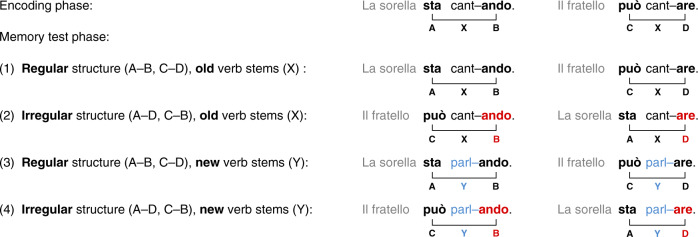
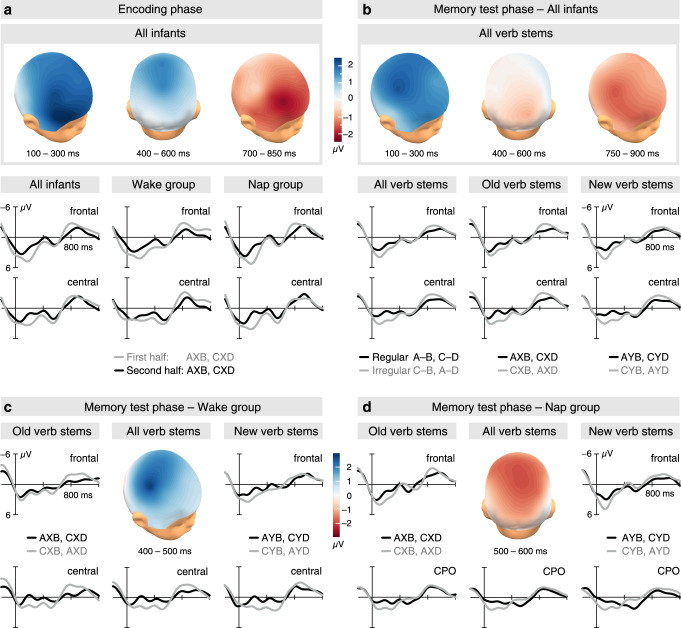
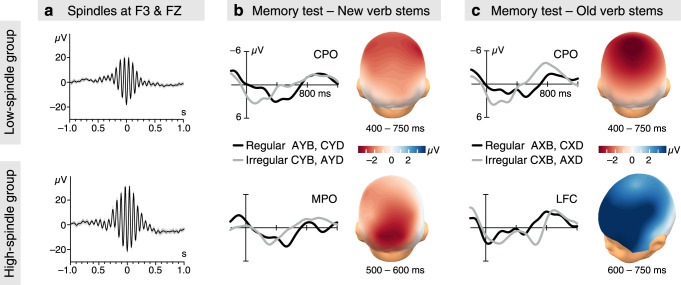
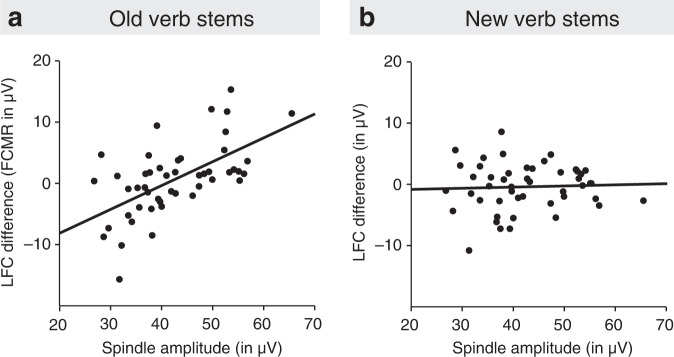
Grammar learning requires memory for dependencies between nonadjacent elements in speech. Immediate learning of nonadjacent dependencies has been observed in very young infants, but their memory of such dependencies has remained unexplored. Here we used event-related potentials to investigate whether 6- to 8-month-olds retain nonadjacent dependencies and if sleep after learning affects this memory. Infants were familiarised with two rule-based morphosyntactic dependencies, presented in sentences of an unknown language. Brain responses after a retention period reveal memory of the nonadjacent dependencies, independent of whether infants napped or stayed awake. Napping, however, altered a specific processing stage, suggesting that memory evolves during sleep. Infants with high left frontal spindle activity show an additional brain response indicating memory of individual speech phrases. Results imply that infants as young as 6 months are equipped with memory mechanisms relevant to grammar learning. They also suggest that during sleep, consolidation of highly specific information can co-occur with changes in the nature of generalised memory.
Overview
The claims and statistics of this paper haven’t been checked yet.
Free: it reads the open-access text and checks the first 5 claims that cite a source we can check. Create a free account to check every claim.
Integrity signals
Registry
Cites
Statistics
Figures
Verification
Claims the paper makes
The claims and statistics of this paper haven’t been checked yet.
Free: it reads the open-access text and checks the first 5 claims that cite a source we can check. Create a free account to check every claim.
Claims other papers make about this one
Each is checked against this paper’s own text: does it say what the citing paper says it does?
The source backs part of the claim, not all of it — or backs it for a different population, condition or comparison.
In the citing paper
“However, such rule memory was also found to be enhanced after a wake control period, although linked to a different pattern of ERP responses suggesting that rule memories formed during sleep and wake at this age differ in quality.”
From Sleep—A brain-state serving systems memory consolidation (2023) · cites this paper as [271]
Experimental — accuracy not yet measuredThe source backs part of the claim, not all of it — or backs it for a different population, condition or comparison.
In the citing paper
“In even younger 6-to 8-month-old infants, indicators of memory for sequential rules (nonadjacent dependencies in spoken artificial word strings) were found to be enhanced after sleep.271”
From Sleep—A brain-state serving systems memory consolidation (2023) · cites this paper as [271]
Experimental — accuracy not yet measuredThe check wasn’t confident either way, so it gives no verdict — never disputed.
In the citing paper
“Studies directly comparing non-REM and REM sleep found no evidence for hippocampal place cell reactivations 131 or coordinated hippocampal-subcortical reactivations in a spatial task with an aversive emotional component 100 during REM sleep.”
From Sleep—A brain-state serving systems memory consolidation (2023) · cites this paper as [131]
Experimental — accuracy not yet measuredThe check wasn’t confident either way, so it gives no verdict — never disputed.
In the citing paper
“Memory reactivations occur preferentially in non-REM sleep.”
From Sleep—A brain-state serving systems memory consolidation (2023) · cites this paper as [131]
Experimental — accuracy not yet measuredThe check wasn’t confident either way, so it gives no verdict — never disputed.
In the citing paper
“In hippocampal networks, rates of replay and reactivation are highest within the first 10-30 min of post-encoding sleep and appear to rapidly fade later.”
From Sleep—A brain-state serving systems memory consolidation (2023) · cites this paper as [131]
Experimental — accuracy not yet measured
Self-check
Percentages, sums and reported differences re-computed from the paper’s own numbers.
The self-check needs the paper’s full text.
Citations
Cites
Comparing correlated correlation coefficients
Meng, X.-L., Rosenthal, R., & Rubin, D. B. (1992) · Psychological Bulletin · doi:10.1037/0033-2909.111.1.172 · Cited by 2,472
Brain potentials during reading reflect word expectancy and semantic association
Kutas, M., & Hillyard, S. A. (1984) · Nature · doi:10.1038/307161a0 · Cited by 2,218
A cortical–hippocampal system for declarative memory
Eichenbaum, H. (2000) · Nature Reviews Neuroscience · doi:10.1038/35036213 · Cited by 1,727
Pattern Separation in the Dentate Gyrus and CA3 of the Hippocampus
Leutgeb, J. K., Leutgeb, S., Moser, M.-B., & Moser, E. I. (2007) · Science · doi:10.1126/science.1135801 · Cited by 1,601
Pattern separation in the hippocampus
Yassa, M. A., & Stark, C. E. L. (2011) · Trends in Neurosciences · doi:10.1016/j.tins.2011.06.006 · Cited by 1,544
Rule Learning by Seven-Month-Old Infants
Marcus, G. F., Vijayan, S., Bandi Rao, S., & Vishton, P. M. (1999) · Science · doi:10.1126/science.283.5398.77 · Cited by 1,244
Mechanisms of systems memory consolidation during sleep
Klinzing, J. G., Niethard, N., & Born, J. (2019) · Nature Neuroscience · doi:10.1038/s41593-019-0467-3 · Cited by 1,176
Self-citationSleep Spindles and Their Significance for Declarative Memory Consolidation
Schabus, M., Gruber, G., Parapatics, S., Sauter, C., Klösch, G., Anderer, P., Klimesch, W., Saletu, B., & Zeitlhofer, J. (2004) · Sleep · doi:10.1093/sleep/27.7.1479 · Cited by 560
The Declarative/Procedural Model of Lexicon and Grammar
Ullman, M. T. (2001) · Journal of Psycholinguistic Research · doi:10.1023/a:1005204207369 · Cited by 508
Pattern-Specific Associative Long-Term Potentiation Induced by a Sleep Spindle-Related Spike Train
Rosanova, M., & Ulrich, D. (2005) · The Journal of Neuroscience · doi:10.1523/jneurosci.2149-05.2005 · Cited by 413
Overnight verbal memory retention correlates with the number of sleep spindles
Clemens, Z., Fabó, D., & Halász, P. (2005) · Neuroscience · doi:10.1016/j.neuroscience.2005.01.011 · Cited by 405
Naps promote abstraction in language-learning infants
Gómez, R. L., Bootzin, R. R., & Nadel, L. (2006) · Psychological Science · doi:10.1111/j.1467-9280.2006.01764.x · Cited by 386
The Visual Scoring of Sleep and Arousal in Infants and Children
Grigg-Damberger, M., Gozal, D., Marcus, C. L., Quan, S. F., Rosen, C. L., Chervin, R. D., Wise, M., Picchietti, D. L., Sheldon, S. H., & Iber, C. (2007) · Journal of Clinical Sleep Medicine · doi:10.5664/jcsm.26819 · Cited by 361
The development of declarative memory in human infants: Age-related changes in deffered imitation.
Hayne, H., Boniface, J., & Barr, R. (2000) · Behavioral Neuroscience · doi:10.1037//0735-7044.114.1.77 · Cited by 261
Overnight alchemy: sleep-dependent memory evolution
Walker, M. P., & Stickgold, R. (2010) · Nature Reviews Neuroscience · doi:10.1038/nrn2762-c1 · Cited by 229
Nap‐dependent learning in infants
Hupbach, A., Gomez, R. L., Bootzin, R. R., & Nadel, L. (2009) · Developmental Science · doi:10.1111/j.1467-7687.2009.00837.x · Cited by 201
Thornhill, D. E., & Van Petten, C. (2012) · International Journal of Psychophysiology · doi:10.1016/j.ijpsycho.2011.12.007 · Cited by 196
Learning at a distance II. Statistical learning of non-adjacent dependencies in a non-human primate
Newport, E. L., Hauser, M. D., Spaepen, G., & Aslin, R. N. (2004) · Cognitive Psychology · doi:10.1016/j.cogpsych.2003.12.002 · Cited by 193
Generalization of word meanings during infant sleep
Friedrich, M., Wilhelm, I., Born, J., & Friederici, A. D. (2015) · Nature Communications · doi:10.1038/ncomms7004 · Cited by 176
Self-citationMills, D. L., Prat, C., Zangl, R., Stager, C. L., Neville, H. J., & Werker, J. F. (2004) · Journal of Cognitive Neuroscience · doi:10.1162/0898929042304697 · Cited by 174
Timely sleep facilitates declarative memory consolidation in infants
Seehagen, S., Konrad, C., Herbert, J. S., & Schneider, S. (2015) · Proceedings of the National Academy of Sciences · doi:10.1073/pnas.1414000112 · Cited by 166
Friedrich, M., & Friederici, A. D. (2005) · Journal of Cognitive Neuroscience · doi:10.1162/089892905774589172 · Cited by 159
Self-citationElectrophysiological evidence for prelinguistic infants' word recognition in continuous speech
Kooijman, V., Peter Hagoort, A., & Cutler, A. (2005) · Cognitive Brain Research · doi:10.1016/j.cogbrainres.2004.12.009 · Cited by 154
The role of sleep spindles and slow-wave activity in integrating new information in semantic memory
Tamminen, J., Lambon Ralph, M. A., & Lewis, P. A. (2013) · The Journal of Neuroscience · doi:10.1523/jneurosci.5093-12.2013 · Cited by 152
Gómez, R. L., & Edgin, J. O. (2016) · Developmental Cognitive Neuroscience · doi:10.1016/j.dcn.2015.08.009 · Cited by 151
Ventral and dorsal streams in the evolution of speech and language
Rauschecker, J. P. (2012) · Frontiers in Evolutionary Neuroscience · doi:10.3389/fnevo.2012.00007 · Cited by 138
Ontogeny of early event memory: II. Encoding and retrieval by 2- and 3-month-olds
Hayne, H., Greco, C., Earley, L. A., Griesler, P. C., & Rovee‐Collier, C. (1986) · Infant Behavior and Development · doi:10.1016/0163-6383(86)90018-4 · Cited by 132
Developmental changes in the specificity of memory over the first year of life
Hartshorn, K., Rovee-Collier, C., Gerhardstein, P., Bhatt, R. S., Klein, P. J., Aaron, F., Wondoloski, T. L., & Wurtzel, N. (1998) · Developmental Psychobiology · doi:10.1002/(sici)1098-2302(199807)33:1<61::aid-dev6>3.0.co;2-q · Cited by 131
Evidence of hippocampal learning in human infants
Ellis, C. T., Skalaban, L. J., Yates, T. S., Bejjanki, V. R., Córdova, N. I., & Turk‐Browne, N. B. (2021) · Current Biology · doi:10.1016/j.cub.2021.04.072 · Cited by 120
The Neural Bases of Infant Attention
Richards, J. E., Reynolds, G. D., & Courage, M. L. (2010) · Current Directions in Psychological Science · doi:10.1177/0963721409360003 · Cited by 120
Gómez, R. L., & Edgin, J. O. (2015) · Child Development Perspectives · doi:10.1111/cdep.12130 · Cited by 93
A mechanism for learning with sleep spindles
Peyrache, A., & Seibt, J. (2020) · Philosophical Transactions of the Royal Society B: Biological Sciences · doi:10.1098/rstb.2019.0230 · Cited by 89
Brain dynamics of word familiarization in 20-month-olds: Effects of productive vocabulary size
Torkildsen, J. V. K., Hansen, H. F., Svangstu, J. M., Smith, L., Simonsen, H. G., Moen, I., & Lindgren, M. P. (2008) · Brain and Language · doi:10.1016/j.bandl.2008.09.005 · Cited by 87
The Evolution of Syntax: An Exaptationist Perspective
Fitch, W. T. (2011) · Frontiers in Evolutionary Neuroscience · doi:10.3389/fnevo.2011.00009 · Cited by 86
Non-adjacent visual dependency learning in chimpanzees
Sonnweber, R. S., Ravignani, A., & Fitch, W. T. (2015) · Animal Cognition · doi:10.1007/s10071-015-0840-x · Cited by 84
Precursors to Natural Grammar Learning: Preliminary Evidence from 4-Month-Old Infants
Friederici, A. D., Mueller, J. L., & Oberecker, R. (2011) · PLoS ONE · doi:10.1371/journal.pone.0017920 · Cited by 80
Self-citationThe sleeping infant brain anticipates development
Friedrich, M., Wilhelm, I., Mölle, M., Born, J., & Friederici, A. D. (2017) · Current Biology · doi:10.1016/j.cub.2017.06.070 · Cited by 77
Self-citationSleep confers a benefit for retention of statistical language learning in 6.5 month old infants
Simon, K. N. S., Werchan, D. M., Goldstein, M. R., Sweeney, L., Bootzin, R. R., Nadel, L., & Gómez, R. L. (2016) · Brain and Language · doi:10.1016/j.bandl.2016.05.002 · Cited by 75
Syntactic learning by mere exposure - An ERP study in adult learners
Mueller, J. L., Oberecker, R., & Friederici, A. D. (2009) · BMC Neuroscience · doi:10.1186/1471-2202-10-89 · Cited by 71
Self-citationLearning non-adjacent regularities at age 0 ; 7
Gervain, J., & Werker, J. F. (2012) · Journal of Child Language · doi:10.1017/s0305000912000256 · Cited by 60
A Daytime Nap Facilitates Generalization of Word Meanings in Young Toddlers
Horváth, K., Liu, S., & Plunkett, K. (2016) · Sleep · doi:10.5665/sleep.5348 · Cited by 53
Friedrich, M., Mölle, M., Friederici, A. D., & Born, J. (2020) · Nature Communications · doi:10.1038/s41467-020-14850-8 · Cited by 49
Self-citationFriedrich, M., & Friederici, A. D. (2017) · Developmental Science · doi:10.1111/desc.12357 · Cited by 47
Self-citationNonadjacent dependency processing in monkeys, apes, and humans
Watson, S. K., Burkart, J. M., Schapiro, S. J., Lambeth, S. P., Mueller, J. L., & Townsend, S. W. (2020) · Science Advances · doi:10.1126/sciadv.abb0725 · Cited by 47
Language Learning without Control: The Role of the PFC
Friederici, A. D., Mueller, J. L., Sehm, B., & Ragert, P. (2013) · Journal of Cognitive Neuroscience · doi:10.1162/jocn_a_00350 · Cited by 41
Self-citationFriedrich, M., Mölle, M., Friederici, A. D., & Born, J. (2019) · Developmental Science · doi:10.1111/desc.12743 · Cited by 38
Self-citationFriedrich, C. K., Schild, U., & Röder, B. (2008) · Biological Psychology · doi:10.1016/j.biopsycho.2008.04.012 · Cited by 38
Bridging the gap: Learning of acoustic nonadjacent dependencies by a songbird.
Chen, J., & ten Cate, C. (2017) · Journal of Experimental Psychology Animal Learning and Cognition · doi:10.1037/xan0000145 · Cited by 30
ACKLES, P. K., & COOK, K. G. (2007) · International Journal of Neuroscience · doi:10.1080/00207450600909970 · Cited by 25
Mass counts: ERP correlates of non-adjacent dependency learning under different exposure conditions
CITRON, F. M. M., Oberecker, R., Friederici, A. D., & Mueller, J. L. (2010) · Neuroscience Letters · doi:10.1016/j.neulet.2010.10.038 · Cited by 25
Self-citationDeveloping knowledge of nonadjacent dependencies.
Culbertson, J., Koulaguina, E., Gonzalez‐Gomez, N., Legendre, G., & Nazzi, T. (2016) · Developmental Psychology · doi:10.1037/dev0000246 · Cited by 23
Friedrich, M. (2017) · Routledge eBooks · doi:10.4324/9781315730974-10 · Cited by 2
Self-citation
Cited by
Sleep—A brain-state serving systems memory consolidation
Brodt, S., Inostroza, M., Niethard, N., & Born, J. (2023) · Neuron · doi:10.1016/j.neuron.2023.03.005 · Cited by 343
Self-citationSleep’s contribution to memory formation
Lutz, N. D., Harkotte, M., & Born, J. (2025) · Physiological Reviews · doi:10.1152/physrev.00054.2024 · Cited by 60
Self-citationDevelopment of slow oscillation–spindle coupling from infancy to toddlerhood
Kurz, E., Bastian, L., Mölle, M., Born, J., & Friedrich, M. (2024) · SLEEP Advances · doi:10.1093/sleepadvances/zpae084 · Cited by 16
Self-citationSleep-slow oscillation-spindle coupling precedes spindle-ripple coupling during development
Fechner, J., Contreras, M. P., Zorzo, C., Xia, S., Born, J., & Inostroza, M. (2024) · SLEEP · doi:10.1093/sleep/zsae061 · Cited by 15
Self-citationNapping and memory consolidation in early childhood: A systematic review and meta-analysis
Souabni, M., Souabni, M. J., Salem, A., Hammouda, O., Ammar, A., Saidi, O., Żmijewski, P., Jahrami, H., de Marco, G., Trabelsi, K., et al. (2025) · Sleep Medicine · doi:10.1016/j.sleep.2025.106649 · Cited by 14
Metadata
- Authors
- Friedrich, M., Mölle, M., Born, J., & Friederici, A. D.
- Affiliations
- Humboldt-Universität zu Berlin (DE)
- University of Lübeck (DE)
- Max Planck Institute for Human Cognitive and Brain Sciences (DE)
- Corresponding author
- Friedrich, Manuela
- Venue
- Nature Communications
- Published
- 2022-12-22
- Volume
- 13
- Issue
- 1
- Pages
- 7896-7896
- ISSN
- 2041-1723 (ISSN-L)
- PMC
- PMC9780241
- OpenAlex
- W4312192738
- Cited by
- 12
- References
- 52
- Citations by year
- 2026: 1 · 2025: 2 · 2024: 7 · 2023: 2
- FWCI
- 4.19
- Type
- journal article
- Language
- en
- Open access
- gold
- doi.org
- Licence
- cc-by
- creativecommons.org/licenses/by/4.0 (tdm)
- creativecommons.org/licenses/by/4.0 (vor)
- Locations
- Nature Communications (publishedVersion, cc-by)
- PubMed Central (publishedVersion, cc-by)
- PubMed (publishedVersion)
- RePEc: Research Papers in Economics (submittedVersion)
- DOAJ (DOAJ: Directory of Open Access Journals) (submittedVersion, cc-by-sa)
- OSF Preprints (OSF Preprints) (submittedVersion)
- Funders
- Deutsche Forschungsgemeinschaft (FR 1336/2–1, FR 1336/2–2)
- Topics
- Social Sciences › Psychology › Developmental and Educational Psychology › Language Development and Disorders
- Life Sciences › Neuroscience › Cognitive Neuroscience › Sleep and Wakefulness Research
- Life Sciences › Neuroscience › Cognitive Neuroscience › Neurobiology of Language and Bilingualism
- Keywords
- non-adjacent dependencies, infant memory, sleep, napping, grammar learning, memory consolidation, event-related potentials, speech processing, language acquisition
- MeSH terms
- Humans, Infant, Language, Learning, Sleep, Speech, Speech Perception
About these checks
Registry, retraction, Cites and statistics results are computed, not judged, with one exception: a printed reference that no index lists is read once by a model before it counts as a citation error. Claims are extracted by a model and kept only when their quote appears verbatim in the text; each cited source is then checked, with a model’s help, for whether it says what the claim relies on. Those verdicts can be wrong — read the claim’s quote and the cited source before relying on one.
Statistics and arithmetic are recomputed, not judged.
Confidence bands are shown only for fields calibrated on our annotated test set. None is calibrated yet, so no band is shown.
What counts as a claim ›How we measure confidence ›How we check this ›
Are you an author, or do you see a problem with this page? Request a review
Data sources
Bibliographic data: Semantic Scholar, OpenAlex, Crossref.
Contains information from the Semantic Scholar Academic Graph Datasets, made available under the ODC Attribution License (ODC-BY 1.0).
Semantic Scholar’s data is described in: Kinney, R., et al. (2023). The Semantic Scholar Open Data Platform. arXiv:2301.10140.
