

Hardware implementation of memristor-based artificial neural networks
Open accessThe DOI matches its Crossref record; 272 of the 290 references it cites were found in a registry or an index, and 3 are not checked yet; 94 of the 273 sources its claims cite were checked for support.
Abstract
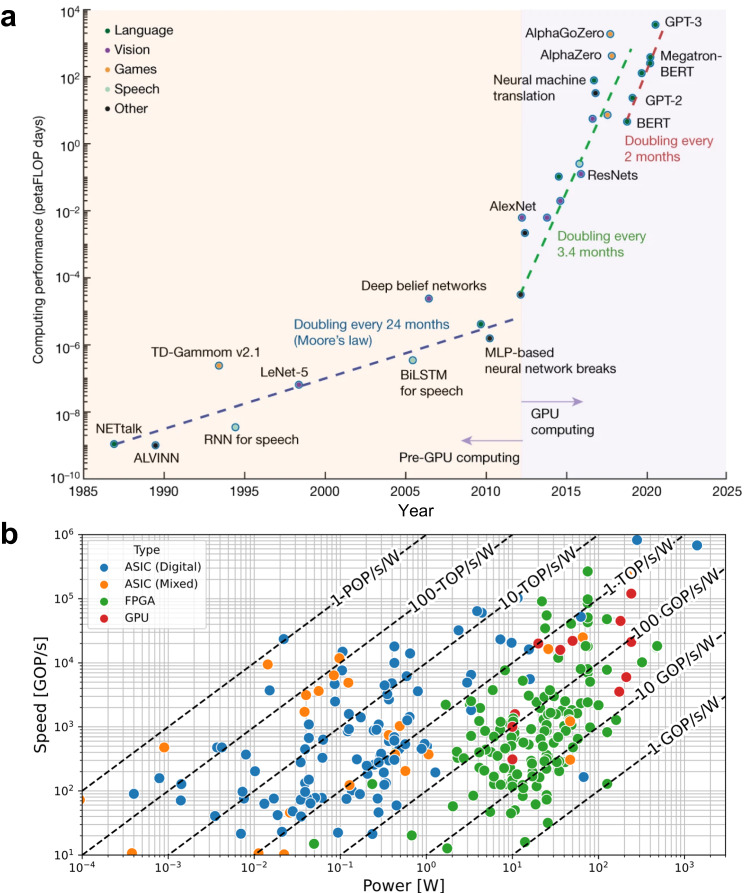
Artificial Intelligence (AI) is currently experiencing a bloom driven by deep learning (DL) techniques, which rely on networks of connected simple computing units operating in parallel. The low communication bandwidth between memory and processing units in conventional von Neumann machines does not support the requirements of emerging applications that rely extensively on large sets of data. More recent computing paradigms, such as high parallelization and near-memory computing, help alleviate the data communication bottleneck to some extent, but paradigm- shifting concepts are required. Memristors, a novel beyond-complementary metal-oxide-semiconductor (CMOS) technology, are a promising choice for memory devices due to their unique intrinsic device-level properties, enabling both storing and computing with a small, massively-parallel footprint at low power. Theoretically, this directly translates to a major boost in energy efficiency and computational throughput, but various practical challenges remain. In this work we review the latest efforts for achieving hardware-based memristive artificial neural networks (ANNs), describing with detail the working principia of each block and the different design alternatives with their own advantages and disadvantages, as well as the tools required for accurate estimation of performance metrics. Ultimately, we aim to provide a comprehensive protocol of the materials and methods involved in memristive neural networks to those aiming to start working in this field and the experts looking for a holistic approach.
Verified 2026-11-22 · 3 references not checked yet
Overview
CoChat Summary
TL;DR
This paper is a review and practical protocol for hardware implementation of memristor-based artificial neural networks, with a focus on image-classification systems. It walks through the full stack from input encoding and crossbar VMM to training, peripheral circuits, simulation, and chip integration, while emphasizing device/circuit non-idealities and design trade-offs.
Key findings
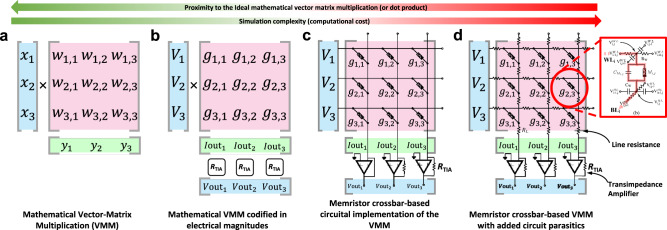
- Memristor crossbars are presented as the core hardware for vector-matrix multiplication, since VMM/MAC is the most demanding ANN operation and can be parallelized in crossbar arrays.
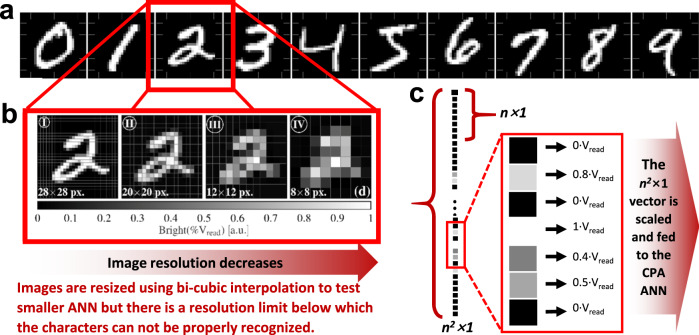
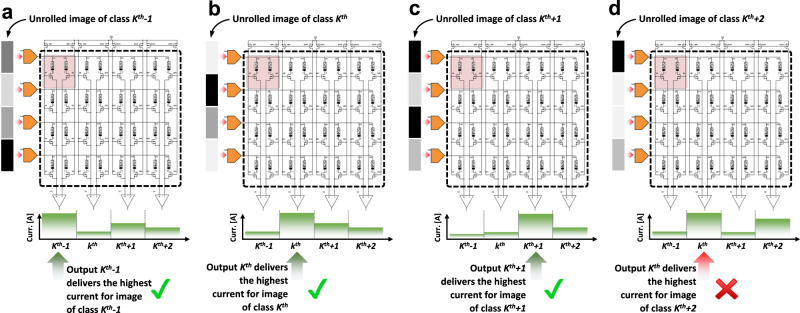
- For MNIST-style benchmarking, the paper uses a 60,000-image training set and 10,000-image test set; in the worked example, images are downsized from 28 × 28 to 8 × 8 and an ANN with one 64 × 10 single-layer perceptron is trained.
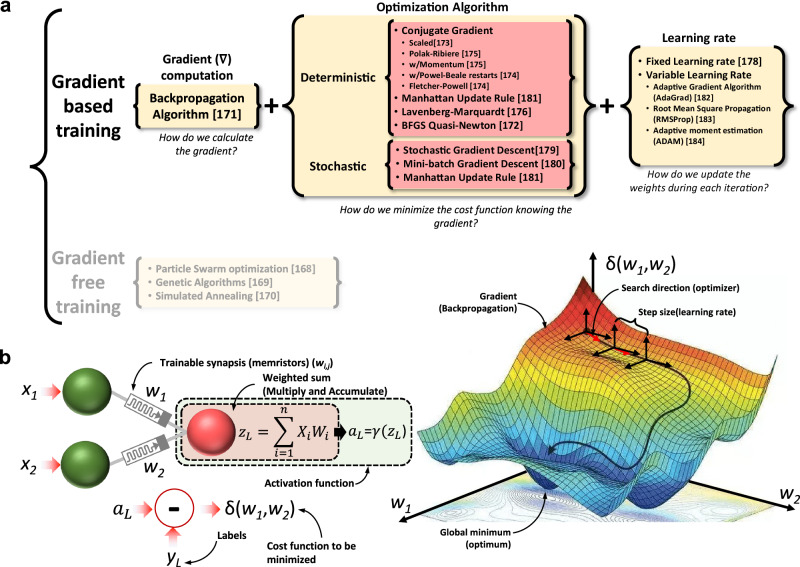
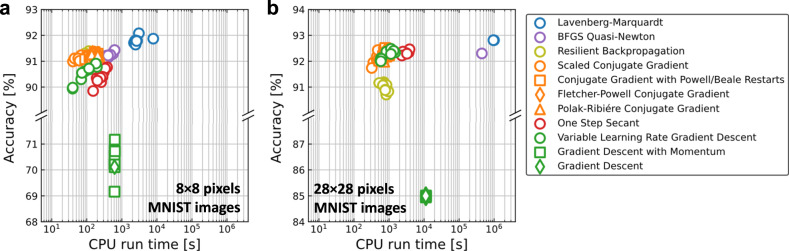
- In the example training study on 100 images, Scaled Conjugate Gradient and Levenberg–Marquardt achieved the highest accuracy, but Scaled Conjugate Gradient was chosen because it was faster.
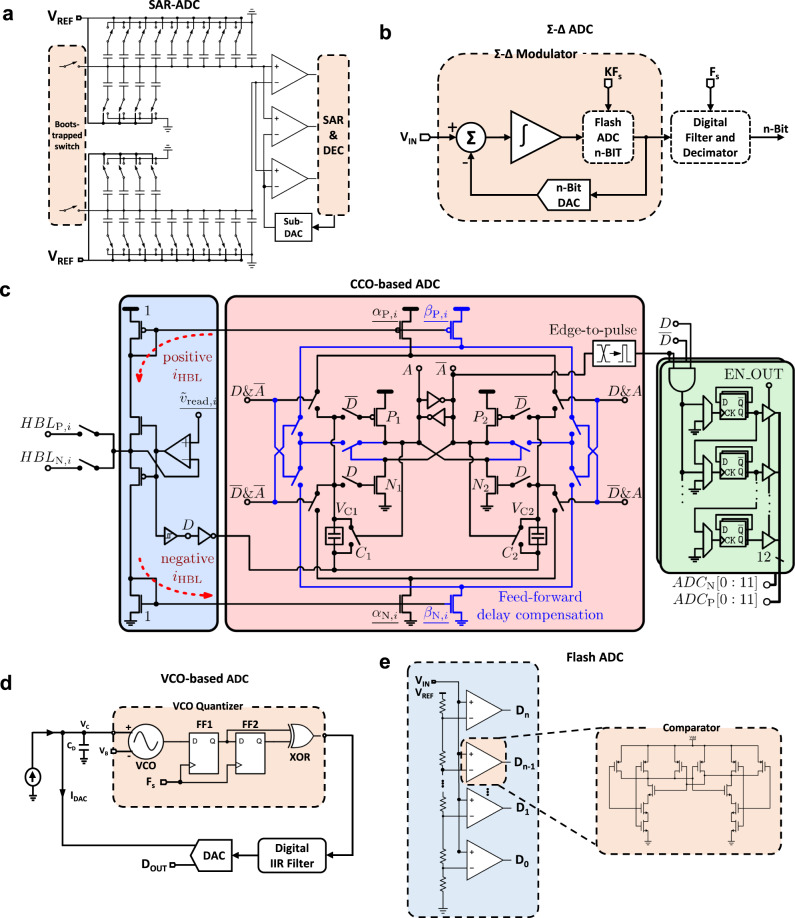
- The paper states that ADCs are often the largest and most power-hungry circuit block in memristive neural networks, consuming up to 70–90% of on-chip area and up to 80–88% of energy.
Methods
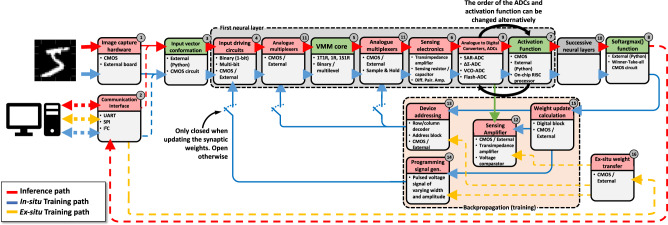
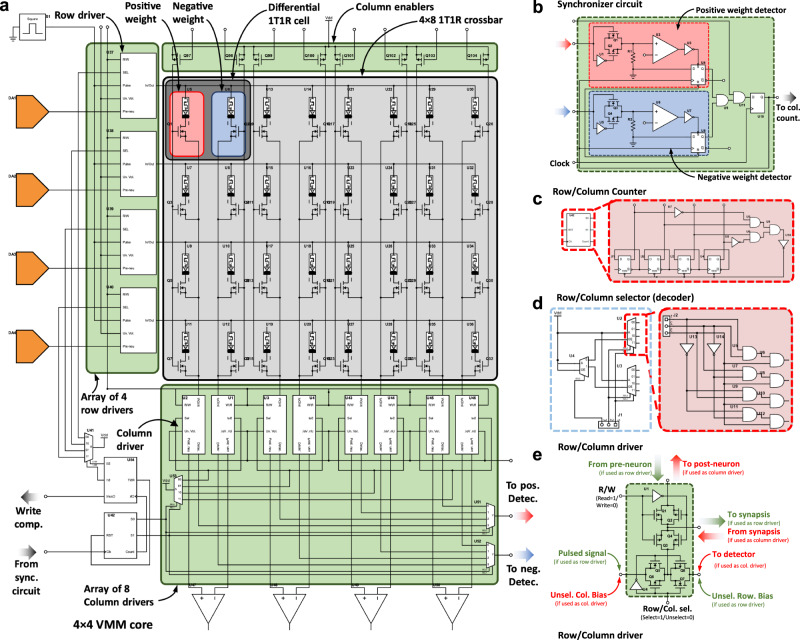
- Review/protocol article: synthesizes prior work on memristive ANN hardware and organizes the system into blocks (image capture, input driving, VMM core, sensing, activation, softargmax, ADCs, and training/update).
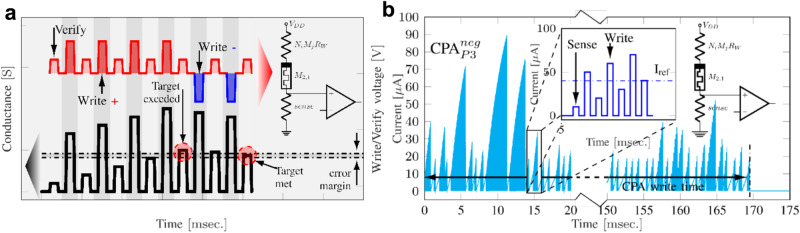
- Worked example: a single-layer perceptron for MNIST image classification; MATLAB is used to train the software model and generate a SPICE netlist, and SPICE simulation is used to evaluate the hybrid CMOS/memristor circuit during inference and write-verify programming.
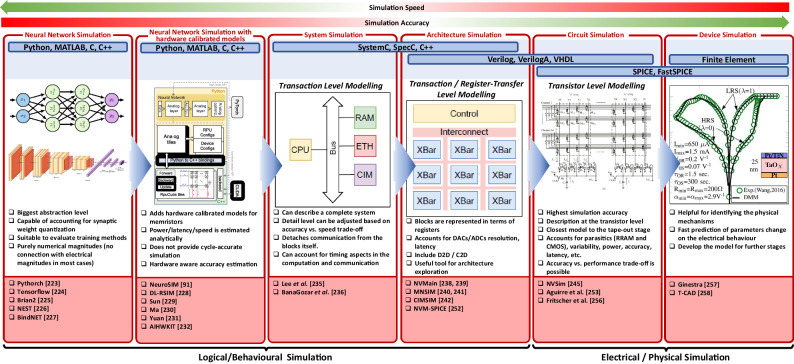
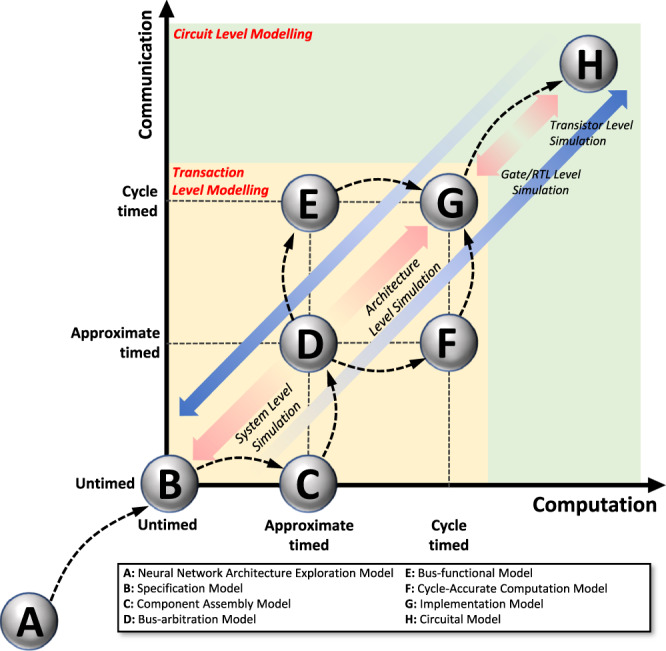
- Analysis emphasis: compares ex situ vs in situ training, discusses conductance mapping to memristors, and surveys simulation abstraction levels from neural-network-level tools to circuit/SPICE-level models.
Limitations
- Stated in the paper: many published studies are not true full-hardware implementations; some only characterize a few devices or rely on software ANN simulations, so reported performance can be weakly connected to fabricated hardware.
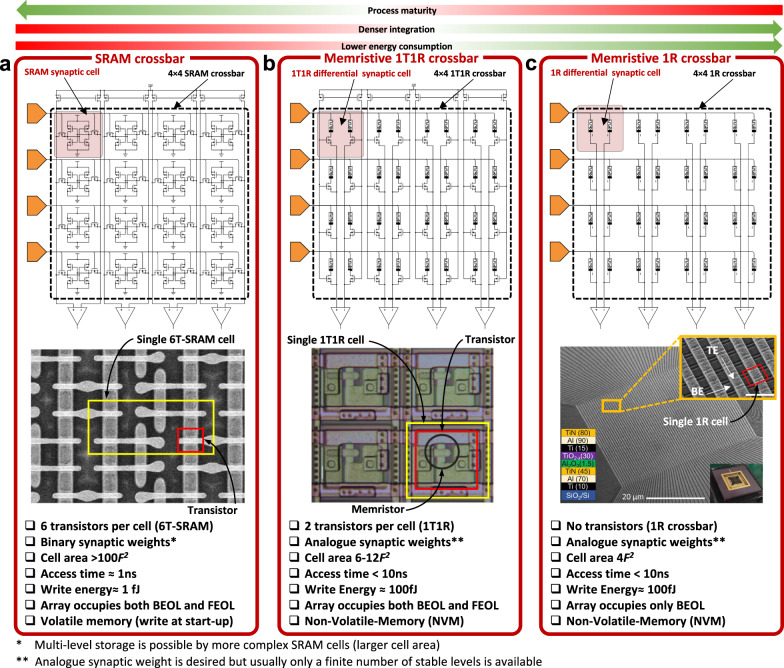
- Stated in the paper: full on-chip memristive ANN implementation is limited by peripheral circuit overhead, ADC/DAC trade-offs, device non-idealities, and the difficulty of integrating memristor stacks with CMOS.
- Evident from the text: the paper is not an experimental validation of a new memristor ANN chip; it is primarily a review plus a simulation-based worked example, so its conclusions about performance are illustrative rather than a direct new hardware result.
Model-written summary. Check it against the paper before relying on it.
Integrity signals
Registry
Cites
Statistics
Figures
Verification
Claims the paper makes
47 Valid · 14 Not valid · 58 Not checked · 121 Own results and interpretations
At least one cited source doesn’t support this claim or points to a different paper, and none confirmed it — see the verdicts below.
In the paper
“ADCs with at least 8-bit resolution are necessary to achieve high (>90%) classification accuracy in a ResNET50-1.5 ANN used to classify the ImageNET157 database”
§ Hardware implementation of memristor-based artificial neural networks > Structure of memristor-based ANNs > Analogue to digital converters (Block 9)
What the sources say
- Disputedcites [157] Xiao TP On the Accuracy of Analog Neural Network Inference Accelerators [Feature],” IEEE Circuits Syst. Mag. 2022 22 26 48 10.1109/MCAS.2022.3214409 sourceExperimental — accuracy not yet measured
Section 6.3 (p. 12) says high accuracy is maintained with a 7-bit ADC, contrary to the claim that at least 8 bits are necessary. Table 2 in Section 4.3 (p. 7) reports 76.466% ImageNet top-1 accuracy for ResNet50-v1.5, not over 90%. (LLM, conf=0.93)
Checked by a reasoning model — may be wrong.
plainstates a cause- Asserted: passes — The authors put it forward as true.
- Checkable: passes — It can be checked against evidence.
- Load-bearing: unclear — It is unclear whether the paper’s conclusions depend on it.
- Based: passes — The paper gives a reason why it holds.
- Disputed
Some cited sources support this claim and some don’t — read each source’s verdict below.
In the paper
“the usual practice reported in the literature for this kind of training has been the use of the so-called Manhattan Update Rule105,194, or the Stochastic Gradient Descent54.”
§ Hardware implementation of memristor-based artificial neural networks > Structure of memristor-based ANNs > ANN training and synaptic weight update (Blocks 2, 11-15)
What the sources say
- Supportedcites [105] Prezioso M “Training and operation of an integrated neuromorphic network based on metal-oxide memristors,” Nature 2015 521 61 64 10.1038/nature14441 25951284 source
The Pattern Classification Experiment (p. 5) explicitly says the network was trained in situ using the Manhattan Update rule. This supports the Manhattan-rule example for which this paper is cited; the separate stochastic-gradient-descent citation is not being judged here. (LLM, conf=0.93)
- Disputedcites [194] Yao, P. et al., “Face classification using electronic synapses,” Nat. Commun., 8, May, 1–8, 10.1038/ncomms15199.2017, PMC5437298 28497781 sourceExperimental — accuracy not yet measured
The citation to this paper is attached to the Stochastic Gradient Descent part of the sentence. In “RRAM-based neuromorphic network” (page unavailable), the paper calls its two weight-update rules the delta rule and the Manhattan rule; Figure 2’s caption explicitly says the demonstration uses a batch learning model, not stochastic gradient descent. (LLM, conf=0.83)
Checked by a reasoning model — may be wrong.
- Could not verifycites [54] Li C “Efficient and self-adaptive in-situ learning in multilayer memristor neural networks,” Nat. Commun. 2018 9 1 8 29921923 PMC6008303 sourceExperimental — accuracy not yet measured
The Methods section describes ray-tracing simulations of bird-of-paradise feathers, not training memristor-based neural networks. Searches for the Manhattan Update Rule and stochastic gradient descent found no passage in our copy addressing either method as a usual training practice. (LLM, conf=0.78)
plain- Asserted: passes — The authors put it forward as true.
- Checkable: passes — It can be checked against evidence.
- Load-bearing: unclear — It is unclear whether the paper’s conclusions depend on it.
- Based: passes — The paper gives a reason why it holds.
- Supported
The cited sources support only part of this claim — read each source’s verdict below.
In the paper
“So far, several groups and companies have claimed the realization of hybrid CMOS/memristor implementations of ANNs53–61, —from now on, memristive ANNs— with performance that is superior to that of fully-CMOS counterparts.”
§ Hardware implementation of memristor-based artificial neural networks > Introduction
What the sources say
- Not checked — no full text of the sourcecites [53] Ishii, M. et al., “On-Chip Trainable 1.4M 6T2R PCM synaptic array with 1.6K Stochastic LIF neurons for spiking RBM,” Technical Digest - International Electron Devices Meeting, IEDM, 2019- 310–313, 2019, 10.1109/IEDM19573.2019.8993466. source
- Could not verifycites [54] Li C “Efficient and self-adaptive in-situ learning in multilayer memristor neural networks,” Nat. Commun. 2018 9 1 8 29921923 PMC6008303 sourceExperimental — accuracy not yet measured
The Results section discusses super-black feather microstructure, and the Introduction discusses structural absorption of light; neither addresses artificial neural networks. Searches for hybrid CMOS/memristor implementations and performance relative to fully-CMOS systems found no relevant passage in our copy. (LLM, conf=0.78)
- Not checked — no full text of the sourcecites [55] Yao P “Fully hardware-implemented memristor convolutional neural network,” Nature 2020 577 641 646 10.1038/s41586-020-1942-4 31996818 source
- Not checked — no full text of the sourcecites [56] Correll, J. M. et al., “An 8-bit 20.7 TOPS/W Multi-Level Cell ReRAM-based Compute Engine,” in 2022 IEEE Symposium on VLSI Technology and Circuits (VLSI Technology and Circuits), IEEE, 264–265. 10.1109/VLSITechnologyandCir46769.2022.9830490.2022, source
- Not checked — no full text of the sourcecites [57] Cai, F. et al., “A fully integrated reprogrammable memristor-CMOS system for efficient multiply-accumulate operations,” Nat Electron, 2, no. July, 290–299, [Online]. Available: 10.1038/s41928-019-0270-x 2019. source
- Not checked — no full text of the sourcecites [58] Hung, J.-M., “An 8-Mb DC-Current-Free Binary-to-8b Precision ReRAM Nonvolatile Computing-in-Memory Macro using Time-Space-Readout with 1286.4-21.6TOPS/W for Edge-AI Devices,” in 2022 IEEE International Solid- State Circuits Conference (ISSCC), IEEE, 1–3. 10.1109/ISSCC42614.2022.9731715.2022, source
- Not checked — no full text of the sourcecites [59] Xue, C.-X., “15.4 A 22nm 2Mb ReRAM Compute-in-Memory Macro with 121-28TOPS/W for Multibit MAC Computing for Tiny AI Edge Devices,” in 2020 IEEE International Solid- State Circuits Conference - (ISSCC), IEEE, 2020, 244–246. source
- Partly supportedcites [60] Wan W “A compute-in-memory chip based on resistive random-access memory,” Nature 2022 608 504 512 10.1038/s41586-022-04992-8 35978128 PMC9385482 sourceExperimental — accuracy not yet measured
The Main section describes NeuRRAM as an RRAM chip integrated with CMOS circuits and reports hardware-measured AI inference, supporting its use as an example of a hybrid implementation. The reported performance gains are against earlier RRAM compute-in-memory chips (Efficient voltage-mode neuron circuit), not fully-CMOS counterparts. The Methods section projects higher efficiency than edge inference accelerators only after scaling NeuRRAM from 130 nm to 7 nm; it does not establish the claimed superiority for the realized chip. (LLM, conf=0.84)
- Partly supportedcites [61] Yin S Sun X Yu S Seo JS “High-throughput in-memory computing for binary deep neural networks with monolithically integrated RRAM and 90-nm CMOS,” IEEE Trans. Electron. Dev. 2020 67 4185 4192 10.1109/TED.2020.3015178 sourceExperimental — accuracy not yet measured
The paper demonstrates a binary neural-network chip that integrates RRAM with 90-nm CMOS (p. 1), and its Results report a density advantage over SRAM-based in-memory computing (p. 6). But its quantified throughput and energy-delay improvements are compared with another CMOS chip containing embedded RRAM, not a fully-CMOS counterpart (Supplementary Figure 7, p. 32). It therefore supports the hybrid implementation, but not the claimed overall performance comparison with fully-CMOS ANNs. (LLM, conf=0.86)
plainstates an association- Asserted: passes — The authors put it forward as true.
- Checkable: passes — It can be checked against evidence.
- Load-bearing: unclear — It is unclear whether the paper’s conclusions depend on it.
- Based: passes — The paper gives a reason why it holds.
Every source the paper cites for this claim was checked and supports it.
In the paper
“Moreover, the switching time can be as short as 85 ps42.”
§ Hardware implementation of memristor-based artificial neural networks > Introduction
What the sources say
- Supportedcites [42] Choi BJ “High-speed and low-energy nitride memristors,” Adv. Funct. Mater. 2016 26 5290 5296 10.1002/adfm.201600680 source
The Results and Discussion state that an AlN memristor switched both off and on in 85 ps. The Conclusions also report a measured ultrafast switching time of 85 ps in AlN memristors. (LLM, conf=0.95)
plain- Asserted: passes — The authors put it forward as true.
- Checkable: passes — It can be checked against evidence.
- Load-bearing: unclear — It is unclear whether the paper’s conclusions depend on it.
- Based: passes — The paper gives a reason why it holds.
- Supported
The cited sources support only part of this claim — read each source’s verdict below.
In the paper
“For instance, given the MNIST dataset in which images have a resolution of 28 × 28 pixels one option is to implement the synaptic layer using multiple crossbars to fit the 784 inputs (e.g., 13 64 × 64 or 4 256 × 256 crossbars would be needed93).”
§ Hardware implementation of memristor-based artificial neural networks > Structure of memristor-based ANNs > Image capture hardware (block 1) and input vector conformation (block 3)
What the sources say
- Partly supportedcites [93] Kim H Mahmoodi MR Nili H Strukov DB “4K-memristor analog-grade passive crossbar circuit,” Nat. Commun. 2021 12 1 11 10.1038/s41467-021-25455-0 34465783 PMC8408216 sourceExperimental — accuracy not yet measured
The Results section (“Modeling of advanced systems”; page unavailable) supports splitting a 784-input MNIST classifier layer across multiple crossbar blocks. It does not give the claimed examples of 13 64 × 64 or 4 256 × 256 crossbars: its modeled implementation uses differential-pair weights and maps a 785 × 64 layer to 24 64 × 64 and two 17 × 64 blocks. (LLM, conf=0.88)
hedged- Asserted: passes — The authors put it forward as true.
- Checkable: passes — It can be checked against evidence.
- Load-bearing: unclear — It is unclear whether the paper’s conclusions depend on it.
- Based: passes — The paper gives a reason why it holds.
- Partly supported
88 more claims · 22 with their cited sources checked
Create a free account to see all 240 claims and to verify the 11 references still open.
- Probably not a substantial claim. 79
- It may state two separate claims as one. 91
- The quote only partly states this claim. 1
Citations
Cites
Deep Residual Learning for Image Recognition
He, K., Zhang, X., Ren, S., & Sun, J. (2016) · 2016 IEEE Conference on Computer Vision and Pattern Recognition (CVPR) · doi:10.1109/cvpr.2016.90 · Cited by 235,474 · cited 1×
“For benchmarking a device or a chip, it is essential to evaluate the accuracy of standard deep neural network models like VGG 89 and ResNet 90 on CIFAR and ImageNet dataset by utilizing architecture-levelsimulationandrealistichardwarestatistics 91,92 .”
Very Deep Convolutional Networks for Large-Scale Image Recognition
Simonyan, K., & Zisserman, A. (2014) · arXiv · doi:10.48550/arxiv.1409.1556 · Cited by 114,148 · cited 1×
“For benchmarking a device or a chip, it is essential to evaluate the accuracy of standard deep neural network models like VGG 89 and ResNet 90 on CIFAR and ImageNet dataset by utilizing architecture-levelsimulationandrealistichardwarestatistics 91,92 .”
Adam: A Method for Stochastic Optimization
Kingma, D. P., & Ba, J. (2014) · arXiv · doi:10.48550/arxiv.1412.6980 · Cited by 98,946 · cited 2×
“…employed 165 , and for stochastic evaluation of the loss function using a mini-batch of images diverse methods have been employed, including Adaptive Gradient Algorithm (or AdaGrad) 182 , Root Mean Square Propagation (or RMSProp) 183 , Adaptive Moment Estimation (or Adam) 184 and Adadelta 185 .”
ImageNet: A large-scale hierarchical image database
Deng, J., Dong, W., Socher, R., Li, L.-J., Li, K., & Fei-Fei, L. (2009) · 2009 IEEE Conference on Computer Vision and Pattern Recognition · doi:10.1109/cvpr.2009.5206848 · Cited by 65,333 · cited 1×
“…86 ; 2) CIFAR (Canadian Institute for Advanced Research),whichcontains60,000colorimagesdividedinto10classes for CIFAR-10 and 100 classes for CIFAR-100 87 ; 3) ImageNet, one of the largest image datasets, which consists of over 1.2 million labelled from 1000 classes for the ImageNet competition 88 .”
InfluentialKennedy, J., & Eberhart, R. (2002) · Proceedings of ICNN'95 - International Conference on Neural Networks · doi:10.1109/icnn.1995.488968 · Cited by 58,192 · cited 1×
“Gradient-free methods such as the Particle Swarm optimization 168 , Genetic Algorithms 169 and Simulated Annealing 170 algorithms are more demanding from a computational point of view, andhence,theyarerarelyemployedforANNtraining,bywhichtheylie beyond the scope of this article.”
Optimization by Simulated Annealing
Kirkpatrick, S., Gelatt, C. D., & Vecchi, M. P. (1983) · Science · doi:10.1126/science.220.4598.671 · Cited by 45,134
Learning representations by back-propagating errors
Rumelhart, D. E., Hinton, G. E., & Williams, R. J. (1986) · Nature · doi:10.1038/323533a0 · Cited by 31,892 · cited 1×
“In most ANNs, the gradient of the loss function is normally computed by the backpropagation algorithm 171 .”
An Algorithm for Least-Squares Estimation of Nonlinear Parameters
Marquardt, D. W. (1963) · Journal of the Society for Industrial and Applied Mathematics · doi:10.1137/0111030 · Cited by 30,728 · cited 6×
“…evaluation, common optimization algorithms are the following: (i) Gradient Descent 165 (the simplest one and closest to the previous (cid:129) Manha(cid:3)an UpdateRule [181] (cid:129) Lavenberg-Marquardt[176] (cid:129) BFGS Quasi-Newton[172] Howdo we updatethe weightsduringeachitera(cid:2)on?”
InfluentialStrukov, D. B., Snider, G. S., Stewart, D. R., & Williams, R. S. (2008) · Nature · doi:10.1038/nature06932 · Cited by 11,828
(2017) · Cited by 11,625
Research works printed but not linked: 3
- “Microchips that mimic the human brain could make AI far more energy efficient | Science | AAAS.” Accessed: May 15, 2023. [Online]. Available: https://www.science.org/content/article/microchips-mimic-human-brain-could-make-ai-far-more-energy-efficient
- Hu, M. et al., “Dot-product engine for neuromorphic computing,” in DAC ’16: Proceedings of the 53rd Annual Design Automation Conference, New York, NY, USA: Association for Computing Machinery, 1–6. 10.1145/2897937.2898010.2016, · doi:10.1145/2897937.2898010.2016
- Ielmini, D. and Waser, R. Resistive Switching. Weinheim, Germany: Wiley-VCH Verlag GmbH & Co. KGaA, 2016.
Cited by
Items 201–300 of 498
MSCGN: Multiscale complementary gating network for time series classification
Wu, X., Yan, M., Tang, H., Wu, D., & Xie, L. (2025) · Biomedical Signal Processing and Control · doi:10.1016/j.bspc.2025.108563 · Cited by 6
Rigid propagation of visual motion in the insect’s neural system
Chen, H., Fan, B., Li, H., & Peng, J. (2024) · Neural Networks · doi:10.1016/j.neunet.2024.106874 · Cited by 4
Chowdhury, M. T. R., Vo, H. Q. N., Ramanan, P., Yildirim, M., & Tütüncüoğlu, G. (2024) · International Conference on Neuromorphic Systems (ICONS) · doi:10.1109/icons62911.2024.00058 · Cited by 6
“Emerging non-volatile memory technologies, such as resistive random access memories (RRAMs) based crossbar arrays, provide a versatile solution to the challenges of data-intensive, large-scale computational tasks [6, 7].”
BackgroundBayes2IMC: In-Memory Computing for Bayesian Binary Neural Networks
Katti, P., Ruah, C., Simeone, O., Al‐Hashimi, B. M., & Rajendran, B. (2025) · IEEE Transactions on Circuits and Systems I Regular Papers · doi:10.1109/tcsi.2025.3543065 · Cited by 5
“Pulse width modulation (PWM) can also be used, as suggested in [13].”
InfluentialYang, B., Cao, Z., Sun, B. T., Gao, K., Wang, M., Zhou, G., Lv, J., Luo, S., Chen, X., Li, X., et al. (2025) · Applied Materials Today · doi:10.1016/j.apmt.2025.102771 · Cited by 7
Bachinin, S. V., Timofeeva, M., Gavrilova, A., Povarov, S. A., Shirobokov, V., Kulakova, A. N., & Milichko, V. A. (2025) · ACS Applied Materials & Interfaces · doi:10.1021/acsami.5c06829 · Cited by 4
Abdel, D., Herda, M., Ziegler, M., Chainais-Hillairet, C., Spetzler, B., & Farrell, P. (2025) · Computers & Mathematics with Applications · doi:10.1016/j.camwa.2025.09.034 · Cited by 7
Chen, Y.-C., Lin, J.-T., Chen, K., Chen, C.-T., & Chen, J. (2025) · Nanoscale Horizons · doi:10.1039/d5nh00040h · Cited by 3
Jin, Y., Xu, X., Gao, Y., & Liu, S. (2025) · Solid-State Electronics · doi:10.1016/j.sse.2025.109129 · Cited by 2
Ha, S., Park, Y. J., Lim, C., Yang, E., Kim, T., Kim, S. J., & Park, J. (2025) · Advanced Electronic Materials · doi:10.1002/aelm.202500029 · Cited by 2
A Field Programmable Gate Array‐Assisted Optoelectronic Emulator for Photonic Neuromorphic Computing
Li, J.-X., Hu, R., Wang, F., Shen, J., Cheng, Z., & Zhou, P. (2025) · Advanced Intelligent Systems · doi:10.1002/aisy.202500223 · Cited by 2
Perovskite Neuromorphic Engine for Transformer Architectures
Zhan, Z., Gao, Y., Liao, Y., Xie, W., Liu, S., & Wang, X. (2025) · Advanced Science · doi:10.1002/advs.202504706 · Cited by 3
A multifunctional optoelectronic memristor for in-memory computing
Ren, Y., Wang, Y., Zhu, S., et al. (2025) · Light Advanced Manufacturing · doi:10.37188/lam.2025.053 · Cited by 2
Li, S., Zeng, Y., Jiang, J., Zhang, X., Zhu, G., Huang, W., He, N., Cai, Z., Lian, X., & Wang, L. (2025) · Applied Surface Science · doi:10.1016/j.apsusc.2025.164292 · Cited by 3
Self-citationReSpike: A Co-Design Framework for Evaluating SNNs on ReRAM-Based Neuromorphic Processors
Asifuzzaman, K., Young, A. R., Date, P., Kulkarni, S., Miniskar, N. R., Marinella, M. J., & Vetter, J. S. (2025) · Lecture notes in computer science · doi:10.1007/978-3-031-99857-7_13 · Cited by 3
Energy-Efficient Training of Memristor Crossbar-Based Multi-Layer Neural Networks
Hasan, R., Alam, M. A., & Taha, T. M. (2025) · Chips · doi:10.3390/chips4030038 · Cited by 4
“Memristor devices [5,6] have received significant interest as a synaptic element in a neuromorphic system [7,8].”
Dias, L. M. S., Abranches, D. O., Bastos, A. R. N., Fu, L., Neto, A. N. C., Pereira, R. F. P., Bermudez, V. D. Z., Towe, E., Ferreira, R. A. S., & André, P. S. D. B. (2025) · Journal of Physics Photonics · doi:10.1088/2515-7647/ae0104 · Cited by 6
Design and Simulation of a High-Order Memristor Emulator Based on Cascaded OTA Integrators
Sağbaş, M., Mınaeı, S., & Çayır, M. (2025) · Circuits Systems and Signal Processing · doi:10.1007/s00034-025-03351-y · Cited by 2
SOLO: Spatial online learning at once for spiking neural networks
Lee, S., Moon, H., Yoon, M., Heo, W., & Kim, S. (2025) · Neurocomputing · doi:10.1016/j.neucom.2025.131940 · Cited by 3
Edge-of-chaos operation and persistent dynamics for neuromorphic meminductor computing
Dinavahi, A., & Harris, H. R. (2025) · Scientific Reports · doi:10.1038/s41598-025-12529-y · Cited by 2
Du, S., Xu, B., Chen, J., Liu, Y., Li, Y., Tan, Y., Wang, J., & Zhou, W. (2025) · Colloids and Surfaces A Physicochemical and Engineering Aspects · doi:10.1016/j.colsurfa.2025.138933 · Cited by 2
Ghode, S. B., Patil, C. S., Sawant, J. K., Kim, J., Chougale, M. Y., Noman, M., Saqib, Q. M., & Bae, J. (2026) · Materials Science and Engineering R Reports · doi:10.1016/j.mser.2026.101184 · Cited by 3
Ren, X., Cao, Y., Xu, X., Liu, X., Gao, S., Alsaadi, F. E., & Mou, J. (2026) · The European Physical Journal Plus · doi:10.1140/epjp/s13360-025-07240-w · Cited by 2
Jiang, B., Xiong, Y., Liu, X., Shi, Y., Zhao, W., Ma, G., Zhang, J., Wan, H., Tao, L., & Wang, H. (2026) · Science China Materials · doi:10.1007/s40843-025-3575-4 · Cited by 3
“…such as cloud computing, the Internet of Things (IoT), artificial intelligence (AI), edge intelligent devices, and other information technology industries have appeared one after another, resulting in an exponential increase in the amount and frequency of data transmission between computers [1–3].”
Internal noise in analog neural networks helps with learning
Kolesnikov, I. D., & Игоревна, С. Н. (2026) · Chaos Solitons & Fractals · doi:10.1016/j.chaos.2026.117874 · Cited by 5
Memristance and transmemristance in multiterminal memristive systems
Milano, G., Pilati, D., Michieletti, F., Cultrera, A., Ricciardi, C., & Miranda, E. A. (2026) · Scientific Reports · doi:10.1038/s41598-026-35671-7 · Cited by 5
Self-citationLi, C., Tan, S., Yang, X., Li, Z., & He, S. (2026) · IEEE Transactions on Instrumentation and Measurement · doi:10.1109/tim.2026.3655905 · Cited by 2
“By synergistically combining the resistance adjustment capability of memristors with the intricate topological architecture of neural networks, we can develop low-power neuromorphic computing systems capable of energy-e ffi cient implementation of spatiotemporal signal processing [12], [13].”
Memristive system in 2D materials: redefining the landscape of future nanoelectronics
Singha, P., & Kalita, P. K. (2026) · Nanotechnology · doi:10.1088/1361-6528/ae435a · Cited by 3
Mechanism and Evaluation of Two-Terminal Ferroelectric-Based Memristive/Memcapacitive Devices
Ahn, H. J., Shin, H. J., Yu, N. K., & Yoon, J. H. (2026) · Electronic Materials Letters · doi:10.1007/s13391-026-00634-7 · Cited by 3
“When assembled into crossbar arrays, these ferroelectric two-terminal devices can implement in-memory vector-matrix multiplication (VMM) based on Ohm’s and Kirch-hoff’s law ( I = G · V ), which is a core computational primitive in neuromorphic architectures [25, 26].”
Advancing neuroengineering with Neuromorphic Twins
Chiappalone, M., & Levi, T. (2026) · Nature Communications · doi:10.1038/s41467-026-68923-1 · Cited by 7
“Indeed, spintronic 101,102 and memristor 103,104 technologies enable reduced power consumption and a smaller implementation footprint.”
Turbocharging EV battery SOH prediction with Quantum-Inspired channel attention
Hong, D., Bin, L., Zhang, Y., & Zhao, H. (2026) · Expert Systems with Applications · doi:10.1016/j.eswa.2026.131731 · Cited by 3
Biomimetic halide perovskite synapses for neuromorphic computing
Sun, Z., Zhao, X., Si, H., Liao, Q., & Zhang, Y. (2026) · eScience · doi:10.1016/j.esci.2026.100558 · Cited by 6
Du, X., Lei, X., He, X., Zhou, Z., Guo, H., & Qin, Y. (2026) · Journal of Forestry Research · doi:10.1007/s11676-026-02013-2 · Cited by 2
“ANN implements a series of mathematical transformations through interconnected processing units (neurons) organized into three layers: an input layer, one or more hidden layers, and an output layer (Wu and Feng 2018; Aguirre et al. 2024).”
Zhou, H., Xu, J., Qin, X., Zhang, J., Zou, W.-J., Shakouri, M., Wu, J., Li, L., Li, Y., Ding, J., et al. (2026) · Chem & Bio Engineering · doi:10.1021/cbe.5c00188 · Cited by 3
Serenko, M. V., Serenko, A. V., Emelyanov, A. V., Liu, G., & Demin, V. A. (2026) · BioNanoScience · doi:10.1007/s12668-026-02542-4 · Cited by 2
Brain-inspired neuromorphic electronics of 2D materials: synapses to hardware systems
Elahi, E., Khan, M. F., Asim, M., Assiri, M. A., Aziz, J., Jamil, M., & Sofer, Z. (2026) · Coordination Chemistry Reviews · doi:10.1016/j.ccr.2026.218310 · Cited by 2
Memristor Crossbar Array Simulation for Deep Learning Applications
Machado, E. D., Vicario, J. L., Miranda, E. A., & Morell, A. (2024) · IEEE Transactions on Nanotechnology · doi:10.1109/tnano.2024.3415382 · Cited by 2
“InthecontextofDLsolutions,thesneak pathproblemisparticularlyrelevantsincesomeauthorspoint tothelimitationsofsmallerMCAs[8].”
Self-citationPerformance tradeoffs of general-purpose digital hardware and application-specific analog hardware
Natalino, C., Li, D., Ozoliņš, O., Pang, X., & Ros, F. D. (2024) · SPIE Machine Learning in Photonics · doi:10.1117/12.3017572 · Cited by 2
Adaptive Signal Modulation Evolved by the Inherent Nonlinearity of Phase-Change Quantum-Dot String
Wan, Q., Zeng, F., Lu, Z., Yu, J., Chen, T., & Pan, F. (2024) · Nano Letters · doi:10.1021/acs.nanolett.4c01786 · Cited by 2
Das, P., Pratyusha, N., Mandal, S., & Sanyal, M. (2024) · The European Physical Journal Special Topics · doi:10.1140/epjs/s11734-024-01342-9 · Cited by 2
“…one signed weight, where weights ( W ji ) will be mapped into the differential conductance of the already pair of memristors, W Herein, a CNN model is simulated to detect MNIST [57] handwritten digit images, utilizing the proposed type II non-linear memristors in DMPW based crossbar array [64, 65].”
InfluentialMemristive Synapses as Building Blocks of Neuromorphic Artificial Intelligence (AI) Hardware
Gül, F. (2024) · International Artificial Intelligence and Data Processing Symposium (IDAP) · doi:10.1109/idap64064.2024.10711094 · Cited by 3
“Recent research suggests that employing memristive devices to mimic synapses can enhance the speed of artificial neural network (ANN) computations while simultaneously lowering power consumption and reducing physical space requirements[13], [14].”
BackgroundPySpice-Simulated In Situ Learning with Memristor Emulation for Single-Layer Spiking Neural Networks
Jurj, S. L. (2024) · Electronics · doi:10.3390/electronics13234665 · Cited by 4
Ma, M., Jiang, W., Liu, J., Du, L., Ma, Z., & Du, Y. (2024) · IEEE Asia Pacific Conference on Circuits and Systems (APCCAS) · doi:10.1109/apccas62602.2024.10808813 · Cited by 3
“Analog voltages are applied to the corresponding wordlines, and bitlines produce the MAC result in the form of current [5].”
Chang, Q., Wang, R., & Yang, Y. (2025) · Fractal and Fractional · doi:10.3390/fractalfract9010039 · Cited by 2
Self-citationMemristive circuit of emotion with negative feedback based on three primary color model
Han, J., Liu, G., & Zhang, Z. (2025) · Neural Networks · doi:10.1016/j.neunet.2025.107385 · Cited by 2
MemMIMO: A Simulation Framework for Memristor-Based Massive MIMO Acceleration
Xu, J., Zheng, Y., Stathis, D., Wang, R., Shen, R., Zheng, L., Zou, Z., & Hemani, A. (2025) · IEEE Transactions on Computer-Aided Design of Integrated Circuits and Systems · doi:10.1109/tcad.2025.3565478 · Cited by 3
“Adopting the crossbar architecture, various works have been proposed to realize memristor-based MVM implementations, targeting applications, such as DNNs [5], [6], [7], [8], [9], signal processing [20], [21], and also MIMO[9], [10], [11], [22].”
Energy- and Area-Efficient CMOS Neuron and Max Pooling Circuit for RRAM-Based CNN Accelerators
Kim, D., & Lee, B. (2025) · IEEE Access · doi:10.1109/access.2025.3568466 · Cited by 2
“In general, at least an 8-bit resolution of ADC is required to classify a complex input dataset [17].”
Pohl, D., Young, A., Asifuzzaman, K., Miniskar, N. R., & Vetter, J. S. (2025) · Design, Automation, and Test in Europe · doi:10.23919/date64628.2025.10992958 · Cited by 3
Kaur, G., & Pramanik, T. (2025) · Journal of Magnetism and Magnetic Materials · doi:10.1016/j.jmmm.2025.173280 · Cited by 2
Geng, R., Xie, J., Han, Q., Sun, G., Ma, J., Zhuang, X., & Guo, Q. (2025) · ACS Applied Electronic Materials · doi:10.1021/acsaelm.5c01038 · Cited by 4
Sakemi, Y., Okamoto, Y., Morie, T., Nobukawa, S., Hosomi, T., & Aihara, K. (2025) · Advanced Intelligent Systems · doi:10.1002/aisy.202500351 · Cited by 4
Intelligent trapezoid and variable weight combination-based reconstructed GM model
Zhang, S., An, H. K., & Yin, H. (2024) · Heliyon · doi:10.1016/j.heliyon.2024.e35889 · Cited by 1
“…[27], Improved Artificial Gorilla Troops Optimizer with Chaotic Adaptive Parameters [28], Memristor-based artificial neural networks algorithm [29], particle swarm optimization-backpropagation-artificial neural network algorithm [30], Wavelet Transform (WT) and Particle Swarm Optimization…”
MethodQin, H., Shilei, S., He, N., Liu, Y., Wang, X., & Tong, Y. (2024) · IEEE International Conference on IC Design and Technology (ICICDT) · doi:10.1109/icicdt63592.2024.10717665 · Cited by 1
“[3, 4] However, memristors still face challenges in terms of consistency, stability, and cycling endurance during their development.”
BackgroundNew Locally-Active Memristor for Neuromorphic Application
Das, P., Mandal, S., Sanyal, M., & Chowdhuri, S. (2024) · 2024 IEEE International Conference of Electron Devices Society Kolkata Chapter (EDKCON) · doi:10.1109/edkcon62339.2024.10870684 · Cited by 1
“As a result, the validation of the proposed memristor model for neuromorphic applications is a potential approach to illustrate its applicability in real-world applications [21 – 23].”
InfluentialMao, L., Ke, Y., Su, H., Zhang, X., Sun, B., Ma, K., & Li, T. (2025) · IEEE Electron Device Letters · doi:10.1109/led.2025.3558375 · Cited by 1
“[5], [6], [7] However, the inevitable mechanical coupling noise inherent to flexible components complicates accurate benchmarking of synaptic plasticity in flexible SNN systems, introducing uncertainty challenges that affect both the prediction accuracy and confidence in real-world flexible…”
Benchmarking Stochasticity behind Reproducibility: Denoising Strategies in Ta 2 O 5 Memristors
Nyáry, A., Balogh, Z., Sánta, B., Lázár, G., Olalla, N. J., Leuthold, J., Csontos, M., & Halbritter, A. (2025) · ACS Applied Materials & Interfaces · doi:10.1021/acsami.5c00257 · Cited by 4
Memristor-Based Selective Convolutional Circuit for High-Density Salt-and-Pepper Noise Removal
Ding, B., Chen, L., Li, C., Huang, T., & Mitra, S. (2025) · IEEE Transactions on Circuits and Systems I Regular Papers · doi:10.1109/tcsi.2025.3566364 · Cited by 3
“In addition, memristors allow for large-scale parallel storage and computation at low power [33].”
A fully-CMOS spiking LIF neuron implementation for optimized STDP learning on memristor
Karamimanesh, M., Moosavi, S. M. R., Abiri, E., et al. (2026) · Scientific Reports · doi:10.1038/s41598-026-55364-5 · Cited by 1
Reliable Analog In-Memory Computing with Crossbars: Memristors for Analog Neural Computing
James, A. P. (2025) · Foundations and Trends® in Integrated Circuits and Systems · doi:10.1561/3500000018 · Cited by 1
Memristor-based multilayer neural network with edge learning and weight update
Jiang, N., Xie, J., Jiang, M., Huang, H., & Zeng, Z. (2025) · Neurocomputing · doi:10.1016/j.neucom.2025.130549 · Cited by 2
Dynamical analysis of novel Memristor Cellular Nonlinear Network cell topologies
Yu, C., Ntinas, V. G., Prousalis, D. A., et al. (2025) · IEEE International Symposium on Circuits and Systems proceedings · doi:10.1109/iscas56072.2025.11044105 · Cited by 1
A Fully Hardware Implemented Accelerator Design in ReRAM Analog Computing without ADCs
Dang, P., Li, H., & Wang, W. (2025) · IEEE International Symposium on Circuits and Systems proceedings · doi:10.1109/iscas56072.2025.11043697 · Cited by 3
Pei-zhen, L., Feng, X., Yan, P., et al. (2025) · The European Physical Journal Plus · doi:10.1140/epjp/s13360-025-06499-3 · Cited by 1
“The memristor is a nonlinear resistor with memory functionality [23, 24].”
Towards Formal Representation of Memristor-Related Domain Knowledge - A Pragmatic Attempt
Knoll, C., Fiedler, J., Bruchatz, C., Schroedter, R., & Tetzlaff, R. (2025) · International Conference on Modern Circuits and Systems Technologies · doi:10.1109/mocast65744.2025.11083947 · Cited by 2
“1) and Tab C. from [27] (Tab.”
Wan, Q., Liu, J., Liu, T., et al. (2025) · Neural Networks · doi:10.1016/j.neunet.2025.107929 · Cited by 1
Biswas, S., Paul, A. D., Ghosh, C. K., Mondal, A., & Mahapatra, R. (2025) · IEEE Transactions on Electron Devices · doi:10.1109/ted.2025.3596966 · Cited by 1
“I N RECENT years, there has been a significant increase in the research on in-memory computing using nonvolatile memories (NVMs), such as the development of a hardware-based neural network built with low-power NVMs [1], [2].”
Liu, Y., Zhang, Z., Cai, D., Zhao, T., Shen, M., & Gu, D. (2025) · Small · doi:10.1002/smll.202503689 · Cited by 2
Nie, C., Shen, X., Zhang, J., Wen, C., Du, Y., Xu, Y., Ma, E., Wang, X., Mazzarello, R., Zhang, W., et al. (2025) · Advanced Materials Interfaces · doi:10.1002/admi.202500455 · Cited by 2
Wang, Q., Tamukoh, H., & Morie, T. (2025) · Frontiers in Neuroscience · doi:10.3389/fnins.2025.1656892 · Cited by 3
Space-time variability of heat content in the North European Basin based on ORAS5 reanalysis
Lis, N. A., Cherniavskaia, E., Лебедев, Н. В., et al. (2025) · Arctic and Antarctic Research · doi:10.30758/0555-2648-2025-71-3-256-276 · Cited by 1
Neural Information Processing and Time‐Series Prediction with Only Two Dynamical Memristors
Molnár, D., Török, T. N., Volk, J., Kövecs, R., Pósa, L., Balázs, P., Molnár, G., Olalla, N. J., Balogh, Z., Volk, J., et al. (2025) · Advanced Electronic Materials · doi:10.1002/aelm.202500353 · Cited by 5
CIMNAS: A Joint Framework for Compute-In-Memory-Aware Neural Architecture Search
Krestinskaya, O., Fouda, M. E., Eltawil, A. M., & Salama, K. N. (2025) · IEEE transactions on circuits and systems for artificial intelligence. · doi:10.1109/tcasai.2025.3617422 · Cited by 1
“To maximize the hardware efficiency of CIM accelerators and maintain high performance for neural network workloads, it is essential to co-optimize both neural network model parameters and CIM hardware parameters [7].”
Self-citationA Stochastic Analog Boolean Satisfiability Solver
Su, S., Zhang, Q., Liu, Z., Cheng, H., Qiu, Z., Palaria, M., Ye, J., Meng, D., Chen, B., Hossain, S., et al. (2025) · IEEE Journal of Solid-State Circuits · doi:10.1109/jssc.2025.3617458 · Cited by 3
“For similar reasons, crossbar arrays have gained significant traction in large-scale accelerators employing emerging mem-ristor devices and high-performance data converters [22], [23].”
High-precision MoS2/PVA polymer electret synaptic transistors for neuromorphic computations
Liu, Y., Yao, R., Cai, W., Xu, M., Fu, X., Cheng, W., Yang, Y., Chen, D., Ning, H., & Peng, J. (2025) · Sensors and Actuators A Physical · doi:10.1016/j.sna.2025.117210 · Cited by 3
Self-citationConductance quantization in memristive devices with electrodeposited Prussian blue-based dielectrics
Cantudo, A., de Avila, L. B., Villena, M. A., Jiménez-Molinos, F., Ducarme, C., Temporao, A. L., Moureaux, A., Araujo, F. A., Müller, C. K., & Roldán, J. B. (2025) · Materials Science in Semiconductor Processing · doi:10.1016/j.mssp.2025.110253 · Cited by 4
Self-citationSerm, T.-B., Chen, T.-C., Wang, P.-K., Wu, Y., Chan, T.-Y., Chiang, M., & Ho, Y.-H. (2025) · Applied Physics Letters · doi:10.1063/5.0304098 · Cited by 1
Self-citationChen, L., He, W. T., Xi, G., Ling, D., Zhang, Y., Wu, W., Shi, Z., Geng, Q., Fan, X., Li, B., et al. (2025) · Chemical Engineering Journal · doi:10.1016/j.cej.2025.170840 · Cited by 4
Features of measuring of characteristics in passive crossbar arrays of memristors
Iliasov, A. I., Emelyanov, A. V., Mikhailov, K. G., Форш, П. А., Rylkov, V. V., & Demin, V. A. (2025) · Review of Scientific Instruments · doi:10.1063/5.0305504 · Cited by 3
Dynamic Error Correction for Memristive Devices via Passive Resistance-to-Time Encoding
Tompris, I., Chatzipaschalis, I. K., Fyrigos, I.-A., & Sirakoulis, G. C. (2025) · IEEE International Conference on Electronics, Circuits and Systems (ICECS) · doi:10.1109/icecs66544.2025.11270708 · Cited by 1
“…such as additional crossbar arrays, sense amplifiers, and ADCs are commonly integrated to facilitate accurate resistance state detection and signal conditioning [8], [9], introducing significant power and area overheads undermining the fundamental in-memory computing advantages of memristors.”
Stable multi-level quantum conductance in an optically tunable ITO/MoS2-Ag/Pt memristor
Zhang, Y., Jiang, K., Dong, A., Chang, K., Jin, X.-M., & Wang, H. (2025) · Applied Physics Reviews · doi:10.1063/5.0296500 · Cited by 2
Organic-engineered MXenes enabling digital-to-analog switching for neuromorphic application
Chen, S., Li, X., Xu, Z., Zhao, Y., Lu, Q., Liu, Y., Zhang, C., Cheng, X., Yuan, S., Wang, N., et al. (2025) · Journal of Colloid and Interface Science · doi:10.1016/j.jcis.2025.139784 · Cited by 1
Zhenhao, J. I. A. O., Chen, X., Tao, H. O. N. G., Li, S., Li, X., Dai, W., Chengcai, T. U., & Song, Z. (2026) · Journal of Systems Architecture · doi:10.1016/j.sysarc.2026.103683 · Cited by 1
Self-citationWen, X., Wang, L., Wang, K. L., Zhao, V., Liu, Z., He, K., Yang, J. J., Tong, H., Miao, X., & He, Y. (2026) · SmartMat · doi:10.1002/smm2.70062 · Cited by 2
Self-citationMoon, J., Kim, K., Kim, J., et al. (2026) · Advanced Intelligent Systems · doi:10.1002/aisy.202501015 · Cited by 1
Towards efficient and reliable artificial intelligence through neuromorphic principles
Rajendran, B., Simeone, O., & Al‐Hashimi, B. M. (2026) · Philosophical Transactions of the Royal Society A Mathematical Physical and Engineering Sciences · doi:10.1098/rsta.2024.0522 · Cited by 17
Enhanced performance of HfOx threshold switching memristors via Ag-doping and Pt nano-islands
Wang, Y., Long, F., Jiang, T., Zhang, Y., Liang, H., & Zhang, B. (2026) · Journal of Materials Science Materials in Electronics · doi:10.1007/s10854-026-16885-x · Cited by 1
“The TSM devices hold potential as artificial neurons for neuro-morphic computing applications [13, 14].”
Zhao, K., Fan, Z., Zhang, K., et al. (2026) · Applied Physics Letters · doi:10.1063/5.0309940 · Cited by 1
Self-citationFlexible neuromorphic electronics: from synaptic devices toward sensing-memory-computing circuits
Zhao, A., Li, Y., Song, H., Gou, K., Lu, R., Lu, C., & Jiang, J. (2026) · Science China Materials · doi:10.1007/s40843-025-4002-8 · Cited by 3
“Synaptic weight modulation in such devices typically relies on mechanisms such as ion or vacancy migration, ferroelectric polarization, phase change, or redox reactions [44].”
Hu, G., Tang, L., Lai, Z., Chen, H., Jiang, H., Chang, T., & Zi, Y. (2026) · Journal of Intelligent Material Systems and Structures · doi:10.1177/1045389x261429622 · Cited by 2
“In particular, memristor neural networks (MNNs) and compute-in-memory architectures integrate storage and computation within nanoscale devices, enabling massively parallel multiply-accumulate operations at exceptionally low energy cost (Aguirre et al., 2024; Jebali et al., 2024; Xia et al., 2025).”
Quiñonez, W., Sánchez, M. J., & Rubi, D. (2026) · APL Electronic Devices · doi:10.1063/5.0310714 · Cited by 1
A neural circuit without consuming Joule heat, and synchronization coupled by a memristor
Cao, Q., Wang, B., & Wang, C.-Y. (2026) · The European Physical Journal Plus · doi:10.1140/epjp/s13360-026-07682-w · Cited by 1
Integrated in-memory and near-memory sensor for bionic robot perception
Ding, Q., Xie, X., Zheng, T., Li, J., Chen, P., Shi, Q., Yu, C., & Wu, J. (2026) · Materials Today · doi:10.1016/j.mattod.2026.103345 · Cited by 3
Dong, M., Hu, R., Wang, J., Han, J., Wu, Z., Li, D., Yang, D., & Pi, X. (2026) · Neuromorphic Computing and Engineering · doi:10.1088/2634-4386/ae6f47 · Cited by 1
Ding, B., Zhang, T., Shao, L., Zhelev, N., Hector, A. L., & Huang, R. (2026) · Advanced Science · doi:10.1002/advs.76163 · Cited by 1
“In such systems, non-ideal effects, including sneak-path currents, line resistance, and interconnect parasitics, may affect switching uniformity and readout accuracy [ 79–81 ].”
Ta Phase Engineering for Defect-Controlled Reliable Switching in Ultrathin TaO x Memristors
Lee, D. H., Yang, S., Lee, W., Kisslinger, K., Xiao, T., & Nam, C. (2026) · ACS Applied Materials & Interfaces · doi:10.1021/acsami.6c04830 · Cited by 1
Spectrally Partitioned All-Optical Memristors for Highly Linear Neuromorphic Vision Systems
Zhang, J., Sun, B., Wang, S., Zhou, G., Sun, L., Cao, Z., Gao, K., Li, X., Chen, X., & Shao, J. (2026) · Nano-Micro Letters · doi:10.1007/s40820-026-02331-4 · Cited by 6
“Neuromorphic computing has emerged as a promising paradigm for overcoming the intrinsic limitations of conventional von Neumann architectures in energy efficiency and parallelism [1–3].”
Dang, R., Bian, Y., Bao, R., Rao, J., Chen, M., & Pan, C. (2026) · Journal of Semiconductors · doi:10.1088/1674-4926/26050023 · Cited by 1
Synaptic Weights in a Neuromemristive Radioisotope Classifier
Canales-Verdial, J. I. (2024) · Engineering headway · doi:10.4028/p-qi5dkx · Cited by 1
“Memristors require crossbar architecture which provides an overall smaller footprint and greater efficiency adding to the benefits of these configurations [13].”
Various optimized artificial neural network simulations of advection-diffusion processes
Sarı, M., Gülen, S., & Celenk, P. (2024) · Physica Scripta · doi:10.1088/1402-4896/ad8190 · Cited by 1
Metadata
- Authors
- Aguirre, F., Sebastian, A., Le Gallo, M., Song, W., Wang, T., Yang, J. J., Lu, W., Chang, M.-F., Ielmini, D., Yang, Y., Mehonic, A., Kenyon, A., Villena, M. A., Roldán, J. B., Wu, Y., Hsu, H.-H., Raghavan, N., Suñé, J., Miranda, E., Eltawil, A., Setti, G., Smagulova, K., Salama, K. N., Krestinskaya, O., Yan, X., Ang, K.-W., Jain, S., Li, S., Alharbi, O., Pazos, S., & Lanza, M.
- Affiliations
- Universitat Autònoma de Barcelona (ES)
- IBM Research - Zurich (CH)
- University of Southern California (US)
- University of Michigan (US)
- National Tsing Hua University (TW)
- Consorzio Nazionale Interuniversitario per la Nanoelettronica (IT)
- Peking University (CN)
- University College London (GB)
- King Abdullah University of Science and Technology (SA)
- Universidad de Granada (ES)
- Singapore University of Technology and Design (SG)
- Hebei University (CN)
- National University of Singapore (SG)
- Corresponding author
- Lanza, Mario
- ORCID
- Aguirre, Fernando
- Sebastian, Abu
- Le Gallo, Manuel
- Song, Wenhao
- Wang, Tong
- Yang, J. Joshua
- Lu, Wei
- Chang, Meng-Fan
- Ielmini, Daniele
- Yang, Yuchao
- Mehonic, Adnan
- Kenyon, Anthony
- Villena, Marco A.
- Roldán, Juan B.
- Wu, Yuting
- Hsu, Hung-Hsi
- Raghavan, Nagarajan
- Suñé, Jordi
- Miranda, Enrique
- Eltawil, Ahmed
- Setti, Gianluca
- Smagulova, Kamilya
- Salama, Khaled N.
- Krestinskaya, Olga
- Yan, Xiaobing
- Ang, Kah-Wee
- Li, Sifan
- Alharbi, Osamah
- Pazos, Sebastian
- Lanza, Mario
- Venue
- Nature Communications
- Published
- 2024-03-04
- Volume
- 15
- Issue
- 1
- Pages
- 1974-1974
- ISSN
- 2041-1723 (ISSN-L)
- PMC
- PMC10912231
- OpenAlex
- W4392367648
- Cited by
- 564
- References
- 282
- Citations by year
- 2026: 246 · 2025: 247 · 2024: 71
- FWCI
- 11.53
- Type
- journal article
- Language
- en
- Open access
- gold
- doi.org
- Licence
- cc-by
- creativecommons.org/licenses/by/4.0 (tdm)
- creativecommons.org/licenses/by/4.0 (vor)
- Locations
- Nature Communications (publishedVersion, cc-by)
- PubMed Central (publishedVersion, cc-by)
- PubMed (publishedVersion)
- PORTO@Iris (submittedVersion, cc-by)
- National University of Singapore (submittedVersion, cc-by-nc-nd)
- RePEc: Research Papers in Economics (submittedVersion)
- DOAJ (DOAJ: Directory of Open Access Journals) (submittedVersion)
- UCL Discovery (University College London) (submittedVersion)
- Virtual Community of Pathological Anatomy (University of Castilla La Mancha) (submittedVersion)
- Greater South Information System
- Funders
- King Abdullah University of Science and Technology
- Universitat Autònoma de Barcelona
- Topics
- Physical Sciences › Engineering › Electrical and Electronic Engineering › Advanced Memory and Neural Computing
- Physical Sciences › Computer Science › Artificial Intelligence › Neural Networks and Applications
- Physical Sciences › Engineering › Electrical and Electronic Engineering › Ferroelectric and Negative Capacitance Devices
- Keywords
- memristors, hardware implementation, in-memory computing, neuromorphic hardware, energy efficiency, deep learning hardware, beyond-CMOS computing, performance estimation
About these checks
Registry, retraction, Cites and statistics results are computed, not judged, with one exception: a printed reference that no index lists is read once by a model before it counts as a citation error. Claims are extracted by a model and kept only when their quote appears verbatim in the text; each cited source is then checked, with a model’s help, for whether it says what the claim relies on. Those verdicts can be wrong — read the claim’s quote and the cited source before relying on one.
The claim verdicts this report counts are experimental: their accuracy is not yet measured.
A language model drew the claims from the paper on 2026-09-29, under version 3 of the claim definition (model deepseek-v4.1-flash, prompt extract-v3).
A second model labelled each claim on 2026-09-29 (model jev-1.13-20260917, definition revision gold-guideline-v0.2).
Cited sources are checked with a language model’s help (gpt-6-sol).
Statistics and arithmetic are recomputed, not judged.
Confidence bands are shown only for fields calibrated on our annotated test set. None is calibrated yet, so no band is shown.
What counts as a claim ›How we measure confidence ›How we check this ›
Are you an author, or do you see a problem with this page? Request a review
Data sources
Bibliographic data: Semantic Scholar, OpenAlex, Crossref.
Contains information from the Semantic Scholar Academic Graph Datasets, made available under the ODC Attribution License (ODC-BY 1.0).
Semantic Scholar’s data is described in: Kinney, R., et al. (2023). The Semantic Scholar Open Data Platform. arXiv:2301.10140.
