

Hardware implementation of memristor-based artificial neural networks
Open accessThe DOI matches its Crossref record; 272 of the 290 references it cites were found in a registry or an index, and 3 are not checked yet; 94 of the 273 sources its claims cite were checked for support.
Abstract
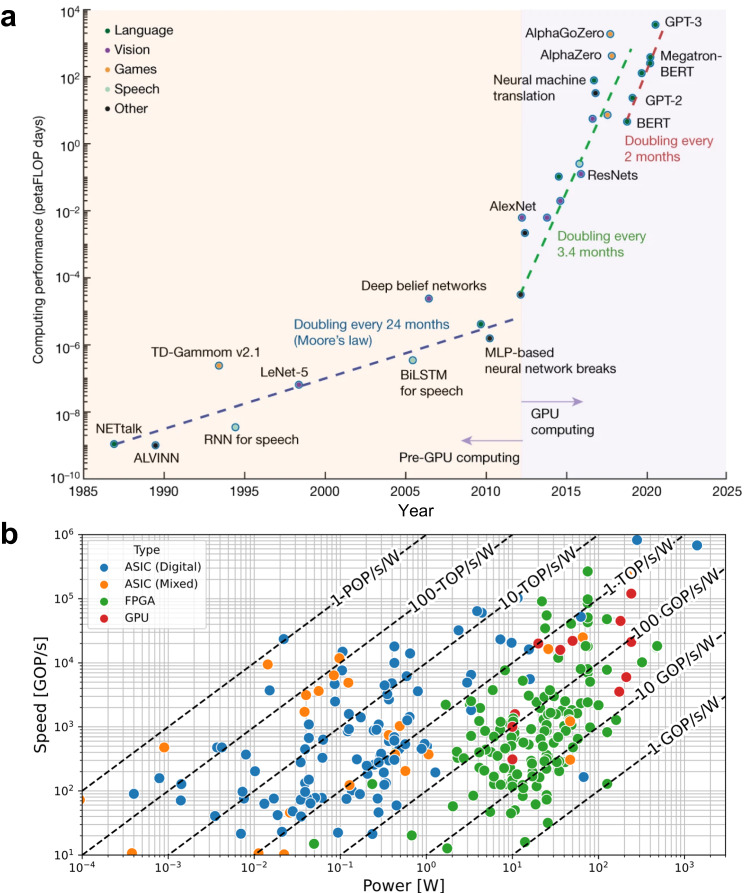
Artificial Intelligence (AI) is currently experiencing a bloom driven by deep learning (DL) techniques, which rely on networks of connected simple computing units operating in parallel. The low communication bandwidth between memory and processing units in conventional von Neumann machines does not support the requirements of emerging applications that rely extensively on large sets of data. More recent computing paradigms, such as high parallelization and near-memory computing, help alleviate the data communication bottleneck to some extent, but paradigm- shifting concepts are required. Memristors, a novel beyond-complementary metal-oxide-semiconductor (CMOS) technology, are a promising choice for memory devices due to their unique intrinsic device-level properties, enabling both storing and computing with a small, massively-parallel footprint at low power. Theoretically, this directly translates to a major boost in energy efficiency and computational throughput, but various practical challenges remain. In this work we review the latest efforts for achieving hardware-based memristive artificial neural networks (ANNs), describing with detail the working principia of each block and the different design alternatives with their own advantages and disadvantages, as well as the tools required for accurate estimation of performance metrics. Ultimately, we aim to provide a comprehensive protocol of the materials and methods involved in memristive neural networks to those aiming to start working in this field and the experts looking for a holistic approach.
Verified 2026-11-22 · 3 references not checked yet
Overview
CoChat Summary
TL;DR
This paper is a review and practical protocol for hardware implementation of memristor-based artificial neural networks, with a focus on image-classification systems. It walks through the full stack from input encoding and crossbar VMM to training, peripheral circuits, simulation, and chip integration, while emphasizing device/circuit non-idealities and design trade-offs.
Key findings
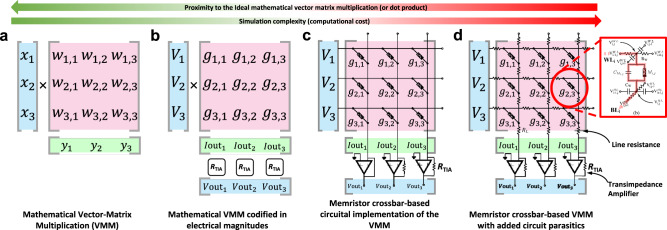
- Memristor crossbars are presented as the core hardware for vector-matrix multiplication, since VMM/MAC is the most demanding ANN operation and can be parallelized in crossbar arrays.
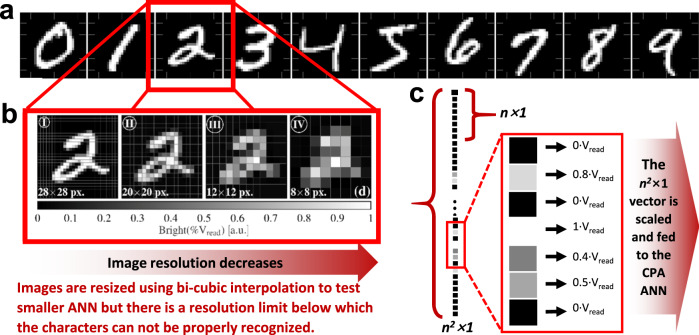
- For MNIST-style benchmarking, the paper uses a 60,000-image training set and 10,000-image test set; in the worked example, images are downsized from 28 × 28 to 8 × 8 and an ANN with one 64 × 10 single-layer perceptron is trained.
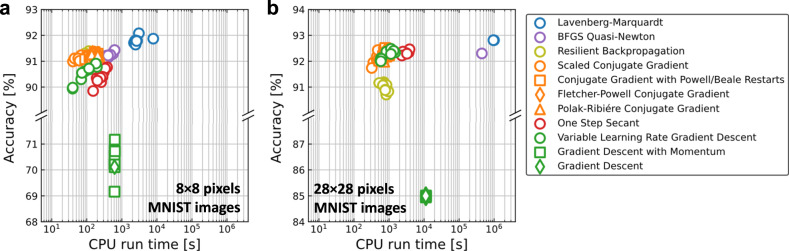
- In the example training study on 100 images, Scaled Conjugate Gradient and Levenberg–Marquardt achieved the highest accuracy, but Scaled Conjugate Gradient was chosen because it was faster.
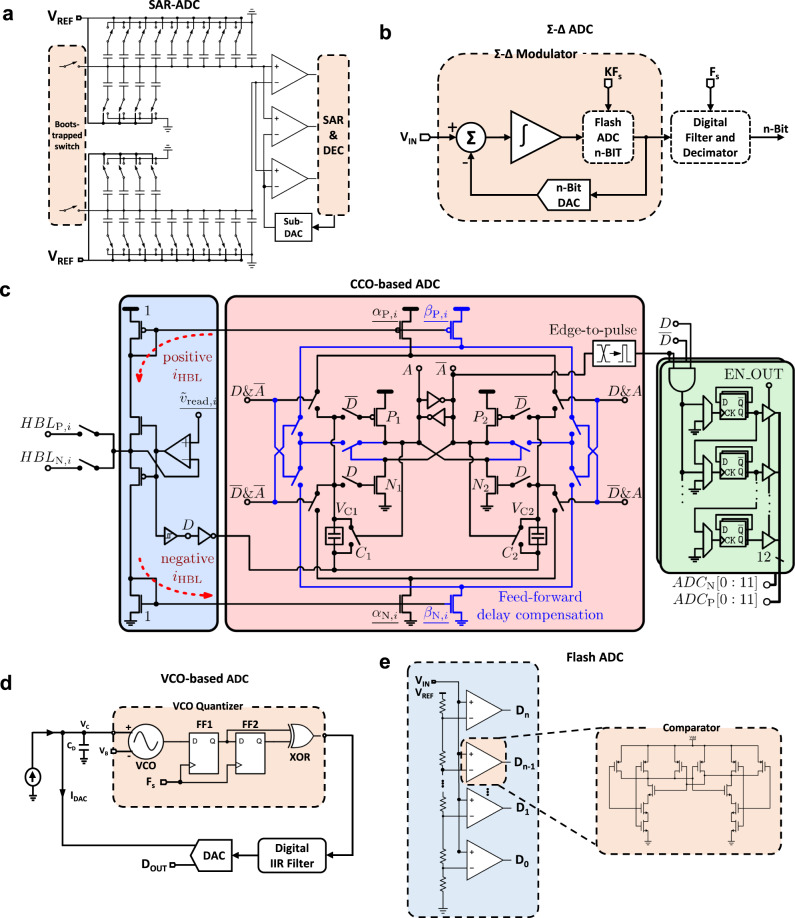
- The paper states that ADCs are often the largest and most power-hungry circuit block in memristive neural networks, consuming up to 70–90% of on-chip area and up to 80–88% of energy.
Methods
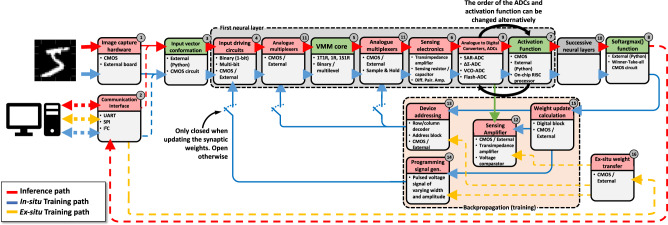
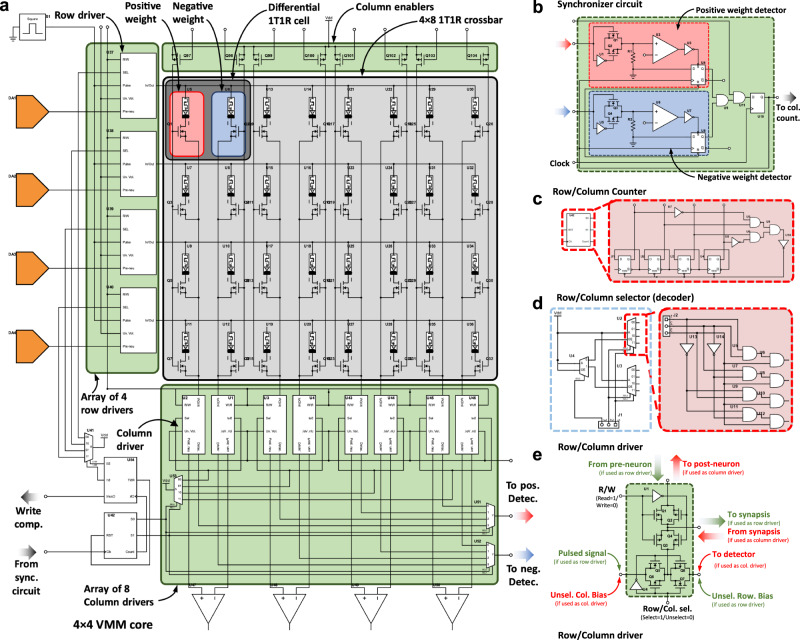
- Review/protocol article: synthesizes prior work on memristive ANN hardware and organizes the system into blocks (image capture, input driving, VMM core, sensing, activation, softargmax, ADCs, and training/update).
- Worked example: a single-layer perceptron for MNIST image classification; MATLAB is used to train the software model and generate a SPICE netlist, and SPICE simulation is used to evaluate the hybrid CMOS/memristor circuit during inference and write-verify programming.
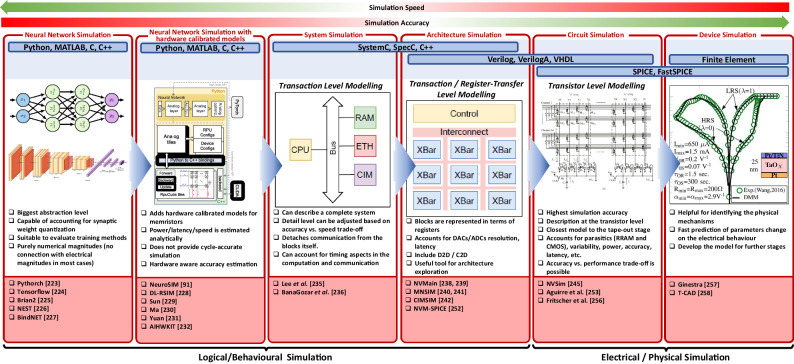
- Analysis emphasis: compares ex situ vs in situ training, discusses conductance mapping to memristors, and surveys simulation abstraction levels from neural-network-level tools to circuit/SPICE-level models.
Limitations
- Stated in the paper: many published studies are not true full-hardware implementations; some only characterize a few devices or rely on software ANN simulations, so reported performance can be weakly connected to fabricated hardware.
- Stated in the paper: full on-chip memristive ANN implementation is limited by peripheral circuit overhead, ADC/DAC trade-offs, device non-idealities, and the difficulty of integrating memristor stacks with CMOS.
- Evident from the text: the paper is not an experimental validation of a new memristor ANN chip; it is primarily a review plus a simulation-based worked example, so its conclusions about performance are illustrative rather than a direct new hardware result.
Model-written summary. Check it against the paper before relying on it.
Integrity signals
Registry
Cites
Statistics
Figures
Verification
Claims the paper makes
47 Valid · 14 Not valid · 58 Not checked · 121 Own results and interpretations
At least one cited source doesn’t support this claim or points to a different paper, and none confirmed it — see the verdicts below.
In the paper
“ADCs with at least 8-bit resolution are necessary to achieve high (>90%) classification accuracy in a ResNET50-1.5 ANN used to classify the ImageNET157 database”
§ Hardware implementation of memristor-based artificial neural networks > Structure of memristor-based ANNs > Analogue to digital converters (Block 9)
What the sources say
- Disputedcites [157] Xiao TP On the Accuracy of Analog Neural Network Inference Accelerators [Feature],” IEEE Circuits Syst. Mag. 2022 22 26 48 10.1109/MCAS.2022.3214409 sourceExperimental — accuracy not yet measured
Section 6.3 (p. 12) says high accuracy is maintained with a 7-bit ADC, contrary to the claim that at least 8 bits are necessary. Table 2 in Section 4.3 (p. 7) reports 76.466% ImageNet top-1 accuracy for ResNet50-v1.5, not over 90%. (LLM, conf=0.93)
Checked by a reasoning model — may be wrong.
plainstates a cause- Asserted: passes — The authors put it forward as true.
- Checkable: passes — It can be checked against evidence.
- Load-bearing: unclear — It is unclear whether the paper’s conclusions depend on it.
- Based: passes — The paper gives a reason why it holds.
- Disputed
Some cited sources support this claim and some don’t — read each source’s verdict below.
In the paper
“the usual practice reported in the literature for this kind of training has been the use of the so-called Manhattan Update Rule105,194, or the Stochastic Gradient Descent54.”
§ Hardware implementation of memristor-based artificial neural networks > Structure of memristor-based ANNs > ANN training and synaptic weight update (Blocks 2, 11-15)
What the sources say
- Supportedcites [105] Prezioso M “Training and operation of an integrated neuromorphic network based on metal-oxide memristors,” Nature 2015 521 61 64 10.1038/nature14441 25951284 source
The Pattern Classification Experiment (p. 5) explicitly says the network was trained in situ using the Manhattan Update rule. This supports the Manhattan-rule example for which this paper is cited; the separate stochastic-gradient-descent citation is not being judged here. (LLM, conf=0.93)
- Disputedcites [194] Yao, P. et al., “Face classification using electronic synapses,” Nat. Commun., 8, May, 1–8, 10.1038/ncomms15199.2017, PMC5437298 28497781 sourceExperimental — accuracy not yet measured
The citation to this paper is attached to the Stochastic Gradient Descent part of the sentence. In “RRAM-based neuromorphic network” (page unavailable), the paper calls its two weight-update rules the delta rule and the Manhattan rule; Figure 2’s caption explicitly says the demonstration uses a batch learning model, not stochastic gradient descent. (LLM, conf=0.83)
Checked by a reasoning model — may be wrong.
- Could not verifycites [54] Li C “Efficient and self-adaptive in-situ learning in multilayer memristor neural networks,” Nat. Commun. 2018 9 1 8 29921923 PMC6008303 sourceExperimental — accuracy not yet measured
The Methods section describes ray-tracing simulations of bird-of-paradise feathers, not training memristor-based neural networks. Searches for the Manhattan Update Rule and stochastic gradient descent found no passage in our copy addressing either method as a usual training practice. (LLM, conf=0.78)
plain- Asserted: passes — The authors put it forward as true.
- Checkable: passes — It can be checked against evidence.
- Load-bearing: unclear — It is unclear whether the paper’s conclusions depend on it.
- Based: passes — The paper gives a reason why it holds.
- Supported
The cited sources support only part of this claim — read each source’s verdict below.
In the paper
“So far, several groups and companies have claimed the realization of hybrid CMOS/memristor implementations of ANNs53–61, —from now on, memristive ANNs— with performance that is superior to that of fully-CMOS counterparts.”
§ Hardware implementation of memristor-based artificial neural networks > Introduction
What the sources say
- Not checked — no full text of the sourcecites [53] Ishii, M. et al., “On-Chip Trainable 1.4M 6T2R PCM synaptic array with 1.6K Stochastic LIF neurons for spiking RBM,” Technical Digest - International Electron Devices Meeting, IEDM, 2019- 310–313, 2019, 10.1109/IEDM19573.2019.8993466. source
- Could not verifycites [54] Li C “Efficient and self-adaptive in-situ learning in multilayer memristor neural networks,” Nat. Commun. 2018 9 1 8 29921923 PMC6008303 sourceExperimental — accuracy not yet measured
The Results section discusses super-black feather microstructure, and the Introduction discusses structural absorption of light; neither addresses artificial neural networks. Searches for hybrid CMOS/memristor implementations and performance relative to fully-CMOS systems found no relevant passage in our copy. (LLM, conf=0.78)
- Not checked — no full text of the sourcecites [55] Yao P “Fully hardware-implemented memristor convolutional neural network,” Nature 2020 577 641 646 10.1038/s41586-020-1942-4 31996818 source
- Not checked — no full text of the sourcecites [56] Correll, J. M. et al., “An 8-bit 20.7 TOPS/W Multi-Level Cell ReRAM-based Compute Engine,” in 2022 IEEE Symposium on VLSI Technology and Circuits (VLSI Technology and Circuits), IEEE, 264–265. 10.1109/VLSITechnologyandCir46769.2022.9830490.2022, source
- Not checked — no full text of the sourcecites [57] Cai, F. et al., “A fully integrated reprogrammable memristor-CMOS system for efficient multiply-accumulate operations,” Nat Electron, 2, no. July, 290–299, [Online]. Available: 10.1038/s41928-019-0270-x 2019. source
- Not checked — no full text of the sourcecites [58] Hung, J.-M., “An 8-Mb DC-Current-Free Binary-to-8b Precision ReRAM Nonvolatile Computing-in-Memory Macro using Time-Space-Readout with 1286.4-21.6TOPS/W for Edge-AI Devices,” in 2022 IEEE International Solid- State Circuits Conference (ISSCC), IEEE, 1–3. 10.1109/ISSCC42614.2022.9731715.2022, source
- Not checked — no full text of the sourcecites [59] Xue, C.-X., “15.4 A 22nm 2Mb ReRAM Compute-in-Memory Macro with 121-28TOPS/W for Multibit MAC Computing for Tiny AI Edge Devices,” in 2020 IEEE International Solid- State Circuits Conference - (ISSCC), IEEE, 2020, 244–246. source
- Partly supportedcites [60] Wan W “A compute-in-memory chip based on resistive random-access memory,” Nature 2022 608 504 512 10.1038/s41586-022-04992-8 35978128 PMC9385482 sourceExperimental — accuracy not yet measured
The Main section describes NeuRRAM as an RRAM chip integrated with CMOS circuits and reports hardware-measured AI inference, supporting its use as an example of a hybrid implementation. The reported performance gains are against earlier RRAM compute-in-memory chips (Efficient voltage-mode neuron circuit), not fully-CMOS counterparts. The Methods section projects higher efficiency than edge inference accelerators only after scaling NeuRRAM from 130 nm to 7 nm; it does not establish the claimed superiority for the realized chip. (LLM, conf=0.84)
- Partly supportedcites [61] Yin S Sun X Yu S Seo JS “High-throughput in-memory computing for binary deep neural networks with monolithically integrated RRAM and 90-nm CMOS,” IEEE Trans. Electron. Dev. 2020 67 4185 4192 10.1109/TED.2020.3015178 sourceExperimental — accuracy not yet measured
The paper demonstrates a binary neural-network chip that integrates RRAM with 90-nm CMOS (p. 1), and its Results report a density advantage over SRAM-based in-memory computing (p. 6). But its quantified throughput and energy-delay improvements are compared with another CMOS chip containing embedded RRAM, not a fully-CMOS counterpart (Supplementary Figure 7, p. 32). It therefore supports the hybrid implementation, but not the claimed overall performance comparison with fully-CMOS ANNs. (LLM, conf=0.86)
plainstates an association- Asserted: passes — The authors put it forward as true.
- Checkable: passes — It can be checked against evidence.
- Load-bearing: unclear — It is unclear whether the paper’s conclusions depend on it.
- Based: passes — The paper gives a reason why it holds.
Every source the paper cites for this claim was checked and supports it.
In the paper
“Moreover, the switching time can be as short as 85 ps42.”
§ Hardware implementation of memristor-based artificial neural networks > Introduction
What the sources say
- Supportedcites [42] Choi BJ “High-speed and low-energy nitride memristors,” Adv. Funct. Mater. 2016 26 5290 5296 10.1002/adfm.201600680 source
The Results and Discussion state that an AlN memristor switched both off and on in 85 ps. The Conclusions also report a measured ultrafast switching time of 85 ps in AlN memristors. (LLM, conf=0.95)
plain- Asserted: passes — The authors put it forward as true.
- Checkable: passes — It can be checked against evidence.
- Load-bearing: unclear — It is unclear whether the paper’s conclusions depend on it.
- Based: passes — The paper gives a reason why it holds.
- Supported
The cited sources support only part of this claim — read each source’s verdict below.
In the paper
“For instance, given the MNIST dataset in which images have a resolution of 28 × 28 pixels one option is to implement the synaptic layer using multiple crossbars to fit the 784 inputs (e.g., 13 64 × 64 or 4 256 × 256 crossbars would be needed93).”
§ Hardware implementation of memristor-based artificial neural networks > Structure of memristor-based ANNs > Image capture hardware (block 1) and input vector conformation (block 3)
What the sources say
- Partly supportedcites [93] Kim H Mahmoodi MR Nili H Strukov DB “4K-memristor analog-grade passive crossbar circuit,” Nat. Commun. 2021 12 1 11 10.1038/s41467-021-25455-0 34465783 PMC8408216 sourceExperimental — accuracy not yet measured
The Results section (“Modeling of advanced systems”; page unavailable) supports splitting a 784-input MNIST classifier layer across multiple crossbar blocks. It does not give the claimed examples of 13 64 × 64 or 4 256 × 256 crossbars: its modeled implementation uses differential-pair weights and maps a 785 × 64 layer to 24 64 × 64 and two 17 × 64 blocks. (LLM, conf=0.88)
hedged- Asserted: passes — The authors put it forward as true.
- Checkable: passes — It can be checked against evidence.
- Load-bearing: unclear — It is unclear whether the paper’s conclusions depend on it.
- Based: passes — The paper gives a reason why it holds.
- Partly supported
88 more claims · 22 with their cited sources checked
Create a free account to see all 240 claims and to verify the 11 references still open.
- Probably not a substantial claim. 79
- It may state two separate claims as one. 91
- The quote only partly states this claim. 1
Citations
Cites
Deep Residual Learning for Image Recognition
He, K., Zhang, X., Ren, S., & Sun, J. (2016) · 2016 IEEE Conference on Computer Vision and Pattern Recognition (CVPR) · doi:10.1109/cvpr.2016.90 · Cited by 235,474 · cited 1×
“For benchmarking a device or a chip, it is essential to evaluate the accuracy of standard deep neural network models like VGG 89 and ResNet 90 on CIFAR and ImageNet dataset by utilizing architecture-levelsimulationandrealistichardwarestatistics 91,92 .”
Very Deep Convolutional Networks for Large-Scale Image Recognition
Simonyan, K., & Zisserman, A. (2014) · arXiv · doi:10.48550/arxiv.1409.1556 · Cited by 114,148 · cited 1×
“For benchmarking a device or a chip, it is essential to evaluate the accuracy of standard deep neural network models like VGG 89 and ResNet 90 on CIFAR and ImageNet dataset by utilizing architecture-levelsimulationandrealistichardwarestatistics 91,92 .”
Adam: A Method for Stochastic Optimization
Kingma, D. P., & Ba, J. (2014) · arXiv · doi:10.48550/arxiv.1412.6980 · Cited by 98,946 · cited 2×
“…employed 165 , and for stochastic evaluation of the loss function using a mini-batch of images diverse methods have been employed, including Adaptive Gradient Algorithm (or AdaGrad) 182 , Root Mean Square Propagation (or RMSProp) 183 , Adaptive Moment Estimation (or Adam) 184 and Adadelta 185 .”
ImageNet: A large-scale hierarchical image database
Deng, J., Dong, W., Socher, R., Li, L.-J., Li, K., & Fei-Fei, L. (2009) · 2009 IEEE Conference on Computer Vision and Pattern Recognition · doi:10.1109/cvpr.2009.5206848 · Cited by 65,333 · cited 1×
“…86 ; 2) CIFAR (Canadian Institute for Advanced Research),whichcontains60,000colorimagesdividedinto10classes for CIFAR-10 and 100 classes for CIFAR-100 87 ; 3) ImageNet, one of the largest image datasets, which consists of over 1.2 million labelled from 1000 classes for the ImageNet competition 88 .”
InfluentialKennedy, J., & Eberhart, R. (2002) · Proceedings of ICNN'95 - International Conference on Neural Networks · doi:10.1109/icnn.1995.488968 · Cited by 58,192 · cited 1×
“Gradient-free methods such as the Particle Swarm optimization 168 , Genetic Algorithms 169 and Simulated Annealing 170 algorithms are more demanding from a computational point of view, andhence,theyarerarelyemployedforANNtraining,bywhichtheylie beyond the scope of this article.”
Optimization by Simulated Annealing
Kirkpatrick, S., Gelatt, C. D., & Vecchi, M. P. (1983) · Science · doi:10.1126/science.220.4598.671 · Cited by 45,134
Learning representations by back-propagating errors
Rumelhart, D. E., Hinton, G. E., & Williams, R. J. (1986) · Nature · doi:10.1038/323533a0 · Cited by 31,892 · cited 1×
“In most ANNs, the gradient of the loss function is normally computed by the backpropagation algorithm 171 .”
An Algorithm for Least-Squares Estimation of Nonlinear Parameters
Marquardt, D. W. (1963) · Journal of the Society for Industrial and Applied Mathematics · doi:10.1137/0111030 · Cited by 30,728 · cited 6×
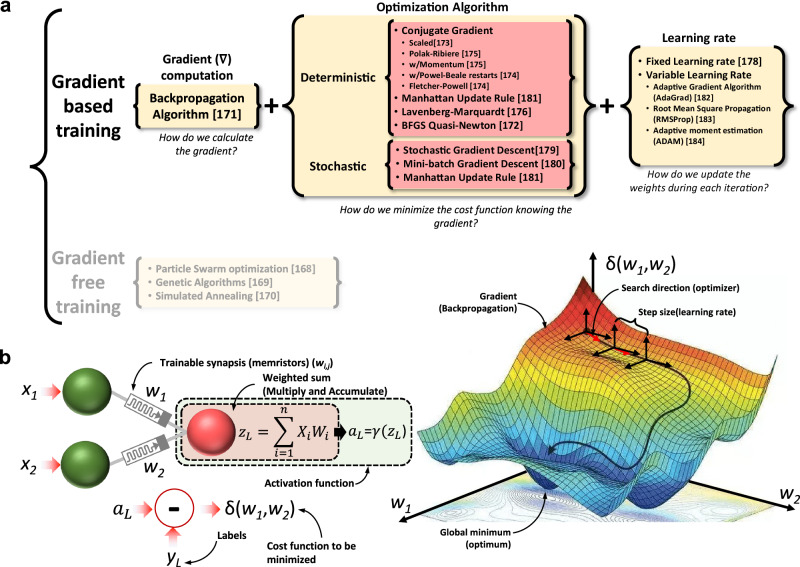
“…evaluation, common optimization algorithms are the following: (i) Gradient Descent 165 (the simplest one and closest to the previous (cid:129) Manha(cid:3)an UpdateRule [181] (cid:129) Lavenberg-Marquardt[176] (cid:129) BFGS Quasi-Newton[172] Howdo we updatethe weightsduringeachitera(cid:2)on?”
InfluentialStrukov, D. B., Snider, G. S., Stewart, D. R., & Williams, R. S. (2008) · Nature · doi:10.1038/nature06932 · Cited by 11,828
(2017) · Cited by 11,625
Research works printed but not linked: 3
- “Microchips that mimic the human brain could make AI far more energy efficient | Science | AAAS.” Accessed: May 15, 2023. [Online]. Available: https://www.science.org/content/article/microchips-mimic-human-brain-could-make-ai-far-more-energy-efficient
- Hu, M. et al., “Dot-product engine for neuromorphic computing,” in DAC ’16: Proceedings of the 53rd Annual Design Automation Conference, New York, NY, USA: Association for Computing Machinery, 1–6. 10.1145/2897937.2898010.2016, · doi:10.1145/2897937.2898010.2016
- Ielmini, D. and Waser, R. Resistive Switching. Weinheim, Germany: Wiley-VCH Verlag GmbH & Co. KGaA, 2016.
Cited by
Items 401–498 of 498
Kim, Y., Cho, S., 강민수, Kim, S., Kim, Y., Woo, J., Lee, C., & Lee, D. (2026) · ACS Nano · doi:10.1021/acsnano.6c02066
In-Memory Boolean Logic Computation in Binary Neural Network Inspired Memristor Crossbar Array
Chowdhury, M. A. S., & Hassan, O. (2026) · IEEE Electron Devices Technology & Manufacturing Conference (EDTM) · doi:10.1109/edtm65772.2026.11497945
Efficient path planning for continuum robotic arm using improved RRT algorithm
Gao, Y., Tang, X., Chen, Y., Zhao, Y., Xiao, H., & Zhang, Y. (2026) · Journal of Mechanical Science and Technology · doi:10.1007/s12206-026-0453-0
“To address this, this study employs particle swarm optimization (PSO) [14] to directly solve the joint variables from 3D coordinates.”
SALMON: Self-Adaptive Learning Model on Neuromorphic Hardware
Cho, Y. W., Lee, S., & Kim, S. (2026) · IEEE Transactions on Neural Networks and Learning Systems · doi:10.1109/tnnls.2026.3687785
“However, digital components could present a bottleneck in power consumption in SALMON [44].”
Unified matrix-parallel outer-product updates for pretrained deployment and on-device adaptationPreprint
Lee, J., Lee, I.-S., Lee, K. H., Koo, R., Im, J., Park, S., Ko, J., Hwang, J., Ryu, S., & Lee, K. H. (2026) · Research Square · doi:10.21203/rs.3.rs-9144413/v1
Adaptive Lead-Time Prediction for Resilient and Sustainable Supply Chains
Mutambik, I. (2026) · Sustainability · doi:10.3390/su18104748
Liu, X. Y., Xie, X., Yin, B., & Ju, R. (2026) · Neural Networks · doi:10.1016/j.neunet.2026.109104
Synaptic Behaviors in a Commercial Bulk Silicon MOSFET at Cryogenic Temperature
Guo, H., Zhang, Y., Chen, Y., Sheng, H., Fang, C., Xu, J. Q., Luo, C., & Guo, G. (2026) · IEEE Electron Device Letters · doi:10.1109/led.2026.3692206
“At the array level, the routing architecture can follow that used in in-memory computing cores based on memristive synapses [32].”
Duong, N. T., Krishna, S., Nguyen, M. C., Kim, H. S., Lam, V. T., Gul, H. Z., Choi, S. H., Kim, M., Lee, D. U., Tran, T. U., et al. (2026) · Nature Communications · doi:10.1038/s41467-026-73279-7
Memristive Conductance Programming and Dot Products for Inference in Machine Learning
Tariq, J., Cimmino, L., Conventi, F., Nola, A. D., Izzo, V., Rossi, E., Bocci, V., Fiacco, D., Iacoangeli, F., Ippolito, V., et al. (2026) · IEEE Transactions on Nuclear Science · doi:10.1109/tns.2026.3695386
“1 (center and right)], analog VMMs can be executed via Kirchho ff ’s and Ohm’s laws [17].”
Efficacy of Bio- and Nanosensors in Monitoring Heavy Metal Contamination: Innovations and Challenges
Sen, K., & Chakraborty, D. (2026) · Sustainability Sciences in Asia and Africa · doi:10.1007/978-981-95-7746-0_18
Energy-efficient water quality modeling using memristor-based neuromorphic computing
Jeung, M., Son, G., Kim, M., & Baek, S.-S. (2026) · npj Clean Water · doi:10.1038/s41545-026-00586-3
“Therefore,theproposed frameworkservesasahardware-awarepre-testingplatformforevaluating thefeasibilityofapplyingthefabricatedmemristordevicetowater-quality forecastingtasks 69 .”
Zhao, J., Farahan, S. B., & Alajlouni, A. (2026) · SSRN Electronic Journal · doi:10.2139/ssrn.6839163
Fang, Z., Zhu, M., Xu, H., & Zhang, L. (2026) · Electronics · doi:10.3390/electronics15112333
Cryogenic Forming/Breakdown of HfO$_{x}$ for Reduced C2C Variability in Filamentary RRAM
Kurup, S., Vadlamani, M., Mammo, F., Weinstein, A. L., Filler, M. A., Yu, S., & Vogel, E. M. (2026) · IEEE Transactions on Electron Devices · doi:10.1109/ted.2026.3696937 · Cited by 1
“Beyond conventional memory applications, RRAMs have also been integrated into non-von Neumann architectures like neuromorphic and compute-in-memory (CIM) systems [2], [3], [4].”
X-Sim: An Accurate and Scalable Simulator for Memristive Computing-in-Memory Accelerators
Stavrakakis, K., Smeele, B., Arapidis, E., Spyrou, T., Gebregiorgis, A., Wong, S., Gaydadjiev, G. N., & Hamdioui, S. (2026) · Design, Automation, and Test in Europe · doi:10.23919/date69613.2026.11539379
Liao, C.-C., & Li, W.-K. (2026) · Results in Engineering · doi:10.1016/j.rineng.2026.111416 · Cited by 1
He, Q., Zhou, Z., Kousseff, C. J., McCulloch, I. A., He, Q., Tam, T. L. D., Fu, H., Mathews, N., & Leong, W. L. (2026) · Advanced Functional Materials · doi:10.1002/adfm.76368 · Cited by 2
Vulnerability Analysis of Timing Side-Channels in Multi-Tenant ReRAM Crossbars
Sifat, M. B. U., Chugh, H., Hasan, N., & Rashed, M. R. H. (2026) · IEEE Dallas Circuits and Systems Conference (DCAS) · doi:10.1109/dcas69364.2026.11544917
“By performing computation directly within memory, this technology promises to accelerate future large-scale applications in the domains of artificial intelligence and machine learning [14–16], graph analytics [17–19], and genomics/bioinformatics [20–22].”
Fault-free analogue computing with imperfect hardware
Xu, Z., Liu, J., Huang, S., Li, Z., Wang, S., Wen, B., Mao, R., Jiang, M., Pedretti, G., Ignowski, J., et al. (2026) · Nature Electronics · doi:10.1038/s41928-026-01638-9 · Cited by 4
A Memristor-Based SNN Hardware Architecture with AHaH Plasticity
Xie, R., Si, G., Xu, X., et al. (2026) · Communications in computer and information science · doi:10.1007/978-981-92-1599-7_6
Self-citationWang, T., Ren, E., Fang, D. Z., Luo, L., Wei, Q., & Qiao, F. (2026) · IEEE International Symposium on Circuits and Systems proceedings · doi:10.1109/iscas66217.2026.11562463
“By co-locating storage and computation units, CIM reduce data movement and increase speed and power for data-heavy operations, such as multiply-and-accumulate (MAC) [1]–[3].”
Self-citationMixed-Mode ReRAM Architecture with Digital Weights and Inputs for High-Precision In-Memory Computing
Krishnan, N., Joshi, R. V., & James, A. (2026) · IEEE International Symposium on Circuits and Systems proceedings · doi:10.1109/iscas66217.2026.11562957
“[11].”
Chen, J., Schormans, M., Que, Z., et al. (2026) · IEEE International Symposium on Circuits and Systems proceedings · doi:10.1109/iscas66217.2026.11562592
Temporal Reference Scouting Logic for PVT Reliable Logic Computation-in-Memory
Siddaramu, S. M., Nezhadi, A., Mayahinia, M., et al. (2026) · Proceedings - IEEE VLSI Test Symposium/Proceedings of the ... IEEE VLSI Test Symposium · doi:10.1109/vts69484.2026.11563400
“This response can be interpreted as either analog arithmetic or digital logic functions [3], [6], [25].”
Variability Aware Design of Memristor-based Gene Implementation in Cellular Neural Networks
Abdelsamad, A., Ntinas, V. G., Prousalis, D. A., Messaris, I., Demirkol, A. Ş., Rana, V., Menzel, S., Ascoli, A., & Tetzlaff, R. (2026) · IEEE International Symposium on Circuits and Systems proceedings · doi:10.1109/iscas66217.2026.11562616
“The crossbar configuration, widely adopted in neural network accelerators, functions as an efficient analog dot-product engine that supports scalable and fabrication-friendly hardware implementations [22].”
Anand, A. Y., Thomas, A., Dayal, G., Gondhalekar, J., & Jinesh, K. B. (2026) · Optical Materials · doi:10.1016/j.optmat.2026.118277
Mahla, R., & Kolla, K. (2026) · Journal of Thermal Analysis and Calorimetry · doi:10.1007/s10973-026-15727-6
“…demonstrates significant potential as a reliable stochastic approach, with applications spanning diverse fields such as the dusty Casson fluid flow model [31], the Casson nanofluid flow model [32], heart disease prediction [33], hardware implementation [34], and agricultural systems [35].”
Far, S. B., Qazani, M. R. C., & Rad, A. I. (2026) · Peer-to-Peer Networking and Applications · doi:10.1007/s12083-026-02268-w
Direct observation of non-integer quantum conductance in filamentary ITO/MoS2-Ag/Pt memristors
Zhang, Y., Jiang, K., Dong, A., Chang, K., Liu, S., Chen, C., & Wang, H. (2026) · Newton · doi:10.1016/j.newton.2026.100588
Programming arbitrary analog conductance states of memristors in one step
Li, Y., Wang, S., Luo, Y., & Sun, Z. X. (2026) · Frontiers in Nanotechnology · doi:10.3389/fnano.2026.1866642 · Cited by 1
Park, S.-J., Park, C., Lee, S., Kim, Y. W., Kim, S., & Yeo, J. (2026) · ACS Applied Electronic Materials · doi:10.1021/acsaelm.6c01010 · Cited by 4
Forward-Forward Autoencoder Architectures for Energy-Efficient Wireless Communications
Seifert, D., Günlü, O., & Schaefer, R. F. (2026) · International Conference on Communications · doi:10.1109/icc59461.2026.11588295
“Ex-situ and hybrid approaches typically train the neural network externally and then map the resulting weights onto analog hardware, such as memristors [7].”
Li, Y., Yang, L., Zhang, D., Gao, Q., Tu, X., Li, M., He, Y., Zhou, Z., Shi, Y., & Jie, W. (2026) · Materials Today Chemistry · doi:10.1016/j.mtchem.2026.103869
Predicting the dynamic behavior of memristive devices using recurrent neural networks
Rezaei, S. G., Spetzler, B., & Mäder, P. (2026) · APL Machine Learning · doi:10.1063/5.0331375
Tian, Y., Sheheryar, T., Wang, S., & Lv, B. (2026) · Measurement · doi:10.1016/j.measurement.2026.122604
A Weight-Importance-Evaluation-Based Hybrid Mapping Strategy for Memristor Synapses
Li, Z. L., Ren, H., Xin, Z., et al. (2026) · doi:10.1109/ecis69634.2026.11604316
A Weight-Importance-Evaluation-Based Hybrid Mapping Strategy for Memristor Synapses
Li, Z. L., Ren, H., Xin, Z., Liu, C. Y., Fu, J., Tong, P., & Du, X. (2026) · IEEE International Conference on Electronics, Communications and Intelligent Science (ECIS) · doi:10.1109/ecis69634.2026.11604428
“In contrast to conventional devices, memristors, which serve as a next-generation non-volatile memory technology [4,5], boast distinctive advantages including in-memory computing capabilities, a simple device structure, low power consumption, and high storage density [6,8], emerging as a pivotal…”
Moon, S., Chae, S., Park, K., Lee, H., Guo, H., Park, C., Kim, D., Ko, H., Kim, H.-M., Kim, H., et al. (2026) · Nano Energy · doi:10.1016/j.nanoen.2026.112229 · Cited by 1
Memristive Structures Based on a-Si with ZrO2(Y) Barrier Layer Produced by Magnetron Sputtering
Ichyotkin, D. V., Задириев, И. И., Chernoglazov, K. Y., et al. (2026) · Nanobiotechnology Reports · doi:10.1134/s2635167625602025
General aspects of internal noise in spiking neural networks
Kolesnikov, I. D., Maksimov, D. A., Moskvitin, V., & Игоревна, С. Н. (2026) · Chaos An Interdisciplinary Journal of Nonlinear Science · doi:10.1063/5.0338509 · Cited by 1
High-precision time-domain parallelism photonic computing
Che, J., Wang, G., Zhou, H., Mu, Y., Shen, J., Cheng, Z., & Zhou, P. (2026) · Science Advances · doi:10.1126/sciadv.aef7533
“In contrast, the performance scaling of mainstream AI hardware (e.g., graphics processing units) has improved by merely10 3 - fold during the same period ( 11 ), creating a critical and unsustainable “AI compute gap.””
Energy‐Aware Perturbation Optimization for Memristor‐Array Convolutional Neural Networks
Xu, A., Lu, L., Wu, Y., Guo, Y., Li, Y., Wang, Y., & Li, Q. (2026) · Advanced Intelligent Systems · doi:10.1002/aisy.70477 · Cited by 1
Self-citationPresas, P. T., Galarregui, L., Acevedo, W. R., Aguirre, M. H., Santiso, J., Matzen, S., Noheda, B., & Rubi, D. (2026) · Applied Physics Letters · doi:10.1063/5.0339149
LOFT: Latent-Fault Optimization Training for Yield Boost in Resistive Crossbar AI Accelerators
Siddaramu, S. M., & Tahoori, M. B. (2026) · IEEE International On-Line Testing Symposium (IOLTS) · doi:10.1109/iolts69666.2026.11633645
“1 [7].”
InfluentialSpiking Neuron Memory Enhancement Model Based on Short-Term Synaptic Plasticity
Fang, C., & Lv, H. (2026) · Youth Academic Annual Conference of Chinese Association of Automation (YAC) · doi:10.1109/yac71005.2026.11615845
Internal noise in deep neural networks: Interplay of depth, neuron number, and noise injection step
Maksimov, D. A., Moskvitin, V. M., & Semenova, N. I. (2026) · Chaos An Interdisciplinary Journal of Nonlinear Science · doi:10.1063/5.0335904
Intermittency and Persistence of Switching Modes in HfO 2 -Based Memristors
Miranda, E. A., Cantudo, A., Jiménez-Molinos, F., Suñé, J., González, M. B., & Roldán, J. B. (2026) · IEEE Electron Device Letters · doi:10.1109/led.2026.3719434
Self-citationPhan, T. L., Nguyen, M. C., Dang, D.-X., Vu, V., Vu, T. T. H., Yun, H.-W.-O., Li, H.-M., Lee, J.-M., Lemme, M., Aggarwal, P., et al. (2026) · Nano Convergence · doi:10.1186/s40580-026-00569-7
Signal processing and resistive switching mechanisms of niobium oxides
Zeng, F., & Ma, D. (2026) · Science and Technology of Advanced Materials · doi:10.1080/14686996.2026.2713993
“Meanwhile, ANNs have evolved along a trajectory focused on the hardware implementation of machine-learning theories [5].”
PMMA-Engineered Halide Perovskite/Ag Interface for Optoelectronic Stable Memristive Synapse
Farooq, F., Kaith, P., & Bera, A. (2026) · ACS Applied Materials & Interfaces · doi:10.1021/acsami.6c08360
Gao, P., Zhang, B., Wang, J., Wang, Z., Li, C., Tan, J., & Zeng, Y. (2026) · Swarm and Evolutionary Computation · doi:10.1016/j.swevo.2026.102505
Yang, X., Yuan, H., Pan, Z., & Wang, J. (2026) · Applied Soft Computing · doi:10.1016/j.asoc.2026.116225
Qu, C., Liu, T., Fang, D. Z., Wang, T., Ren, E., Luo, L., Liu, B., Li, Y., Wei, Q., & Qiao, F. (2026) · IEEE Transactions on Circuits & Systems II Express Briefs · doi:10.1109/tcsii.2026.3723668
“CIM has therefore emerged as a promising solution by performing MAC operations directly inside memory arrays, significantly reducing data movement and improving energy e ffi ciency [1], [2], [3].”
Self-citationA Variability-Aware Compact Memristor Model for HfO 2 -based 1T1R ReRAM Devices
Nguyen, K. P., Schroedter, R., Ntinas, V. G., Quesada, E. P.-B., Pérez, E., Wenger, C., & Tetzlaff, R. (2026) · International Conference on Synthesis, Modeling, Analysis and Simulation Methods and Applications to Circuit Design · doi:10.1109/smacd70206.2026.11647838
“Data storage and in-memory computing utilizing memristive devices have emerged as a transformative paradigm for data-centric processing, offering the potential to significantly enhance energy efficiency and computational throughput by alleviating the von Neumann bottleneck [1].”
Huang, T., Huang, Y., Yu, Z., Wei, D., & Wang, X. (2026) · International Conference on Computer, Control and Robotics (ICCCR) · doi:10.1109/icccr69988.2026.11642658
“Recent advances span device innovation [10], [11] and network design [12]–[14].”
Analysis and Applications of Neuromorphic Memristors in Artificial Intelligence Computing
Wang, J., Chen, Q., Zhang, J., Meng, J., & Wang, T. (2026) · Nano-Micro Letters · doi:10.1007/s40820-026-02322-5
Self-citationDigital-analog concept for superconducting perceptron-like neural networks
Anonymous, Ruzhickiy, V. I., Gubochkin, G. I., Ionin, A. S., Nazhestkin, I. A., Fominskii, M. Y., Filippenko, L. V., Soloviev, I. I., Tereshonok, M. V., & Klenov, N. V. (2026) · Physical review. E · doi:10.1103/y84t-zzch
“The approach has been developed mainly for analog-memory and phase-change-memory accelerators [20–24].”
Ghosh, S., & Konar, A. (2026) · Lecture notes in networks and systems · doi:10.1007/978-3-032-25446-7_39
Li, X., Zhang, Y.-B., Liu, S., & Sun, W.-G. (2026) · Chaos · doi:10.1063/5.0339271 · Cited by 1
Porous ZnO nanoparticle films with redox-active oxygen environments for stable resistive switching
Lee, S.-H., Khan, S. A., Park, J., Lee, D., Hong, S., Lee, S., & Jang, J. (2026) · Journal of Materials Chemistry C · doi:10.1039/d6tc01791f
Mo, F., Zhao, X., Xu, Y., Tang, C., Zhang, D., Li, S., Chen, D., Li, W., Song, Z., & He, S. (2026) · iScience · doi:10.1016/j.isci.2026.117268
Self-citationHwang, J., Kim, J., Cho, J., Shin, H., Bae, J., Park, M.-K., & Lee, J. (2026) · Nano Energy · doi:10.1016/j.nanoen.2026.112320
Xie, M., Lin, H., Wan, Q., Yu, F., & Yao, W. (2026) · Cognitive Neurodynamics · doi:10.1007/s11571-026-10536-x · Cited by 2
Matsukatova, A. N., Ryabova, M. A., Emelyanov, A. V., et al. (2026) · Journal of Alloys and Compounds · doi:10.1016/j.jallcom.2026.190674
A Wide Memory Window of 10.3 V With Ferroelectric AlScN Layer In 2 O 3 FeFET
Lin, J.-H., Chen, S.-M., Li, A., et al. (2026) · IEEE Transactions on Electron Devices · doi:10.1109/ted.2026.3721473
“Things (IoT) have been popular topics recently [1], [2], [3].”
Fully in-memory photonic computing
Zhou, T., Wu, W., & Fang, L. (2026) · Nature Sensors · doi:10.1038/s44460-026-00123-2
Wafer-scale SOT-MRAM for analog crossbar array applications
Liu, S., Rogers, V., Hu, C.-Y., Song, M.-Y., Bao, X., & Incorvia, J. (2026) · Science Advances · doi:10.1126/sciadv.aee6952
“The output of the array is also simplified, allowing a single comparator to be used to determine the activation value as opposed to an analog- to-digital converter, often the costliest component in a crossbar array in terms of energy dissipation ( 74 ).”
Adaptive conductance optimization for suppressing wire-resistance-induced errors in crossbar arrays
Zhao, Y., Wang, C., Wu, Z., Kong, D., Wei, W., Ding, S., Yangdong, X.-J., Shen, Y., Wang, Y., Zhang, J., et al. (2026) · Device · doi:10.1016/j.device.2026.101280
Toward next-generation computing through ferroelectricity
Kim, Y., & Jang, H. W. (2026) · npj Unconventional Computing · doi:10.1038/s44335-026-00088-y · Cited by 1
Wang, Q., Liao, W., Shi, A., Wu, X., Sang, H., & Wan, G. (2026) · The European Physical Journal B · doi:10.1140/epjb/s10051-026-01236-w
Lee, S., Jeong, S., Joo, H., Kong, Y., Lee, J. K., Kim, W., Yu, H. W., Kim, S., Chai, Y. J., Choi, J. Y., et al. (2026) · Surgery · doi:10.1016/j.surg.2026.110599
Zhang, B., Wen, G., Zhao, X., et al. (2026) · physica status solidi (a) · doi:10.1002/pssa.70516
“Researchers are inspired by the biological neural networks of the biological brain, which enable parallel computing with low power consumption while supporting self-learning capability [3].”
A low-cost portable array testing system based on an FPGA and dual multiplexers
Deng, Y., Zhang, S., Yang, Q., & Gao, Z. (2026) · Journal of Physics Conference Series · doi:10.1088/1742-6596/3292/1/012043
Fully hafnium-based ferroelectric/antiferroelectric devices for hybrid SNN neuromorphic computing
Chen, Q., Zhang, J., Zhang, J., Yue, Z., Meng, J., Xin, Q., Xu, M., & Wang, T. (2026) · Applied Physics Letters · doi:10.1063/5.0321092
Self-citationBai, J., Cui, Y., & Li, W. (2026) · IEEE International Conference on Nanotechnology (IEEE-NANO) · doi:10.1109/nano67986.2026.11667578
“Memristors, owing to their continuously tunable resistance states and non-volatile storage characteristics, are considered strong candidates for implementing in-memory computing and neuromorphic systems [7-8] .”
RRAM-based computing-in-memory: Devices, arrays, circuits, and applications
Lu, W., Yang, H., Li, Y., Luo, X., Li, Y., Fu, Y., Ye, W., Guo, X. F., Yu, L., Gao, H., et al. (2026) · Journal of Systems Architecture · doi:10.1016/j.sysarc.2026.103984 · Cited by 1
Self-citationForming-free Ag/Hf0.5Zr0.5O2 Memristive Synapse Enabled by Annealing-induced Ag Diffusion
Zhidkov, N., Zenkevich, A., & Khanas, A. (2026) · Nanobiotechnology Reports · doi:10.1134/s2635167626602755
Effect of Annealing Temperature on Memristive Characteristics of Cu/Parylene–MoOx/ITO Structures
Trofimov, A. D., Несмелов, А. А., Streltsov, D. R., et al. (2026) · Nanobiotechnology Reports · doi:10.1134/s2635167626603086
Capacitive in-memory vector–matrix multiplication computing with charge-trap memcapacitors
Yu, J., Hwang, H., Kim, H., & Choi, W. Y. (2026) · Nano Convergence · doi:10.1186/s40580-026-00575-9
Fractional-Order Memristive Diode-Bridge Emulator: An Implementation and Analysis
Silwal, S., & Pershin, Y. V. (2026) · IEEE International Midwest Symposium on Circuits and Systems (MWSCAS) · doi:10.1109/mwscas67364.2026.11680736
“These properties have made them central to emerging memory technologies, neuromorphic computing [3], [4], and adaptive electronic circuits, motivating extensive investigation of both physical devices and their circuit emulators [5]–[8].”
Sle, Y., Park, J., Vincent, P., Lee, W., Jeon, J., & Cho, H. S. (2026) · Engineering Applications of Artificial Intelligence · doi:10.1016/j.engappai.2026.116185
Gao, B., Xu, R., Shao, H., Zhang, S., Zhang, Y., Wu, Z., Shen, Y., Meng, Y., Wang, W., Hu, S., et al. (2026) · Small · doi:10.1002/smll.75621
Yin, C., Li, Y., Wang, Y., et al. (2026) · Nano Letters · doi:10.1021/acs.nanolett.6c03046
Xiao, J., Wang, H., Xu, C., et al. (2026) · Applied Physics Letters · doi:10.1063/5.0342723
Gong, J., Gong, F., Wang, X., Deng, M., Ni, Y., Ye, H., Wei, H., Han, S., & Xu, W. (2026) · Device · doi:10.1016/j.device.2026.101301
Wang, J., Wang, G., Ji, Y., Ren, Y., Xu, F., Zhang, Y., & Lin, Z. (2026) · Nano Letters · doi:10.1021/acs.nanolett.6c03546 · Cited by 1
Wu, X., di wang, Liu, Y., Huang, J., Guo, Z., Zou, Y., Wang, T., Sun, L., Sun, X., Zhang, Z., et al. (2026) · Research Square · doi:10.21203/rs.3.rs-10824719/v1
Self-citationLiu, Y., Liu, X., & Liu, H. (2026) · Neurocomputing · doi:10.1016/j.neucom.2026.135211
Qi, Y. (2026) · Multiscale and Multidisciplinary Modeling Experiments and Design · doi:10.1007/s41939-026-01271-1
“Thesebenefitsmakemetaheuristiclearn-ing particularly appealing to memristive SNNs, which fail to fulfilltheconditionsofhigh-fidelitydevicemodelsandspike-based dynamics based on common optimization algorithms (Aguirre et al. 2024).”
InfluentialRodríguez, E. A., Huhtinen, H., Paturi, P., et al. (2026) · ACS Applied Electronic Materials · doi:10.1021/acsaelm.6c01363
Xie, Q., Pan, X., Luo, W., Shuai, Y., Wu, C., Pu, Y., Chen, J., Gao, D., Fu, Q., & Zhang, W. (2026) · Journal of Applied Physics · doi:10.1063/5.0353639
Ultralow‐Energy Analog Reservoir Computing via Reconfigurable 2‐Transistor Memory
Park, J.-M., Kim, Y., Yoon, J. H., Lee, S. J., Ham, W., Lee, D., Lee, J., Shin, D., Park, K. J., Namgung, S. D., et al. (2026) · Advanced Science · doi:10.1002/advs.77921
“Distinct relaxation rates can enrich the temporal state space and improve the representation of input sequences without requiring proportional replication of physical reservoir elements [ 44 ].”
Zhang, J., Yan, J., He, N., et al. (2026) · Small · doi:10.1002/smll.76033
Self-citationZi, Y., Liu, J., Dou, G., Zhu, W., & Chen, D. (2026) · The European Physical Journal Plus · doi:10.1140/epjp/s13360-026-08344-7
Sputtered Hafnium Oxide Based Memristive Crossbar Array for Energy Efficient MAC Operations
Muhammed Rahees, A., Kuruvithadam, R. M., Sharon, A., et al. (2026) · International Symposium on VLSI Design and Test (VDAT) · doi:10.1109/vdat72243.2026.11704585
“The memristor located at each intersection of i th row and j th column has a conductance G ij [5].”
Lim, S., Lee, D., Jung, S., et al. (2026) · Applied Physics Letters · doi:10.1063/5.0353240
Self-citation
Metadata
- Authors
- Aguirre, F., Sebastian, A., Le Gallo, M., Song, W., Wang, T., Yang, J. J., Lu, W., Chang, M.-F., Ielmini, D., Yang, Y., Mehonic, A., Kenyon, A., Villena, M. A., Roldán, J. B., Wu, Y., Hsu, H.-H., Raghavan, N., Suñé, J., Miranda, E., Eltawil, A., Setti, G., Smagulova, K., Salama, K. N., Krestinskaya, O., Yan, X., Ang, K.-W., Jain, S., Li, S., Alharbi, O., Pazos, S., & Lanza, M.
- Affiliations
- Universitat Autònoma de Barcelona (ES)
- IBM Research - Zurich (CH)
- University of Southern California (US)
- University of Michigan (US)
- National Tsing Hua University (TW)
- Consorzio Nazionale Interuniversitario per la Nanoelettronica (IT)
- Peking University (CN)
- University College London (GB)
- King Abdullah University of Science and Technology (SA)
- Universidad de Granada (ES)
- Singapore University of Technology and Design (SG)
- Hebei University (CN)
- National University of Singapore (SG)
- Corresponding author
- Lanza, Mario
- ORCID
- Aguirre, Fernando
- Sebastian, Abu
- Le Gallo, Manuel
- Song, Wenhao
- Wang, Tong
- Yang, J. Joshua
- Lu, Wei
- Chang, Meng-Fan
- Ielmini, Daniele
- Yang, Yuchao
- Mehonic, Adnan
- Kenyon, Anthony
- Villena, Marco A.
- Roldán, Juan B.
- Wu, Yuting
- Hsu, Hung-Hsi
- Raghavan, Nagarajan
- Suñé, Jordi
- Miranda, Enrique
- Eltawil, Ahmed
- Setti, Gianluca
- Smagulova, Kamilya
- Salama, Khaled N.
- Krestinskaya, Olga
- Yan, Xiaobing
- Ang, Kah-Wee
- Li, Sifan
- Alharbi, Osamah
- Pazos, Sebastian
- Lanza, Mario
- Venue
- Nature Communications
- Published
- 2024-03-04
- Volume
- 15
- Issue
- 1
- Pages
- 1974-1974
- ISSN
- 2041-1723 (ISSN-L)
- PMC
- PMC10912231
- OpenAlex
- W4392367648
- Cited by
- 564
- References
- 282
- Citations by year
- 2026: 246 · 2025: 247 · 2024: 71
- FWCI
- 11.53
- Type
- journal article
- Language
- en
- Open access
- gold
- doi.org
- Licence
- cc-by
- creativecommons.org/licenses/by/4.0 (tdm)
- creativecommons.org/licenses/by/4.0 (vor)
- Locations
- Nature Communications (publishedVersion, cc-by)
- PubMed Central (publishedVersion, cc-by)
- PubMed (publishedVersion)
- PORTO@Iris (submittedVersion, cc-by)
- National University of Singapore (submittedVersion, cc-by-nc-nd)
- RePEc: Research Papers in Economics (submittedVersion)
- DOAJ (DOAJ: Directory of Open Access Journals) (submittedVersion)
- UCL Discovery (University College London) (submittedVersion)
- Virtual Community of Pathological Anatomy (University of Castilla La Mancha) (submittedVersion)
- Greater South Information System
- Funders
- King Abdullah University of Science and Technology
- Universitat Autònoma de Barcelona
- Topics
- Physical Sciences › Engineering › Electrical and Electronic Engineering › Advanced Memory and Neural Computing
- Physical Sciences › Computer Science › Artificial Intelligence › Neural Networks and Applications
- Physical Sciences › Engineering › Electrical and Electronic Engineering › Ferroelectric and Negative Capacitance Devices
- Keywords
- memristors, hardware implementation, in-memory computing, neuromorphic hardware, energy efficiency, deep learning hardware, beyond-CMOS computing, performance estimation
About these checks
Registry, retraction, Cites and statistics results are computed, not judged, with one exception: a printed reference that no index lists is read once by a model before it counts as a citation error. Claims are extracted by a model and kept only when their quote appears verbatim in the text; each cited source is then checked, with a model’s help, for whether it says what the claim relies on. Those verdicts can be wrong — read the claim’s quote and the cited source before relying on one.
The claim verdicts this report counts are experimental: their accuracy is not yet measured.
A language model drew the claims from the paper on 2026-09-29, under version 3 of the claim definition (model deepseek-v4.1-flash, prompt extract-v3).
A second model labelled each claim on 2026-09-29 (model jev-1.13-20260917, definition revision gold-guideline-v0.2).
Cited sources are checked with a language model’s help (gpt-6-sol).
Statistics and arithmetic are recomputed, not judged.
Confidence bands are shown only for fields calibrated on our annotated test set. None is calibrated yet, so no band is shown.
What counts as a claim ›How we measure confidence ›How we check this ›
Are you an author, or do you see a problem with this page? Request a review
Data sources
Bibliographic data: Semantic Scholar, OpenAlex, Crossref.
Contains information from the Semantic Scholar Academic Graph Datasets, made available under the ODC Attribution License (ODC-BY 1.0).
Semantic Scholar’s data is described in: Kinney, R., et al. (2023). The Semantic Scholar Open Data Platform. arXiv:2301.10140.
