

Hardware implementation of memristor-based artificial neural networks
Open accessThe DOI matches its Crossref record; 272 of the 290 references it cites were found in a registry or an index, and 3 are not checked yet; 94 of the 273 sources its claims cite were checked for support.
Abstract
Artificial Intelligence (AI) is currently experiencing a bloom driven by deep learning (DL) techniques, which rely on networks of connected simple computing units operating in parallel. The low communication bandwidth between memory and processing units in conventional von Neumann machines does not support the requirements of emerging applications that rely extensively on large sets of data. More recent computing paradigms, such as high parallelization and near-memory computing, help alleviate the data communication bottleneck to some extent, but paradigm- shifting concepts are required. Memristors, a novel beyond-complementary metal-oxide-semiconductor (CMOS) technology, are a promising choice for memory devices due to their unique intrinsic device-level properties, enabling both storing and computing with a small, massively-parallel footprint at low power. Theoretically, this directly translates to a major boost in energy efficiency and computational throughput, but various practical challenges remain. In this work we review the latest efforts for achieving hardware-based memristive artificial neural networks (ANNs), describing with detail the working principia of each block and the different design alternatives with their own advantages and disadvantages, as well as the tools required for accurate estimation of performance metrics. Ultimately, we aim to provide a comprehensive protocol of the materials and methods involved in memristive neural networks to those aiming to start working in this field and the experts looking for a holistic approach.
Verified 2026-11-22 · 3 references not checked yet
Overview
CoChat Summary
TL;DR
This paper is a review and practical protocol for hardware implementation of memristor-based artificial neural networks, with a focus on image-classification systems. It walks through the full stack from input encoding and crossbar VMM to training, peripheral circuits, simulation, and chip integration, while emphasizing device/circuit non-idealities and design trade-offs.
Key findings
- Memristor crossbars are presented as the core hardware for vector-matrix multiplication, since VMM/MAC is the most demanding ANN operation and can be parallelized in crossbar arrays.
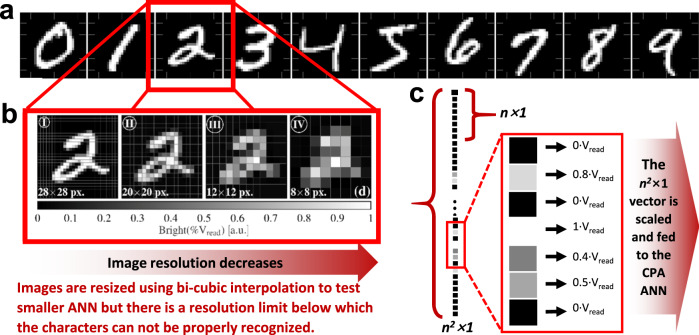
- For MNIST-style benchmarking, the paper uses a 60,000-image training set and 10,000-image test set; in the worked example, images are downsized from 28 × 28 to 8 × 8 and an ANN with one 64 × 10 single-layer perceptron is trained.
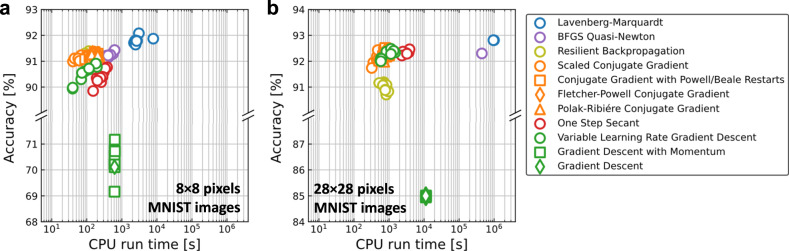
- In the example training study on 100 images, Scaled Conjugate Gradient and Levenberg–Marquardt achieved the highest accuracy, but Scaled Conjugate Gradient was chosen because it was faster.
- The paper states that ADCs are often the largest and most power-hungry circuit block in memristive neural networks, consuming up to 70–90% of on-chip area and up to 80–88% of energy.
Methods
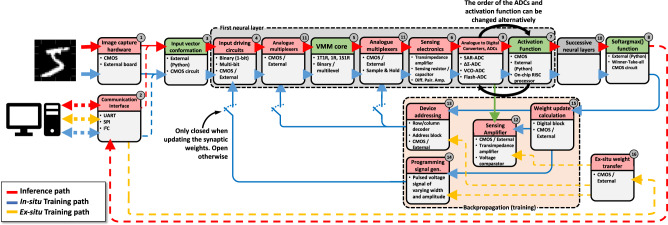
- Review/protocol article: synthesizes prior work on memristive ANN hardware and organizes the system into blocks (image capture, input driving, VMM core, sensing, activation, softargmax, ADCs, and training/update).
- Worked example: a single-layer perceptron for MNIST image classification; MATLAB is used to train the software model and generate a SPICE netlist, and SPICE simulation is used to evaluate the hybrid CMOS/memristor circuit during inference and write-verify programming.
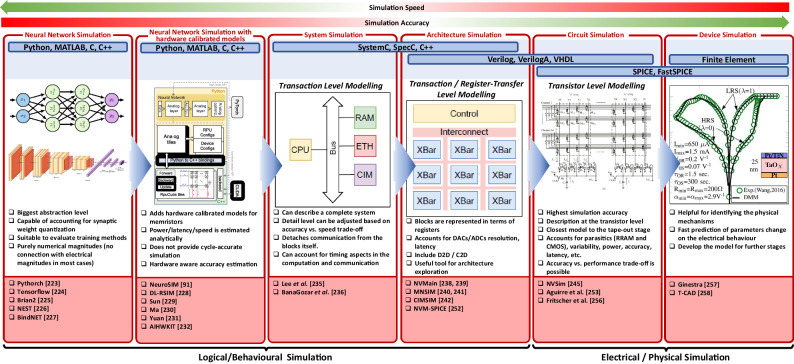
- Analysis emphasis: compares ex situ vs in situ training, discusses conductance mapping to memristors, and surveys simulation abstraction levels from neural-network-level tools to circuit/SPICE-level models.
Limitations
- Stated in the paper: many published studies are not true full-hardware implementations; some only characterize a few devices or rely on software ANN simulations, so reported performance can be weakly connected to fabricated hardware.
- Stated in the paper: full on-chip memristive ANN implementation is limited by peripheral circuit overhead, ADC/DAC trade-offs, device non-idealities, and the difficulty of integrating memristor stacks with CMOS.
- Evident from the text: the paper is not an experimental validation of a new memristor ANN chip; it is primarily a review plus a simulation-based worked example, so its conclusions about performance are illustrative rather than a direct new hardware result.
Model-written summary. Check it against the paper before relying on it.
Integrity signals
Registry
Cites
Statistics
Figures
Verification
Claims the paper makes
47 Valid · 14 Not valid · 58 Not checked · 121 Own results and interpretations
At least one cited source doesn’t support this claim or points to a different paper, and none confirmed it — see the verdicts below.
In the paper
“ADCs with at least 8-bit resolution are necessary to achieve high (>90%) classification accuracy in a ResNET50-1.5 ANN used to classify the ImageNET157 database”
§ Hardware implementation of memristor-based artificial neural networks > Structure of memristor-based ANNs > Analogue to digital converters (Block 9)
What the sources say
- Disputedcites [157] Xiao TP On the Accuracy of Analog Neural Network Inference Accelerators [Feature],” IEEE Circuits Syst. Mag. 2022 22 26 48 10.1109/MCAS.2022.3214409 sourceExperimental — accuracy not yet measured
Section 6.3 (p. 12) says high accuracy is maintained with a 7-bit ADC, contrary to the claim that at least 8 bits are necessary. Table 2 in Section 4.3 (p. 7) reports 76.466% ImageNet top-1 accuracy for ResNet50-v1.5, not over 90%. (LLM, conf=0.93)
Checked by a reasoning model — may be wrong.
plainstates a cause- Asserted: passes — The authors put it forward as true.
- Checkable: passes — It can be checked against evidence.
- Load-bearing: unclear — It is unclear whether the paper’s conclusions depend on it.
- Based: passes — The paper gives a reason why it holds.
- Disputed
Some cited sources support this claim and some don’t — read each source’s verdict below.
In the paper
“the usual practice reported in the literature for this kind of training has been the use of the so-called Manhattan Update Rule105,194, or the Stochastic Gradient Descent54.”
§ Hardware implementation of memristor-based artificial neural networks > Structure of memristor-based ANNs > ANN training and synaptic weight update (Blocks 2, 11-15)
What the sources say
- Supportedcites [105] Prezioso M “Training and operation of an integrated neuromorphic network based on metal-oxide memristors,” Nature 2015 521 61 64 10.1038/nature14441 25951284 source
The Pattern Classification Experiment (p. 5) explicitly says the network was trained in situ using the Manhattan Update rule. This supports the Manhattan-rule example for which this paper is cited; the separate stochastic-gradient-descent citation is not being judged here. (LLM, conf=0.93)
- Disputedcites [194] Yao, P. et al., “Face classification using electronic synapses,” Nat. Commun., 8, May, 1–8, 10.1038/ncomms15199.2017, PMC5437298 28497781 sourceExperimental — accuracy not yet measured
The citation to this paper is attached to the Stochastic Gradient Descent part of the sentence. In “RRAM-based neuromorphic network” (page unavailable), the paper calls its two weight-update rules the delta rule and the Manhattan rule; Figure 2’s caption explicitly says the demonstration uses a batch learning model, not stochastic gradient descent. (LLM, conf=0.83)
Checked by a reasoning model — may be wrong.
- Could not verifycites [54] Li C “Efficient and self-adaptive in-situ learning in multilayer memristor neural networks,” Nat. Commun. 2018 9 1 8 29921923 PMC6008303 sourceExperimental — accuracy not yet measured
The Methods section describes ray-tracing simulations of bird-of-paradise feathers, not training memristor-based neural networks. Searches for the Manhattan Update Rule and stochastic gradient descent found no passage in our copy addressing either method as a usual training practice. (LLM, conf=0.78)
plain- Asserted: passes — The authors put it forward as true.
- Checkable: passes — It can be checked against evidence.
- Load-bearing: unclear — It is unclear whether the paper’s conclusions depend on it.
- Based: passes — The paper gives a reason why it holds.
- Supported
The cited sources support only part of this claim — read each source’s verdict below.
In the paper
“So far, several groups and companies have claimed the realization of hybrid CMOS/memristor implementations of ANNs53–61, —from now on, memristive ANNs— with performance that is superior to that of fully-CMOS counterparts.”
§ Hardware implementation of memristor-based artificial neural networks > Introduction
What the sources say
- Not checked — no full text of the sourcecites [53] Ishii, M. et al., “On-Chip Trainable 1.4M 6T2R PCM synaptic array with 1.6K Stochastic LIF neurons for spiking RBM,” Technical Digest - International Electron Devices Meeting, IEDM, 2019- 310–313, 2019, 10.1109/IEDM19573.2019.8993466. source
- Could not verifycites [54] Li C “Efficient and self-adaptive in-situ learning in multilayer memristor neural networks,” Nat. Commun. 2018 9 1 8 29921923 PMC6008303 sourceExperimental — accuracy not yet measured
The Results section discusses super-black feather microstructure, and the Introduction discusses structural absorption of light; neither addresses artificial neural networks. Searches for hybrid CMOS/memristor implementations and performance relative to fully-CMOS systems found no relevant passage in our copy. (LLM, conf=0.78)
- Not checked — no full text of the sourcecites [55] Yao P “Fully hardware-implemented memristor convolutional neural network,” Nature 2020 577 641 646 10.1038/s41586-020-1942-4 31996818 source
- Not checked — no full text of the sourcecites [56] Correll, J. M. et al., “An 8-bit 20.7 TOPS/W Multi-Level Cell ReRAM-based Compute Engine,” in 2022 IEEE Symposium on VLSI Technology and Circuits (VLSI Technology and Circuits), IEEE, 264–265. 10.1109/VLSITechnologyandCir46769.2022.9830490.2022, source
- Not checked — no full text of the sourcecites [57] Cai, F. et al., “A fully integrated reprogrammable memristor-CMOS system for efficient multiply-accumulate operations,” Nat Electron, 2, no. July, 290–299, [Online]. Available: 10.1038/s41928-019-0270-x 2019. source
- Not checked — no full text of the sourcecites [58] Hung, J.-M., “An 8-Mb DC-Current-Free Binary-to-8b Precision ReRAM Nonvolatile Computing-in-Memory Macro using Time-Space-Readout with 1286.4-21.6TOPS/W for Edge-AI Devices,” in 2022 IEEE International Solid- State Circuits Conference (ISSCC), IEEE, 1–3. 10.1109/ISSCC42614.2022.9731715.2022, source
- Not checked — no full text of the sourcecites [59] Xue, C.-X., “15.4 A 22nm 2Mb ReRAM Compute-in-Memory Macro with 121-28TOPS/W for Multibit MAC Computing for Tiny AI Edge Devices,” in 2020 IEEE International Solid- State Circuits Conference - (ISSCC), IEEE, 2020, 244–246. source
- Partly supportedcites [60] Wan W “A compute-in-memory chip based on resistive random-access memory,” Nature 2022 608 504 512 10.1038/s41586-022-04992-8 35978128 PMC9385482 sourceExperimental — accuracy not yet measured
The Main section describes NeuRRAM as an RRAM chip integrated with CMOS circuits and reports hardware-measured AI inference, supporting its use as an example of a hybrid implementation. The reported performance gains are against earlier RRAM compute-in-memory chips (Efficient voltage-mode neuron circuit), not fully-CMOS counterparts. The Methods section projects higher efficiency than edge inference accelerators only after scaling NeuRRAM from 130 nm to 7 nm; it does not establish the claimed superiority for the realized chip. (LLM, conf=0.84)
- Partly supportedcites [61] Yin S Sun X Yu S Seo JS “High-throughput in-memory computing for binary deep neural networks with monolithically integrated RRAM and 90-nm CMOS,” IEEE Trans. Electron. Dev. 2020 67 4185 4192 10.1109/TED.2020.3015178 sourceExperimental — accuracy not yet measured
The paper demonstrates a binary neural-network chip that integrates RRAM with 90-nm CMOS (p. 1), and its Results report a density advantage over SRAM-based in-memory computing (p. 6). But its quantified throughput and energy-delay improvements are compared with another CMOS chip containing embedded RRAM, not a fully-CMOS counterpart (Supplementary Figure 7, p. 32). It therefore supports the hybrid implementation, but not the claimed overall performance comparison with fully-CMOS ANNs. (LLM, conf=0.86)
plainstates an association- Asserted: passes — The authors put it forward as true.
- Checkable: passes — It can be checked against evidence.
- Load-bearing: unclear — It is unclear whether the paper’s conclusions depend on it.
- Based: passes — The paper gives a reason why it holds.
Every source the paper cites for this claim was checked and supports it.
In the paper
“Moreover, the switching time can be as short as 85 ps42.”
§ Hardware implementation of memristor-based artificial neural networks > Introduction
What the sources say
- Supportedcites [42] Choi BJ “High-speed and low-energy nitride memristors,” Adv. Funct. Mater. 2016 26 5290 5296 10.1002/adfm.201600680 source
The Results and Discussion state that an AlN memristor switched both off and on in 85 ps. The Conclusions also report a measured ultrafast switching time of 85 ps in AlN memristors. (LLM, conf=0.95)
plain- Asserted: passes — The authors put it forward as true.
- Checkable: passes — It can be checked against evidence.
- Load-bearing: unclear — It is unclear whether the paper’s conclusions depend on it.
- Based: passes — The paper gives a reason why it holds.
- Supported
The cited sources support only part of this claim — read each source’s verdict below.
In the paper
“For instance, given the MNIST dataset in which images have a resolution of 28 × 28 pixels one option is to implement the synaptic layer using multiple crossbars to fit the 784 inputs (e.g., 13 64 × 64 or 4 256 × 256 crossbars would be needed93).”
§ Hardware implementation of memristor-based artificial neural networks > Structure of memristor-based ANNs > Image capture hardware (block 1) and input vector conformation (block 3)
What the sources say
- Partly supportedcites [93] Kim H Mahmoodi MR Nili H Strukov DB “4K-memristor analog-grade passive crossbar circuit,” Nat. Commun. 2021 12 1 11 10.1038/s41467-021-25455-0 34465783 PMC8408216 sourceExperimental — accuracy not yet measured
The Results section (“Modeling of advanced systems”; page unavailable) supports splitting a 784-input MNIST classifier layer across multiple crossbar blocks. It does not give the claimed examples of 13 64 × 64 or 4 256 × 256 crossbars: its modeled implementation uses differential-pair weights and maps a 785 × 64 layer to 24 64 × 64 and two 17 × 64 blocks. (LLM, conf=0.88)
hedged- Asserted: passes — The authors put it forward as true.
- Checkable: passes — It can be checked against evidence.
- Load-bearing: unclear — It is unclear whether the paper’s conclusions depend on it.
- Based: passes — The paper gives a reason why it holds.
- Partly supported
88 more claims · 22 with their cited sources checked
Create a free account to see all 240 claims and to verify the 11 references still open.
- Probably not a substantial claim. 79
- It may state two separate claims as one. 91
- The quote only partly states this claim. 1
Citations
Cites
Deep Residual Learning for Image Recognition
He, K., Zhang, X., Ren, S., & Sun, J. (2016) · 2016 IEEE Conference on Computer Vision and Pattern Recognition (CVPR) · doi:10.1109/cvpr.2016.90 · Cited by 235,474 · cited 1×
“For benchmarking a device or a chip, it is essential to evaluate the accuracy of standard deep neural network models like VGG 89 and ResNet 90 on CIFAR and ImageNet dataset by utilizing architecture-levelsimulationandrealistichardwarestatistics 91,92 .”
Very Deep Convolutional Networks for Large-Scale Image Recognition
Simonyan, K., & Zisserman, A. (2014) · arXiv · doi:10.48550/arxiv.1409.1556 · Cited by 114,148 · cited 1×
“For benchmarking a device or a chip, it is essential to evaluate the accuracy of standard deep neural network models like VGG 89 and ResNet 90 on CIFAR and ImageNet dataset by utilizing architecture-levelsimulationandrealistichardwarestatistics 91,92 .”
Adam: A Method for Stochastic Optimization
Kingma, D. P., & Ba, J. (2014) · arXiv · doi:10.48550/arxiv.1412.6980 · Cited by 98,946 · cited 2×
“…employed 165 , and for stochastic evaluation of the loss function using a mini-batch of images diverse methods have been employed, including Adaptive Gradient Algorithm (or AdaGrad) 182 , Root Mean Square Propagation (or RMSProp) 183 , Adaptive Moment Estimation (or Adam) 184 and Adadelta 185 .”
ImageNet: A large-scale hierarchical image database
Deng, J., Dong, W., Socher, R., Li, L.-J., Li, K., & Fei-Fei, L. (2009) · 2009 IEEE Conference on Computer Vision and Pattern Recognition · doi:10.1109/cvpr.2009.5206848 · Cited by 65,333 · cited 1×
“…86 ; 2) CIFAR (Canadian Institute for Advanced Research),whichcontains60,000colorimagesdividedinto10classes for CIFAR-10 and 100 classes for CIFAR-100 87 ; 3) ImageNet, one of the largest image datasets, which consists of over 1.2 million labelled from 1000 classes for the ImageNet competition 88 .”
InfluentialKennedy, J., & Eberhart, R. (2002) · Proceedings of ICNN'95 - International Conference on Neural Networks · doi:10.1109/icnn.1995.488968 · Cited by 58,192 · cited 1×
“Gradient-free methods such as the Particle Swarm optimization 168 , Genetic Algorithms 169 and Simulated Annealing 170 algorithms are more demanding from a computational point of view, andhence,theyarerarelyemployedforANNtraining,bywhichtheylie beyond the scope of this article.”
Optimization by Simulated Annealing
Kirkpatrick, S., Gelatt, C. D., & Vecchi, M. P. (1983) · Science · doi:10.1126/science.220.4598.671 · Cited by 45,134
Learning representations by back-propagating errors
Rumelhart, D. E., Hinton, G. E., & Williams, R. J. (1986) · Nature · doi:10.1038/323533a0 · Cited by 31,892 · cited 1×
“In most ANNs, the gradient of the loss function is normally computed by the backpropagation algorithm 171 .”
An Algorithm for Least-Squares Estimation of Nonlinear Parameters
Marquardt, D. W. (1963) · Journal of the Society for Industrial and Applied Mathematics · doi:10.1137/0111030 · Cited by 30,728 · cited 6×
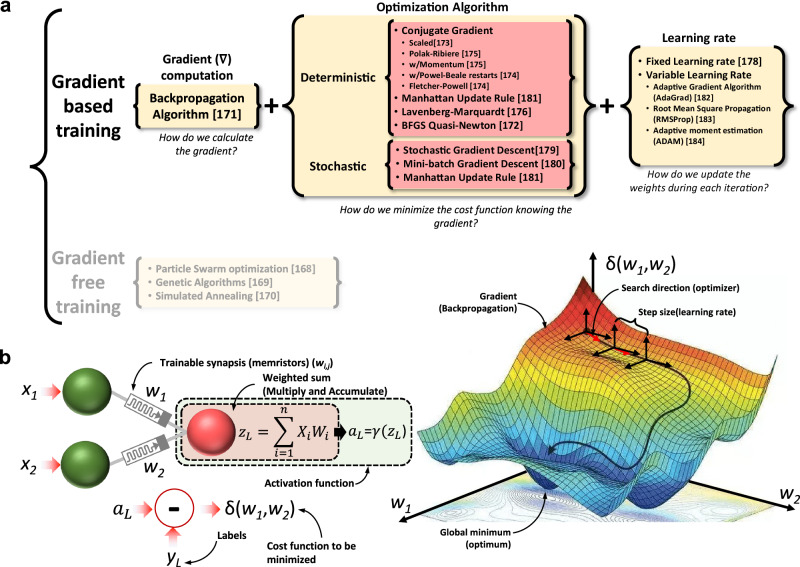
“…evaluation, common optimization algorithms are the following: (i) Gradient Descent 165 (the simplest one and closest to the previous (cid:129) Manha(cid:3)an UpdateRule [181] (cid:129) Lavenberg-Marquardt[176] (cid:129) BFGS Quasi-Newton[172] Howdo we updatethe weightsduringeachitera(cid:2)on?”
InfluentialStrukov, D. B., Snider, G. S., Stewart, D. R., & Williams, R. S. (2008) · Nature · doi:10.1038/nature06932 · Cited by 11,828
(2017) · Cited by 11,625
(2010) · Cited by 8,261
Numerical Methods for Unconstrained Optimization and Nonlinear Equations
Dennis, J. E., & Schnabel, R. B. (1996) · Society for Industrial and Applied Mathematics eBooks · doi:10.1137/1.9781611971200 · Cited by 7,615
Structural absorption by barbule microstructures of super black bird of paradise feathers
McCoy, D. E., Feo, T., Harvey, T. A., & Prum, R. O. (2018) · Nature Communications · doi:10.1038/s41467-017-02088-w · Cited by 7,424
ADADELTA: An Adaptive Learning Rate Method
Zeiler, M. D. (2012) · arXiv · doi:10.48550/arxiv.1212.5701 · Cited by 5,322 · cited 2×
“…employed 165 , and for stochastic evaluation of the loss function using a mini-batch of images diverse methods have been employed, including Adaptive Gradient Algorithm (or AdaGrad) 182 , Root Mean Square Propagation (or RMSProp) 183 , Adaptive Moment Estimation (or Adam) 184 and Adadelta 185 .”
Anomalous collapses of Nares Strait ice arches leads to enhanced export of Arctic sea ice
Moore, G. W. K., Howell, S. E. L., Brady, M., Xu, X., & McNeil, K. (2021) · Nature Communications · doi:10.1038/s41467-020-20314-w · Cited by 5,155
Redox‐Based Resistive Switching Memories – Nanoionic Mechanisms, Prospects, and Challenges
Waser, R., Dittmann, R., Staikov, G., & Szot, K. (2009) · Advanced Materials · doi:10.1002/adma.200900375 · Cited by 5,080
Function minimization by conjugate gradients
Fletcher, R. (1964) · The Computer Journal · doi:10.1093/comjnl/7.2.149 · Cited by 4,939 · cited 2×
“(cid:129) Fixed Learningrate [178] (cid:129) Variable LearningRate paragraph ’ s explanation) and its variants (Gradient Descent with Momentum 165 ), (ii) Newton (analytically complex, as besides the gradient it also requires the Hessian matrix associated of the loss function) and Quasi-Newton methods (which operates…”
In-Datacenter Performance Analysis of a Tensor Processing Unit
Jouppi, N. P., Young, C., Patil, N., Patterson, D., Agrawal, G., Bajwa, R., Bates, S., Bhatia, S., Boden, N., Borchers, A., et al. (2017) · Proceedings of the 44th Annual International Symposium on Computer Architecture · doi:10.1145/3079856.3080246 · Cited by 4,537 · cited 1×
“Acomprehensivelist of these ASICs comprising those such as the Google TPU 19 , Amazon inferentia 20 , Tesla NPU 21 , etc., are summarized in ref.”
A million spiking-neuron integrated circuit with a scalable communication network and interface
Merolla, P. A., Arthur, J. V., Alvarez-Icaza, R., Cassidy, A. S., Sawada, J., Akopyan, F., Jackson, B. L., Imam, N., Guo, C., Nakamura, Y., et al. (2014) · Science · doi:10.1126/science.1254642 · Cited by 4,147 · cited 1×
“Also, the platforms developed by IBM (TrueNorth 33 ), and Tsingshua 34 are well known examples of the research effort of both the industry and the academia in this fi eld.”
A scaled conjugate gradient algorithm for fast supervised learning
Møller, M. F. (1993) · Neural Networks · doi:10.1016/s0893-6080(05)80056-5 · Cited by 4,052
A direct adaptive method for faster backpropagation learning: the RPROP algorithm
Riedmiller, M., & Braun, H. (2002) · IEEE International Conference on Neural Networks · doi:10.1109/icnn.1993.298623 · Cited by 3,917 · cited 1×
“Alternatively, other methods are the Levenberg-Marquardt 176 (uses the Jacobian matrix instead of the Hessian Matrix), Resilient Backpropagation 177 and One Step Secant 178 , but these are more demanding from a computational point of view.”
Eyeriss: An Energy-Efficient Reconfigurable Accelerator for Deep Convolutional Neural Networks
Chen, Y.-H., Krishna, T., Emer, J. S., & Sze, V. (2017) · IEEE Journal of Solid-State Circuits · doi:10.1109/jssc.2016.2616357 · Cited by 3,247
Genetic Algorithms and Machine Learning
Goldberg, D. E., & Holland, J. H. (1988) · Machine Learning · doi:10.1023/a:1022602019183 · Cited by 3,193 · cited 1×
“Gradient-free methods such as the Particle Swarm optimization 168 , Genetic Algorithms 169 and Simulated Annealing 170 algorithms are more demanding from a computational point of view, andhence,theyarerarelyemployedforANNtraining,bywhichtheylie beyond the scope of this article.”
Training and operation of an integrated neuromorphic network based on metal-oxide memristors
Prezioso, M., Merrikh-Bayat, F., Hoskins, B. D., Adam, G. C., Likharev, K. K., & Strukov, D. B. (2015) · Nature · doi:10.1038/nature14441 · Cited by 3,001 · cited 5×
“Then, analogue VMM has been demonstrated both for binary inputs and weights 218 – 220 , as well as for binary inputs and analogue/multilevel weights 60,85,105,217 .”
InfluentialMemory devices and applications for in-memory computing
Sebastian, A., Le Gallo, M., Khaddam-Aljameh, R., & Eleftheriou, E. (2020) · Nature Nanotechnology · doi:10.1038/s41565-020-0655-z · Cited by 2,289 · cited 2×
“In a DNN the information is represented with values that are continuous in time and can achieve high data recognition accuracy by using at least two layers of nonlinear neurons interconnected by adjustable synaptic weights 25 .”
Self-citationAnalog-to-digital converter survey and analysis
Walden, R. H. (1999) · IEEE Journal on Selected Areas in Communications · doi:10.1109/49.761034 · Cited by 2,186
Fully hardware-implemented memristor convolutional neural network
Yao, P., Wu, H., Gao, B., Tang, J., Zhang, Q., Zhang, W., Yang, J. J., & Qian, H. (2020) · Nature · doi:10.1038/s41586-020-1942-4 · Cited by 2,179 · cited 11×
“The most advanced studies in this fi eld have reported fully integrated memristor-based compute-in-memory systems 48,53 – 55, In this article we provide a comprehensive step-by-step description of the hardware implementation of memristive ANNs for image classi fi cation — the most studied application…”
InfluentialSelf-citationOptimizing FPGA-based Accelerator Design for Deep Convolutional Neural Networks
Zhang, C., Li, P., Sun, G., Guan, Y., Xiao, B., & Cong, J. (2015) · Proceedings of the 2015 ACM/SIGDA International Symposium on Field-Programmable Gate Arrays · doi:10.1145/2684746.2689060 · Cited by 2,158
Stochastic Gradient Descent Tricks
Bottou, L. (2012) · Lecture Notes in Computer Science · doi:10.1007/978-3-642-35289-8_25 · Cited by 1,929
Restart procedures for the conjugate gradient method
Powell, M. J. D. (1977) · Mathematical Programming · doi:10.1007/bf01593790 · Cited by 1,717
ISAAC: a convolutional neural network accelerator with in-situ analog arithmetic in crossbars
Shafiee, A., Nag, A., Muralimanohar, N., Balasubramonian, R., Strachan, J. P., Hu, M., Williams, R. S., & Srikumar, V. (2016) · ACM SIGARCH Computer Architecture News · doi:10.1145/3007787.3001139 · Cited by 1,536
DaDianNao: A Machine-Learning Supercomputer
Chen, Y., Luo, T., Liu, S., Zhang, S., He, L., Wang, J., Li, L., Chen, T., Xu, Z., Sun, N., et al. (2014) · 2014 47th Annual IEEE/ACM International Symposium on Microarchitecture · doi:10.1109/micro.2014.58 · Cited by 1,492
Pan, F., Gao, S., Chen, C., Song, C., & Zeng, F. (2014) · Materials Science and Engineering: R: Reports · doi:10.1016/j.mser.2014.06.002 · Cited by 1,403 · cited 1×
“A plethora of studies have revised the different switching mechanisms of memristive devices 205 – 212 , therefore we will not further dig into this issue.”
Analogue signal and image processing with large memristor crossbars
Li, C., Hu, M., Li, Y., Jiang, H., Ge, N., Montgomery, E., Zhang, J., Song, W., Dávila, N., Graves, C. E., et al. (2017) · Nature Electronics · doi:10.1038/s41928-017-0002-z · Cited by 1,292 · cited 1×
“The most common approach in this contest is the use of an Off-the-shelf, external DAC to drivetheanalogueinputs 54,55,102,222 ,whichareintegratedwiththerestof the circuit (i.e. the memristor crossbar) in printed circuit boards.”
Self-citationChi, P., Li, S., Xu, C., Zhang, T., Zhao, J., Liu, Y., Wang, Y., & Xie, Y. (2016) · ACM SIGARCH Computer Architecture News · doi:10.1145/3007787.3001140 · Cited by 1,231
Self-citationNVSim: A Circuit-Level Performance, Energy, and Area Model for Emerging Nonvolatile Memory
Dong, X., Xu, C., Xie, Y., & Jouppi, N. P. (2012) · IEEE Transactions on Computer-Aided Design of Integrated Circuits and Systems · doi:10.1109/tcad.2012.2185930 · Cited by 1,217
First- and Second-Order Methods for Learning: Between Steepest Descent and Newton's Method
Battiti, R. (1992) · Neural Computation · doi:10.1162/neco.1992.4.2.141 · Cited by 1,193 · cited 2×
“Alternatively, other methods are the Levenberg-Marquardt 176 (uses the Jacobian matrix instead of the Hessian Matrix), Resilient Backpropagation 177 and One Step Secant 178 , but these are more demanding from a computational point of view.”
Equivalent-accuracy accelerated neural-network training using analogue memory
Ambrogio, S., Narayanan, P., Tsai, H., Shelby, R. M., Boybat, I., di Nolfo, C., Sidler, S., Giordano, M., Bodini, M., Farinha, N. C. P., et al. (2018) · Nature · doi:10.1038/s41586-018-0180-5 · Cited by 1,151 · cited 1×
“This is the most commonly used approach on research prototypes developed as technology demonstrators due to its versatility, as the activation function can be implemented and changed by simply modifying the software code 55,100,113 – 115, 122, 123 .”
Carnevale, N. T., & Hines, M. L. (2006) · Cambridge University Press eBooks · doi:10.1017/cbo9780511541612 · Cited by 1,121
Fully memristive neural networks for pattern classification with unsupervised learning
Wang, Z., Joshi, S., Savel’ev, S., Song, W., Midya, R., Li, Y., Rao, M., Yan, P., Asapu, S., Zhuo, Y., et al. (2018) · Nature Electronics · doi:10.1038/s41928-018-0023-2 · Cited by 1,106 · cited 2×
“Note that most of the literature claiming unsupervised learning with memristive devices used software 166 , and we are only aware of a few works 53,116,167 , that demonstrated hardware-based unsupervised learning.”
Self-citationApproximate computing: An emerging paradigm for energy-efficient design
Han, J., & Orshansky, M. (2013) · 2013 18TH IEEE EUROPEAN TEST SYMPOSIUM (ETS) · doi:10.1109/ets.2013.6569370 · Cited by 1,098 · cited 1×
“An alternative to keep a high throughput and still employ a low-resolution DAC is using approximate computing 101 .”
Towards artificial general intelligence with hybrid Tianjic chip architecture
Pei, J., Deng, L., Song, S., Zhao, M., Zhang, Y., Wu, S., Wang, G., Zou, Z., Wu, Z., He, W., et al. (2019) · Nature · doi:10.1038/s41586-019-1424-8 · Cited by 1,082 · cited 1×
“Also, the platforms developed by IBM (TrueNorth 33 ), and Tsingshua 34 are well known examples of the research effort of both the industry and the academia in this fi eld.”
Self-citationA compute-in-memory chip based on resistive random-access memory
Wan, W., Kubendran, R., Schaefer, C., Eryilmaz, S. B., Zhang, W., Wu, D., Deiss, S., Raina, P., Qian, H., Gao, B., et al. (2022) · Nature · doi:10.1038/s41586-022-04992-8 · Cited by 943 · cited 2×
“Also, many papers 55,60,99,100 , have explored the case of ANNs with binarized inputs, as they employ the simplest DACs (1-bit).”
Burr, G. W., Shelby, R. M., Sidler, S., di Nolfo, C., Jang, J., Boybat, I., Shenoy, R. S., Narayanan, P., Virwani, K., Giacometti, E. U., et al. (2015) · IEEE Transactions on Electron Devices · doi:10.1109/ted.2015.2439635 · Cited by 936 · cited 1×
“This neural network type is simpler than those considered in other more complex memristive ANNs, e.g. Multi-layer Perceptron (MLP) 54,196,267 , Convolutional Neural Networks (CNNs) 268 , Spiking Neural Networks (SNNs) 269 , among others (see Table 5).”
Efficient and self-adaptive in-situ learning in multilayer memristor neural networks
Li, C., Belkin, D., Li, Y., Yan, P., Hu, M., Ge, N., Jiang, H., Montgomery, E., Lin, P., Wang, Z., et al. (2018) · Nature Communications · doi:10.1038/s41467-018-04484-2 · Cited by 931
Self-citationFace classification using electronic synapses
Yao, P., Wu, H., Gao, B., Eryilmaz, S. B., Huang, X., Zhang, W., Zhang, Q., Deng, N., Shi, L., Wong, H.-S. P., et al. (2017) · Nature Communications · doi:10.1038/ncomms15199 · Cited by 909 · cited 4×
“The weight update process is implemented by applying voltage or current pulses to the memristors (block 13 and 14), following the Write-Verify (or Close Loop Tunning) 194 – 196 , or the Write-without-Verify (or Open Loop Tunning) 103,107,197,198 .”
InfluentialNeuro-inspired computing chips
Zhang, W., Gao, B., Tang, J., Yao, P., Yu, S., Chang, M.-F., Yoo, H.-J., Qian, H., & Wu, H. (2020) · Nature Electronics · doi:10.1038/s41928-020-0435-7 · Cited by 892
Self-citationThree-dimensional integration of nanotechnologies for computing and data storage on a single chip
Shulaker, M. M., Hills, G., Park, R. S., Howe, R. T., Saraswat, K., Wong, H.-S. P., & Mitra, S. (2017) · Nature · doi:10.1038/nature22994 · Cited by 866
PipeLayer: A Pipelined ReRAM-Based Accelerator for Deep Learning
Song, L., Qian, X., Li, H., & Chen, Y. (2017) · 2017 IEEE International Symposium on High Performance Computer Architecture (HPCA) · doi:10.1109/hpca.2017.55 · Cited by 833 · cited 1×
“Alternatives to overcome this lim-itationhavebeenproposed,asforinstancethesimulatordevelopedby Song et al. 246 to evaluate their PipeLayer architecture, which considers highly parallel designs based on the notion of parallelism granularity and weight replication.”
Yu, S., Wu, Y., Jeyasingh, R., Kuzum, D., & Wong, H.-S. P. (2011) · IEEE Transactions on Electron Devices · doi:10.1109/ted.2011.2147791 · Cited by 805
Self-citationISAAC: A Convolutional Neural Network Accelerator with In-Situ Analog Arithmetic in Crossbars
Shafiee, A., Nag, A., Muralimanohar, N., Balasubramonian, R., Strachan, J. P., Hu, M., Williams, R. S., & Srikumar, V. (2016) · 2016 ACM/IEEE 43rd Annual International Symposium on Computer Architecture (ISCA) · doi:10.1109/isca.2016.12 · Cited by 775
A comprehensive review on emerging artificial neuromorphic devices
Zhu, J., Zhang, T., Yang, Y., & Huang, R. (2020) · Applied Physics Reviews · doi:10.1063/1.5118217 · Cited by 758 · cited 1×
“A plethora of studies have revised the different switching mechanisms of memristive devices 205 – 212 , therefore we will not further dig into this issue.”
Self-citationMemristor‐Based Analog Computation and Neural Network Classification with a Dot Product Engine
Hu, M., Graves, C. E., Li, C., Li, Y., Ge, N., Montgomery, E., Davila, N., Jiang, H., Williams, R. S., Yang, J. J., et al. (2018) · Advanced Materials · doi:10.1002/adma.201705914 · Cited by 751 · cited 1×
“A cost-effective recurrent solution has been to use a smaller number of DACs and share them among different rows by adding a layer of analogue multiplexors between the DACs and the wordline inputs 93,95,221 .”
Self-citationBrian 2, an intuitive and efficient neural simulator
Stimberg, M., Brette, R., & Goodman, D. F. (2019) · eLife · doi:10.7554/elife.47314 · Cited by 749
Efficient mini-batch training for stochastic optimization
Li, M., Zhang, T., Chen, Y., & Smola, A. J. (2014) · Proceedings of the 20th ACM SIGKDD international conference on Knowledge discovery and data mining · doi:10.1145/2623330.2623612 · Cited by 742 · cited 2×
“For stochastic evaluation, the most common optimization algorithms are: the i) Stochastic Gradient Descent 179 (the stochastic equivalent of the Gradient Descent 165 method previously mentioned, assuming that one epoch consists of only 1 training input vector) and Mini-batch Gradient Descent 180 (which is a generaliza…”
Artificial optic-neural synapse for colored and color-mixed pattern recognition
Seo, S., Jo, S.-H., Kim, S., Shim, J., Oh, S., Kim, J.-H., Heo, K., Choi, J.-W., Choi, C., Oh, S., et al. (2018) · Nature Communications · doi:10.1038/s41467-018-07572-5 · Cited by 731 · cited 1×
“However, most of those studies in fact only measured the fi gures-of-merit of one/few devices and simulated the accuracy of an ANN via software 62 – 67 in such type of studies the connection between the memristors fabricated and the ANN is relatively weak.”
A fully integrated reprogrammable memristor–CMOS system for efficient multiply–accumulate operations
Cai, F., Correll, J. M., Lee, S. H., Lim, Y., Bothra, V., Zhang, Z., Flynn, M. P., & Lu, W. D. (2019) · Nature Electronics · doi:10.1038/s41928-019-0270-x · Cited by 728 · cited 25×
“The MATLAB code employed to train an ANN containing one 64 × 10 Single Layer Perceptron (SLP) ANN — using MNIST images downsized to 8 × 8 — is shown in Supplementary Algorithm 3; the code depicts both the ANN creation and training.”
InfluentialSelf-citationAdvancing Neuromorphic Computing With Loihi: A Survey of Results and Outlook
Davies, M., Wild, A., Orchard, G., Sandamirskaya, Y., Guerra, G. A. F., Joshi, P., Plank, P., & Risbud, S. R. (2021) · Proceedings of the IEEE · doi:10.1109/jproc.2021.3067593 · Cited by 688 · cited 1×
“Intel probably has the most extensive research program for evaluating the commercial viability of SNN accelerators with their Loihi technology 27,28 , and Intel Neuromorphic Development Community 29 .”
Hu, M., Strachan, J. P., Li, Z., Grafals, E. M., Davila, N., Graves, C., Lam, S., Ge, N., Yang, J. J., & Williams, R. S. (2016) · Proceedings of the 53rd Annual Design Automation Conference · doi:10.1145/2897937.2898010 · Cited by 686 · cited 1×
“The weight update process is implemented by applying voltage or current pulses to the memristors (block 13 and 14), following the Write-Verify (or Close Loop Tunning) 194 – 196 , or the Write-without-Verify (or Open Loop Tunning) 103,107,197,198 .”
Self-citationChen, P.-Y., Peng, X., & Yu, S. (2018) · IEEE Transactions on Computer-Aided Design of Integrated Circuits and Systems · doi:10.1109/tcad.2018.2789723 · Cited by 652 · cited 3×
“For benchmarking a device or a chip, it is essential to evaluate the accuracy of standard deep neural network models like VGG 89 and ResNet 90 on CIFAR and ImageNet dataset by utilizing architecture-levelsimulationandrealistichardwarestatistics 91,92 .”
Pattern classification by memristive crossbar circuits using ex situ and in situ training
Alibart, F., Zamanidoost, E., & Strukov, D. B. (2013) · Nature Communications · doi:10.1038/ncomms3072 · Cited by 642 · cited 1×
“Ex situ training has the advantage of requiring little/no circuit overhead to perform quick tests of the classi fi cation performance of the network, and hasmade possible to evaluate the performanceof home-made memristive crossbar-arrays 93,188 .”
Brain-inspired computing needs a master plan
Mehonic, A., & Kenyon, A. J. (2022) · Nature · doi:10.1038/s41586-021-04362-w · Cited by 632 · cited 1×
“1a), as these can perform multiple operations in parallel 10 – 12 .”
Self-citationWinner-Take-All Networks of O(N) Complexity
Lazzaro, J., Ryckebusch, S., Mahowald, M. A., & Mead, C. A. (1988) · doi:10.21236/ada451466 · Cited by 582
Chi, P., Li, S., Xu, C., Zhang, T., Zhao, J., Liu, Y., Wang, Y., & Xie, Y. (2016) · 2016 ACM/IEEE 43rd Annual International Symposium on Computer Architecture (ISCA) · doi:10.1109/isca.2016.13 · Cited by 573
Self-citationSPECC: Specification Language and Methodology
Gajski, D. D., Zhu, J., Dömer, R., Gerstlauer, A., & Zhao, S. (2000) · Springer eBooks · doi:10.1007/978-1-4615-4515-6 · Cited by 546
Woo, J., Moon, K., Song, J., Lee, S., Kwak, M., Park, J., & Hwang, H. (2016) · IEEE Electron Device Letters · doi:10.1109/led.2016.2582859 · Cited by 512 · cited 1×
“The weight update process is implemented by applying voltage or current pulses to the memristors (block 13 and 14), following the Write-Verify (or Close Loop Tunning) 194 – 196 , or the Write-without-Verify (or Open Loop Tunning) 103,107,197,198 .”
Thousands of conductance levels in memristors monolithically integrated on CMOS
Yang, J., Rao, M., Tang, H., Wu, J.-B., Song, W., Zhang, M., Yin, W., Zhuo, Y., Kiani, F., Chen, B., et al. (2022) · doi:10.21203/rs.3.rs-1939455/v1 · Cited by 504
Self-citationThousands of conductance levels in memristors integrated on CMOS
(2023) · doi:10.1038/s41586-023-05759-5 · Cited by 503
Gokmen, T., & Vlasov, Y. (2016) · Frontiers in Neuroscience · doi:10.3389/fnins.2016.00333 · Cited by 491 · cited 2×
“The weight update process is implemented by applying voltage or current pulses to the memristors (block 13 and 14), following the Write-Verify (or Close Loop Tunning) 194 – 196 , or the Write-without-Verify (or Open Loop Tunning) 103,107,197,198 .”
Accurate deep neural network inference using computational phase-change memory
Joshi, V., Le Gallo, M., Haefeli, S., Boybat, I., Nandakumar, S. R., Piveteau, C., Dazzi, M., Rajendran, B., Sebastian, A., & Eleftheriou, E. (2020) · Nature Communications · doi:10.1038/s41467-020-16108-9 · Cited by 490 · cited 1×
“To avoid this loss of accuracy, hardware-aware training methods, in which device non-idealities are incorporated during training have been proposed in the literature 189,190 .”
Self-citationMixed-precision in-memory computing
Le Gallo, M., Sebastian, A., Mathis, R., Manica, M., Giefers, H., Tuma, T., Bekas, C., Curioni, A., & Eleftheriou, E. (2018) · Nature Electronics · doi:10.1038/s41928-018-0054-8 · Cited by 485 · cited 1×
“…training, whichaccumulatestheweightupdateinsoftwareandonlyupdatesthe memristor devices when the accumulated value surpasses the programming granularity, can greatly relax requirement for conductance update resolution and endurance and allow software-comparable accuracy to be achieved 192,193 .”
Self-citationIn-Memory Computing: Advances and Prospects
Verma, N., Jia, H., Valavi, H., Tang, Y., Ozatay, M., Chen, L.-Y., Zhang, B., & Deaville, P. (2019) · IEEE Solid-State Circuits Magazine · doi:10.1109/mssc.2019.2922889 · Cited by 473 · cited 1×
“The proposed circuit comprises 4 kb synapses fabricated in a 65 nm CMOS processand reported anenergy ef fi ciencyof 55.8 TOPS per W. Incases where x is non-binary, one approach is to employ capacitors in addition to the SRAM cells 76,77,79 , involving a three-step process.”
InfluentialXNOR-SRAM: In-Memory Computing SRAM Macro for Binary/Ternary Deep Neural Networks
Yin, S., Jiang, Z., Seo, J.-S., & Seok, M. (2020) · IEEE Journal of Solid-State Circuits · doi:10.1109/jssc.2019.2963616 · Cited by 429
Automated Systolic Array Architecture Synthesis for High Throughput CNN Inference on FPGAs
Wei, X., Yu, C. H., Zhang, P., Chen, Y., Wang, Y., Hu, H., Liang, Y., & Cong, J. (2017) · Proceedings of the 54th Annual Design Automation Conference 2017 · doi:10.1145/3061639.3062207 · Cited by 426 · cited 1×
“Another option is to use fi eld programable gate arrays (FPGAs), which consume much less energy than GPUs while providing an intermediate computing ef fi ciency between CPUs and GPUs 13 – 17 .”
PUMA: A Programmable Ultra-efficient Memristor-based Accelerator for Machine Learning Inference
Ankit, A., Hajj, I. E., Chalamalasetti, S. R., Ndu, G., Foltin, M., Williams, R. S., Faraboschi, P., Hwu, W.-M. W., Strachan, J. P., Roy, K., et al. (2019) · Proceedings of the Twenty-Fourth International Conference on Architectural Support for Programming Languages and Operating Systems · doi:10.1145/3297858.3304049 · Cited by 424 · cited 1×
“Moreover, ADC can consume up to 70 – 90% of the on-chip area of the crossbar-based computation unit, including memristive crossbar and peripheral circuits, and up to 80-88% of energy 55,154,155 .”
Reflections on the memory wall
McKee, S. A. (2004) · Proceedings of the 1st conference on Computing frontiers · doi:10.1145/977091.977115 · Cited by 420
Immunity to Device Variations in a Spiking Neural Network With Memristive Nanodevices
Querlioz, D., Bichler, O., Dollfus, P., & Gamrat, C. (2013) · IEEE Transactions on Nanotechnology · doi:10.1109/tnano.2013.2250995 · Cited by 420 · cited 1×
“This neural network type is simpler than those considered in other more complex memristive ANNs, e.g. Multi-layer Perceptron (MLP) 54,196,267 , Convolutional Neural Networks (CNNs) 268 , Spiking Neural Networks (SNNs) 269 , among others (see Table 5).”
Memristor Crossbar-Based Neuromorphic Computing System: A Case Study
Hu, M., Li, H., Chen, Y., Wu, Q., Rose, G. S., & Linderman, R. W. (2014) · IEEE Transactions on Neural Networks and Learning Systems · doi:10.1109/tnnls.2013.2296777 · Cited by 414
Biswas, A., & Chandrakasan, A. P. (2019) · IEEE Journal of Solid-State Circuits · doi:10.1109/jssc.2018.2880918 · Cited by 414 · cited 1×
“The proposed circuit comprises 4 kb synapses fabricated in a 65 nm CMOS processand reported anenergy ef fi ciencyof 55.8 TOPS per W. Incases where x is non-binary, one approach is to employ capacitors in addition to the SRAM cells 76,77,79 , involving a three-step process.”
InfluentialAccurate deep neural network inference using computational phase-change memory
Joshi, V., Gallo, M. L., Haefeli, S., Boybat, I., Nandakumar, S. R., Piveteau, C., Dazzi, M., Rajendran, B., Sebastian, A., & Eleftheriou, E. S. (2020) · RePEc: Research Papers in Economics · doi:10.3929/ethz-b-000416797 · Cited by 379
Self-citationThree-dimensional memristor circuits as complex neural networks
Lin, P., Li, C., Wang, Z., Li, Y., Jiang, H., Song, W., Rao, M., Zhuo, Y., Upadhyay, N. K., Barnell, M., et al. (2020) · Nature Electronics · doi:10.1038/s41928-020-0397-9 · Cited by 375 · cited 1×
“…non-volatile states (up to ~100 47,48 , and even ~1000 49 ), ii) a low-energy consumption for switching(~10fJperstatetransitionwithzero-staticconsumptionwhen idle 50 ), and iii) a scalable structure appropriate for matrix integration (often referred to as crossbar 51 ) and even 3D stacking 52 .”
Self-citationNeuFlow: A runtime reconfigurable dataflow processor for vision
Farabet, C., Martini, B., Corda, B., Akselrod, P., Culurciello, E., & LeCun, Y. (2011) · CVPR 2011 WORKSHOPS · doi:10.1109/cvprw.2011.5981829 · Cited by 369
CNP: An FPGA-based processor for Convolutional Networks
Farabet, C., Poulet, C., Han, J. Y., & LeCun, Y. (2009) · 2009 International Conference on Field Programmable Logic and Applications · doi:10.1109/fpl.2009.5272559 · Cited by 367 · cited 2×
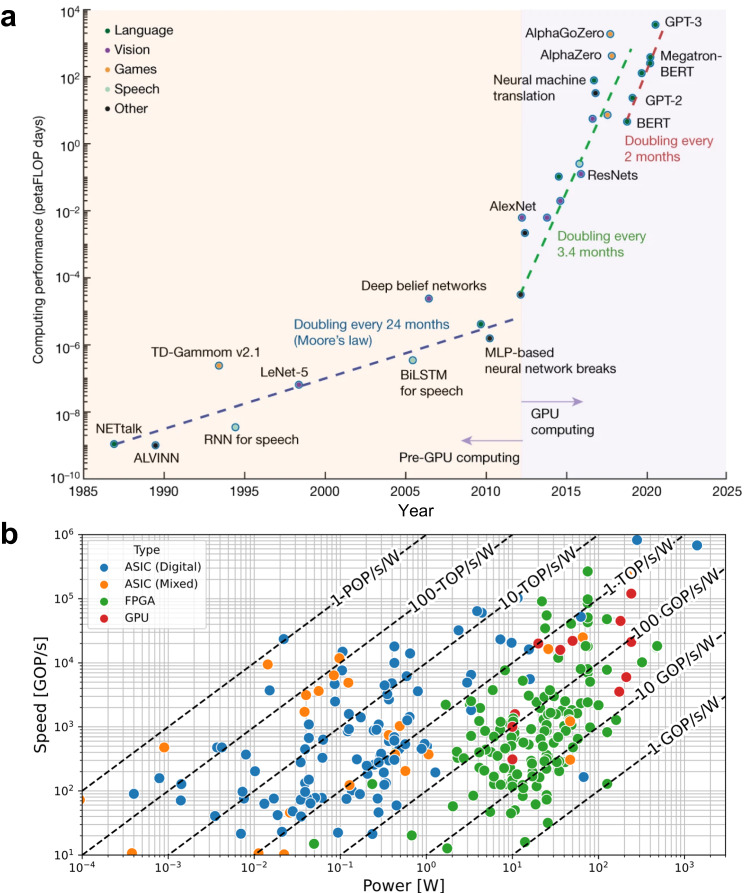
“The computing time can be accelerated by using graphics processing units (GPUs) to implement the ANNs (see Fig.”
A single-transistor silicon synapse
Diorio, C., Hasler, P., Minch, A., & Mead, C. A. (1996) · IEEE Transactions on Electron Devices · doi:10.1109/16.543035 · Cited by 360 · cited 1×
“An alternative memory element for VMM operation is the fl ash memory cell 80,81 , in which the charge storage node is coupled to the gate of a FET with charge stored either on a conductive electrode surrounded by insulators ( fl oating gate) or in discrete traps within a defective insulator layer…”
High‐Speed and Low‐Energy Nitride Memristors
Choi, B. J., Torrezan, A. C., Strachan, J. P., Kotula, P. G., Lohn, A. J., Marinella, M. J., Li, Z., Williams, R. S., & Yang, J. J. (2016) · Advanced Functional Materials · doi:10.1002/adfm.201600680 · Cited by 356 · cited 2×
“Moreover, the switching time can be as short as 85 ps 42 .”
Self-citationOrigin of the Ultra‐nonlinear Switching Kinetics in Oxide‐Based Resistive Switches
Menzel, S., Waters, M., Marchewka, A., Böttger, U., Dittmann, R., & Waser, R. (2011) · Advanced Functional Materials · doi:10.1002/adfm.201101117 · Cited by 348
Kull, L., Toifl, T., Schmatz, M., Francese, P. A., Menolfi, C., Brandli, M., Kossel, M., Morf, T., Andersen, T. M., & Leblebici, Y. (2013) · IEEE Journal of Solid-State Circuits · doi:10.1109/jssc.2013.2279571 · Cited by 347 · cited 1×
“Therefore, not only the system becomes more sensitive and error-prone, but also its power consumption increases exponentially as the resolution of DACs and ADCs increase 163,164 .”
A dynamically configurable coprocessor for convolutional neural networks
Chakradhar, S., Sankaradas, M., Jakkula, V., & Cadambi, S. (2010) · Proceedings of the 37th annual international symposium on Computer architecture · doi:10.1145/1815961.1815993 · Cited by 343
UNPU: An Energy-Efficient Deep Neural Network Accelerator With Fully Variable Weight Bit Precision
Lee, J., Kim, C., Kang, S., Shin, D., Kim, S., & Yoo, H.-J. (2019) · IEEE Journal of Solid-State Circuits · doi:10.1109/jssc.2018.2865489 · Cited by 335
Engineering incremental resistive switching in TaOxbased memristors for brain-inspired computing
Wang, Z., Yin, M., Zhang, T., Cai, Y., Wang, Y., Yang, Y., & Huang, R. (2016) · Nanoscale · doi:10.1039/c6nr00476h · Cited by 329
Self-citationA 64-Tile 2.4-Mb In-Memory-Computing CNN Accelerator Employing Charge-Domain Compute
Valavi, H., Ramadge, P. J., Nestler, E., & Verma, N. (2019) · IEEE Journal of Solid-State Circuits · doi:10.1109/jssc.2019.2899730 · Cited by 328 · cited 2×
“The proposed circuit comprises 4 kb synapses fabricated in a 65 nm CMOS processand reported anenergy ef fi ciencyof 55.8 TOPS per W. Incases where x is non-binary, one approach is to employ capacitors in addition to the SRAM cells 76,77,79 , involving a three-step process.”
InfluentialCurrent-mode subthreshold MOS circuits for analog VLSI neural systems
Andreou, A. G., Boahen, K. A., Pouliquen, P. O., Pavasovic, A., Jenkins, R. E., & Strohbehn, K. (1991) · IEEE Transactions on Neural Networks · doi:10.1109/72.80331 · Cited by 313
Multibit memory operation of metal-oxide bi-layer memristors
Stathopoulos, S., Khiat, A., Trapatseli, M., Cortese, S., Serb, A., Valov, I., & Prodromakis, T. (2017) · Scientific Reports · doi:10.1038/s41598-017-17785-1 · Cited by 312
Le Gallo, M., Khaddam-Aljameh, R., Stanisavljevic, M., Vasilopoulos, A., Kersting, B., Dazzi, M., Karunaratne, G., Brändli, M., Singh, A., Müller, S. M., et al. (2023) · Nature Electronics · doi:10.1038/s41928-023-01010-1 · Cited by 310
Self-citationLiu, Q., Gao, B., Yao, P., Wu, D., Chen, J., Pang, Y., Zhang, W., Liao, Y., Xue, C.-X., Chen, W.-H., et al. (2020) · 2020 IEEE International Solid- State Circuits Conference - (ISSCC) · doi:10.1109/isscc19947.2020.9062953 · Cited by 308
Self-citationNeuromorphic Hardware System for Visual Pattern Recognition With Memristor Array and CMOS Neuron
Chu, M., Kim, B., Park, S., Hwang, H., Jeon, M., Lee, B. H., & Lee, B.-G. (2015) · IEEE Transactions on Industrial Electronics · doi:10.1109/tie.2014.2356439 · Cited by 296
Xue, C.-X., Chen, W.-H., Liu, J.-S., Li, J.-F., Lin, W.-Y., Lin, W.-E., Wang, J.-H., Wei, W.-C., Chang, T.-W., Chang, T.-C., et al. (2019) · 2019 IEEE International Solid- State Circuits Conference - (ISSCC) · doi:10.1109/isscc.2019.8662395 · Cited by 291
Self-citationA SPICE Compact Model of Metal Oxide Resistive Switching Memory With Variations
Guan, X., Yu, S., & Wong, H.-S. P. (2012) · IEEE Electron Device Letters · doi:10.1109/led.2012.2210856 · Cited by 282 · cited 1×
“Note that for other memristive models the state variable would be calculated following a different equation (for instance in the Stanford model 270 ).”
CMOS-integrated memristive non-volatile computing-in-memory for AI edge processors
Chen, W.-H., Dou, C., Li, K.-X., Lin, W.-Y., Li, P.-Y., Huang, J.-H., Wang, J.-H., Wei, W.-C., Xue, C.-X., Chiu, Y.-C., et al. (2019) · Nature Electronics · doi:10.1038/s41928-019-0288-0 · Cited by 276
Self-citation4K-memristor analog-grade passive crossbar circuit
Kim, H., Mahmoodi, M. R., Nili, H., & Strukov, D. B. (2021) · Nature Communications · doi:10.1038/s41467-021-25455-0 · Cited by 265 · cited 3×
“Crossbar arrays of two-terminal metal/insulator/metal (MIM) memristive devices can be fabricated easily using standard lithography and deposition techniques; this has been readily achieved by multiple groups 57,64,68 – 70 ,85 ,93, The crossbar (block 5 in Fig.”
Efficient Neuromorphic Signal Processing with Loihi 2
Orchard, G., Frady, E. P., Rubin, D. B. D., Sanborn, S., Shrestha, S. B., Sommer, F. T., & Davies, M. (2021) · 2021 IEEE Workshop on Signal Processing Systems (SiPS) · doi:10.1109/sips52927.2021.00053 · Cited by 265 · cited 2×
“Among the applications that have been explored with Loihi are target classi fi cation in synthetic aperture radar and optical imagery 30 , automotive scene analysis 31 , and spectrogram encoder 27 .”
Khwa, W.-S., Chen, J.-J., Li, J.-F., Si, X., Yang, E.-Y., Sun, X., Liu, R., Chen, P.-Y., Li, Q., Yu, S., et al. (2018) · 2018 IEEE International Solid - State Circuits Conference - (ISSCC) · doi:10.1109/isscc.2018.8310401 · Cited by 260 · cited 1×
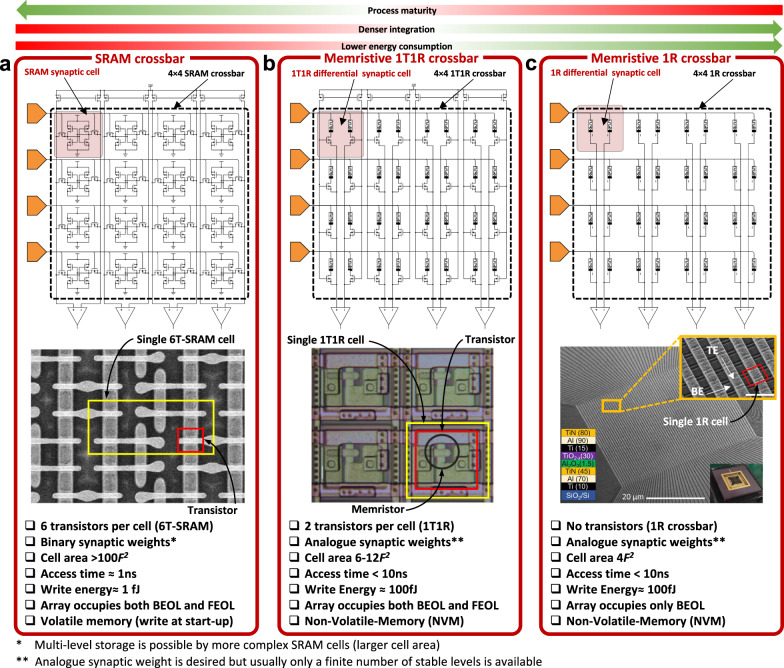
“An example of this is the work by Khwa et al., which reports a compute in memory systembasedonacrossbararray of6TSRAMmemory cellsas binary synaptic connections that uses binary inputs/outputs 78 .”
Self-citationRescuing Memristor-based Neuromorphic Design with High Defects
Liu, C., Hu, M., Strachan, J. P., & Li, H. (. (2017) · Proceedings of the 54th Annual Design Automation Conference 2017 · doi:10.1145/3061639.3062310 · Cited by 257
Analog Synaptic Behavior of a Silicon Nitride Memristor
Kim, S., Kim, H., Hwang, S., Kim, M.-H., Chang, Y.-F., & Park, B.-G. (2017) · ACS Applied Materials & Interfaces · doi:10.1021/acsami.7b11191 · Cited by 252 · cited 1×
“Introducing nonidentical pulses can help to reduce non-linearity, and some studies reached near-linear and symmetric potentiation and depression process by applying incremental positive pulses and decremental negative pulses, respectively 213 .”
BindsNET: A Machine Learning-Oriented Spiking Neural Networks Library in Python
Hazan, H., Saunders, D. J., Khan, H., Patel, D., Sanghavi, D. T., Siegelmann, H. T., & Kozma, R. (2018) · Frontiers in Neuroinformatics · doi:10.3389/fninf.2018.00089 · Cited by 252 · cited 1×
“Another alternative to Brian2 capable of providing better performance at the cost of a lower fi delity to the real biological model is the BindsNET simulator 227 , a Python library built on top of PyTorch 223 .”
XNOR-RRAM: A scalable and parallel resistive synaptic architecture for binary neural networks
Sun, X., Yin, S., Peng, X., Liu, R., Seo, J.-S., & Yu, S. (2018) · 2018 Design, Automation & Test in Europe Conference & Exhibition (DATE) · doi:10.23919/date.2018.8342235 · Cited by 246 · cited 2×
“In binarized networks, ADC can be replaced by a 1-bit comparator 96 orADC-like multi-level sense ampli fi er 158 .”
Saberi, M., Lotfi, R., Mafinezhad, K., & Serdijn, W. A. (2011) · IEEE Transactions on Circuits and Systems I: Regular Papers · doi:10.1109/tcsi.2011.2107214 · Cited by 236 · cited 1×
“Therefore, not only the system becomes more sensitive and error-prone, but also its power consumption increases exponentially as the resolution of DACs and ADCs increase 163,164 .”
NVMain 2.0: A User-Friendly Memory Simulator to Model (Non-)Volatile Memory Systems
Poremba, M., Zhang, T., & Xie, Y. (2015) · IEEE Computer Architecture Letters · doi:10.1109/lca.2015.2402435 · Cited by 235
Chen, A. (2013) · IEEE Transactions on Electron Devices · doi:10.1109/ted.2013.2246791 · Cited by 230 · cited 3×
“Despite the increased peripheral circuitry complexity, this scheme improves the voltage delivery to each synapse 248 by connecting the two terminals of each wordline to the same input stimuli.”
InfluentialXue, C.-X., Huang, T.-Y., Liu, J.-S., Chang, T.-W., Kao, H.-Y., Wang, J.-H., Liu, T.-W., Wei, S.-Y., Huang, S.-P., Wei, W.-C., et al. (2020) · 2020 IEEE International Solid- State Circuits Conference - (ISSCC) · doi:10.1109/isscc19947.2020.9063078 · Cited by 230
Self-citationThree-dimensional crossbar arrays of self-rectifying Si/SiO2/Si memristors
Li, C., Han, L., Jiang, H., Jang, M.-H., Lin, P., Wu, Q., Barnell, M., Yang, J. J., Xin, H. L., & Xia, Q. (2017) · Nature Communications · doi:10.1038/ncomms15666 · Cited by 229
Self-citationHardware Implementation of Neuromorphic Computing Using Large‐Scale Memristor Crossbar Arrays
Li, Y., & Ang, K.-W. (2021) · Advanced Intelligent Systems · doi:10.1002/aisy.202000137 · Cited by 220 · cited 1×
“The processes by which the memristor conductance is increased and decreased are called potentiation and depression, respectively, and have been observed when applying different sequences of voltage pulses 199 – 204 .”
Self-citationScaling-up resistive synaptic arrays for neuro-inspired architecture: Challenges and prospect
Yu, S., Chen, P.-Y., Cao, Y., Xia, L., Wang, Y., & Wu, H. (2015) · 2015 IEEE International Electron Devices Meeting (IEDM) · doi:10.1109/iedm.2015.7409718 · Cited by 219 · cited 1×
“The weight update process is implemented by applying voltage or current pulses to the memristors (block 13 and 14), following the Write-Verify (or Close Loop Tunning) 194 – 196 , or the Write-without-Verify (or Open Loop Tunning) 103,107,197,198 .”
Binary neural network with 16 Mb RRAM macro chip for classification and online training
Yu, S., Li, Z., Chen, P.-Y., Wu, H., Gao, B., Wang, D., Wu, W., & Qian, H. (2016) · 2016 IEEE International Electron Devices Meeting (IEDM) · doi:10.1109/iedm.2016.7838429 · Cited by 219 · cited 1×
“Then, analogue VMM has been demonstrated both for binary inputs and weights 218 – 220 , as well as for binary inputs and analogue/multilevel weights 60,85,105,217 .”
90% yield production of polymer nano-memristor for in-memory computing
Zhang, B., Chen, W., Zeng, J., Fan, F., Gu, J., Chen, X., Yan, L., Xie, G., Liu, S., Yan, Q., et al. (2021) · Nature Communications · doi:10.1038/s41467-021-22243-8 · Cited by 218
Perspective: A review on memristive hardware for neuromorphic computation
Sung, C., Hwang, H., & Yoo, I. K. (2018) · Journal of Applied Physics · doi:10.1063/1.5037835 · Cited by 217 · cited 1×
“Recent studies have proposed that the use of memristive devices to emulate the synapses may accelerate ANN computational tasks while reducing the overall power consumption and footprint 36 – 42 .”
Nanoscale resistive switching memory devices: a review
Slesazeck, S., & Mikolajick, T. (2019) · Nanotechnology · doi:10.1088/1361-6528/ab2084 · Cited by 217
Robust Ag/ZrO 2 /WS 2 /Pt Memristor for Neuromorphic Computing
Yan, X., Qin, C., Lu, C., Zhao, J., Zhao, R., Ren, D., Zhou, Z., Wang, H., Wang, J., Zhang, L., et al. (2019) · ACS Applied Materials & Interfaces · doi:10.1021/acsami.9b17160 · Cited by 217 · cited 2×
“We note that some articles focused on the fabrication and device-level characterization of one/few memristors 62 – 70, 186, Ex situ versus In situ training .”
Self-citationAmirsoleimani, A., Alibart, F., Yon, V., Xu, J., Pazhouhandeh, M. R., Ecoffey, S., Beilliard, Y., Genov, R., & Drouin, D. (2020) · Advanced Intelligent Systems · doi:10.1002/aisy.202000115 · Cited by 216
A survey on neural speech synthesis
Tan, X., Qin, T., Soong, F., & Liu, T.-Y. (2021) · arXiv · doi:10.48550/arxiv.2106.15561 · Cited by 216 · cited 1×
“Beyond image recognition, other examples are the engines that convert speech to text in computers and smartphones 6 , natural language processing as for example the novel automated chat system chat-GPT 7 , and those that provide accurate recommendations for online shopping based on previous…”
Prezioso, M., Mahmoodi, M. R., Bayat, F. M., Nili, H., Kim, H., Vincent, A., & Strukov, D. B. (2018) · Nature Communications · doi:10.1038/s41467-018-07757-y · Cited by 215
Rasch, M. J., Mackin, C., Le Gallo, M., Chen, A., Fasoli, A., Odermatt, F., Li, N., Nandakumar, S. R., Narayanan, P., Tsai, H., et al. (2023) · Nature Communications · doi:10.1038/s41467-023-40770-4 · Cited by 213 · cited 1×
“To avoid this loss of accuracy, hardware-aware training methods, in which device non-idealities are incorporated during training have been proposed in the literature 189,190 .”
Self-citationBojnordi, M. N., & Ipek, E. (2016) · 2016 IEEE International Symposium on High Performance Computer Architecture (HPCA) · doi:10.1109/hpca.2016.7446049 · Cited by 205
Memristive Crossbar Arrays for Storage and Computing Applications
Li, H., Wang, S., Zhang, X., Wang, W., Yang, R., Sun, Z., Feng, W., Lin, P., Wang, Z., Sun, L., et al. (2021) · Advanced Intelligent Systems · doi:10.1002/aisy.202100017 · Cited by 205 · cited 1×
“…non-volatile states (up to ~100 47,48 , and even ~1000 49 ), ii) a low-energy consumption for switching(~10fJperstatetransitionwithzero-staticconsumptionwhen idle 50 ), and iii) a scalable structure appropriate for matrix integration (often referred to as crossbar 51 ) and even 3D stacking 52 .”
(2024) · TIB Data Manager · doi:10.57702/h8wosv5j · Cited by 202
Multilevel HfO2-based RRAM devices for low-power neuromorphic networks
Milo, V., Zambelli, C., Olivo, P., Pérez, E., K. Mahadevaiah, M., G. Ossorio, O., Wenger, C., & Ielmini, D. (2019) · APL Materials · doi:10.1063/1.5108650 · Cited by 200 · cited 2×
“The weight update process is implemented by applying voltage or current pulses to the memristors (block 13 and 14), following the Write-Verify (or Close Loop Tunning) 194 – 196 , or the Write-without-Verify (or Open Loop Tunning) 103,107,197,198 .”
Self-citationMochida, R., Kouno, K., Hayata, Y., Nakayama, M., Ono, T., Suwa, H., Yasuhara, R., Katayama, K., Mikawa, T., & Gohou, Y. (2018) · 2018 IEEE Symposium on VLSI Technology · doi:10.1109/vlsit.2018.8510676 · Cited by 194 · cited 1×
“Also, many papers 55,60,99,100 , have explored the case of ANNs with binarized inputs, as they employ the simplest DACs (1-bit).”
Compute Solution for Tesla's Full Self-Driving Computer
Talpes, E., Sarma, D. D., Venkataramanan, G., Bannon, P., McGee, B., Floering, B., Jalote, A., Hsiong, C., Arora, S., Gorti, A., et al. (2020) · IEEE Micro · doi:10.1109/mm.2020.2975764 · Cited by 193
Analog architectures for neural network acceleration based on non-volatile memory
Xiao, T. P., Bennett, C. H., Feinberg, B., Agarwal, S., & Marinella, M. J. (2020) · Applied Physics Reviews · doi:10.1063/1.5143815 · Cited by 193
NVMain: An Architectural-Level Main Memory Simulator for Emerging Non-volatile Memories
Poremba, M., & Xie, Y. (2012) · 2012 IEEE Computer Society Annual Symposium on VLSI · doi:10.1109/isvlsi.2012.82 · Cited by 188 · cited 3×
“Although NVMain 2.0 allows to estimate energy consumption metrics based on the results of circuit-level simulations, it has limitations.”
InfluentialXue, C.-X., Hung, J.-M., Kao, H.-Y., Huang, Y.-H., Huang, S.-P., Chang, F.-C., Chen, P., Liu, T.-W., Jhang, C.-J., Su, C.-I., et al. (2021) · 2021 IEEE International Solid- State Circuits Conference (ISSCC) · doi:10.1109/isscc42613.2021.9365769 · Cited by 182
Self-citationElectronic system with memristive synapses for pattern recognition
Park, S., Chu, M., Kim, J., Noh, J., Jeon, M., Hun Lee, B., Hwang, H., Lee, B., & Lee, B.-G. (2015) · Scientific Reports · doi:10.1038/srep10123 · Cited by 181 · cited 1×
“Then, analogue VMM has been demonstrated both for binary inputs and weights 218 – 220 , as well as for binary inputs and analogue/multilevel weights 60,85,105,217 .”
Stuck-at Fault Tolerance in RRAM Computing Systems
Xia, L., Huangfu, W., Tang, T., Yin, X., Chakrabarty, K., Xie, Y., Wang, Y., & Yang, H. (2018) · IEEE Journal on Emerging and Selected Topics in Circuits and Systems · doi:10.1109/jetcas.2017.2776980 · Cited by 177 · cited 2×
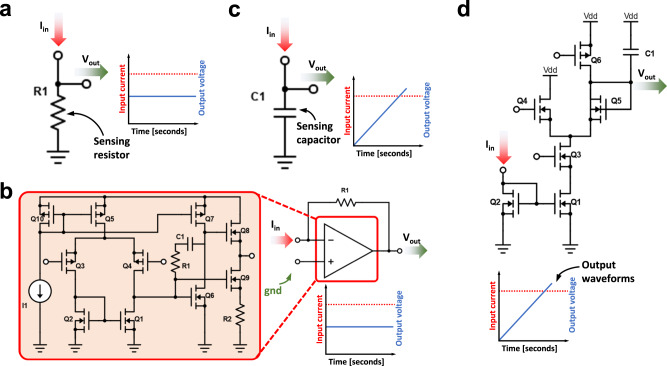
“There are three widely used sensing modes for the output voltages 112 .”
Phase-Change and Redox-Based Resistive Switching Memories
Wouters, D. J., Waser, R., & Wuttig, M. (2015) · Proceedings of the IEEE · doi:10.1109/jproc.2015.2433311 · Cited by 173
Yin, S., Sun, X., Yu, S., & Seo, J.-S. (2020) · IEEE Transactions on Electron Devices · doi:10.1109/ted.2020.3015178 · Cited by 171 · cited 1×
“So far,several groups and companies have claimed the realization of hybrid CMOS/memristor implementations of ANNs 53 – 61 , — from now on, memristive ANNs — with performance that is superior to that of fully-CMOS counterparts.”
MNSIM: Simulation Platform for Memristor-based Neuromorphic Computing System
Xia, L., Li, B., Tang, T., Gu, P., Chen, P.-Y., Yu, S., Cao, Y., Wang, Y., Xie, Y., & Yang, H. (2017) · IEEE Transactions on Computer-Aided Design of Integrated Circuits and Systems · doi:10.1109/tcad.2017.2729466 · Cited by 171
Sun, X., & Yu, S. (2019) · IEEE Journal on Emerging and Selected Topics in Circuits and Systems · doi:10.1109/jetcas.2019.2933148 · Cited by 170 · cited 1×
“The same philosophy was adopted by Sun et al. 229 , placing special emphasis on the effect of the non-linear and quantized nature of the synaptic weight update.”
Self-Selective Multi-Terminal Memtransistor Crossbar Array for In-Memory Computing
Feng, X., Li, S., Wong, S. L., Tong, S., Chen, L., Zhang, P., Wang, L., Fong, X., Chi, D., & Ang, K.-W. (2021) · ACS Nano · doi:10.1021/acsnano.0c09441 · Cited by 170 · cited 3×
“We note that some articles focused on the fabrication and device-level characterization of one/few memristors 62 – 70, 186, Ex situ versus In situ training .”
Self-citationHigh-Performance Mixed-Signal Neurocomputing With Nanoscale Floating-Gate Memory Cell Arrays
Merrikh-Bayat, F., Guo, X., Klachko, M., Prezioso, M., Likharev, K. K., & Strukov, D. B. (2018) · IEEE Transactions on Neural Networks and Learning Systems · doi:10.1109/tnnls.2017.2778940 · Cited by 167 · cited 2×
“An alternative memory element for VMM operation is the fl ash memory cell 80,81 , in which the charge storage node is coupled to the gate of a FET with charge stored either on a conductive electrode surrounded by insulators ( fl oating gate) or in discrete traps within a defective insulator layer…”
Learning in Memristive Neural Network Architectures Using Analog Backpropagation Circuits
Krestinskaya, O., Salama, K. N., & James, A. P. (2019) · IEEE Transactions on Circuits and Systems I: Regular Papers · doi:10.1109/tcsi.2018.2866510 · Cited by 167
Self-citationEnergy-efficient Mott activation neuron for full-hardware implementation of neural networks
Oh, S., Shi, Y., del Valle, J., Salev, P., Lu, Y., Huang, Z., Kalcheim, Y., Schuller, I. K., & Kuzum, D. (2021) · Nature Nanotechnology · doi:10.1038/s41565-021-00874-8 · Cited by 161 · cited 1×
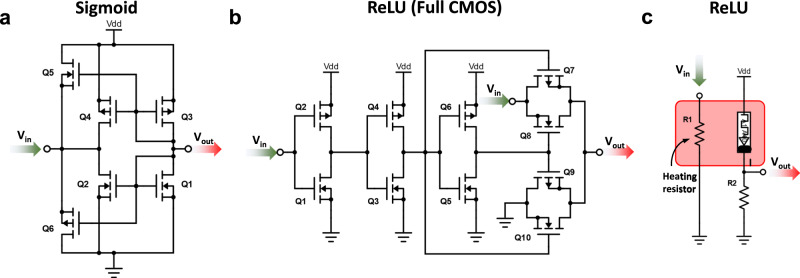
“This is done by the so-called neuron activation functions, and the most common are: Sigmoid (also called Logistic) 119,120 , Hyperbolic Tangent 120 and Recti fi ed Linear Unit (ReLU) 120,121 .”
Ando, K., Ueyoshi, K., Orimo, K., Yonekawa, H., Sato, S., Nakahara, H., Takamaeda-Yamazaki, S., Ikebe, M., Asai, T., Kuroda, T., et al. (2018) · IEEE Journal of Solid-State Circuits · doi:10.1109/jssc.2017.2778702 · Cited by 160
Mixed-Signal Computing for Deep Neural Network Inference
Murmann, B. (2021) · IEEE Transactions on Very Large Scale Integration (VLSI) Systems · doi:10.1109/tvlsi.2020.3020286 · Cited by 160 · cited 1×
“Thosememory devicescould beeither charge-based memories as well as resistance-based memories 25,74 .”
A Flexible and Fast PyTorch Toolkit for Simulating Training and Inference on Analog Crossbar Arrays
Rasch, M. J., Moreda, D., Gokmen, T., Le Gallo, M., Carta, F., Goldberg, C., El Maghraoui, K., Sebastian, A., & Narayanan, V. (2021) · 2021 IEEE 3rd International Conference on Artificial Intelligence Circuits and Systems (AICAS) · doi:10.1109/aicas51828.2021.9458494 · Cited by 160 · cited 2×
“Also, the platforms developed by IBM (TrueNorth 33 ), and Tsingshua 34 are well known examples of the research effort of both the industry and the academia in this fi eld.”
Self-citationReconfigurable Logic‐in‐Memory and Multilingual Artificial Synapses Based on 2D Heterostructures
Xiong, X., Kang, J., Hu, Q., Gu, C., Gao, T., Li, X., & Wu, Y. (2020) · Advanced Functional Materials · doi:10.1002/adfm.201909645 · Cited by 158 · cited 1×
“We note that some articles focused on the fabrication and device-level characterization of one/few memristors 62 – 70, 186, Ex situ versus In situ training .”
Self-citationBankman, D., Yang, L., Moons, B., Verhelst, M., & Murmann, B. (2018) · 2018 IEEE International Solid - State Circuits Conference - (ISSCC) · doi:10.1109/isscc.2018.8310264 · Cited by 157
Khaddam-Aljameh, R., Stanisavljevic, M., Fornt Mas, J., Karunaratne, G., Brändli, M., Liu, F., Singh, A., Müller, S. M., Egger, U., Petropoulos, A., et al. (2022) · IEEE Journal of Solid-State Circuits · doi:10.1109/jssc.2022.3140414 · Cited by 144 · cited 2×
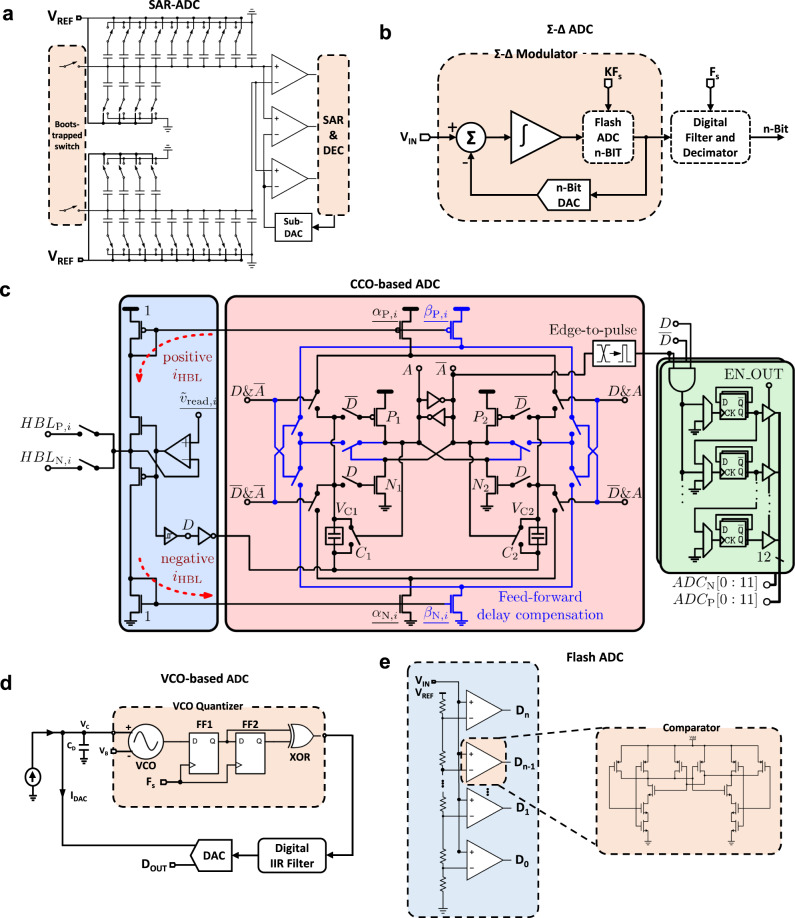
“In this regard, and unlike the more commonly used VCO-based ADCs, CCO-based ADCs such as the one proposed by Khaddam-Aljameh et al. 71 (see Fig.”
Self-citationA high-precision VLSI winner-take-all circuit for self-organizing neural networks
Choi, J. O., & Sheu, B. J. (1993) · IEEE Journal of Solid-State Circuits · doi:10.1109/4.229397 · Cited by 143
Chakraborty, I., Ali, M., Ankit, A., Jain, S., Roy, S., Sridharan, S., Agrawal, A., Raghunathan, A., & Roy, K. (2020) · Proceedings of the IEEE · doi:10.1109/jproc.2020.3003007 · Cited by 140
Self-citationChallenges hindering memristive neuromorphic hardware from going mainstream
Adam, G. C., Khiat, A., & Prodromakis, T. (2018) · Nature Communications · doi:10.1038/s41467-018-07565-4 · Cited by 136
Data Clustering using Memristor Networks
Choi, S., Sheridan, P., & Lu, W. D. (2015) · Scientific Reports · doi:10.1038/srep10492 · Cited by 132 · cited 1×
“Note that most of the literature claiming unsupervised learning with memristive devices used software 166 , and we are only aware of a few works 53,116,167 , that demonstrated hardware-based unsupervised learning.”
Self-citationThree-Dimensional nand Flash for Vector–Matrix Multiplication
Wang, P., Xu, F., Wang, B., Gao, B., Wu, H., Qian, H., & Yu, S. (2019) · IEEE Transactions on Very Large Scale Integration (VLSI) Systems · doi:10.1109/tvlsi.2018.2882194 · Cited by 132 · cited 1×
“However, there is recent work describing the use of 3D NAND, consisting of vertically stacked layers of serially connected FLASH devices, whereby each layer of the array encodes a unique matrix 82 .”
Improving linearity by introducing Al in HfO 2 as a memristor synapse device
Chandrasekaran, S., Simanjuntak, F. M., Saminathan, R., Panda, D., & Tseng, T.-Y. (2019) · Nanotechnology · doi:10.1088/1361-6528/ab3480 · Cited by 131
Xue, F., He, X., Wang, Z., Retamal, J. R. D., Chai, Z., Jing, L., Zhang, C., Fang, H., Chai, Y., Jiang, T., et al. (2021) · Advanced Materials · doi:10.1002/adma.202008709 · Cited by 130
Hung, J.-M., Huang, Y.-H., Huang, S.-P., Chang, F.-C., Wen, T.-H., Su, C.-I., Khwa, W.-S., Lo, C.-C., Liu, R.-S., Hsieh, C.-C., et al. (2022) · 2022 IEEE International Solid- State Circuits Conference (ISSCC) · doi:10.1109/isscc42614.2022.9731715 · Cited by 125
Self-citationProgramming algorithms for multilevel phase-change memory
Papandreou, N., Pozidis, H., Pantazi, A., Sebastian, A., Breitwisch, M., Lam, C., & Eleftheriou, E. (2011) · 2011 IEEE International Symposium of Circuits and Systems (ISCAS) · doi:10.1109/iscas.2011.5937569 · Cited by 124
Self-citationA 0.20 $\text {mm}^2$ 3 nW Signal Acquisition IC for Miniature Sensor Nodes in 65 nm CMOS
Harpe, P., Gao, H., Dommele, R. V., Cantatore, E., & van Roermund, A. H. M. (2016) · IEEE Journal of Solid-State Circuits · doi:10.1109/jssc.2015.2487270 · Cited by 124 · cited 1×
“150 – 152, increasing 1-bit resolution or increasing the throughput by doubling the sampling frequency results in a 4× increase in power consumption (particularly for highly scaled CMOS technology nodes, where the power consumption is usually bounded by the thermal noise 153 ).”
Khaddam-Aljameh, R., Stanisavljevic, M., Fornt Mas, J., Karunaratne, G., Braendli, M., Liu, F., Singh, A., Müller, S. M., Egger, U., Petropoulos, A., et al. (2021) · 2021 Symposium on VLSI Circuits · doi:10.23919/vlsicircuits52068.2021.9492362 · Cited by 124 · cited 2×
“Note that most of the literature claiming unsupervised learning with memristive devices used software 166 , and we are only aware of a few works 53,116,167 , that demonstrated hardware-based unsupervised learning.”
Self-citationAI Accelerator Survey and Trends
Reuther, A., Michaleas, P. W., Jones, M. P., Gadepally, V. N., Samsi, S., & Kepner, J. (2021) · IEEE High Performance Extreme Computing Conference · doi:10.1109/hpec49654.2021.9622867 · Cited by 124
Mixed-Precision Deep Learning Based on Computational Memory
Nandakumar, S. R., Le Gallo, M., Piveteau, C., Joshi, V., Mariani, G., Boybat, I., Karunaratne, G., Khaddam-Aljameh, R., Egger, U., Petropoulos, A., et al. (2020) · Frontiers in Neuroscience · doi:10.3389/fnins.2020.00406 · Cited by 120 · cited 1×
“…training, whichaccumulatestheweightupdateinsoftwareandonlyupdatesthe memristor devices when the accumulated value surpasses the programming granularity, can greatly relax requirement for conductance update resolution and endurance and allow software-comparable accuracy to be achieved 192,193 .”
Self-citationTransaction level modeling: an overview
Cai, L., & Gajski, D. D. (2004) · doi:10.1109/codess.2003.1275250 · Cited by 118
TIME: A Training-in-memory Architecture for Memristor-based Deep Neural Networks
Cheng, M., Xia, L., Zhu, Z., Cai, Y., Xie, Y., Wang, Y., & Yang, H. (2017) · Proceedings of the 54th Annual Design Automation Conference 2017 · doi:10.1145/3061639.3062326 · Cited by 117
All‐optical ultrafast ReLU function for energy‐efficient nanophotonic deep learning
Li, G. H. Y., Sekine, R., Nehra, R., Gray, R. M., Ledezma, L. M., Guo, Q., & Marandi, A. (2022) · Nanophotonics · doi:10.1515/nanoph-2022-0137 · Cited by 117
In-Memory Data Parallel Processor
Fujiki, D., Mahlke, S., & Das, R. (2018) · Proceedings of the Twenty-Third International Conference on Architectural Support for Programming Languages and Operating Systems · doi:10.1145/3173162.3173171 · Cited by 109 · cited 1×
“The obvious approach i) is to design the DAC circuits with the capability of providing both positive and negative voltages 161 .”
AI and ML Accelerator Survey and Trends
Reuther, A., Michaleas, P., Jones, M., Gadepally, V., Samsi, S., & Kepner, J. (2022) · 2022 IEEE High Performance Extreme Computing Conference (HPEC) · doi:10.1109/hpec55821.2022.9926331 · Cited by 109
In-Memory and Error-Immune Differential RRAM Implementation of Binarized Deep Neural Networks
Bocquet, M., Hirztlin, T., Klein, J.-O., Nowak, E., Vianello, E., Portal, J.-M., & Querlioz, D. (2018) · 2018 IEEE International Electron Devices Meeting (IEDM) · doi:10.1109/iedm.2018.8614639 · Cited by 99 · cited 1×
“This is the most commonly used approach on research prototypes developed as technology demonstrators due to its versatility, as the activation function can be implemented and changed by simply modifying the software code 55,100,113 – 115, 122, 123 .”
A fully hardware-based memristive multilayer neural network
Kiani, F., Yin, J., Wang, Z., Yang, J. J., & Xia, Q. (2021) · Science Advances · doi:10.1126/sciadv.abj4801 · Cited by 97 · cited 3×
“This scheme is used in various papers 54,102 .”
Self-citationDevice-Circuit-Architecture Co-Exploration for Computing-in-Memory Neural Accelerators
Jiang, W., Lou, Q., Yan, Z., Yang, L., Hu, J., Hu, X. S., & Shi, Y. (2021) · IEEE Transactions on Computers · doi:10.1109/tc.2020.2991575 · Cited by 96 · cited 3×
“For example, an optimum crossbar size 266 , ADC/DAC resolution, and device precision 265 can be searched along with the software-related parametersoftheneuralnetwork.”
Real-Time Abnormal Object Detection for Video Surveillance in Smart Cities
Ingle, P. Y., & Kim, Y.-G. (2022) · Sensors · doi:10.3390/s22103862 · Cited by 96 · cited 1×
“…of electronic productsthatcontainANNswithwhichweinteractinourdailylivesare thosethatidentifybiometricpatterns(e.g.,face, fi ngerprint)foraccess control in smartphones 2 or online banking apps 3 , and those that identify objects in images from social networks 4 and security/traf fi c cameras 5 .”
Truly Electroforming‐Free and Low‐Energy Memristors with Preconditioned Conductive Tunneling Paths
Yoon, J. H., Zhang, J., Ren, X., Wang, Z., Wu, H., Li, Z., Barnell, M., Wu, Q., Lauhon, L. J., Xia, Q., et al. (2017) · Advanced Functional Materials · doi:10.1002/adfm.201702010 · Cited by 95
Self-citationA 1.06-to-5.09 TOPS/W reconfigurable hybrid-neural-network processor for deep learning applications
Yin, S., Ouyang, P., Tang, S., Tu, F., Li, X., Liu, L., & Wei, S. (2017) · 2017 Symposium on VLSI Circuits · doi:10.23919/vlsic.2017.8008534 · Cited by 93
Hirtzlin, T., Bocquet, M., Penkovsky, B., Klein, J.-O., Nowak, E., Vianello, E., Portal, J.-M., & Querlioz, D. (2020) · Frontiers in Neuroscience · doi:10.3389/fnins.2019.01383 · Cited by 93
Design Exploration of Hybrid CMOS and Memristor Circuit by New Modified Nodal Analysis
Fei, W., Yu, H., Zhang, W., & Yeo, K. S. (2011) · IEEE Transactions on Very Large Scale Integration (VLSI) Systems · doi:10.1109/tvlsi.2011.2136443 · Cited by 91
PANTHER: A Programmable Architecture for Neural Network Training Harnessing Energy-Efficient ReRAM
Ankit, A., Hajj, I. E., Chalamalasetti, S. R., Agarwal, S., Marinella, M., Foltin, M., Strachan, J. P., Milojicic, D., Hwu, W.-M., & Roy, K. (2020) · IEEE Transactions on Computers · doi:10.1109/tc.2020.2998456 · Cited by 88
Price, M., Glass, J., & Chandrakasan, A. P. (2017) · 2017 IEEE International Solid-State Circuits Conference (ISSCC) · doi:10.1109/isscc.2017.7870352 · Cited by 86
Narayanan, P., Ambrogio, S., Okazaki, A., Hosokawa, K., Tsai, H., Nomura, A., Yasuda, T., Mackin, C., Lewis, S. C., Friz, A., et al. (2021) · IEEE Transactions on Electron Devices · doi:10.1109/ted.2021.3115993 · Cited by 85
A novel artificial synapse with dual modes using bilayer graphene as the bottom electrode
Tian, H., Mi, W., Zhao, H., Mohammad, M. A., Yang, Y., Chiu, P.-W., & Ren, T.-L. (2017) · Nanoscale · doi:10.1039/c7nr03106h · Cited by 83
Self-citationArtificial Neural Networks Based on Memristive Devices: From Device to System
Huang, H.-M., Wang, Z., Wang, T., Xiao, Y., & Guo, X. (2020) · Advanced Intelligent Systems · doi:10.1002/aisy.202000149 · Cited by 82 · cited 1×
“First, devices involved require high resolution to program the weight update accurately and a high endurance due to the frequent SET/ RESET operation during training process 191 .”
Self-citationMNSIM 2.0: A Behavior-Level Modeling Tool for Memristor-based Neuromorphic Computing Systems
Zhu, Z., Sun, H., Qiu, K., Xia, L., Krishnan, G., Dai, G., Niu, D., Chen, X., Hu, X. S., Cao, Y., et al. (2020) · Proceedings of the 2020 on Great Lakes Symposium on VLSI · doi:10.1145/3386263.3407647 · Cited by 77 · cited 1×
“MNSIM 240,241 , proposes a hierarchical structure for memristor-based neuromorphic computing accelerators, with interfaces for customization.”
Li, W., Sun, X., Huang, S., Jiang, H., & Yu, S. (2022) · IEEE Journal of Solid-State Circuits · doi:10.1109/jssc.2022.3163197 · Cited by 77 · cited 1×
“For this reason, these approaches have been demonstrated mostly for the weight update of isolated devices, with just a few examples of on-chip integrated approaches 214 .”
Sign backpropagation: An on-chip learning algorithm for analog RRAM neuromorphic computing systems
Zhang, Q., Wu, H., Yao, P., Zhang, W., Gao, B., Deng, N., & Qian, H. (2018) · Neural Networks · doi:10.1016/j.neunet.2018.08.012 · Cited by 76
DL-RSIM: a simulation framework to enable reliable ReRAM-based accelerators for deep learning
Lin, M.-Y., Cheng, H.-Y., Lin, W.-T., Yang, T.-H., Tseng, I.-C., Yang, C.-L., Hu, H.-W., Chang, H.-S., Li, H.-P., & Chang, M.-F. (2018) · Proceedings of the International Conference on Computer-Aided Design · doi:10.1145/3240765.3240800 · Cited by 76
Self-citationStrategies to Improve the Accuracy of Memristor-Based Convolutional Neural Networks
Pan, W.-Q., Chen, J., Kuang, R., Li, Y., He, Y.-H., Feng, G.-R., Duan, N., Chang, T.-C., & Miao, X.-S. (2020) · IEEE Transactions on Electron Devices · doi:10.1109/ted.2019.2963323 · Cited by 76
On the Accuracy of Analog Neural Network Inference Accelerators
Xiao, T. P., Feinberg, B., Bennett, C. H., Prabhakar, V., Saxena, P., Agrawal, V., Agarwal, S., & Marinella, M. J. (2022) · IEEE Circuits and Systems Magazine · doi:10.1109/mcas.2022.3214409 · Cited by 76
Jain, S., Tsai, H., Chen, C.-T., Muralidhar, R., Boybat, I., Frank, M. M., Woźniak, S., Stanisavljevic, M., Adusumilli, P., Narayanan, P., et al. (2023) · IEEE Transactions on Very Large Scale Integration (VLSI) Systems · doi:10.1109/tvlsi.2022.3221390 · Cited by 76
Self-citationCMOS current mode winner-take-all circuit with both excitatory and inhibitory feedback
Starzyk, J. A., & Fang, X. (1993) · Electronics Letters · doi:10.1049/el:19930606 · Cited by 75
A Current-Mode Hysteretic Winner-take-all Network, with Excitatory and Inhibitory Coupling
Indiveri, G. (2001) · Analog Integrated Circuits and Signal Processing · doi:10.1023/a:1011208127849 · Cited by 75
MNSIM: Simulation Platform for Memristor-based Neuromorphic Computing System
Xia, L., Li, B., Tang, T., Gu, P., Yin, X., Huangfu, W., Chen, P.-Y., Yu, S., Cao, Y., Wang, Y., et al. (2016) · Proceedings of the 2016 Design, Automation & Test in Europe Conference & Exhibition (DATE) · doi:10.3850/9783981537079_0549 · Cited by 75
Chen, W.-H., Lin, W.-J., Lai, L.-Y., Li, S., Hsu, C.-H., Lin, H.-T., Lee, H.-Y., Su, J.-W., Xie, Y., Sheu, S.-S., et al. (2017) · 2017 IEEE International Electron Devices Meeting (IEDM) · doi:10.1109/iedm.2017.8268468 · Cited by 73 · cited 1×
“Then, analogue VMM has been demonstrated both for binary inputs and weights 218 – 220 , as well as for binary inputs and analogue/multilevel weights 60,85,105,217 .”
Self-citationHigh on/off ratio black phosphorus based memristor with ultra-thin phosphorus oxide layer
Wang, Y., Wu, F., Liu, X., Lin, J., Chen, J.-Y., Wu, W.-W., Wei, J., Liu, Y., Liu, Q., & Liao, L. (2019) · Applied Physics Letters · doi:10.1063/1.5115531 · Cited by 72 · cited 1×
“Crossbar arrays of two-terminal metal/insulator/metal (MIM) memristive devices can be fabricated easily using standard lithography and deposition techniques; this has been readily achieved by multiple groups 57,64,68 – 70 ,85 ,93, The crossbar (block 5 in Fig.”
Liang, J., Yeh, S., Wong, S. S., & Wong, H.-S. P. (2013) · ACM Journal on Emerging Technologies in Computing Systems · doi:10.1145/2422094.2422103 · Cited by 71 · cited 1×
“A widely accepted 104,271 , alternative design to minimize this problem consists in dividing the large crossbars into smaller ones (Supplementary Fig.”
Su, F., Chen, W.-H., Xia, L., Lo, C.-P., Tang, T., Wang, Z., Hsu, K.-H., Cheng, M., Li, J.-Y., Xie, Y., et al. (2017) · 2017 Symposium on VLSI Technology · doi:10.23919/vlsit.2017.7998149 · Cited by 69
Self-citationA System-Level Simulator for RRAM-Based Neuromorphic Computing Chips
Lee, M. K. F., Cui, Y., Somu, T., Luo, T., Zhou, J. R., Tang, W. T., Wong, W., & Goh, R. S. M. (2018) · ACM Transactions on Architecture and Code Optimization · doi:10.1145/3291054 · Cited by 69 · cited 1×
“Examples of this simulation abstraction level include the work by Lee et al. 235 , which introduced a cycle-accurate system simulator to model hardware-implemented spiking neural networks.”
MEMRISTIVE CHAOTIC CIRCUITS BASED ON CELLULAR NONLINEAR NETWORKS
BUSCARINO, A., FORTUNA, L., FRASCA, M., GAMBUZZA, L. V., & SCIUTO, G. (2012) · International Journal of Bifurcation and Chaos · doi:10.1142/s0218127412500708 · Cited by 68
Goux, L., Fantini, A., Kar, G., Chen, Y.-Y., Jossart, N., Degraeve, R., Clima, S., Govoreanu, B., Lorenzo, G., Pourtois, G., et al. (2012) · 2012 Symposium on VLSI Technology (VLSIT) · doi:10.1109/vlsit.2012.6242510 · Cited by 67 · cited 1×
“…non-volatile states (up to ~100 47,48 , and even ~1000 49 ), ii) a low-energy consumption for switching(~10fJperstatetransitionwithzero-staticconsumptionwhen idle 50 ), and iii) a scalable structure appropriate for matrix integration (often referred to as crossbar 51 ) and even 3D stacking 52 .”
A Deep Neural Network Accelerator Based on Tiled RRAM Architecture
Wang, Q., Wang, X., Lee, S. H., Meng, F.-H., & Lu, W. D. (2019) · 2019 IEEE International Electron Devices Meeting (IEDM) · doi:10.1109/iedm19573.2019.8993641 · Cited by 66 · cited 2×
“For benchmarking a device or a chip, it is essential to evaluate the accuracy of standard deep neural network models like VGG 89 and ResNet 90 on CIFAR and ImageNet dataset by utilizing architecture-levelsimulationandrealistichardwarestatistics 91,92 .”
Self-citationViale, A., Marchisio, A., Martina, M., Masera, G., & Shafique, M. (2021) · 2021 International Joint Conference on Neural Networks (IJCNN) · doi:10.1109/ijcnn52387.2021.9533738 · Cited by 66
Simulation of Inference Accuracy Using Realistic RRAM Devices
Mehonic, A., Joksas, D., Ng, W. H., Buckwell, M., & Kenyon, A. J. (2019) · Frontiers in Neuroscience · doi:10.3389/fnins.2019.00593 · Cited by 64
Self-citationKrestinskaya, O., Choubey, B., & James, A. P. (2020) · Scientific Reports · doi:10.1038/s41598-020-62676-7 · Cited by 63
Self-citationYuan, G., Ma, X., Ding, C., Lin, S., Zhang, T., Jalali, Z. S., Zhao, Y., Jiang, L., Soundarajan, S., & Wang, Y. (2019) · 2019 IEEE/ACM International Symposium on Low Power Electronics and Design (ISLPED) · doi:10.1109/islped.2019.8824944 · Cited by 58 · cited 1×
“However, the negative side is that these are rather closed pieces of software, which has been partially solved by Ma et al. 230 and Yuan et al. 231 , by using PyTorch instead of TensorFlow, focusing in this case on the weight pruning and quantization effects.”
Research works printed but not linked: 3
- “Microchips that mimic the human brain could make AI far more energy efficient | Science | AAAS.” Accessed: May 15, 2023. [Online]. Available: https://www.science.org/content/article/microchips-mimic-human-brain-could-make-ai-far-more-energy-efficient
- Hu, M. et al., “Dot-product engine for neuromorphic computing,” in DAC ’16: Proceedings of the 53rd Annual Design Automation Conference, New York, NY, USA: Association for Computing Machinery, 1–6. 10.1145/2897937.2898010.2016, · doi:10.1145/2897937.2898010.2016
- Ielmini, D. and Waser, R. Resistive Switching. Weinheim, Germany: Wiley-VCH Verlag GmbH & Co. KGaA, 2016.
Cited by
The growing memristor industry
Lanza, M., Pazos, S., Aguirre, F., Sebastian, A., Le Gallo, M., Alam, S. M., Ikegawa, S., Yang, J. J., Vianello, E., Chang, M.-F., et al. (2025) · Nature · doi:10.1038/s41586-025-08733-5 · Cited by 177
“…in purely passive, high-density 1R crossbar arrays 119 that can be self-rectifying 120 , but these alternatives are not demonstrated in commercial platforms, have limited size (64 × 64 memristors 119 ) and always require system-level mitigation of sneak-path currents 24 , adding complexity.”
Self-citationWeilenmann, C., Ziogas, A. N., Zellweger, T., Portner, K., Mladenović, M., Kaniselvan, M., Moraitis, T., Luisier, M., & Emboras, A. (2024) · Nature Communications · doi:10.1038/s41467-024-51093-3 · Cited by 148
“Although such investigations would certainly lead to increased energy consumption 59 , we believe that the memristor advantage is large enough (two orders of magnitude) to persist even under more realistic conditions.”
Synaptic and neural behaviours in a standard silicon transistor
Pazos, S. M., Zhu, K., Villena, M. A., Alharbi, O., Zheng, W., Shen, Y., Yuan, Y. J., Ping, Y., & Lanza, M. (2025) · Nature · doi:10.1038/s41586-025-08742-4 · Cited by 150
“…over a wide range of bursting frequencies and input stimuli (Supplementary Note 6), accommodate external reset signals (through bulk bias control pulsing) or operate as a two-, three-or four-terminal neuron in different neural network architectures 45 (Supplementary Note 6 and Supplementary Fig.”
Self-citationTwo-Dimensional Materials for Brain-Inspired Computing Hardware
Hadke, S. S., Kang, M., Sangwan, V. K., & Hersam, M. C. (2025) · Chemical Reviews · doi:10.1021/acs.chemrev.4c00631 · Cited by 112
Solution-processed memristors: performance and reliability
Pazos, S. M., Xu, X., Guo, T., Zhu, K., Alshareef, H. N., & Lanza, M. (2024) · Nature Reviews Materials · doi:10.1038/s41578-024-00661-6 · Cited by 111
“…would be the size of the crossbar array used for the neural network simulation based on the sizes of the memris-tors demonstrated — and note that this excludes all the peripheral circuitry such as digital-to-analog or analog-to-digital converters, transimpedance amplifiers and comparators 120 .”
Self-citation
Metadata
- Authors
- Aguirre, F., Sebastian, A., Le Gallo, M., Song, W., Wang, T., Yang, J. J., Lu, W., Chang, M.-F., Ielmini, D., Yang, Y., Mehonic, A., Kenyon, A., Villena, M. A., Roldán, J. B., Wu, Y., Hsu, H.-H., Raghavan, N., Suñé, J., Miranda, E., Eltawil, A., Setti, G., Smagulova, K., Salama, K. N., Krestinskaya, O., Yan, X., Ang, K.-W., Jain, S., Li, S., Alharbi, O., Pazos, S., & Lanza, M.
- Affiliations
- Universitat Autònoma de Barcelona (ES)
- IBM Research - Zurich (CH)
- University of Southern California (US)
- University of Michigan (US)
- National Tsing Hua University (TW)
- Consorzio Nazionale Interuniversitario per la Nanoelettronica (IT)
- Peking University (CN)
- University College London (GB)
- King Abdullah University of Science and Technology (SA)
- Universidad de Granada (ES)
- Singapore University of Technology and Design (SG)
- Hebei University (CN)
- National University of Singapore (SG)
- Corresponding author
- Lanza, Mario
- ORCID
- Aguirre, Fernando
- Sebastian, Abu
- Le Gallo, Manuel
- Song, Wenhao
- Wang, Tong
- Yang, J. Joshua
- Lu, Wei
- Chang, Meng-Fan
- Ielmini, Daniele
- Yang, Yuchao
- Mehonic, Adnan
- Kenyon, Anthony
- Villena, Marco A.
- Roldán, Juan B.
- Wu, Yuting
- Hsu, Hung-Hsi
- Raghavan, Nagarajan
- Suñé, Jordi
- Miranda, Enrique
- Eltawil, Ahmed
- Setti, Gianluca
- Smagulova, Kamilya
- Salama, Khaled N.
- Krestinskaya, Olga
- Yan, Xiaobing
- Ang, Kah-Wee
- Li, Sifan
- Alharbi, Osamah
- Pazos, Sebastian
- Lanza, Mario
- Venue
- Nature Communications
- Published
- 2024-03-04
- Volume
- 15
- Issue
- 1
- Pages
- 1974-1974
- ISSN
- 2041-1723 (ISSN-L)
- PMC
- PMC10912231
- OpenAlex
- W4392367648
- Cited by
- 564
- References
- 282
- Citations by year
- 2026: 246 · 2025: 247 · 2024: 71
- FWCI
- 11.53
- Type
- journal article
- Language
- en
- Open access
- gold
- doi.org
- Licence
- cc-by
- creativecommons.org/licenses/by/4.0 (tdm)
- creativecommons.org/licenses/by/4.0 (vor)
- Locations
- Nature Communications (publishedVersion, cc-by)
- PubMed Central (publishedVersion, cc-by)
- PubMed (publishedVersion)
- PORTO@Iris (submittedVersion, cc-by)
- National University of Singapore (submittedVersion, cc-by-nc-nd)
- RePEc: Research Papers in Economics (submittedVersion)
- DOAJ (DOAJ: Directory of Open Access Journals) (submittedVersion)
- UCL Discovery (University College London) (submittedVersion)
- Virtual Community of Pathological Anatomy (University of Castilla La Mancha) (submittedVersion)
- Greater South Information System
- Funders
- King Abdullah University of Science and Technology
- Universitat Autònoma de Barcelona
- Topics
- Physical Sciences › Engineering › Electrical and Electronic Engineering › Advanced Memory and Neural Computing
- Physical Sciences › Computer Science › Artificial Intelligence › Neural Networks and Applications
- Physical Sciences › Engineering › Electrical and Electronic Engineering › Ferroelectric and Negative Capacitance Devices
- Keywords
- memristors, hardware implementation, in-memory computing, neuromorphic hardware, energy efficiency, deep learning hardware, beyond-CMOS computing, performance estimation
About these checks
Registry, retraction, Cites and statistics results are computed, not judged, with one exception: a printed reference that no index lists is read once by a model before it counts as a citation error. Claims are extracted by a model and kept only when their quote appears verbatim in the text; each cited source is then checked, with a model’s help, for whether it says what the claim relies on. Those verdicts can be wrong — read the claim’s quote and the cited source before relying on one.
The claim verdicts this report counts are experimental: their accuracy is not yet measured.
A language model drew the claims from the paper on 2026-09-29, under version 3 of the claim definition (model deepseek-v4.1-flash, prompt extract-v3).
A second model labelled each claim on 2026-09-29 (model jev-1.13-20260917, definition revision gold-guideline-v0.2).
Cited sources are checked with a language model’s help (gpt-6-sol).
Statistics and arithmetic are recomputed, not judged.
Confidence bands are shown only for fields calibrated on our annotated test set. None is calibrated yet, so no band is shown.
What counts as a claim ›How we measure confidence ›How we check this ›
Are you an author, or do you see a problem with this page? Request a review
Data sources
Bibliographic data: Semantic Scholar, OpenAlex, Crossref.
Contains information from the Semantic Scholar Academic Graph Datasets, made available under the ODC Attribution License (ODC-BY 1.0).
Semantic Scholar’s data is described in: Kinney, R., et al. (2023). The Semantic Scholar Open Data Platform. arXiv:2301.10140.
