

Extracting accurate materials data from research papers with conversational language models and prompt engineering
Open accessThe DOI matches its Crossref record; 46 of the 46 references it cites were found in a registry or an index.
Abstract
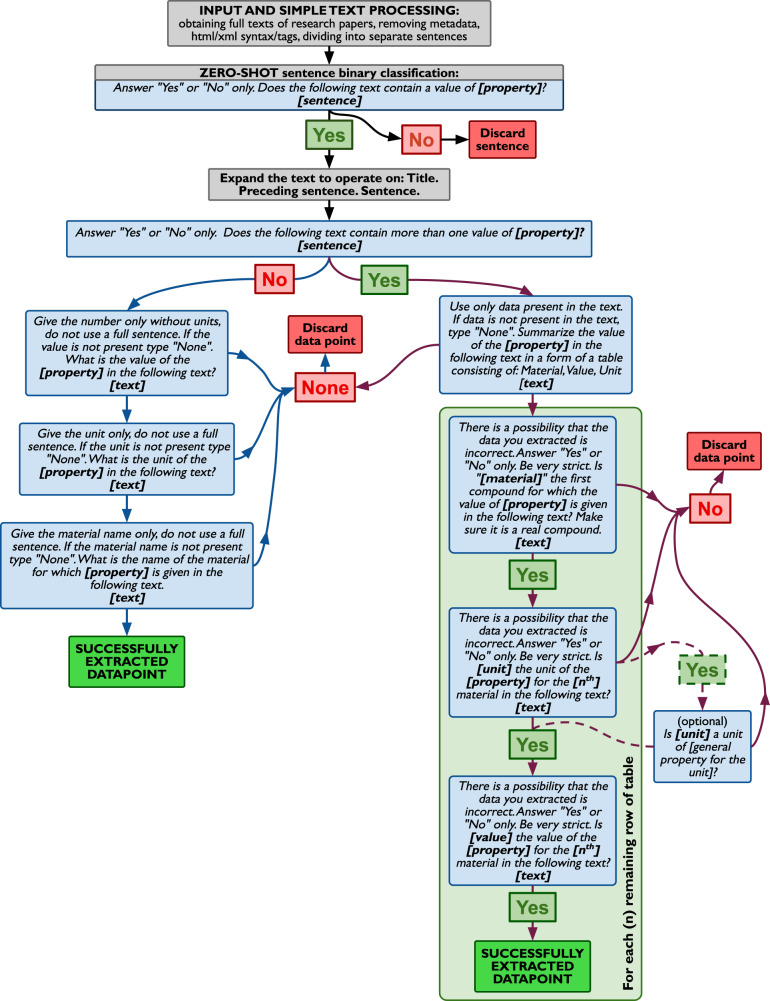
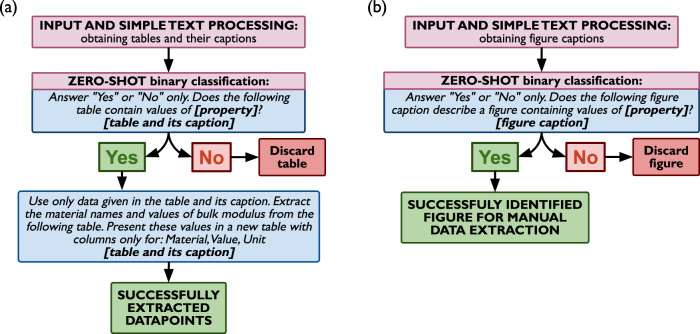
There has been a growing effort to replace manual extraction of data from research papers with automated data extraction based on natural language processing, language models, and recently, large language models (LLMs). Although these methods enable efficient extraction of data from large sets of research papers, they require a significant amount of up-front effort, expertise, and coding. In this work, we propose the method that can fully automate very accurate data extraction with minimal initial effort and background, using an advanced conversational LLM. consists of a set of engineered prompts applied to a conversational LLM that both identify sentences with data, extract that data, and assure the data’s correctness through a series of follow-up questions. These follow-up questions largely overcome known issues with LLMs providing factually inaccurate responses. can be applied with any conversational LLMs and yields very high quality data extraction. In tests on materials data, we find precision and recall both close to 90% from the best conversational LLMs, like GPT-4. We demonstrate that the exceptional performance is enabled by the information retention in a conversational model combined with purposeful redundancy and introducing uncertainty through follow-up prompts. These results suggest that approaches similar to , due to their simplicity, transferability, and accuracy are likely to become powerful tools for data extraction in the near future. Finally, databases for critical cooling rates of metallic glasses and yield strengths of high entropy alloys are developed using .
Overview
The claims and statistics of this paper haven’t been checked yet.
Free: it reads the open-access text and checks the first 5 claims that cite a source we can check. Create a free account to check every claim.
Integrity signals
Registry
Cites
Statistics
Figures

Verification
Claims the paper makes
The claims and statistics of this paper haven’t been checked yet.
Free: it reads the open-access text and checks the first 5 claims that cite a source we can check. Create a free account to check every claim.
Claims other papers make about this one
Each is checked against this paper’s own text: does it say what the citing paper says it does?
The source backs part of the claim, not all of it — or backs it for a different population, condition or comparison.
In the citing paper
“Although these proof-of-concept studies have reported encouraging results and the potential to substantially reduce manual workload and human error, most evaluations have been limited to single models, small or restricted datasets, or single extraction runs (15–20).”
From Performance of large language models and prompt engineering strategies for data extraction in systematic reviews (2026) · cites this paper as [18]
Experimental — accuracy not yet measuredThe cited source says what the claim attributes to it.
In the citing paper
“one study demonstrated that GPT-4 achieved precision and recall approaching 90% for automated extraction of structured scientific data using prompt-engineered workflows (18).”
From Performance of large language models and prompt engineering strategies for data extraction in systematic reviews (2026) · cites this paper as [18]
Self-check
Percentages, sums and reported differences re-computed from the paper’s own numbers.
The self-check needs the paper’s full text.
Citations
Cites
Language Models are Few-Shot Learners
Brown, T. B., Mann, B., Ryder, N., Subbiah, M., Kaplan, J., Dhariwal, P., Neelakantan, A., Shyam, P., Sastry, G., Askell, A., et al. (2020) · arXiv · doi:10.48550/arxiv.2005.14165 · Cited by 23,372
High-Resolution Image Synthesis with Latent Diffusion Models
Rombach, R., Blattmann, A., Lorenz, D., Esser, P., & Ommer, B. (2022) · 2022 IEEE/CVF Conference on Computer Vision and Pattern Recognition (CVPR) · doi:10.1109/cvpr52688.2022.01042 · Cited by 20,302 · cited 2×
“Prompt engineering has now become a standard practice in the field of image generation [32–34] to ensure high quality results.”
BackgroundKaugeranna, R., Kaugeranna, E., & Aion, (. S. 4. 6. (2023) · DROPS (Schloss Dagstuhl – Leibniz Center for Informatics) · doi:10.4230/lipics.giscience.2023.43 · Cited by 13,690
LLaMA: Open and Efficient Foundation Language Models
Touvron, H., Lavril, T., Izacard, G., Martinet, X., Lachaux, M.-A., Lacroix, T., Rozière, B., Goyal, N., Hambro, E., Azhar, F., et al. (2023) · arXiv · doi:10.48550/arxiv.2302.13971 · Cited by 4,602
Python Materials Genomics (pymatgen): A robust, open-source python library for materials analysis
Ong, S. P., Richards, W. D., Jain, A., Hautier, G., Kocher, M., Cholia, S., Gunter, D., Chevrier, V. L., Persson, K. A., & Ceder, G. (2013) · Computational Materials Science · doi:10.1016/j.commatsci.2012.10.028 · Cited by 4,534
Training language models to follow instructions with human feedback
Ouyang, L., Wu, J., Jiang, X., Almeida, D., Wainwright, C. L., Mishkin, P., Zhang, C., Agarwal, S., Slama, K., Ray, A., et al. (2022) · arXiv · doi:10.48550/arxiv.2203.02155 · Cited by 4,208
Llama 2: Open Foundation and Fine-Tuned Chat Models
Touvron, H., Martin, L., Stone, K., Albert, P., Almahairi, A., Babaei, Y., Bashlykov, N., Batra, S., Bhargava, P., Bhosale, S., et al. (2023) · arXiv · doi:10.48550/arxiv.2307.09288 · Cited by 2,604 · cited 1×
“As an alternative model to assess, we chose LLaMA2-chat (70B) [39], a model developed by GenAI (Meta), which has extensive documentation [40], and is available to download for free and use locally without limits.”
MethodHierarchical Text-Conditional Image Generation with CLIP Latents
Ramesh, A., Dhariwal, P., Nichol, A., Chu, C., & Chen, M. (2022) · arXiv · doi:10.48550/arxiv.2204.06125 · Cited by 2,511
Large language models are zero-shot reasoners
Kojima, T., Gu, S. (., Reid, M., Matsuo, Y., & Iwasawa, Y. (2022) · Advances in Neural Information Processing Systems 35 · doi:10.52202/068431-1613 · Cited by 2,013
Large Language Models are Zero-Shot Reasoners
Kojima, T., Gu, S. S., Reid, M., Matsuo, Y., & Iwasawa, Y. (2022) · arXiv · doi:10.48550/arxiv.2205.11916 · Cited by 2,013
Research works printed but not linked: 1
- Polak, M. P. & Morgan, D. Datasets and Supporting Information to the paper entitled ‘Extracting accurate materials data from research papers with conversational language models and prompt engineering’ (2023). PMC10882009 38383556
Cited by
Items 201–300 of 478
From Deep Learning to ChatGPT for Materials Design
Mudabbiruddin, M., Mosavi, A. A., & Imre, F. (2024) · IEEE International Conference on Computational Cybernetics (ICCC) · doi:10.1109/iccc62278.2024.10582940 · Cited by 6
Acquisition of absorption and fluorescence spectral data using chatbots
Taniguchi, M., & Lindsey, J. S. (2024) · Digital Discovery · doi:10.1039/d4dd00255e · Cited by 5
Position Paper: Unlocking the Potential of AI Researchers in Scientific Discovery—What Is Missing?
Yu, H., Liu, S., Yang, H., Yan, Y., Qu, M., & Jin, Y. (2026) · International Joint Conference on Neural Networks (IJCNN) · doi:10.1109/ijcnn69854.2026.11729527 · Cited by 5
“Providing experimental scientists with AI tools for data collection [23], modeling and analysis [24], and experiment design and conduction [25] can significantly accelerate scientific discovery. across a range of scientific fields.”
Artificial Intelligence Quotient (AIQ)Preprint
Qin, X., Lu, J. G., Chen, C., Zhou, X., Gan, Y., Li, W., & Song, L. L. (2024) · PsyArXiv (OSF Preprints) · doi:10.31234/osf.io/qjm3r · Cited by 7
Oami, T., Okada, Y., Maeda, K., & Nakada, T.-A. (2026) · Frontiers in Digital Health · doi:10.3389/fdgth.2026.1799623 · Cited by 4
“Our findings further indicated that not only model selection but also prompt engineering strategies influence performance, emphasizing prompt optimization as a primary means of improving LLM outputs (18, 19).”
Using Large Languge Models for Processing Sensor Data
Hojda, M. (2025) · Sensors · doi:10.3390/s25144380 · Cited by 5
“[27] present ChatExtract, which is a method for the automation of materials data extraction from research papers.”
Empowering scientific discovery with explainable small domain-specific and large language models
Yu, H., Wang, Y., Cheng, T., Yan, Y., Dawson, K. A., Li, S. F. Y., Zheng, Y., & Jin, Y. (2025) · Artificial Intelligence Review · doi:10.1007/s10462-025-11365-w · Cited by 5
“…including small domain-specific models and large language models (LLMs), has been more commonly adopted across scientific disciplines to collect (Polak and Morgan 2024 ), augment, and auto-label data (Roh et al. 2021 ), generate hypotheses and design experiments (Jain et al. 2023 ), analyze…”
Developing an intelligent data-driven framework for organic photovoltaic research
Cui, Y., Ma, W., & Yan, H. (2026) · EES solar. · doi:10.1039/d5el00160a · Cited by 5
A general LLM-powered text mining framework: Applied to extract high entropy alloys
Yuan, H., Zeng, J., Zuo, J., Wang, X., & Xu, D. (2026) · Computational Materials Science · doi:10.1016/j.commatsci.2025.114476 · Cited by 7
Li, D., Sun, X., Sun, S., Wang, R., Zhang, M., Xiao, M., Wang, Y., & Zhang, Y. (2026) · Advanced Science · doi:10.1002/advs.202524215 · Cited by 5
Can large language models assess the quality of peer review? An empirical study
Tang, Y., Kang, Y., Wu, S., Zhang, R., & Sun, Z. (2026) · Scientometrics · doi:10.1007/s11192-026-05622-0 · Cited by 4
Lan, K., Li, G. Y., Huang, W., Li, J., & Yu, Y. (2026) · IEEE Transactions on Network Science and Engineering · doi:10.1109/tnse.2026.3687554 · Cited by 4
“The LLM-HGAN framework demonstrates that TTP-based detection efficacy critically depends on the temporal relevance 2024)proposed theChatExtractmethod,whichutilizesadvancedconversational largeLLMtoperformhighlyaccuratedataextractioninafully automatedmannerwithminimalbackgroundknowledge[68].”
Cairang, Z., Shi, C., Ou, H., Wu, Y., Fang, D., & Li, W. (2026) · International Journal of Biological Macromolecules · doi:10.1016/j.ijbiomac.2026.153254 · Cited by 4
Fan, Y., Li, J., Ren, Y., Liu, C., & Zhang, W. (2026) · Environmental Science & Technology · doi:10.1021/acs.est.6c00882 · Cited by 4
Large language model-based multi-objective modeling framework for vacuum gas oil hydrotreating
Pang, Z., Liu, S., Lin, Y., Fang, X., Liu, H., Peng, C., & Lian, C. (2025) · Chinese Journal of Chemical Engineering · doi:10.1016/j.cjche.2025.05.012 · Cited by 4
Deriving inferences through natural language from structured datasets for asset lifecycle management
Sanchit, Bhattacharjee, S., & Pandhare, V. (2024) · IFAC-PapersOnLine · doi:10.1016/j.ifacol.2024.08.064 · Cited by 4
Chatgpt Inaccuracy Mitigation During Technical Report Understanding: Are we There Yet?
Tamanna, S. B., Uddin, G., Wang, S., Xia, L., & Zhang, L. (2025) · ACM/IEEE International Conference on Software Engineering: Companion Proceedings (ICSE-Companion) · doi:10.1109/icse55347.2025.00145 · Cited by 6
Key technologies and applications of large language models for materials science
Danyu, L. U. O., Liyang, W. E. N., Chen, B., Sijia, G. U. O., Wang, H., Ziping, W. A. N., Chen, L., & Chen, X. (2025) · Scientia Sinica Informationis · doi:10.1360/ssi-2025-0169 · Cited by 5
Lainwright, N., & Pemberton, M. (2024) · OSF Preprints (OSF Preprints) · doi:10.31219/osf.io/34yqj · Cited by 4
Weber, I. (2024) · arXiv (Cornell University) · doi:10.18420/akwi2024-001 · Cited by 5
JSONSchemaBench: A Rigorous Benchmark of Structured Outputs for Language Models
Geng, S., Cooper, H., Moskal, M., Jenkins, S., Berman, J., Ranchin, N., West, R., Horvitz, E., & Nori, H. (2025) · arXiv · doi:10.48550/arxiv.2501.10868 · Cited by 3
“Guidance outperforms other frameworks on these dimensions. as web navigation [Yao et al., 2023b], data extraction [Polak & Morgan, 2024], and tool use [Schick et al., 2023].”
From Legacy to Standard: LLM-Assisted Transformation of Cybersecurity Playbooks into CACAO Format
Akbari Gurabi, M., Nitz, L., Castravet, R.-M., Matzutt, R., Mandal, A., & Decker, S. (2026) · Lecture Notes in Computer Science · doi:10.1007/978-3-032-16092-8_27 · Cited by 3
LLMs Tackle Meta-analysis: Automating Scientific Hypothesis Generation with Statistical Rigor
Lin, T.-W., Yang, R., Abdeen, Z. U., Sangiovanni-Vincentelli, A. L., Huang, H., & Jin, M. (2025) · Communications in computer and information science · doi:10.1007/978-981-96-8912-5_2 · Cited by 4
Are we there yet? Adventures on a road trip through machine learning as a computational chemist
Kulik, H. J. (2025) · APL Computational Physics · doi:10.1063/5.0297853 · Cited by 3
Wu, J., Shi, R., Zhou, X. Y., Zhang, L., Chen, K., Yu, H., & Wu, Y. S. (2025) · Angewandte Chemie · doi:10.1002/ange.202520525 · Cited by 18
LLM-Based Web Data Collection for Research Dataset Creation
Berkane, T., Charpignon, M., & Majumder, M. S. (2025) · Findings of the Association for Computational Linguistics: EMNLP (Findings of EMNLP) · doi:10.18653/v1/2025.findings-emnlp.674 · Cited by 3
Yang, Y., Liu, Z., Wu, W., Zhang, Y., Zhang, H., Lin, J., Wu, S., Chen, Z., Sun, Y., Li, R., et al. (2025) · Journal of Chemical Information and Modeling · doi:10.1021/acs.jcim.5c02299 · Cited by 3
Oami, T., Okada, Y., & Nakada, T. (2026) · Hong Kong Journal of Emergency Medicine · doi:10.1002/hkj2.70085 · Cited by 3
Nie, W., Li, F., Tsolakis, N., & Kumar, M. (2026) · Journal of the Operational Research Society · doi:10.1080/01605682.2025.2612145 · Cited by 6
“In an OR context, RAG can convert heterogeneous unstructured sources (e.g., policy reports, news, technical documents) into structured, auditable data suitable for simulation model inputs (Polak & Morgan, 2024; Prince et al., 2024; Xu et al., 2024).”
Systematically Verified Experimental Thermoelectric Dataset For Data-driven Approaches
Tang, L. Z., Purdy, L., Mohanty, T., Ng, L. W. T., & Sparks, T. D. (2026) · Integrating materials and manufacturing innovation · doi:10.1007/s40192-026-00446-5 · Cited by 5
Song, Z., Cai, Y., Yu, Y., Xiang, P., Li, M., Liu, Z., & Dai, M. (2026) · Materials Genome Engineering Advances · doi:10.1002/mgea.70042 · Cited by 3
Zhou, R. H. F. L., Ma, H., Xin, T., Miao, Q., Zou, L., Hu, Q., Cheng, H., Guo, J., Mu, Y., Wang, S., et al. (2026) · Journal of Chemical Information and Modeling · doi:10.1021/acs.jcim.6c00090 · Cited by 3
Roy, A., Grisan, E., Buckeridge, J., & Gattinoni, C. (2026) · Digital Discovery · doi:10.1039/d5dd00521c · Cited by 8
Santos, A. D. S. S., Stojanovska, E., Junior, A. A. A., de Paula, A. J., de Florio, D. Z., & Almeida, J. (2026) · Journal of Chemical Information and Modeling · doi:10.1021/acs.jcim.6c00752 · Cited by 3
Large language model-enabled automated data extraction for concrete materials informatics
Li, Z., Yang, K., He, Q., & Gong, K. (2026) · npj Computational Materials · doi:10.1038/s41524-026-02304-6 · Cited by 5
“…such approaches typically require substantial manual effort, such as developing parsing rules and curating large human-annotated corpora for model training or fi ne-tuning 14,25,26 , which limits their adaptability and scalability across different materials systems, properties, and reporting styles.”
Shi, S., Huang, J., Qin, L., Chen, D., Zhou, L., Pan, H., & Zhu, L. (2026) · Chemical Engineering Journal · doi:10.1016/j.cej.2026.177780 · Cited by 3
Breaking Bottlenecks in Solid Electrolyte Discovery With Large Artificial Intelligence Models
Cheng, E. J., Hong, M., Zeng, Z., Liu, C., Wang, Q., Meadowcroft, M. J., Badilita, V., Costa, C. M., Lanceros-Méndez, S., Li, Y., et al. (2026) · Advanced Materials · doi:10.1002/adma.75354 · Cited by 3
Artificial intelligence for life-cycle-aware sustainable materials discovery
Mannan, S., Myers, R. J., Batra, R., Mercado, R., Wondraczek, L., & Krishnan, N. M. A. (2026) · Nature Sustainability · doi:10.1038/s41893-026-01950-4 · Cited by 4
Agentic AI systems for scientific discovery
Feng, B., Walther, P., Zhang, L.-L., Coyle, R., Kim, S., Mandal, A., Zhang, Z.-J., Papidocha, S. M., Kelmanson, A., Segura, D. M., et al. (2026) · Nature Reviews Methods Primers · doi:10.1038/s43586-026-00534-y · Cited by 1
“Within the context of knowledge extraction, this includes comparison against source documents, assessment of citation grounding, schema completeness, consistency across repeated runs and detection of unsupported claims 26,111,130,131 .”
Schultz, L. E., Afflerbach, B. T., Voyles, P. M., & Morgan, D. D. (2024) · Journal of Materiomics · doi:10.1016/j.jmat.2024.100964 · Cited by 5
“One dataset contained 299 entries (where some are duplicates) gathered with the assistance of large language models [32, 33].”
Self-citationChen, M., Zhang, T., & Wang, S. (2025) · PLoS ONE · doi:10.1371/journal.pone.0320123 · Cited by 4
Liu, J., Liu, Z., Shen, Y., Zhang, R., Song, N., Liu, J., & Pei, L. (2025) · npj Heritage Science · doi:10.1038/s40494-025-01669-z · Cited by 3
“…texts without the required information, and the second stage involves distinguishing single-valued from multi-valued information, encouraging negative responses, using appropriately redundant prompts, contextual prompts, and strict output formats to facilitate ef fi cient information extraction 46 .”
Leveraging LLMs to identify patent-free glass materials
Urata, S., Miya, N., Hashimoto, R., Konishi, T., Fujii, K., Murakami, Y., & Kanehara, K. (2025) · Computational Materials Science · doi:10.1016/j.commatsci.2025.114022 · Cited by 4
Kuculo, T., Abdollahi, S., & Gottschalk, S. (2025) · Semantic Web · doi:10.1177/22104968251363759 · Cited by 10
“In 2023, Polak and Morgan (2024) expanded on the early promises of unstructured IE with ChatExtract , demonstrating that a significant amount of up-front effort, expertise, and coding may be fully automated using an advanced conversational LLM.”
Liu, J., Anderson, H., Waxman, N. I., Kovalev, V., Fisher, B., Li, E., & Guo, X. (2026) · Advanced Intelligent Systems · doi:10.1002/aisy.202500857 · Cited by 4
“[19] However, for papers published before the year 2000, their PDF documents are highly likely to be low-quality scans with OCR-based results containing many errors.”
Automatic Design Summary Generation with Generative AI
Ikoma, D., Aoki, E., Taniguchi, T., Suzuki, S., & Ohkuma, T. (2024) · International World Wide Web Conference (WWW) · doi:10.1145/3589335.3651901 · Cited by 3
“Polak and Morgan proposed a procedure of prompts called ChatExtract for extracting material phrases from scientific papers[5].”
BackgroundA large language model-powered literature review for high-angle annular dark field imaging
袁, W. 文. Y., 彭, C. 程. P., & 何, Q. 迁. H. (2024) · Chinese Physics B · doi:10.1088/1674-1056/ad625c · Cited by 3
Balancing Privacy and Robustness in Prompt Learning for Large Language Models
Shi, C., Su, J., Chu, C., Wang, B., & Feng, D. (2024) · Mathematics · doi:10.3390/math12213359 · Cited by 3
“The goal is to identify prompts that maximize task performance while minimizing the need for human intervention [25].”
BackgroundComparative Modular Product Development Using TRIZ, AI, and VA++
Mysior, M., Iniotakis, C., & Iwan, D. (2024) · IFIP advances in information and communication technology · doi:10.1007/978-3-031-75923-9_16 · Cited by 3
Kalmer, T. L., Ancajas, C. M. F., Cheng, Z., Oyedele, A. S., Davis, H. L., & Walker, A. S. (2024) · bioRxiv (Cold Spring Harbor Laboratory) · doi:10.1101/2024.08.01.606186 · Cited by 3
Fine-tuned large language models for answering questions about full-text biomedical research studiesPreprint
Tao, K., Zhou, J., Osman, Z. A., Ahluwalia, V., Sabatti, C., & Shafer, R. W. (2024) · Research Square · doi:10.1101/2024.10.28.24316263 · Cited by 4
Soleymani, S., Gravel, N., Kochut, K., & Kannan, N. (2025) · bioRxiv (Cold Spring Harbor Laboratory) · doi:10.1101/2025.04.23.649790 · Cited by 3
“Prompt engineering is another powerful technique to guide LLMs toward more accurate outputs 44,45 .”
Probing Materials Knowledge in LLMs: From Latent Embeddings to Reliable PredictionsPreprint
Venugopal, V., Mahjoubi, S., & Olivetti, E. (2026) · arXiv (Cornell University) · doi:10.48550/arxiv.2603.01834 · Cited by 4
“• Robustness to input variations : LLMs recognize the equivalence between “bar-ium titanate,” “BaTiO 3 ,” and “TiBaO 3 ” without explicit mapping rules Polak and Morgan (2024).”
Coevolution of large language models with physical models boosts advanced battery research
Li, J.-H., Hu, Y., Xia, G., Mo, W., Li, B., Jia, Y., Gao, Y., Xuan, F., Liu, H., & Lian, C. (2025) · Cell Reports Physical Science · doi:10.1016/j.xcrp.2025.102553 · Cited by 2
SciHyp: A Fine-Grained Dataset Describing Hypotheses and Their Components from Scientific Articles
Vasu, R., Sarasua, C., & Bernstein, A. (2024) · Lecture notes in computer science · doi:10.1007/978-3-031-77847-6_8 · Cited by 5
HUANG, Y., Wanjun, X. I. A., Junmei, D., JIANG, Y., Xin, W. A. N. G., Yuanzheng, C. H. E. N., Hongyan, W. A. N. G., Jijun, Z., & Chunsheng, G. U. O. (2025) · Acta Physica Sinica · doi:10.7498/aps.74.20250497 · Cited by 2
Shan, G., Ding, Z., Xi, L., Zhao, H., Zhang, J., & Xu, F. (2025) · Rare Metals · doi:10.1007/s12598-025-03617-z · Cited by 2
“5, Patiny and Godin [16] [55].”
Yang, Y., Wang, X., Tang, Y., & Liu, Q. (2025) · International Transactions in Operational Research · doi:10.1111/itor.70122 · Cited by 2
Xu, J., You, J., Zhang, C., Huang, H., Tao, J., & Yi, J. (2025) · Lecture notes in computer science · doi:10.1007/978-981-95-3058-8_4 · Cited by 2
Automating the Construction of Environmental Policy Knowledge Graph with Large Language Models
Yang, Y., Liu, X., Tu, X., Lu, Y., & Wang, Y. (2025) · Sustainability · doi:10.3390/su172210282 · Cited by 2
Sharifan, A., Dobrescu, A. I., Harrod, C. S., Klerings, I., Ong, A. Y., Ngeh, E. N., Xiao, Y., & Gartlehner, G. (2025) · Journal of Clinical Epidemiology · doi:10.1016/j.jclinepi.2025.112083 · Cited by 2
Ren, Z., Yang, T., Li, G., Sheng-wu, H., Mou, N., & Chen, Z. (2025) · Applied Sciences · doi:10.3390/app152413125 · Cited by 2
Du, W., Li, W., Chen, X., Wang, Y., Mou, J., Cui, Y., Wu, H., Wang, X., Xie, D., & Zhang, Y. (2025) · Chinese Geographical Science · doi:10.1007/s11769-025-1582-6 · Cited by 2
Liu, S., Booth, T. R., Ji, Y., Reinhart, W. F., & Balachandran, P. V. (2026) · Integrating materials and manufacturing innovation · doi:10.1007/s40192-026-00460-7 · Cited by 3
“…such as the one by Borg et al. [32], which includes mechanical properties and phase information, and the data-base constructed by Polak and Morgan [10], which contains yield strength data along with annotated source passages, do not provide lattice constant data for experimentally synthesized…”
InfluentialStuhlfauth, V., Saheb, Y., & Bouzouina, L. (2026) · Environmental Research Communications · doi:10.1088/2515-7620/ae4563 · Cited by 2
Use of Machine Learning and Large Language Models in Chemical Information Extraction
Chen, Y., Zhang, Y., Zhou, H., Leung, C. T., & Gao, H. (2026) · Annual Review of Chemical and Biomolecular Engineering · doi:10.1146/annurev-chembioeng-100724-080433 · Cited by 4
Soldatkina, M. A., Tsymbarovich, P., Fomin, D. S., & Ivanov, A. L. (2026) · Agronomy Journal · doi:10.1002/agj2.70324 · Cited by 2
Sustainable Materials Design With Multi‐Modal Artificial Intelligence
Xu, T., Wei, T., Ge, Y., Peng, B., Li, Y., Wang, M., Wen, P., Yang, C., & Wei, Y. (2026) · Advanced Science · doi:10.1002/advs.202524273 · Cited by 8
Fatawi, I., Bilad, M. R., & Asy’ari, M. (2026) · IAES International Journal of Artificial Intelligence · doi:10.11591/ijai.v15.i2.pp1071-1086 · Cited by 2
“Refining interdisciplinary prompt engineering techniques will ensure that LLMs maintain contextual relevance and avoid introducing biases when integrating data from various domains [11].”
InfluentialChatMat: a multi-agent chemist for autonomous material prediction and exploration
Lv, S., Peng, L., Jiao, S., Yao, Y., Wu, W., & Hu, W. (2026) · Digital Discovery · doi:10.1039/d5dd00582e · Cited by 3
Prediction of ionic conductivity in solid-state electrolytes using machine learning
Kim, Y., Polak, M. P., & Morgan, D. D. (2026) · Materials Today Communications · doi:10.1016/j.mtcomm.2026.115317 · Cited by 2
Self-citationSayeed, H. M., Clark, C., Mohanty, T., & Sparks, T. D. (2026) · Integrating materials and manufacturing innovation · doi:10.1007/s40192-026-00455-4 · Cited by 3
Librarian of Alexandria: A Modular Chemical Data Extraction Pipeline to Compare LLM Performance
Grougan, M., Subasinghe, J., Hix, M. A., & Walker, A. R. (2026) · Journal of Chemical Information and Modeling · doi:10.1021/acs.jcim.6c00374 · Cited by 3
Automated Extraction of Multicomponent Alloy Data Using Large Language Models for Sustainable Design
Sundaram, A., Chakraborty, M., Devathi, S. M. K., Prusty, B. P., & Batra, R. (2026) · Advanced Science · doi:10.1002/advs.75916 · Cited by 2
Intelligent Material Framework for Data Mining and Performance Prediction of Invar Alloy
Jiang, T., Shang, C., Wu, H., Nie, M., Zhu, D., Yang, F., Wang, H., Wang, S. K., Gao, J., Zhao, H., et al. (2026) · Rare Metals · doi:10.1002/rar2.70309 · Cited by 2
Duan, Y., Zhang, Y. L., Yu, R., Li, D., Kosugi, S., Okumura, M., & Funakoshi, K. (2026) · Materials Today Communications · doi:10.1016/j.mtcomm.2026.115551 · Cited by 3
From data to theory: Autonomous large language model agents for materials science
Alfred, S. O., & Sundararaghavan, V. (2026) · Computational Materials Science · doi:10.1016/j.commatsci.2026.114862 · Cited by 3
Tang, Z., Dreger, M., Jiang, P., Malek, K., & Tu, Q. (2026) · Journal of Industrial Ecology · doi:10.1007/s44498-026-00135-8 · Cited by 2
“Studies have demonstrated that even using general-purpose LLMs with prompt engineering can achieve high performance in data mining tasks (Luo et al., 2025; Polak & Morgan, 2024; Zheng et al., 2023), thus considerably reducing deployment time and computational cost compared with fine-tuning.”
Chen, J., Qin, N., Pei, F., Zhang, Y., Qiao, Y., Yu, Y., & Huang, Y. (2026) · Energy & Environmental Science · doi:10.1039/d6ee01488g · Cited by 2
Extraction of optimal synthesis conditions from scientific literature using a knowledge graph
Kobayashi, S., Kuwashiro, N., Itoh, F., Sakurai, D., & Hitosugi, T. (2024) · Science and Technology of Advanced Materials Methods · doi:10.1080/27660400.2024.2395242 · Cited by 2
“Large-language models (LLMs), such as ChatGPT, have also been adopted to extract material properties [9,10].”
Pasarkar, M., Kim, J., O’Gara, E., Zhang, A., Magdon‐Ismail, M., Munasinghe, T., Weng, J., Qiu, D., Cruz, E., Wei, J., et al. (2024) · IEEE International Conference on Big Data (BigData) · doi:10.1109/bigdata62323.2024.10825214 · Cited by 2
Fani, M., Chadwell, W., Tasnim, N., Wang, X., Araghi, M., Lü, K., Zhou, Z., Gu, T., & Xu, S. (2025) · Journal of materials research/Pratt's guide to venture capital sources · doi:10.1557/s43578-025-01571-1 · Cited by 2
“Materials scientists have applied generative LLMs to tasks such as extracting data from unstructured text in scientific literature [17, 18].”
Wang, J., Silberman, P. C., Chowdhury, S. M., & Blaser, B. W. (2025) · JCO Oncology Practice · doi:10.1200/op-25-00293 · Cited by 2
AquaMTL-chain: Advancing multi-task learning for event extraction in aquaculture
Li, Z., Zhang, S., Zhang, J., An, Z., Han, Z., & Cao, P. (2025) · Aquaculture · doi:10.1016/j.aquaculture.2025.743001 · Cited by 2
Exploring the role of machine learning in materials science and engineering
Morgan, D. D., & Jacobs, R. M. (2023) · Open Access Government · doi:10.56367/oag-040-11110 · Cited by 2
Self-citationZheng, C., Su, X., Tang, Y., Li, J., & Kassem, M. (2024) · SSRN Electronic Journal · doi:10.2139/ssrn.4883720 · Cited by 2
Evaluation of Bias Towards Medical Professionals in Large Language ModelsPreprint
Chen, X., Xu, Y., You, M. D. M., Wang, L., Liu, W., Du, S., Huo, B., & Li, J. (2024) · SSRN Electronic Journal · doi:10.2139/ssrn.5002806 · Cited by 3
The Prompt Engineering Report Distilled: Quick Start Guide for Life SciencesPreprint
Romanov, V., & Niederer, S. (2025) · arXiv (Cornell University) · doi:10.48550/arxiv.2509.11295 · Cited by 2
A multimodal dataset of causal mechanisms in materials science literature
Liu, Y., Wang, C., Liu, J., Shi, X. D., Huang, Y., Cheng, Q., & Wei, L. (2026) · Scientific Data · doi:10.1038/s41597-026-06598-5 · Cited by 3
Huynh, D.-L., Asp, E., Ballante, F., Puigvert, J. C., DeGrave, A. N., Karki, R., Nader, K. M., Östling, P., Pokharel, B. K., Rietdijk, J., et al. (2026) · bioRxiv (Cold Spring Harbor Laboratory) · doi:10.64898/2026.04.20.719538 · Cited by 2
Suzuki, T., & Bono, H. (2025) · Database · doi:10.1093/database/baaf022 · Cited by 1
“LLMs, such as OpenAI’s ChatGPT and Meta’s Llama, have been reported to exhibit strong capacities for a wide range of complex tasks beyond text generation [22], including the extraction of metadata from the research literature [23–25].”
Матвеева, А. Р., & Антонов, Е. В. (2024) · Вестник НИЯУ МИФИ · doi:10.26583/vestnik.2024.5.7 · Cited by 1
GenAI-Based News Article Analysis Chatbot
Dubey, A., Sharma, R., Diwakar, M., Singh, P., Mishra, A. K., & Lamba, S. (2024) · International Conference on Advancement in Electronics & Communication Engineering (AECE) · doi:10.1109/aece62803.2024.10911100 · Cited by 3
Automatic Categorization of Software Repository Domains with Minimal Resources
Dahou, A. H., & Mathiak, B. (2025) · Communications in computer and information science · doi:10.1007/978-3-031-87569-4_2 · Cited by 1
Короп, М. М., & Prybyla, A. V. (2025) · Journal of Thermoelectricity · doi:10.63527/1607-8829-2025-1-16-25 · Cited by 1
“Polak M.P., Morgan D. [17] presented in Nature Communications the “ChatExtract” methodology, where ChatGPT ( GPT -3.5) was used to extract data on material properties with a minimum number of training examples.”
InfluentialThe converging moment of chemistry and artificial intelligence: a review and outlook
Zhang, W., Zhang, Y., Xiong, J., Zheng, M., & Chen, K. (2025) · Scientia Sinica Chimica · doi:10.1360/ssc-2025-0111 · Cited by 1
Evaluating Large Language Models for Table Data Extraction from Annual Reports in PDF
Nguyen, N. B., Kammermann, L., & Hanne, T. (2025) · Journal of Advances in Information Technology · doi:10.12720/jait.16.8.1118-1126 · Cited by 1
Tereshchenko, V., Martsinkevich, V., Aminov, N., & Dukhanov, A. V. (2025) · International Conference on Artificial Intelligence, Computer, Data Sciences and Applications (ACDSA) · doi:10.1109/acdsa65407.2025.11165914 · Cited by 3
“In existing research dedicated to extracting specific data from research papers using conversational language models [3] and methods described in works on network analysis of relationships in scientific publications [1], the main success factor can be the adaptation of pre-trained models to the…”
Mechanical properties of the meninges: An expansive LLM-assisted systematic review
Chelstrom, B. P., Polak, M. P., Morgan, D. D., & Henak, C. R. (2025) · Materials Today Communications · doi:10.1016/j.mtcomm.2025.114034 · Cited by 2
Self-citationTa, P., Venkatesaperumal, S., Ram, K., & Sivaprakasam, M. (2025) · Neuroscience Informatics · doi:10.1016/j.neuri.2025.100237 · Cited by 1
Metadata
- Authors
- Polak, M. P., & Morgan, D.
- Affiliations
- University of Wisconsin–Madison (US)
- Corresponding author
- Polak, Maciej P.
- Morgan, Dane
- Venue
- Nature Communications
- Published
- 2024-02-21
- Volume
- 15
- Issue
- 1
- Pages
- 1569-1569
- ISSN
- 2041-1723 (ISSN-L)
- PMC
- PMC10882009
- OpenAlex
- W4392002118
- Cited by
- 365
- References
- 40
- Citations by year
- 2026: 136 · 2025: 156 · 2024: 70
- FWCI
- 35.33
- Type
- journal article
- Language
- en
- Open access
- gold
- doi.org
- Licence
- cc-by
- creativecommons.org/licenses/by/4.0 (tdm)
- creativecommons.org/licenses/by/4.0 (vor)
- Locations
- Nature Communications (publishedVersion, cc-by)
- PubMed Central (publishedVersion, cc-by)
- PubMed (publishedVersion)
- DOAJ (DOAJ: Directory of Open Access Journals) (submittedVersion)
- Funders
- National Science Foundation (1931298)
- Topics
- Physical Sciences › Materials Science › Materials Chemistry › Machine Learning in Materials Science
- Physical Sciences › Computer Science › Artificial Intelligence › Topic Modeling
- Social Sciences › General Social Sciences › Computational and Text Analysis Methods
- Keywords
- automated data extraction, research papers, prompt engineering, materials data, factual accuracy, amorphous alloys, critical cooling rate, high-entropy alloys, yield strength, information retention
About these checks
Registry, retraction, Cites and statistics results are computed, not judged, with one exception: a printed reference that no index lists is read once by a model before it counts as a citation error. Claims are extracted by a model and kept only when their quote appears verbatim in the text; each cited source is then checked, with a model’s help, for whether it says what the claim relies on. Those verdicts can be wrong — read the claim’s quote and the cited source before relying on one.
Statistics and arithmetic are recomputed, not judged.
Confidence bands are shown only for fields calibrated on our annotated test set. None is calibrated yet, so no band is shown.
What counts as a claim ›How we measure confidence ›How we check this ›
Are you an author, or do you see a problem with this page? Request a review
Data sources
Bibliographic data: Semantic Scholar, OpenAlex, Crossref.
Contains information from the Semantic Scholar Academic Graph Datasets, made available under the ODC Attribution License (ODC-BY 1.0).
Semantic Scholar’s data is described in: Kinney, R., et al. (2023). The Semantic Scholar Open Data Platform. arXiv:2301.10140.
