

Extracting accurate materials data from research papers with conversational language models and prompt engineering
Open accessThe DOI matches its Crossref record; 46 of the 46 references it cites were found in a registry or an index.
Abstract
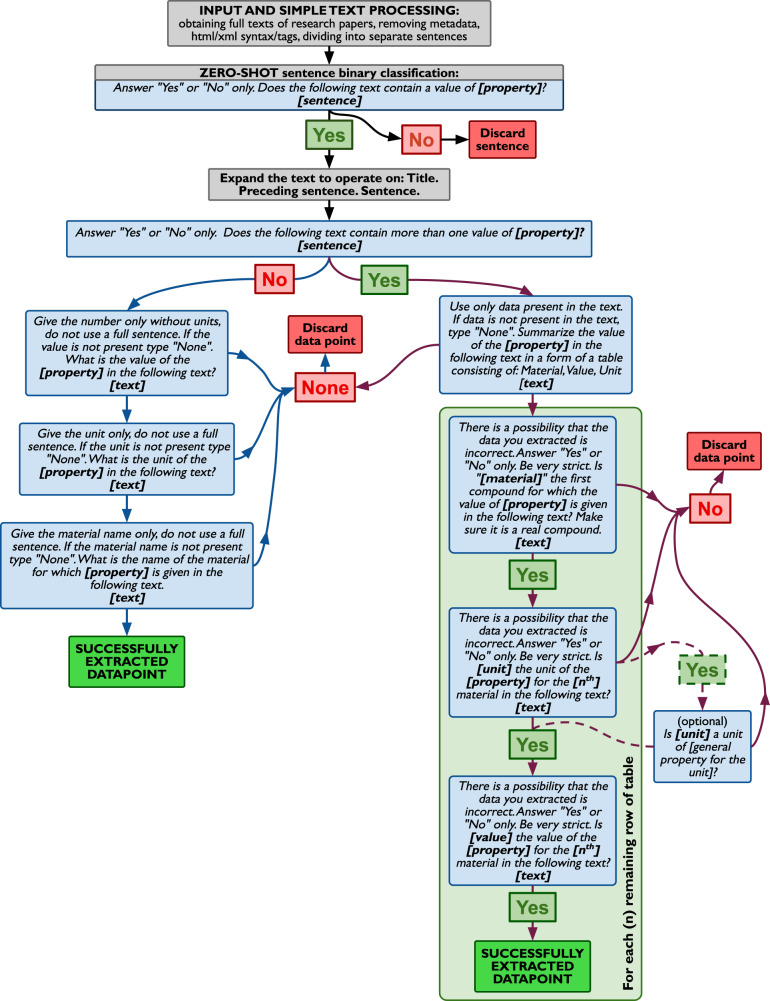
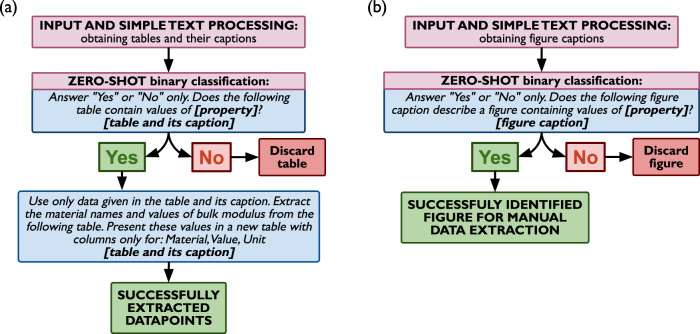
There has been a growing effort to replace manual extraction of data from research papers with automated data extraction based on natural language processing, language models, and recently, large language models (LLMs). Although these methods enable efficient extraction of data from large sets of research papers, they require a significant amount of up-front effort, expertise, and coding. In this work, we propose the method that can fully automate very accurate data extraction with minimal initial effort and background, using an advanced conversational LLM. consists of a set of engineered prompts applied to a conversational LLM that both identify sentences with data, extract that data, and assure the data’s correctness through a series of follow-up questions. These follow-up questions largely overcome known issues with LLMs providing factually inaccurate responses. can be applied with any conversational LLMs and yields very high quality data extraction. In tests on materials data, we find precision and recall both close to 90% from the best conversational LLMs, like GPT-4. We demonstrate that the exceptional performance is enabled by the information retention in a conversational model combined with purposeful redundancy and introducing uncertainty through follow-up prompts. These results suggest that approaches similar to , due to their simplicity, transferability, and accuracy are likely to become powerful tools for data extraction in the near future. Finally, databases for critical cooling rates of metallic glasses and yield strengths of high entropy alloys are developed using .
Overview
The claims and statistics of this paper haven’t been checked yet.
Free: it reads the open-access text and checks the first 5 claims that cite a source we can check. Create a free account to check every claim.
Integrity signals
Registry
Cites
Statistics
Figures

Verification
Claims the paper makes
The claims and statistics of this paper haven’t been checked yet.
Free: it reads the open-access text and checks the first 5 claims that cite a source we can check. Create a free account to check every claim.
Claims other papers make about this one
Each is checked against this paper’s own text: does it say what the citing paper says it does?
The source backs part of the claim, not all of it — or backs it for a different population, condition or comparison.
In the citing paper
“Although these proof-of-concept studies have reported encouraging results and the potential to substantially reduce manual workload and human error, most evaluations have been limited to single models, small or restricted datasets, or single extraction runs (15–20).”
From Performance of large language models and prompt engineering strategies for data extraction in systematic reviews (2026) · cites this paper as [18]
Experimental — accuracy not yet measuredThe cited source says what the claim attributes to it.
In the citing paper
“one study demonstrated that GPT-4 achieved precision and recall approaching 90% for automated extraction of structured scientific data using prompt-engineered workflows (18).”
From Performance of large language models and prompt engineering strategies for data extraction in systematic reviews (2026) · cites this paper as [18]
Self-check
Percentages, sums and reported differences re-computed from the paper’s own numbers.
The self-check needs the paper’s full text.
Citations
Cites
Language Models are Few-Shot Learners
Brown, T. B., Mann, B., Ryder, N., Subbiah, M., Kaplan, J., Dhariwal, P., Neelakantan, A., Shyam, P., Sastry, G., Askell, A., et al. (2020) · arXiv · doi:10.48550/arxiv.2005.14165 · Cited by 23,372
High-Resolution Image Synthesis with Latent Diffusion Models
Rombach, R., Blattmann, A., Lorenz, D., Esser, P., & Ommer, B. (2022) · 2022 IEEE/CVF Conference on Computer Vision and Pattern Recognition (CVPR) · doi:10.1109/cvpr52688.2022.01042 · Cited by 20,302 · cited 2×
“Prompt engineering has now become a standard practice in the field of image generation [32–34] to ensure high quality results.”
BackgroundKaugeranna, R., Kaugeranna, E., & Aion, (. S. 4. 6. (2023) · DROPS (Schloss Dagstuhl – Leibniz Center for Informatics) · doi:10.4230/lipics.giscience.2023.43 · Cited by 13,690
LLaMA: Open and Efficient Foundation Language Models
Touvron, H., Lavril, T., Izacard, G., Martinet, X., Lachaux, M.-A., Lacroix, T., Rozière, B., Goyal, N., Hambro, E., Azhar, F., et al. (2023) · arXiv · doi:10.48550/arxiv.2302.13971 · Cited by 4,602
Python Materials Genomics (pymatgen): A robust, open-source python library for materials analysis
Ong, S. P., Richards, W. D., Jain, A., Hautier, G., Kocher, M., Cholia, S., Gunter, D., Chevrier, V. L., Persson, K. A., & Ceder, G. (2013) · Computational Materials Science · doi:10.1016/j.commatsci.2012.10.028 · Cited by 4,534
Training language models to follow instructions with human feedback
Ouyang, L., Wu, J., Jiang, X., Almeida, D., Wainwright, C. L., Mishkin, P., Zhang, C., Agarwal, S., Slama, K., Ray, A., et al. (2022) · arXiv · doi:10.48550/arxiv.2203.02155 · Cited by 4,208
Llama 2: Open Foundation and Fine-Tuned Chat Models
Touvron, H., Martin, L., Stone, K., Albert, P., Almahairi, A., Babaei, Y., Bashlykov, N., Batra, S., Bhargava, P., Bhosale, S., et al. (2023) · arXiv · doi:10.48550/arxiv.2307.09288 · Cited by 2,604 · cited 1×
“As an alternative model to assess, we chose LLaMA2-chat (70B) [39], a model developed by GenAI (Meta), which has extensive documentation [40], and is available to download for free and use locally without limits.”
MethodHierarchical Text-Conditional Image Generation with CLIP Latents
Ramesh, A., Dhariwal, P., Nichol, A., Chu, C., & Chen, M. (2022) · arXiv · doi:10.48550/arxiv.2204.06125 · Cited by 2,511
Large language models are zero-shot reasoners
Kojima, T., Gu, S. (., Reid, M., Matsuo, Y., & Iwasawa, Y. (2022) · Advances in Neural Information Processing Systems 35 · doi:10.52202/068431-1613 · Cited by 2,013
Large Language Models are Zero-Shot Reasoners
Kojima, T., Gu, S. S., Reid, M., Matsuo, Y., & Iwasawa, Y. (2022) · arXiv · doi:10.48550/arxiv.2205.11916 · Cited by 2,013
Research works printed but not linked: 1
- Polak, M. P. & Morgan, D. Datasets and Supporting Information to the paper entitled ‘Extracting accurate materials data from research papers with conversational language models and prompt engineering’ (2023). PMC10882009 38383556
Cited by
Items 401–478 of 478
Zhang, Q., Liang, Y., Dong, H., Yin, H., Yun, H., Li, P., & Shang, C. (2026) · Lecture notes in electrical engineering · doi:10.1007/978-981-95-9342-2_48
Henninger, M., Radek, J., Snijder, J.-P., & Pauly, M. (2026) · Advances in Methods and Practices in Psychological Science · doi:10.1177/25152459261473490
Tao, K., Satija, R., Zhou, J., Osman, Z. A., Ahluwalia, V., Sabatti, C., & Shafer, R. W. (2026) · PLoS ONE · doi:10.1371/journal.pone.0351631
“Several studies have also demonstrated the capacity of LLMs to extract targeted information from scientific articles [9,11,13,17–19].”
Intelligent visualization-driven materials design via two-dimensional symbolic feature generation
Yong, W., Zhang, H., Li, Z., He, J., Chen, C., Gao, Y., Fu, H., & Xie, J. (2026) · Journal of Materials Informatics · doi:10.20517/jmi.2026.02
Shifting the educational paradigm: Discovering concepts and connections
Rajan, K. (2026) · Elsevier eBooks · doi:10.1016/b978-0-443-22256-6.00006-3
Moore, T. M. (2026) · Research Square · doi:10.21203/rs.3.rs-10220777/v1
Context-adaptive deep learning for sustainable product recommendation: Application to concrete
Vergés, R., Forcada, N., Gaspar, K., & Hosseini, M. R. (2026) · Sustainable Production and Consumption · doi:10.1016/j.spc.2026.06.011
Yu, X., Yu, J. K., Chen, X., Wang, Q., Xiong, L., Li, X., & Liu, S. (2026) · SSRN Electronic Journal · doi:10.2139/ssrn.7067667
Wang, X., Pan, Y., Pan, D., Bian, H., & Hu, S. (2026) · The Journal of Physical Chemistry C · doi:10.1021/acs.jpcc.6c03290
Zhao, Y., Chen, B., Yin, Y., Yin, L., Yang, Y., Li, H., Xu, X., Wu, T., Nan, G., & Zou, L. (2026) · Chinese Chemical Letters · doi:10.1016/j.cclet.2026.113200
Zhang, Y., Fang, Q., Zhen, R., Liu, J., Zheng, Y., & Zhang, C. (2026) · Reliability Engineering & System Safety · doi:10.1016/j.ress.2026.113148 · Cited by 1
LLMs as Judgment Oracles: A Framework for Tracking Conversational Opinion Dynamics
Akinifev, I. A., & Bodrunova, S. S. (2026) · Lecture notes in networks and systems · doi:10.1007/978-3-032-24929-6_23
Yoon, B., & Kim, J. (2025) · Journal of Data Forensics Research · doi:10.12972/jdfr.2025.2.2.2
Deep Research in the Era of Agentic AI: Requirements and Limitations for Scholarly Research
Jaradeh, M. Y., & Auer, S. (2025) · RENATE · doi:10.34657/39960 · Cited by 1
Jiang, Y., Bai, X., Liu, L., Ahemaiti, A., Liu, Y., & Yu, S. (2026) · SSRN Electronic Journal · doi:10.2139/ssrn.7164158
Liu, P., Wang, H., Zhang, H., & Li, D. (2026) · SSRN Electronic Journal · doi:10.2139/ssrn.7199721
Liu, P., Wang, H., Zhang, H., & Li, D. (2026) · SSRN Electronic Journal · doi:10.2139/ssrn.7199673
LLM-driven materials knowledge extraction: multimodal parsing, ontology, and agentic systems
Yang, S., Wang, Y., Tu, Q., Ran, N., & Lu, Y. (2026) · Journal of Materials Informatics · doi:10.20517/jmi.2026.38 · Cited by 2
Liu, X., Anjah, C., Jolly, B., Markanday, J. F. S., Berry, J., Wang, H., Morley, N., Oliver, R. D. J., Ramadan, A. J., Zhang, D. C., et al. (2026) · Journal of Physics Materials · doi:10.1088/2515-7639/ae93fd
Jin, S., Song, G., Xiang, H., Fu, Z., Zhang, X., Pei, J., Zhang, T., Fan, W., Wang, Q., & Zhang, D. (2026) · Journal of Energy Chemistry · doi:10.1016/j.jechem.2026.07.066
Shin, G., Lee, S., Kim, S., Ji, H., & Kang, J. (2026) · Advanced Intelligent Discovery · doi:10.1002/aidi.70151
Zhu, M., Chen, Y., & Zheng, Z. (2026) · ACM SIGKDD Conference on Knowledge Discovery and Data Mining (KDD) · doi:10.1145/3770855.3817812
Advancing Data Extraction Workflows for Single-Case Design Meta-Analysis Using Large Language Models
Lou, Y. (2026) · Scholars Archive - University at Albany (University at Albany, State University of New York)
Bao, T., Zhao, Y., Zhang, H., & Zhang, C. (2026) · Expert Systems with Applications · doi:10.1016/j.eswa.2026.133983
“Similarly, Polak and Morgan (2024) introduced ChatExtract, which utilizes prompt engineering to guide LLMs in automatically extracting entity information from material field.”
InfluentialHeuristic Search in AI-Assisted Discovery: A Recursive Architecture
Sercovich, F. C. (2026) · Lecture notes in networks and systems · doi:10.1007/978-3-032-32726-0_40
Wang, X., Raj, A., Luebbe, M., Wen, H., Xu, S., & Lu, K. (2026) · Digital Discovery · doi:10.1039/d6dd00374e
LLM-driven hybrid truss-lattice design via structural gene recombination
Cao, S., Meng, H., & Lu, T. J. (2026) · International Journal of Mechanical Sciences · doi:10.1016/j.ijmecsci.2026.112035
Assessing the Reliability of Large Language Models for Scientific Information Extraction
Schneider, L., Maitra, D., Zhao, J., & Gong, J. (2026) · ASEE Annual Conference & Exposition · doi:10.18260/1-2--58978
Schubert, E., & Bießmann, F. (2026) · arXiv (Cornell University) · doi:10.48550/arxiv.2608.18289
“…literature: meaning-typed prompting via Pydantic schemas rather than rigid JSON definitions for reliable structured output [10], a verification phase where the model reviews its own output [25], delimiters to separate schema definitions and text sections [4], and concise, direct instructions [13].”
Zhuang, Z., Li, C., Cui, J., Yang, X., Wang, L., Shi, S., Liu, J., Yang, X., & Wu, S. (2026) · Nano Energy · doi:10.1016/j.nanoen.2026.112352
Su, C., Yang, Y., & Fu, P. (2026) · Environmental Pollution · doi:10.1016/j.envpol.2026.129052
Safety Rule Extraction in Human-Robot Collaboration via Prompt-Driven Large Language Models
Quan, L., & Ma, G. (2026) · ASCE Construction Research Congress (CRC) · doi:10.1061/9780784486962.019
Advancing Disaster Response: An Approach to Mitigate Delays in Resource Management
Liu, Y., Ceferino, L., & Li, Y. (2026) · ASCE Construction Research Congress (CRC) · doi:10.1061/9780784487006.017
Ding, C., Zheng, S., Dong, Y., Wan, P., Zhang, C., Hua, W., Yan, S., Wei, W., Zhang, L., & Zhang, Y. (2026) · IEEE Transactions on Geoscience and Remote Sensing · doi:10.1109/tgrs.2026.3728201
“To address these issues, prompt engineering (PE) and PEFT have emerged as e ff ective alternatives [43].”
Zhang, T., Dai, B., Wu, Z., Xu, Z., Li, W., Li, W., Qian, X., Zhou, Z., Han, Y., Shen, Y., et al. (2026) · Digital Discovery · doi:10.1039/d6dd00240d
Kelly, C. R., & Cole, J. M. (2026) · Journal of Chemical Information and Modeling · doi:10.1021/acs.jcim.6c00136
Wang, Z.-Q., Zhou, Y., Song, W., Yao, X.-J., Chen, K.-F., Liu, J., & Xue, D.-F. (2026) · Advanced Functional Materials · doi:10.1002/adfm.78176
Koo, B. W., Ki, D., Kim, Y., Han, C., & Lee, S. (2026) · Journal of Environmental Planning and Management · doi:10.1080/09640568.2026.2714014
Artificial Intelligence in Scalable Materials Synthesis and Manufacturing
Andraju, N. (2026) · AI Chemistry · doi:10.3390/aichem1030014
Duong, T. C., Binh, P. M. Q., Хай, Д. Т. Т., Thanh, L. T., Tuan, T. T., Nguyen, T. P. N., Kiet, N. V., N., N. H., & Duong, H. M. (2026) · Gels · doi:10.3390/gels12090824
Schroeder, A. D., Wilson, M., Harrison, G., Machi, D., Klahn, B., Swarup, S., Vullikanti, A., Marathe, A., Foster, M., Potter, P., et al. (2026) · Research Square · doi:10.21203/rs.3.rs-10767641/v1
Chang, Y.-X., Chao, K.-H., Wang, Y., Chen, Y.-H., Ouyang, F.-Y., & Wu, S. (2026) · Knowledge-Based Systems · doi:10.1016/j.knosys.2026.117012
Agentic AI for food property data: From literature to database to new discovery
Zhou, X., Zhang, Y., Sablani, S. S., Wang, S., & Tang, J. (2026) · Journal of Food Engineering · doi:10.1016/j.jfoodeng.2026.113327
Zhao, Y., Song, T., Chen, L., Huang, Y., Sun, K., Han, W., Shen, M., Mao, C., Lan, P., Zhou, M. R., et al. (2026) · Journal of the American Chemical Society · doi:10.1021/jacs.6c13252
Large language models for literature screening in conceptually complex and interdisciplinary reviews
Cheng, N., Dong, H., Han, X., Tan, B., & Zhu, S. (2026) · Aslib Journal of Information Management · doi:10.1108/ajim-06-2025-0363
Li, Y., Guo, J., & Shi, W. (2026) · Artificial Intelligence & Environment · doi:10.66178/aie-0026-0019
Nian, F., & Fu, Y. (2026) · Multimedia Systems · doi:10.1007/s00530-026-02677-0
“Recent LLM-based data extraction systems, such as ChatExtract [ 17], also demon - strate that conversational prompting can recover scientific data with high precision when extraction is decomposed and repeatedly verified.”
Language-model-derived training data for polymer glass transition prediction: a controlled benchmarkPreprint
Rusev, R. (2026) · ChemRxiv · doi:10.26434/chemrxiv.15009353/v1
MXLLM: An integrated literature-to-experiment framework for MXene electromagnetic absorbers
Ma, Y., Zhao, H., Zhang, N., Yao, L., Liang, X., Yan, J., Kang, P., & Yun, J. (2026) · Journal of Alloys and Compounds · doi:10.1016/j.jallcom.2026.191306
Formation and perspectives of metal halide hybrid glasses
Liu, J., & Xi, J. (2026) · Applied Physics Letters · doi:10.1063/5.0352187
CP-Agent: A harness-engineered agent for crystal plasticity simulation workflows
Alfred, S. O., Kumar, A., & Sundararaghavan, V. (2026) · Computational Materials Science · doi:10.48550/arxiv.2609.31790
Xie, H., Yan, Z., Luo, D., Chen, L., Yu, K., Hui, J., Lookman, T., Rao, Z., Ren, Y., & Zeng, X. (2026) · Progress in Materials Science · doi:10.1016/j.pmatsci.2026.101849
A Locally Deployed Multimodal Literature Model System for Lithium Battery ResearchPreprint
Wang, Y.-F., Zhang, Y., Li, Y.-Z., Zheng, Q.-R., Liu, J., Lin, R., Xu, Q.-M., & Ni, D.-X. (2026) · doi:10.20517/scierxiv202609.0856.v1
Language-model-derived training data for polymer glass transition prediction: a controlled benchmarkPreprint
Rusev, R. (2026) · ChemRxiv · doi:10.26434/chemrxiv.15009353/v2
Walica, D., Zhidchenko, V., Saeed, S. M., Gupta, T. S., Agúndez, A. G., Härkönen, A., Khadim, Q., Nemov, A. S., Ahola, A., Orzechowski, G., et al. (2026) · Results in Engineering · doi:10.1016/j.rineng.2026.113301
Lu, C., Zhang, P., Hao, J., Luo, X., Li, K., Lu, Y. C., & Cui, X. (2026) · Colloids and Surfaces A Physicochemical and Engineering Aspects · doi:10.1016/j.colsurfa.2026.141995
Eken, T. Y. (2026) · ChemRxiv · doi:10.26434/chemrxiv.15009971/v1
Artificial Intelligence Applications for Composite Materials: A Review
Alharthi, N. S., Alqahtani, L. M., Abaalkhail, A. A., Baazeem, I. S., Haddad, M. Y., Alamoudi, M. T., & Alshammari, B. A. (2026) · Polymers · doi:10.3390/polym18192439
“Polak et al. [171] demonstrated materials-data extraction with explicit verification steps, but errors remained [15,172].”
Biodegradable electronic materials and devices
Khandelwal, G., Rani, S., Vivekananthan, V., Mishra, S., Manojkumar, K., Mulvihill, D. M., Prodromakis, T., & Kottapalli, A. G. P. (2026) · Progress in Materials Science · doi:10.1016/j.pmatsci.2026.101862
da Silva, S. A. (2026) · Portuguese National Funding Agency for Science, Research and Technology (RCAAP Project by FCT)
Jiang, D., Li, Y., Wang, W., Wang, K., Zhai, W., Yen, C.-C., Lu, W., Zhang, D., Wang, K., & Wang, L. (2026) · International Journal of Plasticity · doi:10.1016/j.ijplas.2026.104867
Benchmarking thermoelectric property extraction from scientific textPreprint
Uyanık, B. (2026) · ChemRxiv · doi:10.26434/chemrxiv.15010913/v2
Bongiorno, V., Curioni, M., Hijnen, N., & Zhou, X. (2026) · Corrosion Engineering Science and Technology The International Journal of Corrosion Processes and Corrosion Control · doi:10.1177/1478422x261499611
Kumar, J., Baroniya, R., Kumar, R., & Bowade, A. (2026) · International Journal of Hydrogen Energy · doi:10.1016/j.ijhydene.2026.158171
A knowledge database of physical activity interventions for hypertension using large language modelsPreprint
Li, C., Obioha, C., Cui, X., Zhou, X., Rosenzweig, A., & Wang, M. (2026) · medRxiv · doi:10.64898/2026.10.22.26366246
Wu, H., Mao, Y., Du, C., Wang, S., Wang, S., Zhao, Z., Tang, D., Lin, X., Jin, F., Xu, X., et al. (2026) · Agronomy · doi:10.3390/agronomy16212094
Manoj, A., Aiyer, A., Lee, A., Saini, N., Birla, P., & Datta, D. (2026) · arXiv (Cornell University) · doi:10.48550/arxiv.2610.34642
“More recently, large language models (LLMs) have extracted structured records from scientific text with precision approaching that of expert curators [12, 13].”
Datta, D. (2026) · arXiv (Cornell University) · doi:10.48550/arxiv.2610.34628 · Cited by 1
“Large language models now extract structured records from scientific text with accuracy approaching that of expert curators [33, 34].”
Wan, X., Shao, J., Yu, L., Xu, S., Su, L., Wang, H., Guo, W., Liu, Y., & Wang, R. (2026) · Progress in Additive Manufacturing · doi:10.1007/s40964-026-02013-y
Yang, Y., Wang, D.-L., Chen, Z., & Tsang, Y. P. (2026) · Reliability Engineering & System Safety · doi:10.1016/j.ress.2026.113745
Savoie, B. M. (2026) · ChemRxiv · doi:10.26434/chemrxiv.15011333/v1
Tool-supported Expert Validation of CONTEXT-sensitive Data Extraction from Scientific Articles
Martínez-Minguet, D., Bono, C. A., Alberto García, S., Pastor, Ó., Pinoli, P., & Bernasconi, A. (2026) · ACM International Conference on Information and Knowledge Management (CIKM) · doi:10.1145/3799682.3840267
Wang, J., Zhu, H., Li, P., Zhong, Y., Zhang, M., Song, L., Zhu, R., Yan, Z., Chen, X., Liu, Y., et al. (2026) · Science China Chemistry · doi:10.1007/s11426-026-3928-4
Wang, K., Wang, P., Jingmang, X., Bai, T., Yen, C. C., Yang, J., Qian, Y., Lai, J., Yue, M., & Chen, Y. (2026) · Wear · doi:10.1016/j.wear.2026.207163
Magableh, M. N., Arisian, S., Khaksar, S. M. S., Jahani, H., & Alahakoon, D. (2026) · Cleaner Logistics and Supply Chain · doi:10.1016/j.clscn.2026.100387
Pei, C., Ma, Q., Xiong, J., Sun, L., Yao, H., liu, X., Liu, C., Liming, Y., Li, H., Gao, Q., et al. (2026) · Corrosion Science · doi:10.1016/j.corsci.2026.114413
An LLM-assisted framework for synthesis of sustainable development research on the Loess Plateau
Xue, W., Zhao, N., Wang, Y., & Xu, M. (2026) · Geography and sustainability · doi:10.1016/j.geosus.2026.100569
Metadata
- Authors
- Polak, M. P., & Morgan, D.
- Affiliations
- University of Wisconsin–Madison (US)
- Corresponding author
- Polak, Maciej P.
- Morgan, Dane
- Venue
- Nature Communications
- Published
- 2024-02-21
- Volume
- 15
- Issue
- 1
- Pages
- 1569-1569
- ISSN
- 2041-1723 (ISSN-L)
- PMC
- PMC10882009
- OpenAlex
- W4392002118
- Cited by
- 365
- References
- 40
- Citations by year
- 2026: 136 · 2025: 156 · 2024: 70
- FWCI
- 35.33
- Type
- journal article
- Language
- en
- Open access
- gold
- doi.org
- Licence
- cc-by
- creativecommons.org/licenses/by/4.0 (tdm)
- creativecommons.org/licenses/by/4.0 (vor)
- Locations
- Nature Communications (publishedVersion, cc-by)
- PubMed Central (publishedVersion, cc-by)
- PubMed (publishedVersion)
- DOAJ (DOAJ: Directory of Open Access Journals) (submittedVersion)
- Funders
- National Science Foundation (1931298)
- Topics
- Physical Sciences › Materials Science › Materials Chemistry › Machine Learning in Materials Science
- Physical Sciences › Computer Science › Artificial Intelligence › Topic Modeling
- Social Sciences › General Social Sciences › Computational and Text Analysis Methods
- Keywords
- automated data extraction, research papers, prompt engineering, materials data, factual accuracy, amorphous alloys, critical cooling rate, high-entropy alloys, yield strength, information retention
About these checks
Registry, retraction, Cites and statistics results are computed, not judged, with one exception: a printed reference that no index lists is read once by a model before it counts as a citation error. Claims are extracted by a model and kept only when their quote appears verbatim in the text; each cited source is then checked, with a model’s help, for whether it says what the claim relies on. Those verdicts can be wrong — read the claim’s quote and the cited source before relying on one.
Statistics and arithmetic are recomputed, not judged.
Confidence bands are shown only for fields calibrated on our annotated test set. None is calibrated yet, so no band is shown.
What counts as a claim ›How we measure confidence ›How we check this ›
Are you an author, or do you see a problem with this page? Request a review
Data sources
Bibliographic data: Semantic Scholar, OpenAlex, Crossref.
Contains information from the Semantic Scholar Academic Graph Datasets, made available under the ODC Attribution License (ODC-BY 1.0).
Semantic Scholar’s data is described in: Kinney, R., et al. (2023). The Semantic Scholar Open Data Platform. arXiv:2301.10140.
