

Extracting accurate materials data from research papers with conversational language models and prompt engineering
Open accessThe DOI matches its Crossref record; 46 of the 46 references it cites were found in a registry or an index.
Abstract
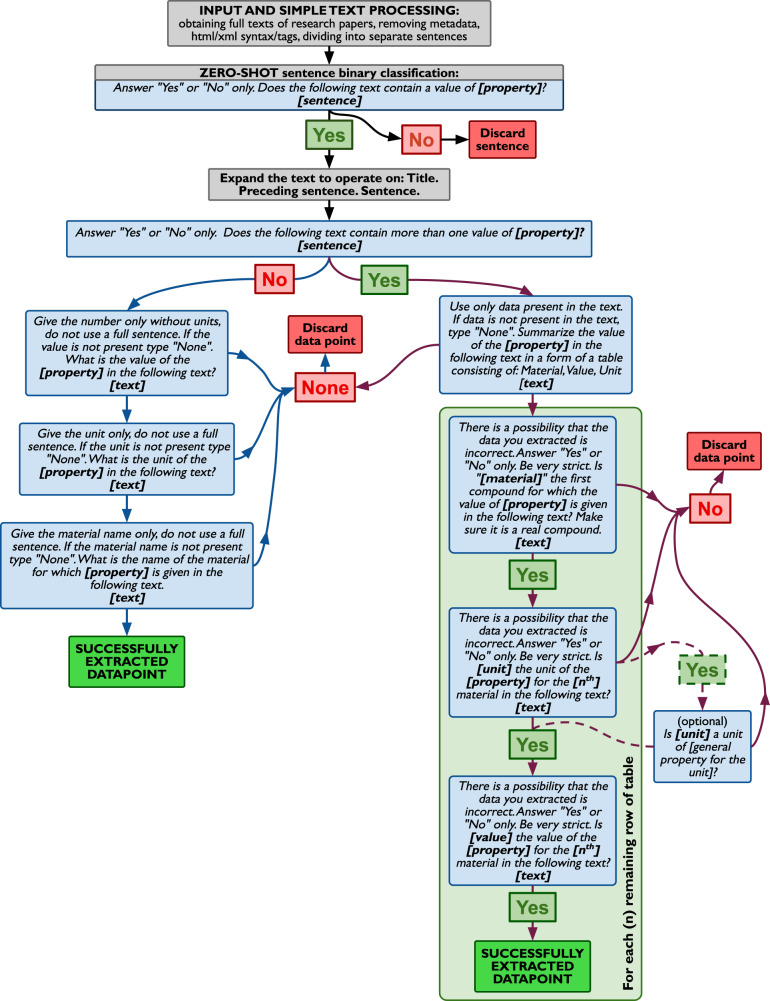
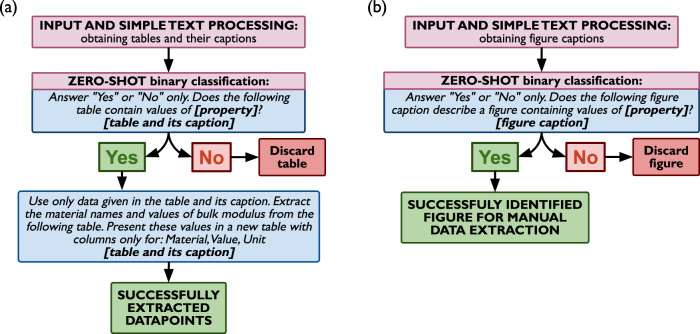
There has been a growing effort to replace manual extraction of data from research papers with automated data extraction based on natural language processing, language models, and recently, large language models (LLMs). Although these methods enable efficient extraction of data from large sets of research papers, they require a significant amount of up-front effort, expertise, and coding. In this work, we propose the method that can fully automate very accurate data extraction with minimal initial effort and background, using an advanced conversational LLM. consists of a set of engineered prompts applied to a conversational LLM that both identify sentences with data, extract that data, and assure the data’s correctness through a series of follow-up questions. These follow-up questions largely overcome known issues with LLMs providing factually inaccurate responses. can be applied with any conversational LLMs and yields very high quality data extraction. In tests on materials data, we find precision and recall both close to 90% from the best conversational LLMs, like GPT-4. We demonstrate that the exceptional performance is enabled by the information retention in a conversational model combined with purposeful redundancy and introducing uncertainty through follow-up prompts. These results suggest that approaches similar to , due to their simplicity, transferability, and accuracy are likely to become powerful tools for data extraction in the near future. Finally, databases for critical cooling rates of metallic glasses and yield strengths of high entropy alloys are developed using .
Overview
The claims and statistics of this paper haven’t been checked yet.
Free: it reads the open-access text and checks the first 5 claims that cite a source we can check. Create a free account to check every claim.
Integrity signals
Registry
Cites
Statistics
Figures

Verification
Claims the paper makes
The claims and statistics of this paper haven’t been checked yet.
Free: it reads the open-access text and checks the first 5 claims that cite a source we can check. Create a free account to check every claim.
Claims other papers make about this one
Each is checked against this paper’s own text: does it say what the citing paper says it does?
The source backs part of the claim, not all of it — or backs it for a different population, condition or comparison.
In the citing paper
“Although these proof-of-concept studies have reported encouraging results and the potential to substantially reduce manual workload and human error, most evaluations have been limited to single models, small or restricted datasets, or single extraction runs (15–20).”
From Performance of large language models and prompt engineering strategies for data extraction in systematic reviews (2026) · cites this paper as [18]
Experimental — accuracy not yet measuredThe cited source says what the claim attributes to it.
In the citing paper
“one study demonstrated that GPT-4 achieved precision and recall approaching 90% for automated extraction of structured scientific data using prompt-engineered workflows (18).”
From Performance of large language models and prompt engineering strategies for data extraction in systematic reviews (2026) · cites this paper as [18]
Self-check
Percentages, sums and reported differences re-computed from the paper’s own numbers.
The self-check needs the paper’s full text.
Citations
Cites
Language Models are Few-Shot Learners
Brown, T. B., Mann, B., Ryder, N., Subbiah, M., Kaplan, J., Dhariwal, P., Neelakantan, A., Shyam, P., Sastry, G., Askell, A., et al. (2020) · arXiv · doi:10.48550/arxiv.2005.14165 · Cited by 23,372
High-Resolution Image Synthesis with Latent Diffusion Models
Rombach, R., Blattmann, A., Lorenz, D., Esser, P., & Ommer, B. (2022) · 2022 IEEE/CVF Conference on Computer Vision and Pattern Recognition (CVPR) · doi:10.1109/cvpr52688.2022.01042 · Cited by 20,302 · cited 2×
“Prompt engineering has now become a standard practice in the field of image generation [32–34] to ensure high quality results.”
BackgroundKaugeranna, R., Kaugeranna, E., & Aion, (. S. 4. 6. (2023) · DROPS (Schloss Dagstuhl – Leibniz Center for Informatics) · doi:10.4230/lipics.giscience.2023.43 · Cited by 13,690
LLaMA: Open and Efficient Foundation Language Models
Touvron, H., Lavril, T., Izacard, G., Martinet, X., Lachaux, M.-A., Lacroix, T., Rozière, B., Goyal, N., Hambro, E., Azhar, F., et al. (2023) · arXiv · doi:10.48550/arxiv.2302.13971 · Cited by 4,602
Python Materials Genomics (pymatgen): A robust, open-source python library for materials analysis
Ong, S. P., Richards, W. D., Jain, A., Hautier, G., Kocher, M., Cholia, S., Gunter, D., Chevrier, V. L., Persson, K. A., & Ceder, G. (2013) · Computational Materials Science · doi:10.1016/j.commatsci.2012.10.028 · Cited by 4,534
Training language models to follow instructions with human feedback
Ouyang, L., Wu, J., Jiang, X., Almeida, D., Wainwright, C. L., Mishkin, P., Zhang, C., Agarwal, S., Slama, K., Ray, A., et al. (2022) · arXiv · doi:10.48550/arxiv.2203.02155 · Cited by 4,208
Llama 2: Open Foundation and Fine-Tuned Chat Models
Touvron, H., Martin, L., Stone, K., Albert, P., Almahairi, A., Babaei, Y., Bashlykov, N., Batra, S., Bhargava, P., Bhosale, S., et al. (2023) · arXiv · doi:10.48550/arxiv.2307.09288 · Cited by 2,604 · cited 1×
“As an alternative model to assess, we chose LLaMA2-chat (70B) [39], a model developed by GenAI (Meta), which has extensive documentation [40], and is available to download for free and use locally without limits.”
MethodHierarchical Text-Conditional Image Generation with CLIP Latents
Ramesh, A., Dhariwal, P., Nichol, A., Chu, C., & Chen, M. (2022) · arXiv · doi:10.48550/arxiv.2204.06125 · Cited by 2,511
Large language models are zero-shot reasoners
Kojima, T., Gu, S. (., Reid, M., Matsuo, Y., & Iwasawa, Y. (2022) · Advances in Neural Information Processing Systems 35 · doi:10.52202/068431-1613 · Cited by 2,013
Large Language Models are Zero-Shot Reasoners
Kojima, T., Gu, S. S., Reid, M., Matsuo, Y., & Iwasawa, Y. (2022) · arXiv · doi:10.48550/arxiv.2205.11916 · Cited by 2,013
Research works printed but not linked: 1
- Polak, M. P. & Morgan, D. Datasets and Supporting Information to the paper entitled ‘Extracting accurate materials data from research papers with conversational language models and prompt engineering’ (2023). PMC10882009 38383556
Cited by
Summary of ChatGPT-Related Research and Perspective Towards the Future of Large Language Models
Liu, Y., Han, T., Ma, S., Zhang, J., Yang, Y., Tian, J., He, H., Li, A., He, M., Liu, Z., et al. (2023) · arXiv · doi:10.48550/arxiv.2304.01852 · Cited by 1,172
Summary of ChatGPT-Related research and perspective towards the future of large language models
Liu, Y., Han, T., Ma, S., Zhang, J., Yang, Y., Tian, J., He, H., Li, A., He, M., Liu, Z., et al. (2023) · Meta-Radiology · doi:10.1016/j.metrad.2023.100017 · Cited by 855
“Polak et al. [76] proposed ChatExtract method - consisting of a set of engineering prompts applied to a conversational LLM - for automatic data extraction.”
MethodPrompt Engineering in Large Language Models
Marvin, G., Hellen, N., Jjingo, D., & Nakatumba-Nabende, J. (2024) · Algorithms for Intelligent Systems · doi:10.1007/978-981-99-7962-2_30 · Cited by 403
Kang, Y., & Kim, J. (2024) · Nature Communications · doi:10.1038/s41467-024-48998-4 · Cited by 236
Korzynski, P., Mazurek, G., Krzypkowska, P., & Kurasinski, A. (2023) · Entrepreneurial Business and Economics Review · doi:10.15678/eber.2023.110302 · Cited by 235
“Science – data extraction: Polak and Morgan (2023) proposed the ChatExtract method using engi‐ neered prompts applied to a conversational LLM for accurate data extraction from research articles.”
MethodArtificial Intelligence for Materials Discovery, Development, and Optimization
Madika, B., Saha, A., Kang, C., Buyantogtokh, B., Agar, J., Wolverton, C. M., Voorhees, P., Littlewood, P., Kalinin, S., & Hong, S. (2025) · ACS Nano · doi:10.1021/acsnano.5c04200 · Cited by 171
From text to insight: large language models for chemical data extraction
Schilling-Wilhelmi, M., Ríos-García, M., Shabih, S., Gil, M. V., Miret, S., Koch, C. T., Márquez, J. A., & Jablonka, K. M. (2025) · Chemical Society Reviews · doi:10.1039/d4cs00913d · Cited by 142
A Multiagent-Driven Robotic AI Chemist Enabling Autonomous Chemical Research On Demand
Song, T., Luo, M., Zhang, X., Chen, L., Huang, Y., Cao, J., Zhu, Q., Liu, D., Zhang, B., Zou, G., et al. (2025) · Journal of the American Chemical Society · doi:10.1021/jacs.4c17738 · Cited by 171
Applications of natural language processing and large language models in materials discovery
Jiang, X., Wang, W., Tian, S., Wang, H., Lookman, T., & Su, Y. (2025) · npj Computational Materials · doi:10.1038/s41524-025-01554-0 · Cited by 145
“Polak et al. 100 proposed ChatExtract to automate precise data with minimal initial effort and background knowledge.”
Enabling large language models for real-world materials discovery
Miret, S., & Krishnan, N. M. A. (2025) · Nature Machine Intelligence · doi:10.1038/s42256-025-01058-y · Cited by 166
Partners, C. M. A., Bào, Y., Zhang, Z., Zhao, W., Xiao, J., Song, S., He, S., Zhang, G., Li, Y., Zhao, G., et al. (2025) · Nucleic Acids Research · doi:10.1093/nar/gkaf1172 · Cited by 160
“Evaluation results show that when using open-source models, OmniExtract achieves a high accuracy with ranges from 82.63% to 89.00% across three public datasets: the WikiReading Recycled dataset [96], the CriticalCoolingRates dataset [97], and the Yidu-S4K dataset.”
InfluentialData extraction from polymer literature using large language models
Gupta, S., Mahmood, A. U., Shetty, P., Adeboye, A., & Ramprasad, R. (2024) · Communications Materials · doi:10.1038/s43246-024-00708-9 · Cited by 130
“Polak and Morgan proposed a similar work fl ow for metallic glassesand high entropyalloys,employingfollow-up questionsto GPT-4to ensure correctness and address the issues of hallucinations with LLMs 30 .”
Potential Roles of Large Language Models in the Production of Systematic Reviews and Meta-Analyses
Luo, X., Chen, F., Zhu, D., Wang, L., Wang, Z., Liu, H., Lyu, M., Wang, Y., Wang, Q., & Chen, Y. (2024) · Journal of Medical Internet Research · doi:10.2196/56780 · Cited by 113
Accelerating materials language processing with large language models
Choi, J., & Lee, B. (2024) · Communications Materials · doi:10.1038/s43246-024-00449-9 · Cited by 118
Probing the limitations of multimodal language models for chemistry and materials research
Alampara, N., Schilling-Wilhelmi, M., Ríos-García, M., Mandal, I., Khetarpal, P., Grover, H. S., Krishnan, N. M. A., & Jablonka, K. M. (2025) · Nature Computational Science · doi:10.1038/s43588-025-00836-3 · Cited by 124
AtomGPT: Atomistic Generative Pretrained Transformer for Forward and Inverse Materials Design
Choudhary, K. (2024) · The Journal of Physical Chemistry Letters · doi:10.1021/acs.jpclett.4c01126 · Cited by 72
“However, if we attempt to perform forward/inverse materials design tasks, the outcomes are quite poor.”
MethodLarge Language Models for Inorganic Synthesis Predictions
Kim, S., Jung, Y., & Schrier, J. (2024) · Journal of the American Chemical Society · doi:10.1021/jacs.4c05840 · Cited by 73
Huber, S. E., Kiili, K., Nebel, S., Ryan, R. M., Sailer, M., & Ninaus, M. (2024) · Educational Psychology Review · doi:10.1007/s10648-024-09868-z · Cited by 85
“Such an approach has already been utilized in the form of prompt engineering in various domains (Oppenlaender et al., 2023; Polak & Morgan, 2023; Short & Short, 2023; Shue et al., 2023; Wang et al., 2023; White et al., 2023; Zhu et al., 2023).”
MethodAgent-based learning of materials datasets from the scientific literature
Ansari, M., & Moosavi, S. M. (2024) · Digital Discovery · doi:10.1039/d4dd00252k · Cited by 103
Automating construction contract review using knowledge graph-enhanced large language models
Zheng, C., Wong, S., Su, X., Tang, Y., Nawaz, A., & Kassem, M. (2025) · Automation in Construction · doi:10.1016/j.autcon.2025.106179 · Cited by 91
“For example, Polak and Morgan [45] proposed a fully automated data extraction framework leveraging GPT-4, which required minimal manual input and demonstrated efficiency in complex scenarios.”
Interpretable Machine Learning Applications: A Promising Prospect of AI for Materials
Jiang, X. F., Fu, H., Bai, Y., Jiang, L., Zhang, H., Wang, W., Yun, P., He, J., Xue, D., Lookman, T., et al. (2025) · Advanced Functional Materials · doi:10.1002/adfm.202507734 · Cited by 96
A general approach for determining applicability domain of machine learning models
Schultz, L. E., Wang, Y., Jacobs, R. M., & Morgan, D. D. (2025) · npj Computational Materials · doi:10.1038/s41524-025-01573-x · Cited by 91
“…detection and microstructure segmentation 4,5 ,assimilationofdataandknowledgefrompublicationsusing naturallanguageprocessingandlargelanguagemodels 6,7 ,and fi ttingofML-basedinteratomicpotentialsrepresenting nearly all elementsintheperiodic table to enable fast and accurate atomistic simulations…”
Self-citationLi, J., Liu, Y., Wang, X., Peng, Y., Sun, C., Wang, S., Sun, Z., Ke, T., Jiang, X., Lu, T., et al. (2025) · IEEE Computer Society Conference on Computer Vision and Pattern Recognition/Proceedings - IEEE Computer Society Conference on Computer Vision and Pattern Recognition/Proceedings · doi:10.1109/cvpr52734.2025.02146 · Cited by 105
“Different from the pre-training and then fine-tuning paradigm, P-E can utilize pre-trained foundation models to complete downstream tasks directly with prompts [34].”
InfluentialSteering towards safe self-driving laboratories
Leong, S. X., Griesbach, C. E., Zhang, R., Darvish, K., Zhao, Y., Mandal, A., Zou, Y., Hao, H., Bernales, V., & Aspuru‐Guzik, A. (2025) · Nature Reviews Chemistry · doi:10.1038/s41570-025-00747-x · Cited by 96
Large-language models: The game-changers for materials science research
Yu, S., Ran, N., & Liu, J. (2024) · Artificial Intelligence Chemistry · doi:10.1016/j.aichem.2024.100076 · Cited by 55
Cross-disciplinary perspectives on the potential for artificial intelligence across chemistry
Mroz, A. M., Basford, A. R., Hastedt, F., Jayasekera, I. S., Mosquera‐Lois, I., Sedgwick, R., Ballester, P. J., Bocarsly, J. D., del Rio‐Chanona, E. A., Evans, M. L., et al. (2025) · Chemical Society Reviews · doi:10.1039/d5cs00146c · Cited by 73
Polak, M. P., Modi, S., Latosinska, A., Zhang, J., Wang, C.-W., Wang, S., Hazra, A. D., & Morgan, D. D. (2024) · Digital Discovery · doi:10.1039/d4dd00016a · Cited by 72
“One limiting case, which we will call ”small data”, is one where only a small amount of data is available in the literature (for example, properties that are very new, very hard to measure, or studied by only a small community), and where completeness and accuracy are highly valued.”
BackgroundSelf-citationWickramasekara, A., Breitinger, F., & Scanlon, M. (2025) · Forensic Science International Digital Investigation · doi:10.1016/j.fsidi.2024.301859 · Cited by 89
“Certainly, AutoGen stands out as a multiagent framework with the capability to autonomously perform tasks or collaborate with human feedback.”
Applications of Large Language Models in Pathology
Cheng, J. (2024) · Bioengineering · doi:10.3390/bioengineering11040342 · Cited by 66
“Prompt engineering is the process of designing questions and instructions in order to obtain the best response from an LLM [61].”
BackgroundFu, X., Wang, R., & Li, C. (2023) · Journal of the American Planning Association · doi:10.1080/01944363.2023.2271893 · Cited by 64
Large‐Language‐Model‐Based AI Agent for Organic Semiconductor Device Research
Zhang, Q., Hu, Y., Yan, J., Zhang, H., Xie, X., Zhu, J., Li, H., Niu, X., Li, L., Sun, Y., et al. (2024) · Advanced Materials · doi:10.1002/adma.202405163 · Cited by 72
AI-empowered scale development: Testing the potential of ChatGPT
Hoffmann, S., Lasarov, W., & Dwivedi, Y. K. (2024) · Technological Forecasting and Social Change · doi:10.1016/j.techfore.2024.123488 · Cited by 57
Peivaste, I., Belouettar, S., Mercuri, F., Fantuzzi, N., Dehghani, H., Izadi, R., Ibrahim, H., Lengiewicz, J., Belouettar-Mathis, M., Bendine, K., et al. (2025) · Composite Structures · doi:10.1016/j.compstruct.2025.119419 · Cited by 54
“DIVE” into hydrogen storage materials discovery with AI agents
Zhang, D., Jia, X., Tran, H. B., Jang, S. H., Zhang, L., Sato, R., Hashimoto, Y., Sato, T., Konno, K., Orimo, S., et al. (2026) · Chemical Science · doi:10.1039/d5sc09921h · Cited by 55
“If such AI-driven agents are directly integrated with high-throughput experimental platforms, the efficiency of materials development could be advanced to an unprecedented level.”
Large language model for knowledge synthesis and AI-enhanced biomanufacturing
Li, W., Mao, Z., Xiao, Z., Liao, X., Koffas, M. A. G., Chen, Y., Ma, H., & Tang, Y. (2025) · Trends in biotechnology · doi:10.1016/j.tibtech.2025.02.008 · Cited by 55
AI-based nanotoxicity data extraction and prediction of nanotoxicity
Ha, E., Ha, S. M., Gerelkhuu, Z., Kim, H.-Y., & Yoon, T. H. (2025) · Computational and Structural Biotechnology Journal · doi:10.1016/j.csbj.2025.03.052 · Cited by 47
“As noted in other studies [30,31], well-designed prompts and clear contextual guidance can significantly reduce hallucination occurrences, ensuring the extraction of accurate and relevant data.”
Large Language Model for Qualitative Research: A Systematic Mapping Study
Barros, C., Azevedo, B. B., Neto, V. V. G., Kassab, M., Kalinowski, M., do Nascimento, H. A. D., & Bandeira, M. C. G. S. P. (2025) · IEEE/ACM International Workshop on Methodological Issues with Empirical Studies in Software Engineering (WSESE) · doi:10.1109/wsese66602.2025.00015 · Cited by 64
Zhao, Y., Zhao, Y., Wang, J., & Wang, Z. (2025) · Industrial & Engineering Chemistry Research · doi:10.1021/acs.iecr.4c04636 · Cited by 50
Empowering Generalist Material Intelligence with Large Language Models
Yuan, W., Chen, G., Wang, Z., & You, F. (2025) · Advanced Materials · doi:10.1002/adma.202502771 · Cited by 55
CURIE: Evaluating LLMs On Multitask Scientific Long Context Understanding and Reasoning
Cui, H., Shamsi, Z., Cheon, G., Ma, X., Li, S., Tikhanovskaya, M., Norgaard, P., Mudur, N., Plomecka, M., Raccuglia, P., et al. (2025) · International Conference on Learning Representations · doi:10.48550/arxiv.2503.13517 · Cited by 70
Artificial intelligence in rechargeable battery: Advancements and prospects
Xiong, Y., Zhang, D., Ruan, X., 蒋善宝, Zou, X., Yuan, W., Liu, X., Zhang, Y., Nie, Z., Wei, D., et al. (2024) · Energy storage materials · doi:10.1016/j.ensm.2024.103860 · Cited by 56
Bhattacharya, M., Pal, S., Chatterjee, S., Lee, S., & Chakraborty, C. (2024) · Molecular Therapy — Nucleic Acids · doi:10.1016/j.omtn.2024.102255 · Cited by 54
“60 Therefore, prompt engineering is valuable in biological macromolecules, biological sciences, and medicine.”
BackgroundA novel large-language-model-driven framework for named entity recognition
Wang, Z., Chen, H., Xu, G., & Ren, M. (2024) · Information Processing & Management · doi:10.1016/j.ipm.2024.104054 · Cited by 47
A Practical Guide and Assessment on Using ChatGPT to Conduct Grounded Theory: Tutorial
Yue, Y., Liu, D., Lv, Y., Hao, J., & Cui, P. (2025) · Journal of Medical Internet Research · doi:10.2196/70122 · Cited by 48
van Ertvelde, J., Verhoeven, A., Maerten, A., Cooreman, A., Rodrigues, B. D. S., Sanz-Serrano, J., Mihajlovic, M., Tripodi, I. J., Teunis, M., Jover, R., et al. (2023) · Journal of Biomedical Informatics · doi:10.1016/j.jbi.2023.104465 · Cited by 41
Review of External Field Effects on Electrocatalysis: Machine Learning Guided Design
Wang, L., Zhou, X., Luo, Z., Liu, S., Yue, S., Chen, Y., & Liu, Y. (2024) · Advanced Functional Materials · doi:10.1002/adfm.202408870 · Cited by 47
Gong, R., & Li, X. (2025) · Computers and Electronics in Agriculture · doi:10.1016/j.compag.2025.110396 · Cited by 43
Evaluating and Advancing Large Language Models for Water Knowledge Tasks in Engineering and Research
Xu, B., Li, Z., Yang, Y., Wu, G., Wang, C., Tang, X., Li, Y., Wu, Z., Su, Q., Shi, X., et al. (2025) · Environmental Science & Technology Letters · doi:10.1021/acs.estlett.5c00038 · Cited by 40
Salas, M., Singh, A., Pignataro, C., & Pal, L. (2026) · Communications Materials · doi:10.1038/s43246-026-01105-0 · Cited by 41
“Tools like Batter-yDataExtractor and ChatExtract 124,125 utilize these advanced models to process unstructured text, extracting meaningful material-property rela-tionshipswithimpressiveaccuracy.”
Rahman, M., Zhao, B., Pan, S., & Qu, Y. (2024) · Computational Materials Science · doi:10.1016/j.commatsci.2024.113624 · Cited by 37
Large language models for batteries
Zuo, W., Zheng, H., He, T., Vishwanath, V., Chan, M. K. Y., Stevens, R. L., Amine, K., & Xu, G. (2025) · Joule · doi:10.1016/j.joule.2025.102037 · Cited by 40
Beyond designer's knowledge: Generating materials design hypotheses via a large language model
Liu, Q., Polak, M. P., Kim, S. Y., Shuvo, M. A. A., Deodhar, H. S., Han, J., Morgan, D. D., & Oh, H. (2025) · Acta Materialia · doi:10.1016/j.actamat.2025.121307 · Cited by 40
Self-citationEvaluating search engines and large language models for answering health questions
Fernández-Pichel, M., Pichel, J. C., & Losada, D. E. (2025) · npj Digital Medicine · doi:10.1038/s41746-025-01546-w · Cited by 33
The northeast materials database for magnetic materials
Itani, S., Zhang, Y., & Zang, J. (2025) · Nature Communications · doi:10.1038/s41467-025-64458-z · Cited by 39
ChatGPT applications in Academic Research: A Review of Benefits, Concerns, and Recommendations
AlZaabi, A., ALAmri, A., Albalushi, H., Aljabri, R., & AalAbdulsalam, A. (2023) · doi:10.1101/2023.08.17.553688 · Cited by 32
Regression with Large Language Models for Materials and Molecular Property PredictionPreprint
Jacobs, R., Polak, M. P., Schultz, L. E., Mahdavi, H., Honavar, V., & Morgan, D. D. (2024) · arXiv (Cornell University) · doi:10.48550/arxiv.2409.06080 · Cited by 36
Self-citationLanguage models for materials discovery and sustainability: Progress, challenges, and opportunities
Pei, Z., Yin, J., & Zhang, J. (2025) · Progress in Materials Science · doi:10.1016/j.pmatsci.2025.101495 · Cited by 30
Seifrid, M. T., Lo, S., Choi, D. G., Tom, G., Le, M. L., Li, K., Sankar, R., Vuong, H., Wakidi, H., Yi, A., et al. (2024) · Journal of Materials Chemistry A · doi:10.1039/d4ta01942c · Cited by 36
AI4Materials: Transforming the landscape of materials science and engineering
Jiang, X. F., Xue, D., Bai, Y., Wang, W. Y., Liu, J., Yang, M., & Su, Y. (2025) · Review of Materials Research · doi:10.1016/j.revmat.2025.100010 · Cited by 48
GPT-4 as Evaluator: Evaluating Large Language Models on Pest Management in AgriculturePreprint
Yang, S., Yuan, Z., Li, S., Peng, R., Liu, K., & Yang, P. (2024) · arXiv (Cornell University) · doi:10.48550/arxiv.2403.11858 · Cited by 39
“In addition, prompt engineering has been applied in various domains such as medical [22, 23, 24], generative art [25], multilingual legal judgment prediction [26], and the extraction of accurate materials data [27].”
BackgroundPDFChatAnnotator: A Human-LLM Collaborative Multi-Modal Data Annotation Tool for PDF-Format Catalogs
Tang, Y., Chang, C.-M., & Yang, X. (2024) · ACM International Conference on Intelligent User Interfaces (IUI) · doi:10.1145/3640543.3645174 · Cited by 47
High-performance carbonaceous absorbers: From heterogeneous absorbents to data-driven metamaterials
Estévez, D., & Qin, F. (2024) · Carbon · doi:10.1016/j.carbon.2024.119850 · Cited by 29
Qiu, Y., Mintenig, S. M., Barchiesi, M., & Koelmans, A. A. (2025) · Environment International · doi:10.1016/j.envint.2025.109341 · Cited by 32
Large language model enhanced corpus of CO2 reduction electrocatalysts and synthesis procedures
Chen, X., Gao, Y., Wang, L., Cui, W., Huang, J., Du, Y., & Wang, B. (2024) · Scientific Data · doi:10.1038/s41597-024-03180-9 · Cited by 37
“Prompt engineering has proven to be a potential solution to mitigate the problem of artificial hallucinations 17–19 .”
BackgroundLaPA: Latent Prompt Assist Model for Medical Visual Question Answering
Gu, T., Yang, K., Liu, D., & Cai, W. (2024) · IEEE/CVF Conference on Computer Vision and Pattern Recognition Workshops (CVPRW) · doi:10.1109/cvprw63382.2024.00502 · Cited by 44
Xu, B., Wu, G., Li, Z., Xu, G., Zeng, H., Tong, R., & Ng, H. Y. (2025) · npj Clean Water · doi:10.1038/s41545-025-00509-8 · Cited by 36
Assessing the practical feasibility of solid-state lithium–sulfur batteries
Wang, G., Luo, X., Sun, W., & Cai, J. (2025) · Communications Materials · doi:10.1038/s43246-025-00918-9 · Cited by 33
“Although several open materials science databases havebeenavailableforresearcherstoreference 183 – 187 ,inconsistentstandards among these databases have led many researchers to still prefer mining and collectingdatafrompublishedliterature 188,189 .”
Automated electrosynthesis reaction mining with multimodal large language models (MLLMs)
Leong, S. X., Pablo‐García, S., Zhang, Z., & Aspuru‐Guzik, A. (2024) · Chemical Science · doi:10.1039/d4sc04630g · Cited by 40
Jacobs, R. M., Schultz, L. E., Scourtas, A., Schmidt, K. J., Price-Skelly, O., Engler, W., Foster, I. T., Blaiszik, B. J., Voyles, P. M., & Morgan, D. D. (2024) · Machine Learning Science and Technology · doi:10.1088/2632-2153/ad95db · Cited by 40
Self-citationKurniati, E. O., Zeng, H., Latypov, M. I., & Kim, H.-J. (2024) · Case Studies in Construction Materials · doi:10.1016/j.cscm.2024.e03373 · Cited by 42
Wang, W., Zhao, R., Han, R., Shang, Y.-H., Yang, Y. G., Liu, S., Zhang, S., Hu, Y., Sun, Y., Li, M.-X., et al. (2025) · Materials Futures · doi:10.1088/2752-5724/adcfb6 · Cited by 30
Ortloff, A.-M., Martius, F., Meier, M., Sans-Raimbault, T., Geierhaas, L., & Smith, M. (2025) · CHI Conference on Human Factors in Computing Systems · doi:10.1145/3706598.3713671 · Cited by 30
Unified multimodal multidomain polymer representation for property prediction
Huang, Q., Li, Y., Zhu, L., Zhao, Q., & Yu, W. (2025) · npj Computational Materials · doi:10.1038/s41524-025-01652-z · Cited by 42
“Recent works 36,37 have successfully extracted domain-speci fi c insights and material data from these models, showcasing their capacity to generate meaningful, context-rich captions for polymers.”
Distilling Knowledge from Catalysis Literature with Long-Context Large Language Model Agents
Chen, H., Liu, H., Tew, Y., Ren, X., Tang, X., & Wang, X. (2025) · ACS Catalysis · doi:10.1021/acscatal.5c06431 · Cited by 29
Choudhary, K. K. (2025) · The Journal of Physical Chemistry Letters · doi:10.1021/acs.jpclett.4c03137 · Cited by 25
“− 36 Nevertheless, inspired by its simplicity of use and the massive success of ChatGPT, an alternate model, AtomGPT, was introduced, tailored for forward and inverse materials design.”
Vijayan, A. (2023) · International Conference on Algorithms, Computing and Artificial Intelligence (ACAI) · doi:10.1145/3639631.3639663 · Cited by 36
Materials Informatics: Emergence to Autonomous Discovery in the Age of AI
Lookman, T., Liu, Y., & Gao, Z. (2026) · Advanced Materials · doi:10.1002/adma.202515941 · Cited by 37
“The goal therefore is to first build databases of structured data and extract insights from this information, in as an automated manner as possible, and to train the transformers so that new materials with desired properties may be synthesized [98–102] .”
InfluentialGeneral-Purpose Models for the Chemical Sciences: LLMs and Beyond
Alampara, N., Aneesh, A., Ríos-García, M., Mirza, A., Schilling-Wilhelmi, M., Aghajani, A. A., Sun, M., Prastalo, G., & Jablonka, K. M. (2026) · Chemical Reviews · doi:10.1021/acs.chemrev.5c00583 · Cited by 37
Rethinking the production and publication of machine-readable expressions of research findings
Stocker, M., Snyder, L. D., Anfuso, M., Ludwig, O., Thießen, F., Farfar, K. E., Haris, M., Oelen, A., & Jaradeh, M. Y. (2025) · Scientific Data · doi:10.1038/s41597-025-04905-0 · Cited by 32
“In this third use case, we highlight how reborn supports expressing rich scientific knowledge, including complex tabular data, in machine-reusable form.”
Cost-efficient prompt engineering for unsupervised entity resolution in the product matching domain
Nananukul, N., Sisaengsuwanchai, K., & Kejriwal, M. (2024) · Discover Artificial Intelligence · doi:10.1007/s44163-024-00159-8 · Cited by 23
Walls, B. W., & Linic, S. (2025) · ACS Catalysis · doi:10.1021/acscatal.5c03844 · Cited by 26
Chen, G., Song, T., Wang, Q., Ma, Z., Hu, J., Li, Q., & Wu, C. (2025) · Neurocomputing · doi:10.1016/j.neucom.2025.131230 · Cited by 28
The Power of AI-Generated Content: Evidence From the Peer-to-Peer Accommodation Market
Fan, N., Li, X. R., Liu, C., & Fan, Z. (2025) · Journal of Travel Research · doi:10.1177/00472875251332951 · Cited by 26
“Third, our research underscores the importance of prompt design strategies, thereby contributing to the growing body of knowledge on prompt engineering (Polak & Morgan, 2024; Short & Short, 2023; M. Wang et al., 2024).”
Large Language Models (LLMs) for Materials Design
Zhang, L., Liu, Z., Ni, B., & Wang, Q. (2025) · Advanced Functional Materials · doi:10.1002/adfm.202525897 · Cited by 36
OpenPoly: A Polymer Database Empowering Benchmarking and Multi-property Predictions
Wang, J.-F., Sun, Y.-B., Chen, Q.-T., Ji, F., Song, Y., Ruan, M., & Wang, Y. (2025) · Chinese Journal of Polymer Science · doi:10.1007/s10118-025-3402-y · Cited by 28
Mi, K., Wu, X., & Lin, Z. (2025) · Environment International · doi:10.1016/j.envint.2025.109339 · Cited by 23
Ocassionally Secure: A Comparative Analysis of Code Generation AssistantsPreprint
Elgedawy, R., Dosch, P., Sadik, J., Dutta, S., Gautam, A., Georgiou, K., Gholamrezae, F., Ji, F., Lim, K., Liu, Q., et al. (2024) · arXiv (Cornell University) · doi:10.48550/arxiv.2402.00689 · Cited by 29
“Prompt engineering has also been studied extensively, with works by White et al. [44], Zhou et al. [48], and Polak et al. [27] exploring how varying prompt structures can influence output quality.”
Wu, J., Shi, R., Zhou, X. Y., Zhang, L., Chen, K., Yu, H., & Wu, Y. S. (2025) · Angewandte Chemie International Edition · doi:10.1002/anie.202520525 · Cited by 22
LLaMP: Large Language Model Made Powerful for High-fidelity Materials Knowledge Retrieval
Chiang, Y., Hsieh, E., Chou, C.-H., & Riebesell, J. (2025) · Conference on Empirical Methods in Natural Language Processing (EMNLP) · doi:10.18653/v1/2025.emnlp-main.1280 · Cited by 30
Ahlawat, D. K., Mishra, V., Singh, S., Zaki, M. F. M., Bihani, V., Grover, H. S., Mishra, B., Miret, S., Mausam, & Krishnan, N. M. A. (2026) · Nature Machine Intelligence · doi:10.1038/s42256-026-01199-8 · Cited by 33
Shi, H., & Zhao, Y. (2024) · Environmental Science & Technology · doi:10.1021/acs.est.4c07524 · Cited by 22
da Silva, V. T., Rademaker, A., Lionti, K., Giro, R., Lima, G., Fiorini, S. R., Archanjo, M., Carvalho, B. W., Ferreira, R. N. B., de Souza, A. A. U., et al. (2024) · arXiv (Cornell University) · doi:10.48550/arxiv.2411.03484 · Cited by 25
“For example, Polak et al. (2024) [19] reported a pipeline for extracting information from unstructured text in the material discovery domain using language models.”
BackgroundResultChiang, Y., Hsieh, E., Chou, C.-H., & Riebesell, J. (2024) · arXiv · doi:10.48550/arxiv.2401.17244 · Cited by 19
“Polak and Morgan [28] employ a prompt workflow to extract the cooling rates of metallic glasses and yield strengths of high entropy alloys.”
MethodEngineering material failure analysis report generation based on QWen and Llama2
Chang, S., Wan, M., Wang, J., Du, H. Y., Zhang, P., & Shi, P. (2025) · Results in Engineering · doi:10.1016/j.rineng.2025.104532 · Cited by 21
Wang, L., Wang, M., Zhang, Y.-R., Ma, J., Shao, H.-Y., & Chang, Z.-X. (2025) · Applied Sciences · doi:10.3390/app15073502 · Cited by 22
Building an end-to-end battery recipe knowledge base via transformer-based text mining
Lee, D., Mizuseki, H., Choi, J., & Lee, B. (2025) · Communications Materials · doi:10.1038/s43246-025-00825-z · Cited by 20
“WhilerecentadvancesinLLMs,suchas GPT-4,havedemonstratedcompetitiveperformanceinNERtasks 52,53 ,their applicationtolarge-scalebatterydataextractionpresentsseveral challenges, including cost, consistency, and interpretability 54 .”
Wang, Q., Zhang, W., Chen, M., Li, X., Xiong, Z., Xiong, J., Fu, Z., & Zheng, M. (2025) · Chemical Science · doi:10.1039/d4sc08802f · Cited by 30
“46 38 MatSci-NLP demonstrated how instruction tuning enhances LLM performance, 39 while LLaMat showed that continued pretraining on materials science literature, followed by instruction tuning, enables superior performance in specialized tasks compared to general-purpose LLMs. 40 LLMs are also used…”
Zhang, X., Zhou, Z., Chen, M., & Sun, Y. (2023) · The Journal of Physical Chemistry Letters · doi:10.1021/acs.jpclett.3c02848 · Cited by 24
“As the NLP field shifted towards large language models (LLMs)[29], interests in applying LLMs to data-mining papers have emerged[30, 31].”
BackgroundKeck, F., Broadbent, H., & Altermatt, F. (2026) · Ecology and Evolution · doi:10.1101/2025.01.24.634685 · Cited by 20
Local large language model‐assisted literature mining for on‐surface reactions
Xiang, J., Li, Y., Zhang, X., He, Y., & Sun, Q. (2025) · Materials Genome Engineering Advances · doi:10.1002/mgea.88 · Cited by 22
Metadata
- Authors
- Polak, M. P., & Morgan, D.
- Affiliations
- University of Wisconsin–Madison (US)
- Corresponding author
- Polak, Maciej P.
- Morgan, Dane
- Venue
- Nature Communications
- Published
- 2024-02-21
- Volume
- 15
- Issue
- 1
- Pages
- 1569-1569
- ISSN
- 2041-1723 (ISSN-L)
- PMC
- PMC10882009
- OpenAlex
- W4392002118
- Cited by
- 365
- References
- 40
- Citations by year
- 2026: 136 · 2025: 156 · 2024: 70
- FWCI
- 35.33
- Type
- journal article
- Language
- en
- Open access
- gold
- doi.org
- Licence
- cc-by
- creativecommons.org/licenses/by/4.0 (tdm)
- creativecommons.org/licenses/by/4.0 (vor)
- Locations
- Nature Communications (publishedVersion, cc-by)
- PubMed Central (publishedVersion, cc-by)
- PubMed (publishedVersion)
- DOAJ (DOAJ: Directory of Open Access Journals) (submittedVersion)
- Funders
- National Science Foundation (1931298)
- Topics
- Physical Sciences › Materials Science › Materials Chemistry › Machine Learning in Materials Science
- Physical Sciences › Computer Science › Artificial Intelligence › Topic Modeling
- Social Sciences › General Social Sciences › Computational and Text Analysis Methods
- Keywords
- automated data extraction, research papers, prompt engineering, materials data, factual accuracy, amorphous alloys, critical cooling rate, high-entropy alloys, yield strength, information retention
About these checks
Registry, retraction, Cites and statistics results are computed, not judged, with one exception: a printed reference that no index lists is read once by a model before it counts as a citation error. Claims are extracted by a model and kept only when their quote appears verbatim in the text; each cited source is then checked, with a model’s help, for whether it says what the claim relies on. Those verdicts can be wrong — read the claim’s quote and the cited source before relying on one.
Statistics and arithmetic are recomputed, not judged.
Confidence bands are shown only for fields calibrated on our annotated test set. None is calibrated yet, so no band is shown.
What counts as a claim ›How we measure confidence ›How we check this ›
Are you an author, or do you see a problem with this page? Request a review
Data sources
Bibliographic data: Semantic Scholar, OpenAlex, Crossref.
Contains information from the Semantic Scholar Academic Graph Datasets, made available under the ODC Attribution License (ODC-BY 1.0).
Semantic Scholar’s data is described in: Kinney, R., et al. (2023). The Semantic Scholar Open Data Platform. arXiv:2301.10140.
