

Extracting accurate materials data from research papers with conversational language models and prompt engineering
Open accessThe DOI matches its Crossref record; 46 of the 46 references it cites were found in a registry or an index.
Abstract
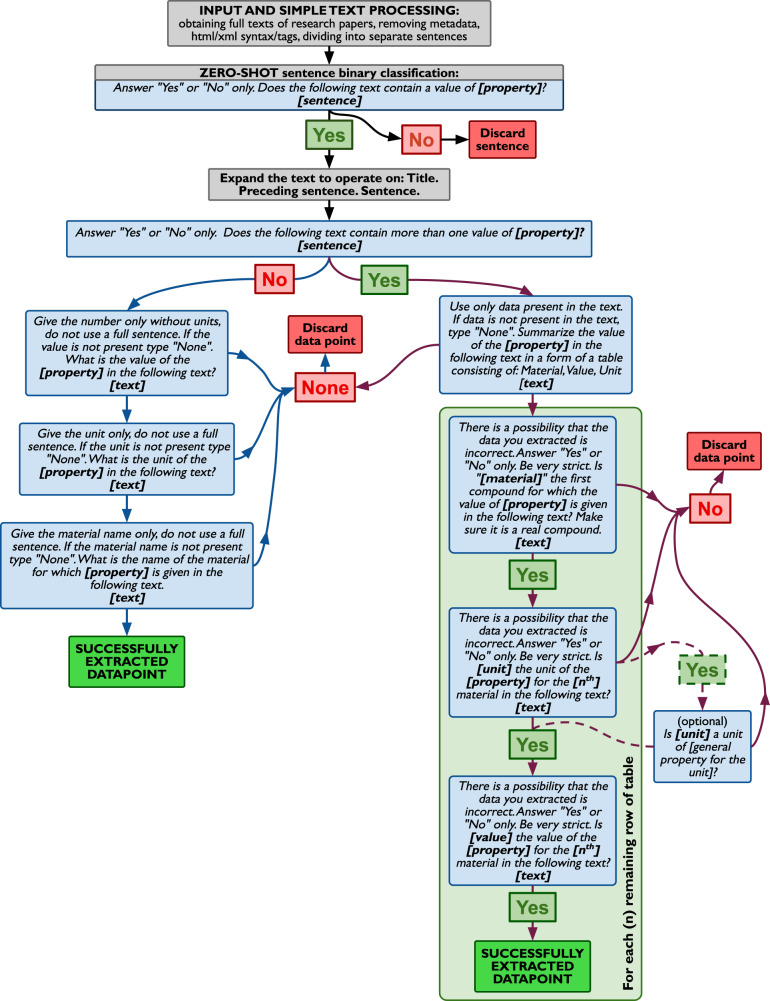
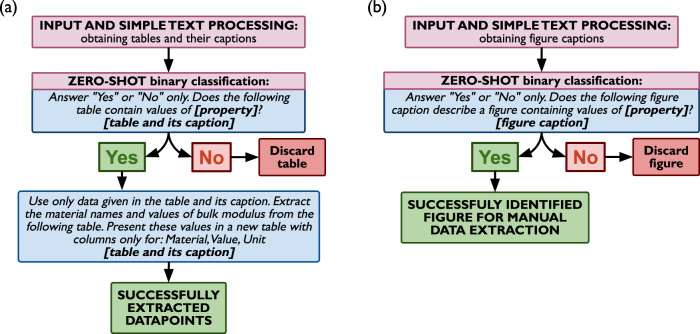
There has been a growing effort to replace manual extraction of data from research papers with automated data extraction based on natural language processing, language models, and recently, large language models (LLMs). Although these methods enable efficient extraction of data from large sets of research papers, they require a significant amount of up-front effort, expertise, and coding. In this work, we propose the method that can fully automate very accurate data extraction with minimal initial effort and background, using an advanced conversational LLM. consists of a set of engineered prompts applied to a conversational LLM that both identify sentences with data, extract that data, and assure the data’s correctness through a series of follow-up questions. These follow-up questions largely overcome known issues with LLMs providing factually inaccurate responses. can be applied with any conversational LLMs and yields very high quality data extraction. In tests on materials data, we find precision and recall both close to 90% from the best conversational LLMs, like GPT-4. We demonstrate that the exceptional performance is enabled by the information retention in a conversational model combined with purposeful redundancy and introducing uncertainty through follow-up prompts. These results suggest that approaches similar to , due to their simplicity, transferability, and accuracy are likely to become powerful tools for data extraction in the near future. Finally, databases for critical cooling rates of metallic glasses and yield strengths of high entropy alloys are developed using .
Overview
The claims and statistics of this paper haven’t been checked yet.
Free: it reads the open-access text and checks the first 5 claims that cite a source we can check. Create a free account to check every claim.
Integrity signals
Registry
Cites
Statistics
Figures

Verification
Claims the paper makes
The claims and statistics of this paper haven’t been checked yet.
Free: it reads the open-access text and checks the first 5 claims that cite a source we can check. Create a free account to check every claim.
Claims other papers make about this one
Each is checked against this paper’s own text: does it say what the citing paper says it does?
The source backs part of the claim, not all of it — or backs it for a different population, condition or comparison.
In the citing paper
“Although these proof-of-concept studies have reported encouraging results and the potential to substantially reduce manual workload and human error, most evaluations have been limited to single models, small or restricted datasets, or single extraction runs (15–20).”
From Performance of large language models and prompt engineering strategies for data extraction in systematic reviews (2026) · cites this paper as [18]
Experimental — accuracy not yet measuredThe cited source says what the claim attributes to it.
In the citing paper
“one study demonstrated that GPT-4 achieved precision and recall approaching 90% for automated extraction of structured scientific data using prompt-engineered workflows (18).”
From Performance of large language models and prompt engineering strategies for data extraction in systematic reviews (2026) · cites this paper as [18]
Self-check
Percentages, sums and reported differences re-computed from the paper’s own numbers.
The self-check needs the paper’s full text.
Citations
Cites
Language Models are Few-Shot Learners
Brown, T. B., Mann, B., Ryder, N., Subbiah, M., Kaplan, J., Dhariwal, P., Neelakantan, A., Shyam, P., Sastry, G., Askell, A., et al. (2020) · arXiv · doi:10.48550/arxiv.2005.14165 · Cited by 23,372
High-Resolution Image Synthesis with Latent Diffusion Models
Rombach, R., Blattmann, A., Lorenz, D., Esser, P., & Ommer, B. (2022) · 2022 IEEE/CVF Conference on Computer Vision and Pattern Recognition (CVPR) · doi:10.1109/cvpr52688.2022.01042 · Cited by 20,302 · cited 2×
“Prompt engineering has now become a standard practice in the field of image generation [32–34] to ensure high quality results.”
BackgroundKaugeranna, R., Kaugeranna, E., & Aion, (. S. 4. 6. (2023) · DROPS (Schloss Dagstuhl – Leibniz Center for Informatics) · doi:10.4230/lipics.giscience.2023.43 · Cited by 13,690
LLaMA: Open and Efficient Foundation Language Models
Touvron, H., Lavril, T., Izacard, G., Martinet, X., Lachaux, M.-A., Lacroix, T., Rozière, B., Goyal, N., Hambro, E., Azhar, F., et al. (2023) · arXiv · doi:10.48550/arxiv.2302.13971 · Cited by 4,602
Python Materials Genomics (pymatgen): A robust, open-source python library for materials analysis
Ong, S. P., Richards, W. D., Jain, A., Hautier, G., Kocher, M., Cholia, S., Gunter, D., Chevrier, V. L., Persson, K. A., & Ceder, G. (2013) · Computational Materials Science · doi:10.1016/j.commatsci.2012.10.028 · Cited by 4,534
Training language models to follow instructions with human feedback
Ouyang, L., Wu, J., Jiang, X., Almeida, D., Wainwright, C. L., Mishkin, P., Zhang, C., Agarwal, S., Slama, K., Ray, A., et al. (2022) · arXiv · doi:10.48550/arxiv.2203.02155 · Cited by 4,208
Llama 2: Open Foundation and Fine-Tuned Chat Models
Touvron, H., Martin, L., Stone, K., Albert, P., Almahairi, A., Babaei, Y., Bashlykov, N., Batra, S., Bhargava, P., Bhosale, S., et al. (2023) · arXiv · doi:10.48550/arxiv.2307.09288 · Cited by 2,604 · cited 1×
“As an alternative model to assess, we chose LLaMA2-chat (70B) [39], a model developed by GenAI (Meta), which has extensive documentation [40], and is available to download for free and use locally without limits.”
MethodHierarchical Text-Conditional Image Generation with CLIP Latents
Ramesh, A., Dhariwal, P., Nichol, A., Chu, C., & Chen, M. (2022) · arXiv · doi:10.48550/arxiv.2204.06125 · Cited by 2,511
Large language models are zero-shot reasoners
Kojima, T., Gu, S. (., Reid, M., Matsuo, Y., & Iwasawa, Y. (2022) · Advances in Neural Information Processing Systems 35 · doi:10.52202/068431-1613 · Cited by 2,013
Large Language Models are Zero-Shot Reasoners
Kojima, T., Gu, S. S., Reid, M., Matsuo, Y., & Iwasawa, Y. (2022) · arXiv · doi:10.48550/arxiv.2205.11916 · Cited by 2,013
Research works printed but not linked: 1
- Polak, M. P. & Morgan, D. Datasets and Supporting Information to the paper entitled ‘Extracting accurate materials data from research papers with conversational language models and prompt engineering’ (2023). PMC10882009 38383556
Cited by
Items 301–400 of 478
Large Language Model for Power System Scenario Generation Considering Weather Condition
Zhou, X., Cheng, Y., Zhong, Y., Zhao, H. Q., Zhu, Y., Cai, X., Xu, Y., & Zhao, J. (2025) · IEEE Power Engineering Society General Meeting · doi:10.1109/pesgm52009.2025.11225627 · Cited by 1
An automated workflow for lithium metal oxide screening assisted by large language models
Zhu, M., Lin, Y., Pang, Z., Zhao, Y., Li, J., Zhang, B., Xu, B., Xuan, F., Liu, H., & Lian, C. (2025) · Chinese Chemical Letters · doi:10.1016/j.cclet.2025.112217 · Cited by 1
The extraction of a brief summary from scientific documents using machine learning methods
Murzabekova, G., Mukhamedrakhimova, G., Taszhurekova, Z., Yerbayev, Y., Доумчариева, Ж., Makhatova, V. E., Tolganbaeva, M., & Serikbayeva, S. (2025) · Bulletin of Electrical Engineering and Informatics · doi:10.11591/eei.v14i6.10660 · Cited by 1
“The gains in ROUGE-2 and ROUGE-L (up to 0.89 and 0.94 in the scientific domain) suggest that semantic filtering and lemmatization are essential for keeping factual accuracy and improving coherence, as noted in [8], [19].”
InfluentialEvaluating guideline adherence in LLM studies using LLMs
Ko, J. S., Heo, H., Suh, C. H., Yi, J., & Shim, W. H. (2026) · Japanese Journal of Radiology · doi:10.1007/s11604-026-01950-6 · Cited by 1
“…showed a transient increase in response time during trials, accompanied by reduced This study demonstrates the potential of LLMs to reduce the manual workload required for systematic literature evaluations, offering a scalable solution for researchers conduct - ing similar assessments [ 40–42].”
Named Entity Recognition With Clue-Word Tags From Patent Documents in Materials Science
Sakai, T., Chiwata, N., & Mine, T. (2026) · IEEE Access · doi:10.1109/access.2026.3671976 · Cited by 1
“Research using LLMs for information extraction from specialized documents in the field of materials science has also been conducted [9], [10], [39].”
Ahmadi, A., Baudry, J. Y., Tenhundfeld, N. L., Goff, K., & Adamek, D. (2026) · PLoS ONE · doi:10.1371/journal.pone.0342700 · Cited by 1
“Additionally, prompt engineering plays a critical role in optimizing LLM performance, particularly in specialized domains like healthcare, where well-designed prompts can achieve nearly 90% precision and recall [45].”
Mining Multimodal Fatigue Data Using Reasoning Foundation Models and Formalized Domain Knowledge
Mohanty, J. P., Thomas, A., Pollock, T. M., & Durmaz, A. R. (2026) · Integrating materials and manufacturing innovation · doi:10.1007/s40192-026-00442-9 · Cited by 1
“Additionally, prompt engineering, i.e., assigning personas and providing explicit task instructions, can significantly improve consistency and accuracy [36–38].”
Leveraging large and small model collaboration for advanced automation in smart manufacturing
Chen, Q., Zhang, Y., Qin, W., Yao, S., Wang, P., Xu, P., & Wang, S. (2026) · Robotics and Computer-Integrated Manufacturing · doi:10.1016/j.rcim.2026.103313 · Cited by 1
From LLMs to AI agents: a systematic benchmark for SAO structure extraction in patent analytics
Zheng, G., An, T., Zuo, Y., Wang, S., & Zhai, Y. (2026) · Scientific Reports · doi:10.1038/s41598-026-49727-1 · Cited by 1
Yang, Z., Ma, Y., Liu, H., & Ji, Y. (2026) · Journal of Alloys and Compounds · doi:10.1016/j.jallcom.2026.188359 · Cited by 1
Zhao, Z., Tan, F., Xie, T., Chen, W., Yu, J., Ye, Y., Liao, Z., Xu, G., Lee, B., Jiang, Y., et al. (2026) · Materials & Design · doi:10.1016/j.matdes.2026.116250 · Cited by 2
Ntinopoulos, V., Biefer, H. R. C., Rings, L., Rosalia, R. A., & Dzemali, O. (2026) · BMJ Health & Care Informatics · doi:10.1136/bmjhci-2025-101956 · Cited by 1
Barros, C. F., Kalinowski, M., Kassab, M., & Neto, V. V. G. (2026) · IEEE/ACM International Workshop on Methodological Issues with Empirical Studies in Software Engineering (WSESE) · doi:10.1145/3786149.3788298 · Cited by 1
Turós, M., Soltész-Várhelyi, K., & Szűts, Z. (2026) · Education Sciences · doi:10.3390/educsci16060920 · Cited by 1
LightAlloy-Bench: Benchmarking reasoning abilities of large language models in light alloys
Xie, H., Zhang, Y., Zini, Y., Lookman, T., Guo, X., Li, S., Fu, H., Liang, S., Rao, Z., & Zeng, X. (2026) · Journal of Magnesium and Alloys · doi:10.1016/j.jma.2026.102127 · Cited by 1
Fine-tuning large language models to generate single-atom catalyst synthesis procedures
Suvarna, M., Manica, M., Ficarra, F., Bran, A. M., Ruiz‐Ferrando, A., Lederbauer, M., Schwaller, P., Pérez‐Ramírez, J., & Laino, T. (2026) · Communications Chemistry · doi:10.1038/s42004-026-02046-y · Cited by 1
“Additionally, LLM-generated structured and reproducible synthesis outputs support fi ndable, accessible, interoperable, and reusable (FAIR) data principles, improving data standardization 15,16 .”
Synthesis‐GPT: An Intelligent Assistant for Solid‐State Electrolyte Synthesis
Li, B. R., Li, P. H., Zhong, Y., Yan, Z., Yu, Z., Ning, Z., Ouyang, C., Chen, X., Jin, H., Yang, L., et al. (2026) · Small Structures · doi:10.1002/sstr.70448 · Cited by 1
Pan, Y. W., Xu, M., Lang, Y., Li, S., Wei, X., Zhai, D., Sun, L., Deng, W., & Yang, L. (2026) · The Journal of Physical Chemistry Letters · doi:10.1021/acs.jpclett.6c01899 · Cited by 1
Data‐Driven Materials Science for Energy‐Sustainable Applications
Cole, J. M. (2026) · Advances in Materials · doi:10.1002/adma.74491 · Cited by 1
Multi-task scheduling of self-driving laboratories under scientific constraints
Zhou, J., Ge, L., Li, X., Guo, L., Chen, L., Jiang, J., & Shang, W. (2026) · Chemical Science · doi:10.1039/d6sc03892a · Cited by 1
Agentic design of compositional descriptors via autoresearch for materials science applications
Cobelli, M., & Sanvito, S. (2026) · Digital Discovery · doi:10.1039/d6dd00313c · Cited by 1
LLM-based design document understanding for semantic knowledge extraction and design verification
Kim, J., Park, S., Lim, S., Lee, H., & Mun, D. (2026) · Journal of Computational Design and Engineering · doi:10.1093/jcde/qwag074 · Cited by 2
Artificial Intelligence in the Discovery and Design of Ionic Liquids for Thermal Energy Applications
Chhipa, P., Baird, Z. S., Abranches, D. O., & Järvik, O. (2026) · Journal of Chemical Information and Modeling · doi:10.1021/acs.jcim.6c02407 · Cited by 1
Jiangwei, L., Shen, H., Li, T., Liu, H., Wu, Y., Song, D., Ma, A., Xue, F., Zhou, P., & Zhou, P. (2026) · Journal of Magnesium and Alloys · doi:10.1016/j.jma.2026.102273 · Cited by 1
When Literature Data Can Mislead Artificial Intelligence in Materials Discovery
Wang, Q., Li, Y., Sato, R., Kato, H., Orimo, S.-I., Li, H., & Cheng, E. J. (2026) · ACS Energy Letters · doi:10.1021/acsenergylett.6c02891 · Cited by 1
LLM‐Powered AI Agents in Materials Science: From Autonomous Design to Autonomous Experimentation
Jiang, T., Zhang, Z., Nie, M., Zhu, D., Meng, E., Wu, H., & Mao, X. (2026) · Advanced Functional Materials · doi:10.1002/adfm.78275 · Cited by 1
“In contrast, more flexible extraction has been enabled by LLMs through adaptation strategies, and improved efficiency and multimodal support have been reported [ 101–103 ].”
OmniExtract: an automatic data extraction tool based on large language model and prompt engineering
Wang, Y., Tang, B., Wu, S., Bei, S., Gao, X., Wu, Y., Liu, S., Hu, H., Meng, Y., Kong, D., et al. (2026) · Briefings in Bioinformatics · doi:10.1093/bib/bbag502 · Cited by 2
Fleckenstein, F., Rodin, V., Dieudonné, I., Machot, F. A., Chiacchiera, S., Horsch, M., Akagić, A., & Stephan, S. (2026) · Journal of Chemical Information and Modeling · doi:10.1021/acs.jcim.6c02128 · Cited by 1
Zhou, X., Han, X., Li, C., Guo, D., & OUYANG, M. (2026) · Journal of Energy Storage · doi:10.1016/j.est.2026.125065 · Cited by 1
Bose, R. S. C. (2026) · ACS Applied Energy Materials · doi:10.1021/acsaem.6c03156 · Cited by 1
Research on Knowledge Graph Extraction Methods for Chinese STEM Curriculum
Wang, C., Sang, X., Wang, X., Gao, Y., & Liu, Y. (2024) · International Conference on Machine Learning and Natural Language Processing (MLNLP) · doi:10.1109/mlnlp63328.2024.10800180 · Cited by 1
“Polak et al. proposed ChatExtract [10], which consists of a set of designed prompts that, on the basis of extracting data from sentences, ensure the correctness of the data through a series of follow-up questions.”
Hernández-Betancur, J. D., & Ruiz‐Mercado, G. J. (2025) · Current Opinion in Chemical Engineering · doi:10.1016/j.coche.2025.101171 · Cited by 1
Wei, Y., & Fan, J. (2025) · Journal Of Big Data · doi:10.1186/s40537-025-01236-0 · Cited by 1
“…the same time, to ensure that the model’s attention to textual details does not dwin-dle as the conversation progresses, we always provide the text with each data extraction, which improves the quality of the answers [26] and strengthens the possibility of responding in a short, structured format.”
Text Mining for Process–Structure–Properties Relationships in Metals
Verma, A. K., Zhang, Z., Seo, J., Kuo, R., Jiang, R., Strubell, E., & Rollett, A. D. (2025) · Integrating materials and manufacturing innovation · doi:10.1007/s40192-025-00420-7 · Cited by 2
“Additionally, we demonstrate the schema’s applicability to uncertainty quantification within materials science, highlighting its versatility across domains.”
Seltmann, S., Kormanyos, E., & Doll, H. C. (2025) · Society, environment and statistics · doi:10.1007/978-3-032-10004-7_14 · Cited by 1
Xia, Z., Ye, J., Hu, B., Qiang, Q., & Debnath, R. (2024) · Research Square · doi:10.21203/rs.3.rs-5063165/v1 · Cited by 1
Beluzo, J. R., & Craveiro, G. D. S. (2024) · doi:10.1590/scielopreprints.7365 · Cited by 1
Kerre, D., Laurent, A., Maussang, K., & Owuor, D. O. (2024) · arXiv (Cornell University) · doi:10.48550/arxiv.2410.22996 · Cited by 1
“The in-context learning method is also applied to assess the ability of LLMs in processing materials data [29] and extracting materials data from research papers [30].”
MethodFuchs, J., Johnson, C., Foster, N. R., & Leese, P. (2025) · medRxiv · doi:10.1101/2025.09.23.25336010 · Cited by 1
“We followed the method of data extraction introduced in (24) and more generally discussed in (33).”
Shang, L., Yu, Y., Kang, W., Zhou, J., Gao, D., Pan, X., Liu, Z., Dai, M., Guo, Z., & Sun, Z. (2025) · arXiv (Cornell University) · doi:10.48550/arxiv.2511.20691 · Cited by 1
Smarter AI Through Prompt Engineering: Insights and Case Studies from Data Science ApplicationPreprint
Paul, S., Kumar, R., & Das, L. (2026) · arXiv (Cornell University) · doi:10.48550/arxiv.2602.00337 · Cited by 1
“According to (Polak & Morgan, 2024) , ChatExtract used systematic follow-up questions in its interview prompts in order to verify and improve the accuracy of raw material information.”
InfluentialNguyen, D.-N., Shakil, S., Tong, R. K.-Y., & Dinh, N. (2026) · bioRxiv (Cold Spring Harbor Laboratory) · doi:10.64898/2026.02.14.705953 · Cited by 1
Sammour, F., Zhang, Y., Wang, X., Hu, M., & Zhang, Z. (2026) · SSRN Electronic Journal · doi:10.2139/ssrn.6552781 · Cited by 2
Suzuki, T., & Bono, H. (2024) · doi:10.1101/2024.10.16.617154 · Cited by 1
Scientific Publication Indexing and Definition Extraction Resource
Singh, P., Nichite, P., Raja, A. B., Sah, P. K., & Yamshchikov, I. P. (2024) · International Conference on Information Technology Based Higher Education and Training (ITHET) · doi:10.1109/ithet61869.2024.10837640
VARAT: Variable Annotation Tool for Documents on Manufacturing Processes
Kato, S., & Kano, M. (2025) · JOURNAL OF CHEMICAL ENGINEERING OF JAPAN · doi:10.1080/00219592.2025.2454461
Wang, D., Wang, M., Peng, Z., Xiao, K., Chen, J., Niu, Z., Yang, S., Huo, F. W., & Song, T. L. (2025) · Research Square · doi:10.21203/rs.3.rs-6051952/v1
Investigating the use of a large language model in general practice
Chorney, W., & Ling, S. H. (2025) · Family Medicine & Primary Care Review · doi:10.5114/fmpcr.2025.146965
“Proper prompts are a knowledge transfer method that provide proper context to ChatGPT in order to enhance its ability to provide a relevant response [21] and im - proves the performance of ChatGPT in a variety of domains, in - cluding data extraction [22] and in the medical domain [23].”
Benchmark Creation for Narrative Knowledge Delta Extraction Tasks: Can LLMs Help?
El-Ebshihy, A., Ningtyas, A. M., Piroi, F., & Rauber, A. (2025) · Lecture notes in computer science · doi:10.1007/978-3-031-88714-7_32
Implications of ChatGPT as AI Tutoring System on Student Learning Outcome
Ama, A. C. G., Caragan, M. D. P. G., Collantes, A. R., Melicio, M. D. J. G., & Mole, C. J. B. (2025) · International Journal of Research Publication and Reviews · doi:10.55248/gengpi.6.0325.1290
Landslide knowledge graph construction
Hou, Y., Ye, R., Wu, R., Huang, J., & Fu, X. (2025) · International Conference on Computer Application and Information Security (ICCAIS) · doi:10.1117/12.3061511
Housing Price Estimation and Reasoning Based on a Large Language Model
Bae, S., Jung, L., Nam, S., An, S., & Ahn, K. (2025) · Blockchain technologies · doi:10.1007/978-981-96-5833-6_2
Development of Medical Databases Using Large Language Models
Kauz, N., & Schanbacher, P. (2025) · Communications in computer and information science · doi:10.1007/978-3-031-94950-0_4
Instruction-tuned extraction of virus-host interactions from integrated scientific evidencePreprint
Zhang, Z., Li, W., Ren, J., Chen, Y., He, B., Sun, Q., & Wang, H. (2025) · bioRxiv (Cold Spring Harbor Laboratory) · doi:10.1101/2025.09.02.673691
Zhang, L., Ni, B., Xu, K., Huang, Y., Li, Q., & Liu, L. (2025) · Journal of Chemical Information and Modeling · doi:10.1021/acs.jcim.5c00876
Energy Efficiency in Robotics Software: A Systematic Literature Review (2020-2024)
Gupta, A. K. (2025) · arXiv (Cornell University) · doi:10.48550/arxiv.2508.12170 · Cited by 2
Kote, V. B., Flores, K., Connolly, B., Pensado, D., Pant, A., & Nicolella, D. P. (2025) · Annals of Biomedical Engineering · doi:10.1007/s10439-025-03845-5
Liu, Y., Zhang, Z., Zeng, X., Zhang, Y., Yu, L., Yang, L., Wang, L., & Yu, X. (2025) · arXiv (Cornell University) · doi:10.48550/arxiv.2509.06093
Extracting Research Instruments from Educational Literature Using LLMsPreprint
Yoo, J., Mahowald, C., Li, M., & Ai, W. (2025) · arXiv (Cornell University) · doi:10.48550/arxiv.2505.21855
“This study uses iterative prompts and targeted follow-up questions to enhance context understanding and filter more accurate responses [13,14].”
Saier, T. (2024) · Repository KITopen (Karlsruhe Institute of Technology) · doi:10.5445/ir/1000170262
DEEP LEARNING FOR MOLECULAR DESIGN: MODELS, FRAMEWORKS, AND APPLICATIONS
Alshehri, A. (2024) · eCommons (Cornell University) · doi:10.7298/ftq5-7g14
AI tool for scientific literature data extraction
Ronkainen, J. (2025) · Theseus (Ammattikorkeakoulujen)
Impact of Prompt Engineering Skills on Cognitive Load: A Qualitative Approach
Nagori, V., Mahmud, S. A., & Iyer, L. S. (2025) · AIS Electronic Library (AISeL) · Cited by 5
Evaluation of modern tools for business process modelers
Chukwu, E. (2024) · Document Server@UHasselt (UHasselt) · Cited by 1
Utveckling av en anonymiseringsprototyp för säker interaktion med chatbotar
Hanna, J. N., & Berjlund, W. (2024) · DiVA (Digitala Vetenskapliga Arkivet)
Wang, X. (2023) · D-Scholarship@Pitt (University of Pittsburgh) · Cited by 2
Improving ChatGPT’s emotional intelligence through prompt engineering
Belkhir, A. (2023) · Archipel (Université du Québec à Montréal) · Cited by 3
Laato, J., Kanerva, J., Loehr, J., Lummaa, V., & Ginter, F. (2025) · UTUPub (University of Turku)
Semantic Enrichment in SQL Workflows Through Targeted LLM Invocation
Foufoulas, Y., Zacharia, E., Dimitropoulos, H., Manola, N., & Ioannidis, Y. (2025) · Communications in computer and information science · doi:10.1007/978-3-032-06136-2_18
Kerre, D., Laurent, A., Maussang, K., & Owuor, D. O. (2025) · HAL
Auxiliary Generation Technology for Engine Model Code on the Basis of Prompt Engineering
Xu, Q., Yang, J., Cao, W., Hu, Z., Hu, A., & Liu, K. (2025) · Springer eBooks · doi:10.1007/978-981-95-0942-3_7
Bhoi, S., & Harish, Y. V. S. (2026) · Communications in computer and information science · doi:10.1007/978-3-032-11477-8_10
SiCExtractor: A Retrieval-Augmented Generation Pipeline for PVT-Based SiC Crystal Growth Research
Pishkool, F., Oh, H., Ryu, G.-A., Park, J., & Yoo, K. (2025) · International Journal of Contents · doi:10.5392/ijoc.2025.21.4.107
Kolmogorov-Arnold Networks Applied to Materials Property PredictionPreprint
Jacobs, R. M., Schultz, L. E., & Morgan, D. D. (2026) · arXiv (Cornell University) · doi:10.48550/arxiv.2601.20097
“…Experiment 372 Elemental 25 [34] Metallic glass D max Experiment 998 Elemental 25 [35] Metallic glass R c (from LLM) Experiment 297 Elemental 25 [36] Metallic glass R c Experiment 2125 Elemental + one-hot encoding of data type 25 [37] Mg alloy yield strength Experiment 365 Material-specific 14…”
Self-citationThe Use of Large Language Models for Information Extraction
Heino, T. (2025) · UTUPub (University of Turku)
Digital Trace Data in Social Media Research: Constructing Opportunities and Contributions
Mirbabaie, M., & Rieskamp, J. (2026) · Progress in IS · doi:10.1007/978-3-032-05497-5_9
Verifying LLM-extracted text with token alignmentPreprint
Booeshaghi, A. S., & Streets, A. (2026) · bioRxiv (Cold Spring Harbor Laboratory) · doi:10.64898/2026.02.06.704502
Simulating Spectroscopy Measuring Processes and Results Using Large Language Models
Ren, G. (2025) · International Conference on Artificial Intelligence, Human-Computer Interaction and Robotics (AIHCIR) · doi:10.1109/aihcir67580.2025.11405289
Matveeva, A. R., & Antonov, E. V. (2025) · Physics of Atomic Nuclei · doi:10.1134/s1063778825100230 · Cited by 1
Autogenerating Material Databases and Language Models for Stress Engineering Materials Science
Kumar, P. (2024) · Apollo (University of Cambridge) · doi:10.17863/cam.128312
Abdulai, H., Manresa-Yee, C., Rexha, H., & Lafond, S. (2026) · Machine Learning Science and Technology · doi:10.1088/2632-2153/ae5442
FePTP: A text-mined dataset of transformation pathways among iron-containing phases
Lin, L., Ren, C., Xiao, Y., Nie, J., Qi, C., Li, X., Wang, H., & Lin, Z. (2026) · Scientific Data · doi:10.1038/s41597-026-07067-9
“…Polak et al . introduced ChatExtract , an innovative method that utilizes zero-shot multi-turn dialogue interrogation to efficiently extract material property information from sentences, significantly minimizing the need for human intervention in constructing high-quality material databases 26 .”
Tang, Z. (2026) · cIRcle (University of British Columbia) · doi:10.14288/1.0451734
Amos, P. G. K. (2026) · SSRN Electronic Journal · doi:10.2139/ssrn.6624062
A Collection of Systematic Reviews in Computer Science
Achkar, P., & Potthast, T. (2026) · arXiv (Cornell University) · doi:10.48550/arxiv.2604.16330
“This approach follows recent work demonstrating the feasibility of LLM-based zero-shot data extraction in scientific documents [12, 13].”
Saha, S., Li, F., Li, Y., Iyengar, A., Alves, L., & Xu, L. (2026) · IEEE/ACM Conference on Connected Health: Applications, Systems and Engineering Technologies · doi:10.1109/chase69719.2026.00019
“Recent work has also explored extracting procedural knowledge from unstructured documents for downstream verification and reasoning [16]–[18].”
The Next Stage of Evolutionary Computation in the Era of Agentic Generative AI
Palk, M., Voß, S., & Glover, F. (2026) · Lecture notes in computer science · doi:10.1007/978-3-032-23607-4_19 · Cited by 1
“It could also retrieve real-word data, as well as benchmark instances from repositories or directly from research papers [59], generate customized instances when benchmarks are insufficient [24], and extend existing datasets to cover realistic scenarios.”
AI for Materials Development and Degradation Analysis in Automotive, Battery and Nuclear Industries
Khan, M. U. F., Taylor, C. D., Kosanam, K., Quraishy, M. S., Raj, A., Jangid, M. K., & Zhao, X. (2026) · Synthesis lectures on computer science · doi:10.1007/978-3-032-18322-4_2
Performance of Large Language Models as a Tool for Primary Care Consultations: Evaluation StudyPreprint
Pascual-Presa, N., Fernández-Pichel, M., Losada, D. E., Orosa, B. G., Gude, F., Lathan, C. C., Justel, J. S., Fontenla, A. G., Pérez, M. L., & García, F. A. (2026) · medRxiv · doi:10.64898/2026.04.29.26352082
Giang, T. T. H., Nguyen, T.-T., Do, L. T. H., Nguyen, H. T., Thuong, D. T. K., & Nguyen, D. (2026) · Asian Education and Development Studies · doi:10.1108/aeds-11-2025-0610
Next-Gen Additive Manufacturing: AI-Powered Design, Production, and Control in Industry 5.0
Bellisario, D., Martini, B., Iorio, L., & Berardi, D. (2026) · Springer eBooks · doi:10.1007/978-3-031-91500-0_11
Towards generalizable seizure monitoring: EpiVLM for cross-environment detection and classification
He, M., Sha, L., Tang, G., Pang, J., Jin, L., Fu, Y., Huang, S., Wang, W., Wen, S., Yao, Y., et al. (2026) · npj Digital Medicine · doi:10.1038/s41746-026-02810-3
“Prompt design was re fi ned through prompt engineering 34,51 – 53 to standardize inference across the fi ve semiologies (clonic, tonic, versive, manual automatisms, and staring).”
Tong, Q., Zhou, L., Liu, X., Liu, X., Wu, N., Wang, Y., Luo, H., Bin, Y., Tian, J., Han, D., et al. (2026) · aBIOTECH · doi:10.1016/j.abiote.2026.100059
“Despite these limitations, models such as ChatExtract, developed by Morgan and colleagues [22], and biomedical natural language processing (BioNLP) techniques [23] have demonstrated remarkable capability for extracting complex data and appear to have strong contextual comprehension skills.”
Chen, X., Ma, Y., Wu, K., Pang, X., Li, G., Ma, R., Yang, L., Peng, C., Zhi, J., & Yuan, J. (2026) · ISPRS International Journal of Geo-Information · doi:10.3390/ijgi15060243
Um, J., An, Y., Lee, S. U., Heo, S.-U., & Seo, Y.-T. (2026) · Journal of the Korean Society for Precision Engineering · doi:10.7736/jkspe.026.00035
Han, C., Ye, X., & Manoharan, S. (2026) · IEEE World Engineering Education Conference (EDUNINE) · doi:10.1109/edunine62390.2026.11547103
Research Process Graph: LLM-Driven Extraction and Hierarchical Organization of Research LogicPreprint
Yang, J., Itharajula, M., & Mutwil, M. (2026) · bioRxiv (Cold Spring Harbor Laboratory) · doi:10.64898/2026.06.09.731113
“Recent applications have extracted gene-function descriptions (Hu et al. 2025), materials data and synthesis methods (Dagdelen et al. 2024; Polak and Morgan 2024), drug-target pairs (Luo et al. 2022) and disease-phenotype links (Yang et al., 2024), and entity-relation mining now spans tens of…”
NATURAL LANGUAGE PROCESSING FOR INFORMATION EXTRACTION FROM PEROVSKITE SOLAR CELLS
Durán, J. P. G., & Clavijo, V. D. L. A. S. (2026) · Universidad Industrial de Santander
Ahmed, T., Rimer, J. D., Wen, M., & Palmer, J. C. (2026) · Molecular Catalysis · doi:10.1016/j.mcat.2026.116097
Metadata
- Authors
- Polak, M. P., & Morgan, D.
- Affiliations
- University of Wisconsin–Madison (US)
- Corresponding author
- Polak, Maciej P.
- Morgan, Dane
- Venue
- Nature Communications
- Published
- 2024-02-21
- Volume
- 15
- Issue
- 1
- Pages
- 1569-1569
- ISSN
- 2041-1723 (ISSN-L)
- PMC
- PMC10882009
- OpenAlex
- W4392002118
- Cited by
- 365
- References
- 40
- Citations by year
- 2026: 136 · 2025: 156 · 2024: 70
- FWCI
- 35.33
- Type
- journal article
- Language
- en
- Open access
- gold
- doi.org
- Licence
- cc-by
- creativecommons.org/licenses/by/4.0 (tdm)
- creativecommons.org/licenses/by/4.0 (vor)
- Locations
- Nature Communications (publishedVersion, cc-by)
- PubMed Central (publishedVersion, cc-by)
- PubMed (publishedVersion)
- DOAJ (DOAJ: Directory of Open Access Journals) (submittedVersion)
- Funders
- National Science Foundation (1931298)
- Topics
- Physical Sciences › Materials Science › Materials Chemistry › Machine Learning in Materials Science
- Physical Sciences › Computer Science › Artificial Intelligence › Topic Modeling
- Social Sciences › General Social Sciences › Computational and Text Analysis Methods
- Keywords
- automated data extraction, research papers, prompt engineering, materials data, factual accuracy, amorphous alloys, critical cooling rate, high-entropy alloys, yield strength, information retention
About these checks
Registry, retraction, Cites and statistics results are computed, not judged, with one exception: a printed reference that no index lists is read once by a model before it counts as a citation error. Claims are extracted by a model and kept only when their quote appears verbatim in the text; each cited source is then checked, with a model’s help, for whether it says what the claim relies on. Those verdicts can be wrong — read the claim’s quote and the cited source before relying on one.
Statistics and arithmetic are recomputed, not judged.
Confidence bands are shown only for fields calibrated on our annotated test set. None is calibrated yet, so no band is shown.
What counts as a claim ›How we measure confidence ›How we check this ›
Are you an author, or do you see a problem with this page? Request a review
Data sources
Bibliographic data: Semantic Scholar, OpenAlex, Crossref.
Contains information from the Semantic Scholar Academic Graph Datasets, made available under the ODC Attribution License (ODC-BY 1.0).
Semantic Scholar’s data is described in: Kinney, R., et al. (2023). The Semantic Scholar Open Data Platform. arXiv:2301.10140.
