

Extracting accurate materials data from research papers with conversational language models and prompt engineering
Open accessThe DOI matches its Crossref record; 46 of the 46 references it cites were found in a registry or an index.
Abstract
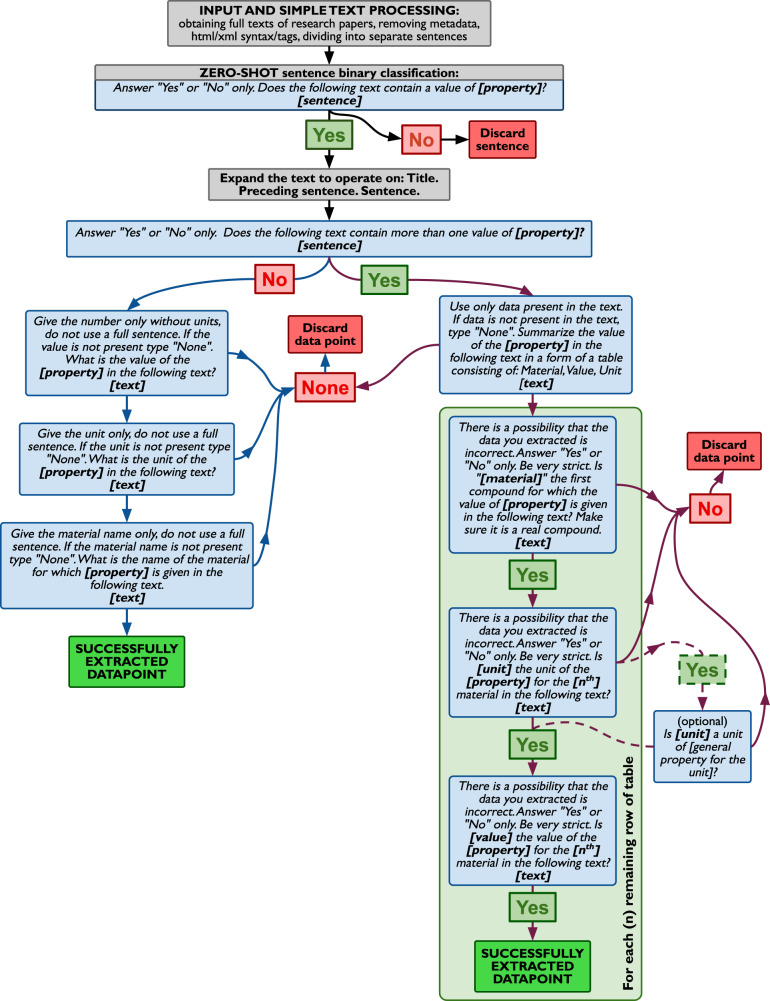
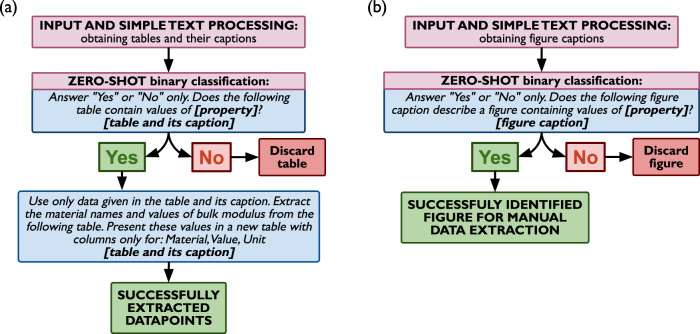
There has been a growing effort to replace manual extraction of data from research papers with automated data extraction based on natural language processing, language models, and recently, large language models (LLMs). Although these methods enable efficient extraction of data from large sets of research papers, they require a significant amount of up-front effort, expertise, and coding. In this work, we propose the method that can fully automate very accurate data extraction with minimal initial effort and background, using an advanced conversational LLM. consists of a set of engineered prompts applied to a conversational LLM that both identify sentences with data, extract that data, and assure the data’s correctness through a series of follow-up questions. These follow-up questions largely overcome known issues with LLMs providing factually inaccurate responses. can be applied with any conversational LLMs and yields very high quality data extraction. In tests on materials data, we find precision and recall both close to 90% from the best conversational LLMs, like GPT-4. We demonstrate that the exceptional performance is enabled by the information retention in a conversational model combined with purposeful redundancy and introducing uncertainty through follow-up prompts. These results suggest that approaches similar to , due to their simplicity, transferability, and accuracy are likely to become powerful tools for data extraction in the near future. Finally, databases for critical cooling rates of metallic glasses and yield strengths of high entropy alloys are developed using .
Overview
The claims and statistics of this paper haven’t been checked yet.
Free: it reads the open-access text and checks the first 5 claims that cite a source we can check. Create a free account to check every claim.
Integrity signals
Registry
Cites
Statistics
Figures

Verification
Claims the paper makes
The claims and statistics of this paper haven’t been checked yet.
Free: it reads the open-access text and checks the first 5 claims that cite a source we can check. Create a free account to check every claim.
Claims other papers make about this one
Each is checked against this paper’s own text: does it say what the citing paper says it does?
The source backs part of the claim, not all of it — or backs it for a different population, condition or comparison.
In the citing paper
“Although these proof-of-concept studies have reported encouraging results and the potential to substantially reduce manual workload and human error, most evaluations have been limited to single models, small or restricted datasets, or single extraction runs (15–20).”
From Performance of large language models and prompt engineering strategies for data extraction in systematic reviews (2026) · cites this paper as [18]
Experimental — accuracy not yet measuredThe cited source says what the claim attributes to it.
In the citing paper
“one study demonstrated that GPT-4 achieved precision and recall approaching 90% for automated extraction of structured scientific data using prompt-engineered workflows (18).”
From Performance of large language models and prompt engineering strategies for data extraction in systematic reviews (2026) · cites this paper as [18]
Self-check
Percentages, sums and reported differences re-computed from the paper’s own numbers.
The self-check needs the paper’s full text.
Citations
Cites
Language Models are Few-Shot Learners
Brown, T. B., Mann, B., Ryder, N., Subbiah, M., Kaplan, J., Dhariwal, P., Neelakantan, A., Shyam, P., Sastry, G., Askell, A., et al. (2020) · arXiv · doi:10.48550/arxiv.2005.14165 · Cited by 23,372
High-Resolution Image Synthesis with Latent Diffusion Models
Rombach, R., Blattmann, A., Lorenz, D., Esser, P., & Ommer, B. (2022) · 2022 IEEE/CVF Conference on Computer Vision and Pattern Recognition (CVPR) · doi:10.1109/cvpr52688.2022.01042 · Cited by 20,302 · cited 2×
“Prompt engineering has now become a standard practice in the field of image generation [32–34] to ensure high quality results.”
BackgroundKaugeranna, R., Kaugeranna, E., & Aion, (. S. 4. 6. (2023) · DROPS (Schloss Dagstuhl – Leibniz Center for Informatics) · doi:10.4230/lipics.giscience.2023.43 · Cited by 13,690
LLaMA: Open and Efficient Foundation Language Models
Touvron, H., Lavril, T., Izacard, G., Martinet, X., Lachaux, M.-A., Lacroix, T., Rozière, B., Goyal, N., Hambro, E., Azhar, F., et al. (2023) · arXiv · doi:10.48550/arxiv.2302.13971 · Cited by 4,602
Python Materials Genomics (pymatgen): A robust, open-source python library for materials analysis
Ong, S. P., Richards, W. D., Jain, A., Hautier, G., Kocher, M., Cholia, S., Gunter, D., Chevrier, V. L., Persson, K. A., & Ceder, G. (2013) · Computational Materials Science · doi:10.1016/j.commatsci.2012.10.028 · Cited by 4,534
Training language models to follow instructions with human feedback
Ouyang, L., Wu, J., Jiang, X., Almeida, D., Wainwright, C. L., Mishkin, P., Zhang, C., Agarwal, S., Slama, K., Ray, A., et al. (2022) · arXiv · doi:10.48550/arxiv.2203.02155 · Cited by 4,208
Llama 2: Open Foundation and Fine-Tuned Chat Models
Touvron, H., Martin, L., Stone, K., Albert, P., Almahairi, A., Babaei, Y., Bashlykov, N., Batra, S., Bhargava, P., Bhosale, S., et al. (2023) · arXiv · doi:10.48550/arxiv.2307.09288 · Cited by 2,604 · cited 1×
“As an alternative model to assess, we chose LLaMA2-chat (70B) [39], a model developed by GenAI (Meta), which has extensive documentation [40], and is available to download for free and use locally without limits.”
MethodHierarchical Text-Conditional Image Generation with CLIP Latents
Ramesh, A., Dhariwal, P., Nichol, A., Chu, C., & Chen, M. (2022) · arXiv · doi:10.48550/arxiv.2204.06125 · Cited by 2,511
Large language models are zero-shot reasoners
Kojima, T., Gu, S. (., Reid, M., Matsuo, Y., & Iwasawa, Y. (2022) · Advances in Neural Information Processing Systems 35 · doi:10.52202/068431-1613 · Cited by 2,013
Large Language Models are Zero-Shot Reasoners
Kojima, T., Gu, S. S., Reid, M., Matsuo, Y., & Iwasawa, Y. (2022) · arXiv · doi:10.48550/arxiv.2205.11916 · Cited by 2,013
Structured information extraction from scientific text with large language models
Dagdelen, J., Dunn, A., Lee, S., Walker, N., Rosen, A. S., Ceder, G., Persson, K. A., & Jain, A. (2024) · Nature Communications · doi:10.1038/s41467-024-45563-x · Cited by 771
High-Resolution Image Synthesis with Latent Diffusion Models
Rombach, R., Blattmann, A., Lorenz, D., Esser, P., & Ommer, B. (2021) · arXiv · doi:10.48550/arxiv.2112.10752 · Cited by 737 · cited 2×
“Prompt engineering has now become a standard practice in the field of image generation [32–34] to ensure high quality results.”
BackgroundSwain, M. C., & Cole, J. M. (2016) · Journal of Chemical Information and Modeling · doi:10.1021/acs.jcim.6b00207 · Cited by 598 · cited 1×
“Many databases have been created using natural language processing (NLP) and language models (LMs) [2– 24 ].”
MethodOpportunities and Challenges for Machine Learning in Materials Science
Morgan, D., & Jacobs, R. (2020) · Annual Review of Materials Research · doi:10.1146/annurev-matsci-070218-010015 · Cited by 549
Self-citationHow is ChatGPT's behavior changing over time?
Chen, L., Zaharia, M., & Zou, J. (2023) · arXiv · doi:10.48550/arxiv.2307.09009 · Cited by 507 · cited 1×
“Their default versions also tend to change their performance over time [38], which we overcome by using version snapshots (see Sec.”
BackgroundHow Is ChatGPT’s Behavior Changing Over Time?
Chen, L., Zaharia, M., & Zou, J. (2024) · Harvard Data Science Review · doi:10.1162/99608f92.5317da47 · Cited by 507
Materials Synthesis Insights from Scientific Literature via Text Extraction and Machine Learning
Kim, E., Huang, K., Saunders, A., McCallum, A., Ceder, G., & Olivetti, E. (2017) · Chemistry of Materials · doi:10.1021/acs.chemmater.7b03500 · Cited by 473
Database on the mechanical properties of high entropy alloys and complex concentrated alloys
Gorsse, S., Nguyen, M. H., Senkov, O. N., & Miracle, D. B. (2018) · Data in Brief · doi:10.1016/j.dib.2018.11.111 · Cited by 322 · cited 1×
“The database of yield strengths for HEAs developed here is significantly larger than databases developed for HEAs previously, for example, databases containing yield strengths for 169 unique HEA compositions from 2018 [43] and containing yield strength for 419 unique HEA compositions from 2020 [44].”
Data-driven materials research enabled by natural language processing and information extraction
Olivetti, E. A., Cole, J. M., Kim, E., Kononova, O., Ceder, G., Han, T. Y.-J., & Hiszpanski, A. M. (2020) · Applied Physics Reviews · doi:10.1063/5.0021106 · Cited by 302 · cited 1×
“Automated data extraction is increasingly used to develop databases in materials science and other fields [1].”
BackgroundA Machine Learning Approach to Zeolite Synthesis Enabled by Automatic Literature Data Extraction
Jensen, Z., Kim, E., Kwon, S., Gani, T. Z. H., Román-Leshkov, Y., Moliner, M., Corma, A., & Olivetti, E. (2019) · ACS Central Science · doi:10.1021/acscentsci.9b00193 · Cited by 282
Opportunities and challenges of text mining in materials research
Kononova, O., He, T., Huo, H., Trewartha, A., Olivetti, E. A., & Ceder, G. (2021) · iScience · doi:10.1016/j.isci.2021.102155 · Cited by 182
Expanded dataset of mechanical properties and observed phases of multi-principal element alloys
Borg, C. K. H., Frey, C., Moh, J., Pollock, T. M., Gorsse, S., Miracle, D. B., Senkov, O. N., Meredig, B., & Saal, J. E. (2020) · Scientific Data · doi:10.1038/s41597-020-00768-9 · Cited by 172
Machine Learning in Materials Discovery: Confirmed Predictions and Their Underlying Approaches
Saal, J. E., Oliynyk, A. O., & Meredig, B. (2020) · Annual Review of Materials Research · doi:10.1146/annurev-matsci-090319-010954 · Cited by 161
ChemDataExtractor 2.0: Autopopulated Ontologies for Materials Science
Mavračić, J., Court, C. J., Isazawa, T., Elliott, S. R., & Cole, J. M. (2021) · Journal of Chemical Information and Modeling · doi:10.1021/acs.jcim.1c00446 · Cited by 153
Inorganic Materials Synthesis Planning with Literature-Trained Neural Networks
Kim, E., Jensen, Z., van Grootel, A., Huang, K., Staib, M., Mysore, S., Chang, H.-S., Strubell, E., McCallum, A., Jegelka, S., et al. (2020) · Journal of Chemical Information and Modeling · doi:10.1021/acs.jcim.9b00995 · Cited by 142
Bridges-2: A Platform for Rapidly-Evolving and Data Intensive Research
Brown, S. T., Buitrago, P. A., Hanna, E., Sanielevici, S., Scibek, R., & Nystrom, N. A. (2021) · Practice and Experience in Advanced Research Computing · doi:10.1145/3437359.3465593 · Cited by 125
Comparative dataset of experimental and computational attributes of UV/vis absorption spectra
Beard, E. J., Sivaraman, G., Vázquez-Mayagoitia, Á., Vishwanath, V., & Cole, J. M. (2019) · Scientific Data · doi:10.1038/s41597-019-0306-0 · Cited by 100
Court, C. J., & Cole, J. M. (2020) · npj Computational Materials · doi:10.1038/s41524-020-0287-8 · Cited by 98
Wang, Z., Kononova, O., Cruse, K., He, T., Huo, H., Fei, Y., Zeng, Y., Sun, Y., Cai, Z., Sun, W., et al. (2022) · Scientific Data · doi:10.1038/s41597-022-01317-2 · Cited by 83
Machine-Learning Rationalization and Prediction of Solid-State Synthesis Conditions
Huo, H., Bartel, C. J., He, T., Trewartha, A., Dunn, A., Ouyang, B., Jain, A., & Ceder, G. (2022) · Chemistry of Materials · doi:10.1021/acs.chemmater.2c01293 · Cited by 79
Polak, M. P., Modi, S., Latosinska, A., Zhang, J., Wang, C.-W., Wang, S., Hazra, A. D., & Morgan, D. D. (2024) · Digital Discovery · doi:10.1039/d4dd00016a · Cited by 72
Self-citationSierepeklis, O., & Cole, J. M. (2022) · Scientific Data · doi:10.1038/s41597-022-01752-1 · Cited by 68
Structured information extraction from complex scientific text with fine-tuned large language models
Dunn, A., Dagdelen, J., Walker, N., Lee, S., Rosen, A. S., Ceder, G., Persson, K., & Jain, A. (2022) · arXiv · doi:10.48550/arxiv.2212.05238 · Cited by 67
Perovskite- and Dye-Sensitized Solar-Cell Device Databases Auto-generated Using ChemDataExtractor
Beard, E. J., & Cole, J. M. (2022) · Scientific Data · doi:10.1038/s41597-022-01355-w · Cited by 65
Georgescu, A. B., Ren, P., Toland, A. R., Zhang, S., Miller, K. D., Apley, D. W., Olivetti, E., Wagner, N., & Rondinelli, J. M. (2021) · Chemistry of Materials · doi:10.1021/acs.chemmater.1c00905 · Cited by 54
A rule-free workflow for the automated generation of databases from scientific literature
Gilligan, L. P. J., Cobelli, M., Taufour, V., & Sanvito, S. (2023) · npj Computational Materials · doi:10.1038/s41524-023-01171-9 · Cited by 53 · cited 1×
“Many databases have been created using natural language processing (NLP) and language models (LMs) [2– 24 ].”
MethodAuto-generated database of semiconductor band gaps using ChemDataExtractor
Dong, Q., & Cole, J. M. (2022) · Scientific Data · doi:10.1038/s41597-022-01294-6 · Cited by 49
A database of refractive indices and dielectric constants auto-generated using ChemDataExtractor
Zhao, J., & Cole, J. M. (2022) · Scientific Data · doi:10.1038/s41597-022-01295-5 · Cited by 46
Auto-generating databases of Yield Strength and Grain Size using ChemDataExtractor
Kumar, P., Kabra, S., & Cole, J. M. (2022) · Scientific Data · doi:10.1038/s41597-022-01301-w · Cited by 43
Zhao, J., & Cole, J. M. (2022) · Journal of Chemical Information and Modeling · doi:10.1021/acs.jcim.2c00253 · Cited by 31
Deliberate then Generate: Enhanced Prompting Framework for Text GenerationPreprint
Li, B., Wang, R., Guo, J., Song, K., Tan, X., Hassan, H., Menezes, A., Xiao, T., Bian, J., & Zhu, J. (2023) · arXiv (Cornell University) · doi:10.48550/arxiv.2305.19835 · Cited by 30 · cited 1×
“This approach was first demonstrated in a preprint of this paper [36], and since then a group from Microsoft has described a similar idea, but for more general tasks than materials data extraction [37].”
BackgroundAfflerbach, B. T., Francis, C., Schultz, L. E., Spethson, J. T., Meschke, V., Strand, E. J., Ward, L. T., Perepezko, J. H., Thoma, D. J., Voyles, P. M., et al. (2022) · Chemistry of Materials · doi:10.1021/acs.chemmater.1c03542 · Cited by 27 · cited 1×
“This size of 217 unique compositions is significantly larger than the previous largest hand-curated database published by Afflerbach, et al. [42], which had just 77 entries.”
BackgroundSelf-citationInorganic Synthesis Reaction Condition Prediction with Generative Machine LearningPreprint
Karpovich, C. J., Jensen, Z., Venugopal, V., & Olivetti, E. (2021) · arXiv (Cornell University) · doi:10.48550/arxiv.2112.09612 · Cited by 17
Polak, M. P., & Morgan, D. D. (2023) · arXiv (Cornell University) · doi:10.48550/arxiv.2303.05352 · Cited by 10
Self-citationBLOOM: A 176B-Parameter Open-Access Multilingual Language Model
Workshop, B., :, Scao, T. L., Fan, A., Akiki, C., Pavlick, E., Ilić, S., Hesslow, D., Castagné, R., Luccioni, A. S., et al. (2022) · arXiv · doi:10.48550/arxiv.2211.05100
OPT: Open Pre-trained Transformer Language Models
Zhang, S., Roller, S., Goyal, N., Artetxe, M., Chen, M., Chen, S., Dewan, C., Diab, M., Li, X., Lin, X. V., et al. (2022) · arXiv · doi:10.48550/arxiv.2205.01068
Research works printed but not linked: 1
- Polak, M. P. & Morgan, D. Datasets and Supporting Information to the paper entitled ‘Extracting accurate materials data from research papers with conversational language models and prompt engineering’ (2023). PMC10882009 38383556
Cited by
Summary of ChatGPT-Related Research and Perspective Towards the Future of Large Language Models
Liu, Y., Han, T., Ma, S., Zhang, J., Yang, Y., Tian, J., He, H., Li, A., He, M., Liu, Z., et al. (2023) · arXiv · doi:10.48550/arxiv.2304.01852 · Cited by 1,172
Summary of ChatGPT-Related research and perspective towards the future of large language models
Liu, Y., Han, T., Ma, S., Zhang, J., Yang, Y., Tian, J., He, H., Li, A., He, M., Liu, Z., et al. (2023) · Meta-Radiology · doi:10.1016/j.metrad.2023.100017 · Cited by 855
“Polak et al. [76] proposed ChatExtract method - consisting of a set of engineering prompts applied to a conversational LLM - for automatic data extraction.”
MethodPrompt Engineering in Large Language Models
Marvin, G., Hellen, N., Jjingo, D., & Nakatumba-Nabende, J. (2024) · Algorithms for Intelligent Systems · doi:10.1007/978-981-99-7962-2_30 · Cited by 403
Kang, Y., & Kim, J. (2024) · Nature Communications · doi:10.1038/s41467-024-48998-4 · Cited by 236
Korzynski, P., Mazurek, G., Krzypkowska, P., & Kurasinski, A. (2023) · Entrepreneurial Business and Economics Review · doi:10.15678/eber.2023.110302 · Cited by 235
“Science – data extraction: Polak and Morgan (2023) proposed the ChatExtract method using engi‐ neered prompts applied to a conversational LLM for accurate data extraction from research articles.”
Method
Metadata
- Authors
- Polak, M. P., & Morgan, D.
- Affiliations
- University of Wisconsin–Madison (US)
- Corresponding author
- Polak, Maciej P.
- Morgan, Dane
- Venue
- Nature Communications
- Published
- 2024-02-21
- Volume
- 15
- Issue
- 1
- Pages
- 1569-1569
- ISSN
- 2041-1723 (ISSN-L)
- PMC
- PMC10882009
- OpenAlex
- W4392002118
- Cited by
- 365
- References
- 40
- Citations by year
- 2026: 136 · 2025: 156 · 2024: 70
- FWCI
- 35.33
- Type
- journal article
- Language
- en
- Open access
- gold
- doi.org
- Licence
- cc-by
- creativecommons.org/licenses/by/4.0 (tdm)
- creativecommons.org/licenses/by/4.0 (vor)
- Locations
- Nature Communications (publishedVersion, cc-by)
- PubMed Central (publishedVersion, cc-by)
- PubMed (publishedVersion)
- DOAJ (DOAJ: Directory of Open Access Journals) (submittedVersion)
- Funders
- National Science Foundation (1931298)
- Topics
- Physical Sciences › Materials Science › Materials Chemistry › Machine Learning in Materials Science
- Physical Sciences › Computer Science › Artificial Intelligence › Topic Modeling
- Social Sciences › General Social Sciences › Computational and Text Analysis Methods
- Keywords
- automated data extraction, research papers, prompt engineering, materials data, factual accuracy, amorphous alloys, critical cooling rate, high-entropy alloys, yield strength, information retention
About these checks
Registry, retraction, Cites and statistics results are computed, not judged, with one exception: a printed reference that no index lists is read once by a model before it counts as a citation error. Claims are extracted by a model and kept only when their quote appears verbatim in the text; each cited source is then checked, with a model’s help, for whether it says what the claim relies on. Those verdicts can be wrong — read the claim’s quote and the cited source before relying on one.
Statistics and arithmetic are recomputed, not judged.
Confidence bands are shown only for fields calibrated on our annotated test set. None is calibrated yet, so no band is shown.
What counts as a claim ›How we measure confidence ›How we check this ›
Are you an author, or do you see a problem with this page? Request a review
Data sources
Bibliographic data: Semantic Scholar, OpenAlex, Crossref.
Contains information from the Semantic Scholar Academic Graph Datasets, made available under the ODC Attribution License (ODC-BY 1.0).
Semantic Scholar’s data is described in: Kinney, R., et al. (2023). The Semantic Scholar Open Data Platform. arXiv:2301.10140.
