

A clinically accessible small multimodal radiology model and evaluation metric for chest X-ray findings
Open accessThe DOI matches its Crossref record; 71 of the 72 references it cites were found in a registry or an index; 11 of the 18 sources its claims cite were checked for support.
Abstract
Large foundation models show promise in biomedicine but face challenges in clinical use due to performance gaps, accessibility, cost, and lack of scalable evaluation. Here we show that open-source small multimodal models can bridge these gaps in radiology by generating free-text findings from chest X-ray images. ... To enable robust, clinically relevant evaluation, we develop and validate CheXprompt, a GPT-4-based metric for assessing factual accuracy aligned with radiologists’ evaluations.
Overview
CoChat Summary
## TL;DR
This paper introduces LLaVA-Rad, a 7B open-source multimodal model for generating chest X-ray findings, trained with a data-centric pipeline on 697,435 image-report pairs. It also proposes CheXprompt, a GPT-4-based factuality metric that correlates better with radiologist error counts than existing automated report metrics.
## Key findings
- LLaVA-Rad was trained using 697K curated chest X-ray image-text pairs from 7 datasets, sourced from approximately 258,639 patients.
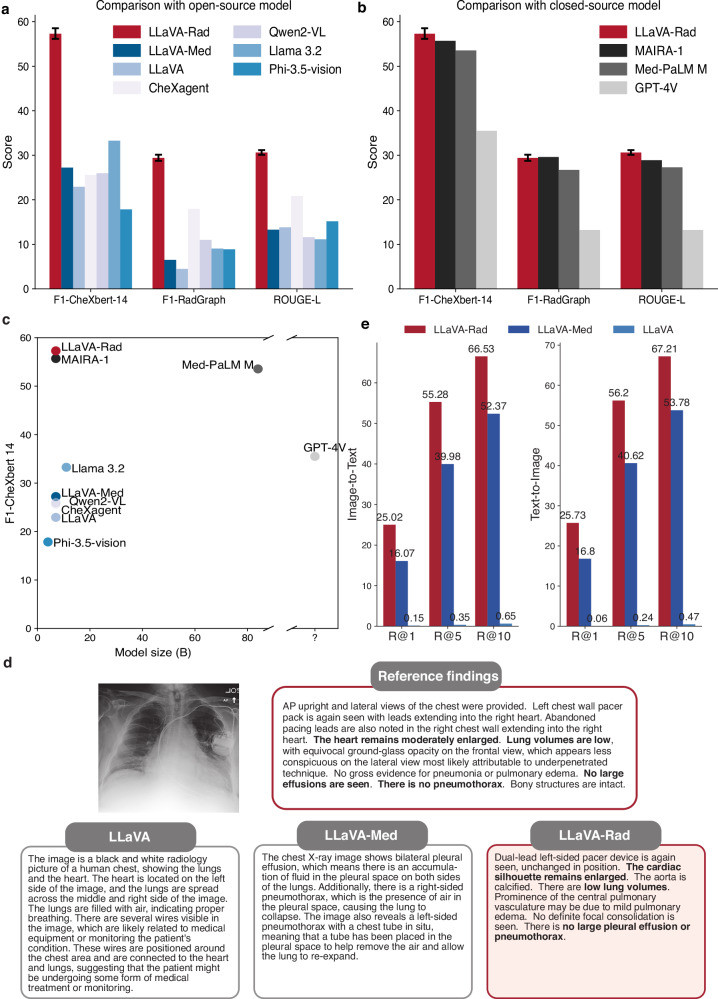
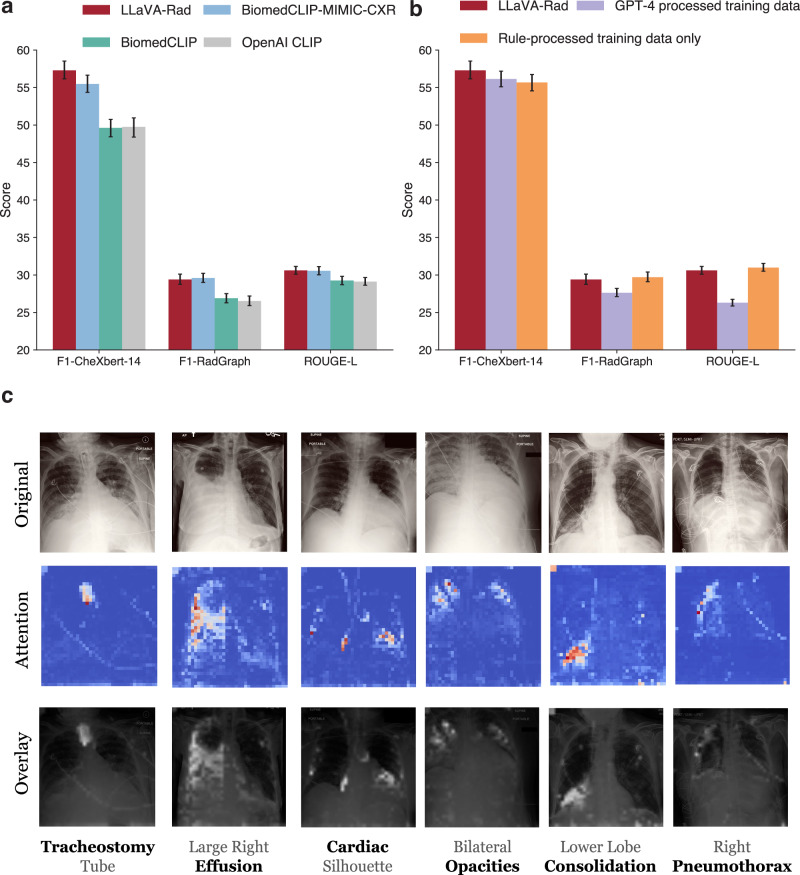
- On MIMIC-CXR report-generation benchmarks, LLaVA-Rad outperformed larger models including GPT-4V and Med-PaLM M (84B); the paper reports 12.1% relative improvement in ROUGE-L and 10.1% in F1-RadGraph over Med-PaLM M.
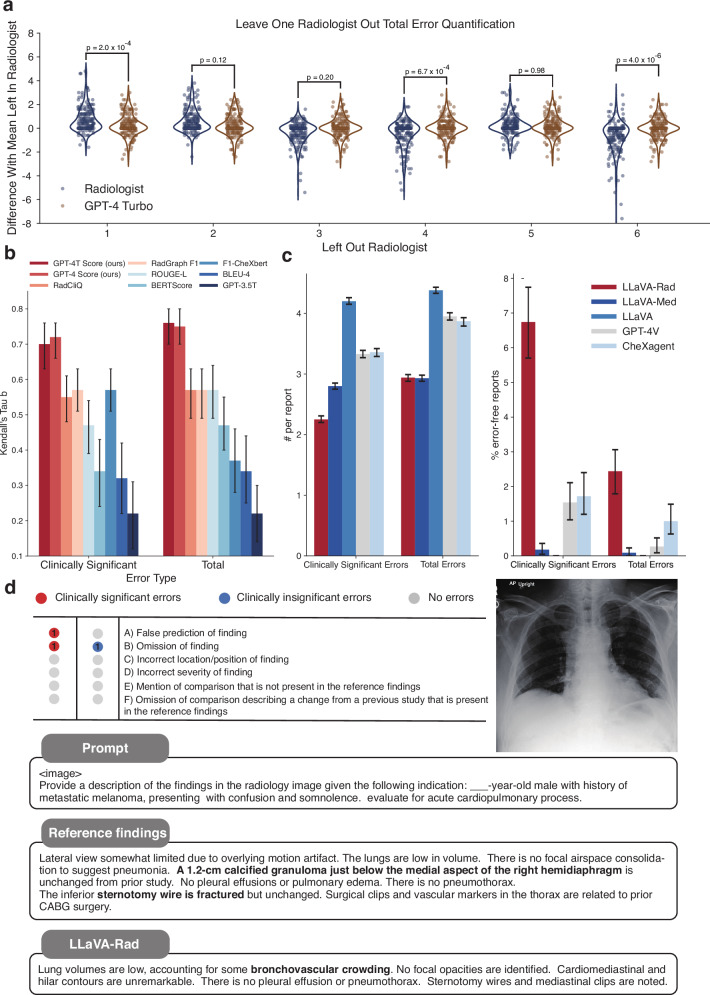
- CheXprompt, evaluated on ReXval with annotations from 6 board-certified radiologists over 200 report pairs, achieved Kendall’s Tau-b correlations > 0.75 for total errors and > 0.70 for clinically significant errors; existing metrics did not exceed 0.57.
- CheXprompt’s GPT-4 Turbo version had lower mean absolute difference than a left-out radiologist on average (0.55 MAD vs 0.71 MAD), and LLaVA-Rad had the highest share of error-free reports: 6.79% free of clinically significant errors and 2.58% free of all errors.
## Methods
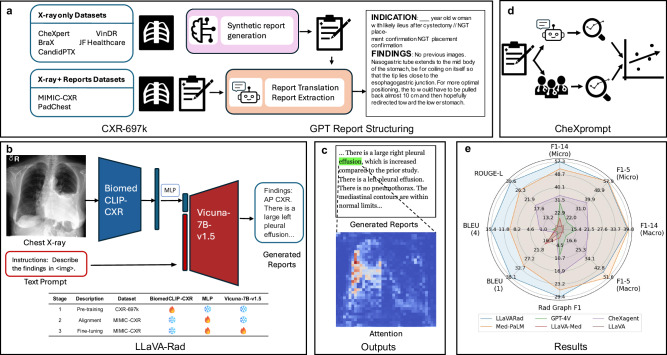
- The model uses a three-stage training pipeline: pretrain a domain-specific vision encoder (BiomedCLIP-CXR) on chest X-ray image-text pairs, align the image encoder with a language model using a lightweight MLP adapter, then fine-tune with LoRA on MIMIC-CXR report data.
- Training data were assembled from 7 public datasets into CXR-697K; where free-text reports were missing or incomplete, the authors used GPT-4 to synthesize or structure reports, and they used MIMIC-CXR train split data for later training stages.
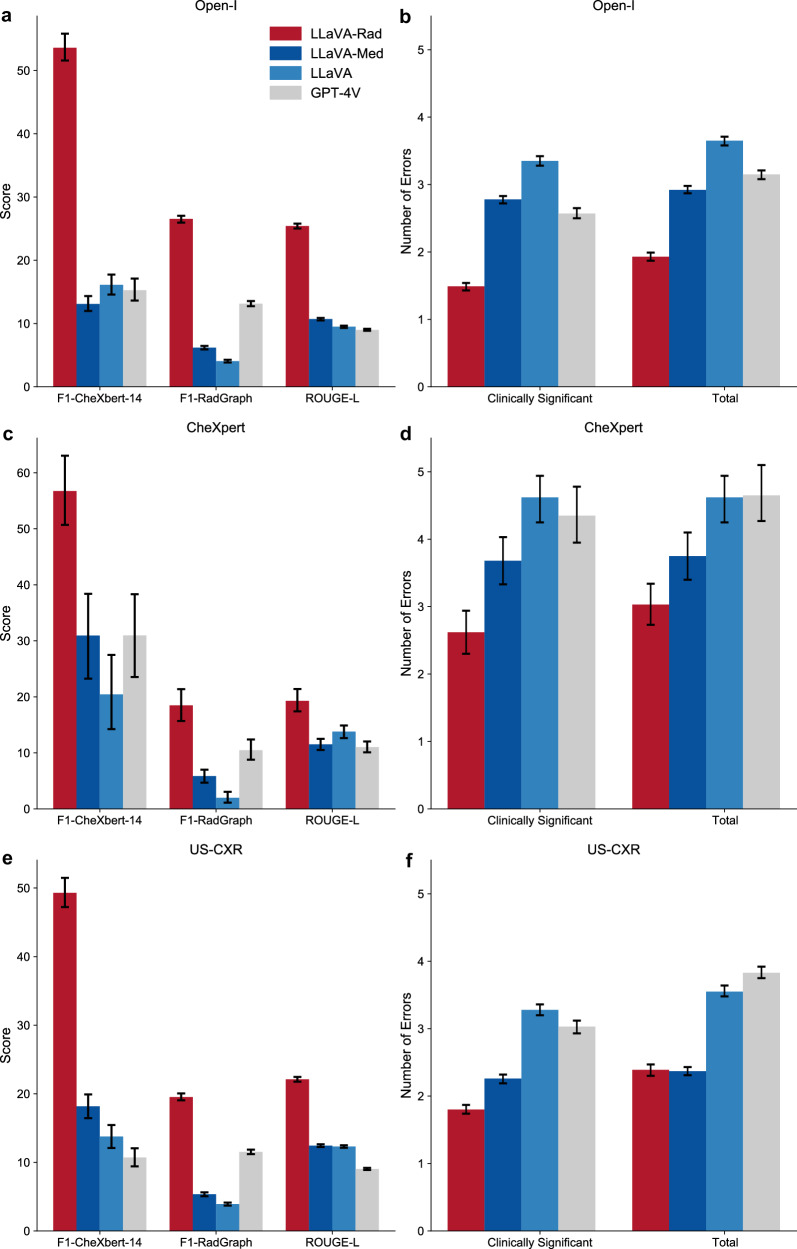
- Evaluation included cross-modal retrieval (recall@K), report-generation metrics (BLEU-4, ROUGE-L, F1-CheXbert, F1-RadGraph), attention visualization, and CheXprompt validation against radiologist annotations in ReXval.
## Limitations
- The paper states that LLaVA-Rad is “not immediately ready for real-time clinical deployment” and is presented as a step toward clinically adaptable multimodal AI.
- The scope is limited to chest X-rays; the authors note that future work should test other anatomies and modalities.
- The text makes evident that performance may vary across datasets and populations because the evaluation sets differ in disease prevalence and setting; this is explicitly noted by the authors as a generalizability concern.
Model-written summary. Check it against the paper before relying on it.
Integrity signals
Registry
Cites
Statistics
Figures
Verification
Claims the paper makes
6 Valid · 5 Not valid · 5 Not checked · 85 Own results and interpretations
At least one cited source doesn’t support this claim or points to a different paper, and none confirmed it — see the verdicts below.
In the paper
“However, while small language models have shown success in text domains14–16, small multimodal models (SMMs) still have significant performance gaps compared to larger models6,10.”
§ A clinically accessible small multimodal radiology model and evaluation metric for chest X-ray findings > Introduction
What the sources say
- Disputedcites [6] Tu, T. et al. Towards generalist biomedical AI. NEJM AI 1, AIoa2300138 (2024). sourceExperimental — accuracy not yet measured
In §8, “Perspective on Generalist Biomedical AI” (page unavailable), the paper says the performance gap across three Med-PaLM M sizes was relatively small for chest X-ray report generation. It also says there was no overall evidence that a larger vision model outperformed a smaller one across its experiments. These findings run counter to the claimed significant performance gap. (LLM, conf=0.86)
Checked by a reasoning model — may be wrong.
- Could not verifycites [10] Tanno, R. et al. Collaboration between clinicians and vision–language models in radiology report generation. Nat. Med.31 1–10 (2024). PMC11835717 39511432 sourceExperimental — accuracy not yet measured
Our copy of Tanno et al. (2025) contains no statement about small multimodal models lagging larger ones: searches for 'small multimodal models performance gap', 'model size scaling', 'built from scratch underperform large pretrained', and 'limited capabilities of smaller VLMs' returned only the Main paragraph on existing report-generation models being 'built from scratch, neglecting the likely useful transfer of knowledge from such pretrained models' (Main) — a pretraining argument, not a size argument. If anything, the paper runs counter to the claim's framing: Methods > Task (Architecture) states Flamingo-CXR 'is built using a parsimonious 400 million parameter version', and Table 1 (Results, Automated report generation metrics) shows it at 0.519 CheXpert F1 (all), above the 12B Med-PaLM-M (0.514), with the text reporting it 'outperforms the current SoTA method by 33%'. Since our copy neither states nor contradicts a general small-vs-large multimodal performance gap, the attribution cannot be settled from this source. (LLM, conf=0.68)
plain- Asserted: passes — The authors put it forward as true.
- Checkable: passes — It can be checked against evidence.
- Load-bearing: passes — The paper’s conclusions depend on it.
- Based: passes — The paper gives a reason why it holds.
- Disputed
The cited sources that could be checked couldn’t confirm or dispute this claim.
In the paper
“Benchmarked with CheXprompt and other standard factuality metrics, LLaVA-Rad (7B) achieves state-of-the-art performance, outperforming much larger models like GPT-4V and Med-PaLM M (84B).”
- Also stated in: § Introduction · plain
“The resulting LLaVA-Rad (7B) model attains state-of-the-art results on standard radiology tasks such as report generation and cross-modal retrieval, even outperforming much larger models such as GPT-4V and Med-PaLM M (84B)6.”
§ A clinically accessible small multimodal radiology model and evaluation metric for chest X-ray findings > Abstract
What the sources say
- Could not verifycites [6] Tu, T. et al. Towards generalist biomedical AI. NEJM AI 1, AIoa2300138 (2024). sourceExperimental — accuracy not yet measured
Table A.7 and the Additional information section report state-of-the-art results for Med-PaLM M on clinical factuality metrics. Our copy does not report results for LLaVA-Rad or GPT-4V, use CheXprompt, or compare either model with Med-PaLM M (searched: LLaVA-Rad, GPT-4V, CheXprompt). It therefore cannot establish the attributed performance claim. (LLM, conf=0.76)
plainstates a cause- Asserted: passes — The authors put it forward as true.
- Checkable: passes — It can be checked against evidence.
- Load-bearing: passes — The paper’s conclusions depend on it.
- Based: passes — The paper gives a reason why it holds.
- Also stated in: § Introduction · plain
Every source the paper cites for this claim was checked and supports it.
In the paper
“First, sharing patient data with large foundation models hosted on the cloud is subject to privacy concerns11.”
§ A clinically accessible small multimodal radiology model and evaluation metric for chest X-ray findings > Introduction
What the sources say
- Supportedcites [11] Thirunavukarasu, A. J. et al. Large language models in medicine. Nat. Med. 29, 1930–1940 (2023). 37460753 source
The Review article section states that 'security and privacy concerns come hand-in-hand with adoption of internet-based platforms, particularly when run by a commercial enterprise', and that these concerns could limit deployment if patient-identifiable data are prohibited from being input as model prompts. A later passage in the same section adds that 'particular attention must be paid to guarding privacy' and that 'clinicians should also take care not to input identifiable data on platforms that may store and use the data for unspecified purposes'. Together these support the paraphrase that inputting/sharing patient data with externally (internet/cloud) hosted large models raises privacy concerns. (LLM, conf=0.88)
plainstates an association- Asserted: passes — The authors put it forward as true.
- Checkable: passes — It can be checked against evidence.
- Load-bearing: passes — The paper’s conclusions depend on it.
- Based: passes — The paper gives a reason why it holds.
- Supported
Every source the paper cites for this claim was checked and supports it.
In the paper
“Finally, even the best models are still subject to errors such as hallucination, and existing automated evaluation methods of factual correctness exhibit limited correlation with expert assessments17.”
- Also stated in: § Evaluating LLaVA-Rad using CheXprompt, a GPT-4-based evaluation system · hedged
“It is well known that existing n-gram and findings-based automated report evaluation methods might be biased to pre-defined conditions and have limited correlation with expert assessments17.”
§ A clinically accessible small multimodal radiology model and evaluation metric for chest X-ray findings > Introduction
What the sources say
- Supportedcites [17] Yu, F. et al. Evaluating progress in automatic chest x-ray radiology report generation. Patterns4, 100802 (2023). PMC10499844 37720336 source
The Introduction states that even metrics designed to assess the correctness of radiology information do not align with radiologists. The Discussion likewise says prior evaluations poorly approximate radiologists’ evaluations of reports. These passages support the claim about limited alignment with expert assessments. (LLM, conf=0.91)
plainstates an association- Asserted: passes — The authors put it forward as true.
- Checkable: passes — It can be checked against evidence.
- Load-bearing: passes — The paper’s conclusions depend on it.
- Based: passes — The paper gives a reason why it holds.
- Also stated in: § Evaluating LLaVA-Rad using CheXprompt, a GPT-4-based evaluation system · hedged
Every source the paper cites for this claim was checked and supports it.
In the paper
“We evaluate the validity of the proposed CheXprompt using the ReXval dataset39, which is comprised of error annotations from 6 board-certified radiologists on 200 pairs of candidate and ground-truth reports”
§ A clinically accessible small multimodal radiology model and evaluation metric for chest X-ray findings > Methods > Quality of generated reports
What the sources say
- Supportedcites [39] Yu, F. et al. Radiology report expert evaluation (rexval) dataset. PhysioNet (2023). source
The Abstract states the dataset 'contains annotations from 6 board certified radiologists' and that 'There are 4 candidate reports generated for 50 studies, translating to 200 pairs of candidate and ground-truth reports on which radiologists provided annotations.' The Methods (Data/Participants, p. ~1) independently confirms 50 MIMIC-CXR studies with 4 generated reports each (200 pairs) annotated by 6 board certified radiologists, and the Data Description section repeats the 6-radiologist error-annotation structure. The citing sentence's description of ReXVal matches our copy exactly. (LLM, conf=0.95)
plain- Asserted: passes — The authors put it forward as true.
- Checkable: passes — It can be checked against evidence.
- Load-bearing: passes — The paper’s conclusions depend on it.
- Based: passes — The paper gives a reason why it holds.
- Supported
56 more claims
Create a free account to see all 101 claims and to verify the 6 references still open.
- It may state two separate claims as one. 35
- Probably not a substantial claim. 10
- The quote only partly states this claim. 2
Citations
Cites
Large language models in medicine
Thirunavukarasu, A. J., Ting, D. S. J., Elangovan, K., Gutierrez, L., Tan, T. F., & Ting, D. S. W. (2023) · Nature Medicine · doi:10.1038/s41591-023-02448-8 · Cited by 3,944 · cited 1×
“Automatically drafting high-quality radiology reports isa challenging but clinically meaningful task that could directly increase radiologist productivity and potentially improve communication and decreaseburnout 19 .”
QLoRA: Efficient Finetuning of Quantized LLMs
Dettmers, T., Pagnoni, A., Holtzman, A., & Zettlemoyer, L. (2023) · arXiv · doi:10.48550/arxiv.2305.14314 · Cited by 3,832
On the Opportunities and Risks of Foundation Models
Bommasani, R., Hudson, D. A., Adeli, E., Altman, R., Arora, S., von Arx, S., Bernstein, M. S., Bohg, J., Bosselut, A., Brunskill, E., et al. (2021) · arXiv · doi:10.48550/arxiv.2108.07258 · Cited by 2,676 · cited 2×
“For more optimal positioning, the towould have to be pulled back almost 10cm and then hopefully redirected toward the lower stomach.”
Liu, H., Li, C., Wu, Q., & Lee, Y. J. (2023) · Advances in Neural Information Processing Systems 36 · doi:10.52202/075280-1516 · Cited by 2,428
Self-citationFoundation models for generalist medical artificial intelligence
Moor, M., Banerjee, O., Abad, Z. S. H., Krumholz, H. M., Leskovec, J., Topol, E. J., & Rajpurkar, P. (2023) · Nature · doi:10.1038/s41586-023-05881-4 · Cited by 2,028
Judging LLM-as-a-Judge with MT-Bench and Chatbot Arena
Zheng, L., Chiang, W.-L., Sheng, Y., Zhuang, S., Wu, Z., Zhuang, Y., Lin, Z., Li, Z., Li, D., Xing, E. P., et al. (2023) · arXiv · doi:10.48550/arxiv.2306.05685 · Cited by 1,888 · cited 2×
“We studied the effects on generalizability of our fi ne-tuning process using MT-bench,ageneraldomainevaluation oflanguage modelcapabilities 31 .”
MIMIC-CXR, a de-identified publicly available database of chest radiographs with free-text reports
Johnson, A. E. W., Pollard, T. J., Berkowitz, S. J., Greenbaum, N. R., Lungren, M. P., Deng, C.-Y., Mark, R. G., & Horng, S. (2019) · Scientific Data · doi:10.1038/s41597-019-0322-0 · Cited by 1,816 · cited 2×
“MIMIC-CXR comprises images and their corresponding radiology reports sourced from radiographic studies conducted at the Beth Israel Deaconess Medical Center in Boston, MA, spanning the years 2011 to 2016 27 .”
Self-citationImproved Baselines with Visual Instruction Tuning
Liu, H., Li, C., Li, Y., & Lee, Y. J. (2024) · 2024 IEEE/CVF Conference on Computer Vision and Pattern Recognition (CVPR) · doi:10.1109/cvpr52733.2024.02484 · Cited by 1,748 · cited 2×
“As noted by other works 9,29 and also demonstrated by our ablation studies, this strategy can substantially improve the alignment by forcing the decoder model to focus on the image alone.”
Self-citationImproved Baselines with Visual Instruction Tuning
Liu, H., Li, C., Li, Y., & Lee, Y. J. (2023) · arXiv · doi:10.48550/arxiv.2310.03744 · Cited by 1,733
Self-citationFlamingo: a Visual Language Model for Few-Shot Learning
Alayrac, J.-B., Donahue, J., Luc, P., Miech, A., Barr, I., Hasson, Y., Lenc, K., Mensch, A., Millican, K., Reynolds, M., et al. (2022) · arXiv · doi:10.48550/arxiv.2204.14198 · Cited by 1,555 · cited 1×
“For more optimal positioning, the towould have to be pulled back almost 10cm and then hopefully redirected toward the lower stomach.”
Qwen2-VL: Enhancing Vision-Language Model's Perception of the World at Any Resolution
Wang, P., Bai, S., Tan, S., Wang, S., Fan, Z., Bai, J., Chen, K., Liu, X., Wang, J., Ge, W., et al. (2024) · arXiv · doi:10.48550/arxiv.2409.12191 · Cited by 1,302
Self-citationChatGPT Outperforms Crowd-Workers for Text-Annotation Tasks
Gilardi, F., Alizadeh, M., & Kubli, M. (2023) · arXiv · doi:10.48550/arxiv.2303.15056 · Cited by 1,207
ChatGPT outperforms crowd workers for text-annotation tasks
Gilardi, F., Alizadeh, M., & Kubli, M. (2023) · Proceedings of the National Academy of Sciences · doi:10.1073/pnas.2305016120 · Cited by 1,197 · cited 2×
“We thus explore the utility of an large language model-based evaluation sys-tem, which has shown success in other domains 36 – 38 .”
DINOv2: Learning Robust Visual Features without Supervision
Oquab, M., Darcet, T., Moutakanni, T., Vo, H., Szafraniec, M., Khalidov, V., Fernandez, P., Haziza, D., Massa, F., El-Nouby, A., et al. (2023) · arXiv · doi:10.48550/arxiv.2304.07193 · Cited by 1,078
Self-citationThe future landscape of large language models in medicine
Clusmann, J., Kolbinger, F. R., Muti, H. S., Carrero, Z. I., Eckardt, J.-N., Laleh, N. G., Löffler, C. M. L., Schwarzkopf, S.-C., Unger, M., Veldhuizen, G. P., et al. (2023) · Communications Medicine · doi:10.1038/s43856-023-00370-1 · Cited by 1,045 · cited 1×
“Hence it is crucial to develop reliablemethodstoevaluatethecorrectnessofmodeloutputsatscale, especially in the specialized fi eld of biomedicine 18 .”
LLaVA-Med: Training a Large Language-and-Vision Assistant for Biomedicine in One Day
Li, C., Wong, C., Zhang, S., Usuyama, N., Liu, H., Yang, J., Naumann, T., Poon, H., & Gao, J. (2023) · Advances in Neural Information Processing Systems 36 · doi:10.52202/075280-1240 · Cited by 986
Self-citationFlamingo: a visual language model for few-shot learning
Alayrac, J.-B., Donahue, J., Luc, P., Miech, A., Barr, I., Hasson, Y., Lenc, K., Mensch, A., Millican, K., Reynolds, M., et al. (2022) · Advances in Neural Information Processing Systems 35 · doi:10.52202/068431-1723 · Cited by 966
G-Eval: NLG Evaluation using Gpt-4 with Better Human Alignment
Liu, Y., Iter, D., Xu, Y., Wang, S., Xu, R., & Zhu, C. (2023) · Proceedings of the 2023 Conference on Empirical Methods in Natural Language Processing · doi:10.18653/v1/2023.emnlp-main.153 · Cited by 948 · cited 2×
“The data used to train our model in the second and third stages is a combination of rule-based and GPT-4 structured data, as summarized in Supplementary Table 7.”
Self-citationG-Eval: NLG Evaluation using GPT-4 with Better Human Alignment
Liu, Y., Iter, D., Xu, Y., Wang, S., Xu, R., & Zhu, C. (2023) · arXiv · doi:10.48550/arxiv.2303.16634 · Cited by 948 · cited 2×
“The data used to train our model in the second and third stages is a combination of rule-based and GPT-4 structured data, as summarized in Supplementary Table 7.”
Self-citationA whole-slide foundation model for digital pathology from real-world data
Xu, H., Usuyama, N., Bagga, J., Zhang, S., Rao, R., Naumann, T., Wong, C., Gero, Z., González, J., Gu, Y., et al. (2024) · Nature · doi:10.1038/s41586-024-07441-w · Cited by 921 · cited 1×
“Smaller models incur smaller carbon footprint 12 and offer reduced serving costs and latency, which is of particular importance in resource-constrained settings outside of data centers 13 .”
Self-citationA large language model for electronic health records
Yang, X., Chen, A., PourNejatian, N., Shin, H. C., Smith, K. E., Parisien, C., Compas, C., Martin, C., Costa, A. B., Flores, M. G., et al. (2022) · npj Digital Medicine · doi:10.1038/s41746-022-00742-2 · Cited by 847
Generating Radiology Reports via Memory-driven Transformer
Chen, Z., Song, Y., Chang, T.-H., & Wan, X. (2020) · Proceedings of the 2020 Conference on Empirical Methods in Natural Language Processing (EMNLP) · doi:10.18653/v1/2020.emnlp-main.112 · Cited by 693
PadChest: A large chest x-ray image dataset with multi-label annotated reports
Bustos, A., Pertusa, A., Salinas, J.-M., & de la Iglesia-Vayá, M. (2020) · Medical Image Analysis · doi:10.1016/j.media.2020.101797 · Cited by 691 · cited 1×
“In the fi rst stage of pre-training, we train a domain-speci fi c vision encoder (BiomedCLIP-CXR) by using 697 thousand pairs of CXR images and associated radiology reports from 7 diverse datasets 22 – 28 .”
Big Self-Supervised Models Advance Medical Image Classification
Azizi, S., Mustafa, B., Ryan, F., Beaver, Z., Freyberg, J., Deaton, J., Loh, A., Karthikesalingam, A., Kornblith, S., Chen, T., et al. (2021) · 2021 IEEE/CVF International Conference on Computer Vision (ICCV) · doi:10.1109/iccv48922.2021.00346 · Cited by 685
LLaVA-Med: Training a Large Language-and-Vision Assistant for Biomedicine in One Day
Li, C., Wong, C., Zhang, S., Usuyama, N., Liu, H., Yang, J., Naumann, T., Poon, H., & Gao, J. (2023) · arXiv · doi:10.48550/arxiv.2306.00890 · Cited by 590 · cited 14×
“We quantify these totals in reports from publicly accessible models, enabling us to compare LLaVA-Rad with LLaVA-Med, LLaVA, CheXagent, and GPT-4V.”
InfluentialSelf-citationGrattafiori, A., Dubey, A., Jauhri, A., Pandey, A., Kadian, A., Al-Dahle, A., Letman, A., Mathur, A., Schelten, A., Vaughan, A., et al. (2024) · arXiv · doi:10.48550/arxiv.2407.21783 · Cited by 505
Self-citationTowards Generalist Biomedical AI
Tu, T., Azizi, S., Driess, D., Schaekermann, M., Amin, M., Chang, P.-C., Carroll, A., Lau, C., Tanno, R., Ktena, I., et al. (2024) · NEJM AI · doi:10.1056/aioa2300138 · Cited by 483
Towards Generalist Biomedical AI
Tu, T., Azizi, S., Driess, D., Schaekermann, M., Amin, M., Chang, P.-C., Carroll, A., Lau, C., Tanno, R., Ktena, I., et al. (2023) · arXiv · doi:10.48550/arxiv.2307.14334 · Cited by 483 · cited 4×
“TheresultingLLaVA-Rad(7B)modelattainsstate-of-the-artresults onstandardradiologytaskssuchasreportgenerationandcross-modal retrieval, even outperforming much larger models such as GPT-4V and Med-PaLM M (84B) 6 .”
InfluentialHuang, S.-C., Pareek, A., Jensen, M., Lungren, M. P., Yeung, S., & Chaudhari, A. S. (2023) · npj Digital Medicine · doi:10.1038/s41746-023-00811-0 · Cited by 479 · cited 1×
“Additionally, we propose CheXprompt, a factuality evaluation method based on GPT-4.”
Self-citationCheXpert: A Large Chest Radiograph Dataset with Uncertainty Labels and Expert Comparison
Irvin, J., Rajpurkar, P., Ko, M., Yu, Y., Ciurea-Ilcus, S., Chute, C., Marklund, H., Haghgoo, B., Ball, R., Shpanskaya, K., et al. (2019) · Proceedings of the AAAI Conference on Artificial Intelligence · doi:10.1609/aaai.v33i01.3301590 · Cited by 392 · cited 3×
“BraX 23 , obtained from chest radiography studies at Hospital Israelita Albert Einstein in S ~ a o Paulo, Brazil, was labeled for 14 radiological fi ndings using the CheXpert Label Extraction Algorithm 22 , which was adapted to detect fi ndings in Portuguese for this dataset.”
Self-citationOrca 2: Teaching Small Language Models How to ReasonPreprint
Mitra, A., Corro, L. D., Mahajan, S., Codas, A., Simoes, C., Agarwal, S., Chen, X., Razdaibiedina, A., Jones, E., Aggarwal, K., et al. (2023) · arXiv (Cornell University) · doi:10.48550/arxiv.2311.11045 · Cited by 339
The shaky foundations of large language models and foundation models for electronic health records
Wornow, M., Xu, Y., Thapa, R., Patel, B., Steinberg, E., Fleming, S., Pfeffer, M. A., Fries, J., & Shah, N. H. (2023) · npj Digital Medicine · doi:10.1038/s41746-023-00879-8 · Cited by 324 · cited 2×
“Third, many state-of-the-art models are inaccessible 13 , necessitating the development of effective open-source models for biomedicine.”
Self-citationA Multimodal Biomedical Foundation Model Trained from Fifteen Million Image–Text Pairs
Zhang, S., Xu, Y., Usuyama, N., Xu, H., Bagga, J., Tinn, R., Preston, S., Rao, R., Wei, M., Valluri, N., et al. (2025) · NEJM AI · doi:10.1056/aioa2400640 · Cited by 283 · cited 1×
“Lastly, we employ the BiomedCLIP recipe for training BiomedCLIP-CXR, which involves contrastive vision-language training with PubMedBERT, a text encoder specialized for the medical domain 53 .”
Self-citationBenchmarking saliency methods for chest X-ray interpretation
Saporta, A., Gui, X., Agrawal, A., Pareek, A., Truong, S. Q. H., Nguyen, C. D. T., Ngo, V.-D., Seekins, J., Blankenberg, F. G., Ng, A. Y., et al. (2022) · Nature Machine Intelligence · doi:10.1038/s42256-022-00536-x · Cited by 270
Self-citationSmit, A., Jain, S., Rajpurkar, P., Pareek, A., Ng, A., & Lungren, M. (2020) · Proceedings of the 2020 Conference on Empirical Methods in Natural Language Processing (EMNLP) · doi:10.18653/v1/2020.emnlp-main.117 · Cited by 262 · cited 3×
“By examining the model weights, we found that LLaVA-Rad can ground key regions of abnormalities to generated words in the output report, which signi fi es future opportunities to synergize with the latest progress in biomedical segmentation and grounded report generation.”
Self-citationRobust and data-efficient generalization of self-supervised machine learning for diagnostic imaging
Azizi, S., Culp, L., Freyberg, J., Mustafa, B., Baur, S., Kornblith, S., Chen, T., Tomasev, N., Mitrović, J., Strachan, P., et al. (2023) · Nature Biomedical Engineering · doi:10.1038/s41551-023-01049-7 · Cited by 250
Is chatGPT a good nlg evaluator? A preliminary study
Wang, J., Liang, Y., Meng, F., Sun, Z., Shi, H., Li, Z., Xu, J., Qu, J., & Zhou, J. (2023) · Proceedings of the 4th New Frontiers in Summarization Workshop · doi:10.18653/v1/2023.newsum-1.1 · Cited by 235
Learning to Exploit Temporal Structure for Biomedical Vision-Language Processing
Bannur, S., Hyland, S., Liu, Q., Pérez-García, F., Ilse, M., Castro, D. C., Boecking, B., Sharma, H., Bouzid, K., Thieme, A., et al. (2023) · 2023 IEEE/CVF Conference on Computer Vision and Pattern Recognition (CVPR) · doi:10.1109/cvpr52729.2023.01442 · Cited by 227 · cited 1×
“For synthetic reports without reference ground truths, we use a similarity comparison (cosine similarity) between the embeddings of corresponding CXR images and synthetic reports, as determined by BiomedCLIP-CXR and BioViL-T 68 .”
Self-citationEvaluating progress in automatic chest X-ray radiology report generation
Yu, F., Endo, M., Krishnan, R., Pan, I., Tsai, A., Reis, E. P., Fonseca, E. K. U. N., Lee, H. M. H., Abad, Z. S. H., Ng, A. Y., et al. (2023) · Patterns · doi:10.1016/j.patter.2023.100802 · Cited by 200 · cited 5×
“Speci fi cally,we employ a large language model as an evaluator that quanti fi es the presence of the following six error types, as per 17 : false prediction of fi nding (false positive), omission of fi nding (false negative), incorrect location/position of fi nding, incorrect severity of fi nding,…”
InfluentialSelf-citationCross-Modal Prototype Driven Network for Radiology Report Generation
Wang, J., Bhalerao, A. H., & He, Y. (2022) · Lecture notes in computer science · doi:10.1007/978-3-031-19833-5_33 · Cited by 191
Collaboration between clinicians and vision–language models in radiology report generation
Tanno, R., Barrett, D. G. T., Sellergren, A., Ghaisas, S., Dathathri, S., See, A., Welbl, J., Lau, C., Tu, T., Azizi, S., et al. (2025) · Nature Medicine · doi:10.1038/s41591-024-03302-1 · Cited by 186 · cited 2×
“Concurrently, Flamingo-CXR fi ne-tuned the Flamingovisionlanguagemodel 47 andincorporatedregularizationand adaptation techniques to tailor their applications to the nuances of radiology report generation 10 .”
Optimizing the Factual Correctness of a Summary: A Study of Summarizing Radiology Reports
Zhang, Y., Merck, D., Tsai, E., Manning, C. D., & Langlotz, C. (2020) · Proceedings of the 58th Annual Meeting of the Association for Computational Linguistics · doi:10.18653/v1/2020.acl-main.458 · Cited by 171 · cited 1×
“In particular, we investigate two key technical ideas used in LLaVA-Rad: the effect of pre-training a domain-speci fi c image encoder using 697 thousand diverse CXR image-text pairs (Fig.”
Self-citationPhi-3 Technical Report: A Highly Capable Language Model Locally on Your Phone
Abdin, M., Aneja, J., Awadalla, H., Awadallah, A., Awan, A. A., Bach, N., Bahree, A., Bakhtiari, A., Bao, J., Behl, H., et al. (2024) · arXiv · doi:10.48550/arxiv.2404.14219 · Cited by 166 · cited 1×
“We compare LLaVA-Rad with both open and closed-source vision language models, including those specialized for CXR fi ndings generation 32,33,60 and other more general ones 9,56,61 – 64 .”
Self-citationDesign and Development of a Multimodal Biomedical Information Retrieval System
Demner-Fushman, D., Antani, S., Simpson, M., & Thoma, G. R. (2012) · Journal of Computing Science and Engineering · doi:10.5626/jcse.2012.6.2.168 · Cited by 161 · cited 2×
“The image also reveals a left-sided pneumothorax with a chest tube in situ, meaning that a tube has been placed in the pleural space to help remove the air and allow the lung to re-expand.”
Gunasekar, S., Zhang, Y., Aneja, J., Mendes, C. C. T., Del Giorno, A., Gopi, S., Javaheripi, M., Kauffmann, P., de Rosa, G., Saarikivi, O., et al. (2023) · arXiv · doi:10.48550/arxiv.2306.11644 · Cited by 138
Generative Artificial Intelligence for Chest Radiograph Interpretation in the Emergency Department
Huang, J., Neill, L., Wittbrodt, M., Melnick, D., Klug, M., Thompson, M., Bailitz, J., Loftus, T., Malik, S., Phull, A., et al. (2023) · JAMA Network Open · doi:10.1001/jamanetworkopen.2023.36100 · Cited by 113
Vision Transformer and Language Model Based Radiology Report Generation
Mohsan, M. M., Akram, M. U., Rasool, G., Alghamdi, N. S., Baqai, M. A. A., & Abbas, M. (2022) · IEEE Access · doi:10.1109/access.2022.3232719 · Cited by 73
Attention-based Saliency Maps Improve Interpretability of Pneumothorax Classification
Wollek, A., Graf, R., Čečatka, S., Fink, N., Willem, T., Sabel, B. O., & Lasser, T. (2023) · Radiology: Artificial Intelligence · doi:10.1148/ryai.220187 · Cited by 68 · cited 1×
“…attention-based attribution methods have been found to be more effective at explaining model decisions and to be more useful by radiologists 49 interpretation algorithms such as Grad-CAM have been shown to have limited correlation with expert assessments and limited robustness to input…”
MedAlign: A Clinician-Generated Dataset for Instruction Following with Electronic Medical Records
Fleming, S. L., Lozano, A., Haberkorn, W. J., Jindal, J. A., Reis, E., Thapa, R., Blankemeier, L., Genkins, J. Z., Steinberg, E., Nayak, A., et al. (2024) · Proceedings of the AAAI Conference on Artificial Intelligence · doi:10.1609/aaai.v38i20.30205 · Cited by 66
Self-citationMedAlign: A Clinician-Generated Dataset for Instruction Following with Electronic Medical Records
Fleming, S. L., Lozano, A., Haberkorn, W. J., Jindal, J. A., Reis, E. P., Thapa, R., Blankemeier, L., Genkins, J. Z., Steinberg, E., Nayak, A., et al. (2023) · arXiv · doi:10.48550/arxiv.2308.14089 · Cited by 65
Self-citationImproving the Factual Correctness of Radiology Report Generation with Semantic Rewards
Delbrouck, J.-B., Chambon, P., Bluethgen, C., Tsai, E., Almusa, O., & Langlotz, C. P. (2022) · arXiv · doi:10.48550/arxiv.2210.12186 · Cited by 63
Self-citationRevisiting the Trustworthiness of Saliency Methods in Radiology AI
Zhang, J., Chao, H., Dasegowda, G., Wang, G., Kalra, M. K., & Yan, P. (2024) · Radiology: Artificial Intelligence · doi:10.1148/ryai.220221 · Cited by 57 · cited 1×
“…attribution methods have been found to be more effective at explaining model decisions and to be more useful by radiologists 49 interpretation algorithms such as Grad-CAM have been shown to have limited correlation with expert assessments and limited robustness to input perturbations 50,51 .”
The Future of AI and Informatics in Radiology: 10 Predictions
Langlotz, C. P. (2023) · Radiology · doi:10.1148/radiol.231114 · Cited by 56 · cited 1×
“Automatically drafting high-quality radiology reports isa challenging but clinically meaningful task that could directly increase radiologist productivity and potentially improve communication and decreaseburnout 19 .”
Self-citationMKCL: Medical Knowledge with Contrastive Learning model for radiology report generation
Hou, X., Liu, Z., Li, X., Li, X., Sang, S., & Zhang, Y. (2023) · Journal of Biomedical Informatics · doi:10.1016/j.jbi.2023.104496 · Cited by 52
Curation of the CANDID-PTX Dataset with Free-Text Reports
Feng, S., Azzollini, D., Kim, J. S., Jin, C.-K., Gordon, S. P., Yeoh, J., Kim, E., Han, M., Lee, A., Patel, A., et al. (2021) · Radiology Artificial Intelligence · doi:10.1148/ryai.2021210136 · Cited by 49
BRAX, Brazilian labeled chest x-ray dataset
Reis, E. P., de Paiva, J. P. Q., da Silva, M. C. B., Ribeiro, G. A. S., Paiva, V. F., Bulgarelli, L., Lee, H. M. H., Santos, P. V., Brito, V. M., Amaral, L. T. W., et al. (2022) · Scientific Data · doi:10.1038/s41597-022-01608-8 · Cited by 47
Biomedical Visual Instruction Tuning with Clinician Preference Alignment
Cui, H., Mao, L., Liang, X., Zhang, J., Ren, H., Li, Q., Li, X., & Yang, C. (2024) · neural information processing systems · doi:10.52202/079017-3057 · Cited by 47
Developing medical imaging AI for emerging infectious diseases
Huang, S.-C., Chaudhari, A. S., Langlotz, C. P., Shah, N., Yeung, S., & Lungren, M. P. (2022) · Nature Communications · doi:10.1038/s41467-022-34234-4 · Cited by 42 · cited 1×
“Smaller models incur smaller carbon footprint 12 and offer reduced serving costs and latency, which is of particular importance in resource-constrained settings outside of data centers 13 .”
Self-citationBenchmarking saliency methods for chest X-ray interpretationPreprint
Saporta, A., Gui, X., Agrawal, A., et al. (2021) · medRxiv · doi:10.1101/2021.02.28.21252634 · Cited by 40
RadGraph: Extracting Clinical Entities and Relations from Radiology Reports
Jain, S., Agrawal, A., Saporta, A., Truong, S. Q., Nguyen Duong, D., Bui, T., Chambon, P., Lungren, M., Ng, A., Langlotz, C., et al. (2021) · PhysioNet · doi:10.13026/hm87-5p47 · Cited by 34 · cited 2×
“By examining the model weights, we found that LLaVA-Rad can ground key regions of abnormalities to generated words in the output report, which signi fi es future opportunities to synergize with the latest progress in biomedical segmentation and grounded report generation.”
Self-citationRadGraph: Extracting Clinical Entities and Relations from Radiology Reports
Jain, S., Agrawal, A., Saporta, A., Truong, S. Q., Nguyen Duong, D., Bui, T., Chambon, P., Lungren, M. P., Ng, A., Langlotz, C. P., et al. (2021) · arXiv (Cornell University) · doi:10.13026/2f5n-pb92 · Cited by 34
Self-citationThe ecological footprint of medical AI
Truhn, D., Müller-Franzes, G., & Kather, J. N. (2023) · European Radiology · doi:10.1007/s00330-023-10123-2 · Cited by 32 · cited 1×
“Smaller models incur smaller carbon footprint 12 and offer reduced serving costs and latency, which is of particular importance in resource-constrained settings outside of data centers 13 .”
S3-Net: A Self-Supervised Dual-Stream Network for Radiology Report Generation
Pan, R., Ran, R., Hu, W., Zhang, W., Qin, Q., & Cui, S. (2023) · IEEE Journal of Biomedical and Health Informatics · doi:10.1109/jbhi.2023.3345932 · Cited by 31
A Vision-Language Foundation Model to Enhance Efficiency of Chest X-ray Interpretation
Chen, Z., Varma, M., Xu, J., Paschali, M., Veen, D. V., Johnston, A., Youssef, A., Blankemeier, L., Blüthgen, C., Altmayer, S., et al. (2024) · arXiv (Cornell University) · doi:10.48550/arxiv.2401.12208 · Cited by 26 · cited 5×
“We quantify these totals in reports from publicly accessible models, enabling us to compare LLaVA-Rad with LLaVA-Med, LLaVA, CheXagent, and GPT-4V.”
InfluentialSelf-citationForty-One Million RADPEER Reviews Later: What We Have Learned and Are Still Learning
Chaudhry, H. S., Gaizo, A. J. D., Frigini, L. A., Goldberg-Stein, S. A., Long, S. D., Metwalli, Z. A., Morgan, J. A., Nguyen, X. V., Parker, M. S., & Abujudeh, H. H. (2020) · Journal of the American College of Radiology · doi:10.1016/j.jacr.2019.12.023 · Cited by 23 · cited 1×
“We refer to a clinically signi fi cant error as one that likely affects treatment, management, or outcomes, and include this distinction in line with the RADPEER system, the most widely accepted peer evaluation frame-workinradiology 67 .”
Radiology report generation using transformers conditioned with non-imaging data
Aksoy, N., Ravikumar, N., & Frangi, A. F. (2023) · SPIE Medical Imaging: Imaging Informatics for Healthcare, Research, and Applications · doi:10.1117/12.2653672 · Cited by 23 · cited 1×
“The landscape of AI-driven radiology report generation has evolved signi fi cantly with the advent of transformers and large multi-modal models, ushering in a new era of more sophisticated and accurate models 33,40 – 45 .”
Ramesh, V., Chi, N. A., & Rajpurkar, P. (2022) · arXiv · doi:10.48550/arxiv.2210.06340 · Cited by 17
MAIRA-1: A specialised large multimodal model for radiology report generation
Hyland, S. L., Bannur, S., Bouzid, K., Castro, D. C., Ranjit, M., Schwaighofer, A., Pérez‐García, F., Salvatelli, V., Srivastav, S., Thieme, A., et al. (2023) · arXiv (Cornell University) · doi:10.48550/arxiv.2311.13668 · Cited by 16 · cited 1×
“INDICATION : ___ year old woman with likely ileus after cystectomy // NGT place-mentconfirmation NGT placement confirmation”
Self-citationChambon, P., Delbrouck, J.-B., Sounack, T., Huang, S.-C., Chen, Z., Varma, M., Truong, S. Q., Chuong, C. T., & Langlotz, C. P. (2024) · arXiv · doi:10.48550/arxiv.2405.19538 · Cited by 8 · cited 1×
“To ensure a thorough evaluation, the modelistestednotonlyonaheld-outsubsetoftheMIMIC-CXRdataset, but also on a held-out subset of the CheXpert ( n = 61) 59 , Open-I ( n = 2163) 35 , and US-CXR ( n = 1757) datasets.”
Self-citationAn Empirical Study of Scaling Instruct-Tuned Large Multimodal Models
Lu, Y., Li, C., Liu, H., Yang, J., Gao, J., & Shen, Y. (2023) · arXiv (Cornell University) · doi:10.48550/arxiv.2309.09958 · Cited by 6
Self-citationRaLEs: a Benchmark for Radiology Language Evaluations
Chaves, J. Z., Bhaskhar, N., Attias, M., Delbrouck, J.-B., Rubin, D., Loening, A., Langlotz, C., & Chaudhari, A. (2023) · Advances in Neural Information Processing Systems 36 · doi:10.52202/075280-3254
Self-citationRadiology Report Expert Evaluation (ReXVal) Dataset
Yu, F., Endo, M., Krishnan, R., Pan, I., Tsai, A., Reis, E. P., Kaiser Ururahy Nunes Fonseca, E., Lee, H., Shakeri, Z., Ng, A., et al. (2023) · PhysioNet · doi:10.13026/r7wq-9h91
Self-citation
Research works printed but not linked: 2
- Lehman, E. et al. Do we still need clinical language models? In Proc Conference on Health, Inference, and Learning, vol. 209 of Proceedings of Machine Learning Research, (eds Mortazavi, B. J. et al.) 578–597 (PMLR, 2023).
- Hu, E. J. et al. LoRA: Low-rank adaptation of large language models. In Proc International Conference on Learning Representations. https://openreview.net/forum?id=nZeVKeeFYf9 (2022).
Cited by
Merlin: a computed tomography vision–language foundation model and dataset
Blankemeier, L., Kumar, A., Cohen, J., Liu, J., Liu, L., Veen, D. V., Gardezi, S. J. S., Yu, H., Paschali, M., Chen, Z., et al. (2026) · Nature · doi:10.1038/s41586-026-10181-8 · Cited by 104
Self-citationDrafting the Future: The Dawn of AI Report Generation in Radiology
Seah, J. C. Y., Tang, J. S. N., & Tran, A. (2025) · Radiology · doi:10.1148/radiol.243378 · Cited by 28
MAIRA-2: Grounded Radiology Report Generation
Bannur, S., Bouzid, K., Castro, D. C., Schwaighofer, A., Thieme, A., Bond-Taylor, S., Ilse, M., Pérez-García, F., Salvatelli, V., Sharma, H., et al. (2024) · arXiv · doi:10.48550/arxiv.2406.04449 · Cited by 19
“Hallucinations or omissions of such mentions would not be detected by CheXprompt.”
BackgroundMethodInfluentialSelf-citationAI-Driven Digital Pathology: Deep Learning and Multimodal Integration for Precision Oncology
Jang, H., & Lee, S. H. (2025) · International Journal of Molecular Sciences · doi:10.3390/ijms27010379 · Cited by 14
“Many models align image features with related medical reporting to support visual question answering (VQA), report generation, and structured reasoning [10–12].”
Huang, L., Lin, A., Li, H., Wang, Q., Shen, J., Jiang, A., Chang, Q., Gan, W., Zhu, L., Mou, W., et al. (2025) · View · doi:10.1002/viw.20250077 · Cited by 10
Metadata
- Authors
- Zambrano Chaves, J. M., Huang, S.-C., Xu, Y., Xu, H., Usuyama, N., Zhang, S., Wang, F., Xie, Y., Khademi, M., Yang, Z., Awadalla, H., Gong, J., Hu, H., Yang, J., Li, C., Gao, J., Gu, Y., Wong, C., Wei, M., Naumann, T., Chen, M., Lungren, M. P., Chaudhari, A., Yeung-Levy, S., Langlotz, C. P., Wang, S., & Poon, H.
- Affiliations
- Stanford University (US)
- Microsoft (United States) (US)
- University of Washington (US)
- University of Southern California (US)
- University of California, Davis (US)
- Corresponding author
- Wang, Sheng
- Poon, Hoifung
- ORCID
- Zambrano Chaves, Juan Manuel
- Huang, Shih-Cheng
- Xu, Yanbo
- Xu, Hanwen
- Usuyama, Naoto
- Zhang, Sheng
- Wang, Fei
- Khademi, Mahmoud
- Yang, Ziyi
- Awadalla, Hany
- Gong, Julia
- Yang, Jianwei
- Li, Chunyuan
- Gao, Jianfeng
- Wong, Cliff
- Wei, Mu
- Naumann, Tristan
- Chen, Muhao
- Lungren, Matthew P.
- Chaudhari, Akshay
- Yeung-Levy, Serena
- Langlotz, Curtis P.
- Wang, Sheng
- Poon, Hoifung
- Venue
- Nature Communications
- Published
- 2025-04-01
- Volume
- 16
- Issue
- 1
- Pages
- 3108-3108
- ISSN
- 2041-1723 (ISSN-L)
- PMC
- PMC11962106
- OpenAlex
- W4409042270
- Cited by
- 45
- References
- 56
- Citations by year
- 2026: 31 · 2025: 14
- FWCI
- 15.63
- Type
- journal article
- Language
- en
- Open access
- gold
- doi.org
- Licence
- cc-by-nc-nd
- creativecommons.org/licenses/by-nc-nd/4.0 (tdm)
- creativecommons.org/licenses/by-nc-nd/4.0 (vor)
- Locations
- Nature Communications (publishedVersion, cc-by-nc-nd)
- PubMed Central (publishedVersion, cc-by-nc-nd)
- PubMed (publishedVersion)
- eScholarship (California Digital Library) (submittedVersion, cc-by-nc-nd)
- RePEc: Research Papers in Economics (submittedVersion)
- DOAJ (DOAJ: Directory of Open Access Journals) (submittedVersion, cc-by-sa)
- Funders
- Microsoft Research
- Topics
- Physical Sciences › Computer Science › Computer Vision and Pattern Recognition › Multimodal Machine Learning Applications
- Health Sciences › Medicine › Health Informatics › Artificial Intelligence in Healthcare and Education
- Health Sciences › Medicine › Radiology, Nuclear Medicine and Imaging › COVID-19 diagnosis using AI
- Keywords
- chest X-ray interpretation, multimodal foundation models, small language models, radiology report generation, cross-modal alignment, clinical implementation of AI
- MeSH terms
- Algorithms, Humans, Radiography, Thoracic, Multimodal Imaging
About these checks
Registry, retraction, Cites and statistics results are computed, not judged, with one exception: a printed reference that no index lists is read once by a model before it counts as a citation error. Claims are extracted by a model and kept only when their quote appears verbatim in the text; each cited source is then checked, with a model’s help, for whether it says what the claim relies on. Those verdicts can be wrong — read the claim’s quote and the cited source before relying on one.
The claim verdicts this report counts are experimental: their accuracy is not yet measured.
A language model drew the claims from the paper on 2026-10-10, under version 3 of the claim definition (model deepseek-v4.1-flash, prompt extract-v3).
A second model labelled each claim on 2026-10-10 (model jev-1.13-20260917, definition revision gold-guideline-v0.2).
Cited sources are checked with a language model’s help (gpt-6-sol and qwen3.8-omni-flash).
Statistics and arithmetic are recomputed, not judged.
Confidence bands are shown only for fields calibrated on our annotated test set. None is calibrated yet, so no band is shown.
What counts as a claim ›How we measure confidence ›How we check this ›
Are you an author, or do you see a problem with this page? Request a review
Data sources
Bibliographic data: Semantic Scholar, OpenAlex, Crossref.
Contains information from the Semantic Scholar Academic Graph Datasets, made available under the ODC Attribution License (ODC-BY 1.0).
Semantic Scholar’s data is described in: Kinney, R., et al. (2023). The Semantic Scholar Open Data Platform. arXiv:2301.10140.
