

The DOI matches its Crossref record; 88 of the 88 references it cites were found in a registry or an index.
Activity in human dorsal raphe nucleus signals changes in behavioural policy
Open accessPublished version of a preprint
Abstract
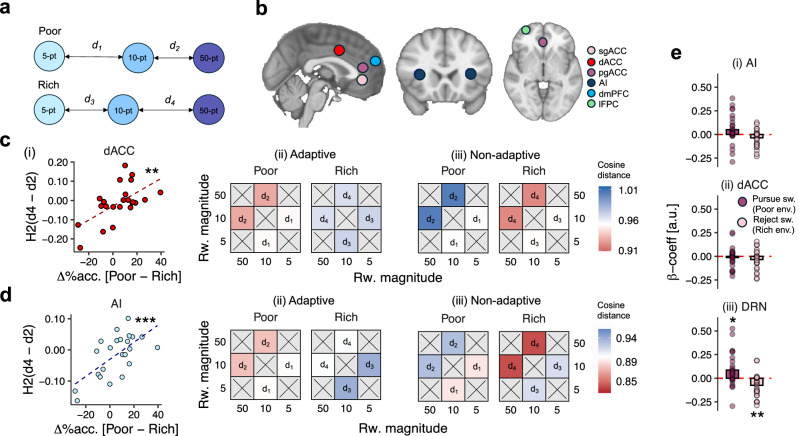
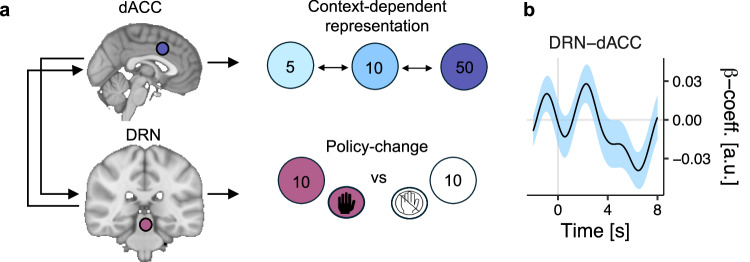
The dorsal raphe nucleus (DRN) is an important source of serotonin to the human forebrain, however there is little consensus about its behavioural function. We build on recent results from animal models to demonstrate that activity in human DRN implements changes in behavioural policy that reflect the distribution of rewards in the environment. We use a foraging-inspired behavioural task to show that human participants change their policy to pursue or reject reward opportunities as a function of the average value of opportunities in the environment. Activity in DRN-but no other neuromodulatory nucleus-signals such policy changes. Patterns of multivariate activity in dorsal anterior cingulate cortex (dACC) and anterior insular cortex (AI), meanwhile, track the relative value of reward opportunities given the average value of the environment. We therefore suggest that DRN, dACC and AI form a circuit in which dACC/AI construct representations of reward opportunities given the current context, and DRN implements changes in behavioural policy based on these representations.
Overview
The claims and statistics of this paper haven’t been checked yet.
Run the check — free, no account needed. It reads the open-access text and checks the sources it cites.
Integrity signals
Registry
Cites
Statistics
Figures
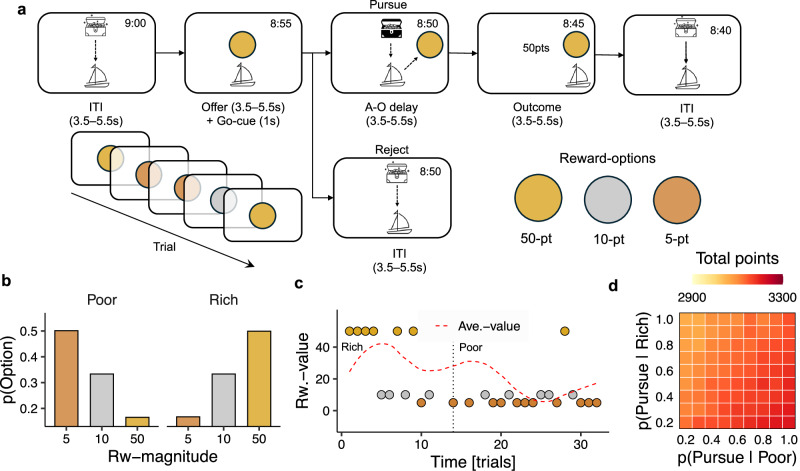
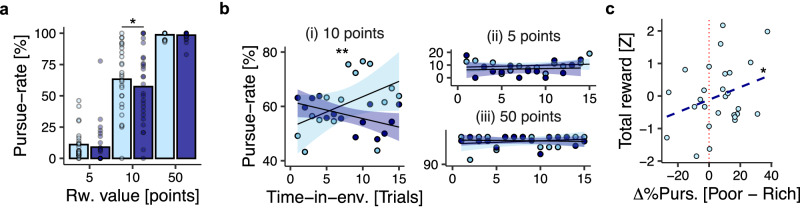
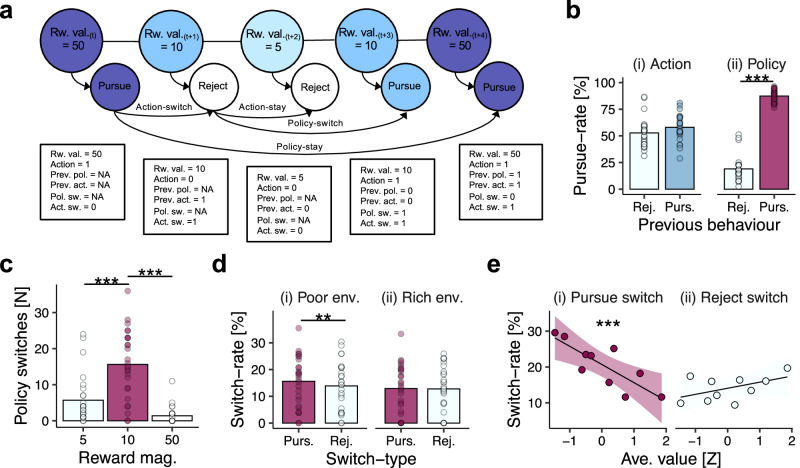
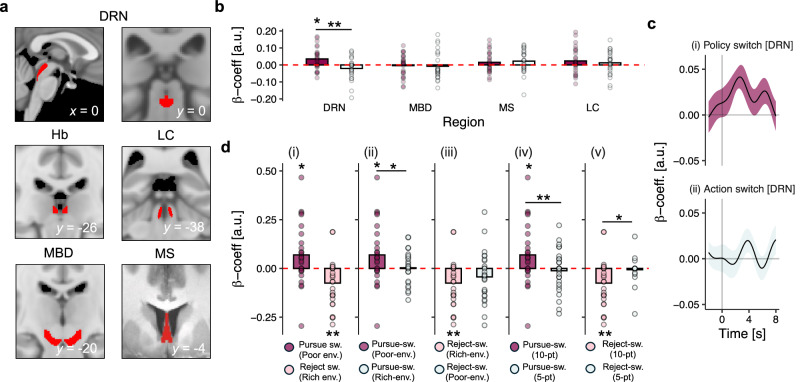
Verification
Claims the paper makes
The claims and statistics of this paper haven’t been checked yet.
Run the check — free, no account needed. It reads the open-access text and checks the sources it cites.
Claims other papers make about this one
Each is checked against this paper’s own text: does it say what the citing paper says it does?
The cited source says what the claim attributes to it.
In the citing paper
“To assess statistical significance while avoiding a temporal selection bias in the time-course analyses, we implemented a LOO procedure.”
From Two prefrontal-subcortical circuits estimate controllability and reflect its impact on learning (2026) · cites this paper as [99]
Self-check
Percentages, sums and reported differences re-computed from the paper’s own numbers.
The self-check needs the paper’s full text.
Citations
Cites
Fitting Linear Mixed-Effects Models Using lme4
Bates, D., Mächler, M., Bolker, B., & Walker, S. (2015) · Journal of Statistical Software · doi:10.18637/jss.v067.i01 · Cited by 86,835
A Simple Sequentially Rejective Multiple Test Procedure
(1979) · Scandinavian Journal of Statistics · doi:10.2307/4615733 · Cited by 21,526
Advances in functional and structural MR image analysis and implementation as FSL
Smith, S. M., Jenkinson, M., Woolrich, M. W., Beckmann, C. F., Behrens, T. E. J., Johansen-Berg, H., Bannister, P. R., De Luca, M., Drobnjak, I., Flitney, D. E., et al. (2004) · NeuroImage · doi:10.1016/j.neuroimage.2004.07.051 · Cited by 13,630
Jenkinson, M., Bannister, P., Brady, M., & Smith, S. (2002) · NeuroImage · doi:10.1006/nimg.2002.1132 · Cited by 11,888
Jenkinson, M., Beckmann, C. F., Behrens, T. E. J., Woolrich, M. W., & Smith, S. M. (2012) · NeuroImage · doi:10.1016/j.neuroimage.2011.09.015 · Cited by 11,314
Fast robust automated brain extraction
Smith, S. M. (2002) · Human Brain Mapping · doi:10.1002/hbm.10062 · Cited by 10,496
Optimal foraging, the marginal value theorem
Charnov, E. L. (1976) · Theoretical Population Biology · doi:10.1016/0040-5809(76)90040-x · Cited by 5,374
Accurate and robust brain image alignment using boundary-based registration
Greve, D. N., & Fischl, B. R. (2009) · NeuroImage · doi:10.1016/j.neuroimage.2009.06.060 · Cited by 3,553
Representational similarity analysis-connecting the branches of systems neuroscience
Kriegeskorte, N. (2008) · Frontiers in Systems Neuroscience · doi:10.3389/neuro.06.004.2008 · Cited by 3,355
Temporal Autocorrelation in Univariate Linear Modeling of FMRI Data
Woolrich, M. W., Ripley, B. D., Brady, M., & Smith, S. M. (2001) · NeuroImage · doi:10.1006/nimg.2001.0931 · Cited by 2,859
Structure and function of the brain serotonin system
Jacobs, B. L., & Azmitia, E. C. (1992) · Physiological Reviews · doi:10.1152/physrev.1992.72.1.165 · Cited by 2,574
The neural correlates of subjective value during intertemporal choice
Kable, J. W., & Glimcher, P. W. (2007) · Nature Neuroscience · doi:10.1038/nn2007 · Cited by 1,916
Uncertainty, Neuromodulation, and Attention
Yu, A. J., & Dayan, P. (2005) · Neuron · doi:10.1016/j.neuron.2005.04.026 · Cited by 1,774
Multilevel linear modelling for FMRI group analysis using Bayesian inference
Woolrich, M. W., Behrens, T. E. J., Beckmann, C. F., Jenkinson, M., & Smith, S. M. (2004) · NeuroImage · doi:10.1016/j.neuroimage.2003.12.023 · Cited by 1,719
Behavioral Theories and the Neurophysiology of Reward
Schultz, W. (2006) · Annual Review of Psychology · doi:10.1146/annurev.psych.56.091103.070229 · Cited by 1,637
Stephens, D. W., & Krebs, J. R. (1987) · Princeton University Press eBooks · doi:10.1515/9780691206790 · Cited by 1,400
Lateral habenula as a source of negative reward signals in dopamine neurons
Matsumoto, M., & Hikosaka, O. (2007) · Nature · doi:10.1038/nature05860 · Cited by 1,292
Reconciling the role of central serotonin neurons in human and animal behavior
Soubrié, P. (1986) · Behavioral and Brain Sciences · doi:10.1017/s0140525x00022871 · Cited by 993
The habenula: from stress evasion to value-based decision-making
Hikosaka, O. (2010) · Nature Reviews Neuroscience · doi:10.1038/nrn2866 · Cited by 955
Associative learning of social value
Behrens, T. E. J., Hunt, L. T., Woolrich, M. W., & Rushworth, M. F. S. (2008) · Nature · doi:10.1038/nature07538 · Cited by 925
Self-citationOpponent interactions between serotonin and dopamine
Daw, N. D., Kakade, S., & Dayan, P. (2002) · Neural Networks · doi:10.1016/s0893-6080(02)00052-7 · Cited by 844
The human raphe nuclei and the serotonergic system
Hornung, J.-P. (2003) · Journal of Chemical Neuroanatomy · doi:10.1016/j.jchemneu.2003.10.002 · Cited by 742
Serotoninergic regulation of emotional and behavioural control processes
Cools, R., Roberts, A. C., & Robbins, T. W. (2008) · Trends in Cognitive Sciences · doi:10.1016/j.tics.2007.10.011 · Cited by 656
Cognitive Inflexibility After Prefrontal Serotonin Depletion
Clarke, H. F., Dalley, J. W., Crofts, H. S., Robbins, T. W., & Roberts, A. C. (2004) · Science · doi:10.1126/science.1094987 · Cited by 632
Kolling, N., Behrens, T. E. J., Mars, R. B., & Rushworth, M. F. S. (2012) · Science · doi:10.1126/science.1216930 · Cited by 629
The Most Expensive Painting in the World
Gregory, R. L. (2007) · Perception · doi:10.1068/p3601ed · Cited by 619
Optimal prey selection in the great tit (Parus major)
Krebs, J. R., Erichsen, J. T., Webber, M. I., & Charnov, E. L. (1977) · Animal Behaviour · doi:10.1016/0003-3472(77)90064-1 · Cited by 560
Neuronal basis of sequential foraging decisions in a patchy environment
Hayden, B. Y., Pearson, J. M., & Platt, M. L. (2011) · Nature Neuroscience · doi:10.1038/nn.2856 · Cited by 547
A high-resolution probabilistic in vivo atlas of human subcortical brain nuclei
Pauli, W. M., Nili, A. N., & Tyszka, J. M. (2018) · Scientific Data · doi:10.1038/sdata.2018.63 · Cited by 515
Serotonin and dopamine: unifying affective, activational, and decision functions.
Cools, R., Nakamura, K., & Daw, N. D. (2011) · Neuropsychopharmacology · doi:10.1038/npp.2010.121 · Cited by 464
A computational and neural model of momentary subjective well-being
Rutledge, R. B., Skandali, N., Dayan, P., & Dolan, R. J. (2014) · Proceedings of the National Academy of Sciences · doi:10.1073/pnas.1407535111 · Cited by 444
What has serotonin to do with depression?
Cowen, P. J., & Browning, M. D. (2015) · World Psychiatry · doi:10.1002/wps.20229 · Cited by 410
Serotonergic neurons signal reward and punishment on multiple timescales
Cohen, J. Y., Amoroso, M. W., & Uchida, N. (2015) · eLife · doi:10.7554/elife.06346 · Cited by 388
Serotonin in Affective Control
Dayan, P., & Huys, Q. J. M. (2009) · Annual Review of Neuroscience · doi:10.1146/annurev.neuro.051508.135607 · Cited by 381
Haruno, M., Kuroda, T., Doya, K., Toyama, K., Kimura, M., Samejima, K., Imamizu, H., & Kawato, M. (2004) · The Journal of Neuroscience · doi:10.1523/jneurosci.3417-03.2004 · Cited by 300 · cited 1×
“…the pursue-vs-reject decision on each trial, reminiscent of a reward-guided action initiation signal 27,28 , and; (ii) a pattern conveying the value-difference between the current reward opportunity and the richnessof the environment, akin to a rewardprediction-error 29 – 32 (see supplementary Fig.”
Optogenetic Activation of Dorsal Raphe Serotonin Neurons Enhances Patience for Future Rewards
Miyazaki, K. W., Miyazaki, K., Tanaka, K. F., Yamanaka, A., Takahashi, A., Tabuchi, S., & Doya, K. (2014) · Current Biology · doi:10.1016/j.cub.2014.07.041 · Cited by 294
Dissociable Effects of Dopamine and Serotonin on Reversal Learning
den Ouden, H. E. M., Daw, N. D., Fernández, G., Elshout, J. A., Rijpkema, M., Hoogman, M., Franke, B., & Cools, R. (2013) · Neuron · doi:10.1016/j.neuron.2013.08.030 · Cited by 271
Action versus valence in decision making
Guitart-Masip, M., Duzel, E., Dolan, R., & Dayan, P. (2014) · Trends in Cognitive Sciences · doi:10.1016/j.tics.2014.01.003 · Cited by 270
Molecular and anatomical organization of the dorsal raphe nucleus
Huang, K. W., Ochandarena, N. E., Philson, A. C., Hyun, M., Birnbaum, J. E., Cicconet, M., & Sabatini, B. L. (2019) · eLife · doi:10.7554/elife.46464 · Cited by 267
Activation of Dorsal Raphe Serotonin Neurons Underlies Waiting for Delayed Rewards
Miyazaki, K., Miyazaki, K. W., & Doya, K. (2011) · Journal of Neuroscience · doi:10.1523/jneurosci.3714-10.2011 · Cited by 265
Learning the opportunity cost of time in a patch-foraging task
Constantino, S. M., & Daw, N. D. (2015) · Cognitive Affective & Behavioral Neuroscience · doi:10.3758/s13415-015-0350-y · Cited by 253
Medial and orbital frontal cortex in decision-making and flexible behavior
Klein-Flügge, M. C., Bongioanni, A., & Rushworth, M. F. S. (2022) · Neuron · doi:10.1016/j.neuron.2022.05.022 · Cited by 244
Physiological noise modelling for spinal functional magnetic resonance imaging studies
Brooks, J. C. W., Beckmann, C. F., Miller, K. L., Wise, R. G., Porro, C. A., Tracey, I., & Jenkinson, M. (2007) · NeuroImage · doi:10.1016/j.neuroimage.2007.09.018 · Cited by 243
Internal state dynamics shape brainwide activity and foraging behaviour
Marques, J. C., Li, M., Schaak, D., Robson, D. N., & Li, J. M. (2020) · Nature · doi:10.1038/s41586-019-1858-z · Cited by 243 · cited 2×
“For example, Marques and colleagues identi fi ed a population of dorsal raphe neurons in zebra fi sh in which activity covaried with transitions between food-oriented foraging and exploration 45 .”
Activity patterns of serotonin neurons underlying cognitive flexibility
Matias, S., Lottem, E., Dugué, G. P., & Mainen, Z. F. (2017) · eLife · doi:10.7554/elife.20552 · Cited by 239
Inferences on a multidimensional social hierarchy use a grid-like code
Park, S. A., Miller, D. S., & Boorman, E. D. (2021) · Nature Neuroscience · doi:10.1038/s41593-021-00916-3 · Cited by 230
A basal ganglia circuit for evaluating action outcomes
Stephenson‐Jones, M., Yu, K., Ahrens, S., Tucciarone, J., van Huijstee, A. N., Mejia, L. A., Penzo, M. A., Tai, L.-H., Wilbrecht, L., & Li, B. (2016) · Nature · doi:10.1038/nature19845 · Cited by 224
Association of neural and emotional impacts of reward prediction errors with major depression
Rutledge, R. B., Moutoussis, M., Smittenaar, P., Zeidman, P., Taylor, T., Hrynkiewicz, L., Lam, J., Skandali, N., Siegel, J. Z., Ousdal, O. T., et al. (2017) · JAMA Psychiatry · doi:10.1001/jamapsychiatry.2017.1713 · Cited by 209
Fouragnan, E. F., Chau, B. K. H., Folloni, D., Kolling, N., Verhagen, L., Klein-Flügge, M. C., Tankelevitch, L., Papageorgiou, G., Aubry, J., Sallet, J., et al. (2019) · Nature Neuroscience · doi:10.1038/s41593-019-0375-6 · Cited by 207
Twenty-Five Lessons from Computational Neuromodulation
Dayan, P. (2012) · Neuron · doi:10.1016/j.neuron.2012.09.027 · Cited by 190
Chemical neuroanatomy of the dorsal raphe nucleus and adjacent structures of the mouse brain
Fu, W.-Y., Maître, E. L., Fabre, V., Bernard, J., Xu, Q., & Hökfelt, T. G. M. (2010) · The Journal of Comparative Neurology · doi:10.1002/cne.22407 · Cited by 186
Serotonin neurons modulate learning rate through uncertainty
Grossman, C. D., Bari, B. A., & Cohen, J. Y. (2022) · Current Biology · doi:10.1016/j.cub.2021.12.006 · Cited by 164
Pharmacological Fingerprints of Contextual Uncertainty
Marshall, L., Mathys, C., Ruge, D., de Berker, A. O., Dayan, P., Stephan, K. E., & Bestmann, S. (2016) · PLOS Biology · doi:10.1371/journal.pbio.1002575 · Cited by 158
Wittmann, M. K., Kolling, N., Akaishi, R., Chau, B. K. H., Brown, J. W., Nelissen, N., & Rushworth, M. F. S. (2016) · Nature Communications · doi:10.1038/ncomms12327 · Cited by 146
Independent circuits in the basal ganglia for the evaluation and selection of actions
Stephenson‐Jones, M., Kardamakis, A. A., Robertson, B., & Grillner, S. E. (2013) · Proceedings of the National Academy of Sciences · doi:10.1073/pnas.1314815110 · Cited by 141
Activation of serotonin neurons promotes active persistence in a probabilistic foraging task
Lottem, E., Banerjee, D., Vertechi, P., Sarra, D., Lohuis, M. N. O., & Mainen, Z. F. (2018) · Nature Communications · doi:10.1038/s41467-018-03438-y · Cited by 140
Hippocampal Neurons Construct a Map of an Abstract Value Space
Knudsen, E. B., & Wallis, J. D. (2021) · Cell · doi:10.1016/j.cell.2021.07.010 · Cited by 130
A primate temporal cortex–zona incerta pathway for novelty seeking
Ogasawara, T., Sogukpinar, F., Zhang, K., Feng, Y.-Y., Pai, J., Jezzini, A., & Monosov, I. E. (2021) · Nature Neuroscience · doi:10.1038/s41593-021-00950-1 · Cited by 100
Learning and Stress Shape the Reward Response Patterns of Serotonin Neurons
Zhong, W., Li, Y., Feng, Q., & Luo, M. (2017) · Journal of Neuroscience · doi:10.1523/jneurosci.1181-17.2017 · Cited by 90
Global reward state affects learning and activity in raphe nucleus and anterior insula in monkeys
Wittmann, M. K., Fouragnan, E. F., Folloni, D., Klein-Flügge, M. C., Chau, B. K. H., Khamassi, M., & Rushworth, M. F. S. (2020) · Nature Communications · doi:10.1038/s41467-020-17343-w · Cited by 88
Meder, D., Kolling, N., Verhagen, L., Wittmann, M. K., Scholl, J., Madsen, K. H., Hulme, O. J., Behrens, T. E. J., & Rushworth, M. F. S. (2017) · Nature Communications · doi:10.1038/s41467-017-02169-w · Cited by 86
Chemoarchitecture of the primate dorsal raphe nucleus
Charara, A., & Parent, A. (1998) · Journal of Chemical Neuroanatomy · doi:10.1016/s0891-0618(98)00036-2 · Cited by 84
Prospection, Perseverance, and Insight in Sequential Behavior
Kolling, N., Scholl, J., Chekroud, A. M., Trier, H. A., & Rushworth, M. F. S. (2018) · Neuron · doi:10.1016/j.neuron.2018.08.018 · Cited by 84
Serotonin and Aversive Pavlovian Control of Instrumental Behavior in Humans
Geurts, D. E. M., Huys, Q. J. M., den Ouden, H. E. M., & Cools, R. (2013) · Journal of Neuroscience · doi:10.1523/jneurosci.2749-13.2013 · Cited by 83
Do dorsal raphe 5-HT neurons encode “beneficialness”?
Luo, M., Li, Y., & Zhong, W. (2016) · Neurobiology of Learning and Memory · doi:10.1016/j.nlm.2016.08.008 · Cited by 81
Momentary subjective well-being depends on learning and not reward
Blain, B., & Rutledge, R. B. (2020) · eLife · doi:10.7554/elife.57977 · Cited by 71
Heuristic and optimal policy computations in the human brain during sequential decision-making
Korn, C. W., & Bach, D. R. (2018) · Nature Communications · doi:10.1038/s41467-017-02750-3 · Cited by 70
Watanabe, N., Sakagami, M., & Haruno, M. (2013) · The Journal of Neuroscience · doi:10.1523/jneurosci.3400-12.2013 · Cited by 65
Opponent control of reinforcement by striatal dopamine and serotonin
Pinto, D. F. C., Pomrenze, M. B., Guo, M. Y., Touponse, G. C., Chen, A. P. F., Bentzley, B. S., Eshel, N., & Malenka, R. C. (2024) · Nature · doi:10.1038/s41586-024-08412-x · Cited by 58
On the normative advantages of dopamine and striatal opponency for learning and choice
Jaskir, A., & Frank, M. J. (2023) · eLife · doi:10.7554/elife.85107 · Cited by 56
Goal-seeking compresses neural codes for space in the human hippocampus and orbitofrontal cortex
Muhle-Karbe, P. S., Sheahan, H., Pezzulo, G., Spiers, H. J., Chien, S., Schuck, N. W., & Summerfield, C. (2023) · Neuron · doi:10.1016/j.neuron.2023.08.021 · Cited by 54
Batten, S. R., Bang, D., Kopell, B. H., Davis, A. N., Heflin, M., Fu, Q. X., Perl, O., Ziafat, K., Hashemi, A., Sáez, I., et al. (2024) · Nature Human Behaviour · doi:10.1038/s41562-024-01831-w · Cited by 53
Challenges in the differentiation of midbrain raphe nuclei in neuroimaging research
Kranz, G. S., Hahn, A., Savli, M., & Lanzenberger, R. R. (2012) · Proceedings of the National Academy of Sciences · doi:10.1073/pnas.1206247109 · Cited by 49
Ligneul, R., & Mainen, Z. F. (2023) · Current Biology · doi:10.1016/j.cub.2023.09.068 · Cited by 43
A neural mechanism for conserved value computations integrating information and rewards
Bromberg-Martin, E. S., Feng, Y.-Y., Ogasawara, T., White, J. K., Zhang, K., & Monosov, I. E. (2024) · Nature Neuroscience · doi:10.1038/s41593-023-01511-4 · Cited by 43
A prospective code for value in the serotonin system
Harkin, E. F., Grossman, C. D., Cohen, J. Y., Béïque, J.-C., & Naud, R. (2025) · Nature · doi:10.1038/s41586-025-08731-7 · Cited by 34
Grid-like entorhinal representation of an abstract value space during prospective decision making
Nitsch, A., Garvert, M. M., Bellmund, J. L. S., Schuck, N. W., & Doeller, C. F. (2024) · Nature Communications · doi:10.1038/s41467-024-45127-z · Cited by 33
A habenula-insular circuit encodes the willingness to act
Khalighinejad, N., Garrett, N., Priestley, L., Lockwood, P., & Rushworth, M. F. S. (2021) · Nature Communications · doi:10.1038/s41467-021-26569-1 · Cited by 32
Human decisions about when to act originate within a basal forebrain–nigral circuit
Khalighinejad, N., Priestley, L., Jbabdi, S., & Rushworth, M. F. S. (2020) · Proceedings of the National Academy of Sciences · doi:10.1073/pnas.1921211117 · Cited by 29
Complementary roles of serotonergic and cholinergic systems in decisions about when to act
Khalighinejad, N., Manohar, S., Husain, M., & Rushworth, M. F. S. (2022) · Current Biology · doi:10.1016/j.cub.2022.01.042 · Cited by 29
A subcortical switchboard for perseverative, exploratory and disengaged states
Ahmadlou, M., Shirazi, M. Y., Zhang, P., Rogers, I. L. M., Dziubek, J., Young, M., & Hofer, S. B. (2025) · Nature · doi:10.1038/s41586-025-08672-1 · Cited by 25
Dorsal raphe nucleus controls motivation-state transitions in monkeys
Priestley, L., Chiew, M., Shahdloo, M., Mahmoodi, A., Cheng, X., Cleveland, R. O., Rushworth, M. F. S., & Khalighinejad, N. (2025) · Science Advances · doi:10.1126/sciadv.ads1236 · Cited by 22
Mahmoodi, A., Nili, H., Harbison, C., Hamilton, S., Trudel, N., Bang, D., & Rushworth, M. F. S. (2023) · Neuron · doi:10.1016/j.neuron.2022.12.030 · Cited by 20
Feng, Y.-Y., Bromberg-Martin, E. S., & Monosov, I. E. (2024) · Cell Reports · doi:10.1016/j.celrep.2024.114341 · Cited by 18
Opportunity cost determines free-operant action initiation latency and predicts apathy
Nair, A., Niyogi, R. K., Shang, F., Tabrizi, S., Rees, G., & Rutledge, R. (2021) · Psychological Medicine · doi:10.1017/s0033291721003469 · Cited by 12
A distributed subcortical circuit linked to instrumental information-seeking about threat
Trier, H. A., Khalighinejad, N., Hamilton, S., Harbison, C., Priestley, L., Laubach, M., Klein-Flügge, M., Scholl, J., & Rushworth, M. F. S. (2025) · Proceedings of the National Academy of Sciences · doi:10.1073/pnas.2410955121 · Cited by 12
DORSAL RAPHE NUCLEUS CONTROLS MOTIVATIONAL STATE TRANSITIONS IN MONKEYSPreprint
Priestley, L., Chiew, M., Shahdloo, M., Mahmoodi, A., Cheng, X., Cleveland, R. O., Rushworth, M. F. S., & Khalighinejad, N. (2024) · bioRxiv (Cold Spring Harbor Laboratory) · doi:10.1101/2024.02.13.580224 · Cited by 9
An ancient subcortical circuit decides when to orient to threat in humansPreprint
Trier, H. A., Khalighinejad, N., Hamilton, S., Harbison, C., Priestley, L., Laubach, M., Scholl, J., & Rushworth, M. F. S. (2023) · bioRxiv (Cold Spring Harbor Laboratory) · doi:10.1101/2023.10.24.563636 · Cited by 3
Research works printed but not linked: 3
- Stephens, D. W. & Krebs, J. R. Foraging Theory. (Princeton University Press, Princeton, New Jersey, 1986).
- Kleiner, M. et al. What’s new in psychtoolbox-3. Perception 36, 1–16 (2007).
- Mai, J. K., Majtanik, M. & Paxinos, G. Atlas of the Human Brain. (Academic Press, Amsterdam, 2016).
Cited by
Sorted by citations
Two prefrontal-subcortical circuits estimate controllability and reflect its impact on learning
Liu, Y., Spiering, L., Luo, S., Kingston, N., Grohn, J., & Rushworth, M. F. S. (2026) · Neuron · doi:10.1016/j.neuron.2026.07.029 · Cited by 1
Winiarski, S., Ngo, M. T., Reith, W. D., Habart, M., Schüffelgen, U., Tachrount, M., Clarke, W. T., Watts, W. W., Whitcomb, D. J., Sharp, T., et al. (2026) · bioRxiv (Cold Spring Harbor Laboratory) · doi:10.64898/2026.05.11.724324
Raphe nuclei in cognition: A network-level framework for behavioral-state control
Khalighinejad, N., & Rushworth, M. F. S. (2026) · Neuron · doi:10.1016/j.neuron.2026.09.013 · Cited by 1
Metadata
- Authors
- Priestley, L., Mahmoodi, A., Reith, W. D., Khalighinejad, N., & Rushworth, M. F. S.
- Affiliations
- University of Oxford (GB)
- Sainsbury Wellcome Centre (GB)
- Corresponding author
- Priestley, Luke
- Venue
- Nature Communications
- Published
- 2026-02-14
- Volume
- 17
- Issue
- 1
- Pages
- 1665-1665
- ISSN
- 2041-1723 (ISSN-L)
- PMC
- PMC12909899
- OpenAlex
- W7128918923
- Cited by
- 3
- References
- 86
- Citations by year
- 2026: 3
- FWCI
- 7.28
- Type
- journal article
- Language
- en
- Open access
- gold
- doi.org
- Locations
- Nature Communications (publishedVersion, cc-by)
- bioRxiv (Cold Spring Harbor Laboratory) (acceptedVersion, cc-by-nc)
- PubMed (publishedVersion)
- PubMed Central (publishedVersion, cc-by)
- DOAJ (DOAJ: Directory of Open Access Journals) (submittedVersion, cc-by-sa)
- Funders
- Wellcome Trust (221794/Z/20/Z)
- Biotechnology and Biological Sciences Research Council (BB/W003392/1, BB/W008947/1)
- Topics
- Life Sciences › Neuroscience › Cellular and Molecular Neuroscience › Neurotransmitter Receptor Influence on Behavior
- Life Sciences › Neuroscience › Cognitive Neuroscience › Neural and Behavioral Psychology Studies
- Life Sciences › Neuroscience › Cognitive Neuroscience › Neural dynamics and brain function
- Keywords
- dorsal raphe nucleus, serotonin, behavioural policy, reward valuation, foraging task, dorsal anterior cingulate cortex, anterior insula, neuromodulation, reward allocation, decision-making, human brain activity
- MeSH terms
- Insular Cortex, Adult, Female, Gyrus Cinguli, Humans, Magnetic Resonance Imaging, Male, Reward, Young Adult, Dorsal Raphe Nucleus
About these checks
Registry, retraction, Cites and statistics results are computed, not judged, with one exception: a printed reference that no index lists is read once by a model before it counts as a citation error. Claims are extracted by a model and kept only when their quote appears verbatim in the text; each cited source is then checked, with a model’s help, for whether it says what the claim relies on. Those verdicts can be wrong — read the claim’s quote and the cited source before relying on one.
Statistics and arithmetic are recomputed, not judged.
Confidence bands are shown only for fields calibrated on our annotated test set. None is calibrated yet, so no band is shown.
What counts as a claim ›How we measure confidence ›How we check this ›
Are you an author, or do you see a problem with this page? Request a review
