

Revealing abrupt transitions from goal-directed to habitual behavior
Open accessThe DOI matches its Crossref record; 102 of the 102 references it cites were found in a registry or an index; 1 of the 61 sources its claims cite were checked for support.
Abstract
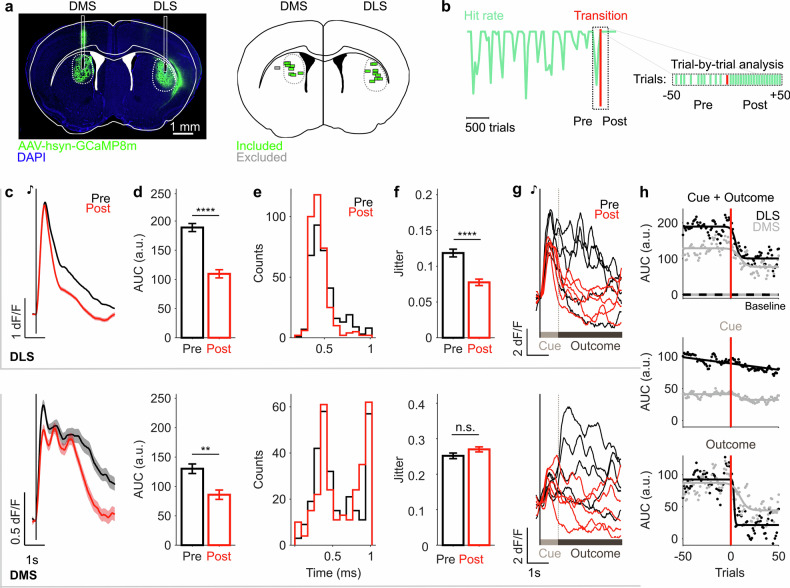
The speed of goal-directed to habit transitions has been debated since Clark Hull asked in 1943: is habit formation slow or sudden? To address this, male mice were given home-cage access to citric-acid water that reduced—without eliminating—reward-seeking for plain water in an auditory go/no-go task. Animals learned to discriminate quickly but exhibited ongoing state-like fluctuations in engagement. Strikingly, these fluctuations abruptly ceased (transition) long after discrimination stabilized, with HMM-GLM modeling pinpointing a ~3-trial transition. We confirmed this as a goal-directed to habit transition using sensory-specific outcome devaluation, DLS lesions, motor stereotypy, and pupillary responses. Dual-site fiber photometry showed equally abrupt DLS dynamics at the transition: outcome-related activity dropped and stimulus-response activity sharpened, suggesting a switch-like mechanism that recruits a readily available habit circuit rather than gradual changes across a threshold. Thus, habits can emerge suddenly, mediated by an abrupt dorsostriatal shift from outcome- to stimulus-driven processing. Whether habits emerge gradually or suddenly remains an open question. Here the authors show that mice abruptly switch from goal-directed to habitual control, marked by a rapid dorsal striatal shift from outcome- to stimulus-driven processing.
Overview
CoChat Summary
TL;DR
In male mice trained on an auditory go/no-go task, reduced reward-seeking from home-cage citric-acid water was associated with an abrupt, not gradual, transition from goal-directed to habitual control. Multiple behavioral, lesion, pupillometry, and dorsal striatal photometry measures converged on a switch-like habit transition occurring in about 3 trials.
Key findings
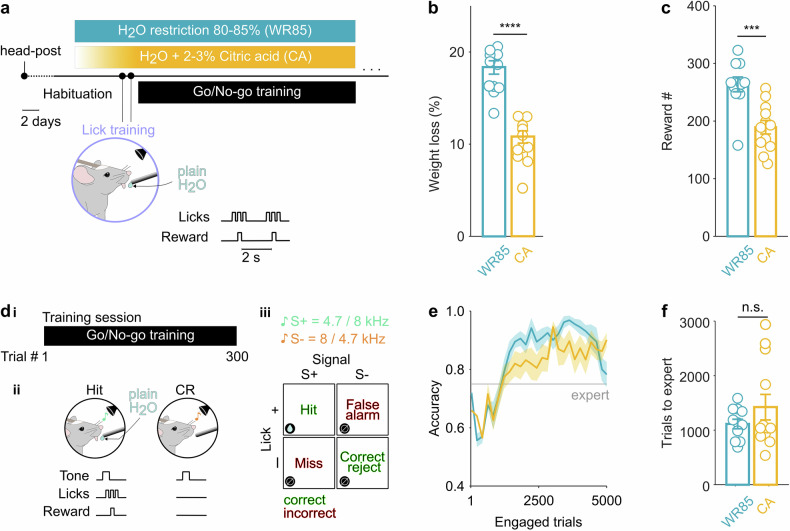
- Self-restricted CA mice lost less weight than standard water-restricted mice before training: 8.9% ± 1.9% vs 17.8% ± 2.3% (p = 5.5×10⁻⁵), and they obtained fewer rewards during lick training (p = 0.00079).
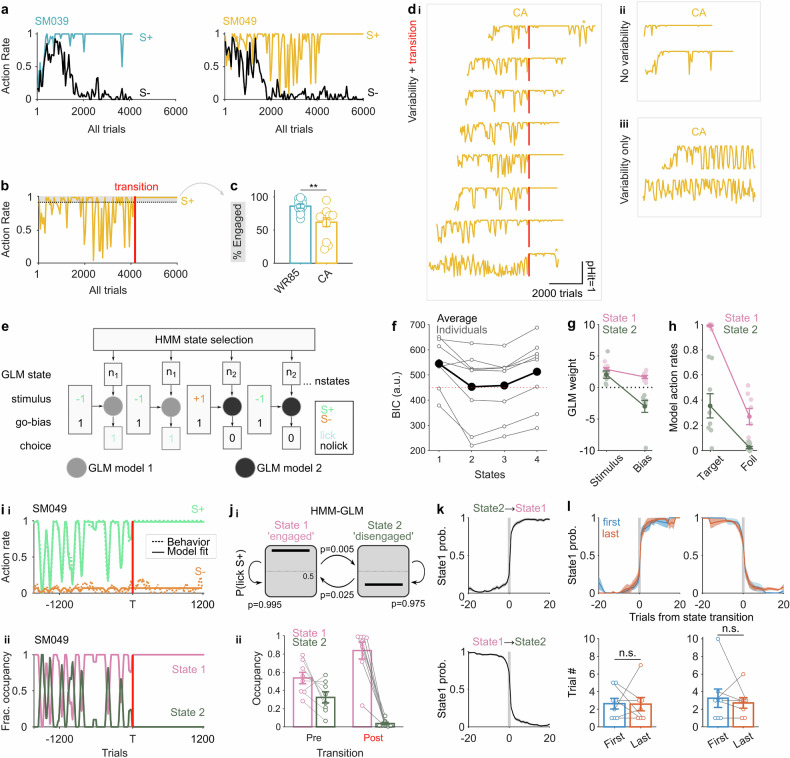
- In the go/no-go task, CA mice showed 10/12 (83.3%) high-variability engagement phases, and 8/10 (80%) of those transitioned to low variability; these transitions happened >1000 trials after expert discrimination (d’ > 2 expert = 1436 ± 454 trials vs transition = 3832 ± 385 trials).
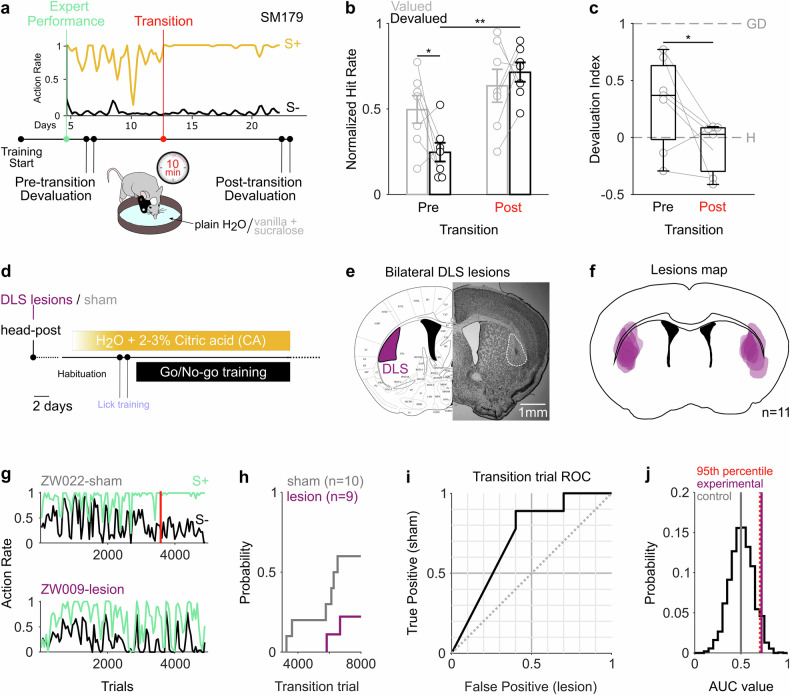
- Sensory-specific outcome devaluation showed that pre-transition behavior was goal-directed (devalued hit rates lower than valued; two-way repeated-measures ANOVA X2 = 5.61, p = 0.018), but post-transition the devaluation effect disappeared; the devaluation index decreased across the transition (t(6) = 2.42, p = 0.026).
- DLS lesions slowed or prevented the transition: 60% of sham CA mice vs 20% of DLS-lesioned mice transitioned to low variability, without deficits in contingency learning or lick-related motor behavior.
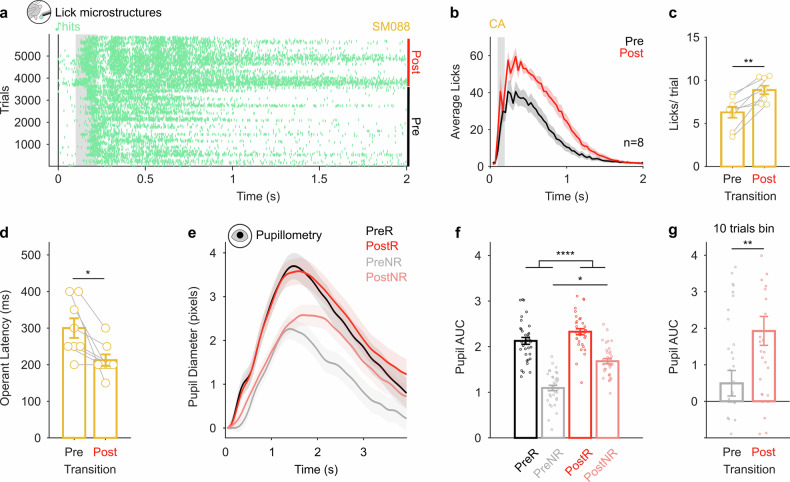
- Lick microstructures became more automatic after transition, with increased consummatory licks (t(7) = -4.87, p = 0.0018) and shorter reaction time (W = 28, p = 0.016); pupillary responses also became less outcome-sensitive, with post-transition effects visible within 10 trials of the transition (z = -2.78, p = 0.0054).
Methods
- Male C57BL/6J mice (11–15 weeks old at training start) were assigned to standard water restriction or self-restriction via ad libitum citric-acid (CA) water in the home cage; 45/48 mice with d’ > 2 were included.
- Animals were trained on a head-fixed auditory go/no-go task with target and foil tones; the study used behavioral analysis, sensory-specific outcome devaluation, bilateral DLS lesions, pupillometry, and dual-site fiber photometry in DLS and DMS.
- Main analyses included blockwise behavior metrics, sensory-specific devaluation tests, HMM-GLM modeling of trial-by-trial choice, and statistical testing with t-tests, Wilcoxon tests, ANOVA/ANCOVA, and mixed-effects models.
Limitations
- The authors note that pan-neuronal fiber photometry is a bulk measure and does not resolve cell types or projections; this limits mechanistic interpretation.
- They state that calcium sensor kinetics are slow relative to task timing, making it hard to fully disentangle cue, action, outcome, and evaluative signals.
- Evident from the text: the study is restricted to male mice and to a specific head-fixed go/no-go paradigm, so generalization beyond this preparation is not directly tested.
Model-written summary. Check it against the paper before relying on it.
Integrity signals
Registry
Cites
Statistics
Figures
Verification
Claims the paper makes
1 Valid · 0 Not valid · 23 Not checked · 120 Own results and interpretations
A result the paper reports from its own data — it cites no other source for it, so there is none to check. The quote shows it is in the paper.
In the paper
“Post-transition, however, three aspects of their licking behavior abruptly appear: a uniform lick stereotypy (Fig. 4a; Post), an increase in consummatory licks (Fig. 4b, c; paired t-test, t(7) = -4.87, p = 0.0018), and a reduction in reaction time (Fig. 4d; paired Wilcoxon signed-rank test, W = 28, p = 0.016).”
§ Revealing abrupt transitions from goal-directed to habitual behavior > Results > Licking microstructures demonstrate motor automaticity post-transition
plainstates a cause- Asserted: passes — The authors put it forward as true.
- Checkable: passes — It can be checked against evidence.
- Load-bearing: passes — The paper’s conclusions depend on it.
- Based: passes — The paper gives a reason why it holds.
A result the paper reports from its own data — it cites no other source for it, so there is none to check. The quote shows it is in the paper.
In the paper
“State 1 (pink) exhibited high engagement, evident by a positive bias and high hit rate (i.e., action rate on target trials), while State 2 (dark green) exhibited strong disengagement, evidenced by a strongly negative bias and low hit rate (Fig. 2g–j).”
§ Revealing abrupt transitions from goal-directed to habitual behavior > Results > Abrupt transition in engagement may reflect a change in decision control
plainstates an association- Asserted: passes — The authors put it forward as true.
- Checkable: passes — It can be checked against evidence.
- Load-bearing: passes — The paper’s conclusions depend on it.
- Based: passes — The paper gives a reason why it holds.
A result the paper reports from its own data — it cites no other source for it, so there is none to check. The quote shows it is in the paper.
In the paper
“Pre-transition, animals had lower hit rates (normalized, see “Methods”) in the devalued condition compared to the valued condition, indicating that behavior is under goal-directed control (Fig. 3b; two-way repeated-measure ANOVA, X2 = 5.61, p = 0.018).”
§ Revealing abrupt transitions from goal-directed to habitual behavior > Results > Sensory-specific outcome devaluation validates transition to habit
plainstates an association- Asserted: passes — The authors put it forward as true.
- Checkable: passes — It can be checked against evidence.
- Load-bearing: passes — The paper’s conclusions depend on it.
- Based: passes — The paper gives a reason why it holds.
A result the paper reports from its own data — it cites no other source for it, so there is none to check. The quote shows it is in the paper.
In the paper
“Post-transition, however, three aspects of their licking behavior abruptly appear: a uniform lick stereotypy (Fig. 4a; Post), an increase in consummatory licks (Fig. 4b, c; paired t-test, t(7) = -4.87, p = 0.0018), and a reduction in reaction time (Fig. 4d; paired Wilcoxon signed-rank test, W = 28, p = 0.016).”
§ Revealing abrupt transitions from goal-directed to habitual behavior > Results > Licking microstructures demonstrate motor automaticity post-transition
plainstates a cause- Asserted: passes — The authors put it forward as true.
- Checkable: passes — It can be checked against evidence.
- Load-bearing: passes — The paper’s conclusions depend on it.
- Based: passes — The paper gives a reason why it holds.
A result the paper reports from its own data — it cites no other source for it, so there is none to check. The quote shows it is in the paper.
In the paper
“Moreover, the devaluation index (see “Methods”) of the animals decreased significantly across the transition (Fig. 3c; paired t-test, t(6) = 2.42, p = 0.026).”
§ Revealing abrupt transitions from goal-directed to habitual behavior > Results > Sensory-specific outcome devaluation validates transition to habit
plain- Asserted: passes — The authors put it forward as true.
- Checkable: passes — It can be checked against evidence.
- Load-bearing: passes — The paper’s conclusions depend on it.
- Based: passes — The paper gives a reason why it holds.
81 more claims
Create a free account to see all 144 claims and to verify the 60 references still open.
- It may state two separate claims as one. 44
- The quote only partly states this claim. 2
- Probably not a substantial claim. 25
Statistics recomputed
Every reported test result, recomputed from its test statistic and degrees of freedom. A result shows as not adding up only once an independent check has confirmed it.
- Consistentt(6) = 2.42reported p = .026 · recomputed p = .052
“t(6) = 2.42, p = .026”
The paper states a one-tailed test
- Consistentt(7) = -4.87reported p = .0018 · recomputed p = .002
“t(7) = -4.87, p = .0018”
- Consistentz = -2.78reported p = .0054 · recomputed p = .005
“z = -2.78, p = .0054”
- Consistentχ²(1) = 5.56reported p = .018 · recomputed p = .018
“X2(1) = 5.56, p = .018”
- Consistentχ²(1) = 8reported p = .0047 · recomputed p = .005
“X2(1) = 8.00, p = .0047”
8 more recomputed tests
Create a free account to see every test the Stats check recomputed.
Self-check
Percentages, sums and reported differences re-computed from the paper’s own numbers.
Self-check results appear here once an independent check has confirmed them.
Citations
Cites
An Integrative Theory of Prefrontal Cortex Function
Miller, E. K., & Cohen, J. D. (2001) · Annual Review of Neuroscience · doi:10.1146/annurev.neuro.24.1.167 · Cited by 12,803
DeepLabCut: markerless pose estimation of user-defined body parts with deep learning
Mathis, A., Mamidanna, P., Cury, K. M., Abe, T., Murthy, V. N., Mathis, M. W., & Bethge, M. (2018) · Nature Neuroscience · doi:10.1038/s41593-018-0209-y · Cited by 5,187
Daw, N. D., Niv, Y., & Dayan, P. (2005) · Nature Neuroscience · doi:10.1038/nn1560 · Cited by 2,533
The role of the basal ganglia in habit formation
Yin, H. H., & Knowlton, B. J. (2006) · Nature Reviews Neuroscience · doi:10.1038/nrn1919 · Cited by 2,402
Balleine, B. W., & O'Doherty, J. P. (2010) · Neuropsychopharmacology · doi:10.1038/npp.2009.131 · Cited by 1,775 · cited 1×
“The potentially higher-level nature points to regions such as premotor or prefrontal cortical areas 3,72 , which directly interact with the dorsal striatum 73 , and have been shown to actively compute higher-order variables such as environmentaluncertainty and cognitive effort 3,72 – 79 .”
Goal-directed instrumental action: contingency and incentive learning and their cortical substrates
Balleine, B. W., & Dickinson, A. (1998) · Neuropharmacology · doi:10.1016/s0028-3908(98)00033-1 · Cited by 1,541 · cited 1×
“A behavior is considered habitual when animals continue to perform an action even when the outcome is devalued via pre-task satiation 15,16,26,27 .”
Temporal difference models and reward-related learning in the human brain
O'Doherty, J. P., Dayan, P., Friston, K., Critchley, H., & Dolan, R. J. (2003) · Neuron · doi:10.1016/s0896-6273(03)00169-7 · Cited by 1,522 · cited 1×
“Pupillary response dynamics are thought to re fl ect multiple different features, including sensory cues 36,37 , arousal/task engagement 38,39 , motor activity 40,41 , and motivation 42,43 .”
Spontaneous behaviors drive multidimensional, brainwide activity
Stringer, C., Pachitariu, M., Steinmetz, N., Reddy, C. B., Carandini, M., & Harris, K. D. (2019) · Science · doi:10.1126/science.aav7893 · Cited by 1,510
Using DeepLabCut for 3D markerless pose estimation across species and behaviors
Nath, T., Mathis, A., Chen, A. C., Patel, A., Bethge, M., & Mathis, M. W. (2019) · Nature Protocols · doi:10.1038/s41596-019-0176-0 · Cited by 1,505
A new look at habits and the habit-goal interface.
Wood, W., & Neal, D. T. (2007) · Psychological Review · doi:10.1037/0033-295x.114.4.843 · Cited by 1,470 · cited 1×
“This interpretation would be more in line with the human experience where, for example, the initial reach for a cup of coffee in the morning may be habitual but subsequent sips may be drivenby thegoalforthecoffeeitself 65 .”
Wood, W., & Rünger, D. (2016) · Annual Review of Psychology · doi:10.1146/annurev-psych-122414-033417 · Cited by 1,445
Yin, H. H., Knowlton, B. J., & Balleine, B. W. (2004) · European Journal of Neuroscience · doi:10.1111/j.1460-9568.2004.03095.x · Cited by 1,226 · cited 2×
“Using standard outcome devaluation procedures, rodents with lesions to the DLS persist in goal-directed mode (i.e., when they should be sensitive to reward devaluation) even after signi fi cant amounts of overtraining 34 .”
Actions and habits: The development of behavioural autonomy
Dickinson, A. (1985) · Philosophical Transactions of the Royal Society of London. B, Biological Sciences · doi:10.1098/rstb.1985.0010 · Cited by 1,217 · cited 2×
“In rodents, studies of habits often use distinct reinforcement schedules to bias goal-directed, or habitual behavior 15 .”
Habits as knowledge structures: Automaticity in goal-directed behavior
Aarts, H., & Dijksterhuis, A. (2000) · Journal of Personality and Social Psychology · doi:10.1037/0022-3514.78.1.53 · Cited by 972
Pupil dilation as an index of effort in cognitive control tasks: A review
van der Wel, P., & van Steenbergen, H. (2018) · Psychonomic Bulletin & Review · doi:10.3758/s13423-018-1432-y · Cited by 928 · cited 1×
“Pupillary response dynamics are thought to re fl ect multiple different features, including sensory cues 36,37 , arousal/task engagement 38,39 , motor activity 40,41 , and motivation 42,43 .”
Pupil fluctuations track fast switching of cortical states during quiet wakefulness
Reimer, J., Froudarakis, E., Cadwell, C. R., Yatsenko, D., Denfield, G. H., & Tolias, A. S. (2014) · Neuron · doi:10.1016/j.neuron.2014.09.033 · Cited by 717
Prefrontal–striatal pathway underlies cognitive regulation of craving
Kober, H., Mende-Siedlecki, P., Kross, E. F., Weber, J., Mischel, W., Hart, C. L., & Ochsner, K. N. (2010) · Proceedings of the National Academy of Sciences · doi:10.1073/pnas.1007779107 · Cited by 695 · cited 1×
“More broadly, our fi nding of an abrupt shift in decision control may inform distinct interventional strategies and new approaches for addressing habit-related disorders in humans, including combining desensitization and cognitive control strategies 80,81 .”
Instrumental Responding following Reinforcer Devaluation
Adams, C. D., & Dickinson, A. (1981) · The Quarterly Journal of Experimental Psychology Section B · doi:10.1080/14640748108400816 · Cited by 687 · cited 2×
“We conducted sensory-speci fi c outcome devaluation tests in the same animals at two discrete time points during behavioral training, one pre-transition and the other post-transition (Fig.”
Gremel, C. M., & Costa, R. M. (2013) · Nature Communications · doi:10.1038/ncomms3264 · Cited by 618 · cited 1×
“Sensitivity to the outcome has been successfully operationalized in laboratory testing with outcome devaluation 4,20 procedures in which a speci fi c reward is devalued (through satiety or taste aversion).”
The learning curve: Implications of a quantitative analysis
Gallistel, C. R., Fairhurst, S., & Balsam, P. (2004) · Proceedings of the National Academy of Sciences · doi:10.1073/pnas.0404965101 · Cited by 613 · cited 1×
“This builds on prior work suggesting that animals may experience nonlinear changes in learning either through hypothesis testing in goal-directed tasks 58 – 60 or step-like changes in associative strength in Pavlovian tasks 61 .”
Variations in the Sensitivity of Instrumental Responding to Reinforcer Devaluation
Adams, C. D. (1982) · The Quarterly Journal of Experimental Psychology Section B · doi:10.1080/14640748208400878 · Cited by 609
Bonsai: an event-based framework for processing and controlling data streams
Lopes, G., Bonacchi, N., Frazão, J., Neto, J. P., Atallah, B. V., Soares, S., Moreira, L., Matias, S., Itskov, P. M., Correia, P. A., et al. (2015) · Frontiers in Neuroinformatics · doi:10.3389/fninf.2015.00007 · Cited by 593 · cited 1×
“A two-state model was suf fi cient to explain the choice behavior of six animals, capturing an engaged state and a disengaged state, whereas a three-state model wasneeded for two animals,capturing an additional low-discrimination state.”
Learning, reward, and decision making
O'Doherty, J. P., Cockburn, J., & Pauli, W. M. (2017) · Annual Review of Psychology · doi:10.1146/annurev-psych-010416-044216 · Cited by 475 · cited 2×
“With overtraining, the habitual system simpli fi es decision-making by shifting to a stimulus-response mode of behavior 51 , making decisions potentially value-less and in fl exible but less cognitively demanding 52 .”
Yin, H. H., Knowlton, B. J., & Balleine, B. W. (2005) · European Journal of Neuroscience · doi:10.1111/j.1460-9568.2005.04219.x · Cited by 447 · cited 1×
“We adapted existing protocols for food-driven tasks 29,85,86 in mice to suit our task structure with thirst as the motivator 87 .”
Associative theories of goal-directed behaviour: a case for animal–human translational models
Wit, S., & Dickinson, A. (2009) · Psychological Research Psychologische Forschung · doi:10.1007/s00426-009-0230-6 · Cited by 424
Relations between Pavlovian-instrumental transfer and reinforcer devaluation
Holland, P. C. (2004) · Journal of Experimental Psychology: Animal Behavior Processes · doi:10.1037/0097-7403.30.2.104 · Cited by 388 · cited 1×
“This behavioral characterization relies on de fi ning habitual behavior as the loss or absence of goal-directed control 18,19 .”
Coutureau, E., & Killcross, S. (2003) · Behavioural Brain Research · doi:10.1016/j.bbr.2003.09.025 · Cited by 342
The effect of the instrumental training contingency on susceptibility to reinforcer devaluation
Dickinson, A., Nicholas, D. J., & Adams, C. D. (1983) · The Quarterly Journal of Experimental Psychology Section B · doi:10.1080/14640748308400912 · Cited by 338 · cited 1×
“’ Here, we lay out an approach that allows real-time assessment of the underlying decision process without the need for discrete testing sessions and without the implementation of speci fi ed training schedules to bias decision modes 21,56,57 .”
A dual operator view of habitual behavior reflecting cortical and striatal dynamics
Smith, K. S., & Graybiel, A. M. (2013) · Neuron · doi:10.1016/j.neuron.2013.05.038 · Cited by 324
Krechevsky, I. (1932) · Psychological Review · doi:10.1037/h0073500 · Cited by 323 · cited 1×
“Mouse allocation to speci fi c groups was randomized but the experimenters were not blinded to group types.”
Why behavior change is difficult to sustain
Bouton, M. E. (2014) · Preventive Medicine · doi:10.1016/j.ypmed.2014.06.010 · Cited by 322
The role of habit in compulsivity
Gillan, C. M., Robbins, T. W., Sahakian, B. J., van den Heuvel, O. A., & van Wingen, G. (2016) · European Neuropsychopharmacology · doi:10.1016/j.euroneuro.2015.12.033 · Cited by 292 · cited 1×
“An assumption of a slow, gradual shift from goal-directed to habitual control underpins most models of learning and informs relevant approaches to understanding the neurobiological basis of habitual behavior 7 – 14 .”
Prefrontal cortex, cognitive control, and the registration of decision costs
McGuire, J. T., & Botvinick, M. M. (2010) · Proceedings of the National Academy of Sciences · doi:10.1073/pnas.0910662107 · Cited by 286
Nilsen, P., Roback, K., Broström, A., & Ellström, P.-E. (2012) · Implementation Science · doi:10.1186/1748-5908-7-53 · Cited by 284
Miller, K. J., Shenhav, A., & Ludvig, E. A. (2019) · Psychological Review · doi:10.1037/rev0000120 · Cited by 280 · cited 1×
“With overtraining, the habitual system simpli fi es decision-making by shifting to a stimulus-response mode of behavior 51 , making decisions potentially value-less and in fl exible but less cognitively demanding 52 .”
When should we use one-tailed hypothesis testing?
Ruxton, G. D., & Neuhäuser, M. (2010) · Methods in Ecology and Evolution · doi:10.1111/j.2041-210x.2010.00014.x · Cited by 269 · cited 1×
“…devaluation index is higher than that of the pre-transition, we performed a one-tailed dependent sample t-test to compare the pre-and post-transition devaluation index 96 – 98 , which yielded signi fi cant result, t(6) =2.42, p =0.026, two-sided 90%CI [0.078,0.71], Cohen ’ s d z =0.92.”
InfluentialSweetener Preference of C57BL/6ByJ and 129P3/J Mice
Bachmanov, A. A. (2001) · Chemical Senses · doi:10.1093/chemse/26.7.905 · Cited by 260 · cited 1×
“Post-hoc pairwise comparison was conducted with Bonferroni corrections or LSD test.”
Carrots and sticks fail to change behavior in cocaine addiction
Ersche, K. D., Gillan, C. M., Jones, P. S., Williams, G. B., Ward, L. H. E., Luijten, M., de Wit, S., Sahakian, B. J., Bullmore, E. T., & Robbins, T. W. (2016) · Science · doi:10.1126/science.aaf3700 · Cited by 239 · cited 1×
“We refer to these mice as self-restricted as they individually balance their hydration needs against their mild distaste for CA water.”
Mice alternate between discrete strategies during perceptual decision-making
Ashwood, Z. C., Roy, N. A., Stone, I. R., Laboratory, T. I. B., Urai, A. E., Churchland, A. K., Pouget, A., & Pillow, J. W. (2022) · Nature Neuroscience · doi:10.1038/s41593-021-01007-z · Cited by 229 · cited 1×
“The model was fi t using a previouslypublished expectation-maximization (EM) algorithm 25 .”
Shifting the balance between goals and habits: Five failures in experimental habit induction.
de Wit, S., Kindt, M., Knot, S. L., Verhoeven, A. A. C., Robbins, T. W., Gasull-Camos, J., Evans, M., Mirza, H., & Gillan, C. M. (2018) · Journal of Experimental Psychology: General · doi:10.1037/xge0000402 · Cited by 214
Dickinson, A. (1994) · Animal Learning and Cognition · doi:10.1016/b978-0-08-057169-0.50009-7 · Cited by 200
Bijleveld, E., Custers, R., & Aarts, H. (2009) · Psychological Science · doi:10.1111/j.1467-9280.2009.02443.x · Cited by 198
Dorsal Striatal Circuits for Habits, Compulsions and Addictions
Lipton, D. M., Gonzales, B. J., & Citri, A. (2019) · Frontiers in Systems Neuroscience · doi:10.3389/fnsys.2019.00028 · Cited by 196 · cited 1×
“The two decision processes (goal-directed and habitual) are thought to be sub-served by distinct neural circuits in the dorsal striatum 31 .”
The role of incentive learning in instrumental outcome revaluation by sensory-specific satiety
Balleine, B. W., & Dickinson, A. (1998) · Animal Learning & Behavior · doi:10.3758/bf03199161 · Cited by 188 · cited 1×
“Thissensitivitytodevaluationshouldbespeci fi ctothe task-associated reward so as to differentiate general motivation (for water or food) from outcome-speci fi c value 3,28 – 30 .”
Still at the Choice‐Point: Action Selection and Initiation in Instrumental Conditioning
BALLEINE, B. W., & OSTLUND, S. B. (2007) · Annals of the New York Academy of Sciences · doi:10.1196/annals.1390.006 · Cited by 184
Smith, K. S., Virkud, A., Deisseroth, K., & Graybiel, A. M. (2012) · Proceedings of the National Academy of Sciences · doi:10.1073/pnas.1216264109 · Cited by 173
Contextual control of instrumental actions and habits.
Thrailkill, E. A., & Bouton, M. E. (2015) · Journal of Experimental Psychology: Animal Learning and Cognition · doi:10.1037/xan0000045 · Cited by 165 · cited 1×
“’ Here, we lay out an approach that allows real-time assessment of the underlying decision process without the need for discrete testing sessions and without the implementation of speci fi ed training schedules to bias decision modes 21,56,57 .”
Renteria, R., Baltz, E. T., & Gremel, C. M. (2018) · Nature Communications · doi:10.1038/s41467-017-02615-9 · Cited by 164 · cited 2×
“We adapted existing protocols for food-driven tasks 29,85,86 in mice to suit our task structure with thirst as the motivator 87 .”
du Prel, J.-B., Röhrig, B., Hommel, G., & Blettner, M. (2010) · Deutsches Ärzteblatt international · doi:10.3238/arztebl.2010.0343 · Cited by 161
Devan, B. D., Hong, N. S., & McDonald, R. J. (2011) · Neurobiology of Learning and Memory · doi:10.1016/j.nlm.2011.06.002 · Cited by 159
On habits and addiction: an associative analysis of compulsive drug seeking
Ostlund, S. B., & Balleine, B. W. (2008) · Drug Discovery Today: Disease Models · doi:10.1016/j.ddmod.2009.07.004 · Cited by 147 · cited 2×
“We refer to these mice as self-restricted as they individually balance their hydration needs against their mild distaste for CA water.”
Current limits of experimental research into habits and future directions
Watson, P., & de Wit, S. (2017) · Current Opinion in Behavioral Sciences · doi:10.1016/j.cobeha.2017.09.012 · Cited by 131 · cited 2×
“…to which discrete measures of sensitivity to outcome devaluation suf fi ciently distinguish goal-directed from habitual control is still under scrutiny 53,54 as sensitivity to outcome devaluation can also be triggered by unexpected cues 29 and in situations where habits are expected to form 55 .”
Fiber photometry in striatum reflects primarily nonsomatic changes in calcium
Legaria, A. A., Matikainen‐Ankney, B. A., Yang, B., Ahanonu, B., Licholai, J. A., Parker, J. G., & Kravitz, A. V. (2022) · Nature Neuroscience · doi:10.1038/s41593-022-01152-z · Cited by 125 · cited 1×
“Mouse allocation to speci fi c groups was randomized but the experimenters were not blinded to group types.”
Ito, M., & Doya, K. (2015) · The Journal of Neuroscience · doi:10.1523/jneurosci.1962-14.2015 · Cited by 113 · cited 1×
“Mouse allocation to speci fi c groups was randomized but the experimenters were not blinded to group types.”
Juczewski, K., Koussa, J. A., Kesner, A. J., Lee, J. O., & Lovinger, D. M. (2020) · Scientific Reports · doi:10.1038/s41598-020-69132-6 · Cited by 112
Distinct recruitment of dorsomedial and dorsolateral striatum erodes with extended training
Vandaele, Y., Mahajan, N. R., Ottenheimer, D. J., Richard, J. M., Mysore, S. P., & Janak, P. H. (2019) · eLife · doi:10.7554/elife.49536 · Cited by 108 · cited 1×
“Mouse allocation to speci fi c groups was randomized but the experimenters were not blinded to group types.”
Transcardiac Perfusion of the Mouse for Brain Tissue Dissection and Fixation
Wu, J., Cai, Y., Wu, X., et al. (2021) · BIO-PROTOCOL · doi:10.21769/bioprotoc.3988 · Cited by 104
Bhalerao, S., & Parab, S. (2010) · International Journal of Ayurveda Research · doi:10.4103/0974-7788.72494 · Cited by 90
Defining the place of habit in substance use disorders
Vandaele, Y., & Janak, P. H. (2018) · Progress in Neuro-Psychopharmacology and Biological Psychiatry · doi:10.1016/j.pnpbp.2017.06.029 · Cited by 81 · cited 1×
“Thissuggeststhat self-restricted CA mice exhibit reduced reward-seeking for plain water despite similar consummatory behavior during active licking.”
Dopamine role in learning and action inference
Bogacz, R. (2020) · eLife · doi:10.7554/elife.53262 · Cited by 81
Citric Acid Water as an Alternative to Water Restriction for High-Yield Mouse Behavior
Urai, A. E., Aguillon-Rodriguez, V., Laranjeira, I. C., Cazettes, F., Mainen, Z. F., & Churchland, A. K. (2021) · eNeuro · doi:10.1523/eneuro.0230-20.2020 · Cited by 78
Neurobiology of habit formation
Amaya, K. A., & Smith, K. S. (2018) · Current Opinion in Behavioral Sciences · doi:10.1016/j.cobeha.2018.01.003 · Cited by 76 · cited 2×
“The observed pupillary dynamics could re fl ect a loss of outcome sensitivity after transitions to habit or could be driven by transition-related differences in task engagement 33,34 , motor activity, or motivation (but not sensory cues, since all analysis is done on S+ trials).”
van Elzelingen, W., Warnaar, P., Matos, J., Bastet, W., Jonkman, R., Smulders, D., Goedhoop, J., Denys, D., Arbab, T., & Willuhn, I. (2022) · Current Biology · doi:10.1016/j.cub.2021.12.027 · Cited by 69
Habit formation coincides with shifts in reinforcement representations in the sensorimotor striatum
Smith, K. S., & Graybiel, A. M. (2016) · Journal of Neurophysiology · doi:10.1152/jn.00925.2015 · Cited by 68
Cortical-subcortical interactions in goal-directed behavior
Cruz, K. G., Leow, Y. N., Le, N. M., Adam, E., Huda, R., & Sur, M. (2023) · Physiological Reviews · doi:10.1152/physrev.00048.2021 · Cited by 67 · cited 1×
“The potentially higher-level nature points to regions such as premotor or prefrontal cortical areas 3,72 , which directly interact with the dorsal striatum 73 , and have been shown to actively compute higher-order variables such as environmentaluncertainty and cognitive effort 3,72 – 79 .”
Methods for Studying Habitual Behavior in Mice
Rossi, M. A., & Yin, H. H. (2012) · Current Protocols in Neuroscience · doi:10.1002/0471142301.ns0829s60 · Cited by 66 · cited 1×
“To date, no approach exists to disambiguate between goal-directed and habitual control in real-time, during training 21,22 .”
Lee, C. R., & Margolis, D. J. (2016) · Frontiers in Behavioral Neuroscience · doi:10.3389/fnbeh.2016.00200 · Cited by 65 · cited 1×
“Pupillary response dynamics are thought to re fl ect multiple different features, including sensory cues 36,37 , arousal/task engagement 38,39 , motor activity 40,41 , and motivation 42,43 .”
Hosking, J. G., Cocker, P. J., & Winstanley, C. A. (2016) · Cerebral Cortex · doi:10.1093/cercor/bhu321 · Cited by 58
Lever Insertion as a Salient Stimulus Promoting Insensitivity to Outcome Devaluation
Vandaele, Y., Pribut, H. J., & Janak, P. H. (2017) · Frontiers in Integrative Neuroscience · doi:10.3389/fnint.2017.00023 · Cited by 58 · cited 3×
“We adapted existing protocols for food-driven tasks 29,85,86 in mice to suit our task structure with thirst as the motivator 87 .”
Aberrant habit formation in the Sapap3-knockout mouse model of obsessive-compulsive disorder
Hadjas, L. C., Lüscher, C., & Simmler, L. D. (2019) · Scientific Reports · doi:10.1038/s41598-019-48637-9 · Cited by 56 · cited 1×
“The devaluation index for each animal was calculated based on the normalized hit rate with the formula below: Devaluation Index = Hit Rate valued (cid:1) Hit Rate devalued Hit Rate valued + Hit Rate devalued A devaluation index score of 1 suggests perfect goal-directed behavior 85,95 .”
Striatal dopamine signals reflect perceived cue–action–outcome associations in mice
Bernklau, T. W., Righetti, B., Mehrke, L. S., & Jacob, S. N. (2024) · Nature Neuroscience · doi:10.1038/s41593-023-01567-2 · Cited by 51 · cited 1×
“Mouse allocation to speci fi c groups was randomized but the experimenters were not blinded to group types.”
Thorndike, E. L. (1898) · Macmillan eBooks · doi:10.5962/bhl.title.25848 · Cited by 49
Exploring the relationship between actions, habits, and automaticity in an action sequence task
Garr, E., & Delamater, A. R. (2019) · Learning & Memory · doi:10.1101/lm.048645.118 · Cited by 47 · cited 2×
“…to which discrete measures of sensitivity to outcome devaluation suf fi ciently distinguish goal-directed from habitual control is still under scrutiny 53,54 as sensitivity to outcome devaluation can also be triggered by unexpected cues 29 and in situations where habits are expected to form 55 .”
Dissociating task acquisition from expression during learning reveals latent knowledge
Kuchibhotla, K. V., Hindmarsh Sten, T., Papadoyannis, E. S., Elnozahy, S., Fogelson, K. A., Kumar, R., Boubenec, Y., Holland, P. C., Ostojic, S., & Froemke, R. C. (2019) · Nature Communications · doi:10.1038/s41467-019-10089-0 · Cited by 45 · cited 2×
“Typically, mice were trained for ~300-320 trials per day with a short block of 20 non-reinforced trials interleaved in the middle of the session 83,84 .”
Self-citationFractionating the all‐or‐nothing definition of goal‐directed and habitual decision‐making
Schreiner, D. C., Renteria, R., & Gremel, C. M. (2020) · Journal of Neuroscience Research · doi:10.1002/jnr.24545 · Cited by 41 · cited 1×
“Thissuggeststhat self-restricted CA mice exhibit reduced reward-seeking for plain water despite similar consummatory behavior during active licking.”
Using optogenetics to study habits
Smith, K. S., & Graybiel, A. M. (2013) · Brain Research · doi:10.1016/j.brainres.2013.01.008 · Cited by 35 · cited 1×
“…or experimenter-de fi ned overtraining periods yield confounding and even con fl icting results: some evidence argues that DLS activity changes rapidly before the behavior onset of a habit 63 , with others fi nding that the change is more gradual and closely aligned with a behavioral change 64 .”
Training Rats Using Water Rewards Without Water Restriction
Reinagel, P. (2018) · Frontiers in Behavioral Neuroscience · doi:10.3389/fnbeh.2018.00084 · Cited by 35
The Psychological and Physiological Mechanisms of Habit Formation
Lingawi, N. W., Dezfouli, A., & Balleine, B. W. (2016) · Wiley eBooks · doi:10.1002/9781118650813.ch16 · Cited by 31 · cited 3×
“The potentially higher-level nature points to regions such as premotor or prefrontal cortical areas 3,72 , which directly interact with the dorsal striatum 73 , and have been shown to actively compute higher-order variables such as environmentaluncertainty and cognitive effort 3,72 – 79 .”
Creatures of Habit: The Neuroscience of Habit and Purposeful Behavior
Mendelsohn, A. I. (2019) · Biological Psychiatry · doi:10.1016/j.biopsych.2019.03.978 · Cited by 31 · cited 2×
“The current consensus, though contentious 62 , is that habitual and goal-directed behavior are supported by the DLS and DMS, respectively 32 , but studies utilizing discrete satiety test sessions or experimenter-de fi ned overtraining periods yield confounding and even con fl icting results: some…”
Fröber, K., Pittino, F., & Dreisbach, G. (2019) · International Journal of Psychophysiology · doi:10.1016/j.ijpsycho.2019.12.010 · Cited by 30 · cited 1×
“Pupillary response dynamics are thought to re fl ect multiple different features, including sensory cues 36,37 , arousal/task engagement 38,39 , motor activity 40,41 , and motivation 42,43 .”
Zareian, B., Lam, A., & Zagha, E. (2023) · Journal of Neuroscience · doi:10.1523/jneurosci.1506-22.2023 · Cited by 29 · cited 1×
“(iii) FewCAmiceshowedinitial hitratevariability,butnevertransitionedtolowvariability(2/12,16.7%). e AnHMM-GLM was used to model behavioral data, which allows us to analyze the state-like natureof transitions. f AnHMM-GLMwith two statesprovidesthe best fi t formost of the CA animals basedonaBIC…”
InfluentialMosberger, A. C., de Clauser, L., Kasper, H., & Schwab, M. E. (2016) · Learning & Memory · doi:10.1101/lm.039537.115 · Cited by 28
Striatal Dopamine Contributions to Skilled Motor Learning
Phillips, C. D., Hodge, A. T., Myers, C., Leventhal, D., & Burgess, C. R. (2024) · Journal of Neuroscience · doi:10.1523/jneurosci.0240-24.2024 · Cited by 28
Yamada, K., & Toda, K. (2022) · Frontiers in Systems Neuroscience · doi:10.3389/fnsys.2022.1045764 · Cited by 26 · cited 1×
“Pupillary response dynamics are thought to re fl ect multiple different features, including sensory cues 36,37 , arousal/task engagement 38,39 , motor activity 40,41 , and motivation 42,43 .”
Slow or sudden: Re-interpreting the learning curve for modern systems neuroscience
Moore, S., & Kuchibhotla, K. V. (2022) · IBRO Neuroscience Reports · doi:10.1016/j.ibneur.2022.05.006 · Cited by 24 · cited 1×
“Typically, mice were trained for ~300-320 trials per day with a short block of 20 non-reinforced trials interleaved in the middle of the session 83,84 .”
Self-citationShillinglaw, J. E., Everitt, I., & Robinson, D. L. (2014) · Alcohol · doi:10.1016/j.alcohol.2013.12.006 · Cited by 23 · cited 1×
“Mouse allocation to speci fi c groups was randomized but the experimenters were not blinded to group types.”
Ganea, D. A., Bexter, A., Günther, M., Gardères, P.-M., Kampa, B. M., & Haiss, F. (2020) · Frontiers in Behavioral Neuroscience · doi:10.3389/fnbeh.2020.00159 · Cited by 23
Her, E. S., Huh, N., Kim, J., & Jung, M. W. (2016) · Scientific Reports · doi:10.1038/srep27056 · Cited by 22
Performance errors during rodent learning reflect a dynamic choice strategy
Zhu, Z., & Kuchibhotla, K. V. (2024) · Current Biology · doi:10.1016/j.cub.2024.04.017 · Cited by 21
Self-citationTowner, T. T., & SPEAR, L. P. (2020) · Alcohol · doi:10.1016/j.alcohol.2020.09.004 · Cited by 15 · cited 1×
“We determined that the differential consumption of vanilla-sucralose and tap water during the devaluation sessions was a covariate for the hit rate 21,29,93,94 .”
Habitual behavior and dopamine cell vulnerability in Parkinson disease
Hernández, L. F., Redgrave, P., & Obeso, J. A. (2015) · Frontiers in Neuroanatomy · doi:10.3389/fnana.2015.00099 · Cited by 15 · cited 1×
“1c, d), while maintaining the same lick frequency when engagedinlicking(Supplementary Fig.1f).”
Young, M. K., Conn, K., Das, J., Zou, S., Alexander, S., Burne, T. H. J., & Kesby, J. P. (2022) · Biological Psychiatry Global Open Science · doi:10.1016/j.bpsgos.2022.08.005 · Cited by 13
Citric Acid Water as an Alternative to Water Restriction for High-Yield Mouse Behavior
Urai, A. E., Aguillon-Rodriguez, V., Laranjeira, I. C., Cazettes, F., Laboratory, T. I. B., Mainen, Z. F., & Churchland, A. K. (2020) · doi:10.1101/2020.03.02.973016 · Cited by 12
Learning to Choose: Behavioral Dynamics Underlying the Initial Acquisition of Decision-Making
White, S. R., Preston, M. W., Swanson, K., & Laubach, M. (2024) · eNeuro · doi:10.1523/eneuro.0142-24.2024 · Cited by 10
Probing the decision-making mechanisms underlying choice between drug and nondrug rewards in rats
Vandaele, Y., Lenoir, M., Vouillac‐Mendoza, C., Guillem, K., & Ahmed, S. H. (2021) · eLife · doi:10.7554/elife.64993 · Cited by 9
Model based control can give rise to devaluation insensitive choice
Garrett, N., Allan, S., & Daw, N. D. (2023) · Addiction Neuroscience · doi:10.1016/j.addicn.2023.100070 · Cited by 8
Sood, A., & Richard, J. M. (2023) · Frontiers in Behavioral Neuroscience · doi:10.3389/fnbeh.2023.1259003 · Cited by 7 · cited 1×
“Where required, paired comparisons were made.”
Model based control can give rise to devaluation insensitive choicePreprint
Garrett, N. E., Allan, S., & Daw, N. D. (2022) · bioRxiv (Cold Spring Harbor Laboratory) · doi:10.1101/2022.08.21.504635 · Cited by 4
Stapf, C. A., Keefer, S. E., McInerney, J. M., Cheer, J. F., & Calu, D. J. (2025) · eNeuro · doi:10.1523/eneuro.0341-24.2024 · Cited by 4
Vandaele, Y., Mahajan, N. R., Ottenheimer, D. J., Richard, J. M., Mysore, S. P., & Janak, P. H. (2019) · eLife · doi:10.7554/elife.49536.028 · Cited by 3
Learning to Choose: Behavioral Dynamics Underlying the Initial Acquisition of Decision MakingPreprint
White, S. R., Preston, M. W., Swanson, K., et al. (2024) · bioRxiv (Cold Spring Harbor Laboratory) · doi:10.1101/2024.02.28.582581 · Cited by 3 · cited 1×
“Mouse allocation to speci fi c groups was randomized but the experimenters were not blinded to group types.”
Vandaele, Y., Lenoir, M., Vouillac‐Mendoza, C., Guillem, K., & Ahmed, S. H. (2021) · eLife · doi:10.7554/elife.64993.sa2 · Cited by 1
Research works printed but not linked: 3
- Bouton, M. E. Learning and behavior: a contemporary synthesis. 2nd ed. J. Undergrad. Neurosci. Educ.15, R3 (2016).
- Lashley, K. S. et al. The Problem of Serial Order in Behavior. Jeffress, L. A. (Ed), Cerebral Mechanisms in Behavior: The Hixon Symposium. 112–136 (1951).
- Paxinos, G. & Franklin, K. B. J. The Mouse Brain In Stereotaxic Coordinates. 5th ed. London: Academic Press; (2019).
Cited by
Uncovering internal states with a robust shared-state multi-neuron GLM-HMM frameworkPreprint
Lawrence, A., Yezerets, E., Janak, P. H., & Charles, A. S. (2026) · bioRxiv (Cold Spring Harbor Laboratory) · doi:10.64898/2026.06.27.734988
Self-citationMartínez-Córdova, V., & Míguez, G. (2026) · Springer eBooks · doi:10.1007/978-3-031-70581-6_584-1
Pang, Y., Zhou, D., Peng, Z., Liu, W., Huang, R., Seger, C. A., & Chen, Q. (2026) · PLoS Biology · doi:10.1371/journal.pbio.3003979
Metadata
- Authors
- Moore, S., Wang, Z., Zhu, Z., Wang, J., Sun, R., Lee, Y. A., Charles, A., & Kuchibhotla, K. V.
- Affiliations
- Johns Hopkins University (US)
- Corresponding author
- Kuchibhotla, Kishore V.
- Venue
- Nature Communications
- Published
- 2026-03-31
- Volume
- 17
- Issue
- 1
- ISSN
- 2041-1723 (ISSN-L)
- PMC
- PMC13216526
- OpenAlex
- W7147635450
- Cited by
- 3
- References
- 91
- Citations by year
- 2026: 3
- FWCI
- 12.39
- Type
- journal article
- Language
- en
- Open access
- gold
- doi.org
- Licence
- cc-by-nc-nd
- creativecommons.org/licenses/by-nc-nd/4.0 (tdm)
- creativecommons.org/licenses/by-nc-nd/4.0 (vor, 58 d)
- Locations
- Nature Communications (publishedVersion, cc-by-nc-nd)
- PubMed (publishedVersion)
- Funders
- U.S. Department of Health & Human Services | NIH | National Institute on Drug Abuse (R01DA062689)
- U.S. Department of Health & Human Services | NIH | National Institute on Deafness and Other Communication Disorders (R01DC018650)
- Topics
- Life Sciences › Neuroscience › Cognitive Neuroscience › Neural and Behavioral Psychology Studies
- Life Sciences › Neuroscience › Cellular and Molecular Neuroscience › Neurotransmitter Receptor Influence on Behavior
- Life Sciences › Neuroscience › Cognitive Neuroscience › Memory and Neural Mechanisms
- Keywords
- goal-directed behavior, habit formation, dorsal striatum, fiber photometry, stimulus-response learning
- MeSH terms
- Animals, Behavior, Animal, Goals, Habits, Male, Mice, Inbred C57BL, Reward, Mice
About these checks
Registry, retraction, Cites and statistics results are computed, not judged, with one exception: a printed reference that no index lists is read once by a model before it counts as a citation error. Claims are extracted by a model and kept only when their quote appears verbatim in the text; each cited source is then checked, with a model’s help, for whether it says what the claim relies on. Those verdicts can be wrong — read the claim’s quote and the cited source before relying on one.
A language model drew the claims from the paper on 2026-10-11, under version 3 of the claim definition (model deepseek-v4.1-flash, prompt extract-v3).
A second model labelled each claim on 2026-10-11 (model jev-1.13-20260917, definition revision gold-guideline-v0.2).
Statistics and arithmetic are recomputed, not judged.
Confidence bands are shown only for fields calibrated on our annotated test set. None is calibrated yet, so no band is shown.
What counts as a claim ›How we measure confidence ›How we check this ›
Are you an author, or do you see a problem with this page? Request a review
Data sources
Bibliographic data: Semantic Scholar, OpenAlex, Crossref.
Contains information from the Semantic Scholar Academic Graph Datasets, made available under the ODC Attribution License (ODC-BY 1.0).
Semantic Scholar’s data is described in: Kinney, R., et al. (2023). The Semantic Scholar Open Data Platform. arXiv:2301.10140.
