

The DOI matches its Crossref record; 149 of the 149 references it cites were found in a registry or an index; 6 of the 9 sources its claims cite were checked for support.
A systematic review and meta-analysis of 90 cohort studies of social isolation, loneliness and mortality
Open accessPublished version of a preprint
Abstract
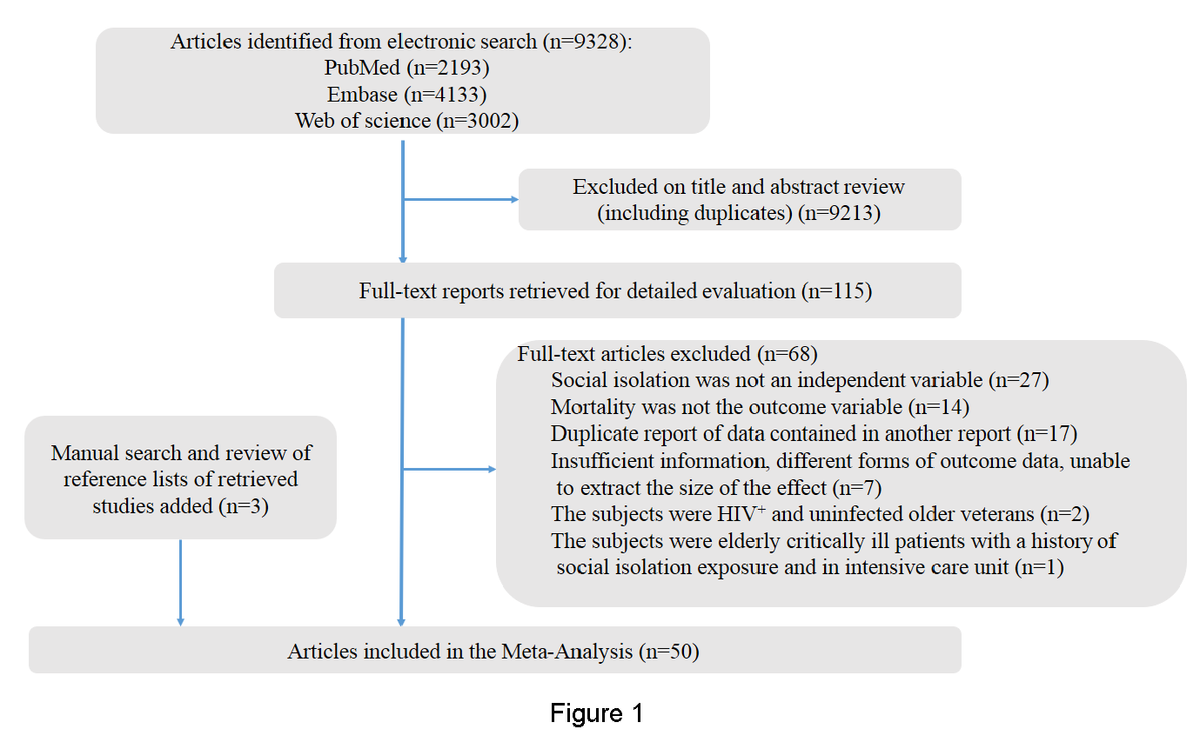
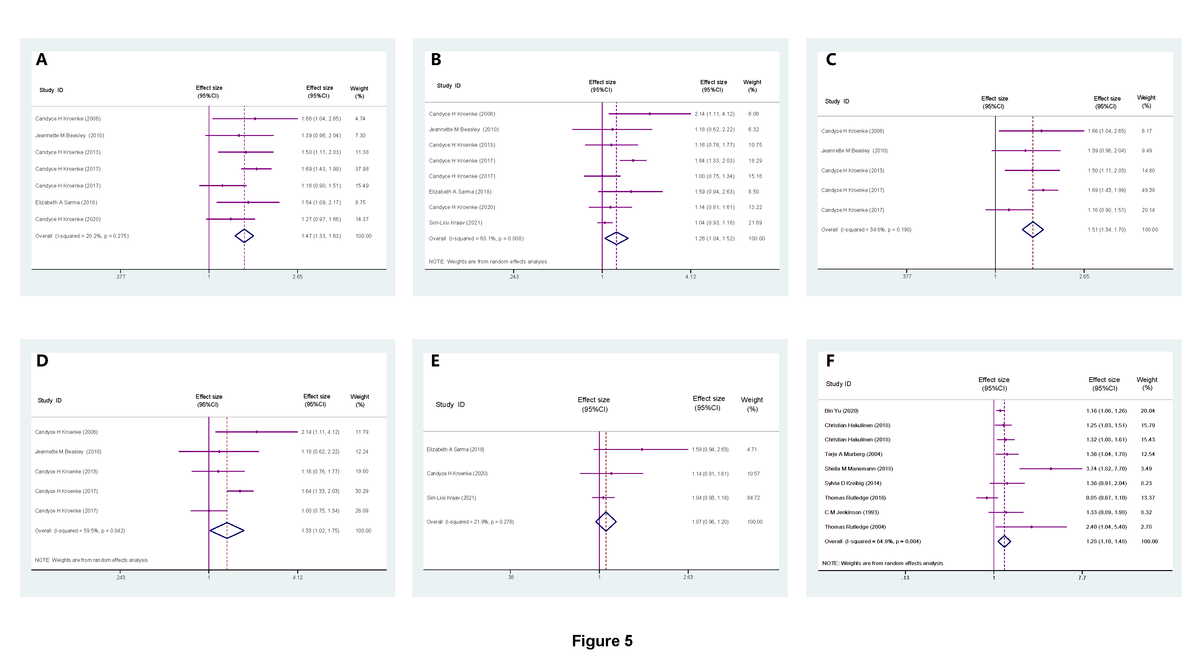
Abstract Background We aimed to assess the associations between social isolation (SI) and the risk of mortality from all causes, cardiovascular disease, and cancer. Methods This was a systematic review and meta-analysis of prospective cohort studies.We searched electronic databases, including PubMed, Web of Science, and Embase, from inception until October 2021, as well as the references of retrieved articles. Prospective studies reporting risk estimates for the association between SI and mortality from all causes, cardiovascular diseases, and cancer in adults aged 18 or older were included in the analyses. Data were screened and extracted independently by two investigators. The fully adjusted effect sizes in the original studies were analyzed, and summary analyses were performed using a fixed-effects or random-effects model, according to the heterogeneity among studies. Subgroup analyses, meta-regression, and sensitivity analyses were performed to evaluate the heterogeneity and robustness of the findings. Simple linear regression was used to analyze the changing trends in social network index grade and risk of mortality. The risk of publication bias was tested using funnel plots and Egger’s and Begg’s tests (each significant at P < 0.05). The trim-and-fill method was used to adjust for the influence of potentially unpublished studies on pooled effect estimates when statistical tests indicated publication bias. The study protocol was registered with PROSPERO (reg. NO CRD42022299959) Results A total of 50 prospective cohort studies with 1,951,661 individuals were included for analysis. The duration of follow-up among included studies ranged from 6 months to 24.4 years. In pooled analyses, SI was significantly associated with an increased risk of mortality from all causes (pooled effect size, 1.22; 95% confidence interval [CI], 1.16 to 1.29; I2 = 77.6%), cardiovascular disease (1.35; 95% CI 1.25 to 1.45, I2 = 65.5%), and cancer (1.23; 95% CI 1.18 to 1.27, I2 = 44.2%) in the general population. Linear regression showed that social network index grade was significantly correlated with the risk of all-cause mortality (P < 0.001). Additionally, the pooled effect estimate for all-cause mortality in patients with breast cancer was 1.51 (95% CI 1.34 to 1.70), and that for cancer-specific mortality was 1.33 (95% CI 1.02 to 1.75). There was a 28% increased risk of all-cause mortality in socially isolated patients with cardiovascular disease (95% CI 1.10 to 1.48). There was no evidence of a positive association between SI and cancer-specific mortality in patients with colorectal cancer (1.07, 95% CI 0.96 to 1.20). Conclusions SI was associated with at least a 20% increased risk of all-cause mortality, cardiovascular disease mortality, and cancer mortality. We highlight that social isolation contributes to chronic disease and mortality, with efforts to improve social isolation likely to have benefits in well-being and survival.
Overview
AI snapshot
Written from the paper’s full text.
TL;DR
This systematic review and meta-analysis of 50 prospective cohort studies (1,951,661 individuals) found that social isolation was associated with increased mortality from all causes, cardiovascular disease, and cancer in the general population. The highest risk was for cardiovascular mortality, and associations were also observed in patients with cardiovascular disease and breast cancer.
Key findings
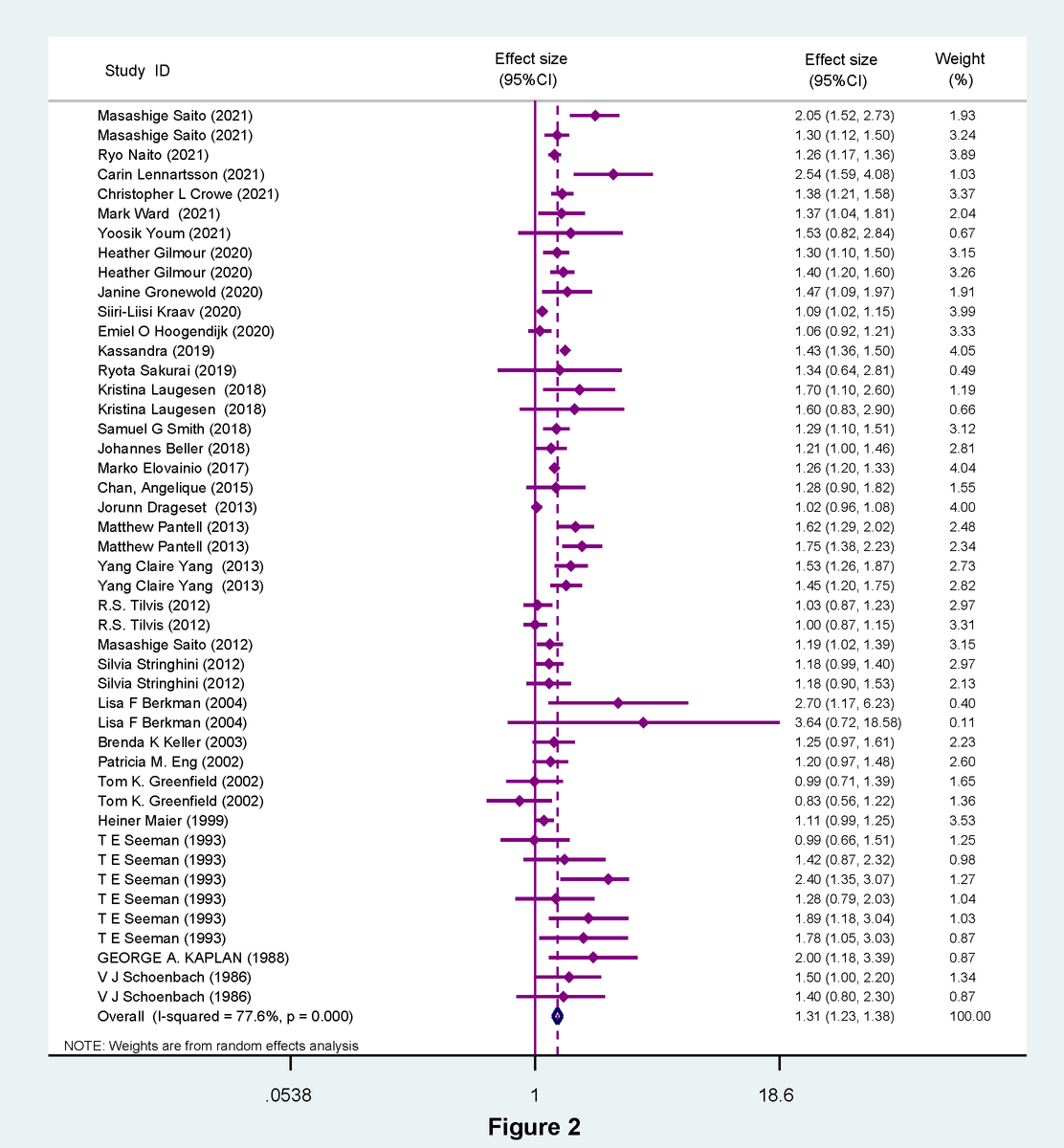
- Social isolation was significantly associated with all-cause mortality (pooled effect estimate 1.31, 95% CI 1.23–1.38; I² = 77.6%), which remained after trim-and-fill adjustment (1.22, 95% CI 1.16–1.29).
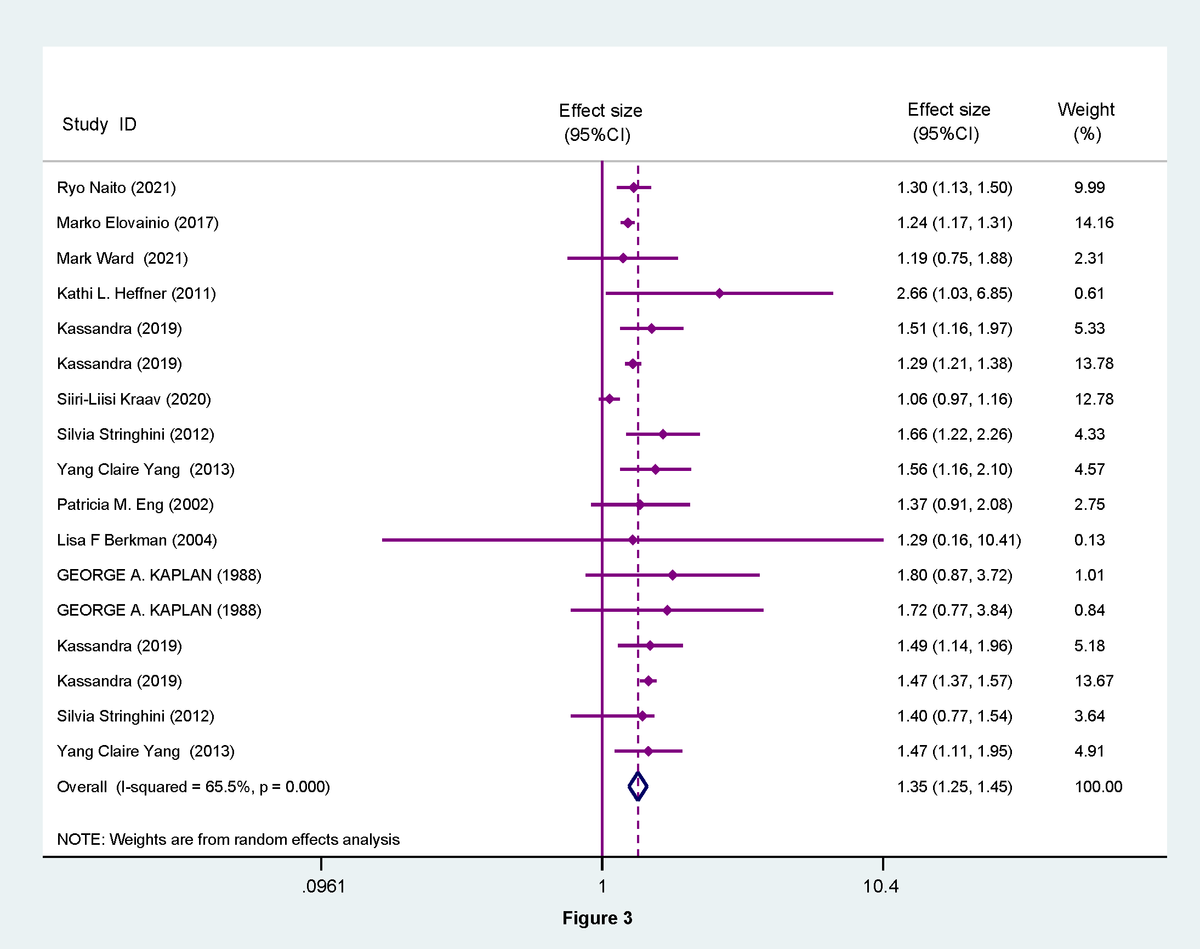
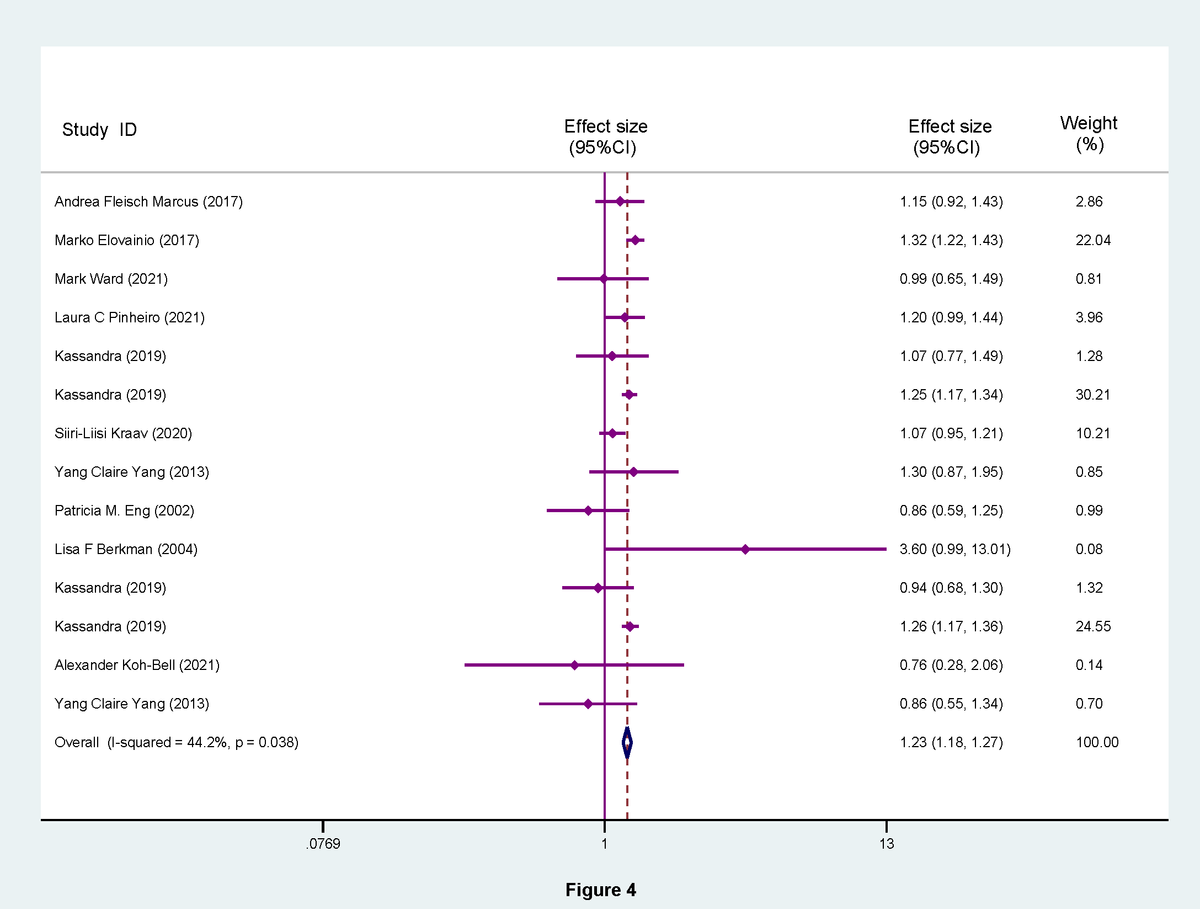
- Pooled estimates were 1.35 (95% CI 1.25–1.45, I² = 65.5%) for cardiovascular/circulatory disease mortality and 1.23 (95% CI 1.18–1.27, I² = 44.2%) for cancer mortality.
- In patient populations: all-cause mortality was 1.28 (95% CI 1.10–1.48) in patients with CVD; in breast cancer, all-cause mortality was 1.51 (95% CI 1.34–1.70) and cancer-specific mortality 1.33 (95% CI 1.02–1.75). No significant association was found for cancer-specific mortality in colorectal cancer (1.07, 95% CI 0.96–1.20).
- Social Network Index grade was significantly correlated with all-cause mortality risk (P < 0.001), with mortality increasing as isolation increased.
Methods
- Systematic review and meta-analysis of prospective cohort studies; PubMed, Web of Science, and Embase searched from inception to October 2021, plus reference lists; protocol registered with PROSPERO (CRD42022299959).
- 50 prospective cohort studies with 1,951,661 participants aged ≥18 years (most ≥50 years); follow-up ranged from 6 months to 24.4 years; 23 studies were from the United States.
- Fully adjusted effect sizes (HR/RR/OR with 95% CIs) were pooled using fixed- or random-effects models according to heterogeneity (I² ≥ 50% random effects); subgroup analyses, meta-regression, sensitivity analyses, and publication bias tests (funnel plots, Egger's and Begg's tests, trim-and-fill) were performed.
Limitations
- Stated: adjustment factors varied greatly across original studies, making the source of heterogeneity complex and difficult to trace; potential unknown confounders may remain; definitions and instruments for social isolation were not consistent across studies; most included studies came from high-income countries; and early deaths were not excluded in the original studies.
- Evident from the text: significant publication bias was detected for the all-cause mortality analysis (Egger's P = 0.037; Begg's P = 0.036), and heterogeneity was substantial (I² = 77.6%).
Model-written summary. Check it against the paper before relying on it.
Integrity signals
Registry
Cites
Statistics
Figures
Verification
Claims the paper makes
28 Own result · 22 Own method · 13 Own interpretation · 4 Couldn’t confirm · 3 No full text of the sources · 2 No basis given · 1 Partly supported · 1 Not checked yet · accuracy not yet measured
The cited sources that could be checked couldn’t confirm or dispute this claim.
In the paper
“Finally, in terms of social factors, socially isolated individuals are less likely to receive emergency and routine medical care owing to their smaller social network if they need help and have no means of transportation 90 .”
§ Social isolation and mortality from all causes, cardiovascular disease, and cancer: A systematic review and meta-analysis of 50 cohort studies > Mechanisms
What the sources say
- Could not verifycites [90] Tilvis, R. S., Laitala, V., Routasalo, P. E. & Pitkälä, K. H. Suffering from loneliness indicates significant mortality risk of older people. J. Aging Res. 2011, 534781 (2011). sourceExperimental — accuracy not yet measured
The Introduction distinguishes social isolation from loneliness and mentions increased use of social and health services in studies of loneliness. Neither the Introduction nor the Discussion addresses whether socially isolated people receive less emergency or routine care because they lack contacts or transportation. Searches for those care-access and transportation claims found no supporting passage in our copy. (LLM, conf=0.77)
hedgeddirect- Asserted: passes — The authors put it forward as true.
- Checkable: passes — It can be checked against evidence.
- Load-bearing: unclear — It is unclear whether the paper’s conclusions depend on it.
- Based: passes — The paper gives a reason why it holds.
- Could not verify
The cited sources that could be checked couldn’t confirm or dispute this claim.
In the paper
“Additionally, Bower et al. 91 reported systematic upregulation of multiple prometastatic molecular processes in primary breast tumors among socially isolated patients with breast cancer.”
§ Social isolation and mortality from all causes, cardiovascular disease, and cancer: A systematic review and meta-analysis of 50 cohort studies > Mechanisms
What the sources say
- Could not verifycites [91] Shiovitz-Ezra, S. & Ayalon, L. Situational versus chronic loneliness as risk factors for all-cause mortality. Int. Psychogeriatr. 22, 455–462 (2010). sourceExperimental — accuracy not yet measured
The Introduction discusses social isolation and health outcomes in older adults, while the Results address loneliness and all-cause mortality. Searches for Bower, primary breast tumors, and prometastatic processes found no passage in our copy addressing the claimed finding. (LLM, conf=0.76)
plaincorrelational- Asserted: passes — The authors put it forward as true.
- Checkable: passes — It can be checked against evidence.
- Load-bearing: unclear — It is unclear whether the paper’s conclusions depend on it.
- Based: passes — The paper gives a reason why it holds.
- Could not verify
A result the paper reports from its own data — it cites no other source for it, so there is none to check. The quote shows it is in the paper.
In the paper
“cardiovascular disease (1.35; 95% CI 1.25 to 1.45, I 2 = 65.5%)”
§ Social isolation and mortality from all causes, cardiovascular disease, and cancer: A systematic review and meta-analysis of 50 cohort studies > Abstract
plaincorrelational- Asserted: passes — The authors put it forward as true.
- Checkable: passes — It can be checked against evidence.
- Load-bearing: passes — The paper’s conclusions depend on it.
- Based: passes — The paper gives a reason why it holds.
- Rests on an assumption: Different methods used to assess social isolation in the included studies measure the same underlying exposure sufficiently to be pooled in a single meta-analysis.
- Rests on an assumption: Hazard ratios, risk ratios, and odds ratios from the included studies are comparable and can be combined to produce pooled effect estimates.
- Rests on an assumption: The most fully adjusted effect estimates from the included studies adequately control for confounding, so the pooled associations can be interpreted as independent effects of social isolation.
A result the paper reports from its own data — it cites no other source for it, so there is none to check. The quote shows it is in the paper.
In the paper
“and cancer (1.23; 95% CI 1.18 to 1.27, I 2 = 44.2%) in the general population.”
§ Social isolation and mortality from all causes, cardiovascular disease, and cancer: A systematic review and meta-analysis of 50 cohort studies > Abstract
plaincorrelational- Asserted: passes — The authors put it forward as true.
- Checkable: passes — It can be checked against evidence.
- Load-bearing: passes — The paper’s conclusions depend on it.
- Based: passes — The paper gives a reason why it holds.
- Rests on an assumption: Different methods used to assess social isolation in the included studies measure the same underlying exposure sufficiently to be pooled in a single meta-analysis.
- Rests on an assumption: Hazard ratios, risk ratios, and odds ratios from the included studies are comparable and can be combined to produce pooled effect estimates.
- Rests on an assumption: The most fully adjusted effect estimates from the included studies adequately control for confounding, so the pooled associations can be interpreted as independent effects of social isolation.
A result the paper reports from its own data — it cites no other source for it, so there is none to check. The quote shows it is in the paper.
In the paper
“and 1.35 (95% CI 1.20 to 1.51) after adjustment using the trim-and-ll method”
§ Social isolation and mortality from all causes, cardiovascular disease, and cancer: A systematic review and meta-analysis of 50 cohort studies > Meta-analyses of SI and all-cause mortality in the general population
plaincorrelational- Asserted: passes — The authors put it forward as true.
- Checkable: passes — It can be checked against evidence.
- Load-bearing: unclear — It is unclear whether the paper’s conclusions depend on it.
- Based: passes — The paper gives a reason why it holds.
- Rests on an assumption: Different methods used to assess social isolation in the included studies measure the same underlying exposure sufficiently to be pooled in a single meta-analysis.
- Rests on an assumption: Hazard ratios, risk ratios, and odds ratios from the included studies are comparable and can be combined to produce pooled effect estimates.
- Rests on an assumption: The most fully adjusted effect estimates from the included studies adequately control for confounding, so the pooled associations can be interpreted as independent effects of social isolation.
A result the paper reports from its own data — it cites no other source for it, so there is none to check. The quote shows it is in the paper.
In the paper
“The pooled effect estimate of cancer-speci c mortality was 1.26 (95% CI 1.04 to 1.52, P = 0.016) (Fig. 5B).”
§ Social isolation and mortality from all causes, cardiovascular disease, and cancer: A systematic review and meta-analysis of 50 cohort studies > Meta-analysis of SI and cancer mortality in the general population
plaincorrelationaln = 21,913 ·- Asserted: passes — The authors put it forward as true.
- Checkable: passes — It can be checked against evidence.
- Load-bearing: passes — The paper’s conclusions depend on it.
- Based: passes — The paper gives a reason why it holds.
- Rests on an assumption: Different methods used to assess social isolation in the included studies measure the same underlying exposure sufficiently to be pooled in a single meta-analysis.
- Rests on an assumption: Hazard ratios, risk ratios, and odds ratios from the included studies are comparable and can be combined to produce pooled effect estimates.
- Rests on an assumption: The most fully adjusted effect estimates from the included studies adequately control for confounding, so the pooled associations can be interpreted as independent effects of social isolation.
The paper states this without a source or data behind it here, so there is nothing to check it against. The quote shows it is in the paper.
In the paper
“Most included studies were from high-income countries; additional results from regions not covered in the included studies are required to more comprehensively understand this topic.”
§ Social isolation and mortality from all causes, cardiovascular disease, and cancer: A systematic review and meta-analysis of 50 cohort studies > Strengths and limitations
plain- Asserted: passes — The authors put it forward as true.
- Checkable: passes — It can be checked against evidence.
- Load-bearing: unclear — It is unclear whether the paper’s conclusions depend on it.
- Based: passes — The paper gives a reason why it holds.
A result the paper reports from its own data — it cites no other source for it, so there is none to check. The quote shows it is in the paper.
In the paper
“The pooled effect estimate was 1.41 (95% CI 1.26 to 1.58; I 2 = 79.1%,P < 0.001; Egger's test P = 0.005; Begg's test P = 0.159)”
§ Social isolation and mortality from all causes, cardiovascular disease, and cancer: A systematic review and meta-analysis of 50 cohort studies > Meta-analyses of SI and all-cause mortality in the general population
plaincorrelational- Asserted: passes — The authors put it forward as true.
- Checkable: passes — It can be checked against evidence.
- Load-bearing: passes — The paper’s conclusions depend on it.
- Based: passes — The paper gives a reason why it holds.
- Rests on an assumption: Different methods used to assess social isolation in the included studies measure the same underlying exposure sufficiently to be pooled in a single meta-analysis.
- Rests on an assumption: Hazard ratios, risk ratios, and odds ratios from the included studies are comparable and can be combined to produce pooled effect estimates.
- Rests on an assumption: The most fully adjusted effect estimates from the included studies adequately control for confounding, so the pooled associations can be interpreted as independent effects of social isolation.
A result the paper reports from its own data — it cites no other source for it, so there is none to check. The quote shows it is in the paper.
In the paper
“Linear regression showed that social network index grade was signi cantly correlated with the risk of all-cause mortality (P < 0.001).”
§ Social isolation and mortality from all causes, cardiovascular disease, and cancer: A systematic review and meta-analysis of 50 cohort studies > Abstract
plaincorrelational- Asserted: passes — The authors put it forward as true.
- Checkable: passes — It can be checked against evidence.
- Load-bearing: unclear — It is unclear whether the paper’s conclusions depend on it.
- Based: passes — The paper gives a reason why it holds.
A result the paper reports from its own data — it cites no other source for it, so there is none to check. The quote shows it is in the paper.
In the paper
“with one study reporting a signi cant positive association (HR = 1.54, 95% CI 1.09 to 2.17)”
§ Social isolation and mortality from all causes, cardiovascular disease, and cancer: A systematic review and meta-analysis of 50 cohort studies > Meta-analysis of SI and cancer mortality in the general population
plaincorrelational- Asserted: passes — The authors put it forward as true.
- Checkable: passes — It can be checked against evidence.
- Load-bearing: unclear — It is unclear whether the paper’s conclusions depend on it.
- Based: passes — The paper gives a reason why it holds.
- Probably not a substantial claim. 18
- It may state two separate claims as one. 17
The cited sources support only part of this claim — read each source’s verdict below.
In the paper
“Because all eligible studies had a cohort study design, the Newcastle-Ottawa quality assessment scale for cohort studies was used to evaluate methodological quality 30 31 .”
§ Social isolation and mortality from all causes, cardiovascular disease, and cancer: A systematic review and meta-analysis of 50 cohort studies > Risk of bias assessment
What the sources say
- Partly supportedcites [30] Kraav, S. L. et al. The effects of loneliness and social isolation on all-cause, injury, cancer, and CVD mortality in a cohort of middle-aged Finnish men: a prospective study. Aging Ment. Health 25, 2219–2228 (2021). sourceExperimental — accuracy not yet measured
The Sample section describes a prospective study of Finnish men, supporting its identification as a cohort study. The Statistical Methods section describes the paper’s analyses but does not mention the Newcastle–Ottawa scale or an assessment of methodological quality. The paper therefore supports the cohort-design part of the sentence, not the scale-use part. (LLM, conf=0.82)
- Could not verifycites [31] Crowe, C. L. et al. Associations of loneliness and social isolation with health span and life span in the U.S. Health and Retirement Study. J. Gerontol. A 76, 1997–2006 (2021). sourceExperimental — accuracy not yet measured
The Statistical Analysis and Sensitivity Analysis sections describe analyses of the Health and Retirement Study cohort, not quality appraisal of a set of eligible studies (page numbers unavailable). Searches for the Newcastle–Ottawa scale and methodological quality assessment found no passage addressing their use. (LLM, conf=0.76)
plain- Asserted: passes — The authors put it forward as true.
- Checkable: passes — It can be checked against evidence.
- Load-bearing: passes — The paper’s conclusions depend on it.
- Based: passes — The paper gives a reason why it holds.
Probably not a substantial claim.
- Partly supported
The cited sources that could be checked couldn’t confirm or dispute this claim.
In the paper
“The ndings from this systematic review and meta-analysis were reported based on the Preferred Reporting Items for Systematic Reviews and Meta-analyses (PRISMA) 23 guideline (Table S1).”
§ Social isolation and mortality from all causes, cardiovascular disease, and cancer: A systematic review and meta-analysis of 50 cohort studies > Methods
What the sources say
- Could not verifycites [23] Yu, B. et al. Social isolation, loneliness, and all-cause mortality in patients with cardiovascular disease: a 10-year follow-up study. Psychosom. Med. 82, 208–214 (2020). sourceExperimental — accuracy not yet measured
The Methods and Figure 1 passages describe a follow-up analysis of Taiwanese survey and insurance-claims data, not the reporting of a systematic review. Searches of our copy for PRISMA and systematic-review reporting found no passage addressing whether the citing review followed that guideline. Page numbers were not available in our copy. (LLM, conf=0.75)
plain- Asserted: passes — The authors put it forward as true.
- Checkable: passes — It can be checked against evidence.
- Load-bearing: fails — The paper’s conclusions may not depend on it.
- Based: passes — The paper gives a reason why it holds.
Probably not a substantial claim. The paper’s conclusions may not depend on it.
- Could not verify
The cited sources that could be checked couldn’t confirm or dispute this claim.
In the paper
“possibly because SI is more common among people with lower levels of education and those who are unemployed 17 .”
§ Social isolation and mortality from all causes, cardiovascular disease, and cancer: A systematic review and meta-analysis of 50 cohort studies > Comparisons with other studies
What the sources say
- Could not verifycites [17] Novak, M. et al. Cardiovascular and all-cause mortality attributable to loneliness in older Swedish men and women. BMC Geriatr. 20, 201 (2020). sourceExperimental — accuracy not yet measured
The Results section (‘Loneliness and background characteristics’; page unavailable) reports that loneliness was more common among participants with poor economic status, but it does not report an association with lower education or unemployment. The Methods section (‘Assessment of loneliness’; page unavailable) measures self-reported loneliness rather than social isolation. Searches for education, employment, and social isolation found no passage establishing the claimed associations. (LLM, conf=0.76)
hedgedcorrelational- Asserted: passes — The authors put it forward as true.
- Checkable: passes — It can be checked against evidence.
- Load-bearing: fails — The paper’s conclusions may not depend on it.
- Based: passes — The paper gives a reason why it holds.
Probably not a substantial claim. The paper’s conclusions may not depend on it. It may state two separate claims as one.
- Could not verify
A result the paper reports from its own data — it cites no other source for it, so there is none to check. The quote shows it is in the paper.
In the paper
“According to the results of subgroup analysis, no signi cant differences were observed for sex, country, follow-up duration, or adjustment for confounding, except for education level (P = 0.029; Table S9).”
§ Social isolation and mortality from all causes, cardiovascular disease, and cancer: A systematic review and meta-analysis of 50 cohort studies > Meta-analyses of SI and all-cause mortality in the general population
plainn = 1,250,108 ·- Asserted: passes — The authors put it forward as true.
- Checkable: passes — It can be checked against evidence.
- Load-bearing: unclear — It is unclear whether the paper’s conclusions depend on it.
- Based: passes — The paper gives a reason why it holds.
It may state two separate claims as one.
A result the paper reports from its own data — it cites no other source for it, so there is none to check. The quote shows it is in the paper.
In the paper
“We demonstrated that SI is positively associated with mortality from all causes, cardiovascular or circulatory diseases, and cancer.”
§ Social isolation and mortality from all causes, cardiovascular disease, and cancer: A systematic review and meta-analysis of 50 cohort studies > Conclusions, Policy Implications, And Future Research
boostedcorrelational- Asserted: passes — The authors put it forward as true.
- Checkable: passes — It can be checked against evidence.
- Load-bearing: passes — The paper’s conclusions depend on it.
- Based: passes — The paper gives a reason why it holds.
It may state two separate claims as one.
A result the paper reports from its own data — it cites no other source for it, so there is none to check. The quote shows it is in the paper.
In the paper
“The duration of follow-up among included studies ranged from 6 months to 24.4 years.”
§ Social isolation and mortality from all causes, cardiovascular disease, and cancer: A systematic review and meta-analysis of 50 cohort studies > Abstract
plain- Asserted: passes — The authors put it forward as true.
- Checkable: passes — It can be checked against evidence.
- Load-bearing: fails — The paper’s conclusions may not depend on it.
- Based: passes — The paper gives a reason why it holds.
Probably not a substantial claim. The paper’s conclusions may not depend on it.
The paper states this without a source or data behind it here, so there is nothing to check it against. The quote shows it is in the paper.
In the paper
“Since early deaths were not excluded in the original study, which may confound the relationship between social isolation and mortality in the original study”
§ Social isolation and mortality from all causes, cardiovascular disease, and cancer: A systematic review and meta-analysis of 50 cohort studies > Strengths and limitations
plain- Asserted: passes — The authors put it forward as true.
- Checkable: passes — It can be checked against evidence.
- Load-bearing: fails — The paper’s conclusions may not depend on it.
- Based: passes — The paper gives a reason why it holds.
Probably not a substantial claim. The paper’s conclusions may not depend on it.
A conclusion the paper draws from its own results — it cites no other source for it, so there is none to check. The quote shows it is in the paper.
In the paper
“SI may be exacerbated by post-cancer or CVD stress and less social contact as well as limited access to care, especially informal care from friends and family.”
§ Social isolation and mortality from all causes, cardiovascular disease, and cancer: A systematic review and meta-analysis of 50 cohort studies > Conclusions, Policy Implications, And Future Research
hedgedconditional- Asserted: passes — The authors put it forward as true.
- Checkable: passes — It can be checked against evidence.
- Load-bearing: fails — The paper’s conclusions may not depend on it.
- Based: fails — The paper may give no reason why it holds.
Probably not a substantial claim. The paper’s conclusions may not depend on it. The paper may give no reason why it holds. It may state two separate claims as one.
What the paper did — it cites no source for this, so there is none to check. The quote shows it is in the paper.
In the paper
“Data were screened and extracted independently by two investigators.”
§ Social isolation and mortality from all causes, cardiovascular disease, and cancer: A systematic review and meta-analysis of 50 cohort studies > Abstract
plain- Asserted: passes — The authors put it forward as true.
- Checkable: passes — It can be checked against evidence.
- Load-bearing: fails — The paper’s conclusions may not depend on it.
- Based: passes — The paper gives a reason why it holds.
Probably not a substantial claim. The paper’s conclusions may not depend on it.
A conclusion the paper draws from its own results — it cites no other source for it, so there is none to check. The quote shows it is in the paper.
In the paper
“By contrast, in socially isolated patients with cancer, death is more often owing to inaccessibility of long-term medical services and basic care in the late stages of disease.”
§ Social isolation and mortality from all causes, cardiovascular disease, and cancer: A systematic review and meta-analysis of 50 cohort studies > Comparisons with other studies
plaindirect- Asserted: passes — The authors put it forward as true.
- Checkable: passes — It can be checked against evidence.
- Load-bearing: fails — The paper’s conclusions may not depend on it.
- Based: fails — The paper may give no reason why it holds.
Probably not a substantial claim. The paper’s conclusions may not depend on it. The paper may give no reason why it holds.
What the paper did — it cites no source for this, so there is none to check. The quote shows it is in the paper.
In the paper
“Although many confounders had been adjusted in the original studies, there were still potential unknown confounders.”
§ Social isolation and mortality from all causes, cardiovascular disease, and cancer: A systematic review and meta-analysis of 50 cohort studies > Strengths and limitations
hedged- Asserted: passes — The authors put it forward as true.
- Checkable: passes — It can be checked against evidence.
- Load-bearing: fails — The paper’s conclusions may not depend on it.
- Based: passes — The paper gives a reason why it holds.
Probably not a substantial claim. The paper’s conclusions may not depend on it.
A conclusion the paper draws from its own results — it cites no other source for it, so there is none to check. The quote shows it is in the paper.
In the paper
“SI was associated with at least a 20% increased risk of all-cause mortality, cardiovascular disease mortality, and cancer mortality.”
§ Social isolation and mortality from all causes, cardiovascular disease, and cancer: A systematic review and meta-analysis of 50 cohort studies > Abstract
plaincorrelational- Asserted: passes — The authors put it forward as true.
- Checkable: passes — It can be checked against evidence.
- Load-bearing: passes — The paper’s conclusions depend on it.
- Based: passes — The paper gives a reason why it holds.
It may state two separate claims as one.
- Rests on an assumption: The observed associations between social isolation and mortality reflect a causal effect of social isolation rather than residual confounding or reverse causation.
A conclusion the paper draws from its own results — it cites no other source for it, so there is none to check. The quote shows it is in the paper.
In the paper
“Since early deaths were not excluded in the original study, which may confound the relationship between social isolation and mortality in the original study”
§ Social isolation and mortality from all causes, cardiovascular disease, and cancer: A systematic review and meta-analysis of 50 cohort studies > Strengths and limitations
hedgedconditional- Asserted: passes — The authors put it forward as true.
- Checkable: passes — It can be checked against evidence.
- Load-bearing: fails — The paper’s conclusions may not depend on it.
- Based: passes — The paper gives a reason why it holds.
Probably not a substantial claim. The paper’s conclusions may not depend on it.
In the paper
“Second, in terms of psychological factors, studies have shown that people who are socially isolated are more likely to be depressed or suicidal 89 .”
§ Social isolation and mortality from all causes, cardiovascular disease, and cancer: A systematic review and meta-analysis of 50 cohort studies > Mechanisms
What the sources say
- Not checked — no full text of the sourcecites [89] Tilvis, R. S., Laitala, V., Routasalo, P., Strandberg, T. E. & Pitkala, K. H. Positive life orientation predicts good survival prognosis in old age. Arch. Gerontol. Geriatr. 55, 133–137 (2012). source
hedgedcorrelational- Asserted: passes — The authors put it forward as true.
- Checkable: passes — It can be checked against evidence.
- Load-bearing: unclear — It is unclear whether the paper’s conclusions depend on it.
- Based: passes — The paper gives a reason why it holds.
It may state two separate claims as one.
A conclusion the paper draws from its own results — it cites no other source for it, so there is none to check. The quote shows it is in the paper.
In the paper
“with efforts to improve social isolation likely to have bene ts in well-being and survival.”
§ Social isolation and mortality from all causes, cardiovascular disease, and cancer: A systematic review and meta-analysis of 50 cohort studies > Abstract
hedgedconditional- Asserted: passes — The authors put it forward as true.
- Checkable: passes — It can be checked against evidence.
- Load-bearing: passes — The paper’s conclusions depend on it.
- Based: passes — The paper gives a reason why it holds.
It may state two separate claims as one.
What the paper did — it cites no source for this, so there is none to check. The quote shows it is in the paper.
In the paper
“The trim-and-ll method was used to adjust for the in uence of potentially unpublished studies on pooled effect estimates when statistical tests indicated publication bias.”
§ Social isolation and mortality from all causes, cardiovascular disease, and cancer: A systematic review and meta-analysis of 50 cohort studies > Abstract
plain- Asserted: passes — The authors put it forward as true.
- Checkable: passes — It can be checked against evidence.
- Load-bearing: fails — The paper’s conclusions may not depend on it.
- Based: passes — The paper gives a reason why it holds.
Probably not a substantial claim. The paper’s conclusions may not depend on it.
What the paper did — it cites no source for this, so there is none to check. The quote shows it is in the paper.
In the paper
“Based on the Newcastle-Ottawa scale, most studies had a low risk of bias in all components.Most studies had a rating of 7-8 and were identi ed as high-quality studies, with only four studies that had a rating of 6 that were considered moderate-quality studies.”
§ Social isolation and mortality from all causes, cardiovascular disease, and cancer: A systematic review and meta-analysis of 50 cohort studies > Characteristics of included studies
plain- Asserted: passes — The authors put it forward as true.
- Checkable: passes — It can be checked against evidence.
- Load-bearing: unclear — It is unclear whether the paper’s conclusions depend on it.
- Based: passes — The paper gives a reason why it holds.
It may state two separate claims as one.
A conclusion the paper draws from its own results — it cites no other source for it, so there is none to check. The quote shows it is in the paper.
In the paper
“Thus, we could con rm that SI was positively correlated with all-cause mortality in the overall population and in both men and women.”
§ Social isolation and mortality from all causes, cardiovascular disease, and cancer: A systematic review and meta-analysis of 50 cohort studies > Comparisons with other studies
hedgedcorrelational- Asserted: passes — The authors put it forward as true.
- Checkable: passes — It can be checked against evidence.
- Load-bearing: passes — The paper’s conclusions depend on it.
- Based: passes — The paper gives a reason why it holds.
It may state two separate claims as one.
In the paper
“Higher levels of in ammatory markers like C-reactive protein and brinogen, are closely associated with CVD and mortality 88 .”
§ Social isolation and mortality from all causes, cardiovascular disease, and cancer: A systematic review and meta-analysis of 50 cohort studies > Mechanisms
What the sources say
- Not checked — no full text of the sourcecites [88] Holwerda, T. J. et al. Increased risk of mortality associated with social isolation in older men: only when feeling lonely? Results from the Amsterdam Study of the Elderly (AMSTEL). Psychol. Med. 42, 843–853 (2012). source
plaincorrelational- Asserted: passes — The authors put it forward as true.
- Checkable: passes — It can be checked against evidence.
- Load-bearing: fails — The paper’s conclusions may not depend on it.
- Based: passes — The paper gives a reason why it holds.
Probably not a substantial claim. The paper’s conclusions may not depend on it.
What the paper did — it cites no source for this, so there is none to check. The quote shows it is in the paper.
In the paper
“The risk of publication bias was tested using funnel plots and Egger's and Begg's tests (each signi cant at P < 0.05).”
§ Social isolation and mortality from all causes, cardiovascular disease, and cancer: A systematic review and meta-analysis of 50 cohort studies > Abstract
plain- Asserted: passes — The authors put it forward as true.
- Checkable: passes — It can be checked against evidence.
- Load-bearing: fails — The paper’s conclusions may not depend on it.
- Based: passes — The paper gives a reason why it holds.
Probably not a substantial claim. The paper’s conclusions may not depend on it.
What the paper did — it cites no source for this, so there is none to check. The quote shows it is in the paper.
In the paper
“No signi cant heterogeneity or publication bias was found (Table S6).”
§ Social isolation and mortality from all causes, cardiovascular disease, and cancer: A systematic review and meta-analysis of 50 cohort studies > Meta-analysis of SI and cancer mortality in the general population
plainn = 21,913- Asserted: passes — The authors put it forward as true.
- Checkable: passes — It can be checked against evidence.
- Load-bearing: unclear — It is unclear whether the paper’s conclusions depend on it.
- Based: passes — The paper gives a reason why it holds.
It may state two separate claims as one.
What the paper did — it cites no source for this, so there is none to check. The quote shows it is in the paper.
In the paper
“There was a large number of internal adjustment factors in the original studies, and adjustment factors varied greatly among studies.”
§ Social isolation and mortality from all causes, cardiovascular disease, and cancer: A systematic review and meta-analysis of 50 cohort studies > Strengths and limitations
plain- Asserted: passes — The authors put it forward as true.
- Checkable: passes — It can be checked against evidence.
- Load-bearing: unclear — It is unclear whether the paper’s conclusions depend on it.
- Based: passes — The paper gives a reason why it holds.
It may state two separate claims as one.
A conclusion the paper draws from its own results — it cites no other source for it, so there is none to check. The quote shows it is in the paper.
In the paper
“We highlight that social isolation contributes to chronic disease and mortality”
§ Social isolation and mortality from all causes, cardiovascular disease, and cancer: A systematic review and meta-analysis of 50 cohort studies > Abstract
plaindirectn = 1,951,661- Asserted: passes — The authors put it forward as true.
- Checkable: passes — It can be checked against evidence.
- Load-bearing: passes — The paper’s conclusions depend on it.
- Based: passes — The paper gives a reason why it holds.
It may state two separate claims as one.
- Rests on an assumption: The observed associations between social isolation and mortality reflect a causal effect of social isolation rather than residual confounding or reverse causation.
What the paper did — it cites no source for this, so there is none to check. The quote shows it is in the paper.
In the paper
“Subgroup analyses, meta-regression, and sensitivity analyses were performed to evaluate the heterogeneity and robustness of the ndings.”
§ Social isolation and mortality from all causes, cardiovascular disease, and cancer: A systematic review and meta-analysis of 50 cohort studies > Abstract
plain- Asserted: passes — The authors put it forward as true.
- Checkable: passes — It can be checked against evidence.
- Load-bearing: passes — The paper’s conclusions depend on it.
- Based: passes — The paper gives a reason why it holds.
Probably not a substantial claim.
What the paper did — it cites no source for this, so there is none to check. The quote shows it is in the paper.
In the paper
“The study protocol was registered with PROSPERO (reg.NO CRD42022299959)”
§ Social isolation and mortality from all causes, cardiovascular disease, and cancer: A systematic review and meta-analysis of 50 cohort studies > Abstract
plain- Asserted: passes — The authors put it forward as true.
- Checkable: passes — It can be checked against evidence.
- Load-bearing: fails — The paper’s conclusions may not depend on it.
- Based: passes — The paper gives a reason why it holds.
Probably not a substantial claim. The paper’s conclusions may not depend on it.
What the paper did — it cites no source for this, so there is none to check. The quote shows it is in the paper.
In the paper
“Most included studies were of high quality, with a low risk of bias, which further lends con dence regarding the reliability of the current pooled results.”
§ Social isolation and mortality from all causes, cardiovascular disease, and cancer: A systematic review and meta-analysis of 50 cohort studies > Strengths and limitations
plain- Asserted: passes — The authors put it forward as true.
- Checkable: passes — It can be checked against evidence.
- Load-bearing: passes — The paper’s conclusions depend on it.
- Based: passes — The paper gives a reason why it holds.
It may state two separate claims as one.
A conclusion the paper draws from its own results — it cites no other source for it, so there is none to check. The quote shows it is in the paper.
In the paper
“We found a signi cant association of SI with increased risk of all three types of mortality outcomes in the general population, with the highest risk for cardiovascular death.”
§ Social isolation and mortality from all causes, cardiovascular disease, and cancer: A systematic review and meta-analysis of 50 cohort studies > Principal ndings
plaincorrelational- Asserted: passes — The authors put it forward as true.
- Checkable: passes — It can be checked against evidence.
- Load-bearing: passes — The paper’s conclusions depend on it.
- Based: passes — The paper gives a reason why it holds.
It may state two separate claims as one.
A conclusion the paper draws from its own results — it cites no other source for it, so there is none to check. The quote shows it is in the paper.
In the paper
“Socially isolated patients with CVD and breast cancer had worse all-cause mortality, and patients with breast cancer and SI had a higher cancer-speci c mortality.”
§ Social isolation and mortality from all causes, cardiovascular disease, and cancer: A systematic review and meta-analysis of 50 cohort studies > Principal ndings
plaincorrelational- Asserted: passes — The authors put it forward as true.
- Checkable: passes — It can be checked against evidence.
- Load-bearing: passes — The paper’s conclusions depend on it.
- Based: passes — The paper gives a reason why it holds.
It may state two separate claims as one.
What the paper did — it cites no source for this, so there is none to check. The quote shows it is in the paper.
In the paper
“Additionally, we conducted a sensitivity analysis, in which each prospective cohort study was excluded in turn to examine the in uence of that study on the overall estimates.”
§ Social isolation and mortality from all causes, cardiovascular disease, and cancer: A systematic review and meta-analysis of 50 cohort studies > Conclusions, Policy Implications, And Future Research
plain- Asserted: passes — The authors put it forward as true.
- Checkable: passes — It can be checked against evidence.
- Load-bearing: fails — The paper’s conclusions may not depend on it.
- Based: passes — The paper gives a reason why it holds.
Probably not a substantial claim. The paper’s conclusions may not depend on it.
In the paper
“First, in terms of physiological factors, individuals who are socially isolated may show elevated activation of the hypothalamic-pituitaryadrenal axis, an increased chronic stress response, elevated blood pressure, and higher levels of serum cortisol 13 .”
§ Social isolation and mortality from all causes, cardiovascular disease, and cancer: A systematic review and meta-analysis of 50 cohort studies > Mechanisms
What the sources say
- Not checked — no full text of the sourcecites [13] Moreno-Tamayo, K., Juarez, F., Manrique-Espinoza, B. & Mejia-Pailles, G. The relationship between social isolation and mortality among adults aged 50 and older in a 12-year follow-up analysis in Mexico. Res. Aging 44, 758–769 (2022). source
hedgedconditional- Asserted: passes — The authors put it forward as true.
- Checkable: passes — It can be checked against evidence.
- Load-bearing: unclear — It is unclear whether the paper’s conclusions depend on it.
- Based: passes — The paper gives a reason why it holds.
It may state two separate claims as one.
What the paper did — it cites no source for this, so there is none to check. The quote shows it is in the paper.
In the paper
“The fully adjusted effect sizes in the original studies were analyzed”
§ Social isolation and mortality from all causes, cardiovascular disease, and cancer: A systematic review and meta-analysis of 50 cohort studies > Abstract
plain- Asserted: passes — The authors put it forward as true.
- Checkable: passes — It can be checked against evidence.
- Load-bearing: passes — The paper’s conclusions depend on it.
- Based: passes — The paper gives a reason why it holds.
Probably not a substantial claim.
What the paper did — it cites no source for this, so there is none to check. The quote shows it is in the paper.
In the paper
“The de nition of SI was not completely consistent among studies, and the instruments used to evaluate SI differed, which may affect the accuracy of the meta-analysis results.”
§ Social isolation and mortality from all causes, cardiovascular disease, and cancer: A systematic review and meta-analysis of 50 cohort studies > Strengths and limitations
plain- Asserted: passes — The authors put it forward as true.
- Checkable: passes — It can be checked against evidence.
- Load-bearing: unclear — It is unclear whether the paper’s conclusions depend on it.
- Based: passes — The paper gives a reason why it holds.
It may state two separate claims as one.
A conclusion the paper draws from its own results — it cites no other source for it, so there is none to check. The quote shows it is in the paper.
In the paper
“The source of heterogeneity is complex and di cult to trace.”
§ Social isolation and mortality from all causes, cardiovascular disease, and cancer: A systematic review and meta-analysis of 50 cohort studies > Strengths and limitations
plain- Asserted: passes — The authors put it forward as true.
- Checkable: fails — It may be too vague to check against evidence.
- Load-bearing: fails — The paper’s conclusions may not depend on it.
- Based: passes — The paper gives a reason why it holds.
Probably not a substantial claim. It may be too vague to check against evidence. The paper’s conclusions may not depend on it.
The paper relies on this without support.
Different methods used to assess social isolation in the included studies measure the same underlying exposure sufficiently to be pooled in a single meta-analysis.
“We included all studies with SI evaluated using different methods (detailed de nitions in Table S2) in the original studies.”
The paper relies on this without support.
Hazard ratios, risk ratios, and odds ratios from the included studies are comparable and can be combined to produce pooled effect estimates.
“HRs and RRs (along with 95% CIs) for comparisons of SI with non-SI or graded variables in the original studies were summarized to calculate the pooled effect estimates for the association between SI and mortality outcomes.”
The paper relies on this without support.
The most fully adjusted effect estimates from the included studies adequately control for confounding, so the pooled associations can be interpreted as independent effects of social isolation.
“If the included studies reported both crude and multivariable-adjusted effect estimates, we extracted the most fully adjusted outcomes in the present meta-analysis.”
The paper relies on this without support.
The observed associations between social isolation and mortality reflect a causal effect of social isolation rather than residual confounding or reverse causation.
“We highlight that social isolation contributes to chronic disease and mortality”
The paper relies on this without support.
The search strategy identified all relevant studies.
“We searched PubMed, Web of Science, and Embase for studies published in English between database inception and October 2021.”
The paper relies on this without support.
This was the first study to comprehensively evaluate the association between SI and mortality from all causes, CVD, and cancer.
“To the best of our knowledge, this was the rst study to comprehensively evaluate the association between SI and mortality from all causes, CVD, and cancer.”
The paper relies on this without support.
The association between SI and cancer mortality was systematically reviewed for the first time, as was the relationship between SI and mortality in patients with CVD and cancer.
“The association between SI and cancer mortality was systematically reviewed for the rst time, as was the relationship between SI and mortality in patients with CVD and cancer.”
Self-check
Percentages, sums and reported differences re-computed from the paper’s own numbers.
Each contradiction between two passages listed here was confirmed by an independent check.
Rated major: it would touch a result — a value a result rests on, reported and recomputed p-values on opposite sides of the significance level, two passages that conflict with no sign which is right, or a cited work retracted before this paper was published.
In the paper
§ Social isolation and mortality from all causes, cardiovascular disease, and cancer: A systematic review and meta-analysis of 50 cohort studies > Meta-analysis of SI and cancer mortality in the general population
“A total of 1,156,644 participants were analyzed, and a positive association with cancer mortality was observed (1.23, 95% CI 1.18 to 1.27, P < 0.001)”
§ Social isolation and mortality from all causes, cardiovascular disease, and cancer: A systematic review and meta-analysis of 50 cohort studies > Comparisons with other studies
“Our study ndings indicated a signi cant positive association (1.18, 95% CI 1.11 to 1.26) according to summarized data from 10 studies conducted in ve countries”
Rated minor: it would not touch a result — a value no result rests on, a p-value that stays on the same side of the significance level, or a conflict that is clerical, resolved elsewhere in the paper, or outside its own findings.
In the paper
§ Social isolation and mortality from all causes, cardiovascular disease, and cancer: A systematic review and meta-analysis of 50 cohort studies > Data sources and database search
“We searched PubMed, Web of Science, and Embase for studies published in English between database inception and October 2021.”
§ Social isolation and mortality from all causes, cardiovascular disease, and cancer: A systematic review and meta-analysis of 50 cohort studies > Literature search
“We identi ed 9328 records through electronic database searches of PubMed, Web of Science, Embase, and the Cochrane Library.”
Citations
Cites
Preferred Reporting Items for Systematic Reviews and Meta-Analyses: the PRISMA statement
Moher, D., Liberati, A., Tetzlaff, J., Altman, D. G., & for the PRISMA Group (2009) · BMJ · doi:10.1136/bmj.b2535 · Cited by 83,823
Preferred Reporting Items for Systematic Reviews and Meta-Analyses: The PRISMA Statement
Moher, D., Liberati, A., Tetzlaff, J., Altman, D. G., & The PRISMA Group (2009) · PLoS Medicine · doi:10.1371/journal.pmed.1000097 · Cited by 64,042
Dermyshi, E., Wang, Y., Yan, C., Hong, W., Qiu, G., Gong, X., & Zhang, T. (2017) · Neonatology · doi:10.1159/000454668 · Cited by 24,586
GRADE: an emerging consensus on rating quality of evidence and strength of recommendations
Guyatt, G. H., Oxman, A. D., Vist, G. E., Kunz, R., Falck-Ytter, Y., Alonso-Coello, P., & Schünemann, H. J. (2008) · BMJ · doi:10.1136/bmj.39489.470347.ad · Cited by 23,305
Meta-analysis of Observational Studies in Epidemiology<SUBTITLE>A Proposal for Reporting</SUBTITLE>
Stroup, D. F. (2000) · JAMA · doi:10.1001/jama.283.15.2008 · Cited by 20,623
Wang, G., Ma, R., Qiao, G., Wada, K., Aizawa, Y., & Satoh, T. (2015) · Integrative Medicine International · doi:10.1159/000368408 · Cited by 18,762
(2014) · Medical Entomology and Zoology · Cited by 17,633
Stang, A. (2010) · European Journal of Epidemiology · doi:10.1007/s10654-010-9491-z · Cited by 17,396
Duval, S., & Tweedie, R. (2000) · Biometrics · doi:10.1111/j.0006-341x.2000.00455.x · Cited by 14,099
Social Relationships and Health
House, J. S., Landis, K. R., & Umberson, D. (1988) · Science · doi:10.1126/science.3399889 · Cited by 7,073
Research works printed but not linked: 2
- National Academies of Sciences, Engineering, and Medicine Social Isolation and Loneliness in Older Adults: Opportunities for the Health Care System (National Academies Press, 2020).
- ICD-9-CM. International Classification of Diseases, 9th revision, Clinical Modification. 3d edition, volumes 1, 2 and 3. Official authorized addendum effective October 1, 1990–HCFA. J. Am. Med. Rec. Assoc. 61, 1–35 (1990). Suppl.
Cited by
Sorted by citations
Items 201–300 of 507
Yuan, R., Qi, F., Zhou, J., Zhu, Q., Liu, Q., Zhang, H., & Wang, Y. Q. (2025) · BMC Psychology · doi:10.1186/s40359-025-03356-x · Cited by 3
Merritt, H., Koch, M. K., Jo, Y., Chumin, E. J., & Betzel, R. F. (2026) · Social Cognitive and Affective Neuroscience · doi:10.1093/scan/nsag005 · Cited by 3
Interpersonal relationships, PNI, and health: Seeds in the 1980s, fruiting trees today
Robles, T. F. (2024) · Comprehensive Psychoneuroendocrinology · doi:10.1016/j.cpnec.2024.100247 · Cited by 3
Floyd, K., Hesse, C., Ray, C. D., & Mikkelson, A. C. (2024) · The Journal of Psychology · doi:10.1080/00223980.2024.2378418 · Cited by 3
Einsamkeit in Zeiten globaler Polykrisen
Spanknebel, S., Barton, S., & Hurlemann, R. (2024) · Der Nervenarzt · doi:10.1007/s00115-024-01739-w · Cited by 3
Bolster, M., Visaria, A., Matchar, D. B., Gerstorf, D., Schmitz, T., Labohm, B., Kohl, R., Haase, D., Gellert, P. R., Chan, A. W.-M., et al. (2025) · BMC Geriatrics · doi:10.1186/s12877-025-06185-0 · Cited by 3
Darabos, K., Manne, S. L., & Devine, K. A. (2024) · Journal of Cancer Survivorship · doi:10.1007/s11764-024-01563-w · Cited by 2
Class III malocclusion: Insights and current perspectives
Srinidhee, M. K., Shetty, S., Umar, D., & Koya, S. (2024) · International Journal of Preventive and Clinical Dental Research · doi:10.4103/ijpcdr.ijpcdr_9_24 · Cited by 2
Holt‐Lunstad, J., Proctor, A. S., Perissinotto, C. M., Cheng, A., Cudjoe, T., Kotwal, A., & Morley, T. (2025) · Annals of the New York Academy of Sciences · doi:10.1111/nyas.15295 · Cited by 2
Nonlinear Associations of Depression and Stigma With Subclinical Hikikomori in Cancer Survivors
Zhang, W., Wu, X., Sun, H., Feng, Y., Zhang, Q.-E., Su, Z., Cheung, T. C. C., Tang, L., Ungvari, G. S., Ng, C. H., et al. (2025) · Psycho-Oncology · doi:10.1002/pon.70268 · Cited by 2
Shyanti, R. K., Alagan, R., Aladuwaka, S., Malik, S., & Mishra, M. K. (2025) · Springer eBooks · doi:10.1007/978-981-96-6650-8_8 · Cited by 2
Liu, Z., Li, Y., Mei, Z., Li, J., Yan, X., & Cao, C. (2025) · Social Psychiatry and Psychiatric Epidemiology · doi:10.1007/s00127-025-03001-3 · Cited by 2
Yang, C., Shi, Z., Song, J., Liu, H., Lin, Z., & Liu, A. (2025) · Frontiers in Public Health · doi:10.3389/fpubh.2025.1678246 · Cited by 2
Yaman‐Dent, G., Dent, G., Lawson, R., Maycroft, H., Figueroa, C., Erringto, L., O’Brien, N., Symington, E. M., Frates, B., Maniatopoulos, G., et al. (2025) · Lifestyle Medicine · doi:10.1002/lim2.70043 · Cited by 2
Sun, G., Du, Y., & Schwanen, T. (2025) · Health & Place · doi:10.1016/j.healthplace.2025.103593 · Cited by 2
Schowe, A. M., Ruks, M., Pahnke, C. K. L., Kuznetsov, D. V., Instinske, J., Rohm, T., Forstner, A. J., Nöthen, M. M., Mönkediek, B., Kandler, C., et al. (2026) · Proceedings of the National Academy of Sciences · doi:10.1073/pnas.2604211123 · Cited by 2
Hernández‐López, M. J., García‐González, J., Leal‐Costa, C., Ramos‐Morcillo, A. J., García, I. D., López-Pérez, M. V., Méndez, S. H., & Ruzafa‐Martínez, M. (2025) · Journal of Clinical Medicine · doi:10.3390/jcm15010093 · Cited by 2
Last, B. S., & Khazanov, G. K. (2026) · Nature Mental Health · doi:10.1038/s44220-025-00565-6 · Cited by 2
Peer support in mental health services to reduce loneliness and emotional symptoms in Latin American
Agudelo‐Hernández, F., Giraldo-Álvarez, A. B., & Guapacha-Montoya, M. (2026) · American Journal of Community Psychology · doi:10.1002/ajcp.70045 · Cited by 2
Gorjup, R. J., Hand, C. L., & Rudman, D. L. (2026) · Canadian Journal on Aging / La Revue canadienne du vieillissement · doi:10.1017/s0714980825100512 · Cited by 2
Loneliness predicts mortality risk via the erosion of purpose in life
O’Súilleabháin, P. S., Kirwan, E. M., Fredrix, M., Luchetti, M., Aschwanden, D., McGeehan, M., Sutin, A. R., Terracciano, A., Stéphan, Y., & McKenna, G. (2026) · Social Science & Medicine · doi:10.1016/j.socscimed.2026.119008 · Cited by 2
Manzato, M., Hamidabad, N. M., Clark, M. M., Pardo, L. S., Montone, R. A., Lerman, L. O., & Lerman, A. (2026) · Trends in Cardiovascular Medicine · doi:10.1016/j.tcm.2026.01.007 · Cited by 2
Han, X., Yu, C., Jiao, K., Zhang, J. J., Li, G., & Bian, D. (2026) · Journal of Epidemiology & Community Health · doi:10.1136/jech-2025-224839 · Cited by 2
The relationship between alexithymia and loneliness: A meta-analysis
Zhou, X., Yang, F., & Ding, T. (2026) · Current Psychology · doi:10.1007/s12144-026-09270-8 · Cited by 2
Student belonging and well-being in higher education: Insights from five European universities
Pleschová, G., Hajdúk, M., Simon, E., Januška, J., Zemandl, E. J., Nyikes, N. N., Kurowski, M., Košatková, M., & Vidláková, J. (2026) · Policy Futures in Education · doi:10.1177/14782103261436155 · Cited by 2
Wang, R., Yin, X., Chen, Y., Wang, X., Shi, M., & Zhang, Y. (2026) · Journal of Affective Disorders · doi:10.1016/j.jad.2026.121690 · Cited by 2
Zhang, Y., Wang, L., Bai, J., Ren, R. C., Wang, W., Liu, J., Ma, Y., & Wang, D. (2026) · Journal of Affective Disorders · doi:10.1016/j.jad.2026.121760 · Cited by 2
Fu, J.-Y., Qiu, Y.-F., Luo, Q.-Q., Liu, R., Liu, J.-L., Yue, Y.-K., Gu, J., Tong, M., & Yang, F. (2026) · Journal of Affective Disorders · doi:10.1016/j.jad.2026.121807 · Cited by 2
Kotera, Y. (2026) · Culture Medicine and Psychiatry · doi:10.1007/s11013-026-09999-8 · Cited by 2
From a Viral Application to a Clinical Imperative—Dying Alone
Qi, X., & Holt‐Lunstad, J. (2026) · JAMA Internal Medicine · doi:10.1001/jamainternmed.2026.2775 · Cited by 2
Searching for fish in trees (緣木求魚)? Economic development when context matters
Moscona, J., Nunn, N., & Robinson, J. A. (2026) · Handbook of development economics · doi:10.1016/bs.hesde.2026.09.001 · Cited by 2
Jose, M. M., Feng, J., Nguyen, H., Juneau, C., Manakatt, B. M., Barnett, J., Jones, J., & Raji, M. A. (2023) · Cureus · doi:10.7759/cureus.49176 · Cited by 2
Pohl, J. S., & Fleury, J. (2024) · Geriatric Nursing · doi:10.1016/j.gerinurse.2024.02.016 · Cited by 2
Social supports in patients with cancer attending an Irish cancer center: a cross-sectional study
Goggin, C., Ged, Y. M. A., Bracken-Clarke, D. M., Hannan, M., Calacsan, F., Jordan, E., Calvert, P. M., O’Connor, M., & Horgan, A. M. (2024) · The Oncologist · doi:10.1093/oncolo/oyae196 · Cited by 2
Allen-Perkins, D., Jiménez, B. R., Ortiz, L. L.-L., Caballero, D. C., & Juárez, L. M. (2024) · Journal of Population Ageing · doi:10.1007/s12062-024-09475-4 · Cited by 2
Duan, X., Wei, Y., Ge, Y., Bo, Y., Wang, X., & Zhu, Y. (2025) · Journal of Epidemiology & Community Health · doi:10.1136/jech-2024-222775 · Cited by 2
Recognising and addressing loneliness and social isolation in older people
Pimm, E. (2025) · Nursing Older People · doi:10.7748/nop.2025.e1490 · Cited by 2
Käläntär, L., Gomi, T., Motokawa, K., Hayakawa, M., Mikami, Y., Shirobe, M., Iwasaki, M., Kojima, N., Osuka, Y., Sasai, H., et al. (2025) · Nippon Ronen Igakkai Zasshi Japanese Journal of Geriatrics · doi:10.3143/geriatrics.62.70 · Cited by 2
Beyond dyadic interaction and shared experience: Rethinking social connections
Chou, F.-C. B., & Chen, P.-H. A. (2025) · The Psychology of learning and motivation/The psychology of learning and motivation · doi:10.1016/bs.plm.2025.03.002 · Cited by 2
Kao, Y.-Y., Wang, S., & Lee, C. (2025) · Medicina · doi:10.3390/medicina61040770 · Cited by 2
Isolation marketing: social isolation and virtual gift donation intention
Aljarah, A., Ibrahim, B., Hazzam, J., & Alam, F. (2025) · Management Decision · doi:10.1108/md-07-2024-1685 · Cited by 2
Loneliness as a determinant of health: evidence from the Health Survey of Catalonia
Hernández-Pizarro, H. M., Prades-Colomé, A., & López-Casasnovas, G. (2025) · Gaceta Sanitaria · doi:10.1016/j.gaceta.2025.102491 · Cited by 2
Lunar, F. R., Kondo, N., Honda, Y., Nakagomi, A., Komura, T., Inoue, K., & Shiba, K. (2025) · The Lancet Regional Health - Western Pacific · doi:10.1016/j.lanwpc.2025.101691 · Cited by 2
Gillmore, B., Chevalier, G., & Kasian, S. (2023) · Health · doi:10.4236/health.2023.1510076 · Cited by 2
Ayyad, M. (2025) · Academic Psychiatry · doi:10.1007/s40596-025-02165-z · Cited by 2
Guerra, S. R. C., de Sousa, L. X. M., Silva, S., Martins, M. D. R., & Tavares, J. (2024) · Revista de Enfermagem Referência · doi:10.12707/rvi23.137.33676 · Cited by 1
Nelson, B., & Faquin, W. (2024) · Cancer Cytopathology · doi:10.1002/cncy.22924 · Cited by 1
Exome sequencing identifies protein-coding variants associated with loneliness and social isolation
Wang, Y., Fei, C.-J., Shen, C., Ou, Y., Liu, W., Yang, L., Wu, B., Deng, Y., Feng, J., Cheng, W., et al. (2025) · Journal of Affective Disorders · doi:10.1016/j.jad.2025.01.096 · Cited by 1
Joint Physical-Psychosocial Frailty and Risks of All-Cause and Cause-Specific Premature Mortality
Zhou, J. S., Kou, M., Tang, R., Wang, X., Li, X., Heianza, Y., Manson, J. E., & Qi, L. (2025) · Journal of General Internal Medicine · doi:10.1007/s11606-024-09335-z · Cited by 1
Video communication mitigate feelings of friendliness: A functional near-infrared spectroscopy study
Yamaya, N., Inagaki, H., Shimizu, Y., Mitsui, S., Hirao, K., Kikuchi, S., Fujita, T., Shimoda, K., Tozato, F., & Tsuchiya, K. (2025) · NeuroImage · doi:10.1016/j.neuroimage.2025.121086 · Cited by 1
The Influence of Networks on Workers’ Well-Being
Mahdon, M., & Gerbasi, A. (2025) · Oxford University Press eBooks · doi:10.1093/9780197755426.003.0008 · Cited by 1
Tatari, C. R., Andersen, B. S., & Kirkegaard, P. (2025) · Journal of Public Health · doi:10.1007/s10389-025-02424-1 · Cited by 1
Schultz, A., Mayerl, H., Freidl, W., & Stolz, E. (2025) · BMC Geriatrics · doi:10.1186/s12877-025-05808-w · Cited by 1
Comprehensive Cancer Care and Lifestyle Medicine
Okamoto, D., & Anantharaman, A. (2025) · Springer eBooks · doi:10.1007/978-3-031-82888-1_14 · Cited by 1
Pandemic-related anxiety and screen time: A mediation analysis
Burns, H., Hossain, A., Forbes, A., Sheikh, S., Iyer, R. S., Marin-Dragu, S., dos Santos, D. P., Orji, R., Hájek, T., Stewart, S. H., et al. (2025) · Journal of Affective Disorders Reports · doi:10.1016/j.jadr.2025.100940 · Cited by 1
Neurocognitive and Psychosocial Interactions in Atrial Fibrillation: Toward a Holistic Model of Care
Pál, T., Preg, Z., Babă, D.-F., Bálint-Szentendrey, D., Polgar, A., Pap, C.-G., & Germán-Salló, M. (2025) · Healthcare · doi:10.3390/healthcare13151863 · Cited by 1
Zhong, C.-M., & Liu, A. (2025) · Medicine · doi:10.1097/md.0000000000043654 · Cited by 1
Liu, S., Lu, C., You, B., Guo, Q., Liu, T., & Li, Y. (2025) · Population Health Metrics · doi:10.1186/s12963-025-00414-9 · Cited by 1
Reunion with a peer partner reduces PVN oxytocin neuron immunoreactivity in socially selective voles
Goodwin, N. L., Licata, A. M., Power, K. C., Reitz, K. M., Kamal, Y., & Beery, A. K. (2025) · Scientific Reports · doi:10.1038/s41598-025-17920-3 · Cited by 1
Attitudes Towards Breastfeeding and Related Factors Among Mothers with Infants Aged 0-6 Months
ALTUN, S. N., & Öcalan, D. (2025) · Clinical and Experimental Health Sciences · doi:10.33808/clinexphealthsci.1586822 · Cited by 1
Kunutsor, S. K., Rikhtehgaran, R., & Soni, A. (2025) · GeroScience · doi:10.1007/s11357-025-01927-9 · Cited by 1
Martínez-Ochoa, M. E., Martínez, P. M., Amo-Saus, E., & Chuliá, M. Á. T. (2025) · Public Health in Practice · doi:10.1016/j.puhip.2025.100673 · Cited by 1
Özsoy, Ç., & Ateş, E. (2025) · Clinical Genitourinary Cancer · doi:10.1016/j.clgc.2025.102455 · Cited by 1
Huang, Q., Wei, S.-T., Li, Z., Lv, Y., Shi, X.-M., & Mao, C. (2025) · GeroScience · doi:10.1007/s11357-025-01971-5 · Cited by 2
Trajectories of psychological and social well-being preceding death
Wang, J., Guo, J., Dove, A. E., Zhang, X., Yue, J., Bennett, D. A., & Xu, W. (2025) · BMJ Mental Health · doi:10.1136/bmjment-2025-301967 · Cited by 1
Ma, R., & Yao, B. (2026) · Neuroscience & Biobehavioral Reviews · doi:10.1016/j.neubiorev.2026.106550 · Cited by 1
Zhong, M., Zheng, C., Zheng, W., Zhou, L., Wu, J., & Chen, Z. (2026) · European Journal of Pharmacology · doi:10.1016/j.ejphar.2026.178535 · Cited by 1
Social connection and loneliness in the era of extreme weather and climate change
Akhter‐Khan, S. C., Holt‐Lunstad, J., & Liu, S. (2026) · Nature Health · doi:10.1038/s44360-025-00041-6 · Cited by 2
Maffei, A., Cristaldi, F. D. P., Tecchio, A., Blumenthal, T. D., & Sessa, P. (2026) · Psychophysiology · doi:10.1111/psyp.70259 · Cited by 1
Zheng, M., Sun, H., Sha, S., Feng, Y., Li, H., Su, Z., Cheung, T. C. C., Ungvari, G. S., Jackson, T., Zhang, Q., et al. (2026) · General Hospital Psychiatry · doi:10.1016/j.genhosppsych.2026.02.010 · Cited by 1
Xie, B., Fang, Y., Lin, F., Yang, M., Liang, Y., & Liu, B. (2026) · PLoS ONE · doi:10.1371/journal.pone.0343021 · Cited by 1
Kong, L., Dou, C., Ye, C., Liu, D., Chen, M., Zheng, J., Xu, M., Xu, Y., Li, M., Zhao, Z., et al. (2026) · BMC Medicine · doi:10.1186/s12916-026-04737-8 · Cited by 1
Ayalon, L., & Roy, S. (2026) · Journal of Aging Studies · doi:10.1016/j.jaging.2026.101409 · Cited by 1
Darabi, F., Montazeri, N., Ziapour, A., Azadi, N. A., Chaboksavar, F., & Rezazade, S. (2026) · Aging Clinical and Experimental Research · doi:10.1007/s40520-026-03379-3 · Cited by 1
Dong, J., Yan, M., Farmer, A., Jiang, L., Zhen, J., Tong, Y., Dong, Y., Zhang, G., Wu, L., Guo, Y., et al. (2026) · Health Expectations · doi:10.1111/hex.70693 · Cited by 1
Social Isolation and Limb Preservation: The Case for the Podiatric Connection Model (PCM)
Evensen, A. C., & Moore, J. L. (2026) · Journal of the American Podiatric Medical Association · doi:10.3390/japma116030031 · Cited by 1
Yao, M., Zhang, X., Lei, F., Yan, T., Jin, B., Wang, J. Z., & Xv, D. (2026) · Annals of General Psychiatry · doi:10.1186/s12991-026-00649-2 · Cited by 1
Jin, Y., Schmidt, S., Hong, I., & Reistetter, T. (2026) · Journal of Aging & Social Policy · doi:10.1080/08959420.2026.2673821 · Cited by 1
Pang, Y., Lin, J., 雷慧娟, Huang, F., Yin, C., & Liang, W. (2026) · Frontiers in Psychiatry · doi:10.3389/fpsyt.2026.1761221 · Cited by 1
Manzato, M., Kalhor, P., Hamidabad, N. M., Nogami, K., Lerman, L. O., López-Jiménez, F. A., & Lerman, A. (2026) · European Journal of Preventive Cardiology · doi:10.1093/eurjpc/zwag212 · Cited by 1
Wang, Y., Qi, Y., Cao, Z., Xu, K., Xia, R., Zhao, S., Cui, L., Wei, D., Zhao, H., Tang, S., et al. (2026) · BMC Medicine · doi:10.1186/s12916-026-05027-z · Cited by 1
Hicken, M. T., DeAngelis, R. T., Rigby, D., Burnside, L., Adar, S. D., Burgard, S. A., Davis, B. A., Donnelly, R., Finlay, J., Hajat, A., et al. (2026) · Alzheimer s & Dementia · doi:10.1002/alz.71648 · Cited by 1
Liu, Q., Peng, S., Guo, Y., Jiang, G., Lu, X., Li, L., & Guo, L. (2026) · Psychoneuroendocrinology · doi:10.1016/j.psyneuen.2026.107977 · Cited by 1
Wang, P., & Tao, C. (2026) · Archives of Gerontology and Geriatrics · doi:10.1016/j.archger.2026.106367 · Cited by 1
Wang, X., Ma, H., Heianza, Y., Liang, Z., Franco, O. H., & Qi, L. (2026) · Nature Communications · doi:10.1038/s41467-026-74498-8 · Cited by 1
Kelly, R. K., Hanus, A., Calhoun, J., Bonnet, J. P., & Stout, R. (2026) · Frontiers in Digital Health · doi:10.3389/fdgth.2026.1947833 · Cited by 1
Polese, A. (2024) · Kulturní studia · doi:10.7160/ks.2024.220106 · Cited by 1
Sosyal Kaygı Bozukluğunun Bilişsel Davranışçı Terapisi: Kapsamlı Bir Gözden Geçirme
Akkuş, K. (2024) · Mediterranean Journal of Humanities · doi:10.13114/mjh.1476738 · Cited by 1
Jiang, H.-X., Ding, C., & Yu, J. (2024) · Clinical Gerontologist · doi:10.1080/07317115.2024.2417009 · Cited by 1
Lee, H., Shin, S., Nam, G., Kwak, S., Cho, Y. S., Hwang, E., Oh, S., Kim, S. Y., Yoo, S. Y., & Lee, J. (2025) · Scientific Reports · doi:10.1038/s41598-025-92497-5 · Cited by 1
Jimenez, A. M., Abplanalp, S. J., Eisenberger, N. I., Horan, W. P., Lee, J., McCleery, A., Myers, A. C., Miklowitz, D. J., Reavis, E. A., Reddy, L. F., et al. (2025) · Schizophrenia Research Cognition · doi:10.1016/j.scog.2025.100367 · Cited by 1
Re-evaluating solitude: A Nietzschean perspective
Rodriguez, M., & Campbell, S. W. (2025) · The Journal of Positive Psychology · doi:10.1080/17439760.2025.2519296 · Cited by 1
Shu, X., Sun, Z., Yang, Y., Huang, H., Guo, Q., Ye, L., Qiu, W., Zhang, Z., & Wu, S. (2025) · Journal of Affective Disorders · doi:10.1016/j.jad.2025.120307 · Cited by 1
Fan, H., Zheng, M., Zhang, Q., Sha, S., Feng, Y., Su, Z., Cheung, T. C. C., Ungvari, G. S., Balbuena, L., & Xiang, Y. (2025) · Epidemiology and Psychiatric Sciences · doi:10.1017/s2045796025100188 · Cited by 1
Social relationships and mortality
Ren, J., & Mao, C. (2023) · Nature Human Behaviour · doi:10.1038/s41562-023-01611-y · Cited by 1
Joffe, A. R., Kazemi, P., Eappen, R., & Milburn, C. (2023) · Preprints.org · doi:10.20944/preprints202310.1271.v1 · Cited by 1
We created health guidelines for fighting loneliness – here’s what we recommend
Aldrich, D. P., & Card, K. G. (2025) · The Conversation · doi:10.64628/aai.jey66ftht · Cited by 1
Hernández, A. B. (2001) · Cuadernos de derecho judicial
Larsen, P. D. (2023) · Rehabilitation Nursing · doi:10.1097/rnj.0000000000000430
Strategies to Address Social Isolation
Larsen, P. D. (2023) · Rehabilitation Nursing · doi:10.1097/rnj.0000000000000436
Metadata
- Authors
- Wang, F., Gao, Y., Han, Z., Yu, Y., Long, Z., Jiang, X., Wu, Y., Pei, B., Cao, Y., Ye, J., Wang, M., & Zhao, Y.
- Affiliations
- Harbin Medical University (CN)
- Corresponding author
- Wang, Maoqing
- Zhao, Yashuang
- Venue
- Nature Human Behaviour
- Published
- 2023-06-19
- Volume
- 7
- Issue
- 8
- Pages
- 1307-1319
- ISSN
- 2397-3374 (ISSN-L)
- OpenAlex
- W4381190169
- Semantic Scholar
- 357da1538277236347b083ace12770c921b2a31e
- Cited by
- 507
- References
- 148
- Citations by year
- 2026: 190 · 2025: 173 · 2024: 117 · 2023: 26
- FWCI
- 20.16
- Type
- journal article
- Language
- en
- Open access
- green
- doi.org
- Licence
- Locations
- Nature Human Behaviour (publishedVersion)
- Research Square (acceptedVersion, cc-by)
- PubMed (publishedVersion)
- RePEc: Research Papers in Economics (submittedVersion)
- Funders
- Dr. Wu Lien teh Science Foundation of Harbin Medical University
- Topics
- Social Sciences › Health › Health disparities and outcomes
- Health Sciences › Medicine › Cardiology and Cardiovascular Medicine › Cardiac Health and Mental Health
- Social Sciences › Psychology › Social Psychology › Death Anxiety and Social Exclusion
- Keywords
- social isolation, loneliness, mortality, all-cause mortality, cardiovascular mortality, cancer mortality, breast cancer, social determinants of health
- MeSH terms
- Adult, Breast Neoplasms, Cardiovascular Diseases, Female, Humans, Loneliness, Prospective Studies, Social Isolation
About these checks
Registry, retraction, Cites and statistics results are computed, not judged, with one exception: a printed reference that no index lists is read once by a model before it counts as a citation error. Claims are extracted by a model and kept only when their quote appears verbatim in the text; each cited source is then checked, with a model’s help, for whether it says what the claim relies on. Those verdicts can be wrong — read the claim’s quote and the cited source before relying on one.
A language model drew the claims from the paper on 2026-11-07, under version 3 of the claim definition (model deepseek-v4.1-flash, prompt extract-v3).
A second model labelled each claim on 2026-11-07 (model jev-1.13-20260917, definition revision gold-guideline-v0.2).
Cited sources are checked with a language model’s help (gpt-6-sol).
Statistics and arithmetic are recomputed, not judged.
Confidence bands are shown only for fields calibrated on our annotated test set. None is calibrated yet, so no band is shown.
What counts as a claim ›How we measure confidence ›How we check this ›
Are you an author, or do you see a problem with this page? Request a review
