

The DOI matches its Crossref record; 149 of the 149 references it cites were found in a registry or an index; 6 of the 9 sources its claims cite were checked for support.
A systematic review and meta-analysis of 90 cohort studies of social isolation, loneliness and mortality
Open accessPublished version of a preprint
Abstract
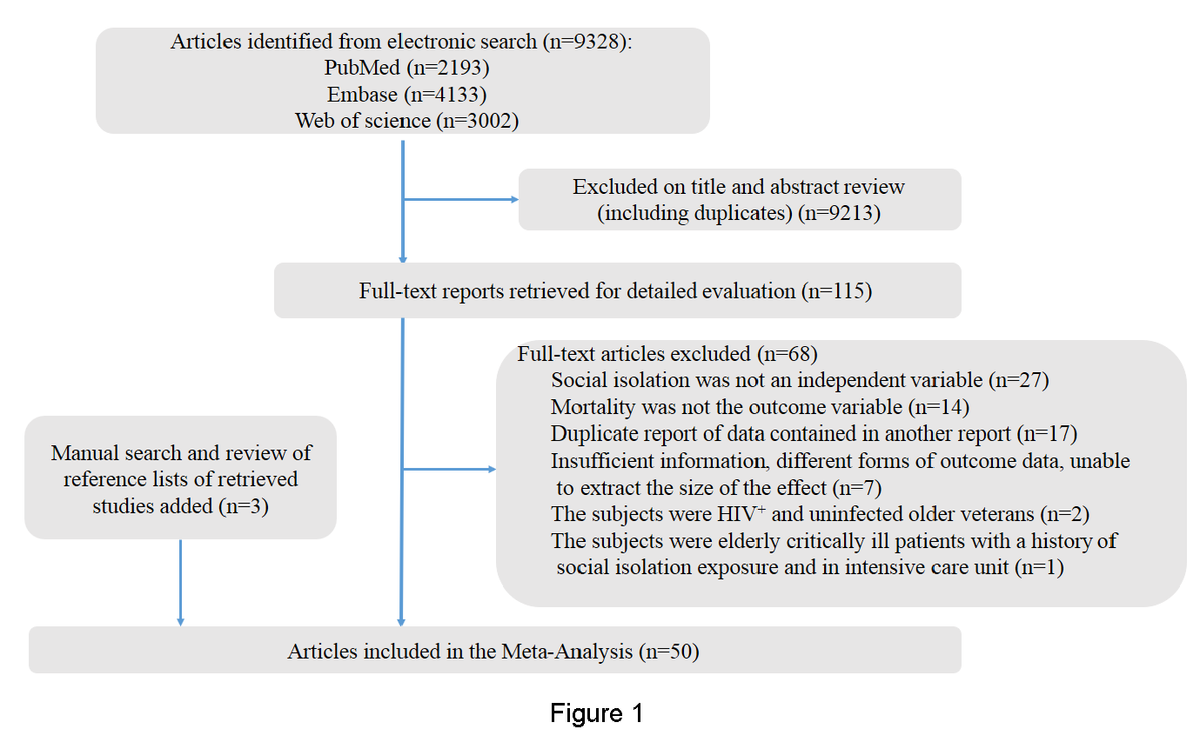
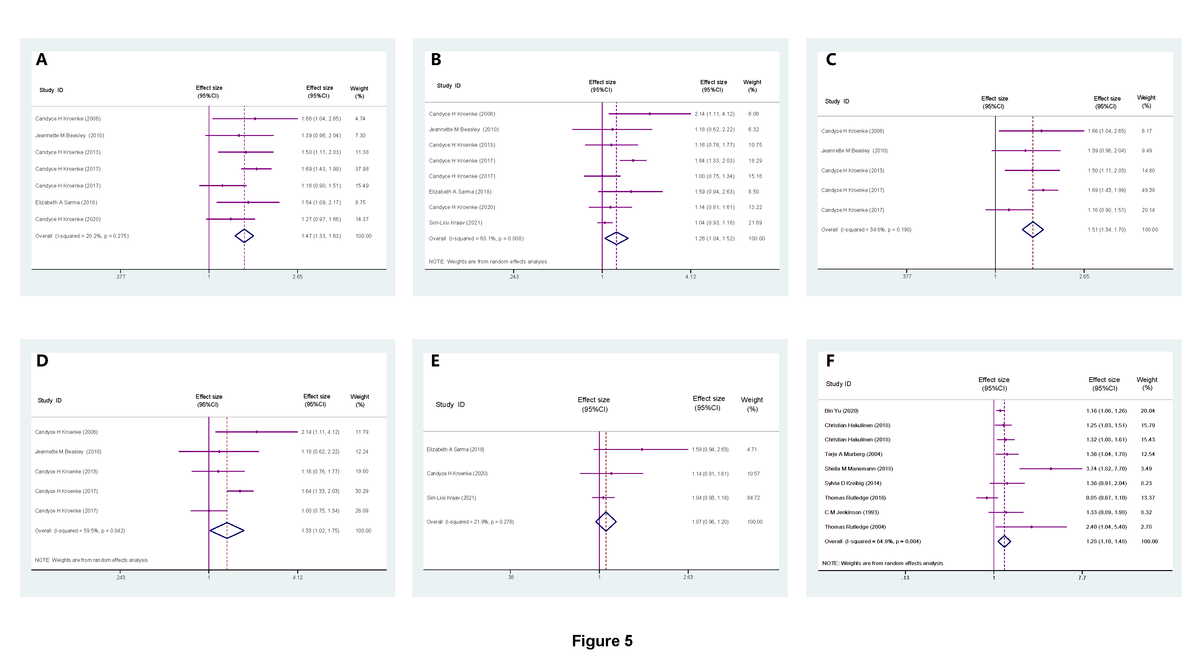
Abstract Background We aimed to assess the associations between social isolation (SI) and the risk of mortality from all causes, cardiovascular disease, and cancer. Methods This was a systematic review and meta-analysis of prospective cohort studies.We searched electronic databases, including PubMed, Web of Science, and Embase, from inception until October 2021, as well as the references of retrieved articles. Prospective studies reporting risk estimates for the association between SI and mortality from all causes, cardiovascular diseases, and cancer in adults aged 18 or older were included in the analyses. Data were screened and extracted independently by two investigators. The fully adjusted effect sizes in the original studies were analyzed, and summary analyses were performed using a fixed-effects or random-effects model, according to the heterogeneity among studies. Subgroup analyses, meta-regression, and sensitivity analyses were performed to evaluate the heterogeneity and robustness of the findings. Simple linear regression was used to analyze the changing trends in social network index grade and risk of mortality. The risk of publication bias was tested using funnel plots and Egger’s and Begg’s tests (each significant at P < 0.05). The trim-and-fill method was used to adjust for the influence of potentially unpublished studies on pooled effect estimates when statistical tests indicated publication bias. The study protocol was registered with PROSPERO (reg. NO CRD42022299959) Results A total of 50 prospective cohort studies with 1,951,661 individuals were included for analysis. The duration of follow-up among included studies ranged from 6 months to 24.4 years. In pooled analyses, SI was significantly associated with an increased risk of mortality from all causes (pooled effect size, 1.22; 95% confidence interval [CI], 1.16 to 1.29; I2 = 77.6%), cardiovascular disease (1.35; 95% CI 1.25 to 1.45, I2 = 65.5%), and cancer (1.23; 95% CI 1.18 to 1.27, I2 = 44.2%) in the general population. Linear regression showed that social network index grade was significantly correlated with the risk of all-cause mortality (P < 0.001). Additionally, the pooled effect estimate for all-cause mortality in patients with breast cancer was 1.51 (95% CI 1.34 to 1.70), and that for cancer-specific mortality was 1.33 (95% CI 1.02 to 1.75). There was a 28% increased risk of all-cause mortality in socially isolated patients with cardiovascular disease (95% CI 1.10 to 1.48). There was no evidence of a positive association between SI and cancer-specific mortality in patients with colorectal cancer (1.07, 95% CI 0.96 to 1.20). Conclusions SI was associated with at least a 20% increased risk of all-cause mortality, cardiovascular disease mortality, and cancer mortality. We highlight that social isolation contributes to chronic disease and mortality, with efforts to improve social isolation likely to have benefits in well-being and survival.
Overview
AI snapshot
Written from the paper’s full text.
TL;DR
This systematic review and meta-analysis of 50 prospective cohort studies (1,951,661 individuals) found that social isolation was associated with increased mortality from all causes, cardiovascular disease, and cancer in the general population. The highest risk was for cardiovascular mortality, and associations were also observed in patients with cardiovascular disease and breast cancer.
Key findings
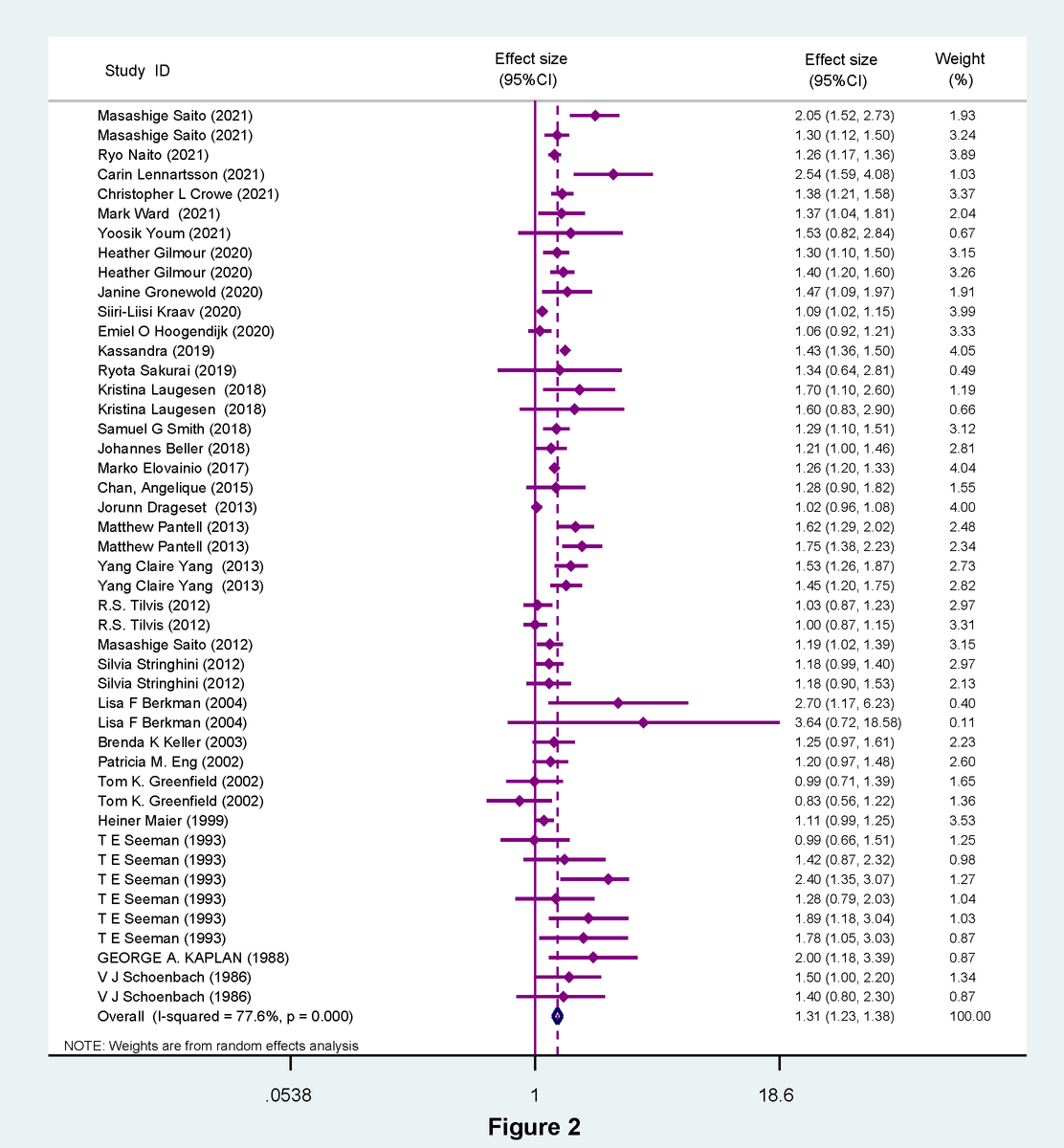
- Social isolation was significantly associated with all-cause mortality (pooled effect estimate 1.31, 95% CI 1.23–1.38; I² = 77.6%), which remained after trim-and-fill adjustment (1.22, 95% CI 1.16–1.29).
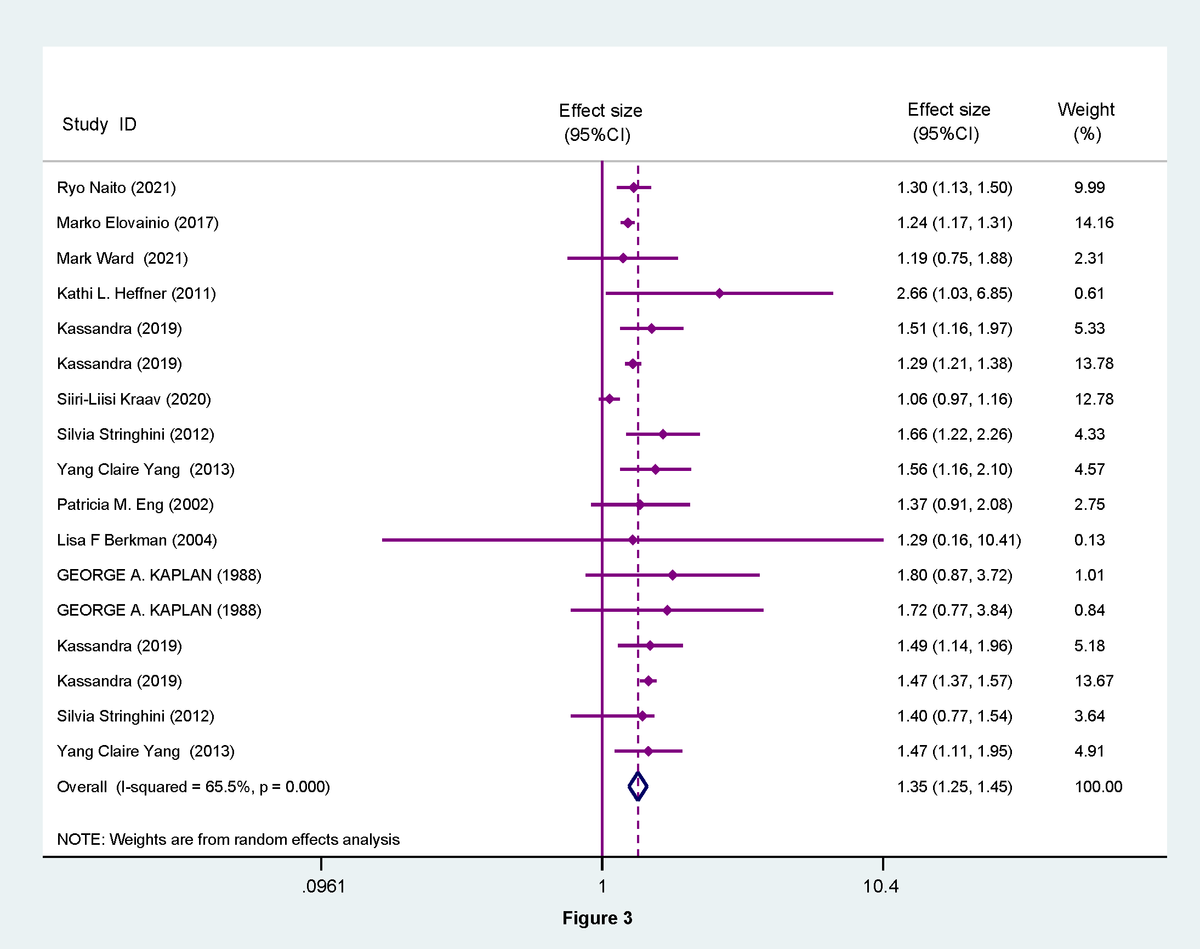
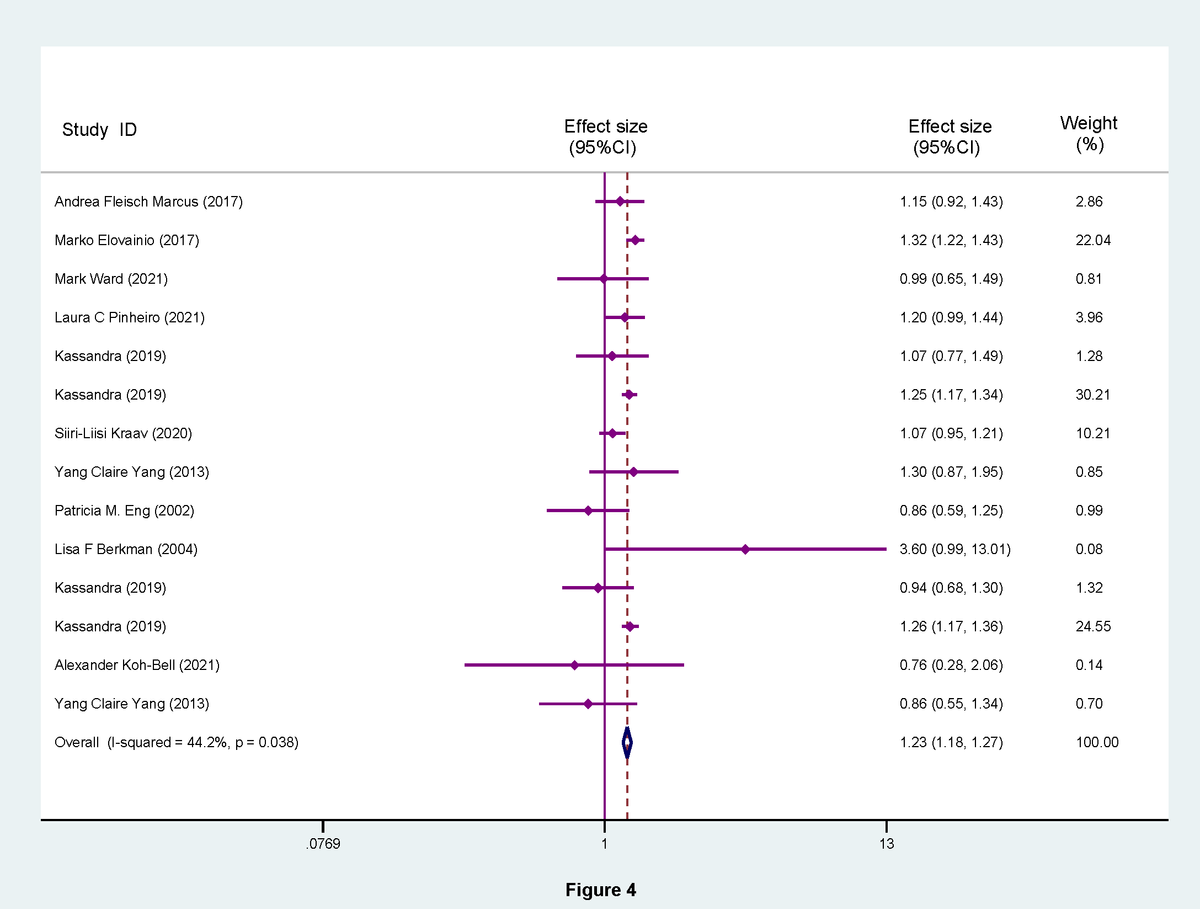
- Pooled estimates were 1.35 (95% CI 1.25–1.45, I² = 65.5%) for cardiovascular/circulatory disease mortality and 1.23 (95% CI 1.18–1.27, I² = 44.2%) for cancer mortality.
- In patient populations: all-cause mortality was 1.28 (95% CI 1.10–1.48) in patients with CVD; in breast cancer, all-cause mortality was 1.51 (95% CI 1.34–1.70) and cancer-specific mortality 1.33 (95% CI 1.02–1.75). No significant association was found for cancer-specific mortality in colorectal cancer (1.07, 95% CI 0.96–1.20).
- Social Network Index grade was significantly correlated with all-cause mortality risk (P < 0.001), with mortality increasing as isolation increased.
Methods
- Systematic review and meta-analysis of prospective cohort studies; PubMed, Web of Science, and Embase searched from inception to October 2021, plus reference lists; protocol registered with PROSPERO (CRD42022299959).
- 50 prospective cohort studies with 1,951,661 participants aged ≥18 years (most ≥50 years); follow-up ranged from 6 months to 24.4 years; 23 studies were from the United States.
- Fully adjusted effect sizes (HR/RR/OR with 95% CIs) were pooled using fixed- or random-effects models according to heterogeneity (I² ≥ 50% random effects); subgroup analyses, meta-regression, sensitivity analyses, and publication bias tests (funnel plots, Egger's and Begg's tests, trim-and-fill) were performed.
Limitations
- Stated: adjustment factors varied greatly across original studies, making the source of heterogeneity complex and difficult to trace; potential unknown confounders may remain; definitions and instruments for social isolation were not consistent across studies; most included studies came from high-income countries; and early deaths were not excluded in the original studies.
- Evident from the text: significant publication bias was detected for the all-cause mortality analysis (Egger's P = 0.037; Begg's P = 0.036), and heterogeneity was substantial (I² = 77.6%).
Model-written summary. Check it against the paper before relying on it.
Integrity signals
Registry
Cites
Statistics
Figures
Verification
Claims the paper makes
28 Own result · 22 Own method · 13 Own interpretation · 4 Couldn’t confirm · 3 No full text of the sources · 2 No basis given · 1 Partly supported · 1 Not checked yet · accuracy not yet measured
The cited sources that could be checked couldn’t confirm or dispute this claim.
In the paper
“Finally, in terms of social factors, socially isolated individuals are less likely to receive emergency and routine medical care owing to their smaller social network if they need help and have no means of transportation 90 .”
§ Social isolation and mortality from all causes, cardiovascular disease, and cancer: A systematic review and meta-analysis of 50 cohort studies > Mechanisms
What the sources say
- Could not verifycites [90] Tilvis, R. S., Laitala, V., Routasalo, P. E. & Pitkälä, K. H. Suffering from loneliness indicates significant mortality risk of older people. J. Aging Res. 2011, 534781 (2011). sourceExperimental — accuracy not yet measured
The Introduction distinguishes social isolation from loneliness and mentions increased use of social and health services in studies of loneliness. Neither the Introduction nor the Discussion addresses whether socially isolated people receive less emergency or routine care because they lack contacts or transportation. Searches for those care-access and transportation claims found no supporting passage in our copy. (LLM, conf=0.77)
hedgeddirect- Asserted: passes — The authors put it forward as true.
- Checkable: passes — It can be checked against evidence.
- Load-bearing: unclear — It is unclear whether the paper’s conclusions depend on it.
- Based: passes — The paper gives a reason why it holds.
- Could not verify
The cited sources that could be checked couldn’t confirm or dispute this claim.
In the paper
“Additionally, Bower et al. 91 reported systematic upregulation of multiple prometastatic molecular processes in primary breast tumors among socially isolated patients with breast cancer.”
§ Social isolation and mortality from all causes, cardiovascular disease, and cancer: A systematic review and meta-analysis of 50 cohort studies > Mechanisms
What the sources say
- Could not verifycites [91] Shiovitz-Ezra, S. & Ayalon, L. Situational versus chronic loneliness as risk factors for all-cause mortality. Int. Psychogeriatr. 22, 455–462 (2010). sourceExperimental — accuracy not yet measured
The Introduction discusses social isolation and health outcomes in older adults, while the Results address loneliness and all-cause mortality. Searches for Bower, primary breast tumors, and prometastatic processes found no passage in our copy addressing the claimed finding. (LLM, conf=0.76)
plaincorrelational- Asserted: passes — The authors put it forward as true.
- Checkable: passes — It can be checked against evidence.
- Load-bearing: unclear — It is unclear whether the paper’s conclusions depend on it.
- Based: passes — The paper gives a reason why it holds.
- Could not verify
A result the paper reports from its own data — it cites no other source for it, so there is none to check. The quote shows it is in the paper.
In the paper
“cardiovascular disease (1.35; 95% CI 1.25 to 1.45, I 2 = 65.5%)”
§ Social isolation and mortality from all causes, cardiovascular disease, and cancer: A systematic review and meta-analysis of 50 cohort studies > Abstract
plaincorrelational- Asserted: passes — The authors put it forward as true.
- Checkable: passes — It can be checked against evidence.
- Load-bearing: passes — The paper’s conclusions depend on it.
- Based: passes — The paper gives a reason why it holds.
- Rests on an assumption: Different methods used to assess social isolation in the included studies measure the same underlying exposure sufficiently to be pooled in a single meta-analysis.
- Rests on an assumption: Hazard ratios, risk ratios, and odds ratios from the included studies are comparable and can be combined to produce pooled effect estimates.
- Rests on an assumption: The most fully adjusted effect estimates from the included studies adequately control for confounding, so the pooled associations can be interpreted as independent effects of social isolation.
A result the paper reports from its own data — it cites no other source for it, so there is none to check. The quote shows it is in the paper.
In the paper
“and cancer (1.23; 95% CI 1.18 to 1.27, I 2 = 44.2%) in the general population.”
§ Social isolation and mortality from all causes, cardiovascular disease, and cancer: A systematic review and meta-analysis of 50 cohort studies > Abstract
plaincorrelational- Asserted: passes — The authors put it forward as true.
- Checkable: passes — It can be checked against evidence.
- Load-bearing: passes — The paper’s conclusions depend on it.
- Based: passes — The paper gives a reason why it holds.
- Rests on an assumption: Different methods used to assess social isolation in the included studies measure the same underlying exposure sufficiently to be pooled in a single meta-analysis.
- Rests on an assumption: Hazard ratios, risk ratios, and odds ratios from the included studies are comparable and can be combined to produce pooled effect estimates.
- Rests on an assumption: The most fully adjusted effect estimates from the included studies adequately control for confounding, so the pooled associations can be interpreted as independent effects of social isolation.
A result the paper reports from its own data — it cites no other source for it, so there is none to check. The quote shows it is in the paper.
In the paper
“and 1.35 (95% CI 1.20 to 1.51) after adjustment using the trim-and-ll method”
§ Social isolation and mortality from all causes, cardiovascular disease, and cancer: A systematic review and meta-analysis of 50 cohort studies > Meta-analyses of SI and all-cause mortality in the general population
plaincorrelational- Asserted: passes — The authors put it forward as true.
- Checkable: passes — It can be checked against evidence.
- Load-bearing: unclear — It is unclear whether the paper’s conclusions depend on it.
- Based: passes — The paper gives a reason why it holds.
- Rests on an assumption: Different methods used to assess social isolation in the included studies measure the same underlying exposure sufficiently to be pooled in a single meta-analysis.
- Rests on an assumption: Hazard ratios, risk ratios, and odds ratios from the included studies are comparable and can be combined to produce pooled effect estimates.
- Rests on an assumption: The most fully adjusted effect estimates from the included studies adequately control for confounding, so the pooled associations can be interpreted as independent effects of social isolation.
A result the paper reports from its own data — it cites no other source for it, so there is none to check. The quote shows it is in the paper.
In the paper
“The pooled effect estimate of cancer-speci c mortality was 1.26 (95% CI 1.04 to 1.52, P = 0.016) (Fig. 5B).”
§ Social isolation and mortality from all causes, cardiovascular disease, and cancer: A systematic review and meta-analysis of 50 cohort studies > Meta-analysis of SI and cancer mortality in the general population
plaincorrelationaln = 21,913 ·- Asserted: passes — The authors put it forward as true.
- Checkable: passes — It can be checked against evidence.
- Load-bearing: passes — The paper’s conclusions depend on it.
- Based: passes — The paper gives a reason why it holds.
- Rests on an assumption: Different methods used to assess social isolation in the included studies measure the same underlying exposure sufficiently to be pooled in a single meta-analysis.
- Rests on an assumption: Hazard ratios, risk ratios, and odds ratios from the included studies are comparable and can be combined to produce pooled effect estimates.
- Rests on an assumption: The most fully adjusted effect estimates from the included studies adequately control for confounding, so the pooled associations can be interpreted as independent effects of social isolation.
The paper states this without a source or data behind it here, so there is nothing to check it against. The quote shows it is in the paper.
In the paper
“Most included studies were from high-income countries; additional results from regions not covered in the included studies are required to more comprehensively understand this topic.”
§ Social isolation and mortality from all causes, cardiovascular disease, and cancer: A systematic review and meta-analysis of 50 cohort studies > Strengths and limitations
plain- Asserted: passes — The authors put it forward as true.
- Checkable: passes — It can be checked against evidence.
- Load-bearing: unclear — It is unclear whether the paper’s conclusions depend on it.
- Based: passes — The paper gives a reason why it holds.
A result the paper reports from its own data — it cites no other source for it, so there is none to check. The quote shows it is in the paper.
In the paper
“The pooled effect estimate was 1.41 (95% CI 1.26 to 1.58; I 2 = 79.1%,P < 0.001; Egger's test P = 0.005; Begg's test P = 0.159)”
§ Social isolation and mortality from all causes, cardiovascular disease, and cancer: A systematic review and meta-analysis of 50 cohort studies > Meta-analyses of SI and all-cause mortality in the general population
plaincorrelational- Asserted: passes — The authors put it forward as true.
- Checkable: passes — It can be checked against evidence.
- Load-bearing: passes — The paper’s conclusions depend on it.
- Based: passes — The paper gives a reason why it holds.
- Rests on an assumption: Different methods used to assess social isolation in the included studies measure the same underlying exposure sufficiently to be pooled in a single meta-analysis.
- Rests on an assumption: Hazard ratios, risk ratios, and odds ratios from the included studies are comparable and can be combined to produce pooled effect estimates.
- Rests on an assumption: The most fully adjusted effect estimates from the included studies adequately control for confounding, so the pooled associations can be interpreted as independent effects of social isolation.
A result the paper reports from its own data — it cites no other source for it, so there is none to check. The quote shows it is in the paper.
In the paper
“Linear regression showed that social network index grade was signi cantly correlated with the risk of all-cause mortality (P < 0.001).”
§ Social isolation and mortality from all causes, cardiovascular disease, and cancer: A systematic review and meta-analysis of 50 cohort studies > Abstract
plaincorrelational- Asserted: passes — The authors put it forward as true.
- Checkable: passes — It can be checked against evidence.
- Load-bearing: unclear — It is unclear whether the paper’s conclusions depend on it.
- Based: passes — The paper gives a reason why it holds.
A result the paper reports from its own data — it cites no other source for it, so there is none to check. The quote shows it is in the paper.
In the paper
“with one study reporting a signi cant positive association (HR = 1.54, 95% CI 1.09 to 2.17)”
§ Social isolation and mortality from all causes, cardiovascular disease, and cancer: A systematic review and meta-analysis of 50 cohort studies > Meta-analysis of SI and cancer mortality in the general population
plaincorrelational- Asserted: passes — The authors put it forward as true.
- Checkable: passes — It can be checked against evidence.
- Load-bearing: unclear — It is unclear whether the paper’s conclusions depend on it.
- Based: passes — The paper gives a reason why it holds.
- Probably not a substantial claim. 18
- It may state two separate claims as one. 17
The cited sources support only part of this claim — read each source’s verdict below.
In the paper
“Because all eligible studies had a cohort study design, the Newcastle-Ottawa quality assessment scale for cohort studies was used to evaluate methodological quality 30 31 .”
§ Social isolation and mortality from all causes, cardiovascular disease, and cancer: A systematic review and meta-analysis of 50 cohort studies > Risk of bias assessment
What the sources say
- Partly supportedcites [30] Kraav, S. L. et al. The effects of loneliness and social isolation on all-cause, injury, cancer, and CVD mortality in a cohort of middle-aged Finnish men: a prospective study. Aging Ment. Health 25, 2219–2228 (2021). sourceExperimental — accuracy not yet measured
The Sample section describes a prospective study of Finnish men, supporting its identification as a cohort study. The Statistical Methods section describes the paper’s analyses but does not mention the Newcastle–Ottawa scale or an assessment of methodological quality. The paper therefore supports the cohort-design part of the sentence, not the scale-use part. (LLM, conf=0.82)
- Could not verifycites [31] Crowe, C. L. et al. Associations of loneliness and social isolation with health span and life span in the U.S. Health and Retirement Study. J. Gerontol. A 76, 1997–2006 (2021). sourceExperimental — accuracy not yet measured
The Statistical Analysis and Sensitivity Analysis sections describe analyses of the Health and Retirement Study cohort, not quality appraisal of a set of eligible studies (page numbers unavailable). Searches for the Newcastle–Ottawa scale and methodological quality assessment found no passage addressing their use. (LLM, conf=0.76)
plain- Asserted: passes — The authors put it forward as true.
- Checkable: passes — It can be checked against evidence.
- Load-bearing: passes — The paper’s conclusions depend on it.
- Based: passes — The paper gives a reason why it holds.
Probably not a substantial claim.
- Partly supported
The cited sources that could be checked couldn’t confirm or dispute this claim.
In the paper
“The ndings from this systematic review and meta-analysis were reported based on the Preferred Reporting Items for Systematic Reviews and Meta-analyses (PRISMA) 23 guideline (Table S1).”
§ Social isolation and mortality from all causes, cardiovascular disease, and cancer: A systematic review and meta-analysis of 50 cohort studies > Methods
What the sources say
- Could not verifycites [23] Yu, B. et al. Social isolation, loneliness, and all-cause mortality in patients with cardiovascular disease: a 10-year follow-up study. Psychosom. Med. 82, 208–214 (2020). sourceExperimental — accuracy not yet measured
The Methods and Figure 1 passages describe a follow-up analysis of Taiwanese survey and insurance-claims data, not the reporting of a systematic review. Searches of our copy for PRISMA and systematic-review reporting found no passage addressing whether the citing review followed that guideline. Page numbers were not available in our copy. (LLM, conf=0.75)
plain- Asserted: passes — The authors put it forward as true.
- Checkable: passes — It can be checked against evidence.
- Load-bearing: fails — The paper’s conclusions may not depend on it.
- Based: passes — The paper gives a reason why it holds.
Probably not a substantial claim. The paper’s conclusions may not depend on it.
- Could not verify
The cited sources that could be checked couldn’t confirm or dispute this claim.
In the paper
“possibly because SI is more common among people with lower levels of education and those who are unemployed 17 .”
§ Social isolation and mortality from all causes, cardiovascular disease, and cancer: A systematic review and meta-analysis of 50 cohort studies > Comparisons with other studies
What the sources say
- Could not verifycites [17] Novak, M. et al. Cardiovascular and all-cause mortality attributable to loneliness in older Swedish men and women. BMC Geriatr. 20, 201 (2020). sourceExperimental — accuracy not yet measured
The Results section (‘Loneliness and background characteristics’; page unavailable) reports that loneliness was more common among participants with poor economic status, but it does not report an association with lower education or unemployment. The Methods section (‘Assessment of loneliness’; page unavailable) measures self-reported loneliness rather than social isolation. Searches for education, employment, and social isolation found no passage establishing the claimed associations. (LLM, conf=0.76)
hedgedcorrelational- Asserted: passes — The authors put it forward as true.
- Checkable: passes — It can be checked against evidence.
- Load-bearing: fails — The paper’s conclusions may not depend on it.
- Based: passes — The paper gives a reason why it holds.
Probably not a substantial claim. The paper’s conclusions may not depend on it. It may state two separate claims as one.
- Could not verify
A result the paper reports from its own data — it cites no other source for it, so there is none to check. The quote shows it is in the paper.
In the paper
“According to the results of subgroup analysis, no signi cant differences were observed for sex, country, follow-up duration, or adjustment for confounding, except for education level (P = 0.029; Table S9).”
§ Social isolation and mortality from all causes, cardiovascular disease, and cancer: A systematic review and meta-analysis of 50 cohort studies > Meta-analyses of SI and all-cause mortality in the general population
plainn = 1,250,108 ·- Asserted: passes — The authors put it forward as true.
- Checkable: passes — It can be checked against evidence.
- Load-bearing: unclear — It is unclear whether the paper’s conclusions depend on it.
- Based: passes — The paper gives a reason why it holds.
It may state two separate claims as one.
A result the paper reports from its own data — it cites no other source for it, so there is none to check. The quote shows it is in the paper.
In the paper
“We demonstrated that SI is positively associated with mortality from all causes, cardiovascular or circulatory diseases, and cancer.”
§ Social isolation and mortality from all causes, cardiovascular disease, and cancer: A systematic review and meta-analysis of 50 cohort studies > Conclusions, Policy Implications, And Future Research
boostedcorrelational- Asserted: passes — The authors put it forward as true.
- Checkable: passes — It can be checked against evidence.
- Load-bearing: passes — The paper’s conclusions depend on it.
- Based: passes — The paper gives a reason why it holds.
It may state two separate claims as one.
A result the paper reports from its own data — it cites no other source for it, so there is none to check. The quote shows it is in the paper.
In the paper
“The duration of follow-up among included studies ranged from 6 months to 24.4 years.”
§ Social isolation and mortality from all causes, cardiovascular disease, and cancer: A systematic review and meta-analysis of 50 cohort studies > Abstract
plain- Asserted: passes — The authors put it forward as true.
- Checkable: passes — It can be checked against evidence.
- Load-bearing: fails — The paper’s conclusions may not depend on it.
- Based: passes — The paper gives a reason why it holds.
Probably not a substantial claim. The paper’s conclusions may not depend on it.
The paper states this without a source or data behind it here, so there is nothing to check it against. The quote shows it is in the paper.
In the paper
“Since early deaths were not excluded in the original study, which may confound the relationship between social isolation and mortality in the original study”
§ Social isolation and mortality from all causes, cardiovascular disease, and cancer: A systematic review and meta-analysis of 50 cohort studies > Strengths and limitations
plain- Asserted: passes — The authors put it forward as true.
- Checkable: passes — It can be checked against evidence.
- Load-bearing: fails — The paper’s conclusions may not depend on it.
- Based: passes — The paper gives a reason why it holds.
Probably not a substantial claim. The paper’s conclusions may not depend on it.
A conclusion the paper draws from its own results — it cites no other source for it, so there is none to check. The quote shows it is in the paper.
In the paper
“SI may be exacerbated by post-cancer or CVD stress and less social contact as well as limited access to care, especially informal care from friends and family.”
§ Social isolation and mortality from all causes, cardiovascular disease, and cancer: A systematic review and meta-analysis of 50 cohort studies > Conclusions, Policy Implications, And Future Research
hedgedconditional- Asserted: passes — The authors put it forward as true.
- Checkable: passes — It can be checked against evidence.
- Load-bearing: fails — The paper’s conclusions may not depend on it.
- Based: fails — The paper may give no reason why it holds.
Probably not a substantial claim. The paper’s conclusions may not depend on it. The paper may give no reason why it holds. It may state two separate claims as one.
What the paper did — it cites no source for this, so there is none to check. The quote shows it is in the paper.
In the paper
“Data were screened and extracted independently by two investigators.”
§ Social isolation and mortality from all causes, cardiovascular disease, and cancer: A systematic review and meta-analysis of 50 cohort studies > Abstract
plain- Asserted: passes — The authors put it forward as true.
- Checkable: passes — It can be checked against evidence.
- Load-bearing: fails — The paper’s conclusions may not depend on it.
- Based: passes — The paper gives a reason why it holds.
Probably not a substantial claim. The paper’s conclusions may not depend on it.
A conclusion the paper draws from its own results — it cites no other source for it, so there is none to check. The quote shows it is in the paper.
In the paper
“By contrast, in socially isolated patients with cancer, death is more often owing to inaccessibility of long-term medical services and basic care in the late stages of disease.”
§ Social isolation and mortality from all causes, cardiovascular disease, and cancer: A systematic review and meta-analysis of 50 cohort studies > Comparisons with other studies
plaindirect- Asserted: passes — The authors put it forward as true.
- Checkable: passes — It can be checked against evidence.
- Load-bearing: fails — The paper’s conclusions may not depend on it.
- Based: fails — The paper may give no reason why it holds.
Probably not a substantial claim. The paper’s conclusions may not depend on it. The paper may give no reason why it holds.
What the paper did — it cites no source for this, so there is none to check. The quote shows it is in the paper.
In the paper
“Although many confounders had been adjusted in the original studies, there were still potential unknown confounders.”
§ Social isolation and mortality from all causes, cardiovascular disease, and cancer: A systematic review and meta-analysis of 50 cohort studies > Strengths and limitations
hedged- Asserted: passes — The authors put it forward as true.
- Checkable: passes — It can be checked against evidence.
- Load-bearing: fails — The paper’s conclusions may not depend on it.
- Based: passes — The paper gives a reason why it holds.
Probably not a substantial claim. The paper’s conclusions may not depend on it.
A conclusion the paper draws from its own results — it cites no other source for it, so there is none to check. The quote shows it is in the paper.
In the paper
“SI was associated with at least a 20% increased risk of all-cause mortality, cardiovascular disease mortality, and cancer mortality.”
§ Social isolation and mortality from all causes, cardiovascular disease, and cancer: A systematic review and meta-analysis of 50 cohort studies > Abstract
plaincorrelational- Asserted: passes — The authors put it forward as true.
- Checkable: passes — It can be checked against evidence.
- Load-bearing: passes — The paper’s conclusions depend on it.
- Based: passes — The paper gives a reason why it holds.
It may state two separate claims as one.
- Rests on an assumption: The observed associations between social isolation and mortality reflect a causal effect of social isolation rather than residual confounding or reverse causation.
A conclusion the paper draws from its own results — it cites no other source for it, so there is none to check. The quote shows it is in the paper.
In the paper
“Since early deaths were not excluded in the original study, which may confound the relationship between social isolation and mortality in the original study”
§ Social isolation and mortality from all causes, cardiovascular disease, and cancer: A systematic review and meta-analysis of 50 cohort studies > Strengths and limitations
hedgedconditional- Asserted: passes — The authors put it forward as true.
- Checkable: passes — It can be checked against evidence.
- Load-bearing: fails — The paper’s conclusions may not depend on it.
- Based: passes — The paper gives a reason why it holds.
Probably not a substantial claim. The paper’s conclusions may not depend on it.
In the paper
“Second, in terms of psychological factors, studies have shown that people who are socially isolated are more likely to be depressed or suicidal 89 .”
§ Social isolation and mortality from all causes, cardiovascular disease, and cancer: A systematic review and meta-analysis of 50 cohort studies > Mechanisms
What the sources say
- Not checked — no full text of the sourcecites [89] Tilvis, R. S., Laitala, V., Routasalo, P., Strandberg, T. E. & Pitkala, K. H. Positive life orientation predicts good survival prognosis in old age. Arch. Gerontol. Geriatr. 55, 133–137 (2012). source
hedgedcorrelational- Asserted: passes — The authors put it forward as true.
- Checkable: passes — It can be checked against evidence.
- Load-bearing: unclear — It is unclear whether the paper’s conclusions depend on it.
- Based: passes — The paper gives a reason why it holds.
It may state two separate claims as one.
A conclusion the paper draws from its own results — it cites no other source for it, so there is none to check. The quote shows it is in the paper.
In the paper
“with efforts to improve social isolation likely to have bene ts in well-being and survival.”
§ Social isolation and mortality from all causes, cardiovascular disease, and cancer: A systematic review and meta-analysis of 50 cohort studies > Abstract
hedgedconditional- Asserted: passes — The authors put it forward as true.
- Checkable: passes — It can be checked against evidence.
- Load-bearing: passes — The paper’s conclusions depend on it.
- Based: passes — The paper gives a reason why it holds.
It may state two separate claims as one.
What the paper did — it cites no source for this, so there is none to check. The quote shows it is in the paper.
In the paper
“The trim-and-ll method was used to adjust for the in uence of potentially unpublished studies on pooled effect estimates when statistical tests indicated publication bias.”
§ Social isolation and mortality from all causes, cardiovascular disease, and cancer: A systematic review and meta-analysis of 50 cohort studies > Abstract
plain- Asserted: passes — The authors put it forward as true.
- Checkable: passes — It can be checked against evidence.
- Load-bearing: fails — The paper’s conclusions may not depend on it.
- Based: passes — The paper gives a reason why it holds.
Probably not a substantial claim. The paper’s conclusions may not depend on it.
What the paper did — it cites no source for this, so there is none to check. The quote shows it is in the paper.
In the paper
“Based on the Newcastle-Ottawa scale, most studies had a low risk of bias in all components.Most studies had a rating of 7-8 and were identi ed as high-quality studies, with only four studies that had a rating of 6 that were considered moderate-quality studies.”
§ Social isolation and mortality from all causes, cardiovascular disease, and cancer: A systematic review and meta-analysis of 50 cohort studies > Characteristics of included studies
plain- Asserted: passes — The authors put it forward as true.
- Checkable: passes — It can be checked against evidence.
- Load-bearing: unclear — It is unclear whether the paper’s conclusions depend on it.
- Based: passes — The paper gives a reason why it holds.
It may state two separate claims as one.
A conclusion the paper draws from its own results — it cites no other source for it, so there is none to check. The quote shows it is in the paper.
In the paper
“Thus, we could con rm that SI was positively correlated with all-cause mortality in the overall population and in both men and women.”
§ Social isolation and mortality from all causes, cardiovascular disease, and cancer: A systematic review and meta-analysis of 50 cohort studies > Comparisons with other studies
hedgedcorrelational- Asserted: passes — The authors put it forward as true.
- Checkable: passes — It can be checked against evidence.
- Load-bearing: passes — The paper’s conclusions depend on it.
- Based: passes — The paper gives a reason why it holds.
It may state two separate claims as one.
In the paper
“Higher levels of in ammatory markers like C-reactive protein and brinogen, are closely associated with CVD and mortality 88 .”
§ Social isolation and mortality from all causes, cardiovascular disease, and cancer: A systematic review and meta-analysis of 50 cohort studies > Mechanisms
What the sources say
- Not checked — no full text of the sourcecites [88] Holwerda, T. J. et al. Increased risk of mortality associated with social isolation in older men: only when feeling lonely? Results from the Amsterdam Study of the Elderly (AMSTEL). Psychol. Med. 42, 843–853 (2012). source
plaincorrelational- Asserted: passes — The authors put it forward as true.
- Checkable: passes — It can be checked against evidence.
- Load-bearing: fails — The paper’s conclusions may not depend on it.
- Based: passes — The paper gives a reason why it holds.
Probably not a substantial claim. The paper’s conclusions may not depend on it.
What the paper did — it cites no source for this, so there is none to check. The quote shows it is in the paper.
In the paper
“The risk of publication bias was tested using funnel plots and Egger's and Begg's tests (each signi cant at P < 0.05).”
§ Social isolation and mortality from all causes, cardiovascular disease, and cancer: A systematic review and meta-analysis of 50 cohort studies > Abstract
plain- Asserted: passes — The authors put it forward as true.
- Checkable: passes — It can be checked against evidence.
- Load-bearing: fails — The paper’s conclusions may not depend on it.
- Based: passes — The paper gives a reason why it holds.
Probably not a substantial claim. The paper’s conclusions may not depend on it.
What the paper did — it cites no source for this, so there is none to check. The quote shows it is in the paper.
In the paper
“No signi cant heterogeneity or publication bias was found (Table S6).”
§ Social isolation and mortality from all causes, cardiovascular disease, and cancer: A systematic review and meta-analysis of 50 cohort studies > Meta-analysis of SI and cancer mortality in the general population
plainn = 21,913- Asserted: passes — The authors put it forward as true.
- Checkable: passes — It can be checked against evidence.
- Load-bearing: unclear — It is unclear whether the paper’s conclusions depend on it.
- Based: passes — The paper gives a reason why it holds.
It may state two separate claims as one.
What the paper did — it cites no source for this, so there is none to check. The quote shows it is in the paper.
In the paper
“There was a large number of internal adjustment factors in the original studies, and adjustment factors varied greatly among studies.”
§ Social isolation and mortality from all causes, cardiovascular disease, and cancer: A systematic review and meta-analysis of 50 cohort studies > Strengths and limitations
plain- Asserted: passes — The authors put it forward as true.
- Checkable: passes — It can be checked against evidence.
- Load-bearing: unclear — It is unclear whether the paper’s conclusions depend on it.
- Based: passes — The paper gives a reason why it holds.
It may state two separate claims as one.
A conclusion the paper draws from its own results — it cites no other source for it, so there is none to check. The quote shows it is in the paper.
In the paper
“We highlight that social isolation contributes to chronic disease and mortality”
§ Social isolation and mortality from all causes, cardiovascular disease, and cancer: A systematic review and meta-analysis of 50 cohort studies > Abstract
plaindirectn = 1,951,661- Asserted: passes — The authors put it forward as true.
- Checkable: passes — It can be checked against evidence.
- Load-bearing: passes — The paper’s conclusions depend on it.
- Based: passes — The paper gives a reason why it holds.
It may state two separate claims as one.
- Rests on an assumption: The observed associations between social isolation and mortality reflect a causal effect of social isolation rather than residual confounding or reverse causation.
What the paper did — it cites no source for this, so there is none to check. The quote shows it is in the paper.
In the paper
“Subgroup analyses, meta-regression, and sensitivity analyses were performed to evaluate the heterogeneity and robustness of the ndings.”
§ Social isolation and mortality from all causes, cardiovascular disease, and cancer: A systematic review and meta-analysis of 50 cohort studies > Abstract
plain- Asserted: passes — The authors put it forward as true.
- Checkable: passes — It can be checked against evidence.
- Load-bearing: passes — The paper’s conclusions depend on it.
- Based: passes — The paper gives a reason why it holds.
Probably not a substantial claim.
What the paper did — it cites no source for this, so there is none to check. The quote shows it is in the paper.
In the paper
“The study protocol was registered with PROSPERO (reg.NO CRD42022299959)”
§ Social isolation and mortality from all causes, cardiovascular disease, and cancer: A systematic review and meta-analysis of 50 cohort studies > Abstract
plain- Asserted: passes — The authors put it forward as true.
- Checkable: passes — It can be checked against evidence.
- Load-bearing: fails — The paper’s conclusions may not depend on it.
- Based: passes — The paper gives a reason why it holds.
Probably not a substantial claim. The paper’s conclusions may not depend on it.
What the paper did — it cites no source for this, so there is none to check. The quote shows it is in the paper.
In the paper
“Most included studies were of high quality, with a low risk of bias, which further lends con dence regarding the reliability of the current pooled results.”
§ Social isolation and mortality from all causes, cardiovascular disease, and cancer: A systematic review and meta-analysis of 50 cohort studies > Strengths and limitations
plain- Asserted: passes — The authors put it forward as true.
- Checkable: passes — It can be checked against evidence.
- Load-bearing: passes — The paper’s conclusions depend on it.
- Based: passes — The paper gives a reason why it holds.
It may state two separate claims as one.
A conclusion the paper draws from its own results — it cites no other source for it, so there is none to check. The quote shows it is in the paper.
In the paper
“We found a signi cant association of SI with increased risk of all three types of mortality outcomes in the general population, with the highest risk for cardiovascular death.”
§ Social isolation and mortality from all causes, cardiovascular disease, and cancer: A systematic review and meta-analysis of 50 cohort studies > Principal ndings
plaincorrelational- Asserted: passes — The authors put it forward as true.
- Checkable: passes — It can be checked against evidence.
- Load-bearing: passes — The paper’s conclusions depend on it.
- Based: passes — The paper gives a reason why it holds.
It may state two separate claims as one.
A conclusion the paper draws from its own results — it cites no other source for it, so there is none to check. The quote shows it is in the paper.
In the paper
“Socially isolated patients with CVD and breast cancer had worse all-cause mortality, and patients with breast cancer and SI had a higher cancer-speci c mortality.”
§ Social isolation and mortality from all causes, cardiovascular disease, and cancer: A systematic review and meta-analysis of 50 cohort studies > Principal ndings
plaincorrelational- Asserted: passes — The authors put it forward as true.
- Checkable: passes — It can be checked against evidence.
- Load-bearing: passes — The paper’s conclusions depend on it.
- Based: passes — The paper gives a reason why it holds.
It may state two separate claims as one.
What the paper did — it cites no source for this, so there is none to check. The quote shows it is in the paper.
In the paper
“Additionally, we conducted a sensitivity analysis, in which each prospective cohort study was excluded in turn to examine the in uence of that study on the overall estimates.”
§ Social isolation and mortality from all causes, cardiovascular disease, and cancer: A systematic review and meta-analysis of 50 cohort studies > Conclusions, Policy Implications, And Future Research
plain- Asserted: passes — The authors put it forward as true.
- Checkable: passes — It can be checked against evidence.
- Load-bearing: fails — The paper’s conclusions may not depend on it.
- Based: passes — The paper gives a reason why it holds.
Probably not a substantial claim. The paper’s conclusions may not depend on it.
In the paper
“First, in terms of physiological factors, individuals who are socially isolated may show elevated activation of the hypothalamic-pituitaryadrenal axis, an increased chronic stress response, elevated blood pressure, and higher levels of serum cortisol 13 .”
§ Social isolation and mortality from all causes, cardiovascular disease, and cancer: A systematic review and meta-analysis of 50 cohort studies > Mechanisms
What the sources say
- Not checked — no full text of the sourcecites [13] Moreno-Tamayo, K., Juarez, F., Manrique-Espinoza, B. & Mejia-Pailles, G. The relationship between social isolation and mortality among adults aged 50 and older in a 12-year follow-up analysis in Mexico. Res. Aging 44, 758–769 (2022). source
hedgedconditional- Asserted: passes — The authors put it forward as true.
- Checkable: passes — It can be checked against evidence.
- Load-bearing: unclear — It is unclear whether the paper’s conclusions depend on it.
- Based: passes — The paper gives a reason why it holds.
It may state two separate claims as one.
What the paper did — it cites no source for this, so there is none to check. The quote shows it is in the paper.
In the paper
“The fully adjusted effect sizes in the original studies were analyzed”
§ Social isolation and mortality from all causes, cardiovascular disease, and cancer: A systematic review and meta-analysis of 50 cohort studies > Abstract
plain- Asserted: passes — The authors put it forward as true.
- Checkable: passes — It can be checked against evidence.
- Load-bearing: passes — The paper’s conclusions depend on it.
- Based: passes — The paper gives a reason why it holds.
Probably not a substantial claim.
What the paper did — it cites no source for this, so there is none to check. The quote shows it is in the paper.
In the paper
“The de nition of SI was not completely consistent among studies, and the instruments used to evaluate SI differed, which may affect the accuracy of the meta-analysis results.”
§ Social isolation and mortality from all causes, cardiovascular disease, and cancer: A systematic review and meta-analysis of 50 cohort studies > Strengths and limitations
plain- Asserted: passes — The authors put it forward as true.
- Checkable: passes — It can be checked against evidence.
- Load-bearing: unclear — It is unclear whether the paper’s conclusions depend on it.
- Based: passes — The paper gives a reason why it holds.
It may state two separate claims as one.
A conclusion the paper draws from its own results — it cites no other source for it, so there is none to check. The quote shows it is in the paper.
In the paper
“The source of heterogeneity is complex and di cult to trace.”
§ Social isolation and mortality from all causes, cardiovascular disease, and cancer: A systematic review and meta-analysis of 50 cohort studies > Strengths and limitations
plain- Asserted: passes — The authors put it forward as true.
- Checkable: fails — It may be too vague to check against evidence.
- Load-bearing: fails — The paper’s conclusions may not depend on it.
- Based: passes — The paper gives a reason why it holds.
Probably not a substantial claim. It may be too vague to check against evidence. The paper’s conclusions may not depend on it.
The paper relies on this without support.
Different methods used to assess social isolation in the included studies measure the same underlying exposure sufficiently to be pooled in a single meta-analysis.
“We included all studies with SI evaluated using different methods (detailed de nitions in Table S2) in the original studies.”
The paper relies on this without support.
Hazard ratios, risk ratios, and odds ratios from the included studies are comparable and can be combined to produce pooled effect estimates.
“HRs and RRs (along with 95% CIs) for comparisons of SI with non-SI or graded variables in the original studies were summarized to calculate the pooled effect estimates for the association between SI and mortality outcomes.”
The paper relies on this without support.
The most fully adjusted effect estimates from the included studies adequately control for confounding, so the pooled associations can be interpreted as independent effects of social isolation.
“If the included studies reported both crude and multivariable-adjusted effect estimates, we extracted the most fully adjusted outcomes in the present meta-analysis.”
The paper relies on this without support.
The observed associations between social isolation and mortality reflect a causal effect of social isolation rather than residual confounding or reverse causation.
“We highlight that social isolation contributes to chronic disease and mortality”
The paper relies on this without support.
The search strategy identified all relevant studies.
“We searched PubMed, Web of Science, and Embase for studies published in English between database inception and October 2021.”
The paper relies on this without support.
This was the first study to comprehensively evaluate the association between SI and mortality from all causes, CVD, and cancer.
“To the best of our knowledge, this was the rst study to comprehensively evaluate the association between SI and mortality from all causes, CVD, and cancer.”
The paper relies on this without support.
The association between SI and cancer mortality was systematically reviewed for the first time, as was the relationship between SI and mortality in patients with CVD and cancer.
“The association between SI and cancer mortality was systematically reviewed for the rst time, as was the relationship between SI and mortality in patients with CVD and cancer.”
Self-check
Percentages, sums and reported differences re-computed from the paper’s own numbers.
Each contradiction between two passages listed here was confirmed by an independent check.
Rated major: it would touch a result — a value a result rests on, reported and recomputed p-values on opposite sides of the significance level, two passages that conflict with no sign which is right, or a cited work retracted before this paper was published.
In the paper
§ Social isolation and mortality from all causes, cardiovascular disease, and cancer: A systematic review and meta-analysis of 50 cohort studies > Meta-analysis of SI and cancer mortality in the general population
“A total of 1,156,644 participants were analyzed, and a positive association with cancer mortality was observed (1.23, 95% CI 1.18 to 1.27, P < 0.001)”
§ Social isolation and mortality from all causes, cardiovascular disease, and cancer: A systematic review and meta-analysis of 50 cohort studies > Comparisons with other studies
“Our study ndings indicated a signi cant positive association (1.18, 95% CI 1.11 to 1.26) according to summarized data from 10 studies conducted in ve countries”
Rated minor: it would not touch a result — a value no result rests on, a p-value that stays on the same side of the significance level, or a conflict that is clerical, resolved elsewhere in the paper, or outside its own findings.
In the paper
§ Social isolation and mortality from all causes, cardiovascular disease, and cancer: A systematic review and meta-analysis of 50 cohort studies > Data sources and database search
“We searched PubMed, Web of Science, and Embase for studies published in English between database inception and October 2021.”
§ Social isolation and mortality from all causes, cardiovascular disease, and cancer: A systematic review and meta-analysis of 50 cohort studies > Literature search
“We identi ed 9328 records through electronic database searches of PubMed, Web of Science, Embase, and the Cochrane Library.”
Citations
Cites
Preferred Reporting Items for Systematic Reviews and Meta-Analyses: the PRISMA statement
Moher, D., Liberati, A., Tetzlaff, J., Altman, D. G., & for the PRISMA Group (2009) · BMJ · doi:10.1136/bmj.b2535 · Cited by 83,823
Preferred Reporting Items for Systematic Reviews and Meta-Analyses: The PRISMA Statement
Moher, D., Liberati, A., Tetzlaff, J., Altman, D. G., & The PRISMA Group (2009) · PLoS Medicine · doi:10.1371/journal.pmed.1000097 · Cited by 64,042
Dermyshi, E., Wang, Y., Yan, C., Hong, W., Qiu, G., Gong, X., & Zhang, T. (2017) · Neonatology · doi:10.1159/000454668 · Cited by 24,586
GRADE: an emerging consensus on rating quality of evidence and strength of recommendations
Guyatt, G. H., Oxman, A. D., Vist, G. E., Kunz, R., Falck-Ytter, Y., Alonso-Coello, P., & Schünemann, H. J. (2008) · BMJ · doi:10.1136/bmj.39489.470347.ad · Cited by 23,305
Meta-analysis of Observational Studies in Epidemiology<SUBTITLE>A Proposal for Reporting</SUBTITLE>
Stroup, D. F. (2000) · JAMA · doi:10.1001/jama.283.15.2008 · Cited by 20,623
Wang, G., Ma, R., Qiao, G., Wada, K., Aizawa, Y., & Satoh, T. (2015) · Integrative Medicine International · doi:10.1159/000368408 · Cited by 18,762
(2014) · Medical Entomology and Zoology · Cited by 17,633
Stang, A. (2010) · European Journal of Epidemiology · doi:10.1007/s10654-010-9491-z · Cited by 17,396
Duval, S., & Tweedie, R. (2000) · Biometrics · doi:10.1111/j.0006-341x.2000.00455.x · Cited by 14,099
Social Relationships and Health
House, J. S., Landis, K. R., & Umberson, D. (1988) · Science · doi:10.1126/science.3399889 · Cited by 7,073
Research works printed but not linked: 2
- National Academies of Sciences, Engineering, and Medicine Social Isolation and Loneliness in Older Adults: Opportunities for the Health Care System (National Academies Press, 2020).
- ICD-9-CM. International Classification of Diseases, 9th revision, Clinical Modification. 3d edition, volumes 1, 2 and 3. Official authorized addendum effective October 1, 1990–HCFA. J. Am. Med. Rec. Assoc. 61, 1–35 (1990). Suppl.
Cited by
Sorted by citations
Items 401–500 of 507
Ruiz-Sancho, E. M., Nieto, M. Á. P., Escamilla, F. S., Callejo, L. T., Cañada, P., Rubio, E., Aguirre, A., & Delgado, M. R. (2026) · BMC Geriatrics · doi:10.1186/s12877-026-07621-5
Švihrová, R., Marzorati, D., Odello, T., Monachino, G., Staletti, T., Tieben, R., Luigies, R., Bodewes, N., Rutten, W., Barrett, G., et al. (2026) · medRxiv · doi:10.64898/2026.05.15.26353188
Social Isolation and Depression
Sunzeri, J. J. (2026) · Springer eBooks · doi:10.1007/978-3-032-14465-2_11
Meng, X., Honda, T., Ohara, T., Furuta, Y., Shibata, M., Hata, J., Taki, Y., Mikami, T., Maeda, T., Ono, K., et al. (2026) · GeroScience · doi:10.1007/s11357-026-02304-w
Jin, B., Zhang, Z., Yan, T., Yao, M., Wang, C., Wei, Y., Zhang, X., 何汝梅, Wang, L., Xi, S., et al. (2026) · Egyptian Journal of Bronchology · doi:10.1186/s43168-026-00582-8
Therapeutic Massage for Psychological Well-being in Geriatric Oncology
Liu, X., Wang, S., Lv, Y., Tong, J., Hu, Y., Xia, M.-H., Yin, X., Zhou, M., Wang, D., Wang, B., et al. (2026) · Journal of Visualized Experiments · doi:10.3791/70026
Self-citationGut microbiota restructured by social isolation: Evidence for sex-specific response patterns
Fallon, K., Challa, S. R., Fornal, C. A., Boyineni, J., Soares, M. B., Malchenko, S., Veeravalli, K. K., Gyarmati, P., & Song, Y. (2026) · Brain Behavior & Immunity - Health · doi:10.1016/j.bbih.2026.101272
Wong, T. Y., Wong, T. S., Hou, W. K., Leung, A. N. M., Xiao, J., Yuen, K. S. L., Lui, S. S. Y., Qiu, A., Moore, T. M., & Gur, R. C. (2026) · Journal of Child Psychology and Psychiatry · doi:10.1111/jcpp.70178
Loneliness and health-related quality of life by chronic disease: a nationally representative survey
Heo, J., Cho, H., Lee, J., Lim, Y., Lee, M., Jo, T., Kang, D., & Cho, J. (2026) · International Journal of Epidemiology · doi:10.1093/ije/dyag051
Kvalnes, Ø. (2026) · Springer eBooks · doi:10.1007/978-3-032-25890-8_10
Social isolation in cancer patients: a bibliometric analysis from 2014 to 2024
Li, X., Li, N., Wang, J. Y., Wang, C., Wang, S., Kong, C., & Chen, D. (2026) · Current Psychology · doi:10.1007/s12144-026-09578-5
When Shortest Isn’t Safest: A Design Science Approach to Senior-Friendly Pedestrian Routing
Ünal, E., Eisenhardt, D., Meske, C., Afzali, S. N., & Doğangün, A. (2026) · Lecture notes in computer science · doi:10.1007/978-3-032-28316-0_23
Chowdhury, D., Corbett, E., Laney, J., Winkle, S. V., Khan, A. A., Edmonds, E., & Sprong, M. E. (2026) · Frontiers in Public Health · doi:10.3389/fpubh.2026.1817065
Moran, D. S., L’Heureux, B. A., Boisvert, L. A., Amarante, C. M., Morrill, E. J., Donnelly, S. L., Flaherty, E., & Kraft, S. A. (2026) · Discover Public Health · doi:10.1186/s12982-026-02099-3
Meland, E., Hufthammer, K. O., Mildestvedt, T., Rangul, V., Vie, T. L., & Hetlevik, Ø. (2026) · BMJ Public Health · doi:10.1136/bmjph-2025-004283
Shimoda, T., Tomida, K., Nakajima, C., Kawakami, A., & Shimada, H. (2026) · Geriatric Nursing · doi:10.1016/j.gerinurse.2026.104136
He, C., Ding, X., Peng, X., Chao, W., & Cao, B. (2026) · Journal of Advanced Nursing · doi:10.1111/jan.70656
Loneliness in prostate cancer survivors
Lunger, L., Schwoy, M., Dinkel, A., Meissner, V. H., Schiele, S., Jahnen, M., Gschwend, J. E., & Herkommer, K. (2026) · Journal of Cancer Research and Clinical Oncology · doi:10.1007/s00432-026-06539-0
Valdebenito, D. M., Espinoza‐Palavicino, T., Terán-Mendoza, O., Cancino, V., & Barra-Barrera, J. (2026) · Journal of Aging and Health · doi:10.1177/08982643261446020
Huang, J. (2026) · The Journals of Gerontology Series B · doi:10.1093/geronb/gbag111
Domínguez-Arriola, M. E. (2026) · doi:10.82308/55937
Lee, M. J., McLean, K. E., Xie, M., & Henderson, S. B. (2026) · Environmental Research Health · doi:10.1088/2752-5309/ae6f40
Mulsrisuk, S., Pachachoo, P., Suksatan, W., Suwan, P., & Posri, P. (2026) · Discover Public Health · doi:10.1186/s12982-026-02480-2
What Older Adults Need from Digital Loneliness Support: A Mixed-Methods Requirements StudyPreprint
Zhao, J., & Or, C. K. (2026) · Research Square · doi:10.21203/rs.3.rs-9991723/v1
Teismann, T., & Claus, C. (2026) · Springer eBooks · doi:10.1007/978-3-662-72796-6_1
Nazır, T., & Önem, Ş. (2026) · İZÜ Eğitim Dergisi · doi:10.46423/izujed.1913893
Adair, T., Li, H., Тимонин, С. А., Cairns, A. J. G., & Canudas‐Romo, V. (2026) · Population Health Metrics · doi:10.1186/s12963-026-00492-3
Mancini, V. O., Guerrini, B., Clarke, J. J., Vergara, D. P., Seidler, Z. E., & Puzio, A. (2026) · Sex Roles · doi:10.1007/s11199-026-01661-2
The role of spousal relationships in shaping clinical trajectories during aging
Kelberman, M. A., & Donaldson, Z. R. (2026) · Neuropsychopharmacology · doi:10.1038/s41386-026-02499-8
The Social Landscape of Ageing
Yuen, C. W., Mohd, T. A. M. T., & Hairi, N. N. (2026) · Springer eBooks · doi:10.1007/978-981-95-2175-3_17
Choi, H., Gramling, R., & Reblin, M. (2026) · Aging & Mental Health · doi:10.1080/13607863.2026.2698705
Uhlmann, L. M. (2026) · Qucosa (Saxon State and University Library Dresden)
Li, L., Kayser, J., & Song, K. (2026) · Innovation in Aging · doi:10.1093/geroni/igag070
Social disconnection in the brain: loneliness and age across networks using graph theory
Chen, Y., & Canli, T. (2026) · Oxford Open Neuroscience · doi:10.1093/oons/kvag006
Loneliness and Memory: The Mediating Role of Cognitive, Physical, and Social Activities
Stéphan, Y., Sutin, A. R., Luchetti, M., Karaköse, S., O’Súilleabháin, P. S., & Terracciano, A. (2026) · Journal of Aging and Health · doi:10.1177/08982643261472012
Language Variation in Iraqi Kurdish EFL Classrooms Run by Social Media
پادار, ه., & شابهرام, د. ا. (2026) · Aran Journal of Language and Humanities · doi:10.24271/arn.2026.8453.1256
Marti, R., Hediger, K., Pauli, E., & Hattendorf, J. (2026) · PLoS ONE · doi:10.1371/journal.pone.0352778
Why is food insecurity associated with health outcomes? A review of possible pathways
Nettle, D., & Melissa Bateson, B. (2026) · Appetite · doi:10.1016/j.appet.2026.108733
Simon, Y., Minagawa, Y., Robine, J., Ojima, T., Brouard, N., & Pérès, K. (2026) · Research Square · doi:10.21203/rs.3.rs-10372018/v1
Potočár, L., Cachón-Alonso, L., Kozák, M., Rodríguez‐Cano, R., Formánek, T., & von Soest, T. (2026) · Psychological Medicine · doi:10.1017/s0033291726105029
Chen, M., Xian, Y., Lin, J., Yang, Y., Comber, A., Chen, L., & Song, W. (2026) · PNAS Nexus · doi:10.1093/pnasnexus/pgag265
Working Out Loud Resilience in Cooperative Extension: Results from an Internal Pilot Program
Buckingham-Schutt, L., Sellers, D., Swanson, B. D., & Gatewood, J. C. (2026) · Journal of Human Sciences and Extension · doi:10.55533/2325-5226.1586
Guerra, S. R. C., de Sousa, L., Silva, S., Martins, M., & Tavares, J. (2024) · Portuguese National Funding Agency for Science, Research and Technology (RCAAP Project by FCT)
Affectionate Communication as an Antidote to Loneliness
Floyd, K., & Zenzola, N. (2026) · Springer eBooks · doi:10.1007/978-3-032-20388-5_10
Kosaka, A., Haseda, M., Inoue, K., Nishio, M., Kondo, K., & Kondo, N. (2026) · SSM - Mental Health · doi:10.1016/j.ssmmh.2026.100691
Kim, H., Park, N.-Y., Choi, M.-Y., & Moon, H. J. (2026) · Journal of Asian Architecture and Building Engineering · doi:10.1080/13467581.2026.2715949
Miao, Y., Zhang, J., Zhu, D., Shen, Z., Feng, Y., Tarimo, C. S., Si, Y., Li, Q., Shi, L., & Wu, J. (2026) · Age and Ageing · doi:10.1093/ageing/afag234
Gao, J., zhu, Y., Yang, S., Jiang, J., & Zhu, J. (2026) · BMC Public Health · doi:10.1186/s12889-026-28852-6
Gedik, G., & Sütcü, S. T. (2026) · Adıyaman üniversitesi sosyal bilimler enstitüsü dergisi/Adıyaman üniversitesi sosyal bilimler enstitisü dergisi · doi:10.14520/adyusbd.1904435
Hirani, S. P., McGraw, C., Sears, N., Taylor, C., McKeown, E., & Mulligan, K. (2026) · Health & Social Care in the Community · doi:10.1155/hsc/3840340
Gao, J. (2026) · Frontiers in Digital Health · doi:10.3389/fdgth.2026.1883306
Ito, H., Okaya, S., Watanabe, T., Zheng, Y., Shimojo, N., Kawano, S., & Tabuchi, T. (2026) · Annals of Epidemiology · doi:10.1016/j.annepidem.2026.110265
Li, P., Yan, C., Li, J., Zheng, Q., & Zhang, H. (2026) · Frontiers in Psychiatry · doi:10.3389/fpsyt.2026.1874650
Zhao, L., Xue, X., Li, T., Tang, C., Li, S., Tan, Z., Yan, W., Ye, M., Li, X., Liu, L., et al. (2026) · Frontiers in Nutrition · doi:10.3389/fnut.2026.1909900
Food cultures of elderly loneliness: health, commensality and agency from and ethnographic approach
Jiménez, B. R., Caballero, D. C., Paz, E. F., Muñoz-Ortega, A. V., Gil, E. N., & Juárez, L. M. (2026) · SSM - Qualitative Research in Health · doi:10.1016/j.ssmqr.2026.100858
Talarowska, M. E., Gapińska, A., & Finogenow, M. (2026) · PLoS ONE · doi:10.1371/journal.pone.0358449
Xiao, Y., Liu, R., Xu, X., Liu, L., He, H., Chen, J., Liu, J., & Wang, F. (2026) · Geriatric Nursing · doi:10.1016/j.gerinurse.2026.104322
Self-citationMishra, E., Subodh, B. N., Ghoshal, S., & Grover, S. (2026) · Geopsychiatry · doi:10.1016/j.geopsy.2026.100119
Chen, D., Duan, L., Huang, X., Li, J., & Wu, D. (2026) · Frontiers in Endocrinology · doi:10.3389/fendo.2026.1866762
Voldstad, A., Solbakken, O. A., Montero‐Marín, J., Monsen, J. T., & Heinonen, E. O. (2026) · Journal of Clinical Psychology · doi:10.1002/jclp.70220
Brandoburová, P., Krakovska, S., Mrva, M., & Hajdúk, M. (2026) · Bratislavské lekárske listy/Bratislava medical journal · doi:10.1007/s44411-026-00845-2
Blázquez‐Fernández, C., Lanza‐León, P., & Cantarero, D. (2026) · PLoS ONE · doi:10.1371/journal.pone.0357725
Delgado‐Ron, J. A., Orpana, H., Roddick, C. M., Mulligan, K., Pinel, E. C., Helm, P. J., Oliffe, J. L., Coplan, R. J., Benoit, C., Joordens, S., et al. (2026) · SSM - Population Health · doi:10.1016/j.ssmph.2026.101970
Finn, S., Roberts, E., Taylor, K. S., & Fancourt, D. E. (2026) · medRxiv · doi:10.64898/2026.09.14.26363022
Ammar, A., Trabelsi, K., Salem, A., Bonifaz, M. A. T., Bouaziz, B., Boujelbane, M. A., Kerkeni, M., Masmoudi, L., Ghazzawi, H., Amawi, A. T., et al. (2026) · Healthcare · doi:10.3390/healthcare14183039
TRUST-Habitat: a Testable Architecture for Proactive Health across People, Places and Time
Yang, Z., & Huang, W. (2026) · Proactive Health · doi:10.2738/ph.2026.0005
Johnston, R., & Saini, P. (2026) · Journal of Mental Health · doi:10.1080/09638237.2026.2732879
Exploring the Lived Experiences of Men Who Voluntarily Remain Childless
Muglia, S. J. (2026) · Scholars Crossing (Liberty University)
Stelmasiak, E., & Molek-Winiarska, D. (2026) · Wroclaw University of Economics and Business eBooks · doi:10.15611/2026.75.3.09
Work, Technology and Wellbeing: Human Adaptation in the Changing Worldof Organizations
(2026) · Wroclaw University of Economics and Business eBooks · doi:10.15611/2026.75.3
Lifestyle medicine in the prevention and management of cancer: a state-of-the-art narrative review
Stevens, J., Forster, B. A., & Manger, S. (2026) · Lifestyle Medicine Advances · doi:10.1136/lma-2026-000022
Tang, M. Y., Cao, M. Y., Xue, M. Y., Sun, M. C., Li, M. A., Zhang, M. X., & Hu, M. (2026) · Brain Behavior & Immunity - Health · doi:10.1016/j.bbih.2026.101360
Hum, E. D., Lapointe, Y., Baumgartner, J. C., Manaugh, K., & Mamiya, H. (2026) · medRxiv · doi:10.64898/2026.09.21.26363514
Loneliness and all-cause mortality in the United States
Akinyemi, O. A., Eze, O., Fasokun, M. E., Mba-Madubuike, I., Ogundipe, T., Singleton, D., Ogunsakin, A., Khalil, S., Gordon, K., Michael, M. B., et al. (2026) · PLoS ONE · doi:10.1371/journal.pone.0354773
Boehm, S. A., Bloedorn, L. A., & Khademi, M. (2026) · Organizational Dynamics · doi:10.1016/j.orgdyn.2026.101284
Ilić, I., & Ilić, M. (2026) · Epidemiologia · doi:10.3390/epidemiologia7050135
Building a Sustainable Street Psychiatry Framework: The Sulzbacher Program in JacksonvillePreprint
Perisetla, P., & Turner, A. (2026) · Research Square · doi:10.21203/rs.3.rs-10988967/v1
Wu, Q., Ding, D., Farnbach, S., HaGani, N., Miller, M., Owen, K., & Clare, P. J. (2026) · Addiction · doi:10.1111/add.70620
Dodell‐Feder, D., Gibbs, K., Silverstein, S. M., & Tamir, D. (2026) · Perspectives on Psychological Science · doi:10.1177/17456916261479653
Kanda, S., Takusari, E., Shimoda, H., Sakata, K., & Tanno, K. (2026) · Preventive Medicine Reports · doi:10.1016/j.pmedr.2026.103654
The relationship between social support, perceived health status, and elderly loneliness
Cicih, L. H. M., & Ardh, M. R. E. (2026) · Jurnal Psikologi · doi:10.14710/jp.25.2.194-210
López, P. J. T., Sbert, P. R., López‐González, Á. A., Campayo, I. C., Busquets-Cortés, C., & Ramírez‐Manent, J. I. (2026) · Nutrición Hospitalaria · doi:10.20960/nh.06671
THE HIDDEN HEART COST OF LONELINESS: NURSING STRATEGIES FOR CARDIOVASCULAR RISK
Langingi, N. L., Kaparang, G. F., & Sambuaga, M. (2026) · JOURNAL OF SCIENCE AND SOCIAL RESEARCH · doi:10.54314/jssr.v9i3.6826
Healy, N., & Cassarino, M. (2026) · Journal of Environmental Psychology · doi:10.1016/j.jenvp.2026.103231
Imerlishvili, E., & Kachkachishvili, I. (2026) · Translational and Clinical Medicine - Georgian Medical Journal
Association of loneliness and substance use among emergency department patients
Sacco, D. L., Anderson, Q. R., Cadet, K., Sichel, C. E., Marziali, M. E., Blanchard, A. M., Agnello, F., Souza, J. N. D., & Mannes, Z. L. (2026) · The American Journal of Emergency Medicine · doi:10.1016/j.ajem.2026.09.061
Chumthong, C., Matesareyapong, K., & Srisuwan, P. (2026) · Thai Journal of Public Health and Health Sciences
Abad, R. C., & Kontopantelis, E. (2026) · PLoS ONE · doi:10.1371/journal.pone.0359074
Wong, A. K. C., Dye, C. H., Wang, M., Bayuo, J., & Tian, A. (2026) · International Journal of Nursing Studies Advances · doi:10.1016/j.ijnsa.2026.100699
Self-citationChrzan, R., Grzechnik, M., Mataśka, J. B., Młynarska, A., Ratajski, O., Miłkowska, U., Wrzesień, M. M., Siwiński, M., Szkurłat, M., Wołyniak, P., et al. (2026) · African Journal of Biomedical Research · doi:10.65327/mw0mk664
Dale, C., Wood, S., Sharp, C., & Hughes, K. (2026) · Frontiers in Public Health · doi:10.3389/fpubh.2026.1918382
Death as Deviant: Mortality Timing and Life-Course Deviance
Mowen, T. J., & Weber, J. (2026) · Deviant Behavior · doi:10.1080/01639625.2026.2748529
Pinnelli, V. B., Surendra Babu, T., A., J. C., Mathew, H. A., Kandi, V., R., M. G., Sam, K. T., Sucharitha, A. S., Divyadharshini, M. S., Batchu, S. V. C., et al. (2026) · Cureus · doi:10.7759/cureus.117984
Psychosocial stress, genetic vulnerability, and biological aging
Schowe, A. (2026) · Electronic Theses of LMU Munich (Ludwig-Maximilians-Universität München) · doi:10.5282/edoc.37822
Bolster, M., Kohl, R., Gerstorf, D., Haase, D., Wolff, M., Azman, N. D., Chan, A. W.-M., Gellert, P. R., & Herrmann, W. (2026) · Wellbeing Space and Society · doi:10.1016/j.wss.2026.100486
Wellness Practices and Self Rated Health among Employees of a Cooperative Company in Kannur, Kerala
George, M. (2026) · International Journal of Science and Research (IJSR) · doi:10.21275/sr261015161525
Schut, C., Sampogna, F., Kupfer, J. P., Dalgard, F. J., Misery, L., & Brenaut, E. (2026) · BMJ Open · doi:10.1136/bmjopen-2026-121489
Jiang, Z., Cao, J., Die, X., Guo, Z., Liu, W., Jinping, H., & Wang, Y. (2026) · Journal of Diabetes & Metabolic Disorders · doi:10.1007/s40200-026-02113-0
Sepulveda, R. A. Y., Uribe-Díaz, A., Olivares, R., Tornero-Aguilera, J. F., Clemente‐Suárez, V. J., Martín-Rodríguez, A., de Souza-Lima, J., Miño, C., Quiroz-Cárdenas, F., & López‐Gil, J. F. (2026) · Healthcare · doi:10.3390/healthcare14213565
Metadata
- Authors
- Wang, F., Gao, Y., Han, Z., Yu, Y., Long, Z., Jiang, X., Wu, Y., Pei, B., Cao, Y., Ye, J., Wang, M., & Zhao, Y.
- Affiliations
- Harbin Medical University (CN)
- Corresponding author
- Wang, Maoqing
- Zhao, Yashuang
- Venue
- Nature Human Behaviour
- Published
- 2023-06-19
- Volume
- 7
- Issue
- 8
- Pages
- 1307-1319
- ISSN
- 2397-3374 (ISSN-L)
- OpenAlex
- W4381190169
- Semantic Scholar
- 357da1538277236347b083ace12770c921b2a31e
- Cited by
- 507
- References
- 148
- Citations by year
- 2026: 190 · 2025: 173 · 2024: 117 · 2023: 26
- FWCI
- 20.16
- Type
- journal article
- Language
- en
- Open access
- green
- doi.org
- Licence
- Locations
- Nature Human Behaviour (publishedVersion)
- Research Square (acceptedVersion, cc-by)
- PubMed (publishedVersion)
- RePEc: Research Papers in Economics (submittedVersion)
- Funders
- Dr. Wu Lien teh Science Foundation of Harbin Medical University
- Topics
- Social Sciences › Health › Health disparities and outcomes
- Health Sciences › Medicine › Cardiology and Cardiovascular Medicine › Cardiac Health and Mental Health
- Social Sciences › Psychology › Social Psychology › Death Anxiety and Social Exclusion
- Keywords
- social isolation, loneliness, mortality, all-cause mortality, cardiovascular mortality, cancer mortality, breast cancer, social determinants of health
- MeSH terms
- Adult, Breast Neoplasms, Cardiovascular Diseases, Female, Humans, Loneliness, Prospective Studies, Social Isolation
About these checks
Registry, retraction, Cites and statistics results are computed, not judged, with one exception: a printed reference that no index lists is read once by a model before it counts as a citation error. Claims are extracted by a model and kept only when their quote appears verbatim in the text; each cited source is then checked, with a model’s help, for whether it says what the claim relies on. Those verdicts can be wrong — read the claim’s quote and the cited source before relying on one.
A language model drew the claims from the paper on 2026-11-07, under version 3 of the claim definition (model deepseek-v4.1-flash, prompt extract-v3).
A second model labelled each claim on 2026-11-07 (model jev-1.13-20260917, definition revision gold-guideline-v0.2).
Cited sources are checked with a language model’s help (gpt-6-sol).
Statistics and arithmetic are recomputed, not judged.
Confidence bands are shown only for fields calibrated on our annotated test set. None is calibrated yet, so no band is shown.
What counts as a claim ›How we measure confidence ›How we check this ›
Are you an author, or do you see a problem with this page? Request a review
