

Testing theory of mind in large language models and humans
Open accessPublished version of a preprint
The DOI matches its Crossref record; 63 of the 63 references it cites were found in a registry or an index.
Abstract
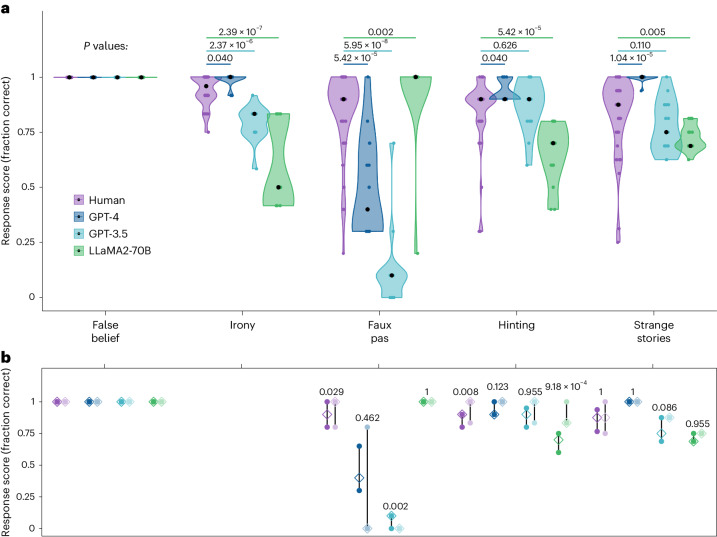
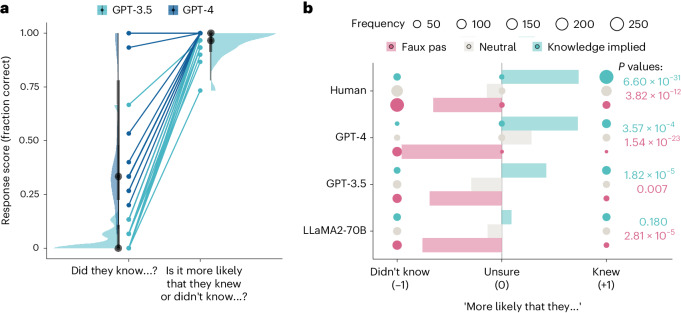
At the core of what defines us as humans is the concept of theory of mind: the ability to track other people’s mental states. The recent development of large language models (LLMs) such as ChatGPT has led to intense debate about the possibility that these models exhibit behaviour that is indistinguishable from human behaviour in theory of mind tasks. Here we compare human and LLM performance on a comprehensive battery of measurements that aim to measure different theory of mind abilities, from understanding false beliefs to interpreting indirect requests and recognizing irony and faux pas. We tested two families of LLMs (GPT and LLaMA2) repeatedly against these measures and compared their performance with those from a sample of 1,907 human participants. Across the battery of theory of mind tests, we found that GPT-4 models performed at, or even sometimes above, human levels at identifying indirect requests, false beliefs and misdirection, but struggled with detecting faux pas. Faux pas, however, was the only test where LLaMA2 outperformed humans. Follow-up manipulations of the belief likelihood revealed that the superiority of LLaMA2 was illusory, possibly reflecting a bias towards attributing ignorance. By contrast, the poor performance of GPT originated from a hyperconservative approach towards committing to conclusions rather than from a genuine failure of inference. These findings not only demonstrate that LLMs exhibit behaviour that is consistent with the outputs of mentalistic inference in humans but also highlight the importance of systematic testing to ensure a non-superficial comparison between human and artificial intelligences.
Overview
The claims and statistics of this paper haven’t been checked yet.
Free: it reads the open-access text and checks the first 5 claims that cite a source we can check. Create a free account to check every claim.
Integrity signals
Registry
Cites
Statistics
Figures
Verification
Claims the paper makes
The claims and statistics of this paper haven’t been checked yet.
Free: it reads the open-access text and checks the first 5 claims that cite a source we can check. Create a free account to check every claim.
Claims other papers make about this one
Each is checked against this paper’s own text: does it say what the citing paper says it does?
The source backs part of the claim, not all of it — or backs it for a different population, condition or comparison.
In the citing paper
“Recent studies have shown that Large Language Models (LLMs), including GPT-3 and GPT-4, can excel in tasks that seemingly require ToM (Kosinski, 2023; van Duijn et al., 2023; Strachan et al., 2024; Street et al., 2024)”
From Can "consciousness" be observed from large language model (LLM) internal states? Dissecting LLM representations obtained from Theory of Mind test with Integrated Information Theory and Span Representation analysis (2025) · cites this paper as Strachan et al., 2024
Experimental — accuracy not yet measuredThe source backs part of the claim, not all of it — or backs it for a different population, condition or comparison.
In the citing paper
“This is amplified by the ability of LLMs to infer as well—or better—than humans the beliefs and intentions of an interlocutor from text (26).”
From The benefits and dangers of anthropomorphic conversational agents (2025) · cites this paper as [26]
Experimental — accuracy not yet measuredThe source backs part of the claim, not all of it — or backs it for a different population, condition or comparison.
In the citing paper
“later models demonstrate an increasing ability to reliably infer unobservable mental states in others (Strachan et al., 2024;Holterman and Deemter, 2023;Moghaddam and Honey, 2023).”
From Machine Psychology (2023) · cites this paper as Strachan et al., 2024
Experimental — accuracy not yet measuredThe cited source says what the claim attributes to it.
In the citing paper
“Specifically, these subjects are adult native English speakers (aged 18-70) with no history of psychiatric conditions or dyslexia, as specified in Strachan et al. (2024).”
From Can "consciousness" be observed from large language model (LLM) internal states? Dissecting LLM representations obtained from Theory of Mind test with Integrated Information Theory and Span Representation analysis (2025) · cites this paper as Strachan et al., 2024
The cited source says what the claim attributes to it.
In the citing paper
“These models are increasingly achieving or surpassing human performance benchmarks in various domains, including medical diagnostic dialogue28, persuasive communication29, theory of mind30, making people feel heard31, responding to relationship issues32 and helping people reframe negative situations to reduce negative emotions33.”
From “It happened to be the perfect thing”: experiences of generative AI chatbots for mental health (2024) · cites this paper as [30]
4 more claims about this paper
Create a free account to see every claim other papers make about this one.
Self-check
Percentages, sums and reported differences re-computed from the paper’s own numbers.
The self-check needs the paper’s full text.
Citations
Cites
The Proceedings of the National Academy of Sciences
Richards, J. W. (1915) · Science · doi:10.1126/science.42.1074.161 · Cited by 13,983
Does the chimpanzee have a theory of mind?
Premack, D., & Woodruff, G. (1978) · Behavioral and Brain Sciences · doi:10.1017/s0140525x00076512 · Cited by 8,743 · cited 1×
“3), dozens of tasks have been developed to study it, including indirect measures of belief attribution using reaction times 4–6 and looking or searching behaviour 7–9 , tasks examining the ability to infer mental states from photographs of eyes 10 , and language-based tasks assessing false belief…”
BackgroundWimmer, H. (1983) · Cognition · doi:10.1016/0010-0277(83)90004-5 · Cited by 6,305
Baron‐Cohen, S., Wheelwright, S., Hill, J., Raste, Y., & Plumb, I. (2001) · Journal of Child Psychology and Psychiatry · doi:10.1111/1469-7610.00715 · Cited by 4,555 · cited 1×
“…indirect measures of belief attribution using reaction times 4–6 and looking or searching behaviour 7–9 , tasks examining the ability to infer mental states from photographs of eyes 10 , and language-based tasks assessing false belief understanding 11,12 and pragmatic language comprehension 13–16 .”
The principles of psychology, Vol I.
James, W. (1890) · doi:10.1037/10538-000 · Cited by 4,514
Happé, F. G. E. (1994) · Journal of Autism and Developmental Disorders · doi:10.1007/bf02172093 · Cited by 2,352 · cited 2×
“We selected a set of well-established theory of mind tests spanning different abilities: the hinting task 14 , the false belief task 11,33 , the recognition of faux pas 13 , and the strange stories 15,16 .”
BackgroundMethodThe Neural Basis of Mentalizing
Frith, C. D., & Frith, U. (2006) · Neuron · doi:10.1016/j.neuron.2006.05.001 · Cited by 1,855
Three-year-olds’ difficulty with false belief: The case for a conceptual deficit
Perner, J., Leekam, S. R., & Wimmer, H. (1987) · British Journal of Developmental Psychology · doi:10.1111/j.2044-835x.1987.tb01048.x · Cited by 1,550 · cited 1×
“…indirect measures of belief attribution using reaction times 4–6 and looking or searching behaviour 7–9 , tasks examining the ability to infer mental states from photographs of eyes 10 , and language-based tasks assessing false belief understanding 11,12 and pragmatic language comprehension 13–16 .”
BackgroundSparks of Artificial General Intelligence: Early experiments with GPT-4
Bubeck, S., Chandrasekaran, V., Eldan, R., Gehrke, J., Horvitz, E., Kamar, E., Lee, P., Lee, Y. T., Li, Y., Lundberg, S., et al. (2023) · arXiv · doi:10.48550/arxiv.2303.12712 · Cited by 1,526 · cited 3×
“One example is the false belief test, one of the most widely used tools so far for testing the performance of LLMs on social cognitive tasks 19,21–23, 25, 51 , 52 .”
BackgroundMethodToward a second-person neuroscience
Schilbach, L., Timmermans, B., Reddy, V., Costall, A., Bente, G., Schlicht, T., & Vogeley, K. (2013) · Behavioral and Brain Sciences · doi:10.1017/s0140525x12000660 · Cited by 1,510
Research works printed but not linked: 1
- Gandhi, K., Fränken, J.-P., Gerstenberg, T. & Goodman, N. D. Understanding social reasoning in language models with language models. In Advances in Neural Information Processing Systems Vol. 36 (MIT Press, 2023).
Cited by
Items 101–200 of 428
The psychology of LLM interactions: the uncanny valley and other minds
Kirkeby-Hinrup, A., & Stenseke, J. (2025) · Journal of Psychology and AI · doi:10.1080/29974100.2025.2457627 · Cited by 12
Liu, D., Zhang, J., & Qi, J. (2025) · Acta Psychologica · doi:10.1016/j.actpsy.2025.105030 · Cited by 11
GPT-4V shows human-like social perceptual capabilities at phenomenological and neural levels
Santavirta, S., Wu, Y., Suominen, L., & Nummenmaa, L. (2025) · Imaging Neuroscience · doi:10.1162/imag.a.134 · Cited by 13
“…of different sociodemographic groups ( Argyle et al., 2023), make human-like economical choices ( Horton, 2023), reach human-like performance in many cognitive tasks ( Binz & Schulz, 2023), emulate personality ( Y. Wang et al., 2025), and simulate human-like theory of mind ( Strachan et al., 2024).”
Nelson, B. W., Winbush, A., Siddals, S., Flathers, M., Allen, N. B., & Torous, J. B. (2025) · npj Digital Medicine · doi:10.1038/s41746-025-01985-5 · Cited by 11
“Generative arti fi cial intelligence (GenAI) based on large language models (LLMs) is becoming central to human – computer interactions (HCIs), demonstrating impressive capabilities in interpreting human intentions 1,2 and understanding human cognitive, social, and emotional processes.”
Through the Theory of Mind’s Eye: Reading Minds with Multimodal Video Large Language Models
Chen, Z., Wang, T., Wang, Y., Kosiński, M., Zhang, X. D., Fu, Y., & Li, S. (2025) · International Joint Conference on Neural Networks (IJCNN) · doi:10.1109/ijcnn64981.2025.11229224 · Cited by 14
“Recent research has discovered emergent theory-of-mind (ToM) reasoning abilities in text-based large language models (LLMs) such as ChatGPT-4 [1], [2].”
Be.FM: Open Foundation Models for Human BehaviorPreprint
Xie, Y., Li, Z., Wang, X., Pan, Y., Liu, Q., Cui, X., Lo, K.-Y., Gao, R., Zhang, X., Huang, J., et al. (2025) · SSRN Electronic Journal · doi:10.2139/ssrn.5274559 · Cited by 15
Re-evaluating Theory of Mind evaluation in large language models
Hu, J., Sosa, F., & Ullman, T. (2025) · Philosophical Transactions of the Royal Society B: Biological Sciences · doi:10.1098/rstb.2023.0499 · Cited by 10
The contributions of language and inhibitory control to false belief reasoning over time
de Villiers, J. G., & de Villiers, P. (2025) · Frontiers in Psychology · doi:10.3389/fpsyg.2024.1455941 · Cited by 10
Examining the Feasibility of Large Language Models as Survey Respondents
Kitadai, A., Ogawa, K., & Nishino, N. (2024) · IEEE International Conference on Big Data (BigData) · doi:10.1109/bigdata62323.2024.10825497 · Cited by 14
Revisiting Rogers’ Paradox in the context of human–AI interaction
Collins, K. M., Bhatt, U., & Sucholutsky, I. (2026) · Philosophical Transactions of the Royal Society A Mathematical Physical and Engineering Sciences · doi:10.1098/rsta.2025.0149 · Cited by 11
Natural and artificial intelligence – the psychotechnical agenda of the 21st century
Webster, C. S. (2025) · Journal of Psychology and AI · doi:10.1080/29974100.2025.2491445 · Cited by 11
Lau, G. R., Low, W. Y., Koh, S. M., Nah, F. F.-H., & Hartanto, A. (2026) · International Journal of Human-Computer Interaction · doi:10.1080/10447318.2026.2755127 · Cited by 10
Kuteeva, M., & Andersson, M. (2025) · Research Methods in Applied Linguistics · doi:10.1016/j.rmal.2025.100267 · Cited by 12
“…in reasoning, problem-solving, and nuanced language comprehension, making it particularly effective for tasks that require subtle contextual interpretation, such as analysing implicit meanings in discourse and adapting dynamically to user goals (Kirk et al., 2024; Strachan et al., 2024).”
Townsend, D. M., Hunt, R. A., Rady, J., Manocha, P., & Jin, J. H. (2024) · Academy of Management Review · doi:10.5465/amr.2024.0299 · Cited by 10
Song, Y., Sun, Y., Zhu, J.-Y., Qiao, H.-B., Gao, Z., & Liu, L. (2024) · Journal of Engineering Design · doi:10.1080/09544828.2024.2436968 · Cited by 10
AToM-Bot: Embodied Fulfillment of Unspoken Human Needs with Affective Theory of MindPreprint
Ding, W., Li, F., Ji, Z., Xue, Z., & Liu, J. (2024) · arXiv (Cornell University) · doi:10.48550/arxiv.2406.08455 · Cited by 11
“These aspects of empathy are instrumental in enhancing HRI by enabling robots to better interpret and respond to both the mental and physical states of humans.”
Tool Use Enables Undetectable Steganography in Multi-Agent LLM SystemsPreprint
Rippin, J. L., Marshall, S. C., Africa, D., & de Witt, C. D. (2026) · arXiv.org · doi:10.48550/arxiv.2606.28425 · Cited by 9
“Despite early research suggesting that LLMs possess ToM [Kosinski, 2023, Strickland, 2024, Strachan et al., 2024], recent results highlight deficiencies in LLM social reasoning abilities [Amirizaniani et al., 2024, Agashe et al., 2025], implying that ToM is likely mimicked by reflection of…”
Judgments of learning distinguish humans from large language models in predicting memory
Huff, M., & Ulakci, E. (2025) · Scientific Reports · doi:10.1038/s41598-025-22290-x · Cited by 9
“Large language models (LLMs) continue to exhibit compliance with human behavior and cognitive processes on the whole, as indicated by studies coming from the increasingly rich literature on machine psychology 1–3 .”
Liu, D., Hu, X., Xiao, C., Bai, J., Barandouzi, Z. A., Lee, S., Webster, C., Brock, L.-U. B., Lee, L., Bold, D., et al. (2025) · JMIR Cancer · doi:10.2196/67914 · Cited by 10
“Large language models (LLMs) are advanced artificial intelligence systems that can understand and generate human-like text by training on vast amounts of data [25].”
Zhang, W., Xie, C., Jiang, L., Li, Y., Hu, Z., & Hao, N. (2025) · Social Cognitive and Affective Neuroscience · doi:10.1093/scan/nsaf071 · Cited by 10
Chun, J. (2024) · Frontiers in Computer Science · doi:10.3389/fcomp.2024.1444549 · Cited by 13
Torres–Martínez, S. (2024) · Language and Semiotic Studies · doi:10.1515/lass-2024-0018 · Cited by 9
Pang, H. Y. M., Meshkat, S., Teferra, B. G., Rueda, A., Samavi, R., Krishnan, S., Doyle, T. E., Rambhatla, S., DeJong, S. M., Sockalingam, S., et al. (2024) · Academic Psychiatry · doi:10.1007/s40596-024-02087-2 · Cited by 9
“A recent study showed GAI’s comparable ability to humans to demonstrate theory of mind, the ability to track other people’s mental states [19].”
A New Strategy for Artificial Intelligence: Training Foundation Models Directly on Human Brain DataPreprint
Donoso, M. (2025) · arXiv (Cornell University) · doi:10.48550/arxiv.2601.12053 · Cited by 9
“Although foundation models exhibit some elements typically associated with social cognition (Strachan et al., 2024), their conceptualization of the world and its different agents often remains superficial.”
A validity-guided workflow for robust large language model research in psychology
Lin, Z. (2026) · Behavior Research Methods · doi:10.3758/s13428-026-03073-2 · Cited by 8
“For example, by altering question format and creating variants of each test, these diagnostic experiments help to unmask the nature of theory-of-mind performance in LLMs (Strachan et al., 2024).”
Emerging Questions in AI Welfare
Keeling, G., & Street, W. (2026) · Cambridge University Press eBooks · doi:10.1017/9781009732000 · Cited by 14
Minds and machines: evaluating the feasibility of constructing an advanced artificial intelligence
Sgantzos, K., Stelios, S., Tzavaras, P., & Theologou, K. (2024) · Discover Artificial Intelligence · doi:10.1007/s44163-024-00216-2 · Cited by 8
Game-theory behaviour of large language models: The case of Keynesian beauty contests
Lu, S. E. (2025) · Economics and Business Review/The Poznań University of Economics Review · doi:10.18559/ebr.2025.2.2182 · Cited by 11
scaron, G. B. (2024) · SSRN Electronic Journal · doi:10.2139/ssrn.4943486 · Cited by 8
From data to perception: visualizing bias in artificial intelligence-generated images
Szymański, P., Lipczyńska, M., & Górska, A. M. (2025) · European Heart Journal · doi:10.1093/eurheartj/ehae850 · Cited by 9
Disentangling interaction and bias effects in opinion dynamics of large language models
Brockers, V. C., Ehrlich, D. A., & Priesemann, V. (2026) · Nature Communications · doi:10.1038/s41467-026-77340-3 · Cited by 8
“Large Language Models (LLMs) demonstrate impressive capabilities in mimicking human behavior, generating text that is increasingly indistinguishable from human-produced language 1 – 3 .”
Tong, J. S., Zhang, Y., & Li, Y. (2025) · Computers in Human Behavior Artificial Humans · doi:10.1016/j.chbah.2025.100123 · Cited by 9
Mudd, A., Conroy, T., Voldbjerg, S. L., Goldschmied, A. Z., Feo, R., & Schuwirth, L. (2025) · Journal of Clinical Nursing · doi:10.1111/jocn.17818 · Cited by 11
Large Language Models Amplify Human Biases in Moral Decision-MakingPreprint
Cheung, V., Maier, M., & Lieder, F. (2024) · PsyArXiv (OSF Preprints) · doi:10.31234/osf.io/aj46b · Cited by 7
Large language models in clinical psychiatry: Applications and optimization strategies
Wang, Y., Li, M.-D., Wang, S.-H., Fang, Y., Sun, J., Lü, L., & Yan, W. (2025) · World Journal of Psychiatry · doi:10.5498/wjp.v15.i11.108199 · Cited by 8
Establishing Construct Validity in LLM Capability Benchmarks Requires Nomological Networks
Freiesleben, T. (2026) · PhilSci-Archive (University of Pittsburgh) · doi:10.48550/arxiv.2603.15121 · Cited by 7
“In current practice, LLM researchers often begin by designing benchmarks for complex capabilities such as reasoning [57], theory of mind [49], or even morality [23].”
Zhang, W., Huang, L., Ding, J., Xie, C., Mu, J., & Hao, N. (2026) · Computers in Human Behavior Reports · doi:10.1016/j.chbr.2026.101023 · Cited by 9
Yacobson, E., Schleifer, Y., Bar-Dov, Z., Rap, S., Blonder, R., & Alexandron, G. (2026) · Journal of Science Education and Technology · doi:10.1007/s10956-026-10310-y · Cited by 8
“…has emphasized instances in which LLMs approach or surpass human performance on selected benchmarks (Luo et al., 2025; Mittelstädt et al., 2024; Strachan et al., 2024) and standard exams (Openai, 2023), the results of the present study align with prior findings showing persistent limitations…”
Wohn, C., Carik, B., Ding, X., Lee, S. W., Kim, Y., & Rho, E. H. R. (2026) · CHI Conference on Human Factors in Computing Systems · doi:10.1145/3772318.3791319 · Cited by 8
The Philosophy of Language Models
Millière, R., & Buckner, C. J. (2026) · Philosophy Compass · doi:10.1111/phc3.70095 · Cited by 10
“…and/or match humans at various logical reasoning problems (Liu et al. 2023), commonsense reasoning problems (Talmor et al. 2021), formal and semantically laden analogical reasoning tasks (Musker et al. 2025; Webb et al. 2023), and Theory of Mind tasks (Kosinski 2024; Strachan et al. 2024).”
MASŁOWSKI, J., & Chudziak, J. A. (2026) · Lecture notes in computer science · doi:10.1007/978-981-92-0071-9_9 · Cited by 6
A Verbal Behavior Analysis of Theory of Mind: Conceptual and Applied Implications
Espinosa, F. D. (2025) · Perspectives on Behavior Science · doi:10.1007/s40614-025-00460-6 · Cited by 6
Do large language models have a theory of mind?
Pang, D. K. F., Pang, S. K. Y., Broeker, M. D., & Hibble, A. (2025) · Proceedings of the National Academy of Sciences · doi:10.1073/pnas.2507080122 · Cited by 9
Are Formal and Functional Linguistic Mechanisms Dissociated in Language Models?
Hanna, M., Belinkov, Y., & Pezzelle, S. (2026) · Computational Linguistics · doi:10.1162/coli.a.24 · Cited by 17
Language and Thought: The View from LLMs
Rothschild, D. (2026) · Oxford University Press eBooks · doi:10.1093/9780198999102.003.0008 · Cited by 6
Theory of Minds: Early Understanding of Interacting Minds
Chuey, A., & Gweon, H. (2025) · Annual Review of Developmental Psychology · doi:10.1146/annurev-devpsych-111323-115032 · Cited by 10
Evaluating the Critical Thinking of Large Language Models: Insights and Limitations
Jiang, L., Cui, Y. D., Liu, R., & Luo, F. (2025) · Journal of Pacific Rim Psychology · doi:10.1177/18344909251406111 · Cited by 8
“Temperature, which controls the randomness of LLM outputs (Wang et al., 2023), is an important parameter in LLM evaluation (Strachan et al., 2024; Webb et al., 2023).”
Transforming phenomenological sociology for virtual personalities and virtual worlds
Shibuya, K. (2025) · AI & Society · doi:10.1007/s00146-025-02189-x · Cited by 6
“For example, Strachan et al. (2024) compared the performance of GPT-and LLaMA-based generative AIs with human subjects on an experimental task related to TOM and found that even though the performance of the generative AIs was not yet fully comparable to humans in terms of gibberish and sarcastic…”
A large-scale evaluation of commonsense knowledge in humans and large language models
Nguyen, T. D., Watts, D. J., & Whiting, M. E. (2026) · PNAS Nexus · doi:10.1093/pnasnexus/pgag029 · Cited by 10
Discovering Differences in Strategic Behavior Between Humans and LLMsPreprint
Wang, C., Kasenberg, D., Stachenfeld, K., & Castro, P. S. (2026) · arXiv (Cornell University) · doi:10.48550/arxiv.2602.10324 · Cited by 6
“…LLMs to humans along cognitive measures (Niu et al., 2024; Coda-Forno et al., 2024), strategic traits such as risk preference (Jia et al., 2024; Xiao & Wang, 2025), rationality (Fan et al., 2024), trust (Xie et al., 2024), bias (Qian et al., 2025a), or theory of mind (Strachan et al., 2024).”
Piao, J., Lu, Z., Gao, C., & Li, Y. (2025) · International World Wide Web Conference (WWW) · doi:10.1145/3696410.3714537 · Cited by 13
Sallam, M., Snygg, J., Hamdan, A. M., Allam, D., Kassem, R., & Damani, M. (2025) · Research and Advances in Education · doi:10.63593/rae.2788-7057.2025.05.005 · Cited by 5
How humorous is AI? Exploring ChatGPT's role in humor generation and human-AI interaction
Cao, Y., Cao, J., Hou, Y., & Ji, L. (2025) · Computers in Human Behavior Reports · doi:10.1016/j.chbr.2025.100807 · Cited by 8
The AI interviewer: multi-faceted evaluation of adaptive questioning by large language models
Panfilova, A. S., Bolshev, V., Mozikov, M., Латынов, В. В., Vanin, A. V., Nestik, T. A., Nourkova, V. V., Александровна, В. А., Kozin, M., Serohvostov, A., et al. (2026) · Scientific Reports · doi:10.1038/s41598-026-46517-7 · Cited by 5
“…on several theory-of-mind tasks (false belief, indirect requests) while failing in others (e.g., faux pas) and showing brittle dependence on phrasing 10 ; this study also emphasized that some theory-of-mind successes can reflect dataset priors or prompt artifacts rather than robust capacities.”
Dimensions of AI de-anthropomorphization based on impression integration theory
Li, J., Huang, J., & Ni, B. (2026) · Technology in Society · doi:10.1016/j.techsoc.2026.103352 · Cited by 6
Beyond representational alignment with brain-guided language models for robust reasoning
Xiao, M., Du, K., & Lin, Z. (2026) · Nature Machine Intelligence · doi:10.1038/s42256-026-01278-w · Cited by 6
“…by human neural representations apart from behaviour supervision 49 , and provides opportunities for other cognitive capabilities, such as theory of mind that has a specialized brain network 9 and potential representational alignment considering the performance 60 and representation 61 of LLMs.”
Understanding Epistemic Language with a Language-augmented Bayesian Theory of Mind
Ying, L., Zhi‐Xuan, T., Wong, L., Mansinghka, V. K., & Tenenbaum, J. B. (2025) · Transactions of the Association for Computational Linguistics · doi:10.1162/tacl_a_00752 · Cited by 13
Artificial Intelligence and Social Action. A techno-sociological contextualizationPreprint
Schrape, J.-F. (2025) · SSRN Electronic Journal · doi:10.2139/ssrn.5166382 · Cited by 7
Ask, T. F., Sütterlin, S., Müller, L., Lugo, R. G., Saari, D., Grahn, H., Canham, M., Hermansen, D., & Knox, B. J. (2025) · PsyArXiv (OSF Preprints) · doi:10.31234/osf.io/2ftqc_v1 · Cited by 11
From Imitation to Introspection: Probing Self-Consciousness in Language Models
Chen, S., Yu, S., Zhao, S., & Lu, C. (2025) · Findings of the Association for Computational Linguistics: ACL 2025 · doi:10.18653/v1/2025.findings-acl.392 · Cited by 29
AI agents can coordinate beyond human scale
De Marzo, G., Castellano, C., & Garcia, D. (2024) · arXiv · doi:10.48550/arxiv.2409.02822 · Cited by 4
Lin, Z. (2026) · Annual Review of Psychology · doi:10.1146/annurev-psych-100925-034807 · Cited by 4
Understanding ironic utterances: A comprehensive examination of ChatGPT-4o
Wen, X., & Tian, Y. (2025) · Intercultural Pragmatics · doi:10.1515/ip-2025-2004 · Cited by 6
Hao, G., Alexandre, F., & Yu, S. P. (2025) · IEEE Transactions on Cognitive and Developmental Systems · doi:10.1109/tcds.2025.3590165 · Cited by 7
“Models such as GPT-4 demonstrated human-level or superior performance on most theory of mind tests [25].”
Large language models for autism: evaluating theory of mind tasks in a gamified environment
Poglitsch, C., Reiss, A., Wriessnegger, S. C., & Pirker, J. (2025) · Scientific Reports · doi:10.1038/s41598-025-18608-4 · Cited by 5
Critical Literacy in an AI World
Mills, K. A., & Gutierrez, A. (2025) · Routledge eBooks · doi:10.4324/9781003539193 · Cited by 8
Why human mistakes hurt more? Emotional responses in human-AI errors
Qin, Y., Zhou, W. A., & Zhong, B. (2025) · Computers in Human Behavior Artificial Humans · doi:10.1016/j.chbah.2025.100238 · Cited by 8
Do neural language models critically reason about moral issues like humans?
Suriano, R., Acciai, A., Fabio, R. A., Guerrisi, L., & Plebe, A. (2026) · Current Psychology · doi:10.1007/s12144-025-08798-5 · Cited by 4
“This is a research line that has seen significant growth (Binz & Schulz, 2023; Dasgupta et al., 2022; Han et al., 2023; Kosinski, 2023; Strachan et al., 2024; Suri et al., 2024 ; Webb et al., 2023) and within which this pres-ent study is situated, adopting a linguistic test designed for human…”
Hagihara, H., & Miyazawa, K. (2026) · Behavior Research Methods · doi:10.3758/s13428-025-02938-2 · Cited by 7
“How much human intelligence is embedded in LLMs (Marjieh et al., 2024; Strachan et al., 2024)?”
SUVA: A Probabilistic Framework for Auditing LLMs with an Application to Social Preferences
Leng, Y., & Yuan, Y. (2026) · Information Systems Research · doi:10.1287/isre.2024.0857 · Cited by 7
Can ChatGPT reciprocate impoliteness? The AI moral dilemma
Tantucci, V., & Culpeper, J. (2026) · Journal of Pragmatics · doi:10.1016/j.pragma.2026.03.008 · Cited by 5
Focus Group-Led Refinement of an LLM-Enabled Companion Robot for Older People
Satake, Y., Nygren, M. O., Yu, C. T. K., Tsuboi, A., Endo, I., Umemura, K., Katsuki, K., Ishimaru, D., Rapaport, P., Bianchi‐Berthouze, N., et al. (2026) · International Journal of Social Robotics · doi:10.1007/s12369-026-01407-w · Cited by 4
Wu, H., Zheng, W., Zhang, M., Bai, X., Pu, M., Sun, L., Liu, J., & Xu, Y. (2026) · Expert Systems with Applications · doi:10.1016/j.eswa.2026.133044 · Cited by 6
Li, Q., Geng, H., Hu, X., Pan, D., Liu, H., Li, Y., & Guo, J. (2026) · Frontiers in Artificial Intelligence · doi:10.3389/frai.2026.1810097 · Cited by 4
Is ChatGPT like a nine-year-old child in theory of mind? Evidence from Chinese writing
Cao, S., Xu, Y., Zhou, T., & Zhou, S. (2024) · Education and Information Technologies · doi:10.1007/s10639-024-13046-7 · Cited by 5
“ToM is the ability to understand that others have perspectives and feelings that are different from one’s own (Doherty, 2008; Strachan et al., 2024).”
Analogical reasoning as a core AGI capability
Firt, E. (2025) · AI and Ethics · doi:10.1007/s43681-025-00785-7 · Cited by 7
“In other words, they include the disciplined ways of thinking rooted in one’s culture or social group. through language and have certain Theory of Mind capabilities [42 , 69].”
Will AI and humanity go to war?
Goldstein, S. (2025) · AI & Society · doi:10.1007/s00146-025-02460-1 · Cited by 7
Patterns, Models, and Challenges in Online Social Media: A Survey
Marco, N. D., Bonetti, A., Martino, E. D., Loru, E., Nudo, J., Pandolfo, M. E., Pecile, G., Sangiorgio, E., Scalco, I., Zollo, S., et al. (2026) · ACM Transactions on the Web · doi:10.1145/3796548 · Cited by 6
The social AI author: modeling creativity and distinction in simulated cultural fields
Roland, E., So, R. J., & Long, H. (2025) · AI & Society · doi:10.1007/s00146-025-02790-0 · Cited by 10
“Psychologists probe how well large language models (LLMs) can reason with metaphor and demonstrate Theory of Mind; mathe-maticians explore how well LLMs can solve problems and prove theorems (Strachan et al. 2024; Romera-Paredes, et al., 2023; Webb et al. 2023).”
Konvalinka, I., Kompatsiari, K., & Li, Q. (2023) · Physics of Life Reviews · doi:10.1016/j.plrev.2023.09.017 · Cited by 4
LLMs as Mediators: Can They Diagnose Conflicts Accurately?
Koçak, Ö., Puranam, P., & Yegin, A. (2026) · ACM Journal on Computing and Sustainable Societies · doi:10.1145/3771553 · Cited by 6
Dong, W., Wang, W., Han, X., Huang, J., Li, L., & Huang, Y. (2025) · Computers in Biology and Medicine · doi:10.1016/j.compbiomed.2025.110789 · Cited by 5
Intersections of Web3 and AI -- View in 2024Preprint
Hyland-Wood, D., & Johnson, S. (2024) · arXiv (Cornell University) · doi:10.48550/arxiv.2411.04318 · Cited by 5
The Psychology of Generative AI in Higher Education: Mapping Benefits and RisksPreprint
Kościelniak, M., & Bielecki, M. (2024) · Qeios · doi:10.32388/x1itss · Cited by 5
GPT-4 accurately predicts human emotions and their neural correlatesPreprint
Santavirta, S., Suominen, L., Wu, Y., Sander, D., & Nummenmaa, L. (2025) · bioRxiv (Cold Spring Harbor Laboratory) · doi:10.1101/2025.09.18.677029 · Cited by 5
“…LLMs can predict the opinions of people belonging to diFerent sociodemographic groups (Argyle et al. 2023), make economic choices similar to humans (Horton 2023), predict diFerent personalities (Y. Wang et al. 2025) and perform human-like mental state inferences (Strachan, Albergo, et al. 2024).”
Outraged AI: Large language models prioritise emotion over cost in fairness enforcementPreprint
Liu, H., Dai, Y., Tan, H., Yu, L., Zhou, Y., & Wu, Z. (2025) · PsyArXiv (OSF Preprints) · doi:10.31234/osf.io/fnk57_v3 · Cited by 4
Li, J. (2025) · Natural Language Processing Journal · doi:10.1016/j.nlp.2025.100163 · Cited by 3
Can LLMs make trade-offs involving stipulated pain and pleasure states?
Keeling, G., Street, W., Stachaczyk, M., Zakharova, D., Comsa, I. M., Sakovych, A., Logothetis, I., Zhang, Z., Arcas, B. A. Y., & Birch, J. (2024) · arXiv · doi:10.48550/arxiv.2411.02432 · Cited by 3
“LLMs also demonstrate some competency at theory of mind tasks (Kosinski, 2023; Bubeck et al., 2023; Shapira et al., 2023; Street et al., 2024; Strachan et al., 2024), where theory of mind is the ability to predict and explain behaviour by attributing mental states to oneself and others including…”
BackgroundLarge Language Model Reasoning Failures
Song, P., Han, P., & Goodman, N. (2026) · arXiv · doi:10.48550/arxiv.2602.06176 · Cited by 3
Computational Models of Cognitive and Affective Theory of Mind
Raggioli, L., Rossi, A., & Rossi, S. (2025) · ACM Conference on User Modeling, Adaptation and Personalization (UMAP) · doi:10.1145/3708319.3733667 · Cited by 5
Exocortex Network for AI-Augmented Human-Led Scientific Expedition
Tsai, E. H. R., & Yager, K. G. (2025) · Photon Science · doi:10.1021/photonsci.5c00009 · Cited by 5
Rosenfelder, A., Levitin, M. D., & Gilead, M. (2025) · Computers in Human Behavior Artificial Humans · doi:10.1016/j.chbah.2025.100228 · Cited by 5
Tools for Implementing Multi-Agent Systems Based on Protocols
Chopra, A. K., Christie, S. H., V, & Singh, M. P. (2026) · Springer eBooks · doi:10.1007/978-3-032-01082-7_8 · Cited by 4
Gricean Norms as a Basis for Effective Collaboration
Saad, F., Murukannaiah, P. K., & Singh, M. P. (2025) · Adaptive Agents and Multi-Agents Systems · doi:10.65109/awnj3464 · Cited by 7
Large Language Models Persuade Without Planning Theory of Mind
Moore, J., Overmark, R., Cooper, N., Cibralic, B., Haber, N., & Jones, C. R. (2026) · Cognitive Science · doi:10.1111/cogs.70259 · Cited by 4
Mapping the landscape of AI-empowered psychology: a topic modeling-based bibliometric analysis
Jia, S., Zhang, Y., & Wang, F. (2026) · Artificial Intelligence Review · doi:10.1007/s10462-026-11543-4 · Cited by 3
“…are investigating LLMs to understand their capacity for human-like reasoning and problem-solving (Loconte et al. 2023; Sartori and Orrù 2023; Strachan et al. 2024), while clinical psychologists are leveraging their sophisticated conver - sational abilities to develop automated therapy and…”
Fallah, A., Keramati, A., Nazari, M. A., & Mirfazeli, F. S. (2024) · International Conference on Computer and Knowledge Engineering · doi:10.1109/iccke65377.2024.10874775 · Cited by 9
“However, as previously discussed, GPT-4 has been shown to struggle with ToM assessment tasks [6, 35].”
InfluentialImproving ToM Capabilities of LLMs in Applied Domains
Galitsky, B. A. (2026) · Springer eBooks · doi:10.1007/978-3-032-16524-4_4 · Cited by 3
Large language models for identifying social determinants of health
Wang, Y. (2025) · Proceedings of the National Academy of Sciences · doi:10.1073/pnas.2501506122 · Cited by 3
Jiao, L., Li, C., Zhen, C. H. E. N., Xu, H., & Yan, X. U. (2025) · Acta Psychologica Sinica · doi:10.3724/sp.j.1041.2025.0929 · Cited by 7
Metadata
- Authors
- Strachan, J. W. A., Albergo, D., Borghini, G., Pansardi, O., Scaliti, E., Gupta, S., Saxena, K., Rufo, A., Panzeri, S., Manzi, G., Graziano, M. S. A., & Becchio, C.
- Affiliations
- University Medical Center Hamburg-Eppendorf (DE)
- University of Trento (IT)
- Italian Institute of Technology (IT)
- Universität Hamburg (DE)
- Princeton University (US)
- Corresponding author
- Strachan, James W. A.
- Becchio, Cristina
- ORCID
- Venue
- Nature Human Behaviour
- Published
- 2024-05-20
- Volume
- 8
- Issue
- 7
- Pages
- 1285-1295
- ISSN
- 2397-3374 (ISSN-L)
- PMC
- PMC11272575
- OpenAlex
- W4398143508
- Semantic Scholar
- 7d16a2de08fc5053e1026ffaa0bbd279302abca2
- Cited by
- 299
- References
- 58
- Citations by year
- 2026: 125 · 2025: 136 · 2024: 37
- FWCI
- 232.53
- Type
- journal article
- Language
- en
- Open access
- hybrid
- doi.org
- Licence
- cc-by
- creativecommons.org/licenses/by/4.0 (tdm)
- creativecommons.org/licenses/by/4.0 (vor)
- Locations
- Nature Human Behaviour (publishedVersion, cc-by)
- Research Square (acceptedVersion, cc-by)
- PubMed Central (publishedVersion, cc-by-nc)
- PubMed (publishedVersion)
- Institutional Research Information System University of Turin (University of Turin) (submittedVersion, cc-by-nc)
- HAL (submittedVersion)
- RePEc: Research Papers in Economics (submittedVersion)
- OSF Preprints (OSF Preprints) (submittedVersion)
- Funders
- Alexander von Humboldt-Stiftung
- European Commission (101071191)
- Universitätsklinikum Hamburg-Eppendorf
- Topics
- Social Sciences › Psychology › Developmental and Educational Psychology › Child and Animal Learning Development
- Social Sciences › Psychology › Social Psychology › Social Robot Interaction and HRI
- Social Sciences › Arts and Humanities › Philosophy › Philosophy and Theoretical Science
- Keywords
- theory of mind, large language models, false belief understanding, indirect requests, irony detection, faux pas, misdirection, GPT-4, Llama 2, human-AI comparison, belief attribution
- MeSH terms
- Adolescent, Adult, Female, Humans, Language, Male, Middle Aged, Models, Psychological, Young Adult, Theory of Mind
About these checks
Registry, retraction, Cites and statistics results are computed, not judged, with one exception: a printed reference that no index lists is read once by a model before it counts as a citation error. Claims are extracted by a model and kept only when their quote appears verbatim in the text; each cited source is then checked, with a model’s help, for whether it says what the claim relies on. Those verdicts can be wrong — read the claim’s quote and the cited source before relying on one.
Statistics and arithmetic are recomputed, not judged.
Confidence bands are shown only for fields calibrated on our annotated test set. None is calibrated yet, so no band is shown.
What counts as a claim ›How we measure confidence ›How we check this ›
Are you an author, or do you see a problem with this page? Request a review
Data sources
Bibliographic data: Semantic Scholar, OpenAlex, Crossref.
Contains information from the Semantic Scholar Academic Graph Datasets, made available under the ODC Attribution License (ODC-BY 1.0).
Semantic Scholar’s data is described in: Kinney, R., et al. (2023). The Semantic Scholar Open Data Platform. arXiv:2301.10140.
