

Testing theory of mind in large language models and humans
Open accessPublished version of a preprint
The DOI matches its Crossref record; 63 of the 63 references it cites were found in a registry or an index.
Abstract
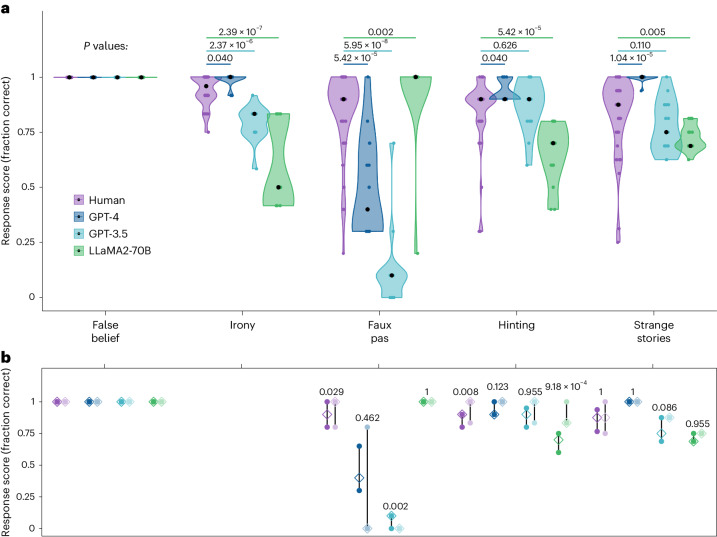
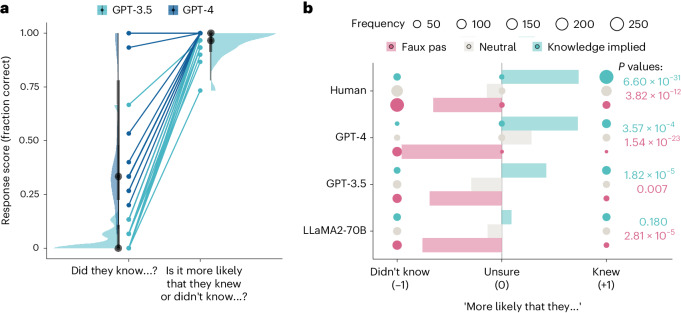
At the core of what defines us as humans is the concept of theory of mind: the ability to track other people’s mental states. The recent development of large language models (LLMs) such as ChatGPT has led to intense debate about the possibility that these models exhibit behaviour that is indistinguishable from human behaviour in theory of mind tasks. Here we compare human and LLM performance on a comprehensive battery of measurements that aim to measure different theory of mind abilities, from understanding false beliefs to interpreting indirect requests and recognizing irony and faux pas. We tested two families of LLMs (GPT and LLaMA2) repeatedly against these measures and compared their performance with those from a sample of 1,907 human participants. Across the battery of theory of mind tests, we found that GPT-4 models performed at, or even sometimes above, human levels at identifying indirect requests, false beliefs and misdirection, but struggled with detecting faux pas. Faux pas, however, was the only test where LLaMA2 outperformed humans. Follow-up manipulations of the belief likelihood revealed that the superiority of LLaMA2 was illusory, possibly reflecting a bias towards attributing ignorance. By contrast, the poor performance of GPT originated from a hyperconservative approach towards committing to conclusions rather than from a genuine failure of inference. These findings not only demonstrate that LLMs exhibit behaviour that is consistent with the outputs of mentalistic inference in humans but also highlight the importance of systematic testing to ensure a non-superficial comparison between human and artificial intelligences.
Overview
The claims and statistics of this paper haven’t been checked yet.
Free: it reads the open-access text and checks the first 5 claims that cite a source we can check. Create a free account to check every claim.
Integrity signals
Registry
Cites
Statistics
Figures
Verification
Claims the paper makes
The claims and statistics of this paper haven’t been checked yet.
Free: it reads the open-access text and checks the first 5 claims that cite a source we can check. Create a free account to check every claim.
Claims other papers make about this one
Each is checked against this paper’s own text: does it say what the citing paper says it does?
The source backs part of the claim, not all of it — or backs it for a different population, condition or comparison.
In the citing paper
“Recent studies have shown that Large Language Models (LLMs), including GPT-3 and GPT-4, can excel in tasks that seemingly require ToM (Kosinski, 2023; van Duijn et al., 2023; Strachan et al., 2024; Street et al., 2024)”
From Can "consciousness" be observed from large language model (LLM) internal states? Dissecting LLM representations obtained from Theory of Mind test with Integrated Information Theory and Span Representation analysis (2025) · cites this paper as Strachan et al., 2024
Experimental — accuracy not yet measuredThe source backs part of the claim, not all of it — or backs it for a different population, condition or comparison.
In the citing paper
“This is amplified by the ability of LLMs to infer as well—or better—than humans the beliefs and intentions of an interlocutor from text (26).”
From The benefits and dangers of anthropomorphic conversational agents (2025) · cites this paper as [26]
Experimental — accuracy not yet measuredThe source backs part of the claim, not all of it — or backs it for a different population, condition or comparison.
In the citing paper
“later models demonstrate an increasing ability to reliably infer unobservable mental states in others (Strachan et al., 2024;Holterman and Deemter, 2023;Moghaddam and Honey, 2023).”
From Machine Psychology (2023) · cites this paper as Strachan et al., 2024
Experimental — accuracy not yet measuredThe cited source says what the claim attributes to it.
In the citing paper
“Specifically, these subjects are adult native English speakers (aged 18-70) with no history of psychiatric conditions or dyslexia, as specified in Strachan et al. (2024).”
From Can "consciousness" be observed from large language model (LLM) internal states? Dissecting LLM representations obtained from Theory of Mind test with Integrated Information Theory and Span Representation analysis (2025) · cites this paper as Strachan et al., 2024
The cited source says what the claim attributes to it.
In the citing paper
“These models are increasingly achieving or surpassing human performance benchmarks in various domains, including medical diagnostic dialogue28, persuasive communication29, theory of mind30, making people feel heard31, responding to relationship issues32 and helping people reframe negative situations to reduce negative emotions33.”
From “It happened to be the perfect thing”: experiences of generative AI chatbots for mental health (2024) · cites this paper as [30]
4 more claims about this paper
Create a free account to see every claim other papers make about this one.
Self-check
Percentages, sums and reported differences re-computed from the paper’s own numbers.
The self-check needs the paper’s full text.
Citations
Cites
The Proceedings of the National Academy of Sciences
Richards, J. W. (1915) · Science · doi:10.1126/science.42.1074.161 · Cited by 13,983
Does the chimpanzee have a theory of mind?
Premack, D., & Woodruff, G. (1978) · Behavioral and Brain Sciences · doi:10.1017/s0140525x00076512 · Cited by 8,743 · cited 1×
“3), dozens of tasks have been developed to study it, including indirect measures of belief attribution using reaction times 4–6 and looking or searching behaviour 7–9 , tasks examining the ability to infer mental states from photographs of eyes 10 , and language-based tasks assessing false belief…”
BackgroundWimmer, H. (1983) · Cognition · doi:10.1016/0010-0277(83)90004-5 · Cited by 6,305
Baron‐Cohen, S., Wheelwright, S., Hill, J., Raste, Y., & Plumb, I. (2001) · Journal of Child Psychology and Psychiatry · doi:10.1111/1469-7610.00715 · Cited by 4,555 · cited 1×
“…indirect measures of belief attribution using reaction times 4–6 and looking or searching behaviour 7–9 , tasks examining the ability to infer mental states from photographs of eyes 10 , and language-based tasks assessing false belief understanding 11,12 and pragmatic language comprehension 13–16 .”
The principles of psychology, Vol I.
James, W. (1890) · doi:10.1037/10538-000 · Cited by 4,514
Happé, F. G. E. (1994) · Journal of Autism and Developmental Disorders · doi:10.1007/bf02172093 · Cited by 2,352 · cited 2×
“We selected a set of well-established theory of mind tests spanning different abilities: the hinting task 14 , the false belief task 11,33 , the recognition of faux pas 13 , and the strange stories 15,16 .”
BackgroundMethodThe Neural Basis of Mentalizing
Frith, C. D., & Frith, U. (2006) · Neuron · doi:10.1016/j.neuron.2006.05.001 · Cited by 1,855
Three-year-olds’ difficulty with false belief: The case for a conceptual deficit
Perner, J., Leekam, S. R., & Wimmer, H. (1987) · British Journal of Developmental Psychology · doi:10.1111/j.2044-835x.1987.tb01048.x · Cited by 1,550 · cited 1×
“…indirect measures of belief attribution using reaction times 4–6 and looking or searching behaviour 7–9 , tasks examining the ability to infer mental states from photographs of eyes 10 , and language-based tasks assessing false belief understanding 11,12 and pragmatic language comprehension 13–16 .”
BackgroundSparks of Artificial General Intelligence: Early experiments with GPT-4
Bubeck, S., Chandrasekaran, V., Eldan, R., Gehrke, J., Horvitz, E., Kamar, E., Lee, P., Lee, Y. T., Li, Y., Lundberg, S., et al. (2023) · arXiv · doi:10.48550/arxiv.2303.12712 · Cited by 1,526 · cited 3×
“One example is the false belief test, one of the most widely used tools so far for testing the performance of LLMs on social cognitive tasks 19,21–23, 25, 51 , 52 .”
BackgroundMethodToward a second-person neuroscience
Schilbach, L., Timmermans, B., Reddy, V., Costall, A., Bente, G., Schlicht, T., & Vogeley, K. (2013) · Behavioral and Brain Sciences · doi:10.1017/s0140525x12000660 · Cited by 1,510
Research works printed but not linked: 1
- Gandhi, K., Fränken, J.-P., Gerstenberg, T. & Goodman, N. D. Understanding social reasoning in language models with language models. In Advances in Neural Information Processing Systems Vol. 36 (MIT Press, 2023).
Cited by
Items 201–300 of 428
The Wildcard XAI: from a Necessity, to a Resource, to a Dangerous Decoy
Carli, R., & Calvaresi, D. (2024) · Lecture notes in computer science · doi:10.1007/978-3-031-70074-3_13 · Cited by 3
Deep canvassing using AIPreprint
Costello, T. H., Pennycook, G., Willer, R., & Rand, D. G. (2025) · OSF Preprints (OSF Preprints) · doi:10.31219/osf.io/q7e6u_v1 · Cited by 5
Detecting Malicious AI Agents Through Simulated InteractionsPreprint
Pi, Y., Bettison, E., & Becker, A. (2025) · arXiv (Cornell University) · doi:10.48550/arxiv.2504.03726 · Cited by 3
“Recent studies have systematically examined how LLMs perform in economic games [Xie et al., 2024], theory of mind tasks [Strachan et al., 2024], and various scenarios designed to test their capacity to emulate human cognitive and social processes, including collective behaviour [Park et al., 2023a,…”
Wang, H., Pawlak, J., & Sivakumar, A. (2025) · arXiv (Cornell University) · doi:10.48550/arxiv.2503.10652 · Cited by 3
Trencsenyi, V., Mensfelt, A., & Stathis, K. (2025) · arXiv (Cornell University) · doi:10.48550/arxiv.2507.19593 · Cited by 3
“…while we encountered only a handful of hypergame-based approaches addressing large language models (LLMs), the growing prevalence of human–agent (Strachan et al., 2024) and agent–agent misalignment (Kierans et al., 2025), along with the application of theory of mind in agentic systems (Bosse et…”
AI and Consciousness: Shifting Focus Towards Tractable QuestionsPreprint
Comșa, I. M. (2026) · arXiv (Cornell University) · doi:10.48550/arxiv.2605.06965 · Cited by 3
“Current AI systems also effectively demonstrate mastery of human theory of mind (Strachan et al., 2024; Street et al., 2026).”
AI Agents: Design and Evaluation of Gamified Conversational Agents
Poglitsch, C., Seiser, M., Buchsteiner, M., & Pirker, J. (2025) · IEEE Conference on Games (CoG) · doi:10.1109/cog64752.2025.11114224 · Cited by 2
Theory of mind in action: The instruction inference task in dynamic human-agent collaboration
Saad, F., Murukannaiah, P. K., & Singh, M. P. (2026) · Artificial Intelligence · doi:10.1016/j.artint.2026.104621 · Cited by 4
Boldi, A., Gabbatore, I., & Bosco, F. M. (2025) · Electronics · doi:10.3390/electronics14224411 · Cited by 2
Eckert, M., Bonial, C., Bonn, J., Hwang, J. D., & Madabushi, H. T. (2025) · Annual Review of Linguistics · doi:10.1146/annurev-linguistics-041824-061723 · Cited by 2
Lim, S.-Y., Sato, K., Takami, K., Parady, G., & KIM, E. (2026) · Travel Behaviour and Society · doi:10.1016/j.tbs.2026.101374 · Cited by 2
Simulated cognitive empathy as an emerging tool for socio-ecological research
Richards, D. R., Heays, A., Herzig, A., Lavorel, S., & Vannier, C. (2026) · Environmental Research Communications · doi:10.1088/2515-7620/ae4cfb · Cited by 2
Generative AI for climate governance and acceptability-constrained policy design
Manivannan, A., Spaiser, V., Cann, T. J. B., Evans, J. A., Everall, J., Falkenberg, M., García, D., Guo, W., Herzog, R., Otto, I. M., et al. (2026) · npj Climate Action · doi:10.1038/s44168-026-00362-6 · Cited by 4
“Strachan et al. 26 showed that responses given by LLMs can resemble the answers that humans (1907 participants) give when they use “ theory of mind ” reasoning (i.e., thinking about other people ’ s beliefs, intentions, knowledge, ignorance), i.e., matching outputs of mentalistic inferences (but…”
InfluentialPeters, U., Bertazzoli, A., DeJesus, J. M., van der Velden, G. J., & Chin-Yee, B. H. (2026) · Public Understanding of Science · doi:10.1177/09636625261425891 · Cited by 4
“Each new LLM chat was a separate random trial and, consistent with previous studies, was treated as one “pseudo-participant” (e.g. Strachan et al., 2024).”
Scaffolding human and AI instruction: Neural alignment and learning gains in online education
Peng, Y., Nastase, S. A., Huang, Y., Li, Y., Guo, Z., & Li, P. (2026) · Neuron · doi:10.1016/j.neuron.2026.04.005 · Cited by 4
Economidou‐Kogetsidis, M., & Lai, S. (2026) · Journal of Pragmatics · doi:10.1016/j.pragma.2026.05.009 · Cited by 2
Brain-inspired large model mindreading
Jin, J., Hu, Y., Wang, Z., Pan, Y., Ma, B., Dong, B., Dong, J., & Pei, G. (2026) · NeuroImage · doi:10.1016/j.neuroimage.2026.122108 · Cited by 4
Chen, J., Qin, N., Pei, F., Zhang, Y., Qiao, Y., Yu, Y., & Huang, Y. (2026) · Energy & Environmental Science · doi:10.1039/d6ee01488g · Cited by 2
Large language models as human proxies
Karetnikov, N., Rahwan, I., & Svetinović, D. (2026) · Nature Computational Science · doi:10.1038/s43588-026-01060-3 · Cited by 6
“Other studies have shown that LLMs can express consistent personality traits 91 ; behave rationally in economic tasks 92 ; and match human performance on tests of theory of mind 93 .”
Transitive Inference in Large Language Models and Prompting Intervention
Wu, W., & Deng, W. (2025) · IEEE International Conference on Acoustics Speech and Signal Processing · doi:10.1109/icassp49660.2025.10889585 · Cited by 3
“LLMs’ abilities to achieve decent cognitive performance in many tasks such as theory of mind, analogical reasoning, and economic decision-making have been found recently [2], [6], [7].”
Santtila, P. O., Sun, Y., Kask, K., Järvilehto, L., & Xiu, J. (2025) · Acta Psychologica · doi:10.1016/j.actpsy.2025.105270 · Cited by 2
A Two-Step, Multidimensional Account of Deception in Language Models
Dung, L. (2025) · Erkenntnis · doi:10.1007/s10670-025-01017-4 · Cited by 3
“This fits with research which claims to find some, albeit very limited, introspective capacity in some LLMs (Binder et al. 2024), as well as theory of mind reasoning (Strachan et al., 2024; Street et al. 2024), although the latter is particularly controversial (Shapira et al., 2023; Ullman 2023).”
Bianco, F., Rigato, S., Filippetti, M. L., & Ognibene, D. (2024) · arXiv (Cornell University) · doi:10.48550/arxiv.2407.18022 · Cited by 2
No Fairness, No Cooperation: Draft Dodging by the Rich and Voluntary Enlistment in World War IIPreprint
Jiang, G. (2024) · SSRN Electronic Journal · doi:10.2139/ssrn.5007109 · Cited by 2
Quantifying Uncert-AI-nty: Testing the Accuracy of LLMs’ Confidence JudgmentsPreprint
Cash, T. N., Oppenheimer, D. M., Christie, S., & Devgan, M. (2025) · PsyArXiv (OSF Preprints) · doi:10.31234/osf.io/47df5_v4 · Cited by 2
AI Behavioral SciencePreprint
Jackson, M. O., Mei, Q., Wang, S., Xie, Y., Yuan, W., Benzell, S. G., Brynjolfsson, E., Evans, J. A., Jabarian, B., Kleinberg, J. M., et al. (2025) · SSRN Electronic Journal · doi:10.2139/ssrn.5395006 · Cited by 12
BeliefNest: A Joint Action Simulator for Embodied Agents with Theory of MindPreprint
Sagara, R., Terao, K., & Iwahashi, N. (2025) · doi:10.64560/19638015 · Cited by 2
Sensorimotor Self-Recognition in Multimodal Large Language Model-Driven RobotsPreprint
Varela, I. D., Sorozábal, P., Torricelli, D., Delgado-Oleas, G., Serrano, J. I., Sobrino, M. D. D. C., Rocón, E., & Cebrián, M. (2025) · arXiv (Cornell University) · doi:10.48550/arxiv.2505.19237 · Cited by 3
“Large language models (LLMs) rapidly advance, demonstrating human-like or superior performance in complex cognitive tasks such as language comprehension, reasoning, multimodal perception and the interpretation of subtle discourse phenomena like irony and faux pas ( 13–17 ).”
Motivation in Large Language ModelsPreprint
Nahum, O., Sklar, A. Y., Goldstein, A., & Reichart, R. (2026) · arXiv (Cornell University) · doi:10.48550/arxiv.2603.14347 · Cited by 2
“A growing line of work further suggests that LLMs can display human-like patterns such as social reasoning [14, 15], cognitive biases [16, 17], theory-of-mind-like ability [18, 19], or even empathy [20].”
The Epistemic Shift in Science Communication: Strategic Foresight for the Future of Peer Review
Biele, C., & Kowalski, J. (2026) · Science Communication · doi:10.1177/10755470261426817 · Cited by 2
Selective Deficits in LLM Mental Self-Modeling in a Behavior-Based Test of Theory of MindPreprint
Ackerman, C. (2026) · arXiv (Cornell University) · doi:10.48550/arxiv.2603.26089 · Cited by 2
“…the room, and are asked where the character will look for the object when she returns - has also been used to evaluate ToM in LLMs [Kosinski, 2024, Strachan et al., 2024]; experiments have shown increasing performance with model scale, with recent frontier models reaching human-level performance.”
Do Matching Mechanisms Work with LLM Agents?Preprint
Hoshino, Y., Kitadai, A., & Nishino, N. (2026) · arXiv (Cornell University) · doi:10.48550/arxiv.2606.03030 · Cited by 2
Assessing mentalization in humans and large language modelsPreprint
Sohail, A., Zhong, X., Konovalov, A., Lockwood, P. L., & Zhang, L. (2026) · Research Square · doi:10.21203/rs.3.rs-11244509/v1 · Cited by 2
Linguistic traces of stochastic empathy in language models
Kleinberg, B., Zegers, J., Festor, J., Vida, S., Präsent, J., Loconte, R., & Peereboom, S. (2024) · arXiv · doi:10.48550/arxiv.2410.01675 · Cited by 1
“For the current paper, we adopt the experimental method and apply it to both human participants and LLM queries.”
Quantifying Dialogue Coherence Using Fuzzy Logic Systems
Al-Daoud, K. I., Yogeesh, N., Mohammad, S. I. S., Raja, N., Ramachandram, S., Aravinda Reddy, N., Vasudevan, A., Alshdaifat, N., & Hunitie, M. F. A. (2025) · Forum for Linguistic Studies · doi:10.30564/fls.v7i6.9442 · Cited by 1
Human versus artificial social cognition and metacognition: the normative difference
Tison, R., & Zawidzki, T. W. (2025) · AI and Ethics · doi:10.1007/s43681-025-00774-w · Cited by 2
“Strachan et al. ( 2024 ) notes that “the poor performance of GPT originated from a hyperconservative approach towards committing to conclusions rather than from a genuine failure of inference”.”
InfluentialWagner, W., GASKELL, G. D., Paraschou, E., Lyu, S., Michali, M., & Vakali, A. I. (2025) · Computers in Human Behavior Artificial Humans · doi:10.1016/j.chbah.2025.100191 · Cited by 2
Theory of Mind as a Core Component of Artificial General Intelligence
Schneider, H. (2025) · Lecture notes in computer science · doi:10.1007/978-3-032-00800-8_16 · Cited by 3
A VR and AI-Powered Game-Based Approach to Minimally-Invasive Social Cognitive Assessment
Krijgsman, C., Poos, J. M., & Rafael Bidarra, E. (2025) · IEEE Conference on Games (CoG) · doi:10.1109/cog64752.2025.11114400 · Cited by 1
“[13] They found that most models performed well on the first-order and second-order false-believe tests, with ChatGPT 3.5 and ChatGPT 4 outperforming human test subjects.”
InfluentialLi, Y. (2026) · Journal of Research in Personality · doi:10.1016/j.jrp.2026.104744 · Cited by 1
Müller, L., & Sütterlin, S. (2025) · Mensch und Computer (MuC) · doi:10.1145/3743049.3748562 · Cited by 1
Bounding Reason: Inferentialism, Naturalism, and the Discursive Agency of LLMs
Malík, J., & Hubálek, M. (2025) · Global Philosophy · doi:10.1007/s10516-025-09761-6 · Cited by 1
“…- ies (Strachan et al. 2024 ) unequivocally states that current LLMs like “GPT models exhibited impressive performance in tasks involving beliefs, intentions and non-lit - eral utterances” (Strachan et al. 2024 , p. 1290), with LLMs also surpassing humans, on some metrics (like irony detection).”
Natural, Artificial, and Human Intelligences
Pothos, E., & Widdows, D. (2025) · Journal of Intelligence · doi:10.3390/jintelligence14100249
Neurocomputational mechanisms of adaptive mentalization in humans
Nong, T., Feng, J. H., & Dreher, J. (2026) · Trends in Cognitive Sciences · doi:10.1016/j.tics.2025.11.009 · Cited by 1
Agency, Competence and GenAI in Translation and Translator Education
Massey, G. (2025) · AUC PHILOLOGICA · doi:10.14712/24646830.2025.10 · Cited by 3
Can large language models mimic airline passenger preferences?
Voltes-Dorta, A., & Suau-Sánchez, P. (2025) · Artificial Intelligence for Transportation · doi:10.1016/j.ait.2025.100034 · Cited by 6
Banh, L., Stangl, F. J., Strobel, G., & Riedl, R. (2025) · Lecture notes in information systems and organisation · doi:10.1007/978-3-032-00815-2_3 · Cited by 2
Banh, L., Stangl, F. J., Strobel, G., & Riedl, R. (2025) · Lecture notes in information systems and organisation · doi:10.1007/978-3-032-00815-2_2 · Cited by 1
Zhang, Y., Hu, Y., Zhao, Q., Wang, Y., Zhai, Y., Yang, J., Lin, Z., & Zhao, L. (2026) · Journal of King Saud University - Computer and Information Sciences · doi:10.1007/s44443-026-00485-0 · Cited by 1
Health or taste? Investigating food decision-making patterns in humans and large language models
Lyu, M., & Huang, J. (2026) · Appetite · doi:10.1016/j.appet.2026.108512 · Cited by 1
Can Machines Think Like Humans: A Behavioral Evaluation of LLM Agents in Dictator Games
Ma, J. (2026) · Voluntas: International Journal of Voluntary and Nonprofit Organizations · doi:10.1017/s0957876526000173 · Cited by 1
Metacognition of ChatGPT in confidence judgements
YOSHIZAWA, S., Onzo, A., Nozawa, S., Takano, T., Ishikawa, T., & Mogi, K. (2026) · Frontiers in Artificial Intelligence · doi:10.3389/frai.2026.1694192 · Cited by 2
“…the Generative Pre-Trained Transformer 4 (GPT-4, OpenAI et al., 2024a) showed never-before-seen performances including the emulation of human cognition (Frank, 2023), inference and reasoning (Bubeck et al., 2023; Webb et al., 2023), and theory of mind (ToM; Kosinski, 2024; Strachan et al., 2024).”
InfluentialFrom Expectation to Evaluation: Expectation Cues Systematically Bias LLM and Human Judgment
Sun, Y., Dillion, D., Gray, K. J., Lyu, M., Zhang, Z., & Li, F. (2026) · CHI Conference on Human Factors in Computing Systems · doi:10.1145/3772318.3790492 · Cited by 2
Contextual Integrity in Large Language Models: A Review
Hassanpour, A., & Yang, B. (2026) · Journal of Cybersecurity and Privacy · doi:10.3390/jcp6020074 · Cited by 1
“Traditional evaluations of ToM have often used passive narratives, which may contain reporting biases and surface cues that large language models (LLMs) can exploit to give the appearance of ToM, without true understanding [52–54].”
Crowdsourced versus large language models forecasting: evidence for the accuracy–correlation effect
Jeddi, Y., Segovia‐Martín, J., & Servan-Schreiber, E. (2026) · Philosophical Transactions of the Royal Society B Biological Sciences · doi:10.1098/rstb.2024.0456 · Cited by 3
ChatGPT is not bullshit, nor is it not not bullshit
Fitts, J. (2026) · Ethics and Information Technology · doi:10.1007/s10676-026-09903-3 · Cited by 1
Prompt carefully! ChatGPT displays rule-based insensitivity to contingencies
Ruiz, F. J., & Cardona-Betancourt, V. (2026) · Journal of Contextual Behavioral Science · doi:10.1016/j.jcbs.2026.101012 · Cited by 1
A Comprehensive Review of Artificial Intelligence in Civil Engineering Education
Zohourian, M., Pamidimukkala, A., Kermanshachi, S., & Almaskati, D. N. (2026) · ASCE International Conference on Transportation and Development (ICTD) · doi:10.1061/9780784487013.015 · Cited by 2
BeatriXR: Comprehensive and Adaptive Feedforward Support for Guidance in Virtual Reality EICS008
Artizzu, V., Luyten, K., Ruiz, G. A. R., & Spano, L. D. (2026) · Proceedings of the ACM on Human-Computer Interaction · doi:10.1145/3816419 · Cited by 1
Panfilova, A. S., Bolshev, V., Mozikov, M., Латынов, В. В., Vanin, A. V., Nestik, T. A., Kozin, M., Serohvostov, A., Tarasova, E., & Nikolenko, S. I. (2026) · IEEE Access · doi:10.1109/access.2026.3711753 · Cited by 2
“These findings are complemented by work showing that LLMs can simulate economic decision-making [8], moral reasoning [10], clinical assessments [11], and theory of mind [23], and can serve as foundation models for human cognition [24].”
Niser, J. C. (2026) · New Ideas in Psychology · doi:10.1016/j.newideapsych.2026.101284 · Cited by 1
jin, K. T., Zhang, Y., Fang, T., & Blanco‐Encomienda, F. J. (2026) · Journal of Industrial Information Integration · doi:10.1016/j.jii.2026.101183 · Cited by 1
Mengyu, C., Lu, F., Chen, C.-F., Tran, L. V., & Katukuri, J. (2026) · ACM Conference on Recommender Systems (RecSys) · doi:10.1145/3773078.3831787 · Cited by 1
Quo Vadis? Scientific Discovery in the Age of Artificial Intelligence
Jedlička, P. (2026) · Teorie vědy / Theory of Science · doi:10.46938/tv.2026.728 · Cited by 1
Sternberg, R. J. (2026) · Gifted Education International · doi:10.1177/02614294261490228 · Cited by 2
Beyond Recognition: Evaluating Visual Perspective Taking in Vision Language Models
Góral, G., Ziarko, A., Miłoś, P., Nauman, M., Wołczyk, M., & Kosinski, M. (2026) · doi:10.1109/cvprf71909.2026.00170 · Cited by 1
“Recent studies suggest that large language models can track the beliefs of different characters, effectively reasoning about the world through the eyes of their minds in the linguistic domain [16, 22, 46].”
Berlincioni, L., Cultrera, L., Becattini, F., Bertini, M., & Bimbo, A. D. (2025) · Lecture notes in computer science · doi:10.1007/978-3-031-92648-8_7 · Cited by 2
Lv, D., Sun, R., Zuo, J., Zhu, Q., & Qin, S. (2025) · Behaviour and Information Technology · doi:10.1080/0144929x.2025.2586246 · Cited by 1
“…behaviors and personality traits are statistically indistinguishable from those of random participants in a sample of tens of thousands of individuals from over 50 countries (Mei et al. 2024), demonstrating that it possesses a certain degree of ‘cognitive ability’ (Strachan et al. 2024).”
Guo, J., Zheng, Y., Yang, S., Zheng, S., Gao, Y., Zou, Z., Zheng, L., & Shijin, S. U. N. (2025) · International Journal of Human-Computer Interaction · doi:10.1080/10447318.2025.2604628 · Cited by 1
“On one hand, research suggests that some advanced models, such as GPT-4, can match human-level performance on classic ToM tasks, like false-belief tests and understanding indirect requests (Strachan et al., 2024).”
Lost in Translation: The Algorithmic Gap Between LMs and the BrainPreprint
Tosato, T., Notsawo, P. T., Helbling, S., Rish, I., & Dumas, G. (2024) · arXiv (Cornell University) · doi:10.48550/arxiv.2407.04680 · Cited by 2
“However, their performance has led to the idea that, beyond modeling language perception, they may also model more complex cognitive abilities such as reasoning (Jones, 2024), theory of mind (Strachan et al., 2024), and building world models (Li et al., 2023).”
Huang, Y., Li, L., Dong, W., Dong, Y., Huang, Y., & Liu, H. (2024) · doi:10.2196/preprints.65435 · Cited by 1
Mudd, A., Conroy, T., Voldbjerg, S. L., Goldschmied, A. Z., & Schuwirth, L. (2024) · Research Square · doi:10.21203/rs.3.rs-4767916/v1 · Cited by 2
Evidence of conceptual mastery in the application of rules by Large Language ModelsPreprint
Nunes, J. L., Almeida, G., & Flanagan, B. (2025) · SSRN Electronic Journal · doi:10.2139/ssrn.5161877 · Cited by 1
Quantifying Uncert-AI-nty: Testing the Accuracy of LLMs’ Confidence JudgmentsPreprint
Cash, T. N., Oppenheimer, D. M., Christie, S., & Devgan, M. (2025) · PsyArXiv (OSF Preprints) · doi:10.31234/osf.io/47df5_v3 · Cited by 1
How Human is the Machine? Evidence from 66,000 Conversations with Large Language ModelsPreprint
Stamatogiannakisa, A., Ghodsinia, A., Etminanrad, S., Gonçalves, D., & Santos, D. (2025) · SSRN Electronic Journal · doi:10.2139/ssrn.5425016 · Cited by 1
Thakur, A., Murray, T., Rodriguez, P., & Hilbert, M. (2026) · SSRN Electronic Journal · doi:10.2139/ssrn.6083909 · Cited by 2
Large language model research: Knowledge structure, thematic evolution, and future research agendaPreprint
Cao, X., Yang, B., Yang, X., Wang, Q., & Cao, N. (2026) · Research Square · doi:10.21203/rs.3.rs-8876513/v1 · Cited by 1
Do LLMs have core beliefs?Preprint
Chawla, N. V., Sokol, A. A., & Ganapini, M. B. (2026) · Research Square · doi:10.21203/rs.3.rs-9013372/v1 · Cited by 1
Harada, Y. (2026) · Qeios · doi:10.32388/be0zbc.3 · Cited by 1
Human-like moral judgments conceal divergent motive attributions in large language modelsPreprint
Wu, X., & Dreher, J. (2026) · arXiv (Cornell University) · doi:10.48550/arxiv.2609.07353 · Cited by 1
Does the MEM Model Explain the "Hard Problem" of Phenomenal Consciousness?Preprint
Galus, W. L. (2026) · Qeios · doi:10.32388/bfdt0t · Cited by 1
Uhler, L., Jordan, V., Buder, J., Huff, M., & Papenmeier, F. (2026) · Communications Psychology · doi:10.1038/s44271-026-00403-0
“For example, Strachan et al. 55 demonstrated notable differences between GPT and LLaMA2 models in how they exhibit and operationalize theory-of-mind reasoning.”
Czajkowski, N. O. (2025) · Tidsskrift for Den norske legeforening · doi:10.4045/tidsskr.25.0044
Refoua, E., Elyoseph, Z., Wacker, R., Dziobek, I., Tsafrir, I., & Meinlschmidt, G. (2025) · SSRN Electronic Journal · doi:10.2139/ssrn.5074696 · Cited by 1
Expectation management in humans and LLMs
Menashe, B. A., Drake, A., & Ben‐Shachar, M. (2026) · Scientific Reports · doi:10.1038/s41598-026-62526-y
“The fact that even lower-constraining sentence fragments produced an increase in entropy when preceded by a mirative marker suggests that mirative markers alter expectations at all levels, even weakly held ones.”
Quantifying Uncert-AI-nty: Testing the Accuracy of LLMs’ Confidence JudgmentsPreprint
Cash, T. N., Oppenheimer, D. M., Christie, S., & Devgan, M. (2025) · PsyArXiv (OSF Preprints) · doi:10.31234/osf.io/47df5_v2
AI Tools and Applications in Managing Immunological Disorders
Kim, S.-J., Lee, S., Jin, S., & Lee, J. W. (2025) · Advances in computational intelligence and robotics book series · doi:10.4018/979-8-3693-9725-1.ch002
Rethinking Theory for Urban Life with AI: Creativity, (Un)Prompting, and Combinatorial Outcomes
McKenna, H. P. (2025) · Springer eBooks · doi:10.1007/978-3-031-88765-9_7
Yu, K. (2024) · doi:10.1109/icdtie65977.2024.00014
“[2][3][4] However, existing LLM-based dialogue systems mainly focus on empathetic conversations, which are different from practical counseling .”
Kubo, R., Nishimoto, S., & Nakai, T. (2025) · bioRxiv (Cold Spring Harbor Laboratory) · doi:10.1101/2025.06.17.660057
“Trained on a vast corpus of real-world text, LLMs capture hierarchical linguistic representations, including syntactic structures, semantic relationships, and contextual dependencies 23–26 .”
Deep Canvassing using AI reduces prejudice toward undocumented immigrantsPreprint
Costello, T. H., Pennycook, G., Willer, R., & Rand, D. G. (2025) · OSF Preprints (OSF Preprints) · doi:10.31219/osf.io/q7e6u_v2
Unpacking the Decision Logic of LLM-based Agents: Evidence from the Newsvendor ProblemPreprint
Zhang, X., & Cavusoglu, H. (2025) · SSRN Electronic Journal · doi:10.2139/ssrn.5337019 · Cited by 4
Ng, S. (2025) · Springer eBooks · doi:10.1007/978-3-031-82790-7_17
Alkhaldi, A. A. H. (2025) · Applied Neuropsychology Child · doi:10.1080/21622965.2025.2541176
Detecting Large Language Model Generated Korean Essays Using Curriculum LearningPreprint
Jung, Y., & Oh, H. (2025) · SSRN Electronic Journal · doi:10.2139/ssrn.5380275
A Theory of Mind Based Generative Chatbot for Emotionally Realistic CounselingPreprint
An, H., Kwon, M., Shin, J., Park, J., & Oh, H. (2025) · SSRN Electronic Journal · doi:10.2139/ssrn.5392982
Theory of Mind in Relation to Other Cognitive Abilities, volume II
Dowker, A., & Frye, D. (2025) · Frontiers research topics · doi:10.3389/978-2-8325-6542-1
Assessing AI Consciousness: A Substrate-Independent FrameworkPreprint
Vale, M. (2025) · SSRN Electronic Journal · doi:10.2139/ssrn.5551300
Moriguchi, Y., Watanabe, R., Hori, Y., & Reyes‐Jaquez, B. (2026) · Humanities and Social Sciences Communications · doi:10.1057/s41599-026-07511-6
“…can blur or extend previously established boundaries between humans, divine entities, and arti fi cial minds, warranting a reconsideration of mental-state and capability attributions to arti fi cial agents (Collins et al., 2024; Garry et al., 2024; Kosinski, 2024; Liu, 2024; Strachan et al., 2024).”
Metadata
- Authors
- Strachan, J. W. A., Albergo, D., Borghini, G., Pansardi, O., Scaliti, E., Gupta, S., Saxena, K., Rufo, A., Panzeri, S., Manzi, G., Graziano, M. S. A., & Becchio, C.
- Affiliations
- University Medical Center Hamburg-Eppendorf (DE)
- University of Trento (IT)
- Italian Institute of Technology (IT)
- Universität Hamburg (DE)
- Princeton University (US)
- Corresponding author
- Strachan, James W. A.
- Becchio, Cristina
- ORCID
- Venue
- Nature Human Behaviour
- Published
- 2024-05-20
- Volume
- 8
- Issue
- 7
- Pages
- 1285-1295
- ISSN
- 2397-3374 (ISSN-L)
- PMC
- PMC11272575
- OpenAlex
- W4398143508
- Semantic Scholar
- 7d16a2de08fc5053e1026ffaa0bbd279302abca2
- Cited by
- 299
- References
- 58
- Citations by year
- 2026: 125 · 2025: 136 · 2024: 37
- FWCI
- 232.53
- Type
- journal article
- Language
- en
- Open access
- hybrid
- doi.org
- Licence
- cc-by
- creativecommons.org/licenses/by/4.0 (tdm)
- creativecommons.org/licenses/by/4.0 (vor)
- Locations
- Nature Human Behaviour (publishedVersion, cc-by)
- Research Square (acceptedVersion, cc-by)
- PubMed Central (publishedVersion, cc-by-nc)
- PubMed (publishedVersion)
- Institutional Research Information System University of Turin (University of Turin) (submittedVersion, cc-by-nc)
- HAL (submittedVersion)
- RePEc: Research Papers in Economics (submittedVersion)
- OSF Preprints (OSF Preprints) (submittedVersion)
- Funders
- Alexander von Humboldt-Stiftung
- European Commission (101071191)
- Universitätsklinikum Hamburg-Eppendorf
- Topics
- Social Sciences › Psychology › Developmental and Educational Psychology › Child and Animal Learning Development
- Social Sciences › Psychology › Social Psychology › Social Robot Interaction and HRI
- Social Sciences › Arts and Humanities › Philosophy › Philosophy and Theoretical Science
- Keywords
- theory of mind, large language models, false belief understanding, indirect requests, irony detection, faux pas, misdirection, GPT-4, Llama 2, human-AI comparison, belief attribution
- MeSH terms
- Adolescent, Adult, Female, Humans, Language, Male, Middle Aged, Models, Psychological, Young Adult, Theory of Mind
About these checks
Registry, retraction, Cites and statistics results are computed, not judged, with one exception: a printed reference that no index lists is read once by a model before it counts as a citation error. Claims are extracted by a model and kept only when their quote appears verbatim in the text; each cited source is then checked, with a model’s help, for whether it says what the claim relies on. Those verdicts can be wrong — read the claim’s quote and the cited source before relying on one.
Statistics and arithmetic are recomputed, not judged.
Confidence bands are shown only for fields calibrated on our annotated test set. None is calibrated yet, so no band is shown.
What counts as a claim ›How we measure confidence ›How we check this ›
Are you an author, or do you see a problem with this page? Request a review
Data sources
Bibliographic data: Semantic Scholar, OpenAlex, Crossref.
Contains information from the Semantic Scholar Academic Graph Datasets, made available under the ODC Attribution License (ODC-BY 1.0).
Semantic Scholar’s data is described in: Kinney, R., et al. (2023). The Semantic Scholar Open Data Platform. arXiv:2301.10140.
