

Testing theory of mind in large language models and humans
Open accessPublished version of a preprint
The DOI matches its Crossref record; 63 of the 63 references it cites were found in a registry or an index.
Abstract
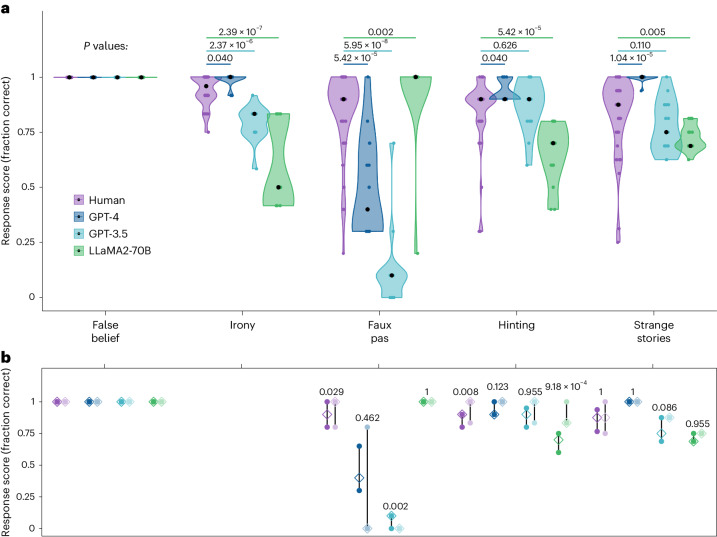
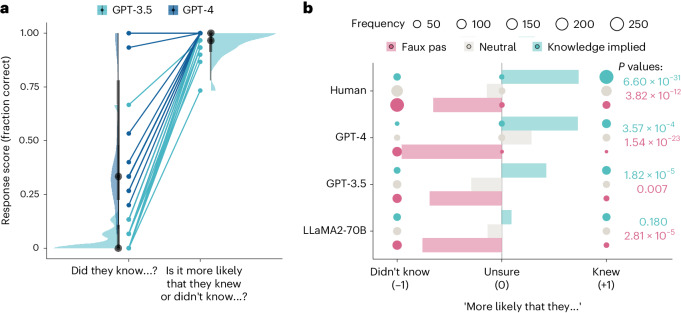
At the core of what defines us as humans is the concept of theory of mind: the ability to track other people’s mental states. The recent development of large language models (LLMs) such as ChatGPT has led to intense debate about the possibility that these models exhibit behaviour that is indistinguishable from human behaviour in theory of mind tasks. Here we compare human and LLM performance on a comprehensive battery of measurements that aim to measure different theory of mind abilities, from understanding false beliefs to interpreting indirect requests and recognizing irony and faux pas. We tested two families of LLMs (GPT and LLaMA2) repeatedly against these measures and compared their performance with those from a sample of 1,907 human participants. Across the battery of theory of mind tests, we found that GPT-4 models performed at, or even sometimes above, human levels at identifying indirect requests, false beliefs and misdirection, but struggled with detecting faux pas. Faux pas, however, was the only test where LLaMA2 outperformed humans. Follow-up manipulations of the belief likelihood revealed that the superiority of LLaMA2 was illusory, possibly reflecting a bias towards attributing ignorance. By contrast, the poor performance of GPT originated from a hyperconservative approach towards committing to conclusions rather than from a genuine failure of inference. These findings not only demonstrate that LLMs exhibit behaviour that is consistent with the outputs of mentalistic inference in humans but also highlight the importance of systematic testing to ensure a non-superficial comparison between human and artificial intelligences.
Overview
The claims and statistics of this paper haven’t been checked yet.
Free: it reads the open-access text and checks the first 5 claims that cite a source we can check. Create a free account to check every claim.
Integrity signals
Registry
Cites
Statistics
Figures
Verification
Claims the paper makes
The claims and statistics of this paper haven’t been checked yet.
Free: it reads the open-access text and checks the first 5 claims that cite a source we can check. Create a free account to check every claim.
Claims other papers make about this one
Each is checked against this paper’s own text: does it say what the citing paper says it does?
The source backs part of the claim, not all of it — or backs it for a different population, condition or comparison.
In the citing paper
“Recent studies have shown that Large Language Models (LLMs), including GPT-3 and GPT-4, can excel in tasks that seemingly require ToM (Kosinski, 2023; van Duijn et al., 2023; Strachan et al., 2024; Street et al., 2024)”
From Can "consciousness" be observed from large language model (LLM) internal states? Dissecting LLM representations obtained from Theory of Mind test with Integrated Information Theory and Span Representation analysis (2025) · cites this paper as Strachan et al., 2024
Experimental — accuracy not yet measuredThe source backs part of the claim, not all of it — or backs it for a different population, condition or comparison.
In the citing paper
“This is amplified by the ability of LLMs to infer as well—or better—than humans the beliefs and intentions of an interlocutor from text (26).”
From The benefits and dangers of anthropomorphic conversational agents (2025) · cites this paper as [26]
Experimental — accuracy not yet measuredThe source backs part of the claim, not all of it — or backs it for a different population, condition or comparison.
In the citing paper
“later models demonstrate an increasing ability to reliably infer unobservable mental states in others (Strachan et al., 2024;Holterman and Deemter, 2023;Moghaddam and Honey, 2023).”
From Machine Psychology (2023) · cites this paper as Strachan et al., 2024
Experimental — accuracy not yet measuredThe cited source says what the claim attributes to it.
In the citing paper
“Specifically, these subjects are adult native English speakers (aged 18-70) with no history of psychiatric conditions or dyslexia, as specified in Strachan et al. (2024).”
From Can "consciousness" be observed from large language model (LLM) internal states? Dissecting LLM representations obtained from Theory of Mind test with Integrated Information Theory and Span Representation analysis (2025) · cites this paper as Strachan et al., 2024
The cited source says what the claim attributes to it.
In the citing paper
“These models are increasingly achieving or surpassing human performance benchmarks in various domains, including medical diagnostic dialogue28, persuasive communication29, theory of mind30, making people feel heard31, responding to relationship issues32 and helping people reframe negative situations to reduce negative emotions33.”
From “It happened to be the perfect thing”: experiences of generative AI chatbots for mental health (2024) · cites this paper as [30]
4 more claims about this paper
Create a free account to see every claim other papers make about this one.
Self-check
Percentages, sums and reported differences re-computed from the paper’s own numbers.
The self-check needs the paper’s full text.
Citations
Cites
The Proceedings of the National Academy of Sciences
Richards, J. W. (1915) · Science · doi:10.1126/science.42.1074.161 · Cited by 13,983
Does the chimpanzee have a theory of mind?
Premack, D., & Woodruff, G. (1978) · Behavioral and Brain Sciences · doi:10.1017/s0140525x00076512 · Cited by 8,743 · cited 1×
“3), dozens of tasks have been developed to study it, including indirect measures of belief attribution using reaction times 4–6 and looking or searching behaviour 7–9 , tasks examining the ability to infer mental states from photographs of eyes 10 , and language-based tasks assessing false belief…”
BackgroundWimmer, H. (1983) · Cognition · doi:10.1016/0010-0277(83)90004-5 · Cited by 6,305
Baron‐Cohen, S., Wheelwright, S., Hill, J., Raste, Y., & Plumb, I. (2001) · Journal of Child Psychology and Psychiatry · doi:10.1111/1469-7610.00715 · Cited by 4,555 · cited 1×
“…indirect measures of belief attribution using reaction times 4–6 and looking or searching behaviour 7–9 , tasks examining the ability to infer mental states from photographs of eyes 10 , and language-based tasks assessing false belief understanding 11,12 and pragmatic language comprehension 13–16 .”
The principles of psychology, Vol I.
James, W. (1890) · doi:10.1037/10538-000 · Cited by 4,514
Happé, F. G. E. (1994) · Journal of Autism and Developmental Disorders · doi:10.1007/bf02172093 · Cited by 2,352 · cited 2×
“We selected a set of well-established theory of mind tests spanning different abilities: the hinting task 14 , the false belief task 11,33 , the recognition of faux pas 13 , and the strange stories 15,16 .”
BackgroundMethodThe Neural Basis of Mentalizing
Frith, C. D., & Frith, U. (2006) · Neuron · doi:10.1016/j.neuron.2006.05.001 · Cited by 1,855
Three-year-olds’ difficulty with false belief: The case for a conceptual deficit
Perner, J., Leekam, S. R., & Wimmer, H. (1987) · British Journal of Developmental Psychology · doi:10.1111/j.2044-835x.1987.tb01048.x · Cited by 1,550 · cited 1×
“…indirect measures of belief attribution using reaction times 4–6 and looking or searching behaviour 7–9 , tasks examining the ability to infer mental states from photographs of eyes 10 , and language-based tasks assessing false belief understanding 11,12 and pragmatic language comprehension 13–16 .”
BackgroundSparks of Artificial General Intelligence: Early experiments with GPT-4
Bubeck, S., Chandrasekaran, V., Eldan, R., Gehrke, J., Horvitz, E., Kamar, E., Lee, P., Lee, Y. T., Li, Y., Lundberg, S., et al. (2023) · arXiv · doi:10.48550/arxiv.2303.12712 · Cited by 1,526 · cited 3×
“One example is the false belief test, one of the most widely used tools so far for testing the performance of LLMs on social cognitive tasks 19,21–23, 25, 51 , 52 .”
BackgroundMethodToward a second-person neuroscience
Schilbach, L., Timmermans, B., Reddy, V., Costall, A., Bente, G., Schlicht, T., & Vogeley, K. (2013) · Behavioral and Brain Sciences · doi:10.1017/s0140525x12000660 · Cited by 1,510
Research works printed but not linked: 1
- Gandhi, K., Fränken, J.-P., Gerstenberg, T. & Goodman, N. D. Understanding social reasoning in language models with language models. In Advances in Neural Information Processing Systems Vol. 36 (MIT Press, 2023).
Cited by
Items 401–428 of 428
Abbas, M. A. I. S. (2026) · مجلة الاتقان للعلوم الإنسانية · doi:10.66359/itqan.v1i4.070
Arena: A Cognitive Multi-agent Framework for Modeling Conflict-Driven Multi-party Conversation
Sun, X., Zuo, L., Zeng, Z., Ngo, T. H., Liu, K., Lechervy, A., Jurie, F., Hatin, J., & Bertin, E. (2026) · Lecture notes in computer science · doi:10.1007/978-3-032-37682-4_17
GPT-4 accurately predicts human emotions at phenomenological and neural levels
Suominen, L. (2026) · UTUPub (University of Turku)
Developing and validating the attitudes toward large language models scale
Liebherr, M., Almourad, M. B., Alshakhsi, S. A. A., Montag, C., Xu, G., Ali, R., & Yankouskaya, A. (2026) · Cogent Psychology · doi:10.1080/23311908.2026.2718273 · Cited by 2
Dio, C. D., Manzi, F., Peretti, G., Longoni, F., Gallese, V., Massaro, D., Gilli, G., & Marchetti, A. (2026) · Computers in Human Behavior Reports · doi:10.1016/j.chbr.2026.101364
Mizrak, F., Kirgiz, A. C. O., & Demirel, H. G. (2026) · Journal of Intelligence · doi:10.3390/jintelligence14100248
“Social-intelligence and theory-of-mind research shows that users and researchers attribute differentiated social-cognitive capacities to artificial agents (Barchard et al., 2020; Kosinski, 2024; Strachan et al., 2024).”
Zhang, T., Shaw, D. J., Zhou, S., Zhu, L., & Lu, C. (2026) · bioRxiv (Cold Spring Harbor Laboratory) · doi:10.64898/2026.10.03.756413
Towards a Communicative Process Design for Human-AI Team Collaboration
Chang, R.-C. (2026) · eScholarship (California Digital Library)
Pragmatics-zombies: Trust and communication in the age of artificial intelligence
Firt, E., & Nir, B. (2026) · Pragmatics and Society · doi:10.1075/ps.25161.fir
Same Passages, Different Readings: Comparing Complete Human and LLM Interpretations of a Story
Li, B., & Feng, Y. (2026) · ACM/IEEE Joint Conference on Digital Libraries · doi:10.1145/3805696.3847293
Problem of Building Synthetic Psychological Data: Experience in Modeling Reactions to Frustration
Chuganskaya, A., Kireev, D., Smirnov, I., & Grigoriev, O. G. (2026) · Automatic Documentation and Mathematical Linguistics · doi:10.3103/s0005105526700792
Chuganskaya, A., Kireev, D., Smirnov, I., & Grigoriev, O. G. (2026) · Russian Digital Libraries Journal · doi:10.26907/1562-5419-2026-29-4-1235-1252
Chen, W., Chu, Y., Jiang, X., & Li, Y. (2026) · Frontiers in Psychology · doi:10.3389/fpsyg.2026.1831256
“This also calls for one qualification to an account offered by Strachan et al. (2024).”
InfluentialJust a Simulation? A Review of Large Language Models as Subjects in Experimental EconomicsPreprint
Kitadai, A., & Nishino, N. (2026) · SSRN Electronic Journal · doi:10.2139/ssrn.7613458
MarketToM: A Theory of Mind framework for modeling latent mental states in stock trend prediction
Chen, Y., Deng, H., Fan, W., Gao, S., & Zhang, T. (2026) · Decision Support Systems · doi:10.1016/j.dss.2026.114784
Chen, X., Li, X., Yin, L., Zhu, H., Xiao, Z., & Peng, Y. J. (2026) · Systems · doi:10.3390/systems14101327
Beyond pass or fail: an information-processing account of the Turing TestPreprint
Zhao, Q., Pansardi, O., Strachan, J. W. A., Scaliti, E., Manzi, G., Borghini, G., Manzi, F., Rufo, A., de Vignemont, F., Graziano, M. S. A., et al. (2026) · arXiv (Cornell University) · doi:10.48550/arxiv.2610.32868
“Participants who had previously taken part in 27 and participants who had completed the Strange Stories test used to generate stimuli to be used for the GPT-5 comparison (see Stimuli), were excluded from serving as interrogators.”
Self-citationWhat compositionality reveals about meaning, cognition, and machines
Mondal, P. (2026) · Frontiers in Language Sciences · doi:10.3389/flang.2026.1979638
Ge, W., Li, Y., Wen, Q., Zhu, Q., Hu, Y., & Wang, B. (2026) · Computers in Human Behavior Reports · doi:10.1016/j.chbr.2026.101412
Pisauro, M. A., & Fouragnan, E. F. (2026) · Behavioral Sciences · doi:10.3390/bs16112047
Phantom Consensus: Measuring Social Reasoning in Multi-Agent LLM Decision-MakingPreprint
Sheshanarayana, D., Pal, R., Sinha, M., & Dasgupta, T. (2026) · arXiv (Cornell University) · doi:10.48550/arxiv.2611.08971
Executable Human Study Programs with Silicon ParticipantsPreprint
Liu, X., Shang, H., Feng, Y., Chu, S.-Y., Li, Q., Shrestha, Y. R., & Jin, H. (2026) · arXiv (Cornell University) · doi:10.48550/arxiv.2611.11969
Lack, O., Tikhomirov, L., Thompson, H., Semmler, C., & McCradden, M. (2026) · arXiv (Cornell University) · doi:10.48550/arxiv.2611.13456
Interdependent conditions for successful human-AI delegation.
Affonso, F. M., & Steyvers, M. (2026) · Trends in Cognitive Sciences · doi:10.1016/j.tics.2026.10.007
Piao, J., Yan, Y., Zhang, J., Li, N., Yan, J., Lan, X., Lu, Z., Zheng, Z., Wang, J. Y., Zhou, D., et al. (2025) · arXiv · doi:10.48550/arxiv.2502.08691 · Cited by 43
“Numerous studies have pointed out that after being empowered by LLMs, these agents agents have generated human-like “minds” [92, 63, 55].”
Metadata
- Authors
- Strachan, J. W. A., Albergo, D., Borghini, G., Pansardi, O., Scaliti, E., Gupta, S., Saxena, K., Rufo, A., Panzeri, S., Manzi, G., Graziano, M. S. A., & Becchio, C.
- Affiliations
- University Medical Center Hamburg-Eppendorf (DE)
- University of Trento (IT)
- Italian Institute of Technology (IT)
- Universität Hamburg (DE)
- Princeton University (US)
- Corresponding author
- Strachan, James W. A.
- Becchio, Cristina
- ORCID
- Venue
- Nature Human Behaviour
- Published
- 2024-05-20
- Volume
- 8
- Issue
- 7
- Pages
- 1285-1295
- ISSN
- 2397-3374 (ISSN-L)
- PMC
- PMC11272575
- OpenAlex
- W4398143508
- Semantic Scholar
- 7d16a2de08fc5053e1026ffaa0bbd279302abca2
- Cited by
- 299
- References
- 58
- Citations by year
- 2026: 125 · 2025: 136 · 2024: 37
- FWCI
- 232.53
- Type
- journal article
- Language
- en
- Open access
- hybrid
- doi.org
- Licence
- cc-by
- creativecommons.org/licenses/by/4.0 (tdm)
- creativecommons.org/licenses/by/4.0 (vor)
- Locations
- Nature Human Behaviour (publishedVersion, cc-by)
- Research Square (acceptedVersion, cc-by)
- PubMed Central (publishedVersion, cc-by-nc)
- PubMed (publishedVersion)
- Institutional Research Information System University of Turin (University of Turin) (submittedVersion, cc-by-nc)
- HAL (submittedVersion)
- RePEc: Research Papers in Economics (submittedVersion)
- OSF Preprints (OSF Preprints) (submittedVersion)
- Funders
- Alexander von Humboldt-Stiftung
- European Commission (101071191)
- Universitätsklinikum Hamburg-Eppendorf
- Topics
- Social Sciences › Psychology › Developmental and Educational Psychology › Child and Animal Learning Development
- Social Sciences › Psychology › Social Psychology › Social Robot Interaction and HRI
- Social Sciences › Arts and Humanities › Philosophy › Philosophy and Theoretical Science
- Keywords
- theory of mind, large language models, false belief understanding, indirect requests, irony detection, faux pas, misdirection, GPT-4, Llama 2, human-AI comparison, belief attribution
- MeSH terms
- Adolescent, Adult, Female, Humans, Language, Male, Middle Aged, Models, Psychological, Young Adult, Theory of Mind
About these checks
Registry, retraction, Cites and statistics results are computed, not judged, with one exception: a printed reference that no index lists is read once by a model before it counts as a citation error. Claims are extracted by a model and kept only when their quote appears verbatim in the text; each cited source is then checked, with a model’s help, for whether it says what the claim relies on. Those verdicts can be wrong — read the claim’s quote and the cited source before relying on one.
Statistics and arithmetic are recomputed, not judged.
Confidence bands are shown only for fields calibrated on our annotated test set. None is calibrated yet, so no band is shown.
What counts as a claim ›How we measure confidence ›How we check this ›
Are you an author, or do you see a problem with this page? Request a review
Data sources
Bibliographic data: Semantic Scholar, OpenAlex, Crossref.
Contains information from the Semantic Scholar Academic Graph Datasets, made available under the ODC Attribution License (ODC-BY 1.0).
Semantic Scholar’s data is described in: Kinney, R., et al. (2023). The Semantic Scholar Open Data Platform. arXiv:2301.10140.
