

Testing theory of mind in large language models and humans
Open accessPublished version of a preprint
The DOI matches its Crossref record; 63 of the 63 references it cites were found in a registry or an index.
Abstract
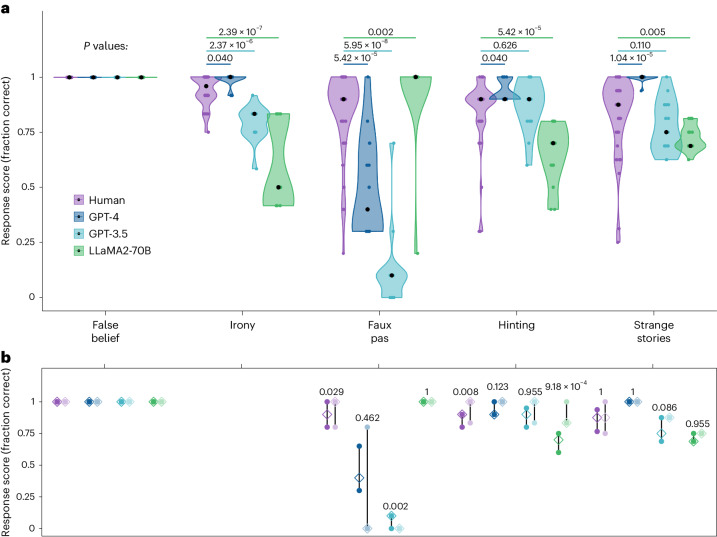
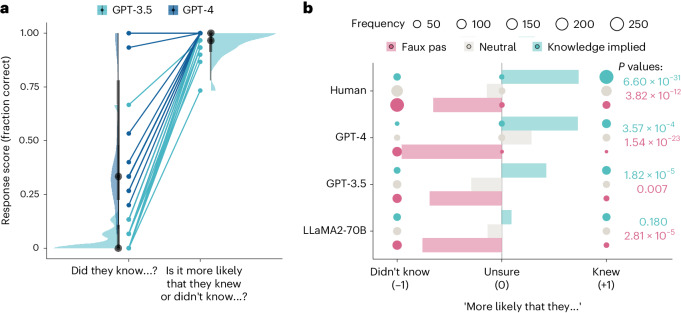
At the core of what defines us as humans is the concept of theory of mind: the ability to track other people’s mental states. The recent development of large language models (LLMs) such as ChatGPT has led to intense debate about the possibility that these models exhibit behaviour that is indistinguishable from human behaviour in theory of mind tasks. Here we compare human and LLM performance on a comprehensive battery of measurements that aim to measure different theory of mind abilities, from understanding false beliefs to interpreting indirect requests and recognizing irony and faux pas. We tested two families of LLMs (GPT and LLaMA2) repeatedly against these measures and compared their performance with those from a sample of 1,907 human participants. Across the battery of theory of mind tests, we found that GPT-4 models performed at, or even sometimes above, human levels at identifying indirect requests, false beliefs and misdirection, but struggled with detecting faux pas. Faux pas, however, was the only test where LLaMA2 outperformed humans. Follow-up manipulations of the belief likelihood revealed that the superiority of LLaMA2 was illusory, possibly reflecting a bias towards attributing ignorance. By contrast, the poor performance of GPT originated from a hyperconservative approach towards committing to conclusions rather than from a genuine failure of inference. These findings not only demonstrate that LLMs exhibit behaviour that is consistent with the outputs of mentalistic inference in humans but also highlight the importance of systematic testing to ensure a non-superficial comparison between human and artificial intelligences.
Overview
The claims and statistics of this paper haven’t been checked yet.
Free: it reads the open-access text and checks the first 5 claims that cite a source we can check. Create a free account to check every claim.
Integrity signals
Registry
Cites
Statistics
Figures
Verification
Claims the paper makes
The claims and statistics of this paper haven’t been checked yet.
Free: it reads the open-access text and checks the first 5 claims that cite a source we can check. Create a free account to check every claim.
Claims other papers make about this one
Each is checked against this paper’s own text: does it say what the citing paper says it does?
The source backs part of the claim, not all of it — or backs it for a different population, condition or comparison.
In the citing paper
“Recent studies have shown that Large Language Models (LLMs), including GPT-3 and GPT-4, can excel in tasks that seemingly require ToM (Kosinski, 2023; van Duijn et al., 2023; Strachan et al., 2024; Street et al., 2024)”
From Can "consciousness" be observed from large language model (LLM) internal states? Dissecting LLM representations obtained from Theory of Mind test with Integrated Information Theory and Span Representation analysis (2025) · cites this paper as Strachan et al., 2024
Experimental — accuracy not yet measuredThe source backs part of the claim, not all of it — or backs it for a different population, condition or comparison.
In the citing paper
“This is amplified by the ability of LLMs to infer as well—or better—than humans the beliefs and intentions of an interlocutor from text (26).”
From The benefits and dangers of anthropomorphic conversational agents (2025) · cites this paper as [26]
Experimental — accuracy not yet measuredThe source backs part of the claim, not all of it — or backs it for a different population, condition or comparison.
In the citing paper
“later models demonstrate an increasing ability to reliably infer unobservable mental states in others (Strachan et al., 2024;Holterman and Deemter, 2023;Moghaddam and Honey, 2023).”
From Machine Psychology (2023) · cites this paper as Strachan et al., 2024
Experimental — accuracy not yet measuredThe cited source says what the claim attributes to it.
In the citing paper
“Specifically, these subjects are adult native English speakers (aged 18-70) with no history of psychiatric conditions or dyslexia, as specified in Strachan et al. (2024).”
From Can "consciousness" be observed from large language model (LLM) internal states? Dissecting LLM representations obtained from Theory of Mind test with Integrated Information Theory and Span Representation analysis (2025) · cites this paper as Strachan et al., 2024
The cited source says what the claim attributes to it.
In the citing paper
“These models are increasingly achieving or surpassing human performance benchmarks in various domains, including medical diagnostic dialogue28, persuasive communication29, theory of mind30, making people feel heard31, responding to relationship issues32 and helping people reframe negative situations to reduce negative emotions33.”
From “It happened to be the perfect thing”: experiences of generative AI chatbots for mental health (2024) · cites this paper as [30]
4 more claims about this paper
Create a free account to see every claim other papers make about this one.
Self-check
Percentages, sums and reported differences re-computed from the paper’s own numbers.
The self-check needs the paper’s full text.
Citations
Cites
The Proceedings of the National Academy of Sciences
Richards, J. W. (1915) · Science · doi:10.1126/science.42.1074.161 · Cited by 13,983
Does the chimpanzee have a theory of mind?
Premack, D., & Woodruff, G. (1978) · Behavioral and Brain Sciences · doi:10.1017/s0140525x00076512 · Cited by 8,743 · cited 1×
“3), dozens of tasks have been developed to study it, including indirect measures of belief attribution using reaction times 4–6 and looking or searching behaviour 7–9 , tasks examining the ability to infer mental states from photographs of eyes 10 , and language-based tasks assessing false belief…”
BackgroundWimmer, H. (1983) · Cognition · doi:10.1016/0010-0277(83)90004-5 · Cited by 6,305
Baron‐Cohen, S., Wheelwright, S., Hill, J., Raste, Y., & Plumb, I. (2001) · Journal of Child Psychology and Psychiatry · doi:10.1111/1469-7610.00715 · Cited by 4,555 · cited 1×
“…indirect measures of belief attribution using reaction times 4–6 and looking or searching behaviour 7–9 , tasks examining the ability to infer mental states from photographs of eyes 10 , and language-based tasks assessing false belief understanding 11,12 and pragmatic language comprehension 13–16 .”
The principles of psychology, Vol I.
James, W. (1890) · doi:10.1037/10538-000 · Cited by 4,514
Happé, F. G. E. (1994) · Journal of Autism and Developmental Disorders · doi:10.1007/bf02172093 · Cited by 2,352 · cited 2×
“We selected a set of well-established theory of mind tests spanning different abilities: the hinting task 14 , the false belief task 11,33 , the recognition of faux pas 13 , and the strange stories 15,16 .”
BackgroundMethodThe Neural Basis of Mentalizing
Frith, C. D., & Frith, U. (2006) · Neuron · doi:10.1016/j.neuron.2006.05.001 · Cited by 1,855
Three-year-olds’ difficulty with false belief: The case for a conceptual deficit
Perner, J., Leekam, S. R., & Wimmer, H. (1987) · British Journal of Developmental Psychology · doi:10.1111/j.2044-835x.1987.tb01048.x · Cited by 1,550 · cited 1×
“…indirect measures of belief attribution using reaction times 4–6 and looking or searching behaviour 7–9 , tasks examining the ability to infer mental states from photographs of eyes 10 , and language-based tasks assessing false belief understanding 11,12 and pragmatic language comprehension 13–16 .”
BackgroundSparks of Artificial General Intelligence: Early experiments with GPT-4
Bubeck, S., Chandrasekaran, V., Eldan, R., Gehrke, J., Horvitz, E., Kamar, E., Lee, P., Lee, Y. T., Li, Y., Lundberg, S., et al. (2023) · arXiv · doi:10.48550/arxiv.2303.12712 · Cited by 1,526 · cited 3×
“One example is the false belief test, one of the most widely used tools so far for testing the performance of LLMs on social cognitive tasks 19,21–23, 25, 51 , 52 .”
BackgroundMethodToward a second-person neuroscience
Schilbach, L., Timmermans, B., Reddy, V., Costall, A., Bente, G., Schlicht, T., & Vogeley, K. (2013) · Behavioral and Brain Sciences · doi:10.1017/s0140525x12000660 · Cited by 1,510
Rahwan, I., Cebrian, M., Obradovich, N., Bongard, J., Bonnefon, J.-F., Breazeal, C., Crandall, J. W., Christakis, N. A., Couzin, I. D., Jackson, M. O., et al. (2019) · Nature · doi:10.1038/s41586-019-1138-y · Cited by 1,364 · cited 1×
“In the service of the broader multidisciplinary study of machine behaviour 28 , there have been recent calls for a ‘machine psychology’ 29 that have argued for using tools and paradigms from experimental psychology to systematically investigate the capacities and limits of LLMs 30 .”
Do humans have two systems to track beliefs and belief-like states
Apperly, I. A., & Butterfill, S. A. (2009) · Psychological Review · doi:10.1037/a0016923 · Cited by 1,261
Baron-Cohen, S., O'Riordan, M., Stone, V., Jones, R., & Plaisted, K. (1999) · Journal of Autism and Developmental Disorders · doi:10.1023/a:1023035012436 · Cited by 1,211 · cited 5×
“The faux pas test 13 presents a context in which one character makes an utterance that is unintentionally offensive to the listener because the speaker does not know or does not remember some key piece of information.”
BackgroundMethodInfluentialAction Anticipation Through Attribution of False Belief by 2-Year-Olds
Southgate, V., Senju, A., & Csibra, G. (2007) · Psychological Science · doi:10.1111/j.1467-9280.2007.01944.x · Cited by 1,066 · cited 3×
“…tasks have been developed to study it, including indirect measures of belief attribution using reaction times 4–6 and looking or searching behaviour 7–9 , tasks examining the ability to infer mental states from photographs of eyes 10 , and language-based tasks assessing false belief understanding…”
InfluentialThe Social Sense: Susceptibility to Others’ Beliefs in Human Infants and Adults
Kovács, Á. M., Téglás, E., & Endress, A. D. (2010) · Science · doi:10.1126/science.1190792 · Cited by 921 · cited 1×
“In partial support of this hypothesis, responses from both GPT models occasionally indicate that the speaker may not know or remember but present this as one hypothesis among alternatives (Supplementary Information section 5).”
Using second-person neuroscience to elucidate the mechanisms of social interaction
Redcay, E., & Schilbach, L. (2019) · Nature Reviews Neuroscience · doi:10.1038/s41583-019-0179-4 · Cited by 738 · cited 1×
“An important direction for future research will be to examine the impact of these non-human decision behaviours on second-person, https://doi.org/10.1038/s41562-024-01882-z real-time human–machine interactions 54,55 .”
InfluentialBeyond the Imitation Game: Quantifying and extrapolating the capabilities of language models
Srivastava, A., Rastogi, A., Rao, A., Shoeb, A. A. M., Abid, A., Fisch, A., Brown, A. R., Santoro, A., Gupta, A., Garriga-Alonso, A., et al. (2022) · arXiv · doi:10.48550/arxiv.2206.04615 · Cited by 569 · cited 2×
“Generative LLMs exhibit performance that is characteristic of sophisticated decision-making and reasoning abilities 19,20 including solving tasks widely used to test theory of mind in humans 21–24 .”
BackgroundUsing cognitive psychology to understand GPT-3
Binz, M., & Schulz, E. (2023) · Proceedings of the National Academy of Sciences · doi:10.1073/pnas.2218523120 · Cited by 559 · cited 2×
“In the service of the broader multidisciplinary study of machine behaviour 28 , there have been recent calls for a ‘machine psychology’ 29 that have argued for using tools and paradigms from experimental psychology to systematically investigate the capacities and limits of LLMs 30 .”
Theory of Mind: A Neural Prediction Problem
Koster-Hale, J., & Saxe, R. (2013) · Neuron · doi:10.1016/j.neuron.2013.08.020 · Cited by 513 · cited 1×
“…the ability to reason about mental states—in combination with information about context, past experience and knowledge of social norms—helps individual reduce uncertainty and commit to likely hypotheses, allowing for successful navigation of the social environment as active agents 44,45 .”
How is ChatGPT's behavior changing over time?
Chen, L., Zaharia, M., & Zou, J. (2023) · arXiv · doi:10.48550/arxiv.2307.09009 · Cited by 507 · cited 1×
“This finding is consistent with longitudinal evidence that GPT models have become more reluctant to answer opinion questions over time 39 .”
ResultHow Is ChatGPT’s Behavior Changing Over Time?
Chen, L., Zaharia, M., & Zou, J. (2024) · Harvard Data Science Review · doi:10.1162/99608f92.5317da47 · Cited by 507
Thinking is for doing: Portraits of social cognition from Daguerreotype to laserphoto.
Fiske, S. T. (1992) · Journal of Personality and Social Psychology · doi:10.1037//0022-3514.63.6.877 · Cited by 476 · cited 1×
“In humans, thinking is, first and last, for the sake of doing 41,42 .”
Emergent analogical reasoning in large language models
Webb, T., Holyoak, K. J., & Lu, H. (2023) · Nature Human Behaviour · doi:10.1038/s41562-023-01659-w · Cited by 404 · cited 1×
“A systematic experimental approach to studying theory of mind in LLMs involves using a diverse set of theory of mind measures, delivering multiple repetitions of each test, and having clearly defined benchmarks of human performance against which to compare 31 .”
Revisiting the Strange Stories: Revealing Mentalizing Impairments in Autism
White, S., Hill, E., Happé, F., & Frith, U. (2009) · Child Development · doi:10.1111/j.1467-8624.2009.01319.x · Cited by 393 · cited 4×
“…indirect measures of belief attribution using reaction times 4–6 and looking or searching behaviour 7–9 , tasks examining the ability to infer mental states from photographs of eyes 10 , and language-based tasks assessing false belief understanding 11,12 and pragmatic language comprehension 13–16 .”
InfluentialElapsed Decision Time Affects the Weighting of Prior Probability in a Perceptual Decision Task
Hanks, T. D., Mazurek, M. E., Kiani, R., Hopp, E., & Shadlen, M. N. (2011) · The Journal of Neuroscience · doi:10.1523/jneurosci.5613-10.2011 · Cited by 378 · cited 1×
“In this context, our findings imply a difference in how humans and GPT models trade off the costs associated with social uncertainty against the costs associated with prolonged deliberation 48 .”
ResultWhat is “theory of mind”? Concepts, cognitive processes and individual differences
Apperly, I. A. (2012) · Quarterly Journal of Experimental Psychology · doi:10.1080/17470218.2012.676055 · Cited by 368 · cited 1×
“Far from being a unitary construct, theory of mind refers to an interconnected set of notions that are combined to explain, predict, and justify the behaviour of others 2 .”
Evaluating Large Language Models in Theory of Mind Tasks
Kosinski, M. (2023) · arXiv · doi:10.48550/arxiv.2302.02083 · Cited by 339
Evaluating large language models in theory of mind tasks
Kosinski, M. (2024) · Proceedings of the National Academy of Sciences · doi:10.1073/pnas.2405460121 · Cited by 339
Resolving uncertainty in a social world
FeldmanHall, O., & Shenhav, A. (2019) · Nature Human Behaviour · doi:10.1038/s41562-019-0590-x · Cited by 274 · cited 2×
“However, it may also foster curiosity 40 .”
BackgroundFANToM: A Benchmark for Stress-testing Machine Theory of Mind in InteractionsPreprint
Kim, H., Sclar, M., Zhou, X., Bras, R. L., Kim, G., Choi, Y.-J., & Sap, M. (2023) · Conference on Empirical Methods in Natural Language Processing · doi:10.48550/arxiv.2310.15421 · Cited by 259 · cited 1×
“One example is the false belief test, one of the most widely used tools so far for testing the performance of LLMs on social cognitive tasks 19,21–23, 25, 51 , 52 .”
Is Belief Reasoning Automatic?
Apperly, I. A., Riggs, K. J., Simpson, A., Chiavarino, C., & Samson, D. (2006) · Psychological Science · doi:10.1111/j.1467-9280.2006.01791.x · Cited by 206 · cited 1×
“3), dozens of tasks have been developed to study it, including indirect measures of belief attribution using reaction times 4–6 and looking or searching behaviour 7–9 , tasks examining the ability to infer mental states from photographs of eyes 10 , and language-based tasks assessing false belief…”
Bernstein, D. M., Thornton, W. L., & Sommerville, J. A. (2011) · Experimental Aging Research · doi:10.1080/0361073x.2011.619466 · Cited by 168 · cited 2×
“We adapted four false/true belief scenarios from the sandbox task used by Bernstein 33 and generated three novel items, each with false and”
MethodPerformance vs. competence in human–machine comparisons
Firestone, C. (2020) · Proceedings of the National Academy of Sciences · doi:10.1073/pnas.1905334117 · Cited by 150 · cited 3×
“…approach taken in this study using a battery of multiple tests spanning theory of mind abilities, exposing language models to multiple sessions and variations in both structure and content, and implementing procedures to ensure a fair, non-superficial comparison between humans and machines 35 .”
InfluentialPragmatics in Action: Indirect Requests Engage Theory of Mind Areas and the Cortical Motor Network
van Ackeren, M. J., Casasanto, D., Bekkering, H., Hagoort, P., & Rueschemeyer, S.-A. (2012) · Journal of Cognitive Neuroscience · doi:10.1162/jocn_a_00274 · Cited by 144
Neural Theory-of-Mind? On the Limits of Social Intelligence in Large LMs
Sap, M., Le Bras, R., Fried, D., & Choi, Y. (2022) · Proceedings of the 2022 Conference on Empirical Methods in Natural Language Processing · doi:10.18653/v1/2022.emnlp-main.248 · Cited by 118
Adaptación al español de la prueba de teoría de la mente Hinting Task
Gil, D., Fernández-Modamio, M., Bengochea, R., & Arrieta, M. (2012) · Revista de Psiquiatría y Salud Mental · doi:10.1016/j.rpsm.2011.11.004 · Cited by 118
Neural Theory-of-Mind? On the Limits of Social Intelligence in Large LMs
Sap, M., LeBras, R., Fried, D., & Choi, Y. (2022) · arXiv · doi:10.48550/arxiv.2210.13312 · Cited by 118 · cited 2×
“One example is the false belief test, one of the most widely used tools so far for testing the performance of LLMs on social cognitive tasks 19,21–23, 25, 51 , 52 .”
Apperly, I. A., Warren, F., Andrews, B. J., Grant, J., & Todd, S. (2011) · Child Development · doi:10.1111/j.1467-8624.2011.01635.x · Cited by 97 · cited 1×
“3), dozens of tasks have been developed to study it, including indirect measures of belief attribution using reaction times 4–6 and looking or searching behaviour 7–9 , tasks examining the ability to infer mental states from photographs of eyes 10 , and language-based tasks assessing false belief…”
Processing of Written Irony in Autism Spectrum Disorder: An Eye‐Movement Study
Au‐Yeung, S. K., Kaakinen, J. K., Liversedge, S. P., & Benson, V. (2015) · Autism Research · doi:10.1002/aur.1490 · Cited by 94 · cited 2×
“Irony comprehension items were adapted from an eye-tracking study 34 in which participants read vignettes where a character made an ironic or non-ironic statement.”
MethodInfluentialLarge Language Models Fail on Trivial Alterations to Theory-of-Mind Tasks
Ullman, T. (2023) · arXiv · doi:10.48550/arxiv.2302.08399 · Cited by 81 · cited 5×
“However, the mixed success of these models 23 , along with their vulnerability to small perturbations to the provided prompts, including simple changes in characters’ perceptual access 25 , raises concerns about the robustness and interpretability of the observed successes.”
BackgroundMethodResultInfluentialGenerating meaning: active inference and the scope and limits of passive AI
Pezzulo, G., Parr, T., Cisek, P., Clark, A., & Friston, K. (2024) · Trends in Cognitive Sciences · doi:10.1016/j.tics.2023.10.002 · Cited by 80 · cited 1×
“GPT models and other LLMs do not operate within an environment and are not subject to the processing constraints that biological agents face to resolve competition between action choices, so may have limited advantages in narrowing the future prediction space 46,49,50 .”
A two-lab direct replication attempt of Southgate, Senju and Csibra (2007)
Kampis, D., Karman, P., Csibra, G., Southgate, V., & Hernik, M. (2021) · Royal Society Open Science · doi:10.1098/rsos.210190 · Cited by 78
LLMs differ from human cognition because they are not embodied
Chemero, A. P. (2023) · Nature Human Behaviour · doi:10.1038/s41562-023-01723-5 · Cited by 75 · cited 1×
“GPT models and other LLMs do not operate within an environment and are not subject to the processing constraints that biological agents face to resolve competition between action choices, so may have limited advantages in narrowing the future prediction space 46,49,50 .”
How Well Do Large Language Models Perform on Faux Pas Tests?
Shapira, N., Zwirn, G., & Goldberg, Y. (2023) · Findings of the Association for Computational Linguistics: ACL (Findings of ACL) · doi:10.18653/v1/2023.findings-acl.663 · Cited by 73 · cited 2×
“…the open-ended format of more complex tasks like hinting and strange stories makes this a convincing control for these tests, they are of limited strength for tasks like false belief and faux pas that use a regular internal structure that make heuristics or ‘Clever Hans’ solutions possible 27,36 .”
Two systems for thinking about others’ thoughts in the developing brain
Grosse Wiesmann, C., Friederici, A. D., Singer, T., & Steinbeis, N. (2020) · Proceedings of the National Academy of Sciences · doi:10.1073/pnas.1916725117 · Cited by 69 · cited 1×
“…test early, efficient but inflexible implicit processes as well as later-developing, flexible and demanding explicit abilities that are crucial for the generation and comprehension of complex behavioural interactions 17,18 involving phenomena such as misdirec-tion, irony, implicature and deception.”
BackgroundHagendorff, T., Dasgupta, I., Binz, M., Chan, S. C. Y., Lampinen, A., Wang, J. X., Akata, Z., & Schulz, E. (2023) · arXiv · doi:10.48550/arxiv.2303.13988 · Cited by 68
Inductive reasoning and the understanding of intention in schizophrenia
Corcoran, R. (2003) · Cognitive Neuropsychiatry · doi:10.1080/13546800244000319 · Cited by 67 · cited 5×
“We selected a set of well-established theory of mind tests spanning different abilities: the hinting task 14 , the false belief task 11,33 , the recognition of faux pas 13 , and the strange stories 15,16 .”
InfluentialMachine Thinking, Fast and Slow
Bonnefon, J., & Rahwan, I. (2020) · Trends in Cognitive Sciences · doi:10.1016/j.tics.2020.09.007 · Cited by 63 · cited 1×
“While LLMs are designed to emulate human-like responses, this does not mean that this analogy extends to the underlying cognition giving rise to those responses 47 .”
CHOICE WITHOUT PREFERENCE. A Study of the History and of the Logic of the Problem of “Buridan's Ass”
Rescher, N. (1960) · Kant-Studien · doi:10.1515/kant.1960.51.1-4.142 · Cited by 63 · cited 1×
“…hypothesis, is that models are capable of inferring mental states but cannot choose between them, as with the eponymous rational agent caught between two equally appetitive bales of hay that starves because it cannot resolve the paradox of making a decision in the absence of a clear preference 37 .”
Adaptation of the Hinting Task theory of the mind test to Spanish
Gil, D., Fernández-Modamio, M., Bengochea, R., & Arrieta, M. (2012) · Revista de Psiquiatría y Salud Mental (English Edition) · doi:10.1016/j.rpsmen.2011.11.002 · Cited by 49
Yiu, E., Kosoy, E., & Gopnik, A. (2024) · Perspectives on Psychological Science · doi:10.1177/17456916231201401 · Cited by 48
Clever Hans or Neural Theory of Mind? Stress Testing Social Reasoning in Large Language Models
Shapira, N., Levy, M., Alavi, S. H., Zhou, X., Choi, Y., Goldberg, Y., Sap, M., & Shwartz, V. (2024) · Proceedings of the 18th Conference of the European Chapter of the Association for Computational Linguistics (Volume 1: Long Papers) · doi:10.18653/v1/2024.eacl-long.138 · Cited by 44
Clever Hans or Neural Theory of Mind? Stress Testing Social Reasoning in Large Language Models
Shapira, N., Levy, M., Alavi, S. H., Zhou, X., Choi, Y., Goldberg, Y., Sap, M., & Shwartz, V. (2023) · arXiv (Cornell University) · doi:10.48550/arxiv.2305.14763 · Cited by 37 · cited 4×
“Supporting this interpretation, LLMs such as ChatGPT have been shown to be susceptible to minor alterations to the false belief formulation 25,27 , such as making the containers where the object is hidden transparent or asking about the belief of the character who moved the object rather than the…”
BackgroundMethodInfluentialFANToM: A Benchmark for Stress-testing Machine Theory of Mind in Interactions
Kim, H., Sclar, M., Zhou, X., Bras, R., Kim, G., Choi, Y., & Sap, M. (2023) · Proceedings of the 2023 Conference on Empirical Methods in Natural Language Processing · doi:10.18653/v1/2023.emnlp-main.890 · Cited by 27
Kovács, Á. M., Téglás, E., & Csibra, G. (2021) · Cognition · doi:10.1016/j.cognition.2021.104640 · Cited by 21 · cited 1×
“…have been developed to study it, including indirect measures of belief attribution using reaction times 4–6 and looking or searching behaviour 7–9 , tasks examining the ability to infer mental states from photographs of eyes 10 , and language-based tasks assessing false belief understanding…”
Openly accessible LLMs can help us to understand human cognition
Frank, M. C. (2023) · Nature Human Behaviour · doi:10.1038/s41562-023-01732-4 · Cited by 18 · cited 2×
“As artificial intelligence (AI) continues to evolve, it also becomes increasingly important to heed calls for open science and open access to these models 32 .”
Brunet-Gouet, É., Vidal, N., & Roux, P. (2023) · Zenodo (CERN European Organization for Nuclear Research) · doi:10.5281/zenodo.7637475 · Cited by 14
Brunet-Gouet, É., Vidal, N., & Roux, P. (2024) · Lecture notes in computer science · doi:10.1007/978-3-031-55245-8_7 · Cited by 13
When uncertainty in social contexts increases exploration and decreases obtained rewards.
Plate, R. C., Ham, H., & Jenkins, A. C. (2023) · Journal of Experimental Psychology General · doi:10.1037/xge0001410 · Cited by 11 · cited 1×
“Humans generally find uncertainty in social environments to be aversive and will incur additional costs to reduce it 43 .”
Yiu, E., Kosoy, E., & Alison Gopnik, C. (2023) · doi:10.31234/osf.io/kt9es · Cited by 10
Ze-nan, D. O. U. (2023) · OSF Preprints (OSF Preprints) · doi:10.31219/osf.io/8r3ma · Cited by 7
How FaR Are Large Language Models From Agents with Theory-of-Mind?
Zhou, P., Madaan, A., Potharaju, S. P., Gupta, A., McKee, K. R., Holtzman, A., Pujara, J., Ren, X., Mishra, S., Nematzadeh, A., et al. (2023) · arXiv · doi:10.48550/arxiv.2310.03051 · Cited by 6 · cited 2×
“The dissociation we describe between speculative reasoning and commitment mirrors recent evidence that, while GPT models demonstrate sophisticated and accurate performance in reasoning tasks about belief states, they struggle to translate this reasoning into strategic decisions and actions 46 .”
BackgroundResultOpenAI, Achiam, J., Adler, S., Agarwal, S., Ahmad, L., Akkaya, I., Aleman, F. L., Almeida, D., Altenschmidt, J., Altman, S., et al. (2023) · arXiv · doi:10.48550/arxiv.2303.08774 · cited 2×
“GPT models are powerful language generators, but they are also subject to inhibitory mitigation processes 38 .”
Background
Research works printed but not linked: 1
- Gandhi, K., Fränken, J.-P., Gerstenberg, T. & Goodman, N. D. Understanding social reasoning in language models with language models. In Advances in Neural Information Processing Systems Vol. 36 (MIT Press, 2023).
Cited by
Evaluating large language models in theory of mind tasks
Kosinski, M. (2024) · Proceedings of the National Academy of Sciences · doi:10.1073/pnas.2405460121 · Cited by 339
“58 and 59 ), others found that LLMs’ performance was inconsistent and brittle ( 26 , 60 , 61 ).”
BackgroundTorous, J., Linardon, J., Goldberg, S. B., Sun, S., Bell, I., Nicholas, J., Hassan, L., Hua, Y., Milton, A., & Firth, J. (2025) · World Psychiatry · doi:10.1002/wps.21299 · Cited by 323
“It happened to be the perfect thing”: experiences of generative AI chatbots for mental health
Siddals, S., Torous, J., & Coxon, A. (2024) · npj Mental Health Research · doi:10.1038/s44184-024-00097-4 · Cited by 241
“…or surpassing humanperformancebenchmarksin variousdomains,including medical diagnostic dialogue 28 , persuasive communication 29 , theory of mind 30 , making people feel heard 31 , responding to relationship issues 32 and helping people reframe negative situations to reduce negative emotions 33…”
(2024) · doi:10.21203/rs.3.rs-4612612/v1 · Cited by 241
Why human–AI relationships need socioaffective alignment
Kirk, H. R., Gabriel, I., Summerfield, C., Vidgen, B., & Hale, S. A. (2025) · Humanities and Social Sciences Communications · doi:10.1057/s41599-025-04532-5 · Cited by 131
Metadata
- Authors
- Strachan, J. W. A., Albergo, D., Borghini, G., Pansardi, O., Scaliti, E., Gupta, S., Saxena, K., Rufo, A., Panzeri, S., Manzi, G., Graziano, M. S. A., & Becchio, C.
- Affiliations
- University Medical Center Hamburg-Eppendorf (DE)
- University of Trento (IT)
- Italian Institute of Technology (IT)
- Universität Hamburg (DE)
- Princeton University (US)
- Corresponding author
- Strachan, James W. A.
- Becchio, Cristina
- ORCID
- Venue
- Nature Human Behaviour
- Published
- 2024-05-20
- Volume
- 8
- Issue
- 7
- Pages
- 1285-1295
- ISSN
- 2397-3374 (ISSN-L)
- PMC
- PMC11272575
- OpenAlex
- W4398143508
- Cited by
- 299
- References
- 58
- Citations by year
- 2026: 125 · 2025: 136 · 2024: 37
- FWCI
- 232.53
- Type
- journal article
- Language
- en
- Open access
- hybrid
- doi.org
- Licence
- cc-by
- creativecommons.org/licenses/by/4.0 (tdm)
- creativecommons.org/licenses/by/4.0 (vor)
- Locations
- Nature Human Behaviour (publishedVersion, cc-by)
- Research Square (acceptedVersion, cc-by)
- PubMed Central (publishedVersion, cc-by-nc)
- PubMed (publishedVersion)
- Institutional Research Information System University of Turin (University of Turin) (submittedVersion, cc-by-nc)
- HAL (submittedVersion)
- RePEc: Research Papers in Economics (submittedVersion)
- OSF Preprints (OSF Preprints) (submittedVersion)
- Funders
- Alexander von Humboldt-Stiftung
- European Commission (101071191)
- Universitätsklinikum Hamburg-Eppendorf
- Topics
- Social Sciences › Psychology › Developmental and Educational Psychology › Child and Animal Learning Development
- Social Sciences › Psychology › Social Psychology › Social Robot Interaction and HRI
- Social Sciences › Arts and Humanities › Philosophy › Philosophy and Theoretical Science
- Keywords
- theory of mind, large language models, false belief understanding, indirect requests, irony detection, faux pas, misdirection, GPT-4, Llama 2, human-AI comparison, belief attribution
- MeSH terms
- Adolescent, Adult, Female, Humans, Language, Male, Middle Aged, Models, Psychological, Young Adult, Theory of Mind
About these checks
Registry, retraction, Cites and statistics results are computed, not judged, with one exception: a printed reference that no index lists is read once by a model before it counts as a citation error. Claims are extracted by a model and kept only when their quote appears verbatim in the text; each cited source is then checked, with a model’s help, for whether it says what the claim relies on. Those verdicts can be wrong — read the claim’s quote and the cited source before relying on one.
Statistics and arithmetic are recomputed, not judged.
Confidence bands are shown only for fields calibrated on our annotated test set. None is calibrated yet, so no band is shown.
What counts as a claim ›How we measure confidence ›How we check this ›
Are you an author, or do you see a problem with this page? Request a review
Data sources
Bibliographic data: Semantic Scholar, OpenAlex, Crossref.
Contains information from the Semantic Scholar Academic Graph Datasets, made available under the ODC Attribution License (ODC-BY 1.0).
Semantic Scholar’s data is described in: Kinney, R., et al. (2023). The Semantic Scholar Open Data Platform. arXiv:2301.10140.
